Introduction
Progress in reducing the stigmatization of individuals with mental illnesses has been slower than that for some other stigmatized groups (Clement et al. Reference Clement, Lassman, Barley, Evans-Lacko, Williams, Yamaguchi and Thornicroft2013; Hatzenbuehler, Phelan, & Link, Reference Hatzenbuehler, Phelan and Link2013; USAID, 2006); and some studies report increasing stigmatization over time (Metha, Kassam, Leese, Butler, & Thornicroft, Reference Metha, Kassam, Leese, Butler and Thornicroft2009; Phelan, Link, Stueve, & Pescosolido, Reference Phelan, Link, Stueve and Pescosolido2000). Possible reasons include lack of agreement among community members about what constitutes a ‘mental disorder’, limited ability to effectively treat persons with mental illnesses, and absence of a unified operational definition of mental illness stigma. Assessing stigmatization of persons with mental illnesses is further complicated by the fact that stigma and discrimination often vary by nation, culture, and demographic group, and, importantly, are constantly changing over time in parallel with changing socio-cultural norms. These issues make it difficult to conduct reliable and valid assessments of the impact of anti-stigma efforts (Corrigan & Shapiro, Reference Corrigan and Shapiro2010). To move forward, we must develop operational definitions of the core components of stigma and discrimination and create reliable, culture-specific and community-specific instruments for assessing these constituent components of stigma (Corrigan & Shapiro, Reference Corrigan and Shapiro2010; Link, Yang, Phelan, & Collins, Reference Link, Yang, Phelan and Collins2004).
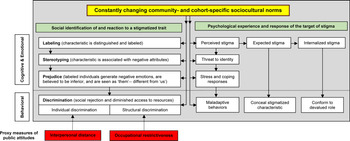
Our conceptualization of stigma, shown in Fig. 1, integrates sociological and psychological perspectives to model stigma as a social-cognitive-behavioral process that includes labeling, stereotyping, prejudice, and discrimination (Corrigan, Reference Corrigan2004). This process involves the use of social, cultural, economic, and political power to stigmatize those who are categorized as different (Link et al. Reference Link, Yang, Phelan and Collins2004; Link & Phelan, Reference Link and Phelan2001). The initial step in the process occurs when a certain characteristic of a group of individuals is distinguished and labeled. The characteristic is then associated with undesirable attributes that induce negative emotional reactions in others, and individuals with the characteristic are separated from those without the attribute (‘us’) and identified as ‘them’ (i.e. ‘not us’). These labelled individuals subsequently experience devalued social status and reduced life chances – discrimination (i.e. ‘enacted stigma’). Discrimination can be enacted by individuals (hereafter, ‘individual-based discrimination’) or by social institutions (hereafter, ‘structural discrimination’) (Pincus, Reference Pincus1996). Structural discrimination includes the policies of private and governmental institutions that restrict the opportunities of stigmatized groups, either intentionally or unintentionally (Corrigan et al. Reference Corrigan, Watson, Heyrman, Warpinski, Gracia, Slopen and Hall2005).
Model of social and personal evolution of trait-specific stigma and discrimination.

Attitudinal social distance scales (Link, Cullen, Frank, & Wozniak, Reference Link, Cullen, Frank and Wozniak1987; Link, Phelan, Bresnahan, Stueve, & Pescosolido, Reference Link, Phelan, Bresnahan, Stueve and Pescosolido1999), which assess respondents' willingness to engage in relationships of varying intimacy with persons with a target condition, are commonly used measures of stigma in the general population. Despite various formats and applications, quantifying one's willingness to interact with someone with a mental illness has proven a reliable, cross-culturally valid measure (Pescosolido, Medina, Martin, & Long, Reference Pescosolido, Medina, Martin and Long2013) that is associated with respondents' actual behavior towards individuals with mental illnesses (Jorm & Oh, Reference Jorm and Oh2009). Social distance measures assess ‘intention to discriminate’, that is, stigmatizing attitudes held by individuals about specific target groups that have not yet been enacted, so we consider such measures indicators of one type of individual-based discrimination.
Structural discrimination is more frequently discussed than measured, partly due to the difficulty of directly measuring this construct. One indirect method is to assess community members' opinions about the kinds of structural policies and procedures that should be implemented to socially restrict stigmatized groups. Angermeyer and colleagues (Angermeyer, Matschinger, Link, & Schomerus, Reference Angermeyer, Matschinger, Link and Schomerus2014) consider public attitudes about structural restrictions of stigmatized groups conceptually distinct from attitudes about individual-based discrimination; in their study, they assessed attitudes about structural discrimination by determining ‘attitudes toward allocating financial resources to the care of people with depression’. Another example is the Community Attitudes toward the Mentally Ill scale (Taylor & Dear, Reference Taylor and Dear1981) which includes one dimension that assesses respondents' attitudes about restricting the rights of persons with mental illnesses to marry, to hold public office, and to live in specific neighborhoods. Despite collecting individual-level data, these measures assess respondents' attitudes about what community institutions should do to allocate community resources to or restrict the freedom of individuals with the target conditions – that is, their support for or against structural discrimination. In the Chinese context where legislation and its enforcement of employment equality for workers with health issues are inadequate, prejudicial attitudes in the community can lead to direct discrimination by employers (Gao et al. Reference Gao, Phillips, Wang, Xu, Jia, Gao and Xu2005; Heather, Reference Heather2006). Thus, we consider measures of community members' attitudes about the appropriateness of different types of social restrictions of targeted groups proxy measures of structural discrimination.
In a multinational survey, about half of the patients with schizophrenia experienced discrimination in interpersonal relationships and about 30% experienced discrimination in job seeking and job keeping (Thornicroft, Brohan, Rose, Sartorius Leese, & INDIGO study group, Reference Thornicroft, Brohan, Rose, Sartorius and Leese2009). Interpersonal relationships and job opportunities are two essential components of well-being, especially for individuals with chronic health concerns. Thus, public attitudes about social distance and occupational restrictiveness could serve as community-specific barometers of the intensity of stigma and discrimination experienced by persons with stigmatized conditions.
This paper reports on the development of two such instruments to assess social distance and occupational restrictiveness of persons with mental health conditions in mainland China.
Methods
Measures
Based on the operationalized definition of stigma and discrimination depicted in Fig. 1, we decided to assess attitudes about one type of social distance (‘interpersonal distance’ – the willingness to establish personal relationships with persons who have target conditions) and one type of social restrictiveness (‘occupational restrictiveness’ – beliefs about the appropriateness of individuals with target conditions for specific occupational roles). Considering personal relationships and occupations that are relevant to mainland Chinese community members led to the development of two community-specific scales: an Interpersonal Distance Scale (IDS) and an Occupational Restrictiveness Scale (ORS). We used four index relationships of varying degrees of intimacy that are well-known by Chinese community members to assess interpersonal distance (spouse, friend, housemaid, and house renovator) and four index occupations with different types of responsibilities that are well-known by Chinese community members to assess occupational restrictiveness (accountant, primary school teacher, policeman, and bus driver). We are interested in stigma and discrimination of persons with mental illnesses, so we chose five specific characteristics of such individuals as ‘target’ conditions: prior psychiatric hospitalization (which in China is primarily a marker of psychotic illness), prior serious depression, prior alcohol abuse, prior drug abuse, and prior suicide attempt. The inclusion of a neutral comparator condition – an innovation not used in previous studies – makes it possible to partially control for individual variation in stigmatizing attitudes; we choose prior appendectomy as the ‘baseline’ health condition (because it is not stigmatized in China and has minimal functional restrictions after recovery) and then measured the degree to which each individual's reported interpersonal distance and occupational restrictiveness for other conditions were greater than their corresponding attitudes about persons with prior appendectomy. Finally, to compare the level of interpersonal distance and occupational restriction of persons with characteristics of mental health problems to that of persons with a chronic physical health condition and other stigmatized conditions in China we included current hypertension, prior imprisonment, homosexuality, and current HIV carrier as target conditions. This resulted in a total of 10 target conditions.
The 40 interpersonal distance questions in the IDS asked respondents the degree to which they would be willing to engage in each of the four specified types of relationships with individuals who had each of the 10 target conditions. Response choices were 1 = ‘very willing’, 2 = ‘willing’, 3 = ‘not so willing’, and 4 = ‘not willing’ (in Chinese these are clearly ranked distinct options). The 40 occupational restrictiveness questions in the ORS scale asked respondents how suitable individuals with the 10 conditions were for each of the four occupations. Response choices were 1 = ‘suitable’, 2 = ‘more or less suitable’, 3 = ‘not so suitable’, and 4 = ‘not suitable’ (in Chinese these are clearly ranked distinct options). These scales have previously been used in studies about attitudes about mental health-related conditions among Chinese university students (Wang et al. Reference Wang, Ai, Kuang, Chen, Gan, Zeng and Phillips2011). In the current study, the internal consistency (Cronbach's alphas) of scores for the four types of relationships for the 10 conditions in the IDS varied from 0.74 to 0.87, and the internal consistency of the scores for the four occupations for the 10 conditions in the ORS varied from 0.76 to 0.88.
Data source and study population
We use data from a comprehensive mental health knowledge and attitude survey (which included the IDS and ORS) conducted in Ningxia autonomous region, a province in northwestern China with a population of 6.5 million. The sampling and survey administration procedures have been described in previous publications by our research group (Chen, Wang, & Phillips, Reference Chen, Wang and Phillips2018; Chen, Wang, Phillips, Sun, & Cheng, Reference Chen, Wang, Phillips, Sun and Cheng2014; Cheng, Phillips, Zhang, & Wang, Reference Cheng, Phillips, Zhang and Wang2016). In brief, a probability proportionate to size method was used to identify a representative sample of 2425 non-institutionalized adult residents (⩾18 years old) from 20 primary sampling sites around the province who participated in face-to-face structured interviews in their homes conducted by trained interviewers. The survey took an average of 45 min to complete; the IDS and ORS component of the survey took about 15 min. All 2425 respondents completed the ORS and 2424 completed the IDS. The data were collected from 18 July to 26 October 2013. Every respondent provided written informed consent to participate in the survey. The study was approved by the Ethics Committees of the Shanghai Mental Health Center and the Ningxia Medical University.
Analysis
The main purpose of the current analysis is to compare respondents' attitudes about interpersonal distance and occupational restrictiveness for individuals with mental health conditions to their corresponding attitudes about individuals who have other conditions. There are various methods of analyzing the raw data from the two scales (consisting of 80 ordinal scores ranging from 1 to 4). ‘Method I’ dichotomizes the scores for each of the 40 items on the two scales: on the IDS, ‘very willing’ and ‘willing’ were classified as ‘willing’ while ‘not so willing’ and ‘not willing’ were classified as ‘unwilling’; on the ORS, ‘suitable’ and ‘more or less suitable’ were classified as ‘suitable’ while ‘not so suitable’ and ‘not suitable’ were classified as ‘unsuitable’. Dichotomizing the scores in this way makes it possible to compute easily interpretable percentages of respondents with specific attitudes.
For the IDS, we computed the proportions of respondents who were unwilling to engage in each of the four types of relationships with individuals with each of the 10 target conditions. For the ORS we computed the proportions of respondents who considered individuals with each of the 10 target conditions unsuitable for each of the four occupations. We also assessed three summary measures: (1) the average proportion of respondents unwilling to have relationships with individuals with each condition across the four types of relationships and the average proportion who consider occupations unsuitable for individuals with each condition across the four occupations; (2) the proportions unwilling to establish any of the four types of relationships with individuals with each condition and who consider all four occupations unsuitable for individuals with each condition; and (3) the proportions willing to have all four types of relationships with individuals with each condition and who consider all four occupations suitable for individuals with each condition. The computed proportions and summary measures for each target condition are then compared separately for the IDS and ORS. Finally, combined measures are computed for the five mental health-related conditions and for the three highly stigmatized non-mental health conditions.
Results for an alternative analytic method – Method II – are provided in the online Supplementary Tables and Figure. This method initially computes adjusted raw scores for each of the four relationships and four occupations for nine conditions (excluding prior appendectomy) by subtracting the original raw score for prior appendectomy (1–4) from the corresponding raw score for the target condition (1–4), resulting in adjusted raw scores with a theoretical range from −3 to +3 which is converted to a scale of −100 to +100. Higher scores represent greater unwillingness to establish the specific type of interpersonal relationship or greater unsuitability of the specific type of occupation for persons with the target condition (negative values, which occur rarely, indicate unwillingness or unsuitability for the target condition which is less than that for persons with prior appendectomy). The average of these scores for all respondents is then computed. This method provides easily computed summary indices of interpersonal distance and occupational restrictiveness for each condition that are adjusted for respondents' ‘baseline attitudes’ and that can be compared between different target conditions. The mean scores of the four interpersonal relationships in the IDS and the four occupations in the ORS for each of the nine target conditions were labelled the ‘Interpersonal Distance Index’ (IDI) and the ‘Occupational Restrictiveness Index’ (ORI) for the corresponding condition.
In all analyses, we used the Complex Sampling modules in SPSS version 20.0 and in R version 3.1.1 to determine probability weights that were used to adjust for differential sampling probabilities and non-response patterns and to apply post-stratification factors to bring the sample into balance with the Ningxia adult population in terms of sex, age, and urban-rural residency. Variance estimation and confidence intervals were adjusted using Taylor Series Linearization. All statistical testing was two-tailed with type I error set at 0.05.
Results
Characteristics of the sample
Among the 2425 respondents, 1347 (55.5%) were female, the mean (s.d.) age was 45.9 (15.3) years (missing data in two cases), and 1207 (49.8%) were living in urban areas. The age by gender by residence (urban v. rural) composition of the surveyed sample is comparable to that of the Ningxia population (National Bureau of Statistics of the People's Republic of China, 2010).
Attitudes about interpersonal distance and occupational restrictiveness of persons with different conditions
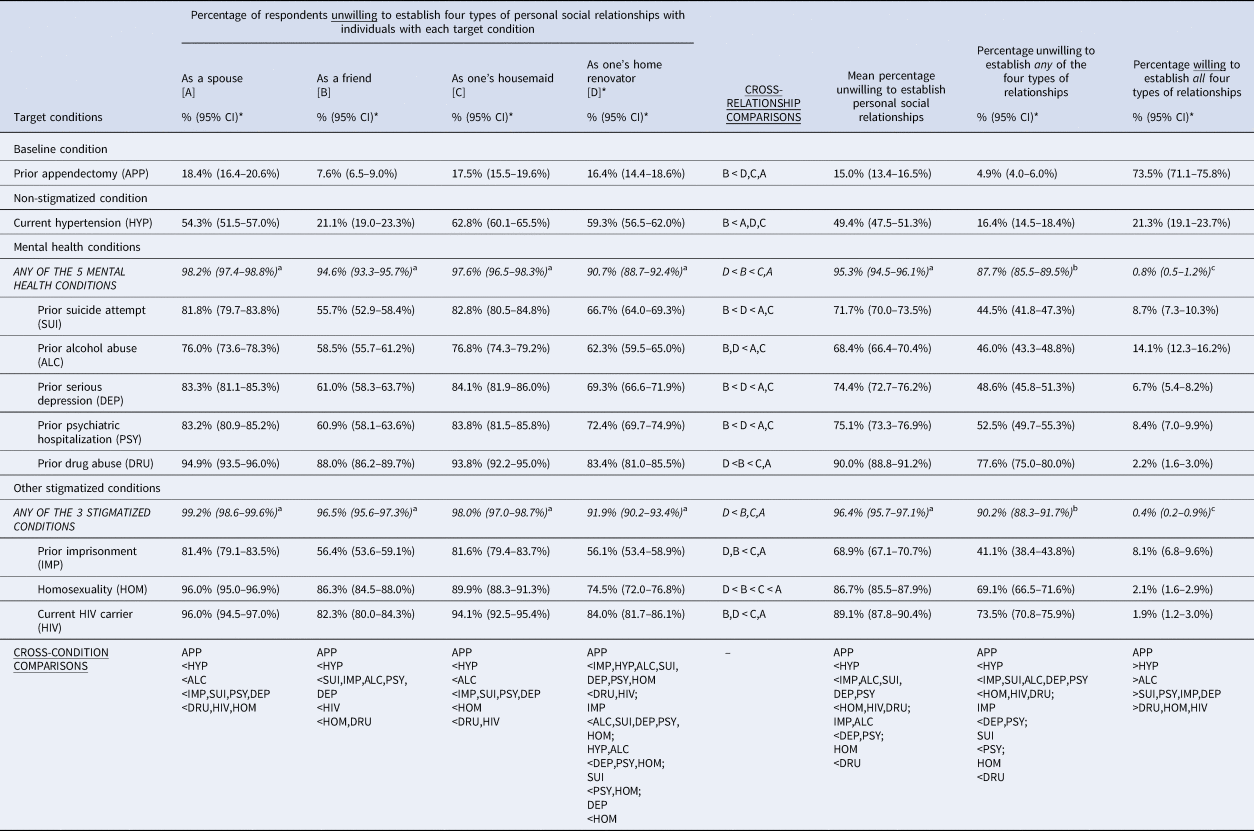
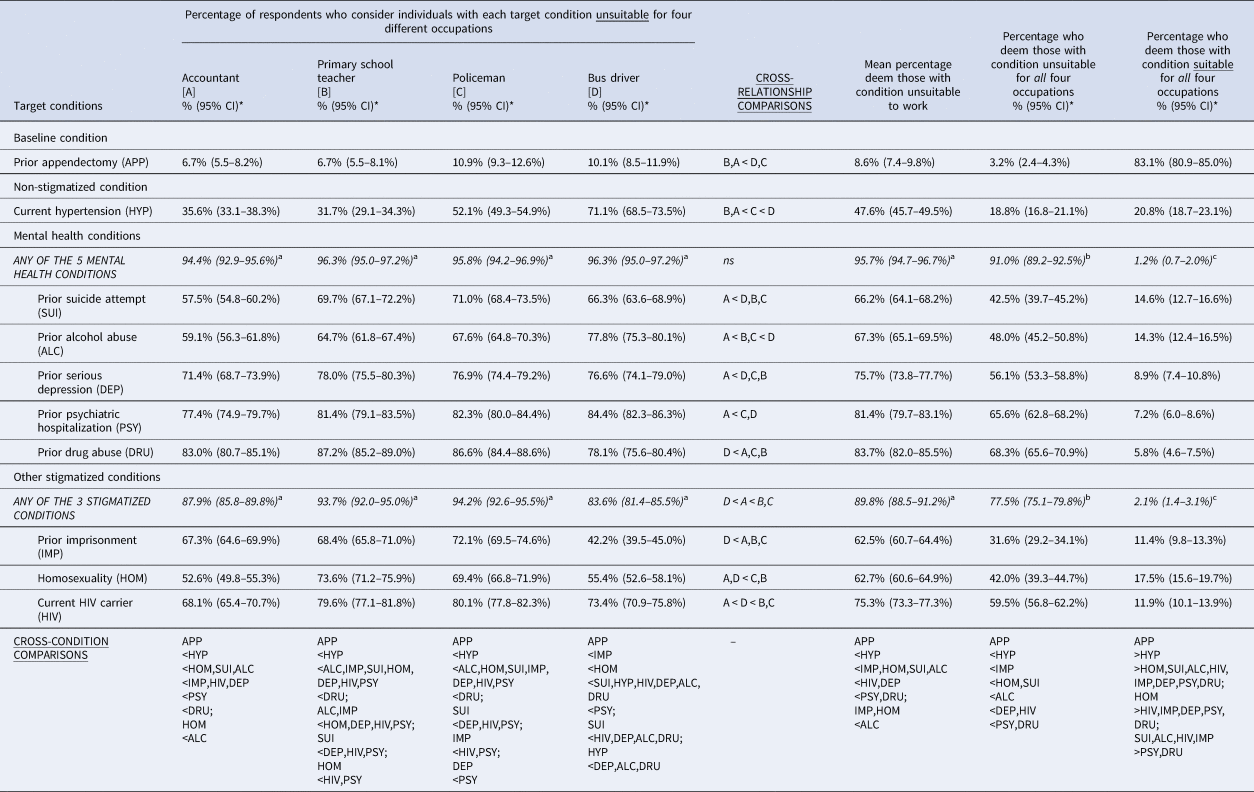
As shown in Tables 1 and 2, among the 10 conditions considered individuals with a prior appendectomy had the lowest levels of interpersonal distance for all four relationships assessed on the IDS and the lowest level of occupational restrictiveness for all four occupations assessed on the ORS. Individuals with current hypertension had the second-lowest level of interpersonal distance for three of the relationships assessed on the IDS and the second-lowest level of occupational restrictiveness for three of the occupations assessed on the ORS; the exceptions were for interpersonal distance with a ‘house renovator’ and for occupational restrictiveness of a ‘bus driver’, conditions for which current hypertension could reasonably be expected to be relevant. These results confirm the face validity of this method for assessing interpersonal distance and occupational restrictiveness.
Percentage of 2424 respondents who were ‘not so willing’ or ‘not willing’ (i.e., 'unwilling') to establish each of the four types of relationships with individuals who had each of the 10 target conditions assessed in the Interpersonal Distance Scale (IDS)

a Unwilling to establish the relationship with individuals who have one or more of the five mental health conditions or one or more of the three other stigmatized conditions.
b Unwilling to establish any of the four relationships with individuals who have any of the five mental health conditions or any of the three other stigmatized conditions.
c Willing to establish all four relationships with individuals who have any of the five mental health conditions or any of the three other stigmatized conditions.
* All percent values and confidence intervals are adjusted for the sampling design and post-stratified to the sampling frame (all of Ningxia).
Percentage of 2425 respondents who reported that each of the four occupations was ‘not so suitable’ or ‘not suitable’ (i.e., 'unsuitable') for individuals who had each of the 10 target conditions assessed in the Occupational Restrictiveness Scale (ORS)

a Consider individuals who have one or more of the five mental health conditions or one or more of the three other stigmatized conditions unsuitable for the occupation
b Consider individuals who have any of the five mental health conditions or any of the three other stigmatized conditions unsuitable for all four occupations
c Consider individuals who have any of the five mental health conditions or any of the three other stigmatized conditions suitable for all four occupations
* All percent values and confidence intervals are adjusted for the sampling design and post-stratified to the sampling frame (all of Ningxia).
The level of interpersonal distance and occupational restrictiveness of individuals with the remaining eight target conditions considered were dramatically greater than those for the baseline condition (prior appendectomy). Among these eight conditions, the interpersonal distance for all four relationships assessed on the IDS and for the three summary measures (which combine results across the four relationships) is greatest for individuals with prior drug abuse, individuals who are homosexual, and individuals who are current HIV carriers. Attitudes about which types of individuals are suitable to work at different jobs vary for the four occupations considered on the ORS, but for most of the occupations (and for the summary measures that combine results across all four occupations) respondents reported that the level of occupational restrictiveness should be greatest for individuals with prior psychiatric hospitalization and for individuals with prior drug abuse. The difference in the ranking of the conditions for the IDS and ORS support the contention that the two scales are assessing relatively independent components of stigma and discrimination.
As expected, there were also differences in the interpersonal distance for different relationships and in the occupational restrictiveness for different occupations. For all eight stigmatized target conditions considered on the IDS (i.e. excluding prior appendectomy and current hypertension), respondents were less willing to establish a relationship with the individual as a spouse or a housemaid and relatively more willing to establish a relationship with the individual as a friend or a house renovator. (Suggesting that in the Chinese environment the relationship with a housemaid – who usually lives in the home – is more intimate than that with a ‘friend’.) On the ORS, differences in the restrictiveness for the four occupations considered reflected common perceptions about the responsibilities of the four occupations; for example, occupational restrictiveness for bus drivers was greatest for persons with prior alcohol abuse and occupational restrictiveness for policemen and primary school teachers was greatest for individuals with prior imprisonment, individuals who are homosexual, and individuals who are current HIV carriers.
The three summary measures considered are shown in the last three columns of Tables 1 and 2. Combining these measures for all five types of mental health conditions considered on the IDS, 87.7% of respondents were unwilling to establish one or more of the four types of interpersonal relationships with individuals who had previously experienced one or more of the five mental health conditions considered, and only 0.8% were willing to establish all four types of interpersonal relationships with individuals who had experienced any of the five mental health conditions. Similarly, on the ORS, 91.0% of respondents considered persons who had previously experienced one or more of the five mental health conditions unsuitable for one or more of the four occupations and only 1.2% of respondents considered individuals who had experienced any of the five mental health conditions suitable for all four occupations.
The results using Method II (mean scores adjusted for baseline attitude about persons with prior appendectomy) are presented in online Supplementary Tables S1 and S2. The rank of the adjusted means scores of the nine conditions (excluding appendectomy) for each of the four types of interpersonal relationships are quite similar to the ranks of the corresponding percentage scores generated using Method I (shown in Table 1), and the rank of the mean scores of the nine conditions for each of the four types of occupations are identical to the rank of the corresponding percentage scores shown in Table 2. Moreover, the rank of the Interpersonal Distance Index and the Occupational Restrictiveness Index for the nine conditions were also similar to the ranks of the first and second summary measures of the percentage scores. However, there were several differences in the pattern of statistically significant relationships between the nine target conditions when using the two methods; generally speaking, despite using a more sensitive 4-point scale in Method II (v. the dichotomous measure used in Method I), after adjusting for the baseline condition (appendectomy) there were fewer statistically significant differences between the nine conditions in Model II than in Model I.
Correlation between the summary measures for the IDS and the ORS for the 10 target conditions
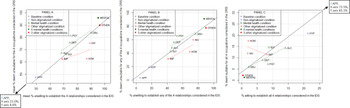
The correlation of the three summary measures computed using Method I for each of the 10 target conditions in the IDS with the corresponding summary measures in the ORS are shown in Panels A, B, and C of Fig. 2 (n = 2424). As assessed by the two scales, the level of stigma and discrimination for mental health conditions and for other stigmatized conditions are clearly much greater than that reported for the baseline condition (prior appendectomy) and for the non-stigmatized health condition (current hypertension). The results for the first two summary measures (shown in Panels A and B) are quite similar: occupational restrictiveness is relatively greater than interpersonal distance for the five mental health conditions but the reverse is true for the three other stigmatizing conditions. This result provides further support to our supposition that interpersonal distance and occupational restrictiveness are distinct constructs.
Correlations of the three summary measures for 2424 respondents to the Interpersonal Distance Scale (IDS) and for 2425 respondents to the Occupational Restrictiveness Scale (ORS) for 10 target conditions among community-based respondents in Ningxia, China.
Panel A: correlation of the mean percentage of respondents who deem individuals with each of the 10 conditions unsuitable for the four occupations in ORS v. mean percentage unwilling to establish the four relationships in IDS with these individuals.
Panel B: correlation of the percentage of respondents who deem individuals with each of the 10 conditions unsuitable for any of the four occupations in ORS v. percentage unwilling to establish any of the four relationships in IDS with these individuals.
Panel C: correlation of percentage of respondents who consider individuals with each target condition suitable for all four occupations in ORS v. % willing to establish all four relationships with these individuals in IDS.
The solid black lines and the dashed lines are the regression lines for all 10 conditions, for the five mental health conditions and for the three other stigmatized conditions, respectively.
ALC, prior alcohol abuse; HIV, current HIV carrier; APP, prior appendectomy; DEP, prior serious depression; HOM, homosexuality; HYP, current hypertension; DRU, prior drug abuse; IMP, prior imprisonment; PSY, prior psychiatric hospitalization; OTHER, summary of three other stigmatized conditions; SUI, prior suicide attempt; MENTAL, summary of five mental health conditions.

Attitudes about individuals with a history of prior illicit drug abuse – which has the highest level of interpersonal distance and occupational restrictiveness of the eight stigmatizing conditions – appear to be closer to those about HIV and homosexuality than to those for the other four mental health conditions. Somewhat surprisingly, among the eight stigmatizing conditions, prior imprisonment has the lowest level of both interpersonal distance and occupational restrictiveness. The summary measures for mental health conditions and other stigmatizing conditions show that respondents heavily stigmatize individuals who have any of the eight conditions.
Panel C of Fig. 2 focuses on the level of acceptance of individuals who have these conditions, that is, the proportion of respondents willing to have all four types of interpersonal relationships with individuals with the conditions and who consider all four occupations suitable for individuals with the conditions. Similar to the results shown in Panels A and B, the acceptance of individuals with the baseline and non-stigmatized control conditions was much greater than that for individuals with the eight stigmatized conditions, but in this case, the acceptance of individuals with the control condition (current hypertension) was much lower than that for individuals with the baseline condition (prior appendectomy). Similar to Panels A and B, prior drug abuse segregates with current HIV carrier and homosexuality – not with other mental illnesses – and has the lowest level of interpersonal and occupational acceptance. Other than this, the correlation of interpersonal and occupational acceptance appears to be condition-specific without any clear grouping of mental health or other stigmatizing conditions. The summary measures for the five mental health and three other stigmatizing conditions again show that global interpersonal and occupational acceptance of individuals with these conditions is extremely uncommon.
Results for a parallel analysis correlating the interpersonal distance index (IDI) for each of the nine conditions generated using Method II (n = 2424) to that of the corresponding occupational restrictiveness index (ORI) are shown in online Supplementary Fig. S1. The results for the nine conditions are similar to those shown in Panels A and B of Fig. 2. However, unlike in Fig. 2, in online Supplementary Fig. S1 the combined values for the IDI and ORI of the five mental health condition indices and the combined values for the IDI and ORI for the three other stigmatizing condition indices are simply the average value for the indices for the conditions considered, so they reflect ‘average’ attitudes about individuals with mental health (or other stigmatizing) conditions; these average values are quite different from the attitudes about individuals who have one or more of the five mental health conditions or one or more of the three other stigmatizing conditions (the two combined summary measures shown in Panels A and B of Fig. 2).
Discussion
Main findings
This study generated a wealth of detailed information about two aspects of stigma: interpersonal distance and occupational restrictiveness. As expected, administration of the new scales developed for the study in a large representative sample of community residents in Ningxia found that mental health conditions are heavily stigmatized. Over 87% of respondents were unwilling to establish one or more of the four interpersonal relationships assessed by the IDS with individuals who had had prior mental health conditions and 91% considered these individuals unsuitable for one or more of the four occupations assessed by the ORS. Conversely, less than 1% of respondents were willing to have all four types of interpersonal relationships with persons who had had prior mental health conditions and less than 2% considered these individuals suitable for all four occupations. The five mental health conditions considered were associated with substantially different levels of interpersonal distance and occupational restrictiveness and one of the mental health conditions – prior drug abuse – clustered more closely with non-mental health stigmatizing conditions (i.e. being homosexual or a current HIV carrier) than with the other mental health conditions.
Limitations
All attitudinal scales are susceptible to social desirability bias (Link et al. Reference Link, Yang, Phelan and Collins2004), so this may have affected our results. However, in China the public perception of mental illness is typically limited to severe psychosis and reducing mental illness stigma is only rarely a target of health promotion campaigns, so we expect that the effect of social desirability on our results is relatively small. Labeling the mental health conditions as ‘prior’ without referring to their treatment status may have altered the results to some extent (Yang, Graciete, WonPat-Borja, Singla, & Link, Reference Yang, Graciete, WonPat-Borja, Singla and Link2012). More importantly, the relationship between the behavioral intentions assessed in such scales and actual discriminating behaviors is far from perfect, primarily because there are always competing attitudes and situational circumstances that modulate the translation of such attitudes into specific behaviors (Link et al. Reference Link, Yang, Phelan and Collins2004). Multi-method studies could help address this issue by comparing identified attitudes with ratings of media reports or government policies related to persons with mental health conditions. Finally, this is a cross-sectional study so further studies demonstrating the sensitivity of these scales to changes over time will be needed before they can be employed to assess the effectiveness of anti-stigma campaigns.
Conclusions and implications
There is a growing global consensus that combatting stigma should be a central component of promoting the mental health of nations. Small-scale studies that aim to reduce stigma by focusing on highlighting the treatability of mental health conditions (McGinty, Goldman, Pescosolido, & Barry, Reference McGinty, Goldman, Pescosolido and Barry2015) and promoting social contact (Dalky, Reference Dalky2011; Pettigrew & Tropp, Reference Pettigrew and Tropp2006) have shown some benefit. However, systematic reviews of efforts to reduce mental illness stigma, largely based on studies from high-income countries (Gronholm, Henderson, Deb, & Thornicroft, Reference Gronholm, Henderson, Deb and Thornicroft2017; Hanisch et al. Reference Hanisch, Twomey, Szeto, Birner, Nowak and Sabariego2016), report limited effectiveness and identify substantial conceptual and methodological problems. Very few studies report on (and, more importantly, evaluate) programs aimed at reducing mental illness stigma in low- and middle-income countries (Stuart, Reference Stuart2016; Thornicroft et al. Reference Thornicroft, Mehta, Clement, Evans-Lacko, Doherty and Henderson2016). We contend failure to establish a methodology for developing culture-specific and community-specific measures of the stigma associated with mental health-related conditions is one of the main barriers to addressing this important issue. This paper describes our relatively simple method for developing context-specific and condition-specific scales which assess two aspects of stigma – interpersonal distance and occupational discrimination. These new scales, which take a total of 15 min to complete, were capable of distinguishing different levels of stigma associated with mental health conditions and other types of stigmatizing conditions. The target conditions, types of interpersonal relationships and occupations considered by the scales can be easily altered to adapt the scales for specific contexts and cohorts of interest. In cultures where other aspects of daily life are central to well-being (e.g. religious activities) a similar methodology could be used to develop scales that would assess the degree to which stigmatization affects these activities in individuals with stigmatized conditions.
Major differences in the interpersonal distance and occupational restrictiveness for the five types of mental health-related conditions considered indicate that community members do not conceptualize these conditions as component parts of a singular ‘mental illness’ construct. Indeed, there is no consensus among community members about what constitutes a mental illness. In China, for example, psychoses are usually considered mental illnesses, depression and suicide are considered responses to social stress that are only occasionally related to mental illness, alcohol abuse is an often normalized behavior (in men) that is not considered a mental illness, and illicit drug use is considered a criminal activity that has nothing to do with mental illness. We expect that similar variations in the conceptualization of mental illness-related conditions occur in other countries, particularly low- and middle-income countries where the categories of abnormal behaviors considered the purview of religious, ideological, legal, and medical institutions are in flux and may vary greatly between urban and rural residents, between different demographic cohorts, and over time. In the absence of a consensus about what constitutes ‘mental illness’, it is better to identify stigmatizing attitudes about specific mental health-related conditions rather than artificially combining them into overall measures of ‘mental illness stigma’.
Like many countries, China has recognized the importance of reducing stigma both in its 2013 national mental health law (Chen et al. Reference Chen, Phillips, Cheng, Chen, Chen, Fralick and Bueber2012) and in its 2015–2020 national mental health plan (Xiong & Phillips, Reference Xiong and Phillips2016), but neither of these documents provides any guidance about how to achieve this goal. Using the scales developed in this study can only provide part of the solution. Effectively utilizing the detailed information about attitudes generated by the two scales to develop community-based educational interventions requires additional ongoing research to help clarify the mechanisms via which changing attitudes can change behaviors towards persons with mental health conditions. Importantly, anti-stigma programs based on the findings of such attitudinal surveys can have unintended negative consequences, so they need to be extensively pilot-tested before they are widely promulgated.
Supplementary material
The supplementary material for this article can be found at https://doi.org/10.1017/S0033291720001439.
Acknowledgements
The authors thank students in the School of Public Health at Ningxia Medical University and staff members of the Ningxia Center for Disease Control and Prevention for their assistance in the conduct of the study. This research was supported by the China Medical Board (project number: 11-063).
Conflict of interest
The authors declare no potential conflicts of interest with respect to the research, authorship, and publication of this article.
Ethical standards
The study was approved by the institutional review boards of the Shanghai Mental Health Center and the Ningxia Medical University.