INTRODUCTION
Species of the genus Etmopterus Rafinesque, 1810 are widely distributed in temperate and tropical waters. They have benthopelagic habits and are confined to the bathyal habitat at depths between 200 and 2000 m (Compagno, Reference Compagno1984; Musick et al., Reference Musick, Harbin, Compagno, Carrier, Musick and Heithaus2004). They are frequently caught as bycatch fauna in commercial fisheries in New Zealand, Australia, western Mediterranean Sea and southern Portugal (Last & Stevens, Reference Last and Stevens1994; Gennari & Scacco, Reference Gennari and Scacco2007; Coelho & Erzini, Reference Coelho and Erzini2008). In Brazil, the occurrence of four species of Etmopterus has been confirmed: E. bigelowi Shirai & Tachikawa, Reference Shirai and Tachikawa1993, E. gracilispinis Krefft, Reference Krefft1968, E. granulosus Günther, 1880, and E. lucifer Jordan & Snyder, 1902 (Sadowsky et al., Reference Sadowsky, Arfelli and Amorim1986; Soto, Reference Soto2000, Reference Soto2001).
The occurrence of E. bigelowi was registered at depths ranging from 163–1000 m (Shirai & Tachikawa, Reference Shirai and Tachikawa1993). However, in Brazil E. bigelowi occurred on the continental slope off the State of Santa Catarina at a depth of 180 m (Soto, Reference Soto2000) and at depths ranging from 637–785 m on the continental slope off the State of Espírito Santo (Séret & Andreata, Reference Séret and Andreata1992; Soto, Reference Soto2000). The E. pusillus specimens described by Krefft (Reference Krefft1968) and denominated E. bigelowi by Soto (Reference Soto2000) were caught at depths of 600 m on the continental slope off Brazil and at 500 m in Uruguayan waters.
The data published on Etmopterus species of the State of Rio Grande do Sul contain information on morphology, identification and places of occurrence (Krefft, Reference Krefft1968; Sadowsky et al., Reference Sadowsky, Arfelli and Amorim1986; Soto, Reference Soto2000; Gianeti & Vooren, Reference Gianeti and Vooren2008). According to Soto (Reference Soto2000) and Shirai & Tachikawa (Reference Shirai and Tachikawa1993), the occurrence of E. pusillus cited by Krefft (Reference Krefft1968) for southern Brazil actually refers to E. bigelowi.
Due to intensification of fishing efforts on the outer continental shelf and continental slope off southern Brazil (Haimovici, Reference Haimovici1997) the study of the ecology of the species of the genus Etmopterus in this region is a very important issue. From this premise, the aim of the present study was to describe the composition of populations of Etmopterus species as well as their distribution in the hydrographic area of southern Brazil.
MATERIALS AND METHODS
Specimens of the genus Etmopterus were collected on two fishery survey cruises: the first survey from 9 August to 10 September 2001; and the second survey from 24 March to 24 April 2002. The study area comprised the outer continental shelf and upper continental slope off Rio Grande do Sul State between Chuí (34°20′S) and the Santa Marta Grande Cape (28°30S′) at depths ranging from 100–600 m. The cruises were carried out with the RV ‘Atlântico Sul’ using bottom trawling.
A total of 58 fishing tows were performed throughout the first survey and 55 throughout the second one. The duration of the tow at each fishing station was 30 minutes. Catches occurred at five depth layers: 100–199 m (with 22 tows in the first survey and 21 tows in the second one); 200–299 m (with 12 tows in the first and 10 in the second survey); 300–399, 400–499 and 500–599 m (with 8 tows for each survey) (Figure 1). Vertical temperature and salinity profiles were recorded on each tow. The population density index of the species at the fishing stations was the catch per unit of effort, expressed in number of individuals caught per 30 minutes' towing.
Occurrence of Etmopterus bigelowi and Etmopterus gracilispinis on the August–September cruise in 2001 (a) and March–April cruise in 2002 (b).

The total length (TL), total weight (TW) and the sex of each Etmopterus specimen were registered. The TL–TW regressions were fitted and the frequency of occurrence (FO%) for the specimens calculated. The specimens were grouped in 5 cm TL-classes.
For female specimens, additional measurements such as width and weight of the left oviducal gland, maximum width of the left uterus, number of vitellogenic ovarian follicles and ovarian weight were determined. Moreover, the diameter and colour of the largest ovarian follicle as well as the presence and absence of embryos in the uteri were recorded, being females with embryos classified as pregnant. By its turn, testes weight and the clasper length (from its insertion to its tip) of male species were determined. The clasper was either classified as flexible or rigid. Furthermore, the presence of clasper spurs and the coiling of sperm duct were recorded.
The statistical analysis employed to test the sex-ratio was the Chi-square test (χ 2) and to compare the TL mean values between genders the Student's t-test (StatSoft, 1998).
RESULTS
The bottom temperature in the study area varied from 5–18°C. Low temperatures with values between 5 and 10°C and averages between 6 and 9°C were predominant at depths between 400 and 599 m to the south of 31°S in both surveys. The corresponding salinities were 34.2–35, with averages of 34.4–34.7.
A total of 152 specimens of the genus Etmopterus were collected and classified as E. bigelowi, E. gracilispinis and E. lucifer.
Population structure and reproduction of E. bigelowi
Etmopterus bigelowi occurred in low density areas in both surveys. The frequency of occurrence (FO%) varied from 50–75% and the catches ranged from 1–40 specimens with averages of 1–20 specimens per tow time. In the first survey, E. bigelowi occurred at latitudes of 31°23′S–34°31′S and at depths of 515–536 m. During the second survey, the species occurred at latitudes of 33°36′S–34°31′S and depths of 440–538 m (Figure 1). The local bottom temperatures and salinities varied from 5.3–7.8°C and from 34.2–35, respectively.
Seventeen males and 22 females were caught in the first survey and 26 males and 23 females were caught in the second one. The sex-ratio did not deviate significantly from 1:1 (first survey: χ 2 = 0.64; P = 0.423; second survey: χ 2 = 0.18; P = 0.668), showing no evidence of sex segregation. The TL ranged from 17.4–60 cm for males and from 18.1–67 cm for females, with no statistically significant difference in the mean values between genders (t = 1.54, P = 0.128). Small individuals in TL-classes 15–19 and 25–29 cm were absent in the first survey, but made up to 26.5% of the second survey sample. The equation TW = 0.0022TL3.14 (r = 0.98) describes the relationship between TW (g) and TL (cm) for grouped genders in our surveys.
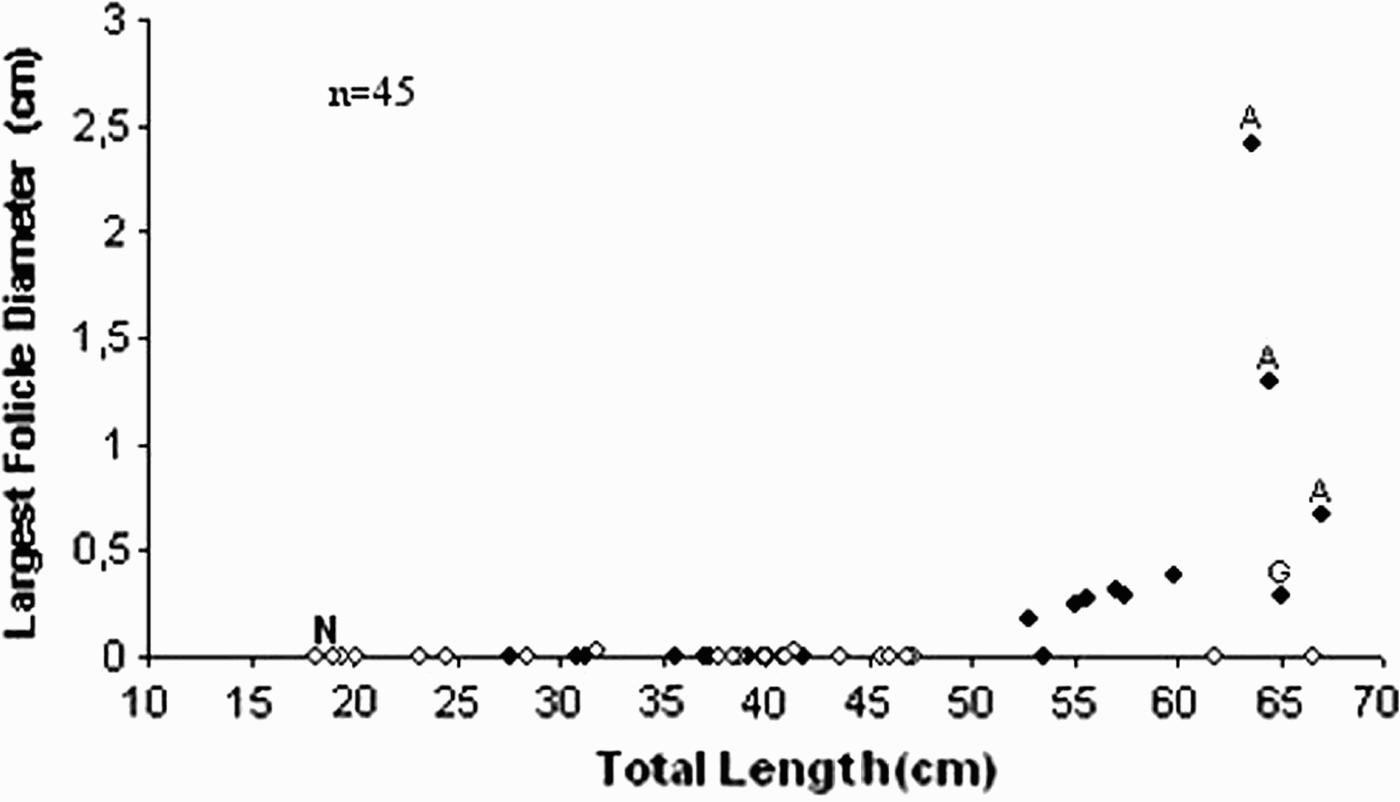
There were no macroscopically visible ovarian follicles in females with TL ranging from 18.1–47 cm (Figure 2). Nine females with 52.8–66.6 cm TL had transparent and colourless ovarian follicles in both ovaries, with diameters ranging from 0.1–0.4 cm (Figure 2). In all these females, the uterus was empty, transparent and had a diameter of about 0.1 cm. The oviducal gland (with an oval shape and 0.5 cm width) was only visible in females with a TL of 66.6 cm.
Relationship between total length (TL) and diameter of the largest ovarian follicle in Etmopterus bigelowi females. Closed circles, Cruise (#1) 2001; open circles, Cruise (#2) 2002; N, newborns; A, vitellogenic follicles (yellow); G, pregnant female.

Three females caught during the first survey, with TL ranging from 63.7–67 cm, had vitellogenic ovarian follicles in both ovaries with diameters ranging from 0.7–2.4 cm (Figure 2). In addition, the uterus was white, opaque and 0.5–0.9 cm in size. The oviducal gland was white, oval and 0.4–0.9 cm in width. Eleven vitellogenic follicles, ranging in diameter from 2.3–2.4 cm, occurred in both ovaries of a 63.7 cm TL female. These follicles weighed 7 g and the gonad weight was 150 g. The ovaries occupied about 3/4 of the abdominal cavity and were in maturation process. This specimen, classified as adult, was the smallest female found with vitellogenic follicles. Moreover, a 65.1 cm TL pregnant female was also classified as adult.
On the other hand, during the second survey, a 65.1 cm TL female with non-vitellogenic ovarian follicles (0.3 cm in diameter) was pregnant with nine embryos in the initial phase of development in each uterus. The mean TL of the embryos was 2.2 cm, with a yolk sack diameter of 3.0 cm and weight of 15 g.
Regarding the E. bigelowi female species collected in southern Brazil, it was observed that the gonadal maturity starts with a TL of around 63.0 cm and that individual variation in size at first gonadal maturity ranged from 52.0 cm–67.0 cm TL. Moreover, nine females ranging from 52–66.6 cm in TL presented immature ovaries, undeveloped uteri and lack of vitellogenic follicles.
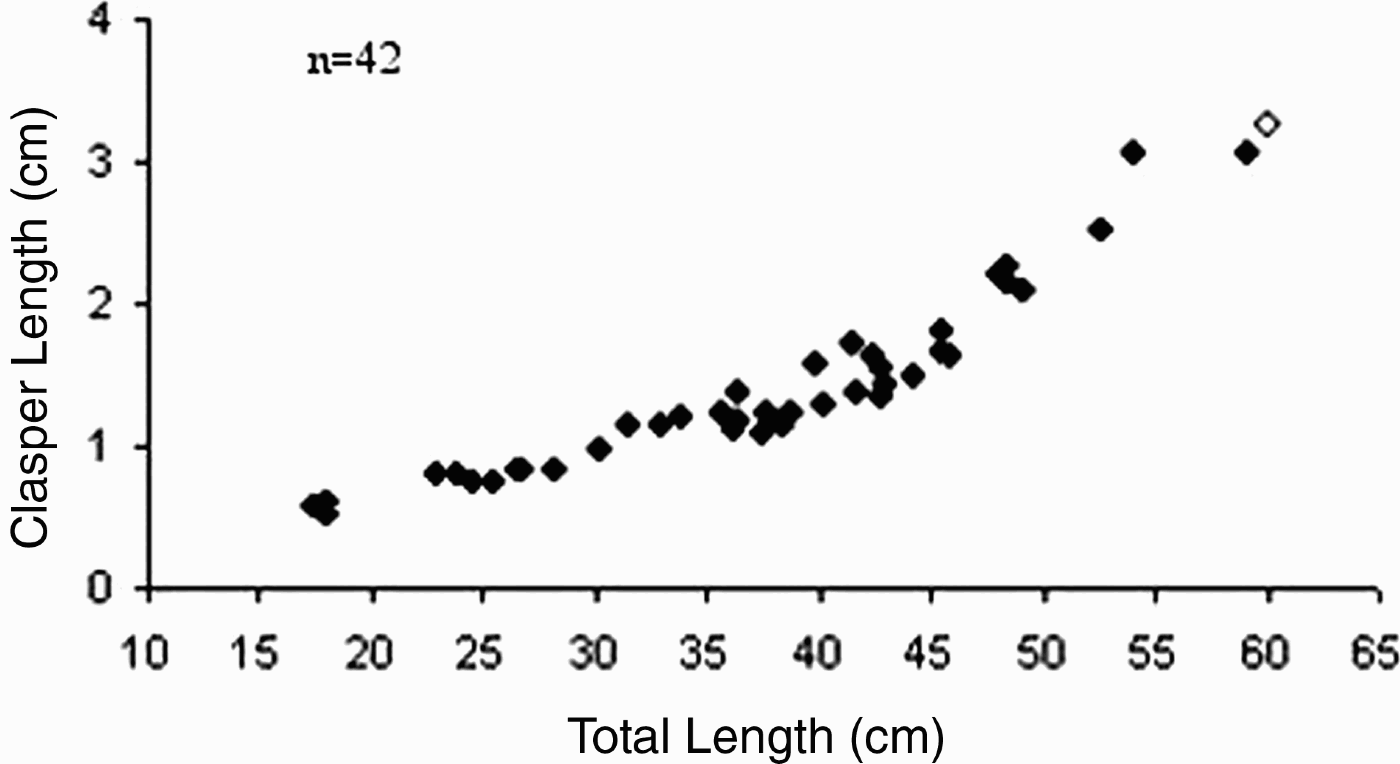
In males, the claspers varying from 0.6–3.0 cm were flexible in specimens up to 59.0 cm TL. One 60.0 cm TL male caught in the second survey had rigid claspers (3.3 cm) with spurs (Figure 3). Moreover, the sperm duct of this specimen was sharp and well developed. This male was classified as adult and had gonad mass of 5.0 g, respectively. For other males, the gonad mass ranged from 0.1–4.0 g. The male gonad mass exhibited a sharp increase at 55.0 cm TL onward, with no difference between surveys. Two 54.0 and 59.1 cm TL males had partially calcified 3.0 cm claspers with spurs. Thus, the size at first gonadal maturity for E. biglelowi males in southern Brazil occurs around 60.0 cm TL.
Relationship between total length (TL) and clasper length in Etmopterus bigelowi males. Closed circles—immature male and flexible claspers; open circles—mature male and calcified claspers with spurs.

Four specimens caught in the second survey with TL ranging from 17.4–18.1 cm and weighing between 0.5 and 0.2 g had the scar from the umbilical cord and still had internal yolk sacs (Figure 2). These specimens were classified as newborns. Thus, the length at birth could vary from 17–18 cm TL for E. bigelowi in southern Brazil.
Distribution and biometrics of E. gracilispinis
Etmopterus gracilispinis occurred from 32°3′S–34°31′S during the first and second surveys, whereas the depths varied from 345–536 m during the first survey and from 350–536 m during the second one (Figure 1). The frequency of occurrence ranged from 20–75% and the catches ranged from 1–14 individuals, with averages of 1–9 individuals per tow time. Although the species is common at depths ranging from 300–599 m on the continental slope at latitudes to the south of 31°S, they occurred in low density areas during both cruises. Etmopterus gracilispinis occurred at bottom temperatures ranging from 5.0–10.3°C and salinities ranging from 34.2–35.0. The species occurred in 29% of the 41 fishing stations within this temperature range.
Nine males and eight females were caught in the first survey, whereas 35 males and 10 females were caught in the second one. The male to female proportion did not deviate significantly from 1:1 in the first survey (χ 2 = 0.059; P = 0.81). However, a significant difference in the male to female ratio (1:0.29) was observed in the second survey (χ 2 = 13.89; P = 0.00). Seven out of eight catches with more than one individual included both genders. Taking into account the total sample, TL ranged from 13.0–22.9 cm for males and from 13.5–22.3 cm for females. No statistically significant difference in the mean values between genders (t = 1.22; P = 0.23) was observed in this work. Furthermore, seasonal variation could not be attested. The equation TW = 0.0013TL3.37 (r = 0.94) describes the correlation between TW (g) and TL (cm) for both genders and cruises.
For female specimens, an increase in the gonad mass from 0.006 g at 13.5 cm TL to 0.08 g at 22.3 cm TL was observed. The largest females caught were 22.3 cm TL and the largest and transparent follicle diameter was 0.1 cm. Furthermore, the oviducal glands were not visible. On the other hand, the male gonad mass ranged from 0.01–0.05 g and the clasper length ranged from 0.39–0.75 cm. A single 21 cm TL specimen caught in the second survey had partially calcified 0.75 cm claspers with spurs and undeveloped sperm ducts.
All male and female specimens caught were immature. Two specimens caught in March (TL of 12.5 and 13.2) had umbilical cord scars and internal yolk sacs. As these specimens were classified as newborns, the TL of E. gacilispinis at birth could be 12–13 cm in southern Brazil.
Etmopterus lucifer
Two specimens of E. Lucifer were caught—one in each survey. In the first survey (August 2001), the specimen was caught in the station at 34°16.94′S–51°37.17′W (536 m depth) with a bottom temperature of 5.8°C and salinity of 34.2. The individual was a 38.4 cm TL and 112.7 g TW male with calcified 2.5 cm long claspers. Moreover, the gonads were well developed and each one weighed 1.7 g. The sperm duct was well-defined and coiled. In the second survey (March 2002), another specimen was caught in the station located at 33°36.4′S–50°43.6′W (about 538 m) with a bottom temperature of 6.3°C and salinity of 34.4. This specimen was a 36.9 cm TL and 143.7 g TW male with 2.22 cm long flexible claspers with spurs. Apparently maturing, the gonads weighed 0.73 g each and the sperm duct was beginning to coil.
DISCUSSION
The occurrence of E. bigelowi, E. gracilispinis and E. lucifer was confirmed in the studied region. Although E. bigelowi was captured in the depth-range already registered on the Brazilian coast, this study enlarged the depth-ranges for Etmopterus gracilispinis presented by Krefft (Reference Krefft1968), which varied from 410–600 m and by Sadowsky et al. (Reference Sadowsky, Arfelli and Amorim1986). There is no occurrence record of E. gracilispinis at further northern latitudes along the Brazilian coast. All records are restricted to the continental slope off the State of Rio Grande do Sul.
The occurrence range of E. lucifer specimens in Brazilian waters was also widened to depths shallower than 600 m. The only previous occurrence record of E. lucifer was also for the State of Rio Grande do Sul (Krefft, Reference Krefft1968) at depths ranging from 600–800 m. The occurrence of an adult male E. lucifer with 38.4 cm of TL is consistent with the size at first maturity of around 38.0 cm, described by Krefft (Reference Krefft1968).
There is evidence that the northern limit of the distribution of E. bigelowi and E. gracilispinis in the studied area is the latitude 31°S and that these species occur in cold, deep waters with no seasonal variation in temperature and salinity. It has already been stated that, in deep waters on the outer continental shelf and upper slope, the environment and hydrographic conditions such as temperature and salinity have the characteristic of remaining stable throughout the year (Carrassón et al., Reference Carrassón, Stefanescu and Cartes1992; Demestre et al., Reference Demestre, Sánchez and Abelló2000; Wetherbee, Reference Wetherbee2000). The stability and homogeneity of deep waters can be related to the composition of fish species (Roel, Reference Roel1987).
The water mass in which the species occurred was characterized as South Atlantic Central Water (SACW) based on temperature and salinity data (Evans & Signorini, Reference Evans and Signorini1985; Gordon & Greengrove, Reference Gordon and Greengrove1986). However, as the sampling was carried out in just two seasons of the year, no conclusions can be drawn regarding the influence of temperature and salinity on the distribution of species, despite the fact that no seasonal variation was observed.
The influence of latitude on the distribution of elasmobranchs is higher for species on the continental slope at deeper depths than for species on the continental shelf (Roel, Reference Roel1987). The distribution patterns by latitude, with an influence on the schooling of diverse cartilaginous fish, were also described by Compagno et al. (Reference Compagno, Ebert and Cowley1991) in deep waters off southern Africa in which E. pusillus, Etmopterus cf. granulosus, Etmopterus compagnoi and Etmopterus cf. brachyurus occurred. For instance, it has been reported that for E. granulosus there is a geographical and temporal variation in the abundance of this species in waters off New Zealand (Wetherbee, Reference Wetherbee2000).
Deep water sharks customarily live on the sea floor (Forster et al., Reference Forster, Badocock, Longbottom, Merrett and Thomson1970; Coelho et al., Reference Coelho, Bentes, Gonçalves, Lino, Ribeiro and Erzini2003) as recorded by Pakhorukov (Reference Pakhorukov1999) for the species Etmopterus baxteri Garrick, 1957 in waters of the Sierra Leone Rise in the south-eastern Atlantic. In addition, E. baxteri has been associated to the sea bottom with some specimens swimming a maximum distance of 1.5 m from the ocean floor. Demestre et al. (Reference Demestre, Sánchez and Abelló2000) describes the occurrence of Etmopterus spinax Linnaeus, 1758 on clay and muddy bottoms and suggests that the type of bottom and depth are the key characteristics for the distribution of the species. Thus, the type of sediment to which these sharks are associated with may be another factor influencing the distribution of Etmopterus species in southern Brazil.
The composition of the sediment of the outer continental shelf and upper slope, where the Etmopterus specimens in the present study were caught, is basically clay and silt (Corrêa, Reference Corrêa1987). Therefore, the occurrence of Etmopterus species on the continental slope off southern Brazil with clay–silty sediment may explain the absence of these sharks at latitudes to the north of 31°S, where the sediment is more sandy at depths greater than 200 m (Corrêa, Reference Corrêa1987; Figueiredo Jr & Tessler, Reference Figueiredo Jr and Tessler2004; Figueiredo Jr & Madureira, Reference Figueiredo Jr and Madureira2004).
The majority of E. bigelowi and E. gracilispinis specimens caught were considered immature. This suggests that there is a spatial segregation by age-group in which adults inhabit deeper waters than juveniles. It is likely that adults occur in depths greater than 600 m. The occurrence of a pregnant adult E. bigelowi female in the depth-range in which juveniles are predominant, indicates that adult females migrate to shallower areas to give birth. No segregation by gender was observed for the two species. Spatial segregation by size and gender is common for other species of Squaliformes. Shirai & Tachikawa (Reference Shirai and Tachikawa1993) reported that smaller E. bigelowi specimens were caught in relatively shallow waters when compared to larger specimens. Segregation by gender and size also occurs in E. granulosus with most mature female individuals found at depths ranging from 800–1200 m (Wetherbee, Reference Wetherbee1996). Likewise, an increase in length for both genders of Centroscyllium fabricii Reinhadt, 1825 has been described with an increase in depth; juveniles occupy shallower waters ranging from 500–799 m, whereas adults occupy depths ranging from 800–1299 m (Yano, Reference Yano1995). For other species such as Centroscymnus coelolepis Barbosa du Bocage & Brito Capello, 1864 and Centroscymnus owstoni Garman, 1906, it is reported that females are distributed in deeper waters than males and adult specimens migrate to shallower waters only during the reproduction period (Yano & Tanaka, Reference Yano and Tanaka1984, Reference Yano and Tanaka1988). Segregation by age and gender were also reported for the species Etmopterus princeps Collet, 1904, Centrophorus squamosus, C. coelolepis and E. spinax (Jakobsdottir, Reference Jakobsdottir2001; Girard, Reference Girard2001; Massutí & Moranta, Reference Massutí and Moranta2003).
Most Squaliformes exhibit sexual dimorphism with growth, in which adult females are larger than adult males (Yano & Tanaka, Reference Yano and Tanaka1983; Coelho & Erzini, Reference Coelho and Erzini2005). Despite the fact that the E. bigelowi females caught have greater TL than the males, no difference in the TL/TW ratio between genders was observed. This is due to the fact that most of the specimens caught were juveniles and that sexual dimorphism in size is only evident in individuals that have reached gonadal maturity (Springer & Burgess, Reference Springer and Burgess1985).
For E. bigelowi, the TL at gonadal maturity was greater than the one reported by Shirai & Tachikawa (Reference Shirai and Tachikawa1993) because both genders and females matured with a greater TL (63.7 cm) than males (60.0 cm). Ovulation occurred with an ovarian follicle diameter of approximately 3.0 cm, as this was the diameter of the yolk sac in the embryos in the beginning of development in the pregnant female.
The pregnant E. bigelowi female generated about 18 embryos and there was no type of capsule or embryonic membrane separating the embryos in the uteri. This is due to the small oviducal glands that have no function of producing such capsules. Similarly, no type of capsule, embryonic membrane or uterine compartments has been observed in Centroscyllium fabricii in any stage of embryonic development (Yano, Reference Yano1995).
All E. gracilispinis specimens collected in this work were classified as immature in agreement with the findings described by Krefft (Reference Krefft1968) and Compagno (Reference Compagno1984), who reported that the size at first maturity is 26.0 cm for males and 33.0 cm for females.
The occurrence of E. bigelowi and E. gracilispinis newborns in the second survey (March) is evidence of birth in this period for the two species. The hypothesis of birth for E. bigelowi is supported by the catches of smaller juvenile specimens (17–25 cm TL) only in the second survey. For E. bigelowi there was also an adult female with mature follicles and a pregnant female in the early stage of pregnancy in the first survey (August). However, as the sampling was performed in just two periods of the year and most of the specimens caught were immature, it is not possible to confirm seasonality in the reproduction of E. bigelowi and E. gracilispinis.
No seasonal variation of the reproduction could be observed in the present work. However, the absence of seasonality in reproduction would be consistent with the data of other Squaliformes, in which this characteristic is common. No seasonality has been observed in the reproduction of C. fabricii (Yano, Reference Yano1995), C. owstoni, C. coelolepis (Yano & Tanaka, Reference Yano and Tanaka1988), E. granulosus (Wetherbee, Reference Wetherbee1996), Etmopterus princeps (Jakobsdottir, Reference Jakobsdottir2001), C. squamosus, C. coelolepis (Girard, Reference Girard2001) and for E. pusillus (Coelho & Erzini, Reference Coelho and Erzini2007). As the lack of seasonality in the reproduction cycle has been reported for diverse species of Squaliformes, this characteristic must be due to the constancy of the environment in which they live (Wetherbee, Reference Wetherbee1996).
There are no previous data on TL at birth for E. bigelowi, which was approximately 17 cm in the present study. For E. gracilispinis, a TL at birth of approximately 13 cm is in agreement with the results described by Krefft (Reference Krefft1968), who found a newborn female with 13 cm TL. The presence of a remaining internal yolk sac in newborns proves that the two species reproduce through aplacentary viviparity.
ACKNOWLEDGEMENTS
We acknowledge the researchers of the ‘Score sul REVIZEE Program’ who contributed to the fishery surveys and the RV ‘Atlântico Sul’ crew.