1. Introduction
The GATT and the WTO between them have existed for over seven decades. During those years, the multilateral trading system has evolved with varying degrees of effectiveness in response to testing times and changing circumstances. But today the GATT/WTO faces bigger challenges than at any time in its history. The situation is judged sufficiently serious for some of the commentariat to be talking of last rites for the WTO. This is surely premature, and discounts the well-known survival capacity of intergovernmental institutions. The challenge today is to ensure the GATT/WTO multilateral trading system undertakes the necessary reforms and adjustments in order to restore its centrality in global trade governance.
The core assumption motivating this paper is that multilateralism is intrinsically desirable as a force for economic and sociopolitical harmony and progress. Multilateralism offers the best prospects for coherence and inclusion in international trade relations. However, this does not always have to mean universal participation. The entire community of nations do not need to always work in tandem in all areas of trade-related rule-making under the auspices of the WTO, as long as all interests are appropriately protected.
Twenty-three parties were original signatories to GATT and 164 members now belong to the WTO. The membership is far more contrasted today in terms of preferences and priorities than was the case at the outset in the late 1940s, and for a couple of decades thereafter. A more numerous and diverse membership poses greater challenges in forging agreement. One way of looking at this is to consider where a line can be drawn between convergence and managed co-existence in striking an appropriate balance between rights and obligations among members of the WTO. Absent the capacity of members to identify and work with that balance, negotiating stasis becomes the norm – a state of affairs that most observers consider has drifted ever closer to reality.
Traditionally, WTO members have aimed for convergence when it comes to the rules on trade, even though uniformity is achieved over time as poorer countries reach the relevant development thresholds. Agreement is not always straightforward as to when the appropriate time arrives for full convergence and this is taken up below. Matters are less clear where governments set the conditions governing foreign access to their markets. No presumption of convergence exists as there is no agreed standard of openness, only an assumption that, circumstances permitting, the more openness there is the better. No two WTO members have identical market access profiles. Again, views differ as to when the circumstances facing any given member are appropriate for greater market opening.
Setting aside cross-border market access issues, one of the themes taken up below is whether the traditional approach to convergence in the area of trade rules is realistic given the heterogeneity of the membership. If the answer to that question is that convergence will not always be feasible, the next question that inevitably arises is whether the current approach to the most-favoured-nation (MFN) principle of non-discrimination is sustainable.Footnote 1
In addition to managing existing regulatory and market access aspects of its remit, the WTO faces a continuing imperative to keep up with evolving economic, social, political, and technological realities. Adjustments may call for re-framing or tightening existing agreements, or venturing into new regulatory fields. All these tasks require negotiations, and part of today's crisis is that the WTO's capacity to negotiate is minimal when compared with the past.
In what follows, the paper will briefly consider the evolution of the multilateral trading system leading up to the present crisis. The alarmingly wide range of issues that have every appearance of bringing the WTO to its knees will be examined in varying degrees of detail. The 12th Ministerial Conference (MC12), that was due to be held in Geneva from 30 November to 3 December 2021 had to be cancelled at the last minute as a result of travel restrictions in response to the new Omicron strain of the COVID-19 virus. Had the meeting taken place, we would have had a better idea of how prepared members are to reverse the WTO's decline. Some pessimists assert that the Omicron variant saved the institution and its members from embarrassment. Perhaps that assessment is too harsh, but we are likely to have a better sense of that in the months to come.
2. The Evolution of the Post-1948 Trading System
Trade rules under GATT used to be mostly about exchanges of merchandise across borders. Nobody spoke of international trade in services. Concern with domestic regulation or so-called behind-the-border policy was focused mostly on protecting the integrity of tariff commitments on goods. Investment was regarded as an alternative form of market access. Today, investment and trade are considered more as complements than substitutes in accessing markets. An explosion of vertically integrated production has seen to that. The virtual economy comprised little more than telephones and telegrams. The greening of economies was not on the trade agenda.
Some drivers of change are more disruptive and potentially divisive than others. Between 1948 and 1994 the GATT held eight rounds of multilateral trade negotiations, all of which included elements of trade liberalization through tariff reductions. Each of these negotiating rounds involved a growing number of countries, although liberalization outcomes were selective and varied among the participants. Regulatory matters received greater attention from the 1970s onwards, along with the broadening of policy areas to be covered by the GATT. Opening markets to more foreign competition, however, continued to be a central objective.
The first textual reviews of the original GATT took place in 1954–1955 when it became apparent that the International Trade Organization would not enter into force. A number of regulatory changes extended, amended, and clarified GATT provisions. The Kennedy Round (1964–1967) saw the first foray into stand-alone non-tariff measure agreements with an agreement on anti-dumping. In the following decade, the Tokyo Round (1973–1979) concluded six non-tariff measure (NTM) agreementsFootnote 2 and redefined the notion of special and differential treatment for developing countries.Footnote 3 A notable feature of these stand-alone agreements – commonly referred to as ‘codes’ – was that developing countries had the option of not signing them, although they would still enjoy their benefits on a non-discriminatory basis.Footnote 4
The Uruguay Round was launched in the 1980s and ended in the 1990s, with transformational consequences for the multilateral trading system. It established the WTO, which absorbed the GATT, extended rules to new areas, including trade in services and intellectual property rights, and redesigned the dispute settlement system. Certain aspects of the Tokyo Round codes were renegotiated and most notably they were no longer optional for developing countries. They had to be adopted as part of the Uruguay Round ‘single undertaking’. The codes did, however, contain special provisions for developing countries.
Irrespective of the misgivings among some regarding aspects of the Uruguay Round outcome, the overall package was without doubt an impressive achievement. It stands in stark contrast to the failed efforts of the WTO to advance agendas in the twenty-first century. As we shall see in due course, some may argue that an inactive WTO in the 2000s was in part a result of the Uruguay Round outcome. In 2001, the Doha Round was launched, and the accession of China to the WTO was a major feature at the launch. The story of an activist WTO has been downhill since then, with limited results to show. By 2015, the Doha Round had failed, although some WTO members continue, somewhat unconvincingly, to challenge this contention.
3. The WTO in the Doldrums: Who Wants to Reform What?
The only successful negotiations in the last 20 years include an agreement on trade facilitation in 2013, the elimination of agricultural export subsidies in 2015, and an expansion of a 1996 agreement among a subset of WTO members on the reduction of barriers to trade in information technology products. Most recently, in December 2021, following the COVID-induced postponement of the 12th WTO Ministerial Meeting, 67 members reached an agreement to strengthen and streamline rules and procedures on domestic regulations in services. While these successes are not trivial, they are modest in terms of the aspirations of a failed Doha Round and, more importantly, in view of the significant challenges currently facing the trading system.
In considering the discontinuity between the WTO's limited progress and the GATT's achievements, it is worth recalling the basic functions of the multilateral trading system. These may be characterized as: (i) negotiating market opening and trade rules; (ii) monitoring and assisting in the administration of the rules; (iii) settling disputes; (iv) ensuring transparency in trade policy; and (v) fostering deliberation amongst its members.
The WTO cannot be fully effective as an arbiter of international trade relations unless all these functions operate in tandem.
The lack of a properly functioning dispute settlement system weakens any desire to negotiate new obligations. The reverse also applies. Absent effective dispute settlement and negotiations, monitoring becomes less meaningful, and the observance of notification obligations falls away. As for deliberation, in these circumstances members tend to talk at, rather than with, one another. The blame game supplants a search for mutual gain. Some commentators have rightly pointed out that the daily workings of the WTO via committee processes have continued to function and serve a useful purpose.Footnote 5 If the other core functions of the system are obstructed, even these well-established processes will eventually feel the strain.
In light of this dispiriting view of where the WTO trading system finds itself today, it comes as no surprise that calls for ‘WTO reform’ punctuate any commentary or speech about trade and the WTO. Such entreaties vary in content and emphasis, depending on national and regional priorities. Perhaps the most generic observation is that the WTO has lost its negotiating capacity. This is often coupled with the lament that the WTO has simply failed to keep up with the forces of change shaping international trade relations today, as well as the way businesses operate. It is badly in need of modernization.Footnote 6
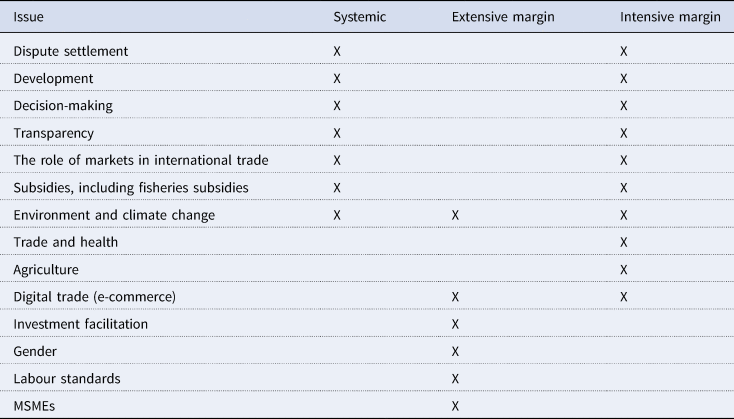
Table 1 lists fourteen issues that have been identified in the context of calls for reform of the WTO. Some may consider the list incomplete. Others may wish to remove items. In certain areas, work may be needed to spell out negotiating mandates. In others, long-standing mandates have festered as members have been unable – some would say unwilling – to make the necessary compromises to secure agreement. Bearing in mind the five functions referred to above – negotiating, administering, and monitoring agreements, settling disputes, ensuring transparency, and fostering deliberation – the argument is that at least one of these functions fails in every subject area listed.
Systemic, old and new WTO reform challenges

The items listed in Table 1 are distinguished in terms of whether they are systemic and whether they are new (extensive margin), or old (intensive margin), or a combination of both. The judgements involved in these characterizations are no doubt debatable. The issues described as systemic permeate and debilitate multiple facets of the WTO's work. A failure to adequately address such fundamental dysfunctionality frustrates the institution's overall effectiveness and further weakens its claim to centrality in global trade governance.
The attempt to identify systemic issues does not detract from the importance of all the topics on the list. Each one matters in its own right, but also by virtue of the fact that it has been put on the table for negotiation and/or highlighted in references made by stakeholders and scholars to the need for WTO reform. Where old issues are concerned, members face the challenge of modifying stated positions in order to achieve workable compromises. In the case of new issues, there may be a greater opportunity to explore mutually desirable outcomes without the baggage of entrenched negotiating positions.
4. Threats to the WTO's Credibility
Space limitations do not permit a detailed treatment of all the items listed in Table 1. The first eight of these – dispute settlement; development; decision-making; transparency; the role of markets in international trade; subsidies, including fisheries subsidies; and environment and climate change – are covered in some detail below. These issues are fundamental in a systemic sense and most of them have posed long-standing challenges to the WTO's effectiveness. First, however, brief mention should be made of the other issues identified in Table 1.
Trade and health has emerged as an issue as a result of COVID-19, putting pressure on the WTO to contribute through trade to the management of the pandemic. Elements of traditional trade policy relating to exports and imports are involved. These market access issues involving pharmaceuticals, personal protective equipment and vaccines are now being monitored. A major sticking point has been the proposal that certain elements of intellectual property (IP) rights relating to COVID-19 vaccines and other products relevant to the control of the pandemic should be relaxed in order to ensure adequate availability of these items on a global scale. Work is continuing on this set of issues, and there are those who believe that relaxing IP rights would not help and may hinder access to the products concerned. Although this may not be a systemic issue per se, the WTO's reputation is on the line, considering the nature of the emergency and its implications for health.
Agriculture is a long-standing issue that that has proven exceedingly difficult to solve. It has strong north–south characteristics, pitting many developed economies against developing ones. For the former, it generally represents a very small share of the economy, but involves significant political interests and social considerations that militate against trade openness. For many developing countries, agriculture is key to livelihoods, although over time successful diversification towards higher value-added production will ameliorate the pressure. Given the interests involved, the WTO's capacity to influence outcomes is limited.
Negotiations among a subset of WTO members on e-commerce have made some progress.Footnote 7 These efforts reflect recognition of the need to ensure the relevance of the WTO in the face of changing policy imperatives and far-reaching developments in technology. This negotiating initiative is being played out alongside a work programme on e-commerce that has yielded little or nothing for over 20 years. The WTO needs a modern rulebook in this area. One of the challenges that emerges is that since the virtual economy is largely a networked industry, if policies and regulations are not sufficiently aligned, it becomes more difficult to avoid discriminatory outcomes that can put a strain on the trading system.
Negotiations are underway on investment facilitation for development, and on micro, small, and medium-sized enterprises (MSMEs). Both of these negotiations are taking place among a subset of the membership and are further discussed below. The issue of gender was raised at the 17th Ministerial Conference in 2017 and an Informal Working Group was established in September, 2020. The Working Group is tasked with examining various aspects of gender in relation to trade and the work of the WTO. The Chairs of the Working Group prepared a draft outcome document intended for discussion at MC12. This work will continue.
Finally, labour standards are not subject to WTO rules but have been a long-standing issue of concern for some developed countries. The 1996 Singapore Ministerial Declaration reaffirmed WTO members’ committed to international core labour standards and the work of the International Labour Organization to promote them. The Declaration also rejected the use of labour standards for protectionist purposes. Some developed countries have made observance of labour standards a pre-condition of access to unilaterally granted preferences under the Generalized System of Preferences. The United States has also introduced the issue of forced labour into the negotiations on fisheries subsides. The alleged use of forced labour in China has surfaced as a trade-related matter. Labour issues are not going to fade away from trade discussions.
4.1 The Dispute Settlement Crisis
The GATT/WTO dispute settlement system has often been acclaimed as a path-breaking and unique system for settling disputes between governments. Over many years, the record of disputes that were successfully settled and acted upon has been impressive. With the addition of the Appellate Body (AB) in the Uruguay Round, things began to change. Although the AB seemed to have worked well in the early years of its existence, difficulties started to arise in the early 2000s.
Although an operational dispute settlement system is essential to the effective working of the GATT/WTO, in practice dozens of WTO members have rarely if ever had recourse to the dispute settlement system. Two of the major users of the dispute settlement system – the United States and the EU – have never been entirely aligned philosophically in relation to the reach of authority of juridical bodies operating at the international level. It is not far-fetched to suggest that these two trading powers are at the centre of the present difficulties.
The EU more readily submits to international adjudication than does the United States. The history of dispute settlement has been punctuated by efforts to resolve the differences. In the 1980s, the then Director-General, Arthur Dunkel, was pressured into dividing the dispute settlement function into two units. The Rules Division was made responsible for disputes involving contingency trade measures (anti-dumping, countervailing duties, and safeguards). The Legal Affairs Division was responsible for the rest. The split reflected tensions between the United States and the EU and did not contribute to coherence. There was at least one occasion in the memory of this author when a sitting Director-General had to negotiate the appointment of a Director of the Legal Affairs Division – a clear departure from normal practice where director-level appointments are not subject to veto or approval from delegations.
Prior to the entry into force in 1995 of the Dispute Settlement Understanding (DSU) with the establishment of the WTO, the consensus rule had made it possible for a complainant or a respondent in a dispute to block a finding. The DSU eliminated this possibility, and in exchange members agreed to the option of a second layer of adjudication with the establishment of the Appellate Body (AB). In this manner, authority was essentially transferred to the adjudicators of the system (dispute settlement panels and the AB). A revealing anecdote on the implications of this decision was a conversational remark to the author by Professor Robert Hudec shortly before his untimely death. His musings turned on the question whether these new arrangements were a step too far for the institution. Were governments really ready to forego the diplomacy and attention to political exigencies that the consensus rule allowed? Was too much sovereignty assigned to an inter-governmental body?
The answer to this question turns in part on the view taken of what went wrong with the AB and whether it can be fixed.Footnote 8 The concerns that have been voiced, mostly by the United States but doubtless shared in other quarters, are well known.Footnote 9 A central concern is that the AB exceeded its remit by arguably on occasion crossing the line between legal interpretation of the WTO agreements and law-making. Other concerns involve the re-interpretation of the facts of a case, which are supposed to be outside the AB's scope of authority, and the time taken to resolve cases. These tendencies have given rise to particular objections relating to such matters as the definition of public bodies, the use of safeguard provisions, and the practice of zeroing in dumping margin calculations.
Since it is obvious that the WTO cannot function effectively without some form of dispute resolution, agreement here is a sine qua non of the WTO's rejuvenation. When President Trump, for example, invoked the WTO's national security provisions to impose additional import barriers or export restraint agreements on steel and aluminium imports from a number of countries, this was widely seen as a violation of the spirit, if not the law, of the WTO. The retaliatory measures taken by most of the affected countries were not WTO consistent, at the very least in procedural terms. It is episodes like this, and the fact they are allowed to fester, that emphasize the need for robust and respected dispute settlement arrangements.
In the meanwhile, a group of some 25 members have signed onto the Multi-Party Interim Appeal Arbitration Arrangement pursuant to Article 25 of the Dispute Settlement Understanding (MPIA). Initiated in April 2020, the MPIA is a temporary solution for a subset of the membership that wanted to have the possibility of availing themselves of an appeals process. By the end of 2021, however, no cases had reached the MPIA's arbitrators. If the parties to a dispute do not agree to use the MPIA, a panel finding can be appealed into the void.
Will the solution be to revert to the old consensus arrangement? This is unlikely to work in the way that it used to, where many, but not all, disputes calling for action by a respondent were acted upon in accordance with panel findings. Members are arguably too far apart and diversified in their interests and priorities today for the old system to operate with a comparable degree of effectiveness. A solution therefore is most likely to be found through a better system of checks and balances than has prevailed so far. It is too early to say whether such an accommodation will be forthcoming in the foreseeable future.
4.2 Development and the Balance of Rights and Obligations in the WTO
Issues surrounding the appropriate balance of rights and obligations among members at different levels of development have troubled the multilateral trading system since the beginning. Differences over claims of developing country status by certain members and entitlement to special treatment have frequently slowed and frustrated trade negotiations. Early manifestations of the problem concerned the product composition of trade liberalization efforts that began with the founding of the GATT. The thrust of early drives to lower tariffs and other border measures was selective from the outset, and generally excluded agricultural products and labour-intensive manufactures.
Early attention was brought to this problem by the 1958 Haberler Report,Footnote 10 which, among other things, noted that high tariffs on agricultural products and labour-intensive manufactures, and tariffs that escalated with the degree of added value were adversely affecting the growth and development of developing countries. The response to this on the part of developed countries was to introduce non-contractual preferential access to their markets for developing countries in lieu of MFN-based reductions in protection levels of interest to the latter.
The unilateral nature of these preferences meant they were reduced or removed as beneficiaries became more competitive, and they were also often entailed with conditionality on non-trade matters such as labour standards and other public policy aspirations of concern to the preference providers. Tariff escalation and high tariffs thus persist in sectors key to development. At the same time, arguably as a quid pro quo for a flawed preference-based market access regime, in those early years developed countries tended not to press developing countries too hard to open their own markets.
The arrangement has also built a constituency opposed to multilateral, non-discriminatory market-opening, arguing that the erosion of preference margins hurts the development prospects of the poorest developing countries. This ‘minimalist bargain’ based on transient preferences continues to blight the multilateral trading system and attenuate its contribution to the reduction of barriers to trade.Footnote 11
From the late 1960s and 1970s onwards, as the GATT and subsequently the WTO became more concerned with non-tariff measures, the issue of differentiated rights and obligations was clarified and legally formalized, and regulatory issues became far more prominent in the mix. These arrangements were part of the results of the Tokyo Round (1973–1979) in the form of the 1979 Decision on Differential and More Favourable Treatment, Reciprocity and Fuller Participation of Developing Countries, also referred to as the Enabling Clause. The Enabling Clause replaced time-bound waivers from the most-favoured-nation (MFN) principle, making a permanent exception for tariff preferences.
The same was done for non-tariff regulatory measures.Footnote 12 This latter addition was important because another significant outcome of the Tokyo Round was the introduction of stand-alone non-tariff measure agreements based on existing articles of the GATT. They included agreements on technical barriers to trade, anti-dumping, subsidies and countervailing duties, customs valuation, and import licensing. Each of the agreements included special and differential treatment (STD) provisions for developing countries. These regulatory instruments were further developed in the Uruguay Round, and a number of other agreements were added.
The main contention here is that a solution to the perennial debate about the balance of rights and obligations assumed by individual countries under the WTO would be significantly facilitated if an analytical distinction were to be made between market access and regulation.Footnote 13
As alluded to above, all countries continue to maintain high tariffs in particular areas. No two tariff schedules are identical, and there is no presumption that all WTO members will eventually converge around tariff-free trade. In these circumstances, it is unclear what constitutes Special and Differential Treatment (SDT) in market access. Yet much of the underlying discussion about developing countries not pulling their weight in the WTO alludes to tariff levels and the degree of market openness.
It would make more sense to treat market access as a matter for negotiation that implicates all members rather than as a pressure point aimed at developing countries in relation to SDT. An additional consideration supporting this argument is that the GATT/WTO has never been particularly successful at market opening. Industrial countries did, however, significantly reduce tariffs on some manufactured products during the GATT/WTO's first 50 years.Footnote 14 The GATT's role here was largely one of coordinating liberalization decisions among countries who were not impervious to terms-of-trade concerns. Nevertheless, as already noted, these reductions were selective and largely excluded agricultural and labour-intensive manufactured products.Footnote 15
In addition, there have been very few instances where developing countries have reduced MFN applied tariff rates on the altar of a multilateral trade negotiating round. The only exception to this general resistance is in the case of GATT/WTO accessions. This does not mean that trade liberalization has not occurred in developing countries. It has happened either unilaterally in terms of unbound applied rates, or under preferential trade agreements. In short, the WTO has not proven to be a particularly effective instrument overall for moving the needle on trade openness via the removal of tariffs.Footnote 16 In this domain, perhaps the ideal role for the WTO would be to periodically meet to determine the degree to which national or preferential actions already in place could be consolidated under the WTO.
This brings us to the other key rule-making role of the WTO, namely the writing of rules in the regulatory sphere. Here the WTO has been far more successful. The question, then, is how do regulatory issues play out in the STD debate? A useful document prepared by the WTO SecretariatFootnote 17 has divided SDT provisions into a number of categories. These include: (i) best-endeavour (effectively non-justiciable) provisions that increase trade opportunities and safeguard the interests of developing countries; (ii) provide flexibility of commitments, action, and use of policy instruments; (iii) offer transitional time periods for implementation of commitments; (iv) offer technical assistance; and (v) provide additional special treatment for LDCs.
The WTO Secretariat document identifies 183 such provisions in the Marrakesh Agreement Establishing the World Trade Organization (hereafter the WTO AgreementFootnote 18). The transitional timeframes are self-executing in that they come to an end after a specified period. This leaves only the flexibility category that may include regulatory SDT provisions that can be exercised unilaterally by developing country beneficiaries. This category accounts for 44 of the 183 SDT provisions (24%) contained in the WTO Agreements. For the rest (excluding LDC-specific provisions), action is required by those granting the SDT. This delineates the scope for the possible opportunistic use of SDT provisions by undeserving developing countries. Focusing on the specifics in this way helps to reduce the SDT debate to manageable specificities and thus detoxify the discussion and find a solution.
Rather than trying to define developing country status by reference to a number of quantitative metrics, as a recent submission by the United States has proposed,Footnote 19 it may be better to allow development status designations to remain in the eye of the beholder, and focus instead on which countries use what measures. If this approach were to be adopted, a survey would be required of what is being used by way of regulatory SDT in each developing country. It is quite possible that many of the developing countries targeted for possible abuse of SDT are not in fact making use of these provisions. In this case, they could undertake not to do so in the future, and this would leave a much more manageable subset of SDT provisions upon which to focus in terms of their contested use.
An alternative approach in future might be to fashion negotiated outcomes on rules in the way the Agreement on Trade Facilitation (ATF) was designed. The particular feature of the ATF relevant here is that members were invited to link their implementation timetables to their development capacities. This was done by establishing three categories under Article 14 of the ATF that specified implementation timetables for individual members. The first list (Category A) included measures each member would implement upon entry into force of the Agreement. Category B set a timeframe for implementation of further provisions, and Category C for the remainder whose implementation was conditioned upon receipt of required technical assistance. This arrangement is fully transparent, and enhances buy-in by making members individually responsible for defining their needs. The challenge for members is then to ensure compliance rather than disappearing down a bottomless rabbit hole to debate entitlement.
A final note is warranted on the approach adopted to SDT in the General Agreement on Trade in Services (GATS). In this case, the starkness of binary positioning in terms of SDT is blunted. The expression SDT does not appear in the Agreement and the issue of developing country participation is couched in more general terms of appropriate progressive liberalization. Whether this is an effective approach, however, is yet to be tested in negotiations that have yet to occur since the entry into force of GATS.
4.3 Decision-Making in the WTO
Much of the stasis plaguing the WTO is attributable to the practice of consensus decision-making. Article IX of the WTO Agreement states that the ‘WTO shall continue the practice of decision-making by consensus’, which is interpreted to mean that there is no dissenting voice among the members present when a decision is taken. The WTO also provides for certain circumstances where in the absence of consensus, outcomes may be decided by voting, with the required majority depending on the issue at hand. The voting option to override a lack of consensus is a road very rarely travelled. Voting might have historically been a more popular pathway were it not for the one-country one-vote rule.Footnote 20
In practice, the consensus requirement has permitted the de facto exercise of veto power by minoritarian interests. Motives for blocking decisions may have nothing to do with the matter at hand.Footnote 21 This state of affairs has led many members to think about ways of making progress on agendas and agreements under the WTO umbrella without the need for a consensus decision implicating the entire WTO membership.Footnote 22 As things stand, agreements among a subset of the membership, or inter se Footnote 23 agreements, are explicitly provided for under Annex 4 of the WTO Agreement. These are referred to as Plurilateral Trade Agreements in the legal text. The agreements contain rights and obligations that apply only to the signatories. They are thus an exception to the MFN rule and discriminate against the rest of the WTO membership. Currently, only two active agreements exist under Annex 4 – the Agreement on Government Procurement and the Agreement on Trade in Civil Aircraft.
Since the end of the Uruguay Round and the entry into force of the WTO in 1995, several additional inter se agreements have entered into force. Up to this point, these agreements are intended to be MFN-consistent, in contrast to Annex 4 agreements. The initial ones were in telecommunications and financial services, and were in effect a continuation of the Uruguay Round negotiations. This meant that the decision to negotiate was made by consensus as part of the Uruguay Round, but the outcomes were adopted through the schedules of specific commitments of the parties involved under GATS Article XVIII (additional commitments) and not on the basis of a consensus decision.
On the goods side, the Information Technology Agreement (ITA) was signed in 1996 and it removed tariffs on a wide range of covered products imported by the signatories. These changes in the tariff schedules of parties to the ITA were entered into their tariff schedules. The agreement was extended to further products in 2015. The second iteration of the ITA in 2015 brought the number of signatories to 81, accounting for around 97% of covered products.
As already noted, the inter se agreements on services and information technology products resulted in new commitments by signatories that benefit all WTO members on an MFN basis. With these agreements as precedents, a significant move occurred at the 11th Ministerial Conference in Buenos Aires in 2017 when a subset of members signed up to Joint Statements on electronic commerce, investment facilitation for development, and Micro, Small and Medium-Sized Enterprises (MSMEs).
These Joint Statement Initiatives (JSIs) sought to initiate work programmes and negotiations in the relevant areas. They clearly started life as inter se arrangements, but they also established an open-ended approach to membership and espoused MFN treatment for all WTO members regardless of whether they participated in the initiatives. Other discussions on domestic regulation in services and gender equality and women in trade have taken on the characteristics of the JSIs and could end up as non-discriminatory inter se agreements.Footnote 24 Another formulation, in the case of the JSI on MSMEs, for example, could be a declaration by a coalition of the willing that would not be legally binding but rather a platform for deliberation, the exchange of ideas, and learning. This is consistent with the WTO objective referred to above of fostering deliberation.
In the unlikely event that all WTO members were to sign up to negotiated outcomes that involved new rights and obligations, these agreements could be adopted by consensus as additions to Annex I of the WTO Agreement. In the absence of consensus, however, they remain inter se agreements and in this case the intention of the signatories would be to add new obligations to their individual schedules of commitments.
This approach to achieving progress in a situation where the alternative appears to many as one of endless frustration with negotiating inaction provoked by minoritarian veto activity and an intensifying assault on the utility of the WTO. India and South Africa, however, have raised objections to this approach, regardless of the fact that it creates obligations only for signatories and additional rights for all.Footnote 25 They consider the approach an assault on the binding force and fundamental principle of multilateralism, as well as a tactic to dodge the consensus imperative, and circumvent the WTO rules on amendments.Footnote 26
Responses to the legal objections argue there is nothing that violates the rules relating to negotiating processes and outcomes arising from the scheduling approach to consolidating the results of inter se agreements.Footnote 27, Footnote 28, Footnote 29 These papers systematically spell out the legal arguments why the WTO is ultimately permissive in relation to inter se agreements, provided they do not undermine the rights of non-signatories. The Zampetti et al. paper also argues that Article 41 of the Vienna Convention on the Law of Treaties provides for inter se agreements provided that the treaty concerned allows for modifications, does not undermine the rights of other parties to the treaty, and does not derogate from the underlying purpose of the treaty in question.
A point that is made explicitly in the Zampetti et al. paper, and not contradicted by Mamdouh in his papers, however, is that by going down the scheduling route, the final decision-making authority on the inter se outcomes is effectively being taken away from members and assigned to the adjudicators (to WTO dispute settlement) in the event that an objection arises in relation to changes made in members’ schedules. In order to address this problem, the authors cited here recognize the desirability of finding ways of amending the WTO in order to put inter se agreements on a firmer footing. Mamdouh, for example, argued for the addition of an Annex 5 for agreements binding only on signatories while creating rights for all members.Footnote 30 This is in recognition of the fact that Annex 4 agreements are binding only on signatories and essentially exclude non-signatories from benefits as well as obligations
A wide range of members espouse inter se agreements, and mostly assume that these will be non-discriminatory. There are systemic reasons for preferring that the necessary adjustments be made to the WTO Agreement to allow for variable geometry that would incorporate non-discriminatory inter se agreements. Existing non-discriminatory inter se agreements are often referred to as ‘critical mass’ agreements. The label is useful in that it distinguishes them from plurilaterals, which in strict WTO-speak is a term that should be reserved for Annex 4 agreements.Footnote 31 The words ‘critical mass’ are instructive. They reflect the reciprocity imperative that, for good or ill, dominates much negotiating behaviour in the WTO. If the trade share of participants is not considered sufficient in terms of some threshold, critical mass agreements will not reach the finishing line. What this means is that power politics and relative economic size play a part in deciding how, when, and with what scope and subject matter non-discriminatory critical mass agreements will take shape.
In this connection, it is perhaps worth recalling the fate of the so-called Tokyo Round Codes on non-tariff measures referred to in the previous section on development. These agreements on technical barriers to trade, anti-dumping, subsidies and countervailing duties, customs valuation, and import licensing were effectively non-discriminatory inter se agreements because countries had the option of not signing them but still enjoying any benefits accruing. This construction was an important part of regulatory SDT that was swept away by the Uruguay Round single undertaking. This point supports the observation that larger countries will be the main architects – but not necessarily the only beneficiaries – of non-discriminatory inter se agreements. As already noted, this is a strong argument for regularizing the status of non-discriminatory inter se agreements, bringing them into the ambit of decision-making by members. This would be better than risking a greater likelihood of fractious dispute settlement in a process that relies solely on the certification of schedules by adjudicators when members disagree.
An amendment under Article X of the WTO Agreement introducing non-discriminatory inter se agreements form part of the WTO architecture would require a consensus decision or a vote. If this approach is blocked out of hand by India, South Africa, or others, and a vote is ruled out, it would be better to allow the adjudicators to take the driving seat on this issue rather than submit to further stasis and shrinkage of the WTO's contribution to global trade governance. Judging by the number of countries that have signed on to JSIs it seems reasonable to assume there would be broad support for a second-hand outcome if that is what it takes to awaken the WTO.
4.4 Transparency and Notifications
In addition to enhancing certainty and predictability through contractual pre-commitment on rules governing trade, an agreement such as the WTO is supposed to reduce information asymmetries through systematic and regular notification of policies regulated by the agreement. This is important in relation to a full accounting of existing policy stances, and even more so in terms of policy changes. In some cases, prior consultation may be called for prior to changes, and enquiry points may also be required in order to facilitate the flow of information. Inadequate compliance with notifications on the scale existing in the WTO seriously undermines the WTO's trade governance capacity.
The Uruguay Round Decision on Notification Procedures established an obligation to notify, as set out in various agreements. It also established a central registry of notifications and a review mechanism for notification obligations and procedures. Compliance with notification has been poor. Problems with notifications are also discussed regularly in various committees. In the case of subsidies, for example, in 2019 some 80 members failed to make any notification of their subsidies.Footnote 32 The EU has stated that the ‘lack of comprehensive information on subsidies provided by members is one of the biggest shortcomings in the application of the current system’.Footnote 33
In the run-up to the 11th Ministerial Conference in Buenos Aires in December 2017, the United States proposed the adoption of a Ministerial Decision in recognition of the ‘chronic low level of compliance with existing notification requirements under WTO agreements’.Footnote 34 Among the proposed measures to be taken against ‘delinquent’ Members failing to meet their notification obligations were denial of the right to chair WTO bodies, denial of access to documentation and the members’ website, and an Inactive Member designation.
While this approach proposed by the United States was particularly punitive, subsequent iterations of the proposal retained softer counter-measures against members who did not meet their notification obligations. A series of revised proposals garnered greater support among the membership. They softened the punitive elements imposed for non-compliance and proposed various support measures including technical assistance to rectify the problem. The latest proposal dated 11 November 2021,Footnote 35 supported by 20 members, suggested certain administrative measures to be enforced against non-complying members including a designation of ‘a WTO member with notification delay’, the right to speak in meetings only after other members have taken the floor, regular reporting by the Secretariat of overall notification compliance, and the denial of opportunities to chair WTO bodies. This proposal would have been discussed at the 12th Ministerial Conference.
4.5 The Role of Markets in International Trade
A major challenge confronting the WTO concerns the relationship between China and some of its major trading partners, most notably the United States, but also the EU and others. As the economic centre of gravity has increasingly shifted towards Asia in recent years, and China in particular, geopolitical rivalry is inevitably a factor. An underlying theme concerns the relative roles of markets and the state in determining economic outcomes. Subsidies figure prominently in this debate. Recent work by the Global Trade Alert,Footnote 36 however, demonstrates that China, the United States, and the EU have a striking similarity in their degrees of reliance on subsidies. This suggests there are grounds for negotiation in place of recrimination and finger-pointing.
Subsidies are not the only issue bedeviling the relationship between China and its various trading partners.Footnote 37 Transparency has been raised frequently as a concern in relation to state control over a significant part of the economy. The market dominance of state-owned enterprises effectively exempts key sectors from the kind of anti-trust disciplines that apply in other more market-oriented economies. A further criticism turns on linkages between investment and an obligation to transfer technology.Footnote 38
A major challenge is to find areas of common interest and build on these in addressing the differences. Logic would suggest that China and its trading partners can reap mutual benefits from engagement. What might make this possible, however, would be a willingness to recognize and work with limitations on trade cooperation. It seems pointless to demand an alignment of approaches and policies. The ‘be more like us’ argument gains little purchase. Rather, mutually beneficial arrangements need to be made to work within the confines of less than fully compatible approaches to policy. Can this happen without undermining the viability of the multilateral trading system? What are the implications of the possibility of a further agreed layering of MFN? Or will differences continue to weaken the WTO and result in a bifurcation of the world economy that forces countries to choose sides? The latter outcome would spell failure for multilateralism, not to mention significantly reduced economic opportunity.
4.6 Subsidies
The issue of subsidies has long been a challenge in the GATT/WTO, in relation both to production and export subsidies, and their impact on the conditions of competition. As noted by the Global Trade Alert,Footnote 39 subsidies have been a predominant form of intervention since the 2008/9 Great Recession. Subsidy discussions used to be focused mostly on agriculture, but that has changed in recent years.Footnote 40 The fact that there is broad agreement on the proposition that subsidies can be good as well as bad makes it no easier to find common ground among governments with differing priorities. A recent concern has been about the medium- and long-term competitive consequences of the use subsidies to manage the economic fallout of the COVID 19 pandemic.Footnote 41 As noted above, subsidies have also been a particular issue in relation to transparency and the poor record of many members in meeting their notification obligations.
Negotiations on fisheries subsidies have been going on in the WTO for some 20 years, with no solution as yet on the horizon. Their objective is to eliminate subsidies on illegal, unreported, and unregulated fishing and to prohibit certain forms of fisheries subsidies that contribute to overcapacity and overfishing. This is a vital sustainability issue, considering that fish are a fugitive resource in danger of exhaustion. Reaching agreement on this issue is seen by some as a litmus test of the WTO's future viability in a broad trade context. In many ways, the logjam here reflects perennial disagreements over historical responsibility for contemporary challenges (a factor also in climate change debates) and appropriate entitlements to differential treatment for poorer countries.
4.7 Environment and Climate Change
The WTO Agreement contains preambular language on protecting and preserving the environment. A Committee on Trade and Environment (CTE) was established in 1994 to examine the relationship between trade and the environment and make recommendations on whether any modifications of the provisions of the multilateral trading system were required. A negotiation on trade and environment was launched in the Doha Round in 2001 with a mandate to examine the relationship between the WTO and multilateral environmental agreements, and to pursue the elimination of tariffs and non-tariff measures on environmental goods and services. In 2014, negotiations began on a Environmental Goods Agreement (EGA). The negotiations did not go anywhere and have not progressed since 2016.Footnote 42 As pressure mounts for the greening of economic activity,Footnote 43 and concepts such as the circular economy take hold, governments will increasingly need to factor green production into trade in order to be competitive. This issue is likely to find its way more explicitly onto the WTO agenda.
Tension between the pursuit of environmental sustainability and discriminatory trade policies aimed to achieve green goals is already emerging. The recent US proposal supported by USTRFootnote 44 that would give additional tax credits for electric vehicles built in the United States by unionized labour has been criticized by both Canada and Mexico on the grounds of unwarranted discrimination. There can be little doubt that such a measure would be found inconsistent with the WTO. The protectionist bent of such initiatives, of which there are likely to be more in the future, will further weaken the WTO and provoke trade-shrinking retaliation, not because of their efforts to address environmental exigencies but because they are designed with the dual purpose of giving additional backdoor support to domestic interests.
A related issue that the WTO is going to have to focus upon more closely is the relationship between trade and climate change. As governments are pressed to do more than in the past to stem carbon emissions, growing concerns are emerging about the competitive consequences of climate change policies. In the absence of any international agreement on pricing carbon, several governments are developing carbon border tax arrangements in order to stem carbon leakage and lost investment opportunities as industries are tempted to migrate to locations where less stringent climate change policies are in place. In the absence of adequate coordination and cooperation between international trade and climate change regimes, there is a risk that mutual harm will be inflicted. Trade policy and climate change policy need to be better synchronized, always bearing in mind that fixing climate is an end in itself while trade is a means to an end.
Some progress has been made recently, with the establishment of three environment-related initiatives by groups of WTO members. These are the Trade and Environmental Sustainability Structured Discussions (TESSD), the Informal Dialogue on Plastics Pollution and Sustainable Plastics Trade (IDP), and Fossil Fuel Subsidy Reform (FFSR). The TESSD and the IDP were originally launched in November 2020 and the FFSR in December 2021. All three statements were issued in December 2021, and they currently have 71 members (TESSD), 67 members (IDP), and 45 members (FFSR). As inter se agreements, these initiatives may make more progress than if they were only advanced on the basis of consensus.
5. Conclusions
The WTO faces a formidable array of issues, unprecedented in their range and complexity. It is no longer far-fetched to ask whether the WTO membership is collectively able and willing to own the institution and propel it towards recovery and enhanced relevance. A more important question still is whether particular individual members with influence care enough about the WTO and its potential contribution to trade governance.
The United States comes to mind in this context for various reasons alluded to already. These include the questionable use of the national security pretext in taking discriminatory trade measures, essentially closing down the dispute settlement function and not engaging in a search for solutions, and the seeming willingness to legislate entirely legitimate environmental objectives with a protectionist sting in the tail.
China also bears considerable responsibility for maintaining the relevance of the WTO. Engagement is needed to address the issues raised by members, in particular the United States, in relation to China's trade policies, not with the aim of succumbing to pressure for China to be more like other countries, but rather to fashion non-converging rules that accommodate managed co-existence to the mutual advantage of the parties concerned. China and the United States have an obligation to settle their differences within the WTO framework. To do otherwise ensures the fracture of multilateralism and a further propulsion of the WTO into irrelevance.
The EU has an important role to play in contributing new ideas and approaches not only to its own advantage but designed for the benefit of the trading system and its members as a whole. Mid-sized economies with a significant stake in multilateralism could do more than some of them are already attempting in coalescing around shared interests that can be projected as building blocks and sources of influence for WTO reform. It is important for developing countries to articulate and defend their interests. But it is useful to bear in mind that group-think can be obstructive and collective positions are not always in the interests of development at the national level. Similarly, defaulting to ´no´ in response to proposals and initiatives of other WTO members will not support progress nor is likely to yield trade benefits.
A sine qua non for achieving progress must be that accommodations are found on the issues identified above as systemic in nature. These do not all have to be resolved at once, but they do require resolution if the WTO is going to thrive. At the very least, processes with reporting obligations need to be in place to address them. Other arguably less systemic issues need fixing too, and some of them may be easier to progress in order to build confidence and momentum towards more comprehensive reform. Progress in areas such as trade and health, fisheries subsides, and the digital economy could begin to build momentum. Talking about the need to talk about reform has run its useful course, if it ever had utility.
A part of the discussion needs to be about better aligning the desirable with the attainable. In order to achieve the requisite degree of cooperation on arrangements that yield mutual benefits, it may be necessary to better understand limits to the surrender of sovereignty in a multi-polar world of varied interests and priorities. The reach of rules and commitments needs to be consistent with the possible. Flurries of enthusiasm unsustained by consistency of purpose and commitment only encourage over-reach, and weaken the institution when members cannot live up to their promises.
This is not an argument for being minimalistic and frugal with ambition. It is simply that securing mutually beneficial outcomes is preferable to talking about them while harbouring unspoken doubts about the feasibility of what is on the table. Understanding the limits of highest common denominator policy convergence, or in some cases any convergence at all, is key to stability and a sustained contribution to governance. If convergence is impossible, divergence must be managed. To call trading arrangements a ‘system’, there must be pre-commitment, predictability, and respect for process. To slip into trying to manage without a system would be an historic error of major proportions.