Introduction
The adoption of western notation (which is an example of graphic notation) as the “official system” in Turkey dates from after 1828. Sultan Mahmud II (reigned 1808–1839) abolished the Janissary force in 1826 and with it the musical unit of that army, it was a band for wind and percussion instruments (Mehterhâne-i Hümâyûn). He then organised his new army on western lines and thus introduced an institution of western origin, the military band, as the musical unit of his modern army. This new institution, which was European in its music system, instruments, repertoire and first and foremost its methods of education, was formed under the name Muzika-i Hümâyûn (the royal military band). Professional musicians were invited from Europe to participate and, with the foundation of Muzika-i Hümâyûn in 1827, the most far-reaching change in Turkish musical history took place. It was an outstanding manifestation of westernisation which necessarily made a deep impact on both the Turkish makam (modal) music system and the existence and the behaviour of the musicians who produced and performed it. The domination of makam music and its masters in court circles and their claim to be the sole and absolute system of taste was undermined, although the appreciation and respect of certain sultans and bureaucrats continued on a personal level. From that date on, a duality, an East-West dichotomy (the effects of which can still be seen), overtook the cultural sphere of which music was a part. Within this dichotomy, tonal polyphonic music of the West began to make its influence felt at least as much as, if not more than, makam based Turkish music both within the state framework and in the society at large. These dual concepts were referred to as Alla Turca and Alla Franga. While Alla Franga (alafranga in common parlance) came to symbolise modernity, change and the new life style, Alla Turca (alaturka in common parlance) became a manifestation of being archaic and conservative and of having a blind commitment to tradition and an under-developed taste (even no taste at all). Within this series of dichotomies, which took hold of every area of life (from literature to fashion also, eating habits, systems of beliefs, and education as well as government) makam based Turkish music received a large share of “cultural negation” with the judgement that it did not even have a decent notation system. It became marginalised and restricted to a narrow social group deeply and passionately devoted to it. Even during this process, makam music developed a dynamic of self-protection against “cultural negation” with its composers, theorists, publishers, performers and listening public. Makam music composers and performers learnt western notation, they wrote pieces down and deciphered music from that notation; a system of education based on modern methods developed while still preserving meşk (the traditional oral teaching method of Turkish music). These efforts were driven by the ‘ideal’ of transforming makam music, which was claimed to be archaic due to its monodic structure, into a polyphonic music. The musicians who knew western notation (such as Melekzet Efendi, Leon [Hancıyan] Efendi, etc.) were paid great amounts of money in order to record the works of the old masters in western notation and compile them, along with new compositions, into extensive note-collections (such as Muzika-i Hümâyûn Kumandanı [the commander of the royal military band] Necîp Paşa Collection and the Pertev Paşa Collection, etc.). Works were also published in note editions (such as Mâlûmat [literally meaning knowledge], Müntehâbât [literally meaning selections], Ûdî [lute-player] Arşak editions, etc.). Moreover, educational guides devoted to teaching makam theory and solmisation (such as Tanbûrî Cemîl Bey's Rehber-i Mûsikî [The Music Guide], Muallim [teacher] İsmail Hakkı Bey's Mahzen-i Esrâr-ı Mûsikî [The Cellar of the Secrets of Music], Muallim Kâzım Bey's Mûsikî Nazariyâtı [Music Theory], etc.) and the first methods for learning the instruments of makam music (such as Ûdî Salâhî Bey's Ud metodu [Lute Method], Seyyid Abdülkaadir Bey's Usûl-i Ta'lîm-i Keman [Method for Practising Violin, etc.], modelled on their European counterparts, were beginning to be published.
The introduction of western notation to Turkey in general and its incorporation into Turkish makam music must be differentiated. As was explained above, its introduction was the result of persistent state intent to impose western music, with all its rules, forms and content, on Turkish society as a ‘high culture’, a condition of the official state policy that aimed at a thorough transformation of musical systems. As a natural outcome of this approach, the use of western notation in this context was realised within developments, which would make possible the performance of a European style music with an eye on the attainment of an integration within European music (such as the formation of a court band, a court choir, a court orchestra and the education of the Sultan and the social elite in western musical methods). The incorporation of western notation into Turkish makam music did not correspond with this impetus but consisted of making use of a ‘technical’ opportunity and practical advantages, which was already imposed on nineteenth-century Turkish music at large. The borrowed technique was used differently in makam music. It was confined to the adaptation of this notation to the makam system in an empirical manner, lacking the “totalistic disciplinary approach” implicit in this notation system. As a result of this adaptation process, the makam system and makram music affected the notation system rather than being affected by it. Thus western notation, which has been developed for centuries to accord with the requirements of tonal music, was transformed into a notational tool assisting, though inadequately, the representation of makam music. During this transformation, many elements dependent on the requirements of tonal musical theory, such as key signature system, alteration signs system, and nuance system, etc. were left out. Leaving out those elements limited the reading and performance of written pieces of makam to only those who already knew makam. This limitation created a theoretical dispute among composers, theorists and performers on the modification of western notation, which still remains unresolved.
Even though the systematic scoring of makam pieces in western notation became possible only after the creating of the Muzika-i Hümâyûn in the nineteenth century, we know that this notation system was made use of earlier to notate certain pieces. It is even possible to claim that it took western notation about 250 years to make its way into Turkish makam music as a fundamental element despite graphic systems being used much earlier to record examples of seventeenth-century Turkish makam music.
Section I Ali Ufkî Bey (ALU) Notation and Its Characteristics
A court musician during the reigns of Sultan Ibrahim and that of Mehmet IV, Santûrî Ali Bey (Albert Bobowski/Ali Ufkî (1610?–1675?) recorded a total of 505 pieces in a notation system of his own creation. These 505 pieces that make up Mecmûa-i Saz ü Söz (Collection of Music and Lyrics) comprise: 155 peşrevs (instrumental prelude form), 41 saz semâîsis (instrumental postlude form), 72 murabbâs, 33 güfteli semâîs, 8 şarkıs (light classical vocal form), 2 incomplete kârs or kârçes, 2 nakşs, 92 türküs (folk song), 46 varsağıs, 19 ilâhîs (hymn), 15 tesbîhs, 9 raksıyyes, 4 yeltmes, 4 oyuns (stylised dance piece for instruments), 1 tekerleme, 1 nağme, 1 raks and semâî, and 1 cenk havası. This notation system was a kind of graphic “Western notation” modified by Ali Ufkî, who made possible the preservation of many examples of sixteenth- and seventeenth-century Turkish music. The most fundamental modification that Ali Ufkî performed on this notation was to reverse its direction of writing in accordance with the structure of Ottoman Turkish, which was written from the right to the left. That Ali Ufkî had had a considerable amount of music training in the West before he was captured and brought to the Ottoman court, can be perceived from his mastery in dictation (notating the music heard with correct rhythms and intervals) and decipheration (performing by reading from notation without memorisation). An examination of his cönk (anthology) Mecmûa-i Saz ü Söz, the contents of which were summarised above, shows that Ali Ufkî, who was also a dragoman (translator), had mastered Turkish classical and folk literature as well as he had mastered makam and folk music.
Technical Qualities of Ali Ufkî (ALU) Notation:
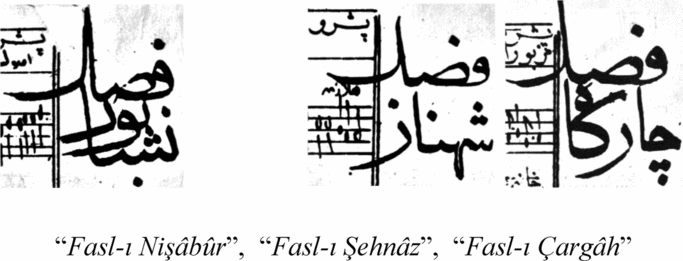
Ali Ufkî grouped the works he recorded in Mecmûa-i Saz ü Söz under subtitles such as Fasl-ı Hüseynî, Fasl-ı Muhayyer, etc. and in twenty-eight makams (see Fig. 1). He included pieces in other similar makams in the makam closest to them (for instance, Düyek Bestenigâr peşrev on page 195 was classified under Fasl-ı Sabâ, etc.)
Chapter Titles in Mecmûa-i Saz ü Söz.

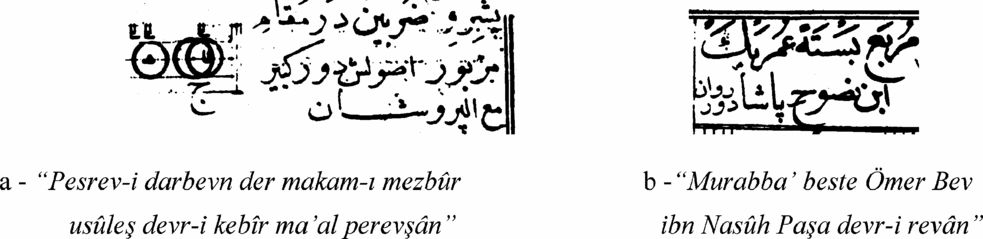
Examples of Piece Titles from Mecmûa-i Saz ü Söz.

Ali Ufkî presented every piece that he notated with a title of the following sort: “Peşrev-i Osman Paşa el'atîk/der makam-ı Dügâh Hüseynî/usûleş düyek”. This title conveys the form, composer, makam and usûl (rhythmic pattern) of the piece, in that order. Another title goes: “Peşrev-i Mevc-i deryâ/makam-ı mezbûr/usûleş düyek”. This time, the title conveys in turn the form, special name, makam group and usûl of the piece. From this second kind of title, we can conclude that the piece had a special name of its own, Mevc-i deryâ, but that its composer was unknown (either forgotten or not recorded) or was Ali Ufkî himself.
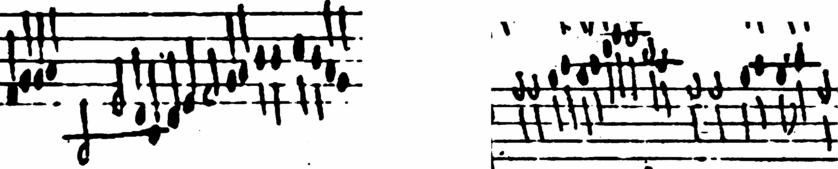
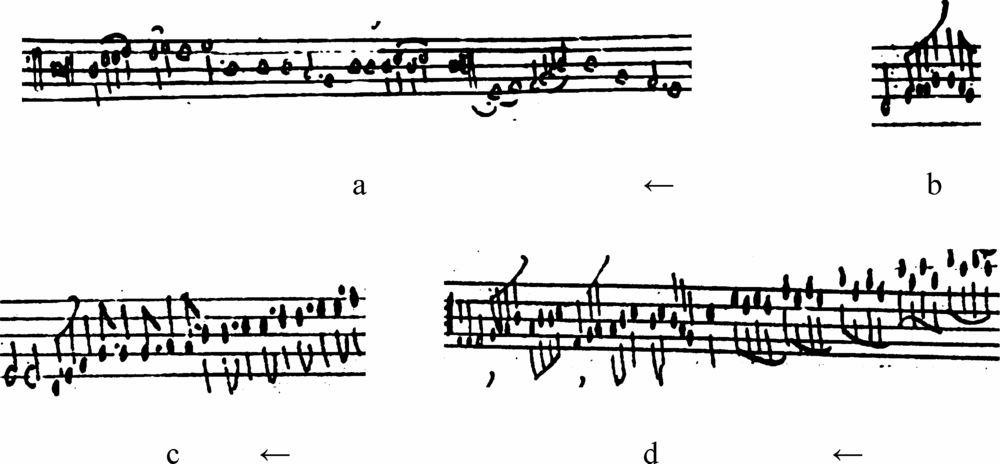
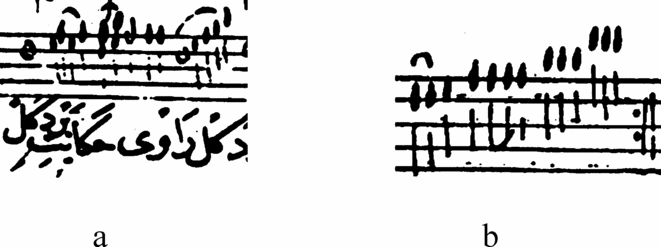
ALU notation was written from the right to the left on a five line staff. On some occasions, both staffs without key signatures and four line staffs were to be seen (probably under the assumption that there were a smaller number of sounds in the high area). In this sort of notation, the notes should be read on five line staffs with first line ‘do’ clef, although they lack both over-line and key signature.
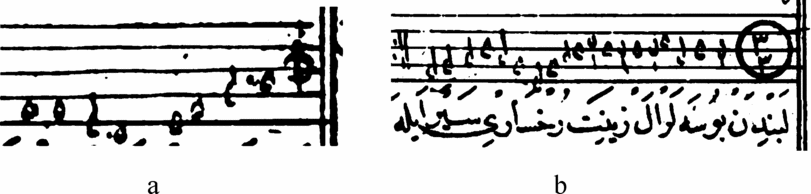
Staffs from Mecmûa-i Saz ü Söz. a. Four line staff, b. Staff without key signature.

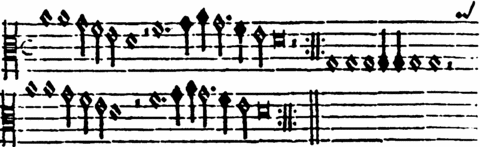
In the notation of basic usûls, other than a few exceptions, no bar lines were used on the staff. The notes were either written in groups or grouped with the use of slurs. In the notation of complex usûls, a measure was usually determined by a complex usûl structure. The use of bar lines was not unseen. Yet it was rare enough to make it possible to claim that the sounds were notated without the use of bar lines.
ALU Notes on Staff from Mecmûa-i Saz ü Söz.

Ali Ufkî used first line ‘do’ (do – c –
 ) clef and expressed the
Rast makam scale beginning from
‘do’. This preference might have resulted from the idea of
using additional lines above and below the staff as rarely
of possible. Although there were makam
scales that made the use of additional lines unavoidable,
melodies could usually be written within staff limits.
Very rarely, second line ‘do’ (do – c –
) and first line ‘sol’ (sol –
 ) clefs were tested.
First and second line Do Clefs from Mecmûa-i Saz ü Söz.

Lower and Higher Additional Lines from Mecmûa-i Saz ü Söz.

First Line Sol Clef in Mecmûa-i Saz ü Söz.

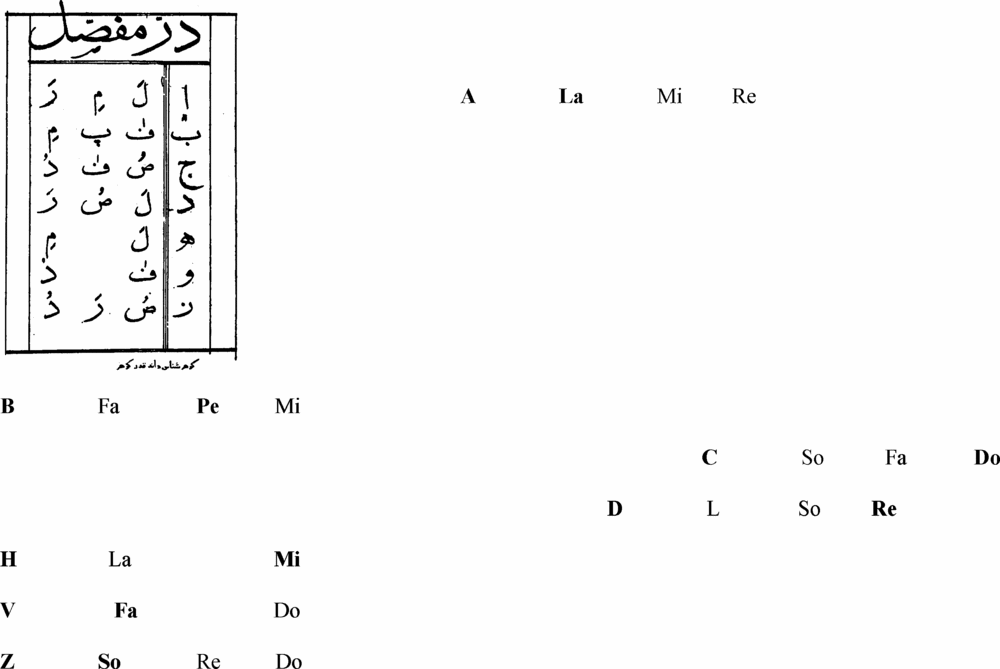
Ali Ufkî borrowed the letters he used for symbolising first
line ‘do’ and ‘sol’ clefs ( and ) from ebced
(first word in the mnemonic formula giving the arrangement
of the Arabic letters according to their numerical value;
enumeration by letters of the alphabet) system, yet
assigned to them their letter note equivalents which were
used in seventeenth-century Europe. The table in which he
made this comparison is reproduced below.
Comparative Sound Table with Ebced Letters from Mecmûa-i Saz ü Söz.

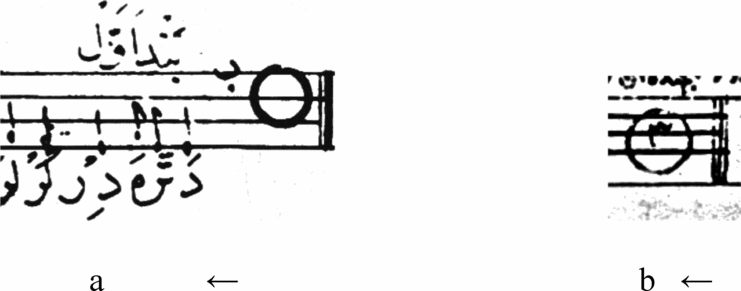
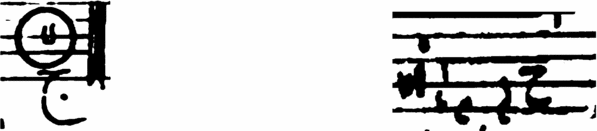
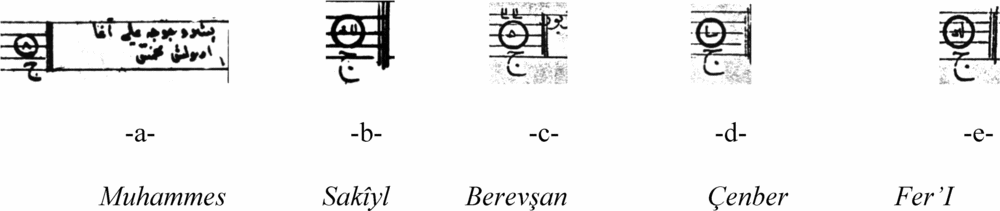
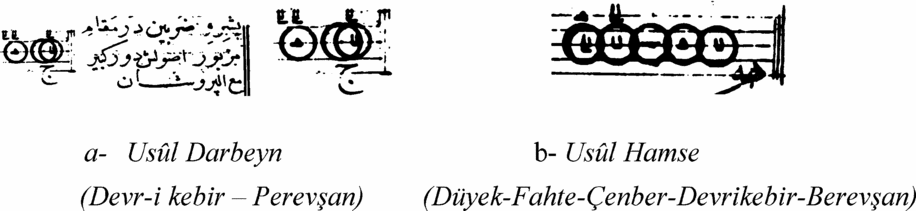
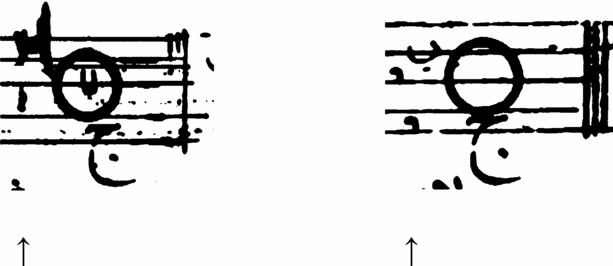
In ALU notation, above the key signature were the usûl circles and inside them were usûl numbers or signs. Various usûls were presented both by their names and by symbols and numbers written in usûl circles in order to denote them.
Representation of Usûls in Mecmûa-i Saz ü Söz.

Representation of Usûls in Mecmûa-i Saz ü Söz.

Haydar Sanal, the Turkish music historian and theoretician, claims that the signs used in representing usûls were modelled on the siyâkat script used by the Ottoman State in official correspondence. Intersecting circles or circles in a row were used to denote the darbeyn usûls produced by combining two or more usûls.
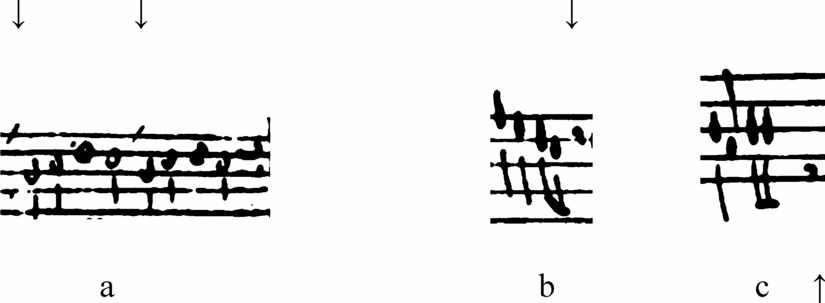
In Ali Ufkî's arguments relating to usûls two approaches influenced by western music stand out. The first one is the recording of four-unit rhythm structures in some pieces as compound duple time with the use of sebare (alla breve) sign and the second one is the recording of three-unit beats as compound triple time. Both of these practices were additions to the classical Turkish music usûl doctrine, and were subject to western influence.
a) Alla breve, b) compound triple time (3/3).

Various titles used in ALU notation are of importance in
getting to know the forms of vocal and instrumental
pieces. These forms include peşrev, saz semâîsi,
murabbâ, güfteli semâî, şarkı, türkü, varsağı,
ilâhî, tesbîh, raksîyye, yeltme, oyun, tekerleme,
cenk havası. Furthermore, the instrumental
pieces (peşrevs and
semais [instrumental prelude and
postlude forms]) were subdivided and these divisions were
assigned subtitles such as “ser hâne”
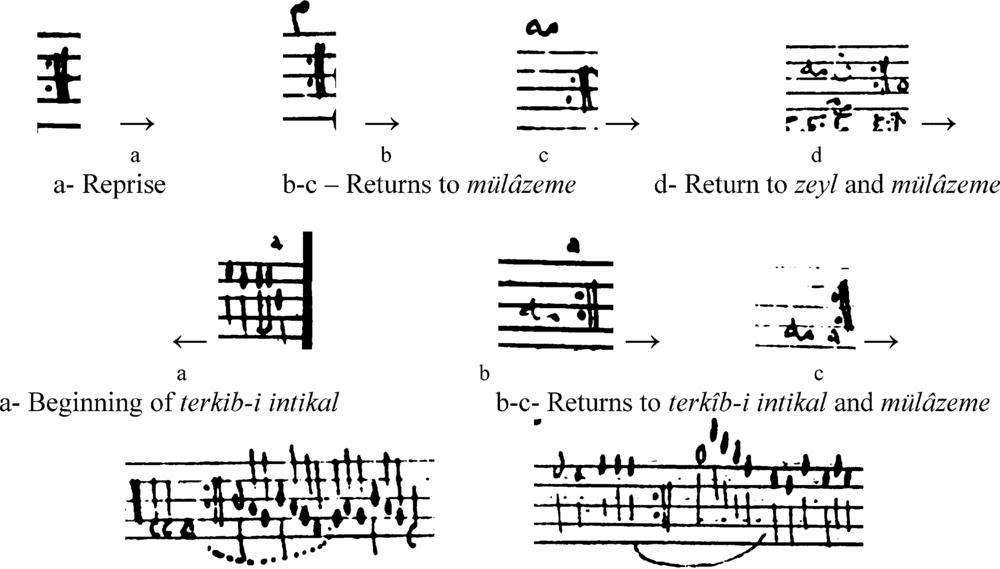
(introduction), “mülâzeme”, “hâne-i
sânî” (the second section), “hâne-i
sâlis” (the third section),
“zeyl”, and “serbend”.
These subtitles were utilised to represent the parts of
each piece and their order of performance in relation to
one another. For instance: mülâzeme
( or
 ) and is the part repeated after
every hâne (section);
zeyl (
 ) (literally meaning postscript or
supplement) is existent only in peşrevs
of Darb-ı Fetih usûl. The sign
( or ) placed at the end of each
hâne means a return to the
mülazeme; while the sign
(
 ) means that first the
zeyl and then the
mülâzeme should be played. The sign
(а) marks a melody as the
terkîb-i intikal (transformational
combination). The sign () put especially after the 2nd and
the 3rd hânes, signifies that first the
terkîb-i intikal and then the
mülazeme should be performed before
reaching the karar (pause). Reprises were
frequently used as repeat signs and they were points of
repetition mandatory to the completion of the
usûl structure in certain cases. On
the other hand, it was possible to perform 1st and 2nd
dolaps (multiple ending repeats) by
way of reprises. The 1st and the 2nd repeats were not
marked on the staff with numbers but the melodic piece
standing for the 2nd repeat was tied to the note after
which it would be played by a slur. It was explicitly
assumed that the part not performed in the second turn was
the 1st repeat.
Words denoting the parts of a musical piece in Mecmûa-i Saz ü Söz (subtitles).

Returns in Mecmûa-i Saz ü Söz.

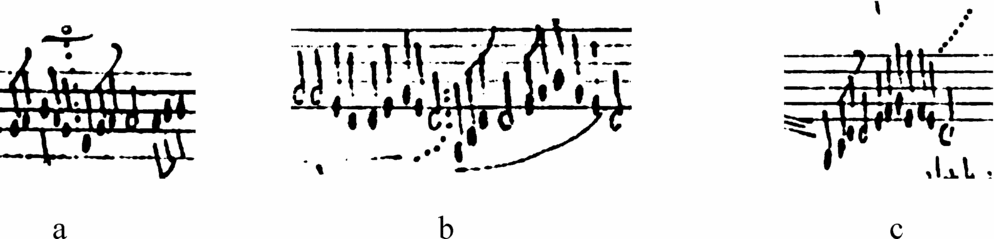
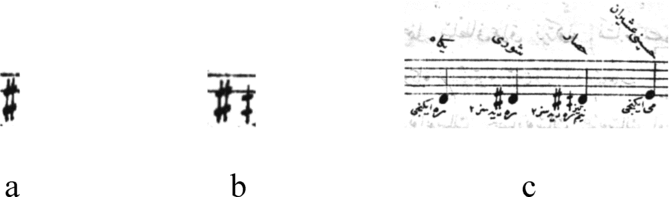
ALU notation also made use of armure and alteration signs,
utilising both ‘letters’ and accidentals in this respect.
Ali Ufkî used ( ) or (#) signs to represent sharps
and the letter (
 ) or the signs
(
 ) to represent flat. Though he did
not provide an explanatory note on the intervalic values
denoted by the accidentals he has used, it goes without
saying that the musicians versed in makam
structures, scales and melodic progression, would surely
have read the right meaning into them. The alteration
signs were either written on bar as accidentals or letter
representations or were shown on reprises. A third way of
representation was the marking of the changes in melodic
progression over the notes. The letters that define the
sounds of scale in the comparative sound table above, also
functioned as bekar (natural) signs (◼).
These letters written on the spot belonging to a sound on
the staff, signified that the sounds previously altered by
accidentals or letters were to be restored to their
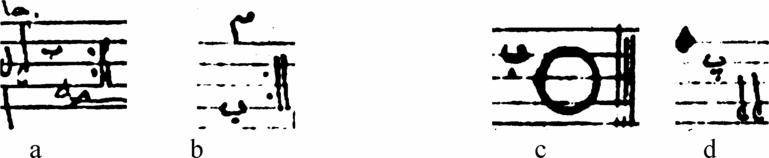
elementary/natural state. For instance: The letter
() placed on the “e” line makes the
sound half a tone lower; while the letter
(
 ) – the symbol of the sound in the
normal scale- put on the same line at a later point in the
melodic progression, takes on the function of
bekar (natural) sign (◼) and
returns the altered “e” sound to its original state.
Accidentals and letter alteration signs on bar.

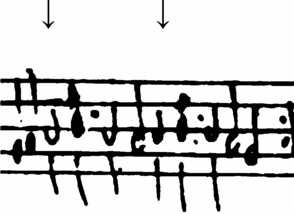
The use of alteration signs in lahin
(melodic progression) to create enharmonic intervals was
also observed. Although in the melodic piece reproduced
below, Nevâ and Beyâtî
pitches in Uşşâk makam were written as “g
#” one after the other to produce a chromatic visual
impression on “g”, it should be kept in mind that the
accidental here had the function of creating not a
chromatic but an enharmonic interval (enharmonic “a”
 ).
(a,b), Alterations in subsections. (c,d), Flat and natural in “e” sound.

Alterations in melodic progression.

Creation of an enharmonic interval with the use of sharp sign.

The note values in ALU system are as follows (in descending
order): 1) Çiftbirlik (breve)
( ) note; 2) Birlik
(semi-breve) (●) note; 3) İkilik (half)
(♒) note; 4) Dörtlük (quarter) (❑) note;
5) Sekizlik (quaver) (⑯) note and 6) the
dotted values of all except the quaver. In ALU notation
only half and quarter rests are encountered. On the bar of
the pieces that included rests, along with the key
signature, accidentals and usûl signs
(time signature), also the “rest values” were marked, so
as to draw the attention of the musician. Ali Ufkî used
(/) sign for half and (7) sign for quarter
rests.
Şekil a) Big value notes, b) Small value notes, c) Dotted notes, d) Quaver notes.

Half and quarter rests marked on bar.

a) Half rests, b) Quarter rests in melodic progression.

Ali Ufkî devised certain signs to complete – or to wish completed - melody pieces and note values that he had inadvertently left out. To this end, he appended the missing part at the end of the piece in question and marked with a dotted curve sign the place where he wanted the part to be inserted.
a-b). Missing notation, c) Melody piece needed to be inserted in the missing part.

There were two kinds of tie signs in ALU notation. The first one was of the kind called the slur and facilitated the perception of the notes written without value lines as rhythmic groups. The second one was of the kind called the extension tie, which elongated notes in value.
a) Slurs, b) Extension ties.

The (∼) sign placed either on lines or on spaces at the end of a staff line, functioned as a remainder, which showed the note that would begin the next line.
Representation of the first note of the following line.

The Fermata sign was put at the end of both the sentences and the piece, and writing the word temmet (literally meaning the end) specified the end of the piece.
Fermata signs and the word ‘temmet’.

To make the lyrics coincide with the notes in accordance with rhythmic and melodic structures in vocal forms such as murabba, sözlü semâî, varsağı and türkü accounts for the most complicated aspect of deciphering ALU notation. The reason for this difficulty is that the lyrics were not written under the notes in a form that made each syllable align with the note to which it belonged, but were rather supplied as a block text at the end of the notation. During the transcription of these notations, the correct placement of the poems according to aruz syllabic meter and to the rhythm and the melody and in keeping with the rules of pronunciation requires long and careful work. Furthermore, keeping in mind that transferring the note values in ALU notation by reducing them by half in transcription might create misleading results in terms of metronome values, utmost effort should be put forward to determine correctly the tempo/pace dictated by ALU notation text. While transcribing ALU notation written with first line ‘do’ clef into western notation, which is used to notate Turkish music in our day and uses staff with ‘sol’ clef, the notes are transposed one whole pentachord up. The sounds and the intervals created in this transfer are different from the real frequencies represented by western notation. They are rather transferred to a relative frequency transpositional notation, which is an issue that will be studied in more detail below, in the part entitled “Writing Turkish makam music with western notation”.
Examples of Notation Recorded by the Foreigners who visited Ottoman Countries
The information pertaining to the musical life of the Ottoman Empire - among other facets of daily life - recorded by European ambassadors, translators, men of religion, painters, and travellers, who visited Ottoman lands for various purposes at various points in time from the fifteenth century, provides valuable material for musicology. This accumulated written material comprises observations, reflections, feelings and judgements on several issues such as Turkish musical instruments, makams (modes), the tradition of fasıl (a concert programme all in the same makam) performance, the Mevlevî âyîn (ritual) of whirling, the behaviour of instrument players and singers, etc. Some of these memoirs, letters or travel accounts contain notation examples for introducing the Turkish musical pieces of the time. These texts also provide the oldest examples of Turkish music written in the western notation of their time. Among the Europeans who visited Turkey and left their marks on Turkish musicology are: Bertrandon de la Brocquiere (died in 1459), the counsellor to Philippe, the Duke of Burgundy; J.A. du Loir (seventeenth century); Dr John Covel (in Istanbul between 1670–79), the priest of the English embassy; Giovanni Battista Donado (in Istanbul between 1680–84), the Venetian ambassador; Charles de Ferriol (in Istanbul between 1699–1711), the French ambassador in Istanbul; dragoman (translator) Charles Fonton (in İstanbul between 1746–53 and in İzmir between 1774–78); Baron de Tott; Lady Montague (1689–1762), the wife of the English ambassador in Istanbul; Charles Henry Blainville (1711–1769); Lady Elisabeth Craven, who spent three months in Istanbul in the year 1786; Priest Giovanni Battista Toderini, the author of the three volume work entitled Letteratura Turchesca, published in Venice in 1787; P. Lichtenthal, the writer of a music dictionary; Bourgault-Decoudray; A. Bacolla (in Istanbul in 1911); and Antuan Murat. (MRG/tamm; CF/18ytm/CB; BA/aggom)
The oldest piece of Turkish music notated and published by a foreigner was a mehter havası found in seyahatname (travel book) written by a Protestant priest named Salomon Schweigger (1551–1622), who went to Turkey in 1571 and stayed for four years.
Salomon Schweigger, ‘mehter havası’ (BA/aggom, 380.).

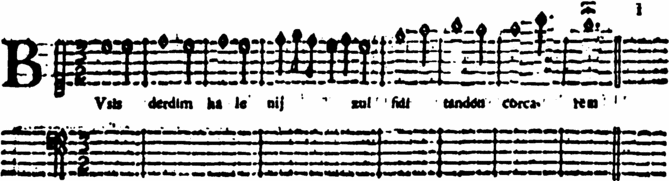
Giovanni Battista Donado, the Venetian ambassador in Istanbul between 1680–1684, reproduced three pieces of Turkish music (two şarkıs [songs] and one piece in big format) in his correspondence with his brother, which was later published. Donato wrote the notes of these three pieces on staffs with first line ‘do’ clef. (BA/aggom, 79.)
The introduction of one of the pieces notated by G. B. Donado (BA/aggom, 383.).

Charles Fanton, who presented his observations of and reflections on the Turkish makam (modal) music in his work entitled The Eastern Music: An Essay on its Comparison with the European Music, wrote down some pieces of contemporary Turkish music in notation and included them in his book.
The introduction of a piece notated by Charles Fonton (CF/18ytm/CB, 100.).

The views voiced by the foreigners, who collected pieces of Turkish in notation or tried to perform those pieces with reference to notation, are of importance in observing the relationship between Turkish makam music and western notation. In this regard, the following statement of Charles Fanton about the notation of pieces of Turkish music is worth attention: “Even if it was possible to record a piece in notation in reality this piece when performed by a European would be unrecognisable to an Oriental. Because one needs to add to every single note, every single sound, the Orient's special flavour and that can only be done by those who have mastered this music. These pieces, when performed in the way they have been notated, become unrecognisable and lose all their ornament and flavour, their peculiar taste”. (CF/18ytm/CB,65.) A similar argument on the same issue can be seen in the following statement of Antuan Murat: “It is hard to make sound judgements about things, to which one is not accustomed or on which one does not have sufficient knowledge. Certain sounds regarded as false notes by the European theorists, are very important and definitely necessary for the Turkish scale. In just the same way, ‘fa’ and ‘si’ pitches in the diatonic scale of the European musicians cannot be integrated into the Turkish scale without making this scale false and terrible”. “One, whose ear is accustomed to perceiving the essence of both tonalities, can distinguish the useful points of each without difficulty. He realises what makes each an entity in its own right. Sometimes I want to try playing a Turkish melody on the piano. The ‘si’ and ‘fa’ pitches of the instrument totally disrupt the quality of the piece; my ears find themselves in real agony. For the same reason, I could never succeed in playing an Italian melody on a Turkish tanbur (the long necked lute), for the tonal systems are irreconcilably in contrast”. (A.d'Adelburg, Aesthetische Rundschau, 1867, “Einiges über die Musik der Orientalen insonderheit über das dominirende persisch-türkische Tonsystem) (MRG/tamm, 47.)
In his writings Râûf Yektâ Bey examined attempts by foreigners to write down Turkish music and made the following statement: “Up until now, many foreigners have tried to express the Turkish scale in European sounds. Yet their comparisons have all been more or less flawed. Priest Toderini was the one who came closest to the truth in this regard”. (RY/tml, 59).
The introduction of the Hicaz semâî notated by Priest Toderini (BA/aggom, 394.).

The Applications of Western Notation in Present Day Turkish Makam Music
The practice of rendering contemporary Turkish makam music in western notation can generally be examined in two main phases. The first phase consists of the period from the foundation of Muzika-i Hümâyûn (the imperial military band) (1828) to the official adoption of the new Turkish alphabet of Latin origin (1928); the second phase is from 1928 onwards. Various technical arrangements have been undertaken, proposed and practiced at various points throughout these two phases, in order to best represent makam music in western notation in accord with disputes within Turkish makam musical theory.
The European notation (western graphic notation) was developed over centuries in accordance with the requirements and the findings of tonal music theory and arrived at a point of expressing that music conclusively. With the adoption of this system for Turkish makam music, naturally the differences between tonal and modal music surfaced. Primary among these differences was the fact that while western notation represented the sounds of tonal music in terms of constant frequencies (due to its reference instrument, clavecin bien tempere, the piano), makam (modal) music pitches could not be expressed with such conclusiveness. Salih Zeki Bey, who was a pioneer in the field of physics and mathematics of music in Turkey, drew attention to this fundamental difference: “Though nowadays the Ottoman musicians refer to the pitches with the names ‘do’, ‘re’,. . . it is very easy to show that these notes do not coincide with the pitches of the Oriental music”. (SZ/sm, p: 26.) This fundamental difference stems first and foremost from the fact that while the first adaptations of western notation to makam music system were being undertaken, the precision of the frequencies of the scales represented by the graphic notation and the functional precision performed by the makam pitches in defining makam music were not reconciled. On the theoretical level, it is difficult to define makam music, which is a kind of open ended music, with data obtained from the “tonal music system”, which at a certain point determined the position of its sounds in relation to each other and, after passing through a phase of temperament, definitively defined its sounds. This irreconcilable data derived from these two systems keeps the debate on “compulsory coexistence” alive. In other words, makam's musical system has not succeeded in revising its own internal structure in a healthy way and reshaping its methodology in line with the fundamental cultural changes which it has undergone and thus has been caught unprepared by western notation. Thus Turkish musical thought during the last century was dominated by a debate of “authentic culture versus counter culture” between the practitioners of makam music and practitioners of western music, as well as a debate of “tradition versus future” (or “old versus new”) and even of “right versus wrong”, “old theory versus new theory” among the practitioners of makam music themselves. With the commencement of notating makam music in western notation, the issue of the methodology to be followed in describing makam music came forward, as an extension of the fundamental difference discussed above. This question of methodology comprises: the major scale; the determination of the note on staff, with which the notation of scales in relation to that major scale will begin (that is, the determination of the frequency of the basic note); whether it was necessary to use more than one key signature; whether the pitches of esâsî süllem (the major scale) of the classical makam doctrine, which were regarded as whole pitches, would require alteration signs when represented in western notation; the number of pitches contained (or needed to be contained) in the makam system; the determination of the smaller intervals other than the tone majeur and the tone mineur; the signs to be used for representing these microtonal intervals in notation/on staff, all in the light of the concepts such as tone, comma and cent that necessarily follow from western notation literature; whether makam music needed bars and if it did, the ways in which to arrange them; the notation of usûls (rhythmic patterns), especially big usûls, which are fundamental to modal music, on bar or in melodic line and in relation, the issue of values; whether the ornamentation elements, which are among the most fundamental features of makam music (a monodic modal music with the quality of heterophonic performance) could be represented in notation; the questions pertaining to the transposition of the makams to other pitches. In addition problems that arose from the use of graphic western notation in makam music, projected themselves into debates about methods of education (such as the study of theoretical knowledge, the study of makam reading and usûl beats (modal solmisation/dictation/decipheration), vocal and instrumental training, the study of composition, the creation of the principles of performance, the conduction of ensembles, etc.). These problems were (and to a large extent still are) in need of reflection and resolution. Naturally, from its start up until today, important experiences have accumulated in the field of notating makam music in western notation, which at the least, led to the observation of the ‘possibilities’ and the ‘problems’ (and in some cases, even to the resolution of certain issues). Yet on most of the issues discussed above, normative and definitive resolutions are awaited. As was alluded above, the main reason for this was, and still is, the inability to systematically combine the method of western music with the knowledge and the elements of makam music in a complete education based on objective criteria.
The First Encounter with the Western Notation
The first teachers at the Muzika-i Hümâyûn consisted of a handful of musicians, who had worked in mehterhâne (the musical branch of the Janissary force) using the traditional meşk method based on memorisation. This small cadre started work immediately after the 1826 revolution, initially under the administration of the Frenchman Manguel and then, soon afterwards, under the direction of Maestro Guiseppe Donizetti. Western notation was systematically taught, for the first time in Turkey, to this cadre by Donizetti. He started off by learning Hamparsum notation, which he realised to be widely used among musicians, he then devised the equivalents to the pitches of this notation in western notation. Thus the use of the western notation in Turkey began with the learning of western equivalents to the notes of Hamparsum prepared by Donizetti and by the musicians working in the Muzika-i Hümâyûn.
Western note equivalents of Hamparsum notation prepared by Donizetti (Donizetti's handwriting, detail, MRG/tamm, 103.).

Donizetti and his assistants, who made great efforts to turn the Turkish musicians with traditional training into well-skilled members of a court band, succeeded in teaching these musicians European notation in a perfect manner with the methods they applied. Yet the use of western notation remained confined to this segment of society and the work they did. This knowledge of notation was not transmitted to the civil music education. Furthermore, a dichotomy ensued in the practice of music within the court itself. A renowned poet and composer of the time, Leylâ Hanım voiced this situation in the following manner: “The Western music was taught by notation while the Turkish music by ear as it is customary”. (Leylâ Saz, Hâtıralar [Memoirs].) It took another sixty years for the first teaching primer representing Turkish music in western notation to be written.
The Presentation of the Western Notation as the Writing System of Turkish Makam Music with the Adaptations of Notacı Hacı Emin Efendi
Mehmet Hacı Emin Efendi, known as Notacı Hacı Emin Efenti, was one of the notation teachers in Muzika-i Hümâyûn during the reign of Abdülhamid II. Emin Efendi is known to have produced the first notation publications, though the fact that these works were for accompaniment by the piano created an obstacle to their reception by Turkish makam music circles. For this reason, Emin Efendi wrote a treatise entitled Nota Muallimi (The Notation Teacher) (1884) to argue and prove that it was possible to apply European notation to alaturka (Turkish style) music and that it would make musical training easier and described the technical qualities of the European notation in a style that specifically targeted the alaturka musicians. This publication marked a turning point for the use of European notation in Turkish makam music. In this treatise – for which he sought the supervision of two famous musicians versed in European notation, Leon Hanciyan and Rif 'at Bey-Hacı, Emin Efendi stated that since the assignment of the Italian musician Donizetti to the post of the head of Muzika-i Hümâyûn by Sultan Mahmud II, only the band musicians had been learning European notation. He argued that elsewhere musical education was conducted either in the alafranga style or the Turkish style. Those who followed the alafranga style were members of the imperial band and the foreign music tutors training certain notables in music. Though the band members played arranged alaturka pieces along with western musical pieces with success, foreign music tutors forbade their pupils to perform alaturka pieces, even from notation, on the grounds that it would ruin their lips and hands. According to Emin Efendi, since the Turkish musical training depended on “memorising modal pieces by ear with düm-tek style”, what was learned could easily be forgotten and that elongated the training period. Since the length of this training time suited the material interests of the tutors, they slandered the use of European notation, which they thought would imperil their interests, to their pupils. Hacı Emin Efendi explained in length this socio-cultural situation and lamented that the publication of notation education designed to fulfil the needs of the common folk who wanted to learn music, had not already happened, even though western notation had been in use for almost 60 years.
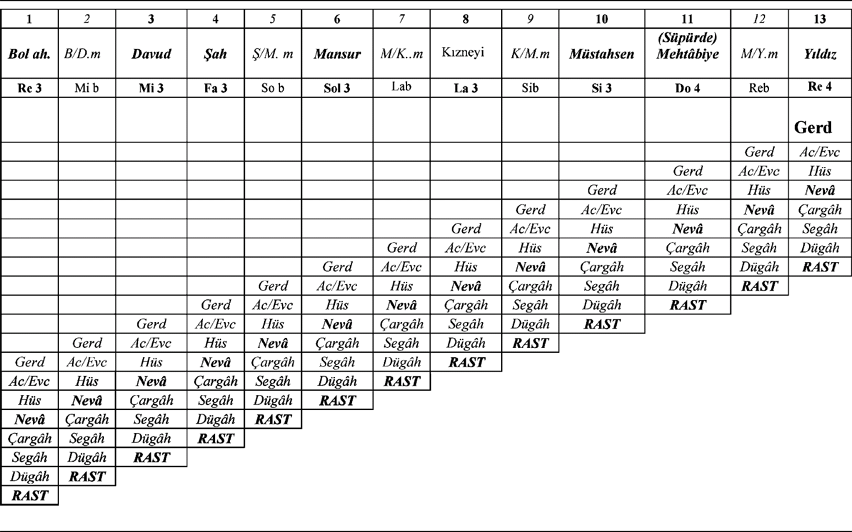
The treatise Nota Muallimi comprised the subtitles “the definition of notation”, “the advantages of notation”, “the history of notation”, “the necessity of notating music”, “the conduct of certain music pupils” and “the ease of learning notation” and it was the first publication providing the equivalents of the makam pitches in western notation. The western notes assigned to the Turkish makam pitches by Emin Efendi were those that had been selected to fit the pitches in Hamparsum notation by Maestro Donizetti. In the determination of these equivalents, one cannot trace a detailed technical method, which would have tried to guard all the requirements of makam music. The determining motive was the transference of the pitches, in use in the makam music system of the day, immediately into western notation in an empirical way. As a result of this transference by Emin Efendi (and of Donizetti), ümmülmakaamat (the major makam/gamme naturelle), that is the Rast makam scale, was transposed one pentachord up, in a way fitting the bolâhenk nısfîye accord system of ney (the flute) and was written from ‘sol’/g note (the fifth sound in the ‘do’ scale of the western notation) on the second line of the staff. Consequently, Çargah pitch, which is the 4th pitch of the Rast makam scale, corresponded to the ‘do’/c sound (the first sound in the ‘do’ scale of the western notation). Accordingly, although they seemed to be sharing the same notation, right from the start, there was a difference of a tetrachord transposition between western music notation and the makam music notation. Emin Efendi provided the equivalents of the whole and half sounds within four octaves in terms of makam music pitches and enumerated sixteen pitch names in an octave between ‘do’-‘do’.
Notes and Pitches in Hacı Emin (NHE/nm, 55, RA/arch.).

Hacı Emin Efendi added a half-sharp to the sharp (diesis) for the nim (half) pitches and provided only the sharps of the pitches in an octave. It remains a question why he did not record the flats of these pitches.
The first alteration signs in Nota Muallimi. a) Diesis, b) Nim diesis, c) Yegâh/Şûrî/Hisar/Hüseynîaşîran pitches.

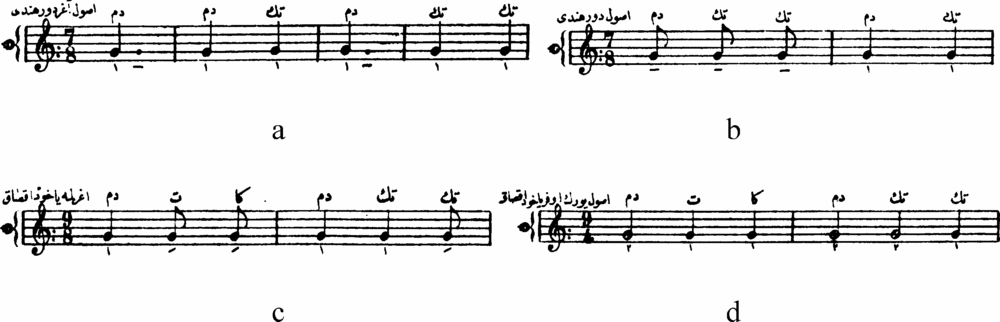
In the notation of the makam music usûls, Hacı Emin Efendi did not preserve the usûl structures bigger than quintuple and compound duple as a whole in each measure, but rather divided them into the smallest pieces possible.
The notation of septuple (a-b) and compound triple (c-d) usûls in measure.

With the transmission of this basic knowledge into musical circles, western notation began to be widely used in training, practice and most importantly in publishing makam music in notation form. During this phase of active publication, since modern scientific works on makam music theory had not materialised, makam pitches were used to a large extent in accordance with the definitions of Emin Efendi. Yet when the publications of the period are examined, it is accepted that in the notation texts the alterations in makam pitches were more and more frequently represented with only the use of a sharp, a flat, or a natural and the performers began to depend on the title of the works (such as Hicaz Peşrevi, Kürdilihicazkâr şarkı, Sabâ saz semâîsi), which by way of referring to a makam, also connoted a melodic progression, in order to understand the notes referred to. This, in time, led to unending disputes among musicians as to the nature of the alterations in makam pitches in any given piece, much in the same way as it has been in the meşk system.
New Studies in the Field of the Turkish Makam Music Theory and Their Reflections on the Notation System
The 1900s was a time of change and innovation for Turkish music. It is necessary to examine these years thoroughly in terms of institutionalisation, the efforts to make use of developing technical possibilities and the initial scientific works on makam musical theory. Of primary importance was the creation of societies devoted to civil musical needs (eg the Mûsikî-i Osmânî Cemiyeti [The Ottoman Music Society] founded in 1907 by Muallim İsmail Hakkı Bey with the purpose of propagate musical education and notation publishing) along with the official institutions affiliated to the court (such as Muzika-i Hümâyûn and the court music school). There was a rapid spread of the musical work facilitated by voice recording technology. Numerous music companies were founded, which recorded the performances of various artists and groups including Tanbûrî Cemîl Bey and cooperation developed with the European recording industry. As a result notated music was published (the publication of note editions such as Mâlûmat, Şamlı İskender and Müntehâbat is significant).
The year 1914 marked another milestone in Turkish music history. The first civil music school (conservatoire) of the country, Dâr'ülelhân (literally meaning the house of melodies), which aimed at the scientific study of makam music along with that of tonal music, was founded; it included a Drama Department and departments for both Western and Turkish music. Within this institution for the first time makam music became an object to be studied in a systematic programme which included makam knowledge, the vocal and instrumental repertoire and the study of the performance of instruments. Many famous masters found they were able to bring together their independent studies and to share them with their students. Among the masters of the time were elite performers, composers and theorists such as Tanbûrî Cemîl Bey, Muallim İsmail Hakkı Bey, Ûdî Nevres Bey and Raûf Yektâ Bey. Beginning with Dâr'ülelhân, the data utilised in the field of education came to be represented in a systematic fashion with notation and in writing. Effort was directed to education and publication, especially the works of Tanbûrî Cemîl Bey and Muallim İsmâil Hakkı Bey on performance and theory, which have retained their influence up until the present.
Finally in the 1920s, Turkish makam music theory began to be re-interpreted with reference to the methods of modern musicology and was systemised. The author of the first scientific works dedicated to the presentation of the makam music theory as a system with clearly defined principles and elements, was Raûf Yektâ Bey, who was a composer, a ney player and a musicologist. He had augmented his knowledge of sound physics with the contribution of Salih Zeki Bey, a famous physicist and mathematician of the period. The monograph entitled La Musique Turque (The Turkish Music) that Raûf Yektâ Bey wrote in 1922 for publication in the Lavignac Music Encyclopedia, was the first study in this field, written to present the history and the theory of the makam music to the international musicology community. While codifying makam musical theory, Raûf Yektâ Bey naturally kept the issue of the method of writing this music on his agenda. In 1916, he wrote: “we, the Turks, have chosen a strange thing such as writing our language from left to right, by way of accepting the western notation as it is”. It is known that he had proposed a method of notation combining ebced and letter/syllable notations under the name of millî nota (national notation) as an alternative to the use of the western notation (which he had deemed strange) in writing makam music, but without much effect. The idea and the approach of notating Turkish music with a notation system of national or modal character instead of European notation, had been suggested before Raûf Yektâ Bey by a commander of Muzika-i Hümâyûn, Necîb Paşa but again without significant success. “Recently, the Divisional General of Muzika-i Hümâyûn, Necîb Paşa saw the deficiency of the European notation in recording Turkish music and with due respect tried to invent a notation system more fitting to our needs, but he could not succeed totally. Thus his work did not circulate and spread among the experts”. (RY/kmd.)
The question of the reasons behind western notation's deficiency in recording Turkish makam music with due respect has not been resolved since the days when it had occupied the minds of Necîb Paşa and Raûf Yektâ Bey, leading them to seek alternatives and make propositions. At the root of this lay reasons that originated from three distinct spheres: cultural, psychological and technical. First, with respect to culture, it is known that western notation had come to the country as an element of counter-culture affected by radical decisions. Second, the politicised manner of its adoption had triggered psychological defence mechanisms on the part of musicians, leading to the conviction that western notation was hard to master and that the discrepancy between the writing of music and a spoken description of the process pointed to a ‘strangeness’. Finally, there were the deficiencies caused by the notation of makam pitches with a small number of notes/signs that were inadequate in representing them. Altogether the “indignation” felt by musicians as a result of such a fait accompli could be sensed. The concern and sensitivity over the sudden or gradual loss of a “very special world of sounds”, which had been inherited from their ancestors and distilled through centuries, led to western notation being made a scapegoat, while that sense of indignation constantly grew and, since indignation is a subjective feeling, it caused reasonable solutions to be rejected. At this point it is useful to underline a “paradoxical situation” in order to obtain clues as to why this question could not be resolved during such an extended history. 1. Notation has to be the easiest vehicle for writing down music, performing what had been written while remembering what had been memorised. 2. Notation should make possible the definition of sounds within the system with clarity and the performance of such defined sound without doubt (the unity of theory and performance). 3. While doing these, notation should leave no element out and answer all questions. 4. Finally, the alteration signs used to obtain the multitude and variety of the pitches of the makam music, have to be big enough in number to account for that multitude and variety, yet small enough in number as to facilitate their writing down, decipherment and practical performance; thus notation should cause no difficulty to musicians with regard to either its signs or other elements. This was tantamount to demanding that a notation system for makam which is a bundle of problems, became a ‘garden of roses without thorns’, unrealistic demands frequently damage the process of systematic thinking and problem-solving.
In this difficult period, when efforts were made to transform
the European notation into a practical notation system
without undermining the characteristics of Turkish
makam music, frequent disputes
between the performers, who voiced the problems, and the
theoreticians, who tried to solve them, were commonplace
(for instance: the dispute between Tanbûrî Cemil Bey and
Raûf Yektâ Bey). In the course of these polemics, which
were reflected in the Istanbul press, even those
intellectuals and writers who did not specialise in music
wrote critical pieces with the conviction that the
problems pertaining to musical theory and notation
emanated from music theorists. In the first years of
Dâr'ülelhân, under the shadow of
such disputes, composers could not assess with any
precision correct notation (especially the alteration
signs to be used to represent the pitches peculiar to
makams) and tended to select the
signs they used according to their own
makam understanding and foresight.
This situation is clearly exemplified by the following
quotation taken from the introduction of the work of
kanun (zither) player and composer
Hasan Ferid Bey, On Saz Semaisi (Ten
Instrumental Postludes): “On the signs used in this work:
 = Bu'd-ü irhâ
bemolü (flat for irhâ);
 = Bu'd-ü bakîye
diyezi (sharp for
bakîye/small half tone). For instance,
since the Çargâh makam is adopted as
gamme naturelle,
 = Segâh and
 = Pest Hicaz.
Though it is not right to present the
Segâh pitch with these signs given
that it is performed lower than Uşşâk,
Sabâ and Karcığar, around
which it stands in terms of descent, I am forced to use
the same sign for representing both the
Segâh pitch and its transposed
counterparts in other makams, be they in
ascending or descending form, until they are determined by
Dâr'ülelhân. Hasan Ferid”.
The following points concluded from the words of the young composer Hasan Ferid display the deficiencies and problems which arose and emphasises the importance of: 1. The quality and the quantity of the alteration signs, 2. The definition of the microtonal intervals along with the whole and the half tones, 3. The question of gamme naturelle, 4. The intervalic structures of makams such as Uşşâk, Sabâ and Karcığar, which provide exceptions to the makams of major and minor character and demonstrate peculiarities that account for the labyrinth-like nature of the makam music, 5. The inflections of the microtonal intervals, such as the Segâh pitch, within ascending and descending melodic lines (getting higher and lower/fickle pitches), 6. The appearance of the counterparts of the microtonal intervals thus inflected in the transposed makams (the place of the intervals in the accord system). To these can be added several more subtitles, such as: the elimination of pitch-note differences in line with constant diapason tuning; the determination of whether different key signatures should be used in notation; the foundation and classification of the makams and the question of the transposed makams; the representation of the alterations of the augmented second within makams that use this intervalic structure, as well as the alterations of other microtonal intervals; the determination of the structures and the metronome values of the usûls with clarity and their representation in notation; the classification of the ornamentation signs and their representation in notation, etc. Above all these problems looms a more fundamental question, which not only includes these problems but also proves a prerequisite for their resolution and that is the representation of the sound system of Turkish music in a clear and distinct way.
The issues stated above exposes the level of the interconnectedness of notation and music systems; better put, the notation system provides the external facade of the musical system it is used to notate. Taking this as their point of departure, throughout the twentieth century theorists have produced a number of works devoted to defining the foundations of the sound system of Turkish music by reference to the historical facts and physical methods. As a result of these studies, each theorist claimed the sound system of his creation to be the ‘real’ sound system of Turkish music in a manner that modified or even altogether dismissed other systems. Every sound system proposed naturally brought its own method of notation along. In this stage, it was apparent that Turkish music had been reconciled with western notation but was trying to adapt and modify it, especially with new proposals on the alteration signs.
The statement “until determined by Dâr'ülelhân” taken from the words of Hasan Ferid Efendi quoted above, underlined the expectation that Dâr'ülelhân should play an active role in producing definitively the alteration signs to be used in notation. Many musicians shared such expectations pertaining to “the necessity of the existence of an ultimate musical authority to say the final word in notation and related issues”. It is possible to further infer from the statements of Hasan Ferid that no such production had materialised by the time of the termination of the study of Turkish music in Dâr'ülelhân in the August of 1926 and that divergent ideas about the music system had prevailed in musical education conducted there till that date. Hasan Ferid was a private pupil of Hüseyin Sadettin Bey, composer and musicologist. Thus he reflected his teacher's conviction that “the gamme naturelle of Turkish makam music is the Çargah scale” in his statement quoted above. It is probable that there were Dâr'ülelhân students who subscribed to an alternative conviction that the gamme naturelle of Turkish makam music was Rast with the influence of Muallim İsmâil Hakkı Bey and Raûf Yektâ Bey. Given this situation, various conflicting assumptions about musical theory were unavoidably preached by different personal authorities. The first response to the expectation of the necessity of changing the nature of the musical authority from a personal to an institutional one to put an end to this disorder, came with the assignment of Raûf Yektâ Bey as “the head of the scientific committee” to Tesbît ve Tasnîf Kurulu (the Committee of Establishment and Classification) founded for conducting research on Turkish music in Dâr'ülelhân (1926). From this date until the death of Raûf Yektâ Bey, the signs and notes belonging to the theory and the sound system preached by Raûf Yektâ Bey were in use in the extensive notation publications aimed at the spread of the classical Turkish music repertoire, led first by Dâr'ülelhân and later by the Conservatoire of the Municipality of Istanbul.
Western Notation in Turkish Music with the Interpretation of Raûf Yektâ Bey
Raûf Yektâ Bey established the Rast scale as the gamme naturelle, which he described as “the ordered form of the natural sounds that provide the basis of a music system”, and he placed this scale at the centre of his theoretical explanations. In the matter of notating Turkish music with western notation, he began his arguments with discussing the questions of the sound from which to begin and the way in which to notate the Rast scale: “Having thus established the natural sound that made up the gamme naturelle of the Turkish music, we are faced with a second question and it is this: What are the real frequency levels of these natural sounds in terms of amplitude? How are these sounds to be written in the alafranga notation that we have adopted from the Europeans and begun to use after performing the necessary modifications and additions?” (RY/tmn, 59.) In his monograph entitled La Musique Turque, written in 1919 and published in the Lavignac Music Encyclopedia in 1922, Raûf Yektâ Bey, following the tradition, presented the Rast scale and consequently all the other makam scales in accordance with the arrangements of Donizetti/Hacı Emin Efendi, that is with the transposed scale. In his unfinished book entitled Türk Musikîsi Nazariyatı (Theory of Turkish Music) that he started publishing in parts in 1924, he discussed this issue in greater detail and emphasised the necessity of notating the Rast scale by beginning at ‘do’3 sound and even of playing Turkish music instruments in accordance with the changes in clef when necessary. Yet Raûf Yektâ Bey, who appears to have been a real reformist with his ideas and proposals in this work, never brought forth or put into practice his ideas about the modification of the notation system during a series of publication works that he conducted in Dâr'ülelhân. The real motivation behind this still begs for an explanation but it was most probably the restraint of the tradition.
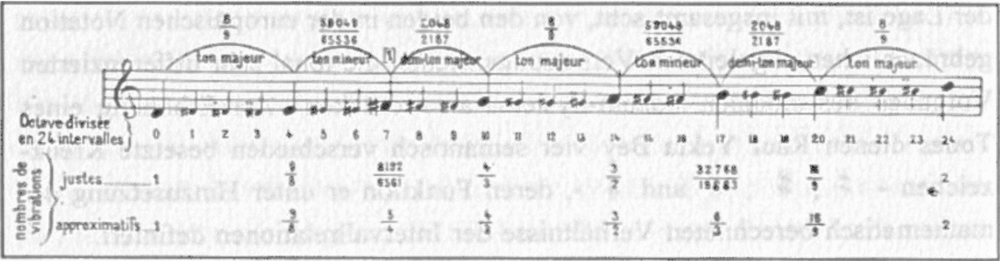
According to the monograph of Raûf Yektâ Bey entitled Türk Müziği (The Turkish Music) written in 1913, the Turkish scale was the diatonic major scale that Fârâbî had taken from the Ancient Greeks and which had been preserved without any change by Arabic, Persian and Turkish theorist and musicians. The esas (essential) and ârızî (contingent) sounds in this scale were as follows: [1] yegâh/[2] nimkabahisar/[3] kabahisar/[4] dikkabahisar/[5] hüseynîaşîran/[6] acemaşiran/[7] dikacemaşiran/[8] ‘arak/[9] gevaşt/[10] dikgevaşt/[11] rast/[12] nimzengûle/[13] zengûle/[14] dikzengûle/[15] dügâh/[16] kürdî/[17] dikkürdî [18] segâh/[19] pûselik/[20] dikpûselik/[21] çargâh/[22] nimhicaz/[23] hicaz/[24] dikhicaz/[25] nevâ. In this system founded on ‘re’, the three kinds of existing intervals were named tone majeur, tone mineur and demi tone majeur.
Raûf Yektâ Bey's 24-note scale (A. Lavignac, Dr.RMJ/tk, 222.).

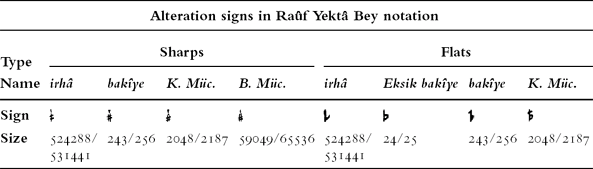
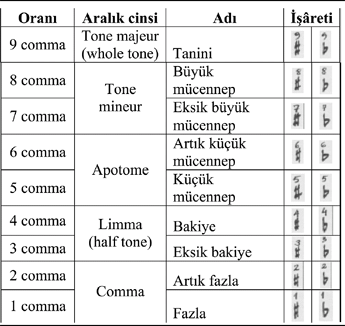
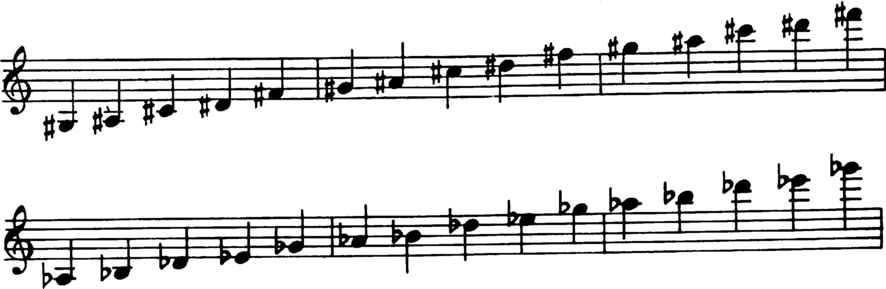
There were three microtonal intervals (ârızî ses) each between the major tones of ‘re’-‘mi’, ‘sol’-‘la’, ‘do’-‘re’; two each between the minor tones of ‘mi’-‘fa’ sharp and ‘la’-‘si’; and again two each between the demi-major tones of ‘fa’ sharp-‘sol’ and ‘si’-‘do’. These were irhâ (the interval of 524288/531441 value); bakîye (the small half tone) (the interval of 243/256 value); eksik bakîye (the interval of 24/25); küçük mücenneb (large half tone) (the interval of 2048/2187 value) and büyük mücenneb (small whole tone) (the interval of 59049/65536 value). In the notation of this scale that included 24 unequal intervals, the following alteration signs were used:
Alteration signs devised by Raûf Yektâ Bey (RY/dek)

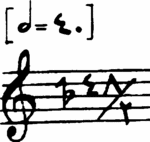
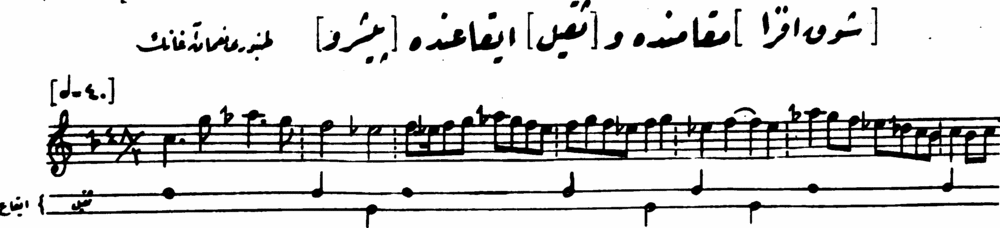
In Raûf Yektâ Bey's notations, the key signature, the alteration signs and the usûl numbers were given in order in the arrangement of the armure. Till that time, in the note editions sold in the market, the big usûls had been designated with 4/4 value. For the first time Raûf Yektâ Bey provided the original time numbers and the unit beat values of the big usûls and added the metronome numbers to determine the pace of the usûl.
Armure in Raûf Yektâ Bey notation (RY/dek).

In the notation of the pieces composed with big usûls, the practice of dividing them into groups of four was adopted in order to assure that Europeans could also understand the usûl structures. Accordingly the usûl structure was divided into measures of four beats and in between each group of four beats was placed a broken measure bar while a continuous bar marked the end of the big usûl. Another novelty was the representation of the usûl structures on a two line usûl staff that ran parallel to and directly under the note staff and that helped observe the beats of the usûl with right or left hands or with both.
The introduction of the peşrev of Tanbûrî Nûman Ağa (in Şevkefzâ makam, Sakîyl rhythmic pattern) (RY/dek, No: 108, RA/arch.).

The notation system incorporating the intervals and the accidentals defined by Raûf Yektâ Bey, was utilised in Turkish notation publications that were undertaken in the period when he was the head of the Scientific Committee of Turkish Music, first in Dâr'ülelhan and later in the Conservatoire of the Municipality of Istanbul. This practice lasted for almost ten years, beginning in 1926, surviving the alphabet reform of 1928 and continuing until his death in 1935.
Raûf Yektâ Bey notation in the new alphabet period A section from Bestenigâr Âyîn, III. Selâm of Dede Efendi (RY/ikon-tmk, vol: 11/XV, p:586, RA/arch).

Western Notation with Arel-Ezgi-Uzdilek System
Hüseyin Sadettin Arel, who became the head of the Istanbul Conservatoire, and Dr Subhi Z. Ezgi, who became head of the Scientific Committee following the death of Raûf Yektâ Bey, began to practice the notation system and the alteration signs they saw fit for the pitches of their theoretical system through the theory books they published. They began to put that notation system in use through both notation publications and education programmes. This notation system, which was a reflection of the theoretical system known by the name Arel-Ezgi-Uzdilek - with the addition of the name of Salih Murad Uzdilek, the physics professor, who determined the physical basis of the Arel-Ezgi system - and was called by the same name (as Arel-Ezgi-Uzdilek notation system (AEU)). This notation system is the “official notation system” in use in modern Turkey today in every area, in which makam music is present – from education to practice, from publication to recording, etc. This theory and notation system, originally proposed/constructed by Raûf Yektâ Bey, is known by the name “24 note non-tempered system” or “24 note system” for short. Though being basically identical with Raûf Yektâ Bey (RY) system, AEU system differed from it in the following points: 1. While the gamme naturelle was the Rast makam scale in the RY system, it became the Çargâh scale in the AEU system. 2. While the gamme naturelle of the RY system began from the ‘sol’3 sound on the second line of the sol key signatured staff, that of the AEU system began from the ‘do’3 sound on the first line of the ‘sol’ key signatured staff. It should be noted that both systems were identical with the “transposed system/notation” of Donizetti/Hacı Emin and that the AEU system resembled the real notation system of the West only visually while remaining different audibly. (In both systems, the written note was heard one whole tetrachord down.) 3. In the gamme naturelle of the RY system, following tradition, segâh, ‘arak and evc pitches were presented as whole/essential/primary pitches and acemaşîran, pûselik and acem as half/accidental/secondary pitches. In the AEU system this situation was totally reversed and acemaşîran, pûselik and acem pitches were presented as whole/essential/primary pitches while segâh, ‘arak and evc were presented as half/accidental/secondary. 4. In the RY system, the segâh pitch, the natural third of the gamme naturelle, was written without the use of any signs, while the pûselik pitch was presented by a ‘si’ note with a sharp of irhâ. On the other hand, the AEU system presented the pûselik pitch as natural, while the segâh pitch, which was considered an ârızî (accidental) sound, was represented by a ‘si’ note with one-comma-flat. 5. A similar situation held true for evc and acem/acemaşîran pitches. In the RY system, they were regarded as whole/essential/primary pitches. Yet in transposed notation, they were represented by a bakîye (4-comma) sharp accidental in front of a ‘fa’ note, since the gamme naturelle started form ‘sol’ 3. This led to criticism in that every single pitch and note of the gamme naturelle had to be unmarked (natural). The AEU system claimed to have solved this problem by changing those pitches into half/accidental/secondary pitches, for then the natural ‘fa’ could be used. This time, they were confronted by the criticism that this arrangement did not conform with tradition. 6. The irhâ interval of 524288/531441 ratio in the RY system was replaced by the comma interval of 81/80 ratio in the AEU system. 7. The eksik bakîye interval of 25/24 ratio, which had a distinct accidental of its own in the RY system (E), was not represented by a separate sign in the AEU system, though its existence was acknowledged. (SMU/im and HSA/tmn, p: 6.) 8. While in the RY system büyük mücennep (small whole tone) interval was signified only with a sharp, in the AEU system this interval was represented in both ways, that is both as a sharp and a flat. 9. Finally, it should not be overlooked that the differences between the RY and the AEU systems were basically a result of the fact that while the RY system had adopted the diatonic natural scale as its gamme naturelle, the AEU had adopted the Pythagorean scale. In modern day Turkey, the disputes on theory and notation system stems from these two different approaches, as well as the differences in opinion between those who opt for a return to the traditional systems and those who propose new and flawless theories and notation systems that can reflect makam music scales and sounds more accurately.
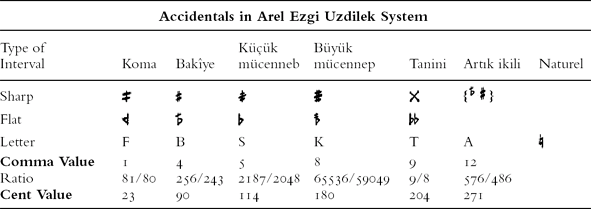
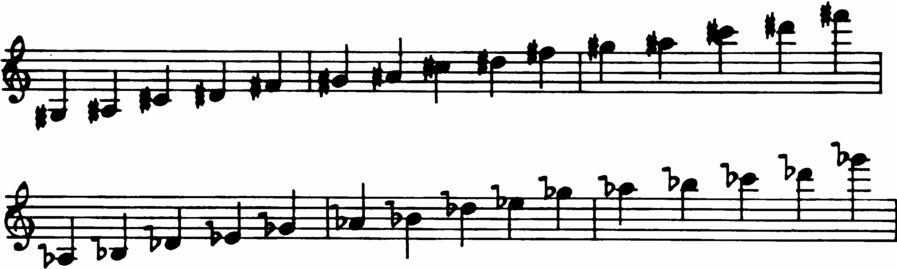
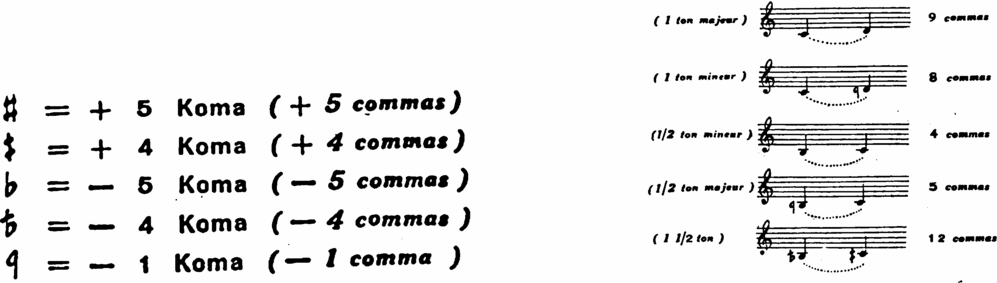
Accidentals in the AEU system

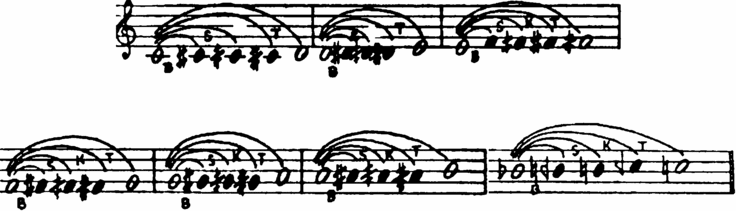
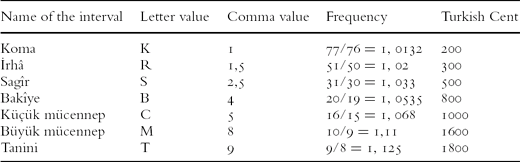
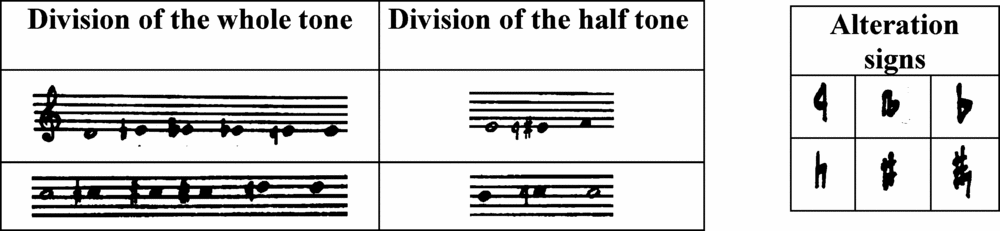
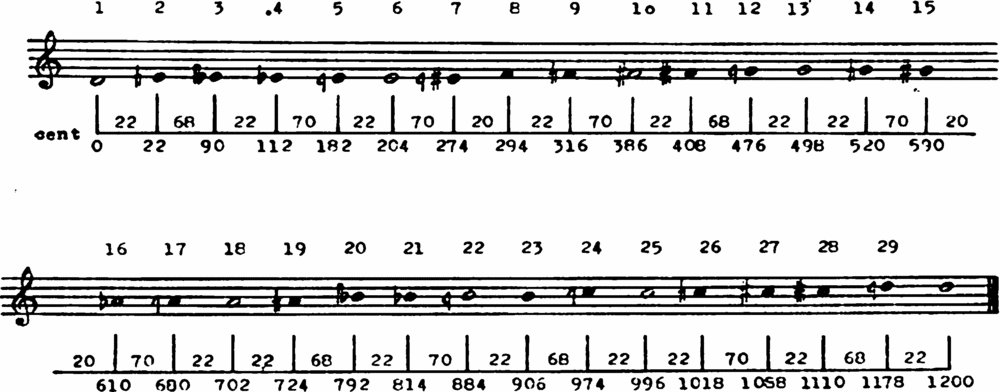
The smallest interval in the AEU system is the bakîye (small half tone) interval (B). The largest one is the artık ikili (augmented second) interval represented by the letter (A). This interval can enlarge up to 14 commas according to the makam scale and structure of which it forms a part. (HSA/tmn, 5.) The main points of discrepancy between the AEU system and practice: 1. The actual value in commas or cents of the second degree (Segâh) in makams such as Uşşâk, Hüseynî, Beyâtî, Acem, Isfahan, Karcığar and Nevâ, which include a ‘si’ (Segâh) pitch written with one comma flat. (Because in the makams mentioned, this pitch acquires more value than it has in theory and changing roles and thus it is claimed that these different roles should be represented with different accidentals. Moreover, through transpositions, this problem tends to multiply). 2. In makams that include artmış ikili (augmented second) interval such as Karcığar, Hüzzam, Sabâ, Hicazkâr and Sûznâk, this interval assumes changing “performance values” other than those foreseen by theory and again the accidentals used in notation are insufficient to represent these. 3. It is ambiguous why in the AEU notation, the flat is equivalent to five commas – as used in western music- while the sharp, which should have the same value in commas, is equivalent to only four commas.
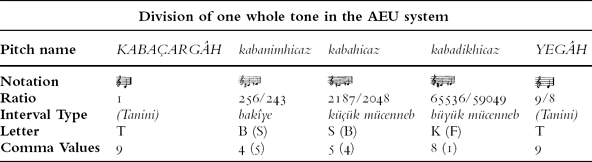
B-S-K-T intervals and their enharmonics in the AEU system

B-S-K-T intervals within one octave in the AEU notation (HSA/tmn).

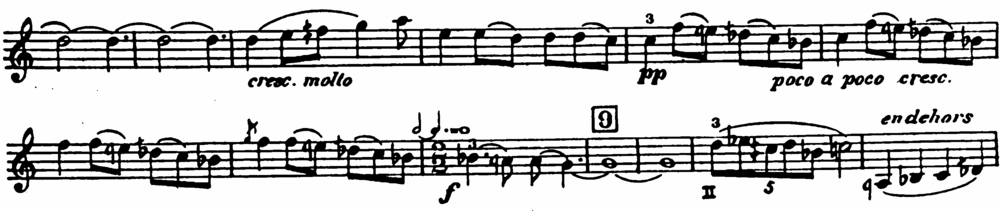
When notating a piece in the AEU notation system, the alteration signs representing the accidental sounds in every makam scale are written in the armure right away. The “close” and “far” modulations taking place during the piece are produced by placing the accidental used to represent the sounds of the makam scale to be gone to within the melodic line without changing the signs in the armure. In some new style pieces written under the influence of western music, temporary armure changes can be made for the purpose of affecting both modulations and transpositions.
Affecting makam modulations with the help of accidentals in the AEU notation system (Şedarâban-Ruhnüvâz-Dilkeş). (Composition: Rûhî Ayangil, Vecd-i dil peşrev/Muhammes/II.Hane).

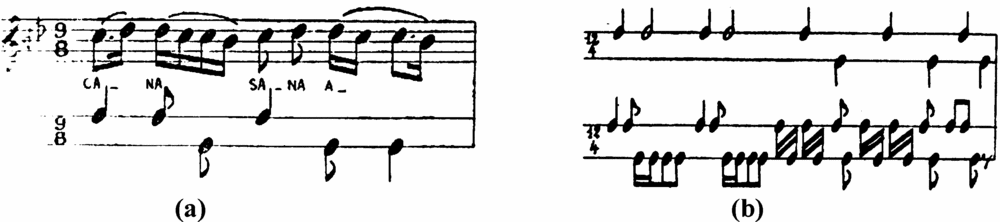
Usûl representations in Arel notation (HSA/tmn). a) Evfer (from the Bestenigâr şarkı of Kanûnî Ahmed Bey), b) Frenkçîn (main pattern and its velvele).

The main points of criticism directed at the AEU theory and notation system are as follows: 1. Its failure in reflecting the traditional Turkish music system, 2. The discrepancy in proposing the “artificial” intervals of the Pythagorean scale in place of the “natural” intervals of the diatonic scale, 3. The lack of an adequate number of accidentals to account for the additional sounds and pitches that the musicians use in practice.
The Notation of Usûls in the AEU system:
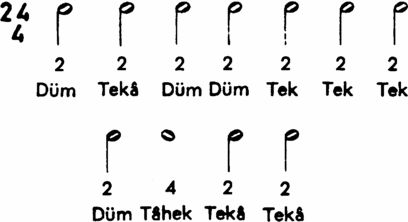
In the AEU system, the style of usûl notation differed in Arel's and Ezgi's practice. Arel adopted Raûf Yektâ Bey's style of notating usûls and followed the convention of showing the usûls with velveles (subdivisions of beats of a rhythmic pattern). In this notation method, the upper line was used to represent the beats of the right hand (düm-te) and the lower one was used to represent the beats of the left hand (tek-ke-ka) according to unit times. This is the method currently in use for teaching/learning the usûls.
On the other hand, Subhi Ezgi wrote usûls above and below the staff and divided the usûls into groups of small usûls. The beat times were written in numbers (as 1–2-4) above the notes while the beat words (düm-tek-te-ke) were written below.
Usûl representations in Ezgi notation (SE/antüm). a) 9-time Evfer; b) 120-time Zincir (Çiftedüyek+Fahte+Çenber+Devr-i kebîr Berefşan).

The nuance terms and the ornamentation elements used in the AEU notation system are identical to those used in western music. Yet Raûf Yektâ Bey, H. S. Arel and Subhi Ezgi all tried hard to find the Turkish equivalents of the names and the meanings of these musical elements in order to domesticate them and wanted to enrich the notation system with the inclusion of these elements.
On the other hand, the more-traditionally-minded musicians did not prefer to attribute finality to notation with the use of expression and ornamentation elements for the fear that it would expose Turkish music to western influence. They rather subscribed to an approach of an anonymous nature to Turkish music performance that fed from tradition and that supposedly provided more freedom to the performers.
Mildan Niyâzî Ayomak Notation System
Composer Mildan Niyâzî Ayomak was the founder of a system that presumed the necessity of notating the Rast makam scale as the gamme naturelle beginning from ‘re’ – the way it was heard. He divided an octave into 53 commas and described the makam intervals in terms of the microtonal intervals that he called minik (literally meaning small). Mildan Niyâzî Bey prsented his ideas, findings and reflections on music theory and notation, which he deemed “revolutionary”, in a series of essays published in the periodical Nota (Note) that he published through the 1930s. His system of notation (MNA) found its place in music history as an “original approach” that did not attract many followers. Mildan Niyâzî reasoned the system he proposed with the following arguments:
“Nazariyatçılarımız şimdiye kadar makamlarımızı, bir sekizlinin yirmidörde taksîminden çıkan seslerle ifâde ediyorlardı. Halbuki bugün en ziyâde kullandığımız uşşak, sabâ, kürdilihicazkâr ve son zamanlarda meydana getirilen garip hicaz, hüseynî ve yeni hüzzam gibi bazı makamlarda bulunup dizilerine dahil olan ve diğer makamların ekserisinde geçici olarak kullanılan birtakım sesler, bu yirmidördün hâricinde kalıyor ve şu halde mûsikîmizin 24 sesle ifâdesi mümkün olmadığı anlaşılıyordu. İşte bu sebeple, dizilerde kullanılan tanînî, büyük mücennep, küçük mücennep, bakîye aralıklarının nasıl vücude geldiği tetkik edilmiş, aranmış ve riyâziyenin verdiği netice ile, ameliyatın neticesi birbirine tamamiyle tetabuk etmek şartile musikîmizin bir sekizlisinde 53 ses bulunduğu meydana çıkarılmıştır. Ancak bu seslerle gerek klâsik musikîmizde, gerekse yeni mûsikîmizde kullanılan makamları ifâde etmek, yani ihtivâ ettiği seslerini yazabilmek imkânı hâsıl olmuştur.”
“Our theorists up until now have represented our makams with the sounds produced by dividing an octave into 24. Yet certain sounds that are included in the scales of some frequently used makams, such as uşşak, sabâ, kürdilihicazkâr, and some recently developed makams, such as garip hicaz, hüseynî and yeni hüzzam, and used temporarily in almost all the other makams, are outside these 24. Under these circumstances it is apparent that it is not possible to represent our music with 24 sounds. Hence, the issue of how the intervals (tanînî, büyük mücennep, küçük mücennep, bakîye) used in these scales came into being has been examined and with the condition of correspondence between the results of mathematics and of operation, it has been revealed that every octave of our music comprises 53 sounds. Only with those sounds, the possibility of presenting the makams used both in our classical music and our new music, that is notating the sounds they included, was attained”. (MNA/nmm, no: 11, pp: 42–43.)
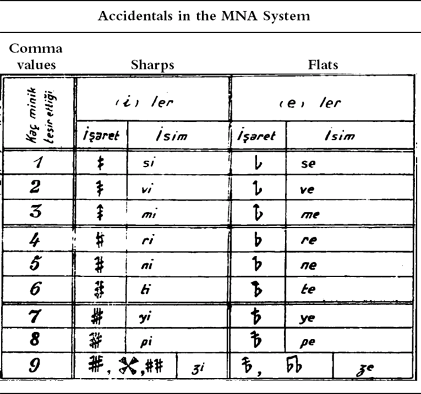
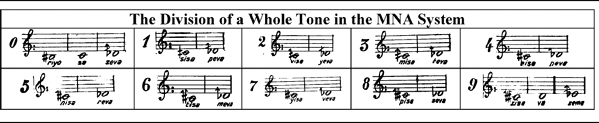
In line with the “reformist” atmosphere of the period, Mildan Niyâzî did not limit the novelties he wished to bring to the theoretical system of Turkish music to his proposal of a 53 note system but demonstrated an “idealist” approach and changed the traditional names of all the musical elements included in this system and popularised the new elements with new self-consistent names he coined. In short, he struggled to develop a terminology for his system. In the MNA system, which used the graphic western notation, the notes were first assigned the consonants “s – v – m – r – n – t – y” from ‘do’ ‘to’ ‘do’ with “letter notation” method. Then within eight octaves, the sounds were subjected to a new “naming process” that had an internal logic of development. In this naming process, the eight octaves were named “oı – aı – ı – o – a – ö – u – ü” in that order. Each of the letter notes above assigned to the seven sounds, combined with the letters designating the octaves to which they belonged, thus transforming from letter to “syllable notes” in the following manner: “s/oı – v/oı – m/oı – r/oı – n/oı – t/oı – y/oı” (first octave sounds, the lowest one having a frequency of 32,2); “s/aı – v/aı – m/aı – r/aı – n/aı – t/aı – y/aı” (second octave sounds, the lowest one having a frequency of 64,4); “s/ı – v/ı – m/ı – r/ı – n/ı – t/ı – y/ı” (third octave sounds, the lowest one having a frequency of 128,8); “s/o – v/o – m/o – r/o – n/o– t/o – y/o” (fourth octave sounds, the lowest one having a frequency of 257,7); “s/a – v/a – m/a – r/a – n/a – t/a – y/a” (fifth octave sounds, the lowest one having a frequency of 515,5); “s/ö – v/ö – m/ö – r/ö – n/ö – t/ö – y/ö” (sixth octave sounds, the lowest one having a frequency of 1031); “s/u – v/u – m/u – r/u – n/u – t/u – y/u” (seventh octave sounds, the lowest one having a frequency of 2062); “s/ü – v/ü – m/ü – r/ü – n/ü – t/ü – y/ü” (eighth octave sounds, the lowest one having a frequency of 4124). In the MNA notation, the letter “i” stood for sharp and “e” for flat and when written before one of the letters representing the seven sounds, they had the function of changing them into sharps and flats. Accordingly the sharp sounds were “s/i – v/i – m/i – r/i – n/i – t/i – y/i”; and the flat sounds were “s/e – v/e – m/e – r/e – n/e – t/e – y/e”. Aside from the division of every octave into 53 miniks (commas), in the MNA system every whole tone was divided into 9 miniks. Separate “i” and “e” signs were designed for each microtonal interval thus created and all these intervals were assigned special names.
Comma and sign values of the “i”s and “e”s in the MNA system. (MNA/nmm, no:9,1933, RA/archive)

In one whole tone, the accidentals were grouped into three: “si-vi-mi/se-ve-me” as the first group (small accidentals); “ri-ni-ti/re-ne-te” as the second group (medium accidentals); and “yi-pi-zi/ye-pe-ze” as the third group (big accidentals). Each microtonal interval was represented by a “word note” produced by adding the appropriate syllable from the list above as a prefix to the syllable signifying the octave sound to which the interval belonged (see the Fig. 41).
Consequently, these 53 microtonal intervals were classified with separate names of their own and their equivalent enharmonic intervals were supplied.
The names and signs of the miniks in one whole tone in the MNA system (MNA/nmm, no: 11, 1933, RA/archive)

The naming of the minik intervals according to the related sounds and octaves in the MNA system (MNA/nmm, no: 11, 1933, RA/archive.).

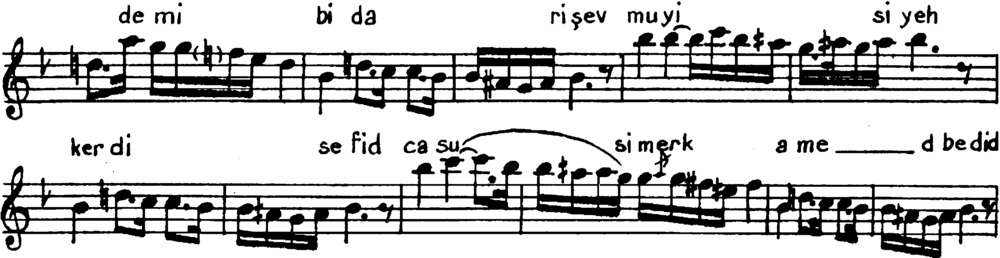
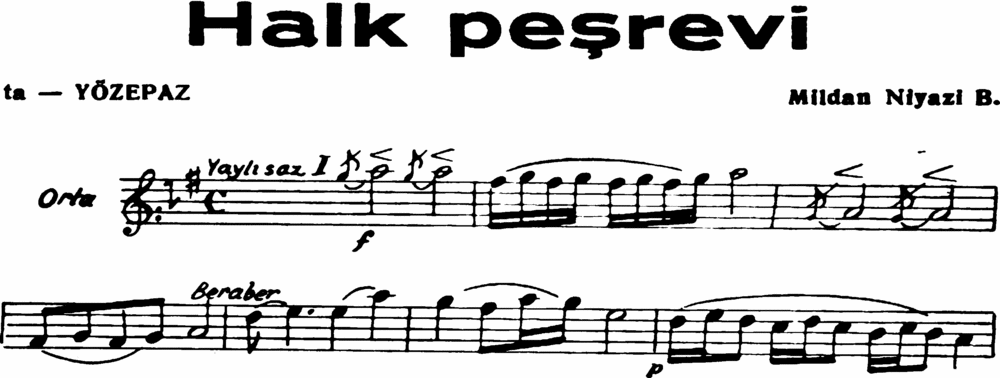
The introduction of Ta-YÖZEPAZ (Hüseynî) Peşrev of Mildan Niyâzî Ayomak (MNA/nmm, no: 11, 1933, RA/archive).

Mildan Niyâzî, who attempted devising a whole new terminology for Turkish music by using western notation, developed further the connection letter note- syllable note- word note and changed the traditional names of makams in favour of new names of his own creation. For example: Rast = Zünezün ; Uşşak = Tuzerez ; Hüzzam = Neninep ; Nihavend = Zozerez ; Hüseynî = Yözepaz, etc. Mildan Niyâzî defended the need for a fundamental change in music theory and notation and claimed that the makams and sounds needed to be moved one whole tetrachord down from their traditional positions and be written from where they were heard. In the issue of the usûls, he advised the discarding of the old habits of usûl beating and the adoption of the beat methods brought along with deciphering western notation. The introduction of a piece by Mildan Niyâzî is reproduced below, in order to provide an example of the use of the MNA theory and notation system.
Independent Practices
The Propositions of Ali Rif 'at Çağatay
Starting with the use of western staff notation in
writing Turkish makam music, the
musicians have been developing their own special
signs to use in points where the
makam pitches did not conform
with the facts of this notation system. An example
of this practice is provided by the signs that lute
player and composer Prince Ali Rif 'at Çağatay (ARÇ)
utilised in his notations. Çağatay proposed a small
number of accidentals in addition to regular sharps
and flats, in order to account for some basic needs,
especially the differentiation of the
uşşâk-segâh-pûselik pitches and
their şeds (a transposition of a
scale to a new pitch without alteration of its
intervals, eg: nim evc-evc-mâhûr,
etc.) and the changing values of the augmented
second interval in different makam
structures. The signs that he proposed were:
( ) for the comma interval (in
order to differentiate between
segâh and
pûselik),
(
 ) for the eksik
bakîye interval and
(
 ) for the bakîye
interval (to secure the division of
uşşak and diminished augmented
second interval). Yet these accidentals were used
only by him and probably a small number of his
students.
The use of Western notation system in Kemal İlerici's regulations
Kemal İlerici (Kİ), one of the modern composers of the twenty first century, exemplifies a new understanding of accepting an octave as 53 commas. He suggests that the Huseyni makam scale be used as a main scale.
He made this suggestion bearing in mind this scale's determining role in Turkish Folk music and also its presence in numerous compositions in the classical city music genre. He also believes that, this scale which has been used throughout the centuries in Anatolia, is most capable of reflecting national feelings.
Main Scale suggestion of Kemal İlerici (Kİ./bbtma., s:1).

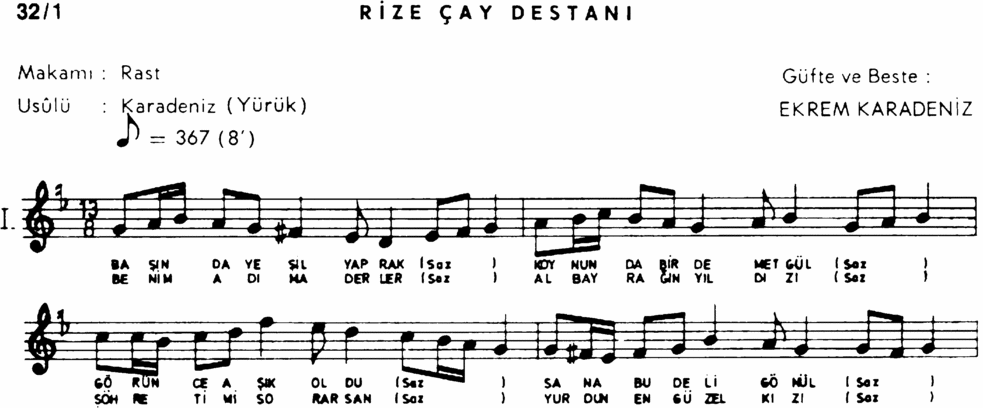
His suggestion is accepted and used, especially by a small number of composers who are in the search of a new notation system to be utilised while composing modern polyphonic Turkish makam music based, only on the origins of Turkish folk music, plus the Turkish folk music musicians who have a the potential to use the system widely throughout the country.
Today, this notation system is being used especially within TRT (Turkish Radio Television Broadcasting Company). Most of the Turkish folk music examples written for TRT musicians and the Turkish folk music publications are prepared using this notation system.
Kemal İlerici writes with the Huseyni scale, which he regards as the main scale, starting from ‘La’ 3 on the G key staff, believing it to be compatible with tradition, in the concept of: the written note being equal to the heard note. He specifies that, the pitches must be tuned, with the help of the numbers that are placed on the flats and the sharps. His writing system divides a “tone majeur” into “9 commas”. The types of intervals, used in his system are shown here.
The pitches and the alteration symbols used in the Ilerici System

Kemal İlerici put forward his suggestions, with the aim of acquiring: a contemporary polyphonic music writing system, a harmony system based on perfect fourths, derived from Turkish makam and Turkish folk music flavours, and to create a national and modern composing style. All his suggestions, other than the intervals’ case, apply the same basic rules of the western notation system.
Notation writing with KI system.

Western Notation according to Abdulkadir Tore – Ekrem Karadeniz system
“A.Töre – E.Karadeniz System” (ATEK) aims to express Turkish music pitches and intervals, with the “intervalic ratios”, that are closest to excellence, and also aims to write these down with the most appropriate notation system, which is in harmony to these ratios.
Ekrem Karadeniz, (the student of the violin teacher Seyyid Abdülkadir Tore, 1930s,) perfected this approach.
The ATEK found favour in the twentieth century, it criticises the AEU system, and it divides an octave as “41 unequal intervals”. In this system, the main scale is regarded as the Rast makam scale, which is in accord with the tradition.
The intervals are calculated and defined by using “Turkish Cent” (ts), which divides an octave as 10,600 equal units, and “the irha” and “the sagir” intervals which are not found in the AEU system, are added to this system.
Intervals in the ATEK system (EK/tümne, 10)

The sounds in the ATEK notation system are divided into “seven groups of 3 octaves”, each followed by the other. Every group are numerated by the alteration signs that it takes.
Group I: Defined as “Seven natural sounds”. Their names are: 1- (pest) Rast (Sol); 2- (pest) dügâh (Lâ); 3- (pest) segâh (Si); 4- (pest) çargâh (do); 5- yegâh (re); 6- hüseynîaşîran (mi); 7- acemaşîran (fa). (see: Fig. 45).
ATEK Group I Sounds (EK/tümne, 16).

Group II: (For each three octaves) “Five half tones” named as: 1 - (pest) nim zengûle (Sol s./Lâ f.); 2 - (pest) nim kürdî (Lâ s./Si f.); 3 - (pest) nim hicaz (do s./re f.); 4 - (pest) nim hisar (re s./mi f.); 5 – ‘arak (fa s./sol f.).
These sounds are written down using 800 ts (= 4 commas) sharp and 1000 ts (= 5 commas) flat. (Fig. 46).
ATEK- Group II tones (EK/tümne, 17).

Group III: (For each three octaves) “five half tones, named as: 1 - (pest) zengûle (Sol s./Lâ f.); 2 - (pest) kürdî (Lâ s./Si f.); 3 - (pest) hicaz (do s./re f.); 4 - (pest) hisar (re s./mi f.); 5 geveşt(fa s./sol f.). These tones are written down using 1,100 ts (= 5,5 commas) sharp and 700 ts (= 3,5 commas) flat. (Fig. 47).
ATEK-Group III tones (EK/tümne, 18).

Group IV: There are “6 tones” in this group written down by 200 ts and comma flat, for each three octaves, and their names are: 1 - (pest) dik zengûle (Lâ f.); 2 - (pest) uşşâk (Si f.); 3 - (pest) dik bûselik (si s.) 4 – (pest) sabâ (re f.); 5 – (pest) hisarek (mi f.); 6 – dik geveşt (sol f.). (Fig. 48).
ATEK- Group IV tones (EK/tümne, 19).

Group V: For every three octaves, there are seven tones of 300 ts.(equal 1,5 comma) in this group, and their names are:: 1- (pest) nigâr (Sol s.); 2- (pest) dilârâ (Lâ f.); 3- (pest) bûselik (Si s.); 4- (pest) niyâz (do s.); 5- (pest) gülzâr (re s.); 6- (pest) dilâvîz (mi s.); 7- sûzidil (fa s.). (Fig. 47).
ATEK-Group V tones (EK/tümne, 19).

Group VI. There are “seven supportive tones for every three octaves in this group, which have 600 ts. sharps (equal to 3 commas), compared to the “main tone”, right before them.
ATEK- Group VI. Tones (EK/tümne, 20).

Group VII: In this group, there are “four supportive sounds” carrying 400 ts. flat (= 2 commas), compared to the “main tone”, right after them. Their names are:: 1-(pest) dikçe zengûle (Lâ f.); 2- (pest) dikçe hicaz (Re f.); 3- (pest) dikçe hisâr (Mi f.); 4- dikçe geveşt (Sol f.) (Fig. 51)
ATEK-Group VII tones (EK/tümne, 20).

ATEK system, which proposes the usage of eight alteration signs, (four different types of sharps and flats) resulting in the division of an octave into forty one pitches, is critisised by today's musicians, with the argument of performing music with this number of signs will not be easy and practical.
The first notes of “Çay Destanı”, Composed by Ekrem KARADENİZ (EK/tümne, 234).

The rhythms (USULLER) in the ATEK notation system, and the values of the notes are shown successively, in row one after another, and the “syllables symbolising the rhythms” are shown by placing them underneath. The words, like “ağır”, “yürükçe”, “yürük” are used to specify the movement of the rhythms.
Writing Rhythms using ATEK system- “Çember USULU” (EK/tümne, 55).

Western Notation with the Propositions of Gültekin Oransay
Professor Gültekin Oransay materialised his views on the number of the pitches in the Turkish music system, not in an independent work but in an article he added to the small dictionary of Muallim Kâzım Uz, entitled “Mûsîkî Istılâhâti” (The Music Reform), while he was editing this work. The Oransay method (OR) almost acted as a conciliator between the traditional makam theory and the modern theories. The gamme naturelle of the OR system was the diatonic Rast makam scale founded on the ‘re’ sound and it comprised 30 pitches. Most probably Oransay's proposal of this 30-pitch system was a result of an effort for producing a conciliatory notation system that consisted of all the sounds in the ATEK system other than the eleven auxiliary sounds of the 6th and 7th groups. The pitches of the OR system were not assigned special names. The sounds were lined up in accordance with their cent values. It can be assumed that these intervals can be named in reference to the pitch names that have kept changing between traditional and modern theories.
The division of whole and half tones and the alteration signs in the OR system (OR-MKU/mı, 54.).

Gamme naturelle of 30 pitches of Gültekin Oransay (the Rast scale) (OR-MKU/mı, 54.).

It is observed that some composers and performers other than Ali Rif 'at Bey and Gültekin Oransay also used accidentals, which they developed in line with their own understanding of makams, to use with western notation while notating Turkish makams and pitches. Another example of these accidentals, which seemed to be alternatives to those in existing makam theories, but which remained limited to personal use and could not spread, was provided by the signs that one comes across in certain works of the violinist, Ekrem Zeki Ün (EZÜ), who composed works of a modern polyphonic nature.
Intervals, their values, signs and notation in the EZÜ system.

An example of the EZÜ notation (Quartet Turc- RA/archive.).

Section II
Âhenks
The sound spectrums called âhenks (harmony/order) are transpositional areas to which each makam can be transferred without disrupting its structural characteristics. Every systemic sound area where transposition – which is the transfer of a makam onto equivalent sounds in different frequencies without changing its scale and its intervalic structure- is referred to by a special âhenk name of its own. In Turkish music, there is a table of âhenks with a total of thirteen areas comprising of eight whole sounds and five half sounds to which every makam can be transposed. Both modulations – effected by a move from one makam structure to another - and transpositions – meaning the transfer of a makam to another pitch while retaining its structural characteristics - enrich music as expression elements and provide opportunities for development. Yet, the system of âhenks is one of the most problematic areas of makam music. As regards transposed Turkish notation system, both in terms of the makam theory and of the foundation of the notation system accompanying it, the main âhenk area currently used makes up not an absolute but a relative sound area. This, in short, means that makam music is not founded on a constant diapason system. The main problem regarding the writing of Turkish music in western notation stems from this point. When the scientific equivalents of the ambitus of the instruments and the range of the human voices are not clearly defined according to the existing notation system - that is when the “existing practice” does not reflect the “absolute meaning” presented by the notation - it is only natural for a certain chaos to develop through empirical and pragmatic practices. The transpositions that can not be brought under “notational discipline” in terms of a constant diapason system and that are only exercised “as needed” and solely with a talent for transposition depending on memory, frequently lead to problems of intonation and performance. As a result of this, the performance of certain makams and certain pieces are avoided with regards to difficulties of pitch and intonation encountered in transposition.
In describing the system of âhenks, we encounter ney, a wind instrument produced in accord with 13 different accords/systems/harmonies, as the reference instrument. The ‘la’4 sound produced by A = 440 frequency diapason, has long been considered equivalent to the nevâ pitch in the Turkish makam music. In reality, this ‘la’ sound of 440 frequencies coincides with a different pitch/sound in each of the thirteen neys of different sizes and systems mentioned above and with half tone minor differences creates a twelve area transpositional table. In Turkish makam music, each of these twelve transpositional areas have a name of their own, providing musicians with a cipher as to which transpositional area they are in.
Pitch equivalents of the ‘la’ 4 (A = 440 hz) sound in the eight main âhenk.

Âhenks of the Turkish makam music

The âhenks founded on the main sounds of the ‘re’ scale are called by their particular names. They are eight in number. These main âhenks are 1. bolâhenk, 2. davud, 3. şah, 4. mansûr, 5. kızneyi, 6. müstahsen, 7. süpürde or mehtâbiye, 8. yıldız or bolâhenk nısfiye. The âhenks founded on the half pitches in between the main sounds are referred to by the term mâbeyn (literally meaning between). The Mâbeyns are five in number and are named in reference to the two main âhenks that they are in between: 1-Bolahenk/Davud mâbeyni; 2- Şah/Mansûr mâbeyni; 3 – Mansur/Kızneyi mâbeyni; 4 – Kızneyi/Müstahsen mâbeyni; 5- Mehtâbiye (or Süpürde)/Yıldız (or Bolahenk nısfiye) mâbeyni. Thus the total number of âhenks – main and mâbeyn - reach thirteen. The makam scales can be performed in thirteen distinct transpositional areas (in line with the varieties and âhenks of the ney). Accordingly, the designations should be such: Rast – ‘do’, Rast - ‘mi’ b., Rast – ‘fa’, Sabâ – ‘la’, Sabâ – ‘mi’, Sabâ – ‘fa’ d., etc.
The first and the 13th âhenks are identical with one octave difference and the first âhenk (the Bolâhenk order) is the lowest chord system of Turkish music. Yet in this âhenk, neither instrumental nor vocal performance is possible. The highest âhenk of number thirteen is also known by the same name, the Bolâhenk nısfiye. Both of these âhenks are referred to by the term Bolâhenk yerinden (from the place of Bolâhenk) - or simply yerinden - by musicians. The Bolâhenk or Bolâhenk nısfiye order is also the basic scale representing the “transposed notation system”, in which all the pieces of Turkish music have been notated since the times of Donizetti and Hacı Emin Efendi. In this system, the “notated sound” is a whole tetrachord up in relation the “heard sound”. Thus saying yerinden implies the performance of the work composed according to the Bolâhenk order as it is, without transposing it onto another tone. This order, which causes no problems (except for the neyzens (flute players) who do not prefer to use this order) in the performance of the instrumental pieces in terms of “ensuring the facility of the notation reading”, is naturally not preferred for the performance of the vocal pieces since it “challenges the limits of the human voice”, especially in the higher areas. For this reason, the vocal artists have in time turned to the lower âhenk areas where they could sing without much effort. Especially after the development of improved microphones and voice enhancing systems, this inclination became almost a habit. Both in solo and in group performances, âhenks 2.5, even 3.5 tones lower than the “written notation” have become frequently preferred and used. These âhenks are Kızneyi - also known as “four sounds lower” or “from four sound” in short - and Mansûr - also known as “five sounds lower” or “from five sounds” in short. While female voices and some baritone male voices use these two âhenks frequently, only some tenor male voices prefer süpürde/mehtâbiye, also referred to as “from one sound” (in fact, it should be two sounds or one tone), or more rarely müstahsen or müstahsen mâbeyni. There is no unity of terminology among the musicians on the issue of the âhenk names. The âhenks higher than müstahsen are named differently by various musicians and writers and this naturally leads to confusion. For instance: mehtâbiye can also be called Süpürde/Ahterî; Bolahenk nısfiye can be called Süpürde/Yıldız/Ahter(î); and the performers call müstahsen and mabeynini as yıldız in practice.
Section III
Expression and Ornamentation Elements
If the most distinctive characteristic of the Turkish makam music is its possession of a microtonal sound system and modal usûl structures, a second characteristic, which is almost of equal importance, is the role of the “performance styles” and “expressional varieties”, which make this microtonal sound system and the usûl structures even more complicated. What accounts for these differences in performance? These varieties of styles, are the elements, which can not be notated yet which sometimes unanimously develop in a shared spirit on behalf of musicians and sometimes lead to conflicts of performance that try the limits of musicality. Still when they are applied well, they add beauty and mastery to music. Though it is not appropriate to group all these elements under the name of ornamentation elements in view of the literal meaning of the concept of ornamentation, such study is unavoidable in the context of the makam music. Although the ornamentations encountered in Turkish music are to a large extent not notated, they materialise as ornamentations or melodic/rhythmic variations spontaneously improvised by the performers. It is appropriate to single out the human voice as the source of the ornamentation elements of the Turkish makam music. A wide-ranging oral tradition founded especially on the beauty of the human voice and on the style of singing has dominated Turkish music from the start and a system of taste arising from the relationship between poetry and melody has been determining in this respect. The performances of the master composers and singers – who were referred to by such attributes as fem-i muhsin (beneficent mouth) or sadâ-i muhrîk (touching sound) and were claimed to have an air and manner of their own - affected the performance style of the instrument players. The instrument players accompanied the singers in a unison structure but with performance manners that presumed differentiation and heterophony within this structure and thus made the ornamentations more pronounced. It is reasonable to claim that the ornamentation elements have become more consciously used and more widespread thanks to the contributions of composers (such as Hacı Ârif Bey, Şevkî Bey, etc.) and virtuoso vocal and instrumental artists (such as Kemençeci Vasil, Tanbûrî Cemîl Bey, Kanûnî Şemsi Efendi, Hâfız Osman, etc.) throughout the nineteenth century, which was a time of important changes in the field of composition and the performance of music. Especially in instrumental performance, with the frequent use of the ornamentation elements that “add extra motion to melodic/rhythmic movement”, performers (for instance Tanbûrî Cemil Bey) obtained a discernible amount of differentiation in their interpretations, thus developing both existing compositions and the art of taksim dependant on improvisation techniques and opening the way to virtuosity in makam performance. Till this day, a clear definition and classification of these ornamentation elements has not been forthcoming. Some of these ornamentation elements comprise characteristics that include performance and composition techniques. The ornamentation elements of the makam music have developed through history either as a direct outcome of this music's own structural peculiarities or as a result of the inspiration provided by the ornamentation elements of the western music following Turkish music's contact with it and they have retained their unwritten, improvisatory character with only minor exceptions. The performers have reverted to these ornamentation elements frequently, to make the vocal or instrumental piece they handled more appealing, colourful, different and demanding, thus proving their mastery by way of surprising the listeners. The differentiation in a work performed with the intent of ornamentation takes two forms: a. the big modular structures: by way of improvised melodic and rhythmic changes (variations) on the primary music text; b. the small modular structures: derived from and shaped through traditional practices accurately defined. The main ornamentation elements used in the Turkish makam music can further be divided in two:
a) The ornamentation elements applied in vocal performances – be they solo or in a group: In this respect, the element that had the greatest impact on vocal performance from the beginning, has been the tecvîd, which was the primary recitation and voice training method for the recitation of the Quran. The hâfızs (those who know the whole Quran by heart), hânendes (singers), na'thâns (those who chant a poem in praise of the Prophet Mohamed), gazelhâns (soloists) and kasidehâns (singers of a eulogy or a commemorative poem put to music and considered as religious) have all utilised the sound training elements of tecvîd to make their voices “effective”. Thus, it is safe to regard the usûls and the principles of tecvîd as the origin of the ornamentation in makam music. This sort of chanting is called tecvîd üzre kıraat (recitation by tecvîd). On the other hand, in the traditional performance, as a result of the meşk (traditional oral training method), the throat was utilised as almost an instrument of rhythm in a capella singing and thus an effective and rich style of singing that defined the length and the rhythmic variety of the sounds obtained. This style, which provided another starting point for the development of the ornamentation elements, was called goygoylu singing in reference to the accented and rhythmic sounds coming from the throat. It was the oldest performance style that contained the authentic ornamentation in totality. The main ornamentation elements used in vocal performance are as follows: acciaccaturas, vibratos, trills, portamento, glissando, accents, grupettos and fast scale movements done with a series of demisemiquaver notes (especially in chanting of kasides and gazels), affecting change of impact by carrying the melodic line to upper and lower octaves (in group performances, especially in fasıls), “polishing the voice”, taking the finalis one octave up with the technique of falcetto.
b) The ornamentation elements used in instrumental performance (group, accompaniment and solo): It is appropriate to group the ornamentation elements in this category according to the class of instruments. Though some of the ornamentations produced by wind, string and percussion instruments are similar, most differ in accordance with their performance techniques and this creates heterophony. The ornamentation elements produced by string and wind instruments are as follows: producing dem (pedal) sounds that almost create an effect of ostinato in the low sounds and doing sound extensions with vibratos that begin with a sound and continue for a long piece of melody until the second-coming of that initial sound (especially with ney); performance with legato and staccato (again with ney); pizzicatos and spiccatos with string instruments; single, double, triple, etc. acciacaturas; augmented fingertaps, trills with high and low notes, timed and un-timed neck vibratos (especially in tanbur performance); glissandos and portamentos; jumping from one octave to the other, arpeggios, accords, consonants, mordents in the performance of ud, tanbur, lâvta and kanuns; especially with kanuns, small modular structures such as tremolos, performance using the octaves, fiskelemes (touching the string lightly with thumb and plectrum), glissandos; grupettos containing long improvised passages (rhythmic, melodic, counter-melodic, contratempo or chromatic) placed in between melodic sections or anywhere that the performer saw fit at the time. In Turkish makam music, the ornamentation element that takes the form of rhythmic and melodic passages (big modular structures) added to the main structure has been referred to as the keriz (literally meaning credulous but referring to Gipsy musicians) by the common/popular instrument players. Unfortunately this slang term has become a part of the terminology. We prefer to use the term çiçekleme (flowering) in its place. The area in which this kind of ornamentation is most frequently used is fasıl (vocal-instrumental suite) music. Prime among the musicians who use this kind of improvised ornamentation were renowned ud (lute) virtuoso Yorgo Bacanos, kanun (zither) virtuoso Ahmet Yatman and clarinet master Mustafa Kandıralı. Along with the rhythmic variations, which generally follow the melody, produced by defs (tambourine with cymbals) and daires (tambourine); there are the beats called velveles, especially produced by kudûms (small double drum used in Mevlevî music). They include more differentiated and detailed beats in comparison to the main structure of the usûl and the main beat points and are predetermined/cliché (thus lacking the quality of improvisation) ornamented beat groups. When usûl beats with velveles combine with the heterophonic melodic structure of the makam music, they produce a kind of “rhythmic polyphony” by way of rhythmic counterpoint. Finally, the karabatak style in solo and group performance and singing should be regarded as an expressive ornamental element stemming from the differences of form in performance, although it is a style of performance.
Conclusion
The problems encountered in notating Turkish makam music in western notation are as follows:
1 What should be the gamme naturelle of Turkish makam music and beginning from which note should it be notated? If we summarise the answers given to these questions, we can see that five proposals have been put forward and are still being discussed today:
a) The gamme naturelle is the Rast makam scale and it should be notated beginning from the ‘do’4 pitch and this note (‘do’4) should be named the Rast pitch. (Rast scale = Reel C Maj.) (RY/tmn, 1924.)
b) The gamme naturelle is the Rast makam scale and it should be notated beginning from the ‘sol’ 4 pitch and this sound should be named the Rast pitch. (NHE/nm, 1876; RY/tml, 1922; MNA/nmd, 1934; AT-EK/tümne, 1965.) (Rast scale = Reel D Maj./transposed scale)
c) The gamme naturelle is the Çargâh scale and it should be notated beginning from the ‘do’ 4 pitch and this sound (‘do’ 4 = in reality sol 3) should be named the çargâh pitch. (SE/antüm- HSA/tmn.) Accordingly, the Rast makam scale, which is no longer the gamme naturelle, is still notated from the ‘sol’ 4 (in reality ‘re’ 4). (Çargâh scale = relative c Maj. = real G Maj.)
d) The gamme naturelle is the Rast makam scale and it should be notated beginning from the ‘re’ 4 = rast pitch. (OR)
e) The gamme naturelle is the Hüseynî makam scale and it should be notated beginning from the ‘la’ 4 sound. (Kİ/btma; THM/Uyg.)
2 How many pitches in total are there in the sound system of Turkish makam music and which names and notes (with accidentals) should be utilised to refer to those pitches? If we summarise the answers given to these questions, we can see that the following proposals have been brought forward and are still being subjected to debate today:
a) There are 17 pitches in the Turkish makam system. (For NHE/nm and the proposed alteration signs, see p. 417)
b) There are 24 pitches in the Turkish makam system. (For RY/tml, RY/tmnd, RY/dek and the proposed alteration signs, see p. 423)
c) There are 24 pitches in the Turkish makam system. (For SE/antüm; HSA/tmn and the proposed alteration signs, see p. 429)
d) There are 41 pitches in the Turkish makam system. (For AT-EK/tümne and the proposed alteration signs, see p. 433)
e) There are 53 pitches in the Turkish makam system. (For MNA/nmd and the proposed alteration signs, see p. 429)
f) There are 53 pitches in the Turkish makam system. (For Kİ/bbtma, THM/Uyg and the proposed alteration signs, see p. 432)
g) There are 30 pitches in the Turkish makam system. (For OR-KU/mı- OR/dml&dbm and the proposed alteration signs, see p. 437)
h) Other unpublished system and pitch number proposals brought forth by various researchers and theorists. (For ARÇ and EZÜ, see p. 438)
- 3
1) The notation system of the Turkish makam music in practice today (also known as the open microtonal system) is the transposed western notation system proposed by Sadettin Arel and Subhi Ezgi. This is a system of notation aiming at representing music on a single staff and is seen fit for a unison music notation. The musical pieces, which are notated on a single staff to satisfy the need for practicality/facility in vocal and instrumental performance and to account for the differences in the range of the human sound and the ambitus of the instruments, can be transposed to other sound areas without being subject to further notational operations. The musicians of our time perform the transposition from one âhenk to another only using their mental faculties, that is from memory. In the performance of transposition, it helps to know the functional characteristics of the makam scales and sounds well. This situation leads to the development of a “relative makam temperament”, in which a makam scale and its intervals are always understood and expressed with the same notes (the notes with which the performer has equated that makam scale at the time when he first encountered it). To clarify this point with an example, a performer can easily transpose a piece composed in the Hicaz makam to various sounds such as ‘mi’, ‘re’, ‘do’, ‘si’, ‘la’ in reference to the sounds of the scale with which he first learned the Hicaz makam. Yet he encounters great difficulty when he tries to perform the same piece from a notation text that represents the transposition of the piece in real notes. This is the result of the fact that the performers have a relative rather than an absolute sense of hearing in accordance with the current notation system.
2) Though the system of âhenks promise a space of movement and venue for development in Turkish makam music, the practices have so far been limited to a couple of transposition areas. Most of the time, the kızneyi, mansur and less frequently sipürde âhenks, which do not pose any difficulty in vocal and instrumental performance, are preferred. This creates confusion both for foreigners who are not familiar with the differences between the notation and the performance of makam music and for those who are new to the study of this music.
3) Aside from the problems of transposition, one of the most important issues of debate about the current notation system is the question of the accuracy of the alteration signs and the pitches that they define. As long as debates ensue in the field of theory, these pitches and the alteration signs that express them will continue to be subject to controversy. Yet, the musicians who have a good understanding of the system of makams and pitches attain almost absolute accuracy in the performance of the makams and the pitches, in spite of the relativity and inaccuracy of the notation system and its alteration signs.
4) Musicians, who were satisfied with their success in performance, have frequently given word to the necessity of developing a notation system fit to accurately represent makam music (and verify their performances). Time after time, there have also been those who defended the merit of returning to older methods of notation – prime among them being the Hamparsum notation- and those who claimed that it would be better to rely solely on the meşk system without the use of any notation.
5) The redefinition of the notation system and the alteration signs in a more precise manner has been the prime issue in tackling the problems of the Turkish makam music system. Within the last thirty years, numerous important scientific studies have been undertaken both privately and institutionally to this end.
Kısaltmalar/Abbreviations