1. Introduction
Tropical and subtropical coastal ecosystems exhibit sedimentary conditions ranging from well-oxygenated environments to anoxic zones, particularly in areas with high organic matter deposition and limited hydrodynamic activity. In these regions, salinity and tidal dynamics play a fundamental role in regulating the flow of water, particles, and nutrients (Feller et al. Reference Feller, Lovelock, Berger, McKee, Joye and Ball2010; Hogarth Reference Hogarth2017). These environments harbor extensive vegetation adapted to extreme conditions, which performs essential ecological functions, including shoreline stabilization, sediment retention, biodiversity support, and carbon accumulation (Ayyam et al. Reference Ayyam, Palanivel and Chandrakasan2019; Gijsman et al. Reference Gijsman, Horstman, van der Wal, Friess, Swales and Wijnberg2021; Kathiresan Reference Kathiresan2012). The soils, often rich in organic matter, act as natural filters, contributing to nutrient retention and functioning as long-term carbon sinks (Ayyam et al. Reference Ayyam, Palanivel and Chandrakasan2019; Kathiresan Reference Kathiresan2012; Sandilyan and Kathiresan Reference Sandilyan and Kathiresan2012). Despite their ecological importance, these ecosystems face increasing anthropogenic pressures (Lugo et al. Reference Lugo, Medina and McGinley2014; Padhy et al. Reference Padhy, Bhattacharyya, Dash, Reddy, Chakraborty and Pathak2020), making them progressively more vulnerable to petroleum hydrocarbon contamination. Their organic-rich and dynamic sedimentary matrices hinder the differentiation between natural and petrogenic carbon, highlighting the importance of applying geochemical and isotopic tools to trace the origin and fate of contaminants.
The vulnerability of these ecosystems to contamination has intensified in recent decades within the broader context of coastal and offshore pollution, which is increasingly recognized as a critical global environmental issue (Zhou et al. Reference Zhou, Wang, Liu, Hu, Liu and He2022). Among the various pollutants, petroleum-derived hydrocarbons represent one of the most severe, with the potential to alter biodiversity and compromise ecosystem functionality (Ahmed and Fakhruddin, Reference Ahmed and Fakhruddin2018; Guo et al. Reference Guo, Wang, Liu, Kong, Wang and Xu2022; Jafarabadi et al. Reference Jafarabadi, Lashani, Moghimi, Kumar, Prasad and Kumar2021; Ríos-Mármol et al. Reference Ríos-Mármol, Daniel-Hincapié, Vivas-Aguas, Romero-D’Achiardi, Espinosa- Díaz, Canals and Garcés-Ordóñez2023). Oil spills negatively impact sediment and water quality, posing a significant environmental threat. In such settings, the combination of high organic content and complex sedimentary processes complicates the distinction between allochthonous and autochthonous carbon sources. This difficulty is further compounded by weathering processes that alter the original composition and signature of petroleum hydrocarbons (Asif et al. Reference Asif, Chen, An and Dong2022; Elumalai et al. Reference Elumalai, Parthipan, Gao, Cui, Kumar, Dhandapani and Choi2024; Wang and Fingas Reference Wang and Fingas2003). Such analytical challenges frequently arise in hydrocarbon contamination studies, in which identifying the source of the oil and assessing its environmental transformation are critical for spill management and forensic investigations (Li Reference Li2023; Oliveira et al. Reference Oliveira, Queiroz, Cerqueira, Soares, Garcia and Pavani Filho2020).
Given these complexities, isotopic geochemical tools have emerged as promising methods for contaminant identification (Li Reference Li2023; Wang and Fingas Reference Wang and Fingas2003), enabling both source apportionment (Kim et al. Reference Kim, Hong, Jun, Lee, Kim, Yim, Khim and Shin2023a; Wang et al. Reference Wang, Zhang, Song, Zhang, Hu, Li, Russel, Yang, Yu, Liu, Li, Guan, Han and Li2021) and the tracking of petroleum fate and degradation in coastal environments. The stable isotope 1 3C aids in inferring sources of organic matter (Samantaray and Sanyal, Reference Samantaray and Sanyal2022; Xiao et al. Reference Xiao, Mao, Wang, Jia and Rao2023), while radiocarbon (Δ14C) unequivocally distinguishes fossil petroleum carbon (devoid of 14C) from biogenic carbon (Chanton et al. Reference Chanton, Zhao, Rosenheim, Joye, Bosman, Brunner, Yeager, Diercks and Hollander2015; Nakamura et al. Reference Nakamura, Tsuchiya, Watanabe, Miyajima, Miyairi, Yokoyama and Sasaki2025). This distinction becomes particularly relevant in anoxic sediments, where limited oxidative degradation promotes the long-term preservation of fossil hydrocarbons and their isotopic signatures (Muñoz et al. Reference Muñoz, Guiliano, Doumenq, Jacquot and Mille1997).
In particular, mangrove ecosystems exhibit distinct biogeochemical characteristics that strongly influence the behavior of petroleum-derived hydrocarbons. Their sediments are typically anoxic (Bosman et al. Reference Bosman, Schwing, Larson, Wildermann, Brooks, Romero, Sanchez-Cabeza, Ruiz-Fernández, Machain-Castillo and Gracia2020; Da Costa et al. Reference Costa, Santos and Yogui2021), rich in refractory organic matter (Wilhelm et al. Reference Wilhelm, Cabral, Santos, Dauner, Bícego, Nagai, Figueira, Mahiques and Martins2025), and subject to dynamic redox fluctuations driven by tidal cycles. These features modulate the rates and pathways of hydrocarbon degradation, often favoring the long-term preservation of fossil carbon. Moreover, the complex root networks and specialized microbial consortia characteristic of mangrove soils create microscale heterogeneity that affects contaminant mobility, transformation, and isotopic fractionation. Collectively, these sedimentological and biogeochemical complexities underscore the need for advanced isotopic and molecular tools to accurately trace oil pollution in these tropical coastal environments.
For a more robust characterization, isotopic analyses are frequently integrated with molecular tracers, such as petroleum biomarkers (e.g. hopanes, steranes) and combustion products (e.g. polycyclic aromatic hydrocarbons (PAHs), black carbon (BC)) (Ahad et al. Reference Ahad, Martel and Calderhead2023; Li et al. Reference Li, Fu, Zeng, Zhou, Zhang, Tu and Luo2021; Mil-Homens et al. Reference Mil-Homens, Gonçalves, Cortés, van Drooge, de Stigter, Grimalt, Berndt, Jesus and Caetano2025; Silva et al. Reference Silva, Carvalho, Libardoni, Macario, de Lima, Pimenta and Cavalcanti2021). Given the biogeochemical complexity of coastal and estuarine ecosystems (Da Costa Filho et al. Reference Da Costa Filho, Duarte and Rocha-Santos2022; Das et al. Reference Das, Das, Tah, Das, Pullaiah and Ashton2023), where intense hydrodynamic activity promotes the mixing of organic matter sources ranging from native to anthropogenic (Bulbul et al. Reference Bulbul, Ankit, Basu and Anoop2021; Wilhelm et al. Reference Wilhelm, Cabral, Santos, Dauner, Bícego, Nagai, Figueira, Mahiques and Martins2025), distinguishing natural carbon from petrogenic inputs remains a central challenge for environmental monitoring.
However, because the δ1 3C values of fossil carbon sources often overlap with those of modern biogenic materials, this isotope alone may not adequately discriminate between them. Radiocarbon analysis (Δ14C) provides a critical advantage for source discrimination, as petroleum is devoid of 14C due to its geological age. Complementary analytical techniques, such as compound-specific isotope analysis (CSIA), are further discussed in the following section as tools to enhance isotopic resolution in complex sedimentary matrices.
In this context, this review compiles and critically analyzes studies that employ the combined use of carbon isotopes δ1 3C and Δ14C to trace oil contamination. Although coastal ecosystems are ecologically vulnerable to hydrocarbon inputs, studies integrating radiocarbon and stable isotopes for tracking petrogenic carbon remain relatively scarce across these environments, particularly in mangrove ecosystems. Acknowledging this gap, the present review focuses on a broader range of coastal and estuarine settings, aiming to consolidate existing knowledge and support the development of future applications in mangrove systems. The applicability and limitations of isotopic methodologies, their synergies with geochemical markers, and the potential of this integrated approach to enhance monitoring and management efforts in sensitive environments are also discussed.
2. Tracing oil-derived carbon in sediments using δ1 3C and Δ14C isotopes
The composition of organic matter (OM) in aquatic sediments mirrors the dynamic balance between autochthonous and allochthonous sources, including phytoplankton, benthic microalgae, terrestrial vegetation (C3 and C4), urban inputs, and petroleum-derived hydrocarbons (Imfeld et al. Reference Imfeld, Ouellet, Douglas, Kos and Gélinas2022; Silva et al. Reference Silva, Dominguez, Yogui and de Almeida2024; Wang et al. Reference Wang, Zhang, Song, Zhang, Hu, Li, Russel, Yang, Yu, Liu, Li, Guan, Han and Li2021). Each of these end-members is characterized by specific isotopic patterns that, in theory, allow source distinction. However, the geochemical identity of these materials is often re-shaped by post-depositional processes, microbial degradation, photochemical oxidation, and anoxic diagenesis, that blur isotopic boundaries and complicate the reconstruction of source contributions, especially in physically and biogeochemically dynamic coastal settings (Alongi Reference Alongi2021; Babcock-Adams et al. Reference Babcock-Adams, Chanton, Joye and Medeiros2017; Jeon et al. 2024; Mirzaei et al. Reference Mirzaei, Douglas and Gélinas2025a).
Within this complexity, carbon isotopes provide a powerful means of disentangling the multiple origins and transformation pathways of sedimentary OM. Stable carbon (1 3C) values capture compositional variability linked to photosynthetic pathways and post-depositional alteration, whereas radiocarbon (14C) discriminates between modern, short-cycle carbon and fossil carbon devoid of radiocarbon activity. When interpreted together, δ1 3C and Δ14C define a quantitative and conceptual framework capable of detecting fossil inputs in mixtures dominated by modern organic matter and of identifying isotopic decoupling resulting from degradation or re-oxidation processes (Li Reference Li2023).
The integration of these isotopic systems has proven especially revealing in coastal and estuarine environments, where OM from continental drainage, marine productivity, and anthropogenic sources converge. By coupling δ1 3C and Δ14C, it becomes possible to separate fossil carbon linked to petroleum residues or industrial emissions from contemporaneous biogenic inputs. This dual-isotope approach refines source apportionment far beyond what single-isotope analysis can achieve, allowing interpretation of both provenance and post-input transformation. Applications in continental-margin and harbor sediments have demonstrated its ability to resolve mixed carbon pools and to detect aged, radiocarbon-depleted fractions associated with chronic contamination (Kim et al. Reference Kim, Hong, Jun, Lee, Kim, Yim, Khim and Shin2023a; Leng and Lewis Reference Leng, Lewis, Weckström, Saunders, Gell and Skilbeck2017; Zhao et al. Reference Zhao, Liu, Zhang, Su and Li2024).
Radiocarbon is particularly decisive in tracing fossil carbon released by oil spills and persistent atmospheric or fluvial discharges of petrogenic material. Its capacity to differentiate the temporal dimension of carbon reservoirs, modern versus geologic, extends isotopic forensics beyond compositional evidence, linking carbon cycling with the persistence of petroleum residues (Gustitus and Clement Reference Gustitus and Clement2017; Graven et al. Reference Graven, Turnbull, Miller, Sweeney, Vaughn, White and Tans2018; Kumata et al. Reference Kumata, Uchida, Saha, Saitoh, Mantoku, Kobayashi and Takada2024; Lee et al. Reference Lee, Shin and Oh2025). From an environmental-monitoring perspective, this time-resolved discrimination is critical for identifying the accumulation of “old” carbon in sedimentary sinks and for evaluating the long-term imprint of anthropogenic perturbations on coastal carbon budgets.
Furthermore, the analytical power of this isotopic framework expands when associated with additional tracers such as δ2H and δ15N, which introduce complementary constraints on organic-matter sources, degradation intensity, and diagenetic pathways (Ogbesejana et al. Reference Ogbesejana, Liu and Ostadhassan2021; Zhang et al. Reference Zhang, Li, Russell, Zhang, Xiao and Cheng2020). When integrated with compound-specific isotope analysis (CSIA) of n-alkanes, isoprenoids, or PAHs, these datasets enable a multidimensional evaluation of carbon cycling, connecting molecular composition to isotopic age and origin. Such coupling between molecular and isotopic proxies has redefined the scope of environmental geochemistry in contaminated coastal systems, turning isotopic signatures into functional markers of both source and process.
2.1. Use of δ1 3C to differentiate contamination sources and assess degradation in coastal sediments
The stable carbon isotope (δ1 3C) is a central tracer in environmental geochemistry, providing insight into both the provenance and post-depositional evolution of organic matter in sediments and water columns (Wilson et al. Reference Wilson, Lloyd, Khan and Kemp2024; Choi et al. Reference Choi, Yi, Kim, Jeong and Um2025). δ1 3C values reflect the 1 3C/1 2C ratio of a sample and vary systematically across primary producers as a function of photosynthetic pathways and carbon fixation mechanisms (Kendall and Doctor Reference Kendall and Doctor2003). C3 plants typically display δ1 3C values from -25‰ to -32‰, whereas C4 plants range from -10‰ to -14‰. CAM species occupy intermediate ranges modulated by water stress and light availability (Sternberg and DeNiro, Reference Sternberg and DeNiro1983). Marine organic matter, largely derived from phytoplankton, is usually enriched in 1 3C (-18‰ to -22‰) due to the limited isotopic fractionation in seawater (Aelion et al. Reference Aelion, Höhener, Hunkeler and Aravena2009; Kirkels et al. Reference Kirkels, de Boer, Concha Hernández, Martes, van der Meer, Basu and Peterse2022).
Petroleum-derived hydrocarbons commonly fall between -24‰ and -30‰ (Killops and Killops Reference Killops and Killops2013), a range that partially overlaps with terrestrial C3 vegetation. This isotopic convergence is particularly critical in transitional settings, where fluvial and marine organic pools merge, making δ1 3C interpretation context-dependent rather than absolute (Corrêa et al. Reference Corrêa, Sousa, Leal and Bernardes2024; Pedentchouk et al. Reference Pedentchouk, Bennett and Larter2021). In such cases, the tracer’s diagnostic capacity relies not only on its numerical range but on its integration with molecular or radiocarbon evidence, as previously outlined.
Beyond its utility for source distinction, δ1 3C is sensitive to biogeochemical alteration. Microbial oxidation preferentially removes 1 2C-rich substrates, driving the residual fraction toward higher δ1 3C values, a kinetic signature of biodegradation. This isotopic enrichment, observed in both laboratory and field studies, marks the selective consumption of lighter hydrocarbons and can serve as a record of microbial activity in sediments long after contamination has occurred (Atoufi and Lampert, Reference Atoufi and Lampert2020; Hassanshahian et al. Reference Hassanshahian, Amirinejad and Askarinejad Behzadi2020; Hazen et al. Reference Hazen, Dubinsky, DeSantis and Andersen2010; Kim et al. Reference Kim, Hwangbo, Shih and Chu2023b; LaBrie et al. Reference LaBrie, Péquin, Fortin St-Gelais, Yashayaev, Cherrier, Gélinas and Maranger2022; Liu et al. Reference Liu, Wu, Gao, Yi and Duan2021). Xu et al. (Reference Xu, Liu, Fan, Wang, Zhang and Li2024), for instance, reported systematic 1 3C enrichment in the residual terpenes of Suaeda salsa exposed to petroleum, interpreting the shift as a metabolic adaptation to hydrocarbon stress.
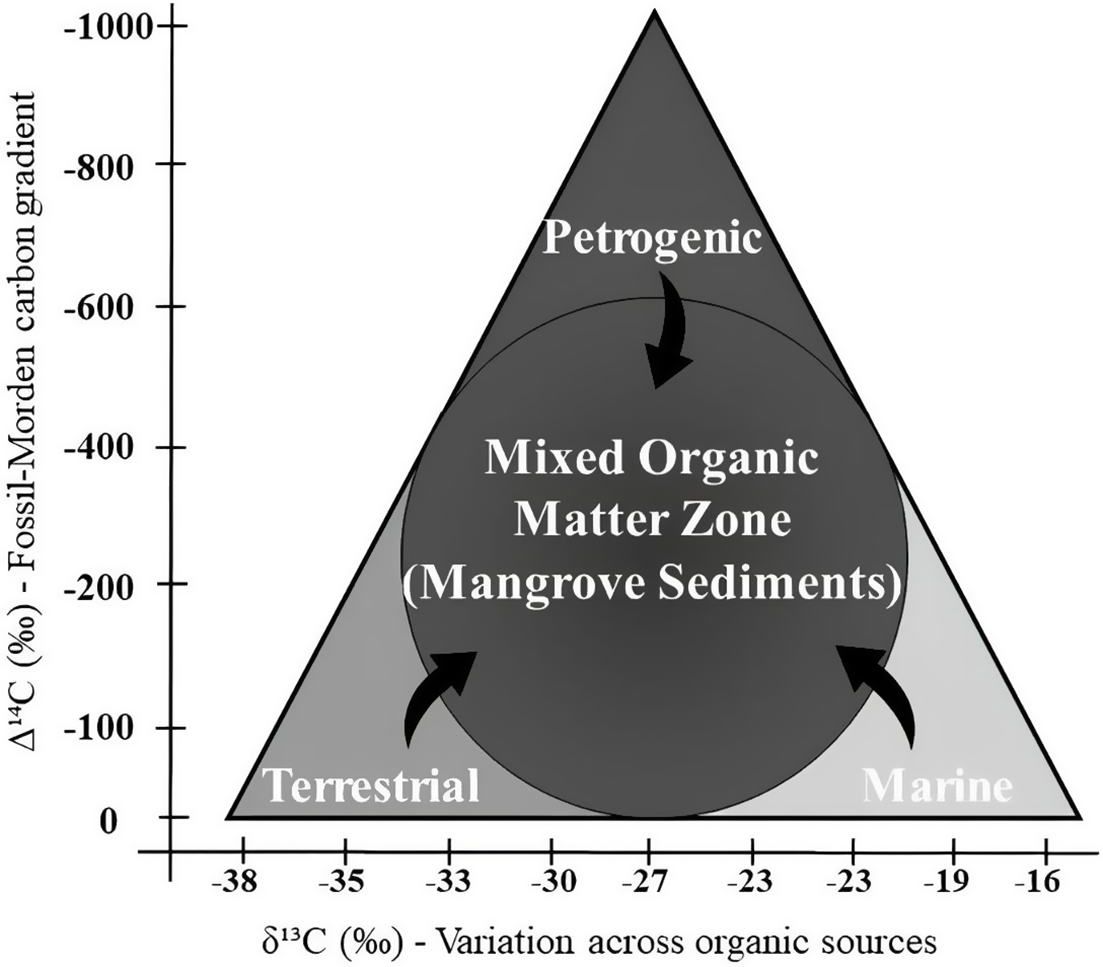
The combination of overlapping δ1 3C signatures and microbially driven fractionation often produces ambiguous isotopic trends in sedimentary matrices, particularly in mangrove and estuarine environments where organic recycling is intense. Figure 1 schematically represents these interactions, illustrating how δ1 3C values from different end-members converge through degradation and mixing processes, thereby obscuring direct identification of petroleum residues. These complexities reinforce the need to interpret δ1 3C within multi-tracer frameworks that integrate isotopic and molecular data, enabling a more reliable reconstruction of both contamination sources and post-depositional alterations.
Conceptual diagram illustrating the isotopic convergence among organic matter sources in mangrove sediments. Shades of gray denote petrogenic (dark), terrestrial (medium), and marine (light) end-members, with the central overlap zone representing mixed organic matter and isotopic homogenization.

In spatial terms, δ1 3C provides a useful baseline for distinguishing terrestrial from marine organic contributions, even in altered environments. Sediments characterized by δ1 3C around -34‰ generally indicate dominance of C3 terrestrial inputs, whereas those near -22‰ reflect greater marine productivity (Imfeld et al. Reference Imfeld, Ouellet, Douglas, Kos and Gélinas2022). In All Saints Bay (Brazil), long-chain n-alkanes (n-C2 7-n-C3 1) with δ1 3C values between -30‰ and -38‰ confirmed the persistence of mangrove-derived carbon, even under the influence of urban effluents and tidal reworking (Silva et al. Reference Silva, Dominguez, Yogui and de Almeida2024).
Isotopic covariation between δ1 3C and δ2H further refines these interpretations, revealing the imprint of anthropogenic activities such as fossil fuel leakage or sewage introduction (Jeon et al. Reference Jeon, Kim, Lee, Cho, Kim, Hong and Shin2024). Recent studies combining dual-isotope (δ1 3C-δ2H) and compound-specific isotope analysis (CSIA) of saturated and aromatic hydrocarbons have demonstrated the method’s capacity to distinguish natural, pyrogenic, and petrogenic inputs in highly mixed coastal sediments (Cooper et al. Reference Cooper, Chanton, D’Andrilli, Hodgkins, Podgorski, Stenson and Wilson2022; Imfeld et al. Reference Imfeld, Ouellet, Douglas, Kos and Gélinas2022; Wang et al. Reference Wang, Zhang, Song, Zhang, Hu, Li, Russel, Yang, Yu, Liu, Li, Guan, Han and Li2021; Wise et al. Reference Wise, Rodgers, Reddy, Nelson, Kujawinski, Wade and Liu2023). In particular, CSIA of PAHs reveals that unburned petroleum residues typically retain δ1 3C values between -24‰ and -30‰, while pyrogenic compounds tend to be less depleted, allowing refined attribution in complex estuarine systems.
2.2. Δ14C in the assessment of hydrocarbon contamination and carbon dynamics in sediments
Radiocarbon represents a measurement based on the quantification of the radioactive isotope of carbon and can be expressed in different forms. In studies aimed at characterizing the presence of petroleum-derived carbon, radiocarbon information may be reported as Δ14C, Percent Modern Carbon (pMC), or Fraction Modern (Fₘ). These parameters are mathematically interrelated (Stuiver and Polach Reference Stuiver and Polach1977), with Δ14C being the most commonly used notation in studies addressing hydrocarbon contamination.
Δ14C allows for the distinction between modern carbon (enriched in 14C) and fossil carbon (devoid of detectable 14C), based on the radioactive decay of 14C, which has a half-life of approximately 5730 years (Aelion et al. Reference Aelion, Höhener, Hunkeler and Aravena2009; Mohanty et al. Reference Mohanty, Agrawal, Shivam and Laskar2025). As a result, 14C is virtually absent in compounds formed millions of years ago, such as petroleum, making Δ14C a powerful tracer of fossil inputs, even at low concentrations (Grant et al. Reference Grant, Repasch, Finstad, Kerr, Marple, Larson and McFarlane2024; Wang et al. Reference Wang, Qiu, Hao, Wang, Zhang, Middelburg and Zou2024). This includes not only oil spills but also aged carbon from industrial emissions and sewage in coastal urban environments (Kennish Reference Kennish2017).
We retain Δ14C/pMC as the severity anchor because it directly reflects fossil dilution, but extend the framework with two optional modifiers: (i) δ1 3C ranges to flag marine vs. C3 dominance and biodegradation-related enrichments, and (ii) CSIA qualifiers (compound-specific δ1 3C and, where feasible, CS-Δ1 4C) to discriminate petrogenic oil from combustion-derived carbon. Practically, classes are assigned by bulk Δ14C/pMC; δ1 3C and CSIA provide confidence intervals and source qualifiers without overriding the radiocarbon-based rank. Class (Δ14C): anchor of severity, modifier δ1 3C: contextualizes mixing/degradation and qualifier CSIA: confirms petrogenic vs pyrogenic.
In systems with mixed carbon sources, such as estuaries, mangroves, and urban bays, relying solely on δ1 3C often leads to ambiguous interpretations due to isotopic overlap between petrogenic and modern organic matter (Kida et al. Reference Kida, Kondo, Tomotsune, Kinjo, Ohtsuka and Fujitake2019). However, the absence of 14C in fossil hydrocarbons results in a phenomenon known as radiocarbon dilution, in which small amounts of 14C-free compounds depress the overall Δ14C signal. This makes Δ14C highly sensitive to fossil inputs, even when recent biogenic matter is dominant (Wilson et al. Reference Wilson, Griffiths, Visser, McFarlane, Sebestyen and Oleheiser2021).
This isotopic behavior has been confirmed in estuarine settings where combined δ1 3C and Δ14C analyses, sometimes supported by biomarker data, have successfully quantified fossil carbon contributions to sedimentary organic matter. For example, Δ14C analysis of estuarine filter feeders after the Deepwater Horizon spill revealed minimal incorporation of fossil oil (<1%), highlighting the potential of radiocarbon tools to detect even diffuse contamination (Wilson et al. Reference Wilson, Cherrier, Sarkodee-Adoo, Bosman, Mickle and Chanton2016).
Moreover, anoxic conditions commonly found in coastal and estuarine subenvironments enhance the preservation of organic contaminants by limiting microbial degradation (Haghani and Amirhosseini Reference Haghani, Amirhosseini, Ghosh and Das2024). This favors the long-term retention of fossil residues in deeper sediment layers, allowing Δ14C to be used in retrospective analyses of sediment cores to reconstruct historical contamination events (Hajdas et al. Reference Hajdas, Ascough, Garnett, Fallon, Pearson, Quarta and Yoneda2021; Mackensen and Schmiedl Reference Mackensen and Schmiedl2019). Intermediate Δ14C values, often expressed as the percentage of modern carbon (pMC), support this effort: values near 100% (Δ14C ≈ 0‰) indicate modern inputs, while those approaching 0% (Δ14C ≈ -1000‰) signify fossil origin (Aelion et al. Reference Aelion, Höhener, Hunkeler and Aravena2009; Su et al. Reference Su, Zuo, Lv, Zhao, Zhu, Lin and Liu2016).
To improve resolution in highly degraded or mixed matrices, recent advances have applied radiocarbon techniques at the molecular level, compound-specific Δ14C analysis (CS-Δ14C), allowing researchers to determine the fossil or modern origin of individual hydrocarbons, such as n-alkanes and PAHs (Jeon et al. Reference Jeon, Kim, Lee, Cho, Kim, Hong and Shin2024; Rogers et al. Reference Rogers, Bosman, Wildermann, Rosenheim, Montoya, Hollander, Zhao and Chanton2021). In the Gulf of Mexico, CS-Δ14C applied to sinking particles and seafloor sediments revealed the persistence of petrocarbon from the Deepwater Horizon spill for up to three years, even when bulk δ1 3C values showed little variation ( Chanton et al. Reference Chanton, Giering, Bosman, Rogers, Sweet, Asper and Arne2018; Rogers et al. Reference Rogers, Bosman, Wildermann, Rosenheim, Montoya, Hollander, Zhao and Chanton2021).
By isolating molecular fractions, CS-Δ14C enhances the ability to distinguish persistent petrogenic compounds from biogenic background carbon, particularly in environments where degradation, sediment mixing, or resuspension obscure bulk isotopic signals. This high-resolution approach strengthens the reconstruction of sedimentary carbon dynamics under anthropogenic pressure and improves the detection of aged fossil- derived contamination (Jeon et al. Reference Jeon, Kim, Lee, Cho, Kim, Hong and Shin2024; Rogers et al. Reference Rogers, Bosman, Wildermann, Rosenheim, Montoya, Hollander, Zhao and Chanton2021).
2.3. Why combine δ13C and Δ14C?
The combined application of δ1 3C and Δ14C isotopes has significantly advanced the identification of carbon sources in contaminated sediments, especially by clarifying the interactions between natural organic matter and fossil-derived contaminants. This dual approach enables estimation of the mixing proportions between recent and ancient carbon and helps resolve complex geochemical signals in systems affected by overlapping inputs (Chanton et al. Reference Chanton, Zhao, Rosenheim, Joye, Bosman, Brunner, Yeager, Diercks and Hollander2015; Rogers et al. Reference Rogers, Bosman, Wildermann, Rosenheim, Montoya, Hollander, Zhao and Chanton2021; Wakeham and McNichol, Reference Wakeham and McNichol2014).
Isotopic variations along sediment profiles, such as δ1 3C shifts driven by selective degradation and Δ14C gradients indicating fossil carbon deposition, have been successfully used to assess the transport, degradation, and long-term persistence of contaminants (Chen et al. Reference Chen, Zhang, Wang, Han, Sun and Liu2021; Volkman and Smittenberg, Reference Volkman, Smittenberg, Weckström, Saunders, Gell and Skilbeck2017). Unlike compound-specific methods, bulk carbon isotope analysis offers a comprehensive view of the sedimentary organic matrix. Δ14C, in particular, provides critical insights into the age and degradation status of hydrocarbon residues, informing remediation strategies and long- term environmental monitoring (Fu et al. Reference Fu, Zhang, Rong, Wu, Wu and Ya2024; Höhener et al. Reference Höhener, Guers, Malleret, Boukaroum, Martin-Laurent, Masbou and Imfeld2022; Keesari, Reference Keesari2024 ; Li et al. Reference Li, Sun and Nie2020; Ogbesejana et al. Reference Ogbesejana, Liu and Ostadhassan2021).
Recent studies have demonstrated that this isotopic pairing is especially effective under complex mixing scenarios. For instance, in sediments from the western Yellow Sea, an estuarine region subjected to multiple carbon inputs Wang et al. (Reference Wang, Zhang, Song, Zhang, Hu, Li, Russel, Yang, Yu, Liu, Li, Guan, Han and Li2021) employed δ1 3C-Δ14C analysis to distinguish between natural, petrogenic, and combustion-derived sources. Their results revealed strong dilution of the modern Δ14C signal by fossil-derived BC and PAHs, emphasizing the dominance of anthropogenic fossil carbon in industrially impacted sediments (Diercks et al. Reference Diercks, Romero, Larson, Schwing, Harris, Bosman, Chanton and Brooks2021; Li et al. Reference Li, Fu, Zeng, Zhou, Zhang, Tu and Luo2021; Wulandari et al. Reference Wulandari, Katz, Kelly, Robinson and Lohmann2023). However, challenges persist. The absence of pre-contamination baselines, combined with post-depositional processes such as bioturbation, biodegradation, and vertical mixing, often masks the isotopic fingerprint of a single contamination event (Babcock-Adams et al. Reference Babcock-Adams, Chanton, Joye and Medeiros2017; Chanton et al. Reference Bosman, Chanton, Rogers, Wang and Stout2018). These factors can generate inconsistencies among isotopic and molecular markers, necessitating integrated approaches with multiple geochemical tracers to enhance interpretative robustness.
This analytical complexity is especially pronounced in tropical estuarine systems, such as Todos os Santos Bay, Brazil. There, sedimentary organic matter is predominantly derived from C3 vegetation, but increasingly masked by urban and industrial petrogenic hydrocarbons (Silva et al. Reference Silva, Dominguez, Yogui and de Almeida2024). In such systems, high biogenic inputs can obscure fossil signals, highlighting the importance of combining bulk and compound-specific radiocarbon approaches to improve source resolution.
To quantify the relative contributions of fossil carbon, particularly petroleum, many studies have employed isotopic mixing models. These models compare the isotopic signatures of environmental samples against well-characterized end-members, such as modern biogenic carbon and fossil-derived inputs (Wang et al. Reference Wang, Zhang, Song, Zhang, Hu, Li, Russel, Yang, Yu, Liu, Li, Guan, Han and Li2021; Rosenheim et al. Reference Rosenheim, Pendergraft, Flowers, Carney, Sericano, Amer, Chanton, Dincer and Wade2016). The position of the sample between these reference values enables estimation of each source’s proportional contribution (Chanton et al. Reference Chanton, Zhao, Rosenheim, Joye, Bosman, Brunner, Yeager, Diercks and Hollander2015; Rogers et al. Reference Rogers, Bosman, Wildermann, Rosenheim, Montoya, Hollander, Zhao and Chanton2021).
Nevertheless, the application of mixing models is often constrained by the lack of methodological standardization and uncertainty in end-member values, which hinder regional comparisons (Rozas et al. Reference Rozas, Idoeta, Rodríguez and Herranz2023; Vaiglova et al. Reference Vaiglova, Lazar, Stroud, Loftus and Makarewicz2023). Challenges in CSIA also persist, particularly in low-concentration samples or those affected by interfering substances, such as drilling fluids in offshore environments (Ya et al. Reference Ya, Wu, Wang, Li and Su2022).
Carbon derived from sources in equilibrium with the atmosphere (Δ14C = 0) differs markedly from that originating from petrogenic sources (Δ14C ≈ -1000). This contrast enables the isotopic discrimination of carbon sources, as both BC and petroleum contribute to Δ14C depletion. BC produced by recent biomass combustion may retain a nonzero, though near-modern, Δ14C signature, whereas petrogenic BC and crude-oil residues exhibit values approaching Δ14C ≈ -1000. Molecular markers further complement radiocarbon analyses: hopanes, steranes, and low-temperature isoprenoids characterize petrogenic inputs, whereas high-ring PAH profiles and diagnostic PAH ratios indicate pyrogenic BC. When bulk isotopic signatures remain ambiguous, compound-specific radiocarbon analysis (CS-Δ14C) of PAHs and n-alkanes provides a decisive means of differentiating fossil-fuel-derived combustion products from those of modern origin.
As the use of carbon isotopes expands in environmental forensics, especially in vulnerable tropical ecosystems, there is an urgent need to systematize current knowledge and harmonize analytical approaches. The critical synthesis of available isotopic datasets can guide methodological improvements and support more effective strategies for contamination monitoring and remediation in coastal areas exposed to petroleum inputs (Lawrence et al. Reference Lawrence, Beem-Miller, Hoyt, Monroe, Sierra, Stoner and Wagai2020).
To support this effort, the following section presents a comparative synthesis of case studies conducted in petroleum-impacted estuarine and coastal environments. This analysis identifies recurring isotopic patterns, examines the persistence and redistribution of fossil hydrocarbons, and demonstrates the added value of integrating multiple geochemical indicators in environmental assessments.
3. Carbon isotopes δ1 3C AND Δ14C) in the identification and assessment of oil spills in coastal and estuarine ecosystems: A synthesis of empirical studies
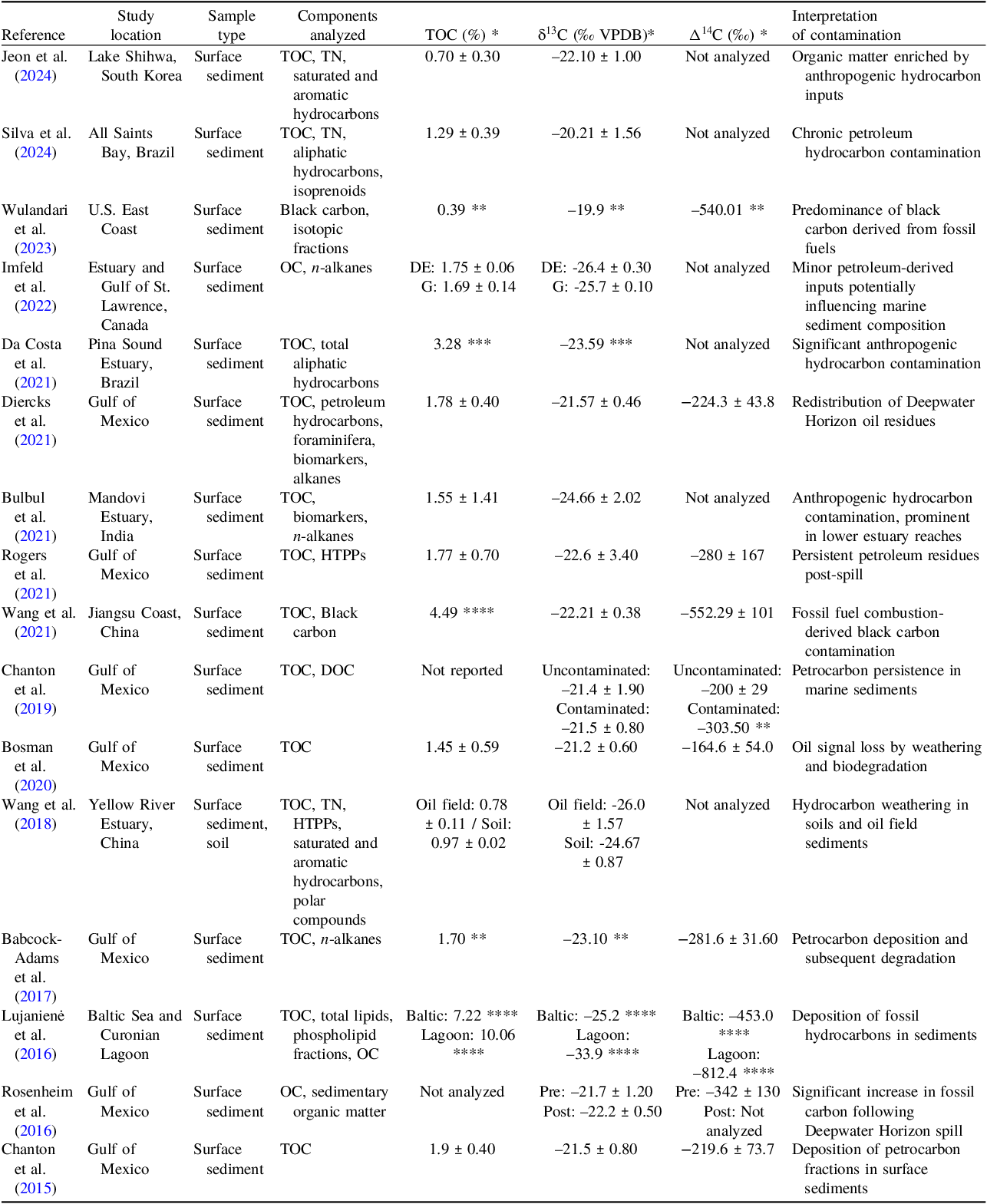
Numerous studies have demonstrated the effectiveness of δ1 3C and Δ14C isotopes, used independently or in combination, for identifying petroleum-derived pollutants. Table 1 summarizes empirical data from the past 15 years that highlight the utility of these isotopes in identifying contaminant sources, assessing hydrocarbon persistence, and distinguishing between natural and anthropogenic inputs. It also reveals wide variability in total organic carbon (TOC) content and analyzed components, the diversity of studied coastal environments (from open marine systems to lagoons), and the frequent underutilization of Δ14C and lack of systematic temporal monitoring, factors that reinforce the need for integrated analytical approaches.
Summary of empirical studies on oil spill contamination in coastal and estuarine ecosystems using carbon isotopes (δ1 3C and Δ1 4C)

Notes:
DE/G: Sampling stations.
*Mean values unless otherwise noted.
**Standard deviation not reported by the original authors.
***Median values reported by Da Costa et al. (Reference Costa, Santos and Yogui2021); standard deviations for these values were not disclosed.
****Midpoint value calculated from reported ranges (not provided by original study).
Abbreviations: TOC = Total Organic Carbon, TN = Total Nitrogen, OC = Organic Carbon, DOC = Dissolved Organic Carbon, HTPPs = High-Temperature Petroleum Products.
Table summarizes empirical studies on oil spill contamination in estuarine and mangrove ecosystems, highlighting the utility of δ1 3C and Δ14C in tracing fossil carbon. The underutilization of Δ14C, particularly in mangrove studies (e.g., Silva et al. Reference Silva, Dominguez, Yogui and de Almeida2024; Da Costa et al. Reference Costa, Santos and Yogui2021), limits fossil carbon detection, emphasizing the need for combined isotopic approaches and standardized methods.
The strength of this dual-isotope strategy lies in its sequential application: Δ14C serves as a sensitive tracer for the presence and quantification of fossil carbon, while δ1 3C provides contextual information about organic matter origin and degradation status. Since petroleum is devoid of radiocarbon, even small contributions of oil measurably dilute the Δ14C signature of modern organic matter in sediments. This makes Δ14C especially valuable for detecting petrogenic contamination at low concentrations or when masked by a background of recent biogenic inputs (Chanton et al. Reference Chanton, Zhao, Rosenheim, Joye, Bosman, Brunner, Yeager, Diercks and Hollander2015; Rogers et al. Reference Rogers, Bosman, Wildermann, Rosenheim, Montoya, Hollander, Zhao and Chanton2021).
Once the presence of fossil carbon is confirmed, δ1 3C adds diagnostic depth by characterizing the surrounding natural organic matter and aiding in the interpretation of overlapping signatures. For example, δ1 3C can differentiate contributions from terrestrial C3 plants and marine phytoplankton, which may otherwise obscure petroleum signals (Imfeld et al. Reference Imfeld, Ouellet, Douglas, Kos and Gélinas2022; Silva et al. Reference Silva, Dominguez, Yogui and de Almeida2024). Additionally, δ1 3C supports the assessment of weathering and biodegradation, as microbial degradation preferentially removes 1 2C-enriched compounds, resulting in a residual pool increasingly enriched in 1 3C. This shift toward less negative δ1 3C values is widely recognized as an indicator of progressive hydrocarbon degradation (Atoufi et al. Reference Atoufi and Lampert2020; Kim et al. Reference Kim, Hwangbo, Shih and Chu2023b; Liu et al. Reference Liu, Wu, Gao, Yi and Duan2021).
Thus, the combined application of δ1 3C and Δ14C not only enables the detection and quantification of petrogenic carbon via radiocarbon dilution, but also supports a more refined understanding of contamination dynamics, sources, and transformation states within complex sedimentary environments.
3.1. Synthesis of empirical studies
The wide range of δ1 3C values reported for coastal sediments, from -33.9‰ (Lujanienė et al. Reference Lujanienė, Mažeika, Li, Petrošiūtė, Stankevičienė, Steponavičius and Jankaitė2016) to -20.2 ± 0.6‰ (Silva et al. Reference Silva, Carvalho, Libardoni, Macario, de Lima, Pimenta and Cavalcanti2021), reflects the complex overlap of marine, terrestrial, and anthropogenic carbon inputs. This variability, commonly observed in estuarine and coastal environments (Mancinelli and Vizzini Reference Mancinelli and Vizzini2015), is shaped by mixtures of natural organic matter and fossil-derived contaminants. Less negative values, such as -19.9‰ (Wulandari et al. Reference Wulandari, Katz, Kelly, Robinson and Lohmann2023), suggest contributions from marine sources and petrogenic carbon, including sewage and black carbon. Intermediate signatures (e.g. -22.21 ± 0.38‰, Wang et al. Reference Wang, Zhang, Song, Zhang, Hu, Li, Russel, Yang, Yu, Liu, Li, Guan, Han and Li2021; -22.1 ± 1.0‰, Jeon et al. Reference Jeon, Kim, Lee, Cho, Kim, Hong and Shin2024) further indicate mixed-source environments and demonstrate the limited diagnostic power of δ1 3C when used in isolation.
Empirical studies compiled in Table 1 highlight that combining δ1 3C and Δ14C significantly improves source discrimination in oil-contaminated coastal systems. This integrative isotopic approach compensates for the overlapping δ1 3C values of fossil and modern carbon sources, particularly in environments with high productivity or substantial riverine input. For instance, studies in the Mandovi Estuary (Bulbul et al. Reference Bulbul, Ankit, Basu and Anoop2021) and the Gulf of Saint Lawrence (Imfeld et al. Reference Imfeld, Ouellet, Douglas, Kos and Gélinas2022) reported δ1 3C values around -25‰, associated with both C3 vegetation and marine inputs. Similar patterns observed in the Baltic Sea (Da Costa et al. Reference Costa, Santos and Yogui2021; Lujanienė et al. Reference Lujanienė, Mažeika, Li, Petrošiūtė, Stankevičienė, Steponavičius and Jankaitė2016) illustrate how petrogenic signals may be masked by biogenic contributions.
Δ14C analysis, in contrast, provides clearer evidence of fossil inputs. Strongly depleted values, such as -812.4‰ (Lujanienė et al. Reference Lujanienė, Mažeika, Li, Petrošiūtė, Stankevičienė, Steponavičius and Jankaitė2016) and -552 ± 101‰ (Wang et al. Reference Wang, Zhang, Song, Zhang, Hu, Li, Russel, Yang, Yu, Liu, Li, Guan, Han and Li2021), are consistent with petroleum or coal-derived carbon. Moderately negative values (e.g. -164.6 ± 54.0‰, Bosman et al. Reference Bosman, Schwing, Larson, Wildermann, Brooks, Romero, Sanchez-Cabeza, Ruiz-Fernández, Machain-Castillo and Gracia2020; -200 ± 29‰, Chanton et al. Reference Chanton, Jaggi, Radović, Rosenheim, Walker and Larter2019) suggest partial dilution by modern organic matter, fitting within the radiocarbon dilution framework. These patterns confirm the value of Δ14C as a sensitive and specific tracer, even when fossil signals are obscured by recent material.
The temporal persistence of fossil carbon can also be evaluated through radiocarbon. Chanton et al. (Reference Chanton, Zhao, Rosenheim, Joye, Bosman, Brunner, Yeager, Diercks and Hollander2015) reported Δ14C values of -219.6 ± 73.7‰ in surface sediments years after the Deepwater Horizon spill, indicating the longevity of petrocarbon residues. Similar findings were reported by Rogers et al. (Reference Rogers, Bosman, Wildermann, Rosenheim, Montoya, Hollander, Zhao and Chanton2021) and Diercks et al. (Reference Diercks, Romero, Larson, Schwing, Harris, Bosman, Chanton and Brooks2021). In contrast, studies by Rosenheim et al. (Reference Rosenheim, Pendergraft, Flowers, Carney, Sericano, Amer, Chanton, Dincer and Wade2016) and Chanton et al. (Reference Chanton, Jaggi, Radović, Rosenheim, Walker and Larter2019) observed only minor changes in δ1 3C post-spill, while Δ14C values showed marked shifts, confirming the fossil origin. Bosman et al. (Reference Bosman, Schwing, Larson, Wildermann, Brooks, Romero, Sanchez-Cabeza, Ruiz-Fernández, Machain-Castillo and Gracia2020) further demonstrated that prolonged microbial degradation can erode the δ1 3C signature of petroleum, making it indistinguishable from natural background carbon.
In addition to temporal dynamics, δ1 3C has also been employed to map spatial heterogeneity. Differences between oil field contamination and agricultural soils (Wang et al. Reference Wang, Liang, Wang and Gao2018), as well as among marine, estuarine, and lagoonal zones (Lujanienė et al. Reference Lujanienė, Mažeika, Li, Petrošiūtė, Stankevičienė, Steponavičius and Jankaitė2016), were effectively captured by δ1 3C. However, such spatial interpretations remain vulnerable to transformation processes that can obscure original signatures. The integration of δ1 3C with Δ14C and molecular markers, such as n-alkanes, PAHs, and hopanes, enhances diagnostic power in these complex systems (Szymczak-Żyła; Lubecki Reference Szymczak-Żyła and Lubecki2022; Mil-Homens et al. Reference Mil-Homens, Gonçalves, Cortés, van Drooge, de Stigter, Grimalt, Berndt, Jesus and Caetano2025).
Despite the proven potential of this combined isotopic approach, its application across studies remains inconsistent. For example, Silva et al. (Reference Silva, Dominguez, Yogui and de Almeida2024) and Jeon et al. (Reference Jeon, Kim, Lee, Cho, Kim, Hong and Shin2024) did not include Δ14C measurements, limiting their ability to distinguish between modern and fossil carbon sources. Additionally, Table 1 reveals substantial variability in analytical components, including TOC and Biomarkers, and a lack of methodological standardization, which complicates comparisons across studies and ecosystems.
Future research should prioritize methodological integration and longitudinal monitoring. The inclusion of temporal datasets, particularly pre and post-spill measurements, is essential to evaluate redistribution and persistence of contaminants. Moreover, the anaerobic conditions typical of mangrove sediments promote hydrocarbon preservation, as evidenced by experimental studies demonstrating prolonged biomarker stability in oil-contaminated soils (Dai et al. Reference Dai, Lv, Fu and Guo2023; Dhar et al. Reference Dhar, Subashchandrabose, Venkateswarlu, Krishnan and Megharaj2020; Muñoz et al. Reference Muñoz, Guiliano, Doumenq, Jacquot and Mille1997; Underwood et al. Reference Underwood, Dumbrell, McGenity, McKew, Whitby and Stal2022). These findings underscore the importance of combining isotopic tools with molecular and spatial analyses to advance our understanding of carbon dynamics in contaminated coastal systems.
3.2. Persistence and redistribution of oil in estuarine ecosystems
Oil accumulation in mangrove ecosystems results in complex retention and redistribution dynamics, driven by physicochemical factors such as salinity fluctuations, organic matter accumulation, and relative sedimentation stability (Little Reference Little, Makowski and Finkl2018). These coastal environments function as hydrocarbon retention zones, particularly within sedimentary compartments, where oily residues can persist for extended periods even after the contamination source ceases (Tansel Reference Tansel2024).
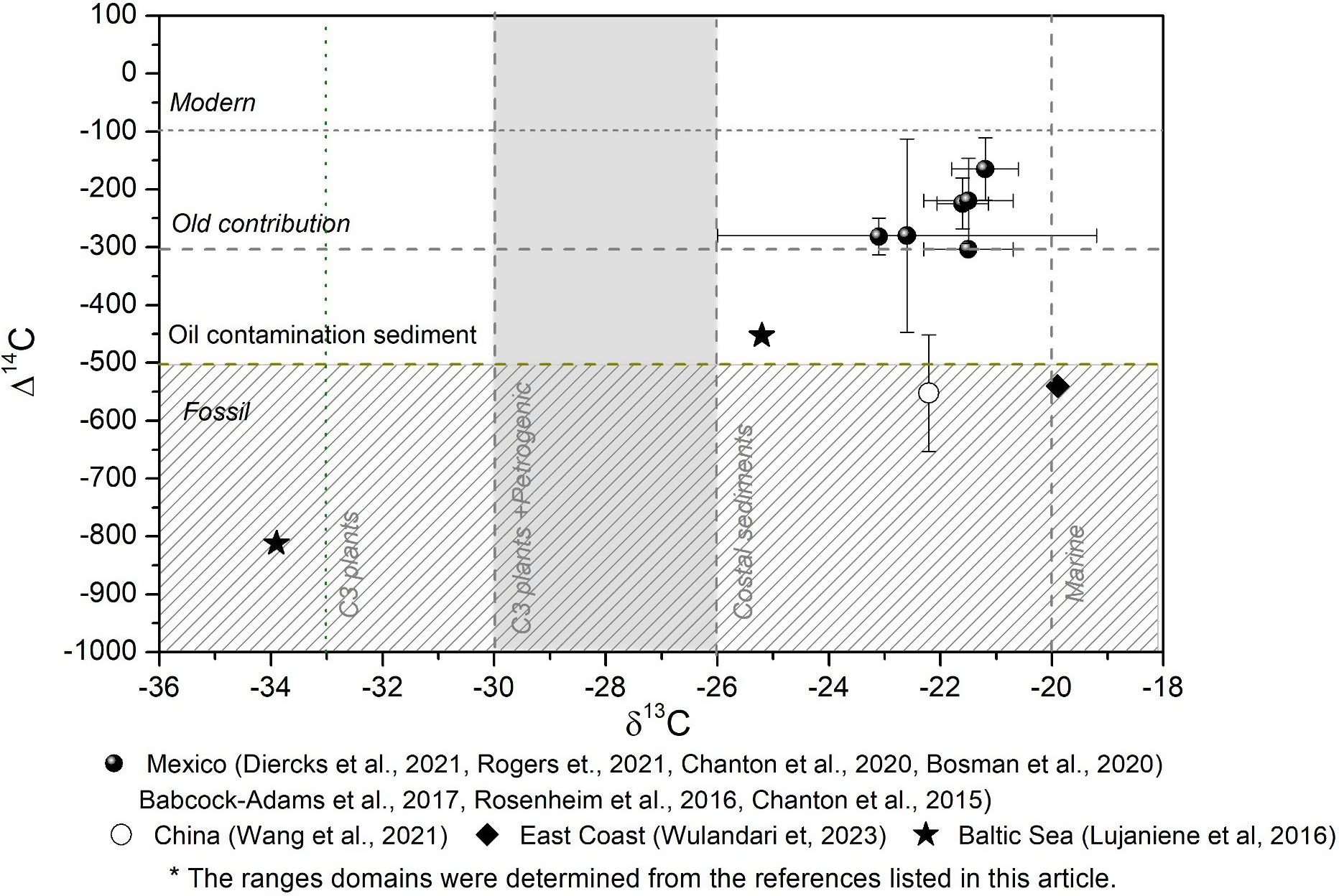
The use of isotopic analyses applied to organic compounds has become an effective approach for investigating the persistence of oil in estuarine environments (Souza et al. Reference Souza, Bernardino and Rezende2018; Yadav et al. Reference Yadav, Dutta, Pulhani and Kumar2025). Figure 2 summarizes the studies listed in Table 1 that employed δ1 3C and Δ14C analyses. It reveals a predominant clustering of samples from the Gulf of Mexico, particularly those associated with the Deepwater Horizon platform spill in 2010. In these studies, δ1 3C values range from -21.2‰ to -23.10‰, while Δ14C values range from -164.6‰ to -303.50‰.
Relationship between Δ¹4C and δ¹³C isotopic values in total organic carbon (TOC) from surface sediments collected in estuarine ecosystems impacted by oil spills between 2010 and 2025. The data were compiled from 10 empirical studies conducted in regions such as the Gulf of Mexico (Diercks et al. (Reference Diercks, Romero, Larson, Schwing, Harris, Bosman, Chanton and Brooks2021); Rogers et al. (Reference Rogers, Bosman, Wildermann, Rosenheim, Montoya, Hollander, Zhao and Chanton2021); Chanton et al. (Reference Chanton, Jaggi, Radović, Rosenheim, Walker and Larter2019); Bosman et al. (Reference Bosman, Schwing, Larson, Wildermann, Brooks, Romero, Sanchez-Cabeza, Ruiz-Fernández, Machain-Castillo and Gracia2020); Babcock-Adams et al. (B Reference Babcock-Adams, Chanton, Joye and Medeiros2017); Rosenheim et al. (Reference Rosenheim, Pendergraft, Flowers, Carney, Sericano, Amer, Chanton, Dincer and Wade2016) and Chanton et al. (Reference Chanton, Zhao, Rosenheim, Joye, Bosman, Brunner, Yeager, Diercks and Hollander2015)), the U.S. East Coast (Wulandari et al. (Reference Wulandari, Katz, Kelly, Robinson and Lohmann2023)), China (Wang et al. Reference Wang, Liu, Xu, Chen, Li, Zhao and Wang(2021) and Baltic Sea (Lujanienė et al. Reference Lujanienė, Mažeika, Li, Petrošiūtė, Stankevičienė, Steponavičius and Jankaitė2016); (Lv et al. Reference Lv, Wang, Su and Zhang2015; Maak et al. Reference Maak, Elvert, Grotheer, Lin, Mollenhauer, Lin and Schefuß2025; Mackensen and Schmiedl, Reference Mackensen and Schmiedl2019 (2016)).

The compiled information indicates recurring isotopic signals over time and suggests that different authors observed consistent patterns related to oil degradation and redistribution. The presence of fossil carbon is evident, although partially mixed with recent organic matter, revealing both the persistence and mobility of the contaminant.
A long-term experimental study on mangrove soil polluted with Arabian Light oil demonstrated the evolution and differential degradation of petroleum biomarkers over eight years, with n-alkanes and isoprenoids degrading more rapidly than steranes and hopanes, which remained detectable, highlighting the persistence of certain oil components even in biologically active environments like mangroves (Muñoz et al. Reference Muñoz, Guiliano, Doumenq, Jacquot and Mille1997). The distribution of data reveals distinct regional patterns of petrogenic contamination: strongly negative Δ14C values indicate a higher presence of petroleum, whereas values near 0‰ suggest a predominant influence of recent organic matter. In the Baltic Sea, the two data points reflect contrasting environmental conditions. The Curonian Lagoon and the R7 site are marked by a strong predominance of terrestrial organic carbon, resulting in more depleted δ1 3C values and comparatively enriched Δ14C signatures, indicating the presence of modern carbon. In contrast, samples from the chemical weapon dumping area in the Gotland Deep show a significant contribution of fossil-derived carbon, leading to much more negative Δ14C values.
In contrast, data from Asian estuaries and the U.S. East Coast reveals more depleted Δ14C values (< -550‰), with ages exceeding 6,000 years. These values indicate the presence of BC or fossil combustion residues (Wang et al. Reference Wang, Zhang, Song, Zhang, Hu, Li, Russel, Yang, Yu, Liu, Li, Guan, Han and Li2021; Wulandari et al. Reference Wulandari, Katz, Kelly, Robinson and Lohmann2023). In coastal areas of the Yellow Sea, for example, stable and radioactive isotopes (δ13C, Δ14C, and δ2H) of BC and PAHs have been used to identify pollutant sources, revealing contributions from coal combustion, liquid fossil fuels, petrogenic sources, and biomass burning (Wang et al. Reference Wang, Zhang, Song, Zhang, Hu, Li, Russel, Yang, Yu, Liu, Li, Guan, Han and Li2021). Li et al. (Reference Li, Fu, Zeng, Zhou, Zhang, Tu and Luo2021), in turn, report more negative δ1 3C values, suggesting contributions from terrigenous organic matter and underscoring the complexity of carbon sources in estuarine environments subject to multiple anthropogenic pressures.
Studies such as those by Chanton et al. (Reference Chanton, Zhao, Rosenheim, Joye, Bosman, Brunner, Yeager, Diercks and Hollander2015), Rogers et al. (Reference Rogers, Bosman, Wildermann, Rosenheim, Montoya, Hollander, Zhao and Chanton2021), and Diercks et al. (Reference Diercks, Romero, Larson, Schwing, Harris, Bosman, Chanton and Brooks2021), conducted in the Gulf of Mexico after the Deepwater Horizon spill, detected fossil carbon in surface sediments using δ1 3C and Δ14C isotopic analyses. These findings suggest that oil residues can persist for extended periods or be remobilized under specific hydrodynamic or depositional conditions. Additionally, Lee et al. (Reference Lee, Shin and Oh2025) reported the presence of fossil carbon in sediments from industrial and port areas, indicating localized accumulation zones or “hotspots”. Together, these studies highlight the need to reassess the effectiveness of monitoring strategies based solely on chemical concentration, reinforcing the importance of also considering the isotopic composition and residence time of contaminants in sedimentary environments.
Incorporating isotopic analyses, such as δ1 3C and Δ14C, into monitoring strategies can provide more detailed diagnostics, aiding in distinguishing between recent and historical contamination sources. This approach also allows for the identification of areas where oil persists due to limited oxygen availability, which slows microbial degradation. In contrast, oxic environments tend to accelerate breakdown and transport of contaminants, increasing ecological vulnerability. This information can support decision making in remediation processes, helping prioritize interventions based on the local characteristics of each system.
In summary, the ten empirical studies reviewed converge in demonstrating that the combined application of δ1 3C and Δ14C in surface sediments provides a robust tool for tracing carbon sources and transformations in contaminated coastal environments. This dual-isotope approach enables precise distinction between recent and fossil inputs, identification of hydrocarbon persistence across varying environmental conditions, and insight into degradation trajectories linked to different depositional settings. By going beyond the mere detection of specific compounds, carbon isotopes offer a more comprehensive temporal and spatial diagnosis that contributes not only to understanding contamination dynamics but also to improving monitoring, mitigation, and remediation strategies in sensitive coastal ecosystems such as estuaries, port zones, and transitional marine systems.
4. Proposed classification of contamination severity based on ∆14C
To enhance comparability across isotopic assessments of oil contamination in coastal ecosystems, we propose an exploratory typology of contamination severity, grounded in mean Δ14C values (‰) and the Modern Fraction (Fm). For geochemical studies, Fm is a relevant parameter that can be calculated directly from ∆14C (Mueller and Muzikar Reference Mueller and Muzikar2002) using the expression 1.
 ${F_m} = {{{{\left( {{\raise0.5ex\hbox{$\scriptstyle {^{14}c}$}\kern-0.1em/\kern-0.15em\lower0.25ex\hbox{$\scriptstyle {^{13}c}$}}} \right)}_{sample}}} \over {{{\left( {{\raise0.5ex\hbox{$\scriptstyle {^{14}c}$}\kern-0.1em/\kern-0.15em\lower0.25ex\hbox{$\scriptstyle {^{13}c}$}}} \right)}_{standd}}}}$
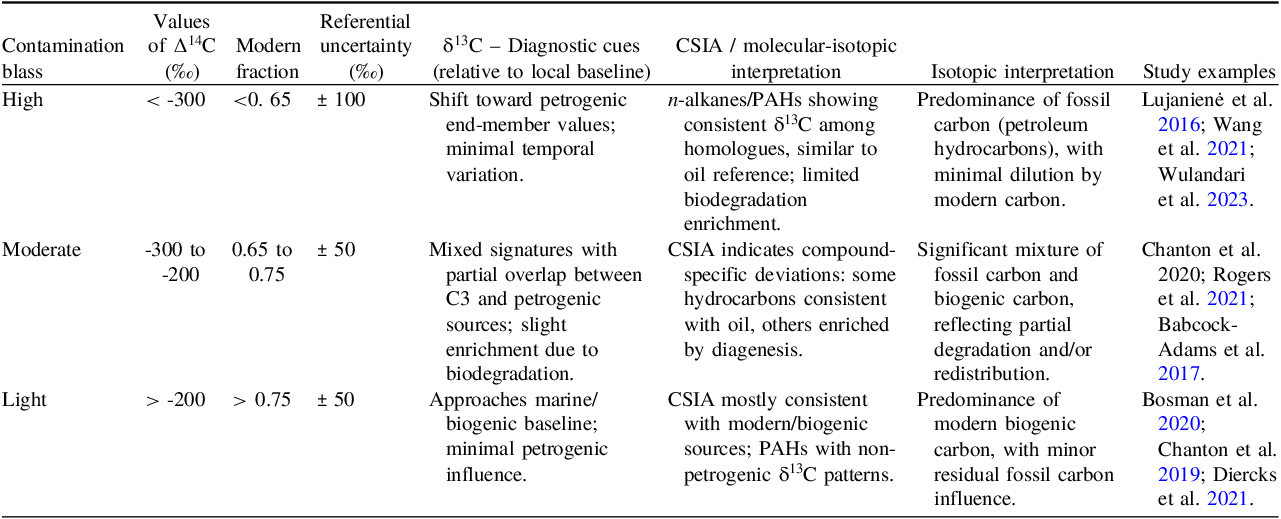
Table 2 not only delineates isotopic thresholds and their conceptual interpretations, but also illustrates each severity class with empirical examples drawn from the reviewed literature (Table 1), providing a concrete foundation for the application of the proposed typology.
The proposed Δ14C thresholds incorporate estimated uncertainties of ±100‰ (high contamination) and ±50‰ (moderate and low contamination), based on the variability observed in the empirical studies reviewed (Table 1)

Table 2 Long description
A table categorizing contamination levels based on isotopic values and diagnostic cues. The table has three rows and seven columns. The columns are labeled 'Contamination blass', 'Values of Δ14C (‰)', 'Referential uncertainty (‰)', 'δ13C – Diagnostic cues (relative to local baseline)', 'CSIA / molecular-isotopic interpretation', 'Isotopic interpretation', and 'Study examples'. The rows are labeled 'High', 'Moderate', and 'Light'. Under 'Contamination blass', the values are 'High', 'Moderate', and 'Light'. Under 'Values of Δ14C (‰)', the values are '< -300', '-300 to -200', and '> -200'. Under 'Referential uncertainty (‰)', the values are '± 100', '± 50', and '± 50'. Under 'δ13C – Diagnostic cues (relative to local baseline)', the values are 'Shift toward petrogenic end-member values; minimal temporal variation.', 'Mixed signatures with partial overlap between C3 and petrogenic sources; slight enrichment due to biodegradation.', and 'Approaches marine/biogenic baseline; minimal petrogenic influence.'. Under 'CSIA / molecular-isotopic interpretation', the values are 'n-alkanes/PAHs showing consistent δ13C among homologues, similar to oil reference; limited biodegradation enrichment.', 'CSIA indicates compound-specific deviations; some hydrocarbons consistent with oil, others enriched by diagenesis.', and 'CSIA mostly consistent with modern/biogenic sources; PAHs with non-petrogenic δ13C patterns.'. Under 'Isotopic interpretation', the values are 'Predominance of fossil carbon (petroleum hydrocarbons), with minimal dilution by modern carbon.', 'Significant mixture of fossil carbon and biogenic carbon, reflecting partial degradation and/or redistribution.', and 'Predominance of modern biogenic carbon, with minor residual fossil carbon influence.'. Under 'Study examples', the values are 'Lujanienė et al. 2016; Wang et al. 2021; Wulandari et al. 2023.', 'Chanton et al. 2020; Rogers et al. 2021; Babcock-Adams et al. 2017.', and 'Bosman et al. 2020; Chanton et al. 2019; Diercks et al. 2021.'.
Note: This semi-quantitative typology is anchored in Δ14C/pMC thresholds. δ1 3C and CSIA provide complementary, site-specific constraints and should be interpreted relative to local baselines and reference oil signatures. δ1 3C cues include departures from marine/terrestrial baselines and biodegradation-related 1 3C enrichment; CSIA cues include compound-level shifts indicative of petrogenic vs. pyrogenic sources. This integration consolidates the proposed framework as a flexible yet comprehensive tool for interpreting isotopic datasets in oil-contaminated coastal systems.
Although Δ14C/pMC provides the primary semi-quantitative anchor for classifying oil-derived carbon, δ1 3C and CSIA offer complementary, site-specific constraints that refine source attribution and process interpretation. Accordingly, Table 2 incorporates qualitative δ1 3C and CSIA diagnostic cues, interpreted against local baselines and reference oils, to enhance the robustness of the Δ14C-based typology. This addition ensures greater coherence between the multi-isotopic framework discussed throughout the manuscript and the proposed classification scheme.
The principal advantage of this typology is that it provides a semi-quantitative framework for interpreting the severity of hydrocarbon contamination, complementing descriptive analyses with isotopic thresholds. By incorporating empirical examples from Table 1 into each category, this approach enables more consistent comparisons across studies and environments. Similar efforts to integrate isotopic data into interpretative models have proven useful in other environmental assessments (Mil-Homens et al. Reference Mil-Homens, Gonçalves, Cortés, van Drooge, de Stigter, Grimalt, Berndt, Jesus and Caetano2025; Rogers et al. Reference Rogers, Bosman, Wildermann, Rosenheim, Montoya, Hollander, Zhao and Chanton2021; Wang et al. Reference Wang, Zhang, Song, Zhang, Hu, Li, Russel, Yang, Yu, Liu, Li, Guan, Han and Li2021). The visual alignment between the proposed classes and field data illustrates the typology’s applicability, particularly for distinguishing degrees of fossil carbon persistence in sediment. This methodological contribution helps address the lack of standardization noted in previous isotopic assessments of oil-contaminated sites (Babcock-Adams et al. Reference Babcock-Adams, Chanton, Joye and Medeiros2017; Chanton et al. Reference Chanton, Zhao, Rosenheim, Joye, Bosman, Brunner, Yeager, Diercks and Hollander2015).
The proposed typology is not normative but provides a preliminary analytical tool for comparison among investigations conducted in different spatial and environmental contexts. Fm, together with δ13C data, can be used as a direct indicator of petroleum degradation levels in contaminated environments.
Since fossil carbon has an isotopic ratio close to -1000‰ (Fm ≈ 0) and modern carbon has an isotopic value close to 0‰ (Fm ≈ 1), the variation between these extremes reflects the relative proportion of fossil versus biogenic sources. In this way, intermediate Fm values indicate mixtures of residual petroleum and contemporary organic matter.
The empirical cases compiled in Table 2 illustrate the flexibility of the proposed typology in capturing a range of contamination scenarios. In highly contaminated environments, Δ14C values well below -300‰, as reported by Lujanienė et al. (Reference Lujanienė, Mažeika, Li, Petrošiūtė, Stankevičienė, Steponavičius and Jankaitė2016) in the Curonian Lagoon (a transnational coastal system shared by Lithuania and Russia) and Wang et al. (Reference Wang, Zhang, Song, Zhang, Hu, Li, Russel, Yang, Yu, Liu, Li, Guan, Han and Li2021) off the Jiangsu Coast (China), indicate a clear dominance of fossil carbon, typically associated with petroleum residues or BC from combustion.
In contrast, the moderate contamination range (Δ14C between -300‰ and -200‰) is exemplified by studies from the Gulf of Mexico (Babcock-Adams et al. Reference Babcock-Adams, Chanton, Joye and Medeiros2017; Rogers et al. Reference Rogers, Bosman, Wildermann, Rosenheim, Montoya, Hollander, Zhao and Chanton2021), where intermediate values reflect a substantial mixture of fossil and modern biogenic carbon. These values suggest ongoing weathering, partial degradation, or redistribution of the contaminant. Low contamination scenarios, characterized by Δ14C values above -200‰, generally reflect a predominance of recent organic matter. This pattern has been observed in areas where petroleum residues have undergone extensive degradation or dilution over time, such as in the Gulf of Mexico following prolonged exposure to weathering and microbial activity (Bosman et al. Reference Bosman, Schwing, Larson, Wildermann, Brooks, Romero, Sanchez-Cabeza, Ruiz-Fernández, Machain-Castillo and Gracia2020).
Complementary insights are provided by percent modern carbon, which reflects the relative contribution of recent versus fossil carbon in sediments. Fm values below 0.65 point to a strong fossil signal, indicating limited replacement by modern carbon and, therefore, a high level of contamination. Intermediate values (0.65–0.75) suggest partial substitution by recent carbon, typically associated with moderate contamination and active degradation processes.
Values exceeding 0.75 are indicative of low contamination, where recent carbon dominates, either due to natural attenuation or advanced weathering. As a whole, Fm functions as a useful companion metric to Δ14C, reinforcing interpretations of fossil carbon input and the extent of its transformation.
The threshold values that define each contamination class are based on patterns observed across a variety of empirical studies. The -200‰ cutoff represents a conservative boundary: although organic matter may still be primarily modern at this level, its slight 14C depletion signals detectable input from older carbon sources, consistent with low-level contamination. The -300‰ threshold marks a clear transition, frequently identified in chronically impacted areas such as the Gulf of Mexico (Chanton et al. Reference Chanton, Zhao, Rosenheim, Joye, Bosman, Brunner, Yeager, Diercks and Hollander2015; Rogers et al. Reference Rogers, Bosman, Wildermann, Rosenheim, Montoya, Hollander, Zhao and Chanton2021), where fossil inputs become dominant and unambiguous. The intermediate zone captures a dynamic mixing regime, where degradation, dilution, and sediment reworking are actively shaping the isotopic composition.
By framing these observations within an interpretive typology, this study contributes to a more standardized analysis of isotopic data in oil-contaminated environments, particularly in systems with high organic complexity, such as coastal and estuarine environments (Rozas et al. Reference Rozas, Idoeta, Rodríguez and Herranz2023; Vaiglova et al. Reference Vaiglova, Lazar, Stroud, Loftus and Makarewicz2023). While not intended as a rigid framework, the classification allows for consistent comparison across cases and facilitates recognition of recurring isotopic patterns linked to contamination levels.
To further enhance the typology presented in Table 2, it is essential to acknowledge that fossil-derived carbon can originate from a variety of sources beyond petroleum, notably BC, which itself encompasses distinct subtypes such as pyrogenic carbon from biomass burning and petrogenic BC from coal or oil combustion (Wang et al. Reference Wang, Chen, Zhao, Qiao, Xu, Li, Zhang and Wang2020).
These forms of carbon differ not only in their molecular composition and environmental persistence but also in their isotopic signatures.
While both are depleted in Δ14C, pyrogenic BC may retain small amounts of radiocarbon depending on the age and type of biomass burned, leading to Fm values that can overlap with those of partially aged biogenic carbon. Petrogenic BC, in contrast, is entirely devoid of 14C and often exhibits extremely negative Δ14C values, as seen in cases of intense BC inputs (Wulandari et al. Reference Wulandari, Katz, Kelly, Robinson and Lohmann2023). This overlap introduces ambiguity in isotopic interpretation, particularly in systems subject to mixed combustion sources or long-range atmospheric transport of aerosols.
Despite their similarly depleted Δ14C signatures, BC and petrogenic carbon originate from fundamentally different processes and display distinct molecular and environmental behaviors. BC results from incomplete combustion of biomass or fossil fuels, producing condensed aromatic structures with high thermal stability and strong resistance to biodegradation (Coppola et al. Reference Coppola, Wagner, Lennartz, Seidel, Nicholas, Dittmar, Santín and Jones2022). Petrogenic carbon, in contrast, derives from unburned petroleum residues composed of a complex mixture of aliphatic and aromatic hydrocarbons that are more labile under oxic or microbially active conditions. These compositional and structural differences influence both degradation kinetics and the isotopic evolution of sediments: BC persists as a refractory fraction, whereas petrogenic compounds undergo progressive oxidation and isotopic enrichment during weathering and biodegradation (Wang et al. Reference Wang, Chen, Zhao, Qiao, Xu, Li, Zhang and Wang2020, Reference Wang, Zhang, Song, Zhang, Hu, Li, Russel, Yang, Yu, Liu, Li, Guan, Han and Li2021). Consequently, distinguishing between BC- and oil-derived carbon requires integrating molecular and compound-specific isotope analyses rather than relying solely on bulk Δ14C values.
In such complex scenarios, the integration of CSIA offers a valuable diagnostic tool. By targeting specific molecular markers such as PAHs, hopanes, and steranes, CSIA can help to distinguish between combustion-derived inputs and petroleum contamination, resolving uncertainties that bulk isotopic analysis alone cannot address.
Therefore, incorporating CSIA into the interpretative framework not only strengthens the robustness of the proposed typology but also broadens its applicability to more heterogeneous, combustion-impacted, and chronically polluted sedimentary environments. This integration consolidates the proposed framework as a flexible yet comprehensive tool for interpreting isotopic datasets in oil-contaminated coastal systems.
4.1. Δ14C and δ1 3C in dating and assessing degradation in petroleum-contaminated marine environments
Several studies have demonstrated that the combined application of δ1 3C and Δ14C isotopes is effective for reconstructing contamination chronologies and assessing the long-term persistence of petroleum in coastal environments. Research conducted in the Gulf of Mexico following the Deepwater Horizon spill consistently shows the presence of oil residues in sediments even years after the event, suggesting that hydrocarbons can remain active or be remobilized under certain depositional or hydrodynamic conditions (Chanton et al. Reference Chanton, Zhao, Rosenheim, Joye, Bosman, Brunner, Yeager, Diercks and Hollander2015; Kujawinski et al. Reference Kujawinski, Reddy, Rodgers, Thrash, Valentine and White2020; Wise et al. Reference Wise, Rodgers, Reddy, Nelson, Kujawinski, Wade and Liu2023).
The joint analysis of δ1 3C and Δ14C in estuarine filter-feeding organisms has also revealed mixtures of recent and fossil carbon, suggesting that legacy contamination is still bioavailable and entering benthic food webs (Bosman et al. Reference Bosman, Chanton, Rogers, Wang and Stout2018; Fry and Anderson Reference Fry and Anderson2014; Rogers et al. Reference Rogers, Bosman, Wildermann, Rosenheim, Montoya, Hollander, Zhao and Chanton2021; Rosenheim et al. Reference Rosenheim, Pendergraft, Flowers, Carney, Sericano, Amer, Chanton, Dincer and Wade2016; Walker et al. Reference Walker, Druffel, Kolasinski, Roberts, Xu and Rosenheim2017). Intermediate Δ14C values in these organisms indicate the presence of partially degraded fossil carbon, reinforcing the role of these isotopes in tracking temporal and biological pathways of contamination.
The integration of isotopic tools with molecular biomarkers has further enabled the assessment of fossil and terrestrial carbon transformation over time, and the extent of microbial degradation based on progressive δ1 3C enrichment in residual compounds. This enrichment reflects the preferential degradation of 1 2C-enriched hydrocarbons by microbial consortia, leaving behind more recalcitrant and 1 3C-enriched fractions (Hou et al. Reference Hou, Yu, Eglinton, Haghipour, Zhang and Zhao2023; Liu et al. Reference Liu, Wu, Gao, Yi and Duan2021; Watzinger et al. Reference Watzinger, Hager, Reichenauer, Soja and Kinner2021). Altogether, these studies highlight recurring isotopic patterns that help distinguish between modern and fossil sources, providing valuable insights into contaminant residence time, biogeochemical mobility, and persistence within sedimentary systems.
Experimental studies on the evolution of petroleum biomarkers in oil-contaminated marine sediments also corroborate the chemical transformation and differential degradation of hydrocarbon compounds over time, even if not focused on δ1 3C fractionation directly (Muñoz et al. Reference Muñoz, Guiliano, Doumenq, Jacquot and Mille1997). Such findings remain critical for informing decision-making processes related to environmental interventions and remediation strategies.
Finally, the integrated application of δ1 3C and Δ14C serves as a sensitive indicator of the effectiveness of environmental recovery efforts, enabling time-resolved tracking of petroleum degradation and sedimentary carbon replacement dynamics. Isotopic changes over time can be interpreted as a proxy for natural attenuation or active remediation progress, thus offering a robust and temporally explicit tool for post-spill environmental monitoring.
4.2. Challenges in applying carbon isotopes for monitoring petroleum contamination
Despite the recognized potential of carbon isotopes in tracing petroleum contamination, their application in mangrove environments remains constrained by significant methodological and environmental challenges. These ecosystems, characterized by high organic matter content, intense microbial activity, and strong spatial heterogeneity, often compromise isotopic resolution, especially when isotopes are applied in isolation. As discussed in Section 2.1, one of the primary challenges lies in the overlapping isotopic signatures of coexisting sources, which hampers discrimination between fossil and biogenic carbon in multi-source settings (Wang et al. Reference Wang, Guo, Huang, Zhu and Zhang2023).
The exclusive use of δ1 3C or Δ14C tends to generate interpretive uncertainties, particularly in complex mixing or advanced degradation scenarios (Imfeld et al. Reference Imfeld, Ouellet, Douglas, Kos and Gélinas2022; Li et al. Reference Li, Sun and Nie2020; Manju et al. Reference Manju, Resmi, Ratheesh Kumar, Girish Kumar, Chandra and Joseph2016). In coastal areas receiving diverse organic inputs, δ1 3C alone may yield inconclusive results, and even molecular-level diagnostic ratios (e.g. n-alkanes) can be misinterpreted if not supported by CSIA. CSIA, which isolates and analyzes the isotopic composition (e.g. δ1 3C) of individual hydrocarbon molecules via gas chromatography-isotope ratio mass spectrometry (GC-IRMS), allows for greater source specificity and enhanced detection of degradation pathways (Min et al. Reference Min, Wu, Wang, Li and Su2022).
Hydrocarbon forensic analysis has further demonstrated the need for integrating broader geochemical markers beyond traditional proxies (Romero et al. Reference Romero, Chanton, Brooks, Bosman, Larson, Harris, Schwing and Diercks2021), especially in chronically impacted environments, where conventional metrics may lose diagnostic power (Zhang Reference Zhang2024).
These analytical limitations are compounded by structural and logistical constraints. High operational costs, limited access to specialized laboratories, and the lack of methodological standardization across studies restrict the implementation and comparability of dual-isotope approaches (Jiang et al. 2025; Ya et al. Reference Ya, Wu, Wang, Li and Su2022). Furthermore, there is a notable scarcity of validation studies focused on tropical coastal systems, which often differ significantly from temperate counterparts in terms of sediment dynamics and organic matter composition (Gorham et al. Reference Gorham, Lavery, Kelleway, Salinas and Serrano2021).
Although these challenges are substantial, they also underscore a strategic opportunity. The combined application of δ1 3C and Δ14C, especially when integrated with molecular and compound-specific tools, holds promise for improving contamination assessment and monitoring. Advancing this potential, however, requires coordinated efforts in standardizing analytical protocols, expanding technical training, and developing cost-effective methods tailored to local environmental and infrastructural realities (Rozas et al. Reference Rozas, Idoeta, Rodríguez and Herranz2023; Vaiglova et al. Reference Vaiglova, Lazar, Stroud, Loftus and Makarewicz2023).
4.3. Contributions of coastal and estuarine studies to isotopic research in mangroves
Despite the proven utility of δ1 3C and Δ14C in tracing petroleum residues in various coastal environments, mangrove ecosystems remain significantly underrepresented in isotopic case studies. This gap limits the transferability of current frameworks to these uniquely organic-rich and hydrologically distinct settings.
Although studies employing the combined δ1 3C and Δ14C isotopic approach in oil- impacted mangroves are scarce, the extensive literature on analogous coastal and estuarine environments offers a robust and transferable foundation for future applications. These studies not only validate the utility of the dual-isotope method but also provide a clear and evidence-based roadmap to guide isotopic investigations in mangrove ecosystems, where such research is urgently needed. Rather than merely replicating prior approaches, the synthesis of coastal case studies enables the formulation of a phased research framework that ensures future work in mangroves is methodologically sound, comparable, and quantitatively rigorous.
The first phase involves establishing a local isotopic baseline. As demonstrated by Imfeld et al. (Reference Imfeld, Ouellet, Douglas, Kos and Gélinas2022) and Bulbul et al. (Reference Bulbul, Ankit, Basu and Anoop2021), reliable contamination detection depends on the thorough characterization of local end-members. In mangrove settings, this entails analyzing δ1 3C and Δ1 4C values from primary organic sources such as leaves from different mangrove species (e.g. Rhizophora, Avicennia), nearby C3 grasses, estuarine phytoplankton, and soil organic matter from uncontaminated reference sites. Additionally, molecular biomarkers such as n-alkanes should be used to construct an integrated molecular and isotopic fingerprint that distinguishes mangrove-derived carbon from marine inputs. Without this baseline, anomalous signals cannot be confidently attributed to petroleum-derived contamination.
The second phase centers on screening and quantifying fossil carbon contamination. Once the isotopic background is established, key lessons from studies in the Gulf of Mexico (Chanton et al. Reference Chanton, Zhao, Rosenheim, Joye, Bosman, Brunner, Yeager, Diercks and Hollander2015; Rogers et al. Reference Rogers, Bosman, Wildermann, Rosenheim, Montoya, Hollander, Zhao and Chanton2021) and from industrialized coastal zones (Wang et al. Reference Wang, Zhang, Song, Zhang, Hu, Li, Russel, Yang, Yu, Liu, Li, Guan, Han and Li2021) can be applied, most notably, the use of Δ14C as a primary tracer of petrogenic inputs. In mangrove sediments, this would involve analyzing the Δ14C content of TOC across sediment cores to identify the depth and extent of fossil carbon deposition. Two-endmember isotopic mixing models, contrasting modern mangrove organic matter with radiocarbon-dead fossil carbon, can then be applied to estimate the percentage of petroleum-derived carbon, helping to overcome the masking effects of naturally high TOC.
The third phase focuses on forensic analysis and degradation assessment. Once contamination is confirmed and quantified, the next step is to determine the nature and transformation state of the petroleum residues. Studies of post-spill degradation (e.g., Bosman et al. Reference Bosman, Schwing, Larson, Wildermann, Brooks, Romero, Sanchez-Cabeza, Ruiz-Fernández, Machain-Castillo and Gracia2020; Liu et al. Reference Liu, Wu, Gao, Yi and Duan2021) emphasize the importance of CSIA of PAHs and recalcitrant biomarkers such as hopanes and steranes. Applying CSIA in mangrove sediments would allow for the differentiation between crude oil and refined fuel sources and the identification of multiple contamination events. Furthermore, monitoring δ1 3C enrichment in degradable hydrocarbon fractions offers insights into the extent of weathering and natural attenuation processes under the characteristically anoxic conditions of mangrove soils.
By adopting this structured and transferable framework, derived from lessons learned across a range of coastal and estuarine systems, mangrove research can progress from largely descriptive studies to more diagnostic, quantitative, and forensic assessments of oil contamination. This approach is critical for addressing key gaps in marine pollution science and for supporting more effective monitoring and remediation strategies in vulnerable tropical ecosystems.
5. Conclusions
The combined analysis of δ1 3C (normalized to VPDB) and Δ14C (expressed as pMC) carbon isotopes effectively detect fossil carbon in coastal and estuarine ecosystems impacted by petroleum contamination, overcoming the limitations of single-isotope approaches in environments with multiple organic matter sources. This review synthesizes the joint application of these isotopes in estuarine environments, demonstrating their effectiveness in tracing petroleum fate, evaluating its persistence in sediments, and identifying degradation even at advanced stages. Across the 16 empirical studies revie
wed, consistent Δ14C depletion (e.g., -219.6 ± 73.7‰; Chanton et al. Reference Chanton, Zhao, Rosenheim, Joye, Bosman, Brunner, Yeager, Diercks and Hollander2015) associated with fossil carbon persists years after major spills, while δ1 3C reveals source heterogeneity and degradation processes when interpreted alongside Δ14C.
Based on the synthesis of studies conducted in diverse coastal and estuarine settings, this review consolidates key methodological and interpretative contributions that can be directly applied to mangrove ecosystems. These findings are particularly relevant for mangroves, where anoxic conditions, high organic matter content, and redox variability influence isotopic behavior and carbon preservation. First, the sensitivity of Δ14C to fossil carbon detection supports its application in mangrove sediments, where high TOC often masks petrogenic signals. Second, δ1 3C variability helps resolve the spatial heterogeneity of carbon sources under mixed terrestrial-marine influence. Third, combining isotopic and molecular markers increases the precision of source discrimination and degradation assessment in chronically contaminated environments. Collectively, these elements provide a transferable analytical basis for extending isotopic research to mangrove systems and for improving monitoring and remediation strategies suited to their biogeochemical complexity.
The main contribution of this review lies in the proposal of an interpretive typology based on Δ14C values and pMC, with contamination severity classes illustrated through empirical examples drawn from the reviewed literature. Although exploratory rather than normative, this typology represents a methodological advancement by offering comparable isotopic criteria across studies and environments, enabling clearer interpretation of the degree of mixing between fossil and modern carbon. However, several limitations remain. The overlap of isotopic signatures among different organic matter sources, isotopic fractionation during microbial degradation, and the non-conservative behavior of stable isotopes influenced by physical and biogeochemical processes can complicate source attribution. Additionally, the lack of standardized protocols and the scarcity of well-characterized end-members in CSIA analyses still restrict inter-study comparability.
In this context, integrating δ1 3C and Δ14C with molecular markers and adopting advanced isotopic fingerprinting techniques is essential to enhance diagnostic resolution. Looking ahead, the application of the proposed typology to new case studies-particularly in underexplored tropical regions-will help refine its robustness and applicability. Methodological standardization and expanded analytical capacity will also be crucial for consolidating the role of carbon isotopes as central tools in environmental forensics and in the long-term monitoring of petroleum contamination in coastal and estuarine ecosystems.
Supplementary material
To view supplementary material for this article, please visit https://doi.org/10.1017/RDC.2026.10204.
Acknowledgments
The study was partially funded by the Coordination for the Improvement of Higher Education Personnel – Brazil (CAPES) – under Financing Code 001. LCL Santos acknowledges the funding provided by the National Council for Scientific and Technological Development (CNPq).