This is the new Communist drama, and the picture is frequently artless and sterile, without depth, without truth, and without reality.
—Walter and Ruth Meserve, 1970Footnote 1Peking opera now is a mixture of drama, music, dance, acrobatics, poetry, propaganda and revolutionary history, with indefatigable heroes (more adroit than James Bond, and with a purpose he never dreamed of) and fabulously wicked villains—the whole socking out a message of exemplary struggle and courage.
—Lois Wheeler Snow, 1972Footnote 2The study of Asian theatre as an academic field independent of English and Asian Studies arose in the West, particularly the United States, after World War II, in part as a result of the U.S. occupation of Japan and cold war–era funding policies aimed at spreading democracy in Asia.Footnote 3 The notable exception was research on theatre in the People's Republic of China (PRC), which was restrained by the McCarthyist Red Scare, which greatly constricted China studies, and the PRC's self-imposed closure to the West, which made field and archival research virtually impossible. However, these conditions changed dramatically in the early and mid-1970s when the combined effect of China's midcourse correction during the Cultural Revolution (1966–76) and Nixon's 1972 trip to China prompted a small boom in the translation, publication, reporting, and research of Chinese plays and performance.Footnote 4 At the same time, as the two epigraphs above indicate, this first group of writings on Chinese theatre was made largely problematic by a number of factors: the inherently ideological nature of Chinese theatre during the Cultural Revolution; the diverse ideological, academic, and theatrical background of the authors working on the subject during a similarly volatile era in the West; an overreliance on official Chinese publications (usually as the only source available); and restricted access to China for all but a small number of Westerners. Although insightful and well-researched writings certainly existed, much of this body of work reflects the ideological preoccupations of Euro-American intellectuals in the cold war era. The latter manifested themselves either through oversimplified condemnation of communist theatre as artless propaganda or through radical leftist eulogy of China's supposed success in combining theatre and ideology, making theatre serve the people, and promoting amateur performance to stimulate production.
Consequently, the works of Euro-Americans during this era offer a cautionary tale in theatre historiography because they demonstrate how the identities of the writers (scholars and reporters who were either proponents or detractors of Communist ideology) and their access to archives (official and unofficial sources as well as performance observation and interviews inside China) were constrained—even tilted—by time and place (China during the Cultural Revolution and North America and Europe in the midst of the cold war, the Vietnam War, and antiestablishment unrest).Footnote 5 The preponderance of such ideological baggage is revealed in several ways, including seeking support for materialist theatre by amateur performers, finding subversive intentions where none existed, and sacrificing professional judgment for the sake of ideological alignment with Cultural Revolution authorities. The historiography of this entanglement between theatre and ideology in the works of Western authors informs my investigation. Specifically, my analysis seeks to (1) document the era's debatable practices; (2) raise concerns about the reliability of these sources for future Chinese theatre scholars, general theatre students, and scholars less immersed in Chinese theatre; (3) provide a case study in theatre historiography that teases out ideological land mines during a time when theatre and performance were part of political warfare; and (4) identify the scholars who successfully navigated these ideological challenges.
The Context
Before delving into Cultural Revolution theatre historiography, some background on the study of Chinese theatre is necessary, in part to illustrate the inadequate preparation of theatre studies for Chinese theatre's sudden popularity in 1972 on the heels of Nixon's visit.
In the 1930s, North America and Europe were introduced to Chinese theatre through Mei Lanfang's tours in the United States (1930) and the Soviet Union (1935) as well as the informative and well-illustrated books of Lewis Charles Arlington.Footnote 6 However, as James Brandon has pointed out, Arlington and several other prewar Western scholars who studied Chinese, Balinese, Japanese, or Indian theatres were hampered by their sense of psychological superiority toward Asian cultures and the fact that “none were theatre practitioners.” Instead, they researched “in situ, often for scores of years, without entering the world of theatre themselves.”Footnote 7 By the latter half of the twentieth century, this anthropological approach had become mostly obsolete thanks to America's Pacific wars and the funding policies of the cold war. Such policies, however, did not extend to China. The only exception to the drought in Chinese theatre studies in the 1950s and 1960s was A.C. Scott, a British scholar and artist who founded the Asian/Experimental Theatre Program at the University of Wisconsin–Madison and researched and translated Chinese theatre during those two decades. As a member of the British Council for Cultural Relations, Scott was immersed in Chinese theatre after World War II, first on the mainland until 1949 and then for a couple of years in Hong Kong with several first-rate jingju (Beijing opera) actors before they returned to the mainland in 1951.Footnote 8 He published The Classical Theatre of China (1957), a biography of Mei Lanfang (1959), and three volumes of translations of traditional Chinese plays that include extensive performance notations and exquisite sketches from onstage and off.Footnote 9 Scott was driven by a mission to save a classical performance genre he feared might be forever lost. He also managed to stage a jingju play, The Butterfly Dream (Hudie meng), in New York and at the University of Wisconsin–Madison. At Madison, he served as advisor to Daniel S.P. Yang, who went on to teach at the University of Colorado–Boulder, write about Chinese theatre, and direct a jingju play, The Black Dragon House (Wulong yuan).Footnote 10
Yang's graduation in 1968 essentially doubled the number of Chinese theatre scholars in the United States. His dissertation, “The Traditional Theatre of China in Its Contemporary Setting: An Examination of the Patterns of Change within the Peking Theatre since 1949,” marked a shift in scholarly focus from preserving China's classical theatre to examining its contemporary upheavals, an obviously attractive subject at the height of the Cultural Revolution. This probably explains why Yang chose to publish the last of his five dissertation chapters in an article titled “Peking Drama with Contemporary Themes” in 1969 in The Drama Review. Footnote 11 Also in 1968, the husband-and-wife team of Walter and Ruth Meserve published the first of a series of articles on modern and contemporary Chinese theatre, entitled “Ts'ao Yu: Dramatist in Communist China.”Footnote 12 In 1970, they edited the anthology Modern Drama from Communist China, a collection of nine plays of official English translations first published in China, seven of which were written between 1949 and 1966.Footnote 13 Also in 1970 they published an article focused on the Cultural Revolution: “China's Persecuted Playwrights.”Footnote 14 In the same year, The Drama Review published a special issue on Asian Theatre that included essays on contemporary Chinese theatre, three official articles from China that praised model plays, and excerpted scenes from two such plays. The general sentiment among Western writers toward contemporary Chinese theatre during this early phase of the Cultural Revolution reflected a general concern about and denunciation of China's destruction of its theatre. Yang, for example, opened his “Censorship: 8 Model Plays” in the special issue of The Drama Review with this declaration: “Communist China now exercises probably the most rigid form of theatre censorship in the world. Today, five years after the start of the Cultural Revolution, the traditional Chinese drama is still forbidden on the stage, as are all Western works in dance, drama, and music. . . . At the end of 1970, only eight stage works had been approved for presentation.”Footnote 15
Indeed, in the five years since its beginning in 1966, the Cultural Revolution had allowed only eight so-called revolutionary model plays (geming yangban xi) on the Chinese stage, banning virtually all other plays of both traditional theatre (xiqu) and modern spoken drama (huaju). The eight model plays included five jingju (The Red Lantern, Taking Tiger Mountain by Strategy, Shajiabang, Raiding the White-Tiger Regiment, and On the Docks), two ballets (The Red Detachment of Woman and The White-Haired Girl), and one symphony adaptation of a model jingju play (Shajiabang). Most well-known actors, directors, and playwrights from before the Cultural Revolution era were persecuted, and a large number of them died as a result of beatings, imprisonment, suicide, or other insufferable conditions. Furthermore, China was virtually sealed off to the outside world. The only information on Chinese theatre came from a handful of publications firmly controlled by Cultural Revolution authorities. This impenetrable barrier shifted slightly after late 1971, when a failed coup by Mao Zedong's heir apparent, Lin Biao, ended with the crash of the latter's flight to the Soviet Union over Mongolia on 13 September 1971. The shock wave this event created forced significant reconsiderations of policies, culminating in Nixon's visit to China in February 1972, during which he was treated to the model ballet The Red Detachment of Woman—a deliberate gesture by the Chinese authorities that put the model plays, the proud centerpieces of the Cultural Revolution, into the center of China's effort to reopen diplomatic relations. For the United States and the Western world in general, Nixon's visit signaled a recognition of China that eased the taboo on studying “Communist China,” thus opening a door for a curious Western audience and readers eager to discover the self-exiled Middle Kingdom.
The first sign of this new post-Nixon-in-China landscape emerged only twenty days after the U.S. president attended that ballet in Beijing, when NBC broadcast its film version of The Red Detachment of Women as a Sunday matinee on 12 March to enthusiastic reviews. John J. O'Connor wrote in the New York Times that it was “an intriguing reflection of Chinese culture and party line” and noted that the “artistic quality of the dancers is superb.”Footnote 16 His enthusiastic endorsement had been preceded by another New York Times article on the same ballet by the kabuki expert Faubion Bowers, who praised the lead, Xue Jinghua, as a “prima ballerina . . . [who] can do anything. . . and do as well as any dancer with a Russian name.”Footnote 17 The Nixon visit and the broadcast of The Red Detachment of Women largely humanized “Communist China” and allowed a more nuanced—at times euphoric—discourse of contemporary Chinese theatre, as evidenced by the publication of a group of articles in academic journals,Footnote 18 several collections of Chinese (mostly model) plays using both original and reprinted translations from China, and several monographs on Chinese theatre, especially its contemporary scene. The play translations are found in Lois Wheeler Snow's China on Stage: An American Actress in the People's Republic, John D. Mitchell's The Red Pear Garden: Three Great Dramas of Revolutionary China, and Martin Ebon's Five Chinese Communist Plays, all from the early 1970s.Footnote 19 In addition to four model plays, Snow's China on Stage includes several chapters of the author's observations and her defense of Cultural Revolution theatre and amateur performance. Monographs from that decade on similar subjects include Amateur Theatre in China 1949–1966 by Colin Mackerras and Contemporary Chinese Theatre by Roger Howard.Footnote 20 Although Howard's book was published in 1978, two years after the end of the Cultural Revolution, it draws largely from the author's experience in China during 1972–4 and, more significantly, maintains an ideological affinity with Cultural Revolution performance that passionately extols and defends its radical agitational theatre. Howard's book is thus an important testament to the ideological disposition exhibited in this group of writings.
The fact that the three monographs on contemporary Chinese theatre and performance came from Snow, Mackerras, and Howard is no coincidence, because they were essentially the only Western theatre experts permitted to venture inside China. It is also worth noting that none of them came from the United States. Mackerras is Australian, and Howard is British. Snow, though she was a U.S. citizen, had been living in Switzerland for more than a decade with her husband, journalist Edgar Snow, whose Red Star over China (1937) put the Chinese Communist Party on the radar of Western observers and earned its author McCarthy-era persecution that eventually drove the Snows out of the United States. In 1970, Lois Wheeler Snow and her husband visited China, where the couple joined Chinese leaders to view the National Day parade on 1 October from atop the iconic Tiananmen gate. As a Broadway, film, and TV actress and the wife of a prominent Westerner with personal connections to the highest Chinese leaders, Snow had extraordinary opportunities to watch model plays and amateur performance and to interview artists and officials. The result was a book that was published by the commercial press Random House and was well timed for the post-Nixon enthusiasm in China. Although the two other Western authors, Roger Howard and Colin Mackerras, were not as well connected, both were able to obtain their visas in 1972 due to pre–Cultural Revolution ties; both had taught English in Chinese universities during 1964–6. By 1972 Howard had already published several plays, and Mackerras had received his Ph.D. in Chinese history from Australian National University and published his meticulously researched The Rise of the Peking Opera, 1770–1870, which he followed with an impressive number of works on Chinese theatre and performance in both contemporary and historical settings.Footnote 21 Snow, Mackerras, and Howard's on-the-ground experience inside China obviously gave them an advantage over other writers; but at the same time, these three had heavy ethical and ideological burdens that each of them handled in different ways, ultimately reflecting their distinct identities as advocate, scholar, or liberal intellectual.
For those shut out of China, the only available sources were official Chinese publications, including newspaper and magazine articles, plays, and books in Chinese and English.Footnote 22 These few sources nonetheless attracted scholars, writers, and artists. The first group includes theatre scholars such as Daniel Yang and Walter Meserve as well as Chinese studies scholars. Walter Meserve had been primarily focused on Euro-American theatre until he teamed up with Ruth, whose focus in graduate study was Chinese communism. It was largely through the lens of communism, not the art of theatre, that they judged modern and contemporary Chinese theatre and its practitioners. Articles by Chinese studies scholars, which were generally well researched and soundly argued albeit somewhat constrained by the small number of officially available sources, include “The Hidden Enemy as Villain in Communist Chinese Drama” (1973), by Constantine Tung; Richard E. Strassberg's “Introduction” to Mitchell's The Red Pear Garden (1973); and “The White-Haired Girl: From Yangko to Revolutionary Modern Ballet” (1975), by J. Norman Wilkinson.Footnote 23
Martin Ebon's intellectual focus was somewhat similar to that of Ruth Meserve. Ebon, a prolific author, had written on both Russian and Chinese communism; he had published a biography of and writings by Lin Biao (1970) and an anthology, Five Chinese Communist Plays (1975).Footnote 24 The latter starts with a well-researched Introduction subtitled “The Brightest Sun, the Darkest Shadow” that focuses almost exclusively on the political intrigue in the theatre scene during the Cultural Revolution. In addition to five model plays—four of the original eight model plays and a new revolutionary jingju, Azalea Mountain—the volume includes three seminal Cultural Revolution documents: two speeches by Jiang Qing, Mao's wife and the champion of model plays (“On the Revolution of the Peking Opera” and “The Shanghai Policy”), and an editorial from the official Red Flag (Hongqi) magazine that praises Jiang Qing's victory over pre–Cultural Revolution cultural authorities (“The Fortress of Peking Opera”).
Instead of using official Chinese translations, the third play anthology of this period, John Mitchell's The Red Pear Garden, chose to include three original translations by U.S.-based translators. Significantly, this independently translated volume also includes two newly adapted traditional jingju plays that had disappeared from the Cultural Revolution stage—The White Snake (Baishe zhuan) and The Wild Boar Forest (Yezhu lin). These two had been written in the late 1940s and been touted by post-1949 cultural leaders as representative achievements of the dramatic reform campaign; yet they had been denounced as poisonous weeds during the Cultural Revolution because they continued to focus on traditional love and hero stories instead of contemporary class struggle led by the Chinese Communist Party (CCP). Mitchell included the two plays because he loved the “style” of Asian theatres. He had founded the Institute for Advanced Studies in the Theatre Arts (IASTA) in New York, whose mission was to “[make] Americans aware of Asian theatre performance at a time when the focus of this country's theatre was the naturalism associated with Method acting.”Footnote 25 Under Mitchell, the IASTA staged a number of Asian theatre productions, including the jingju play The Butterfly Dream, directed by A.C. Scott with the help of actors from Hong Kong. Mitchell had seen The Wild Boar Forest performed by first-rate actors from China during their international tour in Montreal in 1960.Footnote 26 He had also seen a production of The White Snake in New York around 1970 and produced it as a semistaged reading in 1972 with the Asian Literature Program of the Asia Society and the IASTA.Footnote 27 It is certainly noteworthy that as one of the few in this group of Western writers who promoted Chinese theatre productions as performance vehicles rather than as ideological vessels or literary texts, Mitchell was almost certainly unaware of the demise of these two plays during the Cultural Revolution; he lumped them together with a model play and designated all three as coming from “the red pear garden,” an allusion to the communist incarnation of traditional Chinese theatre.Footnote 28
These studies and translations formed the first large-scale cluster of works on Chinese theatre and performance and constitute the basis of my analysis in the following section.
The Narratives
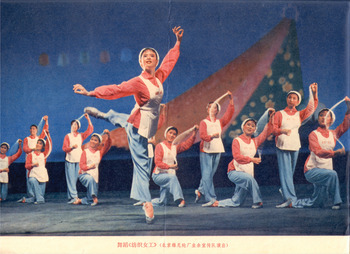
Looking at these works together as the first mass-scale attempt by Euro-American scholars, journalists, and artists to understand contemporary Chinese theatre, one is struck by the division between efforts to understand the theatre's artistry and its relations to ideology and attempts to seek validation of preconceived notions of communist theatre. An example of the latter approach, as well as its inherent fallacy, can be found in Contemporary Chinese Theatre by Roger Howard, who used the short ballet Weavers' Dance (Fangzhi nügong) by Beijing Vinylon Factory Amateur Propaganda Troupe (see Fig. 1) as a shining example of materialist theatre in China, where theatre's “agitational function has often overridden its anaesthetizing tendency.”Footnote 29 According to Howard, this agitational function was achieved through the fact that “[m]ost of the dancers were themselves from the factory's spinning and weaving shops.” Howard claimed that after an initial performance in Chinese folk dance, these performers “felt they had observed life in creating their dance but they had not yet ‘concentrated, summarized and typified’ the knowledge they had gained from that observation.” Consequently, the team “found folk-dance movements insufficient and they turned to ballet for the steps needed,” which led the piece to national fame and attracted many imitators, including professional troupes.Footnote 30 Howard concluded that the result was particularly representative of the success of the theatre of the Cultural Revolution in giving power to performers who possessed “a familiarity with the relations of production and with social relations which the professionals cannot match.”Footnote 31
Poster of the ballet Weavers' Dance (Fangzhi nügong) attributed to amateur performers of Beijing Vinylon Factory. Author's collection. Copyright information unavailable. Published during the Cultural Revolution (1966–7) as a color poster (285 × 290 mm) with no photographer or publisher information. Original caption translated: “Dance ‘Female Weavers’ (Performed by Beijing Vinylon Factory Amateur Propaganda Team).”

However, Howard's excitement about finding in China his dream scenario for agitational and materialist theatre obviously overlooked one simple fact: How could the amateur performers, who were textile factory workers with no formal training, have made the easy transition from folk dance to ballet with the level of professionalism shown in the poster? Furthermore, how did ballet, a foreign dance form, become a natural choice for a “concentrated, summarized and typified” expression of the weavers' lives, especially given the fact that Weavers' Dance remained the only amateur ballet piece produced during the Cultural Revolution and only the third Chinese-themed ballet until 1972 that was performed anywhere in China? (The other two were the full-length model revolutionary ballets The Red Detachment of Women and The White-Haired Girl.) As it turned out, a full-length ballet with exactly the same title (Weavers' Dance, or Fangzhi nügong, literally “female weavers”) had been created by the Central Ballet Company in Beijing as the third Chinese ballet in 1965 and was already in dress rehearsal when the Cultural Revolution had put an end to it.Footnote 32 Combining this fact with the common phenomenon that many professional artists were sent to factories and the countryside to “learn from the masses” during the Cultural Revolution,Footnote 33 one has to doubt the “amateur” nature of this five-minute ballet piece and instead conclude that it is almost certainly connected to the pre–Cultural Revolution full-length version. As early as 17 February 1967, the CCP's Central Committee, in its “Decision on Arts Organizations in the Proletariat Cultural Revolution,” had demanded that “literary and art workers should go to the countryside and factories in an organized and orderly manner, integrate with the workers and peasants, and transform their world outlook.” It also mandated that local governments send actors in private companies to work in rural areas or factories.Footnote 34 As a result, “all dance organizations at the central government level were forced to stop performance; Beijing Dance School was forced to stop admitting students and effectively halted operation.”Footnote 35 Indeed, the large-scale success of amateur performance that Howard enthusiastically endorsed as the power of grassroots agitational theatre was in fact largely coached and (at least in key positions) performed by former professional actors, arts school students, and aspiring performers who had no route to the professional stage. Thus, this glossy amateur performance was largely the product of the waste of professional talents in factories, rural areas, army barracks, schools, and universities.
In this sense, Weavers' Dance illustrates the inherent danger in viewing Cultural Revolution theatre and performance as confirming one or another strand of ideology. Although these highly ideological and propagandist works could indeed be easily appropriated as either Marxist, materialist agitational theatre on behalf of the people or as a totalitarian propaganda machine that was completely devoid of literary values and creative freedom, the reality behind the glossy (or rotten) surface was much more complex than what such rigid constructions allow. Howard's seemingly perfect illustration of the materialist amateur performance that resulted from the weavers' closeness to the means of production turned out to be the result of creations by professionals located far away from the means of production in the relatively normal creative environment that had existed before the Cultural Revolution. Furthermore, the undeniable professionalism of the lead dancer for this piece serves as a vivid reminder of the wasted stage lives and crushed professional dreams of a generation of practicing and aspiring Chinese artists as a result of Mao's utopian idealism. When such idealism became the overriding lens through which a Western intellectual examined contemporary Chinese theatre, cognitive dissonance was bound to occur, inevitably leading to distorted or even conspiratorial readings of evidence, willing disregard of contradictory sources, and excuses for inconvenient incongruity that at times clashed with sound professional judgment. Howard serves as a revealing example of this, partly because he was the most theoretical and systematic of this group of writers in his ideological defense of Cultural Revolution–era policies and practice.
In addition to Contemporary Chinese Theatre, Howard also wrote several articles on agitational theatre in China and the Soviet Union, as well as a biography of Mao Zedong, Mao Tse-Tung and the Chinese People, which purports “to show the closeness . . . [that] existed between him and the masses of workers and, especially, peasants.”Footnote 36 Taken together, his works form a materialistic argument for China's agitational theatre and its assumed function in pushing Chinese society forward. In his 1977 “Propaganda in the Early Soviet and Contemporary Chinese Theatre” (1977), for example, Howard theorized the function of amateur agitational teams:
Their function is “to organize, to stimulate, to agitate, to criticize, to propel”—to help organize ideological and production movements, to stimulate hard work and a consciousness of the changes modernization and industrialization entail, to agitate against ideas holding back these changes, to criticize people who hold those ideas: in sum, to help propel history forward along the lines of the industrial revolution which the political revolution has set in motion.Footnote 37
Notice that the term “propaganda” here is used without any negative connotation, a standard translation of the Chinese word xuanchuan during the Cultural Revolution and in Howard's works. Here, Howard's reasoning seems to be a utopian elaboration of Mao Zedong's motto “take charge of the revolution, promote production” (zhua geming, cu shengchan), which was widely disseminated during the Cultural Revolution to justify endless ideological campaigns and propaganda performances with the logic that the correct ideological and political conviction gained from these propaganda pieces would stimulate production. The fact that amateur performance supposedly adopted materials closer to the source of production and were staged by workers and peasants only served to bolster this argument. In fact, Howard was so convinced of China's success in using ideological and agitational artistic works to stimulate production that he even recommended the model to other British playwrights in a forum held by Theatre Quarterly in 1976 and wrote an article titled “Individual Creation, Socialist Action” to urge the British Arts Council to “install playwrights in the workplace,” arguing that “if playwrights are in the workplace, plays will materialize.”Footnote 38 For Howard, China suggested a practical way out of bourgeois idealist playwriting:
In my experience of a country that calls itself socialist, plays arising from that ground tend to have a correspondingly grounded reality. . . . Socialism is not a belief, a matter of faith. It is a method of work, a matter of understanding. A material understanding, in order to supplant the idealist understanding, must alter the very core of our method of work, in the writing. A socialist play will arise from the new ground of material. It will not arise from the grafting of a “socialist” branch on to a bourgeois tree. If the structure of a play accords with the material world-view, then its scenes and acts will proceed on a material basis in a dialectical formation. Part of our current work, I suggest, should be to try to work out the means of relating a socialist working method to the individual act of writing a play. It needs the application of theory; it is actually a practical problem.Footnote 39
However, although Howard enthusiastically recommended China's success as a practical working method to his fellow playwrights, the Weavers' Dance example exposes the fact that Howard's excited conclusion relied on a Potemkin-like facade propped up by former professional actors and art students who had been forced into factories and rural production teams by a tyrannical regime that allowed only model plays on the professional stage. The story that the production emerged organically from the ground of the factory was a crooked creation myth. Though Howard may very well have been unaware of the origin of the piece, the involvement of former professionals in the best amateur performance was common knowledge in China. Furthermore, as evidenced by the near-bankruptcy of the Chinese economy by the end of the Cultural Revolution, this facade also hid a rotten core that falsified Howard's logic that agitational theatre functioned to “stimulate hard work” and “propel history forward along the lines of the industrial revolution which the political revolution has set in motion.” While this does not mean that amateur performance alone brought down the national economy, the extraordinary amount of time devoted to training, performance, and touring in schools, factories, and rural areas encroached heavily on study and production time and severely drained productivity, resulting in exactly the opposite result than the one Howard had blithely predicted.
For Howard, however, China's economic and social realities were immaterial to his appropriation of amateur performance to bolster his theory of agitational theatre. In fact, his materialist logic even propelled him to pit amateur theatre against its professional counterpart in his 1976 “Agitation and Anaesthesia: Aspects of Chinese Theatre Today.” For him, the amateurs' “social being lies within the social relations governed by the relations of production,”Footnote 40 giving them an aura of “truly agitational” theatre “which questions, provokes re-definitions and arouses new thought,” in contrast to “professional cultural troupes” that “turns agitation into its opposite, anaesthesia,” and “fails to ask questions but only puts forward answers by blurring meanings and taking short cuts to definitions.”Footnote 41 In Contemporary Chinese Theatre, he denounced the stale slickness of the professionals who appropriated Weavers' Dance for a “spectacular variety show given at the opening of a table-tennis tournament in the Capital Stadium,” arguing that the professionals were devoid of “a solid meaning invested in every step” and confused a technical detail by having the weaving “‘machines’ start working before the operator has even reached them.”Footnote 42 Howard's article went so far as to excoriate a wide swath of late Cultural Revolutionary performance for sacrificing the correct portrayal of continued class struggle and agitation in favor slickness and polish. Howard was blissfully unaware of the nation's fatigue after a decade of chaos and the desire of most Chinese for a modicum of professional-level entertainment that, while no less propagandistic, as Howard recognized, was at least technically sufficient and enjoyable. In this sense, even China failed Howard's utopian vision of agitational theatre.
In contrast to the dogmatism of Howard's reading of China's performance landscape during the Cultural Revolution, Colin Mackerras's methodical analysis was based on extensive research into amateur performance policies and practice before and during the Cultural Revolution. Part of the reason behind this difference can be traced to the backgrounds of the two men—a radical Marxist playwright who went to China for confirmation of his beliefs versus a historian who treated China as a site of research in an objective, albeit sympathetic, manner. Like Howard, Mackerras first went to China to teach English in 1964 while an M.A. student at Cambridge; his research interest at the time was classical Chinese musical instruments. Once in China, though, he quickly discovered the impracticality of continuing such an erudite pursuit in an already heightened political environment. Instead, he seized on the opportunity to collect books on and gramophone records of Chinese theatre, particularly jingju from the classical repertoire and the newly minted revolutionary modern plays (the first incarnation of model plays), which had their first grand review at a national festival in Beijing in 1964. After being forced out of China at the outset of the Cultural Revolution in 1966 with almost all other foreigners, Mackerras received a Ph.D. in Chinese history at Australian National University in 1972. His first major research project after completing the degree was on amateur performance; in 1973, he published Amateur Theatre in China 1949–1966. As a historian, Mackerras was interested in amateur theatre because of its social function: “It brings up general problems such as the political nature of art and leisure in China and shows the extent to which both are linked with Maoist ideology; and in particular sheds further light on how the government spreads its socialist message among the masses.”Footnote 43 As we will see, Mackerras approached the topic with intellectual skepticism and relentless reliance on data, even though he may not have been completely successful in extricating himself from largely official sources.
Written before Mackerras's 1972 visit to China, Amateur Theatre in China 1949–1966 exhibited a poised balance in its examination of pre-1966 government policies toward amateur theatre under President Liu Shaoqi (Liu Shao-ch'i) and Deputy Head of the Propaganda Bureau Zhou Yang (Chou Yang), both of whom were considered pragmatists in terms of policy and consequently were prime targets of the Cultural Revolution. Mackerras wrote: “Nowadays, the Chinese claim that ‘Liu Shao-ch'i, Chou Yang and swindlers of their ilk . . . always opposed and [tried to] destroy movements for mass amateur literary and art creation.’ But the press of the period before 1966 gives no hint of this at all.”Footnote 44 This scholarly independence forms a sharp contrast to the work of Howard and Snow, both of whom devoted extensive passages to Jiang Qing's triumph over Liu Shaoqi and his deputies on the cultural front, who supposedly sabotaged the development of model plays before the Cultural Revolution.Footnote 45 Mackerras's research pointed to pre-1966 official and media criticism of the tendencies of amateur groups to professionalize because they had a negative impact on “serving production.” To demonstrate the fact that “this problem seems to have assumed quite serious proportions,” Mackerras used three examples from the contemporary press to illustrate “how the neglect of the amateurs themselves can harm production,” “how excesses in scale and quantity of amateur theatre can affect the productive capacity not only of the actors themselves but of the spectators,” and how “they frequently use up money which could have been put to better use.”Footnote 46 During the Cultural Revolution, such criticism of overprofessionalization was both ignored and adopted as proof of the pre-1966 regime's anti–mass movement policies. Consequently, the protoprofessional proficiency, frequent touring, and participation in large-scale performance of amateur performers only served to drain production. This reduced productivity was exactly the opposite of Howard's claim that amateur performance played a positive economic role because it spurred productivity. Indeed, during the decade, the first half of Mao's dictum (“take charge of the revolution”) had assumed paramount importance and completely overshadowed the second half (“promote production”), a situation Howard ignored in his euphoric theorization of materialist theatre.
Mackerras's ability to seek information through data largely immunized him against grandiose theorizing about amateur theatre's supposed contributions to agitational theatre. It also made him a quiet skeptic of the contemporary leadership's harsh denunciation of pre-1966 policies. In fact, his monograph found few policy differences between the two periods. His 1973 “Chinese Opera after the Cultural Revolution (1970–1972),”Footnote 47 written as a result of his 1972 visit to China during which his interviewees included some government insiders,Footnote 48 reveals a genuine and all-too-rare (for the period) effort to reach a balanced and nuanced understanding of not only the policy differences before and during the Cultural Revolution but also the motive behind the contemporary accusation that “Liu Shao-ch'i, Chou Yang and their colleagues were sabotaging mass art behind a facade of supporting it.” Mackerras wrote:
One clue to this dilemma may be that the present leadership sees a need to present issues in a stark black-and-white fashion to make them comprehensible to the masses. They may feel that Liu and the others did not promote amateur theatre enough and were too obsessed with the problems they raised. Although they are themselves concerned about such questions, they may see the issue as a matter in which the emphases between the Liu group and themselves are different. But because such a line is too complex to drive home to the masses, whose level of philosophical training may not be high, the leaders must oversimplify the issue to make their point.Footnote 49
This calm reasoning could certainly be read as accusing the leaders of the Cultural Revolution of Machiavellian demagoguery for their own political advantage, especially considering the fact—in post–Cultural Revolution hindsight—that this need to “oversimplify the issue to make their point” resulted in the imprisonment of Liu Shaoqi, Zhou Yang, and Tian Han (who was in charge of theatre, including amateur performance) and the deaths of Liu and Tian in prison. Mackerras's diligent research, cool-headed skepticism of official claims, and steadfast reliance on data instead of grandiose theory served as an effective defense against the rampant propaganda and ruthless factional politics of the era.
Looking at Mackerras's works almost four decades later, one may be justified in critiquing his occasional kid-glove approach as a way of maintaining his access to China—an all-too-real consideration during the Cultural Revolution—or as a result of his essentially positive view of the PRC's achievements in theatre and art in general.Footnote 50 The fact remains, however, that he was the only Western scholar who had a chance to observe theatre and popular performance in China during the Cultural Revolution while maintaining a healthy and scholarly perspective in his report and analysis. He was especially careful in distinguishing his sources, usually through such clear formulations as “the Maoists claim” or “according to official claims” and through careful analysis and commentary. Another illuminating example of his evenhanded analysis is his view on the addition of Western symphonic musical instruments to model jingju accompaniment, which had traditionally used only Chinese stringed instruments in addition to the percussion section. The use of a full Western symphony orchestra to “enrich” conventional accompaniment was one of the significant differences between model plays and their traditional counterparts. Jiang Qing touted this development as a major contribution, and both Howard and Snow were eager to present her as instrumental in the success of the model plays.Footnote 51 As an expert on musical instruments as well as jingju history, Mackerras was far more reserved in his observations on the role and cultural implications of using Western orchestras in jingju accompaniment, particularly the irony that the supposedly proletariat revolutionary plays felt the need to resort to bourgeois Western cultural legacies. In typical understatement, he observes: “The overall impression [of including a symphony orchestra] is a more powerful dramatic impact, but it is ironic that the Chinese should feel the need to appeal to the West for techniques to strengthen the heroics of their own theatre.”Footnote 52
Mackerras's ability to maintain a scholarly distance in his analysis without being pulled into the fervent ideology of the Cultural Revolution's advocates or detractors was at least in part due to his scholarly training; he considered historical contexts before taking sides and jumping to conclusions. In the case of amateur performance, he was insulated by his study of pre-1966 policies. In the case of jingju music, his pre-1966 trip to China gave him the means to compare the 1964 and 1970 versions of the model play The Red Lantern from gramophone records. This comparison allowed him to conclude that while the “new version . . . sounds very different from a traditional Peking opera” and “more heroic,” “[i]n general . . . the two scripts are very similar.”Footnote 53 This assertion of the absence of fundamental difference between pre-1966 and Cultural Revolution versions reveals an intellectual integrity that refused to fall in line with the wishes of his Chinese hosts. This stance contrasts sharply with Howard's and Snow's repetition of the supposedly fundamental struggles between Jiang Qing and pre-1966 leaders under Liu Shaoqi. In fact, at times, Mackerras's assessment went further than resisting the hyped contrast in the two regimes and moved into veiled criticism of Cultural Revolution didacticism because it was antithetical to artistic nuance and character delineation. For example, he wrote: “Dualism is extremely strong in contemporary Chinese attitudes to drama. There are two lines only and no room for a middle way. An opera is either beneficial or harmful[;] it cannot be neither, that is, harmless.”Footnote 54
Mackerras's scholarly nuance is shared by some other writers of the period. For example, Martin Ebon concluded his introduction to Five Communist China Plays with the following plea:
Whether one writes from New York, Paris, Hong Kong, or any other foreign center, it is well to view the Peking cultural scene with calm and sympathy. Westerners should avoid an air of patronizing forgiveness for the obvious zealotry and intolerance that has marked, and presumably still shapes, literature and the arts in contemporary China. . . . One cannot very well ignore the self-imposed ideological purities in Chinese stage productions today. . . . And while the propaganda images permit only the brightest sunlight, contrasted by the darkest shadows, the hidden, ongoing struggle for hues indicates China's essential humanity.Footnote 55
However, this appeal for “calm and sympathy” was easily lost amid the powerful narrative that communist theatre during the Cultural Revolution had unleashed some of the most destructive forces on cultural practitioners, including playwrights and actors. Consequently, the ability to remain emotionally restrained, resist sweeping indictments of Chinese theatre, and guard against simplistic understandings of dramatic texts often became the true test of an author's preparation and judgment. One example of sweeping and unsubstantiated statements can be found in the introduction to Modern Drama from Communist China by Walter and Ruth Meserve, quoted in part as an epigraph to this article: “This is the new Communist drama, and the picture is frequently artless and sterile, without depth, without truth, and without reality. But it is, nevertheless, an extremely powerful drama because it is being used as a dominant force in the creation of a new Communist society.”Footnote 56 The apparent contradiction of these two sentences is symptomatic of the assessment of Chinese endeavors as inept but extremely dangerous, a formulation born of a cold war mentality that precluded openness to the possibility that quality work could be generated in a highly politicized environment. Even the Meserves could not sustain the “artless and sterile” claim; they assessed one of the plays in the anthology, the opera version of The White-Haired Girl, as a “first-rate melodrama with nearly all the traditional devices.”Footnote 57
More significantly, the practice of dwelling solely on an ideological reading of Chinese drama sometimes led the authors to far-fetched allegorical interpretations of anti-communist conspiracies in pre–Cultural Revolution plays that amounted to a search for antiauthoritarian sparks that simply were not there. This erroneous reading is apparent in the Meserves' 1974 article on the modern huaju (spoken drama) playwright Lao She (Lao Sheh), in which they read certain passages in his play Teahouse (Chaguan, 1958)—which used a big tea house in Beijing to stage critical portrayals of the late Qing (1898), Warlord (1920s), and Republican (late 1940s) eras—as hidden attacks on communist-era political restrictions:
Throughout the play, Lao Sheh used an effective and satiric theatrical device that would now be unacceptable on the Chinese stage:
On the walls of the tea house are pasted a number of notices with the words “Don't talk politics!” Their number increases with each era, and the notices are written in even larger and bolder characters.
Although written in 1957 and performed in 1958 at the beginning of the Big Leap Forward, the play, most significantly, does not suggest a different future for the tea house hangers-on. True, it would have been anti-climatic to have a fourth act take place after liberation with all of the signs removed. But the fact that the playwright in no way suggests a change is important, while his poster device leaves a definite imprint. Essentially, Lao Sheh was doing what he did best—criticizing the old—but he was not following Party requirements and praising the new life in China. His confessions had indicated that he had already struggled greatly with the problem of relating literature-art to politics. Apparently, he still rebelled at artistic subordination to politics.Footnote 58
The “confession” by Lao She refers to an article he published in The People's Daily on 21 May 1952 titled “Chairman Mao Has Given Me a New Artistic Life” (“Mao Zhuxi geile wo xinde wenyi shengming”), one of a series of articles that commemorated the tenth anniversary of Mao's “Talks at the Yan'an Forum on Literature and Art,” the Chinese government's chief document on art in the service of the people. Lao's article followed the typical pattern of politically expedient writings by starting with self-criticism of his pre-1949 works, followed by descriptions of how his new works had benefited from Mao's teachings, a performance routine that all Chinese had long been trained to recognize as having nothing to do with self-confession. In addition, these writings, at least in the early 1950s, before the political campaigns that were especially harsh to artists and intellectuals, reflect at least in part genuine gratitude to Mao and the Chinese Communist Party (CCP), which, after all, had unified China after a century of wars, national humiliations, and weak and corrupt governments. In addition, the poster that said “Don't talk politics!” in the play was commonly used in post-1949 plays and movies set in the Republican era. Ironic as they may seem to outside eyes, they were accepted in China as a genuine reflection of the lack of democracy in “old China.” Finally, the Meserves' charge of the play's lack of a hopeful solution betrays an ignorance that almost disqualifies them as Chinese theatre scholars. The play's final act was full of repeated references to the “Western Hills” (Xishan), which was the communist army base outside Beijing, and to student protest marches that signified the end of the corrupt nationalist government and the impending new communist society. In addition, as the authors mentioned elsewhere in the article, most of Lao She's post-1949 plays openly praised new China, and Lao had even earned the title of “People's Artist” for his 1951 play The Dragon Beard Ditch (Longxu gou), which he wrote as a commissioned promotional piece for an urban reconstruction project in Beijing.Footnote 59 Therefore, to read Teahouse as a dark satire with sinister insinuations of a communist future betrays both a lack of the knowledge required to understand the allusions that would have been obvious to any huaju spectator in China and a willful distortion of a significant piece of art in an ideological pursuit of an argument about Lao She's “devious satiric devices” that were clearly absent in the play by any objective analysis.Footnote 60
The Meserves were angry about the ruthless persecution of Lao She. Red Guards had brutally beaten him and Lao had drowned himself in a Beijing lake on 24 August 1966. The Meserves felt that Lao She was a cultural hero whose “love for his people, particularly the common man . . . made him a gifted social playwright.”Footnote 61 While their anger was certainly justified, their emotions clearly clouded their reading of his play. Ironically, the conspiratorial readings the Meserves employed was also commonly adopted by the Red Guards during the Cultural Revolution in their cynical search for “evidence” of anti-Mao and anti-CCP crimes in pre-1966 writings. The Meserves' hunt for subversive pulses from Chinese writers shared the same teleological tactic the Red Guards used when they distorted evidence that would justify a preconceived conclusion. It is worth noting that this practice of finding nonexistent subversive intentions in Chinese plays (and literary works in general) is not limited to the Cultural Revolution era; its legacy persisted into recent decades, which certainly adds contemporary relevance to our retrospection of Chinese theatre historiography.Footnote 62
Lois Wheeler Snow's euphoric endorsement of Cultural Revolution–era model plays and amateur performance in spite of her professional judgment provides an example of the cognitive dissonance that resulted from prioritizing ideological fidelity over observed reality. As an accomplished Broadway, film, and TV actress whose career was cut short by cold war politics because of her husband's work as a wartime correspondent, Snow had earned the right to declare that “we tend to ignore [that] all theatre—all art for that matter—is political, a reflection of the society that sponsors and controls it. The capitalist system produces ‘conformist’ theatre and ‘protest’ theatre, theatre that perpetuates bourgeois standards, and theatre that exposes its faults and weaknesses.”Footnote 63 The problem arose, however, when she used this argument to justify Mao Zedong's formulation of the relationship between art and life in his 1942 “Talks at the Yan'an Forum on Literature and Art”:
In the world today, all literature and art belong to definite classes and are geared to definite political lines. There is in fact no such thing as art for art's sake, art that stands above classes, art that is detached from or independent of politics. Proletarian literature and art are part of the whole proletarian revolutionary cause; they are, as Lenin said, cogs and wheels in the revolutionary machine.Footnote 64
Snow boiled down Mao's teaching to the issue of “for whom” and declared the Cultural Revolution theatre a shining success because it was created “for the masses: the workers, peasants, and peasant-worker-soldiers of China, the 90 percent of the population.”Footnote 65 Here, Snow's argument is similar to Howard's, who praised the Cultural Revolution as an “ideological revolution, a change in thinking on the part of all workers in the field of drama, that is at the heart of the contemporary transformation of Chinese drama and gives to the new productions since the cultural revolution their freshness and, in the context of Chinese tradition, their startling and audacious novelty.”Footnote 66
Unlike Howard's unbending conviction, however, Snow's book often reads like the journey of a believer who started her trip convinced of the goodness of Cultural Revolution–era model theatre. However, while she wholeheartedly endorsed the model plays' dramaturgy of subsuming art to ideology, her theatrical instincts and experience often prevented her from completely accepting the plays in theatrical terms. This resulted in visible conflicts in her writing between her theatrical judgment and the ideological need to endorse the crown jewel of the Cultural Revolution. One such conflict centered on the depiction of negative characters in model plays, whose dramatic functions were drastically reduced as a result of the official “three prominences” principle of model play creation. The principles dictated that positive characters would be given prominence over all others, that heroes would be given prominence above all other positive characters, and that the principle hero would be given prominence over all other heroes. There is no place in this formula for negative characters, who were consequently assigned fewer and fewer performance opportunities to speak, sing, and participate in physical routines in the model jingju plays. However, jingju's rich performance vocabulary, especially when presented by veteran actors with outstanding physical skills, often made the villains stand out within the limited space allotted to them, making them more intriguing—even enjoyable—as characters than was ideologically permissible. Snow clearly recognized this dynamic, and her enjoyment of the villains' performance and her recognition of their dramatic significance became a source of guilty pleasure that deviated from the intent of the plays' official creators. Her solution to this cognitive conflict was to criticize her judgment for coming from a Western bourgeois perspective that prevented her from “correctly” receiving the model plays' message of class struggle intended for the working Chinese. The following quote about the jingju model play Taking Tiger Mountain by Strategy, which centered on a 1946 battle in northeast China between a team of communist soldiers and a group of nationalist-backed bandits led by Vulture (Zuoshan Diao), provides an example of this internal struggle:
To my Western, bourgeois stage eyes, the evil ones are often more successful dramatically than the heroes. They are so bad they are interesting. If I had seen Tiger Mountain's Vulture when I was a child, I would have gone to bed with the shivers; watching with more sophistication I found him fascinating. The actor we saw was superb in the role. His physical dexterity and grace added a supernatural quality as he literally rose in the air or bounced on his rocky throne in the throes of wily wickedness, like an Oriental Nome king. It is difficult to achieve the portrayal of complete bad or complete good on stage. Somewhere in conveying badness an interesting contrast is bound to appear, even if it is only unintentional humor. All good is sometimes all bore.Footnote 67
Here, Snow's comments draw upon her long stage experience, noting the impracticality of what Mackerras identified as the absolute dualism in Cultural Revolution theatre. The difference, however, is that while Mackerras refrained from second-guessing his judgment, Snow's sense of ideological obligation to the authorities of the Cultural Revolution made her question her own eyes. She overrode her subjectivity and persuaded herself that the character Vulture was a complete villain that the average Chinese audience could only despise and never appreciate as performance:
But here it is important to remember the “for whom” the new Chinese theatre was created to reach. Audiences whose heritage is deep suffering from Kuomintang bandits, invaders, imperialist, landlords, war lords, traitors, spies, and the like, are apt to accept—and relish—absolutely drawn heroes and villains than bourgeois theatre audiences in the U.S.A. or Europe, thousands of miles and ideological light years away from such immediate suffering.Footnote 68
Snow's willing suspension of disbelief for the sake of ideological correctness is in full view. Although her vast experience in performance told her that the model plays' absolutist treatment of heroes and villains went against basic theatrical principals (“All good is sometimes all bore”), was literally impossible (“Somewhere in conveying badness an interesting contrast is bound to appear”), and was doomed to backfire (“the evil ones are often more successful dramatically than the heroes”), she quickly reminded herself that her “Western, bourgeois stage eyes” were politically incorrect and “ideological light years away” from the Chinese proletarian audience that had experienced “immediate suffering” from the villains on stage. There was no way for her to gauge the average Chinese audience's reaction to the play because she was insulated as a state guest in a highly secretive environment, nor was she equipped, as Mackerras was, with the knowledge of pre–Cultural Revolution theatrical practice that would enable her to compare and contrast the model theatre's ideological and theatrical effectiveness. Her only source for the “immediate suffering” of the Chinese audience was a passage in American correspondent Jack Belden's China Shakes the World (1949) that describes how China's post–World War II civil war between communist and nationalist forces released “a flood of emotional energy that exploded with the force of an atomic bomb within Chinese society, nearly dissolving it.”Footnote 69 Belden's description is a deeply disturbing reminder of the agonizing interfamily and intervillage brutality of a civil war. It is a warning about the destructive mass energy both landowners and peasants released when they were forced to choose between two political forces that were tearing the villages apart and an illustration of the sufferings by both sides during a civil war, not just the peasants' sufferings.Footnote 70 Furthermore, over two decades transpired between Belden's observations and Snow's writing, and during that time numerous propaganda pieces had been devoted to the topic of “class struggles.” Thus, the emotional impact of class struggle on the spectators was significantly reduced by 1970, when Snow watched the model plays. The “immediate sufferings” of the laboring Chinese whom Snow imagined as the receptive audience for the model plays' didacticism was largely a fiction she employed to reconcile her professional skepticism and her ideological cheerleading.
Implicit in her attempt to square the circle is a sense of “good enough for them” that treated the Chinese audience as unpolished receivers of political messages who were not “bothered” by the model play's lack of theatrical consistency and could not enjoy fine performance. This logic is also evident in her discussion of the ballet The White-Haired Girl. After interviewing students at the Shanghai Dance School, where the piece was created, she stated:
Western critics could pick out choreographic limitations resulting from cultural insulation, but the gains made by dancers with a totally different heritage are impressive. However, many of what the Chinese consider their own innovations are to be found way back in the history of our ballet, when it did away with classic restrictions.Footnote 71
To her credit, she points out that the so-called innovations had long been staples of modern ballet and were only innovative in comparison to Swan Lake—in many ways the upper limit of Chinese understanding of classical ballet—therefore serving only as evidence of “the great gap” between Chinese and Western ballet and not necessarily as proof that The White-Haired Girl had “revolutionized ballet.” Nonetheless, she called The White-Haired Girl “a unique art” that successfully fulfilled Mao's dictum of “for whom,” describing it as “a proletarian tale depicted with great beauty in now-understandable content and form [that] is a moving and educational experience . . . to be judged principally by the laboring people of a new world ‘for whom’ it has been created.”Footnote 72 While there is no doubt that Snow's heart was with the Chinese masses, stating the ballet was good enough for “the laboring people” became an escape route that allowed her to express her reservations without diverging from the official line. Claiming that her own judgment was ideologically inferior allowed her to psychologically separate herself from the laboring Chinese who were culturally unequipped to discern the ballet's technical inadequacies but were politically receptive to the “educational experience.” In this sense, Snow became the mirror image of Brandon's description of how pre–World War II anthropologists approached Asian theatre: they stood “psychologically outside of and, because of their special status, above Asian cultures.”Footnote 73
Conclusion
The Cultural Revolution officially ended in 1976 with the arrest of Jiang Qing and her “Gang of Four” one month after Mao's death on 9 September. A year later, Howard published his biography of Mao, and two years later he published Contemporary Chinese Theatre. One review of Contemporary Chinese Theatre noted: “China's sudden change of direction in 1976 following the death of Mao Zedong undermined many external views of the country's development, but few books have been left quite so high and dry as this.”Footnote 74 Howard, who was fully aware of the political change in China, nonetheless chose to argue for agitational theatre throughout the book, ending with the conclusion that “the dynamism of the revolutionaries' theoretical foundation is persuasive and of great importance for future developments in world theatre.”Footnote 75 While Howard's larger point that “drama [was] the political expression of groups of antagonistic publicists, each pursuing a certain class line” may indeed have merit, it was his and other ideologically driven writers' penchant for seeing Chinese theatre as validations of their preconceptions that led to their erroneous narratives of tyrannical persecutions and rebellious subversions, amateur performance that correctly reflected the relations of production, agitational theatre that provided a solution to bourgeois anesthetic theatre, and proletarian art that served the vast majority of the laboring masses.
While the Potemkin-like façade of the Cultural Revolution undoubtedly encouraged these projections, these authors' fixation on ideology inevitably led them to logical and evidentiary fallacies. Furthermore, while China's opening up in recent decades has resulted in mostly sound scholarship, the ghost of this ideology-focused approach still haunts the study of Chinese theatre from time to time. While Howard's and Snow's ultra-left eulogies of revolutionary theatre have largely disappeared, the Meserves' conspiratorial reading of subversive intellectuals has been occasionally resurrected.Footnote 76 In addition, many works from this period are still routinely included in bibliographies of Chinese theatre. While it is unquestionably legitimate to acknowledge this group's historical significance as a link between prewar studies and the research of the recent decades, their inclusion in the canon calls for careful documentation and analysis.
In the end, what we have witnessed is as much a story about Chinese theatre itself as it is about how Chinese theatre produced reflections or refractions in the Western mirror during one of the most extraordinary periods in theatre history, a time when the ability of the theatre scholar, artist, and reporter to navigate the elements of historiography—archive, time, place, identity, and narrative—was thrown into sharp relief. In a way, cold war–era Chinese theatre became an attractive topic not only because of its inherently ideological nature but also because of its correspondence to the rise of agitational theatre and antiestablishment protests in North American and Europe. Knowing what we know now of the extraordinary factional politics, corruption, deceit, and propaganda during the Cultural Revolution, we may find it hard to fault some authors for being overrun by passion. Yet the correlation I have described between passion and questionable works only attests to the absolute necessity to maintain both professional rigor and healthy levels of skepticism, humility, and distance from personal attachment and ideological orientations.