
Of the entire canon of Eugene O'Neill, Desire under the Elms (1924) is arguably the most popular piece on the contemporary Chinese stage. In 2006 audiences in various parts of China witnessed at least three professional productions of the play, including two adaptations into traditional Chinese theatre (xiqu): Sichuan opera (chuanju) and Henan qu opera (Henan quju). As revivals of previous productions premiered in 1989 and 1999 respectively, the two operatic adaptations came to epitomize the modern transformation of the indigenous theatre, which has been taking place over the past three decades and which reflects the poetic and aesthetic changes in Chinese theatre against a backdrop of rapidly changing social, political and cultural contexts during the past century. A close reading of both adaptations reveals a persistent search for intercultural perspectives, which proves simultaneously self-reflective. This paper mainly deals with the dramaturgical aspects of these intercultural adaptations, although their stage presentations are also introduced and briefly discussed.
The choice: O'Neill and Desire under the Elms
The post-Cultural Revolution decade of the 1980s witnessed an earnest interest among Chinese theatre practitioners in adapting and staging Western dramas. O'Neill's debut on the traditional Chinese stage was a 1988 Zhejiang opera (yueju) production partially based on his celebrated trilogy Mourning Becomes Electra. Receiving little popular and critical attention, the production had only one performance before it closed. O'Neill's less praised Desire under the Elms, on the other hand, has repeatedly captured the hearts of Chinese theatre artists.
In 1989 playwright Xu Fen adapted the play into chuanju, a regional form of traditional theatre prevalent in Sichuan Province. Renamed Raging Tides of a Sea of Desire (Yuhai kuangchao), the chuanju production thrilled the province's capital city of Chengdu upon its premiere in 1989, and it had several well-received stage revivals in the 1990s. When playing in 1999 at a Chinese symposium held in honour of the American dramatist, however, its bold approach irritated several loyal O'Neill fans in the audience. One of them, playwright Meng Hua from Henan Province, decided to adapt the O'Neill play into another regional theatre form. His adaptation was staged a year later in henan quju under the title Old House under the Elms (Yushu guzhai). It ran for a season in the winter of 2000 and travelled to the United States in the summer of 2003. In 2006 both the chuanju and quju adaptations went through further revisions and reappeared onstage, each surpassing its regional limits this time by moving to another province. The choice of O'Neill and Desire under the Elms, transformed into two local theatrical forms and performed in the two most populous provinces in China, has attested to the popularity of the American author as well as to the continuing relevance of his text for the contemporary stagings of traditional Chinese theatre.
Since the 1980s O'Neill has been hailed in China as one of the world's greatest playwrights. From 1983 onwards, China's O'Neill students have met regularly at national symposia to discuss his life and work. In June 1988 more than a hundred scholars, critics and theatre professionals from China and abroad attended an international conference and theatre festival held consecutively in Nanjing and Shanghai to celebrate the centennial of O'Neill's birth; thirteen O'Neill productions were presented within one month. No other dramatist from the Western world, except Shakespeare, has enjoyed such an enthusiastic reception. The editor's note to a 1983 translation of Desire under the Elms not only compares O'Neill to James Joyce in the domain of novels and T. S. Eliot in that of poetry, but also places him on a par with Aeschylus and Shakespeare,Footnote 1 thereby presenting the American playwright as a key dramatic and literary figure not only of the twentieth century but of all ages. O'Neill still fascinates many artists in the Chinese theatre. For example, the 2006 revival of the chuanju version of Desire under the Elms was described by its leading actress, Chen Qiaoru, as an endeavour to ‘stand on the shoulders of the giant’ for a better vision of ‘good’ theatre.Footnote 2
Throughout the 1980s, O'Neill's tragic vision satisfied the Chinese need for reflection and catharsis in the face of the collective memory of the Cultural Revolution (1966–76). Many theatre artists would remember that political disaster as a negation of both life and art, during which they were forbidden both to perform as artists and to live with dignity as human beings. Xu Fen, too, suffered physical and mental abuse during the years of the Cultural Revolution; in 1989 she expressed her appreciation for O'Neill's ‘sense of tragedy’ and proclaimed: ‘China still needs enlightenment. It is important for us to understand life and ourselves, and to confront the dark side of human life and human nature with courage.’Footnote 3 This statement about her Desire adaptation revealed a position firmly rooted in the principal values of humanism and the Enlightenment – the two major Western discourses that Chinese intellectuals wielded, first in the 1920s to subvert the feudal mindset, and again in the 1980s to challenge the collectivist ideology that had led to the inhumane, irrational Cultural Revolution. As an intellectual beginning to voice her opinions publicly in the 1980s, Xu Fen made it her social responsibility in the aftermath of the national disaster to arouse ‘pity and fear’ among her people by introducing O'Neill's tragedy to the traditional Chinese stage.
However, the O'Neill vogue of the 1980s also betrayed an emerging fear of the future. Disillusionment with the communist utopia filled the post-Cultural Revolution era with a moral and spiritual vacuum; the majority of Chinese people had lost their faith in both traditional Confucian values and modern Marxist ideology, and this chaotic state was further exacerbated by an ensuing rise of commercialism in Chinese life. Especially since the 1990s, the fast switch to a market economy has turned the country into a consumer society, where many seek material comfort while few like to stop and take a look inward. When Meng Hua wrote his Desire adaptation in 1999, he foregrounded this new problem with the quotation in O'Neill's own preface: ‘For what shall it profit a man, if he shall gain the whole world, and lose his own soul?’Footnote 4 Meng compared this biblical inquiry to an ancient poem by Qu Yuan (340–278 BC), an exiled patriotic poet and permanent icon of the Chinese intelligentsia. Qu Yuan was mainly concerned with the social and political aspects of human life while O'Neill focused on the spiritual; the somewhat inappropriate analogy nevertheless reveals a portrait of the American dramatist in Meng's mind – a poet who alone stayed awake in a disjointed time, and persistently searched for meaning in a chaotic, corrupt world like our own. O'Neill's tragedy therefore furnished the adapter with a paradigm through which to criticize the faithless contemporary era and re-examine human nature in the modern Chinese context.
The fundamental quality of human nature which both adapters perceive in Desire under the Elms is desire; they relate it to the social and moral issues of the here and now. Xu comes straight to the point in her lucid theme song:
With these and more rhetorical questions, Xu sets the key for her adaptation: a dualistic view of desire and its role in our spiritual and emotional life. Like Meng Hua in his version, she replaces O'Neill's 1850s puritan New England family with a Chinese household from some unidentified ancient feudal era – a sensible transplantation considering the rigid asceticism, strict morality and pragmatic concern for worldly life that American Puritanism shares with Chinese Confucianism. As Confucianism-based Chinese society was constructed on domestic values such as fidelity and filial piety, the disintegration of familial bonds in Desire under the Elms takes on a broader meaning in its ‘nativized’ chuanju adaptation, criticizing the patriarchal feudal ideology that has manipulated the Chinese mind for thousands of years. The adaptation was also meant to criticize the ultra-leftist line that the Communist leadership adopted before 1976, which denied human desire and imposed a lifestyle of ‘asceticism’ on the entire population.Footnote 6 Xu Fen had already noticed, however, that greedy possessiveness was running wild in the national psyche as political authorities diverted their attention from class struggle to economic boost. With this outlandish but hardly outdated tragedy by an American playwright, she attempted to warn her own people against the dark side of desire and soulless acquisition. Meng Hua, too, in the 2000 production of his quju adaptation, emphasized dualism: ‘The tree of desire bears two types of fruits: fair hope and insatiable greed.’Footnote 7 However, he especially alerted his audience, now living in a commercialized time, to the destructive powers of desire affecting both the individual and society. Desire, in its duality, thus constitutes the motif of both adaptations in relation to Chinese experiences in the past and in the present.
The traditional vehicles: chuanju and Henan quju
The traditional artistic forms that Xu Fen and Meng Hua, respectively, employed for their Desire adaptations are the regional theatrical genres of chuanju and Henan quju. Far from being a homogeneous entity, the traditional Chinese theatre is a protean art with a broad spectrum of local diversities. Chuanju, for instance, is indigenous to the south-western region of Sichuan and characteristic of the Sichuan dialect, music, social custom and cultural tradition. The genre started to take shape in the Ming dynasty (1368–1644), acquiring the name chuandiao (‘Sichuan tone’) for its distinguished music based on the phonology of Sichuan dialect. As theatrical exchanges increased between regions in the Qing dynasty (1616–1911), however, the gamut of chuanju music broadened to incorporate major vocal styles from other regional theatres, namely kunqiang (‘Kunshan tone’), gaoqiang (‘high tone’), huqin (Chinese violin) and tanxi (clapper).
This characteristically synthetic chuanju form first integrated Western elements in the early twentieth century, when intellectuals and artists facing an unprecedented national crisis attempted to reform Chinese society by reforming Chinese theatre. In April 1912 a new chuanju group staged Harriet Beecher Stowe's Uncle Tom's Cabin, claiming that the production was meant to awaken a political consciousness of nationalism and patriotism among the Chinese people.Footnote 8 After the People's Republic of China (PRC) was founded in 1949, however, no Western plays appeared on the chuanju stage, or in any other traditional genre, until the isolationist Mao era ended in 1976.
In the 1980s, the traditional theatre found itself in a dilemma. Having lost to television its position as the most popular form of entertainment, the indigenous art, it seemed to many, had either to modernize and survive, or to stick to tradition and perish. It was at this moment that Western plays returned to the traditional Chinese stage. Xu Fen's 1989 adaptation of Desire under the Elms helped to fashion an ‘experimental chuanju’ that reputedly initiated the genre's ‘artistic metamorphosis from “the traditional” to “the modern.”’Footnote 9 Other samples of Western drama that have been shown on the chuanju stage since the late 1980s include Bertolt Brecht's The Good Woman of Setzuan and The Caucasian Chalk Circle, as well as Shakespeare's Macbeth, the last shortened and adapted by Xu Fen into a one-act piece entitled Maikebai furen (Lady Macbeth).
By comparison with chuanju, Henan quju has a relatively short history. Some of its components budded during the Ming and Qing dynasties, when folk songs were performed to entertain the guests at communal or family gatherings. Movements taken from folk dances were added to the songs, and performers put on stilts to give parade shows on public occasions, such as festivals and temple fairs. As a mature theatrical form, however, quju did not come into being until the 1920s, when its performance groups turned professional and some reform-oriented intellectuals, impressed by its vigour and popularity, started to write full-length plays for the genre.
Unlike chuanju, quju had incorporated no Western drama prior to the production of Desire under the Elms in 2000. If intracultural or intercultural exchange has played a significant part in the culture and theatre of the geographically marginal province of Sichuan, the Henan province, known in ancient times as the ‘Central State’ (Zhongzhou), was for centuries a source and centre of mainstream Chinese culture, symbolized by the Yellow River running through the heart of the region. Adapting a modern Western drama like Desire under the Elms therefore posed a great challenge to the artists and audience of this relatively conservative genre. As Meng noted in the preface to his 1999 adaptation, the quju version of Desire was ‘the prime landing; of an ‘international’ playwright on the theatrical stage of middle China. Given the situation, the adapter not only accommodated the interests of Chinese audiences at large, but also took into consideration the horizon of expectations of the local spectator.
Adaptation: globalizing O'Neill
Despite their intracultural differences, chuanju and Henan quju share the formal features that distinguish the total, presentational and conventionalized Chinese theatre from its Western realist counterpart. By adapting Desire under the Elms into these regional varieties, Xu Fen and Meng Hua aimed to re-create a traditional performance including certain aspects that they considered essential to modern drama of the West. In fact, the influence of Western elements has been changing the ‘façade’ of Chinese theatre since the early 1900s, and has given rise to endless controversies between reformists and traditionalists. Both Xu Fen and Meng Hua belong to the former camp but the Sichuan playwright, especially, has assumed the role of a conscious reformer. As a self-claimed ‘reformist,’Footnote 10 Xu Fen argues that indigenous art, having gone through centuries of transformation to reach its current form and structure, should remain open to further changes and developments.Footnote 11
Xu's Desire adaptation complies with O'Neill's highly developed concept of dramatic conflict and unified action; the result is a closely knit, fast-paced drama that turns against the episodic structure of traditional plays. Her adaptation also draws upon other resources of Western theatre. Having tried out symbolist and expressionist techniques and even elements from the theatre of the absurd in some of her previous chuanju plays in the 1980s, she felt that such alternative approaches would help break through the realist bondage officially sanctioned and imposed upon the traditional theatre after the victory of the Communist Revolution in 1949. She thus describes the ‘invasion or penetration of realism by modernism’ as a ‘progressive phenomenon’.Footnote 12 In the chuanju version of the O'Neill play, an added character, personifying desire, most compellingly evidences the influence non-realist Western trends have had on her. The adaptation opens and ends with Desire's homiletic verses, immediately revealing her symbolic identity and her decisive part in human life and destiny in a prologue addressed directly to the audience:
As the plot develops, this figure reappears at every critical juncture to urge the characters into action and push the plot forward, from its exposition, through its complication and climax, to its denouement (Fig. 1).
The bedroom scene with Ye Changmin as Desire, Chen Qiaoru as Abbie and Wang Chao as Eben, in the chuanju production of Desire under the Elms, 2006, directed by Zhang Manjun.

Unlike Xu, who thus takes a ‘medley’ approach, Meng Hua demonstrates a greater effort to stick to O'Neill's text. The disagreement between the two adapters belongs to a larger ongoing debate among theatre practitioners and scholars, centring on the question of how to stage classical drama that is either inherited from the past or transposed from Western traditions. Xu's radical rewriting has contributed to a trend of ‘creative betrayal’ in relation to works by previous masters.Footnote 14 However, Meng Hua and other critics tend to view such bold adaptations more as ‘betrayal’ than as ‘creativity’. Meng Hua's Desire script attempts to adhere to O'Neill's realistic style. For example, the opening scene in O'Neill's Act III shows a spectacular celebration, with the Cabot kitchen crammed with people from neighbouring farms. In the chuanju play-text, four actors replace the crowd, in accordance with the traditional practice that a team of four performers tacitly connotes an army of hundreds, even thousands, of soldiers. In the quju version, however, a multitude of walk-on actors flock onto the stage, providing a sense of realism in a crowd scene.
Adaptation: localizing O'Neill
While on the one hand globalizing O'Neill by applying concepts from his Western poetics to the traditional native theatre, both adaptations seek, on the other hand, to localize the American text by reworking it within a framework of Chinese aesthetics and sociocultural contexts (Fig. 2).
Zhang Lanzhen as Abbie and Zhang Laifeng as Eben in the quju production of Desire under the Elms, 2006, directed by Xie Kang.

Ironically, the adapters misrepresented O'Neill's sense of tragedy, which they claimed to admire most. Chinese theatre has seldom, if ever, posed metaphysical questions concerning the existential situation of free-willed human beings in a universe with or without God. As Wang Guowei rightly pointed out as early as 1904, the secular and optimistic temperament of the Chinese made it impossible for traditional indigenous literature to breed a tragic genre in the Greek sense.Footnote 15 The mainstream Confucian ideology, the philosophical root of traditional drama and literature, concentrates on the present life rather than afterlife and on the relationship between society and the individual rather than that between the individual and God. Even though religious and ritual elements did exist in traditional folk performances – there were, for instance, theatrical presentations about the Buddhist character Mulian in both Sichuan and Henan – it scarcely left any trace in written plays, and was denounced by latter-day enlightenment intellectuals as well as the PRC government as a relic of ‘feudal superstition’ rather than a valuable part of the Chinese theatrical heritage.
In their adaptations of Desire under the Elms, therefore, both Xu Fen and Meng Hua removed the religious, metaphysical content from O'Neill's tragedy. In her chuanju version Xu Fen deleted all but a few religious references present in the original text, admitting that she neither understood nor felt interested in the Puritanical problems engaging O'Neill.Footnote 16 Even though Meng's quju adaptation seems almost like a literal translation in many places, it randomly refers to Buddha or Taoist deities where O'Neill mentions the Christian God, but no in-depth exploration is made of the imprint of these traditional thoughts on the Chinese cultural psychology. In Meng's script the biblical names of the Cabot brothers – Peter, Simeon, and Eben – are changed to Tiger, Leopard and Dragon; the jungle imagery invoked by this clutter of animal names harkens back to the popularity in the 1980s of social Darwinism and writers like Jack London and Theodore Dreiser, both labelled ‘critical realists’ by the Chinese. The farmland setting in O'Neill's text turns in Meng's version into a grand manor where the patriarchal family relationships epitomize the strictly hierarchical structure of rural Chinese society. A mere object of family-related or social rivalries, the manor loses the metaphysical implication of O'Neill's farmland as a source of mythic forces that render all characters in the play fated, flawed human beings.
For instance, both adapters reduce the Puritanical Ephraim's complex motives to an insatiable earthly greed. With the deletion of all his self-revealing monologues, the father in Meng's text becomes a ruthless, ridiculous old man, who gives up his family for the sake of material wealth. Answering to the Confucian maxim that ‘the mind of the superior man is conversant with righteousness [while] the mind of the mean man is conversant with gain’,Footnote 17 the traditional Chinese theatre usually depicts a money-grabbing character as the villain, a stereotype that the quju version of Ephraim embodies perfectly. The man appears as an avaricious manor owner who, rather than labouring ardently in the field like the O'Neillian farmer, has no attachment to the earth itself, and who treats his sons as cheap farmhands.
O'Neill's notion of tragedy is to all intents and purposes as amoral as Nietzsche's. Influenced by Nietzsche's doctrine of moral relativity,Footnote 18 O'Neill tended to view the society-based distinction between good and evil as irrelevant to tragedy, declaring that as a playwright he tried to avoid making value judgements in his work.Footnote 19 His Desire under the Elms describes the contradiction between reason and unreason – or between morality and desire – enabling O'Neill to explore the existential dilemma and spiritual frustration of modern individuals. What O'Neill thus eschewed the traditional Chinese artists whole-heartedly embraced. Theatre practitioners in the past used to compare their art to the book of Spring and Autumn Annals (Chunqiu), allegedly compiled by Confucius to clarify his ethical ideas through historical accounts. By measuring dramatic characters against strict moral standards, the traditional repertoire helped to disseminate the norms and principles upon which Confucian society was based.
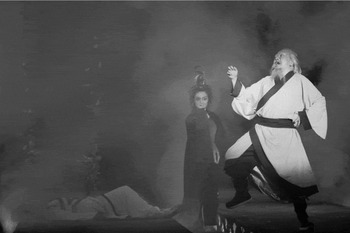
The theatre-as-history metaphor is still valid for the contemporary stage of traditional theatre. Despite their modern enlightenment stance, both Xu Fen and Meng Hua embrace conventional Chinese values as well. Take their treatment of Abbie and her choice between love and child, for example: O'Neill's Abbie refuses with invincible pride to ask for God's forgiveness for her forbidden love with Eben, and the lovers go to prison hand in hand.Footnote 20 In the chuanju version, however, the lovers exercise so harsh a moral censorship upon themselves that they have to forfeit their lives to appease a guilty conscience. Believing that irrational passion brings about destruction, Xu reckons it impossible for the characters to live with their son's death while going on to celebrate their own love. She also deems it inconceivable that Ephraim, the father of the family, should be as inexorably severe towards his family members as to remain nonchalant in face of the imprisonment of his wife and son. In her adaptation, the old man sets his farmhouse on fire in a moment of grief and, immediately regretting the act and returning to save his possessions, loses his life to the flames (Fig. 3). O'Neill's denouement highlights the redemptive power of love, which Xu obscures by foregrounding the Confucian norms of moderation and family obligations. The 2006 performance of the quju script also demonstrated a clear moral orientation by exerting poetic justice on Ephraim: the arch-villain in Meng's adaptation almost physically collapsed onstage when the curtain fell, instead of remaining steadfast on his feet to live on in solitude as in O'Neill's text. Objections from some O'Neill scholars notwithstanding, the cast and crew insisted that the original ending would not have satisfied the demand of the Henan audience for the downfall and defeat of the evil character.
Sun Puxie as Ephraim in the chuanju production of Desire under the Elms, 2006.
The chuanju and quju adaptations also find a way to undermine the psychological underpinning of the original Desire text. O'Neill did not consciously turn to Freud's modern psychology until his later The Strange Interlude and Mourning Becomes Electra, but the psychoanalytic element already exists in Desire under the Elms, with its archetypal motifs drawn from classical Greek dramas. As Freud sees it, in the psychic id, Eros, or sexual instinct, reigns most conspicuously.Footnote 21 O'Neill's play is concerned to a great extent with sexual desire, which, in Abbie's seductive intimation to Eben, has its roots in ‘the earth – Nature – makin’ thin's grow’ like the elm trees.Footnote 22 The naturalistically treated Eros is subdued in Meng Hua's adaptation, which deals mainly with materialist rather than sexual desire. Tellingly, the new title, Old House under the Elms, replaces ‘Desire’ with a less controversial ‘Old House’.Footnote 23 The adapter felt especially upset about the incestuous relationship between Abbie and Eben, believing that this theme ran counter to the Chinese value of filial respect, and would spoil the production irrevocably if it were not revised. Meng's final script changes Ephraim from Eben's biological father to his stepfather and intentionally downplays O'Neill's realistic portrayals of sexual encounters by using vocal duets in place of physical movements. This prudent approach also has historical reasons, as theatrical productions with obvious sexual contents used to be banned by Chinese feudal, republican and Communist governments. Meng's adaptation presents an interesting contrast to a quasi-erotic presentation of the same O'Neill play in a multimedia spoken drama production in Shanghai in 2006. Yet it is worth noting also that Meng's attitude towards the taboo topic of sex is ambiguous. In the 2006 revival of his quju version he agreed to the directorial decision that the symbolically choreographed movements used in the bedroom scene of the 2000 production be replaced by more natural-looking, and therefore more explicit, contact between the two actors.
Xu Fen's version replaces sexual instincts with de-sexualized love, which she regards as a sublimation of and therefore morally superior to the former. This interpretation echoes a Chinese translation of the O'Neill play printed in 1983 – Yushuxia de lianqing (Love under the Elms) – on which Xu's 1989 adaptation was directly based.Footnote 24 Although the adapter makes no attempt to deny the blood relationship between Ephraim and Eben, she manages to erase Eben's Oedipus complex, which, in O'Neill's text, leads to his self-identification with an absent mother and his sexual desire for older women like Abbie and the local prostitute Minnie. Xu Fen and Meng Hua both deliberately reduce the age span between son and stepmother in order to make their relationship look more like ‘healthy’ love than incestuous lust. Xu's Eben acquires a remarkable amount of masculinity in comparison with the ‘soft’ prototype in O'Neill's text,Footnote 25 and his longing for Abbie is by no means associated with a son's desire for maternal reunion. The offstage Minnie turns into an onstage character, Qiezihua (‘Eggplant Flower’), whose unrequited infatuation with Eben evidences Eben's loyal love for Abbie. This point was made even clearer in the 2006 chuanju revival (Fig. 4), where the sturdy physique and sonorous voice of a virile Eben transcended the usually gentle and weak image of the young male character type in traditional Chinese theatre. Every sign indicating an incestuous motive was thus carefully blotted out.
Wang Chao as Eben and Ma Li as Minnie in the chuanju production of Desire under the Elms, 2006.

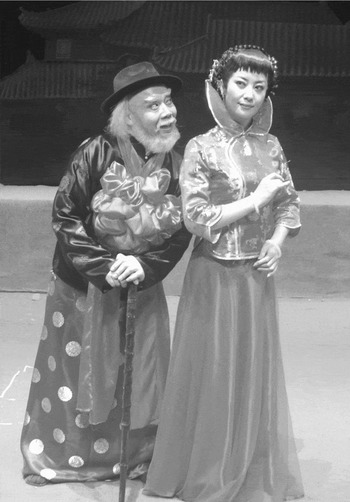
Aside from these thematic twists, both adaptations breach the aesthetic terms and standards of Western tragedy that O'Neill observes in his text. Chinese plays used to mix comic elements with the tragic and, for the sake of the spectators, invariably end happily. Happy endings still prevail in the present era, remarked Meng Hua, because the modern-day Chinese believe in amusement and hedonism in life and, consequently, avoid pessimism and tragedy in the theatre.Footnote 26 The adapter was looking up to O'Neill's text as an efficacious remedy for his own contemporaries, who, immersed in the routine muddle of modern life, are striving after nothing but material gain and sensual happiness, but he also contradicted himself by announcing that he had intentionally lightened the ending of this ‘pure tragedy’ by O'Neill so that it would seem less depressing to the Chinese.Footnote 27 In fact, O'Neill's text already contains an optimistic message, and Meng's statement clearly reveals his readiness to soothe the audience. Although all of the three main characters die in Xu Fen's adaptation, it, too, exhibits a touch of comedy before reaching the gloomy denouement. Comic effects, according to the influential theory of the Qing dramatist Li Yu, enable a play to suit refined as well as popular tastes, and furnish the audience with both entertainment and education.Footnote 28 Therefore the greedy but simple Peter in Meng's adaptation, as well as the flirtatious middle-aged woman Qiezihua in Xu's, they appear in the comic roles of chou (clown) and pola dan (shrew) respectively in this serious tragedy. As comic gestures and remarks are traditionally not only essential to the clown but also indispensable for every role type,Footnote 29 Meng's version further relieves the tragic tension with some amusing moments between the old man and his young bride (Fig. 5).
Liu Junqin as Ephraim and Zhang Lanzhen as Abbie in the quju production of Desire under the Elms, 2006.
An even greater transformation of the O'Neill play can be found in sections of its Chinese adaptations which are not directly plot-related, such as when the characters sing and dance to express their inner twists and turns, with the dramatic time and space rearranged subjectively to go with their emotional or psychological fluctuations. For instance, both adaptations blur the topographical boundary between Abbie and Eben's separate bedrooms in the telepathy scene of O'Neill's Act II. Xu's chuanju text, in particular, visualizes how Abbie and Eben repeatedly meet and part in their imagination, before they actually break down all the psychological barriers to unite with each other. In the infanticide scene (Fig. 6), too, both adapters wrote extended songs to function as interior monologues, amplifying the pathos of the heroine's difficult choice. When Xu's adaptation was revived in 2006, the number of songs and dances was increased. This change brings the chuanju performance even closer to the quintessence of the indigenous total theatre.
Chen Qiaoru as Abbie in the infanticide scene, in the chuanju production of Desire under the Elms, 2006.

At times, even technical traits acknowledged by the adapters as Western influences resonate with their respective native theatrical traditions. Take, for example, Xu Fen's personification of desire. Some of her friends warned her that ordinary, especially rustic, audiences might feel uncomfortable with her modernist approach, or find the play incomprehensible. To the playwright's surprise, however, the Desire character turned out to be an eye-catcher for both urban and countryside spectators. Some of the peasant audiences saw her as an evil phantom that drove the family into crazy actions, while others thought she was the spirit of Eben's dead mother seeking to avenge her husband through her son. All of these interpretations, Xu admitted, related to what she had meant to convey in the play.Footnote 30 Indeed, the traditional chuanju theatre is replete with such supernatural or psychological devices. The convention of tiao yingzi (dancing shadow), for instance, presents a nameless, expressionless figure clad in black, who follows a dramatic character step by step and mimics all his gestures to concretize his intangible fear inside. At certain points Xu Fen also consciously exploits traditional techniques to clarify some modern Western concepts. When appearing in the infanticide scene to incite Abbie to smother her child, the Desire figure performs the chuanju convention of bianlian (mask-changing) to expose the shocking complexity of human desire. Instead of mechanically showcasing acrobatic techniques as an exotic attraction, as is often done in local tourist programmes, Xu Fen employs it to intensify Abbie's internal struggle and highlight the climactic moment. The quju version, likewise, represents the ancient theatrical spectacle of ‘a hundred entertainments,’ capturing the carnival-like atmosphere of the birth celebration scene, clearly showing how the abundant use of indigenous theatrical traditions made this American play more available to Chinese audiences (Fig. 7).
The celebration scene in the quju production of Desire Under the Elms, 2006.

Performance: staging the adaptations
The chuanju adaptation premiered in 1989, performed by the Chengdu Chuanju Company under the direction of Li Zenglin, Tian Huiwen and Hu Chengde, and was revived in 2006 under the direction of Zhang Manjun. The Henan quju version was directed by Xie Kang for the Zhengzhou Quju Company, with different casts in 2000 and 2006. Credit for these Desire productions should go in part to the artistry of their actors, especially four award-winning performers playing the part of Abbie, namely Liu Ping (1989) and Chen Qiaoru (2006) in the chuanju productions, and Huang Dehua (2000) and Zhang Lanzhen (2006) in the quju versions. These actors performed in conventional role types, but elements from Western theatre affected their stylized utterances and movements to a greater or lesser extent. Huang Dehua admitted that she delivered her speeches in a ‘spoken drama’ manner, and that she had incorporated the vocal techniques of Western opera in her singing.Footnote 31
Pan Yongchang composed the instrumental and vocal music for the quju production; Wang Wenxun did the same for the chuanju version. They adopted some Western melodies and rhythms, expanded the traditionally small band to a grand orchestra, and introduced Western instruments such as the cello and double bass. While melodic instruments used to play in unison in the traditional Chinese theatre, the Desire compositions resorted to such Western techniques as harmony and counterpoint to achieve sophistication in the accompanying music. Both the chuanju and quju productions appeared less symbolic than traditional plays in terms of costume, make-up and stage property. As regards scenery, the chuanju performances largely adhered to the traditional minimalist staging, with the actors ‘creating’ the different theatrical spaces on a bare stage on the basis of their verbal description and pantomimic action. The set of the quju production, however, lay somewhere between the traditional stage and O'Neill's elaborate stage directions. Both appeared in a large proscenium theatre, which since the 1900s has replaced the traditional theatre space featuring a three-sided stage.
As adaptations of an American play, both productions sought to perform for Western audiences as well. The chuanju production would probably have travelled to New York after its premiere in May 1989, were it not for the sudden diplomatic tension between China and the United States following the events on Tiananmen Square in June of that year. In the summer of 2002, the quju version, accompanied by Liu Haiping as its literary consultant,Footnote 32 instead became the first full-length O'Neill production presented by a Chinese troupe on the American stage. Codirected by Xie Kang and Alexander Moffett,Footnote 33 the touring production played at California Plaza (Watercourt stage) in Los Angeles, Kansas State University at Hays, Grinnell College in Iowa (Fig. 8), Minnesota State University at Mankato and the Saint Louis University in Missouri.
Huang Dehua as Abbie and Wang Haisheng as Eben in rehearsal for the quju production of Desire under the Elms at Grinnell College, Iowa, 2002.

Adapting Desire under the Elms for the traditional Chinese stage, writers as dissimilar as Xu Fen and Meng Hua expressed a common aspiration towards Western modernity, the primary agent of change in Chinese culture since the early twentieth century. In the contemporary context of cultural globalization, theatre practitioners in China have nevertheless found themselves caught between the alternating drives of modernism and nativism, especially those working in the traditional genres, because for them the anxiety of influence is more than an individual, artistic concern; it relates to the fate and future of a Chinese cultural legacy. All through the two Desire adaptations there runs a significant indigenous vein, bringing to the American play a mixture of historical memories and contemporary experiences peculiar to China. Indeed, both scripts mirror the current spectacle of dramatic encounters between heterogeneous elements – native and foreign, traditional and modern – producing unceasing collisions and fragmentary images in the process. They nevertheless suggest the possibility of reaching a plateau where boundaries will be crossed and the seemingly incompatible elements integrated. The selective assimilation of modern Western thoughts and dramatic techniques is effecting a new turn in the traditional Chinese theatre after all. It is on this level that the adaptations of Desire under the Elms have taken on an importance greater than that of two cases of mere dramatic rewriting.



