A decade ago the Washington Conference on Holocaust-Era Assets highlighted what had become a major issue on the international scene. A new call went out for restitution of cultural property, and especially art, still displaced as a result of the Second World War, with special consideration for victims of the Holocaust. At the conclusion of the conference 44 delegations, including the Russian Federation, signed the Washington Principles on Nazi-Looted Art.Footnote 1 Starting in 2008, a series of international conferences have been reflecting on achievements over the decade since the Washington Conference. One of the first, a workshop at the Harvard Law School in February 2008, zeroed in on one of the most controversial elements covered in the Washington Conference.
Extensive displaced cultural valuables from all over Europe are still in Russia, where restitution efforts have been stalled by passage in 1998 of a new law that favors nationalization over return to their homelands. The sensational revelations about secret depositories of “beautiful loot,” an estimated 12 million books, and untold linear kilometers of archives from all over Europe had come only with the collapse of the Soviet Union. At the close of World War II, the Red Army's triumphal march to Berlin and the Soviet flag raised over the German capital destroyed Hitler's plans for a spectacular museum in his hometown of Linz. The Western Allies were busy returning most of the vast cultural property Nazi agencies had collected to the various countries from which it was seized.
Stalin, by contrast, launched his own counterplans for a Trophy Administration and a super museum heralding victory on the Eastern Front. Under his orders Soviet authorities lost no time in emptying the salt mines and castles in parts of Germany and Eastern Europe occupied by the Red Army that had served as evacuation sites for cultural treasures from German museums, libraries, and archives. Some of the cultural property transferred to the Soviet Union under Stalin's orders had earlier been plundered by the Nazi regime under Hitler's orders. Many of the twice-plundered items from occupied lands and others from within the Reich itself had been seized from Holocaust victims, although Russians were slow to recognize the Holocaust. When news of the secret depositories spread around the world, Western countries hoped those cultural hostages could soon go home, as had Hitler's loot found in the Western occupation zones half a century earlier.Footnote 2 Instead, after years of debate, the new and hoped-for democratic regime in Moscow passed a law justifying and virtually nationalizing the Russian spoils of war.
The U.S. State Department volume of Proceedings, rushed into print in 1999, included not only the “Washington Conference Principles on Nazi-Confiscated Art” (Appendix G) but also an English translation of the Russian Federal Law No. 64-FZ of 15 April 1998, “On Cultural [Valuables Displaced] to the USSR as a Result of the Second World War and Located [on] the Territory of the Russian Federation” (Appendix M).Footnote 3 The 1998 law is still in force today in the Russian Federation, as amended by a follow-up law in 2000, after the Constitutional Court issued some objections, and with slight modifications in 2004. (See the latest English translation of the amended law by Akinsha and Grimsted in Appendix 1 of this issue.) The head of the Russian delegation assured the conference that his country was prepared to cooperate in the identification and to entertain claims for cultural valuables “confiscated by the Nazis from their victims … even after the expiration of the … 18-month period [of limitations set by the law] beginning from April 21, 1998.”Footnote 3
Ten years after the signing of that first version of the Russian cultural property law, and its discussion at the Washington Conference, the international debate about the fate of the long-hidden cultural property in Russia from public and private foreign collections is unresolved. Stalin's victory museum never emerged. Many archives have gone home to Western Europe, most of the returns involving payment of “storage charges” and other expenses, together with an “exchange” component of archival Rossica from the receiving countries. But from the vast art booty, only the symbolic stained glass from the Marienkirche in Frankfurt on Oder have returned to their homeland. While the present article cannot offer resolution, we may nonetheless attempt to put the law in historical and sociopolitical context and try to understand the popular support of it in Russia. International lawyers have difficulty defending the law, as apparent in several legal and ethical analyses already published elsewhere.Footnote 4 Many would sympathize with Russian President Boris Yeltsin, who strongly opposed the Russian law, understanding that a law favoring nationalization over restitution on the cultural front would keep Russia at odds with the rest of Europe and with Holocaust heirs in the United States as well.
Germans refuse to recognize the law or to negotiate under its provisions: They signed a “Treaty … on Good-Neighborliness, Partnership and Cooperation” with the USSR in November 1990, followed by an “Agreement … on Cultural Cooperation” with the successor Russian Federation in December 1992.Footnote 5 Even the Russian Constitutional Court in its judgment of constitutionality left aside the rather debatable legal concept of compensatory restitution. As one commentator put it, “Legal issues do not and cannot have the last word in the battle over the politics and ethics of relocated art,” but even choosing the adjective “relocated” rather than “displaced” also affects diverging interpretations of the issues at hand.Footnote 6 A Western historian can only venture a few highlights and impressions.
Factors in the wide-scale Russian support of the law are harder to comprehend. Before commenting on implementation of the law and the scant achievements in restitution under its auspices, we sketch briefly the political context of its passage and the flavor of fierce debates that ensued. Other articles in this issue concentrate on more specific issues. Clearly we must look beyond international law, beyond the lack of Western legal traditions in Russia, or the absence of a concept of private property in the Soviet Union, to the sociopolitical context and the manipulation of historical memory by the Stalinist regime. What explanation emerges seems to revolve around the symbolic importance of those long-hidden cultural trophies as “myth and memory” of “victory” in the Great Patriotic War, as the Second World War is still known in Russia.
1992: RESTITUTION HOPES
After all the revelations about the secret depositories in 1990 and 1991, initially there was some immediate talk of restitution in Moscow. Indeed in 1992, there was still hope. In June 1992, a Decree of the Russian Government created the State Commission for Restitution of Cultural Valuables to decide and advise on such issues.Footnote 7 The commission was not formally abolished until March 2001, long after the term “restitution” had been virtually banished in Russia, but the commission had done very little to encourage any form of restitution and was already at a standstill by June 1993.Footnote 8
In 1992 the Netherlands had started negotiations for the return of the Koenigs Collection of master drawings; eventually they did gain the right of examination, an inventory, and an exhibition at the Pushkin Museum in 1995.Footnote 9 The Dutch were the first to sign an agreement for archival restitution in 1992, but the Dutch archives did not go home until after passage of the 1998/2000 law, and not before Queen Beatrix visited Moscow in 2001 to sign an agreement for their return (one batch at the end of 2001 and the rest late in 2003), another example of the high stakes required in the politics of cultural restitution. That part of the Koenigs Collection that surfaced in Ukraine went home to the Netherlands in 2003 (having been taken by a Ukrainian Trophy Brigade that also visited Weesenstein Castle outside of Dresden), but the rest of the drawings are still in Moscow, and the Dutch have since despaired of pressing their claim.
In June 1992 some 600 Dutch books went on exhibit at the Foreign Literature Library (VGBIL) in Moscow, and in October 1992, they were returned to the Netherlands, in what was—and still can be termed—“Russia's Only Restitution of Books to the West.” What was not known at the time was that the Dutch books that were returned had arrived in Minsk in the fall of 1945 in a shipment containing an estimated half million books plundered by the Nazis from several countries in Western Europe and then appropriated by a Soviet trophy brigade in Silesia. Moreover, the 600 books returned to Amsterdam from Moscow were only a small part of an estimated 20,000–30,000 twice-plundered Dutch books that had arrived in the USSR. The batch of 600 had been forwarded to Moscow initially because there was no censor to deal with them in Minsk, and then no one in the Belarusian capital could catalogue, let alone read, them.Footnote 10
Following the 1992 Dutch agreements, a higher level French diplomatic agreement was signed in Paris by French and Russian foreign ministers in November 1992, a year after publication in Moscow and then in Paris of Grimsted's findings about the seven linear kilometers of French archives in Moscow, including military intelligence (II-ème Bûreau) and National Security (Sûreté nationale) records.Footnote 11 The archives were to be returned to France by 1994.
Other countries signed bilateral cultural agreements with the Russian Federation, including Belgium, Bulgaria, Denmark, Germany, Greece, Hungary, Luxembourg, Poland, and the United Kingdom, most of them containing articles providing for the mutual restitution of displaced cultural property, including archives.Footnote 12 None of those agreements still on the books were mentioned in the 1999 decision by the Constitutional Court in its ruling on the constitutionality of the Russian 1998 law, although the Russian Constitution puts international agreements above domestic laws.
1994: STOP RESTITUTION AND START DEBATE
Debate over the Russian law actually started with the issue of the French archives. In fulfillment of the 1992 agreement, almost two-thirds of the French archives were returned during the winter of 1993–1994. However, when Duma deputies learned about more French trucks arriving in Moscow to take home the rest, they objected bitterly and quickly passed a decree sending the trucks home empty in May 1994. Debate on the law then opened in earnest: the Duma cited the lack of international laws and the inadequacy of domestic legislation to justify its refusal to permit further restitution.
Attitudes demanding compensation accompanied the emerging would-be capitalist mentality, but there were no attempts to define compensation in a legal framework. In the course of 1994 debate, one Duma deputy suggested that France and other countries should be charged storage fees for the materials held secretly in Russia for 50 years.Footnote 13 In fact, the current law does impose storage fees and appraisal charges in any cases of restitution abroad. France had paid half a million dollars, but the money was lost before it could reach the holding archive. Any private returns require full monetary compensation in exchange for the value of the property returned.
Deputies and other Russian politicians justified provisions that “restitution of cultural treasures” to the “aggressor nations … could be possible only by exchange for Russian cultural treasures.” Deputies openly argued that many of the plundered cultural treasures from Russia had gone across the ocean from the U.S. Zone of Occupation in Germany, rather than being returned to the Soviet Union after the war. For archives they could accurately cite the example of the so-called Smolensk Archive, which in 1995 was in fact still held in the U.S. National Archives, after the U.S. Senate refused to permit the return of those more than 500 Communist Party files that had been scheduled during a presidential summit in 1992. (Those files were finally returned to Russia in 2002.) But of course Duma deputies were not aware that, while U.S. intelligence agents had taken 500 files to the States, the Soviets had found five train wagons full of records from the same archive in Silesia, which secretly went back to Smolensk in the spring of 1945. And when the United States had offered to return the 500+ files in 1963, Soviet authorities declined to file a claim, given the negative propaganda potential of the files demonstrating adverse affects of Soviet collectivization.Footnote 14
During the initial bitter debates, Russian legislators, backed by legal specialists from the Academy of Sciences Institute of State and Law, claimed that all cultural treasures (including archives) “rescued by the Soviet Army” or brought to Moscow under government orders were transferred legally: Stalin, and later his deputies, signed the appropriate orders. Interestingly enough today, Stalin's February 1945 decree, establishing the Trophy Administration under the State Committee of Defense (GKO), executed just after the Yalta Conference, has still not been declassified to this day, nor have the subsequent implementing decrees on the Trophy Brigades in the same series. The text of several of the most important Stalin decrees appeared in a sensational unauthorized edition in 1994; the author died mysteriously a year later.Footnote 15 Yet those are the decrees on which are based the legality of the Soviet “trophies” as spoils of war, or today as justly deserved compensation for Russian wartime loss and destruction. Fifty years later in the Duma, a highly placed Academy legal specialist and representative cried out, “We owe nothing to no one,” offering a Soviet-style legal justification for not surrendering wartime trophies, despite already signed bilateral agreements.Footnote 16
There were, nevertheless, other circles in Russia, including the Yeltsin government, that were arguing for compromise and more internationally appropriate solutions. Statements pointing out the inadequacies of the law were submitted to the Duma in April 1995 by the Ministry of Culture and the State Archival Service of Russia (Rosarkhiv). Writing in 2009, a Ministry of Culture legal specialist recalls how it was shown that passage of the law “would appear as a unilateral Russian rejection of its international obligations and evoke a negative impact on international relations of the Russian Federation with various European governments.”Footnote 17 In September 1994 a progovernment Izvestiia banner headline denounced the parliamentary prohibition on restitution as “A Scandal Unworthy of Russia.”Footnote 18 Thus the debate continued for the next six years. In following the legislative steps involved in the passage of the law, it is important to remember that in the mid-1990s there was a fierce debate on the issue, but Russian politicians were not ready to listen.
1995: FROM THE FAR SHORE—NEW YORK DEBATES THE “SPOILS OF WAR”
While debates continued in Moscow in January 1995, across the ocean a major international conference on the “Spoils of War” gathered in New York City, sponsored by the Bard Graduate Center with support of the Soros Foundation. Half a century after the end of the Second World War, we heard a vocal confrontation between Germany and Russia on the issue of cultural restitution. One of the most memorable sessions featured several of the then-elderly American “Monuments Men” (Museum, Fine Arts, and Archives [MFA&A] officers), who had guided the U.S. postwar cultural restitution program.Footnote 19 Michael Kurtz had just explained how the divisive attitudes to restitution at the end of the war among the four victorious Allies prevented any joint agreement on restitution from Germany (as he details again in his article, “The Allied Struggle over Cultural Restitution, 1942–1947,” in this issue). Hence, each country handled the matter as it saw fit in its own Zone of Occupation in Germany. However, “No Allied agreement … ever specified that works of art or other materials could be used for reparations purposes.”Footnote 20
The British and Americans carried out an elaborate program of restitution to the countries of origin. The United States returned half a million cultural items to the Soviet Union, but none of the Monuments Men on stage recalled that fact. The Russians had never heard that story either before the late 1990s—another case of Soviet manipulation of wartime and postwar historical memory. If the Russian copies of the inventories of cultural property returned to the USSR had been preserved, none of my colleagues in the Ministry of Culture had seen them before publication of facsimile copies (signed by Soviet restitution officers) from the U.S. National Archives in 2001, the “Spoils of War Returned.”Footnote 21 Many of the Soviet documents with restitution receipts have since surfaced among recently declassified Ministry of Foreign Trade records, as revealed in a February 2009 Russian-German conference in Moscow.Footnote 22
To be sure, the Americans did not find all of the German-captured treasures, and many German items slipped illegally into U.S. soldiers' knapsacks or were siphoned off by dealers and other postwar looters. As a most spectacular example, the New York conference heard a special panel on the case of the Quedlinburg treasures with the ninth-century Samuel Gospels, a prominent example of German cultural heritage taken as war booty to Texas by an American GI. That treasure was finally returned to its homeland in 1990, after settlement through U.S. courts with a monstrous finder's fee, the acceptance of which is now apparently setting a precedent for the Russians.Footnote 23
Unlike U.S. Army regulations that sought to prohibit such trophies at the time, Stalin ordered Soviets Trophy Brigades to Germany to bring home as much loot as possible. Perhaps we should pose the question—was plunder in 1942 and 1943 different from a legal standpoint than plunder in the name of spoils of war or would-be unilaterally seized compensation in 1945 and 1946? Even if Russians today may have forgotten, Soviets during the war were quite aware of international legal concepts and precedents. In November 1942, a Soviet Information Bulletin condemned the Nazi cultural atrocities and looting on the Eastern Front. It reminded the world of Article 56 of the 1907 Hague Convention, which
forbids the seizure, damaging and destruction of property of educational and art institutions, … and articles of scientific and artistic value belonging to individuals and societies as well as to the State. But the Hitlerite clique in criminal manner tramples upon the rules and laws of warfare universally accepted by all civilized nations.Footnote 24
The Hague Convention was actually the work of a prerevolutionary Russian diplomat, Feodor Martens. But that international agreement did not stop a victorious Stalin from ordering the seizure of trophies as compensatory reparations from Germany, estimated at no less than 400,000 railway freight wagons of loot during 1945 alone—from dismantled German factories and museum treasures to pianos and wine.Footnote 25 Documents in both the U.S. and French archives well demonstrate that the Western Allies had inventories of what the Soviets were taking from German museums, but they never confronted the Soviets on that issue at the time. That knowledge did not stop U.S. postwar restitution to the USSR. The Cold War was already brewing: The political future of Germany was more important to the Western high command.
The official Russian position today follows Stalin's decreed conception that “to the victor go the spoils”—reinforced by the argument that those transfers to the Soviet Union were carried out legally after the war as compensation to which Russia was legitimately entitled, as opposed to Nazi illegal seizure and destruction of cultural property during the war. Yet such a concept of compensation is hardly a measurable legal principle, nor does it follow from the Yalta agreement for Soviet economic reparations on which Stalin insisted at the time. Rather, compensation has become a vague rallying cry, as a concept closer to trophies or spoils of war. Certainly it is far removed from the legal implications of restitution in kind, because the basis of losses were never established that might have justified in-kind replacement, as Konstantin Akinsha explains in his article in this issue, “Stalin's Decrees and Soviet Trophy Brigades: Compensation, Restitution in Kind, or ‘Trophies’ of War?”
A large part of the German cultural property taken to the Soviet Union was returned to East Germany during the Soviet era, including many (but not all) paintings from the Dresden Gallery, as Pushkin Museum director Irina Antonova reported in New York.Footnote 26 Indeed, during the Soviet period particularly under Nikita Khrushchev, when it was politically expedient, there had been some major returns of trophy cultural valuables and archives, especially to Eastern bloc brothers. But today many Russians complain openly in the press about the return of many (but hardly all) of the paintings from the Dresden Gallery in the late 1950s. Today, restitution no longer serves as political compensation to socialist “brothers.” With the emergence of a purportedly democratic new regime in Moscow, restitution has been turning into commercial demands for capitalist-style compensation.
Much of the German-owned cultural property from public and private collections taken to Russia has not gone home, including two Gutenberg Bibles that could well count as cultural heritage. Another such example is the Bremen Kunsthalle collection, seized—and in this case literally saved—in Germany by a private Soviet soldier. Since he and his Red Army buddies took it home without orders, its return to Bremen could not come under the 1998 law. Before his death, Baldin repeatedly requested successive Soviet—and then Russian—leaders to return the collection home after he learned of its provenance; but the collection is still in Russia, as we learn in the article, “Why Can't Private Art “Trophies” Go Home from the War? The Baldin-Bremen Kunsthalle Case,” by Konstantin Akinsha in this issue.
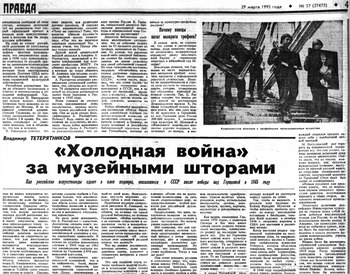
The Cold War was still brewing, not only at the conference in New York but also in Moscow, symbolically represented in a photograph on the front page of the newspaper Pravda in March 1995 (Figure 1).
Clipping from the full-page report in the Moscow newspaper Pravda, no. 57 (29 March 1995). Report on “Spoils of War” conference in New York City, by Vladimir Teteriatnikov, “The ‘Cold War’ Behind Museum Blinds.” The 1945 photograph (from the Signal Corps Collection in the U.S. National Archives) pictures American MFA&A officer James Rorimer (later director of the Metropolitan Museum), directing soldiers removing works of art from the Castle of Neuschwanstein in Bavaria to be taken to the Munich Central Collecting Point for restitution. That castle had been one of the main repositories for looted art from France run by the Einsatzstab Reichsleiter Rosenberg during the war. The Pravda caption reads “American Troops with Trophy Works of Art.” Reproduction courtesy of the editors of Pravda.

In the picture, an American Monuments Man, Captain James Rorimer (later director of the Metropolitan Museum), is directing U.S. soldiers carrying plundered canvases down the stairs in the Bavarian castle of Neuschwanstein to be transported to the Munich Central Collecting Point, one of the several restitution processing centers under U.S. Military Government in Germany (OMGUS), for return to their country of origin. That fairy-tale Bavarian castle had been the Einsatzstab Reichsleiter Rosenberg's (ERR's) prime repository for plundered art from French Jewish collections. This photograph has become familiar in many accounts of the Western Allied cultural restitution after the war, and it coincidentally appeared in an article celebrating the Monuments Men in the Smithsonian Magazine just before the Harvard Law School Workshop in February 2008.Footnote 27
In Moscow, however, the photograph was manipulated to present an opposite and more ominous connotation of American “trophies”: The caption on the front page of Pravda (Truth) read merely, “American troops with trophy works of art,” with no explanation about their destination. It appeared symbolically a week before a preliminary draft of the Federal Law under discussion was first adopted by an overwhelming majority by the upper house of the Russian legislature, the Council of the Federation. The banner headline read, “‘The Cold War’ behind Museum Blinds,” the sole illustration for a full-page report extremely critical of the “Spoils of War” Conference in New York City. The article was subtitled “How Russian Art Experts Are Surrendering into Captivity Masterpieces That Turned Up in the USSR After Victory over Germany in 1945.”Footnote 28
The contrasting Western and Russian use of the same image illustrates how the attitudes of the Cold War persist over the fate of Russia's “beautiful loot” and the differing perceptions of the spoils of war in Russia. Yet we do not come any closer to understanding why the large ultra-patriotic segment of opinion was so strong in Russia at the time and continues to prevail. Nor does it make any more sense when we learn that the author of the Moscow article, Vladimir Teteriatnikov, one of the most vocal proponents of passage of the law, was in fact a Russian émigré art historian who had come to the United States in the 1970s and already had American citizenship.Footnote 29
Among those fiercely criticized in the Pravda article was Ekaterina Genieva, director of the VGBIL in Moscow, whom many of us know as one of the more reasonable proponents of cultural restitution. She spoke openly about the 11 million German books transferred to the Soviet Union and suggested at the conclusion of the conference in New York that, if restitution issues for art were going to leave the European continent divided, perhaps the further restitution of library books, such as those unneeded early German imprints taking up extra shelf space in her Moscow library, if returned to Germany, could “make us friends” again and help create “a shared European community.”Footnote 30 The Pravda article, on the other hand, considered Genieva's “anti-Russian rhetoric a disgrace to the Russian delegation.”Footnote 31 Genieva had earlier suggested that
claims to property [or] ownership rights … by the German side lose any validity when the scale of guilt is taken into account. But claims to ownership on the Russian side, and demands for compensation for damages, also do not hold up if we take into account the wrong done in terms of noncompliance with international law regarding the protection of cultural property, the present state of affairs, and the present state of a significant number of the trophy holdings in Russia.Footnote 32
Teteriatnikov, to be sure, did not quote that opinion of Genieva in his article. He simply concluded, “The international conference in New York, bringing together leading specialists, came to the conclusion that there is no legal basis to require Russia to give up its trophies.”Footnote 33
The initial draft of the law was already before the Russian legislature.Footnote 34 Three weeks later the Russian lower house, the State Duma, declared “A moratorium on the return of cultural valuables displaced in the years of the Great Fatherland War”—until the law could be enacted.Footnote 35
Neither did Teteriatnikov take notice of the concluding address by Lyndel Prott representing UNESCO at the New York conference, where three years before the Washington Principles, she movingly set forth a review of UNESCO efforts and the “Principles for the Resolution of Disputes Concerning Cultural Heritage Displaced during the Second World War.”Footnote 36 Today, an edited version of Prott's principles is still being considered by UNESCO, which, if not completely adulterated in the process, may serve as a weaker, although more internationally acceptable, variant of the Washington Principles for all types of displaced cultural valuables.Footnote 37
A year later when Russian Minister of Culture Evgenii Sidorov opened an exhibition of the Koenigs drawings at the Pushkin Museum in Moscow in October 1995, he suggested the exhibit symbolized “a liberation of the last prisoners of war—the cultural valuables.”Footnote 38 Teteriatnikov, as if in reply, published a pamphlet arguing Russia's right to the Koenigs Collection of master drawings. He based his argument on captured German documents held today in Moscow, demonstrating that the German banker Franz Koenigs, who lived in exile in the Netherlands until he was assassinated in 1940, had sold the collection to Hitler's agent legitimately.Footnote 39 To be sure, Teteriatnikov made no mention of the January 1943 London Declaration, whereby the Soviet Union and 16 Allies declared “null and void” Nazi-style wartime “sales” and seizures. (Incidentally, Article 2 of the current Russian Law references that Declaration but erroneously attributes it to the United Nations). Not all Russians today follow Teteriatnikov's rhetoric, but a decade and a half later in mid-2010, the Russian-held part of the Koenigs Collection was still in Moscow, and Dutch restitution specialists are discouraged about further pursuit of their claim.
1996: RUSSIA JOINS THE COUNCIL OF EUROPE—WITH UNFULFILLED CONDITIONS
In the fall of 1995, Russia's failure to resolve unfinished chapters in restitution of cultural treasures and archives to other European countries was the subject of hearings before the Council of Europe (CoE). Ukraine had already been accepted as a member of the CoE by November 1995 without obligations, but Russian acceptance was delayed. Some members went so far as to suggest that Russia should not be admitted before it made good on the cultural and archival claims of member States. As a compromise, Russia was required to sign a statement of intent in order to be admitted to CoE membership in January 1996. Along with points regarding human rights and other issues, two points made specific reference to cultural valuables, and Russia agreed:
xi. to negotiate claims for the return of cultural property to other European countries on an ad hoc basis that differentiates between types of property (archives, works of art, buildings etc.) and of ownership (public, private or institutional);…
xiv. to settle rapidly all issues related to the return of property claimed by Council of Europe member states, in particular the archives transferred to Moscow in 1945.Footnote 40
Since that document was signed, those conditions never appeared in the Russian press, as far as I know, and certainly were not heard, let alone ratified, by the legislature.
Not even half a year later, in the heat of the 1996 Russian presidential campaign, a week after Victory Day (9 May), the Duma passed a first reading of the proposed law nationalizing the spoils of war. Indicative of extreme nationalist attitudes, a week later Teteriatnikov published another full-page diatribe against restitution in Pravda—“Will the Russian People Be Robbed Again?”—listing various acts or proposals for restitution. That blacklist even included library books that Moscow had transferred to western Ukraine in 1939 after that area had been annexed from Poland.Footnote 41 And it included other cultural valuables that had been transferred to Ukraine after the war. When many in the Yeltsin administration were named as offenders, Deputy Minister of Culture Mikhail Shvydkoi, accused of “selling out to Germany,” sued and won his case for slander. Shvydkoi then stressed Russia's right to “compensation” and the need for a “mechanism” of “equivalent exchange” in cases where other countries have a legitimate claim for displaced cultural treasures.Footnote 42
JULY 1996: LEGISLATIVE SETBACK
After the Russian Duma passed the law almost unanimously on 5 July 1996, Germany and other European countries that were affected became understandably bitter. Official diplomatic protests were registered in Bonn and Moscow. The foreign reaction may have had a sobering effect on Russian lawmakers. On 17 July, the Russian upper house, the Council of the Federation, rejected the law, after representatives from the victorious Yeltsin administration emphasized the extent to which its passage would conflict with numerous international agreements and would compromise “Russian international prestige.”
After defeat of the law in the upper house in July 1996, historian Igor Maksimychev wrote that “the thesis ‘We owe nothing to no one’ entails grave unpleasant consequences for our country. We do not live on the moon, but rather surrounded by other countries who always owe us something and to whom we have debts ourselves.” His suggestion that Russia's “weakened moral authority” would be strengthened and restored by its “adherence to generally accepted norms of international law” brought a strong counterreaction.Footnote 43 The rare book specialist Aleksandr Sevast'ianov, who had written against restitution in the past, in reply, once again argued in favor of the law that the Council of the Federation threw out and bitterly denounced the “anti-patriotic and liberal currents of the 1991–1993 period,” which were favoring restitution of the “Spoils of War”—which, in his view, were much “more than trophies” for Russia.Footnote 44
At the end of the summer of 1996, Minister of Culture Evgenii Sidorov, who a year earlier had been burned in effigy by conservative nationalists for his support of restitution, summarized the deficiencies of the proposed law and its alternative variant. He set forth a convincingly reasoned summary of the importance of restitution for Russia on the international front—especially to countries other than Germany.Footnote 45 But the extent to which the Yeltsin government favored restitution was one more point to be trumpeted by the opposition, as the Communist and nationalist-oriented parties increased their strength in the 1996 parliamentary elections.
1996–1997: THE LAW GAINS MORE SUPPORT
Support for the law became intense. As chair of the Duma Committee on Culture, Nikolai Gubenko, himself a native of Odessa, who had lost both parents in the war, was a popular actor and the last minister of culture under Soviet President Mikhail Gorbachev. He continued to push for passage of the law, emphasizing that all of the treasures brought to the Soviet Union were transported “legally,” according to Allied agreements. “The law indeed provides justice” and would be supported by “those who perished” in that war and their loved ones—“the votes of 22 million, if only they could speak.” Lawmakers in both houses again cried out that Russia had received nothing back from Germany that was taken by the Nazi invaders.Footnote 46 The implication clearly was that the Russian cultural treasures not returned had been taken across the ocean. Sometimes Gubenko even made the accusation explicit, as he did in a BBC broadcast in September 2007, where he claimed that there was Russian cultural property locked away in Fort Knox for 100 years.Footnote 47
Minor editorial changes addressed some of the earlier technical criticism of the law, and the term “ownership” had disappeared from the title, but the only new article guaranteed ownership rights for the newly independent states on the basis of their status as former Soviet Union republics. The slightly revised text of the law passed the Duma almost unanimously on 5 February 1997—291 to 1 with 4 abstentions.Footnote 48 And then the upper house, the Council of the Federation, passed the law on 5 March.
MARCH–MAY 1997: OVERRIDING THE PRESIDENTIAL VETO: YELTSIN'S LAST STAND
Aware of the potential international outcry about the violation of international law and agreements, and undoubtedly with an eye toward his upcoming visit to Germany, President Yeltsin vetoed the law on 18 March 1997. In his official message to the Duma, Yeltsin emphasized that the law contradicted the Constitution.Footnote 49 The law came back to the Duma on 4 April. But the specific legal points raised by Yeltsin, and the Administration's view on the incompatibility of the law with international legal norms and Russian bilateral agreements, fell on deaf ears. Antagonism between the Duma and the president was apparent at every turn.
At a presidential summit in Baden-Baden in April 1997, President Yeltsin responded to a press inquiry regarding restitution: Russia is a “civilized nation and will find a civilized solution” to the restitution issue.Footnote 50 But his admission of the need for any restitution put him at odds with the new Russian parliament and an estimated “eighty percent of the population at large who believe that all cultural treasures should stay in Russia,” and were “not about to be convinced otherwise by logic, treaties, or credits.”Footnote 51
The Duma was much more prepared to listen to the law's chief patron, Nikolai Gubenko, who emphasized the “symbolic significance” of the struggle for victory in adopting the law. This time, Gubenko suggested, “It could be appropriately compared to the Battle of Stalingrad.” Fully justifying provisions that “restitution of cultural treasures” to the “aggressor nations” could “be possible only by exchange for Russian cultural treasures,” he glossed over other presidential objections. Gubenko stated that he was thinking only of “the 27 million who perished [during the Great Patriotic War] and the graves on the Volga.” He suggested on public TV that even symbolic restitution to Germany would be like “spitting on those graves.” Ultra-nationalist Vladimir Zhirinovskii bitterly complained about any prospective Yeltsin restitution to the German “fascist scoundrels.”Footnote 52 International reaction was so intense that even the New York Times carried a front-page story, suggesting that the matter of Nazi-looted “trophy art” and archives still held in Russia had “emerged as one of Russia's most vexing foreign policy quandaries.” The accompanying picture showed French records still in the stacks of the former Special Archive.Footnote 53
The Council of the Federation overrode the presidential veto on 14 May 1997, with 141 of 178 representatives voting in favor of the law. Citing allegations of voting irregularities, as well as conflict with Russia's international legal obligations, President Yeltsin again defied the legislature by refusing to sign the law for almost a year. A decision of the Constitutional Court (6 April 1998) forced his hand, when it ruled that it could not consider the issue of constitutionality before the president signed the law.Footnote 54 He did so 15 April 1998, creating a Federal Law.Footnote 55
FALL 1998: GUBENKO DEFENDS THE LAW IN WASHINGTON
The following November Gubenko took part in the Washington Conference on Holocaust-Era Assets, defending his support of the new Russian law. In Washington, he stressed that “the Soviet Union suffered the most.” And hence “Russia has a normal right to compensation.” He claimed, “The law is based on the international legal principles and other acts, specified in Article 2 of the Law.” He argued that “the property rights of Russia including the right to transferred cultural valu[abl]es acquired as compensation for damage caused emerge just from these documents,” as he cited various peace treaties with Italy, Bulgaria, Hungary, and Romania. And he cited arguments that international lawyers would define as “restitution in kind.” The only problem with that claim, as Konstantin Akinsha explains in his article in this issue, “Stalin's Decrees,” is that Russia never defined its losses or what it had already removed from Germany, making it impossible for the Allies to establish procedures for restitution in kind. Gubenko ended with an appeal to a public opinion poll in Russia that 86% of the population supported the law. “And it is natural,” he said, “because the language of this Law is the language of justice.” He described the loss of his own parents in the war and concluded that “it will be a shame to divide into ‘ours’ and ‘aliens’ those victims who survived. We must unite all efforts aimed at just compensation for every victim of the tragedy regardless of nationality.”Footnote 56 The Washington Conference listened to Gubenko, but delegates from many of the attending nations could not accept his position.
1998: FOREIGN DENUNCIATION OF THE LAW
Even before President Yeltsin signed the law in April 1998, an issue of the Spoils of War: International Newsletter in the summer of 1997 presented the preliminary text of the law and a series of critiques from international lawyers in Belgium, Hungary, Switzerland, Poland, and the United States. Russian professor Mark Boguslavskii, now based at the Institute for Eastern European Law at Christan-Albrechts University in Kiel, repeated many of the tenets of the law itself in his contribution, starting with the principle of compensatory restitution. He noted, “The Law takes for granted that this principle was anchored in the Peace Treaties of 1947 and in other international law files,” although he offered neither legal citations nor analysis of the issue.Footnote 57 A Hungarian specialist listed numerous points on which the Russian law violates international law and treaties, stressing that “Hungary is entitled to the restitution of the Hungarian property removed to the Soviet Union as a result of World War II.”Footnote 58 A Ukrainian specialist on restitution issues was highly critical of Russian nationalization, to the exclusion of
Ukraine and other former Soviet republics that suffered in the war [and] must have a deciding voice in determining the fate of the stocks of art treasures stolen as war booty. There are enormous cultural assets [that] should be re-allocated fairly on the basis of international norms and democratic principles.Footnote 59
Wojciech Kowalski, a leading Polish legal specialist on restitution law found many of its provisions “entirely unclear and dubious,” concluding with the following:
What is known for sure is that such an act will not help to build new and better relations between “affected states” as was many times declared to be the policy of the Russian Federation. With the passage of time people can certainly forgive even wanton destruction of towns and villages but will never forget lost heritage that constitutes a part of their national identity.Footnote 60
Other criticism of the law by recognized international legal specialists pinpointed numerous irregularities that conflict with international law. Kurt Siehr (University of Zurich), a deputy editor of the International Journal of Cultural Property, explained that “none of … the international instruments [mentioned] on which it is based and which allegedly justify ‘compensatory restitution’ … legalize pillage, or any confiscation of foreign cultural property,” for indeed, “such behavior was forbidden under international customary law.” He called attention to the errors in citation of international agreements in Article 2 of the Federal Law, which incidentally were never corrected in the 2000 amendments.Footnote 61
Siehr fully recognized the extent to which “Russia suffered severely from German occupation and plundering.” But then he queried, “How can this be compensated or how can cooperation be guaranteed if Russia takes unilateral measures?” In conclusion, he quoted the “Wiesbaden Manifesto” of 7 November 1945, signed by American MFA&A cultural officers in contempt of the U.S. decision to remove 202 German paintings to the United States:
No historical grievance will rankle so long, or be the cause of so much justified bitterness, as the removal, for any reason, of a part of the heritage of any nation, even if that heritage may be interpreted as “a prize of war.” The same is true for keeping such a prize of war.Footnote 62
The foreign policy impact of passage of the Russian nationalization law could well be seen in the context of what might well be called “Russia's new cultural ‘Cold War’ with Europe.”Footnote 63
1999: THE CONSTITUTIONAL COURT RULES
President Yeltsin's case against the law went back for examination by the Constitutional Court, both on technical grounds in connection with alleged irregular voting procedures in the final passage of the law as well as the conflict between the law and Russia's international legal obligations. A compromise and somewhat confusing, if not contradictory, ruling of the Russian high court was handed down on 20 July 1999, declaring parts of the law “unconstitutional,” but refraining from invalidating the law. While the Court “ruled that parliamentary procedures were violated when the law was passed,” the concluding article declared the enactment of the law “was not in conflict with the Constitution.” Among other details, not unexpectedly, the high court determined that cultural valuables seized from Nazi Germany at the end of World War II and now located on Russian territory should not be returned to former “aggressor countries.” At the same time, it ruled that countries that fought against Hitler, as well as victims of the Holocaust and the Hitler regime, are entitled to the restitution of their cultural heritage.Footnote 64
2000: AN AMENDED LAW IMPLEMENTED UNDER THE MINISTRY OF CULTURE
Further delays in implementation followed, because many questions were left unresolved by the Constitutional Court decision. The matter went back to the legislature, and in November 1999 the Duma undertook a first reading of the proposed amendments. A Federal Law incorporating those amendments emerged with President Vladimir Putin's signature on 25 May 2000.Footnote 65 But that was only the start. Not only does the Russian law essentially nationalize the spoils of war, but it also forbids return of cultural property to Germany and other Axis countries. It does, nevertheless, make very complicated and costly provisions for restitution in exceptional cases—for Holocaust victims, family relics, and property belonging to those who fought against Nazi and Fascist regimes.
Pending claims could not be processed immediately, however, because various implementing decrees would be required.Footnote 66 A Directive (postanovlenie) of the Government of the Russian Federation (2 December 2000, no. 913), implementing the new law, put the Ministry of Culture in charge of processing restitution claims.Footnote 67 Subsequent Government Directives (11 March 2001, no. 174) have established and then amended procedures for management of “displaced” cultural trophies and processing potential claims from foreign countries under the Ministry of Culture. That March 2001 Government Directive also named the members of a new Interagency Council on Questions of Cultural Valuables Displaced as a Result of the Second World War, which was to review all foreign claims. The council includes the directors of major museums and also Gubenko, who shepherded the nationalization law through the Duma, where until 2003 he chaired the Committee on Culture.Footnote 68
Under the terms of the law, claims from abroad for cultural valuables must be presented through diplomatic channels of the country involved, negotiated on a state-to-state basis, but eventually processed by the appropriate office under the Ministry of Culture (from March 2004 until May 2008, the Ministry of Culture and Mass Communications).Footnote 69 Under the presidency of Dmitrii Medvedev, a new Department of Cultural Heritage (Departament kul'turnogo naslediia), established within the Ministry in September 2008, was to be the office involved in implementing claims from abroad for displaced cultural property; however, with a subsequent Ministry Order (prikaz) of 24 December 2009, it was renamed the Department of Cultural Heritage and Fine Arts (Departament kul'turnogo naslediia i izobrazitel'nogo iskusstva). Noticeably, however, the latest December 2009 Order with more details regarding the function and responsibilities of that department does not give it authority for evaluating initial claims from foreign countries for cultural valuables held in Russia or for initial diplomatic negotiation with potential claimants.Footnote 70 Accordingly, foreign claimants still have to start through diplomatic channels, but they will necessarily have to proceed through the Ministry of Culture.
In the case of archives, however, negotiations must also be pursued through the Federal Archival Agency (Rosarkhiv), now under the Ministry of Culture, and with the holding repository. So far claims for records have been entertained only for those held in the former Special Archive, now part of the Russian State Military Archive (RGVA). Although many fonds (or individual files) have been moved to other archives since their arrival in Moscow, Rosarkhiv has not been willing to consider restitution of any materials currently held in other state archives. A full list of fonds (record groups and collections) in RGVA has been published, and in almost all cases, more detailed file-level finding aids for holdings from the former Special Archive may be openly examined by researchers.Footnote 71 Except for the Rothschild archive from Vienna, claims have been handled only on a country-to-country basis, negotiated by the national archives of the claimant country, or in the French case, the Archives of the Ministry of Foreign and European Affairs.
The law does provide for private claims to be handled through the Russian courts, but only one case has been attempted, so far unsuccessfully, by an heir (now an American citizen) to the Hungarian Herzog Collection. One case of archival restitution has been made to a private family—that of the Rothschild family archives from Vienna that were returned in 2001 to The Rothschild Archive in London. That return, however, was billed as an “exchange” rather than restitution, involving as it did hefty “compensation,” namely, a gift to the Russian Federal Archives of some 5000 letters of Russian Emperor Alexander II and his morganatic wife, which had been purchased in London for the occasion at a high price from Sotheby's.Footnote 71a
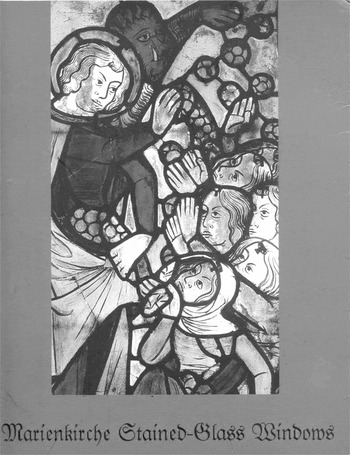
Several procedures have been amended during the decade since the passage of the law. For example, in 2006 a provision was enacted bearing on any unique cultural items designated of “special cultural significance.” Such items now require a separate federal law passed by the legislature before return to their country of origin is permitted. That has already happened in the case of the additional 11 pieces of stained glass from the Marienkircke in Frankfurt on Oder identified in the Pushkin State Museum of Fine Arts (GMII) in Moscow, after the rest had been returned in 2002 (Figure 2). A special law was enacted by the Duma in June 2008 to permit their return.Footnote 72 A separate federal law had earlier also been required in the case of the early rare books from Sárospatok College (northeast Hungary), and the same situation has arisen with the Pahlavi parchments from the National Library in Vienna, now held in the Hermitage, which were also declared of “special cultural significance.”
Cover of the State Hermitage Exhibition Catalogue, Marienkirche Stained-Glass Windows (St. Petersburg: SLAVIA, 2002). The medieval stained-glass windows were subsequently restored to the church in Frankfurt on Oder. Image courtesy of the Slavia publishing house.

2002–PRESENT: INVENTORIZATION AND THE 18-MONTH STATUTE OF LIMITATIONS
As of June 2010, there is still no publicly available centralized register of displaced works of art or library books in the Russian Federation that were brought to the USSR after the Second World War, although various catalogues and other publications cover some collections.Footnote 73 According to the law as amended in 2000, claims may be filed “for precisely defined cultural valuables” anytime an “interested State … becomes aware that those valuables … are located on the territory of the Russian Federation.” However, claims from abroad may be filed only within 18 months of appropriate federal agency publication of information about such displaced cultural property. Article 9 explains this point for “interested States,” and Article 10 of the Law explains the provision in the case of “former Enemy States.” The claiming state must also “officially confirm that it has not received any lump sum compensation for the loss of these valuables from Germany or any other former enemy State.” Thus under the 2000 law, the clock still starts ticking at the time of official government authorized publication of a description of the property to be claimed. However, if no publication has occurred, or if the owner is not aware of any publication, how can such a statute of limitations be applied? The question of what constitutes “authorized publication,” and the progress in such publication remain unclear as of June 2010.
Problems in the application of a statute of limitations thus arise due to the failure of adequate publication of information about displaced cultural valuables now located within Russian territory. The March 2001 implementing regulations assigned the Ministry of Culture the task to provide a nationwide inventory of the cultural property that was transferred or “displaced” to Russia as a result of the war, with the provision for publication and posting on the Ministry web site. A full catalogue was to be published by the end of 2005. As early as the end of March 2001 the Ministry of Culture issued its own internal regulation (prikaz) regarding “inventorization,” ordering all cultural institutions to undertake a full accounting of their trophy holdings of displaced cultural property in Russia. More detailed instructions and budgetary provisions for cultural institutions under the ministry appeared in subsequent months.Footnote 74 However, such provisions have still not been fulfilled.
Earlier, at the beginning of 2003, a web site sponsored by the Ministry of Culture—http://www.lostart.ru/—appeared on the Internet with an opening page listing 19 museums and libraries that were expected to supply lists of their trophy foreign cultural holdings. However, only a few of the repositories pictured displayed any such lists of trophy cultural treasures. A sizeable number of works of art (with images) appeared as being held in the Pushkin State Museum of Fine Arts and the Grabar Restoration Center in Moscow. Catalogue data for many trophy books appeared for the Russian National Library in St. Petersburg, the State Public Historical Library in Moscow, and the State Regional Library in Nizhnii Novgorod. The site was only in Russian and operated with no searching capacity, but it was an important start. Even the New York Times ran a story about the new glasnost in March 2003.Footnote 75 Within a month of posting, the Poles identified several paintings taken by the Nazis from a museum in Breslau (now Polish Wrocław). The Dutch found four canvases that had belonged to Dutch Holocaust victims, and the Germans also found six previously unidentified items from private collections of Holocaust victims.Footnote 76 By the end of the year, nonetheless, the web site was history, although limited access was still possible through cross listings on other sites, but eventually access through those means also disappeared.
The Ministry Order (prikaz) of 3 September 2008 establishing the Department of Cultural Heritage within the Ministry called for the compilation of an appropriate electronic database for the identification and description of displaced cultural valuables in state institutions of the Russian Federation and subordinate entities, including those items not eligible for foreign restitution claims. However, the procedures involved were not clarified for over a year and could not be implemented because the Ministry Regulation issued in May 2009 dealing with provisions for publishing information was never confirmed and then was nullified in September 2009 on the grounds of “juridical conflict.”Footnote 77
More recently the Ministry Order (prikaz) of 24 December 2009, creating the renamed Department of the Cultural Heritage and Fine Arts within the Ministry, which is currently responsible for displaced foreign cultural valuables held by Russian state institutions, also gives the department responsibility for publishing information about them. Among other points covered, the new Order
Provides that cultural valuables displaced during the Second World War and located on the territory of the Russian Federation be duly apportioned amongst cultural institutions by way of compensation for damages sustained by these cultural institutions resulting from the plunder and destruction of their property by forces of former enemy States.
Further, the new Department is specifically designated as responsible for the “preparation of … an electronic database of all cultural valuables displaced as a result of the Second World War and located on the territory of the Russian Federation,” along with a register of such cultural valuables intended for exchange.Footnote 77a As of mid-2010, however, it is not clear if or how soon the database will be publicly available, or how much has been accomplished in descriptive work during recent years. Obviously it will not be a speedy task, and that has not been aided by successive changes within the ministerial bureaucracy.
Recently, the Ministry web site has been expanding, with listings of the on-going extensive series of published catalogues of Russian wartime losses, most of which are now electronically accessible in a designated section of the website. A separate webpage now details Russian cultural valuables that have been repatriated from foreign countries since 1997, and another lists published catalogues of trophy valuables prepared by a number of different institutions, including those from special exhibitions. There are also lists of related Russian legal instruments albeit not complete.Footnote 78
INVENTORIZATION UNRESOLVED: CULTURAL TREASURES MISSING IN ACTION
Many Russian museums and libraries are working on the identification of their displaced cultural property, but staff shortages and lack of expertise regarding foreign holdings impede the overwhelming task. It is unlikely that the situation can be improved anytime soon without considerable additional efforts, and most probably not without some financial and technical assistance from abroad. Indeed, almost all of the published catalogues of trophy holdings now listed (with covers displayed) on the Ministry web site have been prepared with significant foreign subsidies.
One revealing example of still-unresolved Moscow identification problems is the case of an estimated 10,000 unidentified works of graphic art still held by the GMII, as reported in November of 2006. In Vienna after the Anschluss, 41 Rembrandt etchings were removed from the Rudolf Gutmann Collection for transfer to Hitler's projected Linz Museum. Available documentation confirms that the etchings ended the war as part of the graphics collection from Dresden evacuated to Weesenstein Castle near Pirna in 1943, and that they were surrendered to Soviet custody in July 1945, but there the trail ends.Footnote 79 Efforts to track down their hiding place in Russia, or even possibly Ukraine, have so far been unsuccessful.
An Austrian art historian visited the Graphics Department of the Pushkin Museum in Moscow several years ago bearing images of the missing etchings, as one step in the search. The curators there were quite openly receptive to the inquiry, coming as it did in the Rembrandt 400th anniversary year, and they were even quite intrigued with the possibility such treasures might be found in their museum. However, they admitted to the visitor that an estimated 10,000 works of graphic art had recently been transferred to their division from former secret depositories. Since passage of the law and new Ministry of Culture regulations requiring inventory, those items were still awaiting description, before they (and the catalogues) could be made available to the public, because the museum had inadequate staff to process all of them. Five years later, there is still no public inventory.
Perhaps given the still-missing major components of war-related displaced cultural valuables, and especially those of victims of the Holocaust, further collaborative assistance from abroad could assist Russian museums, libraries, and archives in improving provenance research techniques and identifying more items. Such joint enterprises are costly, and from the experience thus far, they are hardly guaranteed to move those cultural “prisoners of war” into the restitution pipeline. There are still too many bureaucratic and legal obstacles in Russia, even when repatriation is appropriate to legal owners, replenishing the cultural heritage of families or countries from which valuables were torn by war. Nevertheless, even if they still must remain prisoners in Russia, at least they could be removed from the missing in action list, and their legitimate owners or heirs would know their whereabouts.
RESTITUTION UNDER THE LAW
Within the Russian Federation itself, it took 10 years after the revelations about displaced cultural treasures to develop a legal basis and procedures for processing restitution claims. Now Russia is the only country to have enacted such a law, thus appearing to be a law unto itself. As many analysts have noted, the resulting law puts the emphasis on nationalization rather than restitution of cultural property “displaced to the Russian Federation as a result of the Second World War.” Some Russian colleagues of a more patriotic bent keep asking me, “Why don't other countries have such a law?” My answer has always been that other countries, including Ukraine, have recently managed major examples of restitution of displaced cultural property without needing such a law. Ukraine returned the so-called Bach Archive (the Sing-Akademie Musikarchiv) to Germany in 2001,Footnote 80 and as noted earlier, that part of the Koenigs Collection of master drawings that surfaced in Ukraine was returned to the Netherlands in 2003.
A decade since the passage of the 1998 law, we could report in the volume Returned from Russia case studies and lists of archives returned to five countries—France, the Netherlands, Belgium, Luxembourg, and the Rothschild Archive in London. Many examples of the return of Jewish and Masonic archives seized from Holocaust victims could be listed amid much larger quantities of French military intelligence archives, along with Dutch and Belgian military records. And even before the law was passed, although in accordance with its stipulations, archives were returned to the Principality of Lichtenstein and the United Kingdom. In the case of archives in contrast to art, Russia has been willing to return some but still not all of its trophies, to the extent that those issues deserve separate, more detailed discussion (see the Grimsted article, “Why Do Captured Archives Go Home?: Restitution Achievements under the Russian Law,” in this issue).Footnote 80a
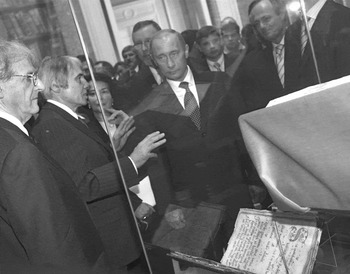
Hungary had been one of the first to line up a restitution agreement, with the Treaty on Friendship and Cooperation with the Russian Federation in place by 6 December 1991. With a bilateral commission in place soon after that, Hungary has been able to document many of its cultural treasures still in Russia. Books from the Sárospatak College Library in northeast Hungary discovered in Nizhnii Novgorod were exhibited, a catalogue was published in Moscow sponsored by the Soros Foundation in 1997, and a large exhibit was shown in Moscow in 2001.Footnote 81 However, it was not until March 2006 that President Putin opened an exhibition in Budapest of a symbolic 146 early books returned to Hungary (Figure 3). That was the first library restitution under the 1998/2000 law, and it took place on the politically expedient occasion of the 50th anniversary of the Soviet invasion of 1956. The Hungarians paid 400,000 (U.S.) dollars in storage, conservation, and digitization fees to the Regional Library in Nizhnii Novgorod (before 1990 Gorkii), where the books had been held in secret for the previous 50 years. Among other political and economic factors involved, the signing of an agreement for natural gas may have proved to be of special significance in the cold winter of 2009. The Sárospatak case was a clear example where symbolic cultural restitution can serve much higher political expediency, as explained in other more detailed accounts.Footnote 82 The Foreign Literature Library in Moscow (VGBIL), which had essentially engineered that restitution case, published a book with a collection of articles about the return of the Sárospatok Collection. However, those accounts did not cover the political or economic context, nor did the volume mention the perhaps embarrassing details about the Soviet-period suppression of information about the collection and its chance identification in the early 1990s.Footnote 83
In the National Museum of Budapest, Russian President Vladimir Putin (center) and Hungarian President Lászlo Sólyóm (left), attend the opening ceremony for the exhibition of early books from the library of the Calvinist college of Sárospatak in northeast Hungary on 1 March 2006. The books that had been removed from a bank vault in Budapest at the end of the Second World War were being returned from the State Library in Nizhnii Novgorod. Photo by Ilya Pitalev, Kommersant, Moscow.

By contrast to the catalogue of books that are now returned to Hungary, a catalog of displaced works of art now in Russia from Hungarian private Jewish collections was published in Moscow in 2003 (with western sponsorship), and some of the displaced Hungarian art objects were exhibited in Nizhnii Novgorod in 2005, but all those treasures still remain in Russia, to say nothing of more rare books from Jewish collections in Nizhnii Novgorod.Footnote 84 The Herzogs were a prime example of a family brutally persecuted and driven from their homeland, lucky enough to have survived the Holocaust. At the Harvard Law School workshop we heard about the lawsuit introduced in Russian courts under provisions of the 1998/2000 law by the heirs of the Baron Herzog Collection, now U.S. citizens. Represented by New York and Moscow counsel, that claim has not gotten to first base, perhaps all too indicative of potential foreign Holocaust-era claims for cultural valuables that are not being honored in the Russian Federation.Footnote 85
Two decades after the revelation of the Soviet secret depositories for captured art, and a decade since the Russian law was first enacted, there have been only two returns of art objects claimed under the law. The Marienkirche in Frankfurt on Oder has seen its stained glass windows restored, and in return the German government in compensation has restored one of the many early churches in Novgorod that had suffered so mercilessly at the time of the 1941 invasion. The second group of 11 Marienkirche glass panels, identified at the Pushkin Museum in Moscow, were declared of special cultural significance, which explains why an additional law was required by the Duma to permit their return in 2008.Footnote 86
As a second case of returned art, four fragmentary early mosaics went back to Ukraine in 2002. Those were not Russian trophies, but rather one of many still-unresolved examples of art objects seized by the Germans during the war and returned from Germany to the Soviet Union by the Americans, but never returned to Kyiv. Yet that small symbolic return represents only a small part of that story of displaced cultural valuables. The Cathedral of Saint Michael of the Golden Domes, dating from the eleventh century, was one of the Kyivan churches destroyed by the Stalin regime in 1934–1936, but many of its twelfth-century mosaics were preserved. The famous mosaic of Saint Demetrius of Thessalonica had been lent for an exhibit in Moscow in 1938, together with two frescoes and a fragment of a bas-relief; those Kyivan treasures still remain today in the Tret'iakov Gallery. Since independence, the Golden Domes Cathedral has been reconstructed in Kyiv, but more fragments returned from Germany after the war remain in Novgorod, all of which have been explained in a carefully researched account by a Ukrainian specialist.Footnote 87 That Ukrainian example is not unique and does not involve a Holocaust claim. However, there has been little receptiveness for other potential claims for the art that filled the secret depositories, nor seemingly any willingness on the Russian side to return other attributes of cultural heritage amid the spoils of war or any of the twice-looted art to Holocaust victims.
2001: PUTIN'S PRIVATE “GESTURES OF GOOD WILL”
Early in the Vladimir Putin regime, we saw a few politically expedient gestures of goodwill. In contrast to Russian nonrestitution, Ukraine returned the early Bach family music scores with the archive of the Sing-Akademie to Berlin in September 2001, even after the head of the Russian archival administration (Rosarkhiv) advised his Ukrainian counterpart not to return the collection to Berlin.Footnote 88 The Ukrainians found justification for the return, however, since it was a privately owned collection before evacuation to Silesia during the war. Then, as if to offset any potential political gain for Ukraine, Russian President Putin, during a period when restitution “gestures of goodwill” were deemed appropriate for Germany, arranged for a major photo-op with the return of three paintings from the Dresden Gallery. These paintings had fallen into the private hands of a Russian oligarch developer, Timur Timerbulatov, and as such, they would not have come under the 1998/2000 Federal Law. Apparently, that event close to home kept German Chancellor Gerhard Schroeder from going to Kyiv in person to accept delivery of the Berlin Music Archive from the Sing-Akademie. (Commentators pointed out that it was Putin's first visit to Dresden since his KGB assignment there in the Soviet era.)Footnote 89
TROPHIES, VICTORY, AND THE MANIPULATION OF HISTORICAL MEMORY
Returning to our initial query, foreign analysts—myself among them—have difficulty understanding the underlying political psychology and complex of attitudes surrounding the Russian cultural property law under discussion. In defending the right to nationalize Stalin's cultural trophies, do most Russians really want to keep their country apart from Western Europe, as their Soviet forbearers kept them since the Revolution? We should not overplay the loss of empire or the centuries-old Russian intellectual controversy between Russia and the West, although certainly both do appear to be involved.
Even more important in trying to understand the antirestitution attitude is the Russian attitude toward the Second World War, and the celebration of victory in what is still called the Great Fatherland War (sometimes translated as the Great Patriotic War) in Russia. Stalin is still the hero leading the Soviet people to the victory that the Soviet propaganda machine created and instilled in public consciousness. Perhaps not surprising in that connection were the reports of Russian public opinion poll at the end of 2008, in which Stalin emerged no less than in third place among the country's most popular ever leaders (despite rumored downward manipulation of the results).Footnote 90 Stalin's plans for the monumental museum to rival Hitler's plans for Linz were displayed at the 1995 New York conference by Konstantin Akinsha and Grigorii Kozlov.Footnote 91 But like the plans for that triumphal museum, most of the cultural trophies were hidden away for half a century. Those trophies, many still not identified, have become a symbol of that victory—“more than trophies,” as we heard from one Russian commentator. When Grigorii Kozlov prepared a documentary film under contract for Russian TV about the “Super Museums for Dictators,” it was nonetheless withdrawn from the Russian media in 2005.Footnote 92
The issues before us today stem not so much from different conceptions of law and justice held by the Soviet Union and the West as they date from the fundamental divisions among the Allies in the final years of Second World War and the Cold War that followed. Many in the West believed that the heavy burden of reparations imposed on Germany by the Versailles settlement after the First World War was a major factor in Hitler's rise to power. Having already flattened Germany to rubble by bombing raids in order to exact surrender, the Western Allies did not want to repeat what they viewed as the mistakes of Versailles. Stalin, on the other hand, wanted all the reparations he could get for his country, so brutally devastated by war, and took many whole factories, along with the art, pianos, and wine.
The Second World War is still with us on the cultural front, with many cultural prisoners of that war and cultural missing in action still remaining in Russia. Even more than the war itself is the memory of that war deep in the soul of the Russian people. The communist system and the Soviet empire Stalin created and saved in that war may have collapsed at the end of 1991, but the real as well as the mythic image of victory in the Great Patriotic War of the Fatherland still has a powerful sway on the public mind. Nina Tumarkin's perceptive essay, “The Great Patriotic War as Myth and Memory,” deserves attention by those monitoring the restitution debates in Moscow. With considerable insight, Tumarkin demonstrated the extent to which the memory and horrors of the war were exploited by the postwar Stalinist regime through propaganda and half-truths about the Soviet role, as a cover-up for some of the less palatable aspects of Stalin's conduct of the war. All of this has contributed to and intensified the cult of the war and the victorious Soviet leaders, as glorified in museums and public statuary and celebrated in annual military displays on Victory Day.Footnote 93
Stalin's body may have been removed from the Red Square tomb after 1956, when the cult of personality was rebuked, and when many of the cultural trophies were returned to Germany. But his ghost has returned. He and his symbolic trophies of victory have not been removed from Russian popular memory. The cult of the war and Soviet victory as developed in postwar decades may well be seen as the manipulation of historical memory. Such manipulation may explain why Russians have never heard about postwar American or British restitution to the USSR, and why some still believe that their lost cultural treasures plundered by the Germans during the war are still hidden away in Fort Knox. Even specialists in the Russian Ministry of Culture before 2001 never saw copies of the inventories of the half million cultural treasures that the Americans returned to the USSR from Germany after the war.
The image of Stalin's victory was compounded by the exaggerated statistical compilations about Soviet war losses compiled by the Extraordinary State Commission on the Registration and Investigation of the Crimes of the German-Fascist Occupiers and their Accomplices and the Damage Done by them to Citizens, Collective Farms, Public Organizations, State Enterprises, and Institutions of the USSR (ChGK). And today total losses for the entire Soviet Union are often manipulated as Russian since the collapse of the Soviet empire, as further justification for Stalin's postwar cultural reparations or compensation policy. In truth, however, as Wolfgang Eichwede reminded us in New York in 1995, “Two-thirds of all cultural losses suffered by the former Soviet Union are losses of Ukraine, …—[a] fact usually overlooked in the Russian-German controversy.”Footnote 94 Meanwhile the displaced cultural treasures in the Russian Federation resulting from that policy (many of them still unidentified) and the rejection of restitution efforts in favor of compensation, even for wartime Western Allies, bolster historical memory. They remain part of the continuing legacy of Stalin and the Soviet regime he molded to the European continent and beyond.
In their commitment to the need for further compensation, large segments of the Russian public appear unconcerned that many of their cultural prisoners of that war remain in captivity and have no interest or relevance to them. They cannot read the Dutch books or the Sephardic Greek Community documents in Ladino from Salonica. They cannot find the Rembrandt etchings amid the uncataloged museum trophy reserves. Many Russians appear oblivious to the fact that many of those cultural treasures were the property of people in other countries who were also victims of Nazi aggression, and who were allied with Russia in the fierce fighting to rid their homelands of the invader. Indeed, too many blank spots persist in the historical record of the war, particularly within Russia, where the manipulation of historical memory has restored Stalin to martyrdom.
Today when we consider the Russian law within the historical context of its passage and the strong support it still has in the court of Russian public opinion, we see the continuing strong belief that to the victor should go the spoils—even if those spoils are part of the cultural heritage of other peoples. We have to understand the extent to which the Russian body politic still celebrates the victory of the Red Army in the Great Patriotic War and believes still more compensation is due from the German invader and his allies for the millions of Soviet citizens that perished and the millions of rubles of cultural loss and devastation.
We are forced to look beyond the technical legal tenets of law itself. We understand why Stalin's decrees establishing the Trophy Administration and the Trophy Brigades are still classified in the former Central Communist Party Archive. Those are the legal bases that from the Russian perspective appear to make the Russian spoils of war legal—even within the updated text of the Russian law. Many of the documents regarding Western cultural restitution to the Soviet Union are likewise not available to researchers in Russian archives, as are many of the documents regarding trophy shipments from the West after the war. With no Freedom of Information Act in the Russian Federation today, the blank spots about the war and its aftermath will continue to prevail, and the manipulation of historical memory will prevent the resolution of many potential claims for cultural property. The Washington Principles versus Russian Historical Memory will be a hard case to resolve. But still we see no resolution in the Harvard Law School workshop conflict, Spoils of War versus Cultural Heritage.