Introduction
Synchrony in the seasonal phenology of parasitoids and their hosts can be a critical factor impacting parasitoid population dynamics (Godfray et al. Reference Godfray, Hassell and Holt1994) with important implications for the success of classical biological control programmes (Stiling Reference Stiling1993; Barlow et al.Reference Barlow, Goldson and McNeill1994; Quicke Reference Quicke2015). Although additional factors certainly contribute to the success or failure of introduced natural enemies (Stiling Reference Stiling1993), synchronisation of life cycles of the pest and natural enemy is particularly important for specialist parasitoids attacking a univoltine host: to be successful the parasitoid must be foraging when the relevant stage of the host is present (Coppel and Mertins Reference Coppel and Mertins1977; Quicke Reference Quicke2015). Therefore, to predict the potential for successful establishment in North America of a sawfly-specific egg-larval parasitoid from China, Collyria catoptron Wahl (Hymenoptera: Ichneumonidae), the annual development of the parasitoid’s host in China, Cephus fumipennis Eversmann (Hymenoptera: Cephidae), and the target sawfly pest in North America, Cephus cinctus Norton (Hymenoptera: Cephidae), was compared with that of the parasitoid. This study was conducted as an early step in evaluating the biocontrol potential of this egg-larval parasitoid given that developmental synchrony is a critical factor determining the potential establishment and success of this natural enemy.
The first specimens of C. cinctus were reared from native grasses in North America (Norton Reference Norton1872; Ainslie Reference Ainslie1929). Infestations were first observed in spring wheat in Manitoba, Canada in 1895, Saskatchewan, Canada in 1907, and losses were heavy in Montana, North Dakota, and South Dakota (United States of America) by 1920 (Fletcher Reference Fletcher1896; Wallace and McNeal Reference Wallace and McNeal1966). Damage also appeared in Montana winter wheat by 1980 (Morrill and Kushnak Reference Morrill and Kushnak1996), and losses continue to be extensive across its historical range in Montana, North Dakota, and some areas of the adjacent Canadian provinces (Nansen et al. Reference Nansen, Payton, Runyon, Weaver, Morrill and Sing2005; Beres et al. Reference Beres, Cárcamo, Weaver, Dosdall, Evenden and Hill2011). Furthermore, the economic range of the pest is expanding south with economic infestations now reported from Wyoming, Colorado, and Nebraska (United States of America) (Peairs et al. Reference Peairs, Hein and Brewer2010). Cephus cinctus has historically been considered native to North America, but its possible discovery in northeastern Asia (Ivie and Zinovjev Reference Ivie and Zinovjev1996) has led to some uncertainty regarding its origin. The related Cephus fumipennis also causes significant losses of wheat in its native China (Zhao Reference Zhao2000; Chen et al. Reference Chen, Hoelmer, Chen, Liu and Shanower2004). The lack of adequate control that is typically afforded by current sawfly management strategies in North America, coupled with the relatively successful biocontrol of Cephus pygmaeus (Linnaeus) in eastern North America (see below), has renewed interest in evaluating foreign natural enemies for biological control of these graminivorous sawflies (Shanower and Hoelmer Reference Shanower and Hoelmer2004; Hoelmer and Shanower Reference Hoelmer and Shanower2004).
The natural histories of C. cinctus and C. fumipennis are similar (Shanower and Hoelmer Reference Shanower and Hoelmer2004). During the winter, sawfly larvae are located within the lower regions of cut stems. The larvae are in a state of obligatory diapause, which is completed after about three months of low temperatures (Salt Reference Salt1947). Larval development resumes in the spring after ambient and soil temperatures increase. There is a brief pupal stage, followed by adult emergence. At emergence, the oviduct contains mature eggs (Ainslie Reference Ainslie1929), there is no pre-oviposition period and females begin host location and oviposition soon after eclosion, irrespective of mating status (Weiss et al. Reference Weiss, Morrill and Reitz1987; Morrill et al. Reference Morrill, Weaver, Irish and Barr2001). The females insert eggs into the lumen of the stems of host plants. The larvae feed along the length of the stem interior and complete their development within the stems. Circular notches are cut around the interior perimeter of stems, which usually lodge or break before harvest. Feeding by larvae reduces the amount of grain that is produced, and additional losses also occur because lodged stems cannot easily be retrieved at harvest (Beres et al. Reference Beres, Cárcamo, Weaver, Dosdall, Evenden and Hill2011). There is one generation per year.
Cephus cinctus populations in feral grasses are hosts for several species of presumably native parasitoids (Ainslie Reference Ainslie1929). Two braconid species, Bracon cephi (Gahan) (Davis et al. Reference Davis, Benton and Somsen1955; Holmes et al. Reference Holmes, Nelson, Peterson and Farstad1963; Morrill et al. Reference Morrill, Kushnak, Bruckner and Gabor1994; Morrill and Gabor Reference Morrill and Gabor1998) and B. lissogaster Muesebeck (Hymenoptera: Braconidae) (Runyon et al. Reference Runyon, Hurley, Morrill and Weaver2001, Reference Runyon, Morrill, Weaver and Miller2002; Weaver et al. Reference Weaver, Sing, Runyon and Morrill2004, Reference Weaver, Nansen, Runyon, Sing and Morrill2005; Cárcamo et al. Reference Cárcamo, Weaver, Meers, Beres and Mauduit2012), currently attack C. cinctus larvae in wheat fields. These parasitoids are bivoltine; first generation larvae of both species develop rapidly, adults emerge and go on to a partial or complete second generation (Nelson and Farstad Reference Nelson and Farstad1953; Somsen and Luginbill Reference Somsen and Luginbill1956). Adult parasitoids insert eggs through stem walls and onto the host larvae, which are paralysed at the time of attack (Nelson and Farstad Reference Nelson and Farstad1953). Host larvae are consumed before the second-generation parasitoid larvae overwinter in cocoons within stems or stubs, and the adult parasitoids emerge during the following late spring or early summer. There are no known egg-larval parasitoids of C. cinctus populations in wheat fields in North America.
In China, C. fumipennis is attacked by the egg-larval parasitoid, Collyria catoptron Wahl (Hymenoptera: Ichneumonidae) (Wahl et al. Reference Wahl, Shanower and Hoelmer2007). The natural history is likely similar to that of Collyria coxator (Villers), which attacks the closely related Cephus pygmaeus (Salt Reference Salt1931; Filipy et al. Reference Filipy, Burbutis and Fuester1985; Shanower and Hoelmer Reference Shanower and Hoelmer2004), which is an introduced species in North America. Adult parasitoids oviposit within newly deposited sawfly eggs, the parasitoid eggs develop and hatch before host eggs, and larvae develop within the sawfly larvae, which continue to feed. Parasitised sawfly larvae complete development, move to the base of the plants and cut the stems. The following spring the parasitoid larvae break diapause, pupate, and the adults emerge (Salt Reference Salt1931). Since parasitoids do not kill larvae until after cutting damage has occurred, any benefits from the biological control perspective would have a time lag, being realised through reduced wheat stem sawfly populations the following year.
An extensive programme to introduce European parasitoids into eastern North America for control of the introduced C. pygmaeus was undertaken several decades ago (Shanower and Hoelmer Reference Shanower and Hoelmer2004). As a result, C. coxator was established in eastern Canada after releases in 1940 (Smith Reference Smith1959; Turnbull and Chant Reference Turnbull and Chant1961) and later in the eastern United States of America (Streams and Coles Reference Streams and Coles1965), and appears to play a role in regulating C. pygmaeus populations (Filipy et al. Reference Filipy, Burbutis and Fuester1985; Shanower and Hoelmer Reference Shanower and Hoelmer2004). Releases of this parasitoid for control of C. cinctus in the northern Great Plains from 1930 to 1939 were not successful. This failure has been attributed to lack of seasonal synchronisation, poor climate matching, and/or high population densities of the cannibalistic sawfly larvae (Smith Reference Smith1959; Turnbull and Chant Reference Turnbull and Chant1961; Beirne Reference Beirne1975). To better match the natural enemy with the target environment, Collyria catoptron was collected from semi-arid northern China, which has a continental climate similar to that of Montana. Our study was designed to compare the number of days between the termination of obligatory larval diapause and adult emergence of the two sawfly species and their associated parasitoids and assess overlap in emergence duration among species. Similar post-diapause development times and emergence patterns for C. fumipennis, C. cinctus, and Collyria catoptron would indicate similar phenologies, such that the lack of suitable hosts would not be predicted to be a limiting factor for foraging C. catoptron. Post-diapause synchrony of the two sawfly species would also indicate that suitable C. fumipennis larvae should be available for foraging females of B. cephi and B. lissogaster if these were to be considered for introduction in Asia.
Materials and methods
Sources of insects
Post-harvest wheat stubs containing sawfly larvae and associated parasitoids were collected in the fall of 2002 from northern China and Montana, United States of America. Eleven collection sites were selected in Gansu Province in China. These included: Yuzhong County (Shanjiao, Gancao, Xiaokangying, and Chengguan townships), Gaolan County (Shuifu and Shidong townships), and Yongdeng County (Liancheng and Hequiao townships). Although global positioning system coordinates for each field used in this study were not recorded, coordinates for nearby fields in each county recorded in 2005 were as follows: Yuzhong (35.889167°N, 104.151389°E); Gaolan (36.315833°N, 103.936111°E); Yongdeng (36.743611°N, 103.2425°E). All sites were located within 100 km from Lanzhou (36°N latitude). Collections were made from 21 to 25 August and again from 12 to 19 October.
Sawfly-infested wheat stubs were also collected from five fields within several counties in Montana in 2002. Three western sites were selected and material was collected on 24–25 October in Broadwater (46.0120°N, 111.5842°W) and Gallatin Counties (45.8161°N, 111.5967°W and 45.8010°N, 111.5167°W), which were approximately 550 km from the two eastern sites in Valley (48.8375°N, 106.3250°W) and Daniels Counties (48.7458°N, 105.1658°W). Sawfly-infested material was collected on 6–7 November from Valley County and on 25 September and 3 November from Daniels County.
Handling of insects
Sawfly-containing stubs of both species were shipped to quarantine facilities at Montana State University (MSU) in Bozeman, Montana, United States of America, as well as the United States Department of Agriculture-Agricultural Research Service, European Biological Control Laboratory (EBCL) in Montferrier-sur-Lez, France. Stubs were placed in plastic bags and held at 4 °C and 35% relative humidity for about five months to permit completion of larval diapause. The bags were occasionally opened and stubs were lightly misted with water to prevent desiccation. The exact duration of the diapause requirement was unknown, so cohorts of larvae were removed from cold incubation conditions in a weekly sequence to increase the potential for successful metamorphosis. Specifically, groups of 30 stubs were removed from cold storage at four weekly intervals (19 May, 26 May, 2 June, and 9 June at MSU; and 20 May, 30 May, 3 June, and 10 June at EBCL). Stubs were then placed in 400 mL clear plastic containers which were held at 25±2 °C, 35% relative humidity, with a 14 light:10 dark hours photoperiod. The emergence of adult sawflies and parasitoids was recorded daily.
Statistical analysis
The post-diapause periods (PDP), or number of days between termination of cold storage and adult emergence, were compared for the two species of sawflies and the parasitoid species. Data were analysed using a mixed model approach (Proc Mixed, SAS version 8.2, Cary, North Carolina, United States of America) with laboratory, sex, and species treated as fixed effects; removal date was treated as a random effect. Treating removal date as a random effect incorporated this variation into the analysis and although we did not explicitly test for differences, there was no trend for either lengthening or shortening the developmental period as the removal date changed. We treated the site variable (nested within country) as random when examining overall differences in the PDP (where sites are treated as random samples from a larger population and we wanted to make an assessment regarding the larger population) or fixed to determine if the PDP differed between sites and if so, where parasitoids should be collected and released to maximise the probability of successful establishment. All data were natural log transformed to meet the assumptions of normality.
Estimating host-parasitoid phenological overlap
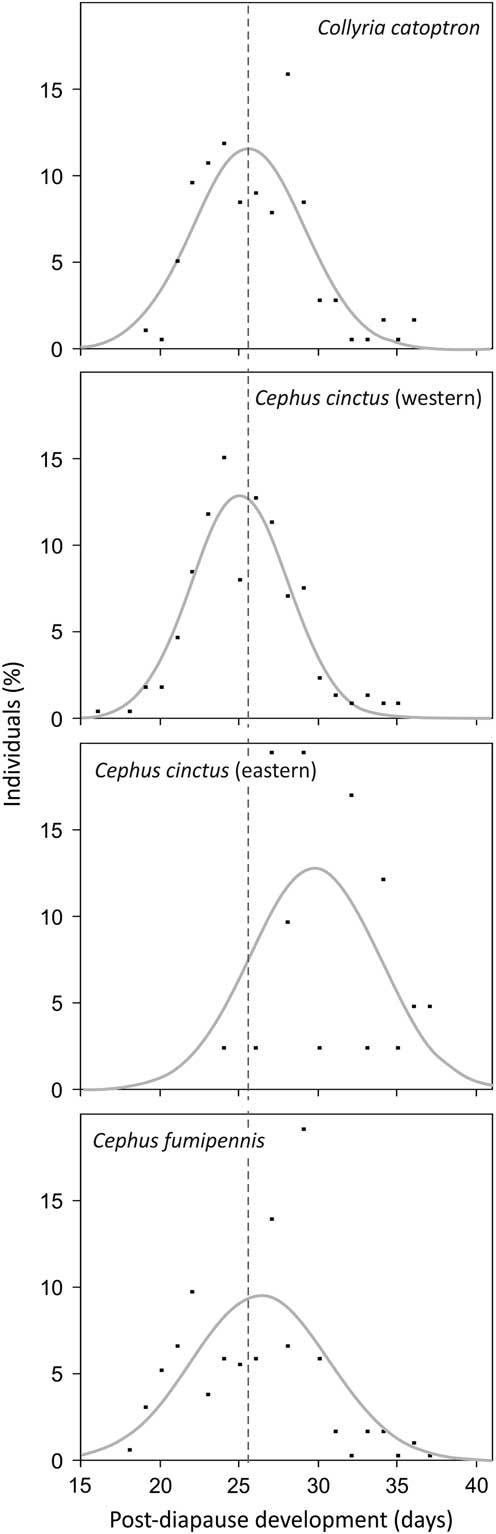
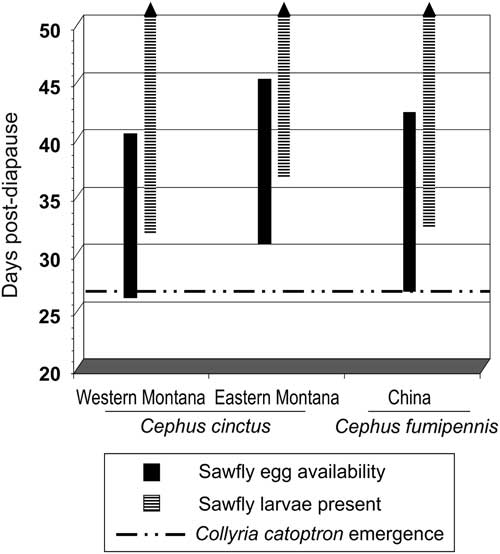
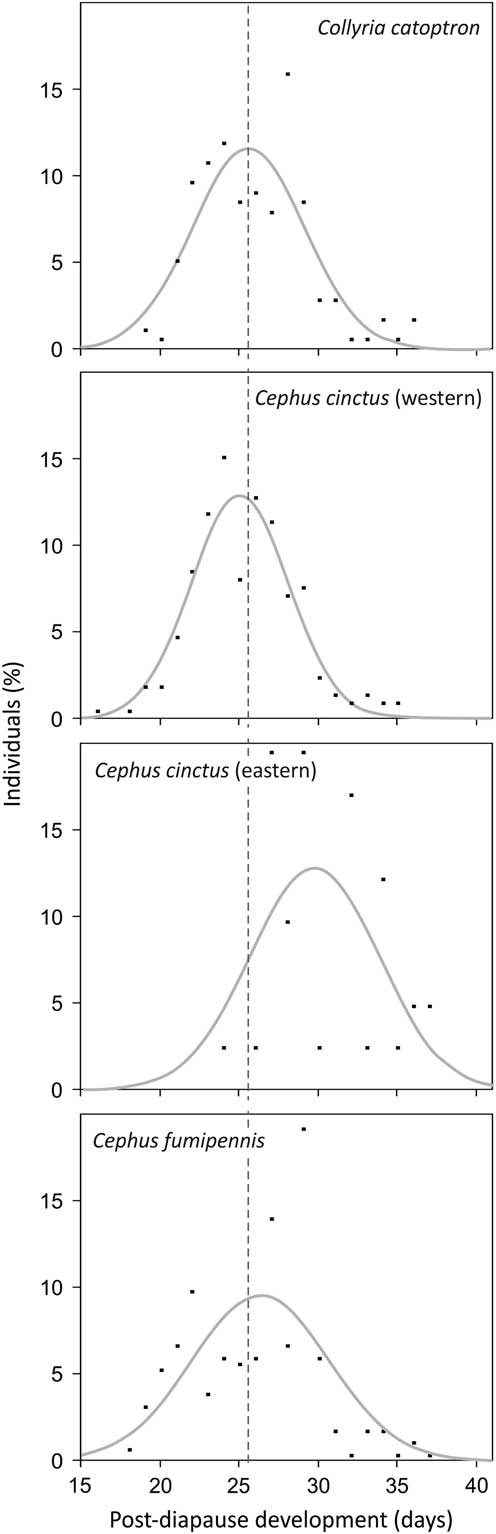
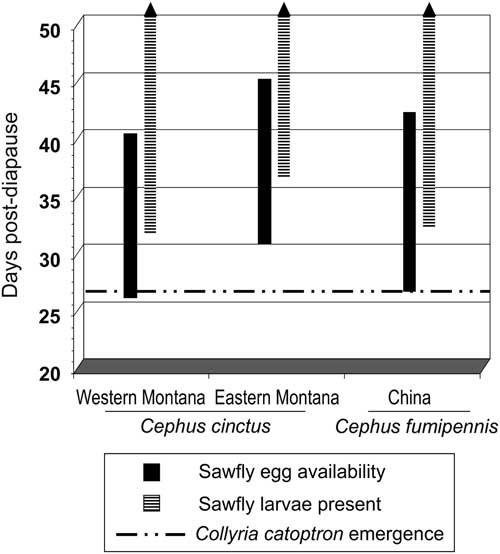
We compared overlap in emergence patterns and duration between the hosts, C. cinctus, from eastern and western Montana populations, as well as the Chinese host, C. fumipennis (populations from different counties in this case were lumped since no significant differences were found in PDP, see Table 2), and the parasitoid, C. catoptron. To do so we plotted the proportion of female individuals emerging through time for each species (Fig. 1), and fit curves to these data using the nonlinear modelling platform in JMP version 10 (SAS Institute Inc. 2010). Additionally, we constructed a figure to visualise the potential availability of the susceptible stage of both host sawfly species to ovipositing C. catoptron females (Fig. 2). Data on adult female emergence timing, adult longevity, and the average egg development time were combined to show the expected duration of life stages. As stated earlier, the natural histories of the two cephid species are similar (Shanower and Hoelmer Reference Shanower and Hoelmer2004). For example, the reported 7.5 days for adult female longevity of C. cinctus (Morrill et al. Reference Morrill, Gabor, Weaver, Kushnak and Irish2000) is very similar to the seven to eight days for adult longevity of C. fumipennis reported from several studies in China by Chen et al. (Reference Chen, Hoelmer, Chen, Liu and Shanower2004). Longevity data were added to the mean number of days required for emergence of adult cephid females from each population, assessed in the present study, and displaced by a further seven-day pre-hatch interval (Ainslie Reference Ainslie1929) for the eggs from the last surviving female (Fig. 2).
The percentage of female individuals emerging through time (days post-diapause) for the parasitoid, Collyria catoptron, and the potential host species the North American sawfly (Cephus cinctus), both western and eastern populations and the Chinese sawfly (Cephus fumipennis). Best-fit Gaussian peak curves are presented, with the dotted line representing peak emergence for C. catoptron, to aid in comparisons with other species.───────────────────────────────>
Predicted number of days Cephus cinctus and C. fumipennis larvae and eggs would be present after completion of larval diapause. Predictions are based on the mean emergence of females, female longevity, and egg development time. The dashed horizontal line shows the mean emergence time of females of the parasitoid, Collyria catoptron.
Results
Effects of laboratory, collection date, and sex on development
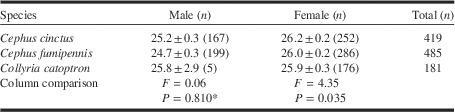
The PDP of more than 1000 individual insects was recorded (Table 1). Overall there was no difference in the PDP between the MSU and EBCL laboratories (F=1.81, P=0.179) nor did collection date influence the PDP of any species (P>0.05). Because previous studies showed that males of C. cinctus emerged earlier than females (Cárcamo et al. Reference Cárcamo, Beres, Clarke, Byers, Mundell and May2005), we tested whether there was a difference in the PDP between sexes. The mean PDP for males of C. catoptron is reported, but these data were removed for this analysis since only five males of this species emerged during the study. Collyria catoptron populations sampled thus far are heavily female biased, with males produced only rarely (Wahl et al. Reference Wahl, Shanower and Hoelmer2007). Sawfly males emerged approximately one day earlier than females (sex, F=45.72, P<0.001) and this was true for both sawfly species (species×sex, F=0.03, P=0.869) (Table 1). Data for males and females were separated for further analysis.
Post-diapause development (days±SEM) of the North American wheat stem sawfly Cephus cinctus, the Chinese wheat stem sawfly Cephus fumipennis, and its parasitoid Collyria catoptron.

Note: * Data for males of Collyria not included in comparison due to small sample size (n=5).
Overall comparison of sawfly and parasitoid development
There was no difference in the PDP between males of C. cinctus and males of C. fumipennis (Table 1). The mean PDP for females of C. cinctus, C. fumipennis, and the parasitoid C. catoptron was significantly different, but varied by less than one day (Table 1).
Comparison of sawfly and parasitoid development among counties
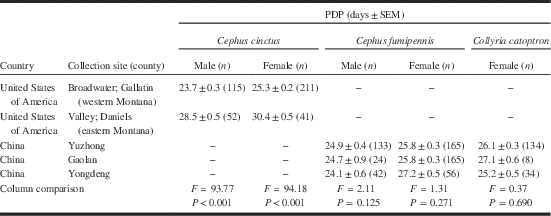
Having established that overall there was little or no difference in the PDP between the two sawfly species and the parasitoid, we next wanted to see if there were developmental differences between locations (i.e., county) within each country. If so, collection and release sites could be chosen to optimise phenological synchrony of host and parasitoid and thus improve the chances of successful establishment. There were no differences in the PDP for either males or females of C. fumipennis or its parasitoid C. catoptron among the sampled counties in China, that were relatively close to one another (⩽150 km)(Table 2). However, across the larger spatial gradient in Montana (550 km) both males and females of C. cinctus emerged about five days earlier when collected from populations from western Montana compared with those from eastern Montana (Table 2). We next compared the PDP of C. cinctus from eastern and western Montana with the PDP of C. fumipennis and C. catoptron from China. The PDP of male (F=10.14, P=0.002) and female (F=10.62, P=0.001) C. cinctus from eastern Montana was longer than C. fumipennis and C. catoptron from China. However, there was no difference in the PDP between C. fumipennis and C. catoptron and males (F=1.62, P=0.205) or females (F=3.08, P=0.080) of C. cinctus from western Montana.
Comparison of post-diapause development (days±SEM) of the North American sawfly Cephus cinctus from different locations in Montana, United States of America and the Chinese sawfly Cephus fumipennis and its parasitoid Collyria catoptron from locations in Gansu Province, China.

Note: PDP, post-diapause period.
Estimating host-parasitoid phenological overlap
The best-fit curves (lowest corrected Aikake Information Criterian values) to the emergence data for all insect species/populations were Gaussian peak curves (Fig. 1) although explanatory power varied across groups (R 2=0.24 for C. cinctus eastern populations; R 2=0.88 for C. cinctus western populations; R 2=0.73 for C. catoptron; R 2=0.44 for C. fumipennis). Minimum-maximum PDP varied only slightly for three of four insect groups: C. cinctus from western Montana (16–35 days), C. fumipennis (18–37 days), and C. catoptron (19–36); furthermore >89% of the individuals emerged in a relatively tight window between 20 and 30 days post diapause for these three groups (Fig. 1). In contrast, C. cinctus from eastern Montana began emerging later (24 days) and continued emerging longer (37 days). The vulnerable egg stages of both host species, C. fumipennis and C. cinctus (both western and eastern populations), are projected to overlap with adult female C. catoptron flight (Fig. 2).
Development of the Cephus cinctus larval parasitoid Bracon cephi
We recorded the PDP of B. cephi that emerged from the eastern Montana sites. No C. cinctus parasitoids were obtained from stubs collected from the western Montana populations, although parasitoids could have been present within the stems, which were not sampled. Previous work has shown that parasitism in these western Montana locations can be substantial (Runyon et al. Reference Runyon, Morrill, Weaver and Miller2002). The average PDP for B. cephi was 26.4±0.9 days (n=86). Males of B. cephi emerged approximately six days earlier than females (23.1±1.2 and 29.0±1.0 days for males and females, respectively) (F=35.17, P<0.001).
Discussion
Synchrony in the seasonal phenology of parasitoids and their host insects is an important factor impacting parasitoid population dynamics (Godfray et al. Reference Godfray, Hassell and Holt1994) and plays an often crucial role in determining the success of classical biological control programmes (Stiling Reference Stiling1993). For example, mismatches in the seasonal development of sawflies and parasitoids has been suggested as one of the factors responsible for the failure of the early attempt to establish European egg-larval parasitoids in the northern Great Plains of the United States of America and Canada (Smith Reference Smith1959; Turnbull and Chant Reference Turnbull and Chant1961; Beirne Reference Beirne1975). As such, knowledge of the seasonal activity of adult C. cinctus and C. fumipennis was needed as an initial step to evaluate the potential suitability of C. cinctus as a host for the egg-larval parasitoid C. catoptron. Because these insects overwinter as larvae in a state of diapause in wheat stubble, with development resuming in the spring, similar rates of post-diapause development (PDP) are critical to ensuring that parasitoids encounter the vulnerable life stages of their hosts upon emergence.
Across all studied populations, we found that mean PDP of all three insects was very similar, varying less than a day (Table 1). Overlap in emergence timing was also substantial for three groups of insects, C. cinctus from western populations, C. fumipennis and C. catoptron, with ⩾89% of individuals emerging between 20 and 30 days post-diapause, and peak emergence between 25 and 26 days post-diapause (Fig. 1). Eastern Montana C. cinctus populations were less well synchronised with C. catoptron, with both first and peak emergence about five days later than the parasitoid. Projection of the duration of life-history stages indicated that the vulnerable host stage (eggs) of C. cinctus would be available to C. catoptron upon emergence for western Montana populations, and less than a week from mean emergence time for the eastern Montana populations (Fig. 2). Thus overall, our data indicate that the Chinese and North American sawfly species are very similar in their seasonal development, and that C. cinctus eggs should be present for foraging C. catoptron if it were to be released in North America.
The population differences in egg availability highlighted in Figure 2 reflect significant differences in PDP among Montana sawfly populations. Both mean and peak emergence of western populations occurred earlier than eastern populations (Fig. 1; Table 2); no such differences were observed among Chinese populations (Table 2). The lack of differences in emergence timing among sawflies from the Chinese populations is not surprising, given their relative proximity (⩽150 km) and lack of geographic barriers among them. In contrast, populations in eastern and western Montana were much more isolated from one another (~550 km) and span a major gradient in precipitation (Rand et al. Reference Rand, Waters, Blodgett, Knodel and Harris2014). These findings support previous observations that sawflies from western Montana emerge earlier than those from eastern Montana (Lou et al. Reference Lou, Weiss, Bruckner, Morrill, Talbert and Martin1998; Perez-Mendoza and Weaver Reference Perez- Mendoza and Weaver2006). Although western Montana collection locations in the current study were also farther south than those in eastern Montana, previous work shows similar differences in emergence timing between western populations collected farther north (Pondera County; 48.17°N, 111.95°W) and those in northeastern Montana (Valley County: 48.5°N, 106.19°W) (Lou et al. Reference Lou, Weiss, Bruckner, Morrill, Talbert and Martin1998; Perez-Mendoza and Weaver Reference Perez- Mendoza and Weaver2006), suggesting that the observed differences are associated with longitude rather than latitude. Genetic studies further show that there are differences in mitochondrial DNA sequences among sawfly populations from various locations across the northern Great Plains of the United States of America and Canada (Bon et al. Reference Bon, Shanower, Morrill, Hoelmer, Hurard and Martin2005), which corroborates the findings in Lou et al. (Reference Lou, Weiss, Bruckner, Morrill, Talbert and Martin1998). Similar differences might be expected between northern versus southern populations of Cephus in China or the United States of America, however this remains to be determined. Since minor genetic differences among insect populations can impact the suitability as hosts for biocontrol agents (Wajnberg Reference Wajnberg2004; Hufbauer and Roderick Reference Hufbauer and Roderick2005), these differences may be important and warrant further investigation.
The fact that sawfly adults are now appearing nearly a month earlier than previously observed in western Montana (Morrill and Kushnak Reference Morrill and Kushnak1996), should provide a greater probability for overlap between host oviposition and foraging populations of C. catoptron. Specifically, our findings suggests that C. catoptron collected from the Chinese locations used in this study are better synchronised with C. cinctus populations from western Montana, increasing the potential for successful establishment there. However, population differences might not limit the potential success of C. catoptron in eastern Montana because adult emergence periods in field situations are often variable (Ainslie Reference Ainslie1929; Wallace and McNeal Reference Wallace and McNeal1966). Morrill and Kushnak (Reference Morrill and Kushnak1996) report the duration of adult C. cinctus flight in western Montana ranging from 9 to 34 days, with slightly less variable duration observed over eight site-years in North Dakota (14–27 days; Stegmiller Reference Stegmiller2012). Thus, establishment failure due to reduced egg availability in the field for eastern populations would be unlikely. A more important consequence of the lack in synchrony might be the potential for late emerging C. cinctus to escape parasitism by C. catoptron. However, relatively rapid shifts in diapause timing by biocontrol agents to be better synchronised with the phenology of their host populations have been observed in other systems (Bean et al. Reference Bean, Dalin and Dudley2012), which could improve synchrony and effectiveness over time.
Bracon cephi is a larval parasitoid that successfully parasitises C. cinctus in Montana wheat fields (Weaver et al. Reference Weaver, Sing, Runyon and Morrill2004, Reference Weaver, Nansen, Runyon, Sing and Morrill2005). Furthermore, parasitism can be extensive in some fields, with maximum observed parasitism rates exceeding ⩾88% (Morrill et al. Reference Morrill, Kushnak, Bruckner and Gabor1994; Rand et al. Reference Rand, Waters, Blodgett, Knodel and Harris2014), and can also attenuate physiological loss (Macedo et al. Reference Macedo, Weaver and Peterson2007; Delaney et al. Reference Delaney, Weaver and Peterson2010) in wheat head weight for infested stems (Buteler et al. Reference Buteler, Weaver and Miller2008). The seasonal activity of B. cephi generally parallels that of its host C. cinctus, although it has a longer flight period (Stegmiller Reference Stegmiller2012; Davis Reference Davis2013). The similarity in development between C. cinctus and C. fumipennis thus suggests that B. cephi would likely encounter suitable stages of C. fumipennis in China. The adult females of this parasitoid species have a pre-oviposition period of three weeks in the first generation, during which the eggs mature, which would ensure that the required larger sawfly larvae are available to ovipositing parasitoids (Nelson and Farstad Reference Nelson and Farstad1953). No additional parasitoid species of either wheat stem sawfly species were found, although a few specimens of the predator, Phyllobanius dubius (Wolcott) (Coleoptera: Cleridae) (Morrill et al. Reference Morrill, Weaver, Irish and Barr2001), were recovered from C. cinctus stubs.
In summary, the findings presented here suggest that lack of developmental synchrony will not be a factor that limits successful establishment of C. catoptron for control of C. cinctus in North America. However, while neither a lack of climatic matching nor host-parasitoid phenological asynchrony are predicted to be impediments to the potential success for this agent, preliminary results from additional studies suggest a basic physiological incompatibility between C. cinctus and C. catoptron. Rand et al. (Reference Rand, Waters and Shanower2015) found that while Collyria catoptron oviposits and initiates larval development within C. cinctus, it never completed development and emerged as an adult from the novel host.
Acknowledgements
The authors thank Hongyin Chen (United States Department of Agriculture-Agricultural Research Service; Sino-American Biological Control Laboratory, Beijing) and Aiping Liu (Chinese Academy of Agricultural Sciences, Grasslands Research Institute, Hohhot, Inner Mongolia) for their assistance in obtaining the samples from China, and J. Zhu (Penn State) for help with the statistical analysis. Norma Irish provided valuable technical assistance. Research conducted at Montana State University was supported by the Montana Wheat and Barley Committee and the Montana Agricultural Experiment Station.