Introduction
The laryngeal mucosa is covered with mucus, which is necessary as a lubricant for vocal fold vibration. This mucus is locally produced by glandular tissue distributed in the secretory mucosa and glandular acini of the larynx. Mucous secretions are known to be important for the mucosal defence system, due to the secretory immunoglobulins they contain.Reference Tomasi, Jan, Solomon and Prendergast1, Reference Brandtzaeg2
Previously, we have studied the development of laryngeal glands in the human fetal,Reference Nakashima, Makishima, Komiyama, Takeda and Hiroto3 infantReference Yonekawa, Fukunaga, Umeno, Mori and Nakashima4 and adultReference Nakashima, Komiyama, Makishima, Takeda and Hiroto5 larynx. In particular, we have observed the presence of closely packed glandular acini in the laryngeal ventricle, as noted by other authors, and have found that the concentration of glandular tissue increases as these acini grow within the developing larynx. Despite knowledge of such glandular distribution, few reports have addressed the contribution to local laryngeal immunity of immunological factors within laryngeal secretions.
In the present study, we examined levels of several immunoglobulins and of a tumour marker known as Cyfra 21-1 (a cytokeratin subunit), within secretions and mucosal tissue specimens of the laryngeal ventricle. Because the larynx is subjected to various environmental stimuli (such as air pollution and viral and bacterial infections), knowledge of the mucosal immune status of the laryngeal glands should provide a valuable baseline for examining the immunological status of laryngeal disorders.
Materials and methods
Approval for the study was obtained from the institutional review board of the Kurume University School of Medicine (Kurume University, Kurume, Japan).
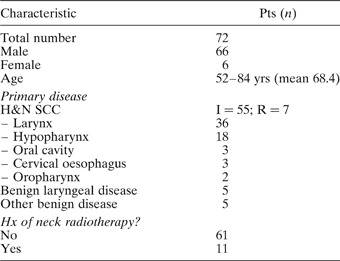
Laryngeal secretions and mucosal tissue specimens were obtained from patients admitted to the Kurume University Hospital between January 2002 and August 2005. Specimens were obtained from 72 adults (66 men and six women) whose ages ranged from 52 to 84 years (mean age, 68.4 years) (Table I). Sixty-two of the 72 patients had head or neck cancer (laryngeal in 36 patients, hypopharyngeal in 18, oral cavity in three, oesophageal in three and oropharyngeal in two). Regarding the other 10 patients, five had benign laryngeal disease (such as vocal fold polyps) and five had other benign disease (such as aspiration). Seven patients had recurrent disease, and 11 had a history of radiotherapy to the neck.
Patient characteristics

Pts = patients; yrs = years; H&N SCC = head and neck squamous cell carcinoma; I = initial; R = recurrent; Hx = history
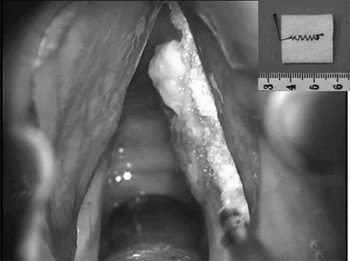
Laryngeal secretions and mucosal tissue specimens were collected during laryngeal microsurgery or at the time of surgical laryngectomy. During laryngeal microsurgery, two 5 × 10 mm pieces of sponge strip was inserted into the laryngeal ventricle (Figure 1), using a modification of the method described by Mogi et al.Reference Mogi, Watanabe, Maeda and Umehara6 After a minute, the sponge strips and their absorbed ventricular secretions were collected. In 15 patients with laryngeal or hypopharyngeal cancer patients, a mucosal tissue specimen (2–3 mm thick) was also taken from the false vocal fold. In a patient whose larynx was removed during radical surgery for the primary cancer, or as treatment for severe aspiration, laryngeal secretions and mucosal tissue from the false vocal cord were extracted immediately after laryngectomy.
Collection of laryngeal secretions. At the beginning of laryngeal microsurgery, a 2 × 2 cm piece of sponge strip (inset) was inserted into the laryngeal ventricle. After a minute, the moistened strip was grasped by forceps and removed.

For comparison purposes, examination of both serum and sputum was also carried out in each patient and the mean of the results were determined.
The levels of immunoglobulins G, A and M (IgG, IgA and IgM) and Cyfra 21-1 in the collected laryngeal secretions were measured quantitatively using turbidmetric immunoassay or electrochemiluminescence immunoassay, according to the manufacturer's protocol (SRL Laboratories, Tokyo, Japan). Levels of secretory IgA were measured by enzyme-linked immunosorbent assay (Medical & Biological Laboratories, Nagoya, Japan).
Measurement of immunoglobulins and Cyfra 21-1 in mucosal tissue specimens was also performed according to the manufacturer's protocol (SRL laboratories). Briefly, tissue specimens obtained at surgery were stored at 4°C and sent to the laboratory. After weighing the specimen, saline was added (to a quantity 10 times the specimen volume). The mixture was homogenised at 4°C and centrifuged for 60 minutes at 13 000 rpm. After removing the lipid layer, the concentration of immunoglobulins and Cyfra 21-1 was measured in the same manner as described above for laryngeal secretions. Actual concentrations were then calculated per specimen weight.
Statistical analysis
Statistically significant correlations between the mean concentrations of immunoglobulins and Cyfra 21-1 for each patient group were determined by the Chochran–Cox test, using the Stat View software package (Abacus Concepts Inc., Berkeley, California, USA). A p value of less than 0.05 was considered to indicate statistical significance.
Results
Analysis of serum, sputum and laryngeal secretions
The mean concentrations of IgG, IgA, IgM, secretory IgA and Cyfra 21-1 in the serum, sputum and laryngeal secretions are listed in Table II. Immunoglobulin concentrations were highest in serum. The mean IgG and IgM concentrations in laryngeal secretions (0.530 and 0.024 mg/ml, respectively) were higher than those in sputum (0.256 and 0.013 mg/ml, respectively). In contrast, the mean IgA and secretory IgA concentrations in laryngeal secretions (0.127 mg/ml and 69.66 µg/ml, respectively) were lower than those in sputum (0.202 mg/ml and 199.15 µg/ml, respectively). The mean Cyfra 21-1 concentration in laryngeal secretions (587.17 ng/ml) was more than twice that in sputum (207.15 ng/ml).
Mean immunoglobulin and Cyfra 21-1 levels in serum, sputum and laryngeal secretions

* Number of cases examined. Ig = immunoglobulin; SIgA = secretory IgA; NE = not examined
Clinical correlations
The mean concentrations of immunoglobulins and Cyfra 21-1 for laryngeal secretions and tissue were analysed according to the patients' clinical characteristics. Compared with patients with head and neck cancer, patients with benign laryngeal disease (3 laryngeal and one other) had lower laryngeal secretion levels of IgG (0.157 mg/ml), IgA (0.065 mg/ml), IgM (0.013 mg/ml) and Cyfra 21-1 (354.00 ng/ml) and a higher level of secretory IgA (90.68 µg/ml) (Table III). Because of the limited number of patients with benign disease, however, no significant difference was detected. In patients who previously received radiotherapy, the level of secretory IgA (42.45 µg/ml) was considerably lower than that in either the normal or cancer (with no previous treatment) groups; however, no significant difference was observed between the two groups.
Mean immunoglobulin and Cyfra 21-1 levels in laryngeal secretions, by patient group

* Number of cases examined. Pt = patient; Ig = immunoglobulin; SIgA = secretory IgA; H&N SCC = head and neck cancer squamous cell carcinoma
Where taken, laryngeal mucosal tissue specimens were homogenised and the concentration of immunoglobulins and Cyfra 21-1 measured per gram of specimen weight. The mean tissue levels for the 57 laryngeal tissue specimens analysed were: 3.138 mg/g for IgG; 0.992 mg/g for IgA; 0.166 mg/g for IgM; 129.14 µg/g for secretory IgA; and 95 864.45 ng/g for Cyfra 21-1 (Table IV). The mean tissue levels of IgM (0.068 mg/g) and secretory IgA (70.60 µg/g) were significantly lower in the benign group, compared with the cancer group (p < 0.05). The radiotherapy group showed a lower mean tissue level of secretory IgA, compared with the cancer group; however, no statistically significant difference was detected. The most striking feature was observed for Cyfra 21-1; tissue levels were considerably lower in the benign group (17 956.00 ng/g) and also in the radiotherapy group (26 976.29 ng/g), compared with the cancer group (111 128.10 ng/g) (p < 0.001).
Mean immunoglobulin and Cyfra 21-1 levels in laryngeal tissue, by patient group

* Number of cases examined. Pt = patient; Ig = immunoglobulin; SIgA = secretory IgA; H&N SCC = head and neck cancer squamous cell carcinoma
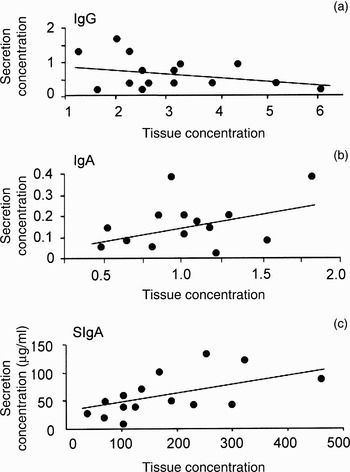
In patients in whom samples of laryngeal secretions and mucosal tissue were simultaneously obtained, correlation between immunoglobulin and Cyfra21-1 levels in the two specimens were examined for each individual. No such correlation was found for IgG, IgM or Cyfra21-1. A slight correlation was found in the case of IgA. In contrast, a statistically significant correlation was found between the levels of secretory IgA in laryngeal secretions and mucosal tissue (Figure 2).
Correlation between immunoglobulin (Ig) concentrations measured in mucosal tissue specimens and laryngeal secretions obtained simultaneously from the same individual, for (a) IgG, (b) IgA and (c) secretory IgA. No correlation was observed for IgG (r = 0.33). A slight but statistically insignificant correlation was observed for IgA (r = 0.43, p = 0.11). A significant correlation was observed for secretory IgA (r = 0.61, p = 0.017).

Discussion
It is well established that mucosal immunity is delivered by the secretions present in both the respiratory and gastrointestinal passages. Locally produced secretory IgA is the predominant immunoglobulin involved in mucosal immunity.Reference Tomasi, Jan, Solomon and Prendergast1, Reference Brandtzaeg2 Using an immunofluorescent method, we have previously demonstrated that IgA-producing plasma cells are numerous in the submucosal and periglandular areas of the human larynx, thus suggesting that a local immune system is active within the human larynx.Reference Nakashima, Komiyama, Makishima, Takeda and Hiroto5 Although the glandular distribution pattern changes with age,Reference Tanaka, Nakashima and Uemura7, Reference Sato and Hirano8 the laryngeal ventricle continues to be richly supplied with laryngeal glands throughout life. The laryngeal secretions covering the vocal fold, therefore, seem to be secreted mainly from the glandular epithelium and acini in the false vocal fold and ventricle.
In a previous report of local immunity of the human larynx, Mogi et al. observed that laryngeal secretions had similar levels of IgG and other immunoglobulins as nasal secretions and tracheobronchial washings.Reference Mogi, Watanabe, Maeda and Umehara6 These authors determined the mean levels of IgA and the secretory component of laryngeal secretions to be 0.620 mg/ml and 61 µg/ml, respectively, whereas those of nasal secretions were 0.540 mg/ml and 97 µg/ml, respectively. We found a lower level of IgA in laryngeal secretions, compared with Mogi et al. There have been no previous reports on the level of secretory IgA in laryngeal secretions. The results of our study confirm the presence of local immunity in the human larynx. Moreover, as there was a significant correlation between levels of secretory IgA in laryngeal secretions and tissue specimens, the local production of secretory immunoglobulins is therefore highly suspected.
The average serum concentration of Cyfra 21-1 (3.43 ng/ml) was higher than that described in previous reports on patients with head and neck squamous cell carcinoma.Reference Ceruse, Rabilloud, Charrie, Dubreuil and Disant9, Reference Doweck, Barak, Greenberg, Uri, Kellner and Lurie10 However, the most interesting finding of the current study was the high concentration of Cyfra 21-1 in laryngeal secretions. Although no statistically significant difference was observed, the Cyfra 21-1 concentration in laryngeal secretions was higher in the cancer group compared with the benign group (Table III), indicating that the concentration of this tumour marker in laryngeal secretions may have diagnostic potential.
On reviewing the previous literature, we could find no prior reports evaluating immunoglobulins and Cyfra 21-1 in mucosal tissue specimens from the larynx. In the current study, the examined mucosa (obtained from the false vocal fold) was thought to contain epithelial and subepithelial tissue, including glandular tissue and stroma. It was interesting to note that the mean tissue levels of IgM and secretory IgA in the benign group were lower than those in the cancer group (p < 0.05). The most striking finding was the difference in tissue Cyfra 21-1 levels between the cancer group and the benign group (p < 0.001).
It should also be noted that the levels of secretory IgA and Cyfra 21-1 in laryngeal secretions and tissue specimens were decreased in patients who had previously undergone radiotherapy to the neck. Serum Cyfra 21-1 concentration has been reported to be an independent prognostic tumour marker of head and neck squamous cell carcinoma.Reference Ceruse, Rabilloud, Charrie, Dubreuil and Disant9, Reference Doweck, Barak, Greenberg, Uri, Kellner and Lurie10 In the tissue regions that have been irradiated, however, the Cyfra 21-1 distribution pattern may be affected. In our recent study of the larynx in patients receiving radiotherapy to the neck, the laryngeal glands were often found to have been replaced by fibrous connective tissue.Reference Nakashima, Tomita, Tsuda and Chitose11 The ratio of serous-type glandular acini to mucous-type glandular acini was also decreased. Thus, radiotherapy of the neck may impair not only the voice but also the local immune defence of the larynx. Further studies on the importance of local immune function and the expression of tumour markers are now underway.
Acknowledgement
This study was supported in part by a Grant-in-Aid for Scientific Research (#17591812) from the Ministry of Education, Culture, Sports Science and Technology, Japan.