Introduction
The lichen family Pyrenulaceae Rabenh. is an important element of the epiphytic lichen flora in tropical rainforests (Sipman & Harris Reference Sipman, Harris, Lieth and Werger1989; Komposch & Hafellner Reference Komposch and Hafellner2002; Rivas Plata et al. Reference Rivas Plata, Lücking and Lumbsch2008; Aptroot Reference Aptroot2009). It is most abundant in montane, sub-montane, semi-evergreen and lowland evergreen rainforests, where together with Graphidaceae Dumort., it constitutes the dominant component of the crustose epiphytic lichen flora. The Pyrenulaceae mainly comprises corticolous species and they are nearly all associated with the green-algal genus Trentepohlia Mart., the most common photobiont for crustose species with a mainly tropical distribution. This family belongs to Pyrenulales (Chaetothyriomycetidae, Eurotiomycetes), an order characterized by perithecial ascomata with an ascohymenial development and fissitunicate asci, and septate to muriform ascospores (Parguey-Leduc Reference Parguey-Leduc1973; Parguey-Leduc & Janex-Favre Reference Parguey-Leduc, Janex-Favre and Reynolds1981; Harris Reference Harris1989; Aptroot et al. Reference Aptroot, Lücking, Sipman, Umaña and Chaves2008). The circumscription of this order has undergone many recent changes (Lutzoni et al. Reference Lutzoni, Kauff, Cox, McLaughlin, Celio, Dentinger, Padamsee, Hibbett, James and Baloch2004; del Prado et al. Reference del Prado, Schmitt, Kautz, Palice, Lücking and Lumbsch2006; Lumbsch & Huhndorf Reference Lumbsch and Huhndorf2007; Nelsen et al. Reference Nelsen, Lücking, Grube, Mbatchou, Muggia, Rivas Plata and Lumbsch2009), because morphological characters used to circumscribe families and genera in this order were also found in members of another fungal class, Dothideomycetes. The use of molecular data has therefore helped disentangle the classification at the family and order levels for the two fungal classes Dothideomycetes and Eurotiomycetes, and Pyrenulales now includes four families: Celotheliaceae Lücking, Aptroot & Sipman, Pyrenulaceae, Requienellaceae Boise and Monoblastiaceae Walt. Watson (Lumbsch & Huhndorf Reference Lumbsch and Huhndorf2010).
Pyrenulaceae is a large family with about 10 genera and 224 currently accepted species (Kirk et al. Reference Kirk, Cannon and Stalpers2008; Aptroot Reference Aptroot2012). The main genus is Pyrenula Ach., which so far includes 169 accepted species (Aptroot Reference Aptroot2012). As for many other crustose, corticolous tropical groups of lichens, molecular data is lacking for most species, mainly due to difficulties in recovering good quality genomic DNA from herbarium specimens, even when recently collected. Most of the existing studies with molecular data on Pyrenulaceae were based on a limited number of species from this family and have focused more on relationships between the main classes and orders in ascomycetes (Lutzoni et al. Reference Lutzoni, Kauff, Cox, McLaughlin, Celio, Dentinger, Padamsee, Hibbett, James and Baloch2004; James et al. Reference James, Kauff, Schoch, Matheny, Hofstetter, Cox, Celio, Gueidan, Fraker and Miądlikowska2006; Lumbsch & Huhndorf Reference Lumbsch and Huhndorf2007; Gueidan et al. Reference Gueidan, Villaseñor, de Hoog, Gorbushina, Untereiner and Lutzoni2008; Schoch et al. Reference Schoch, Sung, López-Giráldez, Townsend, Miądlikowska, Hofstetter, Robbertse, Matheny, Kauff and Wang2009). The study by del Prado et al. (Reference del Prado, Schmitt, Kautz, Palice, Lücking and Lumbsch2006) was the first focusing on the order Pyrenulales and examining the phylogenetic placement of families and genera traditionally classified within this order. However, no study so far has focused on phylogenetic relationships within the family Pyrenulaceae. The current generic delimitation in this family has therefore not yet been tested using molecular data.
In Sri Lanka, the diversity of Pyrenulaceae is poorly known, with only a few studies referring to these crustose lichens (Nayanakantha & Gajameragedara Reference Nayanakantha and Gajameragedara2003; Wijeyaratne Reference Wijeyaratne2003; Attanayaka Reference Attanayaka2006). Moreover, only a handful of species have been recorded in these inventories, although the diversity of Pyrenulaceae in neighbouring India suggests that many more species should also be present in Sri Lanka (Singh & Sinha Reference Singh and Sinha2010). During a recent lichenological survey carried out in the Knuckles mountain range in Sri Lanka (Weerakoon Reference Weerakoon2010), specimens of Pyrenulaceae were collected from different habitats. The sampling of these fresh specimens allowed us to obtain DNA sequences and assemble a molecular dataset in order to carry out a preliminary investigation of the relationships within the family Pyrenulaceae.
Material and Methods
Taxon sampling
As part of a lichen survey in the Knuckles mountain range in Sri Lanka, several specimens of Pyrenulaceae were collected, air dried and stored in labelled packets in 2010. These specimens were identified using a key by Aptroot (Reference Aptroot2012). Some of the voucher specimens of Pyrenulaceae for which sequence data was already available in GenBank were borrowed from DUKE and F and re-identified using the same key (Aptroot Reference Aptroot2012). Identifications were carried out using an OLYMPUS SZX12 dissecting microscope and a ZEISS Axioscope 2 plus compound microscope. Photographs were taken in the Sackler Biodiversity Imaging Laboratory at the Natural History Museum using a Zeiss Stemi SV11 stereomicroscope coupled with a Canon EOS imaging system.
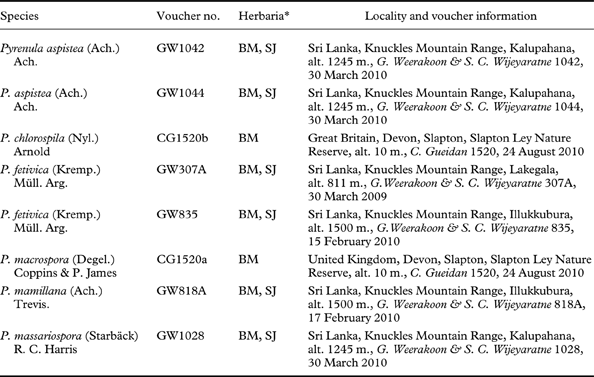
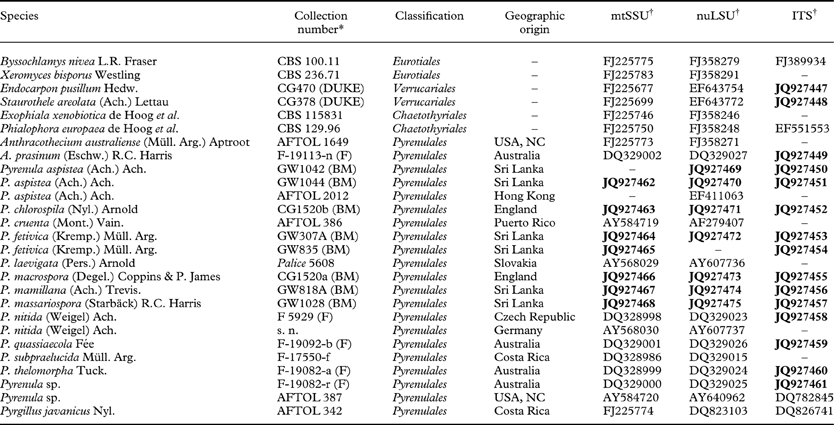
The specimens of Pyrenula from Sri Lanka were more than a year old and, therefore, potentially already too old to obtain good genomic DNA extracts. Therefore, only the largest and healthiest were selected for molecular analysis. Two other species of Pyrenula collected in the UK (P. chlorospila and P. macrospora) were also added to the taxon sampling. Amplifications worked relatively well for eight specimens (Pyrenula aspistea GW1042 and GW1044, P. chlorospila CG1520b, P. fetivica GW835 and GW307A, P. macrospora CG1520a, P. mamillana GW818A and P. massariospora GW1028; Table 1). The molecular dataset was completed using sequences available in GenBank for a total of 21 taxa of Pyrenulaceae, including Anthracothecium australiense, A. prasinum, Pyrgillus javanicus and 18 specimens of Pyrenula (Table 2). Additional ITS sequences were obtained in this study for specimens with other molecular data available in GenBank. Two species of Verrucariales (Endocarpon pusillum and Staurothele areolata) and two species of Chaetothyriales (Exophiala xenobiotica and Phialophora europaea) were also included because they belong to the sister subclass Chaetothyriomycetidae (Gueidan et al. Reference Gueidan, Villaseñor, de Hoog, Gorbushina, Untereiner and Lutzoni2008) and two species of Eurotiomycetidae (Byssochlamys nivea and Xeromyces bisporus) were used as outgroups.
Locality and voucher information for specimens for which molecular data has not previously been published
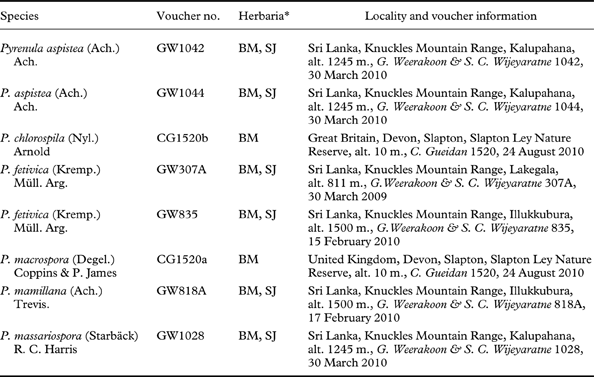
* BM=Natural History Museum, London (UK); SJ=University of Sri Jayewardenepura, Nugegoda (Sri Lanka)
Specimen data and sequences used in this study
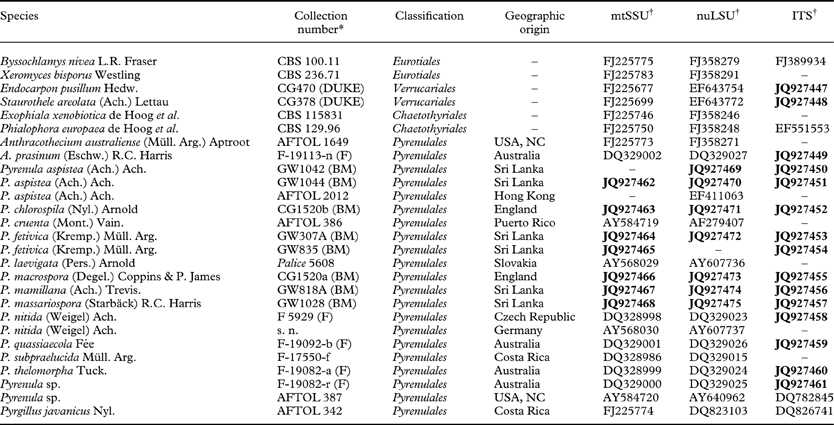
* Herbaria are indicated in parenthesis after the collection number for specimens for which new sequences were produced.
† Missing sequences are indicated by dashes and GenBank accession numbers of newly obtained sequences are shown in bold.
Molecular data
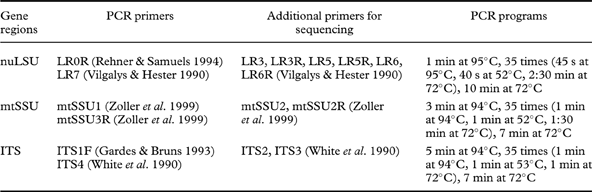
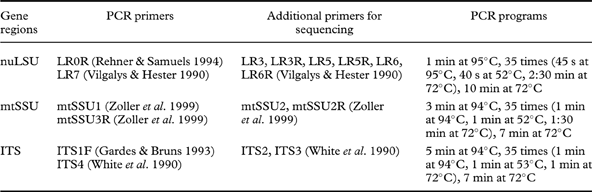
Perithecia and, when possible, thallus fragments were collected from herbarium specimens with a sterile razor blade and transferred to an Eppendorf tube. Genomic DNA was then obtained using a protocol modified from Zolan & Pukkila (Reference Zolan and Pukkila1986), as described in Gueidan et al. (Reference Gueidan, Roux and Lutzoni2007). DNA extracts were checked with a gel electrophoresis and for each sample the band intensity was used to choose the appropriate genomic DNA dilution for amplification. A dataset of three markers was assembled: the large subunit of the nuclear ribosomal RNA gene (nuLSU), the small subunit of the mitochondrial ribosomal RNA gene (mtSSU), and the region including the internal transcribed spacers 1 and 2 and the 5.8S subunit of the nuclear ribosomal RNA gene (ITS). These markers were amplified using primers and PCR programs described in Table 3. For the three gene regions, 1 µl of a 1/10 or 1/100 dilution of genomic DNA was added to the following PCR mix: 2·5 µl PCR buffer 10×NH4 (Bioline, London, UK), 1·5 µl of MgCl2 (50 mM), 0·5 µl dNTP (100 mM), 1 µl primers (10 µM), 0·5 µl DNA polymerase Bioline BioTaq (5 U µl-1), and water to a total volume of 25 µl. PCR was performed using a Techne TC-4000 PCR machine (Bibby Scientific Ltd, Stone, UK). Cloning was conducted on PCR products with multiple bands using a Topo TA cloning kit (Invitrogen, Carlsbad, CA). PCR product clean-up and sequencing were carried out by the sequencing facility of the Natural History Museum in London, using PCR Clean-up Filter Plates (Millipore, Billerica, MA), BigDye chemistry and an ABI 3730xl sequencing machine (Applied Biosystems, Carlsbad, CA, USA).
List of primers for the three loci (nuLSU, mtSSU and ITS) used in this study and PCR programs used for their amplification
Alignments and phylogenetic analyses
DNA sequences were edited and assembled using Sequencher 4.8 (Gene Codes Corporation, Ann Arbor, MI). Sequences were manually aligned in MacClade 4.08 (Maddison & Maddison Reference Maddison and Maddison2003). Ambiguous regions were delimited according to Lutzoni et al. (Reference Lutzoni, Wagner, Reeb and Zoller2000) and excluded from the alignments. Two species of Eurotiomycetidae (Byssochlamys nivea and Xeromyces bisporus) were selected as outgroups. The congruence of the three datasets was tested using a 70% reciprocal bootstrap criterion (Mason-Gamer & Kellogg Reference Mason-Gamer and Kellogg1996): the three matrices (nuLSU, mtSSU, ITS) were analyzed separately using 500 bootstrap pseudoreplicates with RAxML VI-HPC (Stamatakis et al. Reference Stamatakis, Ludwig and Meier2005, Reference Stamatakis, Hoover and Rougemont2008) on the Cipres Web Portal (http://www.phylo.org). No conflicts were detected and the three datasets were combined. Phylogenetic relationships were investigated using a Maximum Likelihood (ML) approach with the software RAxML VI-HPC as implemented on the Cipres Web Portal. The combined dataset was analyzed using a GTRMIX model applied to three partitions (nuLSU, mtSSU and ITS). Support values were obtained using a bootstrap analysis of 1000 pseudoreplicates. Additional support values were obtained using weighted Maximum Parsimony (wMP) and a Bayesian approach (MB). The wMP bootstrap analysis was conducted in PAUP* version 4.0b10 (Swofford Reference Swofford1999). Constant sites were excluded and gaps were treated as fifth characters. Step matrices were obtained for each of the three previously mentioned partitions by using StMatrix 4.2 (Lutzoni & Zoller, Duke University, www.lutzonilab.net/downloads/). A tree search was carried out using 1000 random addition sequences (RAS). The same most parsimonious tree was recovered for 388 of the 1000 RAS. A bootstrap analysis of 1000 replicates and ten RAS was then conducted using PAUP*. For the Bayesian approach, the Akaike Information Criterion as implemented in Modeltest 3.7 was used to estimate the model of molecular evolution. A GTR+I+G model was used for the three partitions (nuLSU, mtSSU and ITS). Two analyses of four chains were run for 5 million generations using MrBayes 3.1.2 (Ronquist & Huelsenbeck Reference Ronquist and Huelsenbeck2003), and trees were sampled every 500 generations. All runs converged on the same average likelihood score and topology. A burn-in sample of 5000 trees was discarded for each run. The remaining 10 000 trees were used to estimate the posterior probabilities with the ‘compute consensus’ command in PAUP*.
Results
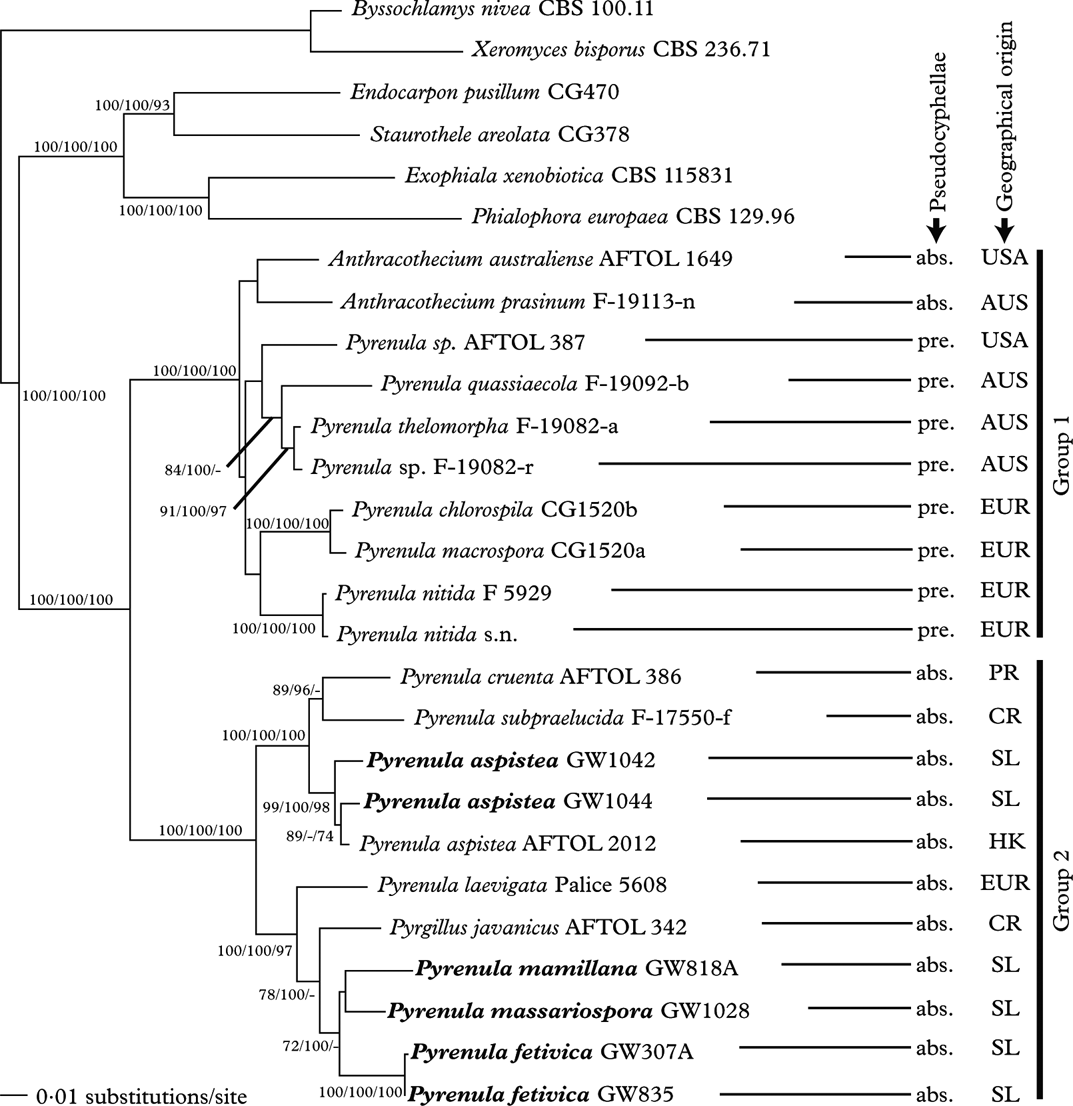
New sequences recovered in this study are 15 for ITS, seven for mtSSU and seven for nuLSU. The combined dataset included 2302 characters (413 for ITS, 716 for mtSSU and 1173 for nuLSU). The amplification of some markers failed for a number of species and some sequences were not available in GenBank. As a result, the combined dataset included missing data for two mtSSU, one nuLSU and eight ITS (see Table 2). Among these 2302 characters, 562 were parsimony-informative. The most likely tree obtained with RAxML is presented in Figure 1, with ML and wMP bootstrap values and posterior probabilities. As in previous studies (Lutzoni et al. Reference Lutzoni, Kauff, Cox, McLaughlin, Celio, Dentinger, Padamsee, Hibbett, James and Baloch2004; del Prado et al. Reference del Prado, Schmitt, Kautz, Palice, Lücking and Lumbsch2006; James et al. Reference James, Kauff, Schoch, Matheny, Hofstetter, Cox, Celio, Gueidan, Fraker and Miądlikowska2006; Lumbsch & Huhndorf Reference Lumbsch and Huhndorf2007; Gueidan et al. Reference Gueidan, Villaseñor, de Hoog, Gorbushina, Untereiner and Lutzoni2008; Schoch et al. Reference Schoch, Sung, López-Giráldez, Townsend, Miądlikowska, Hofstetter, Robbertse, Matheny, Kauff and Wang2009), Pyrenulaceae (Pyrenulales) forms a sister group to the lineage including Verrucariales and Chaetothyriales (all 100% bootstrap; Fig. 1). The family Pyrenulaceae is divided into two well-supported groups, group 1 and group 2, both supported by 100% bootstrap values (Fig. 1). Group 1 includes two species of Anthracothecium (A. australiense and A. prasinum) and 7 species of Pyrenula (P. chlorospila, P. macrospora, P. nitida, P. thelomorpha, P. quassiaecola, and two Pyrenula spp.). All the specimens collected in Sri Lanka belong to group 2. This group includes the mazaediate species Pyrgillus javanicus and seven species of Pyrenula (P. aspistea, P. cruenta, P. fetivica, P. laevigata, P. mamillana, P. massariospora and P. subpraelucida).
Phylogenetic relationships within Pyrenulaceae based on a maximum likelihood approach using three gene regions (ITS, nuLSU, mtSSU). Most likely tree obtained with RAxML. Support values are indicated below or above the branches, with ML bootstrap/posterior probabilities/wMP bootstrap. Only bootstrap values superior or equal to 70% and posterior probabilities superior or equal to 95% are shown (dashes show non-significant values). The presence (pre.) or absence (abs.) of pseudocyphellae and the geographic origin are mapped on the tree for members of the family Pyrenulaceae (AUS=Australia, CR=Costa Rica, EUR=Europe, HK=Hong Kong, PR=Puerto Rico, SL=Sri Lanka, USA=United States of America). Specimens from Sri Lanka are highlighted in bold.

Discussion
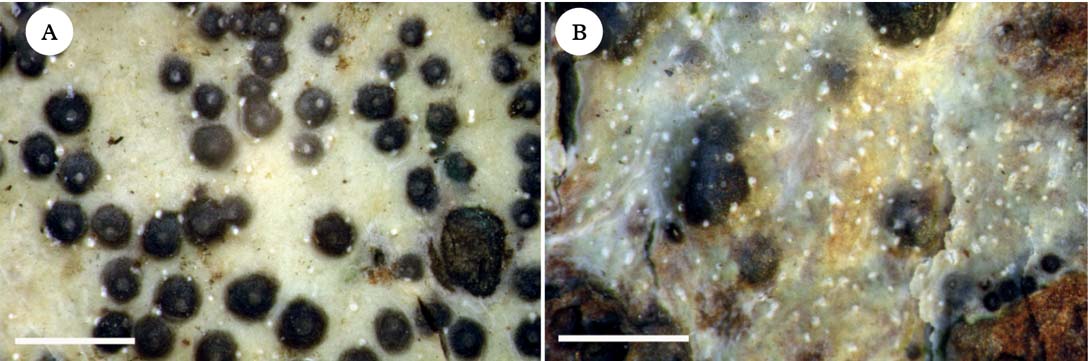
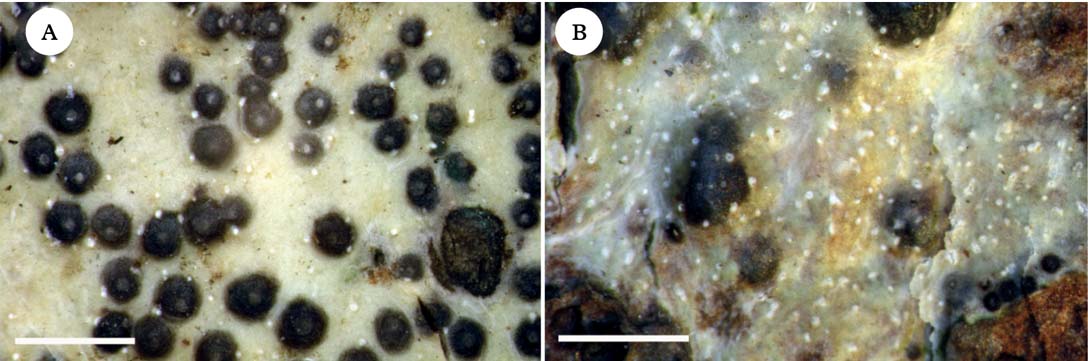
The generic delimitation within the family Pyrenulaceae has never been tested with molecular data, mostly due to technical difficulties as discussed above. Specimens of Pyrenulaceae collected in Sri Lanka also proved difficult to work with using molecular techniques, but the molecular results that we obtained from this limited taxon sampling were sufficient to show the presence of two strongly supported groups within Pyrenulaceae. The members of these two groups do not differ greatly morphologically or anatomically, and the division in the two groups does not seem to correlate with the usual, mostly ascomatal characters used for generic classification in this family: ascospore colour and septation, structure of the ascospore locules, secondary chemistry, hamathecium inspersion and chemistry, and ostiole position. However, one morphological feature is present in one group and absent in the other: the pseudocyphellae (Fig. 2). Except for the two species of Anthracothecium A. Massal., all species of Pyrenula in group 1 have pseudocyphellae, whereas they are absent in group 2 for all species of Pyrenula and for Pyrgillus javanicus. The species sampling is, however, still too limited (only 12 out of 169 Pyrenula species and 15 out of 224 Pyrenulaceae species) to draw definitive conclusions, and further taxon sampling will be required to evaluate the informativeness of this character and other morphological, anatomical or chemical features.
Pseudocyphellae or small white pores visible on the upper surface of the thallus in Pyrenula. A, Pyrenula chlorospila CG1520b; B, Pyrenula macrospora CG1520a. Scale=1 mm.
Pyrenulaceae is most diverse in the tropics, but a few species are more commonly found in temperate climates. Among these temperate taxa, the two species collected in Great Britain, P. chlorospila and P. macrospora, are well supported as sister taxa. They are commonly found growing side by side on the bark of trees, and differ morphologically only by the size of their perithecia (0·2–0·4 mm for P. chlorospila and 0·4–1·2 mm for P. macrospora). Because the genetic variation between these two species is rather low and comparable for example, to that found among the three specimens of P. aspistea, further taxon and gene sampling will be necessary to investigate the delimitation between these two species. Also of interest are the phylogenetic placements of all taxa collected in Sri Lanka into group 2 and all taxa collected in Australia into group 1. Members of the family Pyrenulaceae are found worldwide but our results on a preliminary taxon sampling seem to suggest that phylogenetic groupings are correlated with geographic origin in this family.
Three genera of Pyrenulaceae have been included in our study: Anthracothecium, Pyrenula and Pyrgillus Nyl. Anthracothecium is characterized by large black perithecia and large brown muriform ascospores. Although these characters are shared with some species of Pyrenula, the type of ascospore septation is different in Anthracothecium. More particularly, the presence of a thick ascospore wall in the young ascospores of species of Anthracothecium separates this genus from Pyrenula. Moreover, species of Anthracothecium form a small group largely confined to the rainforest. Anthracothecium and Pyrenula differ morphologically from Pyrgillus, which is characterized by its perithecioid mazaedia and transversally septate ascospores. In our phylogeny, the two species of Anthracothecium belong to group 1 and cluster together. However, their relationship to other members of group 1 is not well supported and only two species of Anthracothecium have been sampled so far, so no conclusion can be reached as yet concerning the placement of this genus. Similarly, the morphologically well-characterized species Pyrgillus javanicus is nested within a group including species of Pyrenula. The genus Pyrenula is therefore not monophyletic according to our molecular results, but further work will be necessary before a revision of the generic delimitation within the family Pyrenulaceae can be carried out.
The work carried out in Sri Lanka was supported by University of Sri Jayewardenepura research funds to SCW (Grant No. ASP/06/Re/2008/11). A travel grant from the British Lichen Society enabled the first author to work on the material from Sri Lanka at the Natural History Museum (NHM) in London. Molecular work on material from Sri Lanka and the UK was supported by NHM funds to CG. Sequencing of other samples was done at the Pritzker Laboratory for Molecular Systematics at The Field Museum (Chicago) and this work was supported by a NSF grant (DEB-0717476). Holger Thüs and other staff members of the NHM Botany Department are specially thanked for their support, as well as two anonymous reviewers for their helpful comments.