1. Introduction
As a key aspect of a maritime regulatory framework, the International Regulations for Preventing Collisions at Sea (1972, COLREGs) has played an important role in guiding seafarers for navigation and resolving ship collision disputes at sea since it has been separated from the International Convention for the Safety of Life at Sea (SOLAS) in 1972.
Since 1972, the International Maritime Organization (IMO) has amended the COLREGs seven times in the form of amendments under the promotion from seafarers, maritime lawyers, maritime judges, teachers of maritime academies, maritime authorities and other relevant parties in maritime industry, so that it has been continuously improved into an international maritime traffic guidelines containing 6 chapters, 41 articles and 4 appendices (IMO 2023).
In the process of continuous revision and updating, the IMO officials and industry experts have interpreted the COLREGs from various perspectives to make them meet the needs of industry practice and development; technical personnel have applied the COLREGs to the collision avoidance geometry and ship autonomous collision avoidance by means of technology, including radar plotting and computer-aided decision-making, providing rule-based technical support for ship collision avoidance at sea.
However, with the continuous acceleration and deepening of the process of economic globalisation, the rate of international trade and cargo transportation soared, and ships have been developing continuously towards the direction of being larger, more automated and intelligent, which has brought a series of problems to the implementation and application of the COLREGs. The rapid development of Maritime Autonomous Surface Ships (MASS) has further highlighted these problems. Therefore, how to revise the COLREGs in terms of both technical specification and legal norms to meet the demands of the developing maritime industry has become a key issue that must be considered (Chen et al., Reference Chen, Lau, Zhang, Dulebenets, Wang and Wang2023).
Based on these issues, this paper provides a comprehensive vision of the historical changes, interpretation, application and revision of the COLREGs from a broader perspective, summarises the main problems faced in the process of its development and application, analyses its development trends and provides valuable references for the revision and application of the COLREGs in the future.
2. History of development
In October 1972, the Intergovernmental Maritime Consultative Organization (IMCO) (Wikipedia, 2022) hosted a conference in London to revise the International Regulations for Preventing Collisions at Sea (1960). The COLREGs were agreed by participating countries and came into force on 15 July 1977 (IMO, 2023). In the subsequent five decades, the IMCO, which was renamed the International Maritime Organization (IMO) in May 1982, revised the COLREGs seven times in the form of amendments; the revisions are as shown in Table 1.
Revisions of the COLREGs

3. Interpretation of the COLREGs
3.1 Interpretation from IMO official
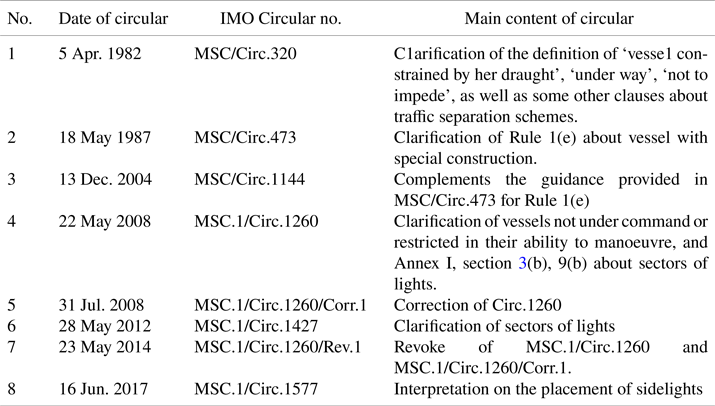
In order to make the personnel from different countries and regions consistent in interpreting and applying the key provisions of the COLREGs, the IMO Maritime Safety Committee (MSC) interprets the COLREGs in the form of circulars, covering the interpretation of provisions, the description of technical rules, and so on. The interpretation circulars are as listed in Table 2.
IMO circulars of interpretation on COLREGs

In addition, IMO has also made more detailed explanations and interpretations regarding some terms and provisions of the COLREGs in some conventions, rules, resolutions and other documents, such as the International Convention on Standards of Training, Certification and Watchkeeping for Seafarers (1978, STCW), in which a detailed requirements of maintaining formal look-out has been made, and also the General Provisions on Ship's Routeing (IMO, 1986), in which the provisions on compliance with the Traffic Separation Schemes has been described.
3.2 Interpretation in practice
Ways to better implement and apply the provisions of the COLREGs and their official interpretations is the most vital issue for maritime industry professionals. To this end, maritime experts, such as seafarers, maritime lawyers and maritime judges, have provided more-detailed explanations covering various aspects, including the background and purpose of the COLREGs, their scope and timing of application, textual interpretation and social implications, as well as the handling of special circumstances, based on the experts’ practical experiences.
(1) Cockcroft and Lameijer (Reference Cockcroft and Lameijer2012) provided a detailed interpretation of the COLREGs by citing actual court cases and analysing the document article by article from the perspective of its background and intent. They pointed out that the main purpose of the COLREGs is to unify the actions of ships and reduce collisions between them, rather than to determine and allocate responsibility for collision accidents. Furthermore, Wu and Zhao (Reference Wu and Zhao2021) conducted a comparative analysis of the interpretation of the nature of the COLREGs in the maritime laws of four countries: the United Kingdom, China, the United States, and Japan. They suggested that the COLREGs has a dual nature of technical specifications and legal norms, and that maritime law and navigation technology professionals need to collaborate in research to achieve an organic unity between the two.
(2) Zhao (Reference Zhao2008), based on the analysis of a large number of classic ship collision cases in English and American courts, pointed out that, in most cases, the COLREGs begin to apply when the risk of collision exists, and sometimes before the very moment when two ships are approaching so nearly as to involve risk of collision; the application time of the overtaking clause may even be earlier than this moment. However, it should be noted that this conclusion does not apply to ships that are actively manoeuvring and dynamically unstable in their courses. Kemp (Reference Kemp2008) argued that although legal precedents can illustrate to a significant extent the moment at which the COLREGs become applicable before the risk of collision exists, there is no universally accepted criterion for determining this moment in the practice of collision avoidance by crew members; it is based solely on the analysis of past collision cases. For crew members, what is more important is the actions and timing taken in successful collision avoidance cases (Zhang and Zhao, Reference Zhang and Zhao2013). Therefore, while these interpretations of the moment at which the COLREGs begin to apply may have some value, they cannot provide definitive guidance for crew members in collision avoidance.
(3) Zhang (Reference Zhang2007) and others (Xin, Reference Xin2006; Salinas et al., Reference Salinas, Peña, Pérez and Horton2012; Zhang and Tang, Reference Zhang and Tang2021), based on the collision avoidance experience of crew members in practice, interpreted some controversial terms in the COLREGs, such as risk of collision, close-quarters situation, shall not impede, and not under command, and so on. They pointed out that when referring to and interpreting the terms and provisions of the COLREGs in navigational practice, it is necessary to not only consider the intention of the regulators but also to comprehensively evaluate the actual operations of the crew members in dealing with various complex collision avoidance situations. Only in this way can the core value of the COLREGs, including reducing collision accidents and ensuring navigational safety, be truly realised.
(4) Belcher (Reference Belcher2002) interpreted and discussed some practical application issues of the COLREGs from a sociological perspective by using the overtaking and head-on situations as examples. He argued that although the COLREGs have good intentions, their contingent and defeasible nature make them impossible to cover all situations in interpretation and application. Thus, instead of constantly adding interpretations to deal with various situations that arise in practice, it is better to delete provisions that cannot be effectively enforced in practice to ensure navigational safety.
(5) Zhang and Zhao (Reference Zhang and Zhao2013) and others (Jie et al., Reference Jie, Zhangfeng, Hao and Peng2022) explicated the principles and practices that anchored vessels should follow when complying with the COLREGs, emphasising that although anchored vessels have significant differences in manoeuvrability compared to underway vessels, this does not relieve their obligation to strictly comply with and execute the COLREGs. Xu T et al. (Reference Xu, Guan and Xia2020) provided a comprehensive overview of the requirements of the COLREGs for vessel of special construction or purpose, noting that with the development of technology, various vessel of special construction or purpose have emerged, and that the COLREGs have not defined or interpreted this term in order to minimise the obstacles of pre-set provisions to the development of new technologies.
4. Application of the COLREGs
According to the interpretation of IMO officials and industry experts, maritime technical personnel have gradually applied the COLREGs to collision avoidance practice based on ship's manoeuvrability and the good seamanship of seafarers. At present, the COLREGs are primarily used in collision avoidance practice in two ways: firstly, guiding seafarers in collision avoidance practice using traditional collision avoidance geometry and radar plotting, and secondly, developing autonomous collision avoidance systems based on the COLREGs using computer-aided decision-making technology, which provides technical support for the development and application of unmanned ships.
4.1 Collision avoidance geometry
The term ‘collision avoidance geometry’ refers to a method of avoiding collision in which the two ships involved in a potential collision are considered as two points moving with certain velocity, without taking into account the size and turning characteristics of the ships. The movement of the two ships is described using velocity triangles, and collision avoidance actions are taken based on the calculated movement parameters, as shown in Figure 1.
The velocity triangle of ship's motion

As shown in Figure 1, when encountering the target ship, the relative velocity of the target ship on the heading of own ship is ${V^{\prime}_O}$ and the velocity of the target ship is VT, the relative velocity of the target ship with respect to own ship is VR . The triangle formed by the three vector lines is the velocity triangle of ship's motion, and the line corresponding to VR is the relative motion line of the target ship. When the ship is altering course and/or speed, the parameters of the velocity triangle are calculated using the radar-plotting method to obtain the motion parameters of the two ships, which can be used for collision avoidance. The velocity triangle can be applied to compile the table of the relationship between bearing, range and the closest point of approach (DCPA), to draw the radar plotting collision avoidance diagram, to determine the danger of the two ships and to delineate the predicted area of danger (PAD).
4.1.1 Table of the relationship between bearing, range and DCPA
The compass-bearing method is the most frequently used approach for evaluating the risk of collision in accordance with the COLREGs. Nevertheless, this method's drawback is that it can only provide an approximate determination of the target ship's relative motion trend and cannot promptly obtain its DCPA. Hence, when observing the target ship and acquiring its bearing and distance, the ship's velocity triangle principle can be utilised to establish a mapping relationship between the variations in bearing, range and DCPA of the target ship (Jianjun et al., Reference Jianjun, Mingjun and Yang2021). As shown in Figure 2 and Equation (1):

where ${\Delta _B}$ is the change in bearing of the target ship between two measurements, d is the DCPA between the two ships, and D 1 and D 2 are the distance to the target ship at the first and second measurements, respectively. Based on this formula, a table of the relationship between the variations in bearing, distance and DCPA can be established for direct reference by seafarers in collision avoidance practice. Compared with the compass-bearing method according to the COLREGs, the precalculated table approach to obtain DCPA is more concise, intuitive and efficient, which can provide early warning of the risk of collision. However, there may be limitations in accuracy.
The relationship between the variations in bearing, range and DCPA

4.1.2 Manoeuvring diagram for collision avoidance
In accordance with the COLREGs, vessels are equally responsible for collision avoidance in restricted visibility. Which method to take collision avoidance actions that comply with the COLREGs in restricted visibility is a key consideration for seafarers and industry experts. By considering both Rule 8 on ‘action to avoid collision’ and Rule 19 on ‘conduct of vessels in restricted visibility’ and applying the principles of collision avoidance geometry, the effectiveness of collision avoidance actions by one's own vessel against targets at various bearings and ranges in restricted visibility can be simulated and calculated. The results can be used to create a manoeuvring diagram for collision avoidance (Cockcroft, Reference Cockcroft2010).
The manoeuvring diagram for collision avoidance provides some usefulness to seafarers in taking collision avoidance actions based on the bearing and distance of the target ship in restricted visibility. However, due to its relatively strict limitations in charting of the diagram, it cannot cover all scenarios in restricted visibility. Additionally, the recommended manoeuvring action is rather too large and does not take into account the vessel's manoeuvring environment and the seafarer's habits, which may make it difficult effectively execute in practice.
4.1.3 Predicted area of danger
Taking into account the potential errors in tracking and processing target vessels by radar and automatic radar plotting aids (ARPAs), a vessel's collision avoidance action should not only avoid the potential point of collision (PPC) but also consider the vessel's size. Therefore, a sufficient safe distance must be maintained between two vessels when they encounter. Based on the principles of collision avoidance geometry, a PAD can be determined on the ARPA (Zhao-lin, Reference Zhao-lin2009). When a vessel alters course to avoid collision in compliance with the COLREGs, as long as its heading avoids the PAD, the safety of navigation can be ensured (Szlapczynski and Szlapczynska, Reference Szlapczynski and Szlapczynska2015; Tsou, Reference Tsou2016).
Although the PPC and PAD have the advantages of being intuitive and convenient in application, their calculation and formation are based on the condition that the target ship keeps her course and speed, as well as the own ship's speed. Once the target ship alters her course and/or speed, the original PPC and PAD cannot be used as a reference for collision avoidance. Instead, the new PPC and PAD can only be formed on the ARPA after the target ship has completed its manoeuvre and has been stable for 1–3 min. It is extremely dangerous for the officer on watch (OOW) to use the old PPC and PAD as a reference for collision avoidance if they are not aware of this situation when taking collision avoidance action in accordance with the COLREGs. Moreover, the most frequent and difficult collision avoidance situations in navigational practice often occur in waters with heavy traffic flow. In these situations, the PPC and PAD of multiple target ships are displayed simultaneously, making it difficult for the OOW to distinguish and observe the target ships effectively, which leads to an invalidation of the PPC and PAD.
4.2 Autonomous collision avoidance systems of ships
With the dramatic development of technologies on electronic information, communication, navigation, as well as artificial intelligence, it has become possible for ships to achieve autonomous collision avoidance. The emergence of MASS has gradually turned this possibility into a reality. The ship's autonomous collision avoidance system, which is based on the COLREGs, is the core of MASS.
The autonomous collision avoidance system is a complex decision-making system that includes multiple variables, such as dynamic obstacle avoidance and ship's manoeuvring characteristics (Shengke, Reference Shengke2020). By perceiving and collecting surrounding navigational information, it processes the collected data and, in conjunction with the COLREGs on the encounter situation and collision avoidance actions, assesses the collision risk index (CRI) (Xiuying, Reference Xiuying2000). Based on the assessment results, the autonomous collision avoidance system makes collision avoidance decisions which are then output to the ship's steering control system for execution. After the steering system provides feedback on the execution status, the system tracks the execution status of the collision avoidance decision until the ship passes and clears, and then resumes the planned route. The framework of the ship's autonomous collision avoidance system (Zhang et al., Reference Zhang, Wang, Jiang, An and Yang2021; Wang et al., Reference Wang, Wang, Xie and Su2022; Yingjun and Zhai, Reference Yingjun and Zhai2022) is as shown in Figure 3.
The framework of ship's autonomous collision avoidance system

The implementation methods of autonomous collision avoidance systems for ships include both traditional geometric analysis and modern machine-learning methods (Hu et al., Reference Hu, Hu, Naeem and Wang2022), mainly including model predictive control (MPC), velocity obstacle (VO), artificial potential field (APF), fuzzy logic (FL), artificial neural networks (ANN), evolutionary algorithms (EA), differential games (DG), interval programming, and deep-reinforcement machine learning (DRL), and so on (Xie et al., Reference Xie, Chu, Liu and Wu2016; García Maza and Argüelles, Reference García Maza and Argüelles2022; Öztürk et al., Reference Öztürk, Akdağ and Ayabakan2022).
Despite the progress made in the theoretical framework of autonomous collision avoidance technology for ships, there are still several significant challenges that must be addressed. Firstly, the parameters and motion models of own ship and target ship are often excessively simplified. For instance, it is frequently assumed that the target ship has the same manoeuvrability as the own ship and that the target ship maintains her course and speed. Secondly, the surrounding navigational environment is not fully considered, and the pre-set environment mainly caters to the scenario of two-ship collision avoidance in open waters, lacking effective methods for autonomous collision avoidance in complex situations, such as narrow channels, busy waterways and multi-ship encounters. Thirdly, collision avoidance actions often do not fully comply with the requirements of the COLREGs and good seamanship practices. Such actions include a succession of small alterations of course and/or speed and other manoeuvres that departure from the COLREGs (Hongguang, Reference Hongguang2019).
5. Revisions of the COLREGs
Since adoption by IMO in 1972, the COLREGs have been amended several times, but the main framework and content have not substantially changed, and some of the inherent problems have not been effectively resolved. With the rapid development of ship size, informatisation and intellectualisation, revising the COLREGs to align with industry progress has become a critical research subject (Zhang et al., Reference Zhang, Chen, Macdonald, Lau and Tang2022).
5.1 Revisions of the lights and shapes, and sound signals
Lights and shapes, as well as sound signals, are essential in indicating the type and motion of a vessel and determining the risk of collision and responsibility accordingly. However, some of their provisions no longer meet the requirements of the rapid development and upsizing of vessels.
Firstly, the visibility of lights is inconsistent. According to the COLREGs, any action to avoid collision shall be made in ample time and with due regard to the observance of good seamanship. However, the minimum visibility required for lights depends on the size and type of the vessel, with larger vessels having a greater range and masthead lights having a greater range than sidelights. This means that smaller vessels can only be visually detected at a closer range, and the time of detecting sidelights will be significantly later than masthead lights. Both of these indicate the fact that it is impossible to determine the approaching vessel's basic motion status early, which contradicts the concept of early determination in the COLREGs.
Secondly, the size of the ship's shapes is inadequate. According to Rule 18 of the COLREGs, the responsibility to avoid collision between vessels is determined based on their types. During the daytime, the type of a vessel is identified by its shapes. However, the minimum diameter of shapes specified in the COLREGs is only 0⋅6 meters, which means that visual recognition of vessel shapes can only be achieved within a range of 1 nautical mile (Zhang, Reference Zhang2016) where the close-quarters situation or immediate danger exists. In such a scenario, determining the collision avoidance responsibility may happen too late.
Thirdly, the audible range of sound signals is relatively short. According to Rule 33 of the COLREGs, the audible range of sound signals is 2 nautical miles. As ship's crash stop astern distance is about 13 times its length (House, Reference House2007), which for a ship of approximately 300 meters in length as an example, corresponds to about 2⋅1 nautical miles. Therefore, even if the ship hears a fog signal in restricted visibility and takes immediate action, it cannot guarantee to pass at a safe distance.
Finally, the requirement to sound bell and gong signals is outdated. The COLREGs require anchored or aground vessels to sound bell and gong signals at intervals of no more than 1 min in restricted visibility to alert surrounding vessels. The purpose of this requirement is to enable vessels in or near areas with restricted visibility to mutually detect each other. However, in today's era of widespread onboard radar and automatic identification systems (AISs), this requirement is not only outdated but also interferes with the work and rest of crew members, and is inconsistent with the provisions of the 2006 Maritime Labour Convention regarding the occupational safety and health protection of seafarers (ILO, 2020).
5.2 Revisions of ambiguity on terms and provisions
The main objective of the COLREGs is to provide guidance for mariners to avoid collisions, and one of the essentials of the COLREGs is that they should, so far as possible, eliminate doubt in the minds of navigators using them (Cooper, Reference Cooper2001; Weber, Reference Weber2009), particularly when determining collision responsibility.
However, the requirements regarding not to impede in Rule 8(f) conflict with the provisions about stand-on and give-way vessel. Rule 8(f) states that a vessel required not to impede another vessel shall take early action to allow sufficient sea room for the safe passage of the other vessel and is not relieved of this obligation if approaching the other vessel so as to involve risk of collision. This means the vessel required not to impede another vessel might be a stand-on vessel when there is a risk of collision. According to the provisions of Rules 16 and 17, a give-way vessel shall take early and substantial action to keep well clear, while a stand-on vessel shall keep her course and speed (Stitt, Reference Stitt2002; Wróbel et al., Reference Wróbel, Gil, Huang and Wawruch2022). Although this provision may be explained in terms of its intention to ensure that both vessels navigate with maximum vigilance, it can be challenging to implement in practice; seafarers even refer to it as the ‘Confusion Clause’. To some extent, this provision cannot guide seafarers in avoiding collisions, but instead may lead to ambiguous situations that cause them to miss the best opportunity to avoid a close-quarters situation.
5.3 Revisions of the framework of the steering and sailing rules
According to the IMO's classification of autonomous vessels (IMO, 2018), MASS has now advanced to degree 3, which refers to remotely controlled without seafarers on board (Wikipedia, 2023). As defined in Rule 3 of the COLREGs, MASS falls under the category of ‘vessel’ and satisfies the definition of ‘power-driven vessel’; thus the COLREGs are generally applicable to MASS (Veal et al., Reference Veal, Tsimplis and Serdy2019; Lyu et al., Reference Lyu, Yin and Bai2020). However, in terms of the basic framework of the Steering and Sailing Rules in Part B, two sets of collision avoidance action rules established based on whether the ships are in sight of one another or are in restricted visibility. The core of this provision is to regard humans as the main driver of the vessel and visual lookout as the primary means of determining the type of the approaching vessel, which are precisely the key characteristics that MASS with degree 3 and 4 do not possess (Miyoshi et al., Reference Miyoshi, Fujimoto, Rooks, Konishi and Suzuki2022). Additionally, the term ‘in sight of one another’ in Rule 3(k) and the requirement about the negligence of master and crew in Rule 2(a) are related (Vojković and Milenković, Reference Vojković and Milenković2020; Hannaford et al., Reference Hannaford, Maes and Van Hassel2022; Kennard et al., Reference Kennard, Zhang and Rajagopal2022).
In accordance with Part B, Section II (Conduct of Vessels in Sight of One Another), even without considering the development of MASS, collision avoidance responsibility can only be allocated based on the relative position and/or the type of vessel after the determination of vessel's type (excluding Rule 13 on overtaking), and then actions to be taken according. With the trend towards larger and faster ships, vessels often miss the best opportunity to avoid collisions when they approach within a visual range (approximately 3 nm) where the lights and/or shapes indicating the type of the vessel can be visually identified. In contrast, with the widespread use of AIS, the type of vessel can be obtained directly through AIS regardless of whether vessels are in sight of one another or what the visibility is likely at that time (Zhang, Reference Zhang2022).
Furthermore, due to the inability of radar alone to determine the type of other vessels in restricted visibility, the fundamental principle of assigning collision avoidance responsibility based on vessel's type cannot be applied. Therefore, the COLREGs assign equal responsibility for avoiding a collision to both vessels in the event of restricted visibility, which means that vessels with a significant gap in manoeuvrability must bear equal responsibility for collision avoidance in restricted visibility (Mahapatra, Reference Mahapatra2020), which contradicts the principle of allocating responsibility based on manoeuvrability and is inconsistent with the requirements of good seamanship.
In light of these facts, it is necessary to revise the framework of Steering and Sailing Rules in order to adapt to the development of MASS, and to address the issues caused by the current action rules system based on whether the vessels are in sight of one another.
6. Difficulties and trend
6.1 Difficulties
The main objective of the COLREGs is to guide seafarers to avoid collision. However, when viewed from a historical development perspective, there are still some difficulties in interpretation, application and revision.
Firstly, in terms of interpretation, official interpretations tend to focus on technical details, with relatively little explanation of key provisions and terminology. Practical interpretations, on the other hand, are mainly based on grammar and past collision case studies, making it difficult for seafarers to deal with the complex situations faced in collision avoidance practice (Miyoshi et al., Reference Miyoshi, Fujimoto and Rooks2021). One of the main difficulties faced is achieving enabling seafarers to truly understand and apply relevant interpretations to guide collision avoidance.
Secondly, concerning application, although the table of the relationship between bearing, range and DCPA is convenient, there are difficulties in executing the manoeuvring diagram and PAD. Additionally, the autonomous collision avoidance system commonly suffers from problems, including oversimplification, singular scenarios and inadequate compliance with the COLREGs and good seamanship practices, particularly in dealing with complex navigational environments and multiple vessel encounter situations. Such systems may face significant challenges and difficulties.
Finally, with regards to revisions, the COLREGs exhibit both textual and structural inadequacies that fail to keep pace with industry developments. The current predicament centres on the question of whether to undertake minor revisions through adding, deleting or modifying certain provisions, or to directly restructure the Steering and Sailing Rules to align with the industry's evolving needs. While the former approach is relatively straightforward to implement and adjust to, it is akin to the patched amendments made before that do not fundamentally solve the underlying issues. In contrast, the latter approach, while capable of addressing some of the primary deficiencies and meeting the development requirements of MASS, may lead to conflicts between old and new collision avoidance practices for extended periods of time due to the significant changes for a global regulation.
6.2 Trend
The preceding discussion highlights that the interpretation, application and revision of the COLREGs require corresponding changes with the progress of the industry, to fulfil its fundamental objective of guiding seafarers in collision avoidance and ensuring safety in navigation. With the rapid advancement of electronic information technology and artificial intelligence, the industry has developed MASS of degree 3. However, its development has been impeded by certain technical and legal barriers (Carey, Reference Carey2017; Danish Maritime Authority, 2017; Zhou et al., Reference Zhou, Huang, Wang, Wu and Liu2020). In response, the IMO approved the ‘Framework for the Regulatory Scoping Exercise (RSE) for the Use of MASS’ (IMO, 2018) based on a proposal jointly submitted by Denmark, Finland, Norway and other countries (IMO, 2017). The outcome of the RSE for the Use of MASS was formed at the MSC 103rd Session (IMO, 2021). The COLREGs, along with some other instruments such as the SOLAS, have become high-priority subjects for processing in this outcome, indicating that IMO has taken a significant step forward in revising the COLREGs to align with the development of MASS.
It can be foreseen that even if the MASS develops to degree 4 with fully autonomy technologically, manned and unmanned ships will coexist at sea for a long time, and collision avoidance between them will still need to follow the same rules. With the continuous progress and implementation of the outcome of the RSE for the Use of MASS produced by IMO, experts, scholars and seafarers in maritime industry will work towards unifying the interpretation, application and revision of the COLREGs for both manned and unmanned ships. Meanwhile, the autonomous collision avoidance system based on the COLREGs in the complicated navigational environments and multi-ship encounter situations will also become an important developing trend (Zhai et al., Reference Zhai, Zhang and Shaobo2022).
7. Conclusions
The COLREGs serve not only as a technical guideline for seafarers to avoid collision at sea but also as a legal norm for resolving ship collision disputes in court. Since its adoption by the IMO in 1972, interpretations of the COLREGs have been provided by IMO officials, industry experts and scholars from the perspective of its background, objectives, principles and applicability. Technical personnel have also applied the COLREGs to navigational practice using collision avoidance geometry and autonomous collision avoidance system. However, there still exist problems of inconsistency between the interpretation and application of the COLREGs and the practice of seafarers. The emergence of MASS has further highlighted the urgency of revising the COLREGs to suit the development of the industry.
There still exists some difficulties in interpretation, application and revision of the COLREGs, which include: (1) seafarers have difficulty in unifying interpretation and execution, (2) autonomous collision avoidance systems encounter challenges in handling complex environments and multi-vessel scenarios, and (3) making choices and balancing between minor and major revisions is challenging.
The IMO has defined the COLREGs as a high-priority instrument in the outcome of the RSE for the Use of MASS, which established the basis for revising the COLREGs to accommodate the development of MASS. Considering the history and current state of the COLREGs, achieving consistency between the interpretation, application and revision of the COLREGs for both manned and unmanned vessels, as well as developing COLREGs-based autonomous collision avoidance systems for complex environments and multi-vessel encounter situations, is expected to be an essential direction for the COLREGs in the near future.
Despite the significant contribution of this research to existing knowledge, there are several limitations that must be acknowledged. Firstly, when discussing the ambiguity of the COLREGs, only the term ‘not to impede’ was concerned, which may lead to an incomplete understanding of the issues; and when arguing about the revision of the framework of the Steering and Sailing rules, we intentionally ignored the specific interpretation details for terms including ‘in sight of one another’ and ‘restricted visibility’, which may have limited the scope of our analysis. In future research, we plan to address the limitations of this study by exploring the ambiguity of other key terms in the COLREGs and providing more detailed analysis of the interpretation details for them. This will help to provide a more comprehensive understanding of the issues involved and to inform future revisions of the COLREGs.
Funding statement
This work is supported by a major project of National Social Science Fund of China (Grant Number: 22AZD108).
Competing interest
The authors declare that they have no known competing financial interests or personal relationships that could have occurred to affect the research reported in this paper.