

Introduction
Down syndrome (DS) has been indisputably linked to the risk of early development of Alzheimer’s disease (AD), the pathogenesis of which involves the triplication of chromosome 21, over-expression of the gene coded on this chromosome for amyloid precursor protein and over-production of β-amyloid (Portelius et al. Reference Portelius, Soininen, Andreasson, Zetterberg, Persson, Karlsson and Mattsson2014). In Ireland, using modified DSM-IV criteria to diagnose cases of dementia in DS, age-specific prevalence rates in one study were as follows: 1.4% for those under age 40; 5.7% for those 40–49 years of age; 30.4% for those 50–59 years of age; 41.7% in those 60 and over; and 50% in those aged 70 or over (Tyrrell et al. Reference Tyrrell, Cosgrave, McCarron, McPherson, Calvert, Kelly, McLaughlin, Gill and Lawlor2001). A 14-year follow-up of a subsample of this cohort (McCarron et al. Reference McCarron, McCallion, Reilly and Mulryan2014) indicated that the risk of developing dementia was 20% by age 50 years, 45% at age 55 years, 79.7% by age 60 years and 95.65% by age 68 years.
The increased frequency with which people with DS appear to develop other age-related changes such as sensory impairments and endocrine disorders (Burt et al. Reference Burt and Aylward1995; Bland et al. Reference Bland, Hutchinson, Oakes and Yates2003) suggests that people with DS experience an increased frequency of decline associated with old age compared with the general population. This may consequently also increase their risk of developing dementia of other types, for example, vascular dementia (Burt et al. Reference Burt and Aylward1995). This increased risk is found in the wider intellectual disability (ID) population where the prevalence rates of any type of dementia are comparable or higher (Strydom et al. Reference Strydom, Lee, Jokinen, Shooshtari, Raykar, Torr, Tsiouris, Courtenay, Bass, Sinnema and Maaskant2010) when compared with the general population.
Given the increased risks of dementia in DS, there are specific challenges in assessment and treatment of dementia within this population. One of the defining features of all causes of dementia is a decline from baseline level of function and performance of daily skills. In older adults with ID, a baseline level of functioning can be difficult to establish due to limited available relevant assessments from childhood, a lack of ongoing involvement of family and involvement of multiple staff members due to high staff turnover (Test et al. Reference Test, Flowers, Hewitt and Solow2003). Often newly involved caregivers will presume an individual’s level of ability represents their baseline level of functioning and thus miss early signs of decline (Aylward et al. Reference Aylward, Burt, Thorpe, Lai and Dalton1997). A wider issue to consider is that the life expectancy of individuals with ID has significantly increased over the last 50 years and this had led to an increased risk of age-associated disability in mental and neurological functions (Strydom et al. Reference Strydom, Shooshtari and Lee2009). This presents challenges to service providers in ID to provide high-quality evaluation and treatment of dementia in all individuals with ID.
Assessment tools used in the general population are not appropriate for use in people with ID. For example, widely used tools such as the Mini-Mental State Examination (MMSE, Folstein et al. 2001) assume the premorbid level of functioning to have been in the average range. The use of the usual MMSE cut-off points to diagnose dementia are not accurate in a DS population (Deb & Braganza, Reference Deb and Braganza1999). An international working group proposed a battery of tests for the diagnosis of dementia applicable to adults with ID in 2000 (Burt & Aylward, Reference Burt, Loveland, Chen, Chuang, Lewis and Cherry2000). This battery included both direct and informant assessments of the individual with ID. Informant scales recommended included the Dementia Questionnaire for Dementia in Mentally Retarded Persons (DMR, Evenhuis, Reference Evenhuis1996) and the Dementia Scale for Down Syndrome (DSDS, Geyde, Reference Geyde1995). Direct assessments proposed included the Test for Severe Impairment (TSI, Albert & Cohen, Reference Albert and Cohen1992), the Boston Naming Test (Kaplan et al. Reference Kaplan, Goodglass and Weintraub1987) and the Purdue Pegboard (Tiffin & Asher, Reference Tiffin and Asher1948). The CAMDEX-DS is another assessment tool used that has been validated for the diagnosis in this population. It has been shown to have good concurrent validity, is a good predictor of future diagnosis and incorporates both direct and informant assessments (Ball et al. Reference Ball, Holland, Huppert, Treppner, Watson and Hon2004). The International Association for the Scientific Study of Intellectual and Developmental Disabilities published a ‘State of Science’ paper in 2009 (Strydom et al. Reference Strydom, Shooshtari and Lee2009), which again outlined multiple assessment tools available for use in this population, but stipulated that they all share to some extent the issue of floor effects in those with severe intellectual disabilities. Although a wide array of both informant and direct assessments are available for the screening and diagnosis of dementia in this population, there is no universally accepted battery of assessments recommended to diagnose dementia in DS.
In recognition of the limited guidance in this area, the British Psychological Society Faculty of Intellectual Disability published guidelines in 2009, which focussed on the assessment, diagnosis and treatment of dementia in this population (Dodd et al. Reference Dodd, Bhaumik and Benbow2009). The report was produced through the combined work of members of a working group including psychologists and psychiatrists and drew on the published evidence base and from the working group members’ extensive clinical experience in this area. Recommendations included the establishment of a baseline for every adult with DS at age 30 against which to compare future suspected changes in functioning. Regular screening was suggested for all adults with DS over 40 (every 2 years after age 40 and then annually after age 50). The assessment process should include a systematic history and collateral, a physical examination and relevant laboratory tests. The guidance specifies the importance of outruling depression, hypothyroidism and sensory impairment. The care pathway for the diagnosis of dementia should be multidisciplinary, involving a community nurse, primary care, clinical psychologists and occupational therapists. Assessments should include direct assessment together with informant-based questionnaires. These guidelines recognise the lack of a universally accepted battery for use in this population, but state that whichever battery is chosen, it should be used longitudinally within the service to enable comparison over time. The final diagnosis should be made by multidisciplinary consensus led by an ID psychiatrist following clinical interpretation of all the relevant data. Information on diagnosis should be shared with the person [by use of communication passport in conjunction with speech and language therapy (SLT)] and with carers (Dodd et al. Reference Dodd, Bhaumik and Benbow2009). In the Irish context, the College of Psychiatry of Ireland issued guidelines in this area in 2014 (Tyrrell et al. Reference Tyrrell, Mulryan and Dodd2014) and recommended that the diagnosis of dementia in DS should be made by a multidisciplinary team; where there was no psychologist available as is the case in some Irish services, the panel recommended the use of the TSI and Fuld Object Memory test (or the CAMCOG-DS alone), together with a measure of adaptive behaviour and an informant-based scale (DMR or CAMDEX-DS).
National Institute for Health and Care Excellence (NICE) guidelines support the use of pharmacological treatment with acetylcholinesterase inhibitors in those with mild to moderate dementia (NICE, 2006). When assessing severity of dementia in those with ID, it would be inappropriate to rely solely on cognition scores, and tools used should be sensitive to the patient’s level of competence. NICE specifies that only specialists (psychiatrists, neurologists and geriatricians) should initiate treatment and that treatment should be continued only when it is having a worthwhile effect based on regular cognitive, global, functional and behavioural assessments. There is a dearth of information on the efficacy of pharmacological treatments for dementia in DS. A Cochrane review (Mohan et al. Reference Mohan, Carpenter and Bennett2009) of acetylcholinesterase inhibitors in 2009 concluded there was too little evidence to make an informed judgement about the potential value of these medications in people with DS. Indeed, the only trial that fulfilled inclusion criteria for the Cochrane review was a small randomised placebo-controlled trial of donepezil in 27 patients with DS and AD (Prasher et al. Reference Prasher and Krishnan2002). This study showed a non-statistically significant trend towards benefit in global, cognitive and adaptive functioning compared with placebo. However, there was a worsening of behavioural and non-cognitive features of AD in those on donepezil, and this was thought to reflect the increased side-effect profile seen in those on the active drug, including fatigue, insomnia and agitation. A further open-label study published by the same group in 2003 (Prasher et al. Reference Prasher, Huxley and Haque2003) showed significantly less deterioration in global functioning and adaptive behaviour in six patients with DS and AD on donepezil over a 104-week period. There have been no adequate studies on the use of galantamine or rivastigmine in this population. A recently published randomised placebo-controlled trial on the use of memantine for dementia in 88 patients with DS (Hanney et al. Reference Hanney, Prasher, Williams, Jones, Aarsland, Corbett and Ballard2012) showed that treatment with memantine for 52 weeks showed no significant difference in any outcome measures between groups, and concluded that memantine was not an effective treatment for cognitive decline in dementia patients with DS.
The present study
The aim of this study was to compare our practice to the consensus recommendations from the Royal College of Psychiatry and British Psychological Society and NICE on the evaluation, diagnosis and pharmacological treatment of individuals with DS who develop dementia. We also aimed to establish the average time taken to make a diagnosis of dementia from first symptom reporting, the average time taken to commence pharmacotherapy and to describe tolerability to acetylcholinesterase inhibitors in this population.
Methods
The service in which this study took place is a specialist catchment-based urban service that provides specialist services to ~1600 children and adults with an ID including 284 adults with DS. Within this service there is a well-resourced specialist multidisciplinary ID care team providing assessment and support services for individuals with dementia. The multidisciplinary team comprises of professionals from psychiatry, medicine, psychology, SLT, nursing, occupational therapy and physiotherapy, all of whom have specialised in the area of ID. There is also a residential care centre for late stage dementia with 10 places. In April 2011, a dementia diagnosis pathway was devised for use within the service for the diagnosis of dementia in service users with ID including those with DS.
A retrospective analysis was performed on an exhaustive sample of all 20 adults with DS with an established diagnosis of dementia attending the service. There were no exclusion criteria applied in selecting participants. Participants were identified using an electronic mental health database. A retrospective file review was conducted by two researchers (R.V. and C.M.) to record demographic information and level of adherence to criteria relating to the pathway to diagnosis and treatment of AD. Only information accessible in the multidisciplinary clinical file was analysed, including medical, nursing and psychology clinical records. If parameters were not specifically documented as present or absent, they were recorded as missing data. Four cases were reviewed by both researchers and inter-rater reliability was calculated as Cohen’s κ=0.70.
The date of diagnosis of dementia was interpreted as the date a psychiatrist documented the diagnosis within the clinical file. The date of commencement and discontinuation of pharmacological treatment was recorded from electronic prescribing records. Medical investigations and sensory assessments were rated as completed if carried out within the 6 months before the diagnosis of dementia. NICE guidelines relating to the assessment of dementia in the general population stipulate that medical investigations should be carried out in primary care at the point of first presentation (NICE, 2006). However, in an ID population medical investigations can prove logistically more difficult; we felt that 6 months was a reasonable time frame (albeit arbitrary) between first presentation and completion of tests in an ID population. When documenting side-effects, these were rated if specifically commented upon in the clinical file. Data were entered into SPSS 16.0 for analysis. Non-parametric tests were used to compare groups including independent samples Kruskal–Wallis and Mann–Whitney U tests. Data were reported as mean±s.d. The study protocol was independently reviewed and approved by the local research and ethics committee before commencement.
Results
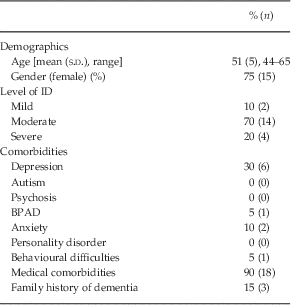
The demographic characteristics of the sample are outlined in Table 1. The study sample consisted of 15 women (75%) and five men (25%). The mean age at review was 51 (s.d.=5) with a range of 44–65 years. The level of ID was mild in 10% (n=2), moderate in 70% (n=14) and severe in 20% (n=4) of participants. Psychiatric comorbidities (past or present diagnosis) included depression (30%, n=6), anxiety (10%, n=2), bipolar affective disorder (5%, n=1) and challenging behaviour (5%, n=1); 90% (n=18) of the study population had medical comorbidities, the most common of which were hypothyroidism (45%, n=9), cardiac conditions (25%, n=5) and sensory impairment (30%, n=6); 15% (n=3) of the study population had a documented positive family history of dementia; 65% of participants (n=13) were living within a group residential setting and the remainder resided within their family home.
Baseline characteristics and comorbidities of study population (n=20)
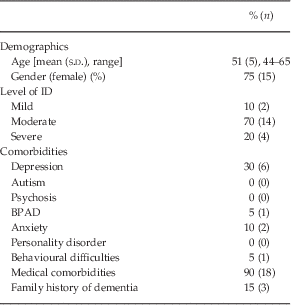
ID, intellectual disability; BPAD, bipolar affective disorder.
Psychiatric comorbidities refer to either past or current diagnosis. Medical comorbidities included hypothyroidism (n=9), cardiac conditions (n=5) and sensory impairment (n=6).
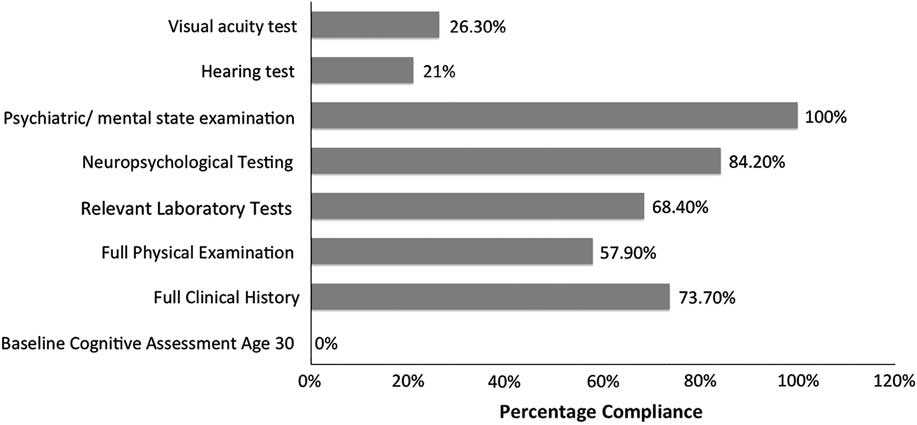
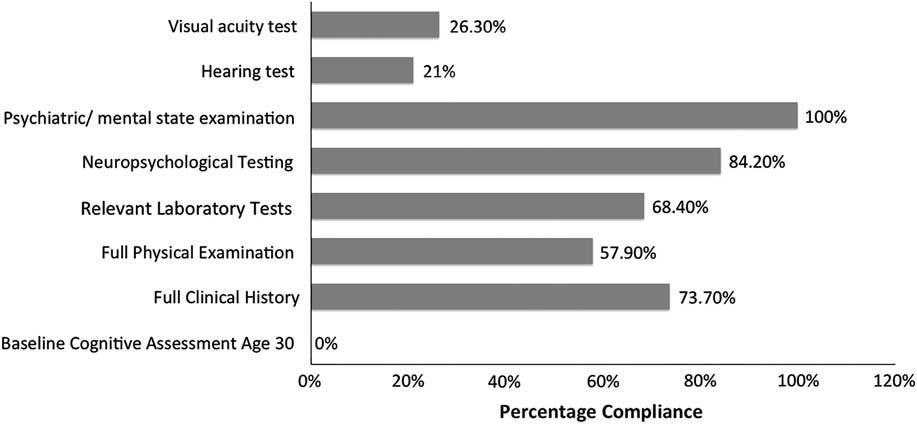
The mean age at diagnosis of dementia was 51 years (s.d.=6, range=35–61). In five cases there was a lack of clarity on the timing of diagnosis, as it was not clearly documented by the psychiatrist or other member of the multidisciplinary team. Overall, 80% of participants (n=16) were diagnosed as Alzheimer’s dementia subtype, with 15% mixed Alzheimer’s/vascular dementia subtype (n=3) and the remainder unspecified. None of the participants had a baseline cognitive assessment before age 30, but 50% (n=10) had baseline assessments before dementia diagnosis at a mean age of 48 years (s.d.=4, range=41–54). On average participants had 2.5 (s.d.=1.9, range=1–7) cognitive assessments completed before diagnosis.
Diagnostic pathway
In all, 19 of the 20 cases had a diagnosis of dementia made within the service. In relation to assessments before a diagnosis of dementia (see Fig. 1), 74% of the sample (n=14) had a full psychiatric history by an ID psychiatrist and all participants had a mental state examination completed. In some cases a full psychiatric history could not be performed due to lack of surviving family members. However, only 58% (n=11) had the necessary physical examination completed including cardiovascular and neurological examination. Recommended routine investigations including full blood count, urea & electrolytes, thyroid function tests and liver function tests, vitamin B12, folate, fasting lipids and glucose were carried out in 68% (n=13) of individuals within the 6 months before diagnosis. Of note, hearing and visual assessments were carried out in 21% (n=4) and 26% (n=5), respectively. In addition, 84% of cases (n=16) had a neuropsychological assessment by a clinical psychologist and 40% (n=8) had neuroimaging as part of their diagnostic workup. It is standard practice at St Michael’s House that all people with DS have an annual comprehensive medical examination, annual bloods and ophthalmology assessments, but if these had not been done in the 6 months before diagnosis they were not included.
Rates of adherence to British Psychological Society and Royal College of Psychiatry recommendations for the diagnostic workup of dementia in individuals with Down syndrome.
Neuropsychological assessments
The most common direct assessment used was the Test for Autobiographical Memory and Orientation, which was carried out with 47% (n=9) of participants. Other direct assessments used included the TSI (37%, n=7), the Simple Commands Assessment (42%, n=8), the Armstrong Naming Test (37%, n=7) and Verbal fluency (37%, n=7). The most common informant-based assessment used was the DSDS, which was carried out in 84% of cases (n=16). The Vineland Adaptive Behaviour Scale was used in 47% of cases (n=9), and other informant-based assessments used included the DMR (10%, n=2) and CAMDEX-DS (5%, n=1). Seven out of 20 participants (35%) had completed longitudinal assessment consisting of both direct and informant-based tools administered sequentially.
Trigger symptoms and timing of diagnosis
The mean age of onset of first symptoms was 50.9 years (s.d.=6.4, range=34.2–61.2). Initial symptoms were predominantly noticed first by care staff (70%, n=14), with the remainder reported by family members. The most common symptoms triggering a diagnosis included forgetfulness (65%, n=13), loss of previously learned skills (90%, n=18), confusion (75%, n=15) and geographical disorientation (45%, n=9). Less commonly reported trigger symptoms were low mood (25%, n=5), aggression (30%, n=6), anergia (35%, n=7) and personality change (35%, n=7). Only 5% (n=1) presented with late onset symptoms such as seizures, apraxia and reduced mobility, whereas 15% (n=3) presented with urinary incontinence. The average time from first symptom to diagnosis was 1.3 years (s.d.=0.7, range=0.5–2.8). The average time between first symptom reporting to diagnosis was not significantly different across levels of ID [χ 2 (2)=1.56, p=0.46], gender (U=13, p=0.28) or residential setting (U=15, p=0.15). Disclosure of diagnosis to the patient was not documented in any of the cases studied, but diagnosis was disclosed to carers or family members in 65% of cases (n=13), as reported in the clinical file. Family carers were involved in the decision to commence medication in 70% of cases (n=14) and carers’ views on the effects of pharmacotherapy were given during follow-up in 94% of cases (n=16).
Pharmacological treatment
Overall, 85% (n=17) of the population studied had a trial of acetylcholinesterase inhibitors, all of whom were prescribed donepezil as first line. The starting dose was 5 mg in all but one case (2.5 mg). The average age at commencement of acetylcholinesterase inhibitors was 52.3 years (s.d.=6.0, range=35.4–62.5). This equated to an average of 0.22 years following the diagnosis. All medications were commenced by a specialist (consultant psychiatrist in ID). Nausea, vomiting and dizziness were recorded in 35% (n=6) of those treated, whereas 23% (n=4) experienced insomnia and urinary incontinence and 17% (n=3) had diarrhoea; 65% of clinical files had no comment regarding the presence or absence of adverse effects of medication. The first trial of donepezil was discontinued in seven cases (out of 17), in six cases due to lack of tolerability (diarrhoea, dizziness, insomnia) and in one case due to lack of efficacy. Other reasons for discontinuation included aggression in two cases. Three cases went on to receive a second trial of recognised pharmacotherapy for dementia [rivastigmine (n=2) and memantine (n=1)].
In terms of monitoring and follow-up of those treated for dementia, all cases prescribed acetylcholinesterase inhibitors were followed up by a consultant psychiatrist in ID, but only 47% (n=8) had follow-up assessments of cognition every 6 months and only 6% (n=1) and 11% (n=2) had global and functional assessments, respectively. No behavioural assessments were conducted as part of follow-up; 53% of files contained no comment as to the efficacy of acetylcholinesterase inhibitors. Only two cases reported significant improvements [cognitive domain (n=1) and affective and behavioural domains (n=1)], while four cases reported minor improvements in cognitive or affective domains.
Discussion
As people with ID age, the development of valid and standardised dementia assessment pathways becomes more important for timely diagnosis and service provision. In this sample, screening for symptoms suggestive of dementia in DS is not currently taking place before age 30, and the mean age for a first baseline cognitive assessment was found to be much later at 48 (s.d. 4, range=41–54). The average age at diagnosis in our study at 51 years was at the lower end of the range of previously reported estimates (51–56 years) (Prasher & Krishnan, Reference Prasher, Adams and Holder1993), possibly indicative of the level of ID in our population, which was largely moderate in severity. It is likely that making a diagnosis of dementia in those with severe or profound ID is more difficult and would have increased the average age of diagnosis in comparative studies.
We showed a wide variety of cognitive assessments currently in use within the service and a lack of longitudinal assessment and follow-up. These issues are addressed in a recent prospective study of 77 women with DS (McCarron et al. Reference McCarron, McCallion, Reilly and Mulryan2014), whose authors argue the efficacy of longitudinal follow-up in a memory clinic setting in the diagnosis of dementia in persons with ID. They report on the usefulness of particular instruments in making a dementia diagnosis in DS when administered longitudinally, citing the TSI, Daily Living Skills Questionnaire (DLSQ) and DMR as sensitive to decline up to 1 year before the diagnosis (or 5 years in the case of the DMR), even in individuals with severe ID. Given the finding of multiple assessment tools seen in our study, the process could be streamlined by using fewer easily administered scales in the outpatient clinic setting (e.g. TSI) repeated on a longitudinal basis. Only 35% of our sample had both direct and informant-based assessments completed longitudinally, which indicates that a significant proportion of diagnoses were made based on a single assessment. This figure may reflect the use of the DSDS in some cases, which does allow for a diagnosis to be made based on a once-off assessment in certain circumstances (Geyde, Reference Geyde1995). However, in general, psychological assessment tools (both direct and informant based) have significant limitations in an ID population when used in a once-off manner at a single time point and are limited in their diagnostic value unless used longitudinally.
In our study, the average length of time from first symptom to diagnosis was 1.3 years (s.d.=0.7). This may represent a preclinical AD/mild cognitive impairment stage where the symptoms are not meeting a critical threshold to make the diagnosis, but may alternatively represent a true delay in dementia diagnosis. Coppus et al. (Reference Coppus, Evenhuis, Verberne, Visser, Oostra, Eikelenboom and Van Duijn2008) showed that a proportion of their sample of individuals with DS declined in functional ability and cognition with age but did not meet the criteria for dementia, but it was not clear whether this represented a preclinical AD or a normal ageing process and further longitudinal studies in this area are necessary. Timely diagnosis is regarded as optimal in order to facilitate care planning, environmental modifications, staff education and in order to allow commencement of acetylcholinesterase inhibitors (although the evidence in this regard is less clear and further research is required into their use in dementia in individuals with DS). In terms of presenting symptoms, only 5% of cases in our sample presented with typical late onset symptoms such as seizures, apraxia and reduced mobility, which may be suggestive that the stage of diagnosis in the majority of cases within the sample was early or middle.
The course of dementia in individuals with DS is variable, and estimates of survival following diagnosis range from 4.6 years (Lai & Williams, Reference Lai and Williams1989) to 6.24 years (McCarron et al. Reference McCarron, McCallion, Reilly and Mulryan2014). These figures highlight the importance of adequate staff education and training in the area of caring for those with DS and dementia, who often have very complex needs and require specialist care in promoting well-being, maintaining communication strategies and addressing end of life/palliative care needs.
Levels of carer involvement were high at all stages of the process in our sample and the diagnosis of dementia was disclosed in most cases to carers, but disclosure to the individual with DS was not documented in any of the cases. This is ethically a challenging area to navigate. In the ID population, the issue of competency and obtaining valid consent from the patient regarding their preference for disclosure of diagnosis are particularly difficult. However, these issues are not unique to the ID population and even in the general population, family members are significantly more likely to have been told the diagnosis than patients themselves (Holroyd et al. Reference Folstein, Folstein and Fanjiang2002). In an Irish context, a survey of Irish general practitioners (Cahill et al. Reference Cahill, Clark, Walsh, O’Connell and Lawlor2006) showed that only 19% reported they always or often disclosed a dementia diagnosis to their patients. The doctor’s perception of the patient’s ability to comprehend the diagnosis was the main barrier to disclosure. Although guidelines recommend the use of a communication passport to facilitate disclosure of diagnosis, the implementation of these recommendations are complex and will depend on a number of factors, including level of ID, stage of dementia and expertise of staff. Although we saw a lack of documentation of this process in our study, the practice of our service is to give patients the opportunity to know their diagnosis and to ask questions. The study highlights the importance of documenting who has been given the diagnosis and the specific reasons for non-disclosure if applicable.
In reference to the use of acetylcholinesterase inhibitors in this study, documented side-effects were frequent and individuals appeared to be continued on medication in the absence of evidence of beneficial effect. The evidence underpinning the use of acetylcholinesterase inhibitors in the DS population is not clear (Mohan et al. Reference Mohan, Carpenter and Bennett2009). Therefore, the importance of adequate follow-up and assessment of perceived benefits to pharmacotherapy is paramount in order to allow clinicians to make decisions regarding continuation of treatment to avoid unnecessary adverse effects. The documentation of adverse effects and reasons for discontinuation is also imperative.
This study highlights the many challenges in the areas of dementia diagnosis and treatment in DS, particularly the absence of a universal dementia cognitive assessment battery for use in DS. The study is limited by a small sample size, retrospective study design and use of a convenience sample. However, it does include all possible participants within the service and also reliability checks supported the validity of the data extraction. In addition, it adds to the limited pool of data in this area and highlights areas of potential improvement in current practice. It is hoped that this study will contribute to the implementation of a standardised evidence-based screening and diagnosis pathway, leading to timely diagnosis and intervention for individuals with dementia and DS and improving quality of life.
Acknowledgements
The authors thank Department of Psychiatry and Department of Psychology SMH, members of staff in Cara Alzheimer’s unit.
Financial Support
This research received no specific grant from any funding agency, commercial or not-for-profit sectors.
Conflicts of Interest
None.
Ethical Standards
The authors assert that all procedures contributing to this work comply with the ethical standards of the relevant national and institutional committee on human experimentation with the Helsinki Declaration of 1975, as revised in 2008. The authors assert that ethical approval for publication of this audit has been provided by their local REC.