The trials of deposed dictators such as Hosni Mubarak of Egypt and Slobodan Milosevic of Serbia, as well as the indictments of sitting heads of state Omar Hassan al-Bashir of Sudan and Muammar Gaddafi of Libya, have brought renewed attention to the debate about the consequences of prosecuting autocratic elites.Footnote 1 Do such prosecutions prevent other dictators from leaving power?
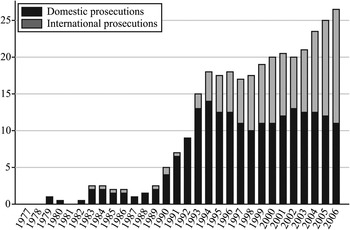
Given the paucity of International Criminal Court (ICC) indictments to date, much less successful prosecution, there is little room to assess how ICC actions influence the behavior of repressive dictatorships. However, Figure 1 shows that the number of human rights prosecutions has risen quickly in the past thirty years.Footnote 2 There was just one prosecution in 1979, but the number rises to more than ten per year in the 2000s.Footnote 3 Overall, the majority of prosecutions are domestic, such as the cases brought against Mubarak in Egypt and Hastings Banda in Malawi. But by the end of the period roughly half were international. For example, after Chilean dictator Augusto Pinochet's arrest in the UK in 1998 at the behest of Spanish judge Baltasar Garzon, Spanish courts were flooded with cases for prosecution of dictators under laws allowing for extraterritorial jurisdiction. Most were dismissed because the courts could not try sitting heads of state, but three cases against former dictators moved forward: Guatemalan General Rios Montt, Chad's former President Hissène Habré, and Désiré Bouterse of Suriname.Footnote 4
Transition human rights prosecutions: Global count of domestic and international prosecutions, two-year moving average

The proponents of campaigns to prosecute human rights abuses hailed these events as key advancements for human rights and as signals of increased enforcement of international human rights norms.Footnote 5 The optimistic view of prosecutions argues that they raise the cost of repression and thus deter regimes from abusing human rights.Footnote 6
Prosecutions of dictators and the growing influence of the ICC, however, are not without critics. One set of detractors argues that prosecuting human rights abusers involved in a conflict may backfire if a political agreement is not already in place because threatened parties have an incentive to continue fighting to avoid punishment.Footnote 7 This suggests that human rights prosecutions in transition countries may hurt progress toward democratic change and in doing so worsen human rights in the long run.
A second set of critics presents a more far-reaching argument, which we test in this article: prosecutions may deter repressive regimes from relinquishing power.Footnote 8 If prosecutions deter human rights abuses in transition countries, the proximate cause is that prosecutions raise the cost of using repression. For this same reason, according to a more pessimistic view, prosecutions might also increase the cost of leaving power for autocratic regimes that have committed human rights abuses.
The toppling of dictatorships during the Arab Spring uprisings revitalized this debate. For example, in reporting on Mubarak's trial, the late Anthony Shadid noted that,
Some Arab officials even suggested that the spectacle of the trial on Wednesday—a president and his family, along with his retinue of officials, facing charges—would make [other] … leaders all the more reluctant to step down.Footnote 9
Shadid then linked the surge of government repression against citizens in the Syrian city of Hama to the trial of Mubarak the same day, suggesting that Mubarak's fate may have increased the resolve of the Ba'athist dictatorship. Similarly, Phillippe Sands wrote in The Guardian that after the ICC arrest warrant, Gaddafi “was bound to dig in his heels.”Footnote 10
Yet, as Sikkink and Walling point out, “there are many claims about the negative effects of trials but relatively little solid evidence to support them.”Footnote 11 We assess the evidence by using human rights prosecutions in neighboring countries as a proxy for expectations of postexit punishment. This measure captures events in neighboring countries that have already experienced transitions, and thus does not rely on information from dictatorships that are currently in power. Therefore, neighbor prosecutions are more likely to be exogenous to the process of democratization than other measures—such as signing human rights treaties—which rely on information from strategic government behavior in dictatorships at risk of transition.
We argue that elites in dictatorships that have institutional mechanisms for protecting elite power after a transition are less susceptible to punishment after they step down. In military regimes, for example, officers can threaten a coup if the new democracy encroaches on their interests. In party-based dictatorships, the dominant party frequently competes in and sometimes wins elections after a transition. In personalist dictatorships, however, regime collapse and transition typically mean the old autocratic elite lose power and lack the institutional capacity to protect their interests after a transition. We build on these intuitions to argue that the evidence for the pessimistic view of human rights prosecutions should be strongest in personalist dictatorships because they typically lack a durable support party and do not have control over the military after they leave power. Using data on regime transitions from 1977–2006, we show that personalist dictatorships are less likely to democratize when more of their neighbors prosecute human rights abusers. In other dictatorships, however, we find little evidence to suggest that neighbor prosecutions deter democratic transition.
Transitions to Democracy and Postexit Punishment
Democratic transitions have been generally studied from two different approaches:Footnote 12 a macro approach focusing on structural determinants of democratization, such as economic development,Footnote 13 and a strategic approach focusing on interactions among actors, especially elites.Footnote 14 Although the structural approach may overlook the role of political actors in the process of democratization and pay too little attention to how structural features shape actors' incentives, the strategic approach has been criticized for focusing too much on elites and overlooking the role of opposition forces. However, recent contributions bridge the gap between these approaches by specifying causal mechanisms that link structural characteristics to changes in the preferences and choices of political actors. For example, economic crises,Footnote 15 inequality,Footnote 16 access to oil and other rents,Footnote 17 regime institutions,Footnote 18 democratic diffusion,Footnote 19 and membership in international organizationsFootnote 20 have been offered as factors that structure the incentives of individual actors to influence the prospects of democratization.
Both ex ante destabilizing conditions and expectations about the ex post consequences of leaving power influence transitions. The factors listed here—both domestic and external—can create destabilizing conditions by limiting the regime's capacity to buy support and thus maintain elite cohesion and by undermining its coercive capacity. Thus, destabilizing structural conditions can influence how strategic actors behave. For example, an economic crisis may decrease the rents available to buy support and spur popular dissent, thereby causing splits within the regime elite. However, the effect of destabilizing factors may vary across regime type—a structural feature.Footnote 21
Given ex ante destabilizing conditions, such as elite divisions because of economic crisis or international pressure, the ability of former elites to protect their interests in a subsequent democracy influences their willingness to negotiate a transition and relinquish power. Despite receiving theoretical attention, this claim has not been systematically tested yet. The strategic approach emphasizes that outgoing elites want to avoid punishment after leaving power, with exit guarantees making peaceful transitions more likely.Footnote 22 This article contributes to the democratization literature by explaining and empirically testing how expectations of postexit punishment (a strategic factor) influence the prospects of democratic transitions in different autocratic contexts (a structural feature) using neighboring events as a proxy.
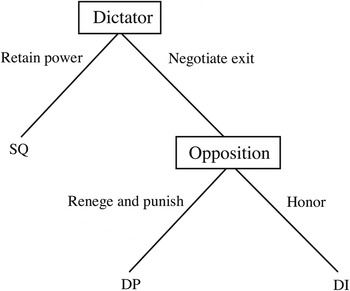
Figure 2 illustrates how ex post expectations of punishment can influence transitions in a two-player game.Footnote 23 Assuming the regime faces challengers motivated by some proximate destabilizing event—such as a mass protest, uprising, or elite divisions—which may lead to a particularly bad outcome for regime elites, they choose between retaining power and negotiating exit as part of a democratic transition. Should they choose the latter, the new democratic government decides whether to honor the agreement or to renege and punish them.
The commitment problem in a transition game

The opposition prefers regime change, and after transition, to punish former autocratic elites for past crimes or corruption: DP > DI > SQ.Footnote 24 Given these preferences, even if the regime prefers democracy with immunity to the status quo, a peaceful transition is not possible when the regime prefers the status quo to democracy with punishment. There is only one Nash-equilibrium, the status quo (SQ), with the dictatorship fighting to stay in power. Anticipating that the opposition has an incentive to renege on the transition pact, the regime does not transfer power peacefully since holding onto power is the best protection against punishment. Transition is possible only if the regime is forcibly removed from power.Footnote 25 Hence, negotiated promises that grant immunity to former elites face a commitment problem, which stems from the fact that after ceding power through a pact the democratic government cannot credibly enforce such promises.Footnote 26
In short, factors that increase the expectation that regime elites will be punished after a transition or will be unable to find asylum in a foreign country should lower the chances that the regime negotiates exit, making a peaceful transition less likely.Footnote 27 Whether prosecution of human rights abusers in neighboring countries (our proxy of ex post expectations of punishment) deters democracy will therefore hinge on whether these prosecutions increase the expectation of ex post punishment.
This logic informs one of two competing views of human rights prosecutions, each of which points to different policy prescriptions for addressing past human rights abuses.Footnote 28 The pessimistic view argues that strategic considerations about the likelihood of punishment after leaving power deter leaders from stepping down. Alternatively, an optimistic view, which focuses on transition countries, claims that prosecutions deter repression by making such behavior more costly to the perpetrators.
The Pessimistic View
The early comparative literature on democratic transitions identified prosecutions for past abuses as a potential obstacle to democratization. Thus, Dix emphasizes that “exit guarantees” for former ruling elites increase the chances of successful transition, whereas O'Donnell and Schmitter argue that past repression under military rule hinders transitions to democracy formed by pacts between the incumbent and the opposition.Footnote 29 Further, if the military remains strong and cohesive, a democracy with some guarantees of the military's interests—including immunity from prosecution—can facilitate extrication of the autocratic regime.Footnote 30
Consistent with the main prediction of the game in Figure 2, these theories suggest that the anticipation of punishment associated with transition reduces the likelihood that authoritarian elites relinquish power through a negotiated process.Footnote 31 Similarly, in his “guidelines for democratizers,” Huntington notes that new democratic authorities should not prosecute former officials for human rights violations.Footnote 32
Concern that prosecutions will deter repressive leaders from leaving power also informs critics of the ICC. Some argue that the growing reach of the ICC will prompt dictators to hold onto power.Footnote 33 For example, the ICC may take “away states' ability to commit to nonprosecution in the case of amnesties.”Footnote 34 Recent indictments of sitting rulers, such as al-Bashir and Gaddafi, have further fueled this debate because these actions targeted individuals who were concurrently facing pressure to step down peacefully. In short, the pessimistic view emphasizes that unless some mechanism exists to credibly prevent new elites from punishing former authoritarian elites, a peaceful, negotiated democratic transition is unlikely.
However, elites in some dictatorships, particularly those with an organizational basis, possess institutionalized mechanisms for retaining some power even after democratization. The extent to which autocratic elites expect their power to be protected after transition, in turn, shapes their beliefs about the likelihood of posttransition punishment. Therefore, in dictatorships where elites can expect to retain some posttransition power, the pessimistic logic should be weaker. And, as Huntington argues, the ability to protect posttransition power varies by autocratic regime type:
The party gives up its monopoly of power but not the opportunity to compete for power by democratic means. When they return to the barracks, the military give up both, but they also retain the capacity to reacquire power by nondemocratic means.Footnote 35
Military regimes are dictatorships where the military as an institution rules and thus constrains the power of the nominal leader. These contrast with personalist dictatorships where, even though the leader may wear a military uniform and has come to power in a coup, the military and high-ranking officers have been subordinated to the power of the leader.Footnote 36 For military regimes, the capacity to make credible transition pacts stems from their advantage in violence. Exit guarantees are credible because the military retains the capacity to reintervene in politics if the new political elites encroach upon their interests. In Argentina, the prosecution of former junta leaders prompted military unrest and a coup threat, forcing Alfonsín's government to pass immunity laws shortly after the transition.Footnote 37 Similarly, during Brazil's transition, the military eliminated “most of the proposed constitutional clauses that would have curtailed military autonomy.”Footnote 38 The military's willingness to bargain indicates they may have longer-lasting power and are thus more likely than other autocratic elites to return power to civilians through a pacted transition.Footnote 39 The game in Figure 2 illustrates this logic. If the opposition opts to renege and initiate prosecutions, the military can decide whether to reintervene to stage a coup. This threat, if credible, is sufficient to induce the opposition to refrain from revising the past. Indeed, many argue that a central reason militaries intervene in politics is to protect their corporate interests, of which a primary one is immunity from prosecution.Footnote 40
Dominant-party dictatorships also frequently end in negotiated transitions, with the regime party competing in posttransition elections.Footnote 41 Thus the dominant party can act as a veto player after a democratic transition, much like the military does in many new democracies that follow military regimes. Dominant-party autocracies typically have cohesive cadres and relatively broad support coalitions, with an institutional structure that produces power-sharing agreements, credible policy concessions, and opportunities to respond to the demands of diverse social groups.Footnote 42 They also buy mass support through broad patronage networks, distributing benefits and public employment by politicizing public resources.Footnote 43 Such features allow party elites to mobilize support and increase their power vis-à-vis the opposition during bargaining over electoral rules of the new democracy. Indeed, former dominant regime parties have generally won at least the second-largest share of seats in the legislature in posttransition democracies, with some former dominant parties even retaking legislative majorities or the executive.Footnote 44 Consequently, these elites are likely to retain posttransition political leverage.
In terms of the logic depicted in Figure 2, if elites from a former party regime win some legislative power, they can block a new democratic government's policy choices that lead to punishment. Because of the control of new institutions by the regime party or the presence of former regime elites among the constituent members of the new regime, the regime's preferences would no longer be DP > DI > SQ, but DI > DP > SQ.Footnote 45 An example from post-Communist transitions in Eastern Europe illustrates this point. David compares the timing and scope of lustration laws after transitions in Poland and Czechoslovakia to show that these laws in Poland were more limited and passed more than a decade after the transition because of the negotiated nature of the transition.Footnote 46 This allowed some former communists to retain power. The first Polish elections in 1989 were only partly competitive with just one-third of parliamentary seats contested, and Jaruzelski remained president until 1990. The Democratic Left Alliance (SLD), controlled by former communists and opposed to lustration, collected the second-largest vote total in the 1991 legislative election, and won the 1993 parliamentary and the 1995 presidential election. This prevented the creation of a legislative majority necessary to pass a lustration law until the victory of the center-right in 1997.
Personalist dictatorships stand apart from regimes based on an institutionalized organization such as a party or the military. Leaders in these autocracies often rely on relatively small support coalitions whose loyalty is ensured by the distribution of material rewards.Footnote 47 The leader typically has near-complete control over decision making and political appointments.Footnote 48 Further, personal rulers tend to weaken the two institutions, the party and the military, that are most capable of defending their interests after they leave power, which reinforces the logic of the model in Figure 2.
Personalist dictators often undermine the collective action capacity of their militaries to reduce the risk of coups.Footnote 49 An array of coup-proofing strategies—such as controlling internal promotion and recruitment, using ethnic or familial criteria for officer selection, purging officers and units, and creating parallel security organizations—ensure loyalty but do so at the expense of weakening the institutional structure of the armed forces. By patrimonializing the military, these leaders rarely have allies within the military once they leave power because losing power means their key supporters in the military have lost power as well.
Likewise, although legislatures and parties typically help enforce power-sharing agreements and policy concessions,Footnote 50 the logic of patrimonialism renders these institutions as mere instruments of patronage in personalist regimes.Footnote 51 Appointments provide access to rents and other benefits, but those selected are subject to frequent rotation to prevent the creation of independent power bases. Parties in these regimes are frequently the creation of the leader and often do not survive him. The support parties in Mobutu's (MPR) and Trujillo's (PD) regimes, for example, disintegrated once they lost power. Gaddafi did not have a support party and, relying heavily on mercenaries, left no military structure behind when his regime fell.
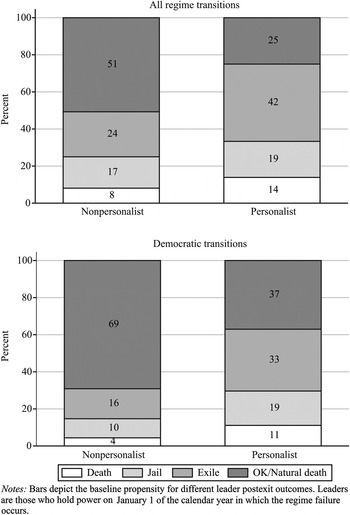
With alienated militaries and weak parties, personalist rulers have less capacity to threaten new elites or to retain leverage. Therefore, they are less likely to have institutional guarantees to protect their interests if they leave power after negotiations. For such rulers, retaining power may be the best protection against punishment. Figure 3 illustrates this point by showing the baseline probability of different postexit outcomes for autocratic leaders who are in power when a regime transition occurs. The left panel shows the fate of these dictators after all regime transitions. Indeed, personalist dictators have faced a worse fate when their regime is ousted: three-quarters end up with a “bad” fate such as exile, jail, or death. In contrast, more than one-half of nonpersonalist dictators are “okay” or die naturally.Footnote 52 The right panel shows the same baseline probabilities but restricts the sample to leaders whose regime ousters end in a democratic transition. Although the fate of dictators is generally better after democratic transitions, the same differences between personalist and nonpersonalist leaders persist.
The fate of dictators after regime transition
Data sources: Goemans, Gleditsch, and Chiozza Reference Goemans, Gleditsch and Chiozza2009; and Geddes, Wright, and Franz Reference Geddes, Wright and Frantz2014. Years 1946–2014.

Hence, the logic of the pessimistic view should be strongest in personalist dictatorships because they have the fewest domestic institutional guarantees of their interests after a transition and should therefore be the most sensitive to changes in externally generated costs of leaving power. This conditional pessimistic hypothesis suggests that neighboring-country prosecutions for human rights abuses are more likely to deter democratic transition in personalist dictatorships.
The Optimistic Approach
Advocates of prosecutions argue that by improving accountability, establishing rule of law, and raising the cost of repression, punishment can deter future abuses.Footnote 53 The increasing domestic legalization of human rights regimes and the recent growth of international agreements obliging states to address human rights abuses have accompanied a steady rise in prosecutions.Footnote 54 The potential costs associated with punishment are not only material (freedom and income), but also social.Footnote 55 Aware of the increased probability of prosecution, proponents argue, state officials should refrain from violating human rights. Indeed, the threat of prosecutions may deter human rights abuses even in the absence of reliable enforcement mechanisms.Footnote 56
Recent evidence that human rights prosecutions in transition countries reduce state repression supports the optimistic view.Footnote 57 Further, deterrence may extend to neighboring countries: transitional states reduce repression when their neighbors prosecute past abusers. Evidence from Latin American cases suggests that human rights trials improved respect for human rights and democratic accountability,Footnote 58 whereas other research shows that trials combined with other forms of transitional justice can have positive effects on democraticness and human rights.Footnote 59
The optimistic view focuses on how prosecutions influence repression in countries that have already transitioned from autocracy, not immediate decisions about whether to negotiate an exit from power. However, if prosecutions make the use of repression more costly in the future, this mechanism may also influence the prospects for political survival. First, public knowledge of costly repression can signal to the opposition that the regime is less capable of suppressing dissent and thus spur antiregime mobilization. Second, prosecutions may increase the likelihood that the repressive apparatus refuses to use violence against regime dissenters. Thus the likelihood that dictators can successfully defend against violent threats to their rule when they arise—which increases the prospect that dictators end up killed or jailed—decreases.
In terms of the logic in Figure 2, if prosecutions raise the long-term cost of repression for the regime, then when dictators choose to hold onto power (SQ) there is some probability, p, that they successfully fight for survival and retain power. Yet, with probability 1 − p, the leader is coercively ousted and faces a higher risk of a nasty fate. If, by emboldening the opposition or reducing security forces' willingness to repress, human rights prosecutions decrease p, the expected utility of staying in power decreases as well. Autocratic elites may thus face an intertemporal dilemma. On the one hand, they can decide to stay in office, but at the risk of being less capable of handling dissent in the future. Alternatively, they may opt to step down in the current period provided they are able to negotiate with opposition forces and ensure a relatively benign fate after democratic transition. Prosecutions may therefore increase the likelihood that regime elites negotiate a peaceful exit from power. Again, this prediction should vary with regime type.
Leaders in personalist dictatorships have more control over the selection of high-level military and security officers and are more likely to personally command these organizations.Footnote 60 Control over the military and the creation of parallel security forces allow dictators to staff these organizations using familial, ethnic, or sectarian loyalties, making them more dependent on a specific autocratic ruler remaining in office.Footnote 61 Such strategies strengthen the loyalty of these groups, reduce the likelihood of defections, and facilitate the regime's repressive response to challengers.
Alternatively, in nonpersonalist regimes military and security forces are often less patrimonialized and more highly institutionalized. These organizations tend to be “rule-governed, predictable, and meritocratic,” with “established paths of career advancement and recruitment.”Footnote 62 Thus the leaders of the coercive apparatus in these dictatorships are less likely to be tied to the regime leader and more likely to survive in their position should the regime fall. In Chile, for example, the leader of the military junta that democratized in 1989 not only retained his status as a general but continued for nearly a decade as the head of the armed forces.
When faced with antiregime uprisings, the regime's survival often depends on whether the military and security forces use their violent capacity to repress opponents.Footnote 63 “The military are the ultimate support of regimes. If they withdraw their support … the regime falls.”Footnote 64 And as Bellin notes, institutionalization “determines the degree to which the military elite is personally invested in the regime's survival.”Footnote 65 Officers in an institutionalized military are more likely to turn their backs on the regime because they typically have fewer ties to the ruler and a more developed “corporate identity” linked to defending the state rather than the regime. If prosecutions in neighboring countries provide a signal that repression is more likely to be punished, the interests of the military may be better served by defecting rather than by fighting for regime survival.
Recent events during the Arab Spring uprisings illustrate this point. In Tunisia, General Ammar, the army chief of staff, refused to obey President Ben-Ali's order to shoot protesters and the dictator soon fled to exile. The Tunisian military was not highly personalized under Ben-Ali and “in time came to rank among the Arab world's most professional forces.”Footnote 66 In Egypt, the decision to defect took more time, with the military initially helping other security forces. However, after violence intensified, the army announced its refusal to use force and the Supreme Council of the Armed Forces quickly forced Mubarak to resign. Egypt's military is highly institutionalized and their institutional economic interests conflicted with Mubarak's plan to elevate his son to succeed him.Footnote 67 These cases contrast with Libya and Yemen, where the dictators' sons held key posts in the regimes' most repressive military divisions.
If growing international protection of human rights and increasing resolve to prosecute violators make future repression more costly, elites in nonpersonalist regimes may have an incentive to step down in a controlled transition provided that they have institutionalized exit guarantees to make transition agreements credible. Regime change may thus be preferable to the uncertainty of fighting for regime survival. Hence, this conditional optimistic hypothesis suggests that neighboring-country prosecutions for human rights abuses are less likely to deter democratic transition in nonpersonalist dictatorships.
Changing Punishment Expectations and Measurement
Both the pessimistic and optimistic views hinge on elites' estimates of the likelihood of being punished after a transition. It is difficult, however, to test this logic because these expectations are not directly observable. Further, although recent evidence suggests that prosecutions reduce repression,Footnote 68 these studies focus on countries that have already transitioned to democracy and therefore cannot rule out the possibility that unobserved factors in the new democracy cause both the timing of prosecutions after transition and improvements in human rights. The decision to prosecute may be endogenous to the political strength of the repressive actors.Footnote 69 Thus if countries prosecute former abusers only when they are less threatening, we observe the benefits of prosecutions only.
To address these issues, we measure the dictator's perception of the likelihood of posttransition punishment with a proxy: the number of human rights prosecutions in neighboring countries that have already transitioned. This approach assumes that dictators observe prosecutions in proximate countries and expect that the politics of human rights punishment in their country may be similar.Footnote 70 Elites in dictatorships often use regional organizations and neighboring countries as a reference point for understanding and responding to political change. For example, Kazakhstan's prime minister, Karim Masimov, told Reuters in an interview that his government was “watching very carefully what's happening in North Africa and the Middle East.”Footnote 71 In another example, high-ranking generals in Pinochet's regime looked to other Southern Cone military dictatorships in Argentina and Brazil when searching for constitutional pathways to permanent rule. In response to international condemnations of human rights abuses, the generals protested that they should not be subjected to the criticisms of military regimes in other parts of the world because they were “a legal government,” and “not a dictatorship of the tropical variety.”Footnote 72
Furthermore, human rights prosecutions often result from the efforts of transnational advocacy networks that cluster geographically.Footnote 73 These transnational networks, in turn, use news media, which may reflect a regional bias in reporting on human rights abuses.Footnote 74 Autocratic elites are therefore likely to be more aware of and influenced by regional changes in human rights regimes. These elements suggest a regional element to the relevant reference group for autocratic elites, with implications for human rights politics and democratic transitions.Footnote 75
Although the structure of the regime—in our case whether it is personalist—can influence the likelihood of postexit punishment, regime type also measures other institutional characteristics, such as their vulnerability to internal splits, that strongly influence transitions.Footnote 76 Neighbor prosecutions, on the other hand, directly capture postexit expectations that vary over time and space. We expect the influence of neighboring prosecutions on the prospects of democratic transition to be higher in personalist regimes, for two reasons.
First, regime opponents pay attention to events in neighboring countries. For example, news reports indicate that hours after Gaddafi's death at the hands of rebels, antiregime protesters in Syria filled the streets chanting slogans urging a similar fate for Bashar al-Asad.Footnote 77 Gaddafi's death also prompted reactions from Iranian antiregime bloggers, with one writing “Gaddafi was killed, be scared dictator,” and another stressing “I hope Khamenei has seen Gaddafi's photos.”Footnote 78 Prosecutions in neighbor countries may increase the opposition willingness and capacity to prosecute because human rights prosecutions are influenced by diffusion processes in geographic and cultural neighbors.Footnote 79
The regulation of human rights has accelerated in the past two decades with a new model of individual criminal legal accountability emerging and diffusing during the 1980s and 1990s.Footnote 80 This new model provides additional enforcement mechanisms and its adoption by states and international organizations has made possible a “justice cascade,” manifested in the rapid increase in the number of human rights prosecutions.Footnote 81 As a result, domestic opposition groups may learn from other countries' experience and receive support (or pressure) from international organizations, foreign governments, and a growing number of transnational advocacy networks. Although domestic opposition groups may be equally emboldened to prosecute past abuses in all dictatorships, their likely success should vary by whether the outgoing elites have institutionalized protections in a posttransition setting. This translates into worse postexit expectations for regime elites in personalist dictatorships who, we argue, are poorly equipped to withstand pressure to prosecute.
Second, our measure of punishment risk captures the practical translation of the growing international commitment and states' obligation to address past human rights abuses.Footnote 82 This growing pressure not only increases the expectation that postexit punishment is more likely for some dictators, but also reduces their options for asylum in foreign countries. Decreasing the likelihood of happy exile is particularly relevant for elites in personalist dictatorships who, because they are less capable of controlling the transition process to negotiate a credible exit, have historically been the most likely to flee their countries (see Figure 3). If exile increasingly involves the risk of punishment or is infeasible, the expected utility of this option may be lower than the utility of retaining power. Gaddafi, for example, was unable to find a suitable exile country and instead decided to fight until his death. Many deposed dictators in exile have recently faced the prospect of foreign host states either extraditing them to another country or prosecuting them. For example, the former president of Chad, Hissène Habré, is slated to be tried for human rights abuses in a Senegalese special court despite having lived in exile in Senegal since his ouster in 1990.Footnote 83 Similarly, former president of Liberia Charles Taylor initially went into exile in Nigeria in 2003, but three years later the Nigerian authorities, facing both international and domestic pressure, accepted the arrest of Taylor and his transfer to the Special Court for Sierra Leone.Footnote 84 As prospects for a happy exile decreases, the influence of postexit punishment on dictators who lack domestic institutional guarantees in a posttransition setting should strengthen. Thus, the marginal effect of neighbor prosecutions on deterring transitions should be stronger in personalist dictatorships where elites lack these guarantees.
Empirical Approach
To test these propositions, we use updated data on autocratic regimes.Footnote 85 We use autocratic regimes instead of leaders because the former capture whether the group of elites who make policy and personnel decisions retains power whereas the latter measures whether a particular individual remains the nominal leader. In some cases, these two concepts are similar—for example, in personalist dictatorships such as Gaddafi's regime in Libya. In other dictatorships, however, regular rotation of the leader is a mechanism for retaining power. For instance, in Mexico under PRI party rule, presidents were limited to one six-year term. Presidents in China (post-Mao) and Iran (post-Khomeini) are also subject to limited terms. Modeling leadership survival counts these changes as equivalent to a democratic transition or ousting a regime via rebellion or uprising. Further, because many leadership changes in dictatorships constitute a reshuffle atop the regime, externally generated changes in the likelihood of postexit punishment should not be as salient when the ruling regime remains in power.Footnote 86
The autocratic regime data code whether regime collapse results in a transition to democracy or to a new autocratic regime.Footnote 87 We test the argument on democratic transitions because most of the transitions literature focuses on this type of political change.Footnote 88 There are 118 autocratic regime failures in the sample (1977–2006), of which sixty-five are democratic transitions.
Data on transition human rights prosecutions (HRP) code international and domestic HRPs using information from US Department of State Human Rights Annual Country Reports, international organizations such as the UN Security Council, and human rights NGOs.Footnote 89 Domestic prosecutions are defined as “those conducted in a single country for human rights abuses committed in that country,” and international prosecutions refer to crimes brought to trial “in international tribunals like the ICTY and ICTR and in hybrid tribunals like in Sierra Leone,” and “include foreign prosecutions like the Pinochet case.”Footnote 90 This database does not include cases from the ICC because the court's first investigation started in June 2004 but concluded in 2012, well after the temporal span of the HRP data.
Although some prosecutions target low-level personnel accused of human rights violations, such as police officers or prison guards, most prosecutions target high-ranking regime officials. In Chile, the director of intelligence under Pinochet's rule was prosecuted. In Paraguay, Alfredo Stroessner's police chief was targeted; in Poland a former interior minister; in Uruguay the Minister of Foreign Affairs; navy commanders fell in Argentina and Ecuador; and in Romania the assassinated dictator's son stood trial. Further, many prosecutions specifically target the nominal regime leader: Hastings Banda (Malawi), Juan Bordaberry (Uruguay), Leopoldo Galtieri (Argentina), Luis García Meza (Bolivia), Mengitsu Haile Miriam (Ethiopia), Manuel Noriega (Panama), Roh Tae Woo (South Korea), Charles Taylor (Liberia), Moussa Traoré (Mali), and Jorge Rafael Videla (Argentina) lead the list of dictators who faced human rights prosecutions after their regimes collapsed.
The main independent variable is a weighted count of the number of HRPs in neighboring countries in the past three years. HRP data begin in the late 1970s, so we examine a thirty-year sample period from 1977 to 2006. To define neighboring countries, we calculate a weighted index using minimum distance data.Footnote 91 Our measure assigns a weight equal to the inverse distance from the target (w = 1/ln(d)) for neighboring countries within a fifty-kilometer threshold of minimum distance. The weight decreases for each group of countries at the next distance threshold, where each threshold is an additional fifty kilometers in minimum distance. This weighted measure incorporates information from all neighbors within 1,000 kilometers of minimum distance:
 $$wHR{P_i} = {\sum\limits_{K = 1}^{20}} {\sum\limits_{k \in K} {w_{iK}N_k} \comma \; }$$
where N is the number of HRPs in the k neighboring countries within the group of countries that fall within each distance threshold K. The weight assigned to the count of all HRPs (Nk ) for the countries in K group is w = 1/ln(d) is.Footnote 92
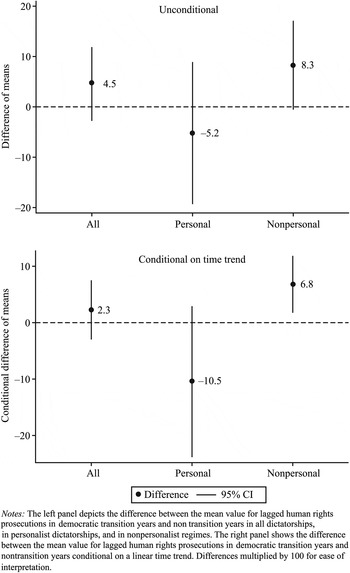
An initial look at the data in Figure 4 suggests that the relationship between neighbor HRPs and democratic transition varies by the incumbent regime type. The left panel shows the difference between the mean value for lagged human rights prosecutions in democratic transition years and nontransition years. The first estimate on the left, for all dictatorships grouped together, indicates that HRPs are roughly 4.5 points higher in democratic transition years than in nontransition years. This estimate, however, obscures the fact that the difference is negative in personalist regimes (−5.2) and positive in nonpersonalist ones (8.3).
Human rights prosecutions, by transition year and regime type

This test does not account for other factors that may influence both transitions and human rights prosecutions. Importantly, the number of HRPs increased substantially over the past three decades (see Figure 1), and this period coincides with the third wave of democratization. Therefore, we need to account for unmeasured factors that also increase over time and may be correlated with regime failure, particularly democratic diffusion. The right panel of Figure 4 shows the difference between the mean value for lagged human rights prosecutions in democratic transition years and nontransition years conditional on a linear time trend. Again, there is a large divergence in the estimates of this difference between personalist and nonpersonalist regimes.
Further, both the neighboring country HRP variable and the political processes that shape the prospects for democratization vary by geographic region. Supplementary dataFootnote 93 show that democratic transitions and neighbor HRPs are clustered geographically, which is not surprising because the prosecutions data capture political events that occur only after a country has transitioned from civil war or autocratic rule, with the majority occurring after a democratic transition. Because of this regional clustering, we cannot rely on cross-sectional variation to estimate the influence of HRPs. Finally, there may be unobserved factors that vary by country (or geographic region)—such as the strength of civil society groups, human rights norms, and the political strength of the military and other repressive actors—which are correlated both with the chances of democratization and the prospects of regional human rights prosecutions. For these reasons, we opt for a model specification that incorporates both country- and year-fixed effects.
We first test a set of conditional logit models.Footnote 94 This approach, however, drops countries that do not transition during the sample period. For example, of the 108 countries in our sample, fifty-four do not have a democratic transition between 1977 and 2006. Dropping these cases substantially increases the baseline probability of democratic transition in the sample, so we also test linear probability models with unit and year effects.Footnote 95
Our argument implies that the influence of human rights prosecutions should vary by whether the autocratic regime is personalist. Roughly one-third of the autocratic regimes in the sample are personalist dictatorships, and one-quarter (or fifteen of fifty-eight) of these transition to democracy during the sample period. These regimes are scattered across the globe and include dictatorships—such as Belarus, Libya, Russia, Sudan, Togo, and Yemen—that lie in neighborhoods with relatively high human rights prosecutions as well as regimes in regions with few neighbor prosecutions—such as Madagascar, Malawi, and the Philippines in the 1980s and early 1990s.
We include a binary indicator of personalist dictatorship (personalist) and interact HRP with this variable: hrp × personalist. In the linear probability model, we include a constant (α0), control variables (X i,t−1 ), as well as country (ξ i ), year (τ t ), and duration time (ζ d ) fixed effects:Footnote 96
 $$\eqalign{Y_{it} & = \alpha_0 + \beta_1 {\rm PERSONALIST}_{it} + \beta_2 {\rm HRP}_{it} + \beta_3 {\rm HRP} \cr & \quad\times {\rm PERSONALIST}_{ti} + \gamma X_{i\comma t-1} + \xi_i + \tau_{t} + \zeta_d + \varepsilon_{i\comma t}}$$
The marginal effect of human rights prosecutions in nonpersonalist regimes is estimated by β 2, whereas the linear combination of β 2 + β 3 estimates this effect for personalist dictatorships.
We test a model that includes three control variables: neighbor democratization, neighbor post–civil war, and prior democracy.Footnote 97 These variables capture diffusion processes that are correlated with both democratization and neighbor human rights prosecutions. We confirm the main results reported below in models that contain four additional control variables: log gdp per capita, log population, civil war, and judicial independence.Footnote 98
Results
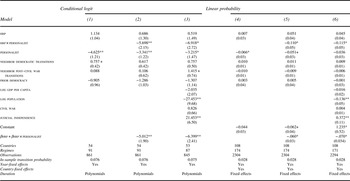
The first column of Table 1 reports the result from the conditional logit for the average effect across all autocracies; the coefficient is negative but not statistically different from zero. This estimate provides little evidence of any effect. Column (2) reports the model with the interaction term, the estimate of which is negative and statistically different from zero. The estimate for HRP is positive but not significant, whereas the coefficient for β hrp + β hrp × personalist is negative and significant. This suggests that the effect of prosecutions differs for the two groups of dictatorships; and consistent with our expectations, the estimated effect is negative for personalist regimes. The model in column (3) adds control variables and yields a stronger result.
Human rights prosecutions and autocratic survival

Notes: Dependent variable is democratic transition. Clustered standard errors are in parentheses. Poly = three polynomials in duration. 174 regimes in 108 countries from 1977–2006. HRP = human rights prosecutions. + p < .10; *p < .05; **p < .01.
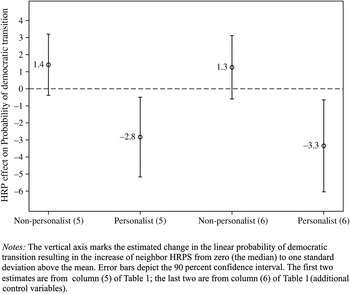
The next three columns test linear probability models, yielding similar results with an expanded sample that includes countries where transition does not occur. The only notable differences in these models are the large and positive estimates for HRP in models with the interaction term. This estimate, though not statistically significant, provides some evidence that prosecutions increase the prospects of democratic transition in nonpersonalist dictatorships. Figure 5 shows the substantive effect of the findings in columns (5) and (6). The vertical axis depicts the change in the estimated linear probability of democratic transition resulting from an increase in neighbor prosecutions from zero to one standard deviation above the mean.Footnote 99 The results from both models suggest that increasing HRPs reduces the chances of transition by roughly 3 percent in personalist regimes; in other regimes HRPs increase the probability of transition by a little more than 1 percent.Footnote 100
Neighbor human rights prosecutions (HRP) and democratic transition

The main finding is robust to a number of changes to the specification. First, we test a binary dependent variable model that includes the unit- and year-means for all variables as proxies for unit- and year-fixed effects. This approach preserves the full sample (unlike a conditional logit), appropriately models a limited dependent variable (unlike the linear approach), yet conditions the parameters of interest on unit effects and year effects. This approach confirms the main result, and we also find a positive effect for prosecutions in nonpersonalist dictatorships.Footnote 101 Second, we change the dependent variable to nonviolent transitionFootnote 102 or leadership changeFootnote 103 instead of democratic transition. Third, we employ an alternative measure of democratic transition.Footnote 104 Fourth, instead of using year-fixed effects we include the global trend in HRPs or region-specific time trends.Footnote 105 Fifth, we alter the lag on the main variable of interest to two- or four-year lagged counts for prosecutions.Footnote 106 The main result remains irrespective of these changes.
Next, we constructed a measure of “religious neighbor” as an alternative weight for the HRP variable.Footnote 107 Instead of relying on geographic proximity, this variable uses information on the share of citizens who belong to a particular religion (Buddhist, Catholic, Hindu, Muslim, Orthodox, and Protestant). “Neighbors” are defined as countries that have similar majority religion.Footnote 108 Results using this measure are consistent with the main findings.Footnote 109
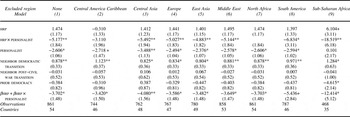
Finally, to understand whether these findings depend on cases from one particular geographic region, we test Model 2 while excluding one geographic region at a time. Because much of the existing evidence supporting the optimistic view of human rights prosecutions draws on Latin American countries,Footnote 110 and recent research suggests that there is a regional bias in information about human rights abuses that favors Latin America,Footnote 111 we examine whether the result relies on information from just one region. Table 2 reports the findings from conditional logit models;Footnote 112 with the first column reporting the model with all regions included for comparison. The estimates for HRPs in personalist dictatorships are similar across all models, though this estimate is stronger once sub-Saharan African dictatorships are excluded from the sample. For HRPs in nonpersonalist dictatorships, we find a positive though not statistically significant result for all models, except the one that excludes Central America and the Caribbean. This suggests that although the main finding is robust to the exclusion of any one region from the analysis, any positive evidence from nonpersonalist dictatorships reflects information from Central American and Caribbean dictatorships.
Human rights prosecutions and democratic transition, regional analysis

Notes: Dependent variable is democratic transition. Conditional logit with standard errors in parentheses. Time period dummies and regime duration polynomials not reported. Years: 1977–2006. HRP = human rights prosecutions. +p < .10; *p < .05; **p < .01.
Discussion
The logic of both the optimistic and pessimistic approaches rests on the assumption that prosecutions are costly to the perpetrators of repression. Proponents focus on how the threat of punishment deters repression in the future. This argument has implications for an autocratic regime's capacity to pursue repression as a tool to survive regime crises in the future. By increasing the chances leaders of the repressive apparatus defect, human rights prosecutions might lower the utility of remaining in power in the current period. Conversely, critics of human rights prosecutions focus on the possibility that punishment in posttransition settings sends a signal to elites in repressive regimes that they are more likely to be punished if they transition to democracy. This logic suggests that prosecutions could deter dictatorships from relinquishing power.
We argue that the domestic political context helps us understand which of these mechanisms is likely to predominate. In dictatorships where autocratic elites can retain some posttransition power to protect their interests, the prospects of punishment after transition should be lower. Thus the logic of the critics is less likely to pinch in these settings. Further, these are the same dictatorships where the repressive apparatus of the regime is less likely to be personally tied to the regime leader. This means that repressive agents are likely to be more sensitive to changes in the costliness of domestic repression and therefore more likely to defect from the regime during crises.
Our theory emphasizes the importance of exit guarantees that are made more credible when the political power of former autocratic elites endures after regime transition. We observe differences in enduring power based on distinctions among domestic institutions in different autocratic contexts, which we measure using a qualitative characteristic of autocratic regimes.Footnote 113 This approach builds on recent research in international relations that distinguishes among autocracies to better understand domestic audience costs, alliance commitments, the political consequences of defeat in war, and the selection of belligerent leaders.Footnote 114
An alternative logic, based on the size of the coalition that supports the dictatorship, suggests that it might be easier to credibly guarantee immunity after transition for a relatively small group of elites. Democratic governments that arise from large coalition dictatorships, on the other hand, might face more difficulties in making credible promises to a large number of coalition elites. Mapping this intuition onto autocratic regime types suggests that it might therefore be easier to make credible promises to a handful of elites in personalist dictatorships—the opposite of our expectation. We find little evidence consistent with this argument, but it nonetheless offers a promising new avenue for future research by pointing to the absolute number of individuals who might be persuaded by ex ante exit guarantees.
Finally, our analysis largely skirts the issue of repression. The logic of the pessimistic view suggests that past repression is a sunk cost, which should influence how an autocratic regime behaves as it confronts the reality of increasing human rights prosecutions over time.Footnote 115 Thus a next step in this research might examine how prosecutions influence transitions, conditional on regime repression. If the logic of the critics is correct, we should observe a stronger deterrent to transition in regimes with a more repressive history. However, this task is complicated by the fact that the most widely used data sets on repressionFootnote 116 rely on information from organizations—such as Amnesty International and the US State Department—that strategically pursue human rights shaming campaigns and advocate for human rights prosecutions. This makes it difficult to disentangle observed repression from the shaming and punishment strategies of international actors.
Conclusion
This article assesses whether domestic and international criminal prosecutions for human rights abuses deter dictators from leaving power. We argue that the influence of human rights prosecutions should vary by whether the incumbent autocratic regime has institutionalized postexit guarantees. In autocracies where former elites are more likely to have credible guarantees of their interests—including protections from prosecution—we expect externally generated increases in the probability of punishment to have little deterrent effect. However, in dictatorships that lack a dominant party or institutionalized military that can preserve posttransition leverage, we expect human rights prosecutions to deter dictators from giving up power.
To test this argument, we use human rights prosecutions in neighboring countries as a proxy for changes in the expectation of punishment should an autocratic regime relinquish power. The evidence for an average effect across all autocracies in the past three decades is inconclusive. However, human rights prosecutions are associated with a decreased risk of democratic transition in personalist dictatorships that typically lack institutionalized posttransition guarantees.
At first glance, our results for human rights prosecutions might appear to be at odds with the finding that these prosecutions reduce repression in transition countries.Footnote 117 The reason underlying both, however, may be the same: human rights prosecutions increase the costs of repression. These findings can be reconciled once we consider the time inconsistency problem in the optimal treatment of dictators.Footnote 118 Ideally, dictators would be punished severely to deter future repression. Kim and Sikkink provide evidence consistent with this logic, warranting optimism for the future of international campaigns to prosecute repressive dictators.
However, human rights advocates also want dictators to leave power peacefully, preferably in a transition leading to democracy. Credible guarantees of amnesty may lower the cost of leaving power, thereby inducing departure. Personalist dictators, as Huntington pointed out two decades ago, are the least likely to have institutional guarantees of their interests after a transition.Footnote 119 For dictators who have already committed human rights abuses, the costs of repression are sunk costs; they cannot undo them once the international regime changes and begins punishing autocratic elites after a transition. For these rulers, prosecutions in other countries simply raise the costs of exit. That the evidence is strongest for personalist dictators suggests exit guarantees may be the link between observing punishment and clinging to power. These autocrats do not have institutional guarantees—either a strong party or a threatening military—to ensure a happy postexit fate. Criminal prosecution of their colleagues may only make them view retirement all the more dimly.
Supplementary Material
Replication data and an online appendix are available at http://dx.doi.org/10.1017/S0020818314000484 and http://sites.psu.edu/wright.