Introduction
Lipopolysaccharide (LPS) endotoxemia has been negatively associated with fertility (Bidne et al., Reference Bidne, Dickson, Ross, Baumgard and Keating2018). LPS is released locally during the occurrence of infectious (e.g. mastitis and endometritis) or metabolic diseases (e.g. ruminal acidosis) with the presence of Gram-negative bacteria such as Escherichia coli, however LPS can be released into the bloodstream and reach organs far from the origin (Stefanska et al., Reference Stefanska, Człapa, Pruszynska-Oszmałek, Szczepankiewicz, Fievez, Komisarek, Stajek and Nowak2018).
In cattle, exposure to LPS initiates an acute systemic inflammatory response, which may have a direct effect on ovaries, oocytes, and embryos (Bidne et al., Reference Bidne, Dickson, Ross, Baumgard and Keating2018). In addition, in vitro studies have shown that LPS can have direct effects on the expression of inflammatory genes in bovine oviductal (Ibrahim et al., Reference Ibrahim, Salilew-Wondim, Rings, Hoelker, Neuhoff, Tholen, Looft, Schellander and Tesfaye2015) and endometrial cells (Cronin et al., Reference Cronin, Turner, Goetze, Bryant and Sheldon2012). Additionally, we recently found that challenge with two doses of LPS [intravenously (i.v.), 24 h interval] was able to generate a systemic inflammatory response in heifers and also led to a decrease in the cleavage rate of oocytes collected 3 days after exposure to LPS (Alvarado-Rincón et al., Reference Alvarado-Rincón, Gindri, Mion, Giuliana de Ávila, Barbosa, Maffi, Pradieé, Mondadori, Corrêa, Ligia Margareth Cantarelli and Schneider2019). In this context, this study aimed to investigate the effect of LPS-induced inflammation on the expression of genes associated with bovine fertility in the uterus and oviduct.
Materials and methods
Sixteen healthy heifers (Bos taurus) of 14 months of age, ±330 kg, managed in feedlot were used. All procedures carried out in this study were approved by the Animal Ethics and Experimentation Committee of the Federal University of Pelotas, RS, Brazil (Protocol 9364). To standardize the reproductive status of all heifers, the follicular wave was synchronized using a hormonal protocol (Supporting information Methods S1).
On day zero of the hormonal protocol (D0), the animals were randomly assigned into two groups. The LPS group (n = 8), which received two i.v. injections of 0.5 µg/kg of body weight of E. coli LPS (Sigma Aldrich) diluted in 2 ml of saline solution (0.9% NaCl) with a 24-h interval and a control group (n = 8), which received two i.v. injections of 2 ml of saline (0.9% NaCl) with the same time interval. The dose and interval of LPS administration were defined by the lowest dose of LPS able to generate an inflammatory response in cattle (Waldron et al., Reference Waldron, Nishida, Nonnecke and Overton2003; Alvarado-Rincón et al., Reference Alvarado-Rincón, Gindri, Mion, Giuliana de Ávila, Barbosa, Maffi, Pradieé, Mondadori, Corrêa, Ligia Margareth Cantarelli and Schneider2019).
Total blood leukocyte counts were performed at 0 (D0, the first LPS injection), 4, 24, and 48 h (BC2800 VET, Mindray). At the same time, rectal temperature was measured using a digital thermometer.
On the fourth day, all animals were slaughtered, then oviduct and uterus samples were taken from each animal. For the oviduct, the isthmus region was opened longitudinally and gently scraped with a blade to recover epithelial cells. For the uterus, a small sample was collected covering the three organ layers, always in the same position. The samples were homogenized in 1 ml of TRIzol (Sigma Aldrich) and stored in liquid nitrogen.
Total RNA extraction, reverse transcription, and real-time PCR protocols are described in the Supporting information. Genes associated with LPS recognition (TLR4), inflammatory response (IL1β, IL10, and TNF), thermal (HSPA1A) and oxidative stresses (GPX4), quality of the oviduct environment (CASP3, IGF2, and OVGP1), and quality of uterine environment (PTGS2, NANOG, MMP19, SELL, and BSG) were evaluated. The PTGS2, NANOG, SELL, MMP19, BSG, TLR4, TNF, IL1β, IL10, GPX4, and HSP70 genes were assessed in the uterus, and TLR4, TNF, IL1β, IL10, GPX4, HSPA1A, CASP3, IGF2, and OVPG1 genes were assessed in the oviduct. Primers sequences used are listed in Table S1.
Statistical analysis was performed using GraphPad Prism 7 software (GraphPad Software Inc., La Jolla, USA). Rectal temperature and total leukocyte count were analyzed using the two-way analysis of variance (ANOVA) test, evaluating the treatment effect (LPS challenge) and time and its interaction (treatment × time). Gene expression data were log-transformed to have a normal distribution and later analyzed using a t-test. P-values < 0.05 were considered statistically different.
Results
The rectal temperature showed interaction (treatment × time, P = 0.0002) in the period evaluated (48 h). At 4 h after each challenge with LPS, that is at 4 h and 28 h, the LPS group exhibited higher temperatures compared with the control group (39.9 ± 0.19°C vs. 39.1 ± 0.1°C and 40.2 ± 0.4°C vs. 39.2 ± 0.1°C, respectively; P < 0.05). At 0 h (38.6 ± 0.1°C vs. 38.7 ± 0.1°C), 24 h (38.6 ± 0.1°C vs. 38.8 ± 0.2°C) and 48 h (38.7 ± 0.1°C vs. 38.9 ± 0.1°C) the temperature was similar between groups (P > 0.05). The mean of the total leukocyte count of the LPS group during the evaluation period (0, 4, 24, 28, and 48 h) was lower than the mean of the control group in the same period (12982 ± 848.3 vs. 17167 ± 983.8 cells/µl; P = 0.002). No interaction (treatment × time) was observed in this variable. These results demonstrated that the LPS dose used in this study was able to initiate an acute systemic response, supported by the presence of fever (T° > 39.6 ºC) (Zebeli et al., Reference Zebeli, Sivaraman, Dunn and Ametaj2013) 4 h after each application of LPS and lower total leukocyte count during the evaluation period (Yagi et al., Reference Yagi, Shiono, Shibahara, Chikayama, Nakamura and Ohnuma2002) in the LPS group.
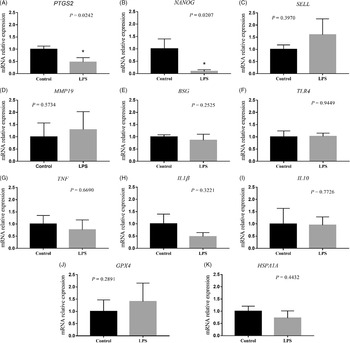
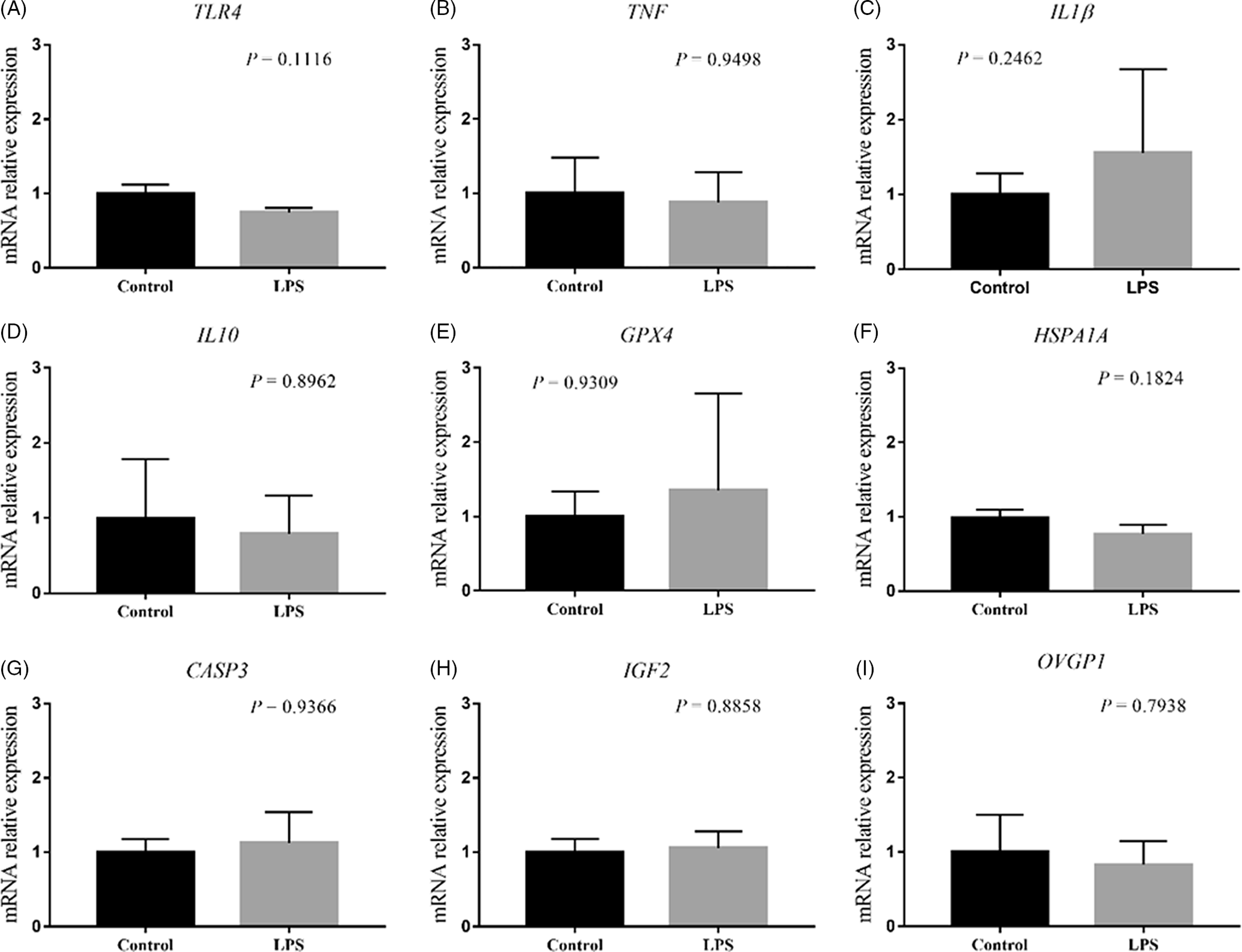
In the uterus, the LPS group showed a lower relative expression of PTGS2 (P = 0.024; Fig. 1A) and NANOG (P = 0.020; Fig. 1B). However, there was no effect on the relative expression of genes SELL, MMP19, BSG, TLR4, TNF, IL1β, IL10, GPX4, and HSPA1A in the uterus (P > 0.05; Fig. 1C–K). Additionally, no change in expression was observed in the genes evaluated in the oviduct (P > 0.05; Fig. 2).
Relative expression of the PTGS2 (A), NANOG (B), SELL (C), MMP19 (D), BSG (E), TLR4 (F), TNF (G), IL1β (H), IL10 (I), GPX4 (J), and HSPA1A (K) genes in the uterus of challenged heifers (n = 8) or not (n = 8) with two doses of LPS (0.5 μg/kg body weight) with a 24 h interval. Gene expression analysis was performed using a t-test. Statistical difference was considered as P < 0.05.

Relative expression of the TLR4 (A), TNF (B), IL1β (C), IL10 (D), GPX4 (E), HSPA1A (F), CASP3 (G), IGF2 (H), and OVGP1 (I) genes in the oviduct of challenged heifers (n = 8) or not (n = 8) with two doses of LPS (0.5 μg/kg body weight) with a 24 h interval. Gene expression analysis was performed using a t-test. Statistical difference was considered as P < 0.05.

Discussion
Despite generating an acute systemic response, the challenge with LPS did not affect the inflammation markers assessed in the uterus and oviduct (i.e. TLR4, TNF, IL1β, and IL10). Probably this occurred because the tissues were analyzed 3 days after exposure to LPS, when there was no longer an inflammatory process, at 24 h after exposure to LPS the body temperature and the leucogram showed no changes. In agreement with our results, Swangchan-uthai et al. (Reference Swangchan-uthai, Lavender, Cheng, Fouladi-Nashta and Wathes2012) observed that in vitro exposure of endometrial cells to LPS increased the expression of TNF and IL6 up to 6 h, but 24 h later these levels returned to normal.
Compared with the control, the LPS group showed a 50% reduction in PTGS2 expression The PTGS2 protein consists of PGE2 and the PGF2α precursor, PGE2 maintains the corpus luteum active and PGF2α induces luteolysis (Parent and Fortier, Reference Parent and Fortier2005). In this regard, LPS exposition may deregulate PGE2 and PGF2α secretion, and affect corpus luteum functioning, delaying the estrus cycle or causing abortions. However, further studies are necessary to confirm this hypothesis.
Conversely, a 92% decrease in NANOG expression can damage pregnancy establishment, as NANOG is associated with cell pluripotency and tissue regeneration in the face of injuries and this is essential for the proper functioning of the endometrium (Jaenisch and Young, Reference Jaenisch and Young2008).
In summary, this study evaluated for the first time the effect of two LPS injections on gene expression associated with the inflammatory response, thermal and oxidative stress, and environment uterus quality and oviduct in cattle, providing a basis for future studies. The inflammatory process triggered by LPS did not persist in the uterus and oviduct 3 days after LPS challenge. Nonetheless, reduction of PTGS2 and NANOG expression in uterus suggests that, indirectly, LPS may have a prolonged effect, which may affect corpus luteum and endometrial functions.
Supplementary material
To view Supplementary material for this article, please visit https://doi.org/10.1017/S0967199421000745
Acknowledgements
We thank CNPq, CAPES, FAPERGS and Frigorifico Espinilho.
Conflict of interest statement
None.
Ethics
All procedures carried out in this study were approved by the Animal Ethics and Experimentation Committee of the Federal University of Pelotas, RS, Brazil (Protocol 9364).