I. INTRODUCTION
The preparation of large-sized and complicated structural ceramics is an important issue in the semiconductor industry. Large-sized alumina grinding disks, plates, and frames of stepper machines are necessary for this application. A conventional forming technique used to prepare large-sized ceramics is cold isostatic pressing, which is a rather mature and acceptable method in the actual industrial production.Reference Fujikawa and Manabe1,Reference Prokhorov and Akimov2 However, the required equipment and molds involved tend to be complex and costly.Reference Tallon and Franks3 Slip casting is also used to make large-sized ceramic parts with complex shapes. Limitations of this process are the low strength of the green body and possible contamination from the mold.Reference Young, Omatete, Janney and Menchhofer4–Reference Denry6
Gelcasting, a near-net shaping method, has exhibited advantages in low cost for the production of ceramics with large-sized or complicated shapes and in high strength of the green bodies over the other techniques.Reference Mao, Shimai, Dong and Wang7–Reference Omatete, Janney and Strehlow10 It is noted that the main problems of gelcasting are the time-consuming drying process and the crack appearance during the drying and/or sintering process. Large-sized ceramic parts have greater internal stress caused by shrinkage that lead to cracking and last part failure. The larger the ceramic part is, the more harmful the internal stress will be.Reference Ma, Huang, Yang, Le and Sun11 To minimize this stress or shrinkage, a stable slurry suspending with high solids loading and low viscosity, which is favorable for high density green body and small shrinkage is desired, and it becomes a big challenge for this method.Reference Maleksaeedi, Paydar and Ma12
Recently, a novel and simple alumina gelcasting system using a water-soluble copolymer, which acts as both a dispersant and a gelling agent was developed. Alumina slurries by this copolymer were gelled at room temperature in air.Reference Yang, Shimai and Wang13–Reference Shimai, Yang, Wang and Kamiya15 Nevertheless, a 50% solids loading of the prepared alumina slurry was not sufficient to control the shrinkage deformation and cracking problems during the subsequent drying and sintering processes. Some researchers have demonstrated that solids loading of a slurry was critical to the stability of the green body and integrity of the ceramics.Reference Omatete, Janney and Strehlow10,Reference Bleier and Omatete16
We identified the need for an alumina slurry with high solids loading, high density green bodies, and ceramics with small shrinkage. A copolymer consisting of isobutylene and maleic anhydride with a rather small molecular weight (5500–6500) was used to meet these requirements. The influence of solids loading and copolymer molecular weight on rheological and gelling behavior of alumina slurries, green body density, linear shrinkage, and flexural strength of pressureless sintered alumina ceramics was investigated.
II. EXPERIMENTAL
The process we have developed now is similar to a previously reported technique.Reference Yang, Shimai and Wang13 A commercial alumina powder (AES-11, Sumitomo, Osaka, Japan) with an average particle size of 0.45 μm was used as a raw material. A copolymer of isobutylene and maleic anhydride (1:1) (average molecular weight: 55,000–65,000, Isobam104#, Kuraray, Osaka, Japan) was used as the dispersant and gelling agent. The molecular structure of this polymer has been previously reported.Reference Yang, Shimai and Wang13 A low molecular weight copolymer (5500–5600, Isobam600AF, Kuraray, Osaka, Japan) was used as a raw material to increase the dispersing ability. Slurries were prepared by 30-min ball-milling the mixture of alumina powder, deionized water, and Isobam600AF and/or Isobam104# (simply noted as Ib600 and Ib104, hereafter). Slurries were degassed in a vacuum chamber to reduce trapped bubbles before casting to molds. After gelation, the wet green bodies were firstly dried at room temperature for 48 h, then dried at a temperature of 60 °C, and at relative humidity of 60% for another 48 h. Afterward, samples were presintered at 1000 °C for 2 h in air with a heating rate of 1 °C/min to remove organic additives. Final sintering was carried out at 1600 °C for 3 h in air.
Zeta potentials of the dilute alumina slurries (powder/water: 0.2 g/L) were measured using electrophoretic mobility (ZetaPlus, Brookhaven, NY). pH values were adjusted by HCl and NaOH solutions. Rheological behavior was characterized using a stress-controlled rheometer (Physica MCR301, Anton Paar, Graz, Austria) with a parallel plate (25 mm in diameter). The viscosities of the slurries were measured with the continuous shear mode increasing from 1/s to 200/s at 25 °C. Gelling behavior of the alumina slurries was studied in the oscillatory mode, at a frequency of 1.0 Hz and a constant train of 0.4%. Pore size distribution and presintered body density were measured by mercury porosimetry using PoreMaster-33 Poremaster (Quantachrome Corporation, Boynton Beach, FL). The typical size of samples for shrinkage testing was 400 × 50 × 5 mm. Flexural strength was measured using a three-point bending on bars of 36 × 4 × 3 mm with a crosshead speed of 0.5 mm/min (Instron-5566, Norwood, MA). Bulk densities of the sintered bodies were determined by Archimedes' principle. The microstructure of the sintered ceramics was evaluated using a scanning electron microscopy (SEM, JSM-6390LV, JEOL, Tokyo, Japan).
III. RESULTS AND DISCUSSION
A. Dispersion of the copolymer
The effect of Isobam600AF (Ib600) on the zeta potential of alumina slurries was determined (Fig. 1). For comparison, the zeta potential of a control alumina slurry with 0.3 wt% Isobam104# (Ib104, relative to the weight of alumina powder) was also included. It was found that the isoelectric point of alumina with no dispersant was pH 8.7, whereas it moved toward a low pH region after the addition of Isobam. For example, the isoelectric point shifted to pH 3.3 and pH 5.8, when 0.3 wt% Ib600 and 0.3 wt% Ib104 were added, respectively. The zeta potential of the alumina slurries with Ib600 was kept at more negative values than that of the alumina slurries with Ib104. This indicated that Ib600 can play a similar dispersing role as Ib104. Moreover, the dispersion ability of Ib600 was greater than that of Ib104, while the molecular structure of Ib600 is the same as that of Ib104. It was possible that the conformation of it absorbed on alumina particles is in the same manner, by means of charge appealing or chelation.Reference Yang, Shimai and Wang13 Given equal coverage, the smaller molecular weight and shorter molecular chain, copolymer chains of Ib600 are better stretched and present more effective –COO groups to appeal to the positive charges or react with –OH groups on the surface of alumina particles. Thus, Ib600 was more effective to dispersant for alumina powder in water. That is, slurries with higher solids loading could be better prepared with Ib600 than with Ib104.
The effect of Isobam on the zeta potential of alumina slurries.

B. Rheological and gelling behavior of slurries
The rheological behavior of slurries with 56 vol% solids loading and different content of Ib600 at room temperature was examined (Fig. 2). The rheological curve of a slurry with 50 vol% solids loading and 0.3 wt% Ib104 was determined for comparison. It can be observed that all slurries show a shear-thinning behavior with increasing shear rate. Slurries composed of 56 vol% solids loading and 0.15–0.25 wt% Ib600 had lower viscosities than the slurry with 50 vol% solids loading and 0.3 wt% Ib104. It is concluded that the slurries with higher solids loading using Ib600 had better rheological properties than that using Ib104. Ib600 had 1/10 the molecular weight of Ib104, whose molecular chain was shorter than that of Ib104. When absorbed on the surface of alumina particles, the Ib600 molecular would be shorter “brush” exposed to the aqueous solution than Ib104. Then, the mean distance among adjacent alumina particles would increase, leading to a lower slurry viscosity.
The rheological behavior of slurries from 56 vol% solids loading and different content of Isobam and from 50 vol% solids loading with 0.3 wt% Ib104.
For the slurries with 57 or 58 vol% solids loading and 0.2 wt% Ib600 addition, the viscosities of the slurries were higher and their rheological properties could not be measured. But the slurries with 57 or 58 vol% solids loading had a viscosity low enough for casting.
The storage modulus G′ of slurries was determined at room temperature (Fig. 3). If we assume a storage modulus G′ of 1500 Pa as a goal, the gelation time would be 38 min for the slurry with 50 vol% solids loading and 0.3 wt% Ib104. However, the gelation time would be 340 min for the slurry with 56 vol% solids loading and 0.2 wt% Ib600. The longer gelling time would somehow cause the sedimentation of the slurry. 0.2 wt% Ib600 and 0.1 wt% Ib104 were used together to decrease the gel time for the slurries with 56 vol% solids loading. We found gelling time decreased to 98 min at the modulus goal. Meanwhile, the viscosity of the slurries with 56 vol% solids loading and 0.2 wt% Ib600 and 0.1 wt% Ib104 was somehow higher than those with 0.2 wt% Ib600 alone, but lower than that of the slurry with 50 vol% solids loading and 0.3 wt% Ib104 (Fig. 2). From these results, it is concluded that the gelation ability of Ib104 was stronger than that of Ib600, although the dispersing ability of Ib104 was weaker than that of Ib600. The stronger gelation ability of Ib104 was ascribed to its longer molecular chain, which could interact with other short chains of Ib600 or react with –OH groups on the alumina particles. Thus, the gelation speed was enhanced. The deformation of wet gel such as bending or twisting was reversible for gel foods, which was the same as mentioned in a previously reported article.Reference Yang, Shimai and Wang13 There was no obvious difference regarding stiffness and elasticity between samples from different solid contents with the naked eyes.
The storage modulus (G′) of alumina slurries at room temperature.
C. Characteristics of presintered bodies and sintered ceramics
As is known to all, the properties of presintered bodies contribute to the final characteristics of manufactured ceramics. The relationship between cumulative intrusion versus pore diameter of presintered bodies manufactured with 50 and 56 vol% solids loading was examined, respectively (Fig. 4). Pore sizes were mainly distributed in the range of 130–200 nm, which were considered as voids among the alumina particles. The cumulative intrusion of a 56 vol% solids loading sample was 0.17 mL/g, less than that of a 50 vol% solids loading sample (0.18 mL/g). This revealed that a slurry with higher solids loading resulted in a presintered body with higher density and smaller porosity (39.6%). As shown in Fig. 5, increasing solids loading increased the density of the presintered body products. For example, the relative densities of presintered bodies made from 50 and 56 vol% solids loading were 58.1% and 60.4%, respectively.
Cumulative intrusion versus pore diameter of presintered bodies from samples of 50 and 56 vol% solids loading.
The effect of solids loading on the density and relative density of presintered bodies.
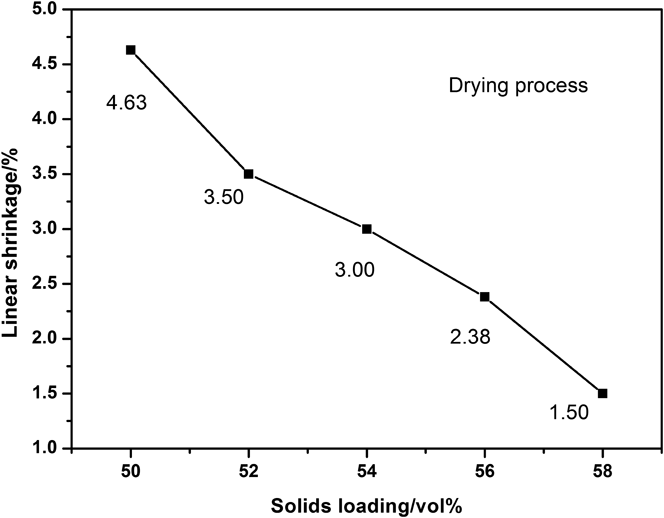
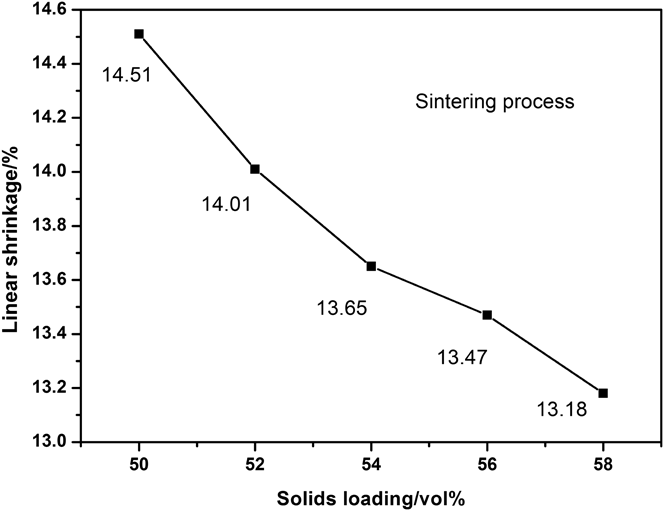
The effect of solids loading on linear shrinkage during the drying and sintering processes was shown in Figs. 6 and 7, respectively. Consequently, a smaller linear loss after drying and sintering was respectively obtained with 58 vol% solids loading (1.50 and 13.18% loss) than with 50 vol% solids loading (4.63 and 14.51% loss). It is clear that a higher solids loading is helpful to decrease the shrinkage ratio during the drying and sintering processes, which is especially valuable when manufacturing large-sized ceramic products.
The effect of solids loading on linear shrinkage during the drying process.
The effect of solids loading on linear shrinkage during the sintering process.
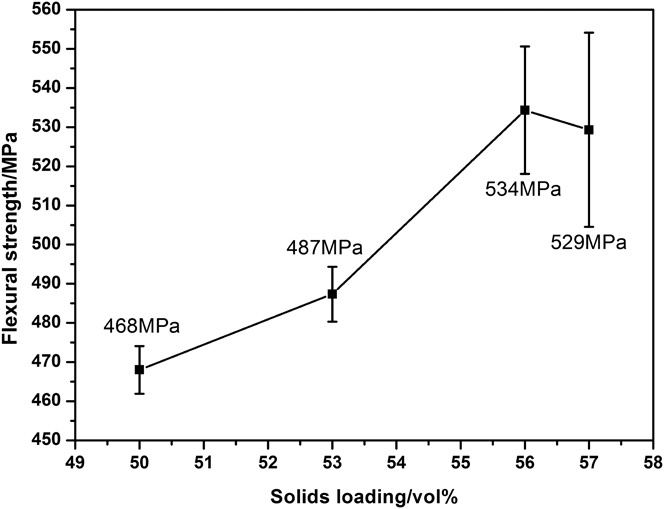
The effect of solids loading on flexural strength was examined in Fig. 8. The strength of sintered samples increased as solids loading of the slurries increased, although all the samples had a similar relative density of 98%. The flexural strength of ceramics made from 56 vol% solids loading slurries was 534 MPa. This higher strength was due to the smaller defect size in the presintered body, which was based on the lower porosity of the presintered body (Fig. 4). However, ceramics manufactured using higher solids loading of 57 vol% would bring difficulty in removing bubbles due to high viscosity slurry.Reference Maleksaeedi, Paydar and Ma17 Vacuum degassing did not resolve this issue. The residual bubbles were not easy to be completely excluded after sintering, which decreased the flexural strength of the final ceramic products.
The effect of solids loading on flexural strength of alumina samples.
IV. CONCLUSIONS
We developed a new kind of nontoxic, water-soluble copolymer with a low molecular weight of 5500–6500 (Ib600) for use in high solids loading slurries. The dispersing ability of Ib600 was greater than that of Ib104, although the gelation ability of Ib600 was less than that of Ib104. The slurry with 56 vol% solids loading by the addition of 0.2 wt% Ib600 and 0.1 wt% Ib104 had the best performance. The resultant presintered body had a high relative density of 60.4%, low drying and sintering linear shrinkage (2.38% and 13.47%, respectively). A final ceramic product had a high flexural strength of 534 MPa. In short, the present gelcasting system is effective for preparing samples with low drying shrinkage and low sintering shrinkage, which is beneficial for controlling deformation or cracking when manufacturing large-sized or complicated parts.
ACKNOWLEDGMENTS
The authors would like to thank Kuraray Co. Ltd. and Kao Co. Ltd. of Japan for donating organic materials. The authors would like to thank Mr. Yoshihiro Yoshioka of Kuraray Polymer Co., Ltd., Japan, for his helpful discussion and donation of organic materials for this study. We also thank Prof. Hidehiro Kamiya from Tokyo University of Agriculture and Technology, Japan, for his helpful discussions.