Introduction
A broad body of literature has been published in the last decade on anisotropic surfaces exhibiting directional wetting properties (also see the Liu et al. article in this issue).Reference Bush and Hu1–Reference Kwak, Jeong, Kim, Yoon and Suh5 We highlight here the most recent additions to this field, including directional membranes, directional electrowetting, directional imbibition, directional checkerboard surfaces, ratchet surfaces, and, finally, recent computational advances to model droplets on chemically and geometrically patterned surfaces.
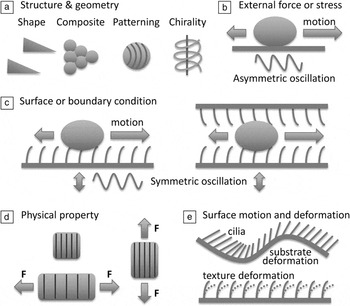
The term “wetting” refers to the degree to which a liquid can wet a given surface (see the Introductory article in this issue). Anisotropic wetting is the directional dependence of wettability due to asymmetric physical or chemical patterns in a material’s surface. To determine the anisotropy of a surface, five factors should be considered: the asymmetry of (1) the structure and geometry; (2) the external field or stress; (3) the boundary conditions (i.e., constraints on the surface); (4) a physical property (i.e., generalized anisotropic constitutive relations), for example the stress-strain relation; and (5) the resulting deformation (Figure 1).Reference Hancock, Sekeroglu and Demirel4 A recent review on bioinspired directional surfaces classified these variations in detail.Reference Hancock, Sekeroglu and Demirel4
The sources of anisotropy of a surface include the asymmetry of (a) the structure and geometry, (b) the external force or stress, (c) the boundary conditions, (d) the physical property, and (e) the resulting surface motion or deformation. In part (d), the anisotropic physical property could be elasticity, such that when a force F is applied in different directions, the spacing of the surface roughness (black lines) changes in different ways. Part (a) is reprinted and (b–d) are adapted with permission from Reference 4. © 2012 Wiley-VCH.

Fabrication and synthesis of anisotropic surfaces
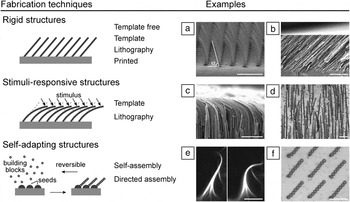
The array of techniques used to fabricate anisotropic surfaces is outlined in Figure 2. These techniques can be categorized as (1) rigid structures, (2) stimuli-responsive structures, or (3) adaptive structures. Numerous techniques for manufacturing rigid anisotropic surfaces have been developed, ranging from templated and template-free deposition to photolithography to direct printing (Figure 2a–b).Reference Hsu, Woan and Sigmund3–Reference Kwak, Jeong, Kim, Yoon and Suh5, Reference Malvadkar, Hancock, Sekeroglu, Dressick and Demirel51,Reference Yoon, Jeong, Kim, Kang, Tahk, Char and Suh80,Reference Yan, Gao and Barthlott81 Linear grooves produced via direct micro-machiningReference Yoshimitsu, Nakajima, Watanabe and Hashimoto6 and lithography have produced surfaces with a preferred axis of wetting. Recently, directional membranes were engineered that provided a wettability gradient along the thickness direction that coupled local geometry and chemical contact angles to cause anisotropic liquid penetration.Reference Tian, Li and Wang7 Such directional membranes are potentially useful for fluid control, membrane separation, and advanced fabrics. Contact angles and adhesion may also be altered through electrowetting, which causes a local voltage-induced molecular reorganization near the solid–liquid interface.Reference Luo, Gupta and Frechette8 Such an approach can direct and deform drops when subjected to a constant external driving force such as gravity.Reference Luo, Gupta and Frechette8 Theoretical simulations have shown that electrowetting can modify the shape of the liquid–liquid interface between two dielectric liquids, yielding a fluidic ratchet mechanism that can propel the fluid.Reference John, Hänggi and Thiele9
Fabrication techniques for directional surfaces may be categorized as rigid structures, stimuli-responsive structures, and adaptive structures. (a) Polymer coated nano-hairs tilted at an angle α. Reprinted with permission from Reference 80. © 2009 Elsevier. (b) Parylene nanofilms with tilted nanorods acting like nanoratchets. Reprinted with permission from Reference 51. © 2010 Nature Publishing Group. (c) Stimuli-responsive poly(hydroxyethyl methacrylate) nanotubes tilted under shear. See text for details. (d) Magnetically actuated poly(dimethylsiloxane) rods. Reprinted with permission from Reference 20. © 2010 National Academy of Sciences, U.S.A. (e) Cilia-like beating of microtubules assembled with depletion forces on a surface. Reprinted with permission from Reference 78. © 2011 AAAS. (f) Directed self-assembly of spherical superparamagnetic particles in an external magnetic field. Reprinted with permission from Reference 79. © 2010 National Academy of Sciences, U.S.A. Scale bars are (a) 1 μm, (b) 5 μm, (c) 5 μm, (d) 5 μm, (e) 30 μm, and (f) 20 μm.

Engineered surfaces exist that change their wetting properties on command or in response to stimuli. Stimuli responsive surfacesReference Tokarev, Motornov and Minko10 can change their physicochemical properties in response to changes in their environment (e.g., pH, temperature, volume stress). In nature, such dynamic surfaces are used by beetles for defense and by water striders to lay eggs via secretion of a biological wax.Reference Bush, Hu and Prakash2 Fabrication of polymeric stimuli responsive nanofiber or nanotube structuresReference Sun, Zussman, Yarin, Wendorff and Greiner12 using co-electrospinningReference Sun, Zussman, Yarin, Wendorff and Greiner12–Reference Dong and Jones14 or template based methodsReference Lee, Oh, Kim and Jang15–Reference Jang, Lim, Lee and Hyeon17 have also been reported. Integration of one or more stimuli-responsive polymers into nanostructures could enhance the sophistication of engineered surfaces. The fabrication of directional nanofilms incorporating stimuli responsive polymers is challenging due to the limitations of deposition techniques. Recently, we demonstrated the fabrication of stimuli responsive nanofilms using chemical vapor deposition.Reference Ozaydin-Ince, Demirel, Gleason and Demirel18,Reference Ozaydin-Ince, Gleason and Demirel19 The nanofilms were fabricated by conformally coating the template membranes with a pH responsive polymer. Specifically, we used vapor deposition of cross-linked poly(hydroxyethyl methacrylate), a pH responsive hydrogel, and sheared the surface to create tilted structures (Figure 2c). Another example of a stimuli-responsive directional surface consists of a soft surface that is powered by external magnetic fields. This surface, which mimics artificial cilia, was fabricated using poly(dimethylsiloxane) and magnetic nanoparticles (Figure 2d).Reference Shields, Fiser, Evans, Falvo, Washburn and Superfine20
There is also a great need for assembly approaches to enable rapid and scalable fabrication of self-adapting directional surfaces with predefined geometrical and topographical features and multiple material types. Although self- and directed assembly techniques (Figure 2e–f) were used to fabricate textured surfaces,Reference Sanchez, Welch, Nicastro and Dogic78,Reference Vilfan, Potočnik, Kavčič, Osterman, Poberaj, Vilfan and Babič79 to our knowledge, the number of reports related to directional wetting surfaces incorporating assembly mechanisms is very limited.Reference Xia, Johnson and López21
Form and function of anisotropic surfaces
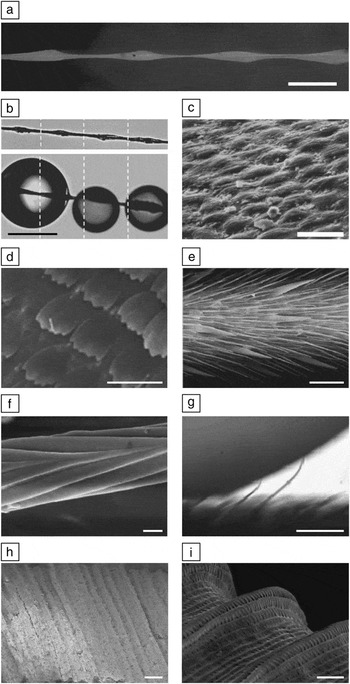
A vast amount of literature exists on natural examples of directional surfaces (Figure 3). Spider silk collects water via a wet adhesion ratcheting mechanism (Figure 3a–b).Reference Zheng, Bai, Huang, Tian, Nie, Zhao, Zhai and Jiang22 After wetting, directional structures form along the silk that create repeating gradients in surface energy and Laplace pressure (i.e., equilibrium pressure difference across an interface) and induce continuous condensation and directional water drop collection.Reference Zheng, Bai, Huang, Tian, Nie, Zhao, Zhai and Jiang22 The wings and legs of insects have directional surfaces for thrust generation, drag reduction, water repellency, and water collection.Reference Bush, Hu and Prakash2,Reference Gao and Jiang23,Reference Prakash and Bush24 The desert beetle Stenocara sp. uses its bumpy back surface consisting of alternating hydrophobic, wax-coated and hydrophilic, non-waxy regions to capture water from fog-laden wind for drinking (Figure 3c).Reference Parker and Lawrence25 Butterfly wings have overlapping strips with directed flexible nanoscale tips to allow dew or rain droplets to slip off the wing away from the body but not move toward the body (Figure 3d).Reference Zheng, Gao and Jiang26,Reference Byun, Hong, Saputra, Ko, Lee, Park, Byun and Lukes27 Water strider legs have hairy surfaces with oriented fibers with multiple length scales of roughness to allow them to walk and propel themselves on the free surface of water (Figure 3e–f).Reference Gao and Jiang23,Reference Feng, Gao, Wu, Jiang and Zheng28 The adhesive force between the water strider leg and water droplets has been measured in the laboratory (Figure 3g).Reference Prakash and Bush24 In the plant world, directional surfaces are used to capture insects and direct rainwater. For example, rice leaves have multiple length scales of roughness to form an anisotropic sliding surface that directs rainwater (Figure 3h).Reference Gao, Liu, Xu, Wang and Zhang29,Reference Wu, Wang, Wu, Chen, Zhao, Zhang, Sun and Jiang30 The directional leaves on pitcher plants capture, retain, and digest insects, while preventing insect attachment by lubrication of the plant surface (Figure 3i).Reference Bohn and Federle31
Structured surfaces for anisotropic wetting in nature. (a) Wet-rebuilt silk of the cribellate spider. Scale bar is 50 μm. (b) Water collection on spider silk. Images at initial (top) and later (bottom) times shown. Dashed lines are visual guides linking fixed positions along the silk between the two images. Scale bar is 100 μm. (a–b) Reprinted with permission from Reference 22. © 2010 Nature Publishing Group. (c) The water-capturing surface on the back of a desert beetle Stenocara sp. Scale bar is 10 μm. Reprinted with permission from Reference 25. © 2001 Nature Publishing Group. (d) Overlapping microscales on the wings of the butterfly Lepidoptera Papilio xuthus (Linnaeus). Scale bar is 100 μm. Reprinted with permission from Reference 27. © 2009 Elsevier. (e) Oriented microsetae on the non-wetting leg of the water strider. Scale bar is 40 μm. (f) Nanoscale grooved structures on a microseta from (e). Scale bar is 400 nm. (e–f) Reprinted with permission from Reference 23. © 2004 Nature Publishing Group. (g) Receding contact line of a droplet moving across the cuticle of a water strider. Scale bar is 100 μm. Reprinted with permission from Reference 24. © 2011 Elsevier. (h) Multiple length scales of roughness on rice leaf surfaces enable anisotropic sliding. Scale bar is 200 μm. Reprinted with permission from Reference 30. © 2011 Wiley-VCH. (i) Surface of peristome (region near mouth) of the Nepenthes pitcher plant has two length scales of ridges. Scale bar is 100 μm. Reprinted with permission from Reference 31. © 2004, National Academy of Sciences, U.S.A.

A host of research exists on the wetting of chemically patterned surfaces, both in the context of slip and drag reductionReference Rothstein32–Reference Vellingiri, Savva and Kalliadasis36 and adhesion.Reference Hancock, Sekeroglu and Demirel4,Reference de Gennes37,Reference de Gennes, Brochard-Wyart and Quéré38,Reference Kusumaatmaja and Yeomans60,Reference Anantharaju, Panchagnula and Vedantam75 Recent work related to anisotropy includes the experimental study of the anisotropic wetting on checkerboard patterned surfaces, in which central continuous lines present in the patterns strongly influence the trajectories and dynamic wetting of droplets.Reference Zhang, Cai and Mi44 On the theoretical side, analytical theory combined with dissipative particle dynamics simulations (i.e., a particle based stochastic simulation technique for predicting the dynamics of fluids) predicted the anisotropic flow in a parallel-plate channel with two superhydrophobic striped walls.Reference Zhou, Belyaev, Schmid and Vinogradova45
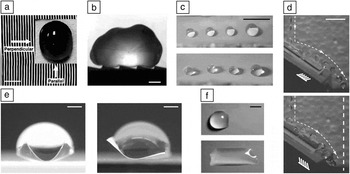
A vast volume of literature also exists on the slip and wet adhesion properties of surfaces with geometrical roughness.Reference Rothstein32–Reference McHale, Newton and Shirtcliffe35,Reference Kwon, Choi, Anantharaju, Lee, Panchagnula and Patankar39–Reference Quéré43,Reference Ybert, Barentin, Cottin-Bizonne, Joseph and Bocquet46–Reference Davis and Lauga48 Grooved surfaces can exhibit directionally dependent contact angles that result in elongated drops (Figure 4a).Reference Zhao, Lu, Li and Li49 For non-wetting roughness, ratchet surfaces have been developed to propel drops when heatedReference Lagubeau, Le Merrer, Clanet and Quéré50 (Figure 4b) or vibrated; a number of studies exist on microratchet surfaces, as recently reviewed,Reference Hancock, Sekeroglu and Demirel4,Reference Malvadkar, Hancock, Sekeroglu, Dressick and Demirel51 while fewer exist on nanoratchet surfaces.Reference Malvadkar, Hancock, Sekeroglu, Dressick and Demirel51,Reference Sekeroglu, Gurkan, Demirci and Demirel52 Drop motion can persist over long distances, along circular paths, and up or downhill.Reference Duncombe, Erdem, Shastry, Baskaran and Böhringer53 Specific drop volumes resonate at specific frequencies, providing a means to selectively propel multiple microliter-sized drops,Reference Duncombe, Erdem, Shastry, Baskaran and Böhringer53 in some cases with cargo, while also enabling drop coalescence (Figure 4c).Reference Sekeroglu, Gurkan, Demirci and Demirel52 Drops impacting certain surfaces with directional roughness bounce further with the grain than against (Figure 4d).Reference Hancock, Sekeroglu and Demirel4 Moreover, directional roughness can affect the folding of elastic substrates. In Figure 4e, isotropic polymer sheets (poly(dimethylsiloxane), left) and asymmetric parylene sheets (right) were folded by evaporating water droplets.Reference Hancock, Sekeroglu and Demirel4 The isotropic and asymmetric sheets folded in symmetric and asymmetric fashions, respectively.Reference Hancock, Sekeroglu and Demirel4 This type of capillary driven folding is used by plants to protect their genetic material during times of flooding.
Engineered surfaces with directional wetting properties. (a) Drop elongation on a grooved surface. Scale bar is 2 μm. Reprinted with permission from Reference 49. © 2007 American Chemical Society. (b) Directional milliratchet surface for drop transport by the Leidenfrost effect. Scale bar is 1 mm. Reprinted with permission from Reference 50. © 2011 Nature Publishing Group. (c) Drop transport powered by mechanical vibration on a directional nanorod surface without (top) and with (bottom) cargo (microscale objects). Scale bar is 5 mm. Reprinted with permission from Reference 52. © 2011 American Institute of Physics. (d) Drops impacting a directional surface with the grain (top) bounce further than those impacting against (bottom). Scale bar is 1 cm. Reprinted with permission from Reference 4. © 2012 Wiley-VCH. (e) Polymer sheets coated with isotropic (left) and directional (right) surfaces fold symmetrically and asymmetrically, respectively, by evaporating droplets. Scale bar is 4 mm. Reprinted with permission from Reference 4. © 2012 Wiley-VCH. (f) Directional droplet spreading on a directional nanorod surface. Scale bar is 1 mm. Reprinted with permission from Reference 58. © 2010 Nature Publishing Group.

One of the greatest dangers to the stability of elastic fibrous surfaces is clumping due to liquid capillary bridges drawing pairs of fibers together with a force per length equal to twice the surface tension.Reference Bush, Hu and Prakash2,Reference Rabinovich, Esayanur and Moudgil54 The stability of a fibrous array is determined by the fiber rigidity, geometry, capillary force, and droplet volume.Reference Kim and Mahadevan55–Reference Duprat, Protière, Beebe and Stone57
A number of experimental studies exist on directing fluids through wettable anisotropic geometrical roughness, called directional imbibition. One such surface uses tilted pillars to induce directional spreading of water droplets (Figure 4f).Reference Chu, Xiao and Wang58
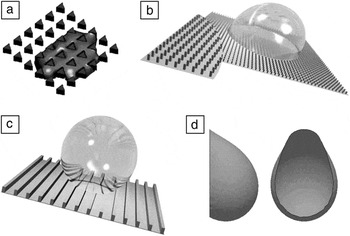
A host of approaches have been used to simulate the wetting behavior and motion of droplets and continuous fluid on directional surfaces. For example, a scaling law was recently developed for the dynamics of directional imbibition.Reference Obara and Okumura59 Such scaling laws are invaluable to the design of future directional surfaces. Reviews exist for certain popular approaches such as analytic theory, finite element simulations, Lattice Boltzman method (LBM), phase field, and molecular dynamics (MD).Reference Hancock, Sekeroglu and Demirel4,Reference Kusumaatmaja and Yeomans60,Reference Kusumaatmaja, Yeomans, Hoekstra, Kroc and Sloot61 LBM is a popular phase-field diffuse-interface approach that has been used to solve an array of dynamic wetting problems, including imbibition (Figure 5a)Reference Blow, Kusumaatmaja and Yeomans62 and droplets sliding on inclined grooved or pillared substrates (Figure 5b–c).Reference Hyväluoma, Koponen, Raiskinmäki and Timonen41 At the nanoscale, MD simulations have enabled predictions of the continuous unidirectional flux of water across deformed carbon nanotubes (CNTs) driven by an external oscillating charge without osmotic pressure or a hydrostatic pressure gradient.Reference Lu, Nie, Wu, Zhou, Kou, Xu and Liu63 Other MD simulations have predicted the motion of nanodroplets through CNTs with surface energy gradients.Reference Kou, Mei, Lu, Wu and Fan64
Theoretical simulations of surface wetting. (a) Lattice Boltzmann simulation of liquid spreading directionally through triangular pillars. Reprinted with permission from Reference 62. © 2009 Institute of Physics. (b–c) Lattice Boltzmann simulations of drops on pillared and grooved surfaces, respectively. Adhesion is evident on the pillared surface. Reprinted with permission from Reference 41. © 2007 Springer-Verlag. (d) Side (left) and underside (right) views of Surface Evolver predictions of a drop stuck to a vertical wall by contact angle hysteresis. Reprinted with permission from Reference 72. © 2012 Springer-Verlag. While both the Lattice Boltzmann and Surface Evolver methods must be thoroughly validated against laboratory experiments, they both have great potential to provide efficient estimates of droplet behavior on directional surfaces.

A surface has inherent contact angle hysteresis (i.e., exhibits contact angles that range between the receding and advancing angle; see the Introductory article in this issue).Reference Johnson, Dettre and Fowkes65–Reference Dettre and Johnson67 Such hysteresis is responsible for wet adhesionReference Dussan V and Chow68,Reference Extrand and Kumagai69 and is therefore an important mechanism for designing and fabricating surfaces for directional wet adhesion.Reference Malvadkar, Hancock, Sekeroglu, Dressick and Demirel51 The ability to include the advancing and receding angles of each underlying material in a numerical simulation is therefore very important. This issue was recently addressed by incorporating a model for the mobility of the three-phase contact line within Surface Evolver, an easy-to-use public domain finite element package.Reference Brakke70–Reference Prabhala, Panchagnula and Vedantam72 The contact line mobility model was based on a phase field model of surface wetting by sessile drops,Reference Vedantam and Panchagnula73,Reference Vedantam and Panchagnula74 and its two inputs were the advancing and receding angles of the underlying material. A version of this Surface Evolver model was used to model the advancing and receding of a free surface on a checkerboard pattern,Reference Kwon, Choi, Anantharaju, Lee, Panchagnula and Patankar39 the shape of a pendant drop on a vertical surface just prior to sliding (Figure 5d),Reference Prabhala, Panchagnula and Vedantam72 equilibrium shapes of coalescing sessile drops on hysteretic surfaces,Reference Prabhala, Panchagnula and Vedantam72 and coalescing puddles under the influence of gravity and hysteresis.Reference Prabhala, Panchagnula and Vedantam72 The phase field model itself was previously used to study the wetting of a chemical checkerboard pattern where each of the two component materials exhibited hysteresis.Reference Anantharaju, Panchagnula and Vedantam75 Though these recent computational models must still be thoroughly validated against laboratory experiments, they provide a much more computationally efficient method of prediction for a wide range of dynamic wetting problems.
A second challenge with Surface Evolver simulations, and any finite element simulations for that matter, is the parameterization of the patterned surface and solution near it. In the case of Surface Evolver, the solid-liquid interface cannot, in general, be modeled with facets, since individual facets may grow or shrink in order to shortcut the curvature of a hydrophobic solid, while facets may overlap or move over the contact line for hydrophilic solids.Reference Blow and Yeomans76 To address this issue, the free energy integrals over the solid-liquid surface were converted to line integrals and embedded within the Surface Evolver simulation script to improve the accuracy and convergence of the algorithm.Reference Blow and Yeomans76 Such an approach allowed the prediction of the Cassie to Wenzel wetting transition (the two main regimes of wetting that occur on structured surfaces) on posts of arbitrary shape, including vertical and inclined posts as well as curved fibers.Reference Blow and Yeomans76 The simulations showed that curved fibers were more efficient at stabilizing the Cassie state than straight posts. In addition, the simulations yielded important design information, including the location where the interface first depinned.Reference Blow and Yeomans76
Summary and outlook
We have summarized recent research on the wetting of anisotropic surfaces by categorizing their fabrication methods, characterizing their anomalous features, and exploring their wide range of applications. Various computational modeling tools are available to predict the directional wetting properties of asymmetric surfaces. New anisotropic surfaces with stimuli-responsive and adaptive features are currently under development. In addition, novel approaches are being developed to enhance the functionality, applicability, characterization, and theoretical modeling of anisotropic wettability.
Directional surfaces not only mimic biological surfaces, but also provide new avenues to discover surface phenomena beyond those in nature. For example, fabrication of adaptive (e.g., self or directed assembly) and stimuli-responsive (e.g., pH, temperature, or magnetic) surfaces will provide novel physicochemical properties in wetting, adhesion, and transport. Nanotextured surfaces made from environmentally friendly materials (e.g., keratin, elastin, laminin, or other elastic proteins) will also be in high demand.Reference Hu, Cebe, Weiss, Omenetto and Kaplan77 Directional surface technology, while still largely confined to laboratory settings, can make a significant impact on the medical and energy fields if these surfaces are integrated into efficient, inexpensive, and environmentally friendly devices.
Acknowledgments
The authors gratefully acknowledge financial support for this work from the National Institutes of Health and The Pennsylvania State University.