Memories of war can remain relevant in the political arena for decades after the conflict has ended, particularly in polities where significant segments of the population directly experienced large-scale violence. Wars create victims, refugees, veterans – populations in need of special public policy attention. In the hands of skilled political entrepreneurs, war memories can also be perfect sources of discursive fodder for political differentiation and mobilization. In many post-war polities, war memories and narratives of painful pasts are revived in public discourse with troubling regularity (Chirot et al. Reference Chirot, Shin and Sneider2014; Smith and Barkhof Reference Smith and Barkhof2018). Real public policy needs of vulnerable populations are often used for ideological and political purposes, raising serious questions about who represents those most affected by wartime violence and what role this representation has in the perpetuation of war-related narratives in public discourse.
This has particularly been the case in post-war countries where the conflicts – although ended – remain politically salient and where political competition has given rise to a class of politicians with first-hand experience of armed combat. A substantial literature, often contextually focused on the US, has found that veteran and non-veteran politicians do indeed differ in the way they represent their constituents, particularly when it comes to policy positions on defence, foreign policy and national security (Best and Vonnahme Reference Best and Vonnahme2019; Karsten Reference Karsten2012; Stadelmann et al. Reference Stadelmann, Portmann and Eichenberger2015, Reference Stadelmann, Portmann and Eichenberger2018). Unfortunately, we know far less about the nature of this distinction between veteran and non-veteran politicians when it comes to representation of groups directly affected by war violence, especially in post-war societies where significant numbers of former combatants, victims and returnees have faced serious challenges when reintegrating into post-war lives. Do war veteran politicians in such post-war contexts represent vulnerable populations created by war differently from their non-veteran counterparts? Is this difference in representation reflected in the kinds of narratives they use when they speak about the wartime past and the populations affected by the war violence? And, if this representational and discursive difference between veteran and non-veteran politicians indeed does exist, how is it related to their ideological orientations?
We answer these questions by using natural language processing tools to analyse the content and sentiment of the discourse of the members of the Croatian parliament (Sabor) during the period surrounding two of the most recent and most prominent debates on the consequences of Croatia's 1991–95 War of Independence (locally known as the Homeland War) which were held in 2012 and 2017. Croatia, as a case representing a much broader group of conflicts of the 1990s, is a perfect example of a context where war has remained highly politically salient and present in public discourse to this day and where veterans with direct experience of armed combat have taken significant political positions (Dolenec Reference Dolenec2017; Gödl Reference Gödl2007; Sokolić Reference Sokolić2019). Unlike many other countries affected by war, however, Croatia offers an exceptional wealth of reliable data on the level of individual parliamentarians, including the length and nature of their war-related military service.
The debates we analyse concern changes to the legislation related to the system of social benefits enjoyed by war veterans, victims and members of their families, as well as to the publication of the registry of Croatian war veterans. These issues struck at the core of Croatia's post-war political conflict regarding the role of the War of Independence and the populations created by it in Croatia's society. Although different cases might have different trigger points fuelling their war-related debates, we argue that the underlying logic of preserving/challenging the legacy of a past war by certain groups of politicians in post-war societies should be universal. Our analysis is based on an original corpus of more than 4 million words spoken in nearly 13,000 MP speeches officially recorded and transcribed by the Croatian Sabor, as well as the database of biographical information we collected on all Croatian MPs, including the length of their military service and exposure to combat during Croatia's War of Independence.
The results of our analysis clearly demonstrate that veteran MPs indeed do differ from their non-veteran counterparts when debating policy issues related to the War of Independence and its consequences. Specifically, veteran MPs bring discursively richer perspectives of the hardship and trauma endured by war-affected populations during and after the war. Their speeches are also more likely to be loaded with negative sentiment in proportion to the level of their exposure to actual combat. Conversely, their non-veteran counterparts are more focused on the technical aspects of the proposed legislation and are less likely to use discourse loaded with negative sentiment. While these findings hold regardless of the MP's ideological orientation, ideology does play a significant role in discourse used when debating issues related to the war and its consequences. Right-wing nationalist politicians are much more likely to use discourse loaded with positive sentiment when talking about the war, stressing the role of the war veterans and victims in Croatia's victory and the protection of its contemporary statehood. What is particularly important is that they are even more likely to use this kind of discourse when they are in government, demonstrating how the heavily politicized and ideologized discourse related to the war is dependent on the balance of political power. The analysis presented in this article has implications for our understanding of the representational role played by combat veterans in the politics of post-war societies in general. It also broadens the debate on the link between descriptive and substantive representation, particularly for social groups with such high symbolic status as war veterans and victims.
War veterans and parliamentary representation
War has a profound impact on people's lives. It affects the personalities, preferences and values of those who experience it. As humans perceive what goes on around them within a frame of reference critically determined by such a distinctive previous experience of exposure to violence, their behaviour is conditioned by it in many social situations (Matthews Reference Matthews1967). This applies equally to political leaders and to the general population. In the context of elected officials, a number of authors have shown that personal backgrounds of politicians significantly affect their policy choices (Burden Reference Burden2007; Washington Reference Washington2008). The studies of James Goldgeier (Reference Goldgeier1994) and Robert Jervis (Reference Jervis2017), for example, demonstrate that prior experiences have a heuristic function that drives how people estimate the potential costs and benefits of their choices and the types of strategies they view as likely to succeed.
The relevance of prior experiences is further highlighted by a large literature on substantive representation which harks back to the theory of presence by Anne Phillips (Reference Phillips1995) and its links to the theory of representation as formulated by Hanna Pitkin (Reference Pitkin1967). Pitkin argued that descriptive representation is something that aims to capture, in a visible way, the character of the nation or of public opinion. Descriptive representation most often refers to the notion that a group chooses representatives mirroring the experiences and manifestations of the selectors (Mansbridge Reference Mansbridge1999). Chosen representatives are then in a narrow sense archetypes representing a larger class with certain manifested characteristics (Phillips Reference Phillips1995). According to this theory, ethnic or gender-based groups may select a representative with embodied characteristics typical for that group as they expect them to be politically relevant. The poverty of this notion, according to Pitkin, is its emphasis on the composition of a political institution rather than its activities, because individuals cannot be held to account for ‘who they are’ but only for ‘what they have done’ (Celis et al. Reference Celis2008; Pitkin Reference Pitkin1967). Substantive representation, on the other hand, captures the relationship between the represented and representative in which the represented are ‘logically prior’, whereby the representatives must be responsive to the represented and not the other way around. In most circumstances, this implies that the wishes of the represented and the actions of the representative will converge (Celis et al. Reference Celis2008: 100; Pitkin Reference Pitkin1967: 163–165).
The most robust body of research utilizing the distinction between descriptive and substantive representation focuses on women and argues that female MPs are better suited to defend the interests of women due to shared experiences that are unique to women. The argument behind it is that experiences generate different perspectives on policy issues or new issue priorities altogether (Wängnerud Reference Wängnerud2009). This line of argumentation serves as one of the primary justifications for gender quotas, which have increasingly found their way into electoral rules (Dahlerup and Freidenvall Reference Dahlerup and Freidenvall2010), and not without cause. Female MPs indeed do behave and vote differently from male MPs (Lawless Reference Lawless2015). Furthermore, Michele Swers (Reference Swers2005) finds that the policy preferences of elites do reflect gender differences in the mass public and voter expectations concerning the policy expertise of women candidates. These differences are constrained by changes in the political and institutional contexts since women increase their activity on social welfare issues when they gain access to strategic positions of power, particularly majority party status, to a greater extent than do similarly situated men. In a similar fashion, Jessica Gerrity et al. (Reference Gerrity, Osborn and Mendez2007) find that women who replace men in the same district are more likely to focus on ‘women's issues’, such as gender equity, child care, employee flexible time, abortion, minimum-wage increases and the extension of the food-stamp programme.
Further research has expanded the scope to include social class (Carnes Reference Carnes2012), education (Bovens and Wille Reference Bovens and Wille2017) and ethnicity (Saalfeld and Bischof Reference Saalfeld and Bischof2013; Wallace Reference Wallace2014). For instance, Nicholas Carnes and Noam Lupu (Reference Carnes and Lupu2015) show that pre-voting decisions like sponsoring legislation often differ dramatically along social class lines, even when political parties control higher-visibility decisions such as roll-call votes. David Broockman (Reference Broockman2013) found that black politicians in the US Congress are more intrinsically motivated to advance blacks’ interests than their counterparts are. Using experimental design, he finds that while non-black legislators are markedly less likely to be responsive when their political incentives to do so are diminished, black legislators tend to continue responding even when doing so promises little political reward. Mark Bovens and Anchrit Wille (Reference Bovens and Wille2017) in their book Diploma Democracy discuss how formal education of legislators affects policy agenda, priorities and goals. They argue that a more descriptive representation based on the level of education may remedy some of the representative deficits (i.e. the dominance of legislators who have higher education and thus a higher likelihood of holding worldviews unrepresentative of the general population) currently present in the political arenas of old Western democracies (Bovens and Wille Reference Bovens and Wille2017: 146–154, 177–181).
We argue that a similar logic applies to MPs who are war veterans. Just like MPs who come from working-class backgrounds, or who are women or members of ethnic minorities, MPs who are war veterans are distinguished from their non-veteran colleagues by their unique and profound experiences. Kenneth Lowande et al. (Reference Lowande, Ritchie and Lauterbach2019) in their recent study on descriptive and substantive representation in the US Congress find that women, racial/ethnic minorities and veterans are more likely to work on behalf of constituents with whom they share identities. Veterans especially offer leverage in understanding the role of political cleavages and shared experiences. Michael Horowitz and Allan Stam (Reference Horowitz and Stam2014), for example, show that leaders with prior military service, but not combat experience, are significantly more likely to initiate militarized disputes and wars than other leaders. David Stadelmann et al. (Reference Stadelmann, Portmann and Eichenberger2015) similarly find that Swiss politicians who served in the military have a higher probability of accepting pro-military legislative proposals. Scott Gartner et al. (Reference Gartner, Segura and Barratt2004) find that state-level casualties and military experience affected candidate positions on the Vietnam War. In another study, Stadelmann et al. (Reference Stadelmann, Portmann and Eichenberger2018) show that politicians who have served in the military do not differ from those who have not served when comparing their voting behaviour on issues related to female welfare and welfare of the weak and disabled, but do differ when it comes to accepting proposals on neutrality or proposals linked to international human rights and the environment. Peter Feaver and Christopher Gelpi (Reference Feaver and Gelpi2011) show that top US military officials involved in the debate on the invasion of Iraq appeared reluctant to use force, while the most hawkish voices in the government were civilians who had not served in uniform. In another study, they find that as the percentage of veterans serving in the executive branch and the legislature increases, the probability that the US will initiate militarized disputes declines. Once a dispute has been initiated, however, the higher the proportion of veterans, the greater the level of force the US will use in the dispute. In this context, military leaders tend towards greater reluctance in adopting a military solution to a diplomatic problem but, if the military is to be used, they favour fewer restrictions so the military could use force in a quick and decisive manner (Gelpi and Feaver Reference Gelpi and Feaver2002).
In general, the expectation in the civil–military literature is that veteran legislators and other government officials will think and behave differently from their non-veteran colleagues (Holsti Reference Holsti1998, Reference Holsti, Feaver and Kohn2001; Miles and Haider-Markel Reference Miles and Haider-Markel2019; Sarkesian et al. Reference Sarkesian, Williams and Bryant1995). However, normative democratic theory emphasizes the importance of MPs’ behaviour not only during a vote on a particular policy proposal, but also during the course of debate and deliberation (Manin Reference Manin2010). Indeed, legislatures were not envisioned as places where agents came together simply to vote as instructed by their principals, but rather as chambers that would arrive at a decision through debate and discussion. Moreover, even if veteran MPs cannot change the outcome of a vote by their numbers, their contributions to the debate and the perspectives they bring to the legislature are arguably their most important representational acts. How then do war veteran MPs act during parliamentary debates?
We expect that veteran MPs behave differently from non-veterans on issues that make their veteran identity salient – that is, on issues related to war or post-war policy towards populations affected by exposure to war violence, particularly other war veterans. On such issues, we believe they will distinguish themselves by emphasizing the misery and suffering experienced by war veterans and others during and after the war, as well as by highlighting aspects of veteran life that are less known to non-veteran MPs. This expectation can be linked to a body of literature focused on post-traumatic stress disorder (PTSD), veterans’ health issues, family matters and their general well-being supported by oral histories, interviews and psychological profiles (Budra and Zeitlin Reference Budra and Zeitlin2004; Miller et al. Reference Miller, Greif and Smith2003; Runnals et al. Reference Runnals2014; Tedeschi and McNally Reference Tedeschi and McNally2011). Although positive attitudes towards heroism, bravery and commemoration might prevail in certain settings (conditioned by situational dynamics), war as an event brings heavily negative connotations of death, decay and misery with prolonged impact on people's lives which is then manifested in their narratives (Sokolić Reference Sokolić2019: 141–163). Moreover, long after a war has ended, war veterans, war victims and their families are in need of care, both physical and psychological. Being naturally privy to these aspects of post-war life, we expect the plight of veterans, victims and their families to feature prominently in the way veteran MPs address related policy issues in parliament – similarly to the way female or ethnic minority MPs do for policy issues directly related to women or ethnic minorities. Veteran MPs are anticipated to engage in a discourse that is different from other MPs’, highlighting their unique status, interests and knowledge of the topic of the post-war lives of those directly affected by and exposed to war violence.
This difference between veteran and non-veteran MPs can manifest itself in two ways. The first is vocabulary. In their parliamentary speeches, we expect veteran MPs to use words and terms related to misery, suffering and hardship in a more substantive and contextually richer way. The second is sentiment. If veteran MPs do indeed focus on the negative aspects of post-war life, the sentiment of their parliamentary speeches should be more negative, regardless of whether the discussed legislation is to the benefit or detriment of war veterans, victims and their families. We expect this relationship to be proportional to the extent of veterans’ exposure to combat – that is, we expect veterans with more combat experience to speak even more negatively. This is why we hypothesize that:
Hypothesis 1: The vocabulary of war veteran MPs focuses more on the hardship endured by war-affected populations during and after the war when discussing related issues.
Hypothesis 2: The sentiment polarity of MPs’ speeches has a negative relationship with the level of the MPs’ exposure to war combat when discussing issues related to the war.
War memories are obviously often heavily politicized. These expected differences between veteran and non-veteran MPs therefore also need to be observed through the prism of political competition. In the US context, for example, veterans are more likely to be Republican than are non-veterans of comparable ages (Newport Reference Newport2009); defence policy is made in a highly partisan context (Swers Reference Swers2007) and party affiliation has a substantive effect on the behaviour of both voters and legislators concerning the issues of foreign policy, defence and war oversight (Bianco Reference Bianco2005; Carsey and Rundquist Reference Carsey and Rundquist1999; Lindsay Reference Lindsay1990; Lupton Reference Lupton2017). In the context of post-war Croatia, communities’ wartime pasts have been shown to be the most significant determinants of electoral results (Glaurdić and Vuković Reference Glaurdić and Vuković2016); war veterans have been shown to be more likely to vote for nationalist parties, though crucially only if they did not suffer from war-related trauma (Lesschaeve Reference Lesschaeve2020); political entrepreneurs have been shown to engage in continued politicization of war memories (Gödl Reference Gödl2007; Sokolić Reference Sokolić2019) and political parties have been shown to have vastly different welfare policies related to war-affected populations, grounded in part in their different connections with war veterans’ associations (Dolenec Reference Dolenec2017; Fisher Reference Fisher, Kopecky and Mudde2005).
In the Croatian context, therefore, it is safe to say that the War of Independence as a source of social memory and public policy is the crucial issue dividing the political right and the political left. This is also in line with an interest-based perspective which sees party affiliation as a proxy for interest alignment. In this context, right-wing MPs secure re-election by reaffirming positive messages about the war victory and the privileged role of veterans. Their personal history of war combat then plays the role of source of ‘ideology’ while party affiliation mediates it via party interest. In this context, the political right – primarily championed by the Croatian Democratic Union (HDZ) which led the country towards independence and throughout the war – sees Croatia's victory in the War of Independence as the foundation of the country's statehood and the source of the political right's legitimacy. This is why we believe that politicians on the right will speak in more positive terms when discussing issues related to the war. Considering the strength and importance of exposure to war combat, however, we do not expect ideology to have an effect on sentiment which is conditional on personal war experiences. This is why we hypothesize that:
Hypothesis 3: Sentiment polarity of parliamentary speeches is more positive among right-wing MPs when discussing issues related to the war.
Hypothesis 3a: This relationship is not conditioned on the level of MPs’ personal exposure to war combat.
Context, data and methods
In order to test the posed hypotheses, we analyse the speeches of the members of the Croatian Sabor during the two most recent and most prominent debates which directly dealt with the consequences of Croatia's War of Independence and which took place in 2012 and 2017. The first debate analysed concerned the new Law on Rights of Croatian Defenders and their Families, which was to place additional limits to financial benefits and was to grant public access to the Veterans’ Registry – the database of Croatia's half a million war veterans (both military and police personnel) who were involved in the 1991–95 war. The proposal of the government led by the Social Democrats (SDP) to make the Registry public was motivated by rampant allegations that many veterans either exaggerated or lied about their involvement in the war in order to obtain social and financial privileges. After a very heated debate and a string of public protests by veterans’ organizations, the SDP-led coalition passed the bill in a vote straight down party/coalition lines (89 for, 31 against, 31 abstentions) and opened the Registry for public scrutiny (Hrvatski sabor 2012). The second debate, held in 2017, also concerned the Registry, though it was not the only point on the agenda. This time the government, led by the right-wing HDZ, revoked public access to the Registry, claiming that its opening did not fulfil the proclaimed purpose as it had not led to a significant number of prosecutions of fake veterans. The government also pushed through a massive expansion of benefits for veterans and members of their families in areas such as healthcare, retirement, unemployment and education (Hrvatski sabor 2017). The vote was once again straight down party lines with 92 for, 15 against and 44 abstentions. Out of 48 war veteran MPs, only three (all three members of the SDP, including the former minister for veterans’ affairs Predrag Matić) voted against, with the bulk of opposition MPs who were veterans choosing to abstain by not even showing up to the vote.
These two debates in many ways captured the essence of the political conflict in contemporary Croatia over the symbolic and public policy status of the War of Independence and the populations created by war – veterans, victims, refugees and their families – in Croatian society. Are war veterans cheats who use and abuse their own sacrifice and sacrifices of others for financial gain? Or are they the ultimate victims who won the war but lost the battle with the administration of the country they had fought for? Was the War of Independence an unwanted and imposed war which had to be won in order to protect the country and its people, or was it simply a tool of war profiteers who used it to secure higher social status and financial benefits? While the 2012 debate was clearly more emotional and heated than the 2017 debate, both episodes served as clear policy and ideological demarcations between Croatia's political right and the political left and as vehicles of voter mobilization. Both debates were also a demonstration of veteran associations’ political power through their close connection to nationalist political parties and their effective use of the memory of the War of Independence. Their mobilization, sparked in part by the 2012 debate and changes to the Law on Croatian Veterans, was arguably crucial in the HDZ's victory in the presidential elections in 2015 and its return to power in the parliamentary elections later that same year.
The parliamentary debates we analyse were scraped from the official website of the Sabor using the R package rvest (Wickham Reference Wickham2016). The corpus covers relevant sessions which were held on 29 November and 13 December 2012, as well as 27 September and 21 November 2017. MPs from 18 parties of all ideological orientations spoke during both sessions, though the debates were dominated by the centre-right HDZ. Figure 1 shows the ideological distribution of MPs (both veteran and non-veteran) together with the distribution of speeches during both debates. As Figure 1 shows, the centre-right (i.e. the HDZ) is home to most veteran MPs. The corpus was lemmatized and tagged using the R package UDPipe with Croatian localization (Straka et al. Reference Straka, Hajič and Straková2015). The final corpus after lemmatization contains 217,536 tokens with 10,050 unique words.
Corpus Distribution by Parties’ Left–Right Placement

To assess whether differences between veterans and non-veterans are indeed triggered only when their veteran identity is made salient, we had to complement our analysis of this corpus by also analysing the months surrounding the relevant debates in 2012 and 2017. Specifically, we created an additional, larger corpus from the debates which took place approximately one month before and one month after (as well as on the dates in between) the two debates in 2012 and 2017. This larger corpus after lemmatization contains 4,170,393 tokens with 35,701 unique words and covers a whole variety of policy areas: from the budget and public procurement through local government reforms to the confidence motion in the national government. These additional debates serve as the baseline against which to compare the behaviour of MPs during the two debates relevant for the purposes of our analysis.
Our analysis basically consists of two parts. The first entails identifying the presence of differences in the political discourse of Croatian MPs depending on their ideological commitments and personal history of being a war veteran or not. To this end, we construct a corpus based on sentence-length unigrams, which are treated as reference frameworks in which the words are mentioned. Unlike alternatives for constructing word contexts (e.g. models produced by latent semantic analysis or word embeddings), this approach is less dependent on the size of the corpus as it purely quantifies co-occurrences of words in the same context without a need for their accurate vector representation. It represents a viable alternative to existing approaches for identifying preferences, positions and narratives and it can help us understand what politicians say and how they say it. This is especially helpful for information retrieval tasks applied over time, or across different subjects.
In the second part of our analysis, we focus on speech sentiment. Since natural language may contain multiple ideas with very complex sentiment charge associated with longer textual sequences, our units of analysis are not full speeches made by individual MPs. Instead, we build a data set based on sentence-based trigrams extracted on the level of individual speeches.Footnote 1 Obviously, when a sentence trigram is extracted, each chunk of text inherits the meta-information of its parent document. This is done for all 630 substantial speeches in our core corpus (giving us 7,377 data points), as well as for the 12,205 speeches in the larger corpus (giving us an additional 134,579 data points).
Each of these data points represents a unique testimony of how a speaker perceives the discussed issue. We can use this information to study sentiment polarity as an indicator of a speaker's policy preferences and his/her affinity towards what is discussed. In this context, we use a sentiment lexicon in combination with a counting algorithm to assess the overall polarity of a string of text. We use a sentilex lexicon trained on a Croatian corpus with approximately 37,000 lemmas ranked by their positivity and negativity. The ranks were created automatically based on small positive and negative seed sets and co-occurrence frequencies, using the PageRank algorithm (Glavaš et al. Reference Glavaš, Šnajder, Dalbelo Bašić and Sojka2012: 169). We perform two separate countings – one for positive and one for negative scores – which are then summed on the level of a text string and hereafter referred to as Sentiment polarity. The Sentiment polarity score indicates whether a string of text has positive or negative polarity, and is thus more negative or positive in nature. It is based on the sum of cosine distances of all words in the processed string as represented in the positive sentilex dictionary, minus the sum of cosine distances of all words as represented in the negative sentilex dictionary. Sentiment polarity is the dependent variable in this segment of our analysis.
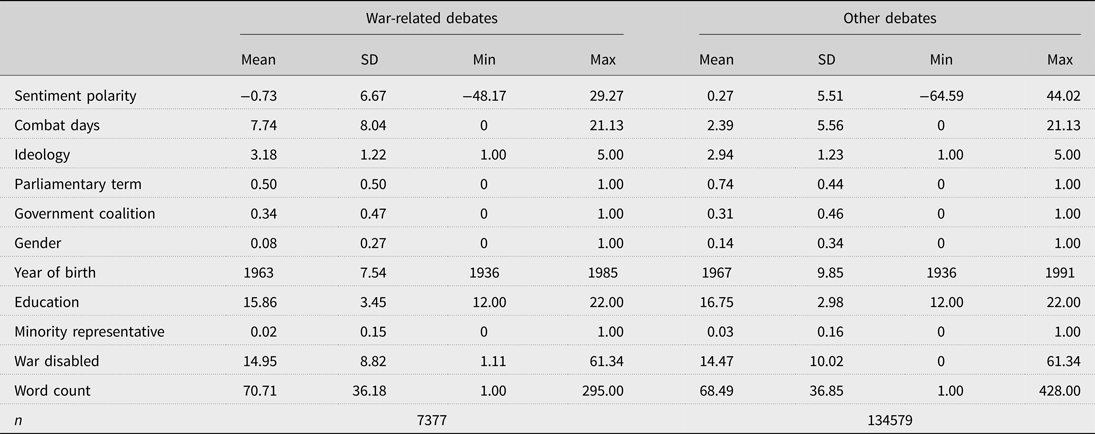
We pair each sentence-based trigram with a string of variables on the individual MPs and their political parties. Our principal explanatory variables of interest are the MPs’ veteran status and the ideological orientations of their parties. We obtained the information on MPs’ veteran status from the aforementioned Veterans’ Registry, which was available to the general public between December 2012 and December 2017. The Registry stored information on the number of days veterans served in the combat or non-combat sectors of the Ministry of Defence or the Ministry of Internal Affairs. Thus, instead of relying on a crude dichotomy between veterans and non-veterans, we employ a more fine-grained measure of MPs’ veteran experience and their exposure to war violence: Combat days. We also control for MPs’ gender, year of birth, years of education and the exposure of their municipality of residence to war violence, which we proxy with the number of war disabled reported in the 2011 census. With this last variable we wish to capture possible contextual effects of the wartime past on MPs’ post-war discourse. All information was extracted from MPs’ official online profiles and voting ballots. Our variable Ideology represents a 1–5 index of political parties’ ideological orientations: left (1), centre-left (2), centre (3), centre-right (4) and right (5). We additionally control for parties’ membership of the governing coalition, whether MPs represented ethnic minorities, as well as for the parliamentary term to distinguish between the potentially different contexts in 2012 versus 2017. Table 1 gives the descriptives of all variables.
Descriptive Values of Variables Used

Notes: Sentiment polarity values multiplied by 10 and Combat days values divided by 100 for ease of presentation of coefficients.
Results
Our first hypothesis proposed that war veteran MPs, compared with their non-veteran counterparts, focus more on the hardship endured by war-affected populations during and after the war when discussing related issues. In order to test this hypothesis, we build two models using co-occurrences of words as represented on the level of sentences. These models unveil the differences in narratives used by veteran and non-veteran members of the Croatian Sabor during the 2012 and 2017 debates. The models are based on pairwise correlations computed among words (using phi coefficients), which indicate how often they appear in a sentence together relative to how often they appear separately. Each of the models covers a different slice of the corpus in order to assess the key concepts and the contexts that define them in different arrangements. Each model is built on a cleaned and preprocessed sub-corpus using R packages tidytext and widyr (Robinson Reference Robinson2019; Silge and Robinson Reference Silge and Robinson2016). In order to select concepts we want to follow, we inspect the overall list of unigrams for words potentially referring to the war or its consequences. We manually select only words that might have a substantial link to the war or its consequences and at the same time are empirically relevant enough (we set the benchmark for a word to be relevant at 20 occurrences in the meta-corpus). This creates a lexicon of 55 keywords related to the war that we track.
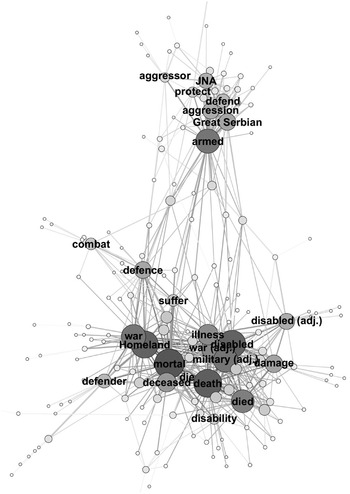
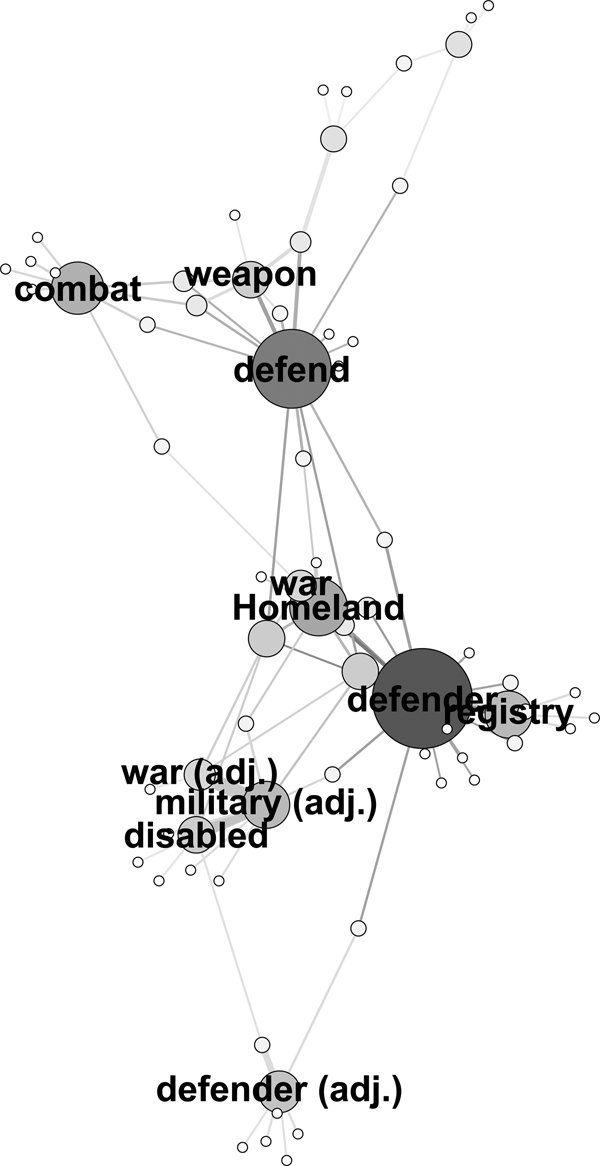
This approach allows us to answer the main research question of how veteran and non-veteran politicians talk about the war and the different populations created by the war such as veterans, victims and their families, as well as how their discourse differs. We run the analysis and build dyads of co-occurring words for each of the war-related keywords. We further filter out those whose phi coefficient is more than 0.1 so only the most frequently co-occurring words are further processed. As listing these dyads for 55 words would be highly impractical, we apply a network approach in order to capture the complexity of discourse on a macro level. We present our findings graphically in Figure 2a and Figure 2b.
Network Representation of War-Related Discourse by Veteran MPs

Network Representation of War-Related Discourse by Non-Veteran MPs

The difference between the two graphs is stark. What is immediately apparent is how sparse the non-veteran network of war-related discourse is compared to the richly populated network of war-related discourse of veteran MPs. Veteran MPs simply use more words directly related to the war and its consequences than their non-veteran counterparts. Here we should note that both graphs are normalized to the words’ actual frequencies and co-occurrences so the graphs are not dependent on the different overall volume of discourse used by veteran and non-veteran MPs. What also needs to be noted is the interesting group of words located in the upper part of the graph showing veteran MPs’ war-related discourse: armed, protect, defend, aggression, aggressor, Great Serbian and JNA. These words refer to a specific and highly politicized historical narrative of the war where Croatian veterans defended and protected the country against an external Great Serbian aggression assisted by the Yugoslav People's Army (JNA), as opposed to the War of Independence being predominantly a civil war between the Croats and the Croatian Serbs. To better demonstrate this, we extracted the most typical sentences in their natural form linking the generalized concept with the discourse of war as presented by veteran MPs:
The Declaration on Homeland War clearly states who the aggressors were: Serbia, Montenegro and the JNA, together with an armed rebellion of a part of Serb population of Croatia. That is in the Declaration and in the first article, line C of the new law. That should present no trouble nor problem to anyone. (Josip Đakić, HDZ (2,113 combat days))
But the fact is that the Greater Serbian aggression was conducted against Croatia. A third of Croatia was occupied and the Croatian soldier – regardless of his ethnicity – defended Croatia. It is shameful to talk about the Law on Croatian Defenders and to have to listen to the complaints by the ministers from Belgrade or by [Aleksandar] Vučić who used to call for Greater Serbia near Zagreb. (Miro Bulj, Bridge of Independent Lists (MOST) (2,006 combat days))
Every Croatian defender deserves this pride because of their personal contribution to the fruition of a thousand-year dream of countless generations of Croatian people: establishment of an independent Croatian state. They deserve it because of their contribution to the defence of its independence and sovereignty from the Greater Serbian aggression, because of the fulfilment of their patriotic duty in front of their ancestors, as well as their children, grandchildren and the generations coming after us. Every Croatian defender deserves this pride also because of those who gave their lives for the freedom and independence of Croatia. (Dinko Burić, Croatian Democratic Alliance of Slavonia and Baranja (HDSSB) (721 combat days))
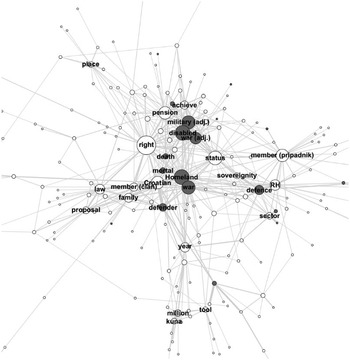
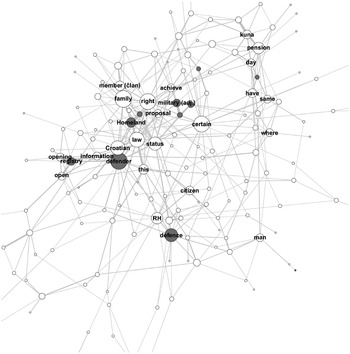
The veteran and non-veteran MPs, however, do not differ only when it comes to the richness of their war-related vocabulary. They clearly also differ on the type of discourse they use. To further demonstrate this, Figure 3a and Figure 3b visualize the overall discourse of non-veterans and veterans using 100 most frequent unigrams, with those that are in the lexicon of war-related unigrams marked in grey. As we can see, non-veterans focus more on specific policy and technical issues under discussion, such as the veterans’ registry, retirement and disability benefits, and care for victims’ families. Indeed, their most prominent non-war related unigrams in the whole corpus are law, right, certain and family. Veterans, on the other hand, often combine policy talk – with the notable centrality of the compound term Homeland War which is itself loaded with particular meaning – with the discourse on the misery that the war caused. The interconnecting positions of words like mortal, death and disabled especially show how the wartime past is connected to social and policy issues on a symbolic level. Veteran MPs use this narrative to great effect to gain personal legitimacy in parliamentary debates and to gain support for their policy proposals aimed at increasing the rights and benefits of the veteran population. We argue all of this is a clear confirmation of our Hypothesis 1. There is indeed a clear difference in the discourse used by veteran and non-veteran MPs. Compared with their non-veteran counterparts, veteran MPs offer a contextually richer and more charged narrative which is focused more on the hardship endured by war-affected populations during and after the war. They thus offer a different kind of both descriptive and substantive representation in the Croatian Sabor for the war-affected populations.
Network Representation of Overall Discourse by Veteran MPs
Note: RH refers to a commonly used abbreviation of Republika Hrvatska (Republic of Croatia).

Network Representation of Overall Discourse by Non-Veteran MPs
Note: RH refers to a commonly used abbreviation of Republika Hrvatska (Republic of Croatia).

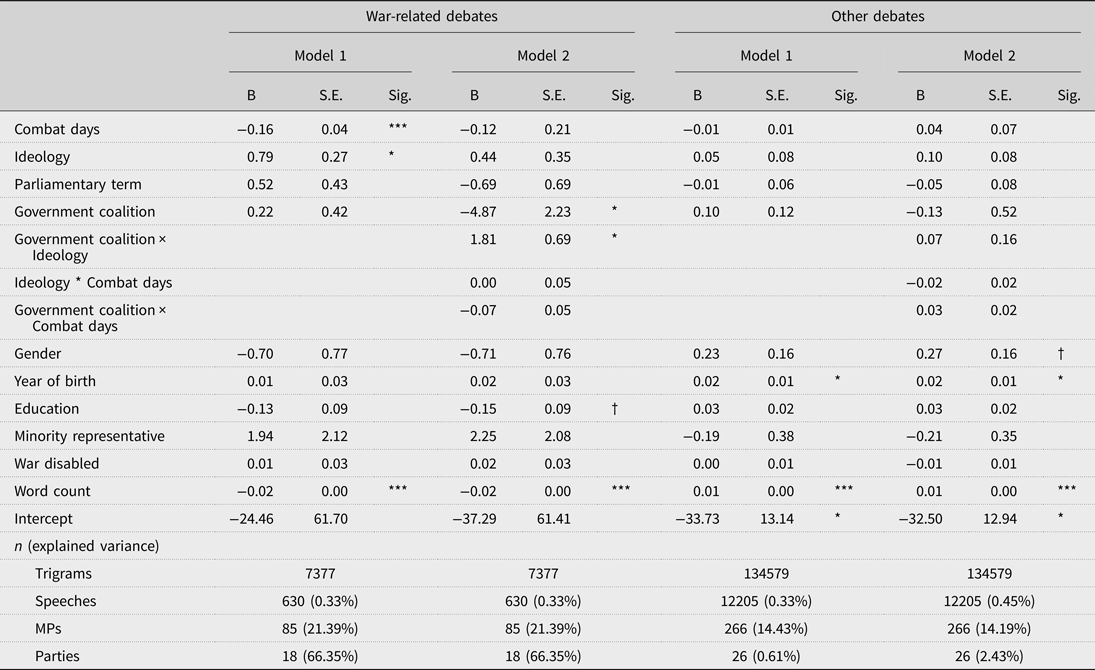
In addition to using different vocabulary, do veteran MPs also use different sentiment when discussing war-related topics? And is there a difference in the sentiment of the speech when talking about war-related topics based on MPs’ ideological orientation? Our hypotheses H2 and H3 proposed that Sentiment polarity of MPs’ speeches had a negative relationship with the level of the MPs’ exposure to war combat and a positive relationship with MPs’ closeness to rightist ideology when discussing issues related to the war. Our Hypothesis 3a furthermore proposed that there was no interactive relationship between combat exposure and ideology. Because the basic units of analysis (sentence-based trigrams) are clustered within speeches, which in turn are clustered within MPs, and in turn in political parties, we employ a series of multilevel regression analyses, with random intercepts included for each level. Table 2 presents the results of analyses of MP speeches with Sentiment polarity as the dependent variable.
Determinants of Sentiment Polarity

Notes: Dependent variable Sentiment polarity and multilevel models throughout; †p < 0.1; *p < 0.05; **p < 0.01; ***p < 0.001.
Models 1 and 2 focus exclusively on the two relevant debates from 2012 and 2017, whereas Models 3 and 4 repeat the analysis, but on the larger corpus using non-war related parliamentary debates in the months surrounding the 2012 and 2017 debates. Model 1 shows that MPs with more exposure to combat did indeed give speeches that were more negative in sentiment when debating issues related to the war and its consequences, whereas Model 3 shows that exposure to combat had no effect on sentiment polarity in debates dealing with other policy areas. This is a clear confirmation of our Hypothesis 2. To be more specific, one standard deviation increase in Combat days (8.04) leads to a decrease in Sentiment polarity equal to −1.29. Considering that the standard deviation of Sentiment polarity is 6.67, this is not only a highly statistically significant (on the 0.001 level) but also a substantively important effect. Veteran MPs are more likely to speak negatively on issues related to Croatia's War of Independence and its consequences than their non-veteran counterparts. Unlike MPs’ personal war experiences, contextual circumstances regarding the war captured by our variable War disabled, on the other hand, do not seem to have an effect on Sentiment polarity.
Model 1 also shows that Ideology has the expected and statistically significant (on the 0.05 level) effect on Sentiment polarity, whereas Model 3 shows it not to have a general effect when looking at the collection of other policy areas during the relevant period. This confirms our Hypothesis 3. To be more specific, a one standard deviation (1.22) move to the right on the ideological spectrum leads to an increase in Sentiment polarity (i.e. the speech on war-related issues becomes more positive) of +0.96 – an effect comparable in magnitude to the effect of exposure to war combat. Right-wing MPs are more likely to speak positively on issues related to Croatia's War of Independence and its consequences than their left-wing counterparts. Here we should also note that Model 3 shows that female MPs and younger MPs have a general tendency to use more positive discourse in discussions on a wide variety of policy areas than their male and older counterparts, though these effects are substantively small.
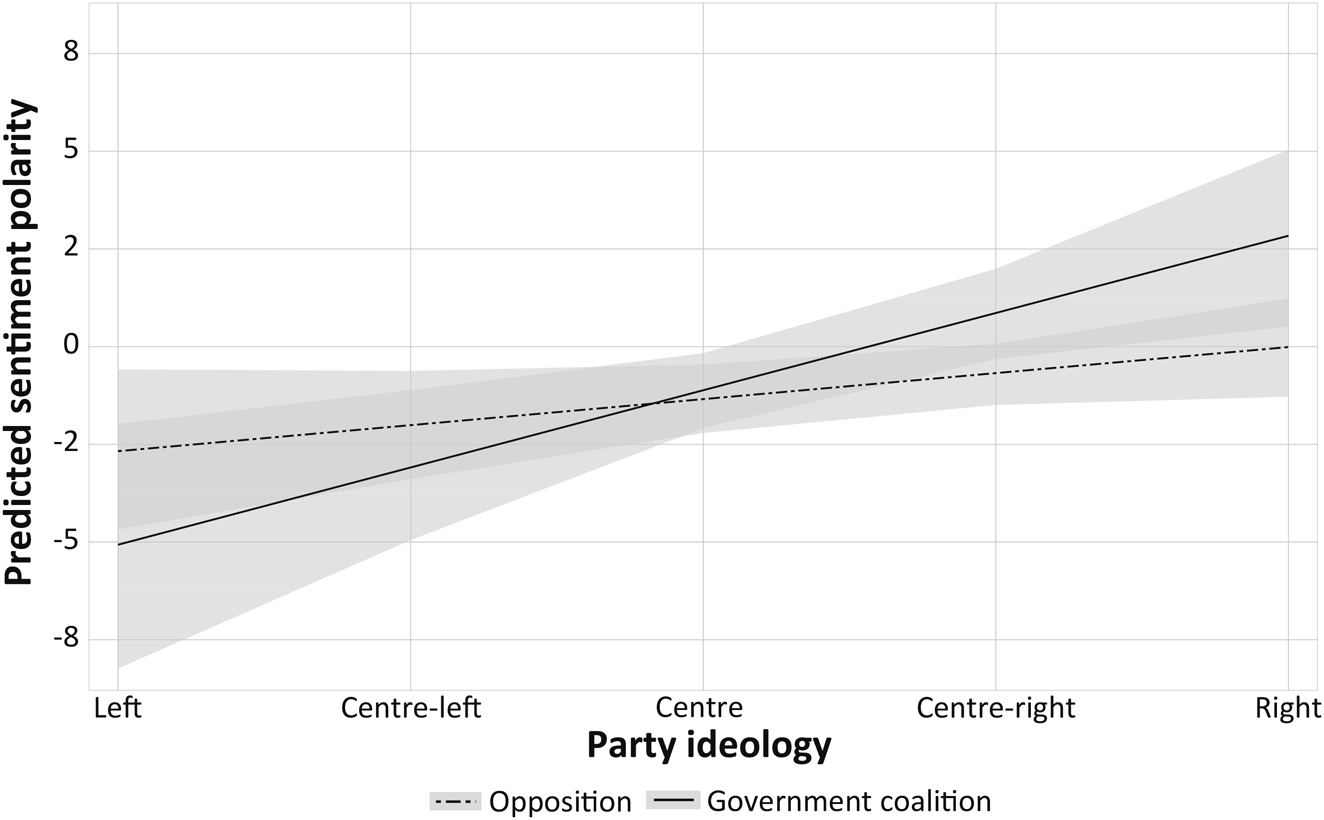
Our Hypothesis 3a furthermore proposed that these diverging effects of exposure to combat and commitment to right-wing political ideology on Sentiment polarity did not have a conditional relationship – that is, their effects were not interactive. Model 2 presents a variation of Model 1 with a string of interactions between Combat days, Ideology and Government coalition tested. We include the variable Government coalition in the interactions because we wish to control for the possible effect of the MP's party being in power on the interaction of his/her ideology and exposure to war combat. We perform a string of robustness tests with different interaction configurations (with or without Government coalition), but substantively achieve nearly identical results. The results presented in Model 2 clearly show that there indeed is no interactive effect between Combat days and Ideology: the effects we observed in Model 1 are not conditional, thus confirming our Hypothesis 3a. There is, however, an interactive effect between Ideology and Government coalition, which suggests that being in power makes right-wing MPs speak more positively and left-wing MPs speak more negatively about the War of Independence and its consequences. We present this substantively sizeable interactive effect graphically in Figure 4. We need to be cautious when interpreting this finding considering the limitations of our sample and the contextual differences between the debates in 2012 and 2017. Nevertheless, considering everything we know about the position of the War of Independence in Croatia's politics, we argue that this finding is an important extension of our Hypothesis 3 because it demonstrates how the heavily politicized and ideologized discourse related to the war is dependent on the balance of political power. In our view, this finding particularly highlights the discursive and very practical strategy of the HDZ: when in opposition, its MPs stress the negative effects for veterans’ post-war lives and the supposedly poor care they and their families are receiving from the state; when in power, its MPs rather focus on the positive aspects and values of the veterans’ service and post-war role in Croatian society.
Predicted Sentiment polarity by Ideology for Governing and Opposition Parties

Conclusions
Our primary motivation for writing this article has been a desire to understand how politicians in post-war societies use discourse of the war to represent constituents made vulnerable by their exposure to war violence. This article is also a building block in our larger work of studying how politicians in contemporary South-East Europe use discourse of the wartime past in order to perpetuate particular narratives in their efforts to mobilize support for their ideological platforms. We believe that the essence of political conflicts and cleavages in the region is rooted in the traumatic history of the 1990s. Understanding the role of politicians’ public discourse in the representation and mobilization of different segments of war-affected societies is critical for our understanding of the larger nature of political competition in general. This article should also be seen as a proposition for a novel path towards methodological rigour in the study of political discourse which can expose previously unobserved dynamics.
The analysis presented in this article has indeed shed a revealing light on the nature of political discourse related to wartime pasts, as well as the nature of substantive representation provided by Croatia's political class to the vulnerable populations created by the War of Independence. We have convincingly demonstrated that there is a clear difference in the nature of war-related discourse used by veteran and non-veteran politicians. More importantly, we have demonstrated that the overall sentiment of political discourse related to the war and its consequences is highly dependent on the level of the speaker's exposure to combat, as well as his/her ideological orientation. Those politicians who actually participated in war combat were more likely to engage in negative discourse and to focus on the traumatic aspects of the affected population's war and post-war lives such as death, loss and disability than their counterparts who did not have combat experience. They offered a qualitatively different form of substantive representation of these populations from their counterparts who had no combat exposure. Right-wing politicians, on the other hand, and particularly those who did not serve in the armed forces during the war and were currently in power, were far more likely to engage in positive and affirmative discourse, stressing the role of the Croatian veterans and victims in Croatia's war victory and foundation of the contemporary state. Although one always needs to be cautious while generalizing findings to other cases, a common ground of legacies of war should be recognized. Our findings show that war experience profoundly affects MPs’ preferences on war-related issues and the nature of their substantive representation of their constituents. Politicians with first-hand experience of combat talk differently about war. We would argue this is the case regardless of geographic or temporal context. War is kept alive by those who fought it and, as we show, it has lasting effects even decades after the fighting is over.
The divergence in the impact of service in combat and commitment to right-wing ideology on war-related discourse that we identified is crucial for our understanding of how particular kinds of war narratives are used in the political arena of a post-war society. In the Croatian case, those who were exposed to violence and those on the non-nationalist left see war and its consequences in negative terms. On the other hand, those who were not exposed to violence and those on the nationalist right (particularly when in power) see war and its consequences in positive terms. Considering the fact that Croatian war veterans are disproportionally supportive of the political (centre-)right and that right-wing politicians are ideologically committed to supporting war veterans and their families, we can say that there exists a discursive coalition when it comes to the narratives of the war and its consequences, particularly on the Croatian political right. It is exactly this amalgamation of seemingly divergent war-related discourse, together with real and very tangible policy benefits, which has been at the core of the political right's competition strategy and mobilization efforts. It has also been one of the main reasons why the war remains so salient in Croatia's political life even two and a half decades after the end of the war. We believe that such discursive coalitions between those who are ideologically committed to the causes and consequences of the ended conflict on the one hand, and those who actually saw combat on the other, can be commonly seen in most post-war societies.
Acknowledgements
The article was supported by an ERC Starting Grant No. 714589 for the project ‘Electoral Legacies of War: Political Competition in Postwar Southeast Europe’ (ELWar). The authors would also like to thank Ljubica Glaurdić and Leo Fel for their research assistance, and participants of the ELWar Workshop ‘Postwar Politics: Memory, Amnesia, and Denial in the Service of Electoral Victory’ held in February 2020 at the University of Luxembourg for valuable comments.