I. INTRODUCTION
Despite significant efforts in searching for efficient materials for the energy conversion applications, for example, waste heat conversion into electricity, the material performance at high temperature still needs a significant improvement. As oxide materials are stable at high temperature, and cobaltate compounds, including NaCoO x (Terasaki et al., Reference Terasaki, Sasago and Uchinokura1997; Ca2Co3O6 (Mikami et al., Reference Mikami, Funahashi, Yoshimura, Mori and Sasaki2003, Reference Mikami and Funahashi2005), Ca3Co4O9 (Masset et al., Reference Masset, Michel, Maignan, Hervieu, Toulemonde, Studer, Raveau and Hejtmanck2000; Minami et al., Reference Minami, Itaka, Kawaji, Wang, Koinuma and Lippmaa2002; Grebille et al., Reference Grebille, Lambert, Bouree and Petricek2004; Hu et al., Reference Hu, Si, Sutter and Li2005; Wang-Ng et al., Reference Wang, Venimadhav, Guo, Chen, Li, Soukiassian, Schlom, Katz, Pan, Wong-Ng, Vaudin and Xi2007), and Bi2Sr2Co2O x (Wang et al., Reference Wang, Venimadhav, Guo, Chen, Li, Soukiassian, Schlom, Katz, Pan, Wong-Ng, Vaudin and Xi2009) have shown promising thermoelectric properties, the search for layered cobaltate compounds with improved thermoelectric properties continues in our laboratory, including phase diagram studies of ternary oxide systems, including CaO and Co3O4 as two of the end members (Wong-Ng et al., Reference Wong-Ng, Liu, Martin, Thomas, Lowhorn and Kaduk2010, Reference Wong-Ng, Luo, Xie, Tang, Kaduk, Huang, Yan, Tang and Tritt2011, Reference Wong-Ng, Laws and Yan2013, Reference Wong-Ng, Laws, Talley, Huang, Yan, Martin and Kaduk2014).
Magnetoplumbite-like hexagonal ferrites belong to a large family of hexagonal or rhombohedral ferromagnetic oxides with widespread applications such as permanent magnets, microwave devices, and recording media (Smit and Wijn, Reference Smit and Wijn1959; Kojima, Reference Kojima and Wohlfarth1982). Their crystal structures can be considered as a superposition of several fundamental structural blocks. These building blocks are formed by close packing of hexagonal or cubic-stacked BaO3 and O4 layers, creating octahedral, tetrahedral, and occasionally bipyramidal interstices. Both the Ba and Fe sites can be substituted by various other elements. The structure of the magnetoplumbite-like BaFe2O19 (first studied by Townes et al. in Reference Townes, Fang and Perrotta1967) and SrFe2O19 have been described by Obradors et al. (Reference Obradors, Collomb, Pernet, Samaras and Joubert1985, Reference Obradors, Solans, Collomb, Samaras, Rodriguez, Pernet and Font-Altaba1988). The structure of a number of other isostructural magnetoplumbite-like compounds include SrM 12O19 (M = Al, Ga) (Kimura et al., Reference Kimura, Ohgaki, Tanaka, Morikawa and Marumo1990), SrGa12O19 (Graetsch and Gebert, Reference Graetsch and Gebert1994), PbAl12O19 (Iyi et al., Reference Iyi, Takekawa and Kimura1990), SrTi6Co6O19 (Graetsch and Gebert, Reference Graetsch and Gebert1995), and BaFe11.6Mn0.4O19 (Wong-Ng et al., Reference Wong-Ng, McMurdie, Paretzkin, Zhang, Davis, Hubbard, Dragoo and Stewart1987). Cabañas et al. (Reference Cabañas, González-Calbet, Rodríguez-Carvajal and Vallet-Regí1994) also studied the details of cationic distribution in BaFe12−2x Co x Ti x O19 by neutron diffraction.
The two main goals of this paper are: (1) to investigate the structure of (Ba x Sr1−x )Ti6Co6O19 (x = 0.2, 0.4, 0.6, 0.8) compounds, in particular, the effect of the smaller size of Sr (Shannon, Reference Shannon1976) on substituting the Ba. Since X-ray diffraction (XRD) is a non-destructive technique for phase identification, XRD patterns are especially important for phase characterization; therefore goal (2) of this investigation is to determine the experimental patterns for (Ba x Sr1−x )Ti6Co6O19 (x = 0.2, 0.4, 0.6, 0.8), and to make them widely available through submission to the powder diffraction file (PDF) (2014).
II. EXPERIMENTAL
Sample preparation
Samples were prepared from stoichiometric amounts of SrCO3, BaCO3, Co3O4, and TiO2 using solid state high-temperature techniques. The starting samples were mixed, pelletized, and heat treated in air at 800 °C for 10 h and subsequently annealed at 1100 °C for 12 h, 1200 °C for 36 h with intermediate grindings, and 1300 °C for another 15 h with intermediate grindings. During each heat treatment in air, the samples were furnace cooled. The heat treatment process was repeated until no further changes were detected in the powder XRD patterns.
X-ray Rietveld refinements and powder reference patterns
The (Ba x Sr1−x )Ti6Co6O19 (x = 0.2, 0.4, 0.6, 0.8) powders were mounted as methanol slurries on zero-background cells. The X-ray powder patterns were measured (5°–130° 2θ, 0.020 214 4° steps, 1 s step−1, CuK α radiation) on a Bruker D2 Phaser diffractometer equipped with a LynxEye detector (The purpose of identifying the equipment in this paper is to specify the experimental procedure. Such identification does not imply recommendation or by the National Institute of Standards and Technology.). To reduce effects of fluorescence, the lower limit of the multichannel analyzer (MCA) was changed from its default value of 0.11 to 0.19 V.
The Rietveld refinement technique (Rietveld, Reference Rietveld1969) with the software suite GSAS (Larson and Von Dreele, Reference Larson and Von Dreele2004) was used to determine the structure of the (Ba x Sr1−x )Ti6Co6O19 (x = 0.2, 0.4, 0.6, 0.8) compounds. The structure of BaTi6Co6O19 (PDF 51-1873) was used as the starting model for the refinements. Reference patterns were obtained with a Rietveld pattern decomposition technique. Using this technique, the reported peak intensities were derived from the extracted integrated intensities, and positions calculated from the lattice parameters. The pseudo-Voight function (profile function #4) was used for the refinement of both series of compounds (Thompson et al., Reference Thompson, Cox and Hastings1987; Finger et al., Reference Finger, Cox and Jephcoat1994; Stephens, Reference Stephens1999). When peaks are not resolved at the resolution function, the intensities are summed, and an intensity-weighted d-spacing is reported. In summary, these patterns represent ideal specimen patterns.
Bond valence sum (BVS) calculations
The BVS values for Ba, Sr, Ti, and Co sites were calculated using the Brown–Altermatt empirical expression (Brown and Altermatt, Reference Brown and Altermatt1985; Brese and O'Keeffe, Reference Brese and O'Keeffe1991). The BVS of an atom i is defined as the sum of the bond valences v ij of all the bonds from atoms i to atoms j. The most commonly adopted empirical expression for the bond valence v ij as a function of the interatomic distance d ij is v ij = exp[(R 0 − d ij )/B]. The parameter, B, is commonly taken to be a “universal” constant equal to 0.37 Å. The values for the reference distance R 0 for Ba–O, Sr–O, Ti4+–O, Co2+–O, Co3+–O are 2.29, 2.118, 1.815, 1.692, and 1.70, respectively (Brown and Altermatt, Reference Brown and Altermatt1985; Brese and O'Keeffe, Reference Brese and O'Keeffe1991). In the sites where there are more than two different types of atoms, the BVS value is the weighted sum of the fraction of occupancy.
III. RESULTS AND DISCUSSION
Structure of (BaxSr1−x)Ti6Co6O19
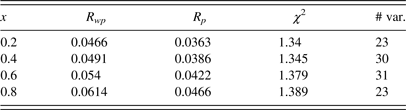
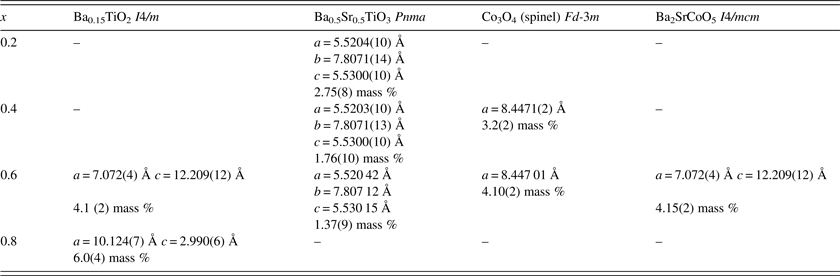
XRD data of (Ba x Sr1−x )Ti6Co6O19 were indexable with a hexagonal unit cell and with a space group of P63 /mmc (No. 194), Z = 2. Table IA gives the refinement results and Table IB gives the minority phases present in the (Ba x Sr1−x )Ti6Co6O19 samples. Figure 1 provides the Rietveld refinement pattern for (Ba0.8Sr0.2)Ti6Co6O19 as an example. The observed (crosses), calculated (solid line), and difference XRD patterns (bottom) as determined by the Rietveld analysis technique, are shown. The difference pattern is plotted at the same scale as the other patterns up to 70° 2θ. At 2θ higher than 70°, all vertical scales are multiplied five times. The row of tick marks refer to the calculated peak positions. The refinement residuals mainly reflect variations in the counting times, and the presence of additional minor impurities. Table IB gives the identities and quantities of the minor impurities.
(colour online) Observed (crosses), calculated (solid line), and difference XRD pattern (bottom) for (Ba0.8Sr0.2)Ti6Co6O19 by Rietveld analysis technique. The difference pattern is plotted at the same scale as the other patterns up to 70° 2θ. At higher 2θ angles, the scale has been magnified five times. The row of tick marks refer to the calculated peak positions.

Rietveld refinement residuals for (Ba x Sr1−x )Ti6Co6O19.

Minority phases present in the (Ba x Sr1−x )Ti6Co6O19 samples.

The unit-cell parameters and mass % of each phase are given. Numbers inside the brackets represent standard deviation.
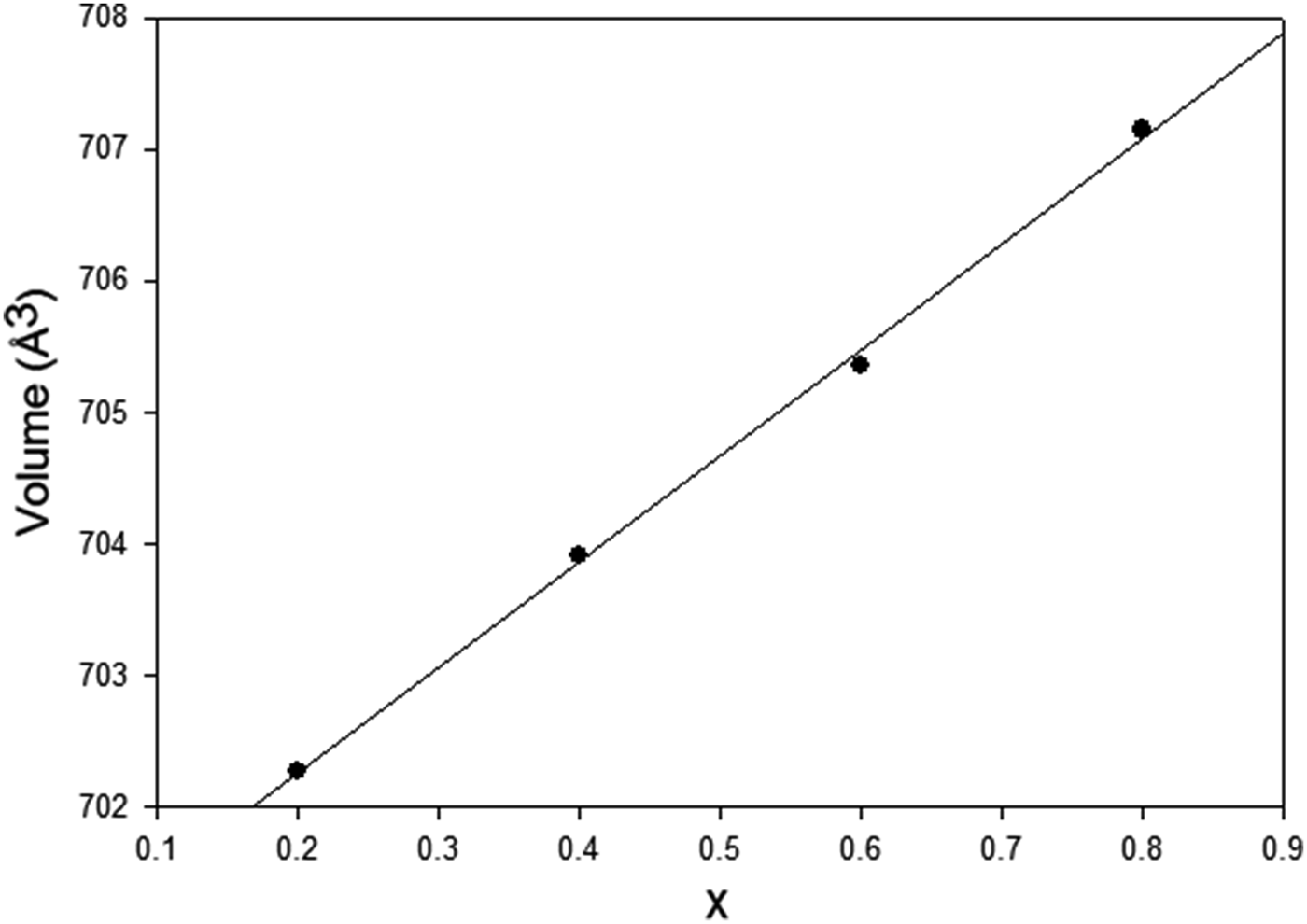
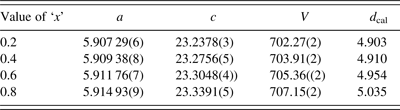
Table II lists the lattice parameters for (Ba x Sr1−x )Ti6Co6O19, and the calculated density values, D x . The lattice parameters range from a = 5.907 29(6), c = 23.2378(3) Å, and V = 702.27(2) Å3 for x = 0.2 to a = 5.914 93(9), c = 23.3391(5) Å, and V = 707.15(2) Å3 with x = 0.8. Figure 2 gives the plot of the unit-cell volumes, V, of (Ba x Sr1−x )Ti6Co6O19 as a function of the barium content ‘x’. As expected, a monotonic trend of volume increasing is observed (Figure 2). This increasing volume is a result of the increase in both a- and the c-parameters.
Plot of unit cell volume, V, of (Ba x Sr1−x )Ti6Co6O19 vs. x. A monotonic increasing trend of V vs. x is observed.

Experimental cell parameters for (Ba x Sr1−x )Ti6Co6O19 [P63/mmc (No. 194), Z = 2].

Numbers inside the brackets represent standard deviation.
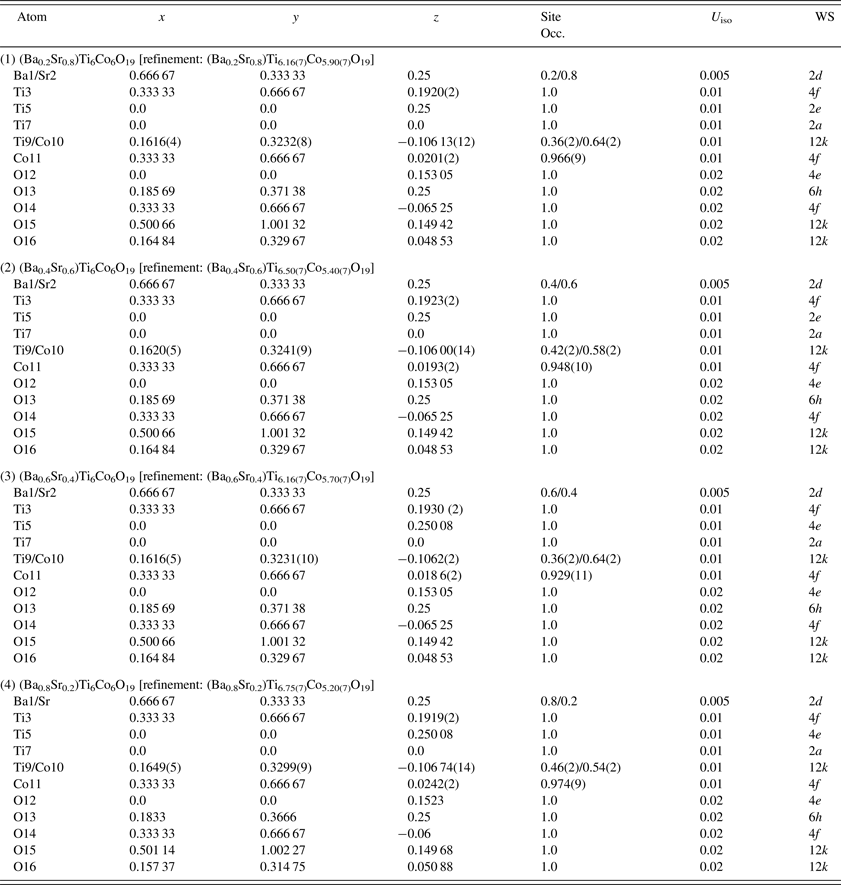
The atomic coordinates, site occupancy, and displacement parameters for the structures of (Ba x Sr1−x )Ti6Co6O19 are given in Table III. We have refined the Ti/Co occupancy for each of the Ti and Co sites. The refinement results indicated that except for sites Ti9/Co10 that are mixed sites and Co11 site that is slightly Co deficient, the rest of the sites are fully occupied by Ti. (Ba x Sr1−x )Ti6Co6O19 are isostructural with BaTi6Co6O19. The refinement results give rise to the chemical formula for the four solid solution members as (Ba0.2Sr0.8)Ti6.16(2)Co5.9(2)O19, (Ba0.4Sr0.6)Ti6.5(2)Co5.4(2)O19, (Ba0.6Sr0.4)Ti6.16(2)Co5.7(2)O19, and (Ba0.8Sr0.2)Ti6.75(2)Co5.2(2)O19.
Atomic coordinates and displacement factors for compounds for (Ba x Sr1−x )Ti6Co6O19 [P63/mmc (No. 194), Z = 2]; M represents site symmetry multiplicity; WS represents Wyckoff symbol.

The coordinate values pertaining to the oxygen atoms were not refined during the refinement process. Numbers inside the brackets represent standard deviation.
The unit cell contains ten close-packed layers. The layers containing the large cations and the two adjacent oxygen layers are usually referred to as the R-blocks. The remaining two oxygen layers are referred to as spinel S-blocks, which contain edge-sharing octahedra as well as tetrahedra that are corner-shared with octahedra. The large cations are located in every fifth layer on mirror planes perpendicular to the stacking c-direction (Figure 3). The crystal structure can be described with the … RSR*S* … layer sequence, where R is a three-layer block (O4–BaO3–O4) and S is the spinel layer which is a two-oxygen layer block (O4–O4) containing the edge-sharing octahedra and corner-sharing tetrahedra (Smit and Wijn, Reference Smit and Wijn1959; Townes et al., Reference Townes, Fang and Perrotta1967; and Obradors et al., Reference Obradors, Collomb, Pernet, Samaras and Joubert1985). The * symbol indicates that the block preceding has been turned 180° around the hexagonal c-axis by a 63 symmetry axis. In brief, five non-equivalent sublattices are present in the structure, including three octahedral (Wyckoff notation 2a, 12k, and 4f), one tetrahedral (4f), and one trigonal bipyramidal (2b, or pseudo-tetrahedral 4e position) (Cabañas et al., Reference Cabañas, González-Calbet, Rodríguez-Carvajal and Vallet-Regí1994). Figure 4 gives the (Ba x Sr1−x )Ti6Co6O19 structure viewing down the c-axis. M9 refers to the mixed site of Ti9/Co10.
(colour online) Crystal structure of (Ba0.8Sr0.2)Ti6Co6O19 based on X-ray powder data, showing a stack of two unit cell content along the c-axis. The figure gives the labeling of atoms and depicts three different type of polyhedral coordination, namely, [CoO4] tetrahedral (blue), TiO5 trigonal-bipyramid (yellow), and TiO6 and (Ti/Co)O6 octahedra (gray).

(colour online) View of the (Ba x Sr1−x )Ti6Co6O19 structure down the c-axis. M9 refers to the mixed site of Ti9/Co10.

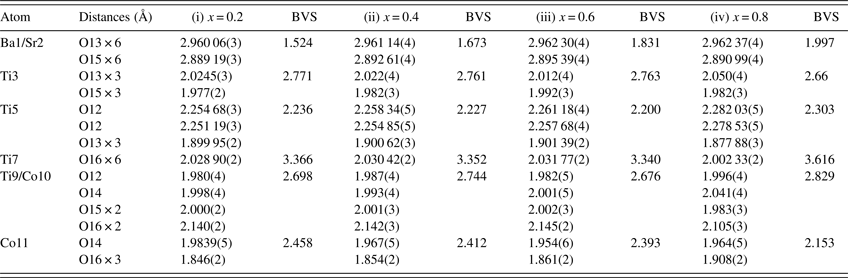
One particularly interesting feature of the structure is the trigonal bipyramidal site (Ti5). This site has been studied extensively by Kimura et al. (Reference Kimura, Ohgaki, Tanaka, Morikawa and Marumo1990) in SrM 12O19 (M = Al, Fe, and Ga) and by Obradors et al. (Reference Obradors, Collomb, Pernet, Samaras and Joubert1985, Reference Obradors, Solans, Collomb, Samaras, Rodriguez, Pernet and Font-Altaba1988) in BaFe12O19. The disordered bipyramidal site can be described by two models. One is the central atom model and the other one is the split atom model (or as pseudo-tetrahedral with half occupation) in which the central cation is displaced from the mirror plane in the opposite direction of the c-axis with half-occupancy of the sites. According to Cabañas et al. (Reference Cabañas, González-Calbet, Rodríguez-Carvajal and Vallet-Regí1994), the motion of the atom in this cavity can be considered as a fast hopping between two adjacent pseudo-tetrahedra lying at each side of the trigonal bipyramid base. The structure imposes an elongated trigonal bipyramid with a small central hop and two exceptionally long apical M–O distances (2.251 19(3) Å–2.282 03(5) Å for x = 0.2 to 0.8, respectively). The BVS values of this trigonal bipyramid site ranges from 2.200 to 2.303, indicating a site with tensile stress (the cage is too large).
Only Co2+ (Co11) in (Ba x Sr1−x )Ti6Co6O19 was found to occupy the tetrahedral sites. The BVS values for this site (2.458–2.153 for x = 0.2–0.8, respectively) are significantly larger than an ideal value of 2.0, indicating compressive stress (the cage is too small). Ti4+ is mainly found on the octahedral sites in both the spinel S-blocks and in the face-sharing octahedra in the R-blocks (Figure 3). Co2+ and Ti4+ are distributed randomly in the octahedral layer between the R- and S-blocks (M9 which represents the mixed site of Ti9 and Co10 experiences slight tensile stress as the experimental BVS values are smaller than the ideal values (Table IV). In the trigonal bipyramid sites of the R-blocks, only Ti was found which experiences large tensile stress (BVS values of about 2.2–2.3, which are less than the ideal value of 4.0). In general, the Ti octahedral sites all experience tensile stress.
Bond distances and bond valence sum (BVS) values for (Ba x Sr1−x )Ti6Co6O19 [P63/mmc (No. 194), Z = 2].

In the sites where there are more than two different types of atoms, the BVS is the weighted sum of the fraction of occupancy. The ideal BVS values for Ti9/Co10 are 2.72, 2.84, 2.72, and 2.92, for x = 0.2, 0.4, 0.6–0.8, respectively. Numbers inside the brackets represent standard deviation.
Figure 5 depicts the 12-coordinated (Ba, Sr)O12 polyhedra in (Ba x Sr1−x )Ti6Co6O19. The Ba/Sr site inside the polyhedra is not shown. The Ba/Sr site has two sets of Ba/Sr–O distances: six longer bonds [2.960 06(3) Å–2.962 37(4) Å for x = 0.2–x = 0.8, respectively] and six shorter bonds with the oxygen sites in the neighboring layers [2.889 19(3) Å–2.890 99(4) Å]. The BVS values for the Ba/Sr sites range from 1.524 (x = 0.2) to 1.997 (x = 0.8). While these sites are all under tensile stress, the stress decreases as the content of the larger size Ba increases. According to Obradors et al. (Reference Obradors, Solans, Collomb, Samaras, Rodriguez, Pernet and Font-Altaba1988), the substitution of Ba with Sr has crystallochemical consequences. For example, the distortion surrounding the Ba/Sr polyhedron is significant enough to modify the distribution of metallic ions among the different sublattices. These effects could be the origin of different magnetic structure observed in (Ba,Sr)Zn2Y and (Ba,Sr)Zn2Z hexagonal ferrites (Sizov et al., Reference Sizov, Sizov and Yamzin1968, Momozawa et al., Reference Momozawa, Yamaguchi, Takei and Mita1985).
(colour online) Twelve-coordinated (Ba,Sr)O12 polyhedra in (Ba x Sr1−x )Ti6Co6O19. Ba/Sr inside the polyhedral are not shown.

Reference XRD pattern
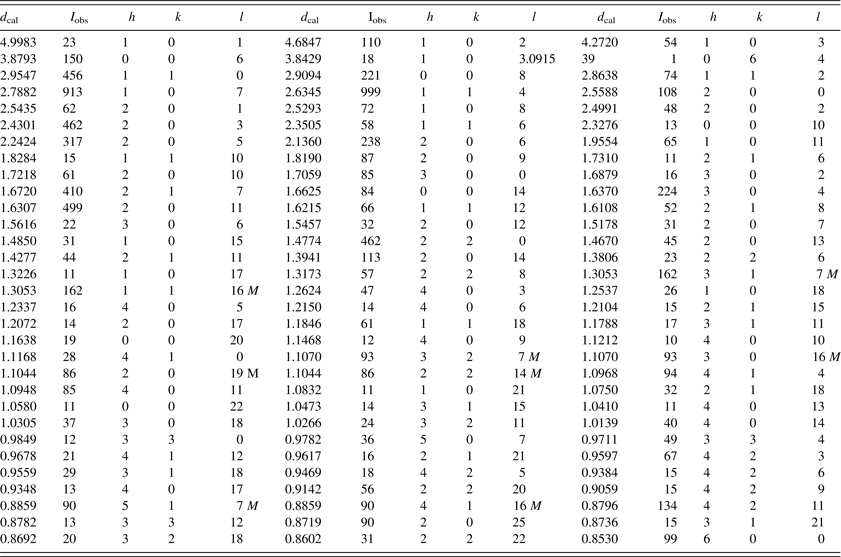
In these patterns, the symbols ‘M’ and ‘+’ refer to peaks containing contributions from two and more than two reflections, respectively. The particular peak that has the strongest intensity in the entire pattern is assigned an intensity of 999 and other lines are scaled relative to this value. In general, the d-spacing values are calculated values from refined lattice parameters. The intensity values reported are integrated intensities (rather than peak heights) based on the corresponding profile parameters as reported in Table V. For resolved overlapped peaks, intensity-weighted calculated d-spacing, along with the observed integrated intensity and the hkl indices of both peaks (for ‘M’), or the hkl indices of the strongest peak (for ‘+’) are used. For peaks that are not resolved at the instrumental resolution, the intensity-weighted average d-spacing and the summed integrated intensity value are used. In the case of a cluster, unconstrained profile fits often reveal the presence of multiple peaks, even when they are closer than the instrumental resolution. In this situation, both d-spacing and intensity values are reported independently. All patterns have been submitted for inclusion in the PDF.
X-ray powder pattern for (Ba0.4Sr0.6)Ti6Co6O19 [P63/mmc (No. 194), Z = 2], a = 5.909 38(8) Å, c = 23.2756(5) Å, V = 703.91(2) Å3, Z = 2, D x = 4.91 g cm−3.

The symbols ‘M’ refers to peaks containing contributions from two reflections. The particular peak that has the strongest intensity in the entire pattern is assigned an intensity of 999 and other lines are scaled relative to this value. The d-spacing values are calculated values from refined lattice parameters, and ‘I obs’ represents integrated intensity values.
IV. SUMMARY
Crystal structure and reference patterns of the (Ba x Sr1−x )Ti6Co6O19 series of compounds have been determined. The crystal structure of (Ba x Sr1−x )Ti6Co6O19, can be described using the … RSR*S* … sequence, where R is a three-layer block (O4–BaO3–O4) and S is the spinel layer which is a two-oxygen layer block (O4–O4) containing edge-sharing octahedra and corning-sharing tetrahedra. Only Co2+ (Co11) in (Ba x Sr1−x )Ti6Co6O19 was found to occupy the tetrahedral sites (with compressive stress), while Ti4+ is mainly found on the octahedral sites in both the spinel S-blocks and in the face-sharing octahedra in the R-blocks (with tensile stress). A bipyramidal cavity, centered in the Wyckoff position 2b, can be described as pseudo-tetrahedra (4e) with half occupation. In summary, other than the Co2+ (Co11) site that experiences compressive stress, all other Ti and Co/Ti sites experience tensile stress. We also found that in the Ba/Sr sites of (Ba x Sr1−x )Ti6Co6O19, tensile stress was released as more larger Ba substitutes in the relatively large 12-membered cage (V b = 1.524–1.997 as x increases from 0.2 to 0.8, respectively).
ACKNOWLEDGEMENT
Partial financial support from ICDD is acknowledged.