Introduction
Properly managing invasive species is a perpetual issue facing land managers, which shifts resources away from other management needs (Renz et al. Reference Renz, Gibson, Hillmer, Howe, Waller and Cardina2009). There is importance in understanding landscape-scale patterns of invasion at the continental and subcontinental level, which may not directly influence on-site management (Oswalt et al. Reference Oswalt, Fei, Guo, Iannone, Oswalt, Pijanowski and Potter2015). However, there is still a need to test tools useful for local land managers on-site within the context of existing management techniques and ecological processes (James et al. Reference James, Smith, Vasquez and Sheley2010; Matzek et al. Reference Matzek, Covino, Funk and Saunders2014).
Callery pear (Pyrus calleryana Decne.) (Rosaceae) is an introduced tree in North America, originally from Asia and widely planted as an ornamental, yet little research has been conducted on the ecological or economic impacts of the introduction (White et al. Reference White, McClain and Ebinger2005). It was originally introduced due to its resistance to fire blight, a bacterial disease, and became a common ornamental tree in the 1950s (Creech Reference Creech1973; Reimer Reference Reimer1925). This follows the trend for the majority of woody invasive species: introduction through horticultural practices (Reichard and White Reference Reichard and White2001). It has spread through the eastern United States and establishes in prairies, old fields, and other disturbed areas (Culley and Hardiman Reference Culley and Hardiman2007; Vincent Reference Vincent2005). Vincent (Reference Vincent2005) found that P. calleryana exhibits improved establishment and recruitment in mid- to late-successional habitats. However, as distance from roads increases into closed-canopy forests, P. calleryana density decreases (Flory and Clay Reference Flory and Clay2006).
Management of invasive species can be challenging, because control techniques may be difficult to implement. Culley and Hardiman (Reference Culley and Hardiman2007) noted that removal of P. calleryana trees is the most effective management strategy. Additionally, herbicide application on cut stumps is necessary to prevent sprouting (Swearingen et al. Reference Swearingen, Reshetiloff, Slattery and Zwicker2002). There have been few studies on the ecological effects of P. calleryana, although predictions have been made regarding its ability to impede establishment of late- to mid-stage successional species (Culley and Hardiman Reference Culley and Hardiman2007). Thorny phenotypes exist that can arise in wild populations and form dense thickets, adding to management complications. Fulcher (Reference Fulcher2002) noted that many P. calleryana trees planted in urban environments are susceptible to limb breakage. This, combined with the litter of fruit on the ground, can cause both an unpleasing aesthetic effect and a potential danger to pedestrians (Dirr Reference Dirr1998; Fulcher Reference Fulcher2002).
Colonization by P. calleryana into prairies leads to interactions between common disturbances (i.e., fire) and this invasive species. Fire is common in many ecosystems, consuming plant litter and reducing biomass (Neary et al. Reference Neary, Klopatek, DeBano and Ffolliott1999; Raison et al. Reference Raison, Khanna and Woods1985). The irregularity of fire contributes to the effect that it has on an ecosystem, with variability in frequency, seasonality, and intensity (DeBano et al. Reference DeBano, Neary and Ffolliott1998). These three factors combine to determine fire regimes, which are used to create management strategies in different ecosystems (Whitlock et al. Reference Whitlock, Higuera, McWethy and Briles2010). Many grasses produce seeds that rely on fire, which serves to release them from dormancy and to prepare the soil for the seeds by altering resources by reducing competition (Auld and Bradstock Reference Auld and Bradstock2006; Ojima et al. Reference Ojima, Schimel, Parton and Owensby1994). Prairies can be colonized by trees, but fire typically acts as a disturbance to keep areas open to allow for herbaceous, prairie species to dominate (Brooks et al. Reference Brooks, D’Antonia, Richardson, Grace, Keeley, DiTomaso, Hobbs, Pellant and Pyke2004).
Management Implications
Managing Callery pear (Pyrus calleryana Decne.) is labor-intensive, because the effective control technique is to cut and apply herbicide to individual trees. Because fire is a standard management tool in natural and planted prairie ecosystems, there is a high probability that prairies invaded by P. calleryana will experience fire. While all P. calleryana individuals were top-killed by fire, well-established root systems remained alive underground. These roots provided necessary resources for aboveground regrowth of stems: 3 to 4 new sprouts following fire. Established seedlings less than 2-yr old and seeds were not be able to survive fire. Removing standing prairie biomass (e. g., grasses and forbs) left P. calleryana stems exposed, which may improve control techniques by making it easier to locate, cut, and spray with herbicide.
Due to invasion of P. calleryana into prairie ecosystems and fire as a common natural disturbance and management tool, it is important to understand how this invasive species responds to fire. The objectives of this study were to (1) map the distribution of P. calleryana individuals within Arrowhead Prairie, Allen County, IN; (2) quantify the growth response of P. calleryana adults, fruits, seeds, and first- and second-year seedlings following prescribed fire; and (3) test the hypothesis that fire is an acceptable management strategy for controlling P. calleryana invasions.
Materials and Methods
Site Description
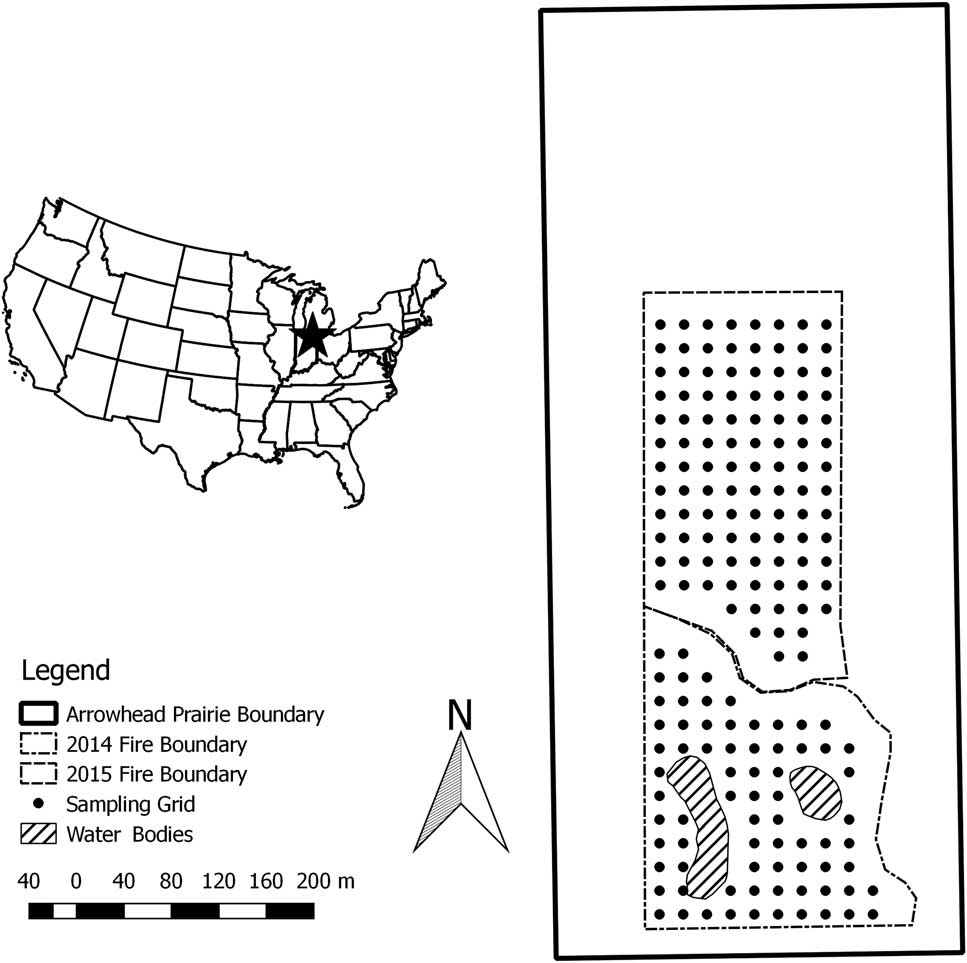
Arrowhead Prairie is a 64-ha property located in southwest Allen County, IN (41.003° N, 85.319° W; Figure 1), of which 27 ha of prairie were used for this study. Before acquisition by the Little River Wetland Project (LRWP) in 2000, the property was used for row-crop agriculture. Conversion of the property from agriculture to prairie included seeding 51 native species (36 forbs, 11 grasses, 4 sedges) in 2005, reseeding with 12 species (8 forbs [5 new], 4 grasses) in 2006, and reseeding with 23 species (17 forbs [3 new], 6 grasses) in 2009 (LRWP, personal communication). The northern half of the study area contained locations of lower elevation that flooded intermittently during the study. Conversely, the southern half was higher in elevation due to additional soil likely accumulated from the building of two ponds. From a rapid stochastic plant community survey, the dominant plant species was prairie cordgrass (Spartina pectinata Bosc ex Link) (Poaceae) with Canada thistle [Cirsium arvense (L.) Scop.] (Asteraceae), yellow Indiangrass [Sorghastrum nutans (L.) Nash] (Poaceae), and parasol whitetop [Doellingeria umbellata (Mill.) Nees] (Asteraceae) being common species. Spartina pectinata comprised 72% of the total cover in 12 randomly located plots across the entire prairie, which was an order of magnitude greater than the second most-dominant species (C. arvense, 7.1% total cover).
Arrowhead Prairie location in Indiana (star) and survey grid layout in two prescribed fire boundaries.

Established Pyrus calleryana
A 20-m spaced grid was layered over an aerial photograph of Arrowhead Prairie using QGIS (v. 2.2, QGIS Development Team 2017). The prairie was divided into the north and southern sections using the historic Graham McCulloch Ditch as the dividing line, which served as a major fire break for the subsequent burns (Figure 1). From each section, 15 points were randomly selected, and a 5-m-radius circular plot was established around each point. All P. calleryana individuals within each plot were measured for height, root collar diameter, and distance and azimuth from the plot center.
To measure the response of P. calleryana, prescribed fire was used in the two halves of the prairie: the southern section was burned on April 16, 2014, and northern section on May 7, 2015. When the southern section was burned, the northern section was left unburned, and vice versa. Southern pre-fire demographics were collected on April 14–15, 2014, southern post-fire demographics were collected on July 23, 2014. Northern pre-fire demographics were collected in November 2014 and March 2015 (before 2015 bud break), and northern post-fire demographics were collected on July 20, 2015. For each demographic survey, a new subset of 15 points were randomly selected in the two sections. During demographic surveys, trees were measured in both northern and southern sections. The number of epicormic sprouts were recorded in post-fire surveys. Due to continuous, active management of P. calleryana by LRWP, the study concluded after post-fire 2015 data collection, as the majority of trees were lost to cutting and herbicide application.
To measure fire temperature during the 2015 burn, ceramic tiles with temperature-indicating lacquers were placed at 95 points on the 20-m spaced grid. Bamboo sticks were used to hold two 10×10 cm tiles lacquer facedown approximately 50 cm above the soil surface. Each tile was painted with temperature-indicating lacquers ranging from 93 to 538 C. Tiles were removed post-fire, and the maximum temperature-indicating lacquer that melted was recorded.
Prairie biomass was sampled in 0.5 by 1 m quadrats at 10 locations in the prairie during the northern pre-fire demographics survey in March 2015 as a measure of fuel before prescribed fire. Biomass samples were collected at randomly selected midpoints between the 20-m spaced grid points to ensure biomass collections did not interfere with fire temperature measurements where tiles were located. Biomass samples were dried in an oven at 50 C to a constant mass. Samples were returned to the prairie before the May 7, 2015 fire.
Pyrus calleryana Seeds and Seedlings
Fruit were collected from two mature P. calleryana trees (41.003° N, 85.109°W). Seeds were removed from half of the fruits. Seeds (n=300; November 3, 2014) and whole fruits (n=100; November 15, 2014) were subjected to fire and placed in cold storage. These seeds and fruits were the prewinter burn treatment group. Seeds (n=649) and whole fruits (n=200) were placed in cold storage (October 31, 2014) to serve as the postwinter burn treatment group and control treatment group. All seeds and fruits were wet stratified in sand and stored at 5 C. All seeds and fruits were removed from cold storage on February 26, 2015, due to seeds germinating in cold storage. After the seeds were removed from cold storage, seeds (n=186) and fruits (n=100) were subjected to fire (February 28, 2015) as the postwinter burn treatment group. The remaining seeds (n=463) and fruit (n=100) were used as a non-burn control. Fire treatments were applied in a 42×30 cm aluminum tray with P. calleryana seeds and fruits in glass dishes, and a 25-cm-deep layer of native biomass collected from Arrowhead Prairie was used as fuel. A single 10×10 cm ceramic tile with temperature-indicating lacquers was held 50 cm above the tray on a ring stand. Following winter and fire treatments, seeds were sown in greenhouse trays over peat moss medium and watered daily. The greenhouse was maintained at 21 C and approximately 33% relative humidity with ambient sunlight. Day length was extended to 18 h with sodium vapor lamps.
Ninety-eight germinated seeds were planted into greenhouse trays with peat moss medium and placed in the same greenhouse as described earlier. Of the 98 seeds that germinated in cold storage, 34 failed to establish in the greenhouse. The remaining 64 seedlings, which established, were divided into two greenhouse trays with peat moss medium, with each tray receiving 32 individuals. One tray, representing first-year seedlings, was burned on May 6, 2015. The second tray, representing second-year seedlings, was burned on January 7, 2016. Trays were returned to the greenhouse after burn to allow for resprouting. After 3 mo, the trays were checked for resprouting. Fuel from Arrowhead Prairie was used, and fire temperatures were measured as described earlier.
Statistical Analysis
Two-way ANOVA was used to compare height, root collar diameter, density, and epicormic sprouts between treatments, with Tukey’s HSD as a post hoc test. From fire temperature grid and biomass grid data, inverse distance-weighted (IDW) interpolation was calculated within the northern section for the 2015 fire and extended to the fire boundary. IDW interpolates a smoothed raster map by estimating cell values from vector point locations of measurements. The influence of a given point in the interpolation decreases with distance from the measured location (Li and Revesz Reference Li and Revesz2004). Output temperature and biomass maps from the IDW interpolation facilitated interpretation of these data points across the prairie. IDW interpolation was conducted in QGIS. All other statistical analyses were conducted in R (v. 3.4.0, R Core Team 2017).
Results and Discussion
Established Pyrus calleryana
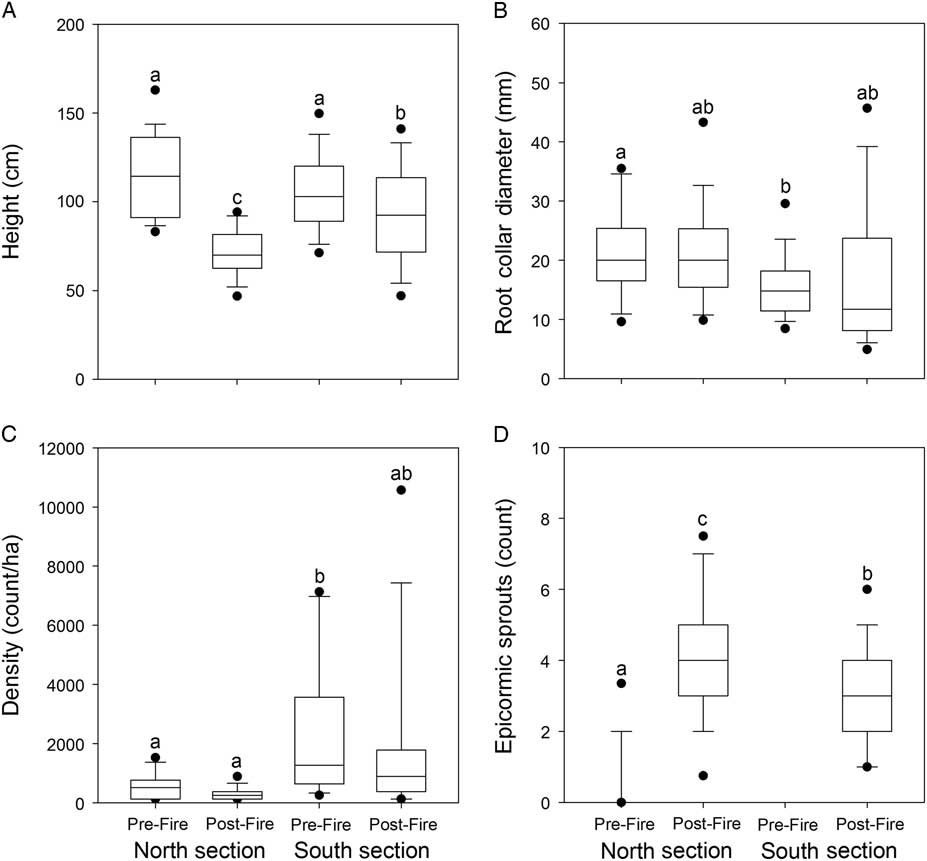
Height of pre-fire P. calleryana did not differ between the northern and southern sections [F(1, 597)=1.74, P=0.188], but post-fire height measurements were reduced compared with pre-fire measurements [F(1, 597)=50.19, P<0.001; Figure 2A]. Root collar diameter was greater in the northern section compared with the southern section, but only before fire [F(1, 597)=8.59, P=0.004; Figure 2B]. Overall, density was greater in the south compared with the north, with 424 individuals ha−1 in the north and 2,240 individuals ha−1 in the south [F(1, 56)=14.58, P<0.001; Figure 2C]. Seeds from P. calleryana are most often dispersed by birds, and the southern section was closer to neighboring properties with P. calleryana individuals. Plants with heavy fruits and seeds will not travel far from the parental individual without the aid of a vertebrate dispersal vector (Levey et al. Reference Levey, Bolker, Tweksbury, Sargent and Haddad2005).
Box-and-whisker plots of Pyrus calleryana (A) height, (B) root collar diameter, (C) individual density, and (D) epicormic sprout counts per individual pre- and post-fire. Fires occurred in 2014 in the southern section and 2015 in the northern section of prairie. Unique letters above boxes indicate significant differences with Tukey’s HSD post hoc test.

The first fire in 2014 covered 4.5 ha. Trees in the southern section were top-killed by the burn, but they all produced epicormic sprouts at a mean of 3.1 per individual (SD=1.8). After this first fire, there were significantly more epicormic sprouts in the southern section compared with the north, which remained unburned [F(2, 414)=100.50, P<0.001; Figure 2D]. The unburned northern section had 0.3 sprouts per individual (SD=1.0), with 12.5% of individuals producing sprouts. Because these trees were not exposed to fire until the 2015 burn, animal damage is likely the main cause of these sprouts, although other underlying factors may be present (Kennard et al. Reference Kennard, Gould, Putz, Fredericksen and Morales2002; Wenger Reference Wenger1953). While not presented here, deer [Odocoileus virginianus (Zimmermann)] (i.e., terminal bud browse) and rabbit [Sylvilagus floridanus (J. A. Allen)] (i.e., bark damage at base of tree) damage were observed during this study. For the southern section, post-fire heights were significantly shorter than pre-fire measurements (Figure 2A), but root collar diameter did not differ (Figure 2B).
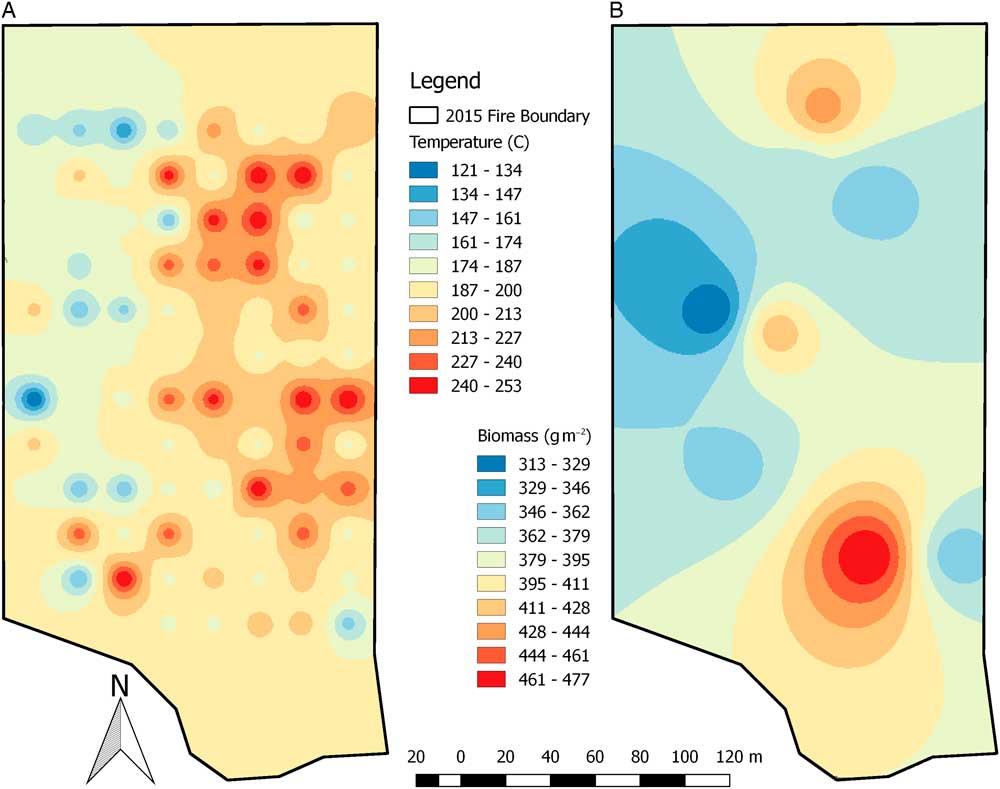
The second fire in 2015 covered 5.1 ha. Similarly, all trees were top-killed by the burn, and all produced epicormic sprouts at a mean of 4.1 per individual (SD=1.6). Due to an error in data collection, sprouts were not counted in the southern section after the northern fire. However, there were significantly more sprouts per individual following the northern fire compared with the southern fire (Figure 2D). Similar to the southern fire, post-fire heights in the northern section were significantly shorter than pre-fire measurements (Figure 2A), but root collar diameter did not differ (Figure 2B). Mean maximum temperature measured in the second fire was 195 C (range=121 to 253 C). The highest temperatures were more often recorded on the eastern half of the burn area (Figure 3A). The fire was started on the western edge and moved toward the east. Higher biomass measurements were found near the southern half of the northern burn area (Figure 3B). Biomass interpolation was exported to the fire temperature grid points. Fire temperature and biomass were not significantly correlated (r=0.16, P=0.115).
Inverse distance-weighted interpolation for (A) fire temperature and (B) biomass at Arrowhead Prairie.

After fire, all measured trees increased in stem number because of epicormic sprouting. This increase in stems could present a problem from a management standpoint due to the likely increase in future flower and fruit production (Bond and Midgley Reference Bond and Midgley2001; Kauffmann Reference Kauffman1991). Even though none of the P. calleryana trees surveyed at Arrowhead Prairie produced flowers, an increase in the number of flower-producing stems could cause an increase in the number of future trees in the prairie (Gonzalez et al. Reference Gonzalez, Ghermandi and Paláez2015). However, if any of the trees were at flowering ages, fire would have destroyed flower buds (Bond and Midgley Reference Bond and Midgley2001). Potentially, fire may have artificially reduced the maturation stage of trees by forcing regrowth and delaying flower production (Gonzalez et al. Reference Gonzalez, Ghermandi and Paláez2015; Kauffmann Reference Kauffman1991). Post-fire tree heights were significantly shorter than pre-fire, but root collar diameter did not change. Because the trees needed to regrow stems in a single growing season, it is not surprising that the post-fire trees were shorter than pre-fire trees (Bond and Midgley Reference Bond and Midgley2001). The post-fire trees likely put more resources into primary growth rather than secondary growth (Kennard et al. Reference Kennard, Gould, Putz, Fredericksen and Morales2002; Nowak and Crane Reference Nowak and Crane2002). Additional questions associated with P. calleryana resiliency after multiple fires need to be addressed. In addition, beyond the scope of this study, mowing may be another technique used to manage similar prairies, but the response from P. calleryana may be similar to fire, that is, epicormic sprouting.
Pyrus calleryana Seeds and Seedlings
While in cold storage, 98 seeds from the control group and 114 seeds from the postwinter fire treatment group (yet to be exposed to fire) germinated. Pre- and postwinter fires applied on seeds and fruits both measured at 149 C. Following fire treatments, none of the seeds exposed to fire as bare seeds or contained in fruits germinated. First- and second-year seedling fires measured 156 and 184 C, respectively. After 3 mo, only one of the first-year seedlings resprouted. However, after 3 mo, all 32 second-year seedlings resprouted. It is important to note that this experiment was conducted with optimal winter conditions in a refrigerator, optimal growing conditions in a greenhouse, and smaller fires. However, the temperatures measured in these tray fires were within the ranges of the larger prescribed burn in the northern section of the prairie.
Summary
Pyrus calleryana has the potential of becoming one of the most problematic invasive species in the United States. We tested a management strategy already used in prairies as a viable method to control P. calleryana. Because prescribed fire is a common management tool, there was potential to reduce economic and ecological costs of effective P. calleryana management. The results presented here indicate that fire was not a viable technique for controlling P. calleryana. While all established individuals were top-killed after the prescribed fires, they all produced epicormic sprouts, resulting in increased numbers of stems, which would likely lead to increased flowering and fruit production. Pyrus calleryana can be controlled by using a cutting and herbicide application. Given that fire reduces the total amount of biomass in the prairie, an herbicide application after a controlled burn may be more practical, due to visual apparency and accessibility of P. calleryana stems. Further public education is necessary regarding P. calleryana to reduce its use as an ornamental species.
Acknowledgements
Funding was provided by the Little River Wetlands Project. The authors would like to thank Nolan Appel, Kayla Chin, Abbigayle Dunlavy, Lauren Hoffman, Hannah Lancaster, Lori Morgan, Andrea Myers, Meriana Nadrous, Yar Thet Pan Naing, Camtien Nguyen, Emily Nguyen, Ziontu Ralhla, Miloslava Shistova, Esther Vel, Nicholas White, and Noah Wolf for their assistance with fieldwork. Finally, the authors would like to thank the anonymous reviewers who provided comments to improve this article. No conflicts of interest have been declared.