


Introduction
Mindfulness-Based Cognitive Therapy (MBCT) was developed with the intention of offering a cost-effective training program that helps people with recurrent depression to learn skills that prevent depressive relapse (Segal, Williams and Teasdale, Reference Segal, Williams and Teasdale2002). There is considerable interest among professionals and clinical researchers in MBCT and an emerging evidence base suggests that MBCT has the potential to help a large number of people step out of a pattern of recurring depression (Baer, Reference Baer2003; Coelho, Canter and Ernst, Reference Coelho, Canter and Ernst2007). Yet the specific processes underlying MBCT's therapeutic effectiveness remain unclear. This is partly due to our relative lack of knowledge of how MBCT is experienced by the people for whom it is intended. This study used a qualitative approach to enquire into the underlying explanatory models people hold for how MBCT works.
MBCT is derived from mindfulness-based stress reduction, a program with proven efficacy in ameliorating distress in people suffering chronic disease (Baer, Reference Baer2003; Kabat-Zinn, Reference Kabat-Zinn1990) and cognitive behavioural therapy for acute depression (Beck, Rush, Shaw and Emery, Reference Beck, Rush, Shaw and Emery1979) that has demonstrated efficacy in preventing depressive relapse (e.g. Hollon et al., Reference Hollon, DeRubeis, Shelton, Amsterdam, Salomon, O'Reardon, Lovett, Young, Haman, Freeman and Gallop2005). MBCT is intended to enable people to learn to become more aware of the bodily sensations, thoughts and feelings associated with depressive relapse and to relate constructively to these experiences. MBCT is taught as eight 2-hour group classes (8–12 participants per group). It is based on theoretical and empirical work demonstrating that depressive relapse is associated with the reinstatement of automatic modes of thinking, feeling and behaving that are counter-productive in contributing to and maintaining depressive relapse and recurrence (e.g. self-critical thinking and avoidance) (Lau, Segal and Williams, Reference Lau, Segal and Williams2004). While MBCT is informed by a cognitive model of depressive relapse and includes several key cognitive and behavioural elements, its primary teaching vehicle is experiential learning through mindfulness practice. Outcome research to date suggests that compared with usual care, MBCT plus usual care halves the rates of relapse over a 60 week follow-up period among people who have experienced three or more previous episodes of major depression (Ma and Teasdale, Reference Ma and Teasdale2004; Teasdale et al., Reference Teasdale, Segal, Williams, Ridgeway, Soulsby and Lau2000). In a recently completed trial MBCT was shown to be equivalent to the current treatment of choice, namely maintenance antidepressants, in terms of depressive relapse, and superior in terms of quality of life and residual depressive symptoms (Kuyken et al., Reference Kuyken, Byford, Taylor, Watkins, Holden, White, Barrett, Byng, Evans, Mullan and Teasdale2008). The proportion of patients in the MBCT arm who relapsed was 47% compared to 60% in the continuation anti-depressant medication arm. The levels of residual depressive symptoms in the MBCT group at 15-month follow-up was significantly lower than in the anti-depressant medication arm and was in the “minimal symptoms” severity range. Despite the promising outcomes, there is currently very limited evidence relating to the mechanism by which MBCT works, which has led a recent systematic reviewer to conclude that such research is essential because it “would further assist in understanding why, or for whom, MBCT may be useful and enable further development and modification of the program” (Coelho et al., Reference Coelho, Canter and Ernst2007; p. 1005).
The development of a broader, theoretical understanding of these psychological mechanisms necessitates an understanding of the subjective experiences of those receiving MBCT. Some steps in this direction have already been taken. Qualitative studies are beginning to emerge in this area, both in peer-reviewed journals (Finucane and Mercer, Reference Finucane and Mercer2006; Mason and Hargreaves, Reference Mason and Hargreaves2001) and as yet unpublished studies (Ma, Reference Ma2002) embedded in randomized controlled trials (Ma and Teasdale, Reference Ma and Teasdale2004). Qualitative research methods are particularly suited to studying phenomena that need to be more clearly delineated in new areas of enquiry (Malterud, Reference Malterud2001; Richardson, Reference Richardson1996). They can also elucidate particular explanatory processes assumed to be important on theoretical grounds. Most important, qualitative approaches can capture the quality of people's lived experience. Given that mindfulness is an experiential phenomenon and that the target of mindfulness-training is a person's experience of their thoughts, feelings and bodily sensations, it is important to ask about people's experience.
Mason and Hargreaves (Reference Mason and Hargreaves2001) used a grounded theory approach to explore seven participants' accounts of MBCT. Their analysis suggested that participants valued the development of mindfulness skills, an attitude of acceptance and living in the moment. Although Mason and Hargreaves identified several themes that may relate to preventing depressive relapse (e.g. “Coming to terms”, “Warning bells” and “Bringing it into everyday”), all but three participants in this study were interviewed immediately after completing the course before they had much opportunity to use what they had learned to stay well. As a consequence, this study was not particular well-adapted to exploring the longer-term effectiveness of MBCT as a relapse prevention program.
Ma (Reference Ma2002) used an interpretative phenomenological analysis approach to analyze the accounts of 41 people 12 months after the end of MBCT. The analysis suggested several themes: ways of change (e.g. warning signals and action plans), changes in relationships, changes in life in general (e.g. feeling empowered and confident) and support from the group (e.g. being understood). While the analysis showed promise of thematically rich data, the interview questions limited participant reflection and disclosure along circumscribed dimensions (i.e. “usefulness” and “difficulty”).
The most recent peer-reviewed study of MBCT used a mixed methods approach. Finucane and Mercer (Reference Finucane and Mercer2006) interviewed 13 people 3 months after they had completed an MBCT program. The findings highlighted participation in a group as a validating experience and the importance of ongoing support for participants beyond the end of the group (Finucane and Mercer, Reference Finucane and Mercer2006). However, the analysis was at a descriptive level and, like the Mason and Hargreaves study, the timing of the interviews is likely to have limited the scope of the findings with regard to MBCT's longer-term effectiveness.
The current study focused on MBCT as a relapse prevention program, conducted interviews a year after the end of MBCT, adopted thematic analysis methodology, and used the perspectives of four researchers/therapists. The research question was: How do people describe and evaluate their experience of MBCT as a treatment for recurrent depression? We sought to elucidate the psychological processes in people's accounts. In doing so we aim to contribute to the development of theory as well as informing the practical delivery of MBCT.
Method
Study context and interventions
This interview study was embedded in a randomized controlled trial (Kuyken et al., Reference Kuyken, Byford, Taylor, Watkins, Holden, White, Barrett, Byng, Evans, Mullan and Teasdale2008). In brief, the trial was a parallel two-arm study comparing MBCT with maintenance antidepressants. To capture participants' more enduring experiences of MBCT the qualitative data reported here were collected one year after the end of the MBCT program. The study was approved by the UK National Health Service North and East Devon Research Ethics Committee.
MBCT and antidepressant tapering/discontinuation. The MBCT relapse prevention intervention is informed by a cognitive-behavioural model of depressive relapse and aims to teach a range of mindfulness (e.g. attentional control), cognitive (e.g. de-centering) and behavioural (e.g. activation) skills (Segal et al., Reference Segal, Williams and Teasdale2002). The groups were delivered in primary care settings with MBCT groups of between 9–14 people following the MBCT manual (Segal et al., Reference Segal, Williams and Teasdale2002): 2-hour sessions over 8 consecutive weeks, followed by 4 follow-up sessions in the following year. Session content included guided mindfulness practices (body scan, sitting meditation, yoga), enquiry into people's experience of these practices, review of weekly homework (40 minutes of mindfulness practice per day and generalization of session learning) and teaching/discussion of cognitive-behavioural skills. All interviewees participated in at least four of the eight MBCT group sessions. As part of the trial design participants were supported in tapering and discontinuing their ADM by their primary care physician.
Participants
Recruitment to the trial was designed to screen as wide a population as possible of people with recurrent depression in primary care (White, Holden, Byng, Mullan and Kuyken, Reference White, Holden, Byng, Mullan and Kuyken2007). All participants met Diagnostic and Statistical Manual IV (American Psychiatric Association, 2000) criteria for recurrent depression, in full or partial remission. Exclusion criteria were: co-morbid diagnoses of current substance dependence; organic brain damage; current/past psychosis, including bipolar disorder; persistent anti-social behaviour; persistent self-injury requiring clinical management/therapy; unable to engage with MBCT and formal concurrent psychotherapy. Of the 61 participants allocated to the MBCT arm, 54 were interviewed (7 did not attend the program and were not interviewed). The final 20 interviews were selected for analysis because earlier interviews were used to shape the interview schedule (see below).
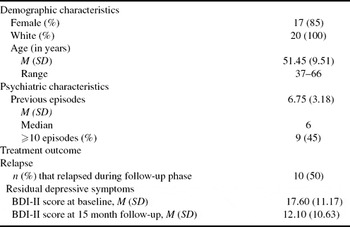
The participants' demographic, psychiatric and treatment characteristics are comparable to the larger sample reported in Kuyken et al. (Reference Kuyken, Byford, Taylor, Watkins, Holden, White, Barrett, Byng, Evans, Mullan and Teasdale2008) (See Table 1). They can be characterized as a group of people with recurrent depression, treated pharmacologically in primary care, who had a referral from their primary care physician after expressing interest in a psychological group-based approach that included tapering/discontinuing their m-ADM. The participants engaged in one of several different MBCT groups and had a range of different outcomes at the time of the interviews. Half had experienced a relapse since MBCT and while the mean level of depressive symptomatology was in the “minimal severity” range, the variation suggested several were still experiencing significant depressive symptoms.
Characteristics of Sample (N = 20)

Note. BDI-II = Beck Depression Inventory II.
Interview schedule and data collection
Interviews were conducted in primary care settings across a range of urban and rural locations in Devon, England. Data were collected by two research officers using a semi-structured interview schedule that was designed to gather information concerning (a) participants' experiences of MBCT and, (b) their experiences of sustained recovery/relapse in the 12 months post-therapy. Interviews ranged between 30 and 60 minutes in length and were recorded using a digital voice recorder. The interview schedule was refined throughout the interviewing phase to ensure that participants had the opportunity to discuss experiences relevant to the research question in full, both positive and negative. Researchers used open questions designed to facilitate spontaneous reflection concerning participants' experiences of MBCT, combined with questions and probes designed to achieve further exploration in relation to known themes (Ma, Reference Ma2002; Mason and Hargreaves, Reference Mason and Hargreaves2001). A thematic analysis of 11 of the early interviews suggested the data corpus was rich enough to yield theoretically and clinically interesting themes. Following refinements to the interview schedule, the final 20 interviews were based on the same pool of open-ended questions. The analysis was based on these 20 interviews.
Analytical strategy and procedure
Interviews were transcribed verbatim, anonymized and analyzed using Thematic Analysis (Braun and Clarke, Reference Braun and Clarke2006). Thematic Analysis allows for a degree of epistemological flexibility (Braun and Clarke, Reference Braun and Clarke2006). It is compatible with an inductive, data-driven approach whilst, at the same time, allowing for the integration of prior theory and research. As such, it is appropriate for use in a multi-method context in which the qualitative element of enquiry is framed by prior work, consistent with the present study which is embedded within a larger quantitative trial and thus attended by certain analytic and epistemological constraints.
Interview recordings were listened to in full and the corresponding transcripts were re-read several times. Specific events, thoughts and actions were coded or identified as themes on the basis of their ability to “capture something important in relation to the overall research question” (Braun and Clarke, Reference Braun and Clarke2006, p. 82). Codes or themes were then compared and either differentiated further in order to capture different nuances of meaning or grouped according to their commonalities. This differentiation and merging of themes allowed for the development of an analytic hierarchy in which abstract, overarching themes were composed of sub-themes that, in turn, were descriptively close to the verbatim data. Overall, the coding process was aimed at the identification of themes that were internally homogeneous, externally heterogeneous and had explanatory power. The process of analysis involved a recursive movement back and forth between source, extract and theme in order to ensure that the emerging structure of themes continued to be grounded in the transcripts. Finally, the themes were considered in terms of the extent to which they coherently and adequately represented the meaning of the data set as a whole and, when necessary, new data were incorporated within a revised thematic structure (Braun and Clarke, Reference Braun and Clarke2006). The credibility and coherence of the findings (see Elliott, Fischer and Rennie, Reference Elliott, Fischer and Rennie1999) was checked at all stages by the members of the research team, with each bringing the following perspectives to the analysis: experience as a psychological therapist (MA, WK); experience as a participant in an MBCT program (AB, MA); expertise in thematic analysis (MA, SJS); experience as an MBCT therapist (WK) and backgrounds in psychology from a range of perspectives (MA, AB, WK, SJS). Finally, the separate analysis of the transcripts conducted during the interview schedule development phase (see above) further cross-validated the emergent structure of themes and sub-themes.
Results
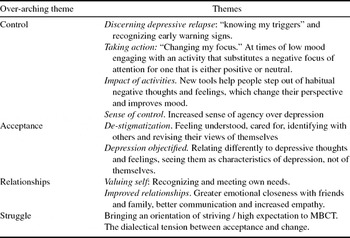
Four over-arching themes were identified in the analysis of the interview data, namely, “Control”, “Acceptance, Relationships” and “Struggle”. Each of these themes is described in turn, beginning with a definition of the themes, followed by a narrative account of the theme including its constituent sub-themes (See Table 2).
Summary of over-arching themes and themes

Control
This over-arching theme describes participants' perceptions and evaluations of personal agency in relation to depression and depression-related thoughts and feelings. Prior to MBCT the majority of participants stated that they had viewed depression as an opaque process over which they felt helpless. During MBCT participants spoke of becoming better able to discern processes of relapse and acquiring tools that enabled them to avert or limit the progression of their relapse. This facilitated a movement from helplessness and passivity to one of perceived control and self-efficacy. Control comprised four themes.
Discerning depressive relapse. Most participants said their ability to avert or contain depressive relapses was facilitated by an increased discernment of their relapse process. This awareness comprised two elements. First, several participants spoke of “Knowing my triggers”, of identifying experiences and circumstances that increased risk of relapse (although one participant spoke of having no observable triggers). The second aspect referred to by most participants concerned a capacity to “Recognize early warning signs” of relapse. This encapsulated knowledge of psychological and bodily signs associated with relapse and an ability to recognize when such signs are present in experience. For most participants this awareness had a “thermostatic” aspect: awareness signalled the need for remedial action: “My symptoms are like a weight on my head and once I feel that, and my vision is a bit blurred, then I think I'm not having a good day. You are going to have to do something about it” (Annie).
Taking action: “changing my focus”. The actions taken by participants in response to early warning signs varied (e.g. the “3-minute breathing space”, gardening, walking their dog) but they had two common characteristics: they were intentional, deliberate responses that shifted attention from a negative focus towards either a neutral or positive focus. Two categories of action were described. First, many of the participants said they used meditation in order to withdraw their attention from negative images and thoughts about their past or future. Often this involved attending to the senses (e.g. to sights, sounds and breathing). Jane offers a vivid description of this strategy: “Usually I take the dog and I force myself . . . I say force myself . . . look at the pattern on the trees, the rain . . . the sound of the rain, the sound of the wind in the trees and actually deliberately listen and look. Feel the wind or the rain or whatever. Or just the way the sun is shining on the dew drops. And actually, actively, look and feel my way round the block, or up the lane, or whatever. And that's, to me, my mindfulness attitude.” A minority of participants spoke of using this strategy during stressful situations such as a entering a crowded room. In the accounts of half the participants intentionally refocusing attention was associated with a positive impact on depression-related mood and thinking.
The second course of action, described by over half of the participants, involved deliberately engaging in a “nourishing” activity in response to their warning signs. Nourishing activities were enjoyable, often involved physical exercise and were usually described as a temporary, strategic withdrawal from a stressful situation. Daniel illustrates this approach, which he used in his workplace (supported by an understanding employer): “If I feel myself beginning to slip, I go to, I go out, I drag myself off to a nice garden centre for half a day. . . I don't necessarily buy anything . . . I just wander round and um, on my own, have a cup of tea or coffee and I find that that a . . . nourishes me.”
Impact of activities. Participants described their actions as tools to help them manage depression-related thoughts and feelings. Three direct effects were described. First, several participants had said that they experienced “stupid thought cycles” (Lizzie) or “snowballing” of negative thoughts (Daniel) when they felt low. Those participants who spoke of using meditation techniques (either as a daily routine or reactively in response to warning signs) said that the practices reduced this “mind-churning”. Bernard gives a concrete description of his experience: “I think it's calming things down, it's slowing the process so what it's actually doing is the thought process that's getting you in depression or getting you stressed, whatever those thought processes, they're running round like a hundred yard dash round your head or grand prix racing, just sort of spinning. And the time, meditation time, slows the lap rate. Yeah, so it slows your metabolism time. It stops some of the palpitations and some of the panic and it slows that race down.”
Second, the majority of participants said that responding to their warning signals by engaging either in mindfulness practice or a “nourishing activity” led to improved mood. They described feeling calmer (more relaxed and less irritable), happier and more energetic. The link between practice and the effect of the practice was made explicit by Jane in relation to walking meditation: “Physically, it has an effect of making me feel smiley, inside. And I can go out feeling really low, perhaps sometimes almost tearful – bad tempered, angry, whatever – and come back feeling a lot lighter hearted.”
Finally, most participants in the sample said that MBCT had developed their ability to put things into perspective. Since doing MBCT they said they are now able to “view things from a different angle” (Annie) and “think straight” (Sam), with a resultant sense of having come “back to reality” (Daniel). This capacity to put things in perspective resulted from mindfulness practices that slowed the mind and relaxed them physically, but was also a factor that facilitated clarity of thinking. Fran represents several participants who made a link between meditation practices, reduced mind-churning, improved mood, and an ability to put things into perspective: “Because it [meditation] allows you to take space, and calm yourself down. It's this constant, constant churning in your head, and if you slow that down it gives you more time to be more logical, and get things more into context.”
Sense of control. The ability to head off the early signs of depression, combined with having techniques to contain and avert relapse, supported the belief in the possibility of prevention and an associated sense of control over depression. Marie conveyed this shift away from a feeling of helplessness: “Where before it just happened. It just, it was just there. It was just me. It was the way I lived and I accepted that. I just went down and, you know, there was nothing I could do about it. I knew it would happen so I never tried to stop it because I had no way of knowing how to stop it.”
Many said that having the tools to cope enhanced their confidence to handle depression-related thoughts and feelings. Sam, reflecting upon her future, touches on both of these aspects: “Now I just feel that I've got the resources that if I take something on instead of always being afraid that it would collapse because I'd had depression and the whole thing go – if I wanted to do my own business or something, I'm starting to think, ‘well no, I could manage, cos I've now got the tools to sort out a management strategy properly.’ So I'm very hopeful for the future instead of thinking that life's just going to tail off into oblivion.”
Acceptance
Many participants who articulated a sense of increased control still continued to experience depressive symptoms. The overarching theme of Acceptance incorporates a number of processes that appear to have increased their capacity to accommodate these ongoing depression-related phenomena with less distress.
Destigmatization. Most participants described negative experiences of being misunderstood, judged and stigmatized because of their depression. They learned to mask their feelings, adopting an appearance of wellness and keeping people at a distance. Most participants described this as an isolating experience. Participating in an MBCT group ameliorated this sense of isolation. First, participants described the group as a place of care and support. This was, in part, rooted in a strong sense of shared identity. Other people in the group were “like a mirror” (Marie) or an “echo” (Irene). Fran revealed how this facilitated greater self-acceptance: “I didn't feel guilty. I think it's a feeling of safety, that everyone else has got the same problems, and that you could go to that group, and know that nobody was going to say ‘oh snap out of it’, or . . . everybody understood what you felt like.” People felt safe to open up to each other and to emotions that had previously been buried, blocked out and concealed. Carrie conveyed this as follows: “Because of attending the groups, and um, talking with the other people in the group, that um, and hearing other people's problems and things, it probably, um, brought it all to the forefront, probably it was making me more aware of myself, and my anxiety and my state of mind and my mood that, um, probably made, it was a very in deep, it was right at the front all the time. I didn't try and push it back where as before, it was so deeply buried I couldn't, it was just never there all the time, now it was reminding me it was there all the time – it was just wanting to come out”.
This process facilitated a process in which negative depression-related identities were revised. Several, like Annie, said that sharing experiences with others led to them no longer feeling abnormal or mad: “I just thought it was me go[ing] mad you know. It's surprising how many other people are out there thinking the same thing. Like I say, when you meet a group of you and you all think the same way, talk the same way.” Half spoke of being encouraged because they made favourable comparisons between themselves and others in the group whom they regarded to be more seriously affected by depression. This group of participants overlapped with another sizeable group who spoke of being impressed by the ordinariness of fellow-sufferers, a perception that challenged their prior negative stereotypes of depressed people.
Depression objectified. Though the theme of destigmatization relates to ways in which participants were able to identify with depression with less distress, this theme incorporates a number of ways in which depression-related thoughts and feelings became more acceptable because participants developed ways of not identifying with their depression. First, approximately half of the participants described a new perspective on their depression-related thoughts and feelings that can be summarized as “These thoughts and feelings aren't me.” For some, this was because, having met others with depression, they now viewed some of their difficulties as characteristics of an illness rather than as fundamental aspects of themselves.
Second, a minority indicated that they had found that the idea taught in the MBCT course that “Thoughts aren't facts” supported a non-judgmental attitude to negative thoughts. This strategy is summarized by Pat: “It was really important to realize that your thoughts aren't necessarily a reflection of who you are. It's almost like you've got an awareness, that you've got this aspect of yourself . . . its like hearing voices, and we call them our thoughts but they are not actually us . . . and I think that's that's really helped.”
Finally, many participants spoke of increased tolerance to depressed mood based upon a realization that it will pass. This perspective, supported by an observation (within the group and in meditation practice) that moods are transient, was articulated by Diane: “Knowing that it doesn't have to be a big fight all the time. That you know, you can just go along with the, the fact that you do feel bad, but it isn't going to last forever and you, you know, it sort of, well, you can have a bit of cohesive thought that goes through you, that you know, it's not the end of the world, and you know it is going to last, it is going to get better.”
Relationships
The sub-themes comprising the over-arching relationships theme relate to changes in participants' interpersonal relationships that participants attributed to MBCT. First, most participants said they had become aware that they often put others' needs above their own. This awareness enabled them to take better care of themselves with a sense of legitimacy and with reduced guilt. Second, participants spoke of several changes in their interpersonal relationships that they attributed to positive changes in their mood and thinking.
Valuing self. Many participants said they had always put others first and according to Sam this was a root problem that MBCT engaged with directly: “What we all seemed to share was that we were all very hard on ourselves and had low self esteem, so we weren't giving ourselves time and we'd filled up our lives with other things to make us feel useful. So by definition, the fact that we were all there means that we were going to struggle to find the time and that was the whole point of course.” Several said that neglecting their own needs made them more vulnerable to relapse and MBCT provided them with a rationale to take time for themselves. Often it was the act of taking daily time aside for mindfulness exercises that fostered this realization. Bernard describes this theme and how, for him it enabled him to be more assertive. “Yeah it's the business about giving time for yourself and all the tapes congratulated you on giving time for yourself and you think maybe I am not giving myself time, maybe I'm not telling people exactly what I feel and maybe I should be saying ‘I don't like this and I don't like that’. And it's not all the time and it'll be perhaps once or twice a month when we'll come to the point where I think ‘well I'm going to put what I need first’ and that's strange for Sheila [his partner] because she's not used to that.”
Improved relationships. Although two participants said that MBCT had had no effect on their relationships, others indicated MBCT had resulted in a number of positive changes, including greater emotional closeness with friends and family, better communication and increased empathy. Two processes were described as enabling and supporting these changes. First, several participants said that, within the accepting culture of the group, they were able to open up to their emotions (that they had previously buried). This experience led to increased awareness and tolerance of their emotions. Second, several said that they were able to engage with others more because they were now “on an even keel” (Lizzie), due to using the tools described above. Here Carrie explains why she now is less “cross and angry” with her 18-year-old daughter and able to relate to her more constructively: “Well, I guess because I was feeling more confident in myself and more in control that I could (.) verbalize how I felt . . . um . . . rather than becoming anxious and hysterical about it myself because I wasn't able to cope with what she'd done, you know, I sort of, told her how I felt and then highlighted her from her side as well . . . not just how it was for me, but you know, this is all about you . . . this is what would have happened to you.”
Struggle
The overarching theme “Struggle” incorporates a range of difficulties and disappointments that participants expressed when they described their experience of MBCT. A sizeable minority spoke of difficulty giving themselves time and indicated that they continued to struggle with the tendency to put others' needs first and some spoke of difficulty practising alone, without group support. Several participants articulated difficulties coming to terms with the limitations of MBCT. This involved adapting to the fact that MBCT was not a cure; that it was not a “magic fix” (Pat) and that continued use of anti-depressant medication may be necessary. Finally, for many in the group, experiences of continued vulnerability were attributed to personal failure and accompanied by guilt or self-blame. The reasons people gave differed and included “low will power” (John), “poor time-management” (Judy) and “trying so hard to do it that I didn't do it” (Jo).
Irene articulated a struggle that offers a helpful insight into what may lie at the heart of this overarching theme: “When I was first diagnosed with depression it took me a long, long time to accept it was an illness I couldn't actually help. And eventually I accepted that and after that I coped nicely. I accepted it was an illness like diabetes and I needed my antidepressants . . . Then I came on the course and I was in limbo for a bit. Here I am. I've got this new skill. It is actually working at the moment. Perhaps I can help having depression. So it confused me a bit. But now I've got it into perspective now.” Irene's struggle illustrates the tension between acceptance of depression-related thoughts and feelings and change. For her a sense of control over depression was associated with a move away from accepting depression as an illness. Depression was now within her control; its presence no longer expresses an external contingency (for which a person cannot be blamed) but an internal contingency, which implies the responsibility to use the tools taught in MBCT.
Discussion
This analysis of peoples' experiences of MBCT identified four overarching themes: an increased sense of control over depression; an acceptance of depression-related thoughts and feelings; expressing and meeting personal needs in relationships and a range of struggles with MBCT (See Table 2). These themes map onto those identified in former qualitative approaches, especially the theme of acceptance, which was noted in all three previous studies (Finucane and Mercer, Reference Finucane and Mercer2006; Ma, Reference Ma2002; Mason and Hargreaves, Reference Mason and Hargreaves2001). However, the current analysis also transcends previous findings by suggesting some important changes in theoretical emphasis (e.g. control), by noting new themes with significant clinical implications (e.g. struggle) as well as through providing a more detailed delineation of certain themes than was possible in previous studies (e.g. relationships). Below, we link our findings to existing theoretical understandings of MBCT and set out potential implications for theory, research and clinical practice.
If the theoretical premise for MBCT is well grounded it should be reflected in participants' experiences of MBCT. When we compare our themes with the theoretical model that underpins MBCT, we find considerable convergence but also some potential refinements and elaborations. MBCT is informed by the theoretical premise that people who have suffered several episodes of depression become increasingly vulnerable to relapse at times of low mood because depression-related cognitions have formed strong associative networks with low mood (Segal, Williams, Teasdale and Gemar, Reference Segal, Williams, Teasdale and Gemar1996; Teasdale, Segal and Williams, Reference Teasdale, Segal and Williams1995). At times of low mood the person becomes locked into a closed circuit of self-devaluative thinking (“depressive interlock”) that intensifies negative affect (Teasdale, Reference Teasdale1999a) and prevents effective problem-solving (Lyubomirsky, Tucker, Caldwell and Berg, Reference Lyubomirsky, Tucker, Caldwell and Berg1999; Watkins and Baracaia, Reference Watkins and Baracaia2002). MBCT, it is argued, cultivates awareness of these processes, enables people to step out of self-devaluative thinking and respond more skillfully to problems. Our data converge with this account. Specifically, the finding that the use of mindfulness practices reduced mind-churning maps well onto the notion of stepping out of self-devaluative thinking. The process of taking action and/or shifting attention to a neutral focus facilitated either escape from, or a deceleration of, negative thought cycles exactly as described in the MBCT protocol (Segal et al., Reference Segal, Williams and Teasdale2002). For some participants stepping out of negative thinking enabled the spaciousness to solve life problems better. For example, Sam described it like this: “The head space . . . you can actually start thinking straight, well I mean it's just . . . wonderful . . . yeah, it's improved matters at work, it's improved matters outside work because it gives you that extra little space and time that you can get your head around what the problem is.”
MBCT is a complex psychosocial intervention that targets specific theory-based mechanisms, but also includes non-specific mechanisms like group support common to any effective group-based psychosocial intervention. The research to date does not enable us to conclude what mechanisms drive change nor say if the processes described are specific to MBCT. Although inductive methods limit what can be inferred about the precise nature of the relationship between the discrete therapeutic components of MBCT and specific therapeutic outcomes, a number of themes can be mapped onto components of the MBCT programme. First, teaching mindfulness skills appeared to be associated with participants' descriptions of meditation as a means to attain a present-focus when mood was low. Mindfulness also seemed linked to participants' ability to reduce “mind-churning” and to descriptions of improved mood (calmer and less irritable). Whilst “valuing self” was not associated exclusively with any one component of MBCT, several participants described how allowing themselves time to meditate throughout the course fostered a realization that they needed to nourish themselves more. This also gave them a rationale for asserting their needs.
The themes “discerning depressive relapse” and “engaging in nourishing activities” were associated with the cognitive-behavioural component of MBCT – group members consider the triggers and signs associated with relapse and develop a relapse-prevention strategy in sessions seven and eight. Whilst identifying triggers and signs is essentially a cognitive exercise, it is possible that the “real-time” sensitivity to somatic and psychological signs of relapse is increased by mindfulness training.
It is interesting that in participants' accounts, the development of awareness, acceptance and behavioural change has a basis in both specific MBCT techniques (i.e. the mindfulness practice) and non-specific factors (i.e. group processes). Are these mutually reinforcing elements in the learning process? Whilst our analysis cannot speak definitively to these questions, it does suggest the intriguing possibility that within MBCT there is a complex interaction of specific and non-specific factors. For example, in the over-arching relationships theme, the social comparisons (Higgins, Reference Higgins1996) that inevitably occur in groups appeared to reduce self-devaluative thinking. For example, Sam described it this way: “Actually they were all bright, intelligent, superficially together people and, you're thinking, ‘gosh, we're all sort of in the same boat’ and they're all making the best of what they could, and I sort of felt privileged that I could sit there and say ‘yeah, I know what you are talking about, and no, we aren't mad, and we ain't stupid’.” More research into how these specific and non-specific factors interact in complex group interventions like MBCT is required.
Moreover, the data suggest that the change process is different for different people. This is consistent with recent descriptions of mindfulness comprising overlapping and mutually supportive facets (Brown, Ryan and Creswell, Reference Brown, Ryan and Creswell2007) and it makes sense that these facets might be more or less relevant for different people who have a variety of presentations and personal histories. Much process-outcome research examines change in one or a few putative mechanisms of change (Laurenceau, Hayes and Feldman, Reference Laurenceau, Hayes and Feldman2007), yet our findings suggest the variance accounted for in the outcome variable will only become more substantial when interventions target a more wide ranging set of mechanisms.
Two of our four over-arching themes, acceptance and control, were particularly dominant in participants' accounts and were often explicitly described as being linked to improved well-being. MBCT is described as increasing the capacity to step out of negative self-devaluative thinking, and thereby increase acceptance of depression-related thoughts and feelings (Segal et al., Reference Segal, Williams and Teasdale2002). However, our overarching theme of acceptance is broader than the notion of acceptance generally associated with MBCT. Participants described a sense of being understood, being able to let go of pretences and identifying with other people who suffer depression. This enabled them to become aware of, express and accept thoughts and feelings, including difficult experiences. The transformative power of acceptance has been articulated in social psychology (Neff, Reference Neff2003), clinical psychology (Hayes, Follette and Linehan, Reference Hayes, Follette and Linehan2004) and Buddhist psychology (Brach, Reference Brach2003).
In our analysis a number of themes were subsumed under control as an over-arching theme (Table 2). There was an evident change from helplessness to a sense of personal agency that could be seen across the data set. The findings should be interpreted in the context of a sample, which in many cases had a longstanding history of recurrent depression. It is also likely that they had experienced treatments that had either not been effective or only partially successful. Therefore, MBCT may have provided experiences of mastery over depressive symptoms that were relatively novel for this group of people. Mindfulness practices aim to cultivate an orientation of being with experience and letting go of striving to change experience. In Buddhist psychology it is striving that underpins suffering (Bodhi, Reference Bodhi1984). Skilful MBCT therapists facilitate participants' mindfulness practice in a way that cultivates attention to experience, unattached to changing experience but nonetheless being curious about how experience is transformed moment by moment within awareness (Kabat-Zinn, Reference Kabat-Zinn2003). When people experience that thoughts, emotions, perceptions and bodily sensations are transformed naturally by bringing a quality of open and non-judgmental awareness this can be empowering (Brach, Reference Brach2003). This facet of mindfulness has also been shown to be associated with a variety of measures of self-regulation (Brown and Ryan, Reference Brown and Ryan2003). Masicampo and Baumeister (Reference Masicampo and Baumeister2007) ask whether mindfulness may be a product of successful self-regulation. That is, when self-efficacy develops, so does mindfulness. Participants in our sample described bringing awareness to the early signs of relapse, shifting their focus of attention, bringing an orientation of non-judgment, and choosing to engage in nourishing activities. This suggests that mindfulness creates the conditions for people to develop a sense of agency. However, some participants noted agency and mindfulness can be a virtuous cycle. For example, Paula said, “I find very often at night if I can't sleep I do the relaxation thing from the group and the concentrating on the breathing and I do find that I go off to sleep then which is helpful cos it does relax me very much.”
In recent years psychological therapies that teach mindfulness have recast the relationship between acceptance and change as a dialectic. That is to say, control and acceptance are not antithetical but paradoxically acceptance creates change (Hayes, Reference Hayes2004; Linehan, Reference Linehan1993; Teasdale, Reference Teasdale1999b). Ceasing to try and use cognitive strategies to change distressing feelings, and shifting instead to accepting difficult thoughts and feelings, proves to be empowering. This dialectal tension is borne out in the overarching theme struggle. In early sessions people bring an orientation of striving and evaluation to MBCT and the mindfulness practices in particular, creating tension (Segal et al., Reference Segal, Williams and Teasdale2002). We also see the struggle in shifting from being busy to finding time each day for mindfulness practice, from trying to “solve sadness” to accepting feelings as they are, from taking care of others' needs to nourishing the self, from avoiding experience to being with experience. By framing questions in a way that allowed people to speak about these experiences, the struggle that is part of the process of change in MBCT was described. We propose that at the heart of this struggle is the dialectical tension between control and acceptance. Change occurs when people, in their own way, begin to resolve this tension. It may help participants to explicitly acknowledge the presence of struggle: both acceptance and change are accepted and embraced as necessary (Linehan, Reference Linehan1993).
People vulnerable to recurrent depression are particularly susceptible to self-devaluation (Teasdale, Reference Teasdale1999a) and MBCT therapists are encouraged to be attuned to people transferring this self-devaluation to their “performance” on the MBCT practices (Segal et al., Reference Segal, Williams and Teasdale2002). In our sample this is a prevalent experience and, when asked about the limitations of MBCT, many made attributions of personal failure. It seems likely that they attempted to acquire acceptance-based mindfulness-techniques with a particular aim in mind (i.e. averting depression). Consequently, the continued presence of depression-related symptoms was attributed to a failure to “do it properly” – which made the presence of these symptoms even more difficult to accept. The developers of MBCT articulated this tension when they advised instructors to “let people know that the lack of homework will likely affect how much they will get out of the program, but without being critical of them” (Segal et al., Reference Segal, Williams and Teasdale2002, p. 135). The clinical implication of our findings is that the balance suggested by Segal et al. is challenging and therapists need to be highly attuned to tendencies in their clients towards striving and self-devaluation, especially when they are unspoken. As a group-based treatment, therapists may wish to consider asking participants to hand in their weekly homework logs so that these difficulties can be identified and worked with in an ongoing way.
The development of the over-arching theme relationships is relatively new in the research literature. Buddhist scholars (e.g. Feldman, Reference Feldman2005) and the main architect of contemporary mindfulness approaches in healthcare (Kabat-Zinn, Reference Kabat-Zinn1990; Kabat-Zinn and Kabat-Zinn, Reference Kabat-Zinn and Kabat-Zinn1998) have long argued that mindfulness can enhance people's ability for self-compassion and their responsiveness in relationships with others. Only very recently has empirical data emerged that mindfulness approaches focusing on different aspects of interpersonal functioning enhance functioning in a variety of relationships (Carson, Carson, Gil and Baucom, Reference Carson, Carson, Gil and Baucom2004; Singh et al., Reference Singh, Lancioni, Winton, Curtis, Wahler, Sabaawi, Singh and McAleavey2006, Reference Singh, Lancioni, Winton, Singh, Curtis, Wahler and McAleavey2007). This is the first study suggesting that MBCT for recurrent depression might enhance self-compassion and interpersonal functioning. Depressive interlock is not compatible with genuine compassion for the self or others. We hear in the transcripts that the therapists' invitation to cultivate kindly awareness builds self-compassion and this in turn creates the conditions for empathy, intimacy and effective communication. There is emerging evidence that facets of mindfulness are associated with attachment security (Shaver, Lavy, Saron and Mikulineer, Reference Shaver, Lavy, Saron and Mikulincer2007), and this is an area clearly ripe for further investigation. Given the reciprocal cycle between depression and interpersonal difficulties (Hammen, Reference Hammen2003), any intervention that breaks this cycle is likely to enhance long term outcomes.
The findings of this study should be interpreted in the context of the sample, which represents people identified in primary care as suffering depression, and who following their physician's invitation were interested in pursuing a psychological approach to relapse prevention. Future studies should use theoretical sampling to investigate possible differences in relation to MBCT's therapeutic pathways. In line with previous trials, participants were invited to four follow-up sessions in the year following the MBCT groups. Our clinical experience is that these follow-up sessions can be essential in consolidating people's learning and it would be interesting to explore this empirically.
The study methodology cannot speak directly to MBCT's mechanisms of change. Rather, it accesses people's perceptions and evaluations, as formulated within the context of an interview with research staff. Although the research staff aimed to conduct the interviews in an exploratory and non-directive manner, participants knew of the researchers' association with the trial, which may have influenced their responses. However, two of the authors (MA and WK) listened to tapes and provided an ongoing critique of the data-collection. In our discussion of the findings we have explored relationships between over-arching themes and themes. However, these relationships (e.g. between control, acceptance and psychological well-being) need further research because the associations in people's accounts suggested multiple possible relationships rather than one organizing pattern. It would also be informative to conduct comparative studies with people who have engaged with a range of individual and group psychotherapies to tease out specific and non-specific factors associated with change, including other mindfulness-based therapies such as mindfulness-based stress reduction.
As a number of commentators have noted (e.g. Coelho et al., Reference Coelho, Canter and Ernst2007), while there is growing evidence of MBCT's efficacy as a relapse prevention program, there is very limited research speaking to how it works. Further work is required to delineate the mindfulness construct and its relationship to well-being and change. Intriguing questions need answering about the relationships between facets of mindfulness, facets of functioning (especially emotion regulation and relationship functioning), and psychological well-being (Baer, Reference Baer2007; Brown et al., Reference Brown, Ryan and Creswell2007; Masicampo and Baumeister, Reference Masicampo and Baumeister2007; Shaver et al., Reference Shaver, Lavy, Saron and Mikulincer2007). Finally, process-outcome research examining the moderators and mediators of change in MBCT will enable the therapy to be refined to maximize its efficacy (Laurenceau et al., Reference Laurenceau, Hayes and Feldman2007). In the meantime, MBCT therapists who work with an awareness of what is helpful and what creates struggle are likely to be more effective.
Author note
The authors are listed in alphabetical order and contributed as follows: MA completed the study as part of his doctoral thesis, refined the design, conducted and wrote up the main analysis. AB conducted a preliminary analysis of early interviews and checked the reliability of the main analysis. WK designed the qualitative study as part of the larger research trial “Mindfulness-based Cognitive Therapy to Prevent Relapse in Recurrent Depression” and took primary responsibility for drafting the paper. SJS refined the design/methodology and supervised the main analysis. All authors contributed to the analysis and to drafting the manuscript. This paper was part of a larger trial, the Exeter MBCT Trial. The trial team comprised: Willem Kuyken (Principal Investigator); Sarah Byford, Rod S. Taylor and Ed Watkins (Co-Investigators); Emily Holden and Kat White (research staff), Barbara Barrett, Richard Byng, Alison Evans, Eugene Mullan and John D. Teasdale (collaborators). We are grateful to the patients who participated in the trial, the physicians and other health care staff who enabled the trial, Becca Crane and Trish Bartley at the Bangor Center for Mindfulness Research and Practice for their input to the MBCT therapist training, the independent members of the Trial Steering Committee, John Campbell (Chair), Emer O'Neill, Richard Moore, Paul Lanham, Andy Richards, Rachel Hayes and Vicky Green for research assistance and three anonymous reviewers. This trial was registered (ISRCTN12720810) and was funded by the UK Medical Research Council (TP 72167).



Comments
No Comments have been published for this article.