Pandemics of influenza and other large community outbreaks of transmissible airborne pathogens are infrequent but have the potential to cause large number of casualties and to overwhelm the capacity of health care systems. During a pandemic, front-line health care personnel (HCP) assume significant occupational risks when performing their duties. Employers have the ethical and legal responsibility to provide for employees’ protection against airborne hazards. 1
Most health care facilities use disposable N95 respirators and/or powered air-purifying respirators (PAPRs) as their respiratory protective device (RPD) of choice for routine care of patients with infections transmitted by airborne aerosols.Reference Hines, Rees and Pavelchak 2 It is not clear whether these types of RPDs are ideal for emergency stockpiles. A prohibitively large volume of disposable respirators would be required during a pandemic to equip each physician, nurse, and other health care personnel with a fresh respirator after each contact with a potentially infectious patient.Reference Bailar and Burke 3 A PAPR is a battery-powered positive pressure respirator that is often used in hospitals to protect HCP who are performing procedures that pose a higher-than-usual threat of exposure to airborne infectious diseases or treating patients with tuberculosis or a newly emergent disease with a high case-fatality rate. A PAPR is more complicated to use and store than a disposable N95 respirator. PAPRs are often noisy, thus interfering with the HCP’s ability to correctly hear others, and require a power supply that must be charged before use.Reference Radonovich, Yanke and Cheng 4 A third type of RPD, a reusable elastomeric half-face respirator, is infrequently used in health care settings, yet it could fill an important supply gap should shortages of N95 respirators emerge during a public health crisis. The three types of respirator included in our model provide adequate protection against airborne pathogens and are appropriate choices according to the Occupational Safety and Health Administration.
While the scope and severity of the next pandemic are impossible to predict, a sound preparedness program should include sufficient supplies to meet needs during a severe event. Emerging outbreaks of contagious infectious diseases, such as the severe acute respiratory syndrome or Middle Eastern respiratory syndrome, are routinely reported by public health agencies, leading to international public health crisis and global response efforts. RPDs will be a critically important component of local, regional, and national stockpiles to mount an effective response. Unfortunately, specific guidance on the composition and size of RPD stockpiles is lacking.Reference Goldfrank and Liverman 5 - 8
To help advance this discussion using objectively gathered evidence, this study compares the cost of purchasing and maintaining an emergency cache equipped with five different types of RPDs.
Methods
The cost of stockpiling respirators to protect HCP during a severe influenza pandemic was calculated for the following five RPD utilization strategies: (1) disposable N95 respirators only, (2) reusable elastomeric respirators only, (3) PAPRs only, (4) reusable elastomeric respirators for medical and nursing personnel and disposable respirators for other HCP, and (5) extended use or reuse of disposable N95 respirators.
The costs for each of the RPD stockpiles were identified and compared using the following steps: (1) An existing modelReference Radonovich, Magalian and Hollingsworth 9 was utilized to calculate how the pandemic would affect the community, health care utilization, and staffing needs for a defined population; (2) These estimates were applied to each RPD utilization strategy to determine the size and composition of the RPD stockpile; (3) Warehouse space and inventory management needs were determined for each RPD stockpile; and (4) Purchasing and storage costs were calculated for each RPD stockpile and presented side by side.
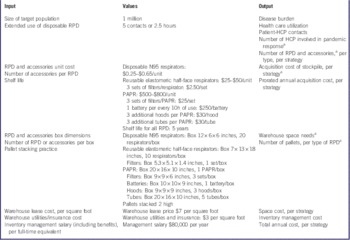
The complete model and cost calculator is included as supplemental material and is available online. Inputs (modifiable by the user), assumptions used to calculate stockpile costs in this study, and outputs are described in Table 1.
Inputs and Outputs, including Values Used in the Present Study

Abbreviations: RPD, respiratory protective device; HCP, health care personnel; PAPR, powered air-purifying respirators.
a Outputs available in supplemental material.
Estimating the Size and Composition of an RPD Stockpile
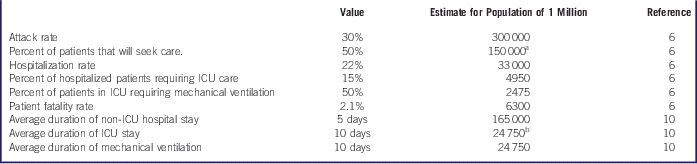
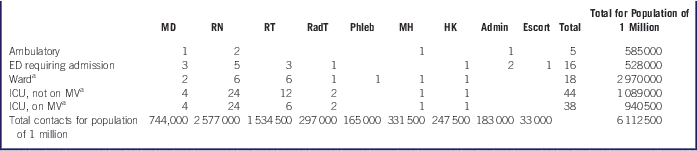
We estimated the size of an RPD pandemic stockpile based on our previously published model.Reference Radonovich, Magalian and Hollingsworth 9 This model uses assumptions based on the 1918 flu pandemic to calculate the number of outpatient visits, hospital days, and intensive care unit days that would be required to provide pandemic-related health care to a defined population (Table 2). 6 , Reference Zhang, Meltzer and Wortley 10 It also estimates the number of expected patient-HCP interactions by type of HCP in each health care setting (Table 3). A patient-HCP interaction was defined as any situation in which there is potential exposure to infectious material from the patient, the patient’s environment, or other situations requiring the HCP to wear an RPD. Model modifications were made to calculate the number of HCP necessary to conduct those contacts, assuming that each HCP works 40-hour weeks for 12 pandemic weeks, at an average pace of 2 contacts per hour (960 contacts per HCP during the pandemic). In addition, a 40% HCP attrition rate was built into the calculations to account for employees who may become ill, unwilling to work, or diverted to take care of family members. 7
Impact and Health Care Utilization During a Severe Pandemic

Abbreviation: ICU, intensive care unit.
a Hospitalization will not be required for 117 000 visits.
b ICU days not on mechanical ventilation.
Number of Contacts by Type of Health Care Personnel and Setting of Care

Abbreviations: MD indicates physician or other licensed independent medical practitioner; RN, registered nurse; RT, respiratory therapist; RadT, radiology technician; Phleb, phlebotomist; MH, social worker, psychologist, chaplain; HK, housekeeping personnel; Admin, registration, admission clerk; ED, emergency department; ICU, intensive care unit; MV, mechanical ventilation.
aPer day of hospitalization.
The number of disposable N95 respirators for applicable stockpiles was calculated on the basis of the number of HCP-patient contacts: 1 respirator per contact for single-use strategies and one respirator for every 5 contacts for extended use/reuse strategies. 11 The number of reusable elastomeric respirators for applicable stockpiles was calculated as 1 respirator and 3 sets of filters for every health care worker involved in the care of patients with pandemic disease. The number of PAPRs was calculated as 1 PAPR and 3 filter sets shared by 3 HCP, 1 hood and tubing per each HCP, and 1 nonrechargeable lithium battery for every 10 hours of use.
Estimating Costs for the Purchase and Storage of RPD
The range of prices used to estimate the cost of each product is based on a survey of national RPD suppliers and a list of negotiated Veterans Health Administration contract prices (from 2013) for each RPD type. Cost estimates are intended for planning purposes only. Actual pricing will vary depending on the make, model, and quantity of RPD selected.
Most products have an expected shelf life, necessitating periodic rotation of stockpiled supplies. Also, when planning the purchase of a stockpile of RPD, spreading the cost over time may be the most prudent approach. We assumed a 5-year shelf life for all RPDs and accessories in the stockpile and prorated the cost of purchasing and maintaining that inventory over this period of time.
Warehouse space needed to store the RPD inventory was calculated assuming typical box size and contents, packaged in pallets 40 inches (wide) by 48 inches (deep) by 48 inches (high) stacked 2 high. A 20% passageway space was added to the footprint of these pallets. Warehouse cost estimates included a lease cost per square foot and utility costs, along with inventory management.Reference Stone 12 , Reference Speh 13 A warehouse manager salary was included, based on estimates of square footage. Our model assumed that the facility would employ 1 individual for every 10 000 square feet of warehouse space.
Results
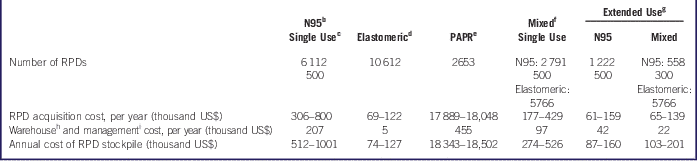
Our model predicts that during a severe pandemic there will be approximately 6.1 million patient-HCP contacts for every 1 million population (Table 3). This includes both inpatient and outpatient contacts, although more than 90% of all contacts occur with patients requiring hospitalization. Table 4 describes the size of each stockpile strategy and their associated costs.
Annual RPDFootnote a Pandemic Stockpiling Costs for a Population of 1 Million, per Strategy

a RPD indicates respiratory protective device, including accessories.
b N95 indicates disposable N95 respirators (U$ 0.25–US$ 0.65).
c Single use indicates 1 disposable respirator for every health care personnel–patient contact.
d Elastomeric indicates reusable half-face respirator (US$ 25–US$ 50).
e PAPR indicates powered air-purifying respirator (US$ 500–US$ 800).
f Mixed indicates elastomeric for physician and registered nurse contacts and N95 for all other contacts.
g Extended use indicates 5 uses or 2.5 hours per disposable respirator.
h Warehouse indicates warehouse lease US$ 7/square foot; utilities US$ 3/ square foot; pallets stacked 2 high; shelf life of 5 years.
i Management indicates 1 FTEE/10 000 square feet of warehouse space; salary and benefits US$ 80,000/annum.
Stockpiling PAPRs was the most expensive strategy. This expense was driven in large part by the cost and maintenance of batteries, which are required for PAPR operation. Stockpiling all single-use disposable N95 respirators was the second most expensive strategy. This strategy requires storing a massively large number of respirators. Warehousing costs represented a large proportion of the all-disposable, single-use N95 respirator strategy, comprising approximately 25% to 40% of the total cost of the stockpile. Stockpiling only reusable elastomeric respirators was the least costly alternative. Even though they are more expensive than the disposable type per unit, the lower number of reusable respirators needed and the much smaller warehousing costs resulted in a lower total cost. Stockpiling a combination of reusable respirators for physicians and nurses and planning to use disposable respirators for all other contacts resulted in an intermediate cost.
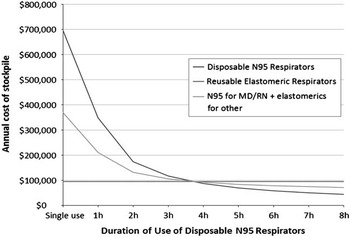
Extending the use of a disposable N95 respirator to 5 contacts or 2.5 hours of use per respirator reduced annual costs to a range that was similar to that of stockpiling reusable elastomeric respirators. Figure 1 depicts the sensitivity of the results to changes in extended use policy. The figure compares the reusable elastomeric-only stockpiling strategy to the 2 strategies that include extended use or reuse of disposable N95 respirators. The cost of stockpiling disposable N95 respirators was comparable to the cost of stockpiling reusable elastomeric respirators when the former are used for approximately 6 contacts or a 3-hour period under the model assumption of 1 contact per half hour. Disposable respirators become less expensive to stockpile than reusable ones when they are expected to be used for 8 contacts (4 hours) or more.
Annual costs of stockpiling respiratory protective device for a pandemic in a population of 1 million, per strategy, by duration of use of disposable N95 respirators Disposable N95 respirators (US$ 0.40 per respirator). Reusable elastomeric respirator (US$ 35 per respirator, US$ 2.50 per filter set, 3 filter sets per respirator). MD indicates physician or other licensed independent medical practitioner; RN, registered nurse. Warehouse lease US$ 7/sq ft; utilities US$ 3/sq ft; pallets stacked 2 high, shelf life 5 years Management=1 full-time-equivalent employee/10 000 sq ft of warehouse space; salary and benefits US$ 80,000/annum.

Discussion
The size and composition of RPD pandemic stockpiles is an unresolved issue. Many factors contribute to the choice of RPD to be stockpiled, including degree of protection, HCP tolerability, ease of storage, and cost. The present study contributes to this discussion by exploring the economic aspect of stockpiling RPD and comparing multiple strategies side by side in a single model. It should be noted that our conclusions are narrowly confined to an economic analysis, and that this should not be the only factor taken into consideration when selecting respiratory protection. Given the low frequency of a pandemic event, we expect a pandemic supply cache to spend most or all of its life on a warehouse shelf. Therefore, our model estimates the cost of an emergency stockpile calculated on the basis of purchasing, storing, managing, and rotating the inventory. Other cost analyses have looked at expenses per protected HCP or the total purchase expenses. 8 , Reference Hashikura and Kizu 14 , 15
Stockpiling reusable elastomeric respirators and/or disposable respirators with an extended use/reuse policy were the least costly stockpiling strategies. Because reusable respirators are not commonly used in health care settings in the United States and implementation of their use during an emergency –including issuing the respirators, fit testing, and training—will take some time and considerable effort, 7 it seems most appropriate to stockpile a combination of disposable and reusable respirators. The use of disposable respirators can be implemented much faster, as many HCP would already be familiar and fit tested for RPDs in routine use at the medical facility, and policies on extended use/reuse can be issued without delay. It is expected that demand will exceed the manufacturing capacity once an outbreak is on the horizon, leading health care organizations to minimize the attrition of disposable RPDs, including reusing the devices or extending the acceptable period of use. 11 , Reference Rebmann 16 , Reference Fisher and Shaffer 17 Discarding disposable respirators after each use is much more expensive not only to purchase but also to store and maintain because of the volume of devices required. Thus, a facility runs the risk of depleting existing inventory very rapidly.
Our study does not support stockpiling PAPRs. Many facilities use PAPRs regularly during their routine clinical operations. However, stockpiling PAPRs poses unique challenges: rechargeable batteries require regular attention to ensure that they are fully charged and working properly. Over time, rechargeable batteries tend to lose charging capacity, eventually becoming a nonfunctional battery that can provide little or no electrical output. Nonrechargeable batteries have a longer shelf life but are typically more expensive, as much as $250 per battery; they provide electricity for approximately 10 hours before being discarded. Very few makes/models have adapters for “standard” batteries, which presents the same issues, plus it adds to the weight and bulk of the blower. Instead of stockpiling PAPRs, we assert that health care organizations should maintain a limited supply of PAPRs to be properly maintained and used routinely during the course of clinical care.
Our model is unique in that our estimates are based on the epidemiology of a pandemic on a defined population and on calculated health care utilization and staffing needs. The results can be scaled to calculate the needs for a population of any size, whether it is a hospital’s expected catchment population, a locality, a state, or a country.
One limitation of our study is a focus solely on HCP. Emergency planners may need to consider RPD needs for first responders and other occupations at high risk for exposure. Every strategy has additional potential costs that were not considered in our estimations, such as training, fit testing, distribution, disinfection, and waste management. Although this analysis is focused on RPDs, the model can be readily adapted to estimate stockpile needs and costs for other items wherein the demand for supplies is dependent on health care utilization, number of patient contacts, or number and type of HCP. Our model may prove useful to conduct stockpile analyses that extend beyond RPDs to HCP supplies, such as gloves, gowns, or goggles, and to patient care supplies, such as intravenous fluids, oxygen tubing, or catheters.
Also limiting our model is an assumption of a flat incidence of cases during the outbreak; it does not accounti for the possibility that additional HCP may be needed to meet peak demand for health care services. This limitation may cause an underestimation of RPDs that are HCP based, such as reusable elastomeric respirators. Finally, many of the model assumptions are based on past experience from other pandemic events, which will not necessarily be repeated in the next pandemic event. As is inherent to preparing for any unknown event, the tool represents a bad-case scenario but is not an exact prediction of the RPD needs for the next pandemic.
In conclusion, our cost model shows that the best approach to RPD stockpiling in preparation for a high-consequence pandemic is a combination of disposable and reusable half-face RPDs. Using each disposable RPD for 3 to 4 hours may be a helpful way to diminish both cost and attrition; however, such decisions should also account for issues pertaining to infection control that were not the subject of this analysis.