Chronic or complex wounds are a frequent and costly healthcare concern (Reference Graham, Harrison, Nelson, Lorimer and Fisher1). Few studies examined the prevalence and incidence of chronic wounds (Reference Järbrink, Ni and Sönnergren2). Gottrup (Reference Gottrup3) estimates that 1.0 to 2.0 percent of people living in an industrialized country will have in his lifetime a chronic wound. The prevalence of leg ulcers, specific chronic wounds, is 1.2–3.0 percent (Reference Nordheim, Haavind and Iversen4). A wound is classified as chronic or complex when it has at least one of the following characteristics: no healing for 3 months; local infection; impaired superficial tissue viability, such as necrosis; impaired circulation; or association with systemic pathologies impairing healing (Reference Tricco, Antony and Vafei5). It has been estimated that complex wounds cost the healthcare system US$10 billion annually in North America (Reference Tricco, Cogo and Isaranuwatchai6), representing a critical public health issue.
Complex wounds mainly affect the elderly; because the population is aging, their prevalence is increasing, and more resources are required for their treatment (Reference Järbrink, Ni and Sönnergren2;Reference Wicke, Bachinger and Coerper7). Age-related risk factors include skin fragility, disturb barrier function, poor mobility, and co-morbidities (Reference Gorecki, Brown and Nelson8). A study of Guest et al. (Reference Guest, Ayoub and McIlwraith9), based on 1,000 patients with a wound registered in 2013 in the Health Improvement Network database of the NHS, National Health Service, in United Kingdom, showed that the mean age of patients with pressure ulcers was 77.8, with leg ulcer (arterial) 79.0, with leg ulcer (venous) 73.7, with mixed leg ulcer 81.6, and with open wound 70.7 years old.
Complex wounds also demand frequent contact with both primary and specialist interdisciplinary professionals (Reference Kolltveit, Gjengedal and Graue10). In the clinical evaluation criteria of wounds, wound size is a monitored indicator, as well as the depth of the wound and its color. However, the main problem is not only the size of the wound but prognosis and risks depending on association with systemic pathologies (diabetes for example) infection, necrosis and duration of the wound healing.
Telemedicine provides the potential for more effective wound care management (Reference Nordheim, Haavind and Iversen4) by allowing coordination between health professionals and improving access to specialized care when necessary. Telemedicine is considered as a feasible solution for most problems encountered with chronic wounds (Reference Sood, Granick and Trial11), pressure ulcers, leg ulcers, and others chronic wounds can be can be examined by telemedicine but the medical treatments are then specific for each wound. A major benefit of store-and-forward telemedicine is that patients can avoid travel while maintaining a high standard of wound care (Reference Chanussot-Deprez and Contreras-Ruiz12).
Medico-economic evaluations of telemedicine are still lacking in number and quality (Reference Bergmo13), and cost-effectiveness studies of telemedicine for wound management are even rarer (14–16). We identified in the literature only three economic evaluations of wound telemedicine based on randomized controlled trials (RCTs). The work of Arora et al. (Reference Arora, Harvey and Glinsky14) concerned an economic evaluation for the management of ulcers at home with telephone-based advice for 12 weeks (group intervention). The results showed a reduction in size of pressure ulcers for the intervention group compared with the traditional practice, an improvement of quality-adjusted life-years but a greater cost of the telephone-based advices.
Stern et al. (Reference Stern, Mitsakakis and Paulden15) described an economic evaluation of the use of an expert multidisciplinary wound care team by means of email, telephone, or video link into a pragmatic randomized stepped-wedge trial. The economic evaluation showed a mean reduction in direct care cost of $650 per resident compare with usual care. However, there were no significant differences in the primary outcome. Fasterholdt et al. (Reference Fasterholdt, Gerstrøm and Rasmussen16) compared the costs and effects of telemonitoring with standard telemonitoring for diabetic foot ulcers. An ICER, incremental cost-effectiveness ratio, as a cost per amputation avoided was calculated even if no statistically significant difference could be detected between telemedicine and actual monitoring in the primary outcome and costs. The result was a saving of €2,039 in the telemedicine group compared with standard monitoring. RCT studies do not actually prove the efficiency of telemedicine in wound care.
In 2013, a telemedicine network (DOMOPLAIES) was established to follow-up chronic wounds in two French regions, Normandy (TELAP Network) and Languedoc-Roussillon (CICAT-LR Network). Each region included telemedicine in the follow-up of chronic wounds as a function of the options available locally. Wound care guidelines were developed in accordance with widely recognized quality criteria and given to all health professionals in the network (17).
The purpose of the present nonrandomized trial was to conduct an evaluation of the real clinical effects and costs of telemedicine versus traditional follow-up of chronic wounds in Normandy. Healthcare organizations for wound care were different in the two regions and the health authorities of each region decided to do their own trial and the results of the patients of TELAP network are analyzed here.
Our hypothesis was that wound management by telemedicine would significantly reduce the time to heal and cost. We first describe the methods to measure medical effectiveness and costs, then the results, and finally we discuss the results, limitations, and perspectives of the work.
MATERIALS AND METHODS
Study Design
The study was carried out in Normandy between January 2014 and December 2015. It was a prospective, pragmatic, open-label study made from the perspective of the public health insurance. The pragmatic approach was designed to test interventions in a real-life setting. Wound management in Normandy did not allow the randomization of patients into two groups, which is why an observational study was preferred, with a control group followed up by traditional care (involving visits to a specialist, without telemedicine). We used observational real-world data, data obtained outside the context of RCT but generated during routine clinical practice (Reference Makady, de Boer, Hillege, Klungel and Goettsch18). To date, no convincing evidence of telemedicine in wound management was found in RCT studies in terms of efficacy of costs. Our objective is to make a new contribution, complementary to RCT results, by a real-world application.
The study ran over a period of 9 months, during which time the direct costs of wound follow-up were measured and compared.
Patients
Patients were allocated to the group of their choice, and the dermatologist fully respected their will and preference. General practicioners (GPs) or home-care nurses made recruitment following requests for opinions on complex wounds. The recruitment was on-going, all the patients were followed during 9 months.
Inclusion criteria for patients were as follows: (i) patient (of any age) with chronic noncancerous wound, (ii) inclusion requested by a member of the private or hospital healthcare team, (iii) patient or requesting physician in the area of the wound healthcare network, (iv) signed informed consent from the patient or their guardian, (v) signed cooperation agreement between the requesting physician and healthcare network. Exclusion criteria were: (i) life-threatening emergency situation during the first call, (ii) lack of requesting physician, (iii) patient or guardian's refusal, (iv) health professional's refusal; (v) cancerous wound, (Reference Wicke, Bachinger and Coerper7) consent agreement not signed.
If a patient had more than one wound, all were included and evaluated.
The Ethics Committee for the Protection of Persons approved the study protocol (N°. 05102013).
Telemedicine Versus Traditional Care
The study compared two medical practices: (i) management of wound care by the general practitioner and private home-care nurse, who were linked by teleconsultation (or tele-expertise) to the expert healthcare network team (a nurse and the dermatologist, Pr Anne Dompmartin, AD); (ii) outpatient visits to the same dermatologist (AD) at the hospital, and nursing care at home.
Each patient was followed up by two pairs of professionals (a GP and private nurse, and the dermatologist and expert nurse), to review and adjust the treatment as necessary. Telemedicine was used for remote consultations to examine, monitor and care for the patients at home. The home-care nurse had a tablet computer on which she had access to the patient's record, was able to take and send pictures, and could contact the dermatologist/expert nurse. The dermatologist and expert nurse carried out the teleconsultation by means of videoconference and from photos provided by the patient. All video consultations were carried out by the expert nurse, and validated by the dermatologist once a week with a record sent to the GP and the patient's nurse.
Asynchronous transmission of clinical pictures was used when technical problems occurred. For example, when the nurse was in a rural area, not accessible to Internet, the nurse took pictures and sent them to the expert nurse and doctor when Internet was available. They phoned and discussed together about the clinical case of the patient when they both had the pictures.
Usually, in the traditional practice, when there is no emergency, patients are seen by the dermatologist every 3 or 4 weeks in telemedicine group but only every 2 months in usual care as it was always done before telemedicine. For the study, outpatient visits by the dermatologist to both groups took place on the inclusion day and have been scheduled for the follow-up on month 1, month 3, month 6, and month 9. Depending on wound stage, the patient's nurse could decide to add some visits during the study. The same dermatologist followed all the patients using the French national recommendation on wound care (17). Patients were followed up for a maximum of 9 months, or until complete or partial wound healing, or death.
Outcome Measures
The primary outcome was time to complete or partial healing. In fact, for each patient, at the beginning of care, health professionals defined a clinical target objective for each wound: healing or partial healing (stabilization or medical support). Indeed, for some patients, healing has not been considered, because of some personal characteristics such as age or co-morbidities. The expert nurse compared the wound evolution with the target and decided if the target was reached (yes or no) by predefined rules. On average, partial healing was approximately 30–50 percent reduction in wound size.
But it is rather the observational quality of the health professional that makes it possible to judge whether the clinical target was affected (size, odor, color, deepness combined with the age and co-morbidities of the patient). Therefore, time to healing was defined as the number of days between study entry and complete healing or number of days between study entry and the decision that the clinical target is reached even if it is partial healing. When patients had more than one wound, all the wounds were examined and followed.
The first secondary outcome was the percentage of wounds reaching target objective. The others secondary outcomes were: percentage of wounds completely healed; costs of wound dressings, drugs, medical consultations, and travel; and the number, duration, and cost of hospitalizations. Clinical outcomes were obtained from network clinical files and hospital files. There were no missing values (all data were collected by the nurse).
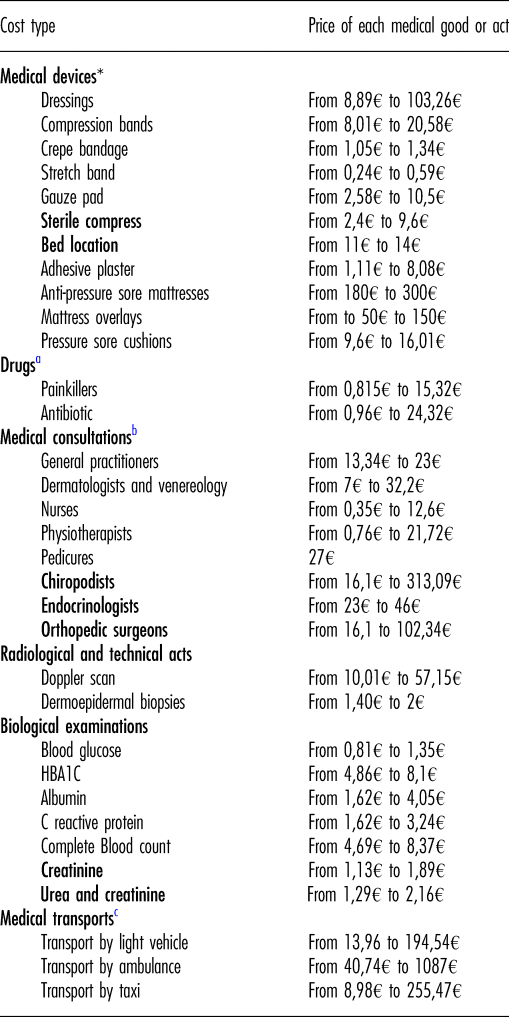
Economic data are real data extracted from the national health insurance database for the region. The public database provides actual individual patients figures related to their health consumption reimbursed by the public health insurance. So cost data are real care consumption by each patient of the two groups during 9 months. The public database provides the type of medical goods consumed, the quantity consumed during the 9 months and the price of each medical item for each patient. Table 1 presents 2015 unit costs used in the analysis. The costs considered are those only reimbursed by health public insurance, due to the choice of the public payer perspective. In France, patients' transport costs are reimbursed by the Health Insurance, on medical prescription, for care or examinations appropriate to the health status of the patient (transport to hospital, transport in case of long-term illness, secured transport). Nurse's transport costs are reimbursed too, by an act payment and taken into account in the costs of the study.
Unit Costs (€, 2015)

Note. Source: National Health Insurance database.
a Variability in price is due to the brand or the capacity.
b Variability in price is due to the type of act.
c Variability in price due to the distance.
HBA1C, hemoglobin A1C.
The public database used does not identify hospital costs. Hospitalization costs were, therefore, calculated according to the hospital average charge per day (which includes living expenses and the cost of care). According to the regional health authority, the day cost in the Caen University Hospital Center is €1,154.
The costs associated with telemedicine included the unit and delivery costs of the tablet computer given to the visiting nurse; telephone subscription; the cost of the workstation at the expert center, which comprised a desktop computer with two screens and a videoconference system; and the cost of the telemedicine platform (use of a regional platform of telemedicine, an integrated device offering adapted and secure services), healthcare data server and wound care software. They can be included in the analysis because they have been funded by the public health system.
Data Management
Clinical and demographic data were collected using medical software called Infinys v1.8. Data have been anonymized.
Statistical Methods
Demographic and clinical characteristics of patients participating in the study were described with means and range for continuous variables, and frequencies and percentages for categorical variables.
Means for continuous variables were compared parametrically using the Student t test. For categorical variables, we used the chi-squared (χ2) proportion comparison test and the nonparametric Mann-Whitney test for non-normally distributed data. SAS 9.2 was used for calculations.
RESULTS
The clinical study included a total of 116 patients: N = 77 in the telemedicine group (148 wounds) and N = 39 in the control group (72 wounds).
Sociodemographic and Clinical Patient Characteristics
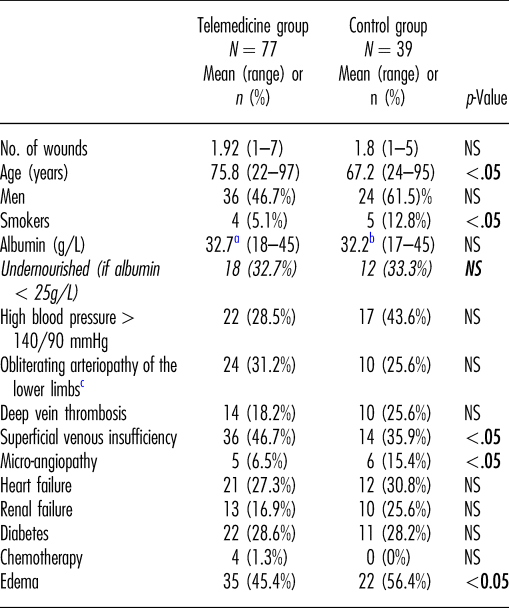
The sociodemographic and clinical characteristics of the two groups are presented in Table 2. It is a close sociodemographic profile between the two groups, an elderly population (retirees) coming from a medium-sized town in France and its surroundings.
Sociodemographic and clinical characteristics of the two study groups, at baseline

a Available data on albumin only for 55/77 patients in the telemedicine group.
b Available data on albumin only for 36/39 patients in the control group.
c Presence in the medical file of a recent arterial-venous Doppler.
NS, nonsignificant difference.
The patients were significantly older in the telemedicine group but the number of wounds did not differ significantly between the groups (Table 2). The telemedicine group had more pressure ulcers than the control group (24.0 percent versus 11.0 percent, respectively) and 41.0 percent of the ulcers were older than one year in both groups.
Eleven patients died in the intervention group and 2 in the control group (p > .05) during the study. The causes of death in the telemedicine group are due to a higher average age for those who die (89 years compared with 84 years in the intervention group) and a higher level of dependency (Karnofsky index of 46 for the intervention group compared with 75 for the control group). They were living in a structure and not at home. Therefore, deaths are not due to wound complications. There were 7 percent lost to follow-up in the intervention group and 12 percent in the control group, due to the choice of patients to stop care or because of care in an institution as a retirement home.
Clinical Results
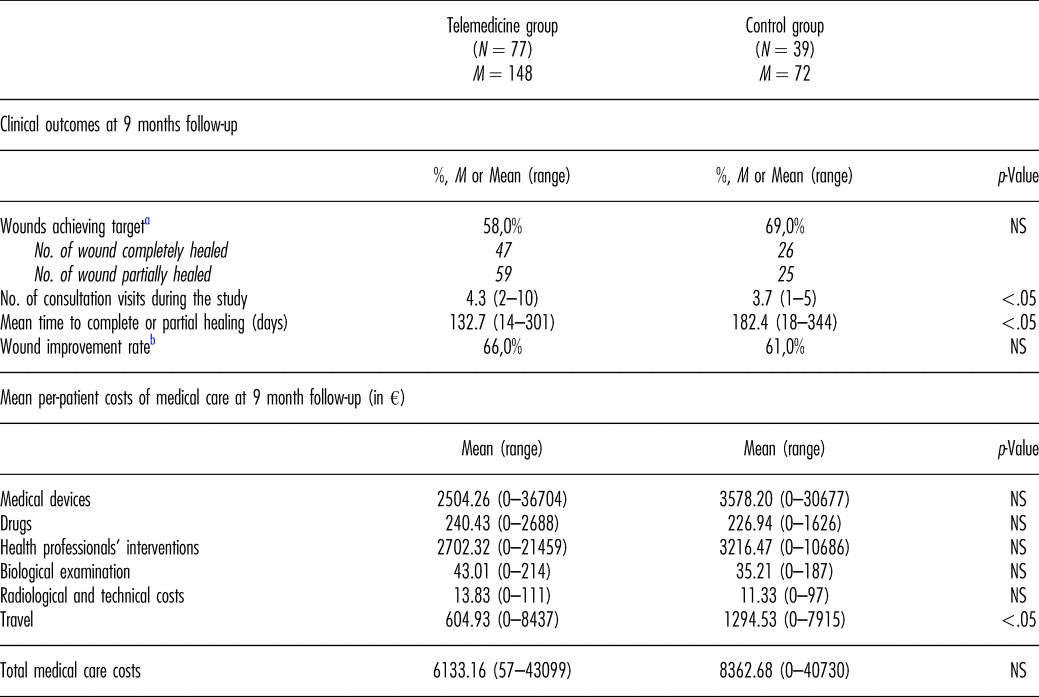
The clinical results are based on the analysis of wounds, M, number of wounds (Table 3). There were a total of 220 wounds: M = 148 in the telemedicine group and M = 72 in the control group. The most common wounds for both groups are pressure ulcers, venous ulcers, and arterial ulcers.
Clinical Outcomes and Medical Care Costs at 9 Months Follow-up

Note. Source of costs: French national Health insurance database.
a Three wound objectives are defined at the inclusion visit: healing, stabilization or support. This is the percentage of wounds that achieved the stated wound goal.
b Percentage of wounds that have improved (healing or positive evolution).
M, number of wounds; NS, nonsignificant difference.
Time to heal was significantly shorter in the telemedicine group than the control group (132.6 versus 182 days, respectively; p < .05). There was also a significant difference in the number of consultations. We expected each patient to need five consultations (in person or by means of teleconsultation). Patients in the telemedicine group had more consultations than the control group. This was because it was easier for patients to have a teleconsultation than a traditional consultation where waiting times for appointments are longer.
Improvement was observed in 66.0 percent of wounds in the telemedicine group versus 61.0 percent in the control group (p > .05), despite patients being older in the telemedicine group (Table 3).
Cost Analysis
Direct Medical Costs
Economic data for the region were obtained from the national health insurance database. Care cost data were collected for 9 months (Table 3). The cost of inpatient public hospital consultations were not collected in this database. In the same way, costs of care provided by a physician by means of teleconsultation and tele-expertise were not evaluated as they are not funded by the public health insurance (at the study time, there was no remuneration for wound telemedical acts in France).
The mean difference in total cost between the telemedicine and control groups was €2,229 (p > .05), but there was a significant difference in medical transport costs (which could be evaluated as they belong to the healthcare sector) between the two groups. Travel costs associated with telemedicine were half those associated with traditional care.
Average dressing costs were also lower with telemedicine, with a difference of €1,000 per patient during the 9-month period, although this difference was not statistically significant.
Hospital Costs
There were fewer hospitalizations, and the length of stay was shorter, in the telemedicine group than in the control group (31.0 percent of people in the telemedicine group were hospitalized for a mean of 5.48 days, versus 46.0 percent for 7.82 days in the control group), but these differences are not statistically significant. The average cost of hospitalization per person was €6,323.9 in the telemedicine group and €9,024.3 in the control group, a saving of €2,700 per patient in the telemedicine group during the 9-month study period.
Telemedicine Technological Costs
The exact cost of the telemedicine platform was difficult to evaluate as the platform is shared with other telemedicine applications. The Healthcare Cooperation Consortium (GCS E-health Basse-Normandie) estimated the share of the cost of the platform that is attributed solely to the TELAP project. Based on the number of files processed over three years and the different platform costs, we were able to get a platform cost.
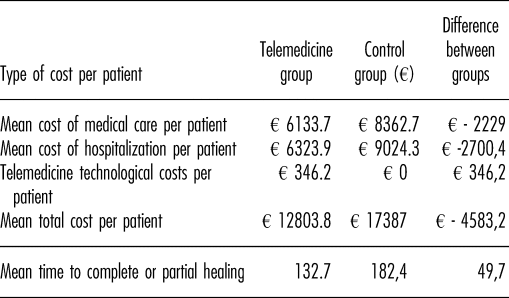
The technological cost per patient for 9 months was €346.2, inclusive of value added tax. The total costs per patient include outpatient care, hospitalization, and telemedicine technological costs (Table 4). Therefore, for 9 months of follow-up, there is a cost difference of €4,583.7 per patient between telemedicine and traditional practice.
Costs and Efficacy Differences in the Telemedicine Group and Control Group over 9 Months

Cost-Effectiveness Analysis
We addressed this from the public health insurance perspective. The clinical effect criterion was time to complete or partial healing. Both hospital and direct medical costs were considered. Costs are expressed as € (EUR) and nondiscounted. Cost-effectiveness analysis results are presented in Table 4. Telemedicine practice is dominant (lower costs, better effects). A patient in the telemedicine group cost €4,583 less per patient and gain 49 days of complete or partial healing compared with usual care over 9 months.
Deterministic Sensitivity Analysis
A sensitivity analysis describes the consequences of uncertainty on the costs. The analysis focused on four groups of parameters: platform costs, tablet cost, delivery cost, and hospital cost. Health consumption costs and follow-up duration are based on real patient behavior so that they were not be included in the sensitivity analysis.
We noticed that economic results are sensitive to hospital costs. As we had no access to the PMSI database, we based our results on the average cost per day of hospitalization in Caen University Hospital Center. However, hospital costs depend on pathologies and co-morbidities. Because our patients had many co-morbidity, the average calculated cost was probably lower than the real cost. Therefore, the duration of hospitalization is probably a more accurate measure, and our results demonstrate that telemedicine reduces the duration of hospitalization.
DISCUSSION
The aim of the present study was to evaluate clinical effects and costs of telemedicine in the management of complex wounds. The intervention group received wound expertise by means of teleconsultation, followed by transfer of digital images.
It was a real-life, observational, nonrandomized cluster trial in the Normandy region. Participants chose to be followed up either by teleconsultation or by traditional consultation, and all patients were treated by the same dermatologist (A.D.). An RCT by Terry et al. (Reference Terry, Halstead and O'Hare19) comprising three groups (telemedicine by wound specialists; standard follow-up by wound specialists; traditional practice) showed that the average time to improve or heal pressure ulcers and surgical wounds was the same in all groups and that 90 percent of wounds improved or healed completely. However, their randomization did not account for wound size or type. This resulted in an uneven distribution between the groups, with participants in the telemedicine group having larger or deeper wounds, while larger wounds are known to consume more resources. In the present study, patients chose the type of follow-up they wished to receive and, as the distribution was adapted to their needs; older patients with poor mobility chose telemedicine. Despite the unfavorable criterion, time to complete or partial healing was significantly lower in the telemedicine group.
The number of visits was higher in the telemedicine group, despite patients being older and having more complex wounds, because the network facilitates communication between primary and specialist care. This was confirmed by Jelnes (Reference Jelnes20) who demonstrated that telemedicine made it possible to reduce the waiting time before the first specialist consultation and avoided unnecessary follow-up consultations. During a teleconsultation, an expert nurse and doctor give wound care advice, and access to a multidisciplinary specialist team is proposed when necessary. Telemedicine realizes the goal of coordinating and integrating care. In the future, as the basic knowledge of home-care nurses improves, the number of visits will decrease.
The total cost difference was €4,584 per patient for the 9-month observation period. It is usually necessary to meet the patient for an initial medical evaluation of the wound and the prognosis. After this, monitoring can be performed with a smartphone or tablet by means of uploaded pictures or teleconsultations. Our results are different from those of Stern et al. (Reference Stern, Mitsakakis and Paulden15), in which only US$ 649 per patient was saved by telemedicine over a period of 17 months. Their study analyzed the impact of enhanced multidisciplinary teams for the treatment of pressure ulcers in long-term care, where advanced practice nurses were linked to a hospital-based expert wound care team. In the study by Stern et al., the main saving in the telemedicine group came from cancellations of prescribed negative-pressure wound therapy. Moreover, hospital costs, dressing costs, and personal costs were higher in the telemedicine group. They did not evaluate travel costs.
We observed that telemedicine halved travel costs as expected. It also reduced nuisance and risk to elderly patients in avoiding the travel and inconvenience of a hospital appointment. Furthermore, it is an environmental benefit, and confirms the results obtained by Rees and Bashshur (Reference Rees and Bashshur21) and Wootton et al. (Reference Wootton, Bahaadinbeigy and Hailey22). Less hospitalizations and shorter length of stay in the telemedicine group can be a result of more frequent follow-up by teleconsultations. Home nurses can reach the expert center more quickly when an adverse event occurs. In most cases, problems can be solved without hospitalization.
Dressing costs were also reduced in the telemedicine group because, during teleconsultations, expert nurses tailored dressing strategies to the patient's tolerance and adjusted the prescription according to what the patient already possessed at home. To reduce the risk of bias due to differences in medical prescriptions, all patients were followed up by the same dermatologist (A.D.).
Telemedicine technological costs are overestimated in this trial as we delivered tablet computers for each teleconsultation. Technology is evolving, and private nurses now use specialized software on their mobile phone, and in nursing homes tablets are already used. Initially, telemedicine was trialed in patients' homes using tablets (Reference Rodrigues, Pedro, Vardasca, de la Torre-Díez and Martins23); today, the smartphone appears to be the technology favored by both health professionals and patients (Reference Wiseman, Fernandes-Taylor and Barnes24). Applications are developing that allow the transmission of pictures and teleconsultations directly from the nurses' smartphone. Technological costs will change with routine use.
Some articles on telemedicine examined whether the skills of home-care nurses and GPs would improve as they had quick access to an expert opinion, which enabled the identification of complications and necessary therapeutic adjustments (Reference Nordheim, Haavind and Iversen4;Reference Zarchi, Haugaard, Dufour and Jemec25). In an RCT by Ameen et al. (Reference Ameen, Coll and Peters26), nurses' knowledge about leg ulcers was evaluated before and after sessions of tele-expertise with a wound expert. The measurement tool was based on a multiple-choice questionnaire. Significant improvements were noted for those who used tele-expertise, especially for the most difficult questions. Telemedicine also improved the patients' own knowledge about their condition, as well as the nurses' wound assessment knowledge. As observed in Norway for diabetes foot care delivery (Reference Kolltveit, Gjengedal and Graue10), the main benefit was streamlined communication between primary and secondary health professionals. In our study, such an evaluation was not conducted but it would have been interesting to see the effects of telemedicine on increasing skills.
Our trial has some limitations. Originally a cost-utility was planned as the main analytical framework but results from this analysis are omitted due to incomplete data. We had a very low completion rate of the EQ-5D questionnaires. Moreover, although more than 100 patients participated, this sample size was relatively small. There was heterogeneity among the participants and the two groups differed substantially.
However, the trial reflects real-life home-care practice. Telemedicine patient were self-selecting. There is a bias of patients' favoring acceptance of telemedicine, even if they did not know exactly what telemedicine was. They agreed to be supported by telemedicine as this allowed them to continue home care instead of going to the hospital. This will favor telemedicine acceptance or compliance as compare to an RCT.
This has had an impact on costs, with a significant difference in transport costs between the two groups. This is a specific result in the French context, which covers patients' travel costs to treatment. In other settings, there would apparently be no significant difference in costs. So, transferability settings are limited as a result of acceptance bias and outpatient transport costs. At last, the medical costs of teleconsultation or tele-expertise were not included in the intervention group as TELAP network was considered as a research experiment. Telemedicine follow-up is a priceless solution which improves coordination between different levels of health care but it is not yet integrated in the current organization of specialist healthcare. At the time of the study, the teleconsultation fee had not been decided by the French authorities, but a fee will be trialed in 2018 before inclusion in the cost classification. Future studies should also include technical, organizational and medical management costs.
The main strengths of this trial are that the same expert dermatologist assessed and treated all patients. This minimized bias associated with the different medical approaches. Similarly, wound management costs were accurate as they were obtained from the national health insurance database.
In conclusion, telemedicine that connects home nurses to a team of wound care experts significantly improves the time to wound healing. We also demonstrate that this approach saves a significant amount of patient and healthcare system transportation resources, meaning that, although the reduction of care costs is not significant, the national health insurance system saved 4,583.7 € per patient over the 9-month study period.
Because of the French specificity of considering transport costs in outpatient medical costs, this cannot be transposed to other health systems. In terms of public recommendations, our findings suggest telemedicine provides good value for money and may be applicable for all patients that need to be followed up for wound care. However, all patients need a previous face-to-face complete examination to make a diagnosis and plan their treatment. Telemedicine follow-up facilitated access to specialist healthcare and increased patient satisfaction. Patients who chose telemedicine appreciate to reach an expert center from their home without long delay and without travels. They enjoyed talking from their home to the expert during teleconsultation. Nowadays, healthcare professionals dealing with complex wounds have well adopted this new telemedicine practice within the TELAP network and this model could be reproduced into other French regions.
SUPPLEMENTARY MATERIAL
The supplementary material for this article can be found at https://doi.org/10.1017/S0266462318000685
Supplementary Figure 1: https://doi.org/10.1017/S0266462318000685
CONFLICTS OF INTEREST
The authors have nothing to disclose.