INTRODUCTION
Fragments of dozens of ceramic roof ornaments (almenas) in association with an elite residence (Structure Q-1) at Cihuatan, El Salvador (Figures 1–2) provided the focus for a highly targeted study to reveal a new context for this category of artifacts. Large stone or ceramic ornaments, of various shapes, but always flat, have long been known as decorations along the edges of the roofs of important buildings in the Valley of Mexico. Rattray (Reference Rattray2001:347) indicates that they “have beginnings in Early Tlamimilolpa” (ca. a.d. 250) and “are most common in Late Xolalpan and Metepec contexts” (a.d. 600–700). At the time of the Spanish conquest, centuries later, almenas of several types were being used at Tenochtitlan. In the early twentieth century Batres (Reference Batres1904:13–14, Figures 13–14) excavated Aztec-period examples of these large roof ornaments at Huexotla and called them almenas, the Spanish term meaning merlons. Merlons are short vertical stone piers or pillars placed at short intervals along the walls of medieval fortifications. European merlons provided some protection for archers and other defenders of castles, while almenas were purely ornamental. In Spain, the term almena also has been applied to the spaces between these defensive stone piers. Batres (Reference Batres1904:13) described “[r]estos de ornatos arquitectónicos hechos de barro (Figs. 11–12) y dos almenas del mismo material (Figs. 13–14).” Batres also recognized two different forms of roof ornaments from their depictions in the codices (Figure 3). In central Mexico the term almena continues to be applied to decorative roof elements and ornamental elements seen along the upper platform of some pyramidal bases often supporting small structures (Gendrop Reference Gendrop1985:48, Figure 2).
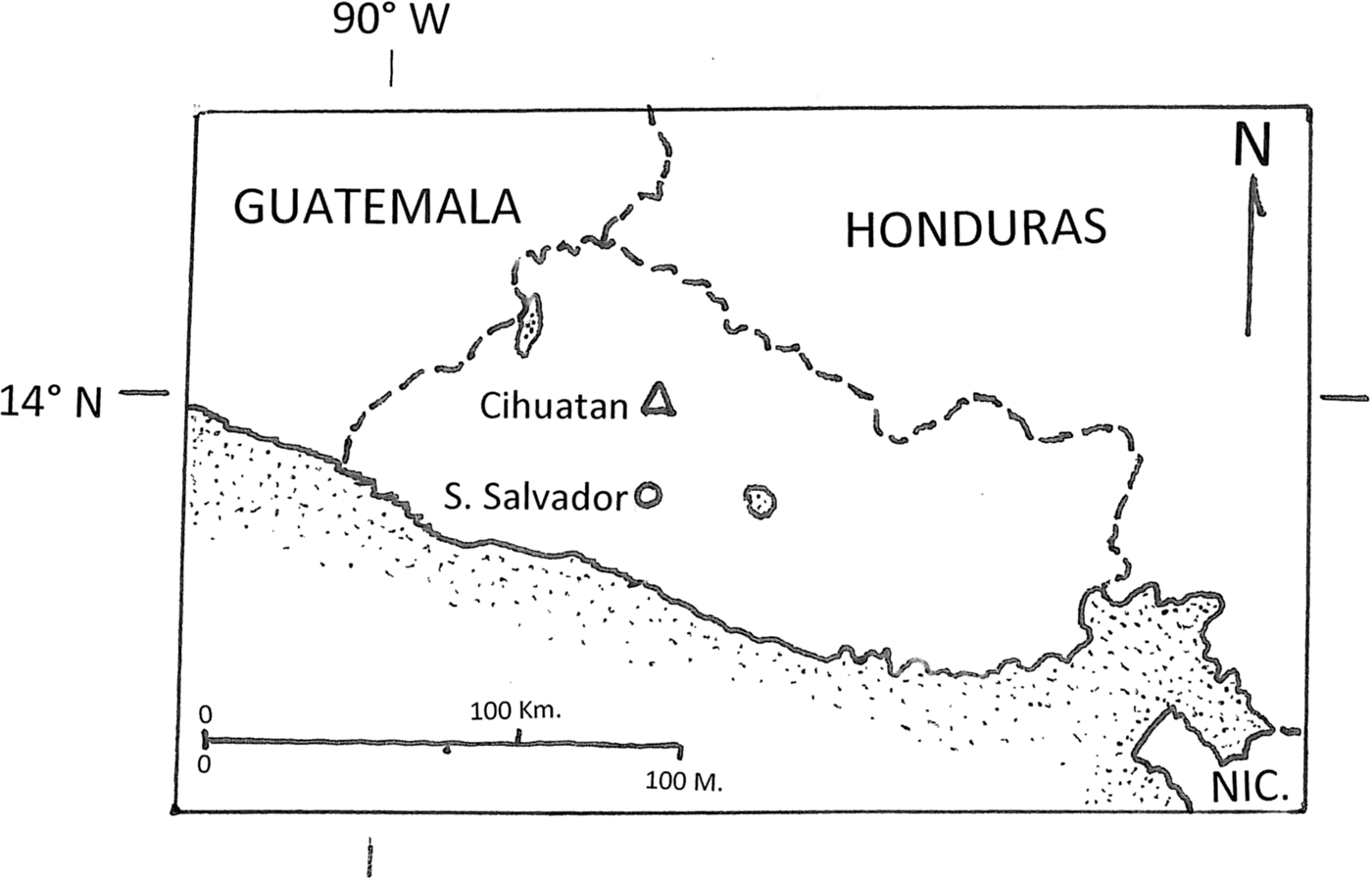
Map of El Salvador, with location of Cihuatan indicated. Map by the author.

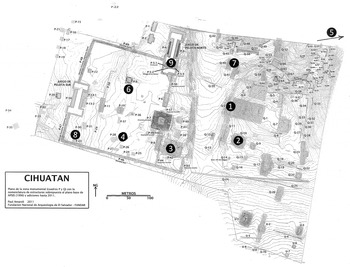
Plan of Cihuatan site core (Amaroli Reference Amaroli2011, reproduced with permission), to which has been added the nine known locations of almenas finds (see Table 1). Map by Paul Amaroli Bertolucci.

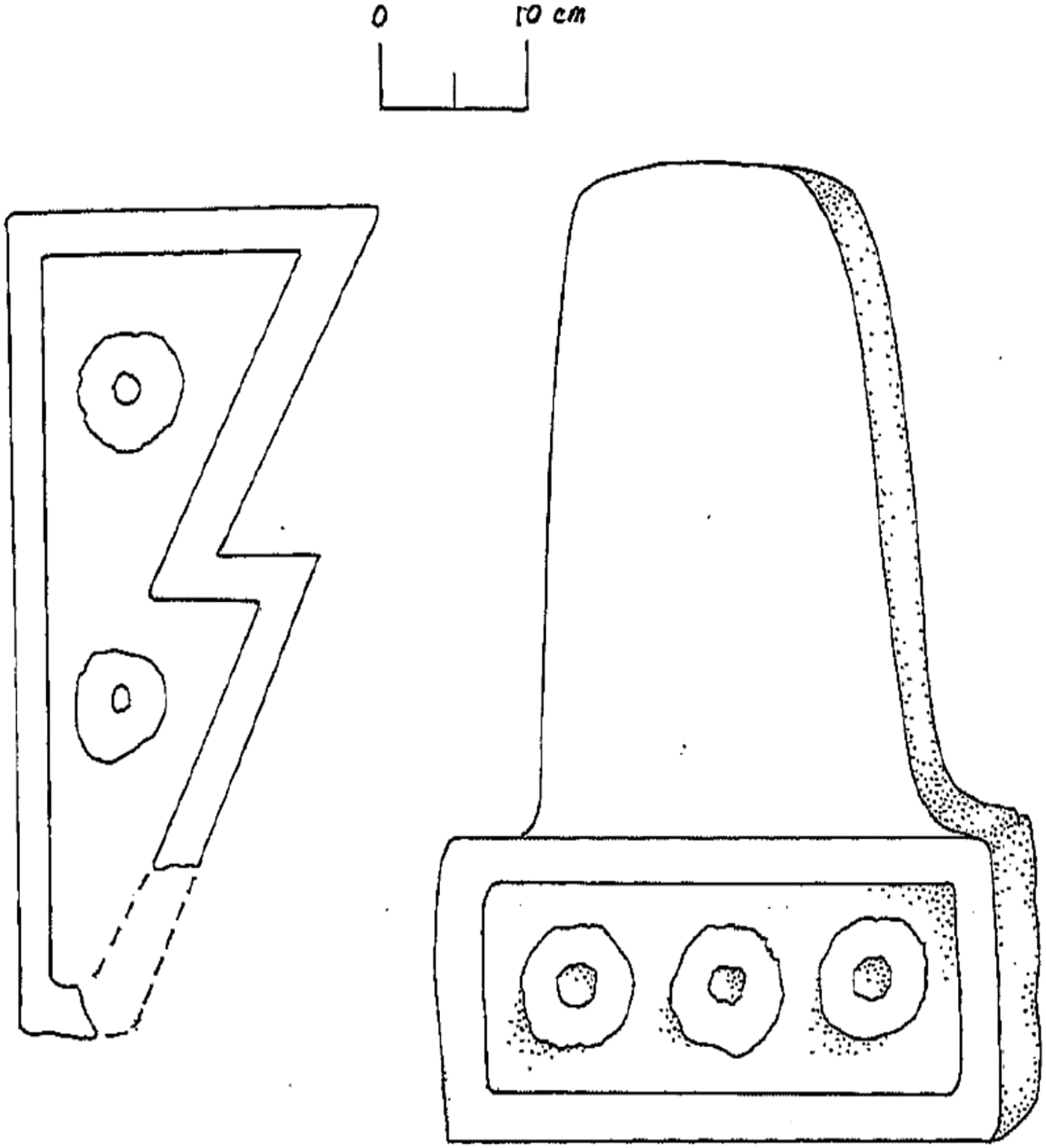
An early publication of almenas. The example on the left has a “serrated” profile (see Figures 8a and 8b). Batres identifies both of these as Aztec in origin and from Huexotla AC4-162. Scale length is 10 cm. Drawings by the author after Batres (Reference Batres1904:14, Figures 13 and 14).

Structures at Cihuatan ornamented with ceramic almenas (see also Figure 2).

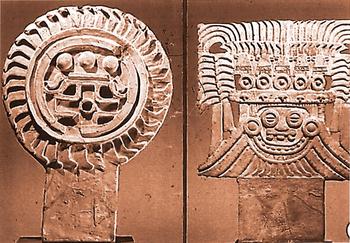
Rattray (Reference Rattray2001:347) says that almenas at Teotihuacan “can be recognized by their thick, flat, squarish form.” Her illustrations reveal that small fragments of these artifacts may be difficult to identify as roof ornaments (Rattray Reference Rattray2001:613–615, Figures 220l and 221k), a problem also evident at Cihuatan. Rattray's (Reference Rattray2001:607, Figure 215) round example of an ornament appeared to me to be an Aztec form, similar to the almenas later common in Tenochtitlan (Carrizosa and Aguirre Reference Carrizosa Montfort, Molina and Moctezuma2003). Smith and Paz Bautista (Reference Smith and Bautista2015) point out that many examples of this form have been excavated from Teotihuacan. Rattray (Reference Rattray2001:347) found fragments of examples “in different parts of the city but they are never common.” Following the total collapse of Teotihuacan, possibly by a.d. 650 to 700 (Clayton Reference Clayton2016:106), the use of these ornaments is not known to have survived, but examples may be found in as yet undetected elite contexts in Epiclassic or later contexts.
Gendrop (Reference Gendrop1985:48) first referred to almenas as “remates o coronamientos de techo” but he later (Gendrop Reference Gendrop and Gendrop1997:16–17) defined them as “[a]dornos de techos o remates de pretil hechos en piedra o barro cocido y modelado, particularmente abundantes en la tradición arquitectónica del Altiplano Central y que aparacían en calidad de coronamiento de edificios suntuarios.” The Mexico City (Aztec) examples invariably are flat, thick stone or ceramic units, the latter often being mold made. Gendrop (Reference Gendrop1985:48) found that heights varied between 22 and 185 centimeters. More specific details are offered by Carrizosa and Aguirre (Reference Carrizosa Montfort, Molina and Moctezuma2003), who greatly expanded the work of Gendrop. Their study includes types of almenas not illustrated by Gendrop, such as those depicted on a complex clay urn from Cinteopa with a representation of the maize god Chicomecoatl emerging from a doorway above which are five small almenas (Carrizosa and Aguirre Reference Carrizosa Montfort, Molina and Moctezuma2003:Figure 1e; Cook Reference Cook de Leonard1985; Lopez Reference Lopez Austin2008:27). Some forms of almena (Carrizosa and Aguirre Reference Carrizosa Montfort, Molina and Moctezuma2003:Figure 1i; Gendrop Reference Gendrop1985:49, Figure 8e) include a circular element. Baudez (Reference Baudez2007:24, Figure 12) believes that types with a circular element resemble a “marcador de juego de balón” or “estela” from La Ventilla, Teotihuacan and is similar to an example of such an “estela” from Tikal that was centered on a small platform. Baudez's assertion regarding such a feature at Tikal cannot be confirmed. There is, however, an incised tripod vessel from Teotihuacan that appears to have been a burial offering that bears a tall, almena-like standard with a circular decoration at its middle (Culbert Reference Culbert1983:Figure 128a; Greene and Moholy-Nagy Reference Greene and Moholy-Nagy1966). This vessel depicts 12 individuals and three Teotihuacan-style structures. The apparent “standard” is located to the left (behind) Structure 2 as numbered by Culbert. Its location appears to denote or mark the temple (residence?) of the chief (Culbert Reference Culbert1983:18, Figure C, perhaps also Figure D) towards whom all the other figures on this vessel are facing.
Carrizosa and Aguirre (Reference Carrizosa Montfort, Molina and Moctezuma2003) offer a listing of almenas known from Mexico City and some information on the ancient buildings with which they are associated. Although they are known from a wide area within the Valley of Mexico, there are few catalogued examples or list of find sites. Beyond the Valley of Mexico, only one example is known from Tikal, and that one is carved from local limestone. Possible examples in stone are reported by Gendrop (Reference Gendrop1985:48, Figures 3 and 5) from Tula and Veracruz. Carrizosa and Aguirre (Reference Carrizosa Montfort, Molina and Moctezuma2003:Figures 2a–2c) also list stone examples from Tula and provide data on several types from Chichen Itza (Carrizosa and Aguirre Reference Carrizosa Montfort, Molina and Moctezuma2003:Figures 2d–2i). Ruppert (Reference Ruppert1943) identifies two from Chichen Itza. These several claims will be addressed below.
The discovery at the site of Cihuatan, in north-central El Salvador (Figure 2), of a large number of three dimensional, box-like examples of almenas merits attention (Amaroli Reference Amaroli2012a, Reference Amaroli2012b, Reference Amaroli2012c). These ornaments may be a significant aspect of the site's brief history, at what is termed a single-component site (Sheets Reference Sheets, Lange and Stone1984:86). This study provides further evidence for major Mexican influence (see Fowler Reference Fowler1978, Reference Fowler1979). Cihuatan is located along the modern highway connecting San Salvador with western Honduras (Cecil Reference Cecil1982). Sixteenth century records reveal this as a Pipil area (Stone Reference Stone, Lange and Stone1984:23–24). Their Nahuatl-speaking ancestors may have come from central or southern Mexico, but until recently data for a Maya to Pipil shift has seemed weak and the ceramic evidence inconclusive (Sheets Reference Sheets, Lange and Stone1984:107–108). Efforts to link the complex prehistory of the region with the historical record (see Fowler Reference Fowler1981) are ongoing. Architecture in the area of Cihuatan, and western El Salvador in general, suggest Maya forms and planning, but I have been unable to identify specific elements with certainty (cf. Becker Reference Becker and Sabloff2003b). Maya influence in the area during the Late Classic period is suggested by I-shaped ball courts, of which there are two examples of Postclassic date at Cihuatan. Further mapping may confirm similarities between the planning of ritual space at Cihuatan and at lowland Maya sites, but the evidence presented below reinforces documented cultural associations with the Valley of Mexico.
Archaeological evidence suggests that occupation at Cihuatan may have begun before a.d. 950 (Early Postclassic). Sheets (Reference Sheets, Lange and Stone1984:108) believes that the site may have been “founded by the ninth century, if not earlier, and therefore it could be viewed as an early example of Mexicanization.” Sheets (Reference Sheets, Lange and Stone1984) summarizes Fowler's (Reference Fowler1978, Reference Fowler1979) view of data suggesting how Mexican architecture and many other features influenced Cihuatan. A beginning date of a.d. 900 or earlier would suggest that Cihuatan's origins might also be related to the centuries-long process of decline and population shifts popularly called the “Classic Maya collapse.” Cihuatan may have been settled, at least in part, by Maya refugees from the conflicts at the end of the Classic period, but the direct evidence remains wanting. Radiocarbon dates had placed the destruction of some parts of Cihuatan between a.d. 1050 and 1080 (Fowler Reference Fowler and William2011:40; see also Sampeck Reference Sampeck2010). More recent testing of samples from more controlled locations place the end date of the site at between a.d. 1140 and 1220 (Amaroli Reference Amaroli2016; Paul Amaroli, personal communication 2016).
At Cihuatan finds of almenas, a type of decorative architectural element typical of structures in the Valley of Mexico in use from the Classic period up to the late pre-Hispanic and Contact periods, provide a strong indication of some connection with the Valley of Mexico (Figure 3). Bruhns and Amaroli (Reference Amaroli2011:255) suggest that the city's leadership included individuals who actually came from Mexico. The Cihuatan almenas merit investigation to confirm that they are common at the site and not specific to a few structures. If almenas were found only on one or more specific structures used by ambassadors or traders from Mexico who were living among members of this community, the evidence would not be as widespread as now indicated.
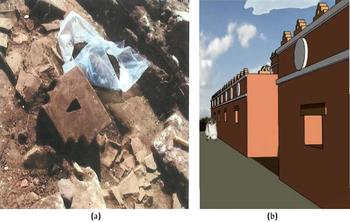
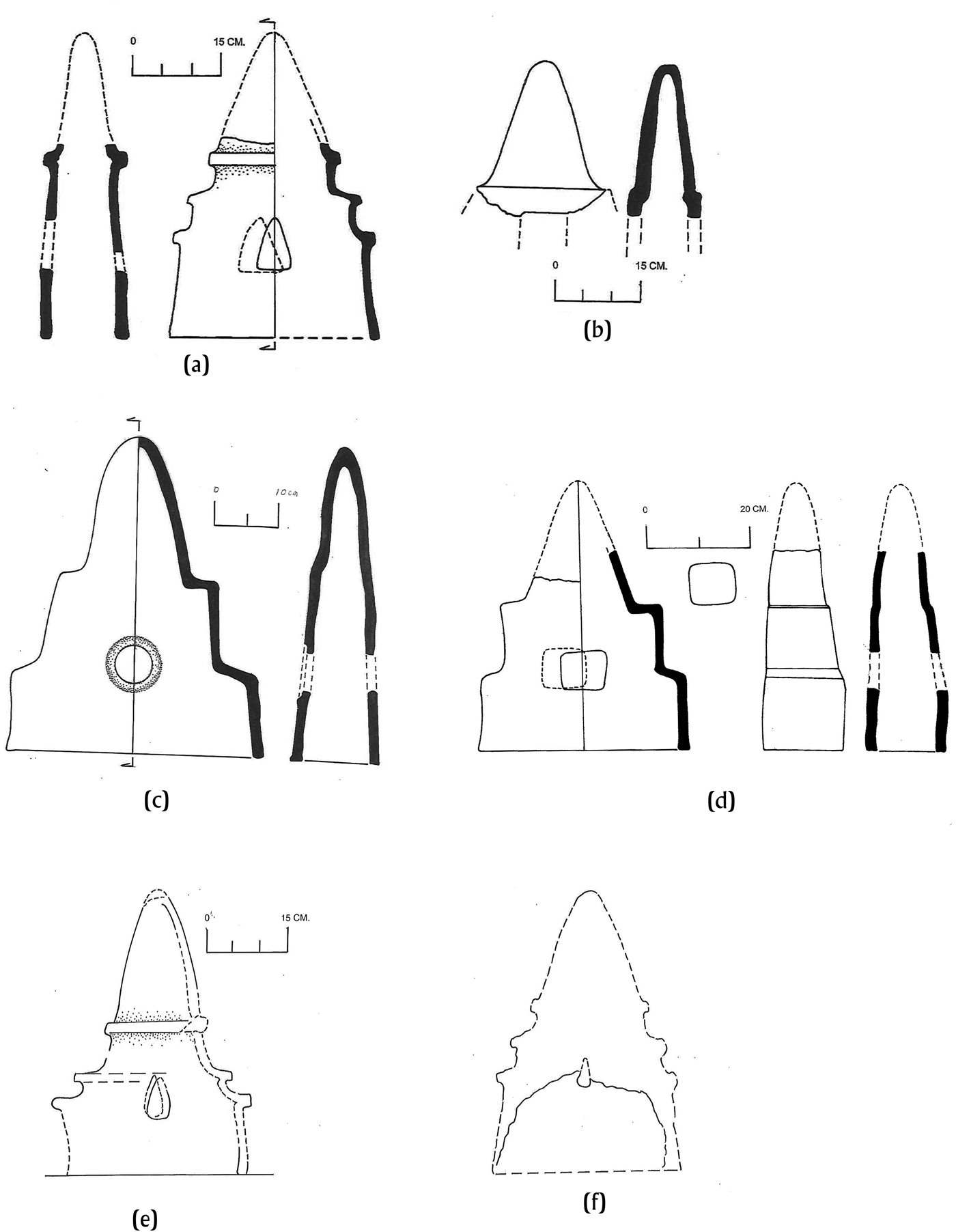
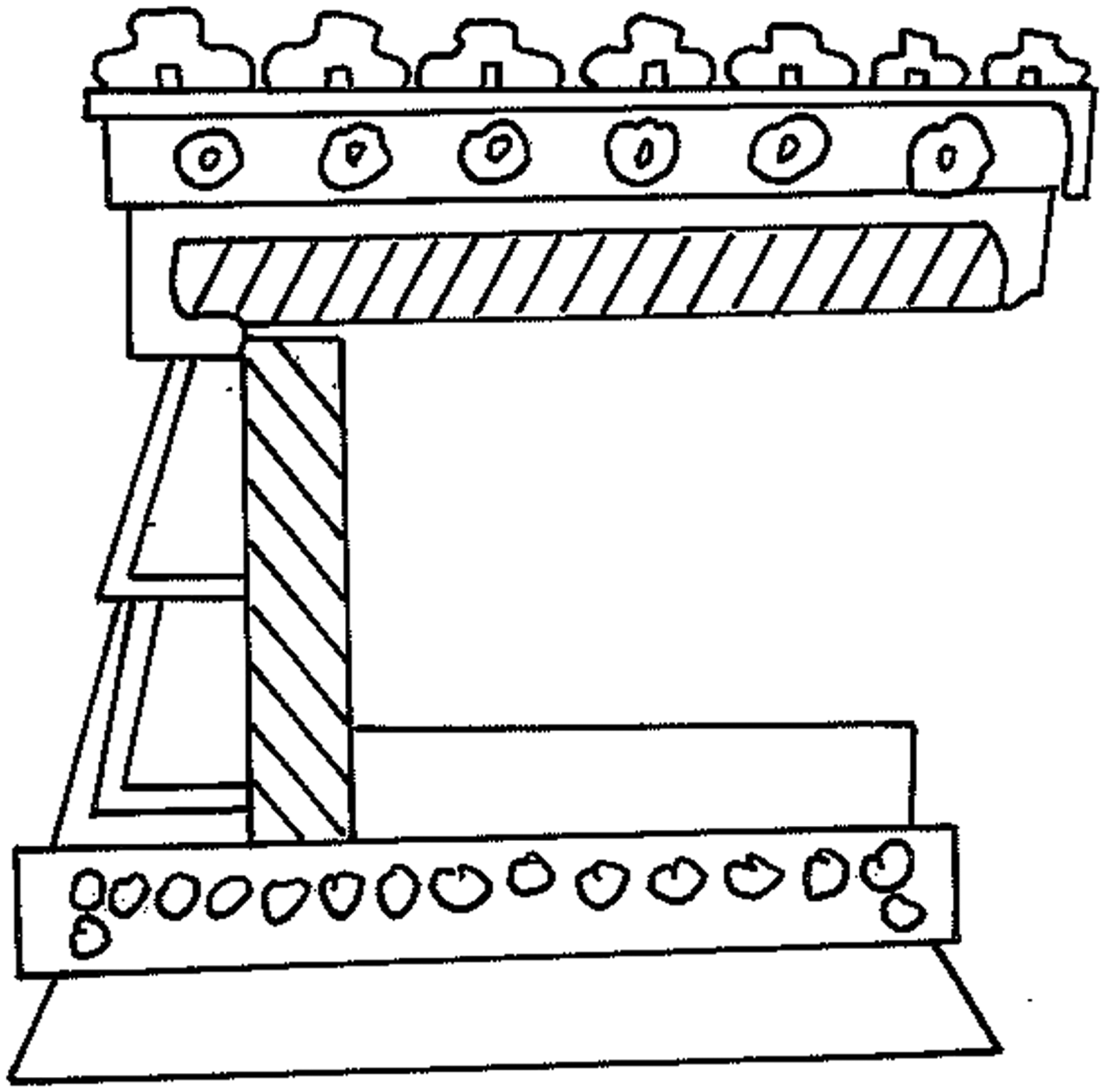
Most of the known almenas at Cihuatan were found on floors where they appear to have fallen from the roofs of major buildings, such as Structure Q-1 (see Figure 4). All of the almenas associated with Structure Q-1 are hollow (box-like) ceramic constructions consisting of a rectangular, open bottom base, stepped sides, and topped with a large, usually hollow, pointed feature (Figure 5; cf. Smith and Paz Bautista Reference Smith and Bautista2015:118, Tipo 2). Bruhns and Amaroli (Reference Bruhns and Bertolucci2011:420) call them “almenas huecas” (hollow almenas). The tops, or points, roughly resemble roof combs commonly found on major temples at lowland Classic-period Maya sites such as Tikal. No clear relationship has been established between this form of almena and Classic-period Maya architecture. The stepped form also is quite similar to each of the separate stepped roof combs on the trilevel roof of a structure at Labna (Séjourné Reference Séjourné2002:140–141, Figure 69).
(a) Nearly intact almena missing only its top, among groups of almena fragments in situ on floor fronting Structure Q-1 at Cihuatan. Photograph courtesy of Paul Amaroli (Amaroli Reference Amaroli2009:10, Figure 12). The point was not recovered from among those many sherds of almenas found in this area that were examined in February 2012 (see Figure 5b). The top may be among the many fragments not yet processed. (b) Reconstruction of Structure Q-1 at Cihuatan depicting almenas in place. Image courtesy of Paul Amaroli (Reference Amaroli2009).

Drawings of Cihuatan almenas reconstructed in this project, with temporary laboratory designations: (a) Lab No. A; (b) Lab No. 1. One of many tops found intact or recently reconstructed. (c) Lab No. C. Nearly identical to Lab No. D, not shown here. (d) Lab No. E. Views include frontal view showing the offset of the rear window, side view and cross-section, and view of rear window. (e) Lab No. F. (f) Lab No. G (labeled CH-08-110A). Drawings by the author.

The basal parts as well as the pointed tops of these box-like Cihuatan almenas are all slab built. The three dimensional aspects of the earliest finds of pieces of these roof ornaments at Cihuatan suggested that they represented ceramic boxes. Subsequent finds of larger pieces revealed the fragments to be derived from a complex form of almena. The basal lengths of these newly reconstructed hollow almenas at Cihuatan vary from between 40 to 50 centimeters and heights generally are around 50 centimeters. All are about 14 centimeters deep. No paint is evident on any of these reconstructed examples (Figures 5a–5f) or on any pieces, washed or unwashed.
Large, flat roofed stone buildings at Cihuatan appear rare. Most of the lesser buildings, and probably even the temple atop the large P-7 pyramid, had thatched roofs (cf. the reconstructions from the nearby site of Las Marías in Fonseca Reference Fonseca2011). At Cihuatan the known almenas were primarily associated with a single, large flat-roofed structure (Q-1), popularly called a “Palace.” Structure Q-1 is located on the highest point at the site, popularly called the “Acropolis.” This may have been a noble's residence (see Fowler Reference Fowler1981:886–888) or seat of government. Excavations at this location yielded fragments of large numbers of almenas. One almena base was found still stuccoed to a possible roof element. This evidence suggests that these ornaments were attached directly to the edges of the flat roofs, being sealed in place by an external plaster coating (see below). The great number of fragments that have survived, and the relative ease with which clusters of these sherds can be assembled, suggests very little disturbance of the thin soils overlying the site. The abundance of fragmentary almenas of several forms may relate to the destruction of these adobe and stone buildings all at the same time, reflecting the end of the final occupation at the site center, generally said to be about a.d. 1050 to 1100 (Bruhns and Amaroli Reference Bruhns and Bertolucci2012). The distribution of the almena fragments suggests a violent end to the structures they adorned.
GOALS AND METHODS
The many large fragments of almenas recovered at Cihuatan from a specific area adjacent to and associated with Structure Q-1 represent a range of variations on a single shape or form used on one roof. The first goal of this research was to describe some of these almenas represented from this single structure. Second, assembling several examples of these almenas enables us to suggest how they had been placed on this building and the extent to which they had been disturbed before and/or after the structure on which they were mounted had collapsed. Third, identification of several other types or forms of almenas suggests differences in use of various classes of almenas in different parts of the site. This last goal emerged only after I arrived on site and recognized that the use of roof ornaments at Cihuatan was not limited to Structure Q-1.
The impressive numbers of box-like almena fragments found during excavations at Structure Q-1 at Cihuatan led the excavators to segregate them from other artifacts recovered in the field. These fragments were double bagged into durable plastic sacks and then placed into larger, well-labeled containers. Most of the recovered almena fragments had been washed before being bagged, but no labeling of individual fragments had been undertaken prior to my arrival on site. In addition, the extensive work surfaces needed for sorting, cross-fitting and assembling these masses of pottery had to be improvised. Since only 15 days had been allotted for this preliminary study, attention was directed to a relatively small percentage of the almena fragments already recovered from a randomly selected group of contiguous excavation units. Efforts focused on assembling whatever fragments had been recovered within and between these few contiguous archaeological “units.” The almenas were provisionally assembled using simple “white glue” (PVA). The ultimate goal is the relocation of these artifacts to the National Museum of Anthropology in San Salvador where select examples could be afforded full conservation for possible exhibition.
Distribution of Box-like Almena Fragments at the Site of Cihuatan
Ceramic almenas had not previously been reported from any site south of Mexico, and still remain unknown from excavations in El Salvador beyond the limits of Cihuatan. The almenas at Cihuatan, a site dated to ca. a.d. 900–1100 (Bruhns and Amaroli Reference Bruhns and Bertolucci2012; Kelley Reference Kelley1988:14), are several centuries earlier than those known from illustrations in Late Postclassic/late pre-Hispanic Mexico, but long after the earliest known examples of roof ornaments in the Valley of Mexico. Similarities in form and use, however, suggest a linkage between these architectural traditions. Study of the clays, improving upon the work of Sayre and Harbottle (Reference Sayre and Harbottle1978), might be productive.
The epicenter of Cihuatan includes an elevated area generally identified as the “Acropolis” and a nearby area including two ball courts, a large temple-platform, and an elite residential zone that Fowler (Reference Fowler1981) suggests may relate to ritual personnel. Major buildings were made of adobe bricks and an array of local stone types, using a clay (adobe) mortar. The walls appear to be coated with plaster or faced with slabs of talpuja, a very soft volcanic tuff. Floors are smoothed clay or talpuja, or both. Supporting pillars are piers made of adobe. No vaulted constructions are known. All the “stone” roofs of the major buildings are flat, made of beams covered with adobe and then with laja, that is, plastered on the exterior. The almenas appear to have been fixed in place with the final plaster coating on the flat roof.
Toward the northwest corner of the “Acropolis” is the architectural complex identified as Structure Q-1, covering a rectangular area of about 40 by 75 meters (Figure 2). This “Palace” complex includes a series of abutting residential and possibly ritual rooms, or structures, arranged around an open courtyard. A very high density of almena fragments have been recovered during extensive clearing operations along the western side of Structure Q-1. Amaroli (Reference Amaroli2009:4, Figure 3) indicates that clusters of fragments representing at least 19 almenas were located directly on the floor along the 40-meter length of the north-south wall. His plan reveals that many almenas seem to have fallen in pairs; each pair having been mounted in two rows along the roof (see also Amaroli Reference Amaroli2009:6, 10, Figure 12). All of the Cihuatan almenas from Structure Q-1 are of the stepped form (cf. Berrin and Pasztory Reference Berrin and Pasztory1993; Carrizosa and Aguirre Reference Carrizosa Montfort, Molina and Moctezuma2003:Figure 1b), but are box-like in construction rather than flat (see Figures 6–7). The risers of these “steps” are vertical (Figure 5), as distinct from the “serrated” form in many Aztec examples (Figure 3 left, Figures 8a–8b). Numerous fragments of possible almenas also were recovered from the surfaces immediately to the north of Structure Q-1 (Figure 2, area 7). The restoration of a sample of the almenas from excavations at Structure Q-1 at this site puts us in a better position to discuss the possible numbers that had been used to decorate this major structure, and to determine if they were only at the front edge of the roof.
Two almenas from an unknown location in the Valley of Mexico; one round and one rectangular in shape, but both with rectangular tenons. Both are now in the Museo Nacional de Antropología (see in Rattray Reference Rattray2001:607, Figure 215). Image courtesy of Linda Manzanilla Naim.

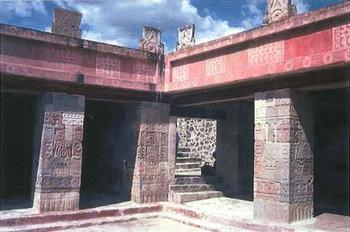
Corner within the principal patio of the Quetzalpapalotl palace in Mexico with almenas escalonadas bearing the year sign (Gendrop Reference Gendrop1985:47, Figure 1). The profiles of these almenas seem to me to be intermediate between “stepped” and “serrated” forms (see Smith and Paz Bautista Reference Smith and Bautista2015).

The Cihuatan Structure Q-1 almena sample includes several different variations of the stepped, hollow form but all have vertical “risers” (see Figures 5a–5f). An astounding number of fragments recovered to date, together with large numbers of pieces that had been left in all of the excavated squares (not yet brought to the laboratory by February 2012), represent at least 50 to 60 examples, and possibly twice that number. One nearly intact example found in the Structure Q-1 area is slightly smaller and more “dense” that the several others found in that area. Most of the almena fragments are large and highly stable, some being fired at temperatures from 1000°F to over 1100°F, probably using a trench type firing system (see Becker Reference Becker2003a, Reference Becker2007, Reference Becker2013). These firing temperatures appear well above those of most local earthenwares (less than 900°F). Some sherds from vessels at Cihuatan seem to have been fired at quite low temperatures, perhaps 800–900 F. As yet there is no confirmed example of an almena of this poor quality ceramic. I suspect that the low-fired sherds may represent another class or category of ceramics, possibly unrelated to the roof ornaments. A number of sherds from this same area were fired at stoneware temperatures (1100–1300°F, gray, semi-vitreous), in shapes similar to the front and/or back surfaces of almenas. They may derive from a yet unknown artifact category.
The backs and fronts of the box-like Cihuatan Structure Q-1 almenas were hand formed from large flat slabs. A pair may have been cut to approximately the same shape by placing one slab over the other. The vertical aspects of the stepped sides, connecting the large front and rear panels, were fashioned from smaller slabs of clay, hand formed and flattened into small “panels.” Some panels were first made as longer pieces that were then bent to form two (or more?) side surfaces. These slabs were formed much like the modern, thick local tortillas that commonly have a diameter of less than 15 centimeters. Of the several hundred individual slabs that I handled, only one had a mat impression on the interior surface. This impression was from a simple mat woven of ordinary marsh reeds. Although molds were used at Cihuatan for spindle whorls, figurine heads (and perhaps bodies), and possibly for adornos decorating censers, there is no evidence for mold use in the construction of these box-like almenas at Cihuatan.
Most of the box-like almenas reconstructed at Cihuatan, in whole or in part, are of the two-level type (Figure 5d). Some are of three levels. Each has one opening or “window” in the front and the back, both of similar shape and roughly the same size. The reconstructed examples reveal that the two windows generally are not in alignment. Some of the partially reconstructed examples seem to have had more than one window on each side, but this remains to be conclusively demonstrated. The variations in “window” shape includes round (N = 2), tall rectangle (N = 4), tall rectangle with rounded corners (N = 2), and tall triangle. These openings probably were cut using a string, if not a wooden blade or an obsidian flake. The newly cut openings were then manually smoothed along the margins. Some almenas that were partially reconstructed in 2012 have horizontal moldings along various lateral edges. Their frequency remains to be determined.
A second location where almenas may have been used at Cihuatan appears to relate to Structure Q-10 (Figure 2). During the course of this 2012 study I made daily tours of the “Acropolis” and other areas of the site in order to gain some familiarity with the relationship between the mapped central area and distribution of structures (cf. Becker Reference Becker, Manzanilla and Chapdelaine2009). During these walks I found significant numbers of flat almena fragments on the surface of the area south of Structure Q-10, located on the southwestern part of the “Acropolis.” This suggests that Structure Q-10 may have been decorated with flat ceramic ornaments, but with stepped outlines. An alternate possible origin for almena pieces found at this location in 2012 may have been a massive ceramic pile of unknown origin discovered there by Boggs in the early 1950s when the forest was cut from this portion of the site (Fowler Reference Fowler1981:41–42). Amaroli (Paul Amaroli, personal communication 2012) pointed out that Boggs (Reference Boggs1973:Figures 12–14) identified this deposit as covering the remains of Structure O-4, now renumbered as Structure Q-14 (see Amaroli Reference Amaroli2011). The hundreds of kilograms of ceramic pieces in that pile, as well as burials found below, are described in a report (Boggs Reference Boggs1973) on the wheeled figurines found in that assemblage. Amaroli (Paul Amaroli, personal communication 2012) told me that these ceramics were transferred to the National University, but that they may have been discarded or lost during the period of political unrest.
A third location where flat almenas may have been used at Cihuatan was on Structure P-42, situated immediately to the southeast of Structure P-7, the largest structure at the site and now known to have talud-tablero architecture (Amaroli Reference Amaroli2015b). Structure P-42, believed to be an elite residence, was the focus of early modern excavations at Cihuatan by Fowler in 1978 and 1979 (Reference Fowler1981:98–116). He identified the area as the Southeast Patio. He did not include the few finds of possible almena fragments in his report, but he now recalls (William R. Fowler, personal communication 2012) that the many thick ceramic sherds found at that location probably represented large flat, modeled roof ornaments. These fragments measure at least 25 by 35 centimeters and from 2 to 3 centimeters thick. In consultation with Boggs, they thought these might be merlons, or rooftop decorations (almenas) similar to those known in Mexico (William R. Fowler, personal communication 2012). There were no examples of nearly intact almenas reported from the original living surfaces of Structure P-42, as was the case in the area around Structure Q-1. If any of these elite residences were decorated with almenas, the history of their termination might be very different from the possibly rapid destruction of Structure Q-1 and its nearby structures. The extensive excavations in the area of Structure P-42 have long been backfilled, but in 2012 I recovered two almena fragments from casual inspection on the surface in that area.
Although Fowler's excavations at the area of Structure P-42 yielded no specific published statement concerning the many thick ceramic sherds that he found, Bruhns (Reference Bruhns1980:93–94) soon after suggested that the known thick ceramic fragments from that area might have been “roof tiles” and that they had been “reported from excavations and from surface contexts for many years. These have now been found in excavations, both in the ceremonial center and in the residential area. These objects are unslipped and of the typical Coarse Ware.”
The crude surface modeling on these thick ceramic fragments from the area of Structure P-42, and their limited numbers, appear to have led subsequent excavators to disregard them. In hindsight, we see that these simple fragments may represent almenas. In addition, special attention should be paid to a possible relationship between the three locations from which almena fragments have been found at the Cihuatan site core and the groups of structures at each of them. Excavations in the area of Structure Q-1, the largest residential grouping known at the site, have yielded the masses of almena fragments that are the focus of this study. Structure Q-1 has the long Structure Q-2 along its western side. The two other areas from which almena fragments are now known have a similar architectural arrangement. Structure Q-10 is bounded along its western side by the elongate Structure Q-11, and Structure P-42 has the long Structure P-8 along its western side (separated by the “West Alley” noted by Fowler Reference Fowler1981:106–112). These three locations, generally considered elite residential areas, may be the sites of large house-complexes such as those known in the Valley of Mexico. At Cihuatan these house-complexes appear less clustered or less contiguous than the compound pattern in Mexico that is often considered to be an “urban” residential form. The Cihuatan pattern seems to resemble certain house groups at Tula (Paredes Reference Paredes1999) as well as those lowland Maya “houses” composed of a series of distinct structures clustered around one or more courtyards (Becker Reference Becker2003a, Reference Becker and Sabloff2003b).
Flat Almenas: Forms found at Three Other Locations at Cihuatan (Structure P-28, San Dieguito, and Structure P-9)
The Cihuatan ceramic fragments believed to derive from flat almenas consistently have one rough (unfinished) side, while the decorated or viewed surface is smoothed and almost always bears a narrow (finger tip-width?) groove parallel to or outlining the edge. Amaroli (Paul Amaroli, personal communication 2014) suggests that these fragments represent a variety of shapes including rectangular and cruciform, and possibly curvilinear. No complete or even partial example has yet been assembled from these sherds, but the pieces may reveal an almena type that is important to expanding this study.
Years after Bruhns had suggested that certain thick ceramic fragments might derive from roof tiles, another set of thick fragments appeared during the Structure P-28 excavations. During the 2004 and 2005 excavations at Structure P-28, one of only four “round” (actually “keyhole” shaped) structures identified from ancient El Salvador (Bruhns and Amaroli Reference Bruhns and Amaroli2009), a number of thick ceramic fragments of what appear to be almenas of the flat form were recovered. A number of keyhole-shaped pyramid bases (yacata) are reported from the Tarascan region west of the Valley of Mexico (Hirshman Reference Hirshman2015:2; Pollard Reference Pollard1993:44–53), but their relationship with the single known example at Cihuatan has not been explored. The flat form of almena found with Structure P-28 at Cihuatan, a type so well-known in the Valley of Mexico, led Amaroli and Bruhns (Reference Amaroli and Bruhns2006:18–19, 25, 27–39, Figures 22–23) to identify these thick fragments as almenas planas (Figures 6 and 8) to distinguish them from the box-like almenas found in the area of Structure Q-1 (see Bruhns Reference Bruhns1980:93). At least 34, and possibly 36, fragments of almenas planas were recovered from excavations at Structure P-28 (Amaroli and Bruhns Reference Amaroli and Bruhns2006:19, Figures 22–23). These fragments of suspected examples of almenas planas at Cihuatan are small, non-descript, and generally from the margins of the pieces.
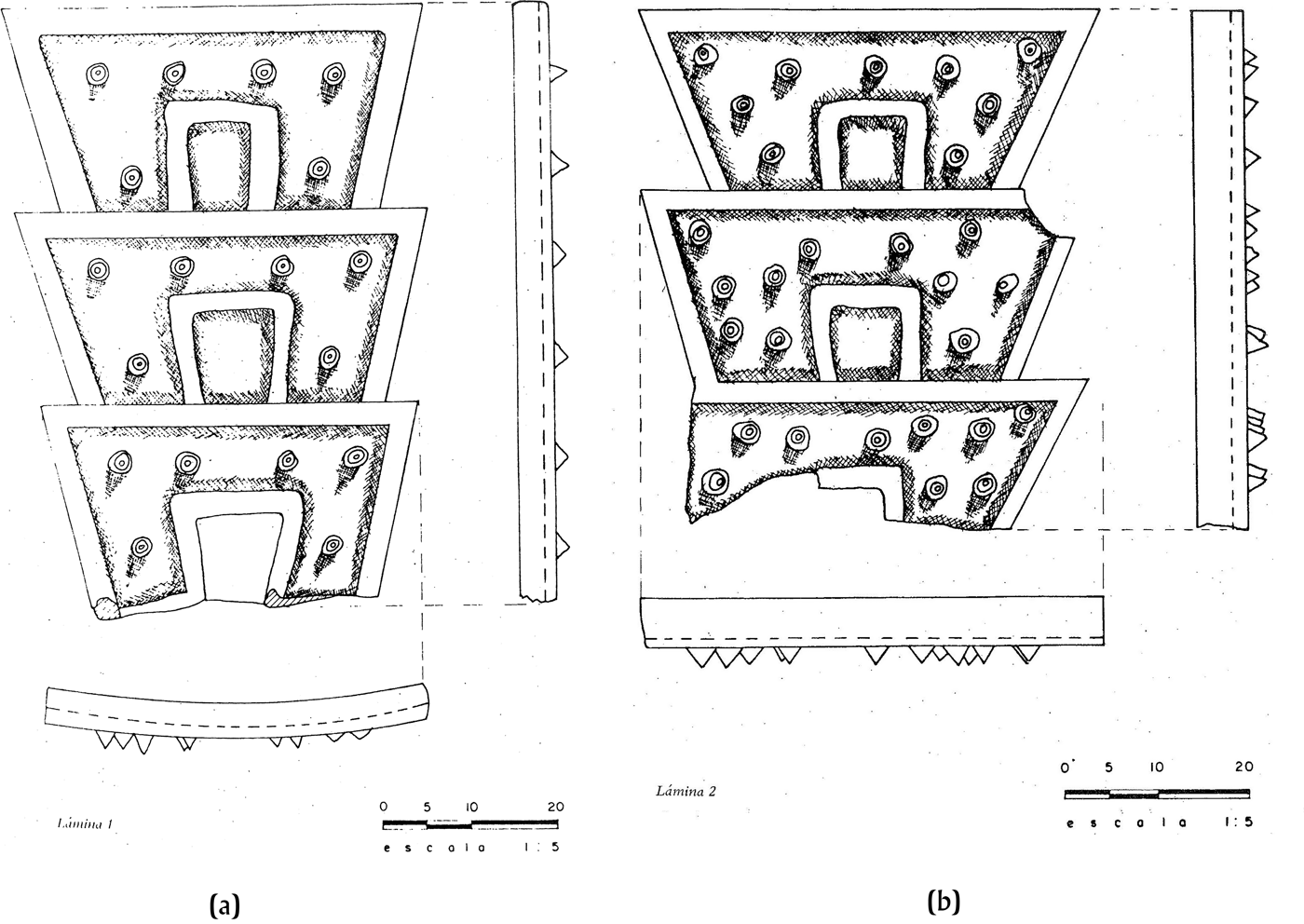
Two flat almenas (AC4-173, AC4-174) recovered from the Metro excavations in Mexico City (from Ramírez Reference Ramírez Acevedo1987:Laminas 1 and 2). Pointed out to me by Michael Smith (personal communication 2015) who dates both to the Aztec period and also notes their serrated form. Both of these are three-tiered almenas that have been broken near their bases (tenons?). Both appear to have “windows” or openings piercing their lowest level. (a) The example depicted in Lamina 1 measures 48 by 70 cm, and has a slight lateral curve. (b) The fragment shown in Lamina 2 measures 53 by 58 cm and is perfectly flat. Drawings by Gilberto Ramírez.

The term almena plana used by Amaroli and Bruhns (Reference Amaroli and Bruhns2006:19) to designate these “solid clay” artifacts appears to have been discontinued (Bruhns and Amaroli Reference Amaroli2009:38, Figure 8). Their footnote (Bruhns and Amaroli Reference Amaroli2009:44n2) provides confusing information. Bruhns and Amaroli (Reference Amaroli2011:61) recently identified three thick ceramic fragments as “almenas solidas.” The possible association of Mexican-type flat almenas found around a round or keyhole-shaped structure at Cihuatan warrants further study (Becker Reference Becker and Sabloff2003b). The material excavated from Structure P-28 remains at Cihuatan (Paul Amaroli, personal communication 2012). Almenas from Structure P-28 suggest a fourth possible location at Cihuatan where decorative roof ornaments may have been used.
A fifth location in Cihuatan at which almenas may have been used is within the zone designated as San Dieguito, to the northeast of the site center (see Figure 2). Kelley's excavations there involved four large test areas. No almenas are mentioned or discussed in Kelley's (Reference Kelley1988:176–182) review of the non-vessel ceramic artifacts at Cihuatan. Her report does include illustrations of two small fragments that she cautiously identified as derived from “Roof tiles” (Kelley Reference Kelley1988:176, 107, Plates 25a–25b). She (Kelley Reference Kelley1988:103) also indicated that they might derive from roof decorations, as I believe to be the case:
“‘Roof’ Tiles (Plate 25 a and b)”
Bruhns (1980a: 93–94) discusses the so-called roof tiles, concluding that they may in fact have adorned the ridgeline of roofs. We have fragments of two of these from Structure 15-1. Both are thick (30 mm to 33 mm) and have shallow grooves. A third piece, equally flat and thick lacks any decoration and might equally well be a flat base of one of the large, vertical walled vessels.”
These two pieces, and the large third fragment (17 × 20 cm) of a more diagnostic form (perhaps an “ear” from a flat type?) that remains to be published, derive from House Platform A at San Dieguito (Kelley Reference Kelley1988:22, Figures 5–6; Jane Kelley, personal communication, 2012). This “house” may have been ornamented with very large flat almenas.
The sixth location from which possible almena fragments have been found is associated with Structure P-9, a small, four-stairway platform situated midway between the two ball courts and nearly due north of Structure P-28. Amaroli (Reference Amaroli2012a:66) variously identifies a few thick fragments of ceramic tablets (e.g., CH11-7) as almenas, almenas solidas and almenas planas. Despite the use of these different terms, Amaroli remained uncertain of their function at that time.
Two Other Locations and Two Unusual Forms of Almena at Cihuatan: Biznagas and “Felines”
A seventh location at which roof ornaments were used at Cihuatan centers on Structure Q-40, also located in the Acropolis area (Amaroli Reference Amaroli2015a). This structure is less than 40 meters to the northwest of Structure Q-1. No almena fragments of the box or flat type were found during the 2012 excavations at Structure Q-40, but Amaroli (Reference Amaroli2013b:5) identified a series of urn-like ceramic items with midsections shaped like the cactus called biznaga. These appear to have served as almenas, although one reviewer suggests that these items are drums. This cactus is well known in Mexico, but is not known to grow as far to the south as Cihuatan. Amaroli's excavations recovered evidence for 22 examples of these phytomorphic effigies, with the fragments found almost in a row (e.g. CH12-9). Most seemed to lack bases, but continuing excavations in Units 57–59 identified a series of at least 7 bases for these almenas, all in positions suggesting that they had been used as roof ornaments for Structure Q-40 (richly illustrated in Amaroli Reference Amaroli2015a). All of the reconstructed effigy biznagas (e.g., CH12-173) measure between 26 and 27 centimeters tall (Amaroli Reference Amaroli2012a:79–83). Amaroli (Reference Amaroli2013a:2) also reviews finds of similar objects elsewhere in the region of Cihuatan (e.g., Fowler Reference Fowler1981), where Postclassic sites are not common. Biznaga-shaped almenas also are well documented from excavations in Mexico City (Carrizosa and Aguirre Reference Carrizosa Montfort, Molina and Moctezuma2003), but appear unrelated to spiked ceramic containers such as those also known from the Valley of Mexico (Deal Reference Deal1982).
An eighth location for finds of almenas at Cihuatan yielded a series of three-dimensional modeled feline (or guardian dog?) sculptures. In 2013, excavations at Structure P-23, at the southwestern corner of the walled area identified as the Plaza Sol revealed at least six examples of these three-dimensional ceramic figures identified as representing felines, only one of which is nearly complete. Structure P-23 and its roof ornaments are within the area in which stands the large pyramid Structure P-7 (see Amaroli Reference Amaroli2015b). Fragments of these animal heads suggested to the excavators that two of them represent large cats (puma?), but Kehoe (Reference Kehoe2016:97, Figure 7.2) points out reasons for identifying them as dogs. The other animals represented are about 40 centimeters tall (Paul Amaroli, personal communication 2013) and may depict lesser felines of which there are three species in this region, including ocelots (Amaroli Reference Amaroli2013a, Reference Amaroli2013b). The ceramic feline with a human head in its mouth from Cihuatan (Bruhns and Amaroli Reference Bruhns and Bertolucci2012:338–339, Figures 10.10 and 12.16) may relate to the Structure P-23 almenas, but no size is provided and no scale appears in the illustrations. This is identified as the figure of a puma as there is no indication “of a spot” on the surface.
These various animal forms reminded Amaroli (Reference Amaroli2013a:4) of finds reported by Antonio Sol from the 1929 excavations in the area of the North Ballcourt. Sol had identified 20 examples of “feline sculptures,” supposedly from the area of the North Ballcourt. This ball court lies at the northeastern corner of what today is called the Plaza Sol, diagonally across from Structure P-23 (Figure 2). In 1942 Stanley Boggs could not find any examples of these 20 ceramic figures in the National Museum, but photographs and drawings document these early finds (Amaroli Reference Amaroli2013a:12, Figures 11–12). The “feline” forms from the North Ballcourt area derive from a set of almenas distinct in details from those that were recently recovered by Amaroli in association with Structure P-23. The size variations between these two “types” may be significant in evaluating function if not social levels of the people using them. Note also should be made that Smith and Paz Bautista (Reference Smith and Bautista2015:118) list animal almenas as their Type 5, but the Teotihuacan corpus includes only flat examples, quite distinct from the box-like examples known from Cihuatan but possibly related to the flat examples at the site that are yet to be restored.
Any possible significance of the distribution of almenas at Cihuatan must await excavations to verify the presence of this artifact category where at present we have only a few fragments (Figure 2:Locations 2–9). Publication of the evidence now available regarding possible examples in and around the site also would be useful as now we believe that almenas appear to be associated primarily, but not exclusively, with large (elite?) residential buildings at Cihuatan.
Comparanda: Almenas Beyond Cihuatan, in Time and Space
The possible use of almenas at sites in the region around Cihuatan is not reported in the literature prior to a review of examples by Bruhns and Amaroli (Reference Bruhns and Bertolucci2012:336–337). Several possible finds are mentioned, with those associated with Structure 2 at Carranza (Bruhns and Amaroli Reference Bruhns and Bertolucci2012:337, Figure 12.15) being the best documented. The dates of these sites do not appear as late as Cihuatan, suggesting that further study of this topic is warranted to seek possible relationships.
The simple, stepped form of ceramic almena now known at Cihuatan (both flat and three-dimensional) has antecedents in clay as well as stone, at many locations in the Valley of Mexico (see Carrizosa and Aguirre Reference Carrizosa Montfort, Molina and Moctezuma2003:Figure 1b; Gendrop Reference Gendrop1985:49, Figures 8a–8b). Almenas were first reported from Teotihuacan by Peterson (Reference Peterson1952, see below), but a comprehensive review and typology has just emerged (Smith and Paz Bautista Reference Smith and Bautista2015). Their Type 2, the stepped shape, clearly associated with the form used at Cihuatan Structure Q-1, also is known from some other sites, and often at a location associated with a Teotihuacan connection. While ceramic forms of this Type 2 appear to predominate at Teotihuacan, varieties in stone also are known, including onyx (Gendrop Reference Gendrop1985:49, Figure 8b). Through excavations conducted by Manzanilla (Linda R. Manzanilla, personal communication 2012), examples of almenas of the stepped type are known at Teotihuacan from Xalla, a palatial structure to the north of the Pyramid of the Sun. Manzanilla also notes other examples from the Quetzalpapálotl palace (Classic period, not Aztec), one of which bears the year sign (Figure 7). Buildings from Texcoco are not known to have such ornaments (Smith Reference Smith2008:116, Figure 4.9A).
Rattray (Reference Rattray2001:347) dates the earliest examples of almenas at Teotihuacan to the Early Tlamimilolpa period, ca. a.d. 250 (Figure 6). She finds they “are most common in Late Xolalpan and Metepec contexts” (Rattray Reference Rattray2001:347, Figures 215–221). Cook (Reference Cook de Leonard1985:51) dates their beginnings to ca. a.d. 300. Rattray (Reference Rattray1990) had suggested that some almenas utilized fine orange pastes, but later placed all the ceramic almenas at Teotihuacan within a category she termed “Granular Ware” (Rattray Reference Rattray2001:337; cf. Ramírez Reference Ramírez Acevedo1987:Laminas 1–4 for the Mexico City Metro excavations). Rattray (Reference Rattray2001:335) defined these thick, flat objects as made from “highly distinctive” clay of unknown provenance that she believed arrived via foreign “trade.” Rattray (Reference Rattray2001:335, 337, 339) discussed possible origins for Granular Wares, and indicated that finds of similar wares also had been imported “into the Valley of Xochicalco” although almenas remain unknown from that site. Rattray (Reference Rattray2001:339; also Séjourné Reference Séjourné1966b) believed that this category of ware appeared at Teotihuacan in “limited and uncommon forms” and discussed why these large ceramic ornaments “could have been brought from afar” (Rattray Reference Rattray2001:339, citing Séjourné Reference Séjourné1959:Figure 137, Reference Séjourné1966a:Figures 194–196). She offered a brief summary of the varied forms of almena, plus a chronology, history and taphonomy (Rattray Reference Rattray2001:337). Ceramic studies such as those of Rattray (Reference Rattray1990, Reference Rattray2001), however, focus on analytical work done more than 30 years ago by Sayre and Harbottle (Reference Sayre and Harbottle1978). New studies using new techniques and a search for new finds are in order.
Tenochtitlan
Carrizosa and Aguirre (Reference Carrizosa Montfort, Molina and Moctezuma2003:278–299) identify seven types of almenas from archaeological contexts in Mexico City, and offer a catalogue of examples. They base their review on 81 complete or nearly complete examples plus 46 fragments. Their tables inventory only 78 examples. Carrizosa and Aguirre also discuss various forms known from historical sources but which remain unknown in the archaeological record (Carrizosa and Aguirre Reference Carrizosa Montfort, Molina and Moctezuma2003:299–301). Extensive pictorial evidence is available in the codices that survive from the period around the arrival of the Spanish. Three examples of the stepped type of almena (see Figure 9), presumably from the same building of the Aztec period in Mexico City, were recovered and published by Ramírez. Ramírez (Reference Ramírez Acevedo1987:49) also published a page from the Codex Vaticano A (Vatican 3738, foja 126) depicting a structure decorated with almenas of the same stepped form as those that he recovered.
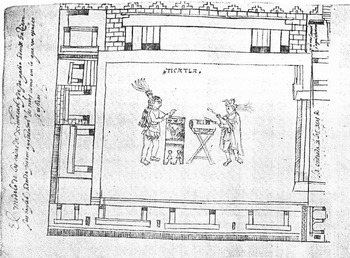
Drummers in the Palace of Xicotencatl in Mexico, from Bruhns and Amaroli (Reference Amaroli2011:421, Figure 10.20). The reconstructed frontal view of the structure depicts ten stepped almenas along the roofline, plus one at each corner. The corner examples in this reconstruction appear specially formed, with a 90 degree bend. Original illustration by Muñoz Carmago (Reference Muñoz Camargo1583); see also Acuña (Reference Acuña1981).

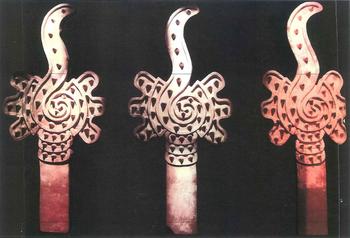
Archaeological evidence for a wide variety of forms of almenas in the Valley of Mexico was gathered by Séjourné in 1966 (reprinted in 2002). Séjourné’s richly illustrated study (Reference Séjourné2002:131–138, Figures 64–66) also includes drawings of these roof ornaments had been depicted in the various surviving codices (Duran, Borbonico, Mendocino [also called the Codex Mendoza], and Borgia) from that region (Figure 10). The codex illustrations reveal a wide range of forms of roof ornaments, ranging from elaborate flame-like examples (Gendrop Reference Gendrop1985:49, Figure f; Séjourné Reference Séjourné2002:131, Figure 59) to a more simplified stepped-form similar to those at Cihuatan (Gendrop Reference Gendrop1985:Figures 49a and 49b; Séjourné Reference Séjourné2002:132, Figures 60, 64–66). What I describe as the “flame-like” form from the Templo Mayor (Figure 11) is identified by Barrera and López (Reference Barrera Rodríguez and Arenas2008:18) as “con forma de caracol seccionado” and by Atwood (Reference Atwood2014:31) as “spiral roof ornaments, representing snails.” Seven unusually large examples of this type, each more than 2.38 meters (eight feet) tall and 1.2 meters wide, were excavated in 2008 by Raul Barrera from the Calmecac (ca. a.d. 1486–1502) beneath modern Mexico City, about 100 meters from the Templo Mayor. These may have been mold made (Figure 12), as were other types also known from buildings in that area.
Three very large “flame” shaped almenas with cylindrical tenons from the Templo Mayor (AC4-245), as illustrated in Barrera and López Arenas (Reference Baez Urincho2008:18).

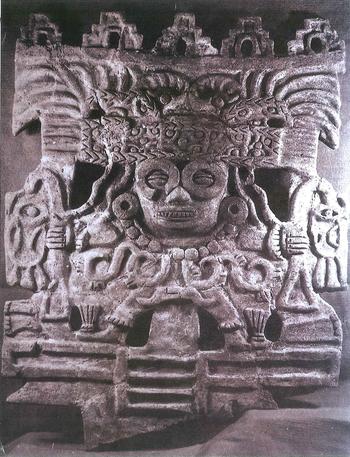
A Classic-period almena from Cinteop (M-87). Michael Smith (personal communication 2015) suggests that this example, almost intact except for the tenon, derives from unauthorized excavations. Photograph courtesy of Michael E. Smith.

Aztec structure with almenas, as depicted in the Codex Nuttall (Nuttall Reference Nuttall1902:f. 64). Drawing by the author.

Tula
Diehl (Reference Diehl1983) points out what appears to be a significant chronological gap in the use of almenas in central Mexico, after the decline of Teotihuacan (see Diehl and Berlo Reference Diehl and Berlo1989) and before the rise of the Aztec state. This interval roughly correlates with the period of the rise of Tula (Diehl Reference Diehl1983). Tula was a major capital from which we still have few examples of this type of architectural ornament. This period happens to have a rough correspondence with the lowland Maya early Postclassic period, also the period proposed for occupancy at the site of Cihuatan. Further speculation may not be warranted. Attention might better be directed to the small city-state of Cacaxtla, to the south of Teotihuacan and postdating it. Cacaxtla lies in the Tlaxcala-Puebla Valley and recent excavations have revealed that almena-like designs appear in the impressive murals known from the site (Brittenham Reference Brittenham2015). Whether talud-tablero architecture is common at Cacaxtla I do not know.
The relationship between Teotihuacan and Tula is discussed by Healan and Stoutamire (Reference Healan, Stoutamire and Healan1989:234) with the conclusion that Tula was neither settled nor colonized by Teotihuacan. Diehl's observation (Reference Diehl and Healan1989) regarding the square shapes of houses, or rooms, and the presence of flat roofs, is important in establishing the presence of architecture ideally suited to the use of various types of roof ornaments. Healan (Reference Healan and Healan1989:62) points out that among the decorative elements at Tula are carved stone pieces such as “worked cantera [sic] used as decorative roof trim on the side [of the building] which faced the courtyard.” These have been identified in various forms such as “simple tabular or rectangular pieces, but more complex forms occur as well, including L-shaped pieces, spindles, and discoidal or cylindrical forms commonly called chalchihuitle, believed to be stylized depictions of the eyes of Tlaloc, the rain god” (Healan Reference Healan and Healan1989:63).
The place of Tula in the origin of Cihuatan, which lies in what became a Nahuatl-speaking area, has been discussed at length by Fowler (Reference Fowler and William2011:21–41). Fowler's (Reference Fowler and William2011:48–52) recent focus has been on Cihuatan's ceramic complex, identified as the Guazapa complex. Fowler identifies several strong ties to the Tollan phase of ceramics at Tula, and he concludes that direct contacts are possible, including “colonization” if not simply “independent expansion.” Consideration of Toltec connections with the Pipil migration into western and central El Salvador during the period a.d. 900–1200 are of considerable interest, particularly in connecting traits that are known from the Valley of Mexico with Cihuatan (Fowler Reference Fowler and William2011; see also Arnauld and Michelet Reference Arnauld and Michelet1991; Escamilla Reference Escamilla2011; Healan Reference Healan2012). The dates and the geographical location of Tula plus the close relationship between the ceramic assemblages at Tula (Cobean Reference Cobean1990) and at both Cihuatan and nearby Santa María in El Salvador seem to link these sites (Fowler Reference Fowler and William2011:19–20, 39; Sharer Reference Sharer1978).
Decades ago Acosta (Reference Acosta1942, Reference Acosta1956) excavated a number of stone sculptural fragments at Tula that have generally been identified as almenas, for which the English term “merlon” appears in translations (Jimenez Reference Jimenez Garcia and Williams2010:13). These usually are dated to Tula's Postclassic, although an anonymous reviewer suggests that a recently discovered example is associated with an Epiclassic period structure. The appearance of these items as fragments or single examples is quite distinct from the extensive clusters of finds at other sites. Jimenez (Reference Jimenez Garcia and Williams2010:13) cautiously indicates that the sculptural fragments at Tula that she identifies may have been parts of elements possibly located on “the tops of buildings or rooms, like the merlons” known elsewhere at Tula. She describes those merlons as being shaped like cut conch shells, or shaped like the letter “G.” Jimenez also describes types such as the “head-dress merlon” and others with spikes called “dented merlons.” This latter group may reveal a translation error.
Regarding those “examples” of merlons shaped like the letter “G,” Jimenez (Reference Jimenez Garcia and Williams2010:Photo 70, also see Photo 69; following Acosta Reference Acosta1956:79) specifically identifies an example “in the shape of a cut conch-shell.” This is 75 cm tall, 68 cm wide and 8 cm thick. This also is the shape of the individual elements of the linear roof ornament on the 35 m long serpent wall, or Coatepantli, at Tula (Jimenez Reference Jimenez Garcia and Williams2010:Photo 59; see Jordan Reference Jordan2013). This structure is located parallel to the north side of Pyramid B (Baez Reference Baez Urincho2008:10, Figure 5). Acosta (Reference Acosta1956:79) and others have interpreted these roof ornaments as a series of individual elements, as a variant form of almena, composed of individual cut shells or identical “G” shaped elements that are touching. Thus, the individual slabs appear as a continuous unit rather than separate and separated units such as those documented with the various types of almenas from Cihuatan. In addition, the upper and lower borders of the long frieze on the coatepantli have a generic stepped pattern, called “frets” in the Jimenez description, similar to the Smith and Paz Bautista (Reference Smith and Bautista2015) Type 2 almena. While this does not confirm the use of almenas at Tula in the same way as elsewhere, what we may have is a local form of roof ornament, perhaps relating to the use of stone rather than ceramic. One almena also is known from the Palacio al Este of Tula (Baez Reference Baez Urincho2008:35–37, Figure 27). This single fragment of a stepped form (Smith and Paz Bautista Reference Smith and Bautista2015:118, Tipo 2) may demarcate the nominal front side of this structure.
From the land of the Mixteca, which lies south of Tula and is even closer to Cihuatan than the Valley of Mexico, there have been recovered eight codices that form what is known as the Mixtec Group. Among these is the well-known Zouche-Nuttall example. The Mixtec codices depict numerous examples of structures with almenas as decorations (Figure 13), some perhaps with thatched roofs. The extent of this pictorial information is so great that listing specific examples and placing them in chronological order will be left for others. The belief that at least one of these eight might date to the same time period as Cihuatan, however, should be noted here. Unfortunately, Mixtec archaeology, as that of Cihuatan, is limited in extent and minimally published.
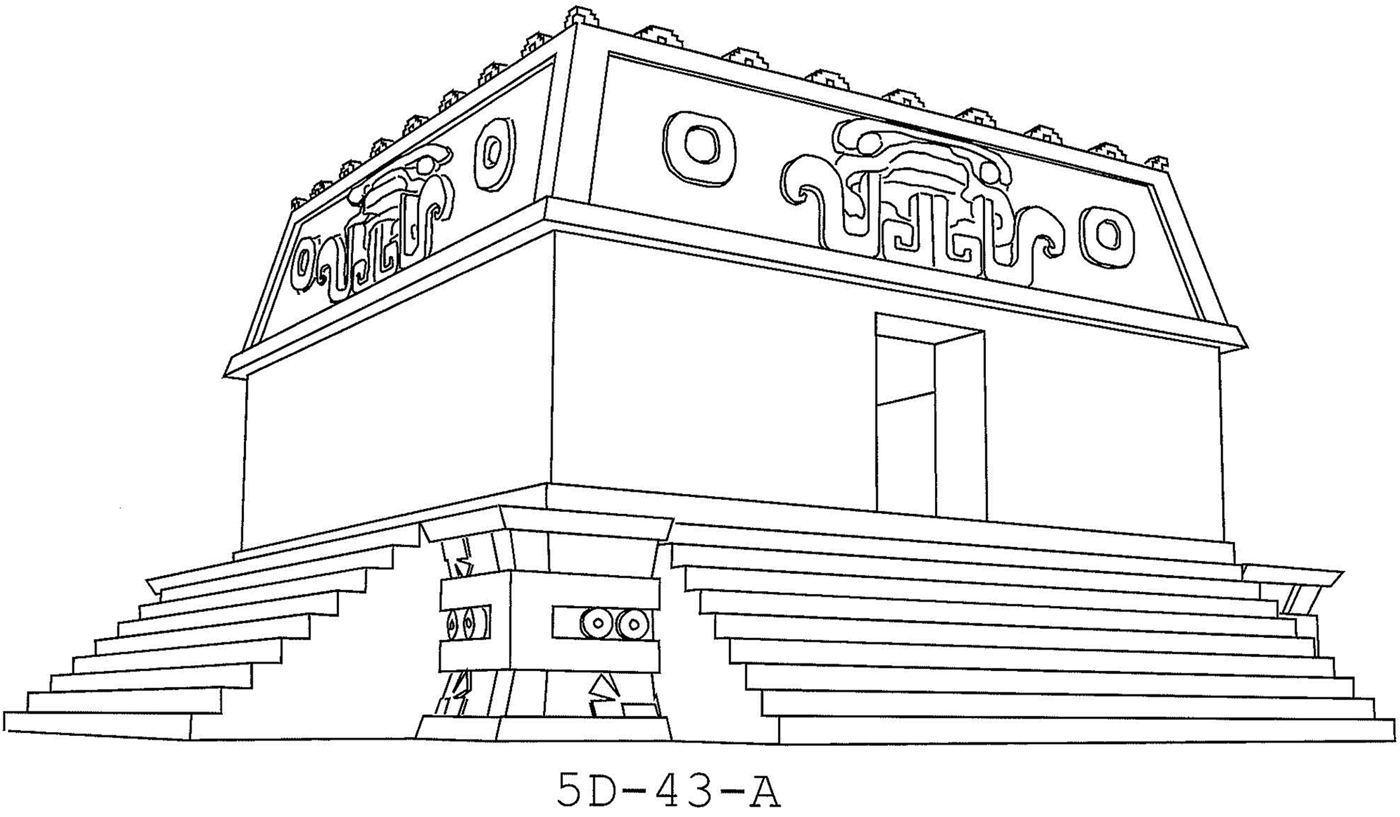
Reconstruction of Tikal Structure 5D-43 ornamented with almenas of the form known from the one intact example recovered (Jones Reference Jones1996). This drawing is used with the permission of Loten (Reference Loten2017).

In addition to illustrations from various codices, Carrizosa and Aguirre (Reference Carrizosa Montfort, Molina and Moctezuma2003:277) have assembled Conquest period Spanish descriptions of Tenochtitlan's Templo Mayor and its almenas. Barrera and López (Reference Barrera Rodríguez and Arenas2008:21) point out similar variations in forms of almenas illustrated in the Codex Mendocino (Berdan and Anawalt Reference Berdan and Anawalt1992:f. 61r). Acuña's (Reference Acuña1985) suggestion that almenas are rarely depicted on the various types of buildings in the codices is refuted by these many recent reviews (Figure 13). In addition, a colonial period map of the epicenter of Cholula, a city allied with Tlaxcala in the Late Aztec period and not part of the Triple Alliance (Smith Reference Smith2008:55, 58), depicts four different structures adorned with almenas, none of which resemble the stepped forms now known from Cihuatan (Smith Reference Smith2008:57, Figure 2.14; see also Smith and Paz Bautista Reference Smith and Bautista2015:118, Tipo 2).
The data relating to almenas provided by Carrizosa and Aguirre (Reference Carrizosa Montfort, Molina and Moctezuma2003), together with work by Ramírez (Reference Ramírez Acevedo1987) and others, offers basic coverage of examples from the Aztec period (Figures 8a–8b). Historically, these roof ornaments of the stepped form also are known from an illustration in the Relacion de Tlaxcala (Figure 13; see Acuña Reference Acuña1984). The Lienzo de Tlaxcala (Muñoz Camargo Reference Muñoz Camargo1583) has a depiction of a house complex in which one of the structures, and also two sides of its courtyard walls, are ornamented with almenas of the stepped type (see Mignolo Reference Mignolo1987:469, Figure I, No. 11; also Smith Reference Smith2008:116, Figure 4.9a). The Lienzo de Tlaxcala (Muñoz Camargo Reference Muñoz Camargo1583:f. 239r) also depicts a structure at that location ornamented with six almenas of an unusual and complex form. The illustration from the Relación de Tlaxcala depicts Xicotencatl's palace at Tizatlan, a town that might be called a suburb of Tlaxcala (see Smith Reference Smith2008 and Wake Reference Wake2002). Fargher et al. (Reference Fargher, Blanton, Expinoza, Millhauser, Xiutecutli and Overholtzer2011) distinguish the political structure at ancient Tlaxcallan as distinct from those of surrounding realms (see also Fargher et al. Reference Fargher, Blanton and Expinoza2010, Reference Fargher, Expinoza and Blanton2011). Evans (Susan T. Evans, personal communication 2012) points out that while the Late Postclassic Tlaxcallans may have used almenas, they did not use the disk motif to indicate a palace, as appears to be the case elsewhere in the Basin of Mexico. Almenas were neither discussed in Evans's (Reference Evans, Evans and Pillsbury2004) review of Aztec palaces, nor in a more recent paper by Nichols and Evans (Reference Nichols and Evans2009). Evans (Susan T. Evans, personal communication 2012) reports, however, that thick, flat ceramic fragments from excavations at the Mexican site of Cihuatepec “should be reassessed” with the possibility that they represent almenas (Evans Reference Evans and Evans1988, Reference Evans, MacEachern, Archer and Garvin1989). Her team did find “cone shaped tenons, plastered at the end” that resemble tenons associated with almenas from Late Postclassic sites in Mexico (Smith and Paz Bautista Reference Smith and Bautista2015:120, section entitled “Bases (Fig. 8)”).
Noteworthy is that one of the two almenas from Huexotla illustrated by Batres (Reference Batres1904:14, Figure 14 ) is somewhat similar to the box-like Cihuatan examples (see Figure 3, right). Batres's example consists of a box-like base surmounted by a rounded “point” or top, very much like the tops (points) common on the Cihuatan examples described here. The Cihuatan almenas appear to combine variations of a simple stepped form with a pointed shape of this upper element that is rarely identified in Mexico. I agree with Gendrop (Reference Gendrop1985:50) who had suggested that these “points” are related to the roof combs on lowland Maya Classic period buildings. The roof structure, built with an internal arch, on El Caracol at Cozumel (Schavelzon Reference Schavelzon1985) is remarkably similar in shape to the points on the Cihuatan almenas.
Cook (Reference Cook de Leonard1985), in an article following Gendrop's overview of almenas, reported on examples from Cinteopa, a Classic period site in the municipio of Tepoztlan, just outside the southern border of the Federal District of Mexico City (Figure 12). The Cinteopa examples are extremely complex depictions in ceramic of a goggle-eyed-being shown exiting through a doorway of a house, the flat roof of which is ornamented by five simple, stepped almenas of the step form type found at Cihuatan. One measures 82.5 by 58 cm, has a maximum thickness of only 4 cm, and weighs an estimated 10 to 12 kilograms (Cook Reference Cook de Leonard1985:52–53, Figure 2b). Cook believes that at least six or seven examples could be reconstructed from the sherds recovered around the structure at Cinteopa. The local Museo Cauahnáhuac holds a very similar example, measuring 60 by 40 cm (Cook Reference Cook de Leonard1985:51, 54–55, Figures 2a–2b; Gendrop Reference Gendrop1985:Figure 59j). Séjourné (Reference Séjourné2002:134, Figures 31, 40, 58, 67) illustrates examples from Cempoala, Chichen Itza, and seems to include a wall from “Tula-Hidalgo” in this category. The example from Chichen Itza (Séjourné Reference Séjourné2002:139, Figure 67) is depicted as an ornamental line on the crest at the top of a structure's roof-comb and Séjourné’s “wall” appears to be the linear roof ornament on the Coatepantli at Tula (see Jordan Reference Jordan2013), an ornament discussed above.
Tikal, El Peten, Guatemala
At Tikal, in the center of Peten in the Maya lowlands of Guatemala, excavation of Structure 5D-43, a structure of Teotihuacan form, yielded one intact example of a solid limestone almena (see roofline in Figure 13; cf. Smith and Paz Bautista Reference Smith and Bautista2015:118, Figures 1 and 5). That any of Tikal's soft limestone objects of this type survive is unusual and attests to skillful excavation. Jones (Reference Jones1996:33) had excavated this almena from the debris east of the structure and recognized it as similar, if not “[i]dentical in shape to almenas (merlons or rooftop elements) from Teotihuacan and other western Mesoamerican sites” as illustrated by Gendrop (Reference Gendrop1985:Figures 2, 4b, 5, 8a–8b). The Tikal example is not only similar in form to one of the varieties recognized at Teotihuacan (for an example of this type in the Codex Nuttall see Séjourné Reference Séjourné2002:Figure 65, No. 4), but Tikal Structure 5D-43, on which it was mounted, bears many other common Teotihuacan features (see Loten Reference Loten2013). Furthermore, Tikal Structure 5D-43 was built during the Early Classic period, when Teotihuacan influence at Tikal was particularly strong (Coe Reference Coe1972). The Tikal almena was not catalogued, but Jones (Reference Jones1996:33, Figures 22a, 74a) describes it as a limestone “block” measuring 52 by 30 by 20 cm and “smoothed and plastered on the front and the stepped sides” (Figure 13, cf. Figure 10). The single surviving Tikal almena also has a rectangular “opening”, measuring about 10 by 10 centimeters, centered at the baseline of the face. Jones (Christopher Jones, personal communication 2012) recalls that it passes through the entire block, similar to the windows in each Cihuatan example that allow one to see through them.
In his reconstruction drawing of Tikal Structure 5D-43 Jones (Reference Jones1996:Figure 22a) imagined a series of seven almenas along the roofline, each separated by a space of approximately 60 to 70 centimeters. Jones speculates that L-shaped “examples” or almenas with right angles, were used at the corners. This inference derives from the stepped examples in the Aztec realm that are depicted in two places in the Bodley Codex (Séjourné Reference Séjourné2002:Figure 66, Nos. 5 and 7). Loten's reconstruction of Tikal Structure 5D-43 (Loten Reference Loten2013) also includes right-angled corner almenas (Figures 7 and 9). Evidence for L-shaped examples or “corner” almenas was sought at Cihuatan, but no indication of “corner” types has yet been found among the fragments of 50 or more examples recognized at Cihuatan, Tikal, or in the Valley of Mexico.
Amaroli's (Reference Amaroli2009) reconstruction of Structure Q-1 at Cihuatan does not include theoretical corner types, while Jones's (Reference Jones1996) reconstruction at Tikal employs this theoretical category. The reconstruction of other Cihuatan almenas may suggest how many were used on Structure Q-1 and how they were spaced. Comparisons among the sizes and shapes of each structure that employed almenas may help us to conceptualize the configuration of these buildings for future reconstruction.
Almenas, so widely identified at sites in the Valley of Mexico and from a few sites in the Maya lowlands, remain unknown at Copán or from other Maya sites to the south and west of Tikal. Those few examples that can be verified, as the example from Tikal, appear to have been associated with diplomatic residences, supposedly of emissaries from Teotihuacan. Before we make evaluations at any site, confirmation of presence, form and, if possible, placement will be needed. As seen at Cihuatan over the past 40 years, the absence of reported examples does not mean that almenas are not present. What their presence indicates remains, of course, speculative.
Chichen Itza, Nohmul, and Belize
Despite a great deal of verbal commentary by my colleagues regarding finds of almenas in Yucatan, actual evidence is sparse (see above). Oral reports of almenas found at Tula and Veracruz, as the one reported from Nohmul, cannot be verified.
Ruppert's (Reference Ruppert1943:243) classic report on the Mercado at Chichen Itza provides good evidence for two examples of almenas carved from stone. These two are of different shape, but both are described as “[r]oof decorations from Structure 2D6” as part of the Mercado gallery. Both appear to be flat and have tenons at the base, presumable allowing them to be inserted into the stone roof of a structure (Ruppert Reference Ruppert1943:Figures 4b, 10a, 17d). One of these from the Mercado, an elaborate “G-shape,” is described as 74 cm tall. The other, at 105 cm tall, is quite elaborate with a crossbar near the center through which a triangular hole has been cut. The hole resembles those holes cut in the front and back sides of the box-like stepped almenas at Cihuatan. Repeated claims regarding supposed almenas on the Castillo (“Temple of Kukulkan”) at Chichen Itza fail to view Maudsley's 1889 photograph of the structure that clearly reveals an upper level that had been almost entirely removed in the supposed reconstruction.
Excavations at Structure 20 in Nohmul, suspected to be “of a unique architectural style for northern Belize” and “possibly Postclassic in date” (Chase and Chase Reference Chase and Chase1982:596), revealed “a possible stucco adorno, perhaps from the perishable roof” (Chase and Chase Reference Chase and Chase1982:598). This single element was not described earlier, but the Chases recently suggested that it might have been an almena (Arlen and Diane Chase, personal communication 2012). This single element may be compared with the obvious almena noted above in association with Tikal Structure 5D-43, a structure of Teotihuacan form that also resembles Nohmul Structure 20. Also of interest is that Nohmul Structure 20 is directly opposite Structure 9, a round structure form apparently unique to that site (cf. Cihuatan Structure P-28).
While many almenas may be described as tenoned roof ornaments, all are intended to stand vertically with their bases on or cut into the roof of a building. An entirely different category of ornaments is tenoned horizontally into the façade or roof of structures. This may be the mode of use for a parrot head and reptile head recovered at Nixtun-Ch'ich’, Peten, Guatemala (Pugh et al. Reference Pugh, Rice, Nieto and Rice2016). Pugh (Timothy Pugh, personal communication 2016) also reports a tenoned bird from Zacpeten. These appear to be Itza introductions from the north, not introduced almenas in the Teotihuacan tradition.
DISCUSSION
The known presence or absence of almenas at a site cannot be taken as definitive of any specific cultural connections. Thirty years ago Santley and Arnold noted what they thought to be a Teotihuacan presence at Matacapan in Veracruz. Arnold and Santley (Reference Arnold, Santley, Arnold and Pool2008) continue to believe that Teotihuacanos interacted with the people of Matacapan, and that they introduced a number of Mexican features to that area; alternate views are plentiful. Almenas do not appear to be among the several features from the Valley of Mexico transferred to the southern Veracruz region (Santley Reference Santley2007). Stark and Arnold (Reference Stark, Arnold, Stark and Arnold1997:24) mention Teotihuacan style architecture at Matacapan, but Arnold (Phillip Arnold, personal communication 2014) points out that poor architectural preservation in the Sierra de los Tuxtlas region does not lend itself to the identification of ornamental features. Arnold believes that almenas do appear at El Tajin, and notes that “almena-like designs appear on Epi-Olmec sculpture from Veracruz,” but they predate possible influences from Teotihuacan (Arnold Reference Arnold and Nichols2012:195).
The limited known distribution of roof ornaments at sites beyond the Valley of Mexico renders the finds at Cihuatan of large numbers of almenas, of several distinct types, all the more interesting. Most types of Mexican almena, whether stone or ceramic, have a tenon for mortaring them into a masonry roof (Figure 10; see Séjourné Reference Séjourné2002:Figures 62–64, Laminas 89–92). The box-like examples at Cihuatan were affixed directly to the flat roof surface, but how the other varieties at the site were affixed remains less clear. The materials used to produce an almena at any site appear to depend on available resources, or perhaps on trade relations. The varied materials used in Mexican examples include clays that may have been foreign to where they were used. The specific sources for these clays may reveal patterns for trade and tribute. The sole Tikal example of an almena is cut from local limestone, the bedrock underlying the entire region. This reveals at least one situation where trade was not necessary to bring the actual almenas to the site (see Moholy-Nagy Reference Moholy-Nagy1999 for Mexican obsidian). More recent questions call for utilizing improved methods and new analytical programs. When the clays of ceramic almenas are tested using modern techniques, these ornaments might be found to have been made locally.
The almenas identified at Cihuatan, all of which are ceramic, are important to understanding the origins of the site and possible links in the cultural history of this part of Central America. Bruhns (Reference Bruhns1980) believes the origins of its inhabitants as being from the Maya realm but offers no clear evidence for such a connection. Most of the almena fragments found in front of Structure Q-1 at Cihuatan were in direct contact with floors. This suggests that they all fell during an earthquake that would have “pitched” them all in a single direction, rather than deliberately being targeted during a raid in which these ornaments would have fallen in a random pattern. Decorative almenas, however, may have been deliberately targeted as easily damaged features in a raid that included the burning of nearby wattle structures. Gordon's (Reference Gordon1953) discussion of military operations in Waziristan during the winter of 1919–1920 (Gordon Reference Gordon1953:149n1) indicates how difficult it is to destroy houses built of adobe and stone. His inadvertent example of “experimental archaeology” indicates that the walls of Cihuatan Structure Q-1 that supported almenas might have survived efforts to burn the structure, which continued to stand for some time after the general destruction at this part of the site. The question regarding the distribution of almenas at Cihuatan can be best addressed through focused test excavations such as Amaroli's, whose records suggested that fragments of almenas were recovered, and presumably used, in pairs. The presence of pairs has been confirmed through the restoration of two nearly identical almenas (see Figures 5c–5d) from sherds found in one small area (proximal excavation units CH08-126 and CH08-87). Whether these identical pairs originally were placed side-by-side on Structure Q-1, or front-and-back, as I believe, remains to be confirmed.
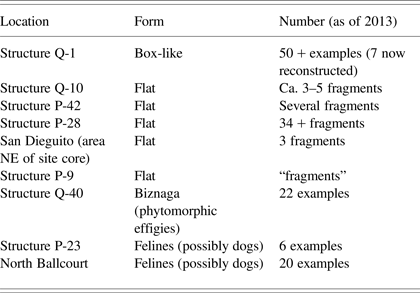
Each building adorned with almenas at Cihuatan appears to use examples of only one form. The limited evidence now suggests that the same may hold true for their use at Mexican sites, although Smith and Paz Bautista (Reference Smith and Bautista2015) found no correlation at Teotihuacan. They do suggest that distribution of specific forms may reveal sociopolitical relations (Smith and Paz Bautista Reference Smith and Bautista2015, also see Fargher et al. Reference Fargher, Blanton, Expinoza, Millhauser, Xiutecutli and Overholtzer2011). Smith and Paz Bautista identified six types of almenas from Teotihuacan. At least four types can be recognized at Cihuatan (Table 1), with the fourth including various flat forms from five other locations that have not yet been categorized.
An extremely interesting find of this preliminary study at Cihuatan is that box-like almenas expressing a number of minor variations (slightly different forms and window shapes) were incorporated as decoration on Structure Q-1. While they all are box-like and stepped, there are wide variations in the presence and shapes of moldings and especially in the shapes of the openings in the flat panels. We do not yet have studies detailing the degree of variation found in the almenas used on any single structure in the Valley of Mexico. The stepped example illustrated by Carrizosa and Aguirre (Reference Carrizosa Montfort, Molina and Moctezuma2003:Figure 1b, from Berrin and Pasztory Reference Berrin and Pasztory1993) has an opening in the form of a tall (higher than wide) rounded rectangle. This is one of the many shapes of openings seen at Cihuatan, but we do not know if any of the sets of Mexican examples varied to the same degree seen at Cihuatan.
Fargher et al. (Reference Fargher, Blanton, Expinoza, Millhauser, Xiutecutli and Overholtzer2011:175) indicate that “Tlaxcallan's urban landscape consisted of large open places surrounded by residential terraces.” This might be used to describe the organization of the site core at Cihuatan, signaling possible connections despite the temporal differences. The settlement pattern at Cihuatan appears to reflect later patterns at Tlaxcallan, which has been described as “a spatial pattern that departs dramatically from a more typical Mesoamerican pattern” (Fargher et al. Reference Fargher, Blanton, Expinoza, Millhauser, Xiutecutli and Overholtzer2011). The nature of the Cihuatan political system also may be inferred from this evidence (Fargher et al. Reference Fargher, Blanton and Expinoza2010).
Almenas of any type appear rare beyond the Valley of Mexico. The southern extent of their distribution remains unclear other than what seems to be an unusual appearance at Cihuatan. The data from Mexico provide sufficient evidence to allow us to make comparisons with design elements on the examples from Cihuatan. A distribution map of almena types for Mexico, combining the archaeological and documentary evidence, would be another step to be taken in this research. Neutron activation analysis (NAA) may allow comparisons with Mexican forms, such as that reported for I-133, from the Merchant's barrio at Teotihuacan (Sayre and Harbottle Reference Sayre and Harbottle1978:113, from Rattray Reference Rattray2001:345). The possibility that the stepped form of almena known from Cihuatan is most similar to those depicted and excavated from a specific part of central Mexico merits consideration. The fragments of almenas planas at Cihuatan also merit scrutiny.
A landscape or spatial pattern approach offers a broader view than the specific study of ceramic almenas employing modern analytical techniques, although ceramic analysis should provide complementary data sets. Clayton's (Reference Clayton2005) summary of more than 500 years of relationships between Teotihuacan and other regions, as seen in ceramic studies, lead her to suggest that ties with Peten were particularly durable. Despite being noted as common decorative features in the Valley of Mexico, until recently the presence of almenas attracted little attention.
The sample now known from Cihuatan has stimulated interest in further investigations at that site. Edgar Cabreras Palacios has begun to identify neighboring excavation units in which almena fragments are plentiful. The next phase of this study of at almenas at Cihuatan will involve an effort to assemble other examples from another location along the wall of Structure Q-1, but at a distance of ten or more meters from the area of the almenas reviewed in February of 2012. The goal would be to demonstrate that almenas appear in “identical” pairs and to determine what range of variation might be found in the types used on a single elite residence.
The possibility that Tikal Structure 5D-43, with its talud-tablero architecture (Green and Moholy-Nagy Reference Greene and Moholy-Nagy1966), was the residence of diplomatic emissaries from Teotihuacan suggests that the structures in Yucatan associated with almenas also should be studied for links with the Valley of Mexico, as should Structure Q-1 at Cihuatan. In the period during which this paper was under review excavations and restoration at Cihuatan Structure P-7 revealed that it utilized a talud-tablero construction form (Amaroli Reference Amaroli2015b). Thus the largest structure at the site appears to bear a strong architectural connection with the Valley of Mexico. This trait plus the abundant use of almenas at the site, and the presence of cremation burials in the area (Bruhns and Amaroli Reference Bruhns and Bertolucci2012:345) suggest strong links to an area quite distinct from the Maya region, to which the site has often been linked.
CONCLUSIONS
A very small portion of the many fragments of almenas that were recovered from a small part of the eight m long area fronting Cihuatan Structure Q-1, have been reassembled into seven relatively complete examples. The recovery of these fragments in groups facilitated the reassembly process, suggesting that there were few if any disturbances to this area after the destruction and abandonment of the large Structure Q-1. The near complete reconstruction of three examples of these almenas, plus large portions of many others, from only the sherds found within a short stretch of the narrow area suggests that these ornaments were mounted along the front edge of the roof of Structure Q-1 with only a short interval between them. This interval may have been less than 30 centimeters, rather than the 1.5 meters that had been estimated by Amaroli prior to the reconstruction effort.
The piles or groups of proximal sherds found in front of Structure Q-1 that could be assembled into relatively complete and “matching” examples of almenas also provide us with evidence suggesting that they were mounted in pairs. That is, two examples of nearly identical shape, both with windows of the same form, were mounted in close proximity. I believe that these pairs were mounted in two lines, front and back rather than side-by-side, along the edge of the flat roof. The abundance of the stepped, box-like form of roof ornaments on Structure Q-1 at Cihuatan suggests that the peoples identified as Pipil-Nicarao, who are believed to have entered this area from central Mexico, either brought this architectural tradition with them, or sustained close relationships with related groups from an area of origin that may have been the Valley of Mexico. Other forms of almenas, including flat types as well as jar-shaped but realistic “felines” (or dogs), suggest that each of the elite residences at Cihuatan was decorated with a specific form of decorative roof ornaments.
Evidence for decorative almenas has been found at nine separate locations, each associated with an individual building at Cihuatan, including Structure Q-40 (see Figure 2 and Table 1). In addition to further work to restore the almenas associated with Structure Q-1, the ceramic materials recovered from the frontal areas of each of the other structures should be subjected to the same intensive study that has provided so much information regarding roof ornaments associated with Structure Q-1.
RESUMEN
El descubrimiento de varios fragmentos de las almenas en el piso colindante al frente del margen occidental de una residencia selecta (Estructura Q-1) en Cihuatan, El Salvador, nos ha provisto de un contexto nuevo para esta categoría de artefactos. Un proyecto preliminar para reconstruir una porción de varios fragmentos de almenas en la forma de una caja escalonada en Cihuatan (Smith and Paz Bautista Reference Smith and Bautista2015:Tipo 2) produjeron siete ejemplos, casi completos, de esta forma indicando que fueron usadas en pares. Una docena más todavía necesitan ser restauradas. Estos ejemplos de almenas de Cihuatan proveen una demostración de la ornamentación en una residencia de élite en este sitio y también revela mucho sobre cómo la Estructura Q-1 y los edificios colindantes llegaron a su fin cerca del 1200 AC.
El hallazgo de estos fragmentos en pila o grupos dentro de cada excavación hizo fácil el proceso de reconstrucción, sugiriendo que fueron pocas o nulas las alteraciones en esta área después del abandono de la Estructura Q-1. La reconstrucción, casi completa, de estos tres ejemplos de Almenas y de grandes piezas de otras más, fragmentos que se encuentran dentro de un área bastante cercana, sugieren que estos ornamentos fueron montados a lo largo del borde del techo de la Estructura Q-1.
Evidencias del uso decorativo de las almenas ha sido descubierto en nueve lugares separados en Cihuatan, representando construcciones individuales las cuales incluyen esfinges fitomorfas asociadas a la Estructura Q-40 (Tabla 1.). otras formas de almenas en el sitio incluyen formas planas, así como felinos (o canes) en forma de vasija. Las evidencias sugieren que cada una de los complejos residencias de las élites en Cihuatan fueron decorados en sus techos con una forma específica de ornamentación.
Las almenas son bien conocidas en sitios del Valle de México, no obstante, en otras partes de Mesoamérica, han sido sólo documentadas sólo en una estructura de estilo teotihuacano en el sitio Maya de Tikal, en una estructura de Mayapan y posiblemente también en otras estructuras en sitios en Yucatan. Los ejemplos de Cihuatan son de una fecha muy posterior a los de Tikal.
Abundantes hallazgos de otras formas de techos ornamentados en Cihuatan sugieren que las personas identificadas con Pipil-Nicarao, quienes es posible que hayan ingresado a esta área desde el centro de México, trajeron esta tradición arquitectónica, o sostuvieron una relación cercana con grupos relacionados de un área de origen que bien pudo haber sido en el Valle de México. Comparaciones con los aztecas y formas tempranas de almenas sugieren la existencia de conexiones culturales. Estos hallazgos vehemente sugieren influencias del centro de México en el uso de techos ornamentados en Cihuatan. Los materiales de cerámica recuperados del área frontal de estas estructuras en Cihuatan, deberían ser sujetos del mismo estudio minucioso e intensivo que ha provisto de mucha información en los techos ornamentados asociados a la Estructura Q-1.
ACKNOWLEDGMENTS
Thanks are due to Dr. K. O. Bruhns for her invitation to conduct this study at Cihuatan. Sincere thanks are due to Rodrigo Brito Lara, President of FUNDAR (El Salvador) for his gracious hospitality and encouragement with this project. Special thanks are due to Paul E. Amaroli Bertolucci for information and advice offered during the term of the field project and after. He and his wife also provided generous hospitality during my brief stay in San Salvador. Special thanks are due to Michael E. Smith (Arizona State University) for his extremely generous sharing of information regarding examples of almenas from the Valley of Mexico, for encouragement in this research, and for his important criticism of the penultimate version of this text. Thanks also are due to Richard A. Diehl, Virginia Greene, and two anonymous reviewers for specific and extremely useful commentary on this text. The extensive editorial aid of Payson Sheets, Clemency Coggins, and Denise B. Tyler is deeply appreciated. Thanks also are due to Lic. Edgar Cabreras Palacios for his help in assembling the fragments of almenas at Cihuatan and to Don Pastór Gálvez and his team for their excellent skills and dedication in recovering these artifacts.
Special thanks are due to William R. Fowler for answering many questions about his findings at Cihuatan and for his generous sharing of data. Thanks also are due to Susan Toby Evans for locating important references. Jane H. Kelley, Philip Arnold, Sergio Gonzalez Valera, Linda Manzanilla Naim, Maria Josefa Iglesias Ponce de Leon, Timothy W. Pugh, Prudence Rice, and Rolf Sinclair also provided very important input to this study. The help of Drs. Diane Z. Chase, Arlen Chase, H. Stanley Loten, Hattula Moholy-Nagy, and the late Christopher Jones in sharing data relating to the single example of an almena known from Nohmul in Belize and one from Tikal in Guatemala is deeply appreciated. Permission to use Prof. Loten's drawing is gratefully acknowledged. Lynn A. Grant, Federico Paredes, Ernest Tyler, and the Interlibrary Loan staffs at West Chester University and Calgary University also provided assistance with this research, as did Christopher Mazzoli, Martha Carson-Gentry, Alexander Pezzoti, Kathryn Sampeck, Kate Sanger, and the late Yoko Hashimoto Sinclair. Expenses at the site during January and February of 2012 were entirely covered by FUNDAR. The ideas offered here, as well as any errors of interpretation or presentation, remain the responsibility of the author alone.
APPENDIX
Pending final cataloguing, the reconstructed examples of almenas were assigned letter identifiers (A through G) along with the data on the excavation unit from which the majority of fragments were recovered. The thicknesses of individual panels (slabs) as well as the fronts and backs vary considerably, even within the same element. Many, if not all, of the tops have vertical striations that characterize their construction and allow the broken pieces of these top features to be recognized with some ease. This feature may have facilitated the addition of a plaster coating.
A. CH11-202 (N36/W68): Intact base of an almena.
This example was found intact, except for its missing top (Figure 4). The paste is a very hard fired orange color. Orange paste ceramics at Cihuatán generally appear to have a softer firing result. The dimensions at the base are 140 by 353 mm. The windows are triangular, with that in the “rear” located slightly left of center and at 76 mm wide, is 17 mm wider than the front window although both are of nearly the same height. The top molding is the only one that goes around the entire piece, while the moldings surmounting the upper margins of the side steps extend only from the front to the back of the piece (compare example “F,” which derives from pieces also found in CH08-87. Possibly examples “A” and “F” represent a pair that was mounted together on the roofline).
B CH08-87 (Surface of intersection at N28/W68 and N24/W68). Top only, broken off as a single piece that was found intact when excavated (Figure 5b).
Very hard fired, dark gray-brown fabric. The cross section has a slight football-shape. Only parts of the tops of both square cut windows, about 55 millimeters wide, are evident and both appear centered relative to the axis of the top. The point has well-marked external striations. This should be compared with CH08-110-C, an intact top of similar shape and thickness that also has square cut windows. The top of the opening for the window of CH08-110-C, for which only 47 mm of the opening is present, is located 47 mm below the top margin of the “base” of this almena. If the square opening of CH08-110-C were centered, it may measure 67 mm wide, and thus could be a twin of the restored example CH08-87 (see example “F”).
C. CH08-126.
The clay fabric appears to have been fired at a medium temperature, resulting in a dull “thunk” when tapped rather than a clear ringing of higher fired examples. The paste has a medium grit temper and a reddish-tan to brown surface. Around the rear circular window of this example there is an orange-yellow “fire cloud” (see Bruhns and Amaroli Reference Amaroli2011:218), suggesting constrained passage of air. Of note is that the same feature can be seen on the face or front side of example “D,” as if they stood face to face at the firing location and the same conditions “colored” the adjacent and facing surfaces.
This almena was reconstructed primarily from sherds in lot “126” but sherds from several other adjacent lots (including CH-08-87) were part of this example. Since none of the sherds from these stored groups had been labeled, the specific combination cannot now be reconstructed (see example “D”). The round window in the 18 mm thick front panel of this almena is outlined by a 3 mm deep groove that appears to have been formed by a finger tip. The front panel also appears slightly concave, as if the almena had been dried while lying on the rear panel, allowing the front to sag slightly. The top, or point, is composed of four ceramic units molded together at its peak.
D. CH08-87.
This almena has not been drawn as it is a remarkably good duplicate of example “C” (see discussion, and Amaroli's findings of these objects in pairs). This “twin” of example “C” and the Unit in which a great number of its sherds were found was adjacent to CH08-126. Note the description of evidence for both being fired at the same time in the description of example “C.”
E. CH11-221. Reconstructed, but the upper portion of the top was not located during the preliminary study.
This orange paste example of an almena has fine to medium grit, fired at a low to medium temperature. The estimated height is 515 millimeters and the maximum length is 404 mm. Among the sherds recovered is a small, roughly rectangular and apparently unbroken slab with rounded corners measuring 79 by 88 mm. The size and general form of this “artifact” is particularly close to the size and shape of the window cut into the front surface of almena E. The “slab” appears to have been fired as a separate item, but it does not fit the windows of this almena. It may be of the size and shape of the hypothesized companion almena, but whether any of the windows or opening had some type of “door” or closing device is otherwise undocumented and unknown.
F. CH08-87 (compare with example “A”).
The rear portion of the top and portions of the base are the only parts of this example that were reconstructed. The front panel has been reconstructed only up to (below) the lower part of the window. The reverse or rear panel has been assembled from the rear of the top (point), which is largely present, down to the upper tip of the window aperture. Most of the rear surface below that point has yet to be located. The windows have been drawn as if both were in near alignment, although this may not have been the case. The top was formed from two elliptical lozenges, angled (or “leaned”) together at the tip of the point. Then both openings or “seams” at the sides were filled with clay and then smoothed before being “streaked” or scratched as so many of the tops appear to have been made.
G. CH08-110A. Reconstructed fragment (Figure 5f).
This piece was fired at a medium temperature. The paste is reddish-brown in color and has medium size grit temper. The reconstructed portion appears to be one-third of the lower part of a front panel, including nearly half of the lower portion of the window. The panel is about 17 to 18 millimeters thick at its base and up to about 35 millimeters from the bottom, then it decreases to 12 mm thick at the area of the window. The low point of the window is 157 mm from the base. It is 29 mm wide at its greatest opening, which is about 10 millimeters above its lowest margin. The “outside” or presumed external surface reveals construction aspects suggesting that the window began as a rectangle some 45 millimeters wide, but that the opening was then lined with strips of clay approximately 9 to 10 millimeters wide.