Implications
Feeding a high-concentrate supplement to nursing beef heifers for 50 days did not enhance their post-weaning body development, physiological responses, and puberty attainment. However, supplemented heifers had long-term increases in biochemical variables suggestive of metabolic imprinting, which is defined as biological responses to a nutritional intervention during early life that permanently alters physiological outcomes later in life. Perhaps a longer period of creep-feeding may be required to further increase supplement intake in nursing beef heifers, and effectively enhance body and reproductive development via metabolic imprinting effects.
Introduction
For optimal economic return and lifetime productivity, beef heifers should attain puberty by 12 months of age (Lesmeister et al., Reference Lesmeister, Burfening and Blackwell1973). Age at puberty in cattle is highly influenced by nutritional status and body development (Schillo et al., Reference Schillo, Hall and Hileman1992). Hence, nutritional interventions that improve nutrient utilization, body fat accretion, and increase circulating concentrations of hormones that facilitate the puberty process, such as IGF-I and leptin, are known to hasten puberty attainment in heifers (Williams et al., Reference Williams, Amstalden, Garcia, Stanko, Nizielski, Morrison and Keisler2002; Cooke et al., Reference Cooke, Arthington, Araujo, Lamb and Ealy2008). Metabolic imprinting, defined as biological responses to a nutritional intervention during early life that permanently alters physiological outcomes later in life (Du et al., Reference Du, Tong, Zhao, Underwood, Zhu, Ford and Nathanielsz2010), has been shown to enhance nutrient metabolism and fat accretion in cattle (Graugnard et al., Reference Graugnard, Berger, Faulkner and Loor2010; Moriel et al., Reference Moriel, Johnson, Vendramini, McCann, Gerrard, Mercadante, Hersom and Arthington2014a). Scheffler et al. (Reference Scheffler, McCann, Greiner, Jiang, Hanigan, Bridges, Lake and Gerrard2014) reported that feeding a high-concentrate diet to early-weaned beef steers from 100 to 205 days of age enhanced carcass marbling compared with forage-fed steers weaned at 205 days of age. Moriel et al. (Reference Moriel, Johnson, Vendramini, Mercadante, Hersom and Arthington2014b) reported earlier onset of puberty in heifers weaned at 72 days of age and fed a concentrate-based diet for 90 days compared with forage-fed cohorts weaned at 252 days of age. Thus, management to stimulate metabolic imprinting may accelerate puberty in heifers by enhancing nutrient utilization and lipogenesis, although this hypothesis needs further investigation. However, Scheffler et al. (Reference Scheffler, McCann, Greiner, Jiang, Hanigan, Bridges, Lake and Gerrard2014) and Moriel et al. (Reference Moriel, Johnson, Vendramini, Mercadante, Hersom and Arthington2014b) evaluated early-weaned beef cattle, and research assessing metabolic imprinting events in cattle normally weaned at 6 to 7 months of age is still warranted. One alternative to evaluate metabolic imprinting effects without the need for early weaning is to provide supplements to nursing cattle via creep-feeding. Therefore, the objective of this experiment was to compare growth, reproductive, and physiological responses of beef heifers with or without access to a creep-feeder while nursing their dams, as a manner to stimulate metabolic imprinting.
Materials and methods
Animals
This experiment was conducted at the Oregon State University – Eastern Oregon Agricultural Research Center from May 2013 to April 2014, and was divided into three phases: imprinting phase (day 1 to 51), pre-weaning phase (day 52 to 111), and development phase (day 112 to 326). All animals utilized in this experiment were cared for in accordance with acceptable practices and experimental protocols reviewed and approved by the Oregon State University, Institutional Animal Care and Use Committee (ACUP # 4446). Sixty nulliparous, nursing Angus×Hereford heifers (initial age=68±3 days; initial BW=140±3 kg) were assigned to the experiment. On day 0, heifers were ranked by BW and age, and dam age and body condition score (BCS; Wagner et al., Reference Wagner, Lusby, Oltjen, Rakestraw, Wettemann and Walters1988). Heifers were assigned to pairs in a manner that all ranking criteria were similar between heifers within each pair (CV⩽10%). Pairs were randomly assigned to: (1) ad libitum access to a corn-based supplement through a creep-feeder for 50 days (MI; n=15); or (2) no supplementation (CON; n=15). The supplementation period and length (day 1 to 51; imprinting phase) was selected to initiate metabolic imprinting events before the allometric period of mammary growth, when excessive average daily gain (ADG; i.e.>1.0 kg/day) may impair heifer mammary gland development and future milk yield (Buskirk et al., Reference Buskirk, Faulkner, Hurley, Kesler, Ireland, Nash, Castree and Vicini1996).
Diets
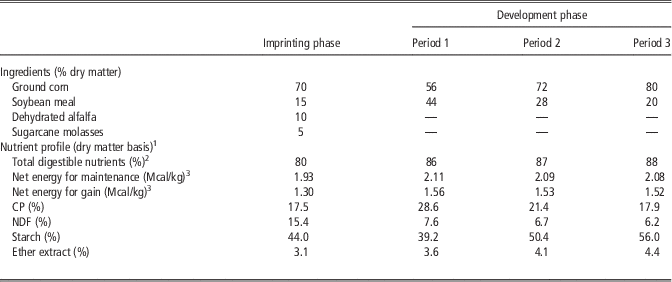
During the imprinting phase, MI heifer pairs and their respective dams were allocated to 15 drylot pens (two cows and heifers/pen; 7×20 m). Each drylot pen had a creep-feeder (2.0×2.5 m) that allowed both heifers to have simultaneous access to a pelletized corn-based supplement (Table 1), which was offered daily in amounts to ensure ad libitum consumption. Heifers were allocated by pairs with similar BW within each pen to ensure fair competition to creep-feeder access. Heifer pairs from the CON group and their respective dams were maintained in a single adjacent drylot pen (30×70 m) within the same feeding facility, with no access to the corn-based supplement. Cows from both treatments received (0800 h) and readily consumed 8.1 kg of dry matter/cow daily of meadow-grass hay and 5.4 kg of dry matter/cow daily of mixed alfalfa-grass hay during the imprinting phase. Hay consumption by heifer calves from both treatments was negligible given that heifer height was insufficient to reach feed bunks containing hay, whereas milk is still the major dietary component of calves at this age (Ansotegui et al., Reference Ansotegui, Havstad, Wallace and Hallford1991). Cattle from CON and MI treatments were exposed to the same stocking rate (70 m2/cow–calf pair), and cows from both treatment groups had the same linear bunk space (1.0 m/cow).
Composition and nutrient profile of supplements offered during the experimentFootnote 1

1 Imprinting phase=day 1 to 51; development phase, period 1=day 112 to 185; development phase, period 2=day 186 to 276; development phase, period 3=day 277 to 325. Values obtained from a commercial laboratory wet chemistry analysis (Dairy One Forage Laboratory, Ithaca, NY, USA).
2 Calculated according to the equations described by Weiss et al. (Reference Weiss, Conrad and St. Pierre1992).
3 Calculated with the following equations (NRC, 2000): Net energy for maintenance=1.37 metabolizable energy –0.138 (metabolizable energy)2+0.0105 (metabolizable energy)3–1.12; Net energy for gain=1.42 metabolizable energy –0.174 (metabolizable energy)2+0.0122 (metabolizable energy)3–0.165, given that metabolizable energy=digestible energy×0.82, and 1 kg of total digestible nutrients=4.4 Mcal of digestible energy.
During the pre-weaning phase, cows and heifers from both treatments were managed as a single group on a 6500 ha semiarid range pasture with no supplementation (Ganskopp and Bohnert, Reference Ganskopp and Bohnert2009). On day 111, heifers were weaned and treatment groups were maintained separately in one of two meadow foxtail (Alopecurus pratensis L.) pastures (6 ha/pasture) harvested for hay the previous summer, where they remained throughout the development phase. Treatment groups were rotated between pastures every 10 days to account for any potential effects of pasture on the variables evaluated herein. During the development phase, heifers received 5.0 kg/heifer of mixed alfalfa-grass hay daily (dry matter basis). Heifers also received a corn-based supplement at a daily rate of (dry matter basis) 1.6 kg/heifer from day 112 to 185, 2.5 kg/heifer from day 186 to 276 and 3.4 kg/heifer from day 277 to 325 (Table 1). Hay and supplement were offered to both treatment groups at 1000 h. During the development phase, pastures had no forage available for grazing, whereas both treatment groups always received and readily consumed the same daily amount of hay and corn-based supplement. Throughout the experiment, water and a commercial mineral and vitamin mix (Cattleman’s Choice; Performix Nutrition Systems, Nampa, ID, USA) containing 14% Ca, 10% P, 16% NaCl, 1.5% Mg, 6000 ppm Zn, 3200 ppm Cu, 65 ppm I, 900 ppm Mn, 140 ppm Se, 136 IU/g of vitamin A, 13 IU/g of vitamin D3, and 0.05 IU/g of vitamin E, were offered for ad libitum consumption for cows and heifers.
Sampling
Hay and supplement samples were collected at the beginning of the experiment, and analyzed for nutrient content by a commercial laboratory (Dairy One Forage Laboratory, Ithaca, NY, USA). Samples were analyzed in triplicates by wet chemistry procedures for ether-extractable fat content (Thiex et al., Reference Thiex, Anderson and Gildemeister2003), CP (method 984.13; AOAC, 2006), ADF (method 973.18 modified for use in an Ankom 200 fiber analyzer, Ankom Technology Corp., Fairport, NY; AOAC, 2006), NDF (Van Soest et al., Reference Van Soest, Robertson and Lewis1991; method for use in an Ankom 200 fiber analyzer, Ankom Technology Corp.) and starch (YSI 2700 SELECT Biochemistry Analyzer; YSI Inc., Yellow Springs, OH, USA). Calculations for total digestible nutrients (TDN) used the equations proposed by Weiss et al. (Reference Weiss, Conrad and St. Pierre1992), whereas net energy for lactation, net energy for maintenance, and net energy for gain were calculated with the equations proposed by the NRC (2000). Nutritive value (dry matter basis) of the meadow-grass and mixed alfalfa-grass hay, respectively, were 56% and 63% TDN, 65% and 34% NDF, 41% and 24% ADF, 1.04 and 1.50 Mcal/kg of net energy for lactation, 1.08 and 1.41 Mcal/kg of net energy for maintenance, 0.53 and 0.83 Mcal/kg of net energy for gain, and 8.2% and 20.0% CP. Composition and nutritive value of supplements offered during the experiment are described in Table 1.
During the imprinting phase, supplement intake was evaluated daily from each pen by collecting and weighing refusals at 0700 h. Samples of the offered and non-consumed supplement were collected from each pen and dried for 96 h at 50°C in forced-air ovens for dry matter calculation. Supplement intake of each pen was divided by the number of heifers within each pen, and expressed as kg per heifer/day. For ADG calculation, heifers were weighed on two consecutive days to determine BW before (days −1 and 0) and at the end of the imprinting phase (days 50 and 51). Individual shrunk BW (after 16 h of feed and water restriction) was recorded on days 112 and 326. Cow BW and BCS were also recorded on day 0 of the experiment. On days 0, 51, 111, 187, 261 and 325, heifers were evaluated for longissimus muscle (LM) depth and backfat thickness via real-time ultrasonography (0800 h). Ultrasound measurements were obtained at the 12th to 13th-rib interface by an experienced technician using an Aloka 500 V (Aloka Co. Ltd, Wallingford, CT, USA) B-mode instrument equipped with a 3.5-MHz, 125 mm general purpose transducer array (UST-5011U-3.5). Images were collected by a single technician with software from the Cattle Performance Enhancement Company (CPEC, Oakley, KS, USA). Estimates of LM depth and backfat thickness were based on image analysis programming (Brethour, Reference Brethour1994) contained within the CPEC software.
Concurrent with each ultrasound exam, blood samples were collected for determination of plasma glucose, insulin, IGF-1, and leptin concentrations. In addition, blood samples were collected on 10-day intervals during the development phase to estimate onset of puberty by determining the first pubertal increase in plasma progesterone concentrations. Heifers were considered pubertal once plasma progesterone concentrations were ⩾1.0 ng/ml, followed by a cyclic pattern of plasma progesterone<and ⩾1.0 ng/ml suggestive of normal estrous cycles (Day et al., Reference Day, Imakawa, Garcia-Winder, Zalesky, Schanbacher, Kittok and Kinder1984). Puberty attainment was declared at the first sampling that resulted in plasma progesterone ⩾1.0 ng/ml. On days 51, 111, 261 and 325, liver and subcutaneous fat samples were collected via biopsy immediately after each blood sampling. On day 51, one heifer within each pen was assigned randomly to liver biopsy, and the remaining heifer assigned to subcutaneous fat biopsy. On the subsequent sampling days (days 111, 261 and 325), heifer biopsy assignment was alternated in a manner that two liver and two subcutaneous fat samples were collected from all heifers assigned to the experiment. Liver samples (average 100 mg of tissue, wet weight) were collected between the 11th and 12th ribs by percutaneous needle biopsy (Arthington and Corah, Reference Arthington and Corah1995), and analyzed via real-time quantitative reverse transcription (RT)-PCR for IGF-I, pyruvate carboxylase (PC), and cyclophilin mRNA expression. Subcutaneous fat samples (average 2 g of tissue, wet weight) were collected from the tailhead according to the technique described by Rule and Beitz (Reference Rule and Beitz1986), and analyzed for adipocyte morphometry and mRNA expression of leptin, fatty acid synthase (FASN), peroxisome proliferator-activated receptor gamma (PPARγ) and glyceraldehyde-3-phosphate dehydrogenase (GAPDH) via real-time quantitative RT-PCR. Liver and subcutaneous fat samples were selected for biopsy and further laboratorial analysis because hepatocytes and adipocytes are the main cells responsible for IGF-I and leptin synthesis, respectively (Houseknecht et al., Reference Houseknecht, Baile, Matteri and Spurlock1998; Yakar et al., Reference Yakar, Liu, Stannard, Butler, Accili, Sauer and LeRoith1999), which are hormones that modulate puberty attainment in heifers (Williams et al., Reference Williams, Amstalden, Garcia, Stanko, Nizielski, Morrison and Keisler2002; Cooke et al., Reference Cooke, Arthington, Araujo, Lamb and Ealy2008) and are directly associated with the main hypothesis of this experiment.
Laboratory analysis
Blood samples
Blood samples were collected via jugular venipuncture into commercial blood collection tubes (Vacutainer, 10 ml; Becton Dickinson, Franklin Lakes, NJ, USA) containing 158 US Pharmacopeial Convention units of freeze-dried sodium heparin for plasma collection. All blood samples were placed immediately on ice, subsequently centrifuged (2500×g for 30 min; 4°C) for plasma harvest, and stored at −80°C on the same day of collection. Plasma glucose concentration was determined using a quantitative colorimetric kit (#G7521; Pointe Scientific Inc., Canton, MI, USA). Plasma IGF-I concentration was determined using a human-specific commercial ELISA kit (SG100; R&D Systems Inc., Minneapolis, MN, USA) with 100% cross-reactivity with bovine IGF-I and previously validated for bovine samples (Cooke et al., Reference Cooke, Cappellozza, Reis, Bohnert and Vasconcelos2012). Plasma leptin concentration was determined by radioimmunoassay according to procedures described by Delavaud et al. (Reference Delavaud, Bocquier, Chilliard, Keisler, Gertler and Kann2000). Plasma insulin and progesterone concentrations were analyzed using a chemiluminescent enzyme immunoassay (Immulite 1000; Siemens Medical Solutions Diagnostics, Los Angeles, CA, USA) with 100% cross-reactivity with the respective bovine hormone. Nevertheless, the insulin procedure was validated for bovine samples using pools of plasma collected from yearling beef heifers immediately before (0 h), 0.5, and 2 h following an intravenous glucose administration (0.25 g of glucose/kg of BW) and analyzed in triplicates. Mean insulin concentrations were 3.73±0.04, 56.80±0.51 and 3.11±0.02 µIU/ml for pools collected at 0, 0.5 and 2 h relative to glucose administration. The progesterone procedure was also validated for bovine samples using charcoal-stripped bovine serum (Sigma-Aldrich Corp., St. Louis, MO, USA) enriched with known concentrations of progesterone (0.0, 0.5, 1.0, 2.5, 5.0 and 10.0 ng/ml) and analyzed in triplicates. The mean r 2 value between the expected and observed results among samples with known progesterone concentrations was 0.971±0.004, and mean progesterone concentrations were (ng/ml) 0.06±0.01, 0.58±0.02, 1.13±0.08, 2.6±0.04, 5.77±0.09 and 11.13±0.25 for, respectively, plasma enriched with 0.0, 0.5, 1.0, 2.5, 5.0 and 10.0 ng/ml of progesterone. The intra- and inter-assay CV were, respectively, 4.64% and 6.18% for glucose, 1.20% and 4.70% for insulin, 4.09% and 10.94% for IGF-I, and 6.03% and 6.15% for progesterone. All samples were analyzed for leptin concentration within a single assay, and the intra-assay CV was 7.11%. The minimum detectable concentrations were 0.02 µIU/ml for insulin, and 0.056, 0.10 and 0.10 ng/ml for IGF-I, leptin, and progesterone, respectively.
Tissue samples
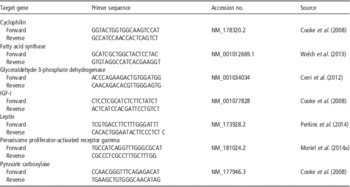
Immediately after collection, all liver samples and ~1 g of each fat sample were placed in RNA stabilization solution (RNAlater, Ambion Inc., Austin, TX, USA), maintained at 4°C for 24 h, and stored at −80°C until processing for real-time quantitative RT-PCR (Table 2) with the StepOne Real-time PCR system (Applied Biosystems, Foster City, CA, USA) according to procedures described by Cooke et al. (Reference Cooke, Arthington, Araujo, Lamb and Ealy2008).
Primer sequences, accession number, and reference for all gene transcripts analyzed by real-time reverse trancriptase-PCR

The remaining 1 g of each fat sample was placed on ice immediately after collection, and stored at −80°C until processing for adipocyte morphometry evaluation. Adipose samples were embedded in NEG50 cutting media (Richard-Allan Scientific, Kalamazoo, MI, USA) and cryosections (10 µm) were collected onto Superfrost Plus glass slides (Thermo Fisher Scientific, Waltham, MA, USA). Slides were stained sequentially with eosin Y (Richard-Allan Scientific) and 4,4-difluoro-4-bora-3a,4a-diaza-s-indacene (BODIPY, Life Technologies, Grand Island, NY, USA) for the detection of extracellular structures and lipid, respectively. Images were captured at 200-fold magnification with a Nikon Eclipse Ti-E inverted microscope (Nikon, Melville, NY, USA) equipped with epifluorescence using a CoolSnap CCD camera (Photometrics, Tucson, AZ, USA). Adipocyte size was measured with NIS Elements (Nikon). Four cryosections from each sample were used for all analysis, and number of adipocytes evaluated per cryosection averaged 25.9±2.1 and 27.4±2.3 for CON and MI, respectively
Statistical analysis
Treatments evaluated herein were based on consumption of the corn-based supplement during the imprinting phase. Although the CON treatment was imposed to heifers individually (all CON heifers consumed 0 kg/day of corn-based supplement during the imprinting phase), heifer pair was considered the experimental unit for CON and MI to ensure equal experimental unit structure as well as random variation and repeated measure calculation between treatments. Growth, body composition, and physiological data were analyzed using the MIXED procedure of SAS (SAS Institute Inc., Cary, NC, USA) and Satterthwaite approximation to determine the denominator degrees of freedom for the tests of fixed effects. The model statement used for cow BW, BCS, days in milk, age on day 0 of the experiment, and heifer ADG within each phase contained the fixed effect of treatment. The model statement used for analysis of blood variables, gene expression, subcutaneous adipocyte morphometry, BW and body composition contained the fixed effects of treatment, sampling day and the resultant interaction. Data were analyzed using pair(treatment) and heifer(pair) as random variables. The specified term used in the repeated statement was sampling day, the subject was heifer(pair), and the covariance structure used was autoregressive, which provided the best fit for these analyses according to the Akaike information criterion. Puberty data were analyzed using the GLIMMIX procedure of SAS (SAS Institute Inc.). The model statement used contained the effects of treatment, sampling day and the resultant interaction. Data were also analyzed using pair(treatment) and heifer(pair) as random variables. Results are reported as least square means and separated using LSD. For all analyses, significance was set at P⩽0.05, and tendencies were determined if P>0.05 and P⩽0.10. Results are reported according to main effects if no interactions were significant, or according to highest-order interaction detected.
Results and discussion
Heifer growth and body composition
Cow milk yield was not evaluated in the present experiment to estimate milk consumption and its contribution to heifer daily nutrient intake during the imprinting phase. Nevertheless, cows nursing CON and MI heifers were Angus×Hereford receiving the same limited-fed diet, and had similar (P ⩾0.72) age (4.6 and 4.9 years, respectively; s.e.m.=0.6), days in milk (67.9 and 69.0 days, respectively; s.e.m.=6.4), BW (499 and 505 kg, respectively; s.e.m.=13), and BCS (4.94 and 4.95, respectively; s.e.m.=0.05) at the beginning of the experiment to mitigate potential differences in heifer milk intake, given these variables are known to impact milk production in cattle (NRC, 2000).
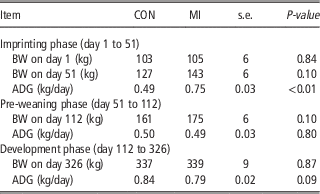
During the imprinting phase, average daily intake of corn-based supplement by MI heifers was 1025±128 g/heifer, which corresponded to 0.83±0.09% of heifer BW based on the average BW during the imprinting phase (Table 3). The MI heifers had greater (P<0.01) ADG during the imprinting phase, which resulted in a tendency (P=0.10) for a greater BW on day 51 compared with CON cohorts (Table 3). During the pre-weaning phase, ADG was similar (P=0.80) between treatments, whereas BW on day 112 still tended (P=0.10) to be greater for MI compared with CON heifers (Table 3). During the development phase, CON tended (P=0.09) to have greater ADG compared with MI heifers, resulting in similar (P=0.87) BW among treatments on day 326 (Table 3) even though both treatment groups received the same limit-fed diet. Given that MI heifers were heavier and had greater nutritional requirements (NRC, 2000) compared with CON heifers at the beginning of the development phase (day 112; Table 3), CON heifers likely had more dietary nutrients available for growth, resulting in differences detected for ADG between treatments during this phase. Moriel et al. (Reference Moriel, Johnson, Vendramini, Mercadante, Hersom and Arthington2014b) observed similar results when comparing early-weaned heifers receiving or not a high-concentrate diet for 180 days after weaning, and subsequently maintained on pasture for 7 months. The reason why a similar outcome was not detected on pre-weaning ADG herein (Table 3) is unclear. Perhaps MI heifers were capable of consuming more forage when maintained under range conditions, due to their greater BW during this phase (Table 3), compared with CON cohorts (Ansotegui et al., Reference Ansotegui, Havstad, Wallace and Hallford1991; NRC, 2000).
BW and average daily gain (ADG) of nursing beef heifers receiving (MI; n=15) or not (CON, n=15) a corn-based supplement for ad libitum consumption through a creep-feeder for 50 daysFootnote 1 , Footnote 2

1 Heifers received or not a corn-based supplement from day 1 to 51 (imprinting phase) of the experiment via creep-feeding while nursing their dams. From day 52 to 111 (pre-weaning phase), cows and heifers from both treatments were managed as a single group on a semiarid range pasture. On day 111, heifers were weaned and allocated to two pastures according to treatment until day 325 of the experiment (development phase).
2 Values reported on days 1 and 51 are the average full BW collected on days −1 and 0, and 50 and 51, respectively. On days 112 and 326, shrunk BW was recorded after a 16 h of feed and water restriction.
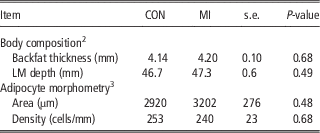
Despite treatment effects detected for ADG and BW at the end of the imprinting phase, MI and CON heifers had similar mean backfat thickness (P=0.68) and LM depth (P=0.49; Table 4). Accordingly, no treatment effects were detected for mean subcutaneous adipocyte cell area (P=0.48) or density (P=0.68; Table 4), given that backfat thickness is determined by subcutaneous adipocyte morphometry (Schoonmaker et al., Reference Schoonmaker, Fluharty and Loerch2004). Supporting our findings, Scheffler et al. (Reference Scheffler, McCann, Greiner, Jiang, Hanigan, Bridges, Lake and Gerrard2014) reported increased marbling, but similar backfat thickness and LM area, upon slaughter in early-weaned steers fed a high-concentrate diet from 100 to 205 days of age compared with forage-fed steers weaned at 205 days of age. Moriel et al. (Reference Moriel, Johnson, Vendramini, Mercadante, Hersom and Arthington2014b) also failed to demonstrate metabolic imprinting responses on backfat thickness and LM area, estimated via real-time ultrasonography, in replacement beef heifers. Collectively, results from this experiment indicate that providing ad libitum creep-feeder access to nursing heifers, as a manner to promote metabolic imprinting, did not impact post-weaning growth and body composition variables, including LM development and subcutaneous fat deposition via hyperplasia (adipocyte density) or hypertrophy (adipocyte area).
Mean body composition and subcutaneous adipocyte morphometry of nursing beef heifers receiving (MI; n=15) or not (CON, n=15) a corn-based supplement for ad libitum consumption through a creep-feeder for 50 daysFootnote 1

1 Heifers received or not a corn-based supplement from day 1 to 51 (imprinting phase) of the experiment via creep-feeding while nursing their dams. From day 52 to 111 (pre-weaning phase), cows and heifers from both treatments were managed as a single group on a semiarid range pasture. On day 111, heifers were weaned and allocated to two pastures according to treatment until day 325 of the experiment (development phase).
2 Evaluated via real-time ultrasonography on days 0, 51, 111, 187, 261, and 325 as described by Cooke et al. (Reference Cooke, Cappellozza, Reis, Bohnert and Vasconcelos2012).
3 Subcutaneous fat samples were collected (Rule and Beitz, Reference Rule and Beitz1986) on days 51, 111, 261, and 325 of the experiment.
Physiological variables
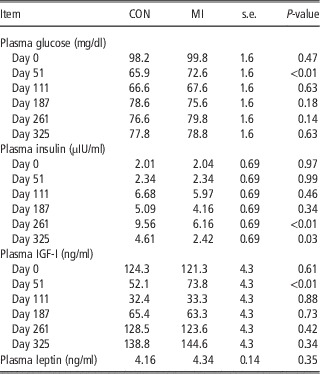
Treatment×day interactions were detected for plasma glucose (P=0.02), insulin (P=0.05), and IGF-I (P<0.01). Heifers assigned to MI had greater (P<0.01) plasma concentrations of glucose and IGF-I on day 51 compared with CON heifers (Table 5). This outcome can be attributed to supplement intake of MI heifers during imprinting phase, given that plasma concentrations of glucose and IGF-I are positively associated with nutrient intake and reflect nutritional status in beef cattle (Vizcarra et al., Reference Vizcarra, Wettemann, Spitzer and Morrison1998; Hess et al., Reference Hess, Lake, Scholljegerdes, Weston, Nayigihugu, Molle and Moss2005). Conversely, plasma insulin concentration was similar (P=0.99) among treatments on day 51, but greater for CON heifers on days 261 and 325 (P⩽0.03) compared with MI heifers (Table 5). The lack of treatment effects on plasma insulin on day 51 was unexpected because circulating insulin is also positively regulated by nutrient intake and glucose concentrations (Vizcarra et al., Reference Vizcarra, Wettemann, Spitzer and Morrison1998). On the other hand, the greater plasma insulin concentration in CON heifers on days 261 and 325 support treatment trends (P=0.09) detected on ADG during the development phase (Table 3), corroborating that CON heifers had more dietary nutrients available for growth during this period (Yelich et al., Reference Yelich, Wettemann, Dolezal, Lusby, Bishop and Spicer1995; Hess et al., Reference Hess, Lake, Scholljegerdes, Weston, Nayigihugu, Molle and Moss2005). No treatment effects were detected (P=0.35) on plasma leptin concentrations (Table 5), although circulating leptin concentration is regulated by nutrient intake and insulin (Houseknecht et al., Reference Houseknecht, Baile, Matteri and Spurlock1998). However, adipose tissues are the main site of leptin synthesis in ruminants, whereas body fat content directly regulates circulating leptin concentrations (Houseknecht et al., Reference Houseknecht, Baile, Matteri and Spurlock1998). Hence, the lack of treatment effects on backfat thickness and subcutaneous adipocyte morphometry (Table 4) supports, at least in part, the similar leptin concentrations between MI and CON heifers throughout the experiment (Table 5).
Plasma concentrations of glucose, insulin, IGF-I, and leptin of nursing beef heifers receiving (MI; n=15) or not (CON; n=15) a corn-based supplement for ad libitum consumption through a creep-feeder for 50 daysFootnote 1 , Footnote 2

1 Heifers received or not a corn-based supplement from day 1 to 51 (imprinting phase) of the experiment via creep-feeding while nursing their dams. From day 52 to 111 (pre-weaning phase), cows and heifers from both treatments were managed as a single group on a semiarid range pasture. On day 111, heifers were weaned and allocated to two pastures according to treatment until day 325 of the experiment (development phase).
2 Blood samples were collected on days 0, 51, 111, 187, 261, and 325 of the experiment. Treatment×day interactions were detected for plasma glucose (P=0.02), insulin (P=0.05), and IGF-I (P<0.01); therefore, means are reported and separated within each sampling day.
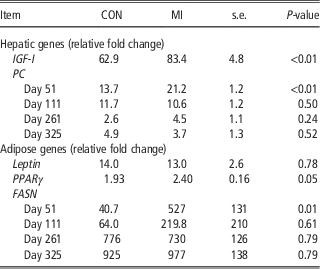
No treatment effects were detected (P=0.78) for mRNA expression of subcutaneous adipocyte leptin (Table 6), which parallels the lack of treatment effect for plasma leptin concentrations (Table 5). Treatment×day interactions were detected for mRNA expression of hepatic PC (P<0.01) and subcutaneous adipocyte FASN (P=0.08). Heifers assigned to MI had greater (P<0.01) mRNA expression of PC on day 51 compared with CON heifers (Table 6), which corroborates with treatment effects on growth and plasma glucose on day 51 because PC mRNA expression is positively associated with nutrient intake (Cooke et al., Reference Cooke, Arthington, Araujo, Lamb and Ealy2008) and glucose synthesis in cattle (Greenfield et al., Reference Greenfield, Cecava and Donkin2000). Heifers assigned to MI had greater (P=0.01) mRNA expression of FASN on day 51 compared with CON heifers (Table 6); an enzyme that modulates de novo lipogenesis and is up-regulated by rate of nutrient intake (Duckett et al., Reference Duckett, Pratt and Pavan2009). Moreover, MI heifers had greater mean mRNA expression of subcutaneous adipocyte PPARγ (P=0.05), which regulates adipocyte development via triglyceride uptake (Rosen and MacDougald, Reference Rosen and MacDougald2006), and hepatic IGF-I (P<0.01) compared with CON heifers (Table 6). Hence, MI heifers had increased adipocyte mRNA expression of FASN on day 51 and a long-term increase in mRNA expression of PPARγ during the experimental period, despite the lack of treatment effects on backfat thickness and subcutaneous adipocyte size and density (Table 4). Similarly, MI heifers had a long-term increase in mRNA expression of hepatic IGF-I, whereas plasma IGF-I concentrations only differed between treatments on day 51 (Table 5). Nevertheless, mRNA expression can be increased without equivalent translation into the final product (Clancy and Brown, Reference Clancy and Brown2008). Moriel et al. (Reference Moriel, Johnson, Vendramini, McCann, Gerrard, Mercadante, Hersom and Arthington2014a and 2014Reference Moriel, Johnson, Vendramini, Mercadante, Hersom and Arthingtonb) reported that high-concentrate diets increased hepatic mRNA expression of hepatic IGF-I or muscle PPARγ without concurrent changes in plasma IGF-I concentration, carcass marbling, or backfat thickness in early-weaned cattle. Graugnard et al. (Reference Graugnard, Berger, Faulkner and Loor2010) also reported altered PPARγ and FASN mRNA expression in the longissimus lumborum, but similar carcass marbling score, in beef steers receiving high- or low-starch diets for 112 days after weaning at 5 months of age. Therefore, MI heifers had transient and permanent increases in mRNA expression of genes associated with nutrient metabolism and lipogenesis compared with CON heifers, suggesting metabolic imprinting effects due to creep-feeding. However these outcomes were not translated into enhanced growth or subcutaneous fat accretion during the experiment. It is also important to note that subcutaneous fat samples were only collected from the tailhead, whereas different treatment outcomes could have been detected if samples were collected from other adipose tissues (Bonnet et al., Reference Bonnet, Cassar-Malek, Chilliard and Picard2010)
Expression of hepatic and adipose genes associated with nutrient metabolism (IGF-I, pyruvate carboxylase [PC], and leptin) and lipogenesis (peroxisome proliferator-activated receptor gamma [PPARγ] and fatty acid synthase [FASN]) in nursing beef heifers receiving (MI; n=15) or not (CON, n=15) a corn-based supplement for ad libitum consumption through a creep-feeder for 50 daysFootnote 1 , Footnote 2 , Footnote 3

1 Heifers received or not a corn-based supplement from day 1 to 51 (imprinting phase) of the experiment via creep-feeding while nursing their dams. From day 52 to 111 (pre-weaning phase), cows and heifers from both treatments were managed as a single group on a semiarid range pasture. On day 111, heifers were weaned and allocated to two pastures according to treatment until day 325 of the experiment (development phase).
2 Liver (according to Arthington and Corah, Reference Arthington and Corah1995) and adipose (according to Rule and Beitz, Reference Rule and Beitz1986) samples were collected on days 51, 111, 261, and 325 of the experiment.
3 Values are expressed as relative fold change (Cooke et al., Reference Cooke, Arthington, Araujo, Lamb and Ealy2008). Treatment×day interactions were detected for mRNA expression of PC (P<0.01) and FASN (P=0.08); therefore, means are reported and separated within each sampling day.
Puberty attainment
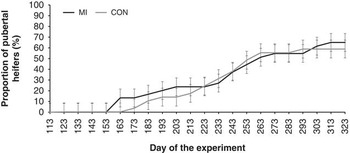
No treatment effects were detected (P=0.76) on rate of heifer puberty attainment (Figure 1). Hence, proportion of heifers pubertal at the end of the experiment were similar (P=0.60) between CON and MI (58.9% v. 65.0% of pubertal heifers on day 323; respectively; s.e.m.=8.3%). The main hypothesis of the experiment was that providing a high-concentrate supplement to nursing heifers via creep-feeding would promote metabolic imprinting events that hasten puberty attainment compared with non-supplemented heifers. This hypothesis was developed based on two premises: (1) puberty in cattle is highly influenced by nutritional status and body development (Schillo et al., Reference Schillo, Hall and Hileman1992), including growth rate, body fat accretion, and circulating concentrations of hormones associated with nutrient metabolism and lipogenesis such as IGF-I and leptin (Williams et al., Reference Williams, Amstalden, Garcia, Stanko, Nizielski, Morrison and Keisler2002; Cooke et al., Reference Cooke, Arthington, Araujo, Lamb and Ealy2008), and (2) management systems that stimulate metabolic imprinting enhance nutrient metabolism and body fat accretion in cattle (Graugnard et al., Reference Graugnard, Berger, Faulkner and Loor2010; Scheffler et al., Reference Scheffler, McCann, Greiner, Jiang, Hanigan, Bridges, Lake and Gerrard2014; Moriel et al., Reference Moriel, Johnson, Vendramini, McCann, Gerrard, Mercadante, Hersom and Arthington2014a). Supporting our rationale, Moriel et al. (Reference Moriel, Johnson, Vendramini, Mercadante, Hersom and Arthington2014b) reported reduced age and BW at puberty in heifers weaned at 72 days of age and fed a high-concentrate diet for 90 days compared with forage-fed cohorts weaned at 252 days of age. Gasser et al. (Reference Gasser, Behlke, Grum and Day2006) observed that beef heifers weaned at 112 days of age and fed a corn-based diet for 10 week reached puberty sooner than forage-fed contemporaries. However, the similar rate of puberty attainment between MI and CON heifers in the present experiment do not support our hypothesis, but parallels the similar subcutaneous fat accretion and plasma concentrations of IGF-I and leptin between treatments during the peripubertal period (Schillo et al., Reference Schillo, Hall and Hileman1992; Williams et al., Reference Williams, Amstalden, Garcia, Stanko, Nizielski, Morrison and Keisler2002; Cooke et al., Reference Cooke, Arthington, Araujo, Lamb and Ealy2008).
Puberty attainment of nursing beef heifers receiving (MI; n=15) or not (CON, n=15) a corn-based supplement from day 1 to 51 of the experiment via creep-feeding while nursing their dams. From day 52 to 111, cows and heifers from both treatments were managed as a single group on a semiarid range pasture. On day 111, heifers were weaned and allocated to two pastures according to treatment until day 325. Puberty was estimated based from blood samples collected every 10 days from day 113 to 323. Heifers were considered pubertal once plasma progesterone concentrations were ⩾1.0 ng/ml, followed by a cyclic pattern of plasma progesterone < and ⩾1.0 ng/ml indicative of normal estrous cycles. Puberty attainment was declared at the first sampling that resulted in plasma progesterone ⩾1.0 ng/ml. No treatment effects were detected (P=0.76).

Overall conclusions
This experiment found no evidence that providing a high-concentrate supplement to nursing heifers via creep-feeding benefits post-weaning growth, subcutaneous fat accretion, plasma hormones that regulate puberty attainment such as IGF-I and leptin, as well as heifer age and BW at puberty. Perhaps the length and rate of supplementation utilized herein were insufficient to impact the aforementioned variables, despite the long-term increase in hepatic IGF-I and adipose PPARγ mRNA expression that suggests a metabolic imprinting effect (Du et al., Reference Du, Tong, Zhao, Underwood, Zhu, Ford and Nathanielsz2010). Heifers utilized by Gasser et al. (Reference Gasser, Behlke, Grum and Day2006) and Moriel et al. (2014b) consumed a corn-based diet for, respectively, 10 week at 2.5% to 3.0% of heifer BW or 90 days at 3.5% of heifer BW. In the present experiment, MI heifers consumed a free-choice corn-based supplement for 50 days at 0.83% of heifer BW. This supplementation length was selected to prevent detrimental effects on heifer mammary gland development (Buskirk et al., Reference Buskirk, Faulkner, Hurley, Kesler, Ireland, Nash, Castree and Vicini1996), and voluntary supplement intake was limited because milk was still the major component of heifer diets (Ansotegui et al., Reference Ansotegui, Havstad, Wallace and Hallford1991). Therefore, a longer period of creep-feeding for nursing beef heifers may be required to further increase their concentrate intake, and effectively enhance body and reproductive development via metabolic imprinting effects.
Acknowledgments
The Eastern Oregon Agricultural Research Center, including the Burns and Union Stations, is jointly funded by the Oregon Agricultural Experiment Station and USDA-ARS. Financial support for this research was provided by the Agricultural Research Foundation. Appreciation is expressed to F. Cooke, A. Nyman, T. Runnels, L. Carlon, J. Ranches, C. Ramos, I. Bueno, and W. Freitas (Oregon State University) for their assistance.