





According to ICD-11, anorexia nervosa is characterised by significantly low body weight for the individual’s height, age and developmental stage that is not attributable to another health condition or to the unavailability of food. Although predominantly associated with adolescents and young adults, anorexia nervosa is increasingly recognised in older adults. Epidemiological data show that 2.1–7.7% of older women and fewer than 1% of older men, defined here as adults aged 40–80 years, meet DSM-IV or DSM-5 diagnostic criteria for eating disorders, with anorexia nervosa being the most prevalent subtype in these populations. Reference Mangweth-Matzek, Kummer and Hoek1 Recent systematic reviews indicate that 84.6% of eating disorder cases in adults ≥65 years involve anorexia nervosa, with 56.4% representing late-onset disease after age 40. Reference Mulchandani, Shetty, Conrad, Muir and Mah2
The diagnosis of anorexia nervosa in older adults is often delayed or missed because of its atypical presentation. Age-related medical comorbidities, cognitive changes and overlapping psychiatric symptoms, such as depression or dementia, may obscure the clinical picture. Reference Shirley, Lord, Cheung and Graham3 Moreover, societal misconceptions that eating disorders are conditions of younger people, together with the assumption that their signs and symptoms are part of normal ageing, contribute to underdiagnosis in this age group. Reference Shirley, Lord, Cheung and Graham3 However, presentations must be interpreted with caution, as clinical features can easily be confounded if general food refusal stems from physical discomfort, age-related somatic decline or underlying digestive concerns rather than the core psychological body image distress and intense fear of weight gain required for a diagnosis of anorexia nervosa.
The COVID-19 pandemic further compounded these challenges, with systematic reviews showing that lockdowns were associated with worsening eating disorder symptoms across age groups, with 83.1% of patients reporting increased restrictive eating behaviours and greater psychological distress. Reference Sideli, Lo Coco, Bonfanti, Borsarini, Fortunato and Sechi4
This case report describes a 72-year-old woman with a chronic, relapsing course of anorexia nervosa complicated by significant behavioural disturbance, a complex medical history and profound lack of insight. Her presentation provides valuable insights into the multifaceted challenges of diagnosing and managing anorexia nervosa in older adults, where presentations may overlap with depression, cognitive impairment and other age-related conditions.
Clinical case illustration
A 72-year-old Caucasian woman was admitted on 20 January 2025 under Section 2 of the Mental Health Act (MHA) of England and Wales to an old age psychiatric in-patient unit because of escalating behavioural disturbances, including irritability, verbal aggression and disinhibition, culminating in an assault attempt on her husband.
The patient exhibited chronic restriction of oral intake, persistent beliefs that she was ‘fat’ despite being significantly underweight (body mass index (BMI) 16.4 kg/m2), and compulsive prolonged daily walks. Notably, she displayed inappropriate urinary and faecal elimination in public and became verbally aggressive when family members attempted to prevent her from walking or obtaining laxatives. She also reported feeling ‘constantly hot’, leading her to disable the heating at home and remain underdressed in the winter. She denied current suicidal ideation, hallucinations and substance use, although she had a historical record of suicidal ideation.
Her psychiatric history included depression and anorexia nervosa, which became apparent around March 2020 with the onset of the COVID-19 lockdown. She stated, ‘When lockdown started, I felt trapped and caged up and decided to stop eating in order to end my life. I felt not eating gave me control over something even if it was my own death.’ However, although marked restrictive eating began during the COVID-19 lockdown, collateral history and longstanding obsessive traits suggested that her disordered eating behaviours may have been present in a more subtle form for many years beforehand.
Previous admissions included an admission from October 2020 to January 2021 for depression and a paracetamol overdose (BMI 14.9 kg/m2), during which she was treated with refeeding, mirtazapine and olanzapine. A relapse occurred between April and December 2021 and was managed in a specialist eating disorders unit.
Her medical history included an enlarged bile duct (2021), osteoporosis (2021) and an undisplaced left pubic rami and sacral fracture (2023). Investigation for dementia revealed small-vessel ischaemic disease on computed tomography (October 2023), but fluorodeoxyglucose positron emission tomography (FDG-PET) (May 2024) showed no evidence of dementia or established cerebral infarction. Collateral history from family members did not suggest any decrease in functioning or change in behaviour over the preceding 5 years, although they reported episodes of inappropriate faecal soiling during previous relapses. On admission, her medications included mirtazapine 30 mg at night, venlafaxine extended release (XL) 150 mg each morning (with which she was non-adherent), multivitamins and colecalciferol. Previous psychotropics had provided partial mood stabilisation but had a limited impact on her persistent anorectic cognitions.
She grew up as the second of seven children and experienced childhood neglect and bullying following her mother’s death at age 9, together with frequent relocations due to her father’s army career. There was no family history of mental illness, including anorexia nervosa, obsessive-compulsive disorder (OCD) or autism spectrum disorder (ASD). She left school at the age of 15 and subsequently worked in physically demanding occupations. Her 49-year marriage provided a strong source of support. Her daughter described her as previously ‘obsessive’ about cleaning, possibly linked to childhood neglect and suggesting a deep-seated need for control. Although overt anorexic behaviours became most apparent during the COVID-19 lockdown, her daughter reported that ‘She always loved her food’ and ‘we don’t know where she puts it’, suggesting that subtle disordered eating behaviours may have been present for many years. She further commented, ‘The last 8 years, she has been thin, and only since maybe mid-2020, during the COVID-19 lockdown, she has had a big problem with eating.’ Before this admission, she had relapsed and become largely isolated because of her unpredictable behaviour. Police involvement was required in late 2024 following episodes of physical aggression towards family members when they tried to limit her incessant walking.
On admission, she appeared frail, dishevelled and cachectic. However, she described her mood as ‘brilliant’ and spoke loudly. Her thoughts revealed a fixed body image distortion, stating ‘because I’m fat’ as her reason for incessant walking and food avoidance. She reported drinking 15–20 glasses of water or squash each day because she felt thirsty. Family members, however, reported that she was drinking large volumes of lukewarm fluids to suppress her appetite. She was fully oriented but did not acknowledge having a significantly low body weight. Although she accepted episodes where she passed urine and faeces in public when confronted during the act (even saying ‘I like the feeling’ on one occasion), she subsequently denied these behaviours or was unable to explain the reasons for them when questioned later.
Investigations showed a BMI of 16.4 kg/m2 and a body weight of 38.1 kg. Her sodium level was 127 mmol/L, indicative of dilutional hyponatraemia. Electrocardiography showed normal sinus rhythm. Thyroid function tests and blood glucose levels were within normal limits, excluding hyperthyroidism and diabetes mellitus as alternative explanations for her low body weight, warmth, overactivity and polydipsia. Urine osmolality was low but normalised after fluid intake was restricted, consistent with primary (behaviourally driven) polydipsia from her deliberate excessive fluid intake to suppress hunger rather than an organic cause such as diabetes insipidus. Her Addenbrooke’s Cognitive Examination III (ACE-III) score was 68, compared with 71 in 2021, suggesting mild cognitive impairment. However, serial neuropsychological assessments undertaken approximately 18 months apart (February 2023 and August 2024) demonstrated improvement in language and other cognitive domains. The assessing psychologist noted that the earlier assessment had been performed during the initial recovery phase following hospital discharge, whereas she was clinically stable at the time of the August 2024 assessment. It is also important to note that both ACE-III assessments were conducted during in-patient admissions, suggesting another mental disorder (previously depression and now anorexia) may have affected performance. A dementia protocol magnetic resonance imaging (MRI) scan performed in July 2025 showed no evidence of dementia or other abnormalities beyond those expected for age.
Differential diagnoses included relapsed anorexia nervosa and frontotemporal dementia or another major neurocognitive disorder. Anorexia nervosa was strongly supported by persistent self-starvation, distorted body image, underweight status and elaborate weight control methods, including incessant walking, excessive fluid intake to suppress appetite and attempts to obtain laxatives. Frontotemporal dementia was considered because of decline in ACE-III score, disinhibited behaviours (including aggression, public defecation and urination and poor insight). However, imaging, the absence of characteristic behavioural features such as hyperphagia and a preference for sweet foods, the context-dependent nature of her behavioural disturbance (with aggression occurring primarily when family members attempted to restrict compensatory behaviours such as incessant walking) and the lack of progressive memory or functional decline reported by family members all argued against a diagnosis of dementia. Obsessive-compulsive disorder (OCD) and body dysmorphic disorder were not assigned as primary diagnoses, given the centrality of low body weight idealisation and food-related obsessions.
Her formulation identified childhood neglect, prior anorexia nervosa and depression and anxious/avoidant traits as predisposing factors. Precipitating factors were less clear, although weight loss and aggressive behaviour appeared to begin after olanzapine had been gradually tapered and discontinued in the community following a period of stability. Perpetuating factors included entrenched anorectic beliefs and limited acknowledgement of her illness. Protective factors were ongoing family involvement and previous engagement with eating disorder services.
Treatment and hospital course
The patient was detained under Section 2 of the MHA in an elderly in-patient psychiatric unit, later extended to Section 3, enabling compulsory treatment. Collaboration with specialist adult eating disorder services involved weekly meetings for care coordination.
Medication management included continuation of mirtazapine 30 mg and reintroduction of olanzapine, which was gradually titrated to 15 mg at night. Venlafaxine was discontinued because of non-compliance. Although olanzapine is well recognised for promoting weight gain whereas venlafaxine is not, her acceptance of olanzapine in preference to venlafaxine is most plausibly explained by its reinstatement within a structured in-patient setting under compulsory treatment, together with the possibility that she did not associate olanzapine with weight gain. In contrast, her earlier refusal of venlafaxine appeared to reflect more general non-adherence rather than a specific weight-related concern. Nasogastric feeding was considered if her BMI dropped below 15.5 kg/m2, in accordance with advice from the specialist eating disorder service and in view of her age and frailty.
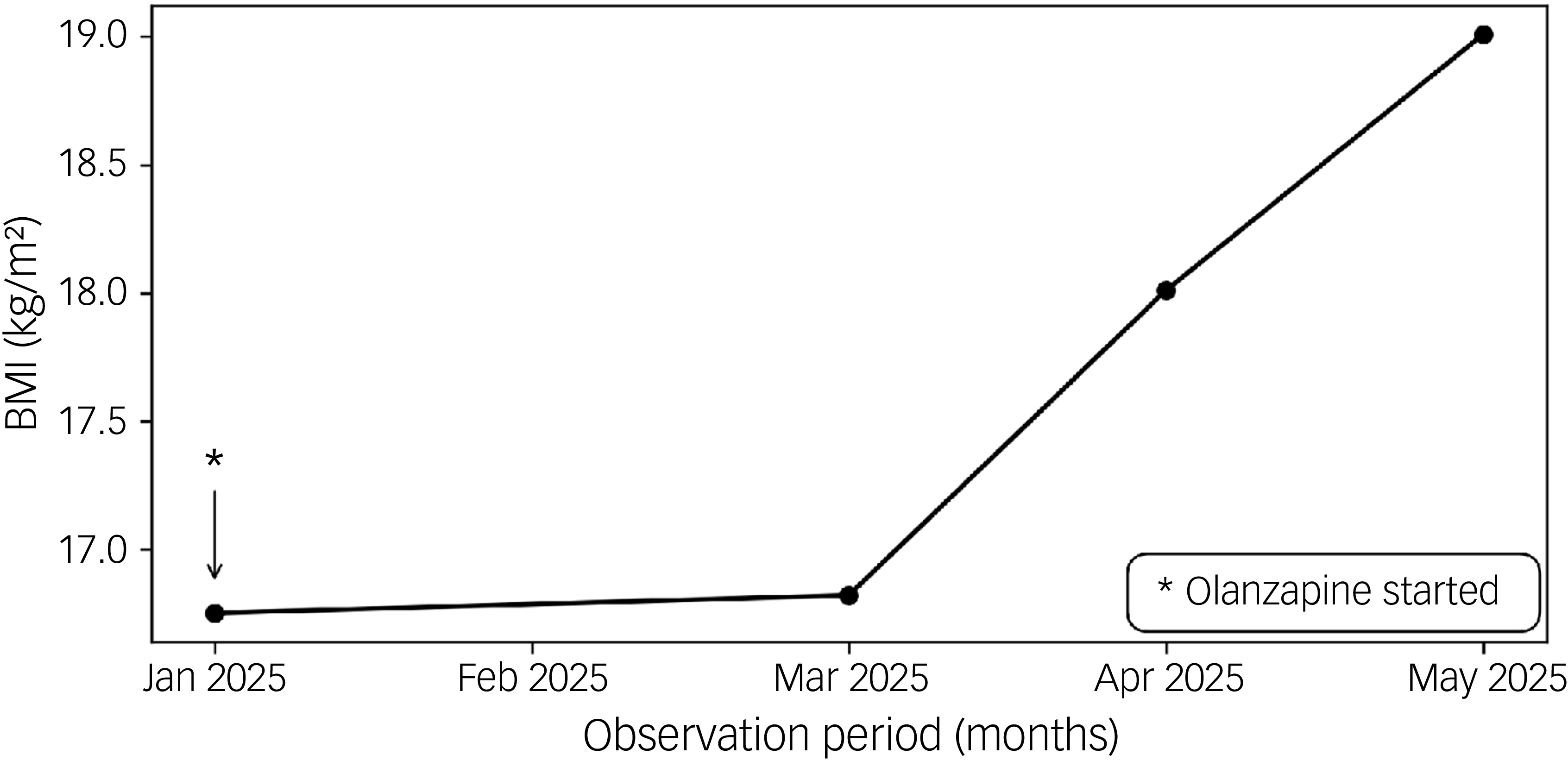
A dietitian-led structured refeeding programme was implemented, including vegan options at the patient’s request while ensuring nutritional adequacy. Fluid intake was carefully limited to manage dilutional hyponatraemia. Compulsive pacing was limited and supervised to minimise further weight loss. Occupational therapy and social work supported discharge planning (Fig. 1).
BMI progression during in-patient admission. BMI, body mass index.

This figure illustrates the patient’s BMI progression during their in-patient admission, with a gradual increase from 16.75 kg/m2 in January to 19.01 kg/m2 in May 2025, reflecting a steady and positive progress in their recovery. The asterisk indicates the point at which olanzapine was initiated. It is also possible that the relatively flat early phase of the curve partly reflects the influence of excessive fluid intake, which may have inflated measured weight before fluid restriction; the graph may therefore underestimate the true early nutritional improvement once overhydration was corrected.
Discussion
This case highlights several features that are rarely reported in the literature of later-life psychopathology. First, although the patient attributed the onset of her restrictive eating behaviours to the COVID-19 lockdown, collateral history suggested long-term subtle obsessive behaviours. Early diagnoses of osteoporosis and fragility fractures indicate prolonged periods of inadequate nutrition, suggesting that her restrictive eating behaviours may have been present for many years before 2020. Such a link underscores the role of psychosocial stressors in precipitating pre-existing vulnerabilities and presentation of anorexia nervosa later in life. Systematic reviews have shown that COVID-19 lockdowns, through social isolation, routine disruption and decreased access to care, were associated with worsening eating disorder symptoms across age groups, with a majority reporting increased restrictive eating behaviours and greater psychological distress. Reference Sideli, Lo Coco, Bonfanti, Borsarini, Fortunato and Sechi4 The pandemic was also associated with increased social media use, which has been suggested as a potential contributor to body image concerns and disordered eating behaviours. Her family reported that she was not actively using social media, but ongoing monitoring and support will be important to prevent exposure to social media content that could reinforce her thoughts after discharge.
Second, her behavioural symptoms – verbal and physical aggression when her activities of weight loss were restricted, disinhibition and public incontinence – are atypical for anorexia nervosa and initially suggested a neurocognitive disorder. However, neuroimaging and neuropsychological assessments did not support a diagnosis of dementia. These behavioural disturbances may reflect the cognitive inflexibility and impaired response shifting often observed in individuals with anorexia nervosa, particularly when rigid routines are disrupted. Reference Zastrow, Kaiser, Stippich, Walther, Herzog and Tchanturia5 Furthermore, starvation itself can result in cognitive and psychological changes, including mood disturbance, social withdrawal and obsessional thinking, as demonstrated in the Minnesota Starvation Study by Keys et al. Reference Keys, Brozek, Henschel, Mickelsen and Taylor6 This case highlights that such symptoms in anorexia nervosa may be a consequence of prolonged starvation and undernutrition rather than representing a primary neurocognitive or psychiatric disorder.
Notably, the relapse of her anorexia nervosa symptoms appeared to coincide with the tapering and discontinuation of olanzapine. Recent guidelines, including the 2023 update from the World Federation of Societies of Biological Psychiatry (WFSBP), recommend olanzapine as a pharmacological treatment option for promoting weight gain in adults with anorexia nervosa. Reference Himmerich, Lewis, Conti, Mutwalli, Karwautz and Sjogren7 In addition, the 2019 randomised controlled trial by Attia et al remains the strongest evidence to date, highlighting that olanzapine is associated with modest but clinically meaningful improvements in weight restoration among adults with late-onset anorexia nervosa. Reference Attia, Steinglass, Walsh, Wang, Wu and Schreyer8 Olanzapine’s anti-histaminergic properties may further contribute to appetite stimulation and weight gain while also providing an anxiolytic effect, which may be particularly beneficial in patients with agitation and anxiety. Evidence from a single case report also suggests that the combined treatment with olanzapine and mirtazapine may be effective in promoting weight gain in adults with anorexia nervosa over a 6-month period. Reference Wang, Chou and Shiah9 However, the potential additive side effects of this combination, including increased sedation and metabolic burden, require careful monitoring, particularly in older adults.
Her inability to prioritise her own health over the obsessive demands of her illness, together with the serious physical risks arising from the disorder, necessitated MHA detention to prevent serious harm. This is consistent with findings that a substantial proportion of patients with severe anorexia nervosa lack decision-making capacity regarding their care, Reference Elzakkers, Danner, Hoek and van Elburg10 emphasising the need for legal frameworks to facilitate life-saving treatment when patients lack the capacity to make informed decisions about their care. The concept of insight is itself problematic in anorexia nervosa, as patients may privately recognise their emaciation yet be reluctant to acknowledge it for fear of interventions leading to weight gain. Framing detention around risk and impaired capacity, rather than insight alone, may therefore be more appropriate. In such cases, a Community Treatment Order (CTO) under Section 3 of the MHA may be considered to support ongoing supervision, weight monitoring and treatment adherence, thus minimising the relapse risk once in-patient care is no longer required.
The presence of dilutional hyponatraemia due to excessive water intake further complicated her clinical picture. This is a known but under-recognised compensatory behaviour in anorexia nervosa and poses significant medical risks, including seizures and central pontine myelinolysis. Reference Puckett11 Online forums increasingly promote excessive water intake as a means of suppressing appetite and falsifying weight, potentially reducing the reliability of BMI as a nutritional indicator. Furthermore, despite early morning weight measurements with minimal clothing, BMI may be inaccurate due to age-related height loss and osteoporosis. Routine blood tests, including a full blood count, electrolytes and liver function tests, may therefore provide a more accurate indication of physiological compromise and excess hydration.
The patient’s insistence on a vegan diet presented an additional challenge. While veganism may reflect a genuine ethical opinion, some individuals with anorexia nervosa may adopt vegan diets as a restrictive mechanism, particularly because hospitals may struggle to provide appetising vegan options. This reinforced the need for a dietitian, who, in this case, was supported by family members willing to provide meals according to the patient’s preferences.
However, it is also important to recognise that the care burden associated with anorexia nervosa can be extremely high for family and carers. Treasure et al found that carers of individuals with anorexia nervosa report a caregiving burden exceeding that associated with chronic schizophrenia, highlighting the importance of providing carer support and access to peer resources in this context. Reference Treasure, Murphy, Szmukler, Todd, Gavan and Joyce12 Physical aggression towards carers who attempt to interrupt eating-disordered behaviours, as seen in this case, is frequently encountered in clinical practice but is seldom documented in the literature, often remaining hidden because of shame. Carers are therefore repeatedly faced with the dilemma of risking confrontation or allowing destructive behaviours to continue.
Constipation had been excluded as a cause of the encopresis and the enuresis persisted despite fluid restriction. However, because the patient declined to discuss or investigate these issues, local and behavioural causes could not be excluded. Importantly, behavioural boundaries around fluid intake and laxative use can be difficult to maintain outside specialist eating disorder units, and determined, illness-driven patients may circumvent such restrictions. Extensive medical investigation is therefore of limited value until these behavioural explanations have been confidently excluded. Similar patterns of behavioural dysregulation, including incontinence, deliberate body cooling, inappropriate dressing and disinhibition, have been described in patients with severe anorexia nervosa. These are often driven by anorexic drive rather than neurological causes and hence may remain a possible explanation for this patient’s presentation.
Given the late onset of anorexia nervosa, together with a chronic and relapsing course, prolonged hospitalisations and comorbid depression, both our team and the eating disorder unit initially suggested a poor prognosis. In older adults, anorexia nervosa differs from its presentation in younger people: body tissues recover more slowly, motivation for recovery is lower, and, unlike this case, social support may be limited, all of which contribute to a poorer prognosis. Importantly, there are fewer prescribing restrictions in this age group, as considerations such as fertility no longer limit the use of psychotropic and bone-protective medications, both of which may be beneficial. Nevertheless, this patient’s prognosis is, in several respects, more favourable than these factors alone might suggest. She benefits from a highly engaged and caring family, a clear diagnosis and formulation and expert multidisciplinary treatment. A Community Treatment Order is also in place to support ongoing supervision and relapse prevention, while supportive psychotherapy may, over time, improve her tolerance of interpersonal closeness. Although the treatment of anorexia nervosa remains challenging for patients, families and clinicians alike, these protective factors provide genuine grounds for hope.
While anorexia nervosa causes multisystem complications, including cognitive changes at any age, Reference Zipfel, Giel, Bulik, Hay and Schmidt13 older adults are particularly vulnerable because diminished psychological reserves means that even modest weight loss can accelerate the onset of frailty, sarcopenia and mortality. Reference Landi, Calvani, Tosato, Martone, Ortolani and Savera14
Management of anorexia nervosa in older adults requires a multidisciplinary approach incorporating medical monitoring, nutritional rehabilitation, tailored psychotropic use and psychosocial support. In this case, structured refeeding, reinstatement of olanzapine and coordinated care with an eating disorder team facilitated modest improvement. Family involvement also played a critical role in supporting long-term care planning.
Clinical Implications
This case underscores the importance of recognising that anorexia nervosa can develop in or persist into later life. Its presentation may differ markedly from the classic adolescent profile and may mimic cognitive or mood disorders. Clinicians should maintain a high index of suspicion for anorexia nervosa in older adults presenting with unexplained weight loss, behavioural disturbances or obsessive traits.
Management requires careful attention to the complex interplay of medical, psychiatric and psychosocial factors in this vulnerable population. Tailored multidisciplinary interventions and increased awareness among clinicians are essential to improving outcomes and reducing the morbidity and mortality associated with late-onset anorexia nervosa.
Data availability
The data supporting the findings of this study are available from the corresponding author, P.G., upon reasonable request and subject to approval by the hospital’s Information Governance Team. The data are not publicly available because they contain information that could compromise patient privacy.
Acknowledgements
The authors thank the patient and her family for consenting to publication of this case report and their involvement in her care. They also thank the multidisciplinary team at Kent and Medway NHS and Social Care Partnership Trust for their contribution to her management.
Author contributions
P.G. conceived the case report, performed the literature review, drafted the original manuscript and assisted with manuscript revision. E.E. provided clinical supervision, contributed to the diagnostic formulation and critically revised the manuscript for important intellectual content. M.B., S.K. and T.H. contributed to the patient’s clinical care, data collection and manuscript revision. All authors approved the final version of the manuscript and meet the criteria for authorship.
Funding
This case report did not receive any specific grant from funding agencies in the public, commercial or not-for-profit sectors.
Declaration of interest
None.
Ethical standards
All procedures contributing to this publication comply with the ethical standards of the relevant institutional and national human research committees and with the 2013 revision of the Declaration of Helsinki 1975. Ethical approval was not required for this case report because it describes routine clinical care without research intervention. Informed and written consent for the publication of this case report was obtained from the patient.

 Open access


eLetters
No eLetters have been published for this article.