INTRODUCTION: INTERVIEWS AS TESTS
In the context of children in public care, parents, when they are being interviewed, face “the plight of the discredited” (Goffman Reference Goffman1990). Even when they are talking to a researcher—a relative outsider who is unconnected to the institutional networks of public surveillance—the awareness that their interlocutor is in the know about or requests to learn “the facts and details” of this particular family will result in a self-perceived need to account for oneself and to redeem one's moral worth and credibility as a parent. Goffman (Reference Goffman1990) sees the “normal” and the “stigmatized” as two perspectives in interaction and this bears directly on how information is managed. It is likely to result in particular forms of revelation and concealment; it may result in the downplaying or upgrading of certain details, so as to invite a reading of plausible and credible behavior and moral worth under unusual and stressful circumstances. In earlier research, Slembrouck and Hall (Reference Slembrouck, Hall, Hall, Juhila, Parton and Pösö2003) have drawn attention to how parents with children in public care, when they are interviewed, typically attend to the pressures of having to account for oneself by drawing on specific rhetorical figures such as “of course I cared but I couldn't cope,” because “this is a difficult child,” “because of my own personal circumstances at the time,” and so forth.Footnote 1 In addition, parents who are being interviewed may also feel they are being tested in other respects. According to Dingwall (Reference Dingwall, Dingwall and Miller1997), interviews must be treated as contextually-produced accounts, partly because there is an interactional pull towards accomplishing a coherent and shared sense of reality. Interviewees may succeed in this by providing a convincing narrative of what happened, and often such a narrative unfolds across the turns of successive question-answer sequences. At the same time, Dingwall adds, interviews count as “situations in which respondents are required to demonstrate their competence in the role in which the interview casts them” (1997:56). Two roles stand out in my particular context of inquiry and they are linked to each other through complex indexicalities: there is the parent/child role relationship (because this is largely what the interviews in this set of data were about) and there is the role of interviewees (interviewees can be expected to develop and interactionally express a position towards the role of ‘doing being an interviewee’). The complex linkage I allude to is as follows: being perceived as rising to the occasion of the interview talk may function as a legitimacy-lending component in building up a persuasive account of parenthood in a period of crisis. One is reminded here of the way in which Bourdieu connects legitimate language use and credibility: “il le dit bien, donc cela a des chances d'être vrai”Footnote 2 (Bourdieu Reference Bourdieu1984:104). It is important, however, to remind ourselves that it is quite possible for other face-related “lines” (Goffman Reference Goffman and Goffman1967) to be taken in response to the situation of being “tested” as an interviewee: for instance, interviewees may convey unease, display unfamiliarity with, or even signal an explicit rejection of the interview game, and such an alignment may be part of communicating distance, in this particular case, from the institutional networks of child protection and care.
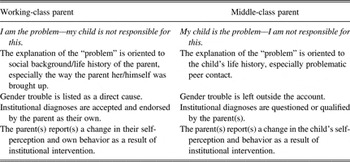
The analytical-ethnographic imperative is thus that we need to concentrate on the interactional negotiation of various aspects of the interview situation and the meaningful sequences that have been accomplished interactionally, including implications for the status of the data subsequently obtained. What is invited is a careful triangulation of data and the key theoretical proposition emerging from this is indeed that of ethnographic reflexivity (Agar Reference Agar and Agar1996, Burawoy Reference Burawoy1998, Bourdieu Reference Bourdieu2001), both epistemologically and heuristically, by focusing on an analysis of data histories (Slembrouck Reference Slembrouck2001; see also Briggs Reference Briggs1986 and Cicourel Reference Cicourel1974 as important precursors). The central research topic of the series of interviews on which I am drawing in this article was “social class and discourses of child protection.” The research was conducted in Flanders/Belgium in 2002. Table 1 below is a specific point of entry into the larger corpus of interviews that were collected as part of the research. The table is suggestive of a broad reading of the accounts in the corpus. They have been projected on a division along occupational lines (using the terminology in Dutch): handarbeiders vs. hoofdarbeiders. Handarbeiders means ‘manual workers’, while hoofdarbeiders could be translated as ‘clerical and professional workers’ (lit.‘head workers'). The allocation of the interviews to one of the two groups yielded a set of salient distinctions that are characteristic of how the interviewed parents, in constructing a narrative account, had positioned themselves vis-à-vis the crisis in parenthood. Accordingly, the table highlights significant distinctions in terms of (i) who is being articulated as the “problem,” (ii) how the family crisis is explained, (iii) whether the relationship between the parents enters the account as a contributing factor or cause, (iv) how self-diagnosis relates to institutional voice, and (v) who/what is reported to have changed for the better.
A set of distinctions.

A first important observation to be made is that the set of distinctions in the table could not be read off entirely or directly from the “texture” of the recorded interviews and the narrative accounts contained in them. In fact, it was arrived at through a combination of, on the one hand, field notes with observations that extend beyond the encounter of the interview and, on the other hand, textual analysis that is particularly sensitive to the way the accounts were negotiated and managed interactionally.
ON WHAT GETS COMMUNICATED OUTSIDE THE RECORD
As already hinted at above, interviews do not appear out of the blue. They are social events that, in many cases, are planned and staged carefully (also logistically—this involves making telephone calls to agree on a time and place, the setting up of recording equipment, etc.). Interviews are sequentially embedded in larger spates of social activity. To take an interview involves a process of legitimation (one must seek permission to interview) and this process extends into the negotiation of a frame of action and interpretation. Very importantly, beforehand and at the beginning of the event itself, there is the negotiation of what the interview will be about (and some of this may occur before the recording equipment is switched on). At the other end, there is the interactional space in which interviewees comment on how they experienced the interview. A rather interesting and telling detail about the present corpus is that all interviewees asked me afterwards if I, too, had children and, in most cases, they did so after the recording equipment had been switched off. The analyst's aim is conventionally understood to be restricted to the recorded and transcribed textual flow, that is the interview data “proper.” What I am suggesting here is that it is equally necessary to attune oneself to the dynamics of entextualization and contextualization beyond the strict boundaries of the recorded segment, and this is one area that invites a considerable amount of interpretative triangulation (Gumperz Reference Gumperz, Eerdmans, Prevignano and Thibault2003:111). Compare also with Goffman's (Reference Goffman1974:466) comments on “bracket use,” especially the occurrence of backstage talk during which talkers are “less guarded” but “not out of role.” An important question in the background is: how far beyond the borders of the recorded interview talk should one move in order to assemble a plausible interpretative take on the data and the data event?
One particularly striking example occurred in the very first interview of the 2002 series. This interview belongs in the left column of Table 1, but the account's congruence with the third feature (gender friction is invoked as a direct cause) was established only by sheer coincidence. The detail emerged after the minidisk recorder had been switched off and after the researcher had been shown the room of the infant in foster care. Unlike the rest of the council flat, the room had been recently refurbished; it was amply equipped with toys, a television set, and so forth; and I was told, this was in eager anticipation of the child's return home. The room was shown to me as part of a display of being a parent who goes through a lot of effort to provide what is necessary, indexing a deep desire for the infant to return home and securing “perfect” conditions for this. As part of the small talk on the way to the door, I happened to ask the mother if this had been the first time she had been interviewed by a researcher. Her answer was negative. She had been previously interviewed by a researcher with a project on gender violence. Only at that point did it occur to me that the mother's troubled move from Wallonia to Flanders—the difficulties she had experienced combining a new job with the demands of child rearing, her temporarily moving in with a friend—had all followed a flight from a violent ex-partner. The episode, which she subsequently recounted in greater detail, added another fifteen minutes to the account—off-the-record, outside the frame boundaries of the interview, unrecorded and accessible now only through the field notes I wrote up afterwards. These details not made me wonder: (i) What did this mother see as lying inside/outside the scope of the stated interview topic? Only her experiences “as a parent”? (ii) How did the on-record nature of the interview affect her decision-making in this area (cf. the point above on concealment and revelation)? The most important insight, however, is that the details that were obtained off-the-record also affect the constitution of the table. Off-the-record, the interviewee had communicated a basis for the claim that Interview 1 is more fully congruent with a particular set of features than would appear on the basis of just the “interview proper.”
ON RESISTANCE TO STATED TOPICS
It is often the case that at the beginning of an interview, the interviewer states the general purpose of the talk, and this is a crucial step in establishing the interviewee's alignment to topic and procedure. In the case of Interview 2—a professional couple in a more affluent council estate with bel étage housing—the father (FA) responded by signalling a different perception of what is to be the central topic.
(1) Interview 2Footnote 3

The father was assuming that the interview would be about a particular institutional experience. In his response he initially mixes up the CLB, Centrum voor Leerlingenbegeleiding ‘student guidance center’, with the district's CBJ, Comité Bijzondere Jeugdzorg ‘the juvenile special care committee’. In fact, both institutions played an important role in this particular case. The father's response takes us back to the moment where the social worker negotiated the consent for the interview. It makes one reflect on the role that my letter of introduction, which also stated the topic of the interview, played in this earlier encounter (how it was possibly quite in the background, not necessarily read in great detail, how it was interpretatively paraphrased by the counsellor). A second interpretative avenue presents itself here, one that does not necessarily rule out the first possibility: by framing the talk in terms of a client experience with an institution, these parents make it easier for themselves to “maintain face”; such framing allows them to adopt and maintain a particular “line” during the interaction (Goffman Reference Goffman and Goffman1967:7), one that invites some distance from a painful experience, the detail of which, as they will be well aware, can easily undermine their credibility as parents.
Interestingly, even though I managed to clear the apparent misunderstanding (i.e. through an extended repair sequence), consumer-satisfaction talk continued to run through the parents' account, for instance, in the form of particular comments that occurred in the margin of (or even framed) particular narrative episodes. Excerpt (2) below offers an example of this. In this excerpt the father sums up the nature of the “family problem,” which resulted in a brief reception into residential care (the institution is here referred to anonymously as de Eik ‘the Oak’). The mother corroborates the father's view, stressing how their daughter's case did not come with “loud alarm bells.” Playing down the seriousness of the case is one way in which parenthood can be redeemed in the face of questioning. Immediately following, the father shifts the talk from “properties of the case” to “institutional coordination and decision making.”
(2) Interview 2. FA: Father, MO: Mother, IN: Interviewer

In the second part of his extended turn, the father lists possible reasons for why their daughter's case was not “top priority”: a lack of communication among the professionals, a lack of communication with the parents, and a lack of transparency in the decision making. These parents appear to meet the test of the interview (by implication, a test of their parenthood) by recounting the events as a series of contacts with institutions. In doing so, their role as “critical clients” is foregrounded, and this is one way of rendering themselves as “responsible parents.” The two parents are “head workers” (a teacher and a senior civil servant).
The above set of data-historical observations are important in more than one respect. A set of interviews may have a uniformly-stated topical focus, but it cannot be said to have resulted in a uniform range of interview topics and interpretative frames. That a perspective of service-centred talk with a client-satisfaction angle to it can be detected in Interview 2 forms part of understanding the data history for this specific interview. It helps us to understand how the case is contextualized and how the narrative is entextualized. It cautions the researcher not to treat individual interviews as interchangeable tokens of the same type. As Cicourel (Reference Cicourel2003) demonstrates in detail: informants who are faced with relative uncertainty about what a specific data event will be about will tend to fill the gaps and develop a frame for action by relying on readily available interpretations. Similarly, the family counsellor who negotiated the interview on behalf of the researcher may also have engaged in interpretative gap-filling. Perhaps unsure about the exact scope of the pre-text stated in the letter, he made up for this by suggesting to the parents that the interview would probably be about their experience with the juvenile care committee (suggested in excerpt (2)). Such an addition to the pre-text stated in the letter may also have been strategic: to win over these parents for an interview (note that I was not allowed to select, let alone contact, any parents directly from a list of potential candidates). In addition, and more importantly, an epistemological concern with ethnographic reflexivity adds to such observations that an analysis of the data histories bears directly on the main topic of research. Applied here: the father's slippage into service-oriented talk foregrounds his familiarity with and literacy in how institutions go about their business; in other words: it reveals his own professional-occupational status as a senior civil servant who is quite acquainted with coordinating talk and with the fact that institutional action is often directed by the accidental imponderables of such talk. Together with other details (for example, the way in which the father presented the institutional intervention during the interview as one which was largely staged and coordinated by the parents themselves, the way he cited particular legislative detail, etc.), this aspect of the talk brings out a specific dimension of the parents' middle class-ness.
ON INTERVIEWEES WHO (FAIL TO) VENTURE
Let me now turn to a final set of examples. Also in these cases, an interactional analysis of the framing moves in the talk can be shown to add focus and scope to the distributional results, when the interviews are processed in the context of Table 1. At the beginning of each interview, the respondent was offered a choice: to tell me what happened or have me direct the talk by asking particular questions. The decision to offer a choice was informed by an anticipation of contradictory tendencies in the interviewees' responses to the occasion of interviewing. On the one hand, the research came with a clear interest in the narrative aspects of identity construction, and how could this be better served than by explicitly setting up the conditions for an uninterrupted narrative that unfolds quasi-monologically. I expected some parents to be keen to tell their story in full. On the other hand, I was also expecting some parents to be uncertain about what the interview was really about or perhaps reluctant to tell their story. An alternative protocol was therefore included, which promoted the articulation of a narrative that unfolds across the question-answer sequences. Let us now look at how two parents, a house cleaner (Interview 4), and a secondary school teacher (Interview 3), responded to the choice that I had offered.
In the second case (a middle-class parent), the mother responded by hinting at a coherent narrative to tell, but she matched her observation with an expressed uncertainty about how the larger narrative will tally with the researcher's expectations.
(3) Interview 3

This occurrence can be contrasted with interview 4 (a working-class parent): here the mother opted for short answers to specific questions, happy to abide by the authority of the interviewer.
(4) Interview 4

This difference is not only important in its own right; in both cases, it was also echoed in the interactional sequences that unfolded as a result. Inasmuch as the mother in Interview 4 stuck to the narrow thematic scope of individual questions (she gave little detail, she paused a lot, etc.) and showed various signs of unease with the interview game, the mother in Interview 3 quite freely ventured beyond the thematic scope of individual questions and elaborated spontaneously on the social actors involved, adding judgement and evaluative comment even when not explicitly invited to do so. Interestingly, this correlated with the way in which the two mothers positioned themselves vis-à-vis the institutional diagnosis. In so far as the mother in Interview 4 cites the institutional categorization and the suggested remedial course of action as also her own (see excerpt (5) below), the mother in Interview 3 engages critically with the institutional analysis (see excerpt (6) below). She does so by acting out a dialogue in which she separates her own voice from that of the institutional representative, and by doing so, she adds qualification to the institutional analysis. Interviews 3 and 4 both concern cases of an adolescent son involved in small crime. Excerpts (5) and (6) also show the different orientation in terms of who is problematized and where the causes are being located (the parents in Interview 4, the adolescent son in Interview 3).
(5) Interview 4

(6) Interview 3

DISCUSSION AND CONCLUSIONS: “NOT NOISE TO BE EXPURGATED, BUT MUSIC TO BE APPRECIATED”
The correlations I have noted in the four data instances above underline the need to complement data analysis with reflexive ethnographic observation. In addition, I hope to have demonstrated that one can draw actively on such observations when interpreting the collected data in light of a central research question (in this case, how parents' narrative accounts of an episode of child protection in their lives are permeated by class-specific orientations in the coding of social experience).Footnote 4 My interactional analysis of how parents responded to the “interview game” is first of all important for mapping the individual interviews on to the hypothesis that is embodied in Table 1. In addition, ethnographic reflexivity adds both scope and depth to the distributional results listed in the table. If social class entails a difference in terms of who appears to be held responsible for a crisis in family relations and where the causes are situated, then one must note a corresponding difference at the level of how the interviewee separates (or fails to separate) her or his “own voice” from that of the institutional actors, categorizations, and analyses. What's more, this may also entail a further corresponding difference in interactional behavior under the conditions of being interviewed (e.g. preferred degree of autonomy in directing the interview talk and thematic leeway that the clients appropriate in responding to specific questions).
Thus, while the five characteristics listed in the polar terms of a professional/occupational class dichotomy are quite suggestive for how social class features in parental accounts of child protection (because they bear on what is being said about the child protection process, that is, the narrative), we are indeed invited to extend the analysis also in the direction of stressing that class-based coding orientations also mediate the process of finding out about these perceptions, broadly: how the account unfolds interactionally. For instance, working-class parents appear to abide by institutional authority and are apparently more led by what the institution brings to their situation, and this can be argued to extend into situations of contact with a researcher who represents another type of highly literate institution (the university). In contrast, middle-class parents appear to be more inclined to engage dialogically and critically with what the child protection experts say, and indeed they also maintain such a stance under the conditions of being interviewed, for example, by seeking to co-monitor the management of the interview flow.
I do not have the space here to develop this insight further in the context of class registers (interesting suggestions are made by Ohmann (Reference Ohmann1987), Ortner (Reference Ortner and Fox1991), and Giddens (Reference Giddens1991); see also Slembrouck Reference Slembrouck2005 for a fuller discussion). The important insight I wish to highlight here is that it is worth analyzing interviews as “tests” precisely because it is likely to generate insights that are central to the topic under investigation. Whether our main topic is x, y, or “the role of social class in the coding of a crisis in parent/child relationships,” my contention is that such is better not engaged in separately from (because it can be shown to be enriched substantially by) a set of interactional and discourse-analytical observations that pertain to the history of specific data instances. That data has a history is inherent in the occasion of being interviewed. Echoing Burawoy's (1998:13–16) detailed notes on reflexivity, my larger point underlines how reflexive science detects merit in situational contingency, “not noise to be expurgated, but music to be appreciated.” It does so by taking advantage of the intervention, which an interview inevitable amounts to. One of its strategies is to unpack situational experiences by moving with the participants through their time and space, an analysis of their data history. One of the windows subsequently opened is that which brings into view structured social processes. This happens in ways that resist routine normalcy judgements in data collection and undermine straightforward answers to the question: “What, in this particular series, is a good interview?”