Introduction
Wildlife parasites are extremely important because they can modulate the dynamics of natural populations, and some of them are shared with domestic species, which can have economic consequences in production. Furthermore, wildlife acts as a reservoir for most of human zoonotic diseases (Uribe et al. Reference Uribe, Hermosilla, Rodríguez-Durán, Vélez, López-Osorio, Chaparro-Gutiérrez and Cortés-Vecino2021). The interactions between parasites and their hosts can be altered by habitat disturbance through anthropogenic activities. This disturbance generates variations in population sizes, genetics, and immune competence, among other factors. Therefore, from a One Health approach, knowledge about parasite diseases affecting wildlife in natural and anthropic environments will help us to understand the dynamics of parasites and their effects on host populations.
The capybara (Hydrochoerus hydrochaeris, Caviomorpha), known as carpincho in some regions of South America, is the largest living rodent in the world and is endemic to the Neotropics. Its distribution is closely associated with the presence of tropical and subtropical wetlands in South America. In addition to their natural habitats, synanthropic populations of capybaras can be found in wetland areas with strong anthropogenic impact (Uribe et al. Reference Uribe, Hermosilla, Rodríguez-Durán, Vélez, López-Osorio, Chaparro-Gutiérrez and Cortés-Vecino2021). Capybara populations have also been frequently documented in urban centers, indicating their remarkable adaptability to anthropic environments (Verdade and Ferraz Reference Verdade and Ferraz2006; Alves and de Freitas Reference Alves and Freitas2022). In Argentina, this species inhabits both natural and anthropic wetland areas. Notably, they have been observed in areas that were originally wetlands but have since been fragmented due to construction of housing estates.
Capybaras exhibit notable resistance to diseases under natural conditions. However, they play a crucial role as hosts for numerous parasites and have been previously identified as natural reservoirs for various zoonotic pathogens (Cueto Reference Cueto, Moreira, Ferraz, Herrera and Macdonald2012). Parasitological studies conducted on capybaras have unveiled the presence of more than 80 parasites across their distribution range (Alves and Freitas Reference Alves and Freitas2022; Assis et al. Reference Assis, López-Hernández, Pulido- Murillo, Melo and Pinto2019; Chiacchio et al. Reference Chiacchio, Prioste, Vanstreels, Knöbl, Kolber, Miyashiro and Matushima2014; Uribe et al. Reference Uribe, Hermosilla, Rodríguez-Durán, Vélez, López-Osorio, Chaparro-Gutiérrez and Cortés-Vecino2021; Jones et al. Reference Jones, Lall and Garcia2019; Ribeiro Fávaro et al. Reference Ribeiro Fávaro, Machado, da Silva Rodrigues Carvalho-Leite, da Silva, Oda, Machado and da Silva Rodrigues Machado2022; Cañizales and Guerrero Reference Cañizales and Guerrero2013; Dutra et al. Reference Dutra, de Freitas Almeida, Oliveira, Santos Abrahão, Kroon and de Souza Trindade2017, among others). Previous parasitological studies conducted in Argentina have documented the occurrence of numerous parasitic species, including Protozoa, Nematoda, Trematoda, and Cestoda parasites, in both natural and anthropic environments (Corriale et al. Reference Corriale, Milano, Gómez-Muñoz and Herrera2011, Reference Corriale, Muschetto and Herrera2013; Santa Cruz et al. Reference Santa Cruz, Sarmiento, González, Comolli and Roux2005; Eberhardt et al. Reference Eberhardt, Costa, Marini, Racca, Baldi, Robles, Moreno and Beldoménico2013, Reference Eberhardt, Robles, Monje, Beldoménico and Callejón2019; Robles et al. Reference Robles, Eberhardt, Bain and Beldoménico2013).
Wildlife populations are commonly surveyed for gastrointestinal parasites using coprology, an effective method that eliminates the need to capture or handle host individuals (Alvarado-Villalobos et al. Reference Alvarado-Villalobos, Cringoli, Maurelli, Cambou, Rinaldi, Barbachano-Guerrero, Guevara, Chapman and Serio-Silva2017). Coprological techniques are widely employed for diagnosing gastrointestinal parasites, including helminths and protozoa, in both humans and animals. In particular, quantitative fecal techniques are preferred over qualitative techniques ones for assessing the infection levels in domestic animals and making informed management decisions (Nielsen Reference Nielsen2021). The use of quantitative and non-invasive methods is essential to gain a better understanding of infectious disease patterns and the health status of wild animal populations, particularly in protected areas. Therefore, the evaluation of non-invasive, cost-effective methods is crucial for wildlife, especially when studying gastrointestinal infections in rodents, where significant challenges still exist.
Various effective techniques are available for studying gastrointestinal parasites in fecal samples. Spontaneous sedimentation, McMaster, and FLOTAC techniques are commonly used in veterinary and wildlife studies. Sedimentation techniques concentrate parasitic elements at the bottom of the fecal sample, making them suitable for traditional clinical and epidemiological tests. The McMaster technique, known for its simplicity and minimal laboratory requirements, is the most commonly used routine for diagnosing gastrointestinal parasites in domestic animals (Hansen and Perry Reference Hansen and Perry1994). The FLOTAC technique, an alternative to previous diagnostic methods, is used for both qualitative and quantitative coprological diagnoses of parasites in humans and other animals. It is a more sensitive, precise, and accurate methodology. A simplified version, the Mini-FLOTAC technique, involves fewer preparation steps and is employed for routine parasitological diagnosis in various animal species (Barda et al. Reference Barda, Rinaldi, Ianniello, Zepherine, Salvo, Sadutshang, Crignoli, Clementi and Albonico2013a,Reference Barda, Zepherine, Rinaldi, Crignoli, Burioni, Clementi and Albonicob; Maurelli et al. Reference Maurelli, Rinaldi, Alfano, Pepe, Coles and Cringoli2014; Alvardo-Villalobos et al. Reference Alvarado-Villalobos, Cringoli, Maurelli, Cambou, Rinaldi, Barbachano-Guerrero, Guevara, Chapman and Serio-Silva2017; Lobos-Ovalle et al. Reference Lobos-Ovalle, Navarrete, Navedo, Peña-Espinoza and Verdugo2021; Coker et al. Reference Coker, Pomroy, Howe, MvInnes, Vallee and Morgan2020; Marcer et al. Reference Marcer, Cassini, Parisotto, Tessarin and Marchiori2022; Johnson et al. Reference Johnson, Reynolds, Adkins, Wehus-Tow, Brennan, Krus, Buttke, Martin and Chelladuraia2022), including rodents (Catalano et al. Reference Catalano, Symeou, Marsh, Borlase, Léger, Fall, Séne, Diouf, Ianniello, Crignoli, Rinaldi, Ba and Webster2019; Carrera-Jativa et al. Reference Carrera-Játiva, Torres, Figueroa-Sandoval, Beltrami, Verdugo, Landaeta-Aqueveque and Acosta-Jamett2023; Lima et al. Reference Lima, Ramos, Lepold, Borges, Ferreira, Rinaldi, Cringoli and Alves2017). However, there still is a lack of consensus on the optimal protocol for diagnosing coccidia and helminth infections in resource-scarce settings, a common challenge when studying many wild mammals.
The Los Padres Lake Integral Reserve (LPLIR) is an important conservation zone in the southern region of Buenos Aires Province, situated within the pampean region of Argentina. This reserve is known for its rich biological diversity, with the capybara being one of its most emblematic species. Therefore, this study aimed to determine the gastrointestinal parasites in wild capybaras of the LPLIR and establish baseline data on these parasites in this protected habitat, representing the southernmost distribution of this rodent species. The specific objectives of the study were 1) to assess the parasitological fauna of capybaras in a protected environment within their southernmost distribution range and 2) to compare different parasite coprological methodologies in capybaras.
Material and methods
Sampling area
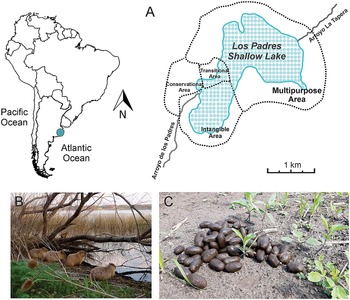
Los Padres Lake Integral Reserve (37º55´–38º02´ S, 57º34´–57º33´ W) is located in the Pampa plain of the Buenos Aires Province (Argentina), 14 km from Mar del Plata city (Figure 1A and B). The reserve constitutes an important recreational tourist center (Cardoni et al. Reference Cardoni, Favero and Isacch2008) inside an area of intense horticultural and livestock activity. It covers an area of 687 ha, 319 of which correspond to the body of water and 368 to the terrestrial area. The shallow lake (LPL, area = 2.97 km2; mean depth = 1.24 m) is characterized by alkaline waters (pH = 8.6) and a polymictic thermal regime (Pozzobón and Tell Reference Pozzobon and Tell1995). It receives a single tributary, named Los Padres stream, and drains part of its surface waters through La Tapera stream. Since 1984, a management plan has existed for the LPLIR that determines the existence of an intangible land zone of approximately 90 ha with restricted access to the public.
A) Location map of the Los Padres Lake Integral Reserve (LPLIR), B) Capybaras in the LPLIR, C) Dung piles of capybaras.

Samples collection
Free-ranging capybara fresh feces samples from 57 individuals were randomly collected from the area of Los Padres Lake (LPL) in the summer of 2022 (Figure 1C). The samples consist of feces collected from dung piles produced by individual capybara. These piles were gathered from directly observed defecation events or from piles with characteristics such as wetness and hardness and that were situated at a significant distance from each other to avoid the possibility of coming from the same capybara. The feces were considered when they were still wet and shiny, had no cracks on the surface, and did not break when there were pressed on. Fecal samples were placed in plastic bags, immediately transported in a cooling bag, stored in a refrigerator (4°C), and examined immediately after arriving at the laboratory within 48 hours.
Parasitological methods
Ten grams of fecal material per sample were homogenized with a metal spatula in order to analyze each sample with three different techniques: spontaneous sedimentation technique (SS), INTA (Instituto Nacional de Tecnología Agropecuaria) modified McMaster technique (MM), and Mini-FLOTAC (MF) technique, as described below. In all cases, the dimensions and morphologies of the eggs and oocysts were compared with available data from the literature in order to identify the parasites at the lowest taxonomic level.
The SS technique was used as a non-quantitative method. Fecal samples were sieved through thrice-folded gauze and centrifuged at 1500 RPM for 5 min. Four slides of 20 x 20 mm with one drop of sediment were prepared for each sample, along with the addition of one drop of glycerin, and examined at 100x and 400x by light microscopy (Zeiss® Primo Star). Parasite remains were measured and photographed at 400x magnifications.
The MM and the MF techniques were used to quantitatively evaluate the numbers of EPGs and OPGs (i.e., E/OPG, eggs or oocysts per gram of feces) in the samples. The MF technique was performed using the protocol described in Cringoli et al. (Reference Cringoli, Maurelli, Levecke, Bosco, Vercruysse, Utzinger and Rinaldi2017). Briefly, two grams of fresh feces were put into the Fill-FLOTAC container, and 38 ml of NaCl (specific gravity = 1.2) were added (dilution ratio = 1:20). The suspension was then thoroughly homogenized using the homogenizer stick of the Fill-FLOTAC. The fecal suspension was then filtered through the Fill-FLOTAC and used to fill the two chambers of the Mini-FLOTAC. After waiting for 10 min to allow the flotation of parasitic eggs and oocysts, the top part of the flotation chambers was translated, and both Mini-FLOTAC chambers were read under a light microscope using a 100x or 400x magnification. Two MFs were made for each sample. FEC values from both MFs, expressed as EPG or OPG of parasite species, were obtained by multiplying the total number of eggs by 5.
The MM was performed using three grams of feces diluted in 42 ml of saturated sodium chloride solution (NaCl, specific gravity = 1.2). The fecal suspension of 1:15 dilution ratio was thoroughly homogenized and filtered through gauzes to remove large debris. The sediment and the flotation solution were thoroughly mixed by mechanical agitation, and the suspension was carefully pipetted into the four chambers (0.5 ml each) of a McMaster INTA modified counting slide, ensuring no air bubbles remained (Fiel et al. Reference Fiel, Steffan and Ferreira1998). After 5 min, the slide was examined under a light microscope at 100x magnification. Eggs and oocysts were counted and multiplied by 7.5 to calculate the EPG or OPG.
Statistical analysis
The species richness (S), the number of parasite species per sample, was obtained for the three different techniques compared in this study. Strongylid eggs were grouped together since the two recorded species in this study had little difference in size and it was impossible to do a rigorous measurement at 100x magnification (MM). The proportion of positive samples (P) was defined as the number of positive samples from the total of analyzed samples. A positive sample was defined as positive when it was positive with any parasitological method, while a negative sample was considered negative if was negative with all methods. The P for each parasite species was compared between techniques through the two-proportions z-test by the function prop.test of R (R core Team Reference Team2013). Yates correction of continuity for small samples was applied. A level of p < 0.05 was considered as significant.
The count of parasite species, the eggs/oocyst per gram (E/OPG), was calculated as total E/OPG and separately for each parasite species. As data do not adjust normality, Wilcoxon Rank sum test for paired samples was used for E/OPG comparison between both quantitative techniques using R (R core Team Reference Team2013). Ggplot2 package in R was used for figures (Wickham Reference Wickham2016).
Results
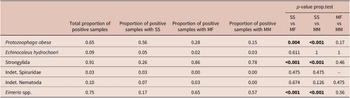
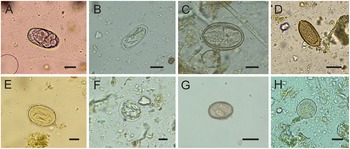
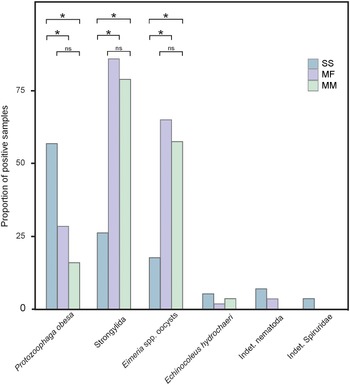
The results of the coproparasitological study obtained by the three methods are presented in Table 1. Fifty-six samples from the total samples analyzed (56/57, 98%) resulted positive for gastrointestinal parasites by at least one of the used techniques (Figure 2A–H). The results indicate that 52 capybaras (91%) were found positive for at least one species of Strongylida (Figure 2A, B), 43 capybaras (74.4%) were positive for Eimeria spp. (Apicomplexa: Eimeriidae), and 37 capybaras (65%) were positive for Protozoophaga obesa (Oxyuroidea, Oxyuridae) (Figure 2C), the most-represented species. Strongylida was represented by a species of Tricostrongyloidea (Figure 2A) and one species of Strogyloidea (Figure 2B), possibly Strongyloides chapini. However, adults or larvae would be necessary to confirm the identity to species level. Additionally, few others were found positive for helminths such as one unidentified nematode (10.5%) (Figure 2F), Echinocoleus hydrochaeris (Trichinelloidea, Trichinellidae) (8.8%) (Figure 2D), and one unidentified spirurid (Spirurida) (3.5%) (Figure 2E). At least two morphotypes of Eimeria spp. oocysts were recorded (Figure 2G, H), and one of them attributed to Eimeria boliviensis. When the MM technique was used, it was impossible to identify the species of Eimeria since observation is only possible at 100x magnification. The proportion of positive samples by method is shown in Table 1 and Figure 3. There were found significant differences in proportion of positive samples of P. obesa, Strongylida, and Eimeria spp. among SS and MM, and SS and MF (Table 2). The proportion of positive samples of P. obesa was higher in SS compared to MM and MF. Conversely, the proportion of positive samples of Strongylida and Eimeria spp. was higher in MM and MF compared to SS. No other significant difference between both quantitative techniques was obtained (Table 2).
Proportion of positive samples for parasite species. First column shows the total proportion of positive samples and second through fourth columns show the results obtained with the different techniques used in this study (SS: sedimentation, MF: Mini-FLOTAC, MM: INTA modified McMaster technique). p-values of the comparisons between techniques obtained through two-proportion Z test are also shown. Significant p-values are in bold

Parasite species recorded in feces from capybaras of the LPLIR, Buenos Aires, Argentina. A) Trichostrongyloidea, B) Strongyloidea, C) Protozoophaga obesa, D) Echinocoleus hydrochaeris, E) indet. spirurid, F) indet. nematode, G) Eimeria boliviensis, H) Eimeria spp. Scale bar 20 μm.

Barplot of proportion of positive samples of gastrointestinal parasites from capybaras obtained with the three different techniques used in this study (SS: sedimentation, MM: INTA modified McMaster technique, MF: Mini-FLOTAC). Each bar of the chart represents the proportion of individuals that resulted positive for infection. Comparisons through the two-proportions Z test between different techniques (bars) is indicated with brackets. Significant differences at p < 0.05 are indicated with an *. ns = non-significant differences.

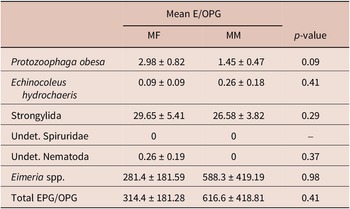
Mean E/OPG obtained with both quantitative methodologies applied (MF: Mini-FLOTAC, MM: INTA modified McMaster technique). p-values from pairwise comparison between MM and MF performed with Wilcoxon test

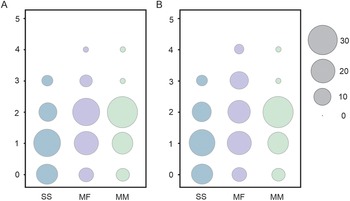
Richness varied between 0 and 3 in SS and between 0 and 4 in MM and MF. Richness also varied between the three techniques considering the magnification used in the microscope. Some species of Strongylida and Eimeria can be differentiated at higher magnifications (400x). This result is expressed through a Bubble plot in Figure 4. Slightly higher values of richness were obtained in SS and MF compared to MM due to oocyst and egg species that could be differentiated at higher magnification. This result is the consequence of the impossibility of using 400x objective with an MM chamber.
Bubble plot showing richness of parasite species recorded with the three different techniques used in this study (SS: sedimentation, MM: INTA modified McMaster technique, MF: Mini-FLOTAC). A) Richness considering Strongylida and Eimeria spp. as a whole, B) Richness considering separated species of Strongylida and Eimeria spp. that can be distinguished at higher magnification (400x) of the microscope.

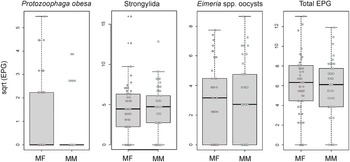
Parasite count expressed as mean total E/OPG and E/OPG of each of the parasite species found in capybaras is shown in Table 2 and Figure 4. No significant differences were found when both quantitative techniques (MM vs MF) were statistically compared (Table 2, Figure 5).
Jitter boxplot of squared-root transformed of total EPG/OPG, and EPG/OPG of each of the parasite species found in capybaras.

Discussion and conclusions
This study examined the composition of the parasite community in capybaras within a natural protected area, situated in the southernmost distribution range of the species. This is the first parasitological study of capybaras in the LPLIR. The high proportion of positive samples found in this study is in accordance with previous results in which a high prevalence or positivity in capybaras was also reported (Ortiz and Rizzelo Reference Ortiz and Rizello2004; Moreno et al. Reference Moreno, Lord, Morales, Pino and Balestrini1999; de Souza et al. Reference Souza, Benatti, Luz, Costa, Pacheco and Labruna2021; Sinkoc et al. Reference Sinkoc, Müller, Brum, Begrow and Delevatti1995, Reference Sinkoc, Brum and Muller2009; Corriale et al. Reference Corriale, Milano, Gómez-Muñoz and Herrera2011; Costa and Catto Reference Costa and Catto1994; Salas and Herrera Reference Salas and Herrera2004; Ojasti Reference Ojasti1973; Alves and de Freitas Reference Alves and Freitas2022). The 91% of capybaras were found positive for at least one parasitic species. The most commonly found species was P. obesa, followed by species of Strongylida and Eimeria. The high representation of P. obesa in capybara parasite assemblages has been observed in several studies, establishing it as the most common parasite in this rodent (Costa and Catto Reference Costa and Catto1994; Casas et al. Reference Casas, Zalles, Patrick and Dailey1995; Bonuti et al. Reference Bonuti, Nascimento, Mapelli and Arantes2002; Ribeiro and Amato Reference Ribeiro and Amato2003; Salas and Herrera Reference Salas and Herrera2004; Souza et al. Reference Souza, Ribeiro and Antonucci2015; Alves and de Freitas Reference Alves and Freitas2022). The presence and proportion of positive samples of E. hydrochaeris and the unidentified nematode and spirurid were too low so they can be considered as satellite species.
All the gastrointestinal parasites identified in our study had been documented in capybaras from various Neotropical regions (Alves and de Freitas Reference Alves and Freitas2022; Salas and Herrera Reference Salas and Herrera2004; Uribe et al. Reference Uribe, Hermosilla, Rodríguez-Durán, Vélez, López-Osorio, Chaparro-Gutiérrez and Cortés-Vecino2021; Casas et al. Reference Casas, Zalles, Patrick and Dailey1995; Sinkoc et al. Reference Sinkoc, Brum, Muller and Brum2004, Reference Sinkoc, Brum and Muller2009; Santos et al. Reference Santos, Zamora and Ribeiro2011, among others). In Argentina specifically, several parasite species have been recorded, including nematodes like Vianella hydrochoeri, Hydrocherisnema anomalobursata, Trichostrongylus cf axei, Strongyloides cf. chapini, E. hydrochoeri, Trichuris sp., and P. obesa; the cestode Monoecocestus sp.; the trematodes Taxorchis cabrali, T. schistocotyle, and Hippocrepis hippocrepis; as well as oocytes of Eimeria spp., among others (Corriale et al. Reference Corriale, Milano, Gómez-Muñoz and Herrera2011; Robles et al. Reference Robles, Eberhardt, Bain and Beldoménico2013; Eberhardt Reference Eberhardt2014; Santa Cruz et al. Reference Santa Cruz, Sarmiento, González, Comolli and Roux2005). Notably, this study did not find helminths such as cestodes, trematodes, and ascaridids, which were commonly reported in previous studies on capybara populations (de Souza et al. Reference Souza, Benatti, Luz, Costa, Pacheco and Labruna2021; Corriale et al. Reference Corriale, Milano, Gómez-Muñoz and Herrera2011; Casas et al. Reference Casas, Zalles, Patrick and Dailey1995; Alves and de Freitas Reference Alves and Freitas2022, among others). In fact, this study recorded only six parasite species, which represents relatively low richness compared to other studies. This result aligns with the classical diversity gradient commonly observed in free-living species, where species richness tends to increase near the tropics and decline toward the poles. However, studies on latitudinal diversity gradients in parasitic species richness are still limited (Preisser Reference Preisser2019; Preisser et al. Reference Preisser, Castellanos, Kinsella, Vargas, Gonzalez, Fernández, Dronen, Lawing and Light2022). Given the scarcity of research on parasite assemblages of wild species, particularly capybaras, further studies are necessary to draw comprehensive conclusions.
The results revealed similar sensitivity in parasitological examination when comparing the three methodologies in terms of richness and parasite composition. This similarity held true even when considering the differences in the protocols of the methodologies, especially in the differences of feces weight analysed. However, although all three methods were useful for the study of parasite diversity, there were some differences in the results. Notably, slightly higher values of richness were obtained using SS and MF methods compared to MM method. This disparity arises from the inability to use the x40 objective with the MM chamber, since the height of the chamber prevents examination under greater magnification interfering with the identification of parasite structures. This disadvantage has not been previously mentioned by other authors. It is possible that in most cases, operators were already familiar with parasitic fauna. In some instances, microscopes can be used with the McMaster INTA modified chamber at higher magnifications, but in our case, the x40 objective was not usable.
The proportion of positive samples varied among the three techniques. SS showed a higher proportion of positive samples for P. obesa, whereas MF and MM had higher proportions for Strongylida and Eimeria species. Sedimentation techniques employed a low-density solution in which parasite eggs and oocysts precipitate, and centrifugation can be used to concentrate these structures. A higher specific gravity of P. obesa eggs may possibly explain the higher proportion of positive samples in the SS technique compared to the MF and MM techniques. Similar results have been observed in the performance of unfertilized Ascaris eggs, where their higher specific gravity causes them to sink rather than float, even in flotation solutions (Periago et al. Reference Periago, Diniz, Pinto, Yakovleva, Correa-Oliveira, Diemert and Bethony2015). This result is particularly important because quantitative techniques are usually compared among them, and it is important to highlight that non-quantitative techniques can be more sensitive for certain parasite species.
Quantitative techniques used in our study, MF and MM, demonstrated similar results to parasite count, making them viable for non-invasive sampling strategies targeting parasitic infections in wild rodents. The comparisons of both methodologies in this study, concerning Eimeria spp. and nematodes, revealed that both techniques yielded similar OPG and EPG results. To improve the recovery of other parasitic remains, future studies could consider experimenting with solutions of higher specific gravity than those used in this work.
A wide range of coproparasitological tools are available for determining egg and oocyst load intensity, primarily in species of veterinary and economic importance. Although flotation methods are widely used for many parasite species, their effectiveness varies depending on the characteristics of the egg and oocyst. In the particular case of the MF method, MF has proven to be an innovative, sensitive, and cost-effective technique for diagnosing intestinal helminths, particularly in veterinary parasitology. In recent years, numerous studies have highlighted its potential for quantitatively monitoring parasite infections in wildlife populations (Alvarado-Villalobos et al. Reference Alvarado-Villalobos, Cringoli, Maurelli, Cambou, Rinaldi, Barbachano-Guerrero, Guevara, Chapman and Serio-Silva2017; Catalano et al. Reference Catalano, Symeou, Marsh, Borlase, Léger, Fall, Séne, Diouf, Ianniello, Crignoli, Rinaldi, Ba and Webster2019; Lobos-Ovalle et al. Reference Lobos-Ovalle, Navarrete, Navedo, Peña-Espinoza and Verdugo2021; Coker et al. Reference Coker, Pomroy, Howe, MvInnes, Vallee and Morgan2020; Marcer et al. Reference Marcer, Cassini, Parisotto, Tessarin and Marchiori2022; Johnson et al. Reference Johnson, Reynolds, Adkins, Wehus-Tow, Brennan, Krus, Buttke, Martin and Chelladuraia2022), including rodents (Carrera-Jativa et al. Reference Carrera-Játiva, Torres, Figueroa-Sandoval, Beltrami, Verdugo, Landaeta-Aqueveque and Acosta-Jamett2023; Catalano et al. Reference Catalano, Symeou, Marsh, Borlase, Léger, Fall, Séne, Diouf, Ianniello, Crignoli, Rinaldi, Ba and Webster2019; Lima et al. Reference Lima, Ramos, Lepold, Borges, Ferreira, Rinaldi, Cringoli and Alves2017). Specifically in rodent studies, FLOTAC and Mini-FLOTAC have emerged as sensitive and reliable tools for conducting future studies, reducing the need for lethal sampling methods and facilitating the comparison of communities and epidemiology over time. However, addressing the limitations of the methods will require operator training and the development of specific protocols according to the characteristics of the sample and the specific gastrointestinal parasites.
The results of this study lead to the conclusion that all three techniques are reliable for assessing richness and, in the case of quantitative techniques, for counting related objectives. In our particular case, MF and MM were both efficient quantitative techniques to complement the SS method for diagnosing intestinal parasites in rodents. However, MF was better at identifying parasite species than MM. The SS technique remains a reliable method for detecting helminth eggs, especially the densest eggs, which are not likely to float effectively in floating methodologies. Quantitative techniques became crucial for diagnosing gastrointestinal parasites in low prevalence populations or when counting objectives are pursued.
According to de Souza et al. (Reference Souza, Benatti, Luz, Costa, Pacheco and Labruna2021), the increasing presence of capybaras in anthropized areas leads to heightened interactions between capybaras, humans, and domestic livestock. Although this study did not detect parasite species of zoonotic or veterinary importance, it remains crucial to gain fundamental understanding of the composition and dynamics of parasite communities for monitoring wildlife species in natural areas adjacent to anthropic regions, particularly synanthropic species like the capybara. Notably, the capybara can be used as an effective indicator of ecosystem health, making the continuous monitoring of their populations a matter of public health concern (Uribe et al. Reference Uribe, Hermosilla, Rodríguez-Durán, Vélez, López-Osorio, Chaparro-Gutiérrez and Cortés-Vecino2021). This study represents an initial exploration of the health status and parasite composition of capybaras from LPLIR, employing a non-invasive sampling methodology to detect a wide range of parasites without disturbing the wildlife populations residing in natural reserves.
In conclusion, the choice of methodology for studying parasitic fauna in wild rodent populations depends on the specific objectives of the study. Factors to consider include the operators’ training with the parasite fauna of the rodent species under study, the need for higher magnifications, and budgetary constraints, among other considerations. In this study, we find that the studied techniques are complementary for identifying and quantifying helminth eggs. Both MF and MM are promising tools for quantitative objectives and SS for detection of densest eggs that are not detectable through floating methods. Furthermore, this study serves as an initial exploration of parasite communities in wild rodents within a natural reserve located among anthropic areas at their southernmost distribution. Further studies could explore comparisons in strictly anthropic areas or areas where capybaras coexist with domestic species like livestock. Research into seasonal variations or year-round variability could also provide valuable insights for more consistent results. Additionally, in line with the non-invasive alternatives for monitoring wildlife population health, molecular techniques can be considered for identifying parasite species that cannot be distinguished based on egg or oocyst morphology or those not detectable through their eggs in host feces.
Acknowledgements
We thank Bárbara Capello (Facultad de Ciencias Veterinarias-Universidad Nacional del Nordeste-Corrientes Capital, Argentina) for her generous collaboration. We are very grateful to the anonymous reviewers who greatly improved a previous version of the manuscript with their comments.
Financial support
This work was founded by the Agencia Nacional de Promoción de la Ciencia y la Tecnología de Argentina (ANPCyT, FONCyT) [PICT 2019-2577].
Competing interest
The authors declare none.