I. INTRODUCTION
Stimuli-responsive hydrogels have attracted much attention in biomedical field due to their swelling and shrinking behavior that can be reversibly stimulated by the environmental stimuli including pH, temperature, redox, light, magnetic fields, and chemical entities.Reference Magalhães, Sousa, Mano, Reis, Blanco and Román1–Reference Galperin, Long, Garty and Ratner4 However, the application is limited due to their slow response rate and poor mechanical properties.
Cellulose constitutes an important renewable raw material that is utilized in many commercial applications in nonfood, paper, textiles, and composite materials. Nanocrystalline cellulose (NCC) obtained from chemical treatments such as acid hydrolysis, or mechanical treatment, has been realized as a new class of nanomaterials.Reference Kramer, Klemm, Schumann, Heßler, Wesarg, Fried and Stadermann5–Reference Couderc, Ducloux, Kim and Someya8 Compared to macrocellulose fibers, NCC possesses many advantages, including nanoscale dimension, high specific strength and modulus, high surface area, unique optical properties, etc.Reference Klemm, Schumann, Kramer, Hessler, Hornung, Schmauder and Marsch9–Reference de Sousa Lima and Borsali13 These amazing physicochemical properties and wide application prospects have attracted significant interest from both research scientists and industrialists.
Because of these advantages, NCC was incorporated into the polymers for improving the mechanical properties, biodegradability, and renewability, which has gained increasing attention as the main application of NCC. Except the traditional solid polymer materials such as epoxy resins, polypropylene (PP), poly(vinylacetate) (PVA), poly(lactic acid) (PLA), and so on, the soft and wet gels could also be enhanced by NCC.Reference Ruiz, Cavaille, Dufresne, Gerard and Graillat14–Reference Jiang, Morelius, Zhang, Wolcott and Holbery27 In previous reports, many hydrogels were modified by incorporating the NCC. Typically, Shanmuganathan and Abitbol incorporated the NCC prepared by acid hydrolyzing the cotton into PVA hydrogels crosslinked by physical hydrogen-bond interaction and chemical cross-linker, respectively. With the increase of NCC, the considerable enhancement effect was found in both kind of gels. Meantime, a similar liquid crystal behavior was observed due to the directional alignment of NCC in gels.Reference Shanmuganathan, Capadona, Rowan and Weder28,Reference Abitbol, Johnstone, Quinn and Gray29 More interestingly, it has been proved that the competition of hydrogen bond between cellulose whisker and solvent exists in hybrid hydrogels. Capadona added NCC prepared from cucumbers into ethylene oxide-epichlorohydrin copolymer, the “switching effect” of NCC incorporation was found and controlled by the content of water in materials, when the content of solvent water is low, the NCC interacts with each other tightly by hydrogen bond to form the network, which makes the gels become rigid. Reversely, when the content of solvent water is high, the NCC incorporates with solvent, the gels are soft with low modulus.Reference Jeffrey, Capadona, Shanmuganathan, Dusti and Juart30 Considering the excellent mechanical properties and biocompatibility, NCC hybrid hydrogels have been applied in biomedical field such as the simulation of human tissues.Reference Morin and Dufresne31,Reference Eyholzer, Couraça, Duc, Bourban, Tingaut, Zimmermann, Månson and Oksman32
Although the NCC hybrid hydrogels show great potential, some drawbacks still limit the application of this kind of smart materials. For the conventional gels crosslinked by organic crosslinkers such as N,N-methylene double acrylamide (BIS), they exhibit intrinsic brittle characteristics, which is easy to break in stretching and compression, even after being enhanced by NCC. A better hydrogel matrix is necessary to be found for preparing NCC hybrid gels with excellent properties. Recently, a novel inorganic–organic nanocomposite hydrogels (NC gels) were created by Harriguchi. Because of the successful fabrication of a unique organic (polymer)/inorganic (clay) network structure, NC gels have attracted great interest. They overcome most of the disadvantages, such as mechanical weakness, structural heterogeneity, and insufficient sensitivity to stimuli. The nonresponsive and responsive monomers such as DMAA and NIPA could be used to synthesize NC gels.Reference Haraguchi, Takehisa and Fan33–Reference Zhu, Liu, Sun, Zhang, Liu, Yu, Zhang, Kuckling and Adler38 Moreover, various syntheses and modification methods were exploited to improve the properties of NC gels, the typical one is freezing polymerization. Zhang and his coworkers prepared PNIPA NC gels by freezing polymerization, the effect of clay concentration (C xLS) on the mechanical properties and response rate of gels was investigated. From their research, 6% C xLS is considered as a critical concentration to the homogeneity and heterogeneity of prepared gels. When the C xLS is higher than 6%, the extensibility decreases and the deswelling rate increases due to the increase of heterogeneity.Reference Zhang, Wang, Liu, Liu, Wang and Tong39 Besides, the start freezing time as another main factor affecting the properties of freezing polymerized PNIPA NC gels was investigated by our team. It was found that earlier start freezing time in polymerization is conducive to the advance of deswelling rate but harmful to the tensile strength.Reference Chen and Xu40 Nevertheless, the contradiction between faster response rate and better mechanical properties exists in freezing polymerization technique. How to prepare the NC gels with both ultrafast response rate and excellent mechanical properties is still a great challenge.
In this study, for preparing the gels with ultrafast response rate and excellent mechanical properties, nanocellulose whisker obtained by acid hydrolysis of cotton cellulose was incorporated into the PNIPA NC gels as a reinforcing agent through in situ radical polymerization by using two-step freezing technique. The existing status of NCC in gels and the effect of the NCC content on the swelling ability, response rate, and mechanical properties of gels were investigated systematically, and the related mechanism was analyzed. In addition to the improvement of basic properties, the addition of NCC should advance the biocompatibility of gels, which makes these hydrogels potential candidates for applications in drug release, tissue engineering, and other biological fields.
II. MATERIALS AND METHODS
A. Materials
The cotton from Whatman cellulose filter aid was used as the cellulose source. N-isopropylacrylamide (NIPA) provided by TCI Co., Japan, was purified by recrystallization from a toluene/n-hexane mixture (2/1 w/w) and dried under vacuum at 40 °C. Potassium peroxodisulfate (KPS) and N,N,N,N-tetramethylethylenediamine (TEMED) were all purchased from Aladdin Co., China, and used without further purification. Synthetic hectorite “Laponite RD” ([Mg5.34Li0.66Si8O20-(OH)4]Na0.667 with 7.68 wt% Na4P2O7, layer size = 20–30 nm × ϕ 1 nm) was purchased from Rockwood Co., America. Deionized water was distilled for all experiments including swelling/deswelling experiments.
B. Methods
1. Sulfuric acid hydrolysis of cellulose
NCC was obtained by acid hydrolysis of cotton using 64% w/w sulfuric acid (Sigma, Co.). Typically, 40 g of cotton filter aid was treated with 700 mL of acid at 45 °C for 45 min with constant stirring. Immediately following the acid hydrolysis, the suspension was diluted 10-fold with purified water to quench the reaction. The suspension was centrifuged at 6000 rpm for 10 min to concentrate the cellulose and to remove excess water and acid. The resultant precipitate was rinsed, re-centrifuged, and dialyzed with water for 5 days until constant neutral pH was achieved in the effluent.
2. Synthesis of C-NC gels
NCC hybrid nanocomposite gels (named as C-NC gels) were prepared by using a two-step freezing polymerization technique. In brief, the first step is as follows: a transparent aqueous solution consisting of water, inorganic clay, NIPA monomer was prepared by magnetic stirring for 1 h at ice-water temperature. The suspensions with NCC were added into the solution and stirred for 1 h. Then, the aqueous solution of initiator KPS and catalyst TEMED was added into the former solution with stirring, the whole process was under the protection of pure nitrogen. Immediately, the pre-polymerization solution was transferred to the mold and sealed, free radical polymerization was allowed to proceed in a water bath at 20 °C for 30 min. Following the first step, the second polymerization step was performed by transferring the mold to the condition at −28 °C and allowed to react for 48 h. Finally, the prepared gels were taken out and immersed into deionized water to remove the unreacted monomer for purification. The mass ratio of water, NIPA, initiator, and catalyst was 1000:100:1.02:0.755. The resulting gels are expressed as Cn-NCm gels, where n and m denote the mass of added NCC with NIPA, and the mole percent of clay with NIPA monomer, respectively. For example, C4-NC4 gel means that the mass of added NCC is 4% of NIPA, and 0.04 mol% clay was added per mol NIPA. Meanwhile, the pure clay cross-linked PNIPA gels were also prepared and named as NCm gels for comparison.
3. Characterization of NCC and C-NC gels
The morphology of NCC was observed by a MultiMode 8 atomic force microscopy (AFM; Bruker AXS Inc., Madison, WI) and a S3000-N low-vacuum scanning electron microscope (SEM; Hitachi High Technologies America Inc., Schaumburg, IL). The crystallinity of cellulose and NCC was analyzed by a D8 advance Cu Kα x-ray diffractometer (Bruker AXS Inc., Germany). The thermal behavior of gels was measured by thermal gravimetric analyzer (TA Instruments Inc., New Castle, DE), the temperature was raised from 20 to 600 °C at a heating rate of 20 °C/min. The morphology of the surface and network structure of gels was also observed by a S3000-N low-vacuum SEM.
4. Mechanical measurements
Tensile mechanical measurements were performed on C-NC gels of the same size ϕ 5.5 mm × 80 mm length using a UTM6000 universal mechanical tester (Suns Inc., Shenzhen, China). The sample length between the jaws was 35 mm, and the crosshead speed was 100 mm/min, the initial cross section 23.75 mm2 was used to calculate the tensile strength and the tensile modulus, the tensile strain was taken as the length change relative to the initial length of the sample. The compression tests were carried out by using samples of the same size (ϕ 12 mm × 10 mm) on the UTM6000 universal mechanical tester. The compression properties of all gels were obtained under the following conditions: compression speed, 10 mm/min; compression distance, 9 mm (90% strain). All gels for test have the same water/polymer ratio (10/1 (w/w)).
5. Dynamic rheological experiment
The rheological tests were carried out on a stress-controlled rheometer AR2000 (TA Instruments Inc., America) in dynamic mode at 20 °C. The linear viscoelasticity region was confirmed by dynamic strain sweeps at a constant frequency of 1 rad/s. The storage moduli G′ were characterized by dynamic frequency sweeps from 0.1 to 100 rad/s, conducted in fixed strain γ = 1%, which is within the linear regime, confirmed by dynamic strain sweeps.
6. Swelling experiment
The swelling experiment was performed by immersing the dried gels in deionized water at least for 72 h to reach the equilibrium at every particular temperature. The weight of the gel was measured after wiping off the excess water on the surface with moistened filter paper. The swelling ratio was calculated from the following formula:
 $${\rm{Swelling}}\;{\rm{ratio}}\;\left( {{\rm{SR}}} \right) = {{\left( {{W_{\rm{s}}} - {W_{\rm{d}}}} \right)} \mathord{\left/ {\vphantom {{\left( {{W_{\rm{s}}} - {W_{\rm{d}}}} \right)} {{W_{\rm{d}}}}}} \right. \kern-\nulldelimiterspace} {{W_{\rm{d}}}}}\quad ,$$
where W s is the weight of equilibrium swollen hydrogels and W d is the dry weight of the hydrogels.
7. Deswelling kinetics experiment
The deswelling kinetics of the hydrogels after a temperature jump from the equilibrated swollen state at 20 °C to the hot water at 50 °C were measured after wiping off the excess water on the surface with moistened filter paper. The water retention corresponding to deswelling ratio was calculated from the following formula:
 $${\rm{Water}}\;{\rm{retention}}\;\left( {{\rm{WR}}} \right) = {{\left( {{W_{\rm{t}}} - {W_{\rm{d}}}} \right)} \mathord{\left/ {\vphantom {{\left( {{W_{\rm{t}}} - {W_{\rm{d}}}} \right)} {{W_{\rm{s}}}}}} \right. \kern-\nulldelimiterspace} {{W_{\rm{s}}}}}\quad ,$$
where W t is the weight of swollen hydrogels at different times and W s is the weight of equilibrate hydrogels.
III. RESULTS AND DISCUSSION
A. Characteristics of NCC
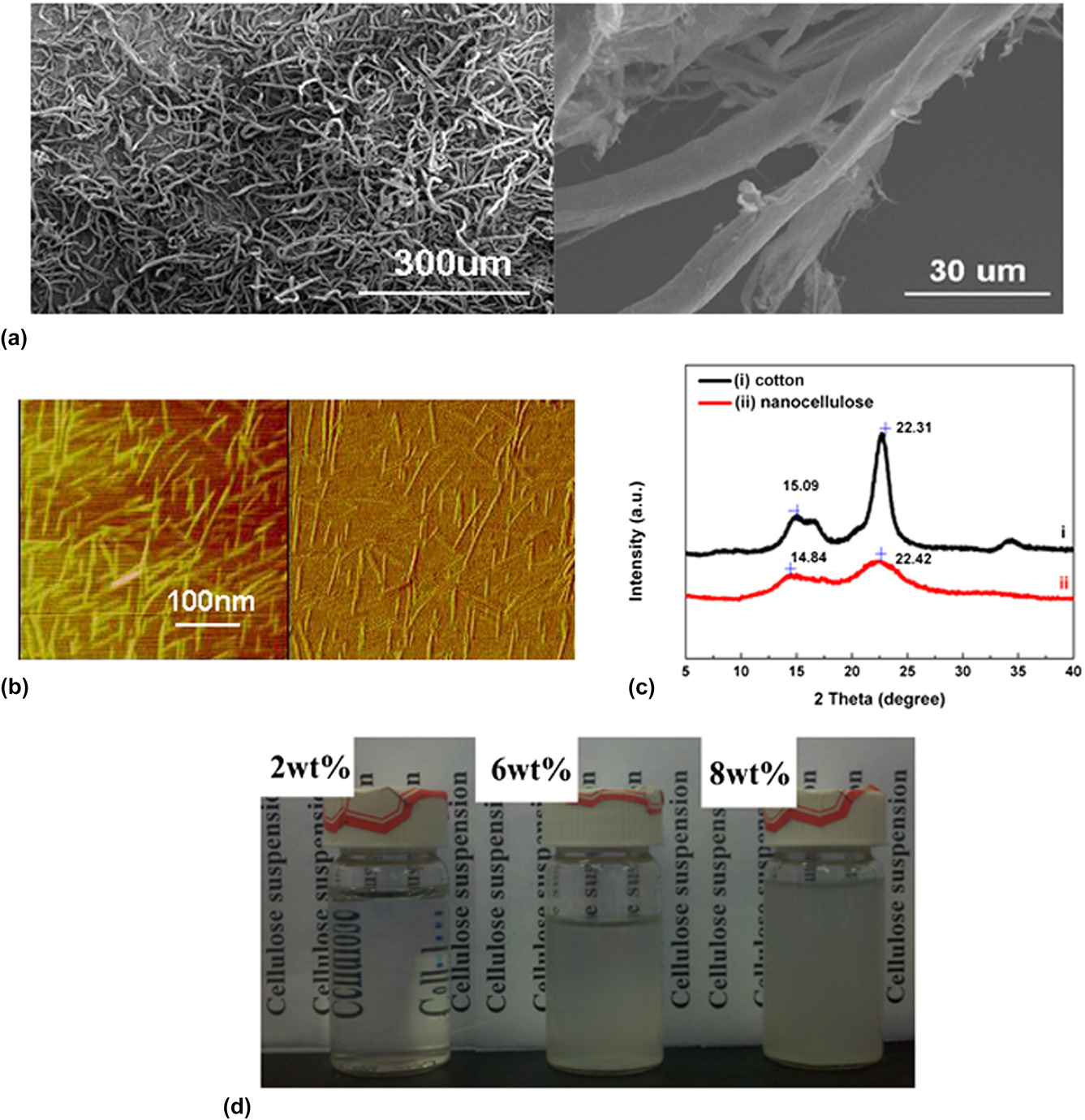
Whatman cellulose filter aid [the morphology is shown in Fig. 1(a)] was used as the cellulose source to prepare NCC. After being treated by sulfuric acid hydrolysis, followed by ultrasonic oscillating, as shown in the AFM image of Fig. 1(b), the prepared NCC exhibits unanimous acicular morphology, the length of whisker is about 50–100 nm and the aspect ratio is in the range of 10–100 approximately. As well known, this relatively large aspect ratio is conducive to the enhancement effect. From the x-ray images shown in Fig. 1(c), it was found that the diffraction peak corresponding to α crystalline form of cellulose disappears basically, indicating the disappearance of crystal in NCC completely. The suspensions with the concentration of NCC lower than 8% could remain stable without obvious aggregation or deposit even after being stored for a week [the suspensions after storing for a week are shown in Fig. 1(d)], which is attributed to the mutual repulsion effect of sulfuric ion in the molecular chains of cellulose.
The characteristics of the prepared NCC. (a) The SEM morphology of cotton cellulose; (b) the AFM morphology of NCC; (c) the x-ray images of cellulose and NCC; (d) the photos of NCC suspensions with 2, 6, and 8 wt% concentration stored for a week.

B. Preparation of C-NC gels
The synthesis and characteristics of freezing polymerized PNIPA NC gels without NCC were studied deeply in our previous work.Reference Zhang, Wang, Liu, Liu, Wang and Tong39 As the main parameter, freezing time and concentration of clay affect the properties of gels significantly. While, after adding NCC into polymerization process, it was found that the successful formation of C-NC gels is also affected and determined synthetically by the concentration of NCC and clay, and the start freezing time in polymerization. Briefly, when the concentration of NCC is higher than 8 wt% of monomer, the pre-polymerization solution becomes turbid, ascribed to the aggregation of NCC and clay due to the increased interaction force, the successful formation of gels becomes unstable whatever the concentration of clay and the start freezing time is. For the same reason, the instability of gel formation appears when the total concentration of clay and NCC is high. For example, when the concentration of NCC is fixed at 6 wt%, the 10 wt% and higher concentration of clay should result in the failure of gelation. Moreover, from a number of synthesis experiments, it was found that the start freezing time in polymerization is nonignorable to the formation of gels. The normal freezing polymerization method for preparing the NC gels is to freezing the reaction mixture immediately after preparation. However, using this method in synthesizing NCC hybrid NC gels always lead to the failure of gel formation. This phenomenon could be reasonably explained by the mechanism with respect to the formation of NC gels. As the previous researches in synthesis of NC gels, it has been proved that the formation of polymer brushes around the clay and the following gelation needs a long time from 20 min to 1 h which is dependent on the ratio of raw materials and the reaction condition.Reference Miyazaki, Endo, Karino, Haraguchi and Shibayama41 At the beginning of polymerization, the hydrophilic NIPA monomer tends to disperse around the clay which owns negative charge in surface. Freezing the reaction solution before the formation of polymer brushes around clay should increase the heterogeneity of solution and lead to the decrease of effective crosslinking of polymer chains between different clay sheets due to the steric hindrance caused by ice crystal. There is no doubt that the existence of NCC should intensify the heterogeneity of solution, and so as to have effect on the crosslink significantly, which results in the unsuccessful gelation. Reversely, freezing after the formation of polymer network basically, the ice-crystal causes slight effect on the formation of gels, meantime, the positive effect on advancing the response rate still exists in some degree. Therefore, the start of freezing was set at 40 min after the polymerization at room temperature, which could guarantee the formation of gels and the improvement of response rate. Since that the NCC-free gels with high concentration of clay exhibit high strength and modulus, which make it hard to analyze the effect of adding NCC on the mechanical properties of gels. Meantime, according to the research by Zhang, the freezing polymerized NC gels with low concentration of clay (lower than 6%) show good extensibility, which is considered as a needed property for gel matrix in this research.Reference Chen and Xu40 Therefore, the concentration of clay was fixed at 4 and 6 wt%, respectively.
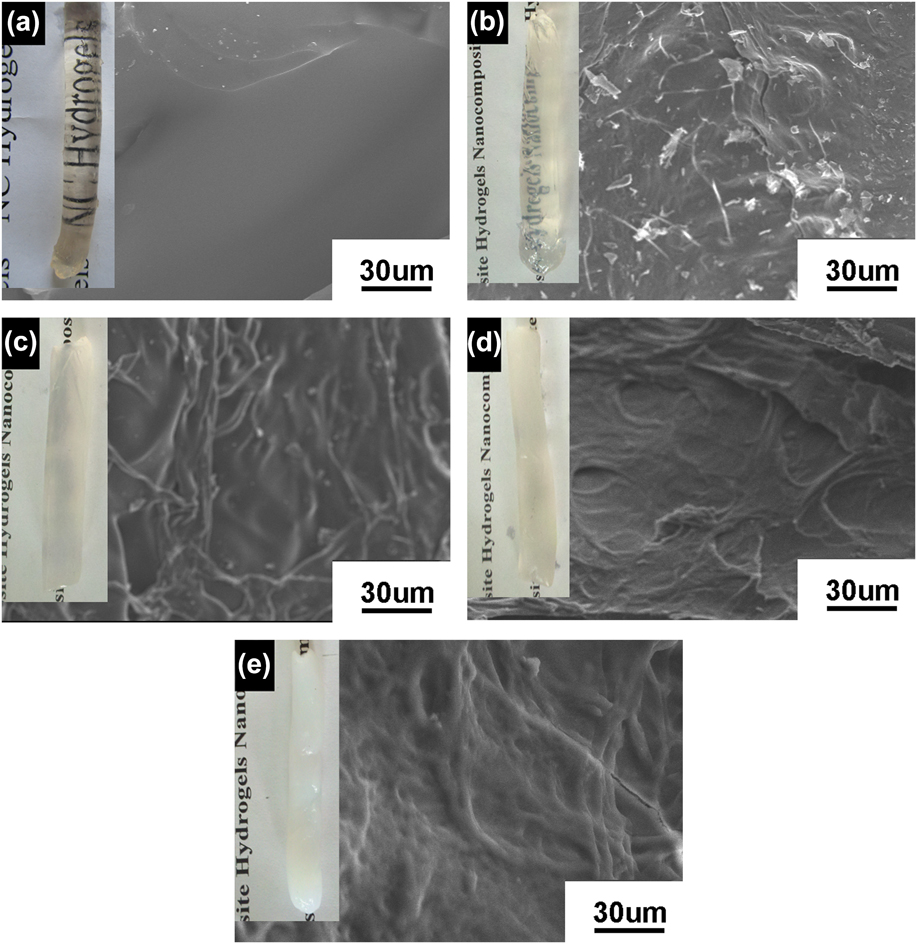
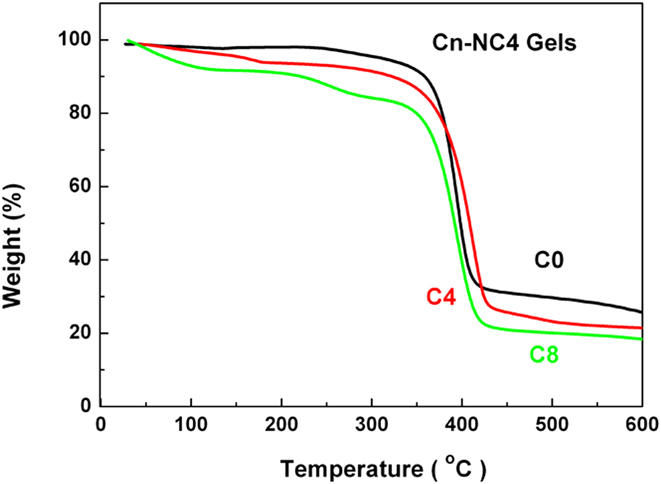
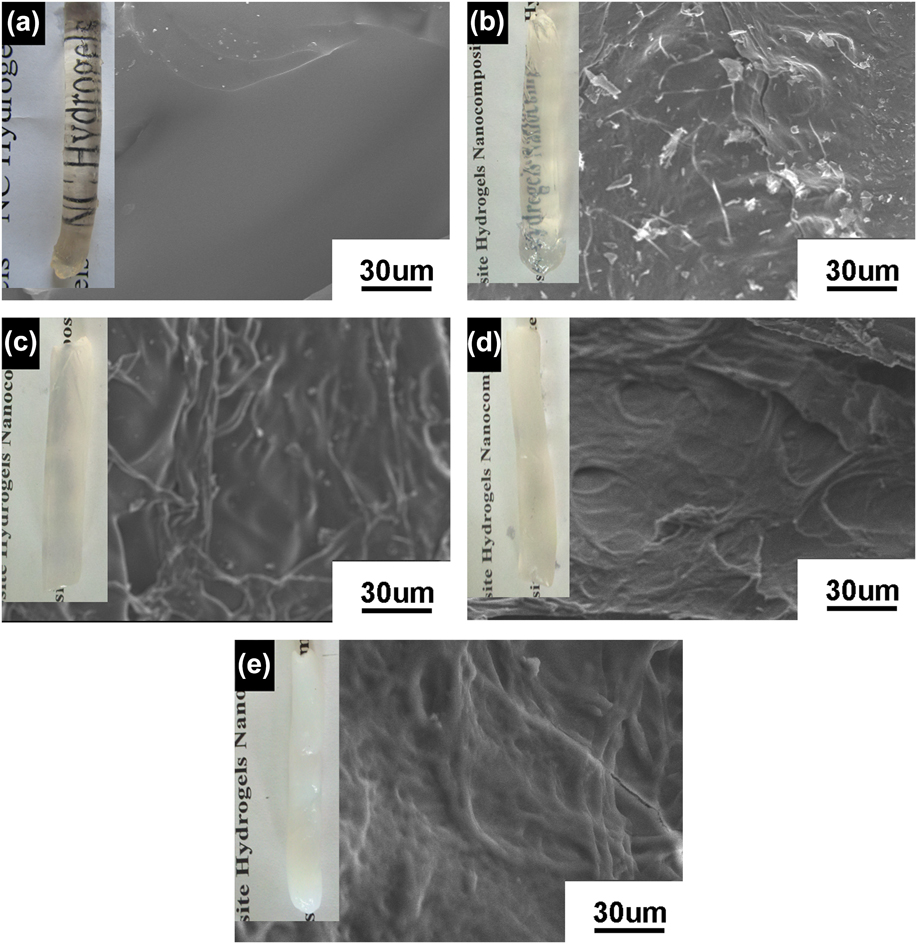
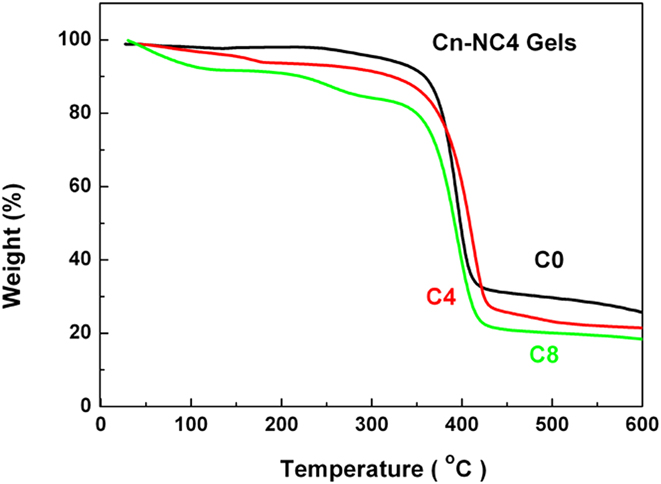
Figure 2 shows the photos of C-NC gels with various concentration of NCC. As shown in photos, the transparency of gels decreases rapidly with the increase of NCC, when the concentration of NCC is higher than 8 wt%, the gels become opaque, which may be attributed to the destruction of homogeneous network structure by the addition of NCC. The corresponding SEM images of the C-NC gels' surface are also shown in Fig. 2. From image (a) to (e), more obvious outline of cellulose is visible with the increase of NCC content. However, it is noticed that the existing status of NCC in gels is not the rod-like, as shown in AFM images, but a “fibrous” structure. This morphology relative to the incorporation of NCC may be caused by the interaction of hydrogen bond between cellulose. From the thermogravimetric curves of C-NC gels shown in Fig. 3, it was found that the addition of NCC makes a slight effect on the thermostability of gels; all gels show similar start temperature for losing weight drastically. However, the thermal trait of NCC in gels is obvious. The lost weight of materials before the drastic weight loss (about at 350 °C), corresponding to the weight of NCC in gels, is consistent with the mass of addition as well.
The photos and SEM images of the prepared C-NC gels: (a) C0-NC4; (b) C2-NC4; (c) C4-NC4; (d) C6-NC4; (e) C8-NC4.
The thermogravimetric curves of C-NC gels: (a) C0-NC4; (b) C4-NC4; (c) C8-NC4.
C. The swelling behavior of C-NC gels
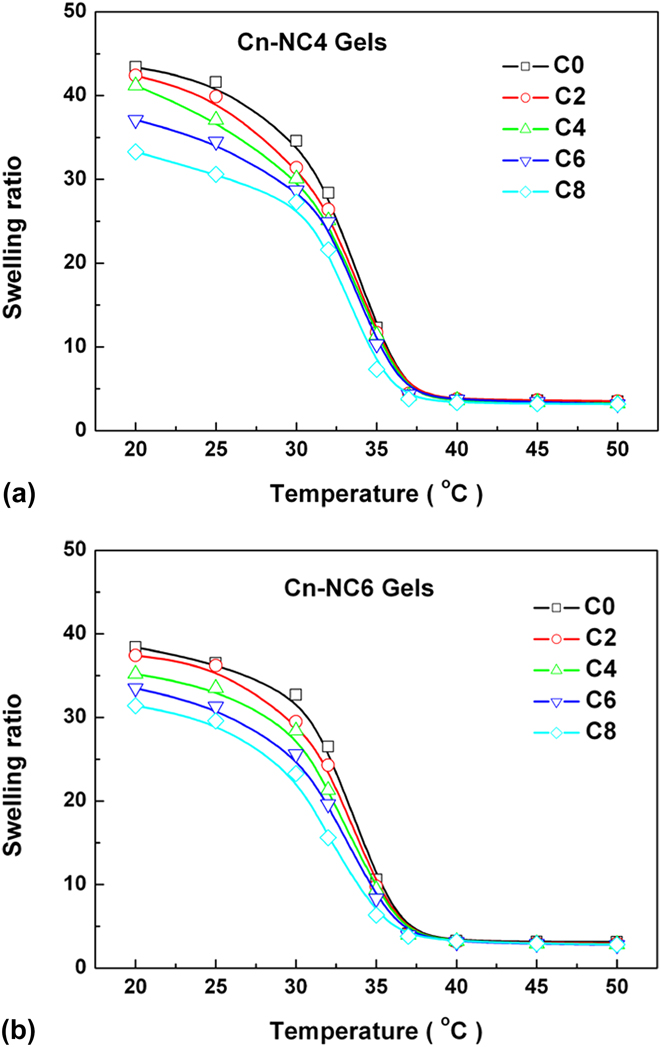
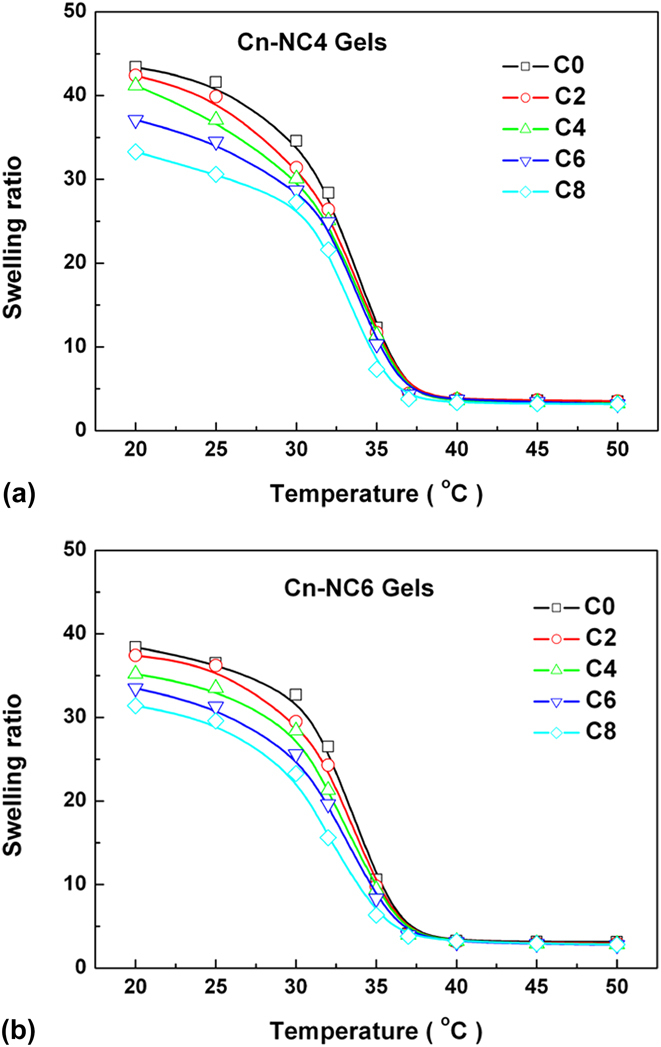
The equilibrium swelling ratio of Cn-NC4 and Cn-NC6 gels as a function of temperature is exhibited in Fig. 4. It was found that the curves for C-NC gels with different contents of NCC are similar, the slight decrease of swelling ratio below the lower critical solution temperature (LCST) is observed with the increase of NCC. The action mechanism of NCC affecting the swelling ratio of gels is complicated. On the one hand, the hydrophobic molecular skeleton of NCC should decrease the whole hydrophilicity of gels' network, the hydrogen bond interaction inter-NCC or between NCC and polymer chains should make the network structure become tighter, both effect against the ability of gels' network to combine with water. On the other hand, the sulfuric ion linked into the cellulose chains through acid hydrolysis should enhance the hydrophilicity of gels, which is conducive to the incorporation of water with gels. The combined action determines the change in swelling ratio of gels. Besides, from the curves, it could be found that the content of NCC makes a slight effect on the LCST of gels basically, indicating the unchanged temperature sensitiveness.
The swelling ratio of (a) Cn-NC4 and (b) Cn-NC6 gels as a function of temperature.
D. The deswelling behavior of C-NC gels
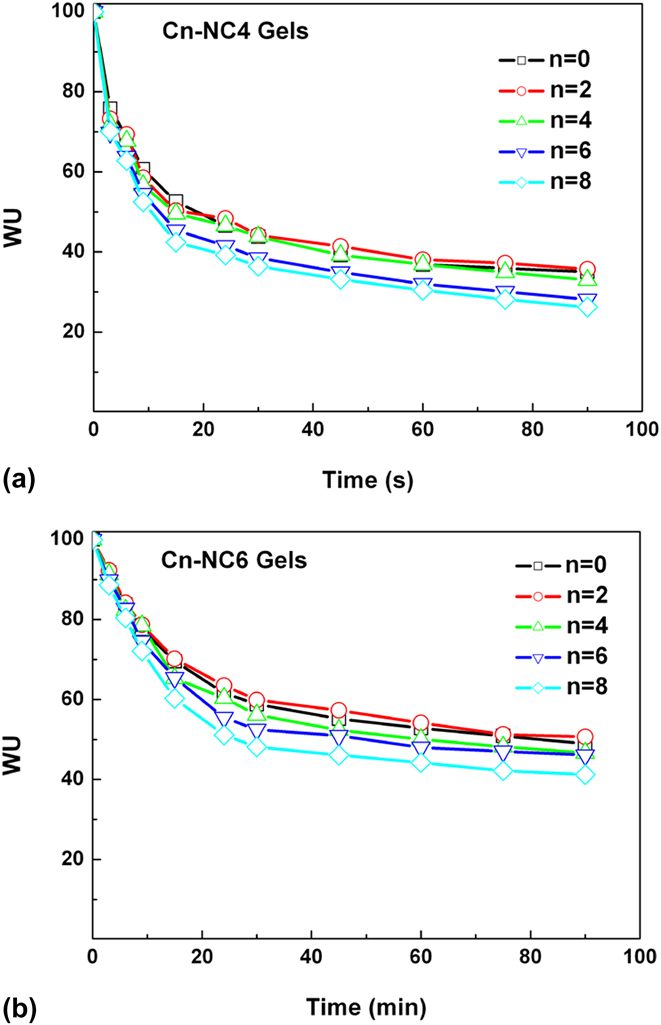
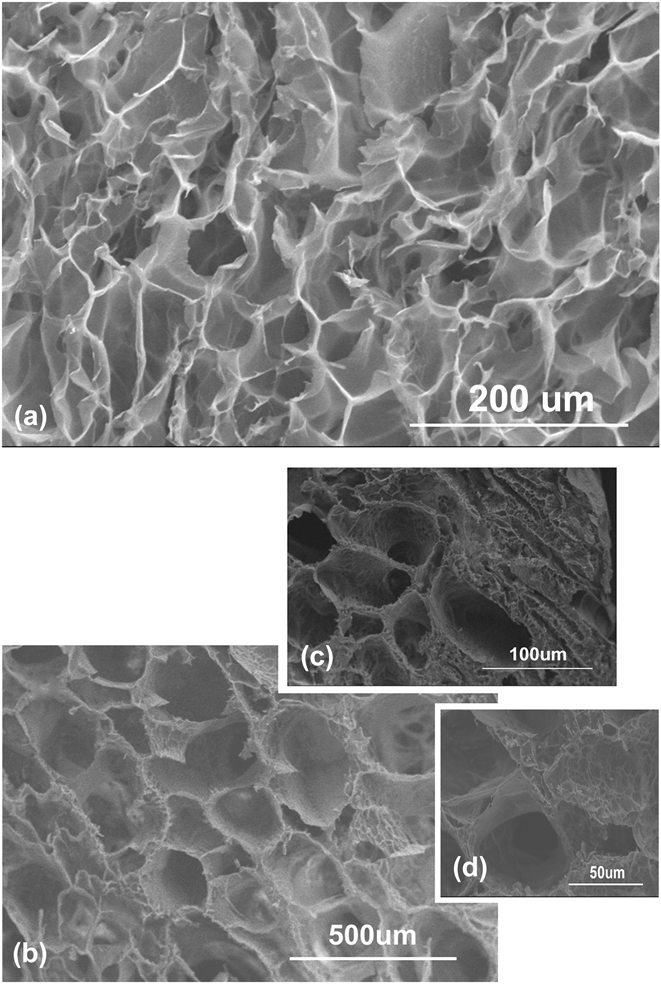
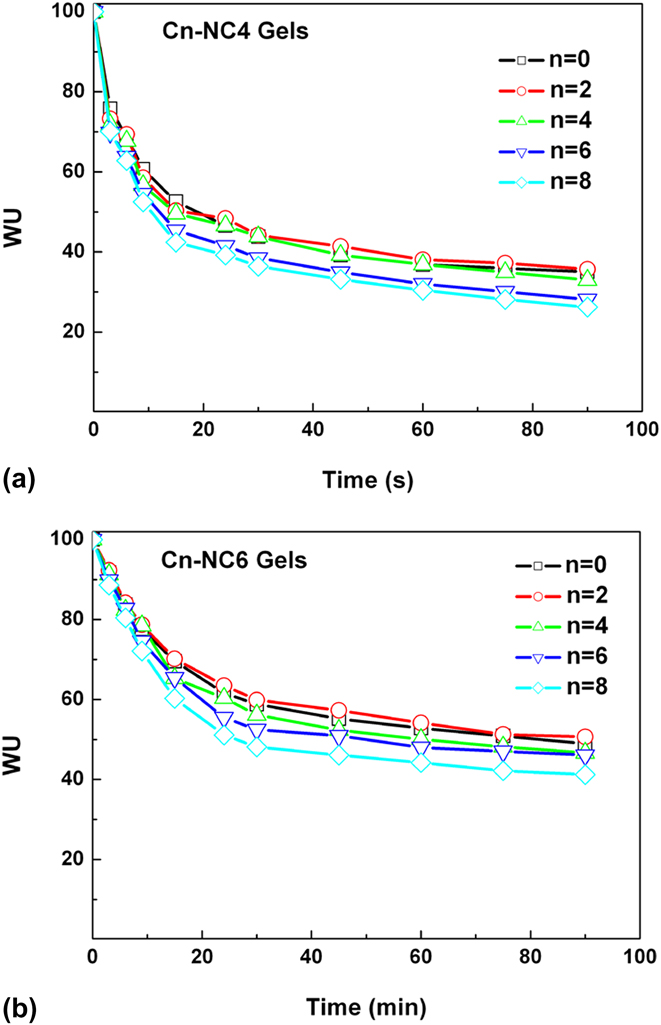
The deswelling behavior of C-NC gels was measured after a temperature jump from equilibrated swollen state at 20 °C to ultrapure water 50 °C. The results are shown in Fig. 5. Surprisingly, for both Cn-C4 and Cn-C6 gels, although the deswelling of NC gels without NCC is already fast, the increase of NCC advances the deswelling rate of gels further, the gels with high content of NCC could lose 70 wt% water within 10 s. For exploring the mechanism, the morphology of C6-NC4 gels' network structure was observed by SEM as a typical example. As shown in Fig. 6, comparing to the NC4 gels without NCC, the network structure of C-NC gels shows a similar macroporous framework structure. Moreover, the interconnected micropores with 5–20 μm pore size increase significantly, being considered as the main reason for the faster deswelling rate. This may be attributed to the formation of ice-crystal around the NCC which acts as a nucleating agent. Meantime, the hydrophilicity of NCC may be another nonignorable reason.
The deswelling rate of (a) Cn-NC4 and (b) Cn-NC6 gels as a function of time.
The SEM image of morphology of (a) C0-NC4 gels, and (b, c, d) C6-NC4 gels with different bars.

E. The mechanical properties of C-NC gels
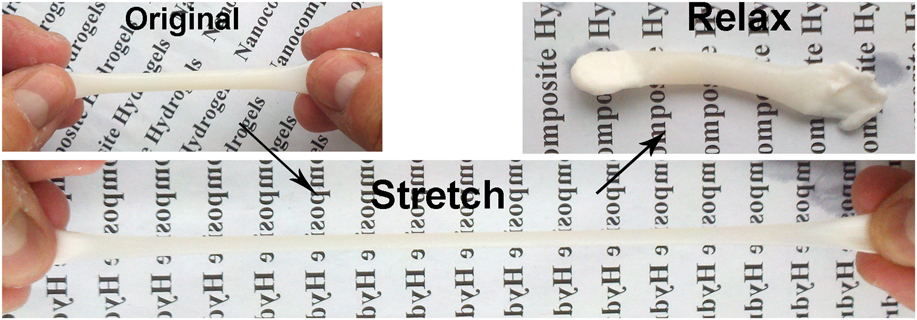
The main target of adding NCC into the gels is to improve the mechanical properties of gels. From the previous study, it has been found that the reinforcing effect of NCC on gels is determined by the interaction between NCC and the formation of NCC network. In this work, when the content of added NCC is higher than 4% of monomer, the C-NC gels exhibit an obviously increased strength and very good elastic resilience when stretching the gels by hand. As shown in Fig. 7, after being stretched to 400% length, the gels could recover to the original length rapidly. This phenomenon indicates that the interaction of NCC provides extra force, which is beneficial to the strength and recovery.
The photos of Cn-NC4 gels under the tensile and relaxation.

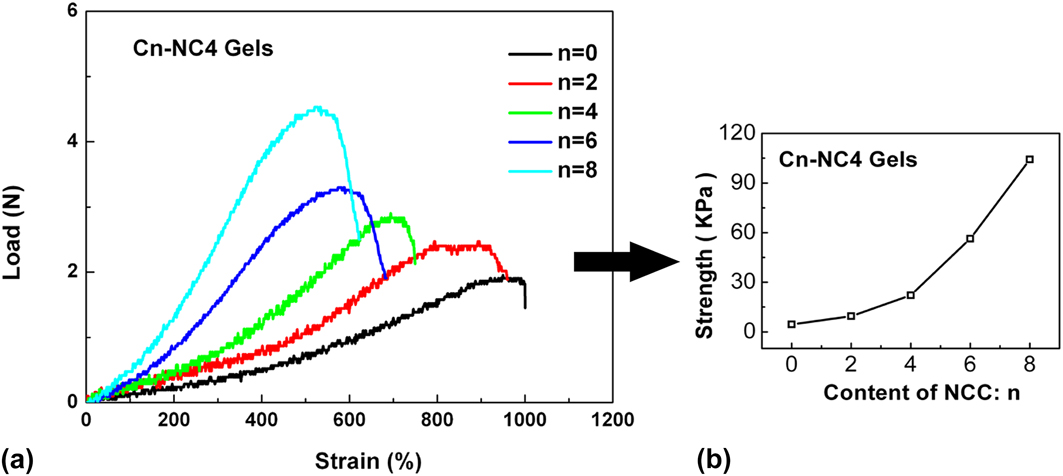
The typical tensile curves of C-NC gels with various contents of NCC are shown in Fig. 8(a). As shown in Fig. 8, the tensile properties of C-NC gels exhibit an obvious dependence on the content of added NCC. With the increase of NCC, the elongation at break decreases and the maximum load increases significantly. For C8-NC4 gels, the maximum load of gels is almost twice as much as that of C0-NC4 gels, but the elongation at break decreases to the half of that of C0-NC4 gels. Moreover, as shown in Fig. 8(b), the strength of gels calculated by the load data of 100 and 200% elongation in curves, respectively, increases from 4 to 100 kPa, revealing a significant reinforcing effect. On the one hand, NCC dispersed in the gels interacts and forms the network sharing the suffered stress, which results in the increased strength. On the other hand, the combination of NCC is destroyed under excessive stretching, and the increased heterogeneity causes the stress concentration, which leads to the earlier break in tensile. Despite that the elongation at break decreases, the advanced strength is still conducive to the application.
The tensile property of Cn-NC4 gels. (a) The stress–strain curves of Cn-NC4 gels under the tensile tests; (b) the strength of Cn-NC4 gels calculated by the data in image (a).

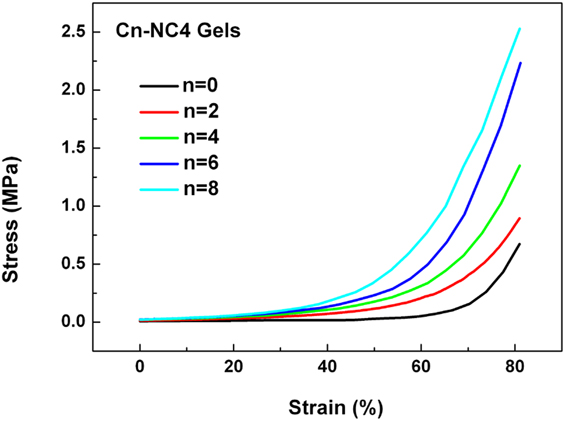
The compression property of C-NC gels was also measured by using a uniaxial compression test. The corresponding stress–strain curves of Cn-NC4 gels with different n under compression (up to 80% compression) are shown in Fig. 9. Obviously, all C-NC gels possess the excellent compression resistance. With the increase of added NCC, the C-NC gels exhibit an earlier strain resistance and higher compression strength at the same strain, which is also ascribed to the effective dispersion of stress by NCC.
The stress–strain curves of Cn-NC4 gels under the compression tests.

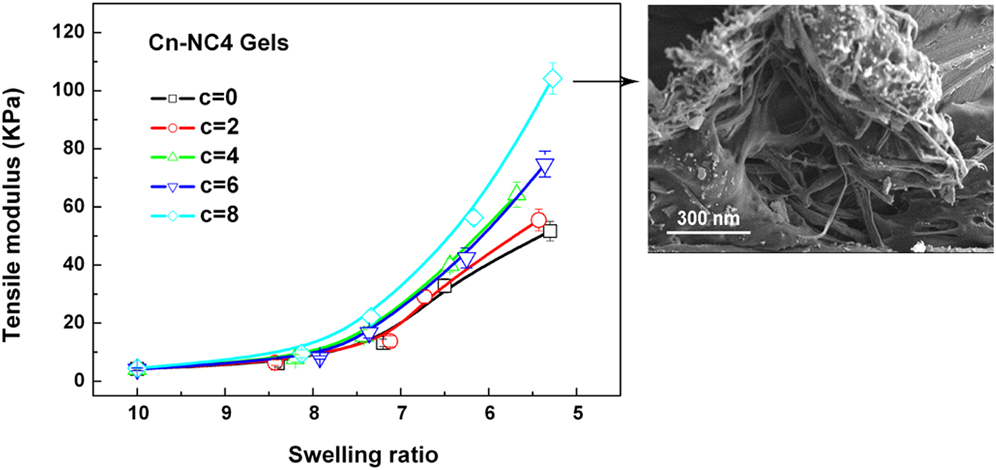
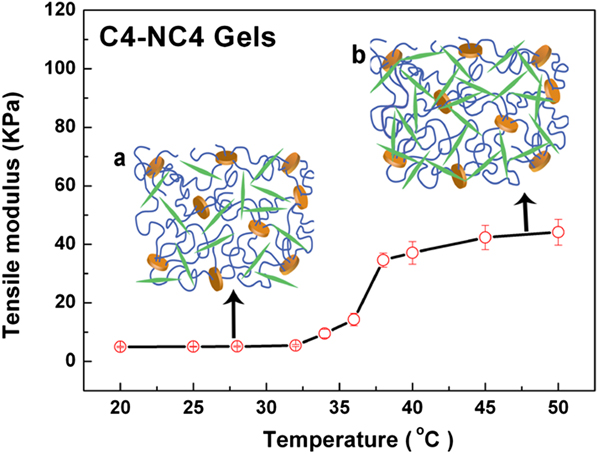
For a further investigation with respect to the interaction between NCC in gels, the tensile modulus of gels with various contents of NCC was measured under the different swelling ratios. As shown in Fig. 10, although that the modulus of Cn-NC4 gels increases considerably with the increased NCC. Comparably, or the gels with the same content of NCC, the gels with lower swelling ratio show a higher modulus, this tendency becomes more obvious in gels with high content of NCC. This result proves that the stronger interaction exists inter-NCC or between NCC and polymers. As reasonably explained, when the swelling ratio of gels is low, the distance between NCC becomes closer, the stronger hydrogen bond interaction exists and makes the modulus of gels increases significantly. Inversely, the increase of modulus is less when the swelling ratio of gels is high, indicating the weak interaction between NCC. The morphology of dissected C-NC gels under the low swelling status was observed by SEM being a direct evidence. As shown in the image, inside the gel's matrix, there exists the obvious combined NCC structure, attributing to the combination of NCC. Considering this feature, the change in tensile modulus of C4-NC4 and C8-NC4 gels at different temperatures was tested and shown in Fig. 11, in the curves, the modulus increases rapidly after the temperature passes across 34 °C corresponding to the LCST of gels. It is also attributed to the decrease of water in gels caused by deswelling, which enhances the interaction of NCC.
The tensile modulus of Cn-NC4 gels as a function of swelling ratio under the tensile tests and the SEM micrograph of C8-NC4 gel with swelling ratio about 5.

The tensile modulus of Cn-NC4 gels as a function of temperature under the tensile tests and the assumptive structure model corresponding to the NCC in gels at different temperatures.

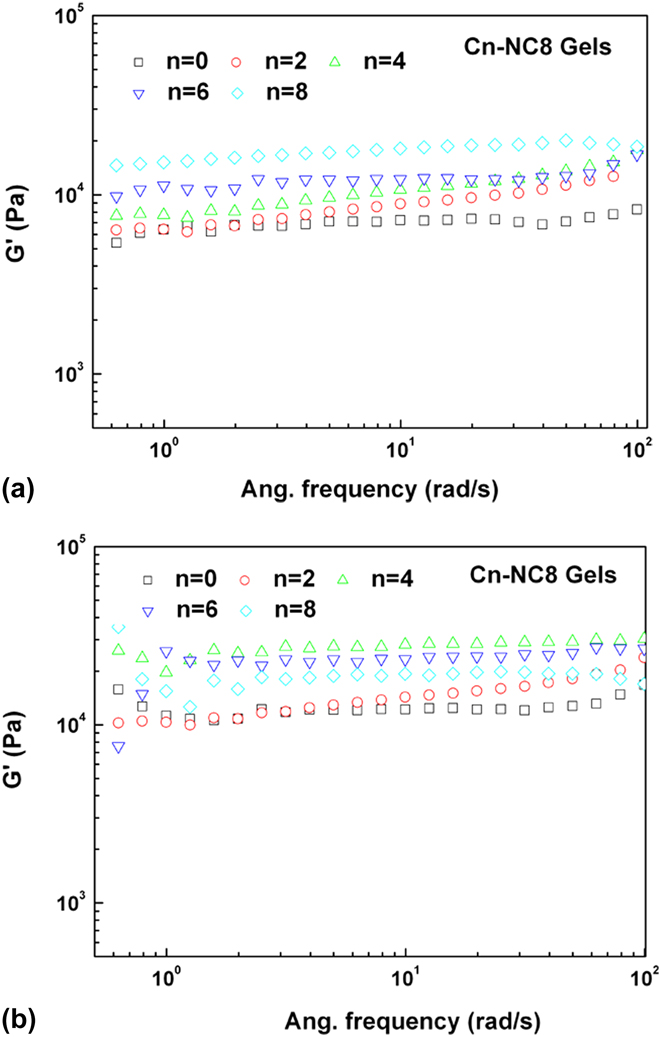
The storage modulus G′ is another parameter corresponding to the strength of gels. The viscoelasticity of gels was measured by using dynamic oscillation shear mode in which the strain was fixed at 1%. As shown in Fig. 12, with the increase of NCC, G′ increases significantly indicating the higher strength and better elasticity, which is consistent with the result of tensile strength. Moreover, the G′ of gels with lower swelling ratio is lower than that of gels with high swelling ratio. This result also supports the conclusion that the combination of NCC in gels reveals the sensitiveness to the swelling ratio of gels.
G′ of Cn-NC8 gels measured under dynamic frequency sweep at fixed strain γ = 1%, which is in linear viscoelasticity region (LVE, in LVE region, the storage modulus G' is greater than loss modulus).

IV. CONCLUSIONS
For improving the properties of responsive hydrogels, nanosized cellulose whisker obtained by acid hydrolysis of cotton was added into the PNIPA gels crosslinked physically by clay through in situ radical polymerization. Freezing polymerization technique was used to provide the gels with fast response rate. The properties of the prepared gels (C-NC gels) show an obvious dependency on the content of added NCC. Several main results were obtained from comprehensive characterization.
Comparing to the gels without NCC, the addition of NCC makes a complicated effect on the swelling behavior and responsive character of gels. Firstly, C-NC gels exhibit similar LCST basically, revealing the unchanged thermo-sensitiveness, which is independent of the NCC content. Secondly, the swelling ratio of gels decreases slightly with the increase of NCC due to the increased hydrophobicity from cellulose molecular chain. Moreover, the deswelling rate of gels increases further with the increase of NCC, the gels with high content of NCC show an ultrarapid deswelling rate, which could lose 70 wt% water within 10 s at 50 °C. This is attributed to that the ice-crystal growth around the NCC makes the gels form with amount of interconnected micropores structure, which is considered as the main reason for the faster deswelling rate.
Moreover, as the main target of adding NCC into the gels, the positive influence of NCC on the mechanical properties of gels is significant. With the increase of NCC, C-NC gels show higher tensile and compressive strength and excellent resilience, while the elongation at break decreases. Meantime, the enhancement effect of NCC is determined by the swelling degree of gels. For the gels with the same content of NCC, the gels with smaller swelling ratio show higher strength and modulus due to the combination of NCC through the stronger hydrogen bond interaction, which is proved by the SEM images.
Comprehensively, NCC hybrid nanocomposite hydrogels consisting of PNIPA and clay synthesized by freezing polymerization exhibit excellent swelling ability, response rate, and mechanical properties, which make this gel potential candidates for applications in drug release, tissue engineering, and other biological fields.
ACKNOWLEDGMENTS
We acknowledge the financial support from the National Natural Science Foundation of China (21104017) and Hunan Province Natural Science Foundation (2015JJ4021).