The increased risk for morbidity and mortality due to cardiovascular causes in patients with chronic kidney disease, particularly in those with end-stage renal disease, is a well-established phenomenon.Reference Parekh, Carrol, Wolfe and Port 1 , Reference Aytaç, Deveci, Bek, Kayabey and Ekinci 2 Previous studies in patients with chronic kidney disease have demonstrated that low levels of 25-hydroxyvitamin-D are associated with endothelial dysfunction and higher cardiovascular mortality compared with normal vitamin-D levels.Reference Chitalia, Recio-Mayoral, Kaski and Banerjee 3 , Reference Pilz, Tomaschitz and Friedl 4 The deficiency of 25-hydroxyvitamin-D has also been linked to left ventricular hypertrophy, hypertension, and inflammation, although the results have been inconsistent.Reference Zittermann, Schleithoff, Tenderich, Berthold, Körfer and Stehle 5 So far, no systematic research has been conducted to investigate the effect of cholecalciferol on cardiovascular status and myocardial function in children with chronic kidney disease.
Tissue Doppler imaging and two-dimensional speckle-tracking echocardiography are relatively new techniques that allow calculation of regional and global myocardial velocities and deformation parameters such as strain and strain rate. Therefore, they provide an objective and quantitative evaluation of global and regional myocardial function independently of any geometrical assumption. Two-dimensional speckle-tracking echocardiography is the most sensitive echocardiographic tool for detecting the subclinical myocardial dysfunction observed in many conditions predisposing to heart failure.Reference Geyer, Caracciolo and Abe 6 Because it does not depend on the Doppler angle, as in tissue Doppler imaging, two-dimensional speckle-tracking echocardiography allows assessment of strain and strain rate analyses along different myocardial axes – that is, longitudinal, circumferential, and radial.Reference Hassanin and Alkemary 7
In this study, we aimed to examine the effect of oral cholecalciferol on early echocardiographic signs of left ventricular systolic dysfunction in children with chronic kidney disease compared with controls.
Materials and methods
Patient characteristics
Patients between 3 and 20 years of age with chronic kidney disease who attended the outpatient clinics of the department of paediatric nephrology were enrolled in this study. Baseline serum 25-hydroxyvitamin-D levels were obtained during clinical visits. According to the Kidney Disease Outcomes Quality Initiative Clinical Practice Guidelines for Bone Metabolism in Children with Chronic Kidney Disease, 25-hydroxyvitamin-D levels between 16 and 30 ng/ml indicate vitamin-D insufficiency, whereas a value <15 ng/ml indicates vitamin-D deficiency. Mild and severe forms of vitamin-D deficiency were defined as levels between 5 and 15 ng/ml and <5 ng/ml, respectively. 8 The glomerular filtration rate was estimated using the Schwartz formula.Reference Schwartz, Brion and Spitzer 9 Chronic kidney disease stage was then graded according to the glomerular filtration rate based on the guidelines of the current Kidney Disease Outcomes Quality Initiative. 10
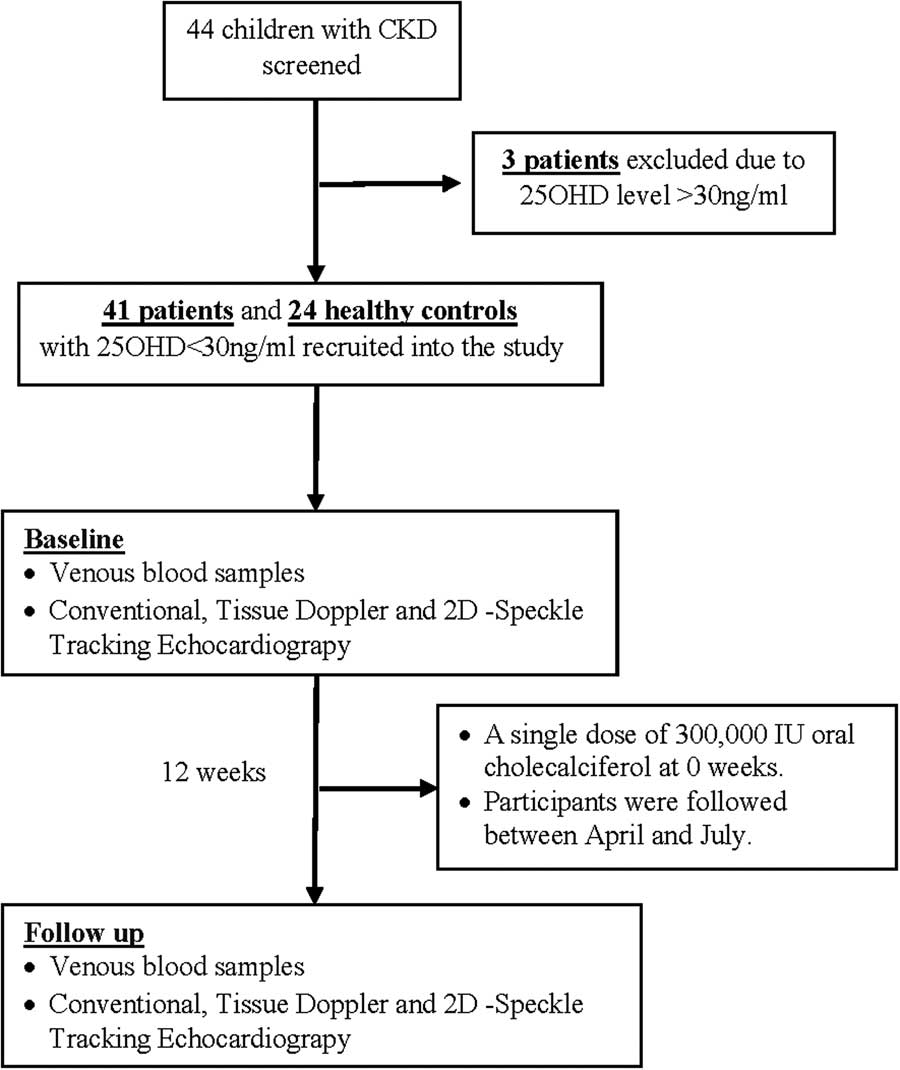
Patients known to have active inflammation, structural or CHD, or malignancy were excluded from the study. On the basis of the aforementioned criteria, 44 children with chronic kidney disease were initially investigated. We enrolled 24 children with low 25-hydroxyvitamin-D levels (<30 ng/ml) who were free of any underlying cardiac or renal disease as the control group. Age, gender, dialysis modality used, primary kidney disease, duration of chronic kidney disease, and requirement of dialysis were reviewed from patient files. After baseline evaluation of biochemical and echocardiographic parameters, 41 patients with chronic kidney disease and low levels of 25-hydroxyvitamin-D, and 24 vitamin-D-deficient children, were supplemented with a single dose of 300,000 IU oral cholecalciferol. Biochemical and echocardiographic assessments were repeated after 12 weeks.
Conventional echocardiography
A single operator obtained transthoracic echocardiography recordings from all subjects, at rest in a left lateral decubitus position, using a standard commercial ultrasound machine (Vivid 7; GE Vingmed Ultrasound AS, Horten, Norway) with a 4 MHz transducer. B-mode greyscale images were obtained from apical four-, three-, and two-chamber views as well as from the parasternal short-axis view – that is, at the level of the papillary muscle – based on the recommendations of the American Society of Echocardiography.Reference Lang, Bierig and Devereux 11
Left ventricular M-mode images were obtained from two-dimensional images with parasternal long-axis views. Interventricular septal thicknesses, left ventricular posterior wall thicknesses, and internal left ventricular diameters in all patients were measured according to the recommendations of the American Society of Echocardiography. Left ventricular systolic functions were measured using shortening fraction, ejection fraction, and myocardial performance index.
The myocardial performance index is defined as the ratio of isovolumic time divided by ejection time. Left ventricular filling patterns were evaluated on the apical four-chamber view using pulsed-wave Doppler echocardiography with the sample volume located between the tips of the mitral valve leaflets during diastole. Early diastolic flow (E-wave) and late diastolic flow (A-wave) velocities as well as the E/A ratio were calculated from recordings, and the deceleration time of the E-wave was measured. Early diastolic (E’-wave), late diastolic (A’-wave), and systolic (S’-wave) velocities were measured at the lateral parts of the mitral annuli on apical four-chamber views using pulsed-wave tissue Doppler imaging.Reference Altun, Babaoğlu, Binnetoğlu, Özsu, Yeşiltepe Mutlu and Hatun 12
Two-dimensional speckle-tracking echocardiography
Greyscale images were recorded from the left ventricle using apical four-, three-, and two-chamber views as well as from the parasternal short-axis view – that is, at the papillary muscle level – at a frame rate of 60–90 frames per second with an image sector angle of 30–60°. At least three consecutive cardiac cycles triggered by the R-wave of the QRS complex were recorded. The stored data were transferred to a computer workstation for offline analysis using dedicated software (EchoPAC version 6.1.0; GE Vingmed Ultrasound AS).
The endomyocardial borders of the left ventricle were marked manually at the end of systole. Epicardial marking was carried out automatically by the computer. These borders were refined manually, to enclose the myocardium where required. Analysis was conducted for left ventricular longitudinal, radial, and circumferential peak systolic strain and strain rate from the above-mentioned echocardiographic views. Each segment of the left ventricle was divided into basal, mid, and apical portions. The left ventricular global systolic strain was calculated as the average value obtained from six segments. Intra- and inter-observer variability for longitudinal, circumferential, or radial regions was analysed in 10 randomly selected echocardiographic examinations and expressed as the mean percentage error – that is, difference/mean.Reference Altun, Babaoğlu, Binnetoğlu, Özsu, Yeşiltepe Mutlu and Hatun 12
Laboratory measurements
Venous blood samples were collected in the morning after an overnight fast (⩾8 hours). At baseline, serum levels of creatinine, blood urea nitrogen, glucose, albumin, calcium, phosphorus, alkaline phosphatase, total cholesterol, triglyceride, low-density lipoprotein, high-density lipoprotein, intact parathyroid hormone, and 25-hydroxyvitamin-D were measured. C-reactive protein and fibrinogen were evaluated for inflammatory activation. Blood sample collection and cardiovascular measurements were carried out 1 day before haemodialysis.
Statistical analysis
Data were expressed as mean±standard deviation for continuous and normally distributed variables and as median with interquartile ranges for skewed variables. Student’s t-test or the Mann–Whitney U-test was used to compare the groups, and one-way analysis of variance or Kruskal–Wallis tests were used for comparison of multiple categories. A significant difference between pre- and post-cholecalciferol supplementation was determined using the paired t-test or the Wilcoxon test. Multiple regression analysis revealed independent risk factors. SPSS 22.0 was used for analysis, and a p value of 0.05 or lower was considered statistically significant.
Results
A total of 44 patients with chronic kidney disease (24 girls) were screened, and 41 (93.2%) patients were found to have low levels of 25-hydroxyvitamin-D. In all, 13 (29.6%) had insufficiency and 23 (52.3%) had mild deficiency. Severe vitamin-D deficiency was detected in five patients (11.3%). Therefore, 41 patients with chronic kidney disease (23 girls) and 24 control subjects with low 25-hydroxyvitamin-D levels were enrolled in this study (Fig 1).
Flow chart of the study protocol. 2D=two dimension; CKD=chronic kidney disease; 25OHD=25-hydroxyvitamin D.

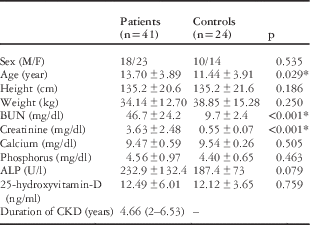
Of the 41 children with chronic kidney disease, seven were on haemodialysis, seven were on peritoneal dialysis, and 27 were not receiving any form of renal replacement therapy. The baseline mean 25-hydroxyvitamin-D value was similar in both patient and control groups (12.4 versus 12.1 ng/ml, respectively; p=0.759). In the patient group, there was no significant difference in vitamin-D levels between dialysis and predialysis samples (p=0.351). Children with chronic kidney disease had significantly higher intact parathyroid hormone (p<0.001); however, serum levels of calcium (p=0.5), phosphorus (p=0.269), alkaline phosphatase (p=0.079), and calcium–phosphorus product (p=0.652) did not differ between patients and controls (Table 1).
Basal clinical characteristics of the study groups.

ALP=alkaline phosphatise; BUN=blood urea nitrogen; CKD=chronic kidney disease; F=female; M=male
*Statistically significant
After cholecalciferol supplementation, serum vitamin-D levels increased significantly in the patient and control groups. The mean 25-hydroxyvitamin-D level increased from 12.4 to 30.6 ng/ml in patients (p<0.001) and from 12.1 to 35.4 ng/ml in controls (p<0.001). There was no significant change in the blood levels of phosphorus, intact parathyroid hormone, and calcium–phosphorus product between the groups when pre- and post-supplementation levels were compared. Systolic and diastolic blood pressure and haemoglobin concentration also remained stable.
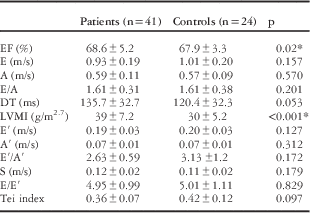
Conventional and tissue Doppler imaging echocardiography revealed no between-group differences of left ventricular mass index (Table 2). Initial left ventricular mass index was significantly higher in patients and improved significantly after vitamin-D supplementation (39 and 37, respectively; p=0.42); however, no significant change was observed for the control group.
M-mode echocardiographic measurements, pulsed-wave, and tissue Doppler results in the study groups.

A=atrial diastolic flow; A′=late diastolic myocardial velocity; DT=deceleration time; E=early diastolic flow; E′=early diastolic myocardial velocity; EF=ejection fraction; LVMI=left ventricular mass index; S=systolic myocardial velocity
*Statistically significant
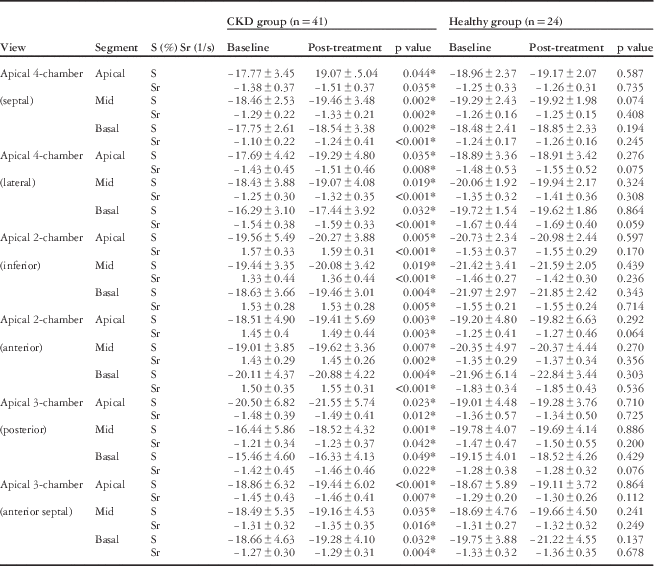
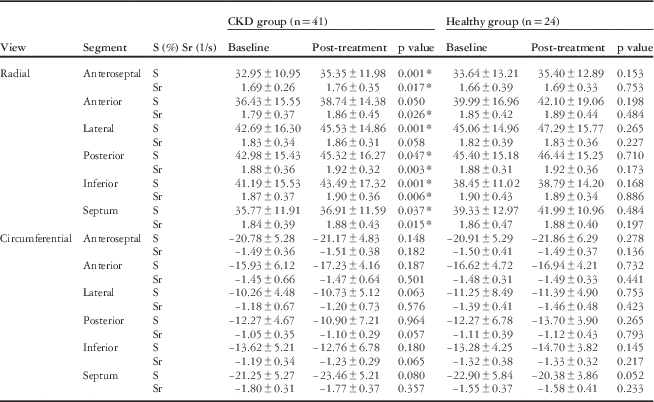
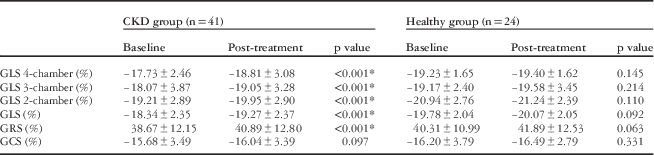
Initial longitudinal and radial strain and strain rate values of the left ventricle were significantly lower in patients with chronic kidney disease; after vitamin-D supplementation, these improved significantly in patients with chronic kidney disease, whereas no significant change was observed in the control group (Tables 3 and 4). Similarly, global longitudinal and radial strain values of the left ventricle were significantly lower among patients with chronic kidney disease than in the control group, and improved in patients with chronic kidney disease after vitamin-D supplementation; however, no significant change was seen in the control group (Table 5).
Comparison of left ventricle longitudinal strain (S) and strain rate (Sr) values.

CKD=chronic kidney disease
*Statistically significant
Comparison of left ventricle radial and circumferential strain (S) and strain rate (Sr) values.

CKD=chronic kidney disease
*Statistically significant
Comparison of left ventricle global strain values.

CKD=chronic kidney disease; GCS=global circumferential strain; GLS=global longitudinal strain; GRS=global radial strain
*Statistically significant
Discussion
This interventional clinical study showed that, although conventional and tissue Doppler imaging methods could not determine any effect, two-dimensional speckle-tracking echocardiography revealed the favourable effects of high-dose cholecalciferol supplementation on cardiac mechanics, implying the importance of vitamin-D supplementation in children with chronic kidney disease. Recurrent heart failure and sudden cardiac death are the leading causes of cardiovascular mortality in patients with chronic kidney disease. This might be caused by uraemic cardiomyopathy, a common complication in patients with end-stage renal disease, characterised by cardiac fibrosis, capillary rarefaction, left ventricular hypertrophy, and both systolic and diastolic dysfunction.Reference Green, Roberts, New and Kalra 13 – Reference Mitsnefes, Daniels, Schwartz, Meyer, Khoury and Strife 16 Numerous factors have been implicated in the development of cardiac abnormalities, such as hypertension, disorders of calcium–phosphorus metabolism, dysregulation of the renin–angiotensin–aldosterone system, as well as elevated serum levels of intact parathyroid hormone and homocysteine.Reference Aytaç, Deveci, Bek, Kayabey and Ekinci 2 , Reference Mitsnefes, Kimball and Kartal 17 , Reference Mitsnefes, Kimball and Kartal 18
Most reports have indicated that diastolic dysfunction precedes systolic dysfunction in many conditions affecting the cardiovascular system. More recent studies have proposed that isolated diastolic dysfunction is rare and is often associated with subclinical systolic dysfunction, which can be identified using tissue Doppler and strain echocardiography in adult patients with chronic kidney disease. There are few studies on subclinical systolic dysfunctions in young adults, children, and adolescents with chronic kidney disease; therefore, the available data are limited. To our knowledge, this is the first study to assess the utility of two-dimensional speckle-tracking echocardiography in children with chronic kidney disease and in controls with vitamin-D deficiency. Further, our study includes results for these parameters after vitamin-D supplementation.
As vitamin-D deficiency has been found to be very prevalent in children with chronic kidney disease, numerous studies have been conducted previously to examine the effect of vitamin-D treatment on bone mineral metabolism or cardiac functions.Reference Ali, Arguelles, Langman and Price 19 – Reference Mehrotra, Kermah and Salusky 21 Receptors for activated vitamin-D are spread along various types of cells, including osteoblasts, parathyroid cells, renal tubular epithelium, lymphocytes, vascular smooth muscle, and myocardial cells.Reference O’Connell and Simpson 22 25-hydroxyvitamin-D has been demonstrated to preserve cardiac function by preventing myocardial hypertrophy, either by ameliorating intact parathyroid hormone secretion or by acting via vitamin-D-dependent mechanisms, suppression of vascular smooth muscle cell proliferation, and modulation of the renin–angiotensin–aldosterone system.Reference Kim, Park and Shin 23 Most paediatric studies have revealed a significant relationship between left ventricular hypertrophy and low haemoglobin, elevated intact parathyroid hormone, and systemic hypertension.Reference Mitsnefes, Daniels, Schwartz, Meyer, Khoury and Strife 16 , Reference Mitsnefes, Kimball and Kartal 18 In recent years, Patange et alReference Patange, Valentini, Du and Pettersen 15 had demonstrated low 25-hydroxyvitamin-D to be an independent risk factor for increased arterial stiffness and increased left ventricular mass index. Marked regression of left ventricular hypertrophy after supplementation with nutritional vitamin-D has already been reported in adult patients with chronic kidney disease.Reference Matias, Jorge and Ferreira 24 The significant decrease in left ventricular mass index in our patients with chronic kidney disease, without any significant change in systolic blood pressure, serum intact parathyroid hormone level, and haemoglobin concentration, highlighted the importance and potential beneficial effects of cholecalciferol on the cardiovascular system.
Development of two-dimensional speckle-tracking echocardiography has facilitated the simple and angle-independent measurement of left ventricular myocardial deformation in the longitudinal, circumferential, and radial directions. Various studies have shown that two-dimensional speckle-tracking echocardiography can detect subtle changes in regional myocardial function in a wide spectrum of myocardial diseases at an earlier stage, compared with conventional methods.Reference Adamu, Schmitz, Becker, Kelm and Hoffman 25 , Reference Saghir, Areces and Makan 26 Increasing data suggest that longitudinal strain is a strong predictor of adverse outcome in patients with different cardiovascular diseases.Reference Lagies, Beck and Hoppe 27 Strain analysis enables early detection of subtle changes in myocardial function in the chronic kidney disease population as well. In asymptomatic clinical states, from the cardiovascular perspective, in patients with chronic kidney disease who have preserved left ventricular ejection fraction, very few studies have attempted to identify subclinical markers of myocardial disease using two-dimensional speckle-tracking echocardiography. We found significant impairment of left ventricular radial and longitudinal, but not circumferential, strains in chronic kidney disease patients compared with the control group. This study demonstrated subclinical systolic dysfunction in patients with left ventricular hypertrophy despite normal left ventricular ejection fraction in all chronic kidney disease stages.
In general, longitudinal left ventricular mechanics, which are predominantly governed by the sub-endocardial region, are the most vulnerable component of left ventricular mechanics and, therefore, most sensitive to the presence of myocardial disease. Mid-myocardial and epicardial function may remain relatively unaffected initially and, therefore, circumferential strain may remain normal or manifest exaggerated compensation for preserving left ventricular systolic performance.Reference Hassanin and Alkemary 7 The present study showed that left ventricular longitudinal and radial functions are impaired in asymptomatic children and adolescents with chronic kidney disease who have normal left ventricular ejection fraction. On the basis of these findings, two-dimensional speckle-tracking echocardiography may be potentially useful in the early detection of myocardial dysfunction in the asymptomatic population with chronic kidney disease. In chronic kidney disease, although the longitudinal and radial systolic functions were reduced, left ventricular ejection fraction may remain within normal limits because of the preservation of the circumferential functions. Two-dimensional speckle-tracking echocardiography can detect the severity of uraemic cardiomyopathy in the early stages of the disease, might provide useful information for risk stratification, and could guide not only the intensity but also the appropriate time for the implementation of dialysis therapy.Reference Hassanin and Alkemary 7
In our study, neither conventional and tissue Doppler imaging echocardiography nor two-dimensional speckle-tracking echocardiography revealed any impairment in cardiac functions in vitamin-D-deficient controls. In a recent study, Sunbul et alReference Sunbul, Bozbay and Mammadov 28 demonstrated that left ventricular global longitudinal strain, global radial strain, and global circumferential strain values were improved after vitamin-D supplementation in subjects with vitamin-D deficiency. A total of 50 adult patients (mean age 42.6±8.9 years) were included in that study and they may have been vitamin-D deficient for many years. Therefore, the duration of the vitamin-D-deficient period may be a risk factor in otherwise healthy individuals.
We used a single large dose of cholecalciferol supplementation, which has been found to be safe and effective in previous studies.Reference Hari, Gupta, Hari, Gulati, Mahajan and Bagga 29 , Reference Belostotsky, Mughal and Webb 30 Hypercalcaemia, hyperphosphataemia, and deterioration in renal function were not observed.
Limitations of the study
Our study has some limitations. The number of participants included in the study was relatively small compared with that in others. We did not evaluate serum levels of 1,25-hydroxyvitamin-D and fibroblast growth factor-23. Further, the study period was not long enough to assess the long-term effects of cholecalciferol. In addition, we did not measure markers for cardiac injury such as troponin T and N-terminal pro-brain natriuretic peptide.
Conclusion
In conclusion, we demonstrated that high-dose oral cholecalciferol therapy improves subtle left ventricular systolic dysfunction in children with chronic kidney disease who have low 25-hydroxyvitamin-D levels. It seems important to maintain serum 25-hydroxyvitamin-D within adequate levels to decrease cardiovascular morbidity and mortality in children with chronic kidney disease. Careful monitoring of subtle left ventricular systolic dysfunction using two-dimensional speckle-tracking echocardiography may help in the selection of the type of renal replacement therapy and in the optimal timing of transplantation to improve survival. Further studies with larger cohorts are needed to confirm our findings.
Acknowledgement
None.
Financial Support
This research received no grant from any funding agency in the public, commercial, or not-for-profit sectors.
Conflicts of Interest
None.
Ethical Standards
All procedures performed were in accordance with the ethical standards of the Kocaeli University Research Committee and with the 1964 Helsinki declaration and its later amendments or comparable ethical standards.