Introduction
Early studies of the effects of childhood adversities (CAs) on long-term mental health focused on a single CA, such as parental death, sexual abuse or neglect (Fristad et al. Reference Fristad, Jedel, Weller and Weller1993; Fergusson et al. Reference Fergusson, Horwood and Lynskey1996; Wark et al. Reference Wark, Kruczek and Boley2003), and one mental disorder, usually depression (Brown et al. Reference Brown, Bifulco and Harris1987; Comijs et al. Reference Comijs, Beekman, Smit, Bremmer, van Tilburg and Deeg2007). Subsequent studies revealed that CAs are frequently concurrent (Ney et al. Reference Ney, Fung and Wickett1994; Dong et al. Reference Dong, Anda, Felitti, Dube, Williamson, Thompson, Loo and Giles2004) and exert non-specific effects across multiple outcomes (Kessler et al. Reference Kessler, Davis and Kendler1997; Arata et al. Reference Arata, Langhinrichsen-Rohling, Bowers and O'Brien2007; Collishaw et al. Reference Collishaw, Pickles, Messer, Rutter, Shearer and Maughan2007; McLaughlin et al. Reference McLaughlin, Green, Gruber, Sampson, Zaslavsky and Kessler2009). To avoid overestimating the effects of particular CAs (Mullen et al. Reference Mullen, Martin, Anderson, Romasn and Herbison1996; Kessler et al. Reference Kessler, Davis and Kendler1997; Finkelhor et al. Reference Finkelhor, Ormrod and Turner2007), retrospective investigations of the joint effects of multiple CAs documented dose–response relationships between the number of CAs and adult mental problems (Dube et al. Reference Dube, Anda, Felitti, Chapman, Williamson and Giles2001; Edwards et al. Reference Edwards, Holden, Felitti and Anda2003; Dong et al. Reference Dong, Anda, Felitti, Williamson, Dube, Brown and Giles2005). However, the assumption in such studies that CAs had equivalent and additive effects has been challenged (Kessler et al. Reference Kessler, McGonagle, Zhao, Nelson, Hughes, Eshleman, Wittchen and Kendler1994, Reference Kessler, Davis and Kendler1997; Schilling et al. Reference Schilling, Aseltine and Gore2008). Moreover, the effects of CAs might attenuate with the age of individuals who had them before (Dube et al. Reference Dube, Miller, Brown, Giles, Felitti, Dong and Anda2006; Schilling et al. Reference Schilling, Aseltine and Gore2008). These findings call for the prospective longitudinal study of a variety of CAs in children, but such a research design is limited by cost and attrition of subjects.
Although the establishment of the People's Republic of China had witnessed many devastating sociopolitical upheavals that almost certainly affected family life and individual development, CA and psychic trauma such as sexual abuse and neglect are relatively new professional concepts in China. Many CAs previously represented a taboo subject in China, and there is a common belief that strong family values protected Chinese individuals against CAs and adult psychopathology (Chen et al. Reference Chen, Wong, Lee, Chan-Ho, Lau and Fung1993). Studies on CAs in China only appeared in the late 1990s. Although greater cultural tolerance of childhood maltreatment and stigma about reporting of CAs could hamper such studies (Chen et al. Reference Chen, Dunne and Han2004; Qiao & Chan, Reference Qiao and Chan2005), their findings suggested that CAs were common and negatively associated with mental health status. These studies drew on school or clinical samples and often focused on only childhood abuse (Kim et al. Reference Kim, Kim, Park, Zhang, Lu and Li2000; Chen et al. Reference Chen, Dunne and Han2004, Reference Chen, Zhang, Zhang and Feng2008; Chen, Reference Chen2005; Sun et al. Reference Sun, Duan, Sun, Yi, Gao and Wang2005; Zhu et al. Reference Zhu, Li, Liang and Wei2006 a, Reference Zhu, Liang, Li, Wei and Tianb; Cao et al. Reference Cao, Yu, Xu and Jiao2007; Xu et al. Reference Xu, Jiao, Cao and Yu2007). They usually used rating scales to measure psychopathology without examining specific disorders (Zhu et al. Reference Zhu, Li, Liang and Wei2006 a, Reference Zhu, Liang, Li, Wei and Tianb; Chang & Wang, Reference Chang and Wang2008; Luo et al. Reference Luo, Parish and Laumann2008; Xie et al. Reference Xie, Tang, Chang and Deng2008; Wong et al. Reference Wong, Leung, Tang, Chen, Lee and Ling2009). The Chinese World Mental Health (WMH) survey in Beijing and Shanghai included measures of six categories of family CAs (FCAs) and a spectrum of 15 mental disorders. Using several competitive multivariate statistical models, the present study aimed to examine the separate and joint effects of a variety of FCAs on the first onset of mental disorders in a Chinese population.
Method
Training and assessment of interviewers, sampling, field procedure and quality control of this study were undertaken according to the standardized procedures of the surveys conducted by all participants of the World Mental Health (WMH) Survey Initiative (www.hcp.med.harvard.edu/wmh/; Kessler et al. Reference Kessler, Berglund, Chiu, Demler, Heeringa, Hiripi, Jin, Pennell, Walters, Zaslavsky and Zheng2004; Shen et al. Reference Shen, Zhang, Huang, He, Liu, Cheng, Tsang, Lee and Kessler2006; Lee et al. Reference Lee, Tsang, Zhang, Huang, He, Liu, Shen and Kessler2007; Heeringa et al. Reference Heeringa, Wells, Hubbard, Mneimneh, Chiu, Sampson, Berglund, Kessler and Üstün2008; Pennell et al. Reference Pennell, Mneimneh, Bowers, Chardoul, Wells, Viana, Dinkelmann, Gebler, Florescu, He, Huang, Tomov, Vilagut, Kessler and Üstün2008).
Sample
The survey was based on a multi-stage clustered area probability sample of household-dwelling adults aged 18–70 years in the metropolitan areas of Beijing (n=2633) and Shanghai (n=2568). The demographic distribution of the sample was weighted with census data (male: 52.6%, female: 47.3%; age 18–29 years: 27.3%, 30–39: 22.4%, 40–49: 21.9%, 50–59: 11.8%, 60–70: 15.6%; education 0–8 years: 17.1%, 9–11: 27.9%, 12: 26.1%, 13–15: 17.4%, ⩾16: 11.5% (Shen et al. Reference Shen, Zhang, Huang, He, Liu, Cheng, Tsang, Lee and Kessler2006). The 5201 face-to-face interviews were administered by trained lay-interviewers at respondents' homes between November 2001 and February 2002. The response rate was 74.8% in Beijing and 74.6% in Shanghai. The interview schedule was divided into two parts to allow early termination of a representative subsample of respondents with no evidence of lifetime psychopathology. Part 1 was administered to all 5201 respondents to diagnostically assess core DSM-IV mental disorders. Those who met criteria for at least one mental disorder during the Part-1 interview and a 25% probability subsample of other Part-1 respondents (n=1628) received the Part-2 interview. The Part-1 sample was weighted to adjust for differential probabilities of selection within households and for differences in intensity of recruitment effort among hard-to-recruit respondents. A second weight was applied to the Part-2 subsample to adjust for the lower selection probabilities for Part-1 respondents without a mental disorder (Shen et al. Reference Shen, Zhang, Huang, He, Liu, Cheng, Tsang, Lee and Kessler2006; Heeringa et al. Reference Heeringa, Wells, Hubbard, Mneimneh, Chiu, Sampson, Berglund, Kessler and Üstün2008). This study was approved by ethics committees of the local institutions and all respondents provided written informed consent.
Measures
Mental disorder diagnoses were based on the WMH 3.0 version of the World Health Organization (WHO) Composite International Diagnostic Interview (WMH-CIDI; Kessler & Üstün, Reference Kessler and Üstün2004). This instrument was translated into Chinese using the standard WHO protocol in which a team of survey experts completed the initial translation and a separate team carried out an independent back-translation to ensure preservation of the meaning of the original English version. Discrepancies between translation and back-translation were adjusted. Blind clinical reappraisal interviews were administered to Chinese psychiatric patients and normal controls. WMH-CIDI diagnoses exhibited good concordance with diagnoses generated by semi-structured diagnostic interview schedules (Huang et al. Reference Huang, Liu, Zhang, Shen, Tsang, He, Lee, Kessler and Üstün2008).
Generating diagnoses according to the definitions of the DSM-IV diagnostic systems (APA, 1994), the WMH-CIDI measured four disorder groups encompassing 15 specific disorders: anxiety disorders (panic disorder, generalized anxiety disorder, specific phobia, social phobia, post-traumatic stress disorder and separation anxiety disorder), mood disorders (major depressive disorder, dysthymia and bipolar disorder), impulse-control disorders (intermittent explosive disorder, conduct disorder) and substance use disorders (alcohol abuse, alcohol dependence with abuse, drug abuse, drug dependence with abuse). The age-of-onset (AOO) of disorders was investigated retrospectively. As retrospective AOO reports may be inaccurate (Simon & VonKorff, Reference Simon and VonKorff1995), we used a special question sequence that experimental research has shown to yield more plausible responses than standard age-of-onset questions (Knauper et al. Reference Knauper, Cannell, Schwarz, Bruce and Kessler1999). This began with questions designed to emphasize the importance of accurate response: ‘Can you remember your exact age the very first time (emphasis in original) when you had (the symptom/the syndrome)?’ Respondents who answered ‘no’ were probed for a bound of uncertainty by moving up the age range incrementally (e.g. ‘Was it before you went to school?’ and ‘Was it before you entered your teenage years?’). To produce a conservative estimate, onset was set at the upper end of the bound of uncertainty (e.g. ‘age 20’ was recorded when a respondent reported 15–20 years).
Twelve FCAs occurring before 18 years of age were dichotomously measured in the Part-2 sample. They included parental death, divorce and other parental loss, parents' substance abuse, other parents' mental disorders, parents' criminality and marital violence, childhood physical abuse, sexual abuse and neglect, serious respondent physical illness and family economic adversity. Besides parental death, parental divorce and other parental separations (adoption, foster placement, living with other relatives instead of parents) were included in the assessment of interpersonal losses in the baseline WMH survey. The latter also had measures for parental criminality, family economic adversity and sexual abuse. The Family History Research Diagnostic Criteria Interview (Endicott et al. Reference Endicott, Andreasen and Spitzer1978) and its extensions (Kendler et al. Reference Kendler, Silberg, Neale, Kessler, Heath and Eaves1991) were applied to assess parental mental disorders (major depression, generalized anxiety disorder, panic disorder, antisocial personality disorder and substance abuse). Family violence and physical abuse of the respondent were assessed by using a modified version of the Conflict Tactics Scale (Straus, Reference Straus1979). Physical abuse included ‘beat, slapped, hit, pushed, grabbed or shoved or threw something at the child’ by father or mother (including biological, step- or adoptive parents) or by the people who raised the child. Neglect was assessed with questions used in child welfare research about frequency of not having adequate food, clothing or medical care, having inadequate supervision, and having to do age-inappropriate chores (Courtney et al. Reference Courtney, Piliavin, Grogan-Kaylor and Nesmith1998). To ensure a better response, sexual abuse (which included sexual intercourse, penetration with a finger or object, or sexual assault or molestation) was not asked in a way that identified whether it was from a family member or not. Those who reported that any of these experiences occurred to them three or more times were coded as having experienced family sexual abuse because previous studies have shown that cases involving one or two instances were typically abuse by a stranger whereas those involving three or more instances typically involved a family member (Molnar et al. Reference Molnar, Buka and Kessler2001).
Statistical analysis
As some kinds of FCAs were rarely reported, the results of factor analysis and association analysis of the 12 FCAs were unstable. Therefore, all 12 FCAs were combined into several rational categories (Table 1). As previous studies found that neglect, sexual and physical abuse are strongly correlated (Dong et al. Reference Dong, Anda, Felitti, Dube, Williamson, Thompson, Loo and Giles2004; Green et al., Reference Green, McLaughlin, Berglund, Gruber, Sampson, Zaslavsky and Kessler2010), and given that each of them alone was uncommon in the sample, a category that included all these three CAs was adopted. In addition, we combined the parental substance abuse and other mental disorders as parental mental disorders, parents' marital violence and criminalities as parental maladjustment, and parents' divorce and other parental loss as parental loss other than death. Parental death and respondents' serious physical illness were retained by themselves. As no respondents reported family economic adversity, the 12 FCAs were finally regrouped into six categories. The factor structure among the six categories of FCAs was then first examined from tetrachoric inter-correlation and factor analysis with promax rotation. The bivariate and multivariate models of FCAs with onset of each DSM-IV/CIDI disorder were then estimated using discrete-time survival analysis with person-years as the unit of analysis (Willett & Singer, Reference Willett and Singer1993). Respondents' age at interview, gender, and other DSM-IV/CIDI disorders that had onsets prior to the age of onset and up to age 17 were controlled in each model. These controls were required to adjust for the predictive effects of the FCAs on temporally secondary disorders through direct effects on earlier-onset disorders that predicted the secondary disorders. Akaike's Information Criterion (AIC; Burnham & Anderson, Reference Burnham and Anderson2002) was used to select the best-fitting multivariate model among the above models. This best-fitting model was then used to estimate associations in subsamples defined by life-course stage of AOO and class of disorder (mood, anxiety, substance and impulse-control disorders). The odds ratios (ORs) and 95% confidence intervals (CIs) of each predictor included in the above survival multivariate models are reported.
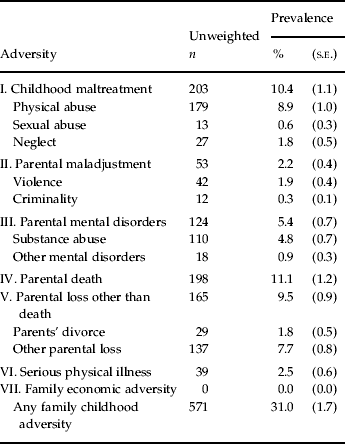
Prevalence of family childhood adversities (FCAs)

s.e., Standard error.
We also estimated the Population Attributable Risk Proportion (PARP) for the best-fitting model. The PARP can be understood as the proportion of observed outcome disorders that would not have occurred in the absence of the measured FCAs if the ORs in the best-fitting model were truly caused by the effects of these FCAs (Northridge, Reference Northridge1995). PARPs were calculated by generating individual-level predicted probabilities of the outcome disorders twice from the coefficients in the best-fitting model: the first time using all the coefficients in the model and the second time assuming that the coefficients associated with the FCAs were all zero. PARP then equaled one minus the ratio of the predicted prevalence estimates in the two specifications. As the data are both clustered and weighted, the standard errors of ORs in the above survival models were estimated by the design-based Taylor series method (Wolter, Reference Wolter1985) implemented in the SUDAAN software system (SUDAAN, 2002) and the statistical significance of coefficients was evaluated using p<0.05-level two-sided tests.
Results
Prevalence
Nearly one-third (31.0%) of respondents reported at least one FCA (Table 1). The most common FCAs were parental death (11.1%), parental loss other than death (9.5%) and physical abuse (8.9%).
Co-occurrence and factors of FCAs
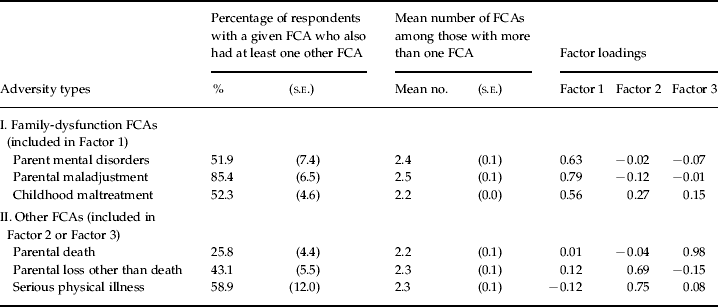
Among respondents with at least one category of FCAs, the percentage of respondents who also had at least one other FCA ranged from 25.8% (for those who reported parental death) to 85.4% (Table 2). Eleven of the 15 tetrachoric correlations between pairs of FCAs (73.3%) were positive. Negative values were mild in magnitude (all around −0.01). Positive values ranged from 0.03 to 0.23 with an interquartile range (25th–75th percentiles) of 0.04–0.14. Factor analysis showed three meaningful factors (Table 2). Half of the six FCAs (namely, parental mental disorders, parental maladjustment and childhood maltreatment) had significant loadings on the first factor, which could be named ‘family dysfunction’. Factor loadings of each FCA were in the range 0.56–0.79. The other two factors were specific. The second factor represented other parental loss and other CA with factor loadings of 0.69 and 0.75 respectively. The third factor only included parental death (factor loading 0.98). The FCAs in Factor 1 and the remaining FCAs are referred to below as ‘family-dysfunction’ FCAs and ‘other’ FCAs.
Co-morbidity and factor analysis of family childhood adversities (FCAs)

s.e., Standard error.
The best model for FCAs predicting the first onset of DSM-IV/CIDI disorders
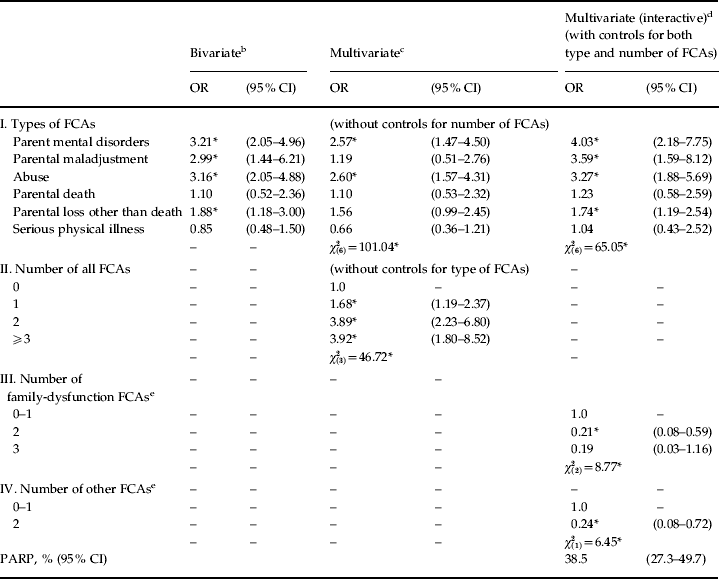
Analysis of the predictive effects of FCAs on first onset of any one of the 15 DSM-IV/CIDI disorders by the bivariate models (i.e. only one category of FCA considered at a time) showed that four of the six FCAs (except parental death and serious physical illness) were significantly associated with disorder onset (OR 1.88–3.21) (Table 3). In the additive multivariate model, which corrected the overestimation of effects of individual FCAs by bivariate models, the ORs decreased and only parental mental disorders (OR 2.57) and childhood maltreatment (OR 2.60) remained significantly associated (Table 3). The joint effect of all FCAs in this model was statistically significant [χ(6)2=101.04, p<0.001]. A test for variation in ORs showed that the hypothesis of the ORs being the same for all FCAs could be rejected [χ(5)2=27.8, p<0.001].
Estimated effects for types and number of family childhood adversities (FCAs) on the first onset of DSM-IV/CIDI disorders in bivariate, multivariate additive, and interactive survival modelsFootnote a

OR, Odds ratio; CI, confidence interval; PARP, Population Attributable Risk Proportion.
a Based on discrete-time survival models with person-year the unit of analysis pooled across 15 different DSM-IV/CIDI disorders, controlling for age at interview, gender, and person-year.
b Six separate bivariate models were estimated, one for each FCA.
c The multivariate additive model was used for Types of FCAs in this column and it was estimated with all six adversities in addition to the controls noted in the first footnote. The multivariate model for Number of all FCAs in this column was estimated with dummy predictors for number of adversities without any information about the types of FCAs, in which the same controls used in earlier models were included as well.
d The models were estimated with dummy predictors for number of adversities (distinguishing number of family-dysfunction FCAs from number of non-family-dysfunction FCAs) in addition to any information about the types of adversities. The same controls used in earlier models were included as well.
e No-one reported more than three family-dysfunction FCAs or more than two non-family-dysfunction FCAs.
* Significant at the p<0.05 level, two-sided test.
The multivariate model that considered only number but not type of FCAs showed that the ORs generally increased with number of FCAs, from 1.68 for exactly one FCA (compared to respondents who had no CA) to 3.92 for three or more FCAs. The joint effect of number-of-FCAs was also statistically significant [χ(3)2=46.72, p<0.001] (Table 3). We then estimated a model that included predictors both for type of FCAs and for number of FCAs. Inspection of the AIC showed that this model (AIC=5129.5) fitted better than the model that only considered number (AIC=5148.9) but not type (AIC=5128.7) of FCAs. We tried to refine the models by distinguishing between number of family-dysfunction FCAs and number of other FCAs. In this refined and best-fitting model (AIC=5112.3), the type-of-FCA predictors were significant even after controlling for any two kinds of FCAs [χ(6)2=65.05, p<0.001], whereas both numbers of family-dysfunction FCAs [χ(2)2=8.77, p=0.013] and other FCAs [χ(1)2=6.45, p=0.011] were significant after controlling for type of FCAs (Table 3). All ORs of associations with type of FCAs were somewhat higher than in the additive model, indicating that the additive assumption had a downward bias in estimating the effects of individual FCAs. This was because the ORs associated with number of FCAs in the final refined model were mostly less than 1.0 and became lower as the number of FCAs increased. Thus, although the odds of disorder onset increased with increasing number of FCAs, they increased at a significantly decreasing rate with increases in number of FCAs. The additive model failed to consider this subadditive interaction and underestimated the main effects of the individual FCAs. As in the additive model, a test for variation in ORs rejected that the ORs were the same for all types of FCAs [χ(5)2=49.5, p<0.001]; the family-dysfunction FCAs consistently had higher ORs than other FCAs. Several complex inherently nonlinear models we also considered did not improve on the fitness of the previous simpler models. Therefore, the best-fitting model above was adopted in disaggregated analyses.
Differential predictive effects by class of DSM-IV/CIDI disorder
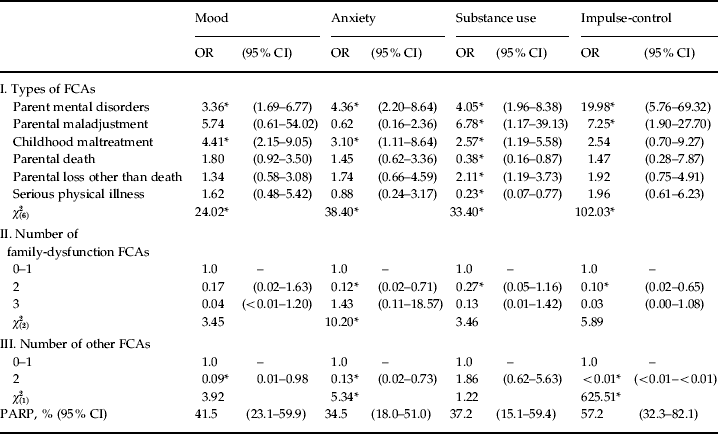
Disaggregation of respondents' mental disorders showed that FCAs were significantly associated with subsequent first onsets of four disorder groups. Type of FCAs was generally associated with increased risk [χ(5)2=24.02–102.03, p<0.001]. Specifically, 12 of 24 analyzed pairs of FCAs showed significant associations and 10 of these 12 significant associations increased the risks (OR>1.00 ) of subsequent disorders, except for the two associations of substance use disorder with parental death and serious physical illness. Among the 10 positive associations, nine were associations between family-dysfunction FCA and disorders. The significant risk estimates for these nine FCAs were higher than the one included in other FCAs (OR 2.57–19.98 v. 2.11) (Table 4). Moreover, although each family-dysfunction FCA (except parental maladjustment) predicted onset of each disorder group, it is striking that the ORs did not differ significantly across the subsequent disorders [χ(3)2=0.83–4.97, p>0.05]. Among 12 ORs of number-of-FCAs, 10 of them (except the ORs for associations between having three FCAs and anxiety disorders, and between having two FCAs and substance use disorders) decreased with increasing number of FCAs; six of these 10 ORs were significant.
Estimated effects of types and disaggregated numbers of family childhood adversities (FCAs) on the first onset of four classes of DSM-IV/CIDI disordersFootnote a

OR, Odds ratio; CI, confidence interval; PARP, Population Attributable Risk Proportion.
a See footnotes a and e of Table 2 for a description of the dataset and overall modeling approach. The model used here was estimated with predictors for both types of FCAs and number of adversities (distinguishing number of family-dysfunction FCAs from number of non-family-dysfunction FCAs) in addition to the controls used in the models described in Table 2.
* Significant at the p<0.05 level, two-sided test.
Differential predictive effects by life-course stage
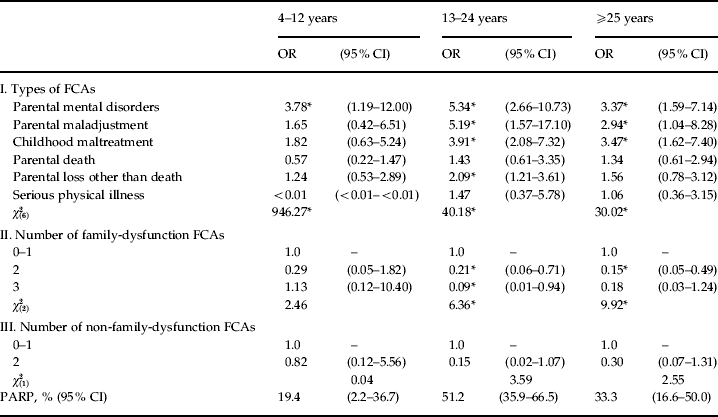
Disaggregation of the best-fitting model by life-course stage (childhood: ages 4–12, adolescence to early adulthood: ages 13–24, middle to later adulthood: ages ⩾25) showed that the significant effects of FCAs on first onsets were found throughout the life course (Table 5). However, for the first stage, only parental mental disorder was significantly associated. For the latter two stages, all types of family-dysfunction FCAs were significantly associated. The average ORs for the second stage were the highest among the three stages, although the patterns were not statistically significant. Moreover, one type of other FCAs (other parental loss) was significantly associated with high risk of disorder onset during the second stage. Regarding number of FCAs, onset during the two latter stages was significantly associated with number of family-dysfunction FCAs [χ(2)2=6.36–9.92, p=0.007–0.042], whereas the number of other FCAs was not significantly associated with onset during any stage.
Estimated effects of family childhood adversities (FCAs) on the first onset of any disorder by life stage of age of onsetFootnote a

OR, Odds ratio; CI, confidence interval; PARP, Population Attributable Risk Proportion.
a See notes a and e of Table 2 for a description of the dataset and overall modeling approach. The model used here was estimated with predictors for both types of FCAs and number of adversities (distinguishing number of family-dysfunction FCAs from number of non-family-dysfunction FCAs) in addition to the controls used in the models described in Table 2.
* Significant at the p<0.05 level, two-sided test.
Population-level predictive effects of FCAs
To evaluate population-level predictive effects of FCAs, PARPs were calculated according to the best-fitting model. The results showed that all FCAs together could explain 38.5% of first onset of any mental disorders (Table 3), 41.5% of mood disorders, 34.5% of anxiety disorders, 57.2% of impulse-control disorders, and 37.2% of substance disorders (Table 4). All FCAs also explained 19.4%, 51.2% and 33.3% of first onset of any mental disorders during the three life-course stages of AOO, respectively (Table 5).
Discussion
Compared to the prevalence of childhood maltreatment found in previous Chinese studies (7.0–22.1% for sex abuse, 40.7–56.3% for all childhood maltreatment) (Kim et al. Reference Kim, Kim, Park, Zhang, Lu and Li2000; Chen et al. Reference Chen, Dunne and Han2004; Chen, Reference Chen2005; Zhu et al. Reference Zhu, Li, Liang and Wei2006 a; Chang & Wang, Reference Chang and Wang2008; Xie et al. Reference Xie, Tang, Chang and Deng2008), our prevalence estimate (10.4%) was lower. Apart from restricted sampling and inclusion of non-family CAs in those studies, the discrepancy could be due to the different modes of questioning used. Thus, the WHM-CIDI asked about ‘sexual assault’ with two questions (namely, ‘The next two questions are about sexual assault. The first is about rape. Did that ever happen to you? Apart from rape, were you ever sexually assaulted or molested?’), whereas several Chinese studies separately asked about 12 kinds of overlapping adverse sexual experiences (ranging from indecent exposure and masturbation to penetration) (Chen et al. Reference Chen, Dunne and Han2004). Moreover, most of the Chinese studies recruited school students. A recent study found that nearly all (97%) Chinese child health doctors and nurses believed that physical punishment of children was widely used in China, but those who were older were significantly more tolerant of it, especially for children aged 4–13 (Hesketh et al. Reference Hesketh, Hong and Lynch2000). Conceivably, our older respondents might be less likely to report physical punishment as ‘abuse’.
Using an identical survey procedure to study a nationally representative sample in the USA, the National Comorbidity Survey Replication (NCS-R) found a higher estimate of FCAs (53.4% v. 31.0%) than our study (Green et al., Reference Green, McLaughlin, Berglund, Gruber, Sampson, Zaslavsky and Kessler2010). This may reflect genuine cross-national differences in prevalence, in addition to culturally mediated differential reporting. For example, although divorce rate has been increasing in China, it is still much lower than in the USA, especially during the period when most respondents spent their childhood (Zeng & Wu, Reference Zeng and Wu1997). Only 2.5% of our respondents (v. 5.8% in the USA) reported serious physical illness. This might be because physical illnesses were less likely to be recognized in China's underdeveloped health-care system. It may seem strange that 10.6% of respondents in the USA as opposed to none in China reported economic adversity. We speculate that because most of our respondents spent their childhood during a socialist era characterized by collective economy and equalitarianism, they might not experience poverty as an adversity. Chinese attitudes toward ‘physical punishment’ to children could set a higher threshold for reporting of certain FCAs. There are popular sayings that approve of physical punishment as a way of building character, such as ‘beating is caring and scolding is loving’ and ‘the rod makes a filial son’ (Qiao & Chan, Reference Qiao and Chan2005). Stigma and the belief that ‘shameful affairs should not be spread outside the family’ could also cause under-reporting of morally sensitive FCAs (Chen et al. Reference Chen, Dunne and Han2004; Qiao & Chan, Reference Qiao and Chan2005). This explanation is supported by the comparable prevalence of less stigmatizing FCAs such as parental death between our study (11.1%) and the NCS-R (9.9%).
Our other findings are consistent with both US and other studies. Family dysfunction emerged as the main factor in factor analysis. CAs were inter-related and associated with a broad spectrum of mental disorders. Multivariate effects of FCAs were broadly subadditive so that bivariate analyses might not accurately estimate the individual effects of CAs (Ney et al. Reference Ney, Fung and Wickett1994; Kessler et al. Reference Kessler, Davis and Kendler1997; Dong et al. Reference Dong, Anda, Felitti, Dube, Williamson, Thompson, Loo and Giles2004; Arata et al. Reference Arata, Langhinrichsen-Rohling, Bowers and O'Brien2007; Collishaw et al. Reference Collishaw, Pickles, Messer, Rutter, Shearer and Maughan2007; Green et al., Reference Green, McLaughlin, Berglund, Gruber, Sampson, Zaslavsky and Kessler2010). Importantly, finding significant mental health impacts of a limited number of CAs in both Western and Chinese studies could be inadequate for the quantitative estimation of their effects. This is because CAs such as abuse and neglect were associated and interacted with many other uncontrolled FCAs that contributed to psychopathology. Consistent with the NCS-R, we found family-dysfunction FCAs to be more associated with psychopathology than other FCAs. As the most severe FCAs were chronic intra-familial adversities involving the use of physical force (Clemmons et al. Reference Clemmons, Walsh, DiLillo and Messman-Moore2007), future studies should consider severity in addition to the cumulative number of adversities. Finally, we found the same lack of specificity on association between family-dysfunction FCAs and disorder groups. This may point to general causal pathways that defied early theories (Tennant et al. Reference Tennant, Bebbington and Hurry1980) and studies that focused specifically on child abuse (McMahon et al. Reference McMahon, Grant, Compas, Thurm and Ey2003; Shanahan et al. Reference Shanahan, Copeland, Costello and Angold2008).
Although previous studies documented long-term predictive effects of some CAs (Horwitz et al. Reference Horwitz, Widom, McLaughlin and White2001; Edwards et al. Reference Edwards, Holden, Felitti and Anda2003), they almost entirely focused on prevalent rather than first-onset disorders. By evaluating PARPs according to the best-fitting model, our study documented long-term multivariate predictive effects of FCAs beyond early adulthood. This provided cross-national empirical justification for exploring hypotheses regarding the effects of various mediators on developmental progression and their interactive relationships. The overall consistency notwithstanding, two differences in the pattern of association between the NCS-R and our study are worth noting. The former found that the PARPs declined steadily with increasing age. By contrast, the highest PARP in our study was shown for disorders onset from adolescence to early adulthood (13–24 years). This difference could arise partly from our failure to measure certain childhood disorders such as attention deficit/hyperactivity disorder (ADHD). Different symptom constellations and reporting across age groups in Western and Chinese populations may also contribute. We also found the average PARPs for all disorder groups higher than in the NCS-R (mood: 41.5% v. 26.2%; anxiety: 34.5% v. 32.4%; substance: 37.2% v. 21.0%; impulse-control: 57.2% v. 41.2%), although this did not reach statistical significance. This pattern of higher association in a Chinese than a US community might seem contrary to the popular claim for a protective effect of strong family values among Chinese individuals (Chen et al. Reference Chen, Wong, Lee, Chan-Ho, Lau and Fung1993). It is possible that negative family events in a society that treasures family values might bring about more negative effects on mental health. That milder FCAs could be more likely to be reported in the USA than China might also contribute.
Our findings have clinical and policy implications. Although China is a signatory to the UN Convention on the Rights of the Child, there has been no formal child protection system or family service beyond a rarely implemented law on protecting people not reaching adulthood. A study of 331 child health doctors and nurses in Zhejiang province indicated that none of them had received training in the management of child abuse and that 85% would not consider child abuse when faced with an injured child (Hesketh et al. Reference Hesketh, Hong and Lynch2000). There is therefore a need to develop multi-sector mechanisms for the early management of FCAs, thereby reducing their impact on mental health in China.
Regarding the limitations of this study, our estimates of the prevalence of FCAs could be conservative because of downward bias from retrospective recall (Hardt & Rutter, Reference Hardt and Rutter2004), whereas those of mental disorders could be affected by the validity of the WMH-CIDI (3.0) in our survey, especially among older respondents (Shen et al. Reference Shen, Zhang, Huang, He, Liu, Cheng, Tsang, Lee and Kessler2006; Lee et al. Reference Lee, Tsang, Zhang, Huang, He, Liu, Shen and Kessler2007). The CAs we examined were by no means comprehensive. Non-familial CAs and other FCAs such as the quality of care after a parent's death may also have an effect on mental disorders, but these were not measured. As some FCAs were rarely reported by respondents, we did not have large enough subsample sizes to assess the individual and interactive effects of every FCA. We did not consider the timing, sequencing and persistence of the individual FCAs studied and other forms of abuse such as emotional and/or verbal abuse. Our analysis of the joint effects of FCAs focused on broad patterns of interactions without evaluating interactions in detail. This approach is an approximation that may miss potentially important relationships, such as how parental divorce might in fact diminish exposure to stressful family situations and thus protect against the onset of mental disorders (Amato, Reference Amato1993; Hetherington & Stanley-Hagan, Reference Hetherington and Stanley-Hagan1999).
It should be emphasized that, because the onset of most mental disorders may be triggered by the interaction between genetic and environmental factors (Caspi et al. Reference Caspi, Sugden, Moffitt, Taylor, Craig, Harrington, McClay, Mill, Martin, Braithwaite and Poulton2003; Kendler et al. Reference Kendler, Kuhn, Vittum, Prescott and Riley2005), and parental mental disorders might be correlated with other FCAs, the associations we found might partly reflect parental genetic effects on children's mental disorders. The effect of the FCAs might be inflated because we failed to control the aforementioned factors (including non-familial CAs, other FCAs and salient biological markers) that may be involved in the etiology of mental disorders and also correlated with FCAs. Finally, despite the profound transformations that have occurred in China, the WMH-CIDI did not examine the impact of specific social context and individual experience. Future research could thus examine how the extreme political turmoil and stable economic times that older and younger Chinese respondents were respectively exposed to could be associated with complex inter-cohort variations in the relationship between onset of mental disorders (Lee et al. Reference Lee, Tsang, Zhang, Huang, He, Liu, Shen and Kessler2007) and experience of FCAs.
Acknowledgments
The Chinese WMH Survey Initiative is supported by the Pfizer Foundation in conjunction with the WHO WMH Survey Initiative. We thank the WMH staff for assistance with instrumentation, fieldwork and data analysis. These activities were supported by the United States National Institute of Mental Health (R01MH070884), the Mental Health Burden Study (Contract number HHSN271200700030C), the John D. and Catherine T. MacArthur Foundation, the Pfizer Foundation, the US Public Health Service (R13-MH066849, R01-MH069864 and R01 DA016558), the Fogarty International Center (FIRCA R01-TW006481), the Pan American Health Organization, Eli Lilly and Company, Ortho-McNeil Pharmaceutical, Inc., GlaxoSmithKline, Bristol-Myers Squibb and Sanofi-Aventis.
Declaration of Interest
R. C. Kessler has been a consultant for GlaxoSmithKline Inc., Kaiser Permanente, Pfizer Inc., Sanofi-Aventis, Shire Pharmaceuticals, and Wyeth-Ayerst; has served on advisory boards for Eli Lilly and Company and Wyeth-Ayerst; and has had research support for his epidemiological studies from Bristol-Myers Squibb, Eli Lilly and Company, GlaxoSmithKline, Johnson & Johnson Pharmaceuticals, Ortho-McNeil Pharmaceuticals Inc., Pfizer Inc. and Sanofi-Aventis.