Introduction
Achieving a pregnancy at the expense of multiple gestation sacs in an assisted reproduction programme is no longer considered a success because of the increase in health risks and costs during pregnancy and labour (Van Royen et al., Reference Van Royen, Mangelschots, De Neubourg, Valkenburg, Van de Meerssche, Ryckaert, Eestermans and Gerris1999; Gerris and Van Royen, Reference Gerris and Van Royen2000). Single-embryo transfer (sET) is the best solution for reduction of multiple pregnancy rates. Reducing the number of transferred embryos without reducing the rates of pregnancy requires improvement in embryo culture conditions in combination with an improved non-invasive scoring system. Culturing embryos until day 5 to select the best-advanced blastocyst together with appropriate uterine preparation ensures high implantation rates and low miscarriage rates (Gardner et al., Reference Gardner, Vella, Lane, Wagley, Schlenker and Schoolcraft1998; Milki et al., Reference Milki, Hinckley, Fisch, Dasig and Behr2000; Blake et al., Reference Blake, Farquhar, Johnson and Proctor2004; Papanikolaou et al., Reference Papanikolaou, D’haeseleer, Verheyen, Van de Velde, Camus, Van Steirteghem, Devroey and Tournaye2005, Reference Papanikolaou, Camus, Kolibianakis, Van Landuyt, Van Steirteghem and Devroey2006; Rehman et al., Reference Rehman, Bukulmez, Langley, Carr, Nackley, Doody and Doody2007). However, the cumulative clinical pregnancy rate (CPR) of cleavage-stage embryos is higher (Glujovsky et al., Reference Glujovsky, Blake, Farquhar and Bardach2012). Extended culture was proven to be a selection tool to avoid transfer of embryos with chromosomal abnormalities (Adler et al., Reference Adler, Lee, McCulloh, Ampeloquio, Clarke-Williams, Wertz and Grifo2014), although aneuploidy remains even among blastocysts with a good score according to the well established blastocyst grading system published by Gardner (Schoolcraft et al., Reference Schoolcraft, Gardner, Lane, Schlenker, Hamilton and Meldrum1999).
The ability to select a blastocyst with the highest reproductive potential is essential to perform a successful blastocyst-stage transfer. Time-lapse monitoring (TLM) represents a non-invasive tool for improving embryo selection by providing stable culture conditions and a complete picture of the dynamic embryonic development process (Porat et al., Reference Porat, Boehnlein, Barker, Kovacs and Lindheim2010; Meseguer et al., Reference Meseguer, Herrero, Tejera, Hilligsøe, Ramsing and Remohí2011; Campbell et al., Reference Campbell, Fishel, Bowman, Duffy, Sedler and Thornton2013; Wong et al., Reference Wong, Chen, Behr and Shen2013; Herrero and Meseguer, Reference Herrero and Meseguer2013; Campbell et al., Reference Campbell, Fishel and Laegdsmand2014; Desai et al., Reference Desai, Ploskonka, Goodman, Austin, Goldberg and Falcone2014; Findikli and Oral, Reference Findikli and Oral2014). In general, key events are gathered and analyzed: (1) kinetic parameters such as the time point of pronuclear fading (tPNf), cleavages to two cells – t2, subsequent mitotic divisions: t3, t4, t5, t6, t7, t8, t9, and morula and blastocyst formation; and (2) morphological parameters such as percentage of fragmentation, even or uneven blastomere size, and multinucleation.
Some in vitro fertilization units worldwide prefer to transfer day-3 embryos rather than day-5 blastocysts (Scholtes and Zeilmaker, Reference Scholtes and Zeilmaker1996; Graham et al., Reference Graham, Han, Porter, Levy, Stillman and Tucker2000; Desai et al., Reference Desai, Ploskonka, Goodman, Austin, Goldberg and Falcone2014; Goodman et al., Reference Goodman, Goldberg, Falcone, Austin and Desai2016). Day-3 embryo transfer decreases transfer cancellations and prolonged culture effects that may lead to imprinting errors and subsequent epigenetic disorders observed when growing embryos in vitro to the blastocyst stage (Niemitz and Feinberg, Reference Niemitz and Feinberg2004; Horsthemke and Ludwig, Reference Horsthemke and Ludwig2005; Manipalviratn et al., Reference Manipalviratn, DeCherney and Segars2009). Moreover, day-3 embryo transfer avoids technical difficulties of day-5 embryo culture such as long embryo culturing and observation, time-consuming embryo annotation, and limited space capacity in the monitoring incubators. Petersen and colleagues (Reference Petersen, Boel, Montag and Gardner2016) developed the known implantation data score (KIDScore) that is based on a day-3 algorithm to predict blastocyst formation. It produces a ranking of relative implantation potential with a score of 1 to 5. Day-3 KIDScore is a deselection model, which anticipates the implantation potential of embryo transfer to the uterus at day 3 of development, but evades embryonic parameters of day-5 embryos. Wong and co-workers (Reference Wong, Loewke, Bossert, Behr, De Jonge, Baer and Reijo Pera2010) found that embryo development to the blastocyst stage was related to the time interval from one to two cells and between first divisions, while Mizobe and colleagues (Reference Mizobe, Tokunaga, Oya, Iwakiri, Yoshida, Sato, Onoue and Ezono2018) showed that the synchrony of the first division predicts blastocyst formation. Later, Campbell and colleagues (Reference Campbell, Fishel, Bowman, Duffy, Sedler and Thornton2013) developed an algorithm showing that aneuploid embryos developed more slowly in relation to starting time of compaction, blastulation stages, and time to form full blastocysts. A later comprehensive review of 13 studies by Reignier and others (Reference Reignier, Lammers, Barriere and Freour2018) evaluated the predictive value of morphokinetic parameters for embryo ploidy status and found significant differences in morphokinetics between aneuploid and euploid embryos.
The purpose of this study was to retrospectively investigate whether the time interval from intracytoplasmic sperm injection (ICSI) performance to time of starting blastulation (tSB) can increase the implantation rate of day-5 transferred blastocysts that were selected based on morphological parameters.
Materials and methods
Study population
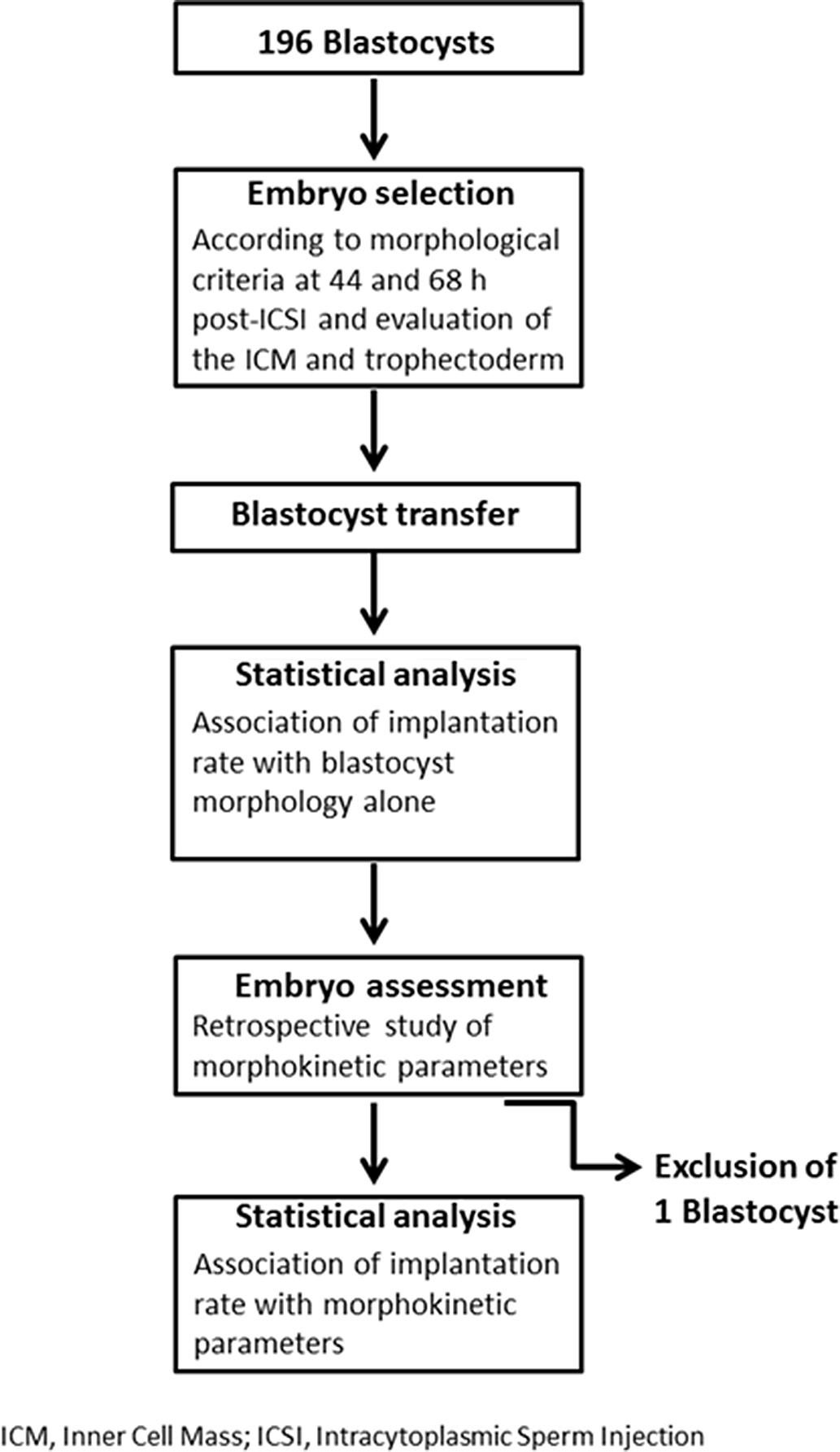
An analysis of TLM recordings of 196 transferred blastocysts from 174 IVF consecutive cycles during 2014–2015 was performed. The study was conducted at the Fertility and IVF Unit at Soroka University Medical Center in Israel. The procedure was approved by the local Institution Review Board (IRB reference SOR 0052-16). All embryos were obtained from fertilized oocytes following sperm injection using the standard ICSI technique. The embryos were cultured for 5 days to the blastocyst stage. For all embryos, the development up to day 5 was documented retrospectively using TLM analysis and measuring the exact timing of the developmental events in hours post-ICSI until the transfer. A flow diagram of the study is illustrated in Figure 1. For every transferred embryo the fate was known (implanted or non-implanted). Only cycles with known implantation data, in which the number of gestational sacs matched the number of transferred blastocysts (full implantation), and blastocysts from cycles for which no conception occurred (no implantation), were included. Cases for which a single gestational sac was observed after the transfer of two embryos were excluded from the study.
Flow diagram of the study population.

Ovarian stimulation and luteal support
In this study, two ovarian stimulation protocols were used: the short and the long protocols for gonadotropin-releasing hormone agonist administration in combination with either human menopausal gonadotropin or recombinant follicle stimulating hormone. Final oocyte maturation was achieved by administering human chorionic gonadotropin (hCG) (HCG; Ovitrelle; Merck-Serono) when at least two follicles of 16 mm diameter were observed using ultrasound examination, and blood 17β-oestradiol concentrations reached at least 500 pg/ml. Oocyte retrieval was performed 36–38 h after the administration of hCG. Embryos were transferred using an abdominal ultrasound-guided technique on the fifth day after oocyte retrieval. Patients were instructed to initiate luteal support using intravaginal or intramuscular administered progesterone, combined with oral oestrogen from the second day after oocyte retrieval until clinical pregnancy was determined.
Oocyte retrieval, denudation, and ICSI
Follicles were aspirated and the cumulus–oocyte complexes were delivered to the laboratory. After washing in Global Total with HEPES medium (Life Global®, Brussels, Belgium), oocytes were cultured in fertilization medium (Life Global, Brussels, Belgium) covered with mineral oil (Irvine Scientific, Santa Ana, CA, USA) for 3 h at 37°C, 5.7% CO2, and 5% O2. Oocyte denudation was initiated by incubation for 30 s in 80 IU/ml of hyaluronidase (Irvine Scientific, Santa Ana, CA, USA) followed by three washings in HEPES medium (Life Global, Brussels, Belgium) to remove residuals of the enzyme. Then, the oocytes were allowed to incubate in fertilization medium (Life Global, Brussels, Belgium) for an additional 1 h before denudation. Removal of cumulus cells from the oocyte was carried out by mechanical pipetting in Global Total medium containing HEPES prior to ICSI. ICSI procedures were performed in the same medium at ×400 magnification using a Nikon eclipse Ti microscope.
Embryo culture, imaging system and embryo selection
Immediately after ICSI procedure was performed, the injected oocytes were placed in culture slides (EmbryoSlide, Unisense FertiliTech, Aarhus, Denmark) containing 12 microwells, each filled with 25-µl droplets of a single step Global medium covered with 1.4 ml mineral oil (Irvine Scientific, Santa Ana, CA, USA) to prevent evaporation. The slides were prepared 17 h in advance and left in an incubator to pre-equilibrate at 37°C in a 5.7% CO2 atmosphere. The injected oocytes were incubated in a TLM EmbryoScope™ system at 37°C, 5.7% CO2, and 5% O2 (Unisense FertiliTech, Aarhus, Denmark). Images were acquired in cycle intervals of 15 min through several focal planes.
Oocyte fertilization was assessed by confirming the presence of two pronuclei (2PN). The embryos were graded daily by morphological criteria. The morphological criteria for cleavage-stage embryos included percentage of fragmentation, symmetry of blastomeres and multinucleation at observed set time points (44 and 68 h). Blastocyst evaluation and selection was based on morphological analysis according to Gardner’s criteria (Schoolcraft et al., Reference Schoolcraft, Gardner, Lane, Schlenker, Hamilton and Meldrum1999; Gardner et al., Reference Gardner, Lane, Stevens, Schlenker and Schoolcraft2000). Priority for transferred embryos was given to blastocysts with well defined trophectoderm and inner cell mass at 120 h. The ICM was evaluated as follows: A, many cells tightly packed; B, several cells loosely grouped; C, very few cells. The trophectoderm was evaluated as follows: A, many cells forming a unified epithelium; B, several cells forming loose epithelium; C, few large cells. The decision for blastocyst culture and transfer was based on previous cycles for which high-quality blastocysts were developed and on the number of good day-3 morphological embryos (at least three embryos of eight cells each). Patients who underwent more than three unsuccessful cycles were transferred with two embryos. Time to PN fading was not measured, nor the timing of cleavage events, or the time of the cell cycles prior to ET. No selection model or day-3 KIDScore analysis program was used for embryo selection purposes in this embryo population, as they were not available at that time.
Outcome measures
Clinical pregnancy was confirmed by the presence of gestational sac with fetal heartbeat by transvaginal ultrasound examination 6 weeks following oocyte retrieval. Overall, 28 cycles were excluded from the analysis: cycles resulting in gestational sac with no evidence of fetal heartbeat (n = 7) and dead fetus (n = 8). Although these embryos were successfully implanted into the uterus, pregnancy did not develop. Chemical pregnancies (n = 13) were also excluded. The exclusion of these cycles enabled us to link tSB to ongoing pregnancies.
Retrospective embryo assessment
Morphokinetic embryo assessment was performed retrospectively by two well trained embryologists following ET and determination of treatment outcome using Embryo Viewer® (Unisense FertiliTech, Aarhus, Denmark). All the relevant events including fertilization, tPNf, time of cleavage to two-blastomere embryo (t2), and subsequent cellular divisions: t3, t4, t5, t6, t7, t8, t9 and timings of morula, starting of blastulation and full blastocyst were tested and recorded.
The time of cellular division was defined and annotated at the moment when the cells were separated by individual cytoplasmic membranes. Time of morula (tM) formation was defined when it was no longer possible to notice the individual cell membranes. Time of starting blastocyst (tSB) formation was defined as the first frame in which an initial cavity was observed, specifically the moment at which a small three-angular opening appeared. Time of blastocyst (tB) was defined as one frame before the zona pellucida was pushed by the trophectoderm cells. Time of expanded blastocyst (tEB) was the time lapse to form a full blastocyst, consisting of an expanded blastocoel cavity and well defined inner cell mass and trophectoderm cells.
For each of the above blastocyst stages the average time interval, expressed in hours post-ICSI, for implanted and not-implanted embryos was calculated. The interval of tSB post-ICSI was limited to <114 h. This time frame was based on conventional observation time for tEB as 114 h. Among the studied blastocysts, one had a tSB = 123.5 h. This blastocyst was excluded from statistical calculations.
The data were analyzed retrospectively in combination with day-3 KIDScore. Day-3 KIDScore is a deselection model based on qualitative deselection parameters including poor conventional day 3 morphology, abnormal cleavage patterns (direct uneven cleavage and revers cleavage) and <8 cells at 68 h post-ICSI. Quantitative parameters include time from pronuclear fading to the 5-cells stage and duration of the 3-cell stage (Liu et al., Reference Liu, Chapple, Feenan, Roberts and Matson2016).
Data analysis and Statistical methods
Statistical analysis was performed using SPSS statistical software version 20 (SPSS Inc., Chicago, IL, USA). The studied embryos were divided into two groups based on whether they implanted and had fetal heartbeat. Categorical variable data were presented by percentage of available observations. The chi-squared (χ2) test or Fisher’s exact test were used as appropriate to compare categorical variables. Continuous variables data were presented using mean and standard deviation (SD), t-test, and univariate logistic regression analysis. All covariates with a P-value < 0.05 in univariate models were considered for inclusion in multivariable models. Multivariate logistic regression analysis was performed to identify the relationship between different time intervals and clinical pregnancy outcome. The odds ratio (OR) and 95% confidence interval (95% CI) were computed. A P-value < 0.05 was considered statistically significant.
Results
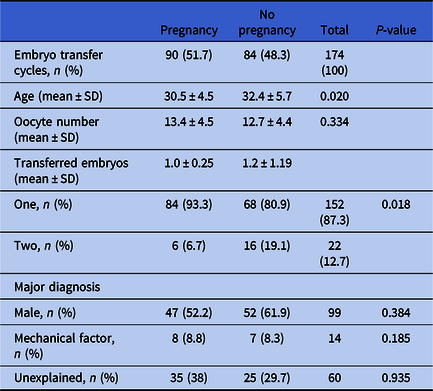
In total, 196 embryos that were cultured until day 5 with all relevant events, such as tPNf, kinetic parameters, either absolute timing of cleavages post-ICSI or time intervals between the cleavage events, were recorded. The 195 embryos were included in the statistical analysis as described in Materials and methods. Out of the 195 day-5 blastocysts, 96 were implanted (49.23%) and defined as clinical pregnancy, and 99 failed to implant. Out of 174 patients who underwent blastocyst transfer, 90 conceived (51.7% CPR) and 84 did not. Twenty-two pregnancies showed two embryonic sacs, but each embryo was annotated individually. Statistical differences regarding baseline characteristics were observed between the pregnant and non-pregnant groups in categories for the number of transferred embryos (1 vs. 1.2, P = 0.018, respectively), and women’s age (30.5 ± 4.5 vs. 32.4 ± 5.7 years, P = 0.020, respectively). As the relationship between women’s age and implantation rate was statistically significant, multivariate statistical analysis controlled for women’s age was applied. There were no statistical differences between pregnant and non-pregnant women with regard to the number of retrieved oocytes and aetiology of infertility (Table 1).
Baseline characteristics of pregnant and non-pregnant patients (N = 174)

First, we investigated blastocyst morphological parameters based on Gardner’s criteria. The analysis indicated no significant association between the morphology of the ICM, trophectoderm and degree of expansion and implantation rate. ICM, implanted embryos: A, 83.5%; B, 15.4%; C, 1.1%; non-implanted embryos: A, 76.7%; B, 15.1%; C, 8.1% (P = 0.078). Trophectoderm, implanted embryos: A, 62.6%; B, 29.7%; C, 7.7%; non-implanted embryos: A, 56.0%; B, 32.1%; C, 11.9% (P = 0.545). Among the transferred blastocysts, 5.2% in the implanted group were defined as early blastocysts compared with 13.1% in the non-implanted group (P = 0.056).
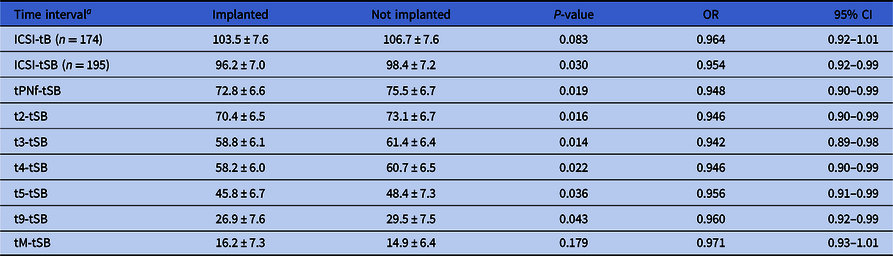
We then investigated whether time intervals from ICSI to tSB or tB (h), correlated with implantation rate. As shown in Table 2, implanted embryos exhibited significantly shorter interval times between ICSI and tSB compared with non-implanted embryos (96.2 ± 7.0 vs. 98.4 ± 7.2, P = 0.030, respectively). Mean time to reach tB was not significantly different between the two groups. The mean tEB values for implanted versus non-implanted embryos were also measured. Overall, 139 embryos reach expanded blastocyst by the time of ET. The implanted embryos showed significantly shorter mean time to reach tEB compared with not-implanted embryos (106.6 ± 6.0 vs.109.7 ± 7.0 h, P = 0.035, respectively).
Time intervals of blastocyst formation in implanted and not-implanted embryos controlling for patient’s age

Values are presented as mean ± standard deviation (SD).
a Mean hourly intervals between the two parameters.
Note: CI, confidence interval; ICSI, intracytoplasmic sperm injection; OR, odds ratio; tB, time of blastocyst formation; tM, time of morula; t(N), time to cleavage of N discrete cells; tPNF, time of pronuclear fading; tSB, time of starting blastulation.
Implanted embryos had also significantly shorter time intervals from tPNf and all the division stages (t2, t3, t4, t5, t9) to tSB compared with not-implanted embryos. Time from embryo compaction (tM) to tSB was not significantly different between implanted vs. not-implanted embryos. Although time intervals from ICSI to tSB and from tPNf to tSB demonstrated statistically significant associations with implantation rate, ICSI was chosen as the reference starting point as discussed later.
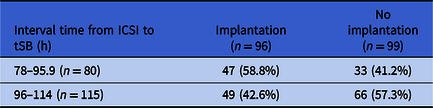
The mean time between ICSI and tSB of all transferred embryos was 96 h. Based on this mean we divided the embryos into two groups of time frames (Table 3): short time frame (78.95–95.9 h) and long time frame (96–114 h), controlled for woman’s age. We compared the two time frames with implantation rate of the transferred embryos. Blastocyst implantation rate was significantly higher for transferred embryos with shorter time intervals between ICSI and tSB compared with embryos with a longer time frame (58.8% vs. 42.6%, P = 0.024, respectively), suggesting that short timing to tSB could predict high reproductive potential.
Timing of starting blastulation (h post-ICSI) of implanted and not-implanted embryos (N = 195)

P = 0.024; OR = 1.9; 95% CI (1.01–3.40).
Note: CI, confidence interval; ICSI, intracytoplasmic sperm injection; OR, odds ratio; tSB, time of starting blastulation.
We then analyzed the relationship between high (5) and low (1–4) KIDScore embryo ranking and implantation rate, as presented in Table 4. Embryos with a high KIDScore (5) had a higher implantation rate compared with embryos with a low KIDScore (1–4) (53% vs. 30.3%, P = 0.004, respectively). When we tested high and low KIDScore embryos regarding short and long tSB time frames (Table 5), we observed a higher percentage of KIDScore 5 embryos in the short tSB group compared with in the long tSB group (92.5% vs. 76.5%, P = 0.0006, respectively).
Low (1–4) and high (5) KIDScore ranking in non-implanted and implanted embryos

P = 0.004; OR = 2.6; 95% CI (1.15–5.73).
Note: CI, confidence interval; KIDScore, known implantation data score; OR, odds ratio.
Timing of starting blastulation (h post-ICSI) and KIDScore

P = 0.0006; OR = 3.47; 95% CI (1.46–9.95).
Note: CI, confidence interval; ICSI, intracytoplasmic sperm injection; KIDScore, known implantation data score; OR, odds ratio.
Finally, to distinguish between high KIDScore ranked blastocysts and those that have a higher implantation potential, we assessed only KIDScore 5 transferred embryos (n = 162) regarding tSB time frames (short vs. long) and implantation rate (Table 6). The implantation rate was significantly higher in the short tSB timeframe embryo group compared with the long tSB timeframe embryo group (62.2% vs. 45.5%, P = 0.029, respectively). No significant difference was found between women’s age and the two categories of tSB (P = 0.50) and of KIDScore (P = 0.90).
Short (78–95.9 h) vs. long (96–114 h) timeframes of tSB (h post-ICSI) and implantation rate of 162 KIDScore 5 embryos

P = 0.029; OR = 2.0; 95% CI (1.07–3.77).
Note: CI, confidence interval; ICSI, intracytoplasmic sperm injection; KIDScore, known implantation data score; OR, odds ratio; tSB, time of starting blastulation.
Discussion
Embryo selection is a critical step in predicting treatment success rate. In the present study, we aimed to investigate whether timing of starting blastulation, tSB, can serve as a sole predictor factor of implantation potential. Our blastocysts cohort was selected for transfer only according to the known morphological parameters at 44 and 68 h post-ICSI and on blastocyst day 5 grading (Liu et al., Reference Liu, Chapple, Feenan, Roberts and Matson2016). In the present study, we retrospectively analyzed the contribution of morphokinetic parameters on implantation rate using the same transferred embryo cohort that was selected based only on morphological parameters. Implantation was verified by the presence of gestational sac and fetal heartbeat.
The implantation rate of our cohort of transferred blastocyst was 49.2%. Evaluation of blastocyst morphology based on Gardner’s criteria, indicated no significant association between implanted versus non-implanted blastocysts. tSB was retrospectively evaluated for these blastocysts. Among the tested time intervals from ICSI to different embryo developmental events, we found that a short time interval (<96 h post-ICSI) to the first sign of cavity opening (tSB) in the morula improved selection ability and CPR. tEB (<114 h post-ICSI) that obviously was not available for all the transferred blastocysts, was also found to be associated with CPR.
The global tendency is to transfer one high-quality embryo to avoid multiple gestations and to achieve a single healthy pregnancy per IVF treatment (Van Royen et al., Reference Van Royen, Mangelschots, De Neubourg, Valkenburg, Van de Meerssche, Ryckaert, Eestermans and Gerris1999; Gerris and Van Royen, Reference Gerris and Van Royen2000; Practice Committee of the American Society for Reproductive Medicine and the Practice Committee of the Society for Assisted Reproductive Technology, 2013). Extension of embryo culture to the blastocyst stage enables better embryo selection and subsequently a higher implantation rate (Blake et al., Reference Blake, Farquhar, Johnson and Proctor2004; Papanikolaou et al., Reference Papanikolaou, D’haeseleer, Verheyen, Van de Velde, Camus, Van Steirteghem, Devroey and Tournaye2005, Reference Papanikolaou, Camus, Kolibianakis, Van Landuyt, Van Steirteghem and Devroey2006; Glujovsky et al., Reference Glujovsky, Blake, Farquhar and Bardach2012). Several published studies have used time-lapse technology for implantation predication or chromosomal abnormality; however, most studies focused mainly on measurements of early developmental events, such as pronuclear fading and time to early embryo divisions (Gardner et al., Reference Gardner, Lane, Stevens, Schlenker and Schoolcraft2000; Meseguer et al., Reference Meseguer, Herrero, Tejera, Hilligsøe, Ramsing and Remohí2011; Practice Committee of the American Society for Reproductive Medicine and the Practice Committee of the Society for Assisted Reproductive Technology, 2013; Liu et al., Reference Liu, Chapple, Feenan, Roberts and Matson2016; Wu et al., Reference Wu, Han, Zhang, Wang, Liu, Xiong and Huang2016; Coticchio et al., Reference Coticchio, Mignini Renzini, Novara, Lain, De Ponti, Turchi, Fadini and Dal Canto2018). There have not been many reports investigating blastocyst formation and implantation potential (Cruz et al., Reference Cruz, Garrido, Herrero, Pérez-Cano, Muñoz and Meseguer2012; Hashimoto et al., Reference Hashimoto, Kato, Saeki and Morimoto2012; Conaghan et al., Reference Conaghan, Chen, Willman, Ivani, Chenette, Boostanfar, Baker, Adamson, Abusief, Gvakharia, Loewke and Shen2013; Kirkegaard et al., Reference Kirkegaard, Kesmodel, Hindkjær and Ingerslev2013; Cetinkaya et al., Reference Cetinkaya, Pirkevi, Yelke, Colakoglu, Atayurt and Kahraman2015; Motato et al., Reference Motato, de los Santos, Escriba, Ruiz, Remohí and Meseguer2016; Mizobe et al., Reference Mizobe, Tokunaga, Oya, Iwakiri, Yoshida, Sato, Onoue and Ezono2018). Therefore, implantation prediction based on blastocyst morphokinetic development is still controversial.
The final goal was to identify an easily observable morphokinetic marker for blastocyst quality in addition to the known morphological parameters published by Gardner et al. (Reference Gardner, Lane, Stevens, Schlenker and Schoolcraft2000) that will assist in predicting high implantation potential and CPR. This parameter would allow differentiation between morphologically good blastocysts with high implantation potential and morphologically good blastocysts that have lower implantation potential. In the present study, after adjustment for women’s age, the shorter time intervals from ICSI to tSB or tEB correlated positively and significantly with implantation rate and CPR.
Analysis of blastocyst quality, according to tSB or tEB, was previously investigated by several groups. Desai and colleagues (Reference Desai, Goldberg, Austin and Falcone2018) and Campbell and co-workers (Reference Campbell, Fishel, Bowman, Duffy, Sedler and Thornton2013) have shown that these morphokinetic parameters may aid in embryo selection with regard to euploidy, aiming to increase implantation and live birth rates. A study by Mumusoglu and colleagues (Reference Mumusoglu, Ozbek, Sokmensuer, Polat, Bozdag, Papanikolaou and Yarali2017) tested several morphokinetic parameters of 415 blastocysts and their ability to predict ploidy status and found that tSB and tEB, among other parameters, were significantly different among euploid and aneuploid blastocysts. However, they showed that these parameters hold only low-to-moderate predictive ability when adjusted for patient-related and ovarian stimulation-related factors. Fishel and colleagues (Reference Fishel, Campbell, Montgomery, Smith, Nice, Duffy, Jenner, Berrisford, Kellam, Smith, D’Cruz and Beccles2017) selected blastocysts with a tSB ≤ 93.1 h or embryos that exhibited tB–tSB ≤ 12.5 h, to investigate the incidence of live births after embryo selection by objective morphokinetic algorithms. Although Fishel and colleagues did not discriminate between the two groups of blastocysts, their findings supported the use of the EmbryoScope morphokinetic data for selection of blastocysts with higher rates of live birth. The present study offers an expanded approach to the process of blastocyst selection using TLM, aimed to increase the incidence of CPR after single-embryo transfer. The results of the present study support the previous findings of Goodman and colleagues (Reference Goodman, Goldberg, Falcone, Austin and Desai2016) and Campbell and co-workers (Reference Campbell, Fishel, Bowman, Duffy, Sedler and Thornton2013) who showed that early blastulation time is associated with higher implantation rate and live birth; therefore offering tSB as a valuable non-invasive morphokinetic parameter for blastocyst selection. We embodied developmental events from ICSI time in contrast with studies that used tPNf as a starting point and discounted the time interval between sperm injection and pronuclei fading. Some studies that have used tPNf as a reliable biological reference point to standardize the timing of developmental events of both insemination and ICSI embryos (Liu et al., Reference Liu, Chapple, Feenan, Roberts and Matson2015, Reference Liu, Chapple, Feenan, Roberts and Matson2016). Several studies claimed that ICSI time is not a precise reference time point because the TLM system enables insertion of only one reference time for an entire slide. Therefore, the exact time point for each injected oocyte cannot be defined (Liu et al., Reference Liu, Chapple, Feenan, Roberts and Matson2015; Reignier et al., Reference Reignier, Lammers, Barriere and Freour2018). However, the effect of seconds-to-minutes differences between injected oocytes has negligible long-term effects on embryo development. In particular, when a highly skilled embryologist with extensive experience with ICSI performs the injection, there should be only a minimal time difference between injected oocytes of the same patient. Moreover, the EmbryoScope set time of the entire slide is determined by the average injection hour between the first and last oocyte. This is consistent with the present study data that reflect the difference in time intervals by hours and not minutes from ICSI and all the division stages (t2, t3, t4, t5, t9) to the time of tSB between implanted and not-implanted embryos. Several studies in the current literature investigated the prediction of blastocyst formation and implantation using the starting point of ICSI for morphokinetic analysis (Campbell et al., Reference Campbell, Fishel, Bowman, Duffy, Sedler and Thornton2013; Motato et al., Reference Motato, de los Santos, Escriba, Ruiz, Remohí and Meseguer2016; Petersen et al., Reference Petersen, Boel, Montag and Gardner2016). The principle behind using injection time as a reference point is based on the fact that from the time of sperm penetration to tPNf there are biological processes that vary in time between fertilized oocytes. This might influence embryo development and cannot be ignored. A recent study by Faramarzi and colleagues (Reference Faramarzi, Khalili and Ashourzadeh2017) showed that the cleavage patterns of embryos were affected by the quality of MII oocytes in ICSI cycles. In the same study, the time interval of extrusion of the second polar body was different in morphologically normal and abnormal oocytes.
In addition to embryo selection based on morphokinetic parameters, extension of embryo culture to the blastocyst stage improved implantation rate. Several studies have demonstrated that fresh day-5 embryo transfers had three-fold increased implantation rates compared with day-6 embryo transfers (Shapiro et al., Reference Shapiro, Richter, Harris and Daneshmand2001; Barrenetxea et al., Reference Barrenetxea, López de Larruzea, Ganzabal, Jiménez, Carbonero and Mandiola2005; Kang et al., Reference Kang, Lee, Yoon, Kim, Lim and Lee2013; Goodman et al., Reference Goodman, Goldberg, Falcone, Austin and Desai2016). The increased implantation potential of day-5 compared with day-6 blastocysts was also observed in frozen–thawed blastocysts (Hashimoto et al., Reference Hashimoto, Amo, Hama, Ito, Nakaoka and Morimoto2013). It is not surprising that day-5 blastocysts are better than day-6, but the challenge is to choose the best day-5 blastocyst from a cohort of blastocysts with similar timings of development. The question that has to be asked is ‘how can we improve the selection of day-5 blastocysts for women who have several morphologically good blastocysts?’ According to our data, although slower cavitating day-5 blastocysts can lead to acceptable CPR, we suggest that the selection of embryos that start to blastulate within 96 h offers a distinct advantage and may be prognostic for implantation potential. Short tEB post-ICSI was also found to be associated with increased potential to implant into the uterus, indicating that tSB is not a sole predictor of implantation. Nevertheless, by the time of blastocyst transfer, not all embryos reach expansion, therefore, tSB, as the earliest stage of blastocyst development, is a preferable marker for prediction of blastocyst implantation.
Another method to improve blastocyst selection is to rely on the day-3 KIDScore algorithm (Liu et al., Reference Liu, Chapple, Feenan, Roberts and Matson2016; Carrasco et al., Reference Carrasco, Arroyo, Gil, Gómez, Rodríguez, Barri, Veiga and Boada2017). Indeed, the current study demonstrates that blastocysts with high scores have a higher implantation rate compared with low-scoring blastocysts (Table 4). The difficulty is to identify the best blastocyst out of several blastocysts that scored 5 on the KIDScore scale. The strategy to overcome this issue was to combine the day-3 KIDScore and the time interval between ICSI and tSB. This strategy resulted in a higher implantation rate.
Our study has several limitations that should be acknowledged: first, its retrospective nature. Second, the time intervals of the developmental events in this study relied on data collected from a specific clinic, and therefore can differ from that of other clinics that culture embryos under different conditions. Third, this study focused only on ICSI embryos. Therefore, the time interval to start blastulation for inseminated embryos is not applicable. Finally, live birth should be the primary outcome of IVF treatments and not clinical pregnancy. A study regarding live birth rate for the clinical pregnancies presented here is in progress to support the benefit of the new strategy for blastocyst selection. A prospective statistically powered study is needed to confirm our results.
In conclusion, data presented in this study may assist embryologists to distinguish between morphologically good blastocysts with a high day-3 KIDScore rank and high implantation potential from identical blastocysts with lower implantation potential. This new non-invasive strategy using the combination of tSB and day-3 KIDScore provides a tool for better blastocyst selection. Selection of embryos based on the timing of cavity opening calculated from ICSI time and not tPNf, combined with high day-3 KIDScore rank, improved implantation rate by almost 10% compared with KIDScore alone, and therefore could be used as an additional selection criterion when choosing the optimal blastocyst for transfer.
Acknowledgements
The authors thank all the dedicated embryologists of the Fertility and IVF Unit at Soroka University Medical Center.
Financial support
None.
Conflict of interest
The authors declare that they have no conflict of interest.
Ethical standards
The authors assert that all procedures contributing to this work comply with the ethical standards of the relevant national and institutional committees on human experimentation and with the Helsinki Declaration of 1975, as revised in 2008. This study was approved by the Human Research Ethics Committees (IRB reference SOR 0052-16). No consent form was required for this anonymous retrospective cohort study.