INTRODUCTION
It is puzzling that the United States, a country whose political culture emphasizes diversity and immigrant roots, produces so few elected Muslim officials while the populations of several European nation states with disadvantaged and marginalized Muslim populations elect Muslims to their national parliaments and to the European parliament at rates that sometimes approximate, or even exceed, their proportion in the general population (Haddad Reference Haddad2002, Reference Haddad2004). One likely explanation for this puzzle is that a segment of the society has attitudes toward Muslims making it difficult for them to get elected in the large First Past the Post (FPTP) districts of the United States (Sinno Reference Sinno2009). In other countries, this may be less of an obstacle. Proportional Representation has aided the prospect of Muslim representation in Europe and the concentration of Muslim-Canadians and British Muslims in some single-member districts has facilitated the election of Muslim candidates in these countries. An American Muslim, however, cannot realistically hope to gain office with the support of only Muslim voters.
Congress generally reflects the religious composition of Judeo-Christian religious groups in society quite well for denominations with 1% or more of the population. The number of Muslims in the United States has increased dramatically since the 1970s. Muslims now make up to 2% of the total United States population and enjoy much larger concentrations in some urban areas;Footnote 1 yet there have been no Muslim representatives in the national legislature until just recently. Muslims are also underrepresented in state politics. Currently, there are no Muslim governors or lieutenant governors, and only five state legislators are Muslims.
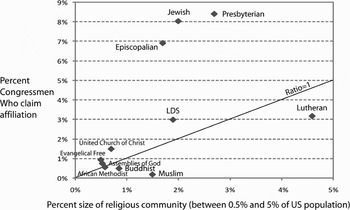
The 110th Congress, elected in November 2006, included one Muslim (Keith Ellison) and two Buddhists for the first time. A second Muslim, André Carson was elected to the 110th Congress in a special election in March 2008. Figure 1 plots the proportion of members of the 110th Congress from religious groups that are comparable in size to the Muslim community (between 0.5 and 5% of the United States population) versus the proportion of Adherents from those groups in American society.
Percentage congressmen versus percent size of religious group (110th Congress).

Some groups such as the Methodists, Presbyterians, Latter Day Saints, Christian Scientists, Episcopalians, and Jews are over-represented, but no Christian religious denomination is grossly underrepresented. Religious and denominational affiliation does not seem to affect the electoral opportunities of candidates for Congress from the Judeo-Christian tradition today, thus producing a distribution of religious backgrounds of congressmen that roughly reflects the proportions of their religious groups and denominations in society. This seems to apply even to groups that were once marginalized, such as Mormons, who also benefit from their concentration in the state of Utah and districts of other states.
The under-representation of American Muslims in American politics is even more puzzling because the immigrant portion of American Muslims enjoys some of the advantages in education and income that likely facilitate the over-representation of Presbyterians, Episcopalians, and Jews in Congress. Two Zogby polls (2001 and 2004) found that American Muslims have a higher median household income than Americans as a whole (above $50,000 per year) and that 58–59% have completed their college education, more than twice the national rate.Footnote 2 All else being equal, we should see a higher rate of American Muslims running in elections and getting elected than in society at large, but this is obviously not the case.
Qualified Muslims may be reluctant to run for office if they fear voters will scrutinize their behavior more closely or judge their actions differently from the way they judge other candidates for office. Indeed, there is a good deal of survey data that suggests this could be the case. Polls conducted between 1999 and 2007 by Gallup, Fox News, the Los Angeles Times, Rasmussen, and Pew find that between 31% and 61% of their respondents claim that they would not vote for a Muslim candidate for president.Footnote 3 Those rates are generally two to five times the rates for Catholics or Jews, slightly worse than the proportion of those who would not vote for a Mormon, but a little better than the proportion of those who would not vote for an “atheist.” This reluctance to vote for a Muslim presidential candidate extends to other types of races. A 2003 Pew Survey reports that 31% of the general public have reasons not to vote for “a well qualified candidate” who is Muslim when the office is not specified.Footnote 4
Thus, observed and latent anti-Muslim sentiment in the electorate makes it more difficult for Muslims to win the electoral support they need to win office and also dissuades qualified candidates from running if they fear they will be harshly judged or discriminated against because of their religion. Indeed, accounts of local and national Muslim candidates being mistreated because of their religion are by no means rare.Footnote 5 Such stories are likely to discourage qualified candidates from running for office.
Survey and anecdotal evidence of the sort described above, however, do not really tell us whether or not Muslim candidates suffer an electoral handicap in concrete political races as many have theorized. Drawing on the attribution literature, we propose an experiment to directly test this proposition by looking at how participants judge identical candidates when they are identified as Muslim and non-Muslim. We believe that creating these counterfactual situations will allow us to measure bias that individual respondents may be unable or unwilling to report.
Although there are citizens who admit in surveys they would not support Muslim candidates, there may be an additional segment of the population unwilling to reveal such views for fear of being seen as intolerant. Moreover, respondents might be unable to report such tendencies because they may not be aware of the role religion plays in their evaluations. Looking at differences in the evaluation of Muslim and non-Muslim candidates who are identical in other respects should alleviate such difficulties. In short, our experimental method is well suited to reveal bias that is undiscoverable with other research techniques. We believe that identifying and testing this specific mechanism of electoral disadvantage will bring us closer to understanding not only whether, but how, Muslim candidates face barriers to representation — and perhaps even suggest ways to overcome such obstacles.
We start to investigate these important issues in an experiment with undergraduate participants. We report our findings ever-mindful of the limits of this particular sample for generalizing to the public at large. Our logic in starting with undergraduates is that evidence of differential candidate evaluations in this population provides a particularly “hard test” of the phenomenon we are investigating.Footnote 6 If evidence reveals differences in attribution among college students, it is very likely studies looking at similar biases in the general population are warranted. We hope our approach and findings will be helpful to researchers in shaping future research looking at these issues.
THINKING ABOUT EVALUATIONS OF MUSLIM CANDIDATES
Individuals are not neutral observers of the social or political world. Citizens are motivated to look for explanations for behavior and phenomena to help us make sense of our environment and others. People have what has been characterized as an innate, automatic, need to categorize others and seek causes for behavior and events (Gilbert Reference Gilbert, Bargh and Uleman1989). Psychological research on impression formation demonstrates that individuals are quick to make character judgments about strangers based on limited, often superficial, information (Kunda Reference Kunda1999; Plous Reference Plous1993).
These attributions are important because they have the potential to shape our behavior, evaluations, and opinions about what should be done to deal with complex problems (Huges and Tuch Reference Hughes, Tuch, Sears, Sidanius and Bobo2000; Nelson Reference Nelson1999; Gomez and Wilson Reference Gomez and Wilson2000, Reference Gomez and Wilson2006; Sharp and Joslyn Reference Sharp and Joslyn2001; Peffley Reference Peffley1984). Political scientists interested in public opinion and voting behavior have recognized the importance of attribution in shaping policy views (Iyengar Reference Iyengar1989; Nelson Reference Nelson1999; Huges and Tuch Reference Hughes, Tuch, Sears, Sidanius and Bobo2000), and opinions about politically relevant groups (Gomez and Wilson Reference Gomez and Wilson2006) and, most relevant for our purposes, candidate assessments (McGraw et al. Reference McGraw, Mark Fische and Lodge1996; Alexander and Andersen Reference Alexander and Anderson1993; Gomez and Wilson Reference Gomez and Wilson2000).
A good deal of research in this area involves looking at traits voters impute to real and hypothetical candidates based on background characteristics like gender (Huddy and Terkidsen Reference Huddy and Terkidsen1993; Alexander and Anderson Reference Alexander and Anderson1993) and race (Sigelman et al. Reference Sigelman, Lee Sigelman and Nits1995). One of the main findings from experimental survey research on differential candidate evaluation is that candidates with different characteristics have a distinct advantage with regard to some politically desirable traits and disadvantage with regard to others.Footnote 7
If people make differential assumptions about candidates based on characteristics like gender and race — it makes sense to think candidates may be subject to differential evaluations depending on their religion (Campbell Reference Campbell2006). Given the current emotionally charged political environment where Islamic fundamentalism has been tied to acts of terrorism, one might expect Americans to see Muslims as less invested in our democratic political culture. Alternatively, strong media campaigns designed to curb stereotyping by distinguishing the vast majority of Muslims from the small cadre of fundamentalists most visible on the nightly news may effectively prevent Americans from questioning the patriotism of Muslims within our midst (Nisbet and Shanahan Reference Nisbet and Shanahan2004).
The practical lesson from research on differential trait attribution is that where they are subject to different evaluations based on characteristics like race and gender candidates need to work to compensate for such differences. For instance, there is evidence that female candidates can overcome disadvantages they may suffer from imputed gender evaluations by emphasizing traditionally masculine traits in their behavior (Huddy and Terkildsen Reference Huddy and Terkidsen1993).Footnote 8 Similarly, if Muslim candidates are perceived by the general population as less patriotic or more likely to have different values, they will need to work hard to highlight behavior that emphasizes those characteristics which are necessary to gain representative office.
Besides candidate characteristics, recent work on attribution has focused on perceiver based variables in shaping attributions. Among those investigated, two seem particularly important — affect and political sophistication. With regard to affect, research shows that people are more likely to attribute positive traits and similar beliefs to people and groups they like and admire. For instance, McGraw et al. (Reference McGraw, Mark Fische and Lodge1996) find that where citizens are describing political figures they like they use general traits when referring to positive attributes, and specific traits when referring to less desirable aspects of their personality — presumably to minimize candidates' shortcomings; the opposite holds true when citizens are describing political figures they do not like. Similarly, Brady and Sniderman (Reference Brady and Sniderman1985) find that people are more likely to attribute political attitudes close to their own to social groups they like and/or feel close to.
Systematic differences in attribution have also been identified between political sophisticates and non-sophisticates in a series of studies by Gomez and Wilson (Reference Gomez and Wilson2000; Reference Gomez and Wilson2006). Basically they argue that sophisticates can draw from a series of complex causal mechanisms, while non-sophisticates tend to look for simpler (often person-based) explanations for phenomena. We take advantage of this prior research by including measures of participants' feelings toward Muslims and political sophistication to see how each influences participants' attributions about candidates in the context of this study.Footnote 9
Moreover, it is important to note that, in the real world, candidate evaluations are seldom based on trait attributions in isolation. Candidates are “presented” to voters in terms of their prior political experience. Upon hearing about a candidate's record people are motivated to attribute causes to particular behaviors. These attributions influence our evaluations depending upon the “justifiability” of imputed motivations for action. Often people are faced with competing accounts for political behavior by candidates and their opponents (McGraw Reference McGraw1998). Citizens need to sift through these proffered explanations to reach conclusions about what accounts for specific behavior. This is an additional advantage of the specific design we choose to employ here. It presents candidate behavior in the context of elections where candidates are vying to influence voter assessments.
Certainly there are a multitude of political behaviors that lend themselves to alternative explanations with religion and/or religiosity more easily called to mind in connection with some behaviors than with others. Moreover, there may be some candidates for whom religion is a “favored” attribution and others for whom it is not. For instance, we wonder, are people more likely to assume that Christians oppose the death penalty on religious grounds than candidates of other backgrounds? Does religion equally come into play when thinking about the foreign policy positions of Christian versus Muslim candidates regarding the war in Iraq?
We were especially interested in the extent to which people fall victim to what has been called the “fundamental attribution error” in thinking about candidate behavior. Generally speaking, the bias is that observers tend to overestimate dispositional factors and underestimate situational factors in explaining the behavior of others. We thought it would be useful look at this question in a political context where we can manipulate the situational forces (i.e., political pressure) to undertake particular actions. We are especially interested to see if there are systematic differences in the extent to which people fall victim to this bias depending on the religion of the candidate. Part of our rationale in looking for such differences is that a similar bias has been identified in the context of inter-group relations, where people make attributions based, in whole or in part, on an actor's social group membership.Footnote 10
If the phenomenon holds true for explaining the behavior political candidates, it could mean that people attribute identical behavior quite differently for Muslim versus non-Muslim candidates. For instance, a Muslim candidate charged with lax prosecution of a suspected terrorist cell might be viewed as doing so because of internal (dispositional) factors like religion or sympathy for suspects who share the candidate's background. When voters are evaluating the same behavior by a non-Muslim candidate, they may be more likely to look to external (situational) causes like lack of prosecutorial resources or the concentration of Muslim voters in the district where ethnic profiling has been an issue.
RESEARCH DESIGN
To investigate people's attributions with regard to Muslim versus non-Muslim candidates, we designed two experiments where participants would have an opportunity to read about a statewide election involving candidates with distinct religious backgrounds. Participants were given one of two mock newspaper articles describing an election in New Jersey. One scenario involved a race for Attorney General between a hypothetical Republican incumbent and his Democratic challenger, A.J. Lami. According to the article, Lami was a local District Attorney in Trenton seeking state office. The other scenario involved a race for United States Senator in New Jersey with the Democratic challenger Lami having previous political experience as the United States Representative from New Jersey's Third District.
We chose these offices because we were interested in looking at attributions for behavior of political figures in the executive and legislative context. Our choice reflects the fact that legislative candidates are not the only ones who may be called on to explain particular behavior or policy views. The actions of executive officials (like District Attorneys charged with prosecuting crimes) often come under scrutiny. We thought it would be particularly interesting to look at how people evaluated the decisions of Muslim versus non-Muslim officials in the context of our domestic and international “war on terrorism.”
Moreover, by choosing statewide elections we were able to construct treatments discussing the prior acts of candidates when they held lower office and were responsible to a specific local constituency. We did so to vary the electoral costs and benefits of particular behaviors by manipulating the characteristics of voters to whom the candidate was accountable when they engaged in specific activity. We purposefully emphasized behaviors in each experiment that were subject to alternative explanations, including the candidates' religion, partisanship, and electoral self interest to see how experimental participants weighed each of these factors in making causal attributions.
The structure of the articles in each of our experiments was substantially similar. In all treatments, the challenger was a Democrat who won victory by a wide margin in the past election cycle. Lami was also described as “a man of considerable principle based, in part on his devout” religious faith. Each experiment involved a 2 × 2 factorial design. The religion of the challenger was manipulated: half of the participants read an article where Lami was Muslim; the other half read an article where he was Christian. The concentration of Muslim voters in the constituency where the challenger held office was also manipulated to vary political costs and benefits of taking particular action: half of the participants read an article saying Lami came from a district with the lowest concentration of Muslims in New Jersey (3%); the other half read an article stating that Lami represented a district with the highest concentration of Muslims in the state (34%).
Each article described two distinct behaviors by the challenger that could be subject to alternative attributions. In the race for Attorney General, there was a charge that Lami (1) failed to aggressively seek the death penalty as Trenton District attorney; and (2) was lax in the prosecution of a suspected terrorist cell with ties to Al Qaeda. In the legislative context, the article stated that, as a Representative in the United States House, Lami (1) co-sponsored legislation calling for the release of prisoners classified as “enemy combatants” by the Bush administration and (2) supported legislation calling for the withdrawal of American troops from Iraq. Exact wording for both articles (with experimental manipulations) can be found in the Appendix.
In terms of trait attributions, participants in all treatments were asked to rate Lami's patriotism on a six point scale. We asked participants how likely they thought it was that they and the candidate shared “similar values” and how much they agreed with the characterization of Lami as a “man of considerable principle.” We also asked all participants to indicate how much of a role they thought religion played in his political behavior.Footnote 11
For each of the behaviors of interest, we asked participants to rate on a six-point scale how important they thought alternative attributions were in explaining the candidates' behavior. Some of the attributions were clearly dispositional (e.g., because he is a religious man, because he held particular beliefs, or was sympathetic toward anti-American actors). Other attributions were more situational (e.g., because it would help his election chances). Still others — particularly one that is uniquely political, partisanship — did not fall neatly into either category.Footnote 12 Also, some of the dispositional attributions may be viewed in a more positive light than others. For instance, when explaining candidate Lami's proposal to terminate the detention of enemy combatants, one possible attribution was that he believes in a right to a fair trial (generally considered a positive dispositional characteristic); another was that he harbors some sympathy for members of Al Qaeda likely to be held under such circumstances (a clearly negative dispositional attribution given our current political environment).
SPECIFIC HYPOTHESES REGARDING TRAIT ATTRIBUTIONS
We look for systematic differences in attributions across candidate type (Muslim versus Christian). Bias against Muslim candidates would be evident if participants were significantly less likely to characterize Lami as patriotic when the candidate was described as a Muslim versus when he was described as a Christian engaging in identical activities. Bias might also be suggested if participants were less likely to believe they shared values with a Muslim challenger and/or saw Lami as significantly less “principled” under conditions where the candidate was Muslim. Finally, we hypothesized that more people would see the candidate's behavior as stemming from his religious background when he was Muslim than when he was Christian. Based on the findings described above, affect toward Muslims should moderate these findings; we expected participants who expressed a favorable view of Muslims to rate Muslim candidates more positively than those who did not.
HYPOTHESES REGARDING BEHAVIORAL ATTRIBUTIONS
We are interested in the relative ratings of attributions for legislative and executive behaviors described. Specifically, we are curious about the extent to which behaviors are attributed to political (e.g., partisan, electoral) versus personal (religiosity, sympathy for unpopular groups) explanations for behavior. Opposition to the war in Iraq, for instance, has taken on a partisan tone in the two years leading up to the 2008 presidential election. This was just starting to become evident in the summer of 2006 when these experiments were conducted.
We were also interested in the interaction between candidate type and concentration of Muslims in the district in participants' attributions. For instance, it could be that the behavior of a Muslim candidate is explained by religion (a dispositional factor) regardless of the concentration of Muslim voters in his district. Attributions for Christian candidates may be more sensitive to situational factors (e.g., attributed to electoral self-interest where there is a high concentration of Muslim voters). We suspect, in line with prior research, that political sophistication may be important in moderating this relationship because it takes some effort to tie situational factors to candidate behavior. Non-sophisticates may be drawn to simpler attributions for candidate behavior.
PROCEDURE
Fifty-four undergraduates took part in this study from August 1 to August 15, 2006. Undergraduates were recruited from upper and lower level political science classes at a large research university during the summer session and through signs posted around the political science building. Once participants indicated interest in the study they signed up to take part in an experimental session. The experiment was administered via traditional paper and pencil techniques; students generally took 30 minutes to complete the instrument. Each student was paid $10 for participating in the experiment.
At the outset, participants were told they were taking part in a study investigating media reports of state-wide elections. We engaged in this minor deception so students would not be sensitized to the fact that we were looking at differences in attributions for Muslim versus non-Muslim candidates. Participants answered the political knowledge questions and then they read one of the two articles describing a race for Attorney General or United States Senator in New Jersey. After reading the article, participants were asked a few questions about its clarity, then asked to rate alternative attributions for behavior described in the article. All participants then had a series of questions regarding traits of the candidates. The experiment concluded with demographic questions, a full debriefing and a series of exit questions about participants' feelings toward Muslims and knowledge of Islam. The Appendix includes the exact wording of articles given to participants, all relevant measures used in our analysis and a summary of sample characteristics.
RESULTS
Our findings suggest reasons to be both optimistic and concerned about the potential for differential evaluation depending on a candidate's religious background. There were few differences in trait evaluations on characteristics like patriotism across treatment groups where the religion of the candidate was manipulated. Moreover, religion seemed to be a disfavored attribution for both Christian and Muslim candidates. However, there was evidence that participants were more likely to cite religion as a cause of behavior when the candidate was Muslim than when he was not. Finally, there seemed to be more differences in the context of evaluating the behavior of our candidate for state Attorney General than in evaluating the behavior of our legislative candidate. This could be seen as evidence that the behaviors described of our legislative candidate — involving opposition to the war and the indefinite detention of detainees — have become so politicized in the current political climate as to transcend being differentially attributed to candidates based on their religious backgrounds. We will present results concerning trait attributions for Muslim versus non-Muslim candidates first; then we will present findings about attributions for specific behavior.
TRAIT ATTRIBUTIONS
Generally speaking, we found participants made the same trait attributions for Christian and Muslim candidates for office.
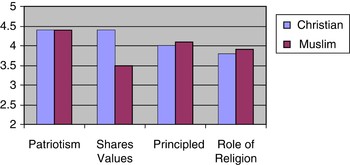
Looking at trait attributions for the pooled sample there was little difference in participants' evaluation of candidate Lami's patriotism.Footnote 13 Where Lami was described as a Christian candidate, participants rated him a 4.4 in terms of patriotism. The same was so where Lami was described as a religious Muslim. Similarly, as demonstrated in Figure 2, there was no difference in participants' willingness to agree with the statement characterizing Lami as “man of principle” depending on his religious background. Participants were more likely, however, to say that they and Lami shared similar values when he was described as a Christian candidate (mean = 4.3) than when he was described as a Muslim (mean = 3.5) notwithstanding the fact that the articles described identical behaviors on behalf of both types of candidates (t = 2.3, p < 0.02).
(Color online) Candidate traits – whole sample by candidate type.

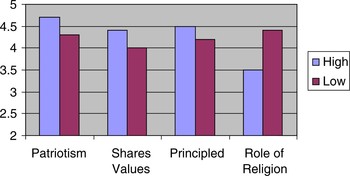
Although our question about the role of religion in candidate Lami's behavior yields no significant differences in the pooled sample, this changes when one breaks up participants in terms of political knowledge. Political sophisticates were less likely to attribute a large role for religion compared to the rest of our sample (means = 3.5 and 4.0, respectively). This difference is clear when one looks at the trait attributions for the highest and lowest thirds in the sample illustrated in Figure 3 (t = 2.32, p < 0.03).
(Color online) Traits by sophistication.

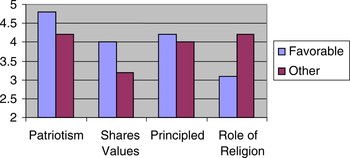
Also, consistent with prior research, affect seemed to play a role in trait evaluations. Among the participants, given articles describing the behavior of a Muslim candidate for office, those in our sample who expressed favorable views toward Muslims tended to make more favorable attributions across the board (see Figure 4). Moreover, they were significantly less likely to attribute an important role to religion for that candidate's behavior than those in our sample who expressed an unfavorable or neutral view toward Muslims (t = 2.4. p < 0.02).
(Color online) Muslim candidate – traits by favorability.

FAVORED AND DISFAVORED ATTRIBUTIONS FOR PARTICULAR BEHAVIOR
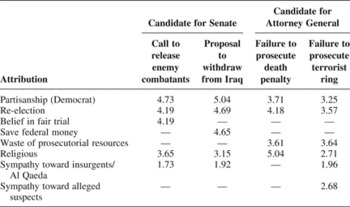
Table 1 sets forth the mean attributions for particular behavior described in each article. For both of the legislative behaviors described, the candidate's partisanship is clearly the preferred attribution. It is ranked highest among alternative explanations for both of the behaviors ascribed to our legislative candidate for office.
Mean attributions for specific behaviors

Another thing that is clear when looking at these means is that the candidate's religion is clearly a disfavored attribution given alternative explanations for the political behavior of our hypothetical candidates. In three out of four instances, the fact that our candidate was described as “religious” ranks fourth among alternative explanations for behavior. The only explanation ranking consistently lower is sympathy for disfavored groups associated with terrorist activities.
The clear exception to this trend is that participants were most likely to attribute Lami's failure to prosecute death penalty cases to his religiosity. This was true for both Christian (mean attribution for religion = 5.21) and Muslim (mean = 4.86) candidates (t = 0.22, not significant). This makes some sense given the strong association between religiosity and opposition to the death penalty often played out in the media.
DIFFERENCES ACROSS CANDIDATE TYPE
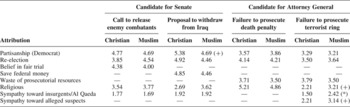
Table 2 sets forth differential attributions given for the behavior of Christian versus Muslim candidates.
Mean attributions for behaviors by candidate type

(+) indicates difference in means across candidate type is significant at 0.10 level, (*) indicates significant difference at 0.05 level (two tailed test).
Race for the Senate
Interestingly, there were no significant differences in attributions for the behavior of Christian versus Muslim candidates in the legislative context. Again relative order of all attributions is quite similar across candidate type with religion and sympathy for disfavored groups consistently ranking lowest. There does seem to be a tendency to rate the fact that the candidate is religious as more important for Muslim candidates than for Christian candidates in explaining foreign policy positions, but the differences are not significant. Participants were marginally more likely to credit partisan explanations for the Christian candidate's call for the withdrawal from Iraq than for that of the Muslim candidate (t = 1.77, p < 0.09).
Moreover, in the legislative context, participants were not particularly sensitive to the concentration of Muslims in the district when making attributions. Surprisingly, there were no significant differences in participants' tendency to attribute behavior to electoral self interest depending on the concentration of Muslims in the district.
Participants did tend to attribute the candidate's calling for the release of enemy combatants to partisan tendencies significantly more where there was a low concentration of Muslims than where the concentration was high [respective means were 5.31 (low) and 4.15 (high), t = 2.5] (p < 0.03). Although differences were not significant, the same general tendency was evident for dispositional attributions (such as religiosity, belief in a fair trial, sympathy for unpopular groups) across the board; participants attributed a greater role to these factors where the concentration of Muslims in the candidate's constituency was low. Perhaps this can be taken as suggestive evidence that dispositional factors are seen as influential in explaining behavior where there is no obvious electoral benefit for taking particular action.
Race for Attorney General
There were no significant differences in attributions across either manipulated factor in participants' responses regarding Lami's failure to prosecute death penalty cases. This makes sense as there is no theoretical reason why the concentration of Muslims in the district should influence a District Attorney's decision to prosecute capital crimes. Moreover, of the four behaviors investigated in this study, death penalty prosecution seems the least likely to call to mind differences based on religious affiliation.
In contrast, it seems that charges of a candidate's failure to aggressively prosecute suspected terrorist activity does bring to mind differential attributions depending on that candidate's religious affiliation. As Table 2 demonstrates, it is in the context of this behavior that we find several differences in attribution across candidate type. Significantly, all the differences involve the “disfavored” attributions based on religion and sympathy for unpopular groups. There were no differences in more neutral partisan and situational attributions across candidate types.
Specifically, participants were more likely to say Lami failed to prosecute the suspected terrorist cell because he was religious where the candidate was described as a Muslim than when he was described as a Christian (t = 1.93, p < 0.06). They were also more likely to say he was sympathetic to the suspects in the case (t = 1.87, p < 0.08) and Al Qaeda itself (t = 2.12, p < 0.04) when the candidate was identified as Muslim.Footnote 14
ANOVAS FOR FAILURE TO PROSECUTE SUSPECTED TERRORIST RING
To probe these differences a bit more, we conducted several three way ANOVAs looking at the disfavored attributions for failure to prosecute the suspected terrorist ring. In these analyses, we used our manipulated traits including (1) candidate type (Christian versus Muslim) and (2) concentration of Muslims (high versus low) as well as (3) political sophistication (sophisticates versus non-sophisticates) as factors to see if we could explain differential attributions for this behavior.Footnote 15
In two of the ANOVAs, candidate type seems to be the main factor driving differential evaluations. There were significant main effects for the candidate's religion in ANOVAs analyzing participants tendency to cite religiosity (F(1, 27) = 4.63, p < 0.04) and sympathy for Al Qaeda (F(1,27) = 4.39, p < 0.05) as reasons for Lami's failure to prosecute the suspected terrorist cell. Participants were significantly more likely to cite each of those reasons to explain the behavior of Muslim candidates than Christian candidates. None of the other factors or interactions was significant in these analyses.
The ANOVA looking at the candidate's sympathy for the suspects in the case as an attribution for the behavior revealed a significant three way interaction between candidate type, concentration of Muslims, and political sophistication (F (1, 27) = 7.80, p < 0.01).Footnote 16 That interaction is set forth in Figure 5.
(Color online) ANOVA sympathy toward candidates; conditional means by sophistication, candidate type and concentration of Muslims in district.

According to the pattern set forth above, non-sophisticates seemed to attribute relatively high sympathy for the Muslim candidate regardless of the concentration of Muslims in the district. Non-sophisticates showed more sensitivity to the concentration of Muslims in the district when evaluating Christian candidates, tending to discount sympathy where the concentration of Muslims in the district was high compared to when it was low. In contrast, sophisticates generally attributed low levels of sympathy for the suspects to Christian candidates (regardless of concentration) and Muslim candidates with high concentrations of Muslim voters. But sophisticates seemed sensitive to the concentration of Muslims in the district when making that attribution for Muslim candidates; again where the concentration of Muslims in the district was low, sophisticates in the sample attributed higher levels of sympathy to our hypothetical candidate for state Attorney General.
In some ways, this pattern echoes findings mentioned earlier suggesting that dispositional factors may be seen as important in explaining behavior where there is no obvious political benefit to explain particular action (i.e., where the concentration of Muslims in the candidate's district is low). The fact that sophisticates and non-sophisticates evaluate candidates of different religious backgrounds differently is further evidence of the complexity of such attribution processes. Non-sophisticates seem to assume sympathy based on religious background. Sophisticates are more willing to give Muslim candidates the same benefit of the doubt they extend to Christian candidates — except where there is no alternative way to explain behavior.
DISCUSSION
We are encouraged and concerned about the prospects for Muslim representation given these findings. We believe that our findings of substantial similarity in candidate evaluations are just as interesting as our findings of difference. The fact that participants evaluated Muslim and non-Muslim candidates similarly in terms of traits like patriotism and having principled political beliefs is truly cause for optimism. Moreover, in the context of our legislative race, participants did not make differential attributions for foreign policy positions based on the candidate's religious background, although they certainly could have. Finally, attributions for Christian and Muslim candidates charged with failing to aggressively prosecute death penalty cases seemed to be based on the candidate's religiousness, rather than on his religion per se. This all bodes well for Muslim candidates being evaluated on the basis of their political actions and beliefs rather than preexisting assumptions held by voters.
Other findings could represent a cause for concern. Some echo previous findings on attribution. The fact that political sophisticates and non-sophisticates differed in trait attributions and the role they assign religion in explaining political action suggests that some segments of our population may be especially receptive to charges of religion as a force motivating political action. Given the disfavored status of religion as an explanation for political behavior, the ability to convince those who are less knowledgeable that religion energizes action could be a significant weapon to demobilize citizens who would otherwise vote for Muslim candidates. The bizarre allegations by some Republican activists that Barack Obama is a closet Muslim and the vicious attacks on Keith Ellison, the first Muslim in Congress, are two recent examples of the use of such tactics by those who realize the gains they may achieve.
Our finding that participants were less likely to say they and candidate Lami shared “similar values” when he was identified as a Muslim than when he was described as Christian means that Muslim candidates have an additional “hurdle” to overcome to gain the trust of constituents, which non-Muslim candidates do not face. It could be that describing the candidate as a “devout” follower of a minority faith brought to mind aspects of a religious group that is not as fully assimilated in our western culture. Indeed, some would argue that it is entirely appropriate for voters to acknowledge religious differences when making voting decisions. We do not necessarily disagree with this assessment. But our political system presumes that people should be judged on the basis of their individual merit encompassed in action and belief, rather than on the basis of gross assumptions based on religious affiliation that may be prone to error. At the very least, this study suggests that Muslim candidates will have to do more to highlight behaviors demonstrating and that they have internalized values like gender equality, they have internalized values that can be particularly important for how voters assess their candidacy.
This study also shows that in the world of differential attributions for candidate behavior, the behavior one is trying to explain matters. Our scenario involving lax prosecution of a suspected terrorist ring resulted in differential attributions for Muslim and Christian candidates; but two other scenarios where the candidate's religious identity was arguably salient — involving foreign policy positions of legislative actors — did not elicit differences across candidate types. As suggested earlier, this could be because voters are used to assessing candidates views on war issues, and so they do not necessarily attribute a particular stance to a candidate's religious background. The scenario involving the lax prosecution of the suspected terrorist ring in the race for state Attorney General was probably much less common in participants' experience of evaluating candidates (though certainly not unrealistic). Such behavior may have been attributed to religion (and/or the candidate's sympathy for disfavored groups) for Muslim candidates where there was no seemingly neutral, well worn alternative attribution to explain it.
We conclude with two very important caveats to what we see as generally optimistic findings about the evaluation of Muslim versus non-Muslim candidates. The first, of course, has to do with our use of an undergraduate convenience sample in this study. As with most student samples, participants in this study were younger, more liberal, and better educated than voters in the population at large. These are differences that compromise the generalizability of our findings as there is good reason to believe people with these specific traits would be less likely to engage in differential attributions compared to the general population.
We note that, notwithstanding such differences, there was evidence of differential trait and behavioral attributions in this sample; if anything our findings likely underestimate the potential for such behavior among voters. Where we failed to identify differences, they may exist in the wider population. Still we believe that our findings with respect to attributions in this undergraduate sample merit careful consideration; they are no less real because participants are undergraduates. Also, our results resonate with previous findings on the role of affect and political sophistication in attribution suggesting these are important factors to consider in this context.
A second caveat has to do with the fact that religion and sympathy toward unpopular groups were clearly disfavored attributions in this student sample. The fact that participants were much less likely to attribute candidate behaviors to such factors means that there was very little variance for us to explain. Thus differences that actually exist may have been masked by participants' reluctance to credit those attributions compared to alternative explanations like partisanship, situational constraints, or positive dispositional explanations for behavior. Of course, we did find significant differences notwithstanding this trend. This finding merits careful consideration as scholars move forward with such inquiries. It might make it harder to detect differences in attribution based on religion. Still, we acknowledge that it is not clear whether citizens in the general population will treat religion as a disfavored attribution especially where, as discussed above, religion is strategically used by political actors to “shade” public perceptions of why Muslim candidates take particular actions.
In this study, we used experimental methods to study the differential evaluation of candidates based on religion. We think our approach has significant potential to uncover biases that may be hard to measure with other methods. Moreover, drawing on knowledge from attribution theory, we believe we have identified variables that are particularly relevant to such inquiries. We look forward to future studies looking at such questions with broader samples — our best guess is that there are more differences in the general population than those we have uncovered in this study. There might be more significant differences in trait evaluations across candidate type. Citizens may be willing to attribute a larger role to religion than our undergraduate participants. We expect the differences we uncovered based on affect (favorability) toward Muslims and political sophistication to be mirrored in the broader population based on previous research on these variables. But these are all questions that beg further investigation. We hope we have made a convincing case for employing attribution to explore these issues; we believe it represents a particularly promising avenue for further research on the subject.
APPENDIX
Mock Article – Senatorial Candidate
Race for New Jersey Senator Heats Up
AP — The close race for junior United States Senator in New Jersey has attracted national attention, and become the subject of great controversy.
Republican incumbent Martin Sight is facing a close race from Democratic challenger A.J. Lami. Lami has been elected as House Representative from the Third District by considerable margins for six terms; he won the most recent, 2004 race by almost twenty percentage points. According to John Mure, Rutgers University political science professor, Lami is considered “a man of considerable principle based, in part, on his devout (Christian/Muslim) faith.”
Now making his move to the Senate arena, Lami is seen as an ambitious new candidate who is not afraid to speak his mind. He has criticized Sight on multiple grounds — recently arguing that the incumbent senator has failed to bring public work projects to New Jersey and emphasizing that the State has the second highest unemployment rate in the nation after Louisiana. Lami stated in a speech earlier this week “we need a Senator who will help revive our economy, help create jobs, and be present in Congress when important decisions are made. We need responsible and capable leadership.”
Sight fought back in a debate televised across the state last night, pointing to what some have characterized as “softness on terrorists” on the part of his opponent. In the U.S. House Lami co-sponsored a bill to end the indefinite detention of individuals designated by the Bush Administration as “enemy combatants.”
Sight also referenced the fact that Lami supported a bill to request that the Bush Administration adopt a timetable to withdraw from Iraq. Lami's district has one of the (highest/lowest) concentrations of Muslims of in all of New Jersey at (34/3)%. Specifically, Lami stated, “being a good Congressman involves making judgment calls about how to best allocate our country's budget. We need money to invigorate our economy not wage war. I've made tough decisions as member of the U.S. House for the past twelve years. I will do the same as New Jersey's Senator.”
Mock Article – Candidate for State Attorney General
Race for State Attorney General Heats Up
AP — Campaigns for lower state office are generally not the subject of great controversy — but the current race for State Attorney General in New Jersey is fast becoming an exception to the rule.
Republican incumbent Martin Sight is facing a close race from Democratic challenger A.J. Lami. Lami has been elected as City District Attorney in Trenton by considerable margins over the last fifteen years years; he won the most recent, 2003 race by almost twenty percentage points. According to John Mure, Rutgers University political science professor, Lami is considered “a man of considerable principle based, in part, on his devout (Christian/Muslim) faith.”
Now making his move to the state arena, Lami is seen as an ambitious new candidate who is not afraid to speak his mind. He has criticized Sight on multiple grounds — recently arguing that the current state attorney general has ignored recent figures released by the U.S. Justice Department demonstrating that New Jersey's rate of insurance fraud is among the highest in the country. Lami stated in a speech earlier this week “we need an AG who will prosecute these claims aggressively and stand up for the taxpayers of New Jersey by showing that this irresponsible behavior will not be tolerated here.”
Sight fought back in a debate televised across the state last night, pointing to what some have characterized as “softness on crime” on the part of his opponent. As Trenton District Attorney Lami only sought the death penalty twice in the fifteen years he has been in charge of the city's prosecutions.
Sight also referenced what some characterized earlier this year as lax prosecution of a suspected terrorist cell in Trenton charged with ties to Al Qaeda. Lami responded by stating that he thought the evidence against the cell was weak and he did not want to get involved in what some might consider ethnic profiling. Trenton has one of the (highest/lowest) concentrations of Muslims of in all of New Jersey at (34/3)%. Specifically he stated, “being a good DA involves making judgment calls about how to best use the city's limited resources. I've done that for the past fifteen years. I will do the same as State Attorney General.”
Measures (Political Sophistication)
1. Who has the final responsibility to decide if a law is Constitutional or not
A. President B. Congress C. Supreme Court D. Don't know
2. Whose responsibility is it to nominate judges to the Federal Courts?
A. President B. Congress C. Supreme Court D. Don't know
3. Which party currently has the most members in the House of Representatives?
A. Republicans B. Democrats C. Don't know
4. Which party currently has the most members in the US Senate?
A. Republicans B. Democrats C. Don't know
5. Which party is more conservative than the other at the national level?
A. Republicans B. Democrats C. Don't know
6. What job is currently held by Dick Cheney? —————
7. What job is currently held by Dennis Hastert? —————
8. What job is currently held by John Roberts? —————
9. Can you name one of (this state's) US Senators? —————
10. Can you name the other US Senator? —————
Measures (Affect toward Muslims)
Would you say you have a favorable or unfavorable view of Islam — the Muslim religion?
Favorable Unfavorable Neither/Don't Know
Measures (Knowledge of Islam)
How much would you say you know about the Muslim religion and its practices?
A great deal Some Not very much Nothing at All
What is the name Muslims use to refer to God? —————
What is the name of the Islamic equivalent to The Bible? —————
Measures (Trait Attributions)

Measures (Behavioral Attributions — Senatorial Candidate)
A. How likely do you believe each of the following explanations is for Lami's SUPPORT FOR THE TERMINATION OF INDEFINITE DETENTION OF THOSE CLASSIFIED AS “ENEMY COMBATANTS” as House Representative …

B. How likely do you believe each of the following explanations is for Lami's SUPPORT FOR A US WITHDRAWAL FROM IRAQ?

Measures (Behavioral Attributions — Candidate for State Attorney General)
A. How likely do you believe each of the following explanations is for Lami's FAILURE TO PROSECUTE DEATH PENALTY CASES as District Attorney in Trenton …

B. How likely do you believe each of the following explanations is for Lami's FAILURE TO PROSECUTE A SUSPECTED TERRORIST RING?