Introduction
Unlike open-air sites, rockshelters and caves have been the main source of anthropological information of Patagonian hunter-gatherers (Miotti, Reference Miotti, Jiménez and González2006; Jackson, Reference Jackson2007) for various reasons: they show better conservation of organic remains, they were frequently occupied because of the harsh regional climate, and, in some cases, they house rock art. In addition, in many cases, they represent sedimentary traps that serve as important sources of palaeoenvironmental information.
The parasitological research carried out in archaeological sites in Santa Cruz Province, Argentine Patagonia, for more than a decade has mainly examined coprolites – mineralized or dehydrated feces – of various mammal species, found in caves and rockshelters that served as shelters for both hunter-gatherers and other mammals during the last 10 000 years (Fugassa et al., Reference Fugassa, Denegri, Sardella, Araújo, Guichón, Martínez, Civalero and Aschero2006, Reference Fugassa, Beltrame, Bayer and Sardella2009; Sardella and Fugassa, Reference Sardella and Fugassa2011; Amalfitano et al., Reference Amalfitano, Petrigh, Loos and Fugassa2017; Taglioretti et al., Reference Taglioretti, Fugassa, Rindel and Sardella2017, among others). Rockshelters also seem to have represented spaces with a special significance in the epidemiology of certain parasites, both because of the recurrence in the use of a reduced area by hunter-gatherers and other species, as well as because of their favourable physical conditions for conservation and viability of the infective forms (Fugassa et al., Reference Fugassa, Beltrame, Bayer and Sardella2009; Fugassa and Petrigh, Reference Fugassa and Petrigh2017). This has also been observed in other latitudes, for example, regarding Chagas disease, where the simultaneous occupation of rockshelters by triatomine vectors and humans in the current southwestern United States, as well as in Piauí, northeastern Brazil, seems to have been relevant for its epidemiology (Reinhard et al., Reference Reinhard, Fink and Skiles2003; Araújo et al., Reference Araújo, Jansen, Reinhard and Ferreira2009).
With the aim of researching the spatial variability of parasite assemblages in mammals that occupied rockshelters used as human habitation places in Patagonia during the Holocene, since 2017 we have performed parasitological examinations on mammalian feces recovered at the archaeological site Campo Cerda 1 (CCe1), Piedra Parada area, Chubut province, Argentina (Fugassa et al., Reference Fugassa, Petrigh, Fernández, Catallud and Bellelli2018, Reference Fugassa, Petrigh, Fernández, Carballido Catalayud and Bellelli2021). These studies enabled us to recover a significant amount of parasitological evidence for past carnivores, especially for culpeo foxes, Lycalopex culpaeus, which was different from that obtained from carnivore coprolites found in caves in a more southern area of Patagonia, in Perito Moreno National Park, Santa Cruz province, Argentina (Fugassa et al., Reference Fugassa, Denegri, Sardella, Araújo, Guichón, Martínez, Civalero and Aschero2006, Reference Fugassa, Beltrame, Bayer and Sardella2009; Beltrame et al., Reference Beltrame, Fugassa and Sardella2010). The aim of the current study was to analyse the variability of parasite assemblages on a smaller spatial scale, by examining carnivore coprolites from the archaeological site Campo Moncada 2 (CM2) – also located in Piedra Parada area, and compare the results with those previously obtained from CCe1. Both the description of the parasite assemblages as well as the identification of changes throughout the Holocene can increase the understanding of the processes that shaped the biological communities surrounding the archaeological sites studied.
Materials and methods
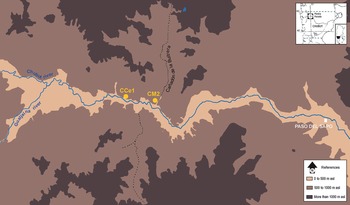
The archaeological site CM2 is located in the Piedra Parada area, northwest of Chubut province, Argentine Patagonia, about 8 km from CCe1 (Fig. 1), the other archaeological site from which carnivore coprolites were examined. There, 7 carnivore coprolites from a level dated in 580 ± 60 years BP (Fugassa et al., Reference Fugassa, Petrigh, Fernández, Catallud and Bellelli2018), and others almost contemporary to those analysed by Fugassa et al. (Reference Fugassa, Petrigh, Fernández, Carballido Catalayud and Bellelli2021) were studied. Archaeological site CM2 is a 39 m wide and 11.5 m deep rockshelter, situated at Cañadón de la Buitrera, 450 m above sea level (Bellelli, Reference Bellelli and Yacobaccio1988). During the excavation of CM2, a total of 11 stratigraphic levels (0, 1, 2, 3 and 4 (and their sub-levels)) were determined and dated between 780 ± 80 and 5080 ± 100 years BP (Bellelli and Guráieb, Reference Bellelli, Guraieb, Gómez Otero, Svoboda and Banegas2019). Through these millennia, hunter-gatherer groups left remains of their activities: hearths (some surrounded by grass ‘beds’), lithic tools and debris, bones of guanaco and other consumed animals, leather fragments, rawhide strips, fleece and fur artefacts, and several artefacts made of vegetable fibres (Nacuzzi, Reference Nacuzzi1987; Pérez de Micou, Reference Pérez de Micou1988; Bellelli, Reference Bellelli and Niemeyer1991; Marchione and Bellelli, Reference Marchione and Bellelli2013). As evidenced by chewed bones and feces, CM2 was also used by carnivores (Fernández, Reference Fernández2008).
Localization of the archaeological sites Campo Moncada 2 (CM2) and Campo Cerda 1 (CCe1), Piedra Parada area, NW Chubut, Argentine Patagonia.

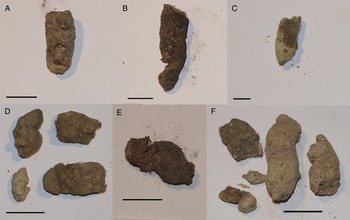
We present the results of the analysis of 6 coprolites: 4 obtained in sub-level 2a (coprolites 812, 813, 814 and 815) and 2 obtained in sub-level 2a/b (coprolites 810 and 811) from CM2, assigned to carnivores (Fig. 2). As in other sites in the area, accumulation of grasses arranged around hearths were identified in these sub-levels (Nacuzzi, Reference Nacuzzi1987; Pérez de Micou, Reference Pérez de Micou1988). Two radiocarbon dates associated with the coprolites (charcoal from hearths) allowed placing samples chronologically between 780 ± 80 and 860 ± 80 years BP (Nacuzzi, Reference Nacuzzi1987).
Coprolites examined: (A) 810, (B) 811, (C) 812, (D) 813, (E) 815 and (F) 814. Scale bar = 20 mm.

A fraction of each coprolite was rehydrated in phosphate-buffered saline (PBS) 0.5× for 3 days at 7°C. The suspension was sieved through a 300 mm opening nylon monofilament mesh and then allowed to sediment spontaneously. The sediment was recovered and used for parasitological examination under light microscopy. The remaining sediment of each coprolite was subjected to flotation in a saturated solution of sucrose and sodium chloride (Royal Veterinary College, 2021) of density = 1.35. The supernatant was recovered and diluted in PBS 0.5× in a 1:3 ratio for the sedimentation of parasitic elements. For each case, this sediment was centrifuged at 1500 rpm for 5 min, washed and used to prepare 2 temporary slides. For parasitological identification, the exhaustive list of terrestrial mammal helminths of Patagonia (Fugassa, Reference Fugassa2020), taxonomic descriptions of helminths and various handbooks (Soulsby, Reference Soulsby1987; Miyazaki, Reference Miyazaki1991; Foreyt, Reference Foreyt2001; Zajac and Conboy, Reference Zajac and Conboy2012, among others) were used. The classification was performed following the higher-level classification system of Anderson (Reference Anderson2000) and Anderson et al. (Reference Anderson, Chabaud and Willmott2009) for the phylum Nematoda, Khalil et al. (Reference Khalil, Jones and Bray1994) and Kuchta et al. (Reference Kuchta, Scholz, Brabec and Bray2008) for the class Cestoda, Gibson et al. (Reference Gibson, Jones and Bray2002), Jones et al. (Reference Jones, Bray and Gibson2005) and Bray et al. (Reference Bray, Gibson and Jones2008) for the subclass Digenea and Amin (Reference Amin2013) for the phylum Acantocephala.
Some definitions of parasite ecology (Bush et al., Reference Bush, Lafferty, Lotz and Shostak1997) must be adapted to the nature of the sample used (Watve and Sukumar, Reference Watve and Sukumar1995). In the present study, fecal parasite richness was defined as the number of taxa observed in each coprolite – by which it refers to the intestinal infracommunity and to some respiratory parasites whose eggs or larvae are dispersed fecally, such as Eucoleus aerophila. Another limitation in the study of coprolite samples is the one that arises when attempting to describe the intestinal component community: if the coprolites examined are not contemporary with each other, estimating the total fecal parasite richness may be inappropriate the same happens with the total fecal parasite richness obtained from isolated host populations (Poulin, Reference Poulin1995), in which the total fecal parasite richness observed would not describe a true parasite community. In addition, since parasites frequently exhibit an aggregate distribution within the host population (Shaw and Dobson, Reference Shaw and Dobson1995), the estimates obtained from a small sample, such as the one studied here, only partially inform about the composition and minimum values of total fecal parasite richness for the host population. Regarding prevalence, unlike the traditional definition (Bush et al., Reference Bush, Lafferty, Lotz and Shostak1997), in the present study, we used the fecal prevalence to indicate the percentage of coprolites in which parasite taxa were detected.
Results
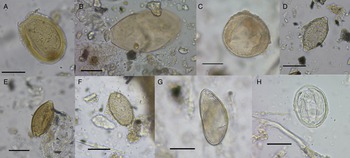
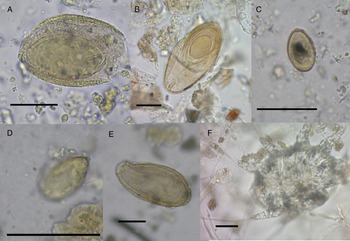
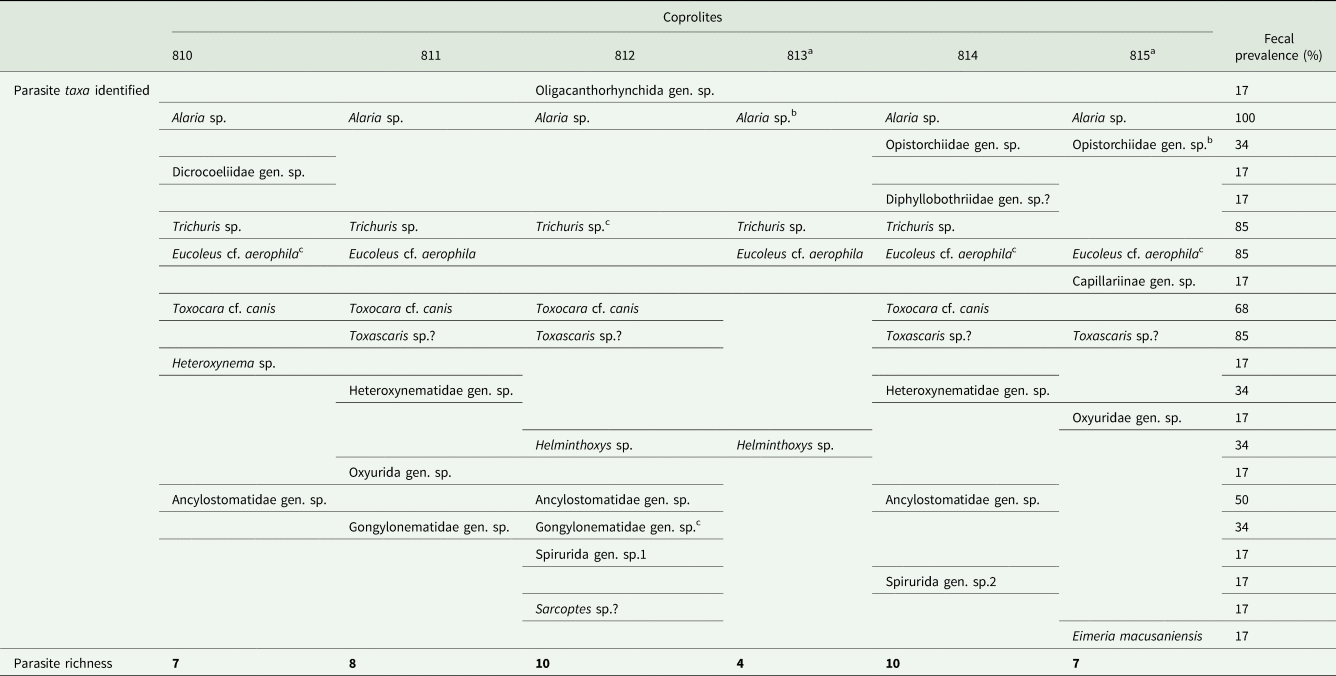
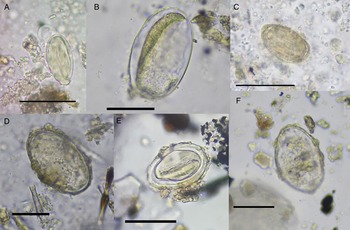
All coprolites presented polyparasitism (Table 1) and the conservative estimation of total fecal parasite richness resulted in 21 parasite taxa. In this work, except for Eimeria macusaniensis (Fig. 3A), the remaining parasite taxa were determined at the genus (38%), family (38%) or higher taxonomic category (19%) levels. In some cases, there were numerous parasitic elements, which were well preserved and had enough distinctive features to facilitate their identification: Alaria sp. (Fig. 3B), Toxocara cf. canis (Fig. 3C), Eucoleus cf. aerophila (Fig. 3D), Trichuris sp. (Fig. 3E), Capillariidae gen. sp. (Fig. 3F), Helminthoxys sp. (Fig. 3G) and Toxascaris sp. (Fig. 3H). Parasite remains of other taxa were present in very low frequency, although they also had enough traits of taxonomic value for their tentative assignment. These included: Oligacanthorhynchida gen. sp. (Fig. 4A), Heteroxynema sp. (Fig. 4B), Opistorchiidae gen. sp. (Fig. 4C), Dicrocoeliidae gen. sp. (Fig. 4D) and Sarcoptes sp. (Fig. 4F).
Parasite eggs found in the archaeological site CM2. (A) Eimeria macusaniensis oocyst. (B) Alaria sp. (C) Toxocara cf. canis (D) Eucoleus cf. aerophila. (E) Trichuris sp. (F) Capillariidae gen. sp. (G) Helminthoxys sp. (H) Toxascaris sp. Scale bar = 40 μm.

Egg of parasite taxa found in low frequency. (A) Oligacanthorhynchida gen. sp. (B) Heteroxynema sp. (C) Opistorchiidae gen. sp. (D) Dicrocoeliidae gen. sp. (E) Heteroxynematidae gen. sp. (F) Sarcoptes sp. Scale bar = 40 μm.

Parasitological findings in the coprolites from the archaeological site CM2

a Coprolites assigned to Puma concolor.
b It is probably a different species.
c They probably consist of 2 different species.
Some of the parasite taxa identified showed morphological variability, which suggests the presence of more than 1 species: for example, Trichuris sp. eggs presented an eggshell of different colour and thickness, Eucoleus cf. aerophila eggs presented different shapes, and Alaria sp. presented larger dimensions – coprolite 813 – than in the other coprolites. Likewise, in addition to the Heteroxynema sp. recorded, results showed poorly preserved eggs attributable to another species of the family Heteroxynematidae (Fig. 4E). Other findings, although frequent, consisted of eggs with ambiguous features, resulting in an uncertain taxonomic determination. For example, some translucent, thick-walled, embryonated eggs with a polar operculum and a 36.5–40 μm major axis, tentatively assigned to the family Gongylonematidae (Fig. 5A) and probably originated from the ingestion of arthropods, which are their intermediate hosts, were found in coprolites 811 and 812. Similarly, a few eggs with a thin and translucent eggshell, 75–80 μm long axis and with an embryonic mass corresponding to a species of the order Strongylida, probably of the family Ancylostomatidae (Fig. 5B), were found in 3 of the coprolites (810, 812 and 814). Less-frequent parasitic elements and with few traits for their correct assignment had only 1 determination at a high taxonomic level: in coprolite 811, a single embryonated egg, 37.5 × 22.5 μm, with a smooth, thick wall and an internal membrane, probably the product of consumption of a parasitized vertebrate, was identified and assigned to the order Oxyurida (Fig. 5C). Likewise, a single ellipsoid egg that could correspond to a spirurid species, was found in coprolite 812 (Fig. 5D); a very thick-walled egg, 50 μm long and embryonated, assigned to another spirurid, probably Pterygodermatites sp. (Fig. 5E), and an operculated egg, 70 μm long and with a thickening in the adopercular end (Fig. 5F) assigned to a pseudophyllidea species of the family Diphyllobothriidae, were identified in coprolite 814.
Helminth eggs with ambiguous features. (A) Gongylonematidae gen. sp. (B) Ancylostomatidae gen. sp. (C) Oxyuridae gen. sp. (D) Spirurida gen. sp. 1. (E) Spirurida gen. sp. 2., probably Pterygodermatites sp. (F) Diphyllobothriidae gen. sp. Scale bar = 40 μm.

Discussion
Zoological origin of coprolites
Hair, bones and arthropod cuticles were recognized in all the coprolites studied, which corroborated their assignment to carnivores. According to that described by Chame (Reference Chame2003), the shape of the coprolites was compatible with that of felines and canids. Since the coprolites came from archaeological levels assigned to pre-Hispanic times close to European colonization, the composition of the contemporary mastofauna would be similar to the current one, with the exception, among carnivores, of species that became extinct during colonization, such as Dusicyon avus and Panthera onca (Díaz, Reference Díaz2010; Prevosti et al., Reference Prevosti, Ramírez, Schiaffini, Martin, Udrizar Sauthier, Carrera and Pardiñas2015). The maximum diameter of feces represents a useful trait to discriminate between sympatric carnivores and its use was compatible with molecular results of previous studies in the region (Fugassa et al., Reference Fugassa, Petrigh, Fernández, Catallud and Bellelli2018, Reference Fugassa, Petrigh, Fernández, Carballido Catalayud and Bellelli2021). Farfán and Jiménez Milón (Reference Farfán and Jiménez Milón2001) determined that L. culpaeus has feces with a maximum diameter that ranges from 17 to 24 mm; therefore, coprolites 810, 811 and 814 would correspond to this species. Likewise, coprolites larger than 24 mm (such as 813 and 815) showed a similar appearance and lower parasite richness than fox coprolites and could thus correspond to Puma concolor or D. avus. Coprolite 812 (maximum diameter <17 mm) could be assigned to various mammals such as L. gymnocercus (griseus), minor cats or mustelids. However, this coprolite contained eggs of Toxocara cf. canis so it can be attributed to L. gymnocercus or to a L. culpaeus subadult because cross-infection with other carnivores is unlikely (Fahrion et al., Reference Fahrion, Schnyder, Wichert and Deplazes2011).
Assessing ancient parasite assemblages
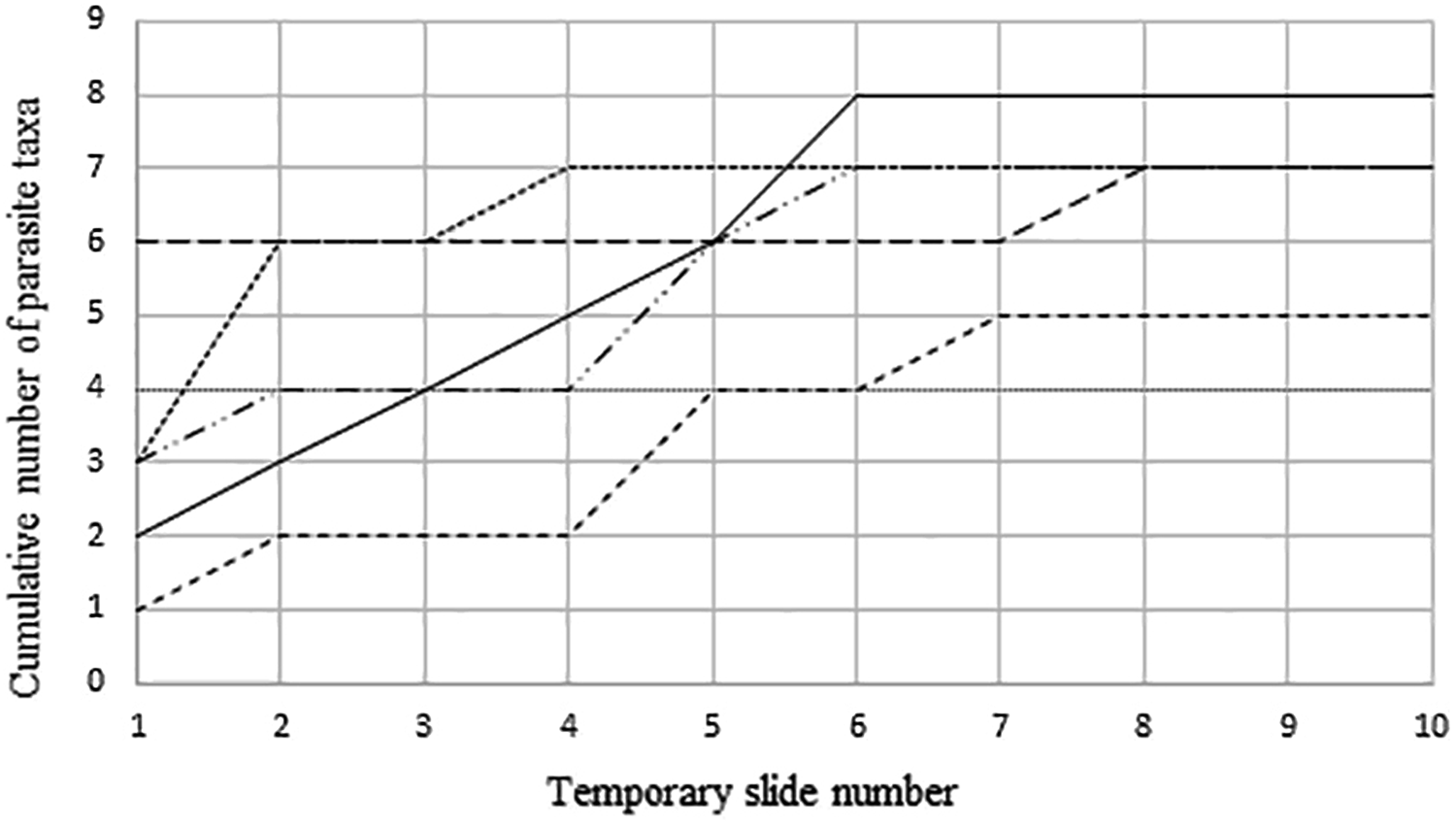
Parasite richness recorded at different scales of analysis tends to correlate closely with sampling effort (Poulin and Morand, Reference Poulin and Morand2000). In this work, after the parasitological examination by sedimentation, 90% of the parasite taxa identified in each coprolite was recovered, on average, in the 6 slides of the 10 examined and where the curve of the accumulated number of parasite taxa found (Fig. 6) suggests having reached an acceptable sampling effort (Walther et al., Reference Walther, Cotgreave, Price, Gregory and Clayton1995). Subsequent examination by flotation enrichment recovered 65.5% of the species found by sedimentation and an average of 0.83 new species per coprolite. The parasite taxa with the highest fecal prevalence (>50%) corresponded to parasites prevalent in modern carnivores (Alaria sp., Toxocara cf. canis, Toxascaris sp., Eucoleus cf. aerophila, Trichuris sp. and Ancylostomatidae gen. sp.). Therefore, some of the taxa that presented lower fecal prevalence could have come from the ingestion of parasitized prey. In carnivore coprolites, since fecal parasite richness may be overestimated due to the presence of parasite taxa from parasitized prey, this issue needs to be considered.
Cumulative number of parasite taxa per temporary slide observed in each coprolite from CM2 by the sedimentation technique.

The pre-Hispanic record of parasitic elements assignable to helminth species typical of modern carnivores (Trichuris sp., Toxocara cf. canis, Toxascaris sp., Eucoleus cf. aerophila) also requires a biogeographical history analysis for such parasites. Currently, the finding of certain species of helminths in modern wild carnivores, such as that of E. boehemi in wolves (Molnar et al., Reference Molnar, Ciucci, Mastrantonio and Betschart2019) and Toxocara spp. in different South American carnivores (Moleón et al., Reference Moleón, Kinsella, Moreno, Ferreyra, Pereira, Pía and Beldoménico2015), is often interpreted as a product of contact with domestic animals.
Methodological limitations
In coprological examinations, the specific determination of parasitic elements is often limited by the absence of sufficient traits with taxonomic value (Zajac and Conboy, Reference Zajac and Conboy2012). On the other hand, in addition to the difficulties already mentioned to determine the identity of the infective elements found in feces and coprolites, even the morphological examination of adult helminths can mask enough genomic differences to consider them as cryptic species and this uncertainty cannot be resolved with only morphological studies (Nadler and Pérez-Ponce de León, Reference Nadler and Ponce de León2011). In wildlife research, this limitation is highlighted due to the lack of knowledge of their parasite diversity, and, in archaeological contexts, parasitic elements suffer alterations and losses due to post-depositional processes that reduce the opportunities to determine their identity (Bouchet et al., Reference Bouchet, Guidon, Dittmar, Harter, Ferreira, Chaves, Reinhard and Araujo2003). In addition, the study of carnivore coprolites is limited by the diversity of parasitic forms that can be found due to the consumption of various taxa of parasitized animals.
Despite the limitations described above, the parasite richness found in a small and pre-Hispanic samples, is greater than that found in coprological research of samples composed of numerous fresh feces of current wild carnivores. For example, 14 parasite taxa were found in 1558 wolf feces from Canada (Bryan et al., Reference Bryan, Darimont, Hill, Paquet, Andrew Thompson, Wagner and Smits2012), 7 parasite taxa in 91 raccoon feces from Poland (Popiolek et al., Reference Popiolek, Szczesna-Staskiewicz, Bartoszewicz, Okarma, Smalec and Zalewski2011), 10 parasite species in 100 lynx feces from Poland (Szczesna et al., Reference Szczesna, Popiolek, Schmidt and Kowalczyk2008), 13 parasite taxa in 82 skunk feces from the USA (Lesmeister et al., Reference Lesmeister, Millspaugh, Wade and Gompper2008), 15 parasite taxa in 168 lion feces from Tanzania (Müller Graf, Reference Müller Graf1995) and 14 parasite taxa in 68 jaguar feces from Mexico (Solórzano García et al., Reference Solorzano García, Day, Gómez-Contreras, Cristóbal, Osorio-Sarabia and Rodríguez-Luna2017). Although the impact of the sampling effort – in terms of sample size – on the estimates of total fecal parasite richness is usually considered, an aspect of the sampling effort that is difficult to measure and compare and remains to be addressed is the quality and intensity of the observation.
Hunter-gatherer and carnivore interactions by parasites
Puma concolor, as a large carnivore, and L. culpaeus, as a mesocarnivore (<15 kg in weight), affect the biological community through their effects on food webs and because, in sympatry, they establish competitive relationships that even reach intra-guild predation (Castillo Sánchez et al., Reference Castillo Sánchez, Álvarez, Nuñez, Kaufmann, Alcaraz, Ochoa and Gatica2021). Likewise, they affect the community through their function in the life cycles of the parasites for which they are definitive, intermediate, paratenic or dispersing hosts due to the predation of parasitized prey. The high total fecal parasite richness found in the present study suggests a network of host–parasite relationships that could include regional hunter-gatherers. The contamination of the human habitation area with carnivore feces, except for those of Eimeria macusaniensis, which is highly host-specific like other eimeriids (Levine and Ivens, Reference Levine and Wens1988), allows assuming a true exposure to the directly transmitted parasites reported here (Toxocara cf. canis, Toxascaris sp., Trichuris sp., Eucoleus cf. aerophila, Capillariinae gen. sp., Ancylostomatidae gen. sp., Heteroxynema sp., Heteroxynematidae gen. sp., Oxyuridae gen. sp. and Oxyurida gen. sp.). Likewise, the eggs of heteroxenous parasites (Spirurida gen. sp. 1, Spirurida gen. sp. 2, Gongylonematidae gen. sp., Alaria sp., Opistorchiidae gen. sp., Dicrocoeliidae gen. sp. and Oligacanthorhynchida gen. sp.) did not represent a direct risk for hunter-gatherers because these eggs must first hatch and infect 1 or more intermediate hosts. However, the high prevalence found for some of them in carnivore coprolites suggests a potential risk for hunter-gatherers who coincided with such carnivores in eating small vertebrates and, intentionally or accidentally, invertebrates in the area. For example, in the case of Alaria sp., hunter-gatherers could have hosted the larvae of these trematodes due to the ingestion of amphibians, reptiles or even some birds, with consequences similar to those reported in carnivores or humans (Ljubaschenko and Petrov, Reference Ljubaschenko and Petrov1962; Fernandez et al., Reference Fernandez, Cooper, Cullen, Freeman, Ritchie, Scott and Stuart1976, among others). For the hunter-gatherers of the area, only an efficient cooking of the prey could have generated a barrier for the trophic transmission of this and other heteroxenous parasites.
Local and regional comparisons
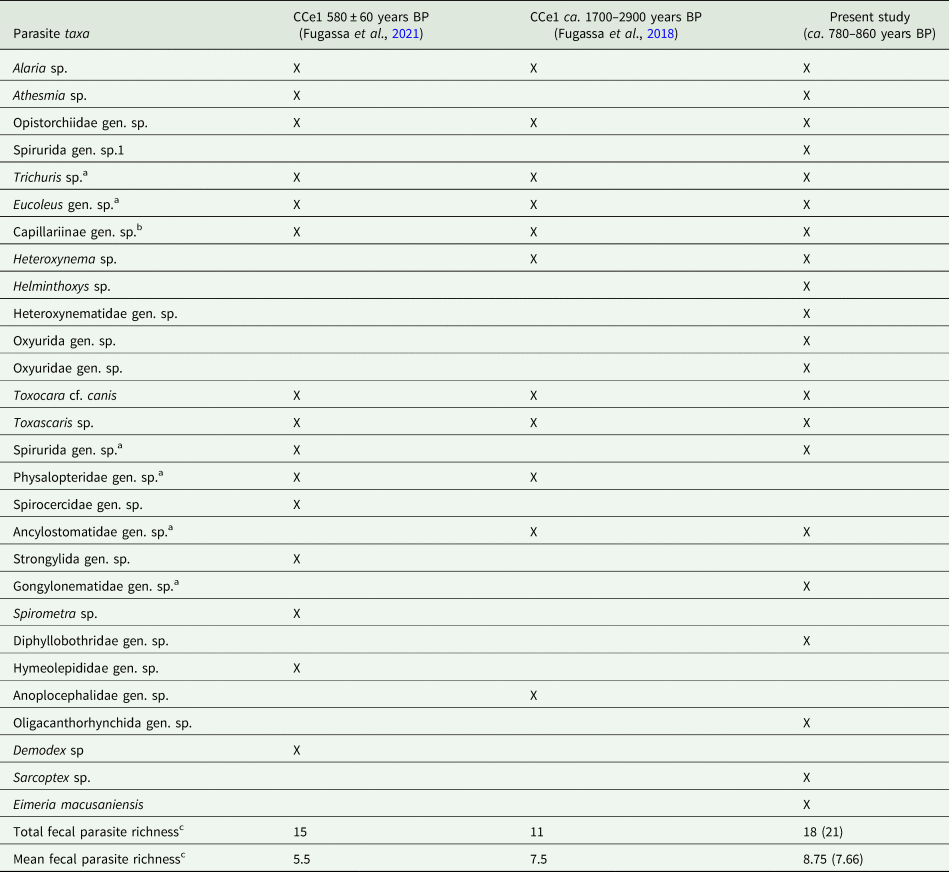
The comparison between the findings in coprolites from CM2 and those obtained from the contemporary levels of CCe1 (Fugassa et al., Reference Fugassa, Petrigh, Fernández, Carballido Catalayud and Bellelli2021) is hindered by the likely presence of puma coprolites in the former and by the difference in the size of both samples. Assuming that the fox coprolites are contemporaneous within the period – ca 600–800 years BP, the total fecal parasite richness estimated for both sites is similar (Table 2). Regarding the composition of the total fecal parasite richness, as observed in the CCe1 sample, Alaria sp. was the only parasite with 100% fecal prevalence (Table 1). In the coprolites from CM2 and CCe1, in addition to Alaria sp., the other 3 helminth taxa with aquatic life cycles were found, although with low fecal prevalence and density (Opistorchiidae gen. sp., Dicrocoeliidae gen. sp. and Diphyllobothriidae gen. sp.). Archaeological sites CCe1 and CM2 are close to the Chubut River, at a distance of about 300 and 600 m, respectively, and CM2, in addition, is located in the Cañadón de la Buitrera creek, which has a permanent course, although with little flow, and contains numerous meandering zones. This would explain the presence of parasites with part of their life cycles related to fresh water.
Comparison of parasite assemblages in samples from the Piedra Parada archaeological area

a Probably more than 1 species.
b Identified as Calodium sp. in Fugassa et al. (Reference Fugassa, Petrigh, Fernández, Carballido Catalayud and Bellelli2021).
c In parentheses, parasite richness including puma coprolites.
Compared to Cerro Casa de Piedra, Santa Cruz province, Argentina – another archaeological locality from Patagonia intensely studied – Piedra Parada area presented higher values of parasite taxa identified in carnivore coprolites (15 vs 28, respectively) and only 1 taxon associated with an aquatic environment (Fugassa et al., Reference Fugassa, Denegri, Sardella, Araújo, Guichón, Martínez, Civalero and Aschero2006, Reference Fugassa, Sardella and Denegri2007, Reference Fugassa, Beltrame, Bayer and Sardella2009, among others). In wolves, which were apex predators in other environments, parasite richness was also greater in ecosystems with greater diversity of prey (Craig and Craig, Reference Craig and Craig2005), a fact that may explain the differences found between both archaeological localities. In Patagonia, as it has been previously postulated (Fugassa et al., Reference Fugassa, Beltrame, Bayer and Sardella2009; Fugassa and Petrigh, Reference Fugassa and Petrigh2017), rockshelters represented parasite exchange nodes and the results obtained in carnivore coprolites allow us to infer a very diverse biological community in Piedra Parada area, so the regional caves and rockshelters could have a proportional epidemiological importance.
Data availability
Supplementary information (eg, photographs and record of measurements of parasitic remains) is available.
Acknowledgements
We are thankful to Ana Forlano for the artwork of Fig. 1. Contributions made by anonymous reviewers are gratefully acknowledged.
Author's contributions
Pablo M. Fernandez and Mariana C. Calatayud contributed the zooarchaeological information on the site and the writing of the manuscript. Cristina Bellelli provided information on the archaeological excavation and collaborated in writing the manuscript. Martín H. Fugassa performed the parasitological examination of the samples.
Financial support
The present study was financed by the Fondo para la Investigación Científica y Tecnológica (FONCyT, PICT 3664), Consejo Nacional de Investigaciones Científicas y Técnicas (CONICET, PIP 436) and Universidad Nacional de Mar del Plata (EXA 983/20), Argentina. The coprolites were recovered in the 1990s with the support of the Subsecretaría de Cultura de la Provincia de Chubut and the Instituto Nacional de Antropología y Pensamiento Latinoamericano (Ministerio de Cultura de la Nación), Argentina.
Conflict of interest
The authors declare there are no conflicts of interest.
Ethical standards
Not applicable.