In April 1975, indigenous youth in Mexico occupied regional development centers throughout the southern state of Oaxaca. From the Sierra Sur town of Miahuatlán, to the arid highlands of the Mixteca Alta, to the valley of the Papaloapan Dam project, these youth took control of Instituto Nacional Indigenista (INI) coordinating centers and held them for more than a month. Trained as promotores bilingües (bilingual agents of education and development projects) by a separate regional development agency (the Instituto de Investigación y Integración Social del Estado de Oaxaca, or IIISEO), they demanded professional training and the creation of positions for themselves as federal teachers. Their banners accused the Mexican government of ethnocide against native peoples, denouncing the government's celebration of indigenous culture as a mask for continued exploitation.Footnote 1
As such, the promotores formed part of a transnational phenomenon of youth protest, one of whose most iconic expressions included the 1968 Mexico City student protests, a denunciation of Mexico's government that met with violent repression.Footnote 2 After six years of struggle and politicization, the promotores eventually won a central component of their demands, gaining positions as bilingual teachers within the Ministry of Education (SEP). This article analyzes the nature of 1968-era youth protest in the Americas through a case study of the experience of indigenous youth trained as promotores bilingües.Footnote 3 In so doing, it reveals how the political radicalization associated with the Global Sixties involved not only the university students and other middle-class elements typically associated with protests of the era, but also new generations of indigenous youth. By focusing on the radical formation and subsequent mobilization of indigenous youth in provincial (non-urban) Mexico, the article decenters the narrative of youth radicalization from both the iconic Mexico City student protests and the turn toward guerrilla struggle in countryside.Footnote 4
In addition, the article contributes to an ongoing debate regarding the nature of power and political culture in post-1968 Mexico. The experiences recounted here demonstrate how local actors contested power within an institutional framework characterized by both negotiation and state repression. That federal power in particular opted for pluralist reforms in this period was both a concession to popular demands and an attempt to get ahead of them. This case study demonstrates the Institutional Revolutionary Party's (PRI) skills, honed over decades, in accommodating opposition, but also the power of a new generation of indigenous youth to negotiate the terms of their integration into state structures.
Little scholarly consensus exists on the Mexican government's response to 1968-era dissent, in which President Luis Echeverría (1970–1976) oversaw a series of liberalizing reforms officially termed the apertura democrática (democratic opening). The period from 1938 to 1968 has been considered the golden age of the PRI, which had ruled Mexico since 1929. During that period, the government oversaw impressive macroeconomic growth and urbanization.Footnote 5 Indeed, Mexico's hosting of the 1968 Summer Olympic Games aimed to be the crowning achievement of the so-called Mexican miracle. In collective memory, that year, 1968, and the subsequent repression of youth protest have become a parteaguas (watershed) in Mexican history. Yet scholars are now analyzing 1968 less as a detonator of change than as emblematic of changes that had come into play during the 30 years preceding.Footnote 6
Many of those who took to the streets against the government in 1968 and its aftermath rejected the democratic opening as a sham, nothing more than a new mask for the same ugly monster. Youth who had witnessed friends massacred or jailed understandably rejected President Echeverría's rhetoric of dialogue. A handful of these same figures went on to become public intellectuals who continued to frame the democratic opening as little more than cooptation.Footnote 7 This in part explains the staying power of a narrative of successful government cooptation for the post-1968 period. Indeed, it cannot be denied that certain federal officials did explicitly aim to incorporate and therefore neutralize opposition.Footnote 8 Yet, as historical analysis, this narrative blinds us to the internal divisions within the governing party itself and the ways in which youth and other sectors of Mexican society actively shaped the government's options during this period.
Through archival research, particularly declassified state surveillance documents, as well as oral histories of the promotores and their allies, this article assesses the experience of the first generations of youth who passed through the IIISEO.Footnote 9 Created in Oaxaca in 1969, the IIISEO aimed to put into practice a new set of theories of indigenous modernization through grassroots development work. The article then examines the experience of the initial generations of promotores in the field and their struggle for economic and political rights. It concludes by arguing that the democratic opening should be understood as a specific outcome of a global process: the liberalizing reforms initiated by President Echeverría were not an aberration from the upheaval of the Global Sixties but part of it. Federal indigenous policy in the post-1968 era was fueled not only by official efforts aimed at incorporating opposition forces into state structures but also by a broader coalescence of New Left ideas of decolonization and revolution.
The Year 1968 and the Democratic Opening in Mexico
In 1968, the year before the first class of students entered the IIISEO, youth across the Americas and throughout the world launched protests. The year has come to represent much more than the calendar period itself, signifying the political dissidence that broke out from Mexico City to Buenos Aires, from Paris to Tokyo, and stretched well beyond its temporal extension and into the 1970s.Footnote 10 It was a historical moment with seemingly endless determinants: the US war in Vietnam and violent conflicts over US race relations, the Soviet Union's invasion of Czechoslovakia, movements against European colonialism in Africa, and events in China all seemed to call into question the legitimacy of the world's superpowers. Radical social change appeared not only possible but seemingly inevitable as countries as diverse as Cuba and the Congo challenged colonial relations and instituted agrarian reform.Footnote 11 These events percolated through Mexican dissident culture, shaping a generation that would challenge a regime that ruled in the name of revolution.Footnote 12
The October 2 repression of youth protests in Mexico City came on the heels of unrest throughout the Americas. Students in Brazil and Venezuela spent the summer of 1968 protesting for university reform. In Uruguay, youth took up and expanded protests initiated by trade unions around economic demands.Footnote 13 By May 1969 the Argentine city of Córdoba had witnessed a popular uprising, the Cordobazo, in which auto workers and student activists initiated a general strike and fought pitched battles against the military government. While the protests of the Global Sixties took different forms under local conditions, they shared the common elements of youth mobilization, a global vision of social change, and a radical critique of existing institutions, be they Communist parties or parties of nationalist reform.Footnote 14 In Latin America youth took inspiration from both currents of New Left politics and progressive elements within the Catholic Church.
Former participants shaped initial discussions of 1968 in the Americas through their published memoirs and testimonials.Footnote 15 While these authors emphasized struggles against authoritarian regimes and experiences of repression, scholarly studies on the period began with a focus on transnational youth cultures and how music and cultural consumption facilitated the protest movements.Footnote 16 Other authors have pointed to cleavages on the political left, in which the primary institutions of the Old Left, Communist parties, trade unions, and peasant leagues, fell out of favor with younger generations.Footnote 17 The 1959 Cuban Revolution played a central role in this break, proving to many youth the need to jettison urban, conservative communist parties in favor of guerrilla struggle.
Scholarship on this period has benefitted from transnational analysis, which points to the conduits through which youth radicalization spread. Eric Zolov has offered a compelling definition for this new approach to what is termed the Global Sixties, emphasizing how transnational forces “produced simultaneity of ‘like’ responses across disparate geographical contexts, suggesting interlocking causes.”Footnote 18 The utility of this approach is precisely its ability to identify how transnational ideas “affected the course of local events.”Footnote 19 It also allows scholars to challenge the nationalist narratives produced by the respective youth generations of the era. Mexico already figures prominently in the literature on the Global Sixties because of the massacre of students in Mexico City, yet a study of this event informs conceptions of both Mexico 1968 and the Global Sixties. Uncovering indigenous youth's active participation in the political effervescence of the period, as the present case study does, not only broadens the frame of inclusion and the range of locales where specific events occurred but also bridges two parallel but seemingly disconnected literatures: global anticolonialism and nationalist student narratives. Scholars have only just begun to link these two literatures. Quinn Slobodian has demonstrated how students from “Third World” countries shaped the politics of youth rebellion in Europe, and Africanists have shown how African youth, particularly urban students, engaged in a global cosmopolitanism and joined in international “leftist networks” to frame their own activism.Footnote 20
This case study explores not just the New Left's critique of reformist institutions but also its emphasis on anti-racism and anticolonialism. While frustrations with the limits of Cold War politics generated discontent, struggles for national liberation sparked the imaginations of youth globally. In addition to the Cuban Revolution, movements against European colonialism in Africa inspired Latin American youth. University students in Mexico City cheered the 1967 debut of the celebrated film The Battle of Algiers and within a few short years indigenous youth in Oaxaca took up anticolonial rhetoric to denounce the Mexican government.Footnote 21 In the United States, Black Power activists and Native American youth framed their own communities’ conditions as parallels to third- world colonialism and articulated their own versions of anticolonial liberation.Footnote 22 In China, Mao's Cultural Revolution appeared to offer a model of revolution based on an embrace of youth and rural peoples as the primary agents of revolution, a politics that had particular resonance in Latin America.Footnote 23
Oaxaca de Juárez: Conduit of Radicalism
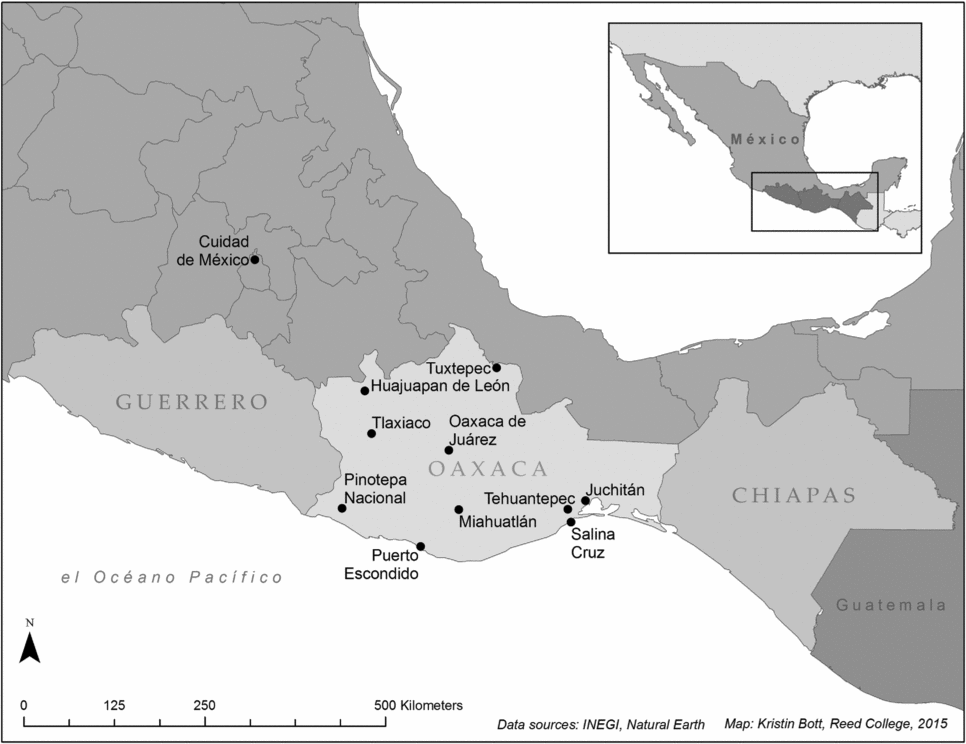
A provincial capital that had been a center of colonial wealth, Oaxaca de Juárez (Oaxaca City) grew substantially in the early 1970s (Figure 1). Beginning in the summer of 1968, a university movement there transformed the existing student federation, the Federación de Estudiantes Oaxaqueños (FEO), previously a pillar of PRI politics and a mechanism for political advancement, into a mobilized organization.
Oaxaca: Major Cities and Neighboring States

The Oaxacan university movement had direct ties to events in the national capital, as many of its initiators had traveled to and even studied at the Universidad Nacional Autónoma de México (UNAM).Footnote 24 Some of those students returned to form a number of new organizations in Oaxaca, including the Bufete Popular Universitario and eventually the Coalición Obrero Campesino Estudiantil de Oaxaca (COCEO), in 1972. They aimed to reform their university, the Universidad Benito Juárez de Oaxaca (UBJO), demanding democratic control of the university's administration and political autonomy, and eventually broadened their struggle to support independent trade unions in the state capital and peasant groups engaged in land seizures on the outskirts of the city.Footnote 25 Indeed, the COCEO would go on to play a crucial role in the overthrow of Oaxacan Governor Manuel Zárate Aquino in 1977.
In this milieu the protest music of Cubans Silvio Rodriguez and Pablo Milanés intermingled with the classic rancheras of Pedro Infante and José Alfredo Jiménez.Footnote 26 The combination of nueva trova and Mexican rancheras speaks to the cultural power of the Cuban Revolution in Mexico and suggests the way in which youth embraced the cosmopolitanism of the Global Sixties along with long-standing local traditions. Nueva trova was a key component of this moment of rupture in Latin America and inspired youth to new models of politics and personal relationships. Yet, the Oaxacan university students also relied on local cultural traditions in their mobilization for democratic reforms. During the last days of Carnival in 1974, the FEO organized its own comparsa (costumed parade with bands), to promote its demands.Footnote 27 The bringing together of these local and global elements in Oaxacan protest culture suggests how events in provincial Mexico were shaped by new political cultures and discourses.
During the same period, a movement of youth and popular classes surged in the Isthmus town of Juchitán, culminating in the ouster of the PRI from the municipal government in 1981, the first such case in the republic.Footnote 28 The Coalición Obrera, Campesina, Estudiantil del Istmo (COCEI), the organization that united the various struggles in Juchitán, built its strength through a Zapotec indigenous identity along with traditions of leftist militancy. The organizers of the COCEI and those in Oaxaca City established direct links to support each other, particularly against reprisals from the state government. These struggles were part of a broader generational conflict in which local PRI authorities, many of whom had participated in post-revolutionary state building, began to lose power, and demographic growth created a new generation of indigenous youth. Jeffery Rubin has argued this point for the case of Juchitán, and Jan Rus has noted similar dynamics among indigenous communities in the neighboring state of Chiapas. Footnote 29 David Recondo has put a finer point on the phenomenon, arguing that the clientelist pact that had successfully equated nation, party, and community in indigenous Mexico came undone in the 1970s as the state was forced to deal with a plethora of new actors. Footnote 30 In a state such as Oaxaca, with a long tradition of government negotiation with indigenous leaders, this new generation was able to leverage the rhetoric of the democratic opening to challenge entrenched local authorities.
In addition to these generational conflicts, Catholic liberation theology, new strands of clandestine leftism, and a changing official policy of indigenous development (indigenismo) contributed to a shift in the political terrain facing indigenous Mexico.Footnote 31 These forces had a particular impact in the southern states of Guerrero, Oaxaca, and Chiapas, each with relatively large indigenous populations and high levels of rural poverty. While liberation theology became influential in Latin America generally during this period, Mexico's particular history of conservative Church opposition to the postrevolutionary state meant the doctrine remained a minor current within the country.Footnote 32 Indeed, the archbishop of Antequera (the archdiocese covering much of Oaxaca), Ernesto Corripio y Ahumada, was a staunch conservative, and Catholic opposition to federal authorities led to violent clashes in the state in the early 1960s.Footnote 33 Yet by the early years of the following decade a small number of Christian base communities were at work in the state capital, and liberation theology emerged at the institutional level through Bartolomé Carrasco Briseño, who replaced Corripio y Ahumada in 1976.Footnote 34
Nor was the clandestine left necessarily at odds with liberation theologians. The most notable example is the 1974 indigenous congress in San Cristóbal de las Casas, Chiapas, in which Archbishop Ruiz actively collaborated with Maoist organizers, many of whom were young northerners, in the organization of the congress.Footnote 35 In the aftermath of government repression of urban protests, and given the long-standing repression of rural agrarian movements, many came to view armed struggle as the only avenue for substantive social change. The most notable example of armed opposition during this period is that of the Partido de los Pobres in Guerrero, but in Oaxaca too a clandestine group, the Unión del Pueblo, took responsibility for multiple bombings in the state capital. Several armed groups were active in Chiapas, including the Fuerzas de Liberación Nacional, an organizational antecedent to the Ejército Zapatista de Liberación Nacional.Footnote 36
The government responded to the opposition with a pan o palo (bread or stick) strategy. Opposition forces that could be accommodated within state structures were dealt with through the pan approach; those that would not accommodate to PRI control were dealt with through targeted violence, the palo. Whereas the violence exercised by the state against youth in Mexico City during this period has become iconic, the regime's use of the pan strategy was perhaps of greater significance. The democratic opening during the presidential term of Luis Echeverría is most emblematic of this approach. Echeverría, who himself headed up the palo strategy as chief of government in October of 1968, oversaw a liberalization in which government critics were welcomed into state agencies. Alan Knight has explained this phenomenon as the outcome of Echeverría's feeling “obliged to extend an olive branch to the left, especially the student left” in the wake of the repression of youth protest.Footnote 37 The president's rhetorical left turn and dramatic expansion of public spending responded to both domestic pressure and the changing context of the Cold War, by presenting Mexico as a Third World nationalist government and an ally of countries such as Cuba and Chile.Footnote 38 These alliances helped transform Echeverría's image from PRI bureaucrat into progressive nationalist leader, an identity he played to by sporting guayaberas and sunglasses in his frequent travels throughout the republic.Footnote 39
Mexico has been portrayed as an outlier in Cold War Latin America, with its relative political stability contrasted to the broader trend of military coups and civil wars. The late 1960s and 1970s saw military juntas come to power in both Brazil and Argentina, to cite just two examples, and violent conflicts between leftist opposition and military regimes divided much of Central America. While Mexico did not experience the levels of mass violence and political upheaval that characterized those places, the distinction between Mexico and its Latin American peers becomes less pronounced upon closer examination.
For example, General Juan Velasco Alvarado seized power in a bloodless coup in Peru in October 1968, and while his was clearly a military government, he pursued a progressive nationalist agenda in ways similar to the efforts of Echeverría in Mexico.Footnote 40 Nor was Mexico immune to threats of civil war and military repression. Echeverría's foreign and domestic policies incurred conservative opposition and rumors of military coups circulated on both the Mexican right and left.Footnote 41 His rhetoric and policies allowed conservative critics to paint him as akin to President Salvador Allende of Chile, whose state visit to Mexico in 1972 seemed to confirm their critique. Fears over left-wing terrorism drew on this international context, as well as on a small but significant domestic guerrilla threat. Kidnappings and armed attacks on businesses and government buildings occurred in cities throughout the republic. In the summer of 1972, as Oaxaca prepared to celebrate its annual Guelaguetza, a festival of regional music and dance, three bombs exploded throughout the city, killing one person.Footnote 42 The polarization of Mexican politics and society, notwithstanding the governing party's ability to preserve itself, was part of a polarization shaping the region more generally.
The democratic opening went beyond rhetoric. Federal authorities initiated a dramatic increase in social spending in all sectors but particularly in education. The number of primary school teachers in Mexico doubled during this period and federal authorities expanded higher education, creating new academic programs and university systems, such as the Universidad Autónoma Metropolitana in Mexico City in 1974.Footnote 43 This expansion of education fit global trends and helps to explain the growth of youth culture and activism. In addition, the federal government created new rural development agencies and policies to distribute land and combat poverty.Footnote 44 The voting age was lowered from 21 to 18.Footnote 45 Together these changes constituted an expansion of the state sector as the regime aimed to incorporate a growing population pushing for increased economic and educational opportunities.Footnote 46 These measures, along with state intervention in industry and (failed) efforts at tax reform, constituted a dramatic attempt to reformulate and stabilize an aging political system.
While historians have developed a complex view of how power operated in mid-century Mexico, understandings of the post-1968 era have only recently begun to shift from what is best described as “memoria” to “historia.”Footnote 47 Many scholars have embraced an analysis of the democratic opening as part of a broader tradition of populism in Latin America. In this vein, Kiddle and Muñoz emphasize Echeverría's political style and response to a perceived crisis as fundamentally populist in nature, whereas Joseph and Buchenau describe Echeverría's sexenio as a “neopopulist revival.”Footnote 48 Renata Keller has pointed to the international issues confronting Mexican officials in the late 1960s to argue that Mexican support for the 1959 Cuban Revolution created domestic pressure that forced officials to take more progressive foreign policy positions.Footnote 49 Domestic reforms also responded to the expansion of the working and middle classes, and attendant demands for education and representation.Footnote 50
Scholarship on the mid-century period has taken up the term “dictablanda” to characterize PRI political culture and practice as a type of “soft” or “competitive” authoritarianism, though some reject authoritarianism outright as a useful descriptor.Footnote 51 The challenge facing scholars has been to balance an understanding of the PRI that captures the circumscribing, at times violent, elements of its rule while also reckoning with the Party's internal heterogeneity, based on political leaning and generation, as well as its varied responses to external pressures. Research on previous periods in Mexican history has demonstrated that regional power dynamics and internal divisions within the ruling party carry substantially more explanatory weight than narratives of cooptation.Footnote 52 The fact that some dissidents were effectively channeled into new corporate organizations, what Enrique Krauze has termed “política de neutralización” (neutralizing strategy), does not mean this was a preordained outcome, and scholars risk missing much about the nature of politics and possibility during the period by relying on this narrative.Footnote 53
Jeffry Rubin has urged scholars to examine “practices or spaces that are alternative enough to enable people to live and compromise somewhat differently or even nudge the path of history in unexpected directions.”Footnote 54 The actions of the Oaxacan youth constitute one such example of that dynamic and underscore the need to develop a historical framework that can account for contingency in post-1968 Mexico.Footnote 55 The global politics of anticolonialism and anti-racism found resonance in Mexican political culture, among both university youth and indigenous youth in states such as Oaxaca. These politics contributed to a shift in state policies in both education and development, and also facilitated a change in people's relationship to the state by providing a language for demanding autonomy and local control.
Social Integration, Social Struggle
The Oaxacan youth who occupied federal development centers in the spring of 1975 had been trained at the IIISEO, which embodied many of the changes wrought by the democratic opening. The institute embraced broadly anticolonial rhetoric and employed a generation of dissident social scientists to lead the effort to combat poverty. Whereas previous federal education policy had relied primarily on teachers trained in normal schools, during the 1970s state policy shifted to rely more heavily on those with backgrounds in higher education. In spite of these contemporary reforms, the IIISEO was also rooted in a nineteenth-century Oaxacan tradition, the system of pupilos (wards), in which well-off Oaxaca City families took in indigenous children from the countryside to work as mozos in their homes in exchange for the child's room, board, and education expenses. One of Oaxaca City's most prominent society members, Mariela Morales de Altamirano, had developed a reputation for taking in young girls for this purpose. In the early 1960s Oaxacan governor Rodolfo Brena Torres (1962–1968) offered to build on Morales's perceived success by creating an institute, the Escuela de Mejoradoras del Hogar Rural (EMHR), which Morales would run.
The school trained the girls in a host of domestic skills as well as Spanish language literacy. In 1969, Víctor Bravo Ahuja became governor of Oaxaca and in that capacity presided over the closing ceremonies of the EMHR. After the performance of El Jarabe del Guajolote and Fandango Mixe, traditional Oaxacan dances, the governor dismissed the young women with the perfunctory words, “I hope that one day, thanks to all of you, every Oaxacan will speak the national language.”Footnote 56 Celebrating indigenous aesthetics and at the same time declaring the need for Spanish language proficiency formed part of a long tradition of indigenista policy in Mexico. But far from ceasing to exist, the school started by Morales underwent an important transformation under the leadership of the new governor's wife, Gloria Ruiz de Bravo Ahuja, a linguist trained at the Colegio de México, one of the country's most prestigious educational centers. The Bravo Ahujas were an up-and-coming political couple whose fortunes were tied to the political faction (camarilla) of Luis Echeverría. Víctor was from Tuxtepec, on the Oaxacan border with Veracruz. He attended the Instituto Politécnico Nacional (IPN) in Mexico City and began his political career in the northern city of Monterrey. Part of a new generation of PRI bureaucrats, Bravo Ahuja was closely identified with Mexico's technical education programs: prior to his term as governor he had served in the SEP national office as director of technical education. Gloria, a native of Mexico City, enrolled in the Colegio de México, known for its Spanish-language linguistics program. Victor served as governor of Oaxaca for just two years, when, in 1970, incoming President Echeverría named him secretary of education.
The IIISEO was formally constituted in August of 1969, on the Xoxocotlán campus of the Mejoradoras School, situated on the southwestern edge of Oaxaca City. Owing to the political connections of its founders, the institute received initial funding from private interests such as the Monterrey Group (industrialists from that northern city) and the financiers Elías Souraski and Carlos Trouyet. These funds, along with support from UNESCO and Mexican federal and state agencies, made the IIISEO a veritable elite school for indigenous youth. It sported the newest equipment and research supplies at its Xoxocotlán campus and well-equipped regional development centers, as well as new imported Ford Broncos for the administrative staff. Footnote 57 The founders of the institute had sought to create an innovative organization that could confront the historic problems of indigenous development in Mexico. As director, Gloria Ruiz de Bravo Ahuja broke with long-held castellanización (Spanish language instruction) methods to create a new method, which she viewed as more effective. Whereas SEP and INI policy had focused on Spanish language literacy among the indigenous, often through cartillas (cards) with vocabulary words, Ruiz de Bravo Ahuja and the IIISEO pioneered a method that focused on oral acquisition of Spanish first, prior to literacy instruction (see Figure 2).Footnote 58
Lesson 7 of the IIISEO Method for Spanish Language Teaching in Oaxaca.
Further, the IIISEO aimed to be an institution that combined development and research, in contrast to the INI, which the former viewed as having reverted mainly to the distribution of resources.Footnote 59 Thus the institute was based on a pyramidal structure that included research and advanced degrees (bachelor's, master's, and doctoral degrees in “social integration”), while its main thrust was the training of agents of change, the promotores.Footnote 60 These promotores, explicitly recruited from each of Oaxaca's indigenous groups, were trained and then sent back to their home communities to serve as leaders in community development.
To test the new language method and to train the promotores, the institute recruited preschool-age children, called portadores, to invoke the notion of bearers of culture. Ruiz de Bravo Ahuja believed she needed children who were 100 percent monolingual in an indigenous language and to that end interviewed them to test their language ability. Reportedly, with the young girls, Ruiz de Bravo Ahuja would offer a doll from a collection she kept behind her desk only if they would say something for her in Spanish. If they were able to utter a semblance of Spanish, they were given the doll but rejected from the program.Footnote 61 If they could not, or did not, speak Spanish, they were selected as participants. In this “scientific” experiment, indigenous language proficiency was in a rare but increasingly common case an advantage, prioritized in this new model of development.
In addition to the portadores, Ruiz de Bravo Ahuja relied in carrying out the mission of the institute on a staff who had directly participated in the radical politics of 1968. It consisted of social scientists and university-educated youth, almost all from Mexico City and abroad, with a handful originating from the state of Oaxaca itself. Tasked to lead the research component of the IIISEO was Margarita Nolasco, a prominent anthropologist. Nolasco's generation had ruthlessly critiqued federal indigenous policy in the preceding years; yet, as part of the democratic opening, she and many of her colleagues gained administrative positions within federal agencies in the early 1970s. The essays collected in De eso que llaman la antropología mexicana, published in 1970, became the clarion call of this generation, launching a trenchant critique of indigenista thought and policy. The authors argued that the indigenista intellectuals were continuing a colonial practice of studying Indians in isolation and that such studies were particularly indefensible from a theoretical viewpoint.Footnote 62 Comparing themselves favorably to Bartolomé de las Casas and dissident Catholic orders of the colonial period, the authors of the essays denounced indigenista practice, arguing that “the anthropologist. . .is a technician in the manipulation of Indians.”Footnote 63 Drawing theoretical support from figures ranging from Rodolfo Stavenhagen and Pablo González Casanova, from Herbert Marcuse to Andre Gunder Frank, Nolasco would argue that “indigenismo has always been a colonialist anthropology, devoted to the knowledge and thus use of the dominated.”Footnote 64
This critique formed part of a broader rupture in the social sciences generally, in which poverty and inequality became central concerns. In a Cold War context where modernization appeared to have failed to address these issues, social scientists in both the United States and Latin America initiated major studies to investigate this apparent dilemma. This shift in the framing of poverty and inequality was intimately connected to the rise of anticolonial and anti-racist politics.Footnote 65 Oscar Lewis’ ethnographic work, published in 1959 in English as Five Families: Mexican Case Studies in the Culture of Poverty, was perhaps the most emblematic and influential single book in this shift. By the early 1960s, Latin American social scientists, influenced by their own nationalist traditions and various currents of Marxism, had begun to articulate a counter-explanation to modernization theory's conceptualization of unequal economic development. Rather than positing an explanation based on deficit—the alleged lack of integration into modern economic activity—these intellectuals argued that so-called developing economies were deeply integrated into the world economy and modernity, some claimed from the colonial period forward, but that this integration was on fundamentally unequal terms.Footnote 66
The implication for indigenous policy was clear: rural schoolteachers and other indigenista agents had been engaged in nothing less than ethnocide, in which native peoples were forced into a homogenizing assimilation process, losing both cultural knowledge and language. Nolasco, as the head of the IIISEO research component, oriented the institute's activities around her structural explanations for rural and ethnic subordination. In addition, she supervised the “scientific” selection of promotores based on levels of monolingualism in each language group. Among the staff was Gerry Morris, a US-born Catholic priest who had worked with Ivan Illich in Cuernavaca, Morelos, outside of Mexico City. There, at the Centro Intercultural de Documentación, Illich and his colleagues promoted a model of education that was critical of institutionalization and rigid classroom-focused models, and encouraged the creativity of youth.Footnote 67 Illich and the center had a close relationship with the archbishop of Cuernavaca, Sergio Méndez Arceo, a prominent liberation theologian. Popular among the students, Morris taught by example through his work with the monolingual portadores selected by Ruiz de Bravo Ahuja.
Anticolonialism also spurred a renewed interest in linguistics.Footnote 68 Mexican linguists had had relatively little interest in studying the country's indigenous languages prior to this period. Indeed, a foreign evangelical organization, the Summer Institute of Linguistics (SIL), was responsible for much of the linguistic research done on Mexico's native languages. Many of those active in indigenous policy circles in the 1970s pushed to expel this organization, which they did successfully, in 1979.Footnote 69 A key component of the IIISEO mission was a linguistic program that involved the cataloguing of Oaxaca's native languages as well as an effort to develop effective methods for teaching Spanish language acquisition. Two institutions, the Colegio de México and the University of Texas, Austin, supported this mission through visiting personnel and material support.Footnote 70 The institute employed respective levels of indigenous language monolingualism to strategically target their efforts in non-Spanish speaking regions of the state. The IIISEO's guiding principle was the integration of indigenous regions and peoples into national society and economic activity, without the loss of their indigenous culture. This notion clearly derived from Nolasco's leadership, but also from a broader coalescence of ideas regarding race, culture, and language during the early 1970s.Footnote 71 While Ruiz de Bravo Ahuja's official objectives formed part of a shift in official indigenous policy and an effort to reformulate government institutions, the staff she counted on to carry this out were engaged in New Left politics, and in turn shared and debated those ideas with their students.
Recruiting Indigenous Youth
Eva Ruiz was from the small town of Santa Inés de Zaragoza, a Mixtec community in the arid Nochixtlán valley, just north of Oaxaca City. Having finished primary school and without money to continue her studies, she was encouraged by her uncle to travel to Oaxaca City to sit for the IIISEO entrance exam, which she did successfully. In contrast, Santiago Salazar claimed his mother had tricked him into enrolling in the IIISEO. Salazar was from San Juan Teita, a community in the Mixteca Alta of no more than 500 residents, which still functioned by usos y costumbres (indigenous customary law involving open assemblies). In the fall of 1969 his mother, already taking his sister to the entrance exam, asked Santiago to accompany them on horseback to the nearest town. Upon arrival, she encouraged him to travel all the way to Oaxaca City and apply as well, which he did successfully. Two years later, Felipe Feria, another would-be promotor, would take a similar journey, traveling for three days on foot, through the Sierra Madre, to enroll in the institute.
All were responding to notice of an official convocation sent out by the IIISEO to municipal authorities. The notice targeted specific regions for recruitment, due to their relatively high levels of indigenous language monolingualism. The requirements for enrollment were strict; the youth had to be between 17 and 21 years of age, have completed six years of primary school (a major accomplishment in Oaxacan communities that, if they had a primary school, often lacked instruction through the sixth grade), be bilingual in Spanish and their native language, and pass an entrance exam.Footnote 72 Out of the roughly 500 youth who applied the first fall, only 100 were selected, a majority of whom were young women, with a total of 87 ultimately matriculating.Footnote 73 This female majority was a unique occurrence in a national context in which male teachers had dominated rural education efforts.
Upon acceptance, the youth enrolled in a ten-month residential program. There was a strict separation of male and female students, as some indigenous communities were particularly concerned about the commingling of their young girls with male students. The curriculum focused on a host of practical skills, including carpentry, domestic organization, sewing, elementary electronics, nutrition, basic linguistics, and most importantly, Spanish language instruction. In addition, the students were asked to record their native languages in the school's linguistic laboratory. All of this, along with the occasional Catholic mass that la maestra Mariela encouraged them to attend, was required.
What differentiated the IIISEO curriculum from those of previous indigenous education efforts were the courses offered on rural economy and the social sciences. It was in these disciplines that the youth were introduced to the concepts of inequality, exploitation, and dependency. Nolasco brought with her students from the Escuela Nacional de Antropología (ENAH) to conduct research and train the young promotores. Among them were social scientists Alberto González Pintos, Héctor Manuel Popoca, and Helario Aguilar, all of whom would go on to serve as advisers to the promotores in the struggle for professionalization. Indeed, the promotores’ official charge was to break relations of domination in the countryside, often identified as exploitative relations between commercial centers and neighboring native communities, and engage in consciousness-raising among the communities they served.Footnote 74 In this way New Left politics engaged with the question of indigenous liberation through both state activities and independent initiatives.
This training was broader and more advanced than that given to promotores employed by the INI, who at most received one month of preparation before being sent to communities as agents of development. The skills in which they were trained led some to label themselves “todólogos,” or experts in everything. Students were allowed to return home for vacations, yet many spent the entire ten months in Oaxaca City, as they could not afford the trip.Footnote 75 While the youth were groomed as agents of development, Oaxaca City, like much of the Americas at the time, was experiencing a new wave of dissidence directed at social and political change. After completing their training, the promotores were sent back to their home communities, both to collect population data for the institute's research component and to spur community development. While most focused on teaching Spanish language to preschool-age children, they were also tasked with a great number of other activities. The promotores aimed to train municipal authorities in basic administrative skills, show them how to send telegrams, teach them to compose official letters to state agencies, and negotiate land conflicts (all too common in Oaxaca). The catch-all term for these activities was gestoría (to negotiate on behalf of clients for official purposes). The goal was to empower communities to organize for their own interests and facilitate their access to government services. In some cases, the promotores were the only state agents in the communities, while in others they worked alongside rural schoolteachers or development agents affiliated with the INI.
In general, the home communities warmly received their returning youth. Having gone away, earned an education, and come back to help, they were often viewed as respected sons and daughters of the community who brought with them needed skills and knowledge. One challenge was that in communities where status was often determined by marriage and positions occupied in the system of usos y costumbres (indigenous customary law), young, single promotores, particularly women, had difficulty gaining respect.Footnote 76 Yet their ability to solve basic problems with knowledge about state law and health care (including childbirth) meant they were called upon frequently. Despite their broad training, many ended up specializing in one service, usually language instruction to preschool-age youth, agricultural support, or community health.Footnote 77 In their work, they sometimes came into conflict with local authorities, and some primary-school teachers viewed their presence outside the classroom as a threat to their own authority.Footnote 78 More significantly, the promotores themselves, whether from the IIISEO or the INI, often constituted a threat to local caciques, who had previously reigned without interference. In many cases promotores aligned themselves with movements for land reform and against entrenched local authorities.Footnote 79
For their services the promotores were paid between 600 and 800 pesos a month, roughly equivalent to the daily minimum wage of 19 pesos, with no vacation or other time off.Footnote 80 Significantly, they were not considered full-time state employees and thus had no access to federal health and social security services. As single youth in their late teens and early twenties, administrators believed the promotores did not need a larger salary, particularly in rural Oaxacan communities where little remunerated employment existed. The institutional expectations appear to have been that the youth were volunteers in their communities, though there is also evidence the administrators knew the wages were ultimately insufficient.Footnote 81 While rural schoolteachers had traditionally engaged in community activities in addition to their work in the classroom, the promotores were placed directly into the broader community from the outset and brought with them a new vision of social change.Footnote 82 This positioning allowed them to build close ties to the communities they served.
These communities were undergoing significant economic and demographic changes. One of the poorest states in Mexico at the time, Oaxaca had a population of roughly two million people, a majority of whom belonged to one of the state's 16 indigenous groups.Footnote 83 Never having undergone any significant industrialization, a large portion of the state's population supported itself through small-scale agriculture. The so-called Mexican miracle, in which post war Mexico experienced substantial macroeconomic growth, adversely affected Oaxaca's small-scale farmers, who struggled to compete with northern commercial agriculture.Footnote 84 Due to the state's rugged topography, few regions were ripe for large-scale monoculture, with the exception of parts of the Pacific Coast and the fertile valley bordering the state of Veracruz (where Governor Bravo Ahuja's family held large tracts of land). In these regions, as well as in the Isthmus, commercial agriculture and livestock were profitable. Yet in mountainous regions such as the Mixteca Alta, which lacked both arable land and water, the growing population could not sustain itself. In fact, the INI's main development work in the region consisted of importing corn at subsidized rates to fight malnutrition. Under these circumstances, rural Oaxaca experienced an uptick in agrarian conflicts and struggles over land in the 1970s.
While some violent conflicts revolved around long-standing intercommunity disputes, others were struggles for land reforms that involved poor campesinos and the violent responses of guardias blancas, armed groups at the pay of large landholders.Footnote 85 Echeverría's 1970 presidential campaign had recognized the reality of rising inequality, particularly the problems facing the Mexican countryside, and promised a more balanced distribution of the fruits of the revolution. Young Oaxacans took Echeverría at his word, campaigning for changes big and small. On the Costa Chica in particular a violent confrontation erupted in 1973 between campesinos and the Iglesias Meza family of Jamiltepec.Footnote 86 By the mid 1970s, there emerged a growing cohesion among dissident forces as land seizures became more frequent and the population of urban squatters on the outskirts of Oaxaca City increased in size and organization.
During the democratic opening, federal authorities frequently opted for a strategy of negotiation and concessions to dissident forces in Oaxaca, yet state authorities preferred a harder line.Footnote 87 Following Bravo Ahuja's departure in 1970, interim governor Fernando Gómez Sandoval was succeeded by Manuel Zárate Aquino, in 1974. From the beginning of his term, Zárate Aquino, a Oaxacan lawyer and PRI politician, explicitly aimed to confront dissident activity in the state. Shortly after assuming power the governor employed military force to suppress municipal elections that did not favor the PRI.Footnote 88 President Echeverría and the governor were often at odds over how to respond to the polarizing struggles around rural lands, the growing urban squatters movement, and conflicts at the Universidad Benito Juárez de Oaxaca. Security archives and newspaper accounts confirm that federal authorities consistently favored a policy of negotiation and concession in Oaxaca, while Zárate Aquino employed strategies of repression at the state level.
Getting Organized
The educated and politicized youth, sent to communities facing material deprivation and geographic isolation with goals of improvement, came to form part of this broader political dissidence, moving to the center of ongoing struggles over land and confrontations with local authoritarian politics. Better trained and politically more astute than their INI counterparts, they often came into conflict with INI promotores, whose numbers expanded during this period after President Echeverría dramatically increased the INI's national budget. Yet the IIISEO youth lacked the material support to carry out their tasks. Trained in carpentry and animal husbandry, they often lacked basic building materials or animal feed.Footnote 89 In spite of ample funding, the institute, focusing as it did on research and educational missions, lacked resources for larger projects involving significant capital input. The promotores complained of overwork, no vacations, poor pay, no compensation for their transportation costs, and a complete lack of job security.Footnote 90 Perhaps more significantly, the promotores’ increased expectations, developed through their technical training and reading of protest movements throughout the Americas, tended to make more piecemeal reforms seem insufficient. The IIISEO had created conditions in which well-trained indigenous youth had learned to think critically about the problems they and their communities faced, yet they lacked the material support to confront the very problems they identified.
The processes surrounding President Echeverría's reforms created the space and opportunity for youth to engage with new ideas of anticolonialism and anti-racism. Applied anthropology at the service of Echeverría's developmentalism was a conduit for the radicalization of the period. As one promotor put it, describing the role of the promotores’ instructors:
That progressive orientation helped us to better understand the political and socioeconomic dynamics of the communities. . .let's say, the cultural question, the way of understanding things, the cosmology of the communities, all of that. This had to be taken into account and one had to understand it, because if we were going to work—let's say, to advance, let's call it that, not really to incorporate into the broader society but rather to advance, to make a change—we had to first understand the situation.Footnote 91
As such, applied anthropology was a key part of the intellectual formation of this new generation in indigenous Mexico. This experience shows that the radicalization of the period, far from being a purely middle-class or urban affair, included indigenous youth who actively consumed and articulated their own version of New Left politics. These agents of modernization often developed alterative visions of social change as they collaborated with official development and education initiatives.Footnote 92
Along with the official curriculum of the IIISEO, the staff offered parallel courses in alternative themes, including a broad range of Marxist literature.Footnote 93 These courses, taught by IIISEO staff, visiting “volunteer teachers” from the national agricultural school and the national universities in Mexico City (UNAM and IPN), had a profound impact on a number of the youth. Santiago Salazar remembers reading a variety of Marxist literature, including interpretations of Karl Marx's Capital, provided by Ernest Mandel and Marta Harnecker. Eleazar García Ortega, a promotor from the central valleys, recalls that among interpreters of the various currents of Marxism, from Trotskyism to Maoism, the Peruvian intellectual José Carlos Mariátegui was most influential:
He said we have a socialism that comes from our own lands. He described this as an Indian socialism, as indianismo, not the official indigenismo. . .Mariátegui is the first to articulate it as a project for the future, not just as the past, not just the dead glorious Indian, etc. No, he proposed an Indian socialism as a project for humanity. . .this stood out to me because all of Mesoamerica is similar to what he described; we thought this could be a real option.Footnote 94
In such ways, the youth attempted to make sense of their very particular situation through debates and ideas articulated on a global level. Another political inspiration for the newly radicalized Oaxacan youth was the Peruvian peasant leader Hugo Blanco. As a Quechua-speaking Trotskyist, Blanco represented a New Left politics that spoke directly to the specific conditions of Latin America.Footnote 95 While ultimately a failure, his 1962 uprising in the department of Cuzco remained symbolic of agrarian radicalism in the second half of the twentieth century. In Oaxaca, Blanco exemplified the struggle for “indigenous liberation,” a struggle intimately tied to questions of class and exploitation.Footnote 96
For the Oaxacans inspired to follow this lead, the logistics of organizing themselves, dispersed as they were throughout the state, were daunting.Footnote 97 How to address shared complaints? How to create a space to discuss their work experiences and grievances? The initiative came in 1971 from the first generation of promotores, 13 of whom were trained as técnicos de integración social, in effect supervisors of the others in the field. These técnicos led the initial organizing efforts in 1973, calling regional meetings in which the promotores were brought together to discuss grievances and strategies for redress. In the Mixteca Alta, the técnicos used basketball tournaments, a product of early postrevolutionary reforms aimed at promoting healthy citizens, to organize their coworkers.Footnote 98 The tournaments provided the space for initial discussions but eventually the técnicos took a more provocative path, using their authority to call “official” regional meetings that all promotores were compelled to attend. At these meetings they would discuss the drive to form a collective organization.Footnote 99
By April of 1974, the promotores had achieved enough group cohesion and commitment to seize control of the IIISEO's Xoxocotlán campus, near Oaxaca City. The offices were occupied for 15 days, resulting in the April 23 signing of an official agreement between the IIISEO administration and the promotores’ new organization, eventually named La Coalición de Promotores Culturales Bilingües.Footnote 100 The agreement detailed a number of labor rights, including the creation of plazas de base (permanent positions) for the promotores and their incorporation into the national Ministry of Education's Dirección General de Educación Extraescolar en el Medio Indígena. This struggle, along with other efforts by promotores pertaining to the INI, resulted in a massive expansion of indigenous education through the creation of permanent positions for bilingual teachers on a national level.Footnote 101
Peace at the institute did not last long. By November of 1974, rumors abounded that the IIISEO youth would stage another action, this time more dramatic.Footnote 102 The coalition—shorthand for the promotores’ organization—had developed explicit relationships with other dissident groups, officially forming part of the COCEO, which itself had links to the COCEI in Juchitán. Only a few months after signing the initial agreement, the promotores came forth to argue that the institute's administration was not respecting what had been established. In particular, they complained that the administration engaged in intimidation and reprisals, arbitrarily changing the assignments of the promotores—to communities outside their language areas—and that seven of the técnicos, in other words half their leadership, had been fired. On March 30, 1975, 12 promotores were arrested in Oaxaca City for passing out literature detailing their demands. Federal agents, conducting surveillance of the conflict, noted the slogans the protesters raised, including, “We are not folklore, we are not just for tourism—this is about exploitation.”Footnote 103 After local police took them into custody, a large crowd, numbering in the hundreds and organized by the COCEO, gathered outside police headquarters to demand the promotores’ release. The protestors chanted “Zárate Aquino, Pinochet!” comparing the state governor to the leader of the 1973 military coup against President Salvador Allende of Chile. Eventually the governor himself ordered the protesters’ release.
This broader context of opposition to the state government and mass mobilization provided crucial leverage to the promotores’ struggle. As the polarity of Oaxacan politics intensified, the broad-based opposition movement increasingly referred to the governor, himself an ally of a “third-worldist” president, and the state police forces as “fascists,” and denounced what they described as torture suffered at the hands of the latter. In response, both local police and army units were deployed in the state capital and used against demonstrations by university students and their allies. Local PRI politicians and business organizations organized their own large-scale demonstrations, in which they bused in Oaxacans from rural towns to demonstrate support for the governor and denounce the opposition.Footnote 104
Indigenismo Occupied
Just after the arrest and release of the protesters, they initiated their most dramatic action to date. Early in April 1975, they struck four INI coordinating centers simultaneously, occupying office buildings and warehouses and paralyzing the institute's activities for the entire month. While security agents stressed that no violence occurred in these actions, interviews with former participants reveal that violence, mainly directed at the occupiers, was a constant reality.Footnote 105 Those occupying the Miahuatlán coordinating center faced violent attacks by the center's staff, armed with machetes.Footnote 106 The promotores sought public support and sympathy by organizing night meetings in the central plazas of Huautla de Jiménez, Miahuatlán, and Tlaxiaco, speaking to the gathered crowds of their own struggle and exposing the alleged corruption of indigenista agencies.Footnote 107 To help them survive, the promotores occupying the Tuxtepec center, located in an agriculturally rich region, sent cash and supplies to comrades in need at other locations.Footnote 108 All of this aimed to place pressure on officials not only at the IIISEO but also at the Ministry of Education to meet the coalition's demands.
To gain support and further publicize the strike, the coalition's leadership traveled to the Escuela Nacional de Agricultura at Chapingo, on the outskirts of Mexico City. Chapingo had a long history of agrarian research and education and at the end of the 1960s was undergoing a major expansion with the creation of a postgraduate program, part of the broader growth in higher education. There, various New Left currents competed for students’ allegiance. Eleazar García Ortega, Santiago Salazar, and Pedro “El Chino” Santiago Méndez canvassed the campus boteando (asking for donations and solidarity). As they passed through the halls a young agrarian economist, Francisco Abardía Moros, invited them into his classroom to make their pitch.Footnote 109 It was there that the promotores met Fernando Soberanes, a student from the northern state of Sinaloa. The leadership eventually invited Soberanes and Abardía to serve as official advisors to the coalition. The two accepted and joined the promotores’ organizing efforts back in Oaxaca. The coalition had successfully built a collaborative and direct relationship between their Oaxaca organization and New Left forces in the country's capital.
The official rhetoric of the democratic opening, its language of dialogue and acknowledgment of grievances, was clearly useful to the promotores’ own goals but they also critiqued it as insufficient and inherently limited by timidity and half measures. The promotores highlighted what they viewed as the hypocrisy of the Mexican state that spoke of “vindicating the Indian” yet acted with utter “paternalism” toward indigenous youth who articulated their own ideas and acted upon them. This effort is evidenced in the text of leaflets the coalition distributed in April of 1975, outside the palacio del gobierno in the state capital:
It is not the fault of the promotores bilingües that those who trained them professionally foolishly think it is possible to develop an indigenous community without confronting caciques, monopolies, and landlords, a confrontation that is utterly political. This situation reveals the contradictory character of the Mexican government that ends up frightened of its own demagoguery.Footnote 110
Thus, the federal government's own rhetoric provided matériel for these youth, who turned it against local elites.Footnote 111
Eva Ruiz led the occupation of the Miahuatlán center. Despite their numeric majority, promotora women had remained a minority within the leadership.Footnote 112 Yet Ruiz played a decisive role in holding together the Miahuatlán occupation, facing off against both armed INI employees angry at the actions of the IIISEO youths and internal tensions between the promotores and their allies. One radical university student, armed with a pistol and targeted by those outside as an agitator, was disarmed by a group of promotoras in an effort to de-escalate the conflict. Once the student was secreted out of the center at three in the morning, Ruiz rallied the remaining comrades to continue the occupation by convincing them that if even one center fell into the hands of the administration, it would be the end of their strike.Footnote 113
The IIISEO youth were successful in winning their demands for the reinstatement of the supervisors, recognition of their organizational structure by the Ministry of Education, and placement within the Dirección General de Educación Normal.Footnote 114 Their struggle formed part of a broader political effervescence involving youth and independent trade unions, which gave material and political support to one another. For example, Rafael Gasca Iturribarría, leader of the students at the Universidad Benito Juárez de Oaxaca, took up the promotores’ demands in a meeting with Zárate Aquino in front of 200 other students. This, along with a direct meeting with President Echeverría during his visit to Oaxaca in May 1975, contributed to the authorities’ eventual recognition of their organizational structure and demands.Footnote 115 In this specific case federal power was marshaled to back up youth demands and limit the state government's repressive approach.
The work of the promotores gained national attention not only from authorities forced to deal with their labor demands but also from the national media. In the winter of 1976, Paco Ignacio Taibo II, a young writer from a prominent literary family and a militant participant in the events of 1968, traveled to Oaxaca to witness the work of the promotores. In an article for El Universal, Taibo described his experience in the town of El Oro, Nuxaá, where he observed a community meeting conducted in Mixtec that addressed collective projects such as the building of individual garden plots to improve nutrition as well as the construction of terraces to protect the soil from the intense erosion in the region. These projects aimed to improve material conditions but also build community organization. As one promotor argued, “Collective work doesn't have as its main goal just the construction of particular projects; rather, it serves to reinforce the confidence of the community in itself, to strengthen ourselves, to not remain isolated but to strengthen our unity.”Footnote 116 Taibo's reporting confirms that the promotores not only aimed to improve their own professional status but also the self-organization, consciousness, and dignity of the communities they served. The New Left's politics of consciousness-raising in this way connected to the concrete survival strategies of the indigenous communities themselves.
Legacies of the Promotores
The most immediate and dramatic outcome of the promotores’ struggle and mobilization was the ouster of Governor Zárate Aquino on March 3, 1977. The state government's violent repression of demonstrations in Oaxaca City, in which state police opened fire on demonstrators and killed at least one student, eventually triggered federal intervention.Footnote 117 Just three months into the presidential term of José López Portillo, the governor agreed to step down. The president and his secretary of government, Jesús Reyes Heroles, orchestrated Zárate Aquino's replacement with Eliseo Jiménez Ruiz, a military general who had just overseen a scorched-earth campaign against a rural guerrilla in the neighboring state of Guerrero. General Jiménez Ruiz's assumption of power signaled that the Oaxacan social movements, of which the promotores formed a part, had met the outer limit of the ruling party's tolerance for organized opposition.
The promotores’ mobilization continued until 1978, when the coalition gained further autonomy under a “pilot plan,” formally constituted under the SEP's newly created Dirección General de Educación Indígena. The most significant result of the IIISEO and the struggle of the promotores’ organization (by then renamed the Coalición de Maestros y Promotores Indígenas de Oaxaca, or CMPIO) was the achievement of institutional autonomy for their group within the Ministry of Education in 1975. Conducting a sustained mobilization, and inspired by transnational currents of New Left politics, the CMPIO carved out a space within the Oaxacan Ministry of Education to develop alternative classroom practices and teacher training. Initially, the only issue on which the youth and the administration appeared to agree was the need to prioritize Spanish language learning, and their struggle, along with divisions within the PRI itself, contributed to the shuttering of the IIISEO.Footnote 118
Yet, the CMPIO had won an autonomy that allowed it to pioneer a radical pedagogy inspired by figures such as Paulo Freire. In the late 1970s and 1980s, CMPIO members made significant strides in language revitalization efforts and education models that embraced local knowledge.Footnote 119 The concept that would become salient among this generation was that of comunalidad (communalism).Footnote 120 Based on the experience of indigenous communities’ traditions, and rearticulated in relationship to Marxist politics of the time, comunalidad was a concept flexible enough to embody multiple meanings for the promotores. It could carry the valence of a radically democratic and socialist society, or it could mean nothing more than using the strength of community ties in struggles for material improvement. Comunalidad would go on to be theorized by Floriberto Díaz, Benjamín Maldonado, Juan José Rendón, and Alberto González Pintos and served as a bridge between the class-based politics of social emancipation and the turn toward cultural concerns related to indigenous language and knowledge. The Ministry of Education shifted to an official embrace of bilingual intercultural education in the 1990s, but it was the CMPIO that pioneered this pedagogy, developing it through their classroom practice and campaigning for it at national congresses.Footnote 121
Conclusion
This generation's experience of indigenous developmentalism and its subsequent politicization and mobilization demonstrates how post-1968 federal reforms were both responses to and attempts to get ahead of demands for change emanating from groups such as the promotores. During this period many social movements and individual activists understood exactly how the state operated and negotiated the terms of their relationship to state agencies with considerable political savvy. In Mexico, these degrees of independence within state structures were often exactly what was being fought over.Footnote 122 While examples of outright opposition to PRI and government control—the armed struggles of the Jaramillistas in Morelos, the campaigns of Genaro Vásquez and Lucio Cabañas in the state of Guerrero, or the 1994 Zapatista uprising in Chiapas—might be more iconic, it was in the quotidian struggles to determine the terms of one's incorporation into state structures that power was most frequently contested.
The youths’ engagement with New Left politics, in this case, anticolonialism and anti-racism, was central to their mobilization. Those politics provided a language with which they challenged the IIISEO administration; they argued they had been used as conejillos de indias (guinea pigs) for Gloria Ruiz de Bravo Ahuja's doctorate. Yet their relationship to their instructors, many of whom encouraged them in their critical reflection, was not always such strident opposition. As one staff member recounted, “The first thing we taught them, let me say it to you in one word, was to think. To not accept things as they were.”Footnote 123 Placing these youth within a constellation of politics that spans the Global Sixties reveals a generation engaged in a New Left political discourse that rejected not only Cold War polarization but also the progressive rhetoric by which nationalist governments attempted to consolidate their rule. The pluralism one associates with this generation, be it efforts at consciousness-raising, Freirian education models, or women's rights, also included a component that pointed the way toward an indigenous resurgence in the Americas. The roots of that resurgence lay in projects of state-led development as well as New Left politics.Footnote 124 The democratic opening constituted part of this transnational context in which forces of youth rebellion and reciprocal state responses took unique forms in particular national contexts.Footnote 125
The experience of the IIISEO youth also demonstrates the geographic and chronological depth of the Global Sixties. Whereas previous generations would have found mobility through participation in municipal governments, peasant leagues, or rural normal schools, it was the democratic opening's educational reforms, along with the emergence of bottom-up practices, that created new spaces of sociability in this period. The IIISEO not only put youth from disparate indigenous communities in dialogue with each other but also placed them within the vibrant politics of Oaxaca City. There, a dissident politics rooted in a youth culture that transcended national boundaries grew beyond university politics. The anthropologists and other social scientists on staff at the IIISEO constituted yet another ingredient in this political effervescence. As one promotor noted, referring to his experience at the institute, “They planted in us a seed of unrest.”Footnote 126