




No CrossRef data available.
Family, Literacy, and Skill Training in the Antebellum South: Historical-Longitudinal Evidence from Charleston
Published online by Cambridge University Press: 01 September 2004
Abstract
Using individual measures of adult and child literacy, this article examines human capital acquisition in one Southern city, Charleston, 1790–1840. White adult literacy rates differed greatly by sex and class and rose gradually over time. Mothers played a critical role in human capital transmission in early childhood and long after children had left their care. Both relatively recent literacy acquisition and early childhood family structure influenced the occupation to which children were apprenticed. These results are consistent with present-day studies that trace sources of adult well-being back into childhood.
Information
- Type
- ARTICLES
- Information
- Copyright
- © 2004 The Economic History Association
Analysis of longitudinal data shows that childhood living conditions influence well-being much later in life. This connection may be surprising, given the many years between observations. This article considers such long-term relationships among very poor white children in Charleston, South Carolina, between the late eighteenth century and the Civil War. A unique data source allows us to follow these children from age five until well into their teens. When first encountered, many children had yet to acquire literacy, and when they leave our period of observation they have entered their initial occupational assignments. What role did their families play in their initial acquisition of basic literacy skills? What role did both family and literacy have in determining occupational placements? The institutional sources of data used to answer these questions, apprentice indentures, were not unique to Charleston, and relationships within these families seem unlikely to have differed substantially from elsewhere in the South. This article increases our understanding of both human capital transmission across generations in the past and the peculiarly Southern context of its subjects' learning.
White adults in Charleston were quite literate for their time. That Southern literacy rates were lower than those in the North is not in question, but the contours of this difference varied considerably over time and by source. The earliest American deeds and wills show little regional difference in the ability to sign one's name. In the mid-eighteenth century male signature literacy rates of 60 to 75 percent were typical in rural parts of New England and Pennsylvania and those in Virginia and the Carolinas were actually slightly higher.1
Grubb, “Growth of Literacy,” pp. 453–54.
Owsley, Plain Folk, p. 146; Graff, Legacies of Literacy, p. 343; and Cipolla, Literacy, p. 115.
How white literacy developed in the South from the mid-eighteenth to the mid-nineteenth century is not very clear. The South lacked the growing system of universal common schools as in the North, and where localities provided free schools, the announced intention that they serve the poor and orphans led to distinctly second-class status. Poor whites who could barely dress and feed their children hesitated to adopt the public label of “pauper” in order to avail themselves of low-quality free schools.3
Knight, Public Education, pp. 205, 215.
Vinovskis, “Family and Schooling,” pp. 24–25.
One reason that parents invested in their children's literacy acquisition was that it promised higher incomes. In 1867 Pennsylvania workers who could read well but were not otherwise educated earned half again as much as those unable to read. Workers who were generally well educated earned more than twice the wages of those who could read just a little. Similarly, literacy and wealth were highly correlated, a relationship that seems to have been about equally strong in the antebellum North and in the South.5
Soltow and Stevens, Rise, pp. 126, 179. On South Carolina, Burton, Father's House, p. 89.
Given that literacy was associated with higher incomes, the sources of literacy may inform our understanding of economic growth. As with other forms of human capital, literacy acquisition occurred by a choice to forgo current income-generating work in order to invest in learning. A feedback effect could occur in which greater adult literacy then led to increased child literacy, as the children learned to read and write from literate adults. In turn, these children became a more literate next generation who were able to induce greater levels of literacy in their children, and so on.6
Mitch, Rise of Popular Literacy, describes this process in England.
Degler, At Odds, pp. 73–74.
LITERACY DATA FROM ANTEBELLUM CHARLESTON
Records of the Charleston Orphan House supplied the data for this study.8
Charleston Orphan House Records, South Carolina Room, Charleston County Public Library. Collections include “Indenture Books of Boys and Girls” [hereafter, “Indenture Book”], “Applications for Admission” [hereafter, “Applications”], “Rejected Applications,” “Indentures,” and Minutes of commissioners' meetings.
By-laws of the Orphan House of Charleston, South Carolina, 1861 version, quoting 1790 city ordinance. Electronic edition at http://docsouth.unc.edu/imls/orphan/menu.html.
Murray, “Bound by Charity.”
South Carolina law did not require children to endorse apprenticeship indentures until after the Civil War: South Carolina, Statutes at Large (1873–1875), Act of 1865, 271; for details see Bardaglio, Reconstructing, p. 103.
The practice of binding poor children into new families extended back to the earliest English poor laws and was carried forward into colonial law and practice.12
Murray and Herndon, “Markets for Children,” examines this institution in eighteenth-century America. Other systematic studies of apprenticeship in the nineteenth century include Bodenhorn, “Just and Reasonable Treatment”; and Hamilton, “Decline of Apprenticeship.”
Knight, Public Education, pp. 47–66.
Simpson, Practical, p. 16. The 1712 law that formed the basis for this power carried through into the nineteenth century. See Cooper and McCord, Statutes, vol. 2, p. 596.
This theme is explored in depth in Bellows, Benevolence.
Over the entire antebellum period, approximately 2,200 young people lived in the Orphan House for some time. This study considers a subset of these children: those who signed or marked an indenture at entrance, were at least five years of age, and entered before 1840. Up to that year, 98 percent of children endorsed their indentures. About that time the Orphan House ceased requiring children to sign or mark the indenture document, and so endorsements appeared much less frequently in the later period. After 1840, only 35 percent signed their names or marked at entrance. The lack of endorsements was systematically related to child and family characteristics, which diminished the value of those records for literacy analysis considerably.16
In logit regressions of children entering after 1840, not reported here, girls, younger children and those left by their mothers were significantly less likely to endorse the indentures.
On writing beginning at age five, see Mrs. Bakewell's, Mother's Practical Guide, as described in Soltow and Stevens, Rise, p. 98.

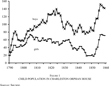
CHILD POPULATION IN CHARLESTON ORPHAN HOUSE
To judge from the occasional references to their occupations, parents who sought the help of the Orphan House were indeed poor and distressed. All came from the lower sort of Charleston's white population.18
Bellows, Benevolence, provides the context of white Charleston's efforts to provide for their poor.
Eliza Fludd to Commissioners re: William and Ann Davis, 9 November 1852, “Applications.”
B. Quinnan to Commissioners, 6 August 1828, “Applications.”
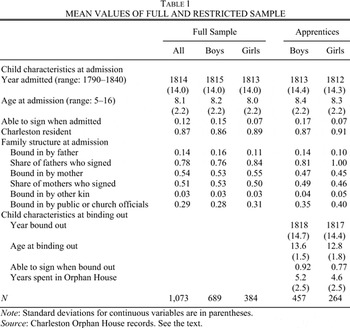
A variety of catastrophic events brought children of these families to the Orphan House. Death of a parent was the most common, and about a third of the children were full orphans (Table 1). In the most common situation a mother nominated her child for admission. Given legal disabilities facing American females who wished to contract, these women had undoubtedly been widowed or obviously abandoned. When a father died, or less commonly ran away, many widows could not earn enough to support their children. Some widowed mothers tried to go out to service, but they found few employers who would let their young children into their homes. Likewise widowers, particularly men who worked on the sea, needed a place for their children to stay while they worked. Some children had been completely on their own before coming to the Orphan House, living rough on handouts from door-to-door begging.

In seeking admission for their children, parents described difficult times in the local economy as well as how these difficulties kept them from providing for their children. In the 1820s Charleston's economy stagnated during a worldwide trough in cotton prices. At the bottom of the city's economy, these parents explained, with “the times being so hard,” economic problems had come to “press so heavily upon the poorer classes,” including themselves.21
Elizabeth Foley to Commissioners, 7 January 1824, “Applications”; Margaret Williamson to Commissioners, 24 October 1823, “Applications.”
Report of visiting commissioner H.A. DeSaussure on application of Amelia Luderwig, 28 March 1850, “Applications.”
Applicants probably did not embellish their stories much, because visiting commissioners literally came to their households, queried neighbors, and checked employers to see how well their stories held up. An unsigned report reveals a broad range of their concerns: “The mother is miserably poor and says she cannot school him…. She washes for a support, and has this one boy with her …. [her] object in trying to get her son into the Orphan House is to have him educated and kept out of mischief. Her occupation keeps her engaged at home and she cannot watch the boy, who she says gets into the street & out of her sight and management.”23
File of Augustine Dooley, 14 February 1856, “Applications.”
Exceptions were occasionally made if room was available, and commissioners overrode their own procedures to admit any child whose family had fled the slave rebellion in Haiti. Minutes, 26 September 1793.
Report re: Isabella Sloan, 21 April 1859, “Rejected Applications.”
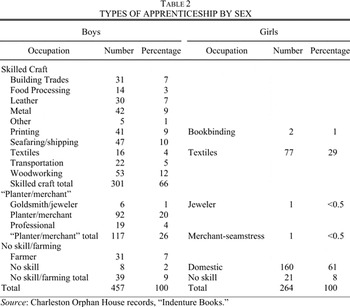
Masters who took children into their homes were typically not among the fabulously wealthy planter class. They included some of the better-off tradesmen and merchants. Table 2 reports trades to which children were bound, which in nearly every case for boys was also the trade of the master. Seafarers and shoemakers probably did not raise their charges much above their initial station in life. Printers, goldsmiths, and carriage makers, on the other hand, must have helped many poor boys become prosperous artisans. Many boys were bound to merchants, such as those who kept stores in Columbia and other market towns in the upcountry. A few youths were assigned to men of professional standing: apothecaries, physicians, and lawyers. It is worth recalling that the alternatives for these boys did not typically include learning their fathers' trade, because most fathers were dead or long gone from Charleston. Without the Orphan House, they would likely have become manual workers on the sea or in lowcountry agriculture. Because most girls were to be trained as domestics it is hard to say much about how well off their mistresses were. A handful of girls were to be trained by Charleston's small but intrepid corps of women entrepreneurs, such as Mary Ann Judge, who promised to treat her orphan girl with kindness (“in every respect as a daughter”) and teach her to measure laces and ribbons.26
Mary Ann Judge to Commissioners re: Jean Chennell, 22 June 1837, “Indentures.”

CHILD AND ADULT LITERACY
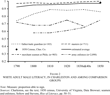
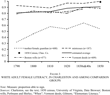
Indentures in the Charleston Orphan House collection recorded a maximum of five separate measures of actual and potential human capital attainments of various parties: the signature or mark of the child at entrance and the same for the child at exit, the signature or mark of the responsible adult at entrance, the signature or mark of the master or mistress at exit, and the trade which the master was expected to teach the child. Figures 2 and 3 illustrate adult, white literacy rates as estimated from the Charleston records, and some comparable literacy series from elsewhere in America. The dashed lines represent literacy rates of masters and mistresses, while the much lower dotted lines show literacy rates of parents and guardians. In the cases of adults who brought the children to the Orphan House, endorsements of kin and strangers were included in these figures, but those of overseers of the poor, church wardens, and other public officials were not. These men were generally much better off than the desperately poor who brought children to the institution, and in any case were unlikely to have influenced the child's literacy.

WHITE ADULT MALE LITERACY, IN CHARLESTON AND AMONG COMPARISON GROUPS

WHITE ADULT FEMALE LITERACY, IN CHARLESTON AND AMONG COMPARISON GROUPS
The ability to sign one's name was unevenly distributed across Charleston's adult, white population.27
Early studies of literacy using petitions, witnesses to wills and deeds and other sources in which a person might sign or mark several times were criticized for recording an unknown number of doubly counted signatures or marks: Lockridge, Literacy, 14. For Figures 2 and 3, no individual appeared more than once per decade; repeated signatures or marks were omitted. It was possible for someone to enter the sample in successive decades, but because the datum of interest was literacy rates by decade repeated recording of the same person in successive decades accurately measures adult literacy in that decade. The relatively small number of signatures and marks recorded in the 1840s (3 fathers, 11 mothers, and 5 mistresses, but 62 masters) required combining that decade's data with the more numerous data from the 1830s. In addition only eight mistresses signed or marked in the 1850s.
Overall literacy for men and for women can be estimated with a weighted average of the literacy rates for each class. Historian Robert Olwell estimated that one-fifth of Charleston's white population in the Revolutionary era was nonslaveowning, working poor—the population from whom the House's inmates were likely to be drawn.28
Olwell, Masters, Slaves, 45.
For purposes of comparison, the ratio of children in the orphan house to one-fifth of Charleston County's white population under the age of 15 was 0.09 in 1800, 0.12 in 1810, 0.11 in 1820, 0.09 in 1830, and 0.08 in 1840, suggesting that the share of the young, poor, and white population in the Orphan House remained steady over the period of this study.
To assess the quality of these estimates I compare them to the 1850 census (the first to report literacy rates by sex) and to other published literacy series. Literacy as reported in the 1850 federal census (the diamond in each Figure) suggests that the estimates presented here are roughly on the mark, especially for men. For women, nearly universal literacy as reported in the census may have been due to undercounting illiteracy among the white poor. The census found all of 63 illiterate white women in Charleston County in 1850, but Orphan House records show 54 women who could not write their names between 1840 and 1859. Part of the difference in the two measures lies in their definitions of literacy. The census merely asked the head of household about the ability of family members to read and write, which may not reflect true literacy skills.
Series of signatures and marks from elsewhere allow comparisons. Other samples of men were drawn from the lower classes: army enlistees and white merchant seamen. Among these relatively poor men, fathers and male guardians in Charleston were much more literate than contemporary soldiers and seamen in the North. Part of the gap may have been due to age differences. The soldiers were in their mid-20s when they enlisted, and the fathers may have been older than that (their ages were not recorded). Even so, it appears that, recalling Owsley, the poorest young adults in the urban South were relatively literate. Elsewhere in the South at this time, Lachance found that white adult literacy among sponsors of craft apprentices was about 50 percent with no time trend, whereas the master craftsmen who took in these apprentices were nearly all literate.30
Lachance, “Literacy.”
The comparison groups of women were of higher social status, which is reflected in their relatively high literacy levels. These women signed or marked wills and deeds in New England, which have been interpreted by scholars as representative of the wealthiest 80 percent or so of the population.31
Herndon, “Literacy,” p. 963. Note that parental literacy in late-eighteenth-century Charleston was very close to that of the poor in New England. Herndon estimated that 29 percent of white women and 77 percent of white men who had been warned out in Rhode Island were literate. “Warning out” was a legal process by which a town could expel the poor who had not established official residency. See Herndon, Unwelcome Americans. See also Main, “Inquiry” on women's literacy in New England.
Literacy was increasing in antebellum Charleston. Given the near universal literacy among the middle classes from an early date, the source of the overall increase had to be among the poor, whose literacy increased steadily up to the 1820s and then leveled off. Free schools were probably not an important factor. To begin with, few students attended them. Public support for education in South Carolina originated in a state law of 1811 that entitled every white child to attend a free public school. Even though the number of pupils in Charleston free schools doubled between 1812 and 1834, this still constituted a very small share, less than 5 percent, of the white school-aged population. For example, in 1820 about 300 students attended Charleston free schools, compared to 8,154 white children under 15 years of age in Charleston County. Second, those few children who sporadically attended free schools seem to have learned very little. One historian assessed these schools as “ungraded, poorly staffed, lax in method, quartered in any derelict room that might be rented, and under-financed.” The teachers may have had as little as two more years of schooling than their students.32
Jordan, “Education,” pp. 104–05. See also, Pyburn, “Public School.” On other sources of education in the North at this time, see Grubb, “Educational Choice.”
Free schools may have influenced child literacy, as noted below.
Although we might assume that a young adult who was unable to sign would remain illiterate for life, the probability of a child being literate usually increases with each year of age.34
Present day educational researchers have analyzed sources and consequences of literacy acquisition among children. See Juel, “Learning”; and in particular Bloodgood, “What's in a Name?” which considers how the ability to write one's name around age six influenced further learning.
Lachance, “Literacy.”

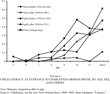
CHILD LITERACY AT ENTRANCE TO CHARLESTON ORPHAN HOUSE, BY AGE, SEX, AND COHORT
At each age more boys than girls could sign, but differences in literacy acquisition by sex changed dramatically over this period. Prior to 1810, boys' experiences in learning to write were much like girls', in that a few had learned at age seven, a substantial increase in literacy occurred from ages eight to ten, after which age few learned to write. Literacy among all children declined after 1810, and girls' literacy in particular declined to nearly zero during this period of stable or slightly increasing adult literacy. The divergence in literacy acquisition between boys and girls may reflect poor families sending sons but not daughters to free schools.36
The late antebellum reformer Christopher Memminger made equal access for white girls to free schools a high priority, citing the need for women to educate their children and communicate with absent husbands. By inference, few girls before the 1850s were attending free schools. Memminger was the most illustrious Orphan House alumnus, rising to become Secretary of the Treasury in the Confederate government. Jordan, “Education,” p. 111.
One factor in the general decline may have been a selection bias induced by, paradoxically, greater access to free schools. The 1811 law drew into the free schools some poor children who would otherwise have entered the Orphan House to gain access to its school. After free schools became more accessible, parents of these children kept them at home and sent them to the free school. Children of still poorer families that could not support, much less educate, them continued to enter the Orphan House, and this may have shifted the composition of the Orphan House's new children towards the poorest and least educated. The increase in number of boys admitted (Figure 1) suggests an overall increase in the population of the poor of both kinds, which is consistent with the narrative record of a Charleston in decline from perhaps 1820 onwards.37
Fraser, Charleston!, pp. 206–12.
Elizabeth Ann Yates et al. to Commissioners, 30 January 1813, “Applications.”
A qualitative check on the reliability of the signature literacy data is provided by the occasional estimate of educational levels in some admission applications. Visiting commissioners who investigated applicant families and surviving parents who petitioned for their child's admission occasionally described the child's educational background. These comments can be compared to the child's ability to sign on the indenture. The two sources typically agree with each other. In 1816 two brothers who were described as “without the smallest instruction” both marked their indentures, as did, the following year, a 12-year-old girl who “had no education.”39
Ann Mitchell and Mary Gregorie to Commissioners re: Nathan and Peter Gordy, 18 July 1816;? to Commissioners re: Mary Ann Davis, 17 December 1817, both in “Applications.”
Rev. B. Manly to Commissioners re: Thomas Stenton, 15 September 1836, “Applications.”
INTERGENERATIONAL TRANSMISSION OF LITERACY IN EARLY CHILDHOOD
Evidence from the indentures can be used to test a hypothesis first proposed by Lee Soltow and Edward Stevens. Southerners, they suggested, primarily acquired literacy through informal means such as tutoring by family, friends, and co-workers.41
Soltow and Stevens, Rise of Literacy, p. 163.
Pyburn, “Public School System.”
Lockridge, Literacy, p. 48.
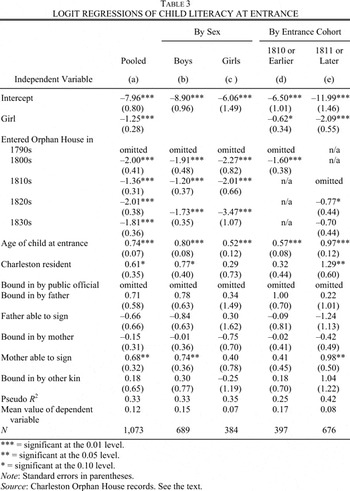
Regression models indicate that a child's ability to acquire basic literacy depended most clearly on his family situation and possibly on availability of schooling as well (Table 3). Here, then, home and school may have been complementary factors in literacy acquisition rather than substitutes. Model (a) in Table 3 used the entire sample, whereas models (b) through (e) were separated by sex and entering cohort. Residence in Charleston served as a proxy for access to free schools and other specifically urban sources of learning such as Sunday and infant schools. The identity of the adult who bound the child into the Orphan House, as given on the indenture, was used to infer the structure of the child's family before admission. Whether that parent could sign was interacted with the identity of the parent or public official to form the parental literacy variables. Their coefficients indicated the conditional effect of paternal or maternal literacy on child literacy, given that the child had been bound in by that parent.

The patterns in literacy by age at entrance in Figure 4 also appeared in the regression results. Age effects had large magnitudes and low levels of statistical significance. Each additional year of age increased the likelihood of signing for all children by 7 percent.44
For the sake of simplicity I used the following formula: ∂P/∂X=β·p(1−p), where p=proportion signing.
Family and residence were important influences on child literacy rates. A child who entered the Orphan House from Charleston was significantly more likely than a child from elsewhere to be able to write. This effect was stronger for boys than girls, and was especially notable after 1811. A child admitted in the later period was about 10 percent more likely to sign if he or she was from Charleston. Prior residence in Charleston may be a proxy for free school attendance or for Sunday school or the other more informal schools that met in the city. Very specific family effects appeared. Children bound in by fathers or by other kin were no more likely to sign than were full orphans bound in by public officials. However, for a child bound in by his or her mother, whether she could write did matter. Overall, children of literate mothers were a significant 8 percent more likely to sign than were children of illiterate mothers. The magnitude of the effect of mother's literacy was about the same as an additional year of age. This result accords with a range of previous work, which suggests that mothers played a quantitatively important role in the rise of American literacy more generally considered.45
Appleby, Inheriting, p. 157; Murray, “Generation(s)”; and Sacerdote, “Slavery.”
Figure 4 suggests that girls and boys became literate—remained illiterate might be a better way to describe the girls' case—in different ways. This suggests splitting the sample and estimating different models for girls and boys to tease out differences in literacy acquisition by sex, the results of which appear in Table 3, models (b) and (c). Residence in the city made boys a significant 10 percent more likely to sign but had no significant effect on girls. A remarkable result with implications for within-family relationships was that the mother's literacy significantly increased her son's literacy but not her daughter's. Sons of literate mothers were about 10 percent more likely to have learned to sign their name, whereas daughters of literate mothers were no more or less likely to sign. Literate mothers seem to have concentrated their efforts to pass on the ability to write to their sons rather than their daughters, and they may have been aided in this by free, Sunday, or other schools in the city.46
Norton, “Evolution,” p. 607, proposed that fathers, not mothers, taught sons how to write in early America, but this assertion was not based on systematic evidence.
The notion that families and schools were complementary in teaching basic literacy is suggested by the timing of their effectiveness. In Table 3 models (d) and (e) report estimates before and after the state law on free schools in 1811. The effect of age changed little from one period to the next, each year adding 8 to 9 percent to the probability of signing. The effect of family and residence, however, may indicate shifting modes of literacy acquisition over this period. In the earlier period, when free schools were virtually nonexistent, prior residence in Charleston had no significant effect on a child's literacy, and neither did most of the family structure variables. However, in the later period both Charleston residence, which raised the probability of signing by 11 percent, and the literacy of the mother, which increased the probability of signing by 8 percent, were significant.
Thus, to summarize, the children particularly likely to be able to sign were boys whose literate mothers brought them to the Orphan House after 1811. The Charleston effect that appears in the post-1811 regressions may have been due to acquisition of basic literacy in free schools, but it may also have been due to other urban-specific sources such as Sunday schools or private charity schools. In any case, educational resources specific to Charleston appear to have been complementary to a mother's literacy in transmitting literacy to children, and particularly to boys; that is, learning at some kind of school appears to have been reinforced at home by a literate mother to a greater extent than by a mother who could not herself sign. In the case of Charleston, Soltow and Stevens were substantially correct; Owsley's argument may be at least partially correct.
FROM LITERACY ACQUISITION IN EARLY CHILDHOOD TO SKILL TRAINING IN LATER LIFE
Acquisition of basic literacy skills early in life influenced the earliest labor market activities of these children: the types of trades to which they were bound to learn. To see how early life conditions affected later life outcomes, this section investigates connections between literacy acquisition in early childhood and skill acquisition in early adulthood. These connections suggest that labor market outcomes of young adults were influenced by childhood experiences many years previously. The possibility of long-term effects of childhood conditions is illustrated in many present-day studies of longitudinal data, but did such effects occur two centuries ago?
During residence in the Orphan House, surviving family members commonly kept up with the lives of the children. Parents noted in admission applications that relinquishment was a last, desperate resort. One recent widow wrote how “grievous it is to me indeed to part with so young an infant who was a solace to me even in distress.”47
Catherine Shelbock to Commissioners, 8 May 1823, “Rejected Applications.”
[Mr. Carson?] to Commissioners, 29 January 1854, “Indentures.”
Aaron Davis to Commissioners, 5 April 1819; and Catherine Brindlay to Commissioners, 10 May 1815, “Applications.”
When children reached an age at which they could be bound out, surviving parents played an important part in the matching process that brought master and apprentice together. Parents who lived in the city were given the opportunity to approve or reject their children's apprenticeship. Tradesmen who had gained parental approval made sure the commissioners knew this. “I have consulted his mother on the subject and she consents that he should come to me” wrote a tinsmith. At times, a mother might address the commissioners directly: “I the mother of R[ichard] Taylor consent to his going with Mr Boling to the country. [signed] Ann Taylor” was scrawled at the bottom of one prospective master's application letter. Occasionally such approval was not forthcoming. One mother rejected a master's offer to take her son because she thought his business of house painting was an “unworthy trade.”50
J. B. Duval to Commissioners re: George King, 18 June 1840; Thaddeus C. Bolling to Commissioners re: Richard Taylor, 4 February 1838, both in “Indentures”; Minutes of Commissioners' Meetings, 30 June 1808, and indenture of Charles Reyer, “Indenture Book.” Reyer was later bound to a carpenter.
M. Moles to Commissioners re: Sarah Fields, 7 January 1815, “Indentures.”
All parties—child, parent, commissioners, and masters alike—desired to make a good match regarding the child's prospective trade. A boy's initial interest in a trade was probably stimulated just as for boys elsewhere in America: a curious peek into a shop, chance discussions with older apprentices, or advice from adult family members. Parents intervened to direct their children into or away from particular occupations, and the child's abilities, a function of investment in his or her human capital, also played a role. Prospective masters observed child literacy carefully. A merchant from Lancaster, S.C., explained his interest in one boy to the commissioners: “The boy Wm. R. Bull, whom I have seen & conversed with & whose writing, ciphering &c I have also seen, I am pleased with him.”52
G. D. Beckham to Commissioners re: William Bull, 19 May 1852, “Indentures.”
The range of potential occupations was considerable for boys but much more restricted for girls (Table 2). It was convenient to aggregate them into three categories for boys and two for girls. For boys, “skilled craft” included the building trades (e.g., mason, carpenter, plasterer); food processing trades (e.g., butcher, baker, confectioner); leather work (e.g., tanner, saddler, shoemaker); metal working trades (e.g., blacksmith, boiler maker, iron worker); seagoing trades (including pilot and navigator); shipping trades (e.g., cooper, ship chandler, sail maker); printing trades (including bookbinder); coach making (including wheelwright); wood working trades (e.g., joiner, turner, cabinet maker); textile production (e.g., upholsterer, hatter, tailor); and other unclassifiable trades such as cigar maker and umbrella maker. The category named “planter/merchant” included not just those bound in those fields but those who were to enter the professions (e.g., architect, attorney, apothecary) and a few highly paid craftsmen such as goldsmiths and jewelers. The “no trade” category included not just boys without a specified trade but those bound to become farmers as well, an occupation which the commissioners generally discouraged boys from entering.53
Bellows, Benevolence, p. 145. In the 1820s agricultural improvers in the Lowcountry had hoped to take boys from the Orphan House and train them to farm in the new ways: Steffen, “In Search of,” p. 764. On improving tendencies more generally in the Lowcountry, see Chaplin, Anxious Pursuit.
There was much less variety in the girls' prospective occupations, with over four in five being assigned to learn either needlework or domestic work, or a combination of these traditional jobs. The lines between these two occupations were not cut and dried. Many letters to commissioners from prospective masters who sought girls contained sentences such as the following: “I shall pay every attention to her improvement in domestic oeconomy, needle work &c.”54
M. Lecompte to Commissioners, 26 March 1818, “Indentures.”
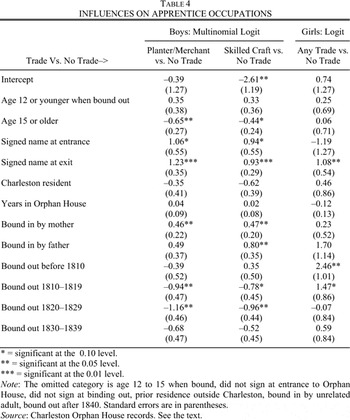
Regression analysis of occupational assignments suggests the extent to which parents intervened in the binding process and the extent to which masters attended to the children's human capital attainments. Table 4 presents a set of multinomial logit regressions for boys and logits for girls, which included age and cohort variables and controls for family structure and own human capital levels. The dependent variables for the boys accounted for differences between white-collar and blue-collar trades, and the comparison category was no trade specified. For girls, the dependent variable was simply trade vs. no trade.

The one consistently significant effect across all three regressions was the child's ability to sign his or her name. Boys and girls alike who could sign were significantly more likely to be assigned to a particular trade rather than be bound to a new master who was not obligated to give them any specific training. For boys, not just present human capital attainments mattered, but so did their endowments as of entrance to the Orphan House. Those who were able to sign several years before being bound out were significantly more likely to be trained in a particular trade, even after controlling for their literacy at binding. Presumably those boys had learned more than just the basics while in the Orphan House, having acquired a minimal level of literacy beforehand. The effect of initial literacy was independent from that of literate parents.55
In regression results not reported here, variables for parental literacy had insignificant coefficients whether or not the initial literacy variable was included. When parental literacy was accounted for, the child's initial literacy still remained significant.
At the same time, family structure at the time of admission to the Orphan House influenced the trade to which boys were bound, but not girls. Boys brought to the Orphan House by their mothers were significantly more likely to be bound into one or another type of trade, whereas those brought by their fathers were more likely to be bound into a skilled trade rather than no trade. Note that according to mean values in Table 1 about five years had passed on average between the formal relinquishment by their surviving parent and the beginning of their apprenticeship. By the time they were bound out, in their early teen years, experiences of many years before in learning to sign their name, or enduring the loss of a father rather than a mother or both parents, influenced strongly how these young people would enter the labor market in early adulthood. Mothers, in particular, appear to have guided their sons into particularly promising trades.
CONCLUSIONS
This article has traced the transmission and consequences of human capital from generation to generation in a sample of very poor whites who lived in antebellum Charleston. Literacy rates among the middling sorts, planters, and merchants who took these children into their homes were as high as those recorded elsewhere in America at this time. Literacy of the poor was increasing, but it started from a very low base for women. Mothers who were literate were better able to make their children, especially sons, literate, and those children who could write their names were more likely to be bound to the better trades as apprentices.
This article addresses questions raised in three different scholarly literatures. First, the nature of the available records made this into a longitudinal study of these children. The indentures formalized binding of these children, first into the Orphan House and then a few years later back out to a master. Each transfer of authority, occurring about five years apart on average, required a child to endorse the document. From the endorsements of adults we can make inferences about the children's family situations before they came to the Orphan House and the skills they would learn after leaving. Such longitudinal study of people in the early republic is unusual.56
For a qualitative study, compare Appleby, Inheriting.
Duncan et al., “How Does”; and Case et al., “Lasting Impact.”
This article also clarifies issues studied by historians of American families. One chestnut is the quality of the relationships between parents and children in the American past. Puritan families, famously, did not spare the rod on their resident children and were quick to bind them out when they could.58
Greven, Protestant; and Demos, Little Commonwealth.
Bellows, Benevolence, pp. 128–29; and Cecil-Fronsman, Common Whites, pp. 136–37. Also on poor white Southerners, see Bolton, Poor Whites.
To return to the question of Southern literacy, Owsley noted that it was relatively common, which he attributed to field schools financed by subscription. Soltow and Stevens, on the other hand, discounted schools and emphasized the efforts of family, friends, and co-workers. Literacy rate series developed and referenced in this article suggest that child literacy rates in Charleston were similar to the only other known series on Southern children. Among men, even the poorest whites in Charleston were more literate than white soldiers and sailors in the North. And estimates of average women's literacy indicated that women in Charleston were about as literate as property-holding New England women in the early nineteenth century. Owsley's claims of relatively high Southern literacy based on mid-century census figures can be projected back into the precensal era of the late eighteenth century.
As for sources of Southern literacy, this article finds more direct evidence for the importance of family, particularly maternal, sources, and more indirect evidence for the effect of schools, based on the effect of Charleston residence. It appears that family and schools were complements in the process of literacy transmission. Together they made the white South more literate than many other parts of the world. But the lack of schools across the South, and lack of women's literacy relative to the North, left the South less able to transmit literacy to succeeding generations. Its legacy was lower levels of human capital in the postbellum period and later.
I thank the Human Learning and Learning Disabilities Program, National Institute for Child Health and Development, National Institutes of Health for financial support, and archivists at the South Carolina Department of Archives and History; the South Carolina Room, Charleston County Public Library; and the College of Charleston Library for their assistance. This essay benefited from comments by Howard Bodenhorn, Harlan Greene, Gillian Hamilton, Ruth Herndon, Paul Lachance, David Mitch, Jonathan Pritchett, Jean Elliott Russo, Billy Smith, Werner Troesken, and James Watkinson; this JOURNAL's referees; and seminar participants and conferees at the University of Michigan, the McNeil Center for Early American Studies at the University of Pennsylvania, the 2003 Allied Social Science Association meetings in Washington and the 2003 Economic History Association meetings in Nashville.
References
Appleby Joyce.
2000.
Inheriting the Revolution: The First Generation of Americans.
Cambridge, MA:
Harvard University Press
Bardaglio Peter.
1995.
Reconstructing the Household: Families, Sex, and the Law in the Nineteenth Century South.
Chapel Hill:
University of North Carolina Press
Bellows Barbara L.
1993.
Benevolence Among Slaveholders: Assisting the Poor in Charleston, 1670–1860.
Baton Rouge:
Louisiana State University Press
Bloodgood Janet W.
1999:
“What's in a Name? Children's Name Writing and Literacy Acquisition,”
Reading Research Quarterly
34,
no. 3
342–
67.Google Scholar
Bodenhorn Howard.
“Just and Reasonable Treatment: Racial Differences in the Terms of Pauper Apprenticeship in Antebellum Maryland.”
NBER working paper w9752, June 2003.
Bolton Charles C.
1994.
Poor Whites in the Antebellum South: Tenants and Laborers in Central North Carolina and Northeast Mississippi.
Durham, NC:
Duke University Press
Burton Orville Vernon.
1985.
In My Father's House Are Many Mansions: Family and Community in Edgefield, South Carolina.
Chapel Hill:
University of North Carolina Press
Case Anne,
Angela Fertig, and
Christina Paxson,
“The Lasting Impact of Childhood Health and Circumstance,”
NBER working paper w9788, June 2003.
Cecil-Fronsman Bill.
1992.
Common Whites: Class and Culture in Antebellum North Carolina.
Lexington:
University Press of Kentucky
Chaplin Joyce E.
1993.
An Anxious Pursuit: Agricultural Innovation and Modernity in the Lower South, 1730–1815.
Chapel Hill:
University of North Carolina Press
Cipolla Carlo.
1969.
Literacy and Development in the West.
Harmondsworth:
Penguin
Cooper Thomas, and
David J. McCord.
1837.
The Statutes at Large of South Carolina, Edited, Under Authority of the Legislature. Volume Second.
Columbia, SC:
A. S. Johnston
Degler Carl.
1980.
At Odds: Women and the Family in America from the Revolution to the Present.
New York:
Oxford University Press
Demos John.
1970.
A Little Commonwealth: Family Life in Plymouth Colony.
New York:
Oxford University Press
Duncan Greg J.,
W. Jean Yeung,
J. Brooks-Gunn, and
J. R. Smith,
1998:
“How Much Does Childhood Poverty Affect the Life Chances of Children?”
American Sociological Review
63,
no. 3
406–
23.Google Scholar
Gilmore William J.
1982:
“Elementary Literacy on the Eve of the Industrial Revolution: Trends in Rural New England, 1760–1830.”
Proceedings of the American Antiquarian Society
92,
part 1
87–
178.Google Scholar
Graff Harvey.
1987.
Legacies of Literacy: Continuities and Contradictions in Western Culture and Society.
Bloomington:
Indiana University Press
Greven Philip J.
1977.
The Protestant Temperament: Patterns of Child-rearing, Religious Experience, and the Self in Early America.
Chicago:
University of Chicago Press
Grubb Farley.
1990:
“Growth of Literacy in Colonial America: Longitudinal Patterns, Economic Models, and the Direction of Future Research,”
Social Science History
14,
no. 4
451–
82.Google Scholar
Grubb Farley.
1992:
“Educational Choice in the Era Before Free Public Schooling: Evidence from German Immigrant Children in Pennsylvania, 1771–1817.”
This JOURNAL
52,
no. 2
363–
75.Google Scholar
Hamilton Gillian.
2000:
“The Decline of Apprenticeship in North America: Evidence from Montréal.”
This JOURNAL
60,
no. 3
627–
64.Google Scholar
Herndon Ruth Wallis.
1996:
“Literacy Among New England's Transient Poor, 1750–1800,”
Journal of Social History
29,
no. 4
963–
65.Google Scholar
Herndon Ruth Wallis.
2001.
Unwelcome Americans: Living on the Margin in Early America.
Philadelphia:
University of Pennsylvania Press
Jordan Laylon Wayne.
1982:
“Education for Community: C. G. Memminger and the Origination of Common Schools in Antebellum Charleston.”
South Carolina Historical Magazine
83,
no. 2
99–
115.Google Scholar
Juel Connie.
1988:
“Learning to Read and Write: A Longitudinal Study of 54 Children from First Through Fourth Grades.”
Journal of Educational Psychology
80,
no. 4
437–
47.Google Scholar
Knight Edgar W.
1922.
Public Education in the South.
Boston:
Ginn and Company
Lachance Paul.
“Literacy in Indentures of Children in New Orleans, 1809–1843.”
Paper presented at McNeil Center for Early American Studies, University of Pennsylvania, November 2002.
Lockridge Kenneth A.
1974.
Literacy in Colonial New England: An Enquiry into the Social Context of Literacy in the Early Modern West.
New York:
W. W. Norton
Main Gloria L.
1991:
“An Inquiry into When and Why Women Learned to Write in Colonial New England.”
Journal of Social History
24,
no. 3
579–
89.Google Scholar
Mitch David F.
1992.
The Rise of Popular Literacy in Victorian England: The Influence of Private Choice and Public Policy.
Philadelphia:
University of Pennsylvania Press
Murray John E.
1997:
“Generation(s) of Human Capital: Literacy in American Families 1830–1875.”
Journal of Interdisciplinary History
27,
no. 3
413–
36.Google Scholar
Murray John E.
2004.
“Bound by Charity: The Abandoned Children of Late Eighteenth Century Charleston.”
In Down and Out in Early America,
edited by Billy G. Smith,
213–
32.
State College:
Penn State University Press
Murray John E., and
Ruth Wallis Herndon.
2002:
“Markets for Children in Early America: A Political Economy of Pauper Apprenticeship.”
This JOURNAL
62,
no. 2
356–
82.Google Scholar
Norton Mary Beth.
1984:
“The Evolution of White Women's Experience in Early America.”
American Historical Review
89,
no. 3
593–
619.Google Scholar
Olwell Robert.
1998.
Masters, Slaves, and Subjects: The Culture of Power in the South Carolina Low Country, 1740–1790.
Ithaca, NY:
Cornell University Press
Owsley Frank Lawrence.
1949.
Plain Folk of the Old South.
Baton Rouge:
Louisiana State University Press
Perlmann Joel, and
Dennis Shirley.
1991:
“When Did New England Women Acquire Literacy?”
William and Mary Quarterly
48,
no. 1
50–
67.Google Scholar
Pyburn Nita Katharine.
1960:
“The Public School System of Charleston Before 1860,”
South Carolina Historical Magazine
61,
no. 2
86–
98.Google Scholar
Sacerdote Bruce I.
“Slavery and the Intergenerational Transmission of Human Capital.”
Review of Economics and Statistics,
forthcoming.
Simpson William.
1761.
The Practical Justice of the Peace and Parish Officer.
Charleston:
Robert Wells
Soltow Lee, and
Edward Stevens.
1980.
The Rise of Literacy and the Common School in the United States: A Socioeconomic Analysis to 1870.
Chicago:
University of Chicago Press
Steffen Charles G.
1997:
“In Search of the Good Overseer: The Failure of the Agricultural Reform Movement in Lowcountry South Carolina, 1821–1834.”
Journal of Southern History
63,
no. 4
753–
802.Google Scholar
University of Virginia Geospatial and Statistical Data Center.
1998.
United States Historical Census Data Browser.
ONLINE.
University of Virginia.
Available: http://fisher.lib.virginia.edu/census/.
Vinovskis Maris A..
1987:
“Family and Schooling in Colonial and Nineteenth Century America.”
Journal of Family History
12,
nos. 1–3
12–
37.Google Scholar
CHILD POPULATION IN CHARLESTON ORPHAN HOUSE
MEAN VALUES OF FULL AND RESTRICTED SAMPLE
TYPES OF APPRENTICESHIP BY SEX
WHITE ADULT MALE LITERACY, IN CHARLESTON AND AMONG COMPARISON GROUPS
WHITE ADULT FEMALE LITERACY, IN CHARLESTON AND AMONG COMPARISON GROUPS
CHILD LITERACY AT ENTRANCE TO CHARLESTON ORPHAN HOUSE, BY AGE, SEX, AND COHORT
LOGIT REGRESSIONS OF CHILD LITERACY AT ENTRANCE
INFLUENCES ON APPRENTICE OCCUPATIONS
 You have
Access
- 8
- Cited by