Introduction
In recent years, we have seen an expansion of the frontiers of research into bilingualism, looking beyond purely spoken language bilingualism into instances of bilingualism that involve both spoken and sign languages. code-switching, which is defined as sequential alternation between two spoken languages, has been reported to be quite common among bilinguals. Linguistic analysis of code-switching generally focuses on the syntactic constituent(s) or the syntactic site(s) involved in the switch. One particular proposal concentrates on the different linguistic behaviors in code-switching involving functional and lexical categories. Examining the code-switching patterns between typologically distinct language pairs, namely SVO and SOV languages, Chan (Reference Chan2003, Reference Chan2008) finds that functional heads determine the order of the code-switched complements while lexical heads do not. Adopting Mahootian's (Reference Mahootian1993) and MacSwan's (Reference MacSwan1999, Reference MacSwan2000) assumptions about the Null Theory, he supports the tenet that code-switching is not governed by a separate set of rules and constraints but by the grammars of the two participating languages. He further argues that it is the inherent properties of the functional heads of the language pair that bring about the directionality of the code-switching elements.
In examining the code-blending of a deaf child in our case study, we adopt a similar framework to Chan's. By code-blending, we mean the simultaneous articulation of both signed and spoken linguistic units in cross-modal language mixing (cf. example (2) below). At the outset, we assume that all natural languages and variations between them are systematically governed by the same underlying linguistic principles of Universal Grammar (UG, Chomsky, Reference Chomsky1981, Reference Chomsky1986, Reference Chomsky1995). Traditionally, parametric variation in head directionality was seen to manifest itself in the typological distinction between head-initial and head-final languages (Huang, Reference Huang1982; Stowell, Reference Stowell1981). There have been recent attempts to reconceptualize parametric variation of UG in terms of macro- and micro-parameters. Baker (Reference Baker, van den Bogaerde, Plaza-Pust and Morales-López2008), for instance, argues that the Head Directionality Parameter may be considered to be a macro-parameter because of its pervasive influence on the internal head-complement order at various syntactic projections. In the current study, which involves the bimodal bilingual production of a deaf child (2;0.26–6;6.26) and three deaf adult native signers, we adopt this parametric view of the linguistic organization of functional categories like modals, auxiliaries and negators. These categories are head-final in Hong Kong Sign Language (HKSL) but head-initial in Cantonese (see section below on HKSL, Cantonese and sign-supported Cantonese). In line with Chan's (Reference Chan2003, Reference Chan2008) analysis, we take it that in natural languages, including both signed and spoken languages, the functional heads with their inherent morphosyntactic properties determine the head-complement order in both code-switching and code-blending. From the perspective of bilingual acquisition, we therefore need to account for how children exposed to linguistic input from two languages that contrast in head directionality – head-initial versus head-final – acquire head-complement directionality in both languages.
In the literature, bimodal bilinguals (also known as cross-modal bilinguals and sign bilinguals) are understood to possess knowledge of a sign language transmitted in the visual-manual modality and of a spoken language in the auditory-vocal modality. Relevant research so far examines the characteristics of cross-modal communication in bimodal bilinguals, considering whether any language mixing processes are similar to those reported in spoken languages. The language pairs on which research is reported are not many, namely spoken English and American Sign Language (ASL, cf. Emmorey, Borinstein, Thompson & Gollan, Reference Emmorey, Borinstein, Thompson and Gollan2008; Lillo-Martin, Quadros, Koulidobrova & Chen Pichler, Reference Lillo-Martin, Quadros, Koulidobrova, Chen Pichler, Costa, Castro, Lobo and Pratas2010; Quadros, Lillo-Martin & Chen Pichler, Reference Quadros, Lillo-Martin and Chen Pichler2010), spoken Italian and Lingua dei Segni Italiana (LIS, i.e., Italian Sign Language, cf. Bishop, Hicks, Bertone & Sala, Reference Bishop, Hicks, Bertone, Sala and Lucas2006; Donati & Branchini, Reference Donati, Branchini, Roberts and Biberauer2013), spoken Dutch and Nederlandse Gebarentaal (NGT, i.e., Sign Language of the Netherlands, cf. Baker & van den Bogaerde, Reference Baker, van den Bogaerde, Plaza-Pust and Morales-López2008; van den Bogaerde & Baker, Reference van den Bogaerde, Baker, Morgan and Woll2002, Reference van den Bogaerde and Baker2005, Reference van den Bogaerde, Baker, Bishop and Hicks2008), and spoken Brazilian Portuguese and Lingua de Sinais Brasileira (LSB, i.e., Brazilian Sign Language, Lillo-Martin et al., Reference Lillo-Martin, Quadros, Koulidobrova, Chen Pichler, Costa, Castro, Lobo and Pratas2010; Quadros et al., Reference Quadros, Lillo-Martin and Chen Pichler2010). Data produced by the adults as well as deaf and hearing children in these studies suggest that code-switching is infrequent but that code-blending is prominent in bimodal bilingual production. Code-switching in the case of bimodal bilinguals is defined as the sequential alternation between signing and speech (cf. example (20)). As stated above, code-blending refers to the simultaneous articulation of both signed and spoken linguistic units in cross-modal language mixing.
In this paper, we will add to this literature by examining code-blending in a set of longitudinal data from a deaf child, CC, who was diagnosed as having bilateral, moderate to severe hearing loss and was prescribed hearing aids on both ears. He has been exposed to HKSL systematically since age 1;9 (see the section Subjects’ backgrounds for more details) and to some Cantonese since age 0;4. In addition, data from three deaf adult native signers participating in the recording sessions were analyzed for comparison purpose. In this study we identified those data that involved the simultaneous production of signing and speech with or without clear vocalization (cf. example (2) and the section Coding of data for more details).
The current investigation aims to examine: (1) the relative frequencies of occurrence of code-switching and code-blending in HKSL–Cantonese bimodal bilingual production; (2) whether processes of code-blending similar to those reported in the literature also occur in our data; and (3) whether the code-blending of functional heads may be accounted for using Chan's (Reference Chan2003, Reference Chan2008) analysis.
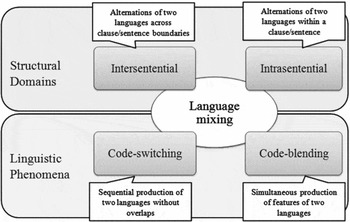
In terms of the structural domains of language mixing, we assume that code-switching and code-blending may occur both within a sentence (i.e., intrasentential mixing) and across two clausal constituents (i.e., intersentential mixing), as shown in Figure 1 (cited from Fung, Reference Fung2012, p. 6, Figure 1–1):
Structural domains and linguistic phenomena in language mixing (Fung, 2012, p. 6, Figure 1–1).

In this study, we focus on intrasentential code-switching and code-blending. Initially, we examine the patterns that occur in the code-blending of functional heads in HKSL–Cantonese bimodal bilingual production. Since modals and negators are head-initial in Cantonese but head-final in HKSL, we want to verify whether this difference in head directionality might induce conflicting head-complement orders in bimodal bilingual production. If Chan's (Reference Chan2003, Reference Chan2008) theoretical assumptions about code-switching in spoken languages also hold in cross-modal code-blending, we may posit the existence of some universal conditions for language mixing that are shared between spoken language and sign language.
In the following section, we will first introduce code-blending as a language mixing phenomenon in bimodal bilingual production. Second, we will summarize the relevant research on code-blending by hearing adults born to deaf parents as well as deaf and hearing children who acquire a sign language and a spoken language simultaneously. Next, we will outline the methodology of data collection in the current study, as well as the identification and categorization of data involving code-switching and code-blending. Finally, we will provide an analysis of the data based on Chan's proposal (Reference Chan2003, Reference Chan2008). The paper will end with a discussion about the limitations of the current study and suggestions for some directions for future research.
Code-blending in bimodal bilingual production
Language mixing is very common among bilinguals who possess knowledge of two spoken languages. An example of language mixing between Cantonese and English is given in (1) below:
-
(1)


In (1), the speaker begins the utterance in Cantonese m-zi di ze wui-m-wui “(I) don't know if the umbrellas”, then s/he switches to English out of stock. At the end of the utterance, s/he switches back to the Cantonese sentence final particles ge ne. This kind of utterance is very common among Cantonese–English bilinguals in Hong Kong (Chan, Reference Chan1992). Example (1) also shows that the language mixing mechanisms among unimodal bilinguals of two spoken languages are serial in nature. Bimodal bilinguals, who know one sign language and one spoken language, tend not to code-switch too frequently but to code-blend signing and speech in a simultaneous fashion. An example of code-blending is given in (2) below, in a transcription format which we hope depicts how linguistic information is processed simultaneously (see Appendix I for the citation conventions and Appendix II for a list of abbreviations). In (2), the deaf HKSL–Cantonese bilingual child, CC, first produces a code-blend underlined and notated as [hoji|CAN] “can” (i.e., hoji in the Cantonese tier and CAN in the HKSL tier). In other words, CC articulates Cantonese hoji “can” simultaneously with the HKSL sign CAN “can”. Then, he signs AGAIN “again” without code-blending (as shown in the HKSL tier). This is followed by another code-blend underlined and notated as [tai|SEE−a ]. meaning “see there”.
-
(2)

In both code-blends, namely [hoji|CAN] “can” and [tai|SEE−a ] “see there”, the morphological roots of the co-articulated signing and speech share the same semantic meaning. In the first code-blend, both hoji and CAN denote permissive “can”. In the second code-blend, tai and SEE both mean “see”. These are examples of morphological root blends (cf. Fung, Reference Fung2012) because the roots transmitted in each of the two modalities share the same meaning, i.e., semantically equivalent. However, the sign SEE−a is morphologically more complex than tai. Unlike tai, which is a bare verb, SEE−a is inflectionally directed to a locus in space (i.e., merged with a locative morpheme marked with a subscript − a )Footnote 1 . Therefore, these examples show that code-blending typically involves two different modalities in language production, and the simultaneous articulation of linguistic units in a spoken language and a sign language may or may not overlap completely. Extending Chan's (Reference Chan2003, Reference Chan2008) proposal, which is based on spoken languages, we argue that both code-switching and code-blending are governed by the grammars of the language pair.
Code-blending in adults
Most previous studies on code-blending involve adult Codas (hearing Children of Deaf Adults) as subjects. Data are drawn from narratives or spontaneous conversations and the language pairs include ASL–English (Bishop, Reference Bishop2006; Bishop & Hicks, Reference Bishop, Hicks, Bishop and Hicks2008; Emmorey, Borinstein & Thompson, Reference Emmorey, Borinstein, Thompson, Cohen, McAlister, Rolstad and MacSwan2005; Emmorey et al., Reference Emmorey, Borinstein, Thompson and Gollan2008) and LIS–Italian (Bishop et al., Reference Bishop, Hicks, Bertone, Sala and Lucas2006). Where the interlocutors are hearing bimodal bilinguals, code-blending is found to be the default strategy of language mixing. Code-switching between a spoken language and a sign language, i.e., switching from speech to sign and vice versa, however, occurs much less frequently. The code-blends are mainly made up of semantically equivalent roots, like the English word bird and ASL sign BIRD in (3). Not many semantically non-equivalent blends are found. However, in example (4), the topic/subject TACCHI “heel” in LIS is co-articulated with bassi “low” in Italian, thus forming a modifier-noun construction (i.e., “low heel”). In this example the simultaneously produced sign TACCHI and word bassi contrast in meaning, grammatical category and morphosyntactic property. Together with other elements un bel that are articulated independently in Italian, the proposition “the heel is cute and low” is expressed.
-
(3)
-
(4)


Fung, Tang, and Lam (Reference Fung, Tang and Lam2008a) examine HKSL–Cantonese code-blending by deaf adults in a pilot study. They consider the utterance in (5), an example of code-blending produced by a non-native but fluent deaf adult signer in a conversation with a deaf adult native signer.
-
(5)

In (5), Cantonese ngo “I” and HKSL IX1 “I” share the same root meaning, so do jat-man “one dollar” and ONE-DOLLAR “one dollar”. However, although the Cantonese verb bei “give” and the HKSL sign GIVE−3 “give him/her” share the same root “give”, they are analyzed as morphosyntactically non-equivalent. Cantonese, like Mandarin Chinese, does not inflect for person, number and gender; hence, the verb bei “give” is simply a bare verb without any inflections. In contrast, agreement verbs like GIVE “give” in HKSL encode person agreement by movement to a specific locus in space. Therefore, in (5), the signing and speech in the code-blend [bei|GIVE−3 ] “give him/her” are semantically equivalent in terms of their morphological root “give” but morphosyntactically non-equivalent because third person object agreement (i.e., indirect object in this case) is encoded in GIVE−3 . After this code-blend, bei “give” in Cantonese is followed by a perfective maker -zo but no corresponding aspect marker like FINISH “finish” is observed in the signed production (cf. Tang, Reference Tang, Tai and Tsay2009). In other words, the meaning of the predicate in (5) is compositionally derived from both HKSL and Cantonese, in the sense that the linguistic encodings of perfectivity and indirect object of “give” (i.e., goal or beneficiary) originate from two independent modalities, namely the aspect marker -zo from Cantonese (i.e., auditory-vocal modality) and the agreement marker -3 from HKSL (i.e., visual-manual modality) respectively (See also the NGT–Dutch example in (7).
There have been various approaches to the analysis of code-blending. Bishop (Reference Bishop2006) as well as Bishop and Hicks (Reference Bishop, Hicks, Bishop and Hicks2008) adopt the base language approach proposed in an earlier study by van den Bogaerde and Baker (Reference van den Bogaerde and Baker2005) in which they define the base language as the one that provides all the necessary vocabulary for the proposition to be fully expressed. The other language provides only signs or words that are usually semantically congruent with the signs or words of the base language. Emmorey et al. (Reference Emmorey, Borinstein, Thompson and Gollan2008), on the other hand, attempt to analyse code-blending using the Matrix Language Frame (MLF) Model (cf. Myers-Scotton, Reference Myers-Scotton1993, Reference Myers-Scotton2002) originally developed to account for code-switching in spoken languages. They argue that in most ASL–English code-blending, English is the matrix language that provides the morphosyntactic frame of an utterance. However, they report on some Coda talk in which they observe that ASL can also serve as the matrix language. An example is given in (6) in which the sequence happen what (instead of “what happened?”) in English code-blends with the ASL signs HAPPEN WHAT “happen what”. In this example, the English word order follows that of ASL.
-
(6)

As mentioned, code-blending by adult bimodal bilinguals occurs more frequently than code-switching. The code-blends involve primarily semantically equivalent roots (i.e., example in (3)). Alternatively, they are derived from semantically equivalent roots but diverge in terms of their morphosyntax (see example (5)). There are also complex code-blends that are compositionally derived from semantically non-equivalent units (see example (4)), though these are less frequently produced. Lastly, there seems to be cross-linguistic influence from one language to the other at least in word order in the language production of Codas (i.e., example (6)). In the next section, we will review the code-blending studies on bilingual children.
Code-blending in children
There have been few studies that investigate code-blending in bimodal bilingual children. Prinz and Prinz (1979, Reference Prinz and Prinz1981) focus on a child Coda (also known as Koda which stands for ‘Kids of Deaf Adults’ in some literature) born to a profoundly deaf mother and a hearing father. They observe that this child begins to mix ASL and English as early as age 1;3. Another study by Petitto, Katerelos, Levy, Gauna, Tetreault & Ferraro (Reference Petitto, Katerelos, Levy, Gauna, Tetreault and Ferraro2001) compares the rate of language mixing of the pair LSQ and French with that of English and French in bilingual children. They observe that the rate of code-blending by bimodal bilingual children is higher than that of code-switching by unimodal bilingual children. They further argue that the rate of language mixing in bilingual children is directly related to parental input.
A series of NGT–Dutch studies (Baker & van den Bogaerde, Reference Baker, van den Bogaerde, Plaza-Pust and Morales-López2008; van den Bogaerde & Baker Reference van den Bogaerde, Baker, Morgan and Woll2002, Reference van den Bogaerde and Baker2005, Reference van den Bogaerde, Baker, Bishop and Hicks2008; van den Bogaerde, Reference van den Bogaerde2000) examine the relationship between hearing status and language mixing of three child Codas and three deaf children born to deaf families in the Netherlands. Categorizing all the utterances into (i) speech only (i.e., Dutch); (ii) sign only (i.e., NGT); and (iii) both signing and speech (i.e., mixed NGT–Dutch utterances), van den Bogaerde (Reference van den Bogaerde2000) observes that there is a relationship between hearing status and quantity of the three types of utterances produced by these children from age 1;0 to 3;0. While the deaf mothers in her study code-blend frequently, the deaf children prefer sign only at all ages, although there is some variation in the amount of speech or code-blending produced over time. In contrast, two child Codas code-blend about one third of their utterances and the third Coda simply prefers speech to code-blending in child-parent interactions. Baker & van den Bogaerde (Reference Baker, van den Bogaerde, Plaza-Pust and Morales-López2008) and van den Bogaerde & Baker (Reference van den Bogaerde, Baker, Morgan and Woll2002, Reference van den Bogaerde and Baker2005, Reference van den Bogaerde, Baker, Bishop and Hicks2008) further confirm this relationship between hearing status and code-blending. At age 3;0, deaf NGT–Dutch children produce less code-blending than the Codas of the same age in parent-child interactions.
The NGT–Dutch studies identify a type of utterances which they call Code-blended Mixed Utterance. In (7), NGT GOOD “good” and Dutch jij leuk “you fun” together form a proposition “You really find that fun”. This type of utterance is comparable to the HKSL–Cantonese example in (5) as well as (8) below because the signing and speech together compositionally derive the meaning of the predicate.
-
(7)

In contrast to the small proportion of code-blending produced by NGT–Dutch deaf children, Fung, Tang, and Lam (Reference Fung, Tang and Lam2008b) observe a relatively high frequency of code-blending by a deaf child, CC in their pilot study. Such utterances constitute more than 56% of the data collected at ages 4;9, 5;8 and 6;11.Footnote 2 Also, in comparison with previous studies on NGT–Dutch (van den Bogaerde & Baker, Reference van den Bogaerde, Baker, Morgan and Woll2002, Reference van den Bogaerde and Baker2005, Reference van den Bogaerde, Baker, Bishop and Hicks2008) and ASL–English (Emmorey et al., Reference Emmorey, Borinstein, Thompson and Gollan2008), CC produces a higher percentage of code-blends that demonstrate non-equivalence in terms of morphological roots or morphosyntactic structures. An example of non-equivalence at the morphosyntactic level can be found in (8) where the cross-modal syntactic constituent “green pen” is compositionally derived from luk “green” in Cantonese and PEN “pen” in HKSL.
-
(8)

In another pilot study by Tang & Fung (Reference Tang and Fung2009) of the same child, the percentage of code-blending utterances increased as a function of increased linguistic knowledge of the two target languages. Adopting a developmental perspective, they classified code-blends structurally into three types: (i) lexical blends; (ii) phrasal blends comprising Determiner Phrases (DP), Verb Phrases (VP), etc.; and (iii) sentential blends comprising Tense Phrases (TP) and Complementizer Phrases (CP). At the initial stage of language acquisition, code-blending occurs in utterances containing one sign/word. These early child productions are structurally analyzed as lexical blends (e.g., [feigei|AIRPLANE] “airplane”). Verbs with an overt object or inflected verbs with or without an overt subject or object are structurally analyzed as phrasal blends (e.g., [bei|GIVE−1 ] “give me”). A larger phrasal unit containing an overt subject is analyzed as a sentential blend (e.g., [zeze fangaau|ELDER-SISTER SLEEP] “elder sister sleeping.”). Tang and Fung (Reference Tang and Fung2009) observe that although lexical and phrasal blends are found throughout the period from age 3;0 to 5;6, there is an overall decline in their frequency of occurrence as the deaf child's age increases. Instead, from age 5;6 onwards, there is an increase in the occurrence of sentential blends, especially those with an overt subject and/or object. They argue that the increasing structural complexity in code-blending is a function of the growth of linguistic knowledge of the two target languages. Methodologically, their study points to the possibility of adopting a syntactic framework to capture the linguistic regularity of code-blending from a developmental perspective.Footnote 3
Branchini (Reference Branchini2009) as well as Donati and Branchini (Reference Donati and Branchini2009, Reference Donati, Branchini, Roberts and Biberauer2013) study LIS–Italian Codas aged from six to eight. These studies concentrate on the syntactic linearization process in bimodal bilingual communication. Due to contrasting word order in head-final LIS and head-initial Italian, the word order of code-blending reveals three interesting characteristics, as illustrated in examples (9–11).
-
(9)
-
(10)
-
(11)
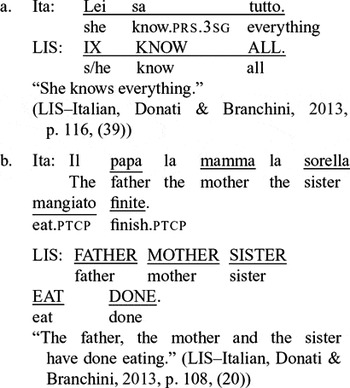


In (9a), the code-blending utterance reveals an SVO word order as in Italian even though LIS is an SOV language. In other words, the process of linearization in this bimodal bilingual production follows Italian grammar only, although the lexemes of both Italian and LIS are articulated simultaneously (i.e., “morphological root blends” in the current paper). On the other hand, the code-blending utterance in example (9b) conforms to the word order of LIS (i.e., [mangiato finite|EAT DONE] “eat finish” instead of that expected in monolingual Italian (i.e., finite mangiato “finish eating”). In other words, the signing and speech in this example are linearized based on the grammar of LIS only. These two examples suggest that word order in bimodal bilingual production is based on one language only. However, using two grammars simultaneously seems to be possible in bimodal bilingual production, as in example (10). In this example, the signed CALL WHO “call who” follows the LIS word order while the speech chi ha telefonato “who had called” follows Italian word order. Sometimes, the simultaneous nature of cross-modal production means that there is not enough material to determine the word order of a code-blend. In example (11), the subject-verb (SV) constituent structure surfaces simultaneously through the subject io “I” in Italian and the verb WIN “win” in LIS.
The studies by Lillo-Martin et al. (Reference Lillo-Martin, Quadros, Koulidobrova, Chen Pichler, Costa, Castro, Lobo and Pratas2010) and Quadros et al. (Reference Quadros, Lillo-Martin and Chen Pichler2010) are based on the longitudinal data of one LSB–Brazilian Portuguese and two ASL–English Codas around age two. When Codas are interacting with familiar hearing bimodal bilinguals, they are more likely to code-blend. However, the rate of code-blending varies individually. Adopting the minimalist model proposed by MacSwan (Reference MacSwan2000, Reference MacSwan2005), these researchers suggest that two different spell-outs are available with bimodal bilinguals because the articulatory organs (i.e., vocal vs. manual) do not conflict with each other during linguistic production. Therefore, the internal structure of code-blending utterances can be determined by the grammar of either the spoken language or the sign language, and the lexical items of either or both languages are inserted late in the computation.
Like the adult studies reported above, the child studies involving language pairs like NGT–Dutch, HKSL–Cantonese, ASL–English, and LSB–Brazilian Portuguese all show that bimodal bilingual children code-blend more frequently than they code-switch. Most of the code-blends reported show semantically equivalent roots; only a small proportion of them are semantically non-equivalent and demonstrate a more complex internal structure. In addition, the study of LIS–Italian bimodal bilingual children also suggests the possibility of producing code-blends that are either structurally non-equivalent (i.e., example (10)) or which lack word order effects due to the cross-modal simultaneous composition of syntactic constituents (i.e., example (11)).
The current study
The current study examines the directionality of the head-complement order of functional elements as observed in the code-blends produced by HKSL–Cantonese bimodal bilinguals. The data is based on a deaf child, CC, who interacts with each of the three deaf adult native signers of HKSL during the recording sessions. Before outlining the subjects’ backgrounds, methodology of data collection and framework of data analysis, we will discuss the head directionalities of the target language-pair, HKSL and Cantonese. Last, we will clarify a form of artificial signing often referred to as sign-supported Cantonese, and discuss how it can be distinguished from code-blending.
HKSL, Cantonese and Sign-supported Cantonese
HKSL
HKSL is the sign language used by deaf people in Hong Kong. It is a pro-drop language and its basic word order is SVO (Sze, Reference Sze2000, Reference Sze2008). The functional heads, including negators (e.g., NOT “not”), modals (e.g., WILL “will” and CAN “can”), as well as auxiliaries (i.e., HAVE “have” and NOT-HAVE “not have”), occur at the post-VP position, yielding a complement-head order in the syntactic structure (Lam, Reference Lam2009; Lam, Tang, Sze & Lee, Reference Lam, Tang, Sze and Lee2008; Lee, Reference Lee2006). Lee (Reference Lee2006) also points out that negative modals, such as WILL-NOT “will not” and CANNOT “cannot”, occur systematically after their complement, similar to other functional elements. Three HKSL examples are given in (12–13) below:
-
(12)
-
(13)


In (12a), the modal WILL “will” follows the conjoined VPs [GO-HOME TELEVISION] “go home and watch television” and scopes over them. In (12b), the negative modal WILL-NOT “will not” takes its VP complement TELEVISION “watch television” to its left. The negator NOT “not” also follows its complement COMPLAIN “complain” in (13), similar to (12a–b). Taken together, the data suggest that functional heads, including negators, modals, negative modals and auxiliaries, adopt a head-final order.
Cross-linguistically, functional heads, such as modals and auxiliaries, are subject to various interpretations (cf. Ouhalla, Reference Ouhalla1991; Pollock, Reference Pollock1989, etc.). In line with the split-INFL hypothesis (Pollock, Reference Pollock1989), we assume that these functional elements head their own projections, e.g., Negative Phrase (NegP), Modal Phrase (ModP), within the split-IP structure. Research on the syntax of HKSL is still highly preliminary, and adult data seems to show that modals, negators, auxiliaries and negative modals are in complementary distribution (cf. Lam, Reference Lam2009; Lam et al., Reference Lam, Tang, Sze and Lee2008; Lee, Reference Lee2006). Therefore, it is premature at this stage to posit a hierarchy of syntactic projections headed by these functional elements. However, given the complement-head order in the deaf adult native signer data in previous studies, we can expect HKSL modals, negators, negative modals and auxiliaries to appear consistently in head-final position. Accordingly, their VP complement will always precede them in surface word order.
Cantonese
Cantonese is the spoken language used in southern China around the Guangzhou area. Like HKSL, it is a pro-drop language and its basic word order is SVO (Cheung, Reference Cheung1972; Lee, Wong & Wong, Reference Lee, Wong, Wong, Lee, Wong, Leung, Man, Cheung, Szeto and Wong1996; Matthews & Yip, Reference Matthews and Yip2011). Functional elements like negators (m “not”, mou “not have” and mei “not yet”), modals (such as hoji “can”), auxiliaries (e.g., wui “will”), and jau “have” all appear before the VP complements they select (Chao & Mui, Reference Chao, Mui and Sun1999, Reference Chao and Mui2000; Lee et al., Reference Lee, Wong, Wong, Lee, Wong, Leung, Man, Cheung, Szeto and Wong1996; Matthews & Yip, Reference Matthews and Yip2011; Wong, Reference Wong and Matthews1998). Two Cantonese examples are given in (14–15) below:
-
(14)
-
(15)


In (14), the negator m “not” appears pre-verbally and selects a verb phrase complement [zungji pinggwo] “like apple” to the right. Similarly, the modal hoji “can” in (15) appears before its complement [daap baasi heoi manfaazungsam] “take the bus to the Cultural Centre”. As Cantonese lacks inflectional morphemes, it is arguable whether these functional elements should be in IP or TP.Footnote 4 It has been proposed that the functional elements in Cantonese are head-initial and take a head-complement order (cf. Cheung, Reference Cheung2005; Tang, Reference Tang1998). The only exception is the modal dak “can”, which usually occurs after the verb in surface word order (Cheng and Sybesma, Reference Cheng and Sybesma2004; Lee et al., Reference Lee, Wong, Wong, Lee, Wong, Leung, Man, Cheung, Szeto and Wong1996; Wong, Reference Wong and Matthews1998). Pertinent to our current analysis of postverbal dak is its meaning of “potentiality” (the other being “permission”). Two examples of potential dak “can” are given in (16a-b).
-
(16)

(16a) is an example of potential dak “can” and (16b) is its negation. In (16a), the verb lo “take” precedes the modal dak “can” and is followed by the verbal particle (notated as vprt) hei “up” and the O(bject) [li-seung syu] “this box of books”. In (16b), the negation of potential dak as in [lo-dak-hei] is [lo-m-hei] “cannot take” where -m “not” is the negative counterpart of dak. Therefore, both the affirmative V-dak and its negation V-m seemingly yield a post-verbal surface word order that differs from the conventional head-initial structure involving a Cantonese functional element. In the current analysis we adopt Cheng & Sybesma's (Reference Cheng and Sybesma2004) analysis of potential -dak and assume that the underlying phrase structure is head-initial, but that the verb raises to adjoin to -dak or -m to form a verb complex V-dak or V-m, hence the surface complement-head order.
Sign-supported Cantonese
Apart from spoken Cantonese and natural HKSL, there is a form of artificial signing (often referred to as sign-supported Cantonese) that is sometimes used by members of the local Deaf community. Sign-supported Cantonese differs from code-blending in that the former systematically follows the grammar of Cantonese, especially its word order, and the utterance is overlaid with manual signs of HKSL as far as possible. The use of sign-supported Cantonese is sometimes accompanied by Cantonese mouthing; hence the prosody of this form of signing often differs from that of natural HKSL but is more akin to the prosody of speech in Cantonese.
-
(17)

In (17), simultaneous articulation occurs between Cantonese m-hoji “neg.can” and HKSL NOT “not”Footnote 5 , as well as between the Cantonese verb lau “leave out” and HKSL LEAVE-OUT “leave out”. This utterance follows Cantonese word order, i.e., negator-modal-verb.
-
(18)

Another example of sign-supported Cantonese is given in (18). In this example, the deaf adult non-native signer mouths a trisyllabic Cantonese word pingsoengsam “as usual ” while articulating the signs FLAT-SURFACE^ALWAYS ^HEART. The meanings of the signs do not bear out the actual meaning of the Cantonese word pingsoengsam and neither do they constitute coherent meanings on their own in HKSL. Since sign retrieval is driven by the Cantonese grammar, especially its word order or even character order of words, the expression in (18) thus shows character/sign alignment between ping “flat-surface” with FLAT-SURFACE, soeng “usual” with ALWAYS “usual”, and sam “heart” with HEART “heart”. If the interlocutor did not know Cantonese, s/he would not be able to understand the meaning of this expression.
Since both sign-supported Cantonese and code-blending may use Cantonese mouthings and Cantonese word order, we distinguish sign-supported Cantonese from code-blending by scrutinizing (i) the signer's choice of lexical variants of the manual signs, and (ii) the rhythm of manual movement in signing. Code-blended utterances with lexical variants of the manual signs that pertain to the intended meaning of the utterances or with the rhythm of manual movement akin to that of HKSL will be included as tokens of code blending in the analysis.
To summarize the differences between HKSL, Cantonese and sign-supported Cantonese, we have seen that HKSL and Cantonese differ in the relative word order of functional elements and their complements. An exception is the Cantonese V-dak whose superficial word order resembles that of HKSL although we argue that underlyingly it has a head-initial structure. Code-blending occurs between HKSL and Cantonese. Sign-supported Cantonese differs from code-blending in that the signing follows Cantonese grammar while HKSL signs are inserted wherever possible. The mouthings used in sign-supported Cantonese can be distinguished from code-blending by the lexical variants selected and by the prosody of manual movements in the signing.
Subjects’ backgrounds
Our deaf child subject, CC, was born to deaf parents who are non-native HKSL signers. Audiological assessment reports at age 1;10 from The Child Assessment Services of the Government of The Hong Kong Special Administrative Region (China) confirmed that CC has bilateral moderate to severe hearing loss. He was prescribed with hearing aids at age 0;4 for both ears. Due to the emphasis on speech rather than sign language for deaf people in Hong Kong, CC was not systematically exposed to HKSL until age 1;9, through his parents as well as three deaf adult native signers who interacted with CC during the recording sessions. His parents, though deaf, did not support the use of HKSL with CC and his deaf younger sister until the family joined the longitudinal study on sign language acquisition. However, we suspect that before age 1;9, CC might have had informal exposure from casually observing the conversations between his deaf parents, which take place using signing as well as speech. As both parents work, CC has been taken care of by his Cantonese-speaking hearing grandmother who does not know HKSL. Although he is being brought up primarily in a Cantonese-speaking environment, CC's Cantonese development is delayed when compared with his age peers. Scores from the Reynell Development Language Scale (in Cantonese) under the aided condition at CC's chronological age 5;3 reveal that CC's receptive skills are equivalent to age 4;0 and his expressive skills to age 4;4, demonstrating a language delay of about one year. Since kindergarten (i.e., around age 3), CC has been going to regular schools and has been exposed systematically to English and Mandarin, in addition to HKSL and Cantonese. CC may have been exposed to some sign-supported Cantonese from his parents and other deaf signers. However, in our data set, CC's choice of lexical variants and the rhythm of manual movement do not reflect the characteristics of sign-supported Cantonese when he interacts with deaf adult native signers. Given CC's language input, we would treat him as an early bilingual child, despite a slight delay in HKSL (since age 1;9) and Cantonese (since age 0;4) input (Deuchar & Quay, Reference Deuchar and Quay2000; Genesee, Reference Genesee, Bishop and Mogford1988; Genesee, Paradis & Crago, Reference Genesee, Paradis and Crago2004; McLaughin, Reference McLaughin1984).
Three deaf adult native HKSL signers in their twenties participated in the same recording sessions as CC. These adult signers have profound bilateral hearing loss, are born of deaf signing parents and each have at least one deaf sibling. They are second language learners of spoken Cantonese, written Chinese and English. We consider them to be bimodal bilinguals who are native signers of HKSL and second language learners of Cantonese.
Methodology
Data collection
CC's longitudinal data (2;0.26–6;6.26) came from the Child HKSL Corpus established in 2002 by the Centre for Sign Linguistics and Deaf Studies. The database represents the first systematic archive of child sign language acquisition in Asia. Subsequent developments of the archive include data from other deaf children's bimodal bilingual acquisition in HKSL and Cantonese. More details about this corpus can be found on the website of Language Acquisition of Deaf Children, Centre for Sign Linguistics and Deaf Studies (URL: http://www.cslds.org/acquisition/en-us/Corpora).
The corpus contains weekly recordings of the conversations between CC and each of his interlocutors in HKSL. CC's interlocutors include (i) three deaf adult native signers who are responsible for interacting with CC and eliciting his signing, (ii) CC's family members who happen to be around in the recording sessions, and (iii) the camera operators whom CC may interact with sometimes. CC has been well acquainted with all three deaf adult native signers since childhood as they frequently meet for various activities of the Deaf community. In the majority of the recordings, one of the deaf adult native signers practises multiple data elicitation techniques with CC, including free conversations, free play, reading of story books, watching animations and cartoons, etc. There are two camera operators who may be deaf adult native signers, non-deaf adult native signers, or occasionally hearing researchers who know HKSL. Sometimes, two deaf adult native signers take turns to interact with CC. In the free conversations, CC usually talks about his school life as well as stories from his favourite TV programmes. Sometimes he discusses the contents of the storybooks or animations with the deaf adult native signers.
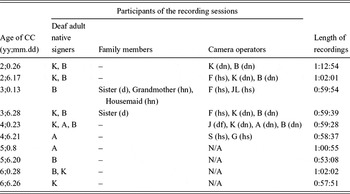
In this project, ten recordings made at six monthly intervals from age 2;0.26 to 6.6.28 were transcribed by a team of deaf adult native signers for HKSL and the first author for Cantonese. The Cantonese transcriptions were cross-checked by the deaf adult native signers for instances of mouthings and mouth gestures. Table 1 provides a summary of the ten recording sessions and the participants involved. In this paper, we include data from a period of four and a half years in order to present an extensive profile of CC's development of code-blending along with his syntactic development of HKSL and Cantonese.
Summary of the recording sessions and participants.

Keys
* dn = deaf adult native signer
df = deaf adult fluent signer
hs = hearing adult signer
hn = hearing adult non-signer
Coding of data
When transcribing the data, English was used to gloss the signs while additional symbols were adopted to code-specific constructions such as classifier predicates (CL:), index signs (IX:), gestures (ges:), etc. (See also Appendix I for the citation conventions and Appendix II for a list of abbreviations). For instance, two monolingual HKSL utterances produced by CC at age 6;6.26 are given in (19) below. In (19a), the utterance begins with a head nod, coded as ges:nod “gesture of nodding”; it is then followed by an index sign IX3 indicating a third person pronoun “s/he”. The predicate consists of two lexical signs glossed in English, GOOD “good” and SKILFUL “skilful”. In (19b), the classifier predicate meaning “a house collapsed” is coded as collapse+CLsem:house. The semantic classifier handshape representing a house is coded as CLsem:house, which is merged with the verb root collapse. This classifier predicate is analysed as a verb phrase (VP), and is followed by the negator NOT-HAVE which is repeated once.
-
(19)

The Cantonese data were notated based on the Cantonese Romanization Scheme designed by the Linguistic Society of Hong Kong (Jyutping). Although tones were marked if identifiable, in this paper they are omitted in the transcriptions for ease of reading as they are not the focus of the current paper. Since the subjects are deaf, their speech is not always vocalized. The symbol @nv (nv for non-vocalization) is adopted to encode whispers, mouthings, and speech without clear vocalization. Also, the symbol /mm is adopted to encode what we refer to as ‘mouth movements’. Mouth movements are potentially ambiguous between mouth gestures of HKSL and mouthings of Cantonese. Mouth gestures refer to those movements of the mouth that naturally evolve with sign language while mouthings are a result of influence or borrowing from spoken languages (cf. Boyes Braem & Sutton-Spence, Reference Boyes Braem and Sutton-Spence2001; Crasborn, van der Kooij, Waters, Woll & Mesch, Reference Crasborn, van der Kooij, Waters, Woll and Mesch2008; Vinson, Thompson, Skinner & Fox, Reference Vinson, Thompson, Skinner, Fox and Vigliocco2010). Linguistically, mouth gestures are part of the phonology of a sign.Footnote 6 An example of a HKSL mouth gesture is MG:puffed-cheeks, co-articulated with the sign NOT-HAVE “not have”. Mouthing, on the other hand, is not a phonological component of a sign but imposed on it as a result of borrowing from Cantonese. For example, the HKSL sign APPLE “apple” might sometimes be articulated with Cantonese mouthing pinggwo “apple” or ping (the first syllable of pinggwo), instead of mouth gestures enacting “biting an apple”, which is the conventional non-manual component of the sign. Sometimes it is very difficult to distinguish mouth gestures from mouthings. An example is the sign FAR “far”. Lexically, it is articulated with protruded lips but such a non-manual feature also resembles the mouth position of the Cantonese word jyun “far”.
Besides mouth movements, gestures and early sign-like elements are also difficult to distinguish. In the transcription, the codes ges: (for gesture) and IX (for index pointing) are used for these cases. For instance, a pointing sign especially during CC's early stage of HKSL development can be a pointing gesture or a HKSL index sign for pronominals or determiners. Another one is, ges:palm-up “palm-up” articulated with an extended open-five-handshape with the palm facing upward. It can either be a gesture or an early form of signing with a loose or phonological erroneous handshape. As a gesture, ges:plam-up “palm-up” may mean “give me” in some contexts.
All the transcribed and coded data were checked with the assistance of two native HKSL deaf signers. A few native Cantonese hearing researchers were also consulted when verifying some speech or mouth movements. However, no statistical checks have been conducted.
Identifying mixed utterances
In the current analysis, about 25 to 30 minutes of the adult-child interactions were extracted after the first 30 minutes of each hourly recording. Altogether, the interactions included 2428 utterances produced by CC and 2341 utterances by the deaf adult native signers. The adult transcript of the recording made with CC at age 2;0.26 was discarded because the deaf adult was off-screen most of the time.
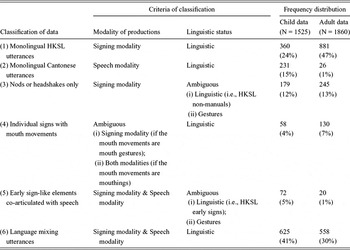
Our first task was to distinguish the utterances including language mixing from other non-mixing tokens for further analysis. First, 903 utterances were discarded from CC's data as they involved only imitations, false starts, incomplete or unintelligible utterances, non-linguistic productions such as simple gestures as well as utterances in which part or all the manual articulators were off-screen. Using the same criteria, a total of 481 utterances were excluded from the deaf adult native signers’ production. Note that the transcripts did not contain those adult utterances during which CC was not looking into the adult's face. At the end, 1525 and 1860 utterances remained that were produced by CC and the deaf adults respectively. They were grouped into six types based on (i) whether the language produced was in signing modality and/or speech modality;Footnote 7 and (ii) whether the production was linguistic or gestural (see Table 2).
Classification and frequency distribution of HKSL–Cantonese utterances.

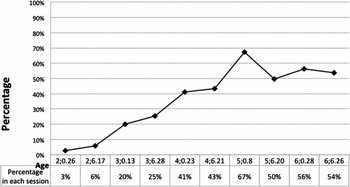
Table 2 summarizes the frequency distribution of all six types of utterances produced by CC. Monolingual utterances contribute 39% (n = 591) of the total number of utterances under investigation, out of which 24% (n = 360) are monolingual HKSL and 15% (n = 231) are monolingual Cantonese utterances. It is quite surprising that CC's speech-only utterances make up about 15% of the data since the interlocutors in the recording sessions were primarily deaf adult native signers. Utterances involving nods or headshakes only amount to 12% (n = 179). There are also 58 utterances (4%) in which individual signs are co-articulated with mouth movements. Another 72 utterances (5%) of early sign-like elements are co-articulated with speech. The language mixing utterances (i.e., Type 6), which involve code-blending and code-switching, comprise 41% (n = 625) of the data, suggesting that they are quite prominent in CC's bimodal production. Figure 2 shows the increasing occurrences of language mixing utterances produced by CC during the period of observation, from 3 % at age 2;0.26 to 67% at age 5;0.8. From age 5;0.8 onwards, CC produced more and progressively more language mixing than other types of utterances.
Percentage distribution of CC's language mixing utterances by age.

The last column of Table 2 summarizes the frequency distribution of six types of utterances produced by the three deaf adult native signers who interacted with CC. More than 48% (n = 907) of the adult input (N = 1860) is monolingual and consists primarily of signs only (97%, n = 881/907). These figures reflect the HKSL-oriented contexts as the deaf adult native signers are instructed by the investigators to use only HKSL with CC during the sessions. There is occasional production of Cantonese-only utterances (n = 26), due to the fact that CC and some of the participants are either bimodal bilinguals or hearing Cantonese speakers (including CC's grandmother, housemaid and some of the camera operators, see Table 1). Nods- or headshakes-only utterances comprise 13% (n = 245). In the adult input data, language-mixing utterances comprise more than one third (n = 558/1860) of the data. As in CC's data, there was only a small proportion of utterances indicating early sign-like elements articulated with speech (n = 20/1860, 1%) and utterances of individual signs co-articulated with mouth movements (n = 130/1860, 7%).
Utterances of Types 1 to 5 (see Table 2) were not included for further analysis for one of three reasons: (a) either they were monolingual utterances in HKSL or Cantonese (i.e., Type 1 and Type 2), (b) or they were non-manual expressions (Type 3) which might or might not assume a linguistic status, and (c) they were ambiguous cases in terms of the modality of productions (i.e., Type 4) or their linguistic status (i.e., Type 5). In the next section we will focus our analysis on the language mixing utterances (i.e., Type 6).
Results
Code-switching vs. code-blending
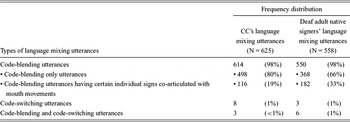
To examine the frequency of occurrences of code-switching relative to those of code-blending, all the language mixing data (i.e., Type 6 in Table 2) were further broken down into code-blending and code-switching. Table 3 shows the relative distribution of code-blending and code-switching utterances in the bimodal bilingual production of CC and the deaf adult native signers.
Frequency distribution of language mixing utterances.

As shown in Table 3, code-switching utterances like that shown in example (2) occur much less frequently (8/625, 1%) than code-blending utterances (614/625, 98%) in CC's data. Of the code-blending utterances, 498 (80%) involve code-blending only and 116 (19%) involve both code-blending and certain signs co-articulated with mouth movements. There are only three tokens of utterances including both code-switching and code-blending within the same utterance (e.g., example 21).
-
(20)

Example (20) represents a case of code-switching between Cantonese and HKSL. When the deaf adult asks CC to elaborate on the story they read together, CC begins the utterance with a subject ngo “I” and a verb gu “guess” in Cantonese, then he stops talking and switches to signing TOGETHER in HKSL. This sign is directed to a spatial locus (i.e., TOGETHER−a ), meaning “these (ingredients) go together”. In other words, the covert arguments of this predicate are assigned to a spatial locus. Since HKSL allows pro-drop, we assume that this Cantonese verb gu “guess” selects a clausal complement in HKSL, as in (20’).
-
(20')

As said, a great majority of CC's utterances involve code blending. Among them, 498 of them (80%) involve code-blending only utterances such as (2) here repeated as (21), and 116 of them (19%) contain both code-blending plus other HKSL signs co-articulated with mouth movement, as shown in (22). In (21), there are two code-blends within the same utterance, namely [hoji|CAN]
-
(21)

“can” and [tai|SEE−a ] “see there”, along with a non-blended element, i.e., the HKSL sign AGAIN “again”.
In (22), in addition to a typical code-blend, the utterance contains another sign that is co-articulated with mouth movements:
-
(22)

In example (22), the code-blend [dim|MOLE] “Mole (name of a character in a TV program)” consists of Cantonese dim “point” and HKSL MOLE “Mole”, which is a name-sign created by CC to refer to a character of his favorite TV program. Another code-blend, [pangjau|FRIEND] “friend”, a morphological root blend, is preceded by a manual sign FEMALE “female” that is co-articulated with a mouth movement which looks very much like either Cantonese neoi “female” or the non-manual of protruded lips commonly observed in the HKSL sign FEMALE “female”. If this mouth movement is interpreted as Cantonese mouthing, it forms a code-blend with the sign FEMALE “female”. If it is a mouth gesture, it is the non-manual feature of the sign FEMALE “female”. Therefore, mouth movement of this kind is ambiguous between a mouthing and a mouth gesture. The mouthing alternative has been arbitrarily chosen for the transcription in (22).
As mentioned, there are only three tokens where both code-blending and code-switching occur within a clause (i.e., intrasentential language mixing). In example (23), CC first adopts HKSL only and signs a classifier predicate flow-through+CLsass:liquid+CLsass:machine “liquid flows through a cylindrical machine”. Then he code-switches to the Cantonese verb fong “put” and code-blends haamin “below” in Cantonese with DOWN−a+CLsass:machine “down below the cylindrical machine” in HKSL. Taken together, this example seems to be a paratactic construction, composed of a classifier predicate in HKSL and a Cantonese VP where the head V fong is solely in Cantonese and it selects a code-blended, locative Prepositional Phrase (PP) [haamin|DOWN−a+CLsass:machine].
-
(23)

Table 3 also shows that there are 558 language mixing utterances in the adult data, and 98.57% (n = 550/558) are code-blending only utterances. There are only three intrasentential code-switching utterances (0.54%) and six utterances showing intrasentential code-blending and code-switching (1.08%). As in CC's production, code-blending occurs more frequently than code-switching.
To conclude, the fact that code-blending in HKSL–Cantonese occurs much more frequently than code-switching in both our deaf child and adult data corroborates previous findings in studies involving either other language pairs or deaf and hearing children as well as adults. As far as the language mixing of functional heads is concerned, we find no tokens of modals, negators, auxiliaries, etc., in utterances involving code-switching: all the code-switching sites are between verbs and nouns or across verbs and their clausal complement.
Code-blending in HKSL–Cantonese: Semantic and morphosyntactic characteristics
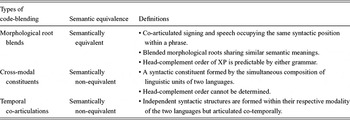
Previous studies on code-blending report that semantically equivalent blends, such as [bird|BIRD] “bird” in (3), are more common than semantically non-equivalent blends, such as [bassi|TACCHI] “high heel” in (4). To examine whether similar processes of code-blending also occurred in HKSL–Cantonese bimodal bilingual production, we further categorized the HKSL–Cantonese code-blending utterances into semantically equivalent and non-equivalent blends. All the semantically equivalent code-blends involved morphological roots. The semantically non-equivalent blends were further categorized based on their morphosyntactic properties. They were cross-modal constituents and temporal co-articulations (see the section on Semantically non-equivalent code-blends). Table 4 summarizes the distribution of the different types of code-blending utterances produced by CC and the deaf adult native signers. In what follows, we will elaborate on the three types of code-blending utterances in detail.
Types of HKSL–Cantonese code-blending.

Semantically equivalent code-blends
Most HKSL–Cantonese code-blends involve the morphological roots of lexical categories like nouns and verbs (ref. example (24a) below); however, there are also tokens of functional heads like modals and negators (ref. example (2) above). These observations are in line with previous findings that code-blends involving a lexical sign/word are semantically equivalent. In example (24a), the Cantonese noun pinggwo “apple” blends with the HKSL noun APPLE “apple”, and no complement is involved. These morphological root blends can themselves be a complement of another head that is either in Cantonese only, HKSL only, or blended. In addition, a functional sign may be blended and select a complement as in example (2), repeated as (24b) below. In this example, the blended functional sign [hoji|CAN] “can” selects a complement, another code-blend [tai|SEE−a ] “see there” which is modified by the sign AGAIN “again”.
-
(24)

Semantically non-equivalent code-blends
From the data, we find 15 code-blending utterances where the signing and speech are semantically non-equivalent. As mentioned above, we grouped these cases into cross-modal constituents and co-temporal articulations based on whether the code-blended signing and speech together formed a syntactic constituent.
A cross-modal constituent is a syntactic XP articulated simultaneously through signing and speech such that the head and its complement are articulated independently through their respective modality. The examples in (25a–b) are both VPs where the verb is articulated in one modality, but the argument, i.e., a Noun Phrase (NP) complement, comes from the other modality. In (25a), the verb EAT “eat” is articulated in HKSL while the internal argument bengbeng “biscuits” is contributed by Cantonese. In (25b), the verb bei “give” is articulated in Cantonese while one of the arguments BISCUITS “biscuits” comes from HKSL. In these cases, the signing and speech together form a licit syntactic constituent such that the head and its complement originate in two different modalities.
-
(25)

In (25’a–b), the head of a constituent is spelt out in one language and its complement in another language. Therefore, one may posit that in bimodal bilinguals, constituents of a phrasal structure, VP in this case, may invoke different spell-outs at PF due to the availability of different sets of articulators in their respective modalities. We argue that the apparent simultaneous co-articulations are just phonetic effects as a result of the different rates of articulation by the articulators of different modalities. Therefore, the formation of this type of code-blending involving cross-modal constituents is underlyingly the same as the code-switching structure shown in (20’).
-
(25')

As for temporal co-articulations, the linguistic elements are co-temporally aligned during bimodal bilingual production but the blended signing and speech do not necessarily form a syntactic constituent, nor do they share any common head X, as shown by fong “put” and NOT “not” in the first code-blend in (26) below. In that example, at first glance, it appears that fong and NOT form a syntactic constituent meaning “not put”. Given the context, NOT is simply a negative interjection, as CC is replying to the deaf adult native signer's comments, with frustration. The first Cantonese verb fong is actually associated with the second code-blend, which is a morphological root blend [fong(x3)|puta-b-c +CLhand:books] “put the books one on top of the other” with some additional morphosyntactic properties. In our analysis, the verb fong and the classifier verb put come from similar morphological roots thus share the same meaning “put”. However, the classifier verb put in HKSL acquires more morphosyntactic properties and becomes more complex than the bare verb fong in Cantonese. Precisely, the verb root “put” combines with a handling classifier (i.e., coded as CLhand:books) which is said to encode the internal as well as external argument of the predicate (Benedicto & Brentari, Reference Benedicto and Brentari2004). The three loci in space (i.e., coded as − a-b-c ) directed by repeated movements encode the locative morphemes where the arguments are.
-
(26)

In sum, semantically equivalent code-blends occur more frequently than semantically non-equivalent code-blends in HKSL–Cantonese, as in earlier studies on other language pairs. Morphological root blends comprise a major chunk of the data while there are just a few tokens of cross-modal constituents and co-temporal articulations. Cross-modal constituents are structurally the same as code-switching albeit articulated simultaneously, but the constituents come from two modalities. In the next section, we will attempt to account for the data adopting the proposal of Chan (Reference Chan2003, Reference Chan2008), in particular, we will explore whether the head of a functional category determines the head-complement order in code-blending.
A linguistic account of code-blending: Some preliminaries
As mentioned above, cross-linguistic comparison between HKSL and Cantonese reveals that the functional categories of HKSL and Cantonese differ in head directionality. In unimodal code-switching involving two spoken languages (or even two sign languages as we would assume), linearization, albeit sequential in nature, may lead to conflicts in selecting the head-complement order when the head directionality of the two languages contrasts. Studies on code-switching in spoken languages consistently find that the head of Language A or B in the language pair <A, B> determines the head-complement order of the switch (Chan, Reference Chan2003, Reference Chan2008; MacSwan, Reference MacSwan1999, Reference MacSwan2000; Mahootian, Reference Mahootian1993; Nishimura, Reference Nishimura1985, Reference Nishimura1997). In other words, this conflict is resolved by selecting the head directionality of the language from which the functional head originates, in line with the principles of Phrase Structure as stipulated by Universal Grammar regarding the hierarchical organization of natural languages. Here, we argue that a similar conflict resolution can obtain in code-blending only when the head occurs in one language but not both. Under this condition, the head-complement order will adopt the directionality of the head of that language. In addition, we need to account for the order when the head is code-blended by two languages that require different head directionalities. For example, HKSL modal CAN “can” is head-final while Cantonese modal hoji “can” is head-initial. When these two modals code-blend, should this blend select its complement to its right or to its left? Therefore, it is important to find out how the two grammars are represented under those circumstances: in particular, how they accommodate this difference in head directionality in code-blending. Such an investigation is crucial for achieving a better understanding of bimodal bilingual production. Equally importantly, investigating code-blending from a developmental perspective will shed light on the properties of bimodal bilingual deaf children's mental representations of the two developing grammars when they acquire two languages simultaneously. In the next section, we will briefly elaborate on Chan's (Reference Chan2003, Reference Chan2008)’s proposal, which offers a theoretical framework for our analysis of HKSL–Cantonese code-blending.
Chan's (Reference Chan2003, Reference Chan2008) account for code-switching in spoken languages
The linguistic account proposed by Chan (Reference Chan2003, Reference Chan2008) presupposes that there is no grammar specific to code-switching. Code-switching is principally governed by the grammars of the two participating languages, just as a monolingual grammar governs its phrase structure via the principles and parameters of UG. Chan (Reference Chan2008) investigates the code-switching of lexical categories (verbs and nouns), functional categories (determiners, tense, light verbs, and verbal inflections, as well as complementizers), and prepositions/postpositions, where the two languages involved are of different head-complement orders. His evidence from a number of language pairs shows that lexical categories and functional categories behave differently while prepositions/postpositions and functional categories behave similarly in code-switching. He observes that the language of the lexical categories does not necessary determine the head-complement order in code-switching. Taking the lexical category of VP as an example, code-switching between VO and OV languages reveals diverse patterns: (i) the head-complement order follows the language of the verb; (ii) the head-complement order follows the language of the complement and probably the so-called “mixed compound verbs”; and (iii) the objects are either topicalized or scrambled to the clause-initial position (Chan, Reference Chan2008, p.787).
Chan (Reference Chan2008) proposes that it is the language of the head of a functional category that sets the parameter value of the head-complement order of a code-switched phrase. If head X is from a head-initial language, the phrase XP must be in head-complement order. If head X is from a head-final language, XP must be in complement-head order. (27a–b) are two examples of CP.
-
(27)

In example (27a), the English complementizer that selects a complement [nae hungukmal ajik yakhanko] “my Korean is still weak” to its right because English CPs are head-initial, i.e., a head-complement order. In example (27b), the head ira, which is a Korean complementizer, selects its English complement [I am out of town] to its left because Korean is a head-final language. Therefore, the phrase headed by ira is in complement-head order, which follows the grammar of the language of ira, which is Korean.
In sum, Chan argues that in code switching functional heads inherit the head parameter value of the languages in question and determine the head-complement order of their projections in the switch. Hence, so long as the head-complement order is obtained, the complement that the functional head selects may come from the other language of the pair. Unlike functional categories, lexical categories do not carry the head parameter value, thus the value of the head parameter or the lexical items thus inserted may come from either language. Put simply, the head-complement order of a switched phrase headed by a lexical category can follow the word order of either language of the pair.
Code-blending: Some predictions
In the current analysis, we propose that code-switching is no different from code-blending as both are governed by the same set of principles and constraints of UG. The principle of economy does not anticipate any extra rules or constraints in the computation during language mixing. Thus Chan's analysis of code-switching derived on the basis of abstract linguistic principles of UG would predict that the linguistic behaviors of unimodal spoken bilinguals and bimodal bilinguals should be essentially the same.
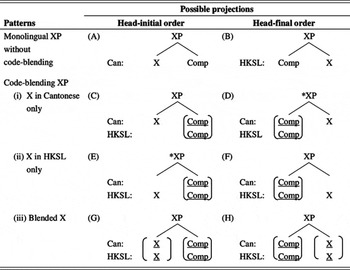
As reported, there are some conditions under which two languages may code-blend. First, with HKSL–Cantonese morphological root blends, the lexical roots, if available in the lexicon, can blend with each other as long as the morphological roots share the same meaning and grammatical category. An example is the nominal blend [pinggwo|APPLE] “apple” in (24a). Note that this nominal blend in other circumstances could become a complement selected by another blended head, a Cantonese-only head or a HKSL-only head. Since both HKSL and Cantonese allow SVO word order for verbs (i.e., similar head directionality), a litmus test for the applicability of Chan's code-switching analysis from unimodal spoken bilingual to bimodal bilingual conditions is HKSL–Cantonese's code-blending of functional heads because they manifest a difference in head directionality, namely head-initial in Cantonese and head-final in HKSL. We predict that they may invoke different head-complement orders in language mixing, depending on the language of the pair <A, B> that the head appears in.
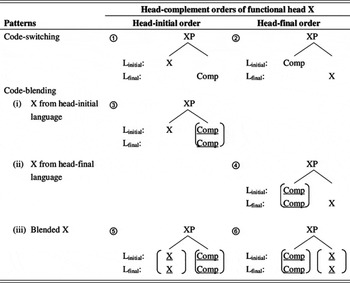
In line with Chan's analysis, given a difference in head directionality with the functional projections in these two languages, the functional head X will select either a head-initial or a head-final order (see Pattern A and Pattern B in Table 5). In code-blending, if a head X is in one of the languages of the pair, the head-complement order will follow the language of head X (i.e., Pattern C and Pattern F). Under this condition, code-blending may occur with the complement of the functional projection.Footnote 8 A Cantonese functional head selects a code-blended complement based on the Cantonese head-initial order (i.e., Pattern C) and likewise for HKSL (i.e., Pattern F). In contrast, Pattern D and Pattern E are unlikely to occur in HKSL–Cantonese code-blending, as predicted by the head directionality of the functional categories.
Predictions for HKSL–Cantonese code-blending in functional XPs.

When a functional head is blended with semantically equivalent roots, either head-complement order or complement-head order results (Pattern G and Pattern H). The former is determined by the head-initial order of Cantonese while the latter parallels the head-final order of HKSL. Under this condition, a blended head may or may not select a blended complement. In other words, the complement selected by a blended head can be (i) blended, (ii) Cantonese-only, or (iii) HKSL-only.
Results (a): Code-blending and functional categories
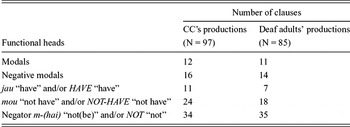
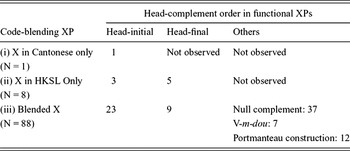
Based on CC's 617 code-blending utterances (including 614 code-blending utterances and three utterances with both code-blending and code-switching), we extracted 740 clauses for further analysis. 97 of them contain a functional head (see Table 6 for a list of functional heads found in the data): 12 clauses with an affirmative modal, 16 with a negative modal, 11 clauses with Cantonese jau “have” and/or HKSL HAVE “have”, 24 clauses with Cantonese mou “not have” and/or HKSL NOT-HAVE “not have”, and 34 clauses with a Cantonese negator m-(hai) “not.(be)” and/or HKSL NOT “not”. These phrases are classified according to (a) whether the functional head is blended or not; and (b) the head-complement order within the functional projections (cf. Table 7). In the next section, we will examine the different types of code-blends along with their head-complement order one by one.
Frequency distribution of clauses containing functional heads in HKSL–Cantonese code-blending utterances.

Frequency distribution of code-blending in functional XPs (CC).

Functional head in Cantonese only
There is only one token showing a non-blended functional head in Cantonese with CC's data (i.e., Pattern C). It is jau “have”, which selects a blended VP complement to its right (see (28)), hence a head-complement order, reflecting the grammar of Cantonese.
-
(28)

Functional head in HKSL only
There are five tokens of clauses that adopt a complement-head order (i.e., Pattern F). In (29), the HKSL modal CAN “can” selects a blended complement to its left, following HKSL grammar.
-
(29)

There are also tokens that run counter to our prediction (i.e., *Pattern E). CC produces three tokens with a word order as in (30) where the HKSL modal CAN “can” precedes its blended complement, resulting in a head-complement order, thus violating the grammar of HKSL as well as our prediction based on Chan's analysis.
-
(30)

Blended X
There are five different types of blended functional head (N = 88) in the data set (see the last row in Table 7). All of them are semantically equivalent root blends in Cantonese and HKSL. Twenty-three tokens observe the Cantonese head-initial order for functional heads. Example (31) below is an example of this. The blended [hoji|CAN] “can” in this example selects a blended complement [waakwaa|DRAW] “draw” to its right. The second type, represented by nine tokens, observes the HKSL head-final order for functional heads (see (32)). In example (32) the blended [m-hai|NOT] “not be” selects a blended complement to its left.
-
(31)
-
(32)


Examples (31) and (32), taken together, suggest that a blended functional head allows the order of the complement to be in either direction, reflecting the grammars of the two target languages, which is head-initial for Cantonese (i.e., Pattern G) and head-final for HKSL (i.e., Pattern H). In addition to these two types, we also find thirty-seven tokens with a null complement. Some of them are followed by a Cantonese sentence final particle, such as aa. In example (33), Cantonese mou “not have” blends with HKSL NOT-HAVE “not have”. Most of these cases are CC's direct responses to the questions posed by the deaf adult native signer, implying that the referent of the null argument is recoverable from the conversational discourse. Since both HKSL and Cantonese allow pro-drop, the code-blends in these clauses show no violation of the two grammars concerned.
-
(33)

The fourth type consists of seven clauses that represent cases of code-blending with V-m-dou in Cantonese and V-CANNOT in HKSL, as in example (34). As discussed in relation to example (16), V-m in Cantonese is analyzed as having an affirmative counterpart V-dak (cf. (16)).
-
(34)

In this example, we assume that the index sign IXobj:door “that door” is underlyingly the grammatical object, i.e., the complement of V0 “open”. The blended functional head [-m-dou |CANNOT] “cannot” selects a code-blended VP complement [hoi- |open+CL:sass:door] “open the door”. In HKSL grammar, the negative modal CANNOT follows its complement VP (i.e., head-final order). Thus we would expect an underlying word order of V-O-CANNOT. The object O is often topicalized in HKSL, yielding a surface order of O-V-CANNOT, just as (34) shows. As discussed in relation to the Cantonese examples in (16), V-m is the negative counterpart of V-dak where dak is a modal. Although V-dak and V-m appear with the same word order at the surface level, we posit that it is the verb that left adjoins to either -dak or -m at a higher syntactic projection, resulting in the seemingly head-final order of V-dak and V-m. If the object were spelled-out overtly with a surface order of V-dak-(vprt)-O, the head-initial status of -dak and -m would be much clearer. However, no data of this kind is found in the corpus. To conclude, although V-m-dou in Cantonese and V-CANNOT in HKSL seem to be aligned co-temporally, they have different underlying syntactic structures because the negative modal in HKSL is in the head-final position of the functional projection, yielding a complement-head order in contrast to that in Cantonese, where hoi-m-dou is underlyingly head-initial. If our analysis is on the right track, CC's co-temporal productions are based on two independent functional projections each with a different head directionality, one from each modality. This is somewhat similar to what occurs in the earlier example (10) from Donati and Branchini (Reference Donati, Branchini, Roberts and Biberauer2013) except that in the HKSL–Cantonese example in (34) the word order remains superficially the same.
Last but not least, the fifth type of blended functional heads consists of portmanteau constructions (n = 12). There are eleven tokens with a head-complement-head order and one token with a complement-head-complement order. Chan (Reference Chan2008) reported cases of portmanteau constructions in code-switching in which elements like complementizers, verbs, etc., are ‘doubled’. The ‘doubled’ elements come from two different languages. In his examples, the head from a head-initial language selects a complement to its right that may be from either language, and this complement is followed by another head whose language is head-final. In our code-blending data, a blended head may be ‘doubled’. In (35), a blended negator [m-hai|NOT] “not” is repeated after a blended complement [baabaa|FATHER] “father”. Here, we propose that these portmanteau constructions are doubling structures of HKSL.
-
(35)

doubling of wh-words, verbs, etc. has been documented in some sign languages (cf. Kimmelman, Reference Kimmelman2012 on Russian Sign Language; Sandler & Lillo-Martin, Reference Sandler and Lillo-Martin2006 on ASL). Despite the fact that there has not yet been any analysis of doubling structures in HKSL, the doubling of the negator NOT “not”, is observed in adult HKSL, as in (36). This example comes from the monolingual HKSL utterances of the three deaf adult native signers. The negator NOT “not” appears before and after its VP complement THROW−a “throw (something) upward”. In other words, the head-complement-head order is a licit word order in the adult grammar of HKSL. This could explain why we find portmanteau constructions in CC's data since these code-blending utterances could be said to reflect the word order of his adult HKSL input.
-
(36)

To summarize this discussion of the child data, we observe that, except for Pattern E, Chan's analysis can also be adopted to account for most of the code blending data, where the head of the functional projections in either language of the pair determines the order of the complement. Also, when the code-blended heads are semantically equivalent and morphologically similar to each other, optional head directionality results (cf. examples in (31-32)), still confirming to the grammar of either HKSL or Cantonese. Portmanteau constructions, on the other hand, reveal the adoption of HKSL grammar in code-blending.
As mentioned, we did find data that seems to show apparent violation of Chan's analysis (i.e., Pattern E). In (30), the modal CAN “can” in HKSL selects a blended complement to its right, in violation of the HKSL head-final order (cf. monolingual HKSL examples in (12-13)). Before discussing this phenomenon, we will turn to the adult data in this study, to find out if the patterns of code-blending as observed in CC are also found among the deaf adult native signers who interact with CC during the recording sessions.
Results (b): Adult input data
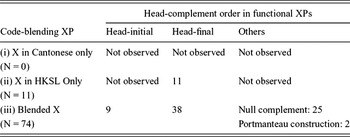
In analyzing the deaf adults’ data, we adopt the same set of predictions as presented in Table 5. The results are summarized in Table 8. Unlike CC's data, the adult input data does not contain any examples like (30) in which the HKSL modal selects a blended complement to its right, which violates the grammar of HKSL. Instead, the adult data follows the HKSL grammar. Eleven tokens of utterances show a monolingual HKSL functional head that selects a code-blended complement to its left, yielding a complement-head order (i.e., Pattern F). For those utterances with a code-blended functional head, we observe either a head-initial (n = 9, i.e., Pattern G) or head-final order (n = 38, i.e., Pattern H), as in to CC's bimodal production. Null complements are also quite prominent (n = 25). There are only two tokens of portmanteau constructions in a complement-head-complement order but no V-m-dou code-blending utterances are found. Hence, the adult input data all confirm our predictions.
Frequency distribution of code-blending in functional XPs (deaf adult native signers).

In sum, we have demonstrated that Chan's (Reference Chan2003, Reference Chan2008) analysis of code-switching concerning spoken languages can also be adopted to account for most of the evidence of HKSL–Cantonese code-blending involving functional heads, except for cases in which CC produces HKSL modal CAN “can” that selects a blended complement to its right instead (cf. example in (30)), in contradiction to our prediction.
Discussion
In this study, we suggest that monolingual or bilingual production is governed by the principles and constraints of natural languages for its syntactic organization. Specifically, the head parameter governs the head-complement order of syntactic structures. Our data show that this applies to unimodal bilinguals just as well to bimodal bilinguals, implying that the principle governing head directionality of natural languages is modality-independent, applying to sign languages as well as to spoken languages. As a preliminary analysis, Table 9 summarizes the plausible patterns of language mixing when the two participating languages reveal a difference in the head directionality (Linitial vs. Lfinal) of their functional projections, where the heads are modals, negators, auxiliaries, or negative modals. As mentioned, code-switching as observed in spoken languages can also be found in bimodal bilingual production, although the number of utterances demonstrating code-switching is not high. So far, we have no data that shows bimodal code-switching with modals, negators and auxiliaries. The current study also shows there are various patterns of code-blending (as summarized in Table 5) between a sign and a spoken language in bimodal bilingual production. Further research, to verify the existence of HKSL–Cantonese code-switching involving functional categories, is needed in order to consider whether Chan's (Reference Chan2003, Reference Chan2008) proposal is also applicable to code-switching between a spoken language and a sign language.
Language mixing of functional XPs in head-initial and head-final languages.

The current findings show that code-blending involving a sign language and a spoken language observes similar principles of linguistic organization to those postulated by Chan (Reference Chan2003, Reference Chan2008) for spoken languages. Code-blending complies with the word order principles of natural languages and the grammars of the language-pair. Specifically, when a non-blended functional head of either a Linitial or Lfinal takes up the head position, it selects a complement in an order that corresponds to the language of the non-blended head, while the complement may contain blended elements contributed by the two participating languages (i.e., Patterns ①-④ in Table 9). In other words, the functional head determines the head-complement order in code-blending, as in the code-switching of spoken languages. On the other hand, when the functional heads of the two participating languages with different head directionalities are blended, optionality of head-complement order results (cf. Patterns ⑤ and Pattern ⑥). Whichever order the blended head takes up, it will observe the grammar of one language of the pair. These observations form the basis of our proposal for conditions governing language mixing in (37) below:
-
(37) Conditions for code-blending of functional heads
-
a. When X is a functional head and is not blended, and when it selects a YP complement that undergoes code-blending, the head-complement order is determined by X of that language.
-
b. When X is a functional head and is blended, on condition that the sign/word contributed by a sign language and a spoken language are semantically equivalent and morphologically share the status of root of the functional categories, the head-complement order of XP is optional between the order of either Language A or B.
-
We propose that these conditions can be adopted to capture code-blending between a sign language and a spoken language. With evidence from code-switching in future research, these conditions might be extended to capture code-switching also, and to verify if code-blending and code-switching comply with similar principles governing head-complement orders. Future research needs to address the code-blending of lexical categories, in particular how nouns and verbs as lexical heads determine the order of their complements. This will provide further testing of Chan's proposal that heads of lexical categories do not determine the order of its complement in code-switching by its extension to the phenomenon of code-blending.
In relation to the current research there are nevertheless some remaining issues that need resolving. Recall that in three tokens, CC places the non-blended HKSL modal before a code-blending complement, creating a head-initial order which violates the adult grammar of HKSL (cf. (30)) and contradicts our prediction (cf. Pattern E in Table 5). Note this phenomenon is not observed in our adult data. To try to account for this pattern, we examined CC's monolingual HKSL utterances in the recording sessions.
There are only two monolingual HKSL utterances containing a modal: one appears at age 4;0.23 and the other at age 6;0.28. Both of these utterances adopt a head-complement order, as in (38), also in violation of the adult HKSL grammar.
-
(38)

In (38), the sign WILL “will” selects a complement move+CLsass:paper +CLsass:board “paper moves on the board” to its right. Taken together, these tokens suggest that during certain stages of CC's bilingual development, it could be assumed that certain (but not all) functional heads are head-initial in HKSL, as in Cantonese. In our data set, only affirmative modals or auxiliaries, but not negative modals or negators, are in head-complement order. In other words, CC might be producing some version of signing that we commonly refer to as sign-supported Cantonese. Sign-supported Cantonese is used in deaf schools and CC's parents as well as the deaf adults also know this visual communication system. Logically, CC could have been exposed to this artificial form of signing, produced by adult native signers, deaf or hearing, in addition to being exposed to natural HKSL and spoken Cantonese. It seems that CC's acquisition of modals in HKSL is reinforced by sign-supported Cantonese, resulting in an order like (38). This use of a head-complement order parallels the code-blending pattern in (30). We argue that such tokens representing Pattern E of Table 5 reflect the developmental grammar of CC. At some point in his bilingual development, CC adopts Cantonese word order in his HKSL signing, thus violating the norms of adult code-blending.
From the perspective of code-blending, the developmental data in our study add a further dimension to the theory, revealing that children acquiring two languages simultaneously are constantly accessing the grammars of the language pair not only in their monolingual but also in their bilingual production. In our study, we observe that knowledge of the head-complement order of one developing grammar is being transferred cross-modally to the developing grammar of the other.
What adds to the complexity of the process of language acquisition is that CC seems to be experiencing difficulty in teasing apart the head directionality of the two developing grammars during certain stages of his bilingual development. For deaf children acquiring a sign language and a spoken language simultaneously, there may be domains of linguistic knowledge such as word order that are susceptible to crosslinguistic influence. Evidence of such influence surfaces in CC's monolingual as well as bimodal bilingual production: in particular, his production of an inappropriate head-complement order of functional heads in his supposedly monolingual HKSL or code-blended utterances. It may be that language dominance is a factor affecting this crosslinguistic influence. In the case of CC, it seems that his Cantonese is more advanced than HKSL in the development of certain functional categories, causing him to adopt an inappropriate head-complement order even in code-blending. Unfortunately, owing to the limitations of the Child HKSL Corpus, we are not able to establish comparative figures based on Mean Length of Utterances (MLUs) or Upper Bound of CC's linguistic production in HKSL and Cantonese to determine language dominance using an independent measure, procedures that are commonly adopted in research on bilingual acquisition (Bernardini & Schlyter, Reference Bernardini and Schlyter2004; Yip & Matthew, 2006).
To conclude, CC's code-blending reveals patterns of head-complement orders that converge to the grammar of either HKSL or Cantonese. Further research involving other functional domains could shed light on theories of code-switching and code-blending in bimodal bilingual production, and on the processes of bimodal bilingual acquisition.
Summary
This paper reports on the code-blending of functional categories in HKSL and Cantonese produced by a deaf child CC (2;0.26–6;6.26) and three deaf adult native signers based on ten video recordings of the Child HKSL Corpus. As shown in other code-blending studies, HKSL–Cantonese bilinguals code-blend more often than they code-switch. In this study, we have identified three types of code-blends: (i) morphological root blends; (ii) cross-modal constituents; and (iii) temporal co-articulations. We have also adopted Chan's analysis in accounting for their patterns of occurrence. Our findings have confirmed that similar principles and constraints of UG are at work in code-blending, namely, the language that the head of the functional categories appears in determines the head-complement order of the projection. This applies to Chan's code-switching data involving spoken languages data as well as the HKSL–Cantonese code-blending. The apparent violations observed in the code-blending data are explicable in terms of bilingual acquisition of the deaf child in the current study, suggesting that bimodal bilingual children can access two developing grammars simultaneously in his linguistic performance. As the results are preliminary, future research is called for on the patterns of language mixing involving other functional and lexical categories, in order to address the issue of universal principles and constraints governing natural languages and their associated linguistic manifestations in code-switching and code-blending.
Appendix I – Citation conventions
All the language data are followed by a bracket in which the name of the language(-pair) and the source of reference is given. If the language data are produced by a child, the age of the child is also given, if known.
Signing data
Following the conventions of sign linguistics research, the signing data are notated in capital letters. English is adopted to gloss the HKSL signs with their closest possible meanings. If more than one word is required to transcribe a sign, hyphens are used to link up the words. Classifier predicates are indicated by the format “verb-root+CLtype:object”. The types of classifier handshape such as size and shape specifiers (“sass”) is marked with subscripts. An example is flow+CLsass:liquid “liquid flows”. If more than two lines are required to transcribe the data, the lines will begin with g1: and g2: which represent gloss 1 and gloss 2 respectively. The simultaneous constructions are bracketed by the symbols {} in the examples and they are linked up by a plus symbol + in text. An example is flow-through+CLsass:liquid+CLsass:machine “liquid flows through a cylindrical machine” where the + symbol connects the components of the simultaneous constructions. Mouth gestures are notated by MG:, such as MG:puffed cheeks.
Cantonese data
The Cantonese data in this study are transcribed using The Linguistic Society of Hong Kong Cantonese Romanization Scheme (usually known as Jyutping). Tone markings are omitted in this paper for ease of reading. A symbol @nv is used to annotate words which are not vocalized with a clear voice, including whisper and mouthings.
Code-switching data
The first line displays the code-switching data. On this line, the linguistic data that appears first (e.g., Language A) is marked in a normal font while the switching elements coded in Language B are marked in italics. Glosses are given in the second line. The third line is for the free translation of the entire utterance.
Code-blending data
Examples of code-blending are transcribed using four lines. One should note that in this paper, we have to read the four lines from top to bottom together. The spoken language data is given in the first line while the second line includes the corresponding glosses. Sign language data are given in the third line and the corresponding glosses are provided in the fourth line. Data from Cantonese and HKSL that are underlined indicate simultaneous articulation. On the first and third line, abbreviations of the language names appear at the beginning of the data line, e.g., “Can” for Cantonese, “HKSL” for Hong Kong Sign Language. Delimiters of the utterance are marked on the data line, i.e., the first and third lines. Free translation of the entire utterance is given on the fifth line.
Some in-text citation of code-blending data is marked by the following format: [speech|sign] “meaning”. In between the square brackets, the speech and signing data are separated by a vertical bar “|”. The free translation of the blended elements is shown using double quotation marks.
Appendix II – List of abbreviations
The followings are abbreviations used in the glosses and codings:
- @nv
-
non-vocalized speech, such as whispering, or unclear vocalization by deaf informants
- (x n)
-
repeated n times
- +
-
symbol to link up the components of the simultaneous construction of signing in text
- {}
-
symbol to marking simultaneous constructions of signing in the examples
- [x|Y]
-
speech x blends with signing Y in text
- X^Y
-
compound formed by the signs X and Y
- 1
-
1st person
- 3
-
3rd person
- −a, -b, -c
-
spatial locus for a referent where a sign is directed to within the discourse
- ASL
-
American Sign Language
- asp
-
aspect marker
- Can
-
Cantonese
- cl
-
classifier
- CL:
-
classifier predicate
- Codas
-
hearing Children of Deaf Adults
- CP
-
Complementizer Phrase
- dak
-
potential and permission modal “can” in Cantonese
- DP
-
Determiner Phrase
- Eng
-
English
- ges:
-
gesture
- ges:attn
-
manual gesture for getting someone's attention
- ges:hs
-
non-manual gesture for headshake
- hand
-
handling classifier handshape
- HKSL
-
Hong Kong Sign Language
- g1
-
gloss 1 tier
- g2
-
gloss 2 tier
- Ita
-
Italian
- Infl
-
Inflection
- IP
-
Inflectional Phrase
- IX
-
index sign
- Lfinal
-
Head-final language
- Linitial
-
Head-initial language
- LIS
-
Lingua dei Segni Italiana (Italian Sign Language)
- LSB
-
Lingua de Sinais Brasileira (Brazilian Sign Language)
- LSQ
-
Langues des Signes Québécoise (Quebec Sign Language)
- MLU
-
Mean Length of Utterance
- ModP
-
Modal Phrase
- neg
-
negator
- NGT
-
Nederlandse Gebarentaal (Sign Language of the Netherlands)
- nod
-
nodding (non-manual features)
- NP
-
Noun Phrase
- O
-
grammatical object
- obj
-
referential object
- obj
-
inflectional morpheme for object
- past
-
past tense
- PP
-
Prepositional Phrase
- prs
-
present tense
- ptcp
-
participle
- S
-
subject
- sass
-
size and shape specifier handshape
- sem
-
semantic classifier handshape
- sfp
-
sentence final particle
- sg
-
singular
- sp
-
spatial locus
- TP
-
Tense Phrase
- UG
-
Universal Grammar
- V
-
verb
- VP
-
Verb Phrase
- vprt
-
verbal particle
- X
-
Head of a phrase
- XP
-
A phrase headed by X