


1 Introduction
Almost all countries of the Western world are confronted with a rapidly aging population which places considerable pressure on the sustainability of pay-as-you-go financed social security systems. With respect to the pension system, the financial problems are exacerbated by the fact that despite the rise in life expectancy, the effective age of retirement has been steadily decreasing for decades, see Cremer and Pestieau (Reference Cremer and Pestieau2003) . At least partly, the described trend toward early retirement was due to the fact that governments had implemented generous early retirement schemes as a means to fight unemployment during the 1980s and 1990s. However, the cost of these programs rose quite dramatically in aging societies since they increase pension-related spending while at the same time reducing tax revenues to finance retirement.Footnote 1 As a consequence, the positive view of early retirement has changed considerably in recent years. Nowadays, it is a key policy objective in countries such as the U.S., France, Great Britain or the Netherlands to encourage labor force participation and employment of older workers through increases in the normal retirement age (NRA) and reductions in early – retirement incentives. On theoretical grounds it has been argued that such a policy may even yield a double dividend since it may improve the financial situation of the pension system and foster redistribution among retirees, see Cremer and Pestieau (Reference Cremer and Pestieau2003).
The purpose of the present paper is to analyze the most recent pension reform in Germany which implements a phased-in increase of the NRA by 2 years from age 65 to age 67. The situation in Germany is of particular interest for at least three reasons. First, in contrast to other countries, Germany's pension system features a tight tax-benefit linkage so that labor supply distortions at the intensive margin are fairly small. Second, various pension reforms of the recent past have already reduced future pension benefits and early retirement incentives. As a consequence, distortions at the extensive labor supply margin have decreased and the effective retirement age has increased recently. Third, due to fairness considerations the increase in the NRA is very unpopular among the German population. There is a widespread fear that especially those with physically demanding and often low-paid jobs are the main losers since they are not able to adjust their retirement behavior.Footnote 2
In order to isolate and quantify the distributional and efficiency effects of the present reform and various supplementary measures, the present study applies a general equilibrium model with overlapping generations in the Auerbach and Kotlikoff (Reference Auerbach and Kotlikoff1987) tradition which takes into account the demographic transition in Germany as well as endogenous retirement choices. The latter is the central innovation of the present study. Among others, Fehr (Reference Fehr2000), Beetsma et al. (Reference Beetsma, Bettendorf and Broer2003), Kotlikoff et al. (Reference Kotlikoff, Smetters and Walliser2007) as well as Catalan et al. (Reference Catalan, Guajardo and Hoffmaister2010) also quantify the macroeconomic and welfare consequences of an increase in the eligibility age for social security. However, the retirement choice in these models is very artificial. Given an exogenous age when they start receiving pension benefits, agents can only decide at what age they quit working. In order to achieve the withdraw from the labor force exactly when agents receive social security benefits, either a significant drop in productivity or a dramatic increase in marginal labor income taxes (due to an earnings test) is assumed. This approach has mainly two disadvantages. First, the drop in individual productivity around retirement is at odds with empirical evidence which shows only a modest decline in productivity between ages 60 and 70, see French (Reference French2005). Second, and even more important, since agents have no choice when to draw their pension claims, social security rules which affect the retirement choice cannot be captured satisfactorily by these models.
Consequently, recent studies have introduced models where individuals optimize the retirement age when they quit working and start to receive their pensions. Fehr et al. (Reference Fehr, Sterkeby and Thøgersen2003) analyze early retirement incentives of the Norwegian pension system in a model with variable labor supply and retirement choice that distinguishes five income classes within a generation. Focusing on the long-run equilibrium, the study compares the impact of various pension reforms on retirement behavior and welfare of the different income classes. The results indicate that reforms which delay retirement also have a positive long-run welfare impact. Eisensee (Reference Eisensee2005) combines endogenous labor supply at the intensive and the extensive margin, includes population aging along the transition path and considers differential mortality among three income classes in a closed-economy model. Comparing different policy reforms aimed to improve the sustainability of the U.S. pension system, the study distinguishes between the direct effect and the general equilibrium effect on retirement behavior. While the former quantifies the impact of the policy in a partial equilibrium framework, the latter also captures the repercussions from changes in wages and interest rates. It turns out that for some policy instruments the indirect effect increases retirement age substantially stronger than the direct effect. This finding indicates that partial equilibrium studies of retirement behavior could be quite misleading. However – and in contrast to Fehr et al. (Reference Fehr, Sterkeby and Thøgersen2003) – Eisensee (Reference Eisensee2005) does not compare the welfare consequences of alternative policy options with endogenous retirement. The latter is done in two recent studies that explore various reforms aimed to improve the sustainability of the Spanish pension system. Díaz-Giménez and Díaz-Saavedra (Reference Díaz-Giménez and Díaz-Saavedra2009) as well as Sánchez-Martín (Reference Sánchez-Martín2010) analyze the impact of the demographic transition using models with both endogenous working hours and endogenous retirement. Whereas Díaz-Giménez and Díaz-Saavedra (Reference Díaz-Giménez and Díaz-Saavedra2009) consider stochastic labor income and a trust fund for the pension system, Sánchez-Martín (Reference Sánchez-Martín2010) abstracts from idiosyncratic income uncertainty and balances the pension system every period. Despite these differences in the model structure both studies conclude that the NRA in Spain should be increased in order to improve sustainability.
This is where the present study steps in. Building on Kallweit (Reference Kallweit2009), we quantify macro-economic impact and the welfare and efficiency consequences of the phased-in NRA increase in Germany. Our baseline path (i.e., the economy with previous benefit cuts but with constant NRA) indicates a significant increase in future old-age poverty rates. The considered reform of 2007 will increase effective retirement by roughly 1 year. Although the reform redistributes toward future cohorts, it hardly reduces old-age poverty. The most promising supplementary instrument is a higher adjustment factor for early retirement. Other reform packages aimed to reduce old-age poverty are either not successful or they come at significant efficiency cost.
The next section reviews the recent pension reform process in Germany. Then we present the general equilibrium model that is applied for the quantitative analysis. Section 4 discusses the calibration of the baseline path, section 5 reports the results from the simulation exercises and section 6 concludes.
2 Recent pension reforms and controversies in Germany
The recently implemented increase in the NRA is the last of four major pension reforms which can be described by three central elements: higher retirement ages, significant benefit cuts and the introduction of tax-favored funded private pensions. Already the reform of 1992, which became fully effective after the year 2004, introduced an actuarial reduction for early and an actuarial increase for deferred retirement. The adjustment factors are 3.6% for each year (or 0.3% per month) of retirement before age 65 and 6% for each year (or 0.5% per month) of retirement after age 65. These adjustments are in addition to reductions (increases) due to fewer (longer) contribution years.Footnote 3 The applied adjustment factors for early and delayed retirement are still strongly disputed. Among others, Berkel and Börsch-Supan (Reference Berkel and Börsch-Supan2004) as well as Queisser and Whitehouse (Reference Queisser and Whitehouse2006) propose an increase in adjustment factors in order to facilitate an undistorted retirement choice.Footnote 4 Before the discussion came to an end and the adjustment factors were fully implemented, the pension reform of 2001 brought a radical change in the pension provision paradigm from a defined benefit toward a defined contribution scheme. It introduced targets for future contribution rates (20% up to 2020 and 22% up to 2030) which should be achieved by adjustments in the pension indexation formula. In order to compensate for future cuts in public pensions, the reform introduced heavily subsidized (and regulated) individual retirement accounts (‘Riester pensions’). Soon it became clear that the adjustment of the indexation formula would not suffice to stay within the contribution rate limits. Therefore, the reform of 2004 introduced the so-called ‘sustainability factor’ that links the current pension benefit to the ratio of pensioners and contributors. As a consequence, the future rise in the dependency ratio will partially translate into a lower replacement rate and a higher contribution rate depending on a weighting factor which is built into the system. This should ensure that the system stays within the contribution rate limits specified above.Footnote 5 In order to stabilize the system in years after 2030, the latest pension reform of 2007 introduced an announced and gradual increase of the NRA from 65 to 67. Starting in 2012 and the birth cohort 1947, the NRA will increase initially by 1 month per year and birth cohort and later by 2 months per year and birth cohort. Consequently, the birth cohort of 1958 faces a NRA of 66, while cohorts born 1964 and later face a NRA of 67.
Of course, the reform will dampen the increase in future contribution rates. This will alter the intergenerational distribution and generate positive efficiency effects from improved labor supply incentives. However, the quantitative results crucially depend on the induced changes in retirement behavior within and across generations, since they determine the future structure of benefits. If, for example, the cohort born in 1964 would retire in year 2029 (i.e., at age 65) it has to accept a benefit reduction of 7.2%, while a deferral of retirement by 2 years would yield full pension benefits. In addition, with differing life expectancies the benefit adjustment cannot be actuarially fair and the higher NRA will affect retirement behavior of different types of individuals within a cohort quite differently.Footnote 6 Since income and life expectancy are positively correlated, one can easily imagine that the reform may generate substantial differences in intra-generational welfare changes which further increase old-age poverty. Therefore, Breyer and Hupfeld (Reference Breyer and Hupfeld2009) criticize the whole concept of neutrality or ‘marginal fairness’ and propose an additional adjustment factor in the pension formula which corrects for differences in life expectancy.
The next section develops a simulation model that is able to quantify the welfare consequences of the recent reform and various policy instruments which are currently discussed.
3 The model economy
3.1 Demographics and intracohort heterogeneity
We consider an economy populated by overlapping generations of individuals with the (exogenous) skill level s∊ ={1, …, }. The skill level s determines the individual productivity e j and affects individual mortality which will also depend on the date of birth (i.e., labor market entry). Consequently, individuals of age j∊(1, …, J) may live up to a maximum possible lifespan of J periods, where individual lifespan uncertainty is measured by ψj,ts⩽1, the period-dependent conditional survival probability from age j−1 to age j of skill type s. At the beginning of each period t, a new generation enters the model where the population growth rate n t depends on the fertility pattern.
Our model is solved recursively. Consequently, an age-j agent faces the individual state vector

where aj∊ =[0, ∞] denotes assets held at the beginning of age j, ep j∊
 =[0, ep max] defines agent's accumulated earning points for public pension claims and rz j∊
 ={0, 1} reveals whether the household is already retired (i.e., receives pension benefits with rz j=1) or is still working at age j (rz j=0). Consequently, in each period t, the age-j cohort is fragmented into subgroups, according to the initial distribution at age j=1 as well as mortality, population growth and optimal household decisions. Let X t(z j) be the corresponding cumulated measure so that

must hold since we have normalized the cohort size of initial newborns to be unity. In the following, we will set  =××× for the sake of simplification and omit the time index t and the state index z j for every variable whenever possible. Agents are then only distinguished according to their age j.
3.2 Budget constraints and bequests
The budget constraint is defined by

with a 1=a J+1=0 and a j⩾0 due to borrowing constraints. In addition to interest income from savings ra j, households receive gross labor income w j=w(1−ℓj)e j during their working period as well as public pensions p j during retirement. As time endowment is normalized to one, ℓj defines leisure consumption and w the wage rate for effective labor. At specific ages households additionally receive accidental bequests b j and in specific simulations they receive lump-sum transfers v j which are explained below. Households have to pay social security contributions and income taxes. Due to a contribution base ceiling which amounts to the double of average income  , the contribution rate τ is not applied to income above the ceiling. Income taxes depend on taxable labor income y jl, taxable capital income y jr, and the tax schedule T(·). Finally, the price of consumption good c j includes consumption taxes τc. Of course, leisure can only be consumed up to the time endowment, i.e., ℓj⩽1.
Our model abstracts from annuity markets. Consequently, private assets of all agents who died are aggregated and then distributed equally among all working age cohorts younger than the earliest possible age of retirement and skill groups. Consequently,

where Γ is the inverse of the sum of the working population below the earliest age of retirement and λ measures technological progress.
3.3 Individual preferences and the decision to retire
Our model assumes a preference structure that is represented by a time-separable, nested CES utility function. Individual period utility depends on consumption of goods c j and leisure ℓj and is defined by

where ρ denotes the intratemporal elasticity of substitution between consumption and leisure at each age j and γ defines the intertemporal elasticity of substitution between consumption and leisure in different years, while α is the age-independent leisure preference parameter.
Households maximize intertemporal utility by taking into account the budget constraint (3). Technically, this decision problem is solved recursively. Consumption, leisure and assets are chosen in order to maximize the utility function

where δ defines the time discount factor and ℓj=1, if the household is already retired.
At the beginning of each year of the retirement window between ages 60 and 70, households have to decide whether to retire or not, i.e., change their status from rz j=0 to rz j=1. We assume retirement to be a one-time, irreversible decision.Footnote 7 The retirement decision is made similar to the college choice in Heckman et al. (Reference Heckman, Lochner and Taber1998) via a comparison of utilities. Let V(z j0) and V(z j1) denote utilities from being in the labor force and being retired at age j. Consequently, we derive
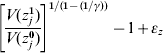
the consumption equivalent variation of retiring, where εz~N(μ, σ2) captures additional non-pecuniary (i.e., psychological) benefits or costs from retirement which are not observed by the model. Since we assume that those gains are normally distributed within each skill class with mean μ and variance σ2, we can – due to the law of large numbers – compute the fraction of households that decide to retire from

where Φμ,σ2(·) is the distribution function of the normal distribution.
3.4 The production side
Firms in this economy use capital and labor to produce a single good according to a Cobb-Douglas production technology Y=ϱK εL 1−ε where Y, K and L are aggregate output, capital and labor, respectively, ε is capital's share in production, and ϱ defines a technology parameter. Capital depreciates at a constant rate δk and firms have to pay corporate taxes T k=τk[Y−wL−δkK] where the time-invariant corporate tax rate τk is applied to the output net of labor costs and depreciation. Firms maximize profits renting capital and hiring labor from households so that net marginal products equal r the interest rate for capital and w the wage rate for effective labor.
3.5 The government sector
3.5.1 The tax system
Our model distinguishes between the tax system and the pension system. In each period t the government issues new debt (1+n t+1)(1+λ)B G,t+1−B G,t and collects taxes from households and firms in order to finance general government expenditure G t, which is fixed per capita, as well as interest payments on its debt, i.e.,

where revenues of income taxation are computed from

and C t defines aggregate consumption (see (15)). The intertemporal budget is balanced by consumption taxation.
Our model takes into account the transition toward deferred taxation of pension benefits in Germany introduced in 2005. Consequently, taxable labor income y jl is computed from gross labor income net of (a fraction κ1 of) pension contributions and a work related allowance d(w j) and – after retirement – (a fraction κ2 of) public pensions. With respect to taxable interest income we apply a fixed saving allowance d s, so that

Given taxable income, we apply the German progressive tax code of 2005 to labor income and assume that all households are married couples (i.e., full income splitting). Interest income, however, is taxed at a constant rate τr which reflects the flat capital income tax recently introduced in Germany. A solidarity surcharge of 5.5% is applied to the final tax burden. Consequently,

where T05(·) denotes the marginal tax rate schedule of year 2005.
3.5.2 The pension system
In each period t, the pension system pays old-age benefits and collects payroll contributions from labor income below the contribution ceiling 2t. Individual pension benefits p j of a retiree of age j⩾j R in a specific year are computed from the product of the adjustment factor ν(j R) which depends on the individual retirement age j R, earning points  he has accumulated until retirement age and the actual pension amount (APA) per earning point:

In the baseline path (before the reform) the NRA is fixed at age 65. Pensions are reduced by 3.6% for each year of early retirement before NRA. However, as will be discussed below, the model abstracts from increases in pensions due to delayed retirement so that

Accumulated earning points of the pension system depend on the relative income position w j/ of a worker. Since the contribution base ceiling is fixed at the double of average income maximum earning points collected per year are 2. Therefore, earning points accumulate according to

where ep 1=0.
Finally, the actual pension amount APA t of a specific year t is adjusted according to

Equation (11) reflects the central elements of the adjustment formula which was introduced by the pension reforms 2001 and 2004. Since then, changes in the APA are related to lagged changes of an artificial income concept which is computed from gross labor earnings net of fictive contributions τp (which amount to 3% before and 4% after 2008) to the private pension scheme and actual contributions to the public scheme. The last part of (11) reflects the sustainability factor where PR defines the pensioners ratio which measures the ratio of retired to working households of a specific year.Footnote 8 Since this pensioners ratio will increase in the future, the adjustment factor will decrease future benefits. However, the impact of the rising dependency ratio is dampened by the weight 0.25. Note that any delay in retirement induced by the reform of 2007 will dampen the sustainability factor and increase benefits of already retired households.
The budget of the pension system must be balanced in every period by adjusting the contribution rate. Consequently,

where

define aggregate pensions benefits and contributions in period t.
3.6 Welfare and efficiency calculation
In order to compare welfare for a specific individual before and after the reform, we follow Auerbach and Kotlikoff (Reference Auerbach and Kotlikoff1987, p. 87) and compute the proportional increase (or decrease) in consumption and leisure φ which would make an agent in the baseline path as well off as after the reform. We can compare all cohorts living in the reform year t=1 and all newborn cohorts along the transition path before and after the reform since they have identical individual state variables. Due to the homogeneity of the utility function (5) and (6) the necessary increase (or decrease) in percent of resources is
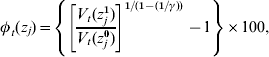
where z j0 and z j1 indicate that utility of the specific person is measured before and after the reform, respectively. Consequently, a value of φt(z j)=1.0 implies that this agent would need 1% more initial endowment in the baseline path to attain the utility level he receives after the policy reform.
In order to assess aggregate efficiency consequences, we introduce a Lump-Sum Redistribution Authority (LSRA) in the spirit of Auerbach and Kotlikoff (Reference Auerbach and Kotlikoff1987, p. 62f.) as well as Fehr (Reference Fehr2000) or Nishiyama and Smetters (Reference Nishiyama and Smetters2007) in a separate simulation. The LSRA treats those cohorts already existing in the initial year 2008 and newborn cohorts differently. To already existing cohorts it pays a lump-sum transfer (or levies a lump-sum tax) v j,1(z j),j>1 to bring their expected utility level after the reform back to the level of the initial equilibrium V 1(z j0). Since utility depends on age and state, these transfers (or taxes) have to be computed for every agent in the first year of the transition. Consequently, after compensation, their relative welfare change is φc(z j)=0.0. Furthermore, those who enter the labor market in period t⩾1 of the transition receive a transfer v 1,t(z 1,φc*(z 1)) which guarantees them a (compensated) relative consumption change φc*(z 1) which is identical for all newborn future cohorts. Note that the transfers v 1,t(z 1,φc*(z 1)) may differ among future cohorts but the relative utility change φc*(z 1) is identical for all. This utility change is determined by requiring that the present value of all LSRA transfers is zero:

In the first period of the transition the LSRA builds up debt (or assets) from

which has to be adjusted in each future period according to

Of course, LSRA assets are also included in the asset market equilibrium condition (16).
If φc*(z 1)>0(φc*(z 1)<0), all households in period t=1 who lived in the previous period would be as well off as before the reform and all current and future newborn households would be strictly better (worse) off. Hence, the new policy is Pareto improving (inferior) after lump-sum redistributions.
3.7 Equilibrium conditions
Given a specific fiscal policy, an equilibrium path of the economy has to solve the households decision problems (6), reflect competitive factor prices and balance aggregate inheritances with unintended bequests. Furthermore, in the closed economy aggregation holds,


the budgets of the government (7), the pension system (12) and the redistribution authority (13) are balanced and the goods market clears in every period, i.e.,

In the small open economy the capital market takes into account net foreign assets and the goods market includes net exports.
The computational method to solve the model numerically follows the Gauss–Seidel procedure of Auerbach and Kotlikoff (Reference Auerbach and Kotlikoff1987). We start with a guess for aggregate variables, bequest distribution and policy parameters. Then we compute factor prices, individual decision rules and value functions which involves discretization of the state space and the use of multidimensional spline interpolation. Next, we obtain the distribution of households and aggregate assets, labor supply and consumption as well as payroll and consumption taxes in order to update the initial guesses. The procedure is repeated until the initial guesses and the resulting values of macro variables and policy parameters have sufficiently converged.
4 Calibration of the initial equilibrium
Since we assume a realistic demographic transition, the initial year of the simulation model is not a long-run equilibrium and the reference simulation for the policy reforms is a baseline path of the economy under the existing fiscal system. In order to compute the initial equilibrium and the subsequent baseline path, households in the first year of the transition are endowed with a profile of assets and pension claims. In the short run the baseline path mainly depends on the exogenous dynamics of the population structure. In the medium run, the model returns to a stable population structure so that in the long run the economy can converge to a steady state. We provide the economy with 300 years to return to the long-run equilibrium. The following subsections discuss the assumed demographic, productivity, preference, technology and fiscal parameters required to solve the model numerically.
4.1 Demographic projections
Since the model's period represents 1 year, agents start economic life at age 20 (j=1) and face a maximum possible life span of 99 years (J=80). In order to derive different skill classes, we have classified individuals between ages 20 and 60 of the years 1984 to 2006 from German Socio-Economic Panel (SOEP) dataFootnote 9 into three different educational groups (S=3) according to the International Standard Classification of Education. For low-skilled we have aggregated levels 0–2 (primary and lower secondary education), levels 3 and 4 (higher-secondary and post-secondary education) are merged to middle-skilled and levels 5 and 6 (tertiary education) to high-skilled individuals. In our data set, low-, middle- and high-skilled individuals represent 26%, 55% and 19% of the population. These relative shares were also applied in the model. The projection starts in the initial year 2008 with the population vector taken from the most recent population forecast of the Federal Statistical Office (StaBu, 2009). For the middle-skilled types we apply conditional survival probabilities ψj which are based on the year 2000 Life Tables reported in Bomsdorf (Reference Bomsdorf2003), which yield a (cross-sectional) life expectancy of 79.6 years. Since our model takes into account the positive relationship between life expectancy and lifetime income, we adjust the conditional survival probabilities of low- and high-skilled so that their initial life expectancy is 77.1 and 82.1 years, respectively. Consequently, the models overall life expectancy in 2008 is 79.4 years, which fits quite well to the official figure of 79.8 years in StaBu (2009). The assumed 5-year difference in life expectancy between low- and high-skilled is well in line with the results from Reil-Held (Reference Reil-Held2000) and von Gaudecker and Scholz (Reference von Gaudecker and Scholz2007) for Germany.Footnote 10 This mortality difference within skill classes is retained in all future periods. The model's population projections are based on StaBu (2009). This forecast compares fifteen alternative combinations of assumptions with respect to fertility, life expectancy and migration which all end in year 2060. We take one of their ‘benchmark scenarios’ and compare it with two alternative scenarios which we call ‘optimistic’ and ‘pessimistic’. Table 1 reports the differences in the assumptions.
Assumptions for population projections

Following the official projections, our benchmark scenario assumes that the birth rate remains at 1.4 children per woman until 2060. Afterwards, we keep the number of newborn constant each year in order to build up a stable population structure with zero population growth. Life expectancy increases linearly until year 2060 by 7.3 years to an age of 86.9 years for the middle-skilled households. After year 2060 we assume constant mortality rates. Finally, following StaBu (2009) we assume that the negative net migration of 50.000 in year 2008 changes gradually again and increases to 100.000 net migrants until year 2014 and beyond. Immigrants have the same educational background as natives. In addition, to simplify our model structure we assume that all net migrants enter at age 20 (i.e., at j=1) without any assets.Footnote 11 In the optimistic scenario we keep life expectancy constant and assume a higher birth and net migration rate. In the pessimistic scenario we keep net migration constant, but assume – as in StaBu (2009) – lower fertility combined with a stronger increase in life expectancy. Figure 1 reports the resulting population dynamics in this century.
Alternative population projections.

In 2008, Germany has a population of 82 million people. In the benchmark scenario of the model simulation, this number decreases until 2060 to 65.6 million people. In the optimistic and pessimistic scenarios the German population declines to 76.7 and 65.7 million people, respectively. The corresponding numbers from the StaBu (2009) projection for 2060 are 64.7, 74.5 and 64.0 million. The right part of Figure 1 shows the development of the dependency ratio, measured by 60-year-old and older to 20–59-year-old. Starting from a ratio of 46.1 in year 2008, this number increases until 2060 to 89.4 (92.3) in the model's (official) benchmark simulation. The respective figures for the optimistic and pessimistic scenario are 73.8 (81.7) and 99.4 (104.8), respectively. Of course, the model's dependency ratio reflects the fact that our immigrants are younger than those of the official projections.
4.2 Productivity assumptions
The productivity profile e j of the three skill classes is important for our quantitative results, since productivity in old age is a decisive determinant of retirement behavior. If productivity of older people declines sharply, retirement behavior will not be affected by the increase in the NRA. However, estimating the productivity of elderly households is complicated by the fact that those with low productivity retire, so that those who remain in the labor force after age 60 represent a biased productivity of the respective cohort. In order to deal with this problem, our productivity estimates are split in two parts, i.e.,

where we also include technological progress which is assumed to cause the time endowment to grow, see Kotlikoff et al. (Reference Kotlikoff, Smetters and Walliser2007). For individuals up to age 60 we estimate productivity profiles from inflated income data of primary household earners from the German SOEP. Our unbalanced panel data covers full-time workers with a total of 83,893 observations which are already divided into the three skill groups explained above. Following the conventional procedure, we correct income for working time and assume that log wages depend on an agent's age and age squared. The resulting parameters are reported in Table 2.
Productivity parameters

For productivity at and above age 60, we follow Eisensee (Reference Eisensee2005, p. 102) and assume that it declines in a quadratic fashion until it reaches zero at age 70 and 75 for the low-/middle-skilled and high-skilled, respectively. This procedure yields an average annual productivity decline of 7%, 15% and 15% for the low-, middle- and high-skilled class after age 60. Consequently, our assumptions are somewhere between the figures in Eisensee (Reference Eisensee2005) where the respective figures are 8%, 19% and 17% and French (Reference French2005) who estimated a productivity decline of 4% in old age from U.S. data. Figure 2 shows the productivity profiles for the different skill classes. It is important to note that these profiles are kept constant in the future despite the increase in life expectancy. We applied alternative assumption about future productivity changes after age 60, but the consequences for retirement behavior where negligible.
Productivity profiles for skill classes.

4.3 Preference, technology and fiscal parameters
With respect to the preference parameters, we set the intertemporal elasticity of substitution γ to 0.5, the intratemporal elasticity of substitution ρ to 0.6 and the leisure preference parameter α to 1.5. This is within the range of commonly used values, see Auerbach and Kotlikoff (Reference Auerbach and Kotlikoff1987) or İmrohoroğlu and Kitao (Reference İmrohoroğlu and Kitao2009). These parameters imply a compensated wage elasticity of 0.1 and 0.15 for age groups 20–39 and 40–59, respectively, which is consistent with the results from Fenge et al. (Reference Fenge, Uebelmesser and Werding2006). In order to calibrate a realistic capital-to-output ratio, the discount factor is set at 0.995 which implies an annual discount rate of about 0.5%. Finally, the parameters for the expected value and the standard deviation of mental benefits from retirement are calibrated in order to generate a specific retirement behavior in the initial equilibrium. Due to the lack of better data the assumed standard deviation σ is identical for all skill classes. The chosen value helps to configure the retirement elasticity reported below. Next, it is assumed that the expected values μ of mental benefits decrease with skill level. The skill-specific values of μ reported in Table 3 generate the average effective retirement ages for different skill classes which are reported below.
Preference, technology and fiscal parameters

As for technology parameters we specify the general factor productivity ϱ=0.93 in order to normalize labor income and set the capital share in production ε at 0.3 which is quite realistic for Germany. The annual depreciation rate for capital δk is set at 4.8% which yields a realistic investment ratio. Finally, the rate of technological progress λ is set to 1.3% which is the average trend for the period 1995–2006 reported in Erber and Fritsche (Reference Erber and Fritsche2009).
With respect to the fiscal parameters we assume a debt-to-output ratio of 60.9% in 2008. Afterwards, we keep government debt constant per capita, so that it increases as a fraction of GDP to more than 70% during the transition. The corporate tax rate is fixed at 15%. The annual APA value in year 2008 is chosen in order to derive a realistic contribution rate of 19.9% in the initial equilibrium. Finally, the taxation of gross income (from labor, pensions and capital) is close to the current German income tax code and the marginal tax rate schedule T05 which was introduced in 2005. For capital income we consider an annual allowance of 1.600 € and a tax rate of τr=0.25. With respect to labor income, we assume that 4% of gross income could be deducted from the tax base in addition to an annual allowance of 1.200 €. The two parameters κ1, κ2 are adjusted in every year and for every cohort in order to reflect the phased-in deferred taxation of public pensions in Germany. Starting in 2005, 60% of contributions could be deducted from the tax base. This fraction increases every year by 2 percentage points until in 2025 all contributions to pensions could be deducted from the tax base. Similarly, in 2005 only 50% of pensions of existing and new pensioners had to be taxed. Since then, the taxable fraction κ2 of pensions increases for every new cohort of pensioners by initially one and later two percentage points, so that cohorts retiring in year 2040 or later have to tax their full pension.Footnote 12 As for the tax schedule, the marginal tax rate rises linearly after the basic allowance of 15.600 € from 15% to a maximum of 42% when y jl passes 104.000 €.
Given revenues from income and corporate taxation, we fix the consumption tax rate at 17% and compute government consumption G endogenously to balance the budget. Table 3 reports our parameter values and Table 4 presents some calibrated figures of the initial equilibrium.
The benchmark equilibrium

Notes:
1 IdW (2009). 2Deutsche Rentenversicherung (Reference Deutsche2009). 3SVR (2008, p. 379).
Our calibration aims to reproduce a realistic government sector and the current German capital–output ratio. Wealth holdings over the life cycle exhibit the typical inverted V-shape. On average, per capita wealth holdings amount to roughly 125.000 €. Some back-of-the-envelope calculations based on data provided in SVR (2009, p. 329) indicate an average wealth holding in Germany of 105.000 €, so the model is not too unrealistic. However, one has to admit that due to the restricted heterogeneity of agents the wealth Gini-coefficient is only 0.43 which is much lower than the respective figure of 0.79 reported in SVR (2009, p. 324). Despite this shortcoming, the central differences between model and reality are due to the assumption of a closed economy which on the one side implies an endogenous interest rate but also requires a zero trade balance. Table 4 also reports the share of elderly (i.e., those age 65 and older) who receive less than 40% of median net income in the economy, so that they are below the social assistance level. Currently, about 2.4% of people older than 64 years receive the (in reality means-tested) basic benefit in Germany.
4.4 Retirement behavior and baseline path
Of course, we are especially interested on how the model could replicate the observed retirement behavior. The right part of Figure 3 shows the distribution of retirement ages for old-age pensions in Germany in year 2008. In order to understand the displayed pattern, one has to distinguish between different groups of retirees. According to the current rules, women, unemployed and severely handicapped people could receive an old-age pension from age 60 at the earliest. Consequently, the first peak of retirement at age 60 in Figure 3 is due to these specific groups. Note, however, that women and the unemployed are only eligible for retirement before age 65, if they have a contribution record of at least 15 years. Severely handicapped can only retire at age 60 in case they have fulfilled the qualifying contribution period of 35 years and are therefore termed as ‘long-term insured’. Otherwise they have to wait until reaching age 63, the (reduced) NRA for severely handicapped people. People who do not belong to one of these groups can only receive an old-age pension starting at age 63 if they qualify as long-term insured. This explains the second peak in the right part of Figure 3. Individuals who have contributed for less than 35 years are not allowed to retire before the NRA of 65. Consequently, most people who retire at the NRA peak in the right part of Figure 3 are forced to do that, despite of many preferring to retire earlier. Except for severely handicapped individuals who retire at age 63, all early retirees have to accept the actuarial adjustments of their pension benefits. Those who retire at the NRA of 65 can receive a full pension without reductions. Surprisingly, there is almost no retirement after the NRA. Partly this may be due to the fact that firms pay seniority wages and therefore have a tendency to encourage retirement of their elderly employees. In addition, since there are no legal restrictions for working after the age of 65, people can receive pensions and receive income from labor at the same time. Finally, the spike in the distribution of retirement age at 65 may also reflect health shocks (Rust and Phelan, Reference Rust and Phelan1997) or may be partly due to irrational decisions (Lumsdaine et al., Reference Lumsdaine, Stock, Wise and Wise1996).
Age-specific shares of old-age retirement. *Source: Deutsche Rentenversicherung (Reference Deutsche2009) Deutsche Rentenversicherung (Reference Deutsche2009).

Our model neither considers different genders, nor does it include employment and disability risk. Since all households pay social security contributions starting at age 20 they all qualify as long-term insured who are allowed to enter retirement before age 65. Consequently, people in the simulation model will retire mostly prior to the NRA. Our parameterization aims to capture the fact that women, unemployed and severely handicapped people are over-represented in the low-skill class.Footnote 13 Consequently, low-skilled households in the model retire earlier than middle- and high-skilled ones. As can be seen in the left part of Figure 3, a significant share of individuals is still working after age 65Footnote 14 and almost identical numbers of individuals are retiring at ages 61 to 64. The mean retirement age of low-skilled in the initial year is 60.4 and 63.3 and 64.8 for middle- and high-skilled, respectively. The average retirement age for the whole population amounts to 62.8, which is very close to the actual average retirement age of 63.1 for old-age pensions in year 2008 computed from Deutsche Rentenversicherung (Reference Deutsche2009). Following Coile and Gruber (Reference Coile and Gruber2007), we also calculate elasticities for retirement. If we increase retirement wealth by 10%, the probability of retirement of a 65-year-old middle-skilled household increases from 54.3% to 56%. This corresponds to an elasticity of non-participation with respect to benefits of 0.32. The retirement elasticity of the model rises with skill and decreases with age. Coile and Gruber (Reference Coile and Gruber2007) estimate an average retirement elasticity of 0.16 for the U.S.
This should suffice to explain our calibration and initial equilibrium. Table 5 reports the baseline path of the economy until 2060 if the NRA is kept at its current level. Due to the positive productivity growth, (effective) labor supply and therefore employment increases despite the fall in the number of employees. However, savings as well as assets and the capital stock grow quite stronger, so that wages increase and the interest rate falls throughout the transition. Due to the change in the age structure, consumption grows stronger than employment and the share of total pension expenditures of GDP rises from initially 13.9–19.6% in 2060. Note that the retirement age almost remains constant until 2060 despite the increase in life expectancy. This finding is surprising since various recent studies find that rising longevity will increase retirement ages, see the discussion in Zhang and Zhang (Reference Zhang and Zhang2009). Due to population aging, total pension expenditures are rising steadily during the first half of the century although the sustainability factor reduces the replacement ratio of benefits. The consequences of the pension reform of 2004 can be seen in the last line of Table 5 where the poverty rate among the elderly strongly increases during the transition. At first sight one might wonder why individuals in the model are not trying more actively to prevent the fall into poverty. At least they could reduce the likelihood of this event by either working longer (thereby increasing their pension benefits) or saving more. The main reason for this behavior is that lifespan is uncertain. If people work longer or save more they face a certain probability that they may die early, and lose the prospects of harvesting welfare levels in the baseline path of the small open economy the benefits from their precautionary behavior. In a model with a perfect annuity market or a bequest motive for low-income households the poverty rate among elderly would increase much less.Footnote 15
Baseline path of the economy

Figure 4 shows the dynamics of the contribution rate and the consumption tax rate. In all three population scenarios considered, the former rises from currently 19.9 to roughly 25% until 2030. Therefore, current pension policy is not able to stabilize the contribution rate at 22% in the short run, as originally intended. Even worse, in the medium and long run our model predicts that the contribution rate will rise up to 28% in the benchmark scenario. The optimistic and pessimistic scenarios mainly differ in their long-run implications where contribution rates either decline to 25% or increase further to 30%. Note that in the right part of Figure 4 the consumption tax also increases significantly by 5 and almost 8 percentage points in the medium and long run. This is due to the fact that public goods are constant per capita and therefore rise with the total population, while taxes are currently mainly paid by employed persons.Footnote 16 Since the tax base declines much stronger than the demand for public goods, the tax rate has to increase during the transition.
Social security contributions and consumption taxes on baseline path.

Is it possible to design a pension reform package which dampens the long-run increase in contribution and poverty rates without harming future cohorts? The next section tries to answer this question by considering specific reform scenarios and computing their welfare and efficiency implications.
Simulation of policy reforms
This section considers four specific policy reform scenarios. The benchmark reform is the pension reform of 2007 which increases the NRA from currently age 65 to age 67. More specifically, starting in 2012 the NRA for the cohort born in year 1947 increases by 1 month. For the cohort born in 1948, the NRA increases by 2 months and so forth. For cohorts born in and after year 1959, the NRA increases by 14, 16, 18 months and so on until, finally, cohorts born in and after 1964 all face an increase in the NRA of 2 years. This benchmark reform is compared with alternative packages where we supplement the pension reform of 2007 with the following measures which are either currently discussed in Germany or are implemented in other countries:
(a) Adjustment factor 6%: Following Berkel and Börsch-Supan (Reference Berkel and Börsch-Supan2004) as well as Queisser and Whitehouse (Reference Queisser and Whitehouse2006) we model an increase in the adjustment factor from 3.6% to 6%. The increase is phased-in – as the NRA – between 2012 and 2029.
(b) Life expectancy adjustment: Following Breyer and Hupfeld (Reference Breyer and Hupfeld2009) we introduce a correction factor
 for life expectancy in the pension formula (8). In our model low income-households (i.e., where ) also have a lower life expectancy, so that the correction factor increases their pension benefit. The opposite holds for high-income households.
(c) Age-dependent contribution rates: Following Cremer and Pestieau (Reference Cremer and Pestieau2003), contribution rates for older workers are reduced. More specifically, workers age 60 and above contribute only 10% of labor income while contribution rates for younger workers have to balance the budget.Footnote 17
 for life expectancy in the pension formula (8). In our model low income-households (i.e., where
 ) also have a lower life expectancy, so that the correction factor increases their pension benefit. The opposite holds for high-income households.
The next subsection discusses the macroeconomic effects of these four policy packages. We then report the resulting welfare and efficiency effects and perform some sensitivity analysis.
5.1 Macroeconomic effects of pension reforms
Table 6 compares changes of some specific macroeconomic variables along the transition path. The first reform considered is the increase in NRAs as implemented by the pension reform 2007. Since with unchanged retirement behavior the reform would reduce future pension benefits significantly, people delay retirement by roughly 12.0 months on average in the long runFootnote 18, which in turn increases employment by 0.4%. The small employment effect indicates a strong intertemporal substitution of labor supply. When households plan to work longer at old age, they reduce labor supply at younger ages.Footnote 19 When they work less at younger ages, savings also decline temporarily which explains the short-run reduction in the capital stock. The increase of the mean retirement age is somewhere around the long-run retirement age increase of 8 months estimated by Berkel and Börsch-Supan (Reference Berkel and Börsch-Supan2004). It is also in line with the results from Mastrobuoni (Reference Mastrobuoni2009), who finds evidence that the mean retirement age of the affected cohorts in the U.S. increases by about half as much as the increase in the NRA.Footnote 20 In the medium and long run, savings grow stronger than employment so that wages increase. Higher income tax revenues allow to reduce consumption taxes and the longer working phase allows to reduce contribution rates. Note, however, that old-age poverty does not change significantly in the long run due to the reduction in pension benefits.
Macroeconomic effects of the considered pension reformsFootnote 1

1 Changes compared to the baseline path.
Figure 5 takes a closer look at contribution rates and the retirement decision. The left part shows that contribution rates would remain constant for quite a while and then fall in the long run by about 1.5 percentage points, if we keep the retirement ages of the baseline path (‘Exogenous RA’). With ‘endogenous’ retirement ages, the delay of retirement has a much stronger impact on contribution rates in the short and medium run due to the immediate increase of the contribution base. In the long run, however, higher pension benefits dampen the reduction in contribution rates. The right part of Figure 5 shows that the increase in effective retirement ages is not uniform across skill classes. While middle- and high-skilled delay retirement by more than 1 year, low-skilled hardly alter their retirement behavior. There also is a slight announcement effect which decreases retirement ages in year 2011 right before the implementation of the reform since households who initially planned to retire early in year 2012 may now find it optimal to already retire in 2011.
Pension reform 2007: Contribution rates and effective retirement ages.

Next, consider alternative packages supplementing the pension reform 2007 in Table 6. In the second column we increase the adjustment factor between 2012 and 2029 from 3.6% to 6%. As one can see, the mean retirement age rises dramatically. Figure 6 shows that now also low-skilled workers postpone their retirement significantly, but they still have the lowest retirement age. Resulting from the postponement of retirement, labor supply increases and savings decline. This leads to a lower wage and a higher interest rate. Note that, although having adapted their retirement behavior, low-skilled workers face even higher pension reductions. Consequently, the poverty rate is slightly higher compared to the benchmark reform explained above.
Supplementary measures and effective retirement ages.

The adjustment for life expectancy as proposed by Breyer and Hupfeld (Reference Breyer and Hupfeld2009) accomplishes to reduce the long-run poverty rate slightly. The mean retirement age now increases by even 20.4 months in the long run. As shown in Figure 6, now mainly high-skilled households delay retirement sharply, since they face lower retirement benefits. Since in our model even the middle-skill class receives an increase in benefits after the reform, aggregate employment and savings fall sharply after the reform. As a consequence, wages decrease, the consumption tax rate increases by one percentage point and contribution rates decrease much less than before.
Finally, we assume in the right part of Table 6 that the contribution rate for workers age 60 or older decreases to 10%. As shown, this measure delays retirement significantly by 16.8 months on average in the medium and long run. At the same time, the contribution rate for younger workers increases by roughly 0.7 percentage points compared to the pension reform 2007. Overall, the reform increases aggregate employment but reduces savings, since people mainly work longer. The reduction of savings combined with the reduced labor supply at an early age has a negative impact on the old-age poverty rate which is higher than in the pension reform 2007.
5.2 Welfare and efficiency effects
Of course, the fiscal and macroeconomic consequences of different reform scenarios discussed in the preceding subsection cannot explain the intra- and intergenerational redistribution effects, nor can they indicate the changes in aggregate efficiency. In order to quantify the former, one has to compute the changes in welfare across and within cohorts due to a specific reform scenario.Footnote 21 The latter requires to implement the LSRA redistribution mechanism explained in subsection 3.6 above.
As one would expect, Table 7 shows that the pension reform of 2007 improves welfare of already retired due to the higher pension value and the consumption tax reduction. Middle-aged cohorts lose, since the reform decreases their future pension benefits, while households living in the long run benefit from reduced contribution rates early in life. The computed long-run welfare gains roughly amount to 0.4% of aggregate lifetime resources. Due to lower life expectancy and earlier retirement, the reduction of pension benefits hurts low-skilled households more significantly than high-skilled ones. Younger high-skilled do not lose due to the reform.Footnote 22 Finally, after implementing LSRA-transfers the right column shows that the pension reform of 2007 will increase efficiency only slightly by 0.13% of aggregate resources. These positive efficiency effects are due to reduced labor supply distortions.
Skill-specific welfare effects of the considered pension reformsFootnote 1

1 Changes measured in percent of resources in initial equilibrium.
Next, Table 7 reports the welfare consequences when the adjustment factor rises to 6% in 2029. As explained above, this policy increases the mean retirement age significantly. Current retirees benefit (due to the higher APA) and older low-skilled workers lose more compared to the benchmark reform. High-skilled workers and especially the young and future generations benefit. As shown in the right column, higher adjustment factors increase efficiency gains significantly. This reflects the reduced (or even eliminated) distortions of the retirement decision.
When the pension formula is adjusted for life expectancy, almost all cohorts lose compared to the pension reform 2007. Only poor medium aged workers gain slightly. The welfare effects are mainly due to higher labor market distortions reflected in the efficiency loss of 0.84% of aggregate resources.
Finally, if the pension reform of 2007 is supplemented by age-dependent contribution rates, intergenerational redistribution is dampened and aggregate efficiency decreases slightly compared to the pension reform 2007. On first sight this result seems to be surprising. In line with the empirical results of Fenge et al. (Reference Fenge, Uebelmesser and Werding2006), labor supply elasticity increases with age in our model. Consequently, optimal tax theory suggests a reduction of marginal taxes with rising age. However, due to the tax-benefit linkage marginal contribution rates already decline with age, so that the additional differentiation might go too far.Footnote 23
5.3 Sensitivity analysis
Simulating the pension reform 2007 with the ‘optimistic’ and ‘pessimistic’ demographic scenarios discussed above has only negligible macroeconomic and welfare effects, since changes in demographic parameters mainly alter the path of the economy but not the impact of the policy reform. Similarly, when we increase future productivity profiles after age 60 to account for the rising life expectancy our results suggest only very modest effects.
We also simulate the policy reform of 2007 in a model with fixed working time per period where people can only choose their retirement age. In this case the employment growth and consequently the dynamic adjustment of the whole economy is dampened compared to Table 5.Footnote 24 Whereas the rising life expectancy increases labor supply and employment during working years in the previous model, it can now only induce delayed retirement. The pension reform of 2007 has now a much smaller effect on retirement which is delayed by 7.2 month so that employment increases by 1.3%. Of course, the stronger effect on employment is due to the fact that intertemporal substitution of labor is not possible any more. In the previous model people stayed longer in the labor market, but they worked less hours. As a consequence, the poverty rate among elderly rises significantly by 4.4 percentage points in the long run. The first part of Table 8 shows that the resulting welfare effects are very similar to the results in Table 7. Efficiency gains are slightly higher since the pension reform shifts tax revenues toward the – in the present case – lump-sum labor income tax.
Sensitivity analysis of skill-specific welfare effectsFootnote 1

1 Changes measured in percent of resources in initial equilibrium.
Finally, we simulate the pension reform of 2007 in the small open economy in order to isolate the general equilibrium effects of factor price adjustments. Again, employment and the whole economy grow slower than in Table 5, but now this is due to capital outflows which reduce the capital stock and wages. With constant interest rates, the pension reform only increases retirement age by 9.6 months in the long run (which is very close to the estimate of Berkel and Börsch-Supan (Reference Berkel and Börsch-Supan2004) for males), whereas employment almost remains constant. Again, the long-run poverty rate increases significantly by 4.4%. It might be surprising on first sight that in Table 8 almost all agents experience welfare improvements compared to the respective figures in Table 7 although wages now do not increase anymore and efficiency gains are slightly smaller. However, one has to keep in mind that with constant factor prices the baseline path in the small open economy is quite different compared to the path described in Table 5 where wages increase and interest rates fall significantly. Since wage changes dominate interest rate changes, welfare levels in the baseline path of the small open economy are significantly lower than in the respective path of the closed economy. Consequently, relative welfare changes induced by the pension reform are higher in the small open economy.
This suffices for the sensitivity analysis. Overall we feel that the welfare effects of Table 7 are quite robust with respect to alternative model parameters.
Conclusions and discussion
The results of this paper strongly suggest that the German pension system faces substantial financial problems in the long run despite all previous efforts to improve sustainability. If existing retirement patterns remain unaltered, contribution rates would increase up to 26% in the year 2040 even in the most optimist demographic scenario. Consequently, the recently implemented increase in the NRA is necessary. It will delay retirement by 9–12 month on average which in turn reduces future contribution rates by roughly 1.5%. However, the reform will not dampen the future increase in the old-age poverty rate. Of all instruments considered to reduce future old-age poverty, the increase of the adjustment factor seems to be most promising. This last finding might also be an important perception for other European countries which currently manage too low adjustment factors for early retirement.
Of course, our quantitative conclusions heavily depend on the assumed model structure, population dynamics and fiscal adjustment. We feel that the results are quite robust with respect to the demographic projections and model parameters as long as fiscal policy remains unaltered. However, specific assumptions of the model structure which seem to be important for our results should be highlighted. First, in order to reduce the model's dimensionality, we have assumed a perfect (positive) correlation between life expectancy and skill-level. While this simplification greatly reduces computational time it is quite unrealistic. At the moment our approach seems to exaggerate redistribution within the cohorts. Second, in our model accidental bequest are distributed equally among all working age cohorts whereas in reality bequest are highly concentrated. If as one could guess the correlation of bequest and skill level is rather high, this may also affect the timing of retirement and the consequences of reforms. Third, our model abstracts from income uncertainty which might be important especially at old age when people become unemployed or may be confronted by considerable expenses on medical treatments or long-term care. Introducing income uncertainty especially during the years before retirement may not only change the households' retirement behavior, but also turn around efficiency effects of policy reforms. With uncertain income, redistribution serves as an insurance device which is not captured in the present study, see Nishiyama and Smetters (Reference Nishiyama and Smetters2007). Forth, our model completely abstracts from disability retirement. At least some people always have the choice to retire earlier on disability benefits or to remain in the labor force and retire as ordinary retirees, see Díaz-Giménez and Díaz-Saavedra (Reference Díaz-Giménez and Díaz-Saavedra2009) for a recent application of this issue in Spain. If the model allows for a disability retirement option, the consequences of the pension reform 2007 may completely change since people may now opt for earlier retirement with disability benefits. In future work we plan to implement these extensions in the model.



