Introduction
Muscovite, a phyllosilicate with the formula KAl2(Si3Al)O10(OH)2, consists of an octahedral sheet sandwiched by two opposing tetrahedral sheets and interlayer K+ ions to bond together the stack of 2:1 layers (Reference PaulingPauling, 1930). This structure facilitates cleavage along the (001) basal plane into thin flakes with atomic-level flatness (Reference PaulingPauling, 1930). Besides abundant reserves and low cost, muscovite possesses outstanding properties of strength, flexibility, optical transmittance, heat conduction, electric insulation, thermal stability, and chemical inertness (Reference Yen, Bitla and ChuYen et al., 2019). Increasing attention has been paid to using 2D muscovite as substrates in flexible electronics (Reference Yen, Bitla and ChuYen et al., 2019; Reference Zhong and LiZhong & Li, 2020) and fillers in high-performance nanocomposites (Reference Arias, Rosa and MarquesArias et al., 2019; Reference Mohammadi and MoghbeliMohammadi & Moghbeli, 2018; Reference Zhang, Li, Lin, Xie and ChenZhang et al., 2022; Reference Zhao, Li, Lei and HaoZhao et al., 2022). In the case of flexible electronics, thin films of inorganic electronic materials (e.g. oxide, metals, halides, chalcogenides, etc.) are formed on the freshly cleaved muscovite surfaces via van der Waals epitaxy; in the case of nanocomposites, muscovite nanoparticles are embedded into polymer matrixes to improve the mechanical, thermal, electrical, or impact properties of composites. In these applications, the molecular interactions at muscovite-based interfaces play a crucial role in controlling the morphology, structure, and properties of fabricated materials.
Hansen solubility parameters (HSPs) measure the strength of nonpolar and polar molecular interactions within or between condensed phases (Reference HansenHansen, 1967). They are defined as:

where subscripts d, p, and h denote dispersion, polar, and hydrogen bonding (HB) interactions, respectively; E denotes cohesive energy; and V denotes molar volume of the solvent in the liquid state.
The total or Hildebrand solubility parameter (Reference HildebrandHildebrand, 1949), δt, is calculated as follows:

The distance between the solubility parameters of phases m and n is defined as
 , where dim is the dimension of the solubility parameter system. Thermodynamically, a sufficiently small Δδ leads to a negative free energy of mixing and consequently to spontaneous mixing. This is the basic assumption in the application of HSPs.
In practice, HSPs were first used to select solvents for coatings and later extended to predict miscibility of solvents, compatibility of polymers, etc., and to characterize the surfaces of pigments, fibers, and fillers (Reference HansenHansen, 1967, Reference Hansen2007). More recently, HSPs have been applied to guide the design and processing of nanocomposites composed of polymers and clay minerals (Reference Qin, Wang, Jiang and CaoQin et al., 2019). As reported, HSPs explain the behavior of clay minerals in physical processes such as dispersion in liquids (e.g. solvents and monomers) (Reference Alin, Rubino and AurasAlin et al., 2015; Reference Ho and GlinkaHo & Glinka, 2003) and basal spacing expansion (Reference Choi, Ham and ChungChoi et al., 2004) or exfoliation (Reference Zhou, Fang, Cao, Wang, Wang, Yang and LiuZhou et al., 2020) in solvents or polymers. HSPs also showed potential in identifying the optimal media for modifying the surfaces of clay minerals (Reference Asgari and SundararajAsgari & Sundararaj, 2018).
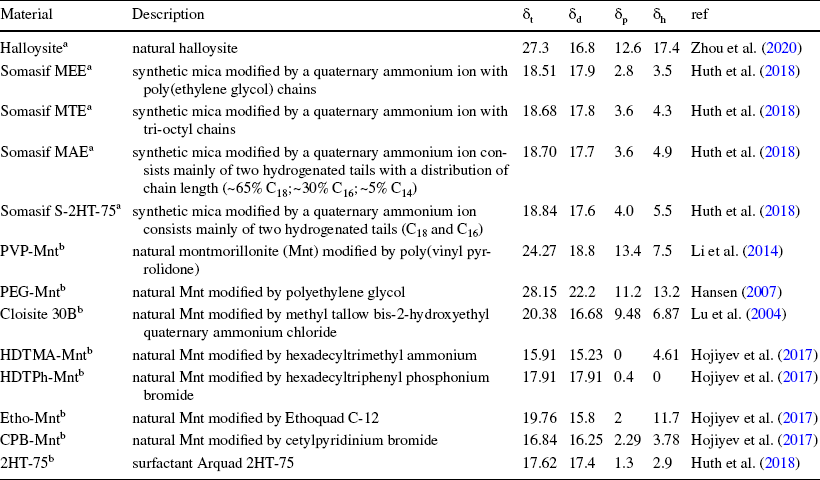
In other studies, the HSPs of clay minerals were determined: (1) to be the center of a solubility region in HSP space by solving an optimization problem based on the HSPs of solvents and clay solubilities therein (Reference HansenHansen, 2007); (2) to be weighted averages of the HSPs of solvents and clay concentrations therein (Reference Zhou, Fang, Cao, Wang, Wang, Yang and LiuZhou et al., 2020); and (3) by a group-contribution method from parameters of partial or all chemical compounds of the clay mineral or a surfactant on its surface (Reference Alin, Rubino and AurasAlin et al., 2015). When using the last method, approximations were involved inevitably when replacing specific groups, e.g. siloxane groups (–Si–O–Si–) in clay minerals or surfactants and quaternary ammonium ions (R4N+X−) in surfactants, with chemical groups having known parameters. This may cause the predicted compatibility to deviate from observed fact (Reference Hojiyev, Ulcay and ÇelikHojiyev et al., 2017). The reported HSPs of raw clay minerals are rare (Table 1). Reference Zhou, Fang, Cao, Wang, Wang, Yang and LiuZhou et al. (2020) calculated the HSPs of raw halloysite and indicated that the dispersion of halloysite depended mainly on the polar, δp, and HB, δh, HSP components of solvents. Similar phenomena were observed by Reference Choi, Ham and ChungChoi et al. (2004) in the dispersion and basal spacing expansion of raw montmorillonite (Mnt); however, the HSPs values were not calculated. Surface modifications are commonly adopted to adjust the HSPs of clay minerals, and hence alter their dispersion abilities in solvents or polymers (Reference Hojiyev, Ulcay and ÇelikHojiyev et al., 2017; Reference Huth, Chen and WagnerHuth et al., 2018) (Table 1). For instance, in contrast to the findings of Reference Choi, Ham and ChungChoi et al. (2004), the dispersion HSP component, δd, of solvents becomes predominant in and governs the dispersion of organophilic modified Mnt (Reference Ho and GlinkaHo & Glinka, 2003; Reference Huth, Chen and WagnerHuth et al., 2018). As far as the present authors are aware, the HSPs of natural mica, whether unmodified or modified, have not been addressed to date.
HSPs of clay minerals (MPa1/2)

a HSPs determined by method 2
b HSPs determined by method 3
The present study, therefore, aimed to investigate the dispersion behavior of raw muscovite (RM) in 17 solvents having diverse polarities, and to propose a method for determining the HSPs of RM. A further objective was to explore the solvent-dispersion mechanisms of RM by a comprehensive examination of the HSPs and Kamlet-Taft's solvatochromic parameters of solvents.
Experimental
Materials and methods
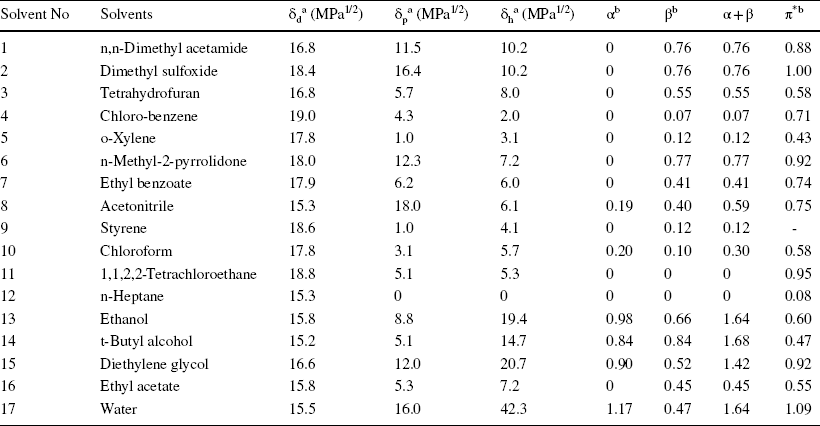
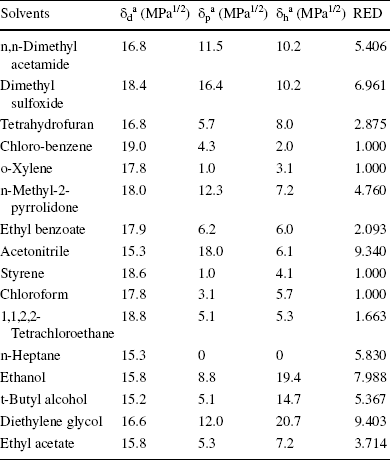
RM nanoparticles were purchased from Lingshou County Dongxin Mineral Products Processing Plant (Shijiazhuang, China). Organic solvents of analytical reagent grade, i.e. n,n-dimethyl acetamide, tetrahydrofuran, chloro-benzene, o-xylene, n-methyl-2-pyrrolidone, and ethyl benzoate were obtained from Shanghai Aladdin Biochemical Technology Co. Ltd. (Shanghai, China). Dimethyl sulfoxide, styrene (containing 10–15 ppm 4-tert-butylcatechol stabilizer), and 1,1,2,2-tetrachloroethane were obtained from Shanghai Macklin Biochemical Co. Ltd. (Shanghai, China). Acetonitrile, chloroform, n-heptane, ethanol, t-butyl alcohol, diethylene glycol, and ethyl acetate were obtained from Hangzhou Gaojing Fine Chemical Research Institute (Hangzhou, China). All solvents were used as received without further purification. Deionized water was self-made on site in the laboratory. The HSPs (Reference HansenHansen, 2007) and Kamlet-Taft’s solvatochromic parameters (Reference MarcusMarcus, 1993) of the solvents tested are listed in Table 2.
The HSPs and Kamlet-Taft's solvatochromic parameters of testing solvents

a Data from Reference HansenHansen (2007)
b Data from Reference MarcusMarcus (1993)
Characterization
The spectrum of mica was measured using a Nicolet iS50 Fourier-transform infrared (FTIR) spectrometer (Thermo Fisher Scientific, Madison, WI, USA). For each spectrum, 32 scans were collected at a resolution of 4 cm–1 in the range of 400–4500 cm–1.
RM nanoparticles were ball milled (400 rpm for 2 h), dried in an oven (60ºC for 24 h), and dispersed in each of 16 organic solvents and water. In each case, 1.5 mg of RM and 10 mL of solvent were added successively to a glass vial. The dilute concentration was selected to make it easier to detect visually changes in dispersion (Reference Wieneke, Kommoß, Gaer, Prykhodko and UlbrichtWieneke et al., 2012). The glass vials were shaken manually for 2 min and kept stationary for 4 h. Dispersion stabilities were evaluated visually and photographs were taken. Manual shaking was adopted because transparent dispersions were obtained easily by this method, or otherwise, sedimentation happened even after ultrasonic agitation (Reference Wang, Liu, Pai, Chen, Chung, Chiang and ChangWang et al., 2013); color changes in aromatic solvents due to degradation were observed during ultrasonic agitation (Reference Wieneke, Kommoß, Gaer, Prykhodko and UlbrichtWieneke et al., 2012); the dispersion state obtained by this method was sufficient to distinguish good and poor solvents according to measured particle sizes (Reference Alin, Rubino and AurasAlin et al., 2015).
Results and Discussion
Characterization
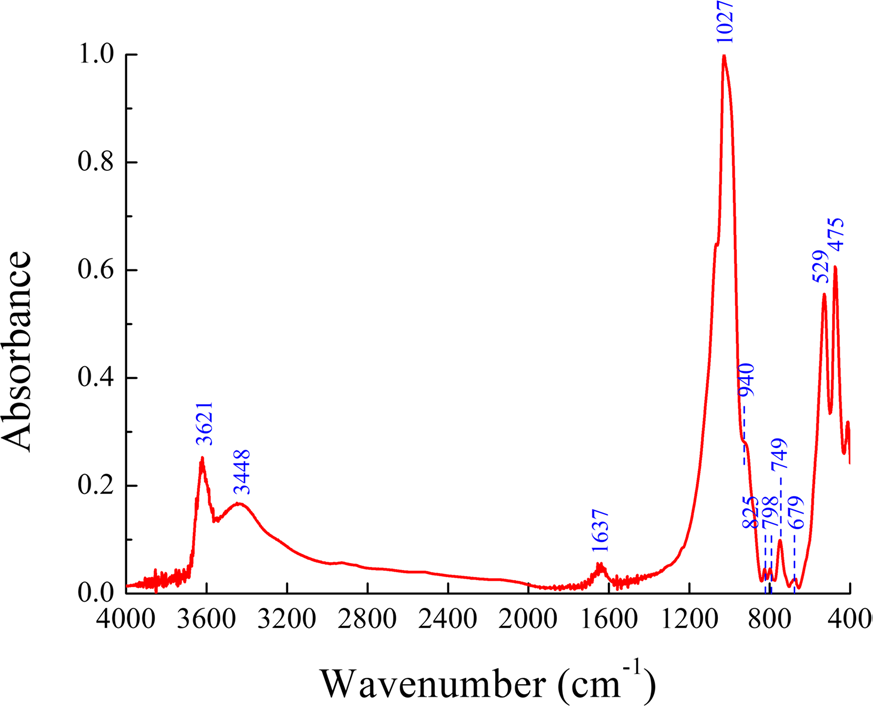
The measured FTIR spectrum of RM (Fig. 1) matched well with the characteristic infrared absorption of muscovite (Reference Hunt and TurnerHunt & Turner, 1953; Reference NahinNahin, 1952; Reference Stubičan and RoyStubičan & Roy, 1961). The peak at 3621 cm–1 was attributed to the stretching of H–O groups and HB with a specific length (Reference Plyusnina and KapitonovaPlyusnina & Kapitonova, 1972). The peaks at 3448 and 1637 cm–1 were caused by the stretching and bending vibration of H–O groups or water molecules, respectively (Reference Schroeder, Rule and GuggenheimSchroeder, 2002; Reference Zhang, Li, Lin, Xie and ChenZhang et al., 2022). The peaks at 1027 cm–1 and ~ 500 cm–1 (e.g. 475 cm–1 and 529 cm–1) corresponded to the stretching and bending vibration of Si–O groups, respectively (Reference BeranBeran, 2002). The shoulder peak at 940 cm–1 was associated with the stretching vibration of the Al–O group (Reference BeranBeran, 2002; Reference Zhang, Li, Lin, Xie and ChenZhang et al., 2022). The peaks at 679, 749, 798, and 825 cm–1 were assigned to the comprehensive effect of the coupling of Al–O and Si–O vibrations, as well as Si–O–Si and Si–O–Al vibrations (Reference BeranBeran, 2002; Reference Fali, Gamage, Howard, Folland, Mahadik, Tiwald, Bolotin, Caldwell and AbateFali et al., 2021).
FTIR spectrum of RM

Determination of a solubility rotated-ellipsoid (SRE)
In this section, the HSPs of a solvent and a solute are denoted as (δd1, δp1, δh1) and (δd2, δp2, δh2), respectively. According to Reference HansenHansen (1967), the solubility of a solvent was represented by a point located at (δd1, δp1, δh1) in δd × δp × δh space, while that of a solute by a solubility region centered at (δd2, δp2, δh2). The solubility region was usually modeled as a sphere, an axis-aligned ellipsoid (the main axes of which were parallel to the δd, δp, and δh axes, respectively), or a rotated-ellipsoid (which was arbitrarily oriented). The rotated-ellipsoid model was adopted in the present study for its advantage in fitting complex shapes of solubility regions (Reference Weng and WangWeng & Wang, 2022).
An optimal SRE of solute was defined as the one which included all good solvents (i.e. solvents for which the solute-affinity was greater than a certain threshold), had the smallest number of outliers (i.e. good solvents that fell outside or poor solvents inside an SRE), and had the smallest volume. It was identified by nine parameters x rel = (δ2d, δ2p, δ2h, a, b, c, θd, θp, θh), where a, b, and c (a > b > c) are the lengths of three semi-axes, θd, θp, and θh (θd, θp, θh ∈ [–π, π]) are three inclination angles. The inclination angles were defined as follows: if an SRE rotated sequentially around δ'h, δ'p, and δ'd axes, by -θh, -θp, and -θd, respectively, it reduced to an axis-aligned ellipsoid, the a, b, and c axes of which coincided with δ'd, δ'p, and δ'h axes, respectively, where a δ'd × δ'p × δ'h coordinate system is created by shifting the origin of δd × δp × δh system to (δ2d, δ2p, δ2h).
The optimal SRE was determined by solving the following optimization problem (Reference Weng and WangWeng & Wang, 2022):

where g G and g L are the global and local searching functions which take the forms of Eqs. 4 and 5, respectively,


where n t is the total number of outliers, n g is the number of good-solvent outliers (i.e. good solvents that fell outside an SRE), V rel = 4π·a·b·c/3 is the volume of SRE, k is a constant, F is fitted data calculated by Eqs. 6, 7 (Reference HansenHansen, 2007)


where N is the number of testing solvents, Ra i is the distance from the HSPs of solute to the HSPs of ith solvent, R i is the distance from the HSPs of solute to the intersection point of Ra i and SRE surface, s i is the solubility of a solute in a solvent measured by experiments, s i = 1 denotes a good solvent and s i = 0 a poor one (i.e. a solvent for which the solute-affinity was lower than a certain threshold), and data fit F reaches the maximum value of 1 when all good solvents lie inside and all poor solvents outside the SRE.
The optimization problem was solved by a hybrid global-local searching algorithm (Reference WengWeng, 2016), where global and local searching were performed using a restartable particle swarm searching algorithm and a Nelder-Mead simplex algorithm, respectively; local searching was activated when the value of the global objective function was below a threshold. The algorithm recorded abundant local optima, from which the global optimum/optima was/were figured out.
Solubility of RM in solvents
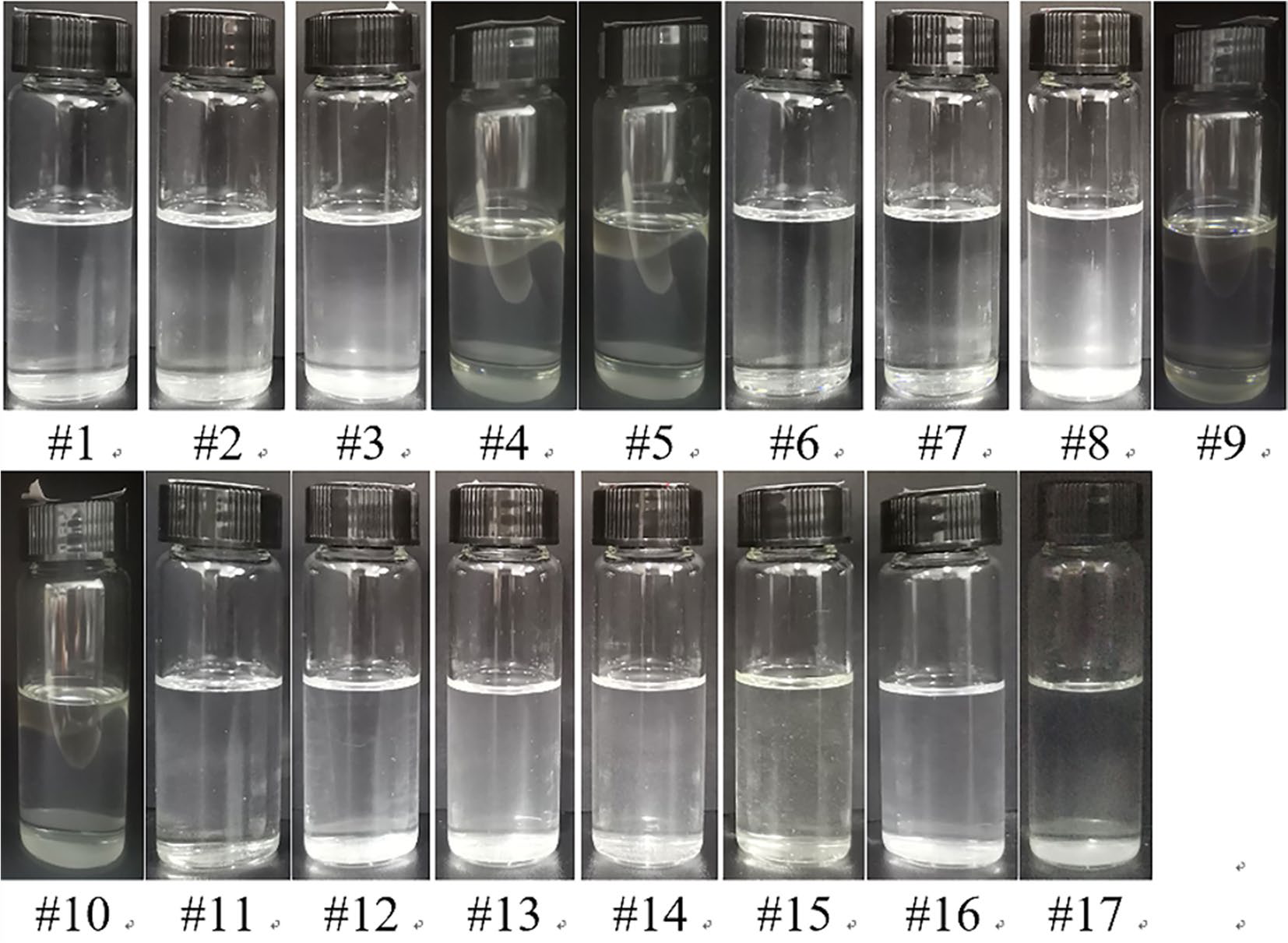
The dispersion of RM in testing solvents after being kept still for 4 h are shown in Fig. 2.
Dispersion of RM in testing solvents after being kept still for 4 h

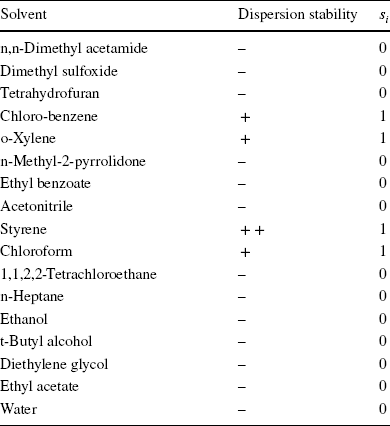
The stabilities of RM-solvent dispersions were classified into three grades according to the morphology of sediments on the bottom of glass vials: (1) no visible sediments in styrene; (2) fine-powdery sediments uniformly covering the vial bottom in chloro-benzene, o-xylene, and chloroform, (3) sediments involving granules or flakes apparently bigger than those in case 2 and/or non-uniformly distributed on the vial bottom in the remaining solvents. The solvents having the best dispersion stabilities of grades (1) and (2) were regarded as good solvents and assigned a RM-solubility s i value of 1, the solvents having poor dispersion stabilities of grade (3) were taken as poor solvents and assigned a RM-solubility s i value of 0. The experimental results are given in Table 3.
Stabilities of RM-solvent dispersions and RM-solubilities s i of the solvents tested

" + + " denotes a stable dispersion with no visible sediments, " + " denotes a dispersion with fine-powdery sediments uniformly covering the bottom of the vial, and "–" denotes a dispersion with sediments involving granules or flakes apparently bigger than those in case (b) and/or non-uniformly distributed on vial bottom
Computer simulation
The HSPs (Table 2) and measured RM-solubilities s i (Table 3) of 16 organic solvents were used as input data for calculations. Water was excluded because of its susceptibility to the local environment (Reference HansenHansen, 2007). Simulation parameters were the same as those reported by Reference Weng and WangWeng and Wang (2022). The output data were the HSPs, total number of outliers, n t, number of good-solvent outliers, n g, and relative energy difference (RED) of each solute-solvent pair, i.e. RED i = Ra i /R i (i = 1, …, N). A RED value of < 1 denotes a good solute-solvent affinity, > 1 denotes a poor affinity, and = 1 denotes a boundary condition.
HSPs and mechanisms of solvent dispersion of RM
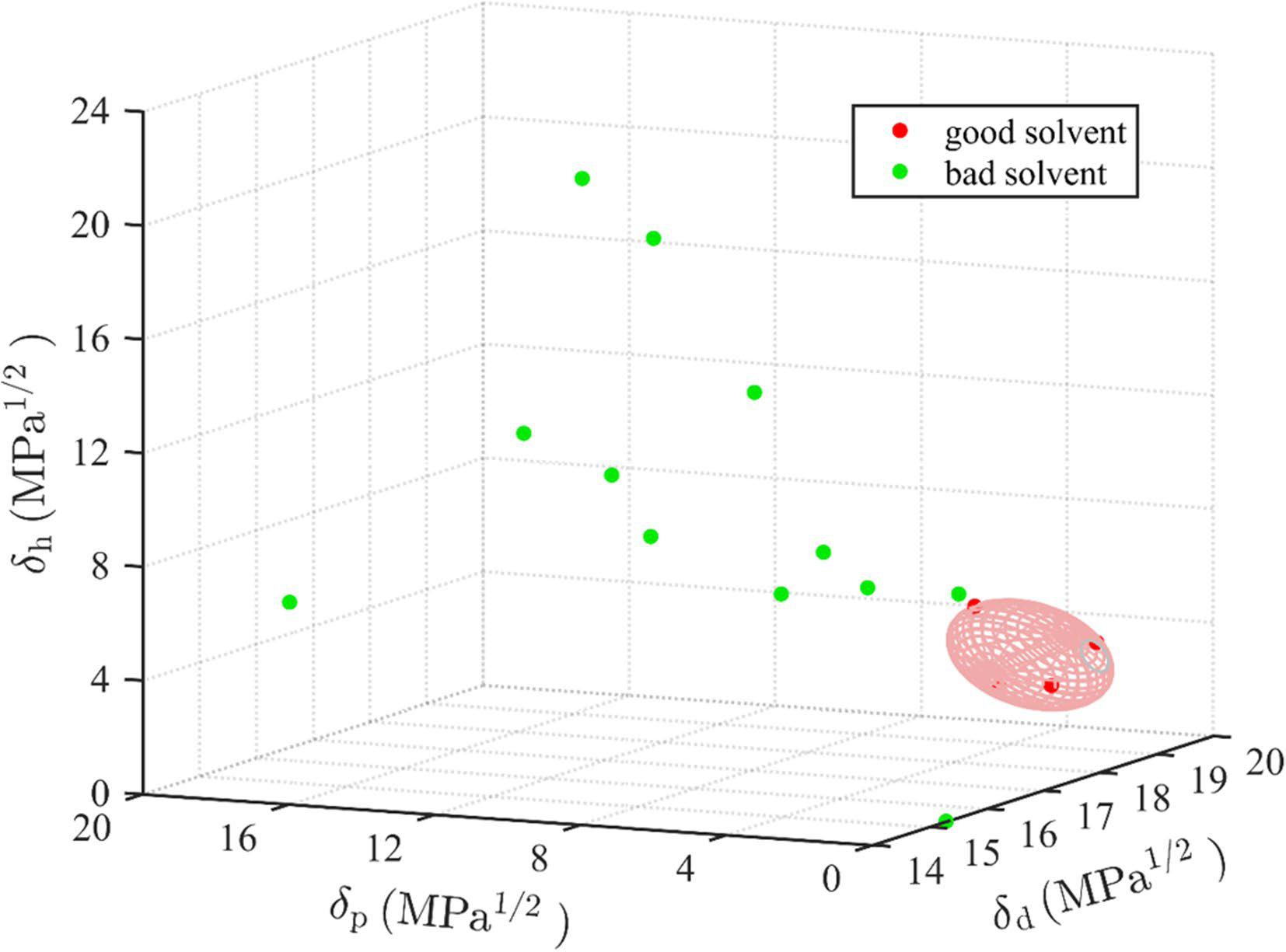
The parameter values of the resultant SRE of RM were δd = 18.301 MPa1/2, δp = 2.366 MPa1/2, δh = 3.727 MPa1/2, a = 2.691 MPa1/2, b = 2.133 MPa1/2, c = 0.640 MPa1/2, θd = 1.257 rad, θp = 0.626 rad, θh = 1.260 rad, and a volume of 15.383 MPa3/2 (Fig. 3). The total solubility parameter δt of RM was 18.826 MPa1/2. All good solvents fell inside and all poor solvents outside of the SRE, i.e. n t = n g = 0, the RED of each RM-solvent pair is given in Table 4.
The SRE of RM


Compared to the HSPs of hydrophilic raw halloysite (Table 1), the dispersion the HSP component of RM was greater by 1.501 MPa1/2, while the polar and HB HSP components of RM were less by 10.234 MPa1/2 and 13.673 MPa1/2, respectively. In contrast, three good solvents of RM (i.e. chloro-benzene, chloroform, and o-xylene) also had the greatest concentrations of organophilic synthetic mica MTE (modified by a quaternary ammonium ion with tri-octyl chain) among the ten testing solvents given by Reference Huth, Chen and WagnerHuth et al. (2018). The difference between the HSPs calculation proposed here and that suggested by Reference Huth, Chen and WagnerHuth et al. (2018) is that in the former, the algorithm confined the HSPs of RM in a subspace constructed by the HSPs of good solvents (Fig. 3), while in the latter, the HSPs of RM were determined from the HSPs of solvents and a wide range of RM concentrations. To minimize the discrepancy, the HSPs of MTE were recalculated by considering exclusively solvents with the highest MTE concentrations (≥ 5%), the results obtained were δd = 18.1 MPa1/2, δp = 3.3 MPa1/2, δh = 3.8 MPa1/2. Compared to the recalculated values, the dispersion HSP component of RM was greater by 0.201 MPa1/2, while the polar and HB HSP components were smaller by 0.934 MPa1/2 and 0.073 MPa1/2, respectively. Theoretically, an increase in the number of hydroxyl groups led to an increase in polar and a greater increase in the HB HSP component (Reference Huth, Chen and WagnerHuth et al., 2018). Meanwhile, hydroxyl groups were unique with strong polarity and HB ability on the mica surface. The results revealed, therefore, that RM had fewer surface hydroxyl groups than MTE. The RMs have been recognized to have high hydrophilicity (contact angle of ~10º) (Reference Xue, Xu, Pedruzzi, Ping and YuXue et al., 2018), while synthetic mica was made from talc with relatively low hydrophilicity (contact angle of ~50–60º) (Reference Wang, Kalinichev and KirkpatrickWang et al., 2009) and the hydroxyl groups within the silicate layer were partially replaced with fluorine (Reference Tateyama, Nishimura, Tsunematsu, Jinnai, Adachi and KimuraTateyama et al., 1992). The polar and HB HSP components of RM obtained in the present study, however, were surprisingly smaller than the respective components of MTE, a synthetic mica modified with a surfactant which had hydrophobic hydrogenated tails.
Generally, good solvent-solute affinity could be estimated by high similarities in the respective partial polarities of both phases, which is known as the principle of "like dissolves like." Two polarity scales were considered herein: Hansen's HSP components δd, δp, and δh, denoting the contributions from dispersion, dipole-dipole and dipole-induced-dipole, and HB forces, respectively (Reference HansenHansen, 1967); Kamlet-Taft's solvatochromic parameters π*, α, and β, denoting the dipolarity/polarizability, HB acidity, and HB basicity of solvents, respectively (Reference Kamlet and TaftKamlet & Taft, 1976a, Reference Kamlet and Taft1976b; Reference Kamlet, Abboud and TaftKamlet et al., 1977). The low polar, δp, and HB, δh, HSP components of RM were comparable to the low dipolarity/polarizability, π*, and HB ability, α + β, of the four good solvents (Table 2), which suggested weak polar and HB interactions in good-solvent dispersion. This was because of the limited number of hydroxyl groups present on the RM surface, owing to the low K+/H+ exchange ratio in an environment with a small amount of water/moisture (Reference Bowers, Bish and KirkpatrickBowers et al., 2008). The low degree of hydration of RM was evidenced by the weak peaks at 1637 and 3448 cm–1 in the FTIR spectrum, which represented the vibrations of H–O groups on RM surface and adsorbed molecular H2O (Reference Schroeder, Rule and GuggenheimSchroeder, 2002). On the contrary, the strong dispersion forces in good-solvent dispersions were indicated by the high dispersion HSP components, δd, of both good solvents and RM. Among the poor solvents, water had a relatively low dispersion HSP component, δd, of 15.5 MPa1/2, a high polar HSP component, δp, of 16.0 MPa1/2, and the highest HB HSP component, δh, of 42.3 MPa1/2, or, the strongest dipolarity/polarizability, π*, of 1.09 and HB abilities, α + β, of 1.64. Although RM has the highest hydration level in water, the results revealed that the polar and HB forces generated by the highly hydrated RM were not strong enough to match the respective molecular forces of solvents. Therefore, low dispersion forces together with the highest possible polar and HB forces generated on the RM-based interface were not sufficient to disperse RM. The other two poor solvents, dimethyl sulfoxide and 1,1,2,2-tetrachloroethane, had the fourth and second highest dispersion HSP components, δd, of 18.4 and 18.8 MPa1/2, respectively. For dimethyl sulfoxide, its strong polar and HB abilities were represented by a high polar HSP component, δp, of 16.4 MPa1/2 and high HB HSP component, δh, of 10.2 MPa1/2, or, a high dipolar/polarization parameter, π*, of 1.00 and high HB basicity, β, of 0.76. For 1,1,2,2-tetrachloroethane, although it had three HSP components closest to those of good solvents, its strong dipolarity/polarization ability was evidenced by a rather high Kamlet-Taft π* value of 0.95. The poor affinity between the two solvents and RM was also represented by their RED values, i.e. 6.961 for dimethyl sulfoxide and 1.663 for 1,1,2,2-tetrachloroethane (Table 4). This revealed that, even in solvents with high dispersion HSP components comparable to that of RM, the unbalanced polar and HB abilities of RM and organic solvents would also ruin the dispersion. The results indicated that the dispersion behavior of RM in solvents was similar to those of organophilic modified synthetic mica (Reference Huth, Chen and WagnerHuth et al., 2018) and modified Mnt (Reference Ho and GlinkaHo & Glinka, 2003), but contrary to those of hydrophilic raw halloysite (Reference Zhou, Fang, Cao, Wang, Wang, Yang and LiuZhou et al., 2020) and raw Mnt (Reference Choi, Ham and ChungChoi et al., 2004).
Conclusions
This study proposed a method for determining the Hansen solubility parameters (HSPs) of raw muscovite (RM). The solubilities of RM in 17 solvents were evaluated according to dispersion states. Experimental results showed that RM was well dispersed in styrene, chloro-benzene, chloroform, and o-xylene. Based on the HSPs of solvents and measured RM solubilities, the HSPs of RM were calculated as the center of the optimal solubility rotated-ellipsoid (SRE) in HSP space, which included all good solvents, had the smallest number of outliers, and had the smallest volume. The derived dispersion, polar, and HB HSP components of RM were 18.301, 2.366, and 3.727 MPa1/2, respectively.
By considering the HSPs (δd, δp, δh) and Kamlet-Taft's solvatochromic parameters (π*, α, β) of solvents, the mechanisms of solvent dispersion of RM were explored. The low polarity of RM was due to the hindered K+/H+ exchange on RM surface in an environment with a limited amount of water/moisture. RM was well dispersed in organic solvents with high dispersion HSP components, δd, and weak polar, δp, and HB, δh, HSP components finely tuned to matching the surface property of RM at a specific hydration level.
The HSPs of RM obtained from the dispersion method could only be used to predict/characterize interactions on RM-based interfaces in material fabrication processes with strictly controlled environmental water/moisture content (e.g. in processing of RM/polymer nanocomposites); otherwise, the changes in surface property of RM induced by variant hydration levels should be taken into consideration. The HSP calculation method proposed here was applied to all clay minerals.
Acknowledgements
This research was supported by the Public Welfare Technology Application Research Project of Zhejiang Province under Grant no. LGG21E030012.
Data Availability
All data are given in the paper and supplementary materials.
Code Availability
The codes developed and/or used in the current study are available from the corresponding author on reasonable request.
Declarations
Conflict of Interest
The authors declare no conflicts of interest.