


Significant outcomes
-
∙ Treated with memantine for 4 weeks improved subjective/objective sleep quality and behavioural and psychological symptoms of dementia.
-
∙ Polysomnography demonstrated a longer total sleep time and decreases in nocturnal awakening.
-
∙ A decrease in the periodic limb movement index may be beneficial for reducing fragmented sleep.
Limitations
-
∙ This study was a prospective open trial, but not a case-controlled design.
-
∙ The sample size was small.
Introduction
Patients with Alzheimer’s disease (AD) experience progressive cognitive impairments such as memory deficits and impaired executive functioning. Cognitive symptoms, most specifically a progressive loss of short-term memory, are predominant in the mild stages of AD. Executive functioning involves the ability to organise, plan and carry out a set of tasks in an efficient manner. In patients with AD, executive function is impaired, and aphasia, agnosia, and apraxia are present. Behavioural and psychological symptoms of dementia (BPSD) are also commonly seen in AD patients, and include delusions, agitation, and aggressiveness. BPSD is a significant burden to caregivers and often relates to poor performance in activities of daily living. Early detection and evaluation are, therefore, necessary for adequate intervention for BPSD. Although BPSD must be properly treated, the treatment strategy has not been sufficiently established. Neuroleptic medications have been adopted clinically for treating BPSD. There have been several studies demonstrating their efficacy and safety. However, the results on the efficacy have been controversial. Studies with large sample sizes have reported negative findings (Reference Lee, Gill, Freedman, Bronskill, Hillmer and Rochon1–Reference Paleacu, Barak, Mirecky and Mazeh3). In addition, the Food and Drug Administration issued a warning that treatments of behavioural disorders with atypical as well as typical neuroleptics are associated with a higher mortality rate among elderly subjects with dementia (4). Acetylcholine esterase inhibitors (AChEIs) are the main medication for the treatment of AD, but their therapeutic effects on BPSD remain uncertain. Because of the lack of effective and safe medication for treating BPSD, a novel therapeutic approach is required.
Age-dependent changes in sleep architecture have been well documented (Reference Montplaisir, Petit, Lorrain, Gauthier and Nielsen5,Reference Bliwise6). The total sleep time, sleep efficiency, and times spent in slow wave sleep (SWS) and rapid eye movement (REM) sleep have been demonstrated to significantly decrease with age. The sleep latency, time spent in stage I, and waking after sleep onset were reported to increase with age. In addition, specific sleep disorders such as sleep-disordered breathing and periodic limb movement disorder (PLMD) can be prevalent in the elderly (Reference Petit, Montplaisir and Boeve7,Reference Montplaisir, Allen, Walters and Ferini-Strambi8). PLMD is defined as a periodic limb movement (PLM) index of 15 or greater that is associated with an otherwise unexplained sleep–wake complaint. These changes result in sleep fragmentation and a poorer sleep quality, and may contribute to sleep disturbances in the elderly. As these features are noticeable in patients with AD, they are troubled by sleep disturbances as well as BPSD (Reference Petit, Montplaisir and Boeve7,Reference Prinz, Peskind and Vitaliano9). The prevalence of sleep disturbance in AD has been estimated to be 25% in mild-to-moderate cases, and about 50% in moderate-to-severe cases (Reference Petit, Montplaisir and Boeve7). Sleep problems in AD may be caused by a disrupted rhythm of melatonin production, a greater prevalence of obstructive sleep apnoea syndrome, and modified sleep architecture (Reference Wu and Swaab10). Changes in sleep architecture in patients with AD seem to be an exaggeration of those that appear normally with ageing. Previous studies with polysomnography (PSG) demonstrated that AD patients showed an increased frequency and duration of awakening, increased proportion of stage I, and a reduced proportion of REM sleep and SWS when compared with elderly control subjects (Reference Bliwise6,Reference Prinz, Peskind and Vitaliano9). Due to these conditions, patients with AD nap excessively in the daytime, have difficulty falling asleep at night, exhibit frequent nocturnal awakening, and wake up too early. Therefore, reducing sleep fragmentation, and poor sleep efficiency is mandatory for restoring their sleep quality.
Memantine is prescribed for the treatment of patients with AD (Reference Jones11). It has been demonstrated to antagonise N-methyl-D-aspartate (NMDA)-type glutamate receptors non-competitively. The pharmacological properties of memantine are distinct from those of AChEIs. NMDA receptors are a subclass of glutamate receptors that requires both the binding of glutamate and postsynaptic depolarisation for their activation, and they mediate Ca2+ entry when they are activated. The NMDA receptor function appears to have bi-modal features, which may be related to the different composition of receptor subunits and localisation. NMDA receptors are heterotetramers composed of two GluN1 and two GluN2 subunits, and contain different GluN2A-2D subunits, which exhibit distinct properties and distributions (Reference Paoletti and Neyton12,Reference Traynelis, Wollmuth and Mcbain13). Synaptic NMDA receptors, mostly composed of two NR1 and two NR2A units, trigger the signal transduction of cell survival pathways. Extrasynaptic NMDA receptors, mostly composed of two NR1 and two NR2B subunits, are involved in the signal pathway of cell death (Reference Ye and Carew14,Reference Kalia, Kalia and Salter15). A decrease in synaptic NMDA receptors results in apoptosis (Reference Ikonomidou, Bosch and Miksa16,Reference Fiske and Brunjes17). In the ageing brain, the NMDA signalling pathways have been demonstrated to be impaired in the cerebral cortex and hippocampus (Reference Yamada and Nabeshima18). Patients with AD have been reported to exhibit fewer NMDA receptors and lowered glutamatergic transmission (Reference Butterfield and Pocernich19). A deficit of NMDA receptors has been postulated to lead to the development of cognitive impairment and BPSD. Amyloid-β (Aβ), which plays important roles in the pathophysiology of AD, has been demonstrated to inhibit long-term potentiation by the excessive activation of extrasynaptic NMDA receptors (Reference Li, Jin, Koeglsperger, Shepardson, Shankar and Selkoe20). Deposition of Aβ has been reported to be associated with glutamate neurotoxicity in AD. Aβ decreases neuronal glutamate uptake, and enhances the activation of extrasynaptic NMDA receptors, which causes neurotoxicity (Reference Wang, Zhao and Li21). A balance of NMDA receptor activity is required for optimal brain functioning.
Memantine has been reported to exhibit a therapeutic effect on BPSD, whereas other non-competitive NMDA receptor antagonists, such as MK-801 and ketamine, induce aberrant behaviours. It may, therefore, be possible to postulate on the differences that underlie memantine and other non-competitive NMDA receptor antagonists. The hypofunction of NMDA receptors may be associated with the emergence of psychiatric and behavioural symptoms, and overactivation of the receptors may result in neurotoxicity. Memantine is a specific, moderate affinity, non-competitive NMDA receptor antagonist, with strong voltage dependency and rapid blocking/unblocking kinetics. These pharmacological properties allow memantine to block the sustained activation of NMDA receptors by elevated concentrations of glutamate under pathological conditions, but rapidly exit the NMDA channel upon transient physiological activation by millimolar concentrations of synaptic glutamate (Reference Parsons, Gruner, Rozental, Millar and Lodge22). Memantine has no significant potency for antagonising the cholinergic system. Memantine can block NMDA receptor overactivation by preventing excessive Ca2+ entry without affecting physiological NMDA receptor activity (Reference Scarpini, Scheltens and Feldman23–Reference Gardoni and Luca25). It was also demonstrated that memantine showed only 30% NMDA receptor occupancy at a therapeutically relevant plasma concentration (Reference More, Gravius, Nagel, Valastro, Greco and Danysz26). These characteristics are distinct from those of other non-competitive antagonists with the potent blockade of Ca2+ channels. These properties have been postulated to be beneficial for treating BPSD and tolerability. Growing evidence suggests that memantine is effective for psychiatric symptoms and behavioural disturbances (Reference Scarpini, Scheltens and Feldman23,Reference Gauthier, Wirth and Möbius27). Although several studies have suggested the benefits of memantine for BPSD, the effect on sleep architecture remains to be elucidated. As adequate treatment for improving sleep quality in AD is required, it is necessary to clarify the therapeutic effects of memantine on sleep architecture. The aim of this study was to investigate whether memantine has an effect on PSG variables.
Methods
Study design
This study was conducted at Kagawa University Hospital. This study had a prospective, open-labelled design to assess the therapeutic effects of memantine. Data were collected between October 2011 and March 2013.
Participants
We included patients who admitted to Department of Neuropsychiatry for the purpose of diagnosis and treatment for cognitive impairment. Inclusion criteria were as follows: (i) they met criteria for probable AD, (ii) they were over 70 years old, regardless of gender, and (iii) physical conditions were stable for at least the past year. Patients were excluded if (i) they had medical illnesses that affected sleep quality or daytime alertness, (ii) they had major physical illnesses likely to prevent the completion of the study, (iii) they met criteria for any other psychiatric disorders such as schizophrenia, mood disorders, or delirium, and (iv) they were being treated with neuroleptics, AChEIs, or psychostimulants.
The institutional Ethical Committee approved this study. All patients and responsible family members gave informed consent according to institutional guidelines and the tenets of the Declaration of Helsinki. Patient anonymity has been preserved.
Evaluations and measurements at the baseline
Experienced, research-trained clinicians conducted semi-structures interviews with the subjects including a medical and psychiatric history, medication, and aphasia battery, and neurological examination. Caregivers and/or next of kin were also interviewed. After a detailed explanation of the study, we obtained written informed consent from participants and their families.
Cognitive function and psychiatric symptoms
In all subjects, the cognitive function was assessed with the Mini-Mental State Examination (MMSE) (Reference Folstein, Folstein and Mchugh28). The Clinical Dementia Rating (CDR) was used to determine whether or not dementia was present and, if present, to stage its severity (Reference Morris29). BPSD were evaluated using the Neuropsychiatric Inventory (NPI) score (Reference Cummings, Mega, Gray, Rosenberg-Thompson, Carusi and Gornbein30). We adopted a 10-item NPI that does not include subscales on sleep disturbances for the following reasons: (1) patients and their principal caregivers do not always share a room at night and it is difficult to observe their nocturnal status; (2) we adopted PSG and a subjective rating tool for evaluating sleep. To avoid overlapping, and to evaluate BPSD individually, we adopted a 10-item NPI in the present study. Subjective sleep quality was assessed with the Athens Insomnia Scale (AIS) (Reference Soldatos31). These examinations were carried out at 14:00 h on the examination days.
Diagnosis
The diagnosis of probable AD was made according to the criteria established by the National Institute of Neurological and Communicative Disorders and Stroke and the Alzheimer’s Disease and Related Disorders Association (Reference Mckhann, Drachman, Folstein, Katzman, Price and Stadlan32). After being diagnosed, patients and their families were informed of the diagnosis.
Magnetic resonance imaging and technetium-99 m ethyl cysteinate dimer single-photon emission computed tomography were also carried out as supplementary diagnostic methods.
PSG
PSG was carried out following the adaptation night. Electrodes for the polysomnogram were attached until 16:30 h. We performed overnight PSG by standard procedures that included recording sleep electroencephalograms (EEG) (C3-A2, C4-A1), bilateral eye movements, submental electromyography (EMG), an electrocardiogram, pulse oximetry, bilateral tibialis anterior EMG, nasal air flow by a pressure sensor, as well as rib cage and abdominal excursions. The sleep stage was scored according to standard criteria (Reference Rechtschaffen and Kales33). The total sleep time, sleep efficiency, and lengths of stages I, II, III, IV, REM were obtained. Stage III plus stage IV were calculated as SWS. REM sleep was defined and analysed according to the scoring criteria of Lapierre and Montplaisir (Reference Lapierre and Montplaisir34). If the activities recorded on the tibialis anterior EMG meet the following criteria, we considered the as significant limb movements (LMs) (Reference Iber, Ancoli-Israel, Chesson and Quan35): (i) the duration of an LM event is 0.5–10 s, (ii) the minimum amplitude of a LM event is an 8 μV increase in EMG voltage above resting EMG, (iii) the timing of the onset of an LM event is defined as the point at which there is an 8 μV-increase in EMG voltage above resting EMG, and (iv) the time LM event ended is defined as the start of a period lasting at least 0.5 s during which the EMG does not exceed 2 μV above resting EMG. To define a PLM series, the following rules were adopted (Reference Iber, Ancoli-Israel, Chesson and Quan35): (i) the number of consecutive LM events is ≧4 LMs, (ii) the period length between LMs to include them as part of a PLM series is 5–90 s, and (iii) LM on two different legs separated by <5 s between movement onsets are counted as a single LM. The PLMS index was calculated as the number of PLMS/ total sleep time (hours). We scored apnoea when all of the following criteria are met (Reference Iber, Ancoli-Israel, Chesson and Quan35); (i) there is a drop in the peak thermal sensor excursion by>90% of baseline, (ii) the duration of the event lasts at least 10 s, (iii) at least 90% of the event’s duration meets the amplitude reduction criteria for apnoea. We score hypopnoea, if all of the following criteria are met (Reference Iber, Ancoli-Israel, Chesson and Quan35); (i) the nasal pressure signal excursions drop by≥30% of baseline, (ii) the duration of this drop occurs for a period lasts at least 10 s, (iii) there is a ≥4% desaturation from pre-event baseline, and (iv) at least 90% of the event’s duration must meet the amplitude reduction criteria for hypopnoea. We scored arousal during sleep stages (Reference Iber, Ancoli-Israel, Chesson and Quan35), if there is an abrupt shift of EEG frequency including α, θ, and/or frequencies >16 Hz (but not spindles) that lasted at least 3 s of stable sleep preceding the change. We scored arousal during REM sleep, when a concurrent increase in submental EMG lasted at least 1 s (Reference Iber, Ancoli-Israel, Chesson and Quan35).
Intervention and outcome measurements
After the baseline examination, 5 mg/day of memantine was administered at 08:00 h in the morning. Under the observation for adverse effects, we increased the daily dose of memantine by 5 mg/day every week to 20 mg/day. After being treated with memantine for 4 weeks, evaluations with PSG and NPI were carried out again.
Data analysis
To assess changes in scores of the PSG variables, AIS scores, and the NPI scores, we used a Wilcoxon’s signed-rank test. Calculation was carried out with the software PASW Statistics 18.0TM. When the p-value was <0.05, we considered the difference as significant.
Results
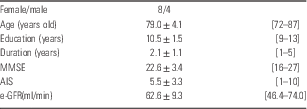
In the study period, 27 patients with AD were admitted to our Department. In total, 13 patients were excluded due to inclusion/exclusion criteria. A total of 14 patients participated our study after obtaining written informed consent. Two patients failed to complete PSG and dropped out of this study. In total, 12 patients (four males and eight females) completed this study. The mean age was 79.0±4.1 years old. Demographic and baseline characteristics of the patients are shown in Table 1.
The demography and clinical characteristics of subjects
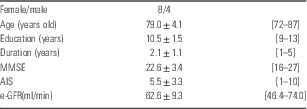
AIS, Athens Insomnia Scale; e-GFR, estimated glomerular filtration rate; MMSE, Mini-Mental State Examination.
Values represent the mean±standard deviation [range].
The effects of memantine on BPSD and cognitive function
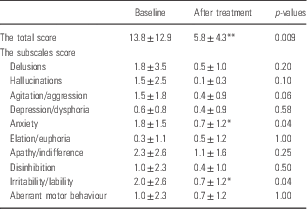
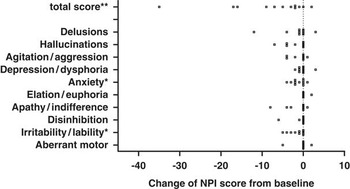
The total NPI scores and subscales scores are shown in Table 2. The mean basal NPI score was 13.8±12.9. After memantine treatment, significant improvement was observed, and the mean NPI score after 4 weeks of administration was 5.8±4.3 (p<0.01). We observed significant decreases in subscale scores for anxiety (p=0.04) and irritability/lability (p=0.04) (Fig. 1).
Comparison of Neuropsychiatric Inventory (NPI) data between the baseline and after memantine treatment
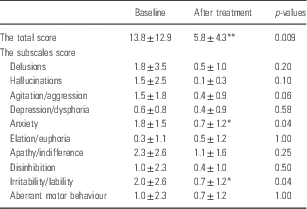
Behavioural and psychological symptoms were evaluated with NPI. Scores were calculated as frequency×severity. The differences of scores were analysed by Wilcoxon’s signed-rank test. Values represent the mean±standard deviation.
*p<0.05, **p<0.01.
The mean basal MMSE score was 22.6±3.4. The mean MMSE score after 4 weeks of administration was 22.4±3.8, and there was no significant difference between the baseline and after the treatment. At baseline, four patients (33%) had a CDR of 1, six (50%) had a CDR of 2, and two (17%) had a CDR of 3, which did not change after the treatment.
The mean AIS scores were 5.5±3.3 and 4.8±2.6 at the baseline and after the treatment, respectively (p=0.09).
The effects of memantine on PSG variables
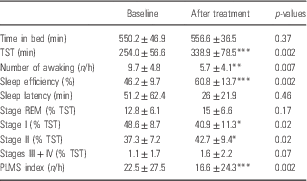
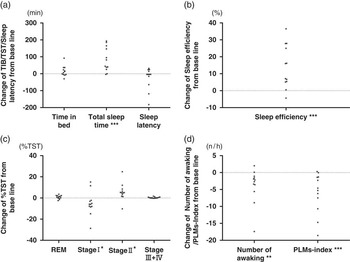
The PSG data are shown in Table 3. When PSG variables after memantine treatment were compared with those obtained at the baseline, significant improvements were observed for the total sleep time (p<0.01), sleep efficiency (p<0.01), number of awakenings (p<0.01), the PLMS index (p<0.01), and the PLM-related arousals (p=0.014). Significant increases in sleep stage II (p=0.02) and decreases in stage I (p=0.02) were also noted (Fig. 2).
Comparison of polysomnography variables between the baseline and after memantine treatment
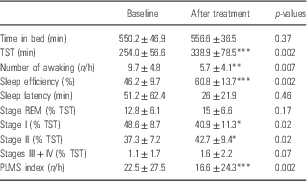
n/h, number per hour; PLMS, periodic limb movement during sleep; REM, rapid eye movement; TST, total sleep time.
The differences of variables were analysed by Wilcoxon’s signed-rank test. Values represent the mean±standard deviation.
*p<0.05, **p<0.01, ***p<0.005.
When we clinically diagnosed the patients based on investigations of subjective sleep quality and interviews, there were no patients who had sleep disorders. However, PSG demonstrated that a high PLMS index and frequent arousals were noted in some patients. Judging from their PSG variables, five patients met criteria for PLMD in the International classification of sleep disorders, 2nd edition (36). Three of the five patients with PLMD also met criteria for sleep disorder associated with neurologic disorders (dementia) (36).
Observations for adverse effects
After treatment with memantine, no adverse effects or significant changes in patients’ laboratory data were noted.
Discussion
In this study, we investigated the effects of memantine on BPSD and sleep architecture in patients with AD. We confirmed the findings of previous research that demonstrated the effects of psychiatric and behavioural symptoms in AD. Furthermore, we are the first to demonstrate that memantine improves PSG variables such as the sleep efficiency and PLMS index in AD patients.
Memantine has no significant potency for antagonising the cholinergic system. Memantine can block NMDA receptor overactivation by preventing excessive Ca2+ entry without affecting physiological NMDA receptor activity (Reference Scarpini, Scheltens and Feldman23–Reference Gardoni and Luca25). In the present study, memantine was prescribed in the morning in the same way as previous clinical studies with randomised, placebo-controlled designs (Reference Reisberg, Doody, Stoffler, Schmitt, Ferris and Mobius37,Reference Nakamura, Kitamura, Homma, Shiosakai and Matsui38). It may be argued whether the therapeutic effects of memantine on the nocturnal sleep depend on the administration time (i.e. in the morning or at bedtime). Mean maximum drug concentration time (Tmax) and half-life period (t1/2) time following a single oral dose of memantine (20 mg) were 6.0±3.8 h and 71.3±12.6 h, respectively. Judging from the pharmacokinetic properties of memantine, steady-state plasma concentrations seem to be achieved by the day when we evaluated PSG after administration for 4 weeks. Therefore, we consider that the administration time may have little impact on PSG variables after treatment with memantine. There was no significant difference in MMSE scores between at baseline and after 4-week treatment with memantine, whereas memantine reduced BPSD and sleep disturbances in the same period. There have been studies demonstrating that treatment prevented cognitive functions from declining, or improved MMSE scores (Reference Molino, Colucci, Fasanaro, Traini and Amenta39). Although treated with memantine for 12–24 weeks resulted in the significant improvement (Reference Fox, Crugel and Maidment40,Reference Rainer, Wuschitz, Jagsch, Erb, Chirikdjian and Mucke41), treatment for 6 weeks did not. The aim of this study was to investigate the effects of memantine on sleep disturbances and BPSD. We demonstrated that 4-week treatment with memantine reduced sleep disturbances and BPSD, although it may take more than a couple of months to exhibit an effect on cognitive impairment. Furthermore, memantine did not cause cognitive declines. We also consider that it is beneficial, because prescriptions of neuroleptics or benzodiazepines may induce daytime somnolence or cognitive decline.
PLMS is characterised by periodic episodes of repetitive and highly stereotyped LMs that occur during sleep (Reference Iber, Ancoli-Israel, Chesson and Quan35,36). PLMS are common, especially in the elderly, but the frequency may be clinically significant. As the movements are associated with a partial arousal or awakening, higher PLMS indices lead to frequent sleep disruption. Although the precise mechanisms responsible for PLMS remain to be elucidated, the dopamine system is currently considered to be involved in the pathophysiology (Reference Montplaisir, Michaud, Denesle and Gosselin42). PLMS are most manifest in disorders involving hypofunction of the dopamine system (Reference Montplaisir, Allen, Walters and Ferini-Strambi8), and dopamine receptor agonists decrease PLMS in patients with restless legs syndrome (Reference Jama, Hirvonen and Partinen43), whereas sleep disturbances caused by frequent PLM-related arousals are usually refractory to benzodiazepine hypnotics. Administration of neuroleptics, potent dopamine D2 antagonists, or γ-hydroxybutyrate, which decreases dopamine release, lead to increases in PLMS (Reference Montplaisir, Allen, Walters and Ferini-Strambi8). Neuroimaging studies demonstrated that patients with a high PLMS index exhibited a decreased number of D2 receptor binding sites in the striatum, which was restored by dopamine replacement therapy (Reference Staedt, Stoppe and Kogler44).
Studies have shown that there are functional interactions between dopamine and NMDA receptors (Reference Wang, Wong and Liu45), and that modulations of the NMDA receptor function causes the changes in dopaminergic signalling. Memantine produces a dose-dependent and significant increase in extracellular dopamine release and metabolism in the prefrontal cortex and striatum of rats (Reference Spanagel, Eilbacher and Wilke46). We consider that memantine may restore the decreased level of the dopaminergic function, which may be effective for reducing the PLMS, and reducing sleep fragmentation.
Previous studies suggested a benefit of memantine for patients with BPSD, but none examined its efficacy on altered sleep architecture or PLMS in patients with AD. Our study demonstrated that memantine was effective for reducing fragmented sleep as well as reducing BPSD. Reduction in psychiatric symptoms may result in longer total sleep time or shorter sleep latency, but no previous studies have reported the effect on PLMS. To our knowledge, this is the first study demonstrating that memantine reduces PLMS in patients with AD. This study, however, has some limitations, in that it was an open trial study with a small sample size. Accumulations of subjects and placebo-controlled studies are necessary for further investigations.
The effect of memantine on the Neuropsychiatric Inventory (NPI) scores. Dots represent changes in scores from baseline. The differences of scores were analysed by Wilcoxon’s signed-rank test. *p<0.05, **p<0.01.

The effect of memantine on the polysomnography (PSG) variables. (a) Lengths of sleep time and sleep latency. (b) Sleep efficiency. (c) Time spent in each stage. (d) Arousal-related indexes. Dots represent changes in scores from baseline. The differences of variables were analysed by Wilcoxon’s signed-rank test. *p<0.05, **p<0.01, ***p<0.005. n/h, number per hour; PLMS, periodic limb movement during sleep; REM, rapid eye movement; TIB, time in bed; TST, total sleep time.

Acknowledgement
The entire study was carried out without industry-supported funding. The authors thank Sonoko Danjo, Naoya Higasa, Shougo Seki, and Katsuhiro Noguchi (Kagawa University, Kagawa, Japan) for clinical assistance. Authors’ Contributions: I.I. carried out clinical evaluations (cognitive function, psychiatric symptoms, and physical conditions), polysomnography (PSG), data analysis, and manuscript preparation. I.I. investigated PSG variables. H.S. planned this study, applied to the IRB, and prepared this manuscript. H.S. also carried out polysomnography, clinical evaluations, and data analysis. H.S. investigated PSG variables. N.A. carried out clinical evaluations (cognitive function, psychiatric symptoms, and physical conditions). N.A. took charge of evaluating psychiatric symptom, and scoring rating scale tool. T.M. carried out clinical evaluations (cognitive function, psychiatric symptoms, and physical conditions). T.M. took charge of evaluating cognitive function, and diagnosis of Alzheimer’s disease. Y.N. planned this study. Y.N. supervised all examinations and procedures whether the results obtained in this study and the conclusions are valid.
Financial Support
The authors report no financial affiliation or relationship relevant to the subject of this article.
Conflicts of Interest
All authors declare no conflicts of interests.
Ethical Standards
All examinations and treatments on the present study were conducted in accordance with the tenets of Declaration of Helsinki (1975, 2008) and that all procedures were carried out with adequate understanding of the patient. The Institutional Review Boards of Kagawa University School of Medicine approved this study (8/30/2011, #2011CS015). The authors have carefully protected the patient’s anonymity. This manuscript includes no identifying information.