Introduction
Our people must join together to form a community in order to struggle that we may survive. The range of such communities is very broad: on a small scale they encompass only people who work at common tasks, while on a large scale they include all people who live in the same epoch; in all countries both types of communities exist. This is society (xã hội).Footnote 1
The arrival of the modern in East Asia in the second half of the nineteenth century brought with it both European gunboats and colonial regimes, as well as European modes of thought. Like its East Asian neighbours, Vietnam was exposed to these interventions, and Vietnamese intellectuals responded by attempting to comprehend and assimilate the broad range of new ideas being introduced into their society. To do so, they needed to make sense of these ideas and to represent them using either existing or newly developed linguistic tools. This Vietnamese interaction with European (French) ideas produced an era of virtually unprecedented ideological and linguistic change that began in the 1870s and stretched into the 1930s and beyond. In particular, new words were entering the language at a furious pace. In many instances, the neologisms that enriched the Vietnamese language and ways of thought were not coined locally, but rather imported from Vietnam's East Asian neighbours, who were themselves engaged in linguistic transformations. Specifically, many of the new terms being circulated within the East Asian world of the late nineteenth and early twentieth centuries had their origins in Japan, whose intellectuals were at the forefront of gaining access to European knowledge, localizing it and developing language to express it.Footnote 2
The arrival in Vietnam of one such term, xã hội (society), at the beginning of the twentieth century coincided with a new era in the contestation between the Vietnamese resistance and the French colonial project as that struggle shifted increasingly into the realm of ideas. The initial wave of anti-French resistance, led by a generation of determined but out-gunned scholar-gentry, had largely subsided or been suppressed by the last decade of the nineteenth century. Although sporadic armed resistance lingered and revolutionaries like Phan Bội Châu continued to advocate for violent struggle against the French, there had been a discernible shift toward confronting the Europeans in the intellectual arena. This new approach involved, among other things, using European-introduced modes of thought as means by which to reflect on Vietnam's past, present, and future.Footnote 3 The French insistence on their mission civilisatrice, moreover, virtually demanded that the engagement between the two societies take place at this intellectual level. The hypocrisy of the French claims to be spreading ‘civilization’ need hardly be mentioned, but it is significant that the Vietnamese took up the challenge wholeheartedly.
The new concepts and ideas with which the Vietnamese were grappling were varied and complex: ‘civilization’, ‘culture’, ‘ideology’, ‘nation’, ‘people’, and ‘religion’ to name but a fraction of them.Footnote 4 Despite, or perhaps because of Vietnam's perilous situation vis-à-vis France, Vietnamese thinkers engaged these ideas with enormous vigour, little daunted by the fact that new vocabulary had to be created, adapted, or imported to enable them to express these new ideas in Vietnamese.Footnote 5 Among the most significant of these neologisms was the term ‘xã hội’, which brought with it profound implications for Vietnam's future and how modernizers would conceptualize it. The idea of society had of course, by the later nineteenth century, become linked to Darwin's ideas of evolution and natural selection, producing the discourse of social Darwinism and related debates about the relative strength and weakness of particular societies and their long-term prospects for survival. Observing that the Vietnamese used the term ‘xã hội’ to represent the English-language notion of ‘society’, however, tells us relatively little. I take up Lydia Liu's suggestion that such cross-cultural linguistic explorations should ‘engage rigorously with those words, concepts, categories, and discourses beyond the realm of common sense, dictionary definition, and even historical linguistics’.Footnote 6 Thus, this article considers what meanings the Vietnamese assigned to this term and how they understood its particular significance for their lives in a changed political and intellectual order.
‘Xã hội’ was not a simple compound word, but a transformative way to conceptualize Vietnam's place in a suddenly very different world. This article thus explores the term's emergence in Vietnam, while locating it within the context of the larger Vietnamese debates about their neologistic project, and against the backdrop of French colonial domination and its perceived consequences for the Vietnamese people. To examine the term's emergence and early significance, I draw primarily on textbooks of the first Vietnamese modernizing school, established in Hanoi in the first decade of the twentieth century. I also consider the writings of Phan Bội Châu and Phan Châu Trinh, two of the school's strongest supporters, and among the earliest Vietnamese intellectuals who struggled with how to understand ‘society’ and what it meant for the Vietnamese. The textbooks and essays by Phan Bội Châu and Phan Châu Trinh represent the earliest written materials in which the term appeared and substantially shaped subsequent discussion of the term and its implications. My particular reliance on the textbooks naturally shapes my reading of this era and its terminology, inflecting it with a slightly scholastic dimension. On the other hand, I would argue that the rigorous engagement with new ideas found in these texts, which offer thoughtful thematic essays rather than simple ‘lessons’, makes them valuable for accessing these discussions and new conceptualizations.
Linguistic debates and emergent neologisms
By the 1880s French scholars taking part in the colonial administration of Indochina were already looking critically at the Vietnamese vernacular as they sought to develop a coherent language policy. These scholars concluded that spoken Vietnamese was at best a crude language, structurally unable to express the broad range of ideas necessary for a society to function in the modern world, and incapable of being transformed into a modern language. One colonial official went so far as to dismiss Vietnamese as a ‘rudimentary patois’, suggesting that for all practical purposes the Vietnamese people were ‘without a language’.Footnote 7 Not surprisingly, such French scholarly assessments set into motion fierce arguments amongst Vietnamese intellectuals. These debates frequently centred on what had become a fundamental question raised by the colonial scholars’ assessment, namely: ‘Is the Vietnamese language rich or poor?’Footnote 8 While some Vietnamese scholars agreed with French views of the Vietnamese language's inadequacies, others argued forcefully that Vietnamese had the capacity to evolve into a language capable of a wide and nuanced range of expression. After all, they noted, French itself was a language that had long been evolving and borrowing foreign terms and phrases, and in so doing was constantly expanding its own capacities.Footnote 9
The debate about the Vietnamese language's poverty or lack thereof was part of a larger discussion concerning the link between language, national identity, and cultural survival.Footnote 10 There were those who argued that French should replace Vietnamese as the national language, that it represented the Vietnamese future, and was, in any case, a language more suited to the modern world. This was in accord with the views of some French colonial officials whose ultimate objective was to enable at least educated Vietnamese to make the transition to French as the language of the colony. For such officials, even the introduction of a romanized form of the Vietnamese written vernacular into schools was seen as merely a temporary expedient that would eventually yield to the widespread use of written and spoken French.
Others scholars countered, however, that to give up the Vietnamese language was to give up the very essence of Vietnamese identity. They argued that it was only by retaining their language that the Vietnamese people would be able to continue to exist as a distinct group. As one intellectual noted in a 1919 newspaper article:
The spoken language is that essential element that creates a unified country and a unified people. Consequently, in ages past any country and any people who had a distinct language of their own, even if that country and its borders were lost, and even if the nation's prestige had vanished, as long as the spoken language still survived then [the people themselves] would continue to exist. Just look at the Poles and the Czechs in Europe; even though their states no longer existed and their peoples were dispersed, their spoken language continued to survive, and the people were not extinguished, and thus thanks to the recent war their independence was restored to them.Footnote 11
This presumed link between lingual and national survival contains echoes of a similar discussion only a decade earlier in a Vietnamese textbook, which also touched on this connection. The textbook suggested that once the people of Poland and India had lost their independence, and hence their countries, their people in turn had lost their very soul and lifeblood.Footnote 12 And yet, as the later observer made clear, at least for the Polish case, the loss had not been irretrievable, but rather had been redeemed precisely because the spoken language had been retained throughout. This logic rendered language modernization as an essential concern, for as long as the language could be updated and kept relevant in changing times it could continue to fend off the threat posed by its displacement in favour of the language of the colonial authority.
This concern around language modernization centred most obviously on expanding the ability of the language to express the influx of new ideas coming from Europe, either directly, or via China and Japan. Like their counterparts elsewhere in East Asia, the Vietnamese had for millennia been strongly influenced by Chinese linguistic currents, which had deposited a large vocabulary base into the Vietnamese vernacular, or at least its higher forms. As new ideas and concepts were introduced from Europe, the Vietnamese could consequently draw either on their own vernacular or on indigenized forms of Chinese terms for rendering these new ideas. Some new terms, such as that for ‘society’ were borrowed from China, though as will be discussed below it was first developed by a Japanese scholar. Others were articulated in Vietnamese through locally created neologisms. In many instances there were extensive discussions about the appropriateness of particular kinds of neologisms entering the language. Most often, these revolved not so much around conceptual terms as nominal ones, with Vietnamese scholars and public intellectuals debating whether to use Chinese renderings of European names or to coin their own, following, most typically, French pronunciations of these terms.Footnote 13
The creation of new words was not, of course, merely an academic exercise. It was also a political issue, one contested among Vietnamese writers and thinkers seeking to shape the future of the language. Thus, some, like Phạm Quýnh, editor of the prominent northern journal Nam Phong (Wind from the South), sought to ensure that the creation of neologisms would follow from Chinese terms, rather than from existing indigenous ones. Quýnh hoped that such an approach would enable his group of neo-traditionalists to preserve the morality and didacticism that was to them inherent in the Chinese terms. Other scholars, however, like Dương Quảng Hàm, recognized that standardizing the creation of neologisms was a chimera. Words would be created as a writer's imagination suggested or circumstances dictated. Vietnamese intellectuals were open to borrowing from languages around them as necessary, even when this meant going beyond Chinese, the language most readily available and most frequently borrowed from. Phan Khoi, for example, wrote:
All words that can be spoken in our language should be. When our language lacks the capacity, or tends toward lacking clarity, incompleteness or verbosity, then Chinese [loan words] should be employed. When Chinese is unsatisfactory then we should be willing to use French [loan words] as well as [those of] other foreign languages.Footnote 14
In any event, the process was a highly creative and dynamic one, in which words were borrowed, adapted, and integrated into the written idiom without reference to formalistic guidelines. Which words would take root, and which ones would drift into disuse would be determined by public response. Indeed, as David Marr has astutely observed, ‘[T]here was in Vietnam no institution similar to the Académie Française; instead words were simply coined by the thousands each year and then left to survive or perish in the language marketplace.’Footnote 15
Many terms appear to have emerged rather organically from people's everyday confrontations with things like bicycles, trains, and cars, with, for example, the bicycle quite simply becoming a ‘pedalled vehicle’ (xe đạp) and the train a ‘fire vehicle’ (xe lửa). Even so, those with a preference for Chinese-inspired terms created their own neologisms, thus rendering train, for example, as ‘fire boat’ (tầu hỏa) using the Sino-Vietnamese terms for boat and fire. The preference of Phạm Quýnh and others for the use of a Sino-Vietnamese vocabulary base to create new terms made many of these neologisms difficult for the average Vietnamese to decipher, decreasing the likelihood that these words would survive the test of time.Footnote 16 Nguyễn Ái Quốc (later Hồ Chí Minh) remarked on this phenomenon in 1925: ‘When we speak, we must borrow many words from foreign languages, and especially [from] Chinese. I think [however] that excessive use of Chinese, except for common words, known by everyone . . . makes the understanding of a text difficult.’Footnote 17 The complexity of the neologistic project was further compounded by the absence of a standardized orthography, another shortcoming bemoaned by the elites, some of whom blamed this on ‘errors of pronunciation’.Footnote 18 The creation of new words was, in any case, an open-ended contest, in which terms were being created at both popular and elite levels, even as intellectuals debated the process and its results.Footnote 19
The new terms were appearing frequently without fanfare, but sometimes with considerable self-consciousness. There are numerous articles from the 1910s through to the 1920s whose title began with the question ‘What is . . .?’ followed by ‘. . . philosophy’, ‘. . . religion’, ‘. . . society’, ‘. . . ideology’, and so forth. Newspapers and journals of the period regularly included glossaries to explain the new terms that were making their appearance in print. Some journals, such as the multilingual Nam Phong, included glossaries that featured the romanized Vietnamese term, followed by its Chinese character representation, followed by a definition in romanized Vietnamese, followed by a French rendering. Even glosses in publications that contained only quốc ngữ frequently provided a French equivalent for various terms. Đào Duy Anh's noted Hán Việt Tự Điển (Chinese-Vietnamese Dictionary) included, for most of its words, a French gloss at the end of definitions. Consequently, we find new words in Vietnamese, including ‘xã hội’, going through a circular process in which they were initially encountered by someone in East Asia—in this case a Japanese man—then rendered into Chinese characters, transmitted back to China, and then on to Vietnam, where they were, through these glossaries, effectively restored to their European origins.
‘Society’ comes to Vietnam
The range of terms entering Vietnam and the Vietnamese consciousness at the turn of the twentieth century was truly enormous, and many offer windows into the transformations of Vietnamese conceptions of themselves and their place within a newly imagined international order. Central to this emergent conceptualization of the Vietnamese place within the suddenly larger world, was the idea of constituting, and at the same time being part of, a society—xã hội. Like many of the terms entering the Vietnamese lexicon during this period, ‘xã hội’ had few antecedents, and yet brought with it a peculiar linguistic heritage that inevitably shaped the ways in which it was transmitted and taken up. The Vietnamese term ‘xã hội’ (社會) is an example of a term whose origins or, to be more precise, modern usage can be traced back to Japan. The Dutch-educated Japanese scholar Nishi Amane (1829–1897), in a move Alexander Woodside aptly described as ‘Westernization through innovative Classicism’, borrowed a term (‘shakai’ in Japanese) originally used by the Sung-dynasty scholar Cheng Yi to refer to ‘communal religious meetings’ and deployed it to represent the European sense of ‘society’.Footnote 20 From Japan the word was then reimported to China using the characters社會(she-hui), and then to Vietnam where these characters were pronounced and later rendered in romanized (quốc ngữ) form as ‘xã hội’, which I use here for convenience.
Although it is not entirely clear when the term ‘xã hội’ found its way into the Vietnamese vocabulary it was almost certainly in the first few years of the twentieth century. While the French term ‘société’ did occur in the earliest modern Vietnamese bilingual dictionary, Trương Vĩnh Ký's Petit Dictionnaire Francaise-Annamite, published in 1884, its definition pertained more to its commercial and economic sense than to the larger sense of a population grouping. Thus, it was glossed only with the Vietnamese term ‘hội’ suggesting a type of commercial grouping or even a guild.Footnote 21 Nor is the compound ‘xã hội’ contained in Huình Tịnh Paulus Của's groundbreaking 1895–1896 Đại Nam Quấc Âm Tự Vị (Dictionary of the National Language of Đại Nam). This early romanized dictionary contains the separate terms ‘xã’ and ‘hội’, but only in their established meanings relating to rural communities and small organizations respectively.Footnote 22 The compound ‘xã hội’ itself probably did not arrive until somewhere between 1900–1902, along with other elements of the ‘New Learning’ being produced in China by the reformist scholars Kang Youwei and Liang Qichao.Footnote 23
The idea of ‘society’ that was introduced with the word ‘xã hội’ was one without real precedent in Vietnamese understanding of the ways in which the world was structured. Alexander Woodside has observed that the Confucian world-view was one concerned not with combinations or groups of people, but with relationships among individuals, and thus had no conception of an abstract entity such as a ‘society’.Footnote 24 The novelty of the concept in East Asia more generally is reflected in Liang Qichao's decision to render Herbert Spencer's A Study of Sociology rather ambiguously as Qun Xue (‘A Study of Grouping’, 群 學). There were certainly pre-existing Vietnamese conceptions of collectivities of people, but these were of a rather different order. Perhaps the most common such conception was expressed by the term ‘thiên hạ’ (天下)—literally ‘that under heaven’. This notion was an extremely broad one, encompassing all of the peoples living under a central authority, and was usually understood in terms of the authority of the ruling emperor. It included not only the people, but also the land on which they lived. Moreover, it could also quite easily be expanded to encompass peoples of multiple lands, or indeed of the entire world (however delimited), and as such did not have the more nationally bounded sense typically found in ‘society’. Another term which had commonly been used to discuss collectivities in Vietnamese history was ‘trăm họ’, literally ‘the hundred surnames’. This compound was used more narrowly to refer to the Vietnamese peoples, often again in the context of imperial authority, either with respect to the obligations of the Emperor towards the populations under his care, or in regard to a distinction of the Vietnamese populations from those in neighbouring realms, most prominently that of the Chinese.
The new term ‘society’ was, perhaps most significantly, one that disconnected the population from the rulership of a single imperial authority and thus established a population that was in its creation, and in its existence, autonomous. It was also, more typically, used in a delimited sense to suggest a population found within the boundaries of a nation-state, or at least one that shared a common language, race, or set of customs. Its meaning did, however, remain fluid, and these generalizations do not always hold. Indeed, in the Vietnamese textbooks of the early twentieth century that will be examined in more detail below, the term was used in various ways to encompass groups spanning a range of dimensions. Nonetheless, there was a clear sense that this new concept of ‘society’ was a departure from existing notions of collective formations.
While society was arguably the most prominent term used to conceptualize collectivities of people in the early twentieth century, it was hardly the only such term. A range of other words referring to large groupings of people was also entering circulation and becoming a part of intellectuals’ discussions about the direction of the Vietnamese peoples in the modern era. For example, in early twentieth-century textbooks and the writings of early modernizers one frequently encounters the term ‘giống’, or race. In most contexts, writers, including both Phan Bội Châu and Phan Châu Trinh, made reference to a ‘giống vàng’ (yellow race), which was juxtaposed to a ‘giống trắng’ (white race).Footnote 25 This was distinctly different from the concept of ‘society’ because the notion of ‘giống’ as used by these writers transcended national boundaries, encompassing peoples of presumed common racial heritage. In this formulation, the Vietnamese were arrayed with their Chinese, Japanese, and other East Asian counterparts against a collectivity of European peoples. The term was consequently part of the larger discourse of civilizational contestation pitting ‘East’ and ‘West’, ‘Asia’ and ‘Europe’, rather than the more narrowly imagined idea of a national ‘society’. At the same time, another iteration of the term for race in reference to a more distinctly Vietnamese population began to appear in the form ‘chủng tộc’ (種族), literally meaning the ‘seeds of a tribe/clan’. One early twentieth-century modernist textbook, for instance, contains the formulation, ‘Họ Hồng Bàng sống ở phương nam, riêng thành một chủng tộc [The Hong Bang clan lived in the south, seperately creating a race].’Footnote 26 Unlike ‘giống’, which was understood in a kind of generic racialization of the type suggested by the colonial powers that pitted ‘East’ against ‘West’, chủng tộc is better understood in terms of ethnicity. Thus, it could serve as the basis of a distinctive and particular people within a bounded nation, rather than a larger, quasicontinental region.
In addition to ‘chủng tộc’ and ‘giống’, authors like Phan Bội Châu were also beginning to think about the nation itself as a collection of peoples, and frequently did so by invoking a family metaphor. In a 1909 essay, Bội Châu mused about the relationship between the terms for nation (quốc) and family (gia) and the compound these two words formed:
‘Quốc gia’, ‘Gia quốc’, these two characters must go with one another. Why is this? Country and family are originally of one form, and are not two [separate] entities. If one divides the country into smaller, more simple units then one is speaking of the family; and if one aggregates many families again then one is speaking of the country. The country is truly composed of the many thousands, many tens of thousands of families; and with respect to their survival or destruction, the country and these families are bound together. The country is in fact the family, and the family is in fact the country.Footnote 27
This formulation suggested another way of thinking about national survival, one that conceptualized a nation as composed of its component families. It did so through the use of the neologism ‘quốc gia’ which brought together the characters for ‘nation’ and ‘family’, suggesting the interconnection between the two. Thus, Phan Bội Châu saw the family as the primary unit that was aggregated to form the larger nation. In some respects this has distinct echoes of earlier Vietnamese conceptions of social organization, for it was the family (or clan) that was the focal point of engagement with the state, whether for purposes of taxation or justice. The innovation here was to see this dynamic in a more mutually interpenetrated and dependent fashion.
Clearly the term ‘xã hội’ existed alongside other words that also sought to group the Vietnamese into smaller or larger collections of people, whether through the transnational ‘giống vàng’ (yellow race) or more nation-focused terms such as ‘chủng tộc’ (race/clan) or ‘quốc gia’ (literally ‘family nation’). While the terms were certainly not interchangeable, they were deployed in similar contexts that involved thinking about the Vietnamese as a people who existed within a radically changed world. The connotations of each suggested different ways of conceptualizing the Vietnamese. ‘Giống’ frequently occurred in the context of the larger ‘East–West’ juxtaposition of peoples, one that grouped people along presumed racial commonalities, rather than in a nation-bounded sense. ‘Chủng tộc’, on the other hand, while also part of a racialized discourse, was one that distinguished the Vietnamese from other East Asian peoples, and to some degree from other ethnic communities living within the Vietnamese boundaries. The term ‘quốc gia’ stressed mutual internal engagements that required Vietnamese to interact with each other in particular ways. As for ‘xã hội’, it seems to have been used in a broader and almost generic sense for the collection of peoples living in the Vietnamese territories, who were being contrasted with other such collectivities elsewhere in the world. It was a term that spoke of a common location, a common project, but one that did not invoke race or ethnic identity, though it sometimes overlapped with the familial note found in ‘quốc gia’.
Even as the new idea of ‘society’ was being introduced to Vietnam alongside these other conceptions of collective peoples, the older term ‘hội’, which had been appropriated to create the neologism ‘xã hội’, was gaining a new prominence. In the first decades of the twentieth century there was a noticeable proliferation of common interest groups (hội), ranging from the politically militant, but monarchist Vietnam Duy Tân Hội (The Vietnam Modernization Society, established in 1904), to its successor, the republican Vietnam Quang Phục Hội (The Vietnam Restoration Society, established in 1912), to the Vietnam Công Hiến Hội (The Vietnam Constitutional Society, possibly established in 1907, although the exact date is uncertain), a student aid and support organization. It was this narrower sense of ‘society’ that was probably more commonly understood by the general Vietnamese public in this early period. For one thing, these concrete entities were more likely to be in the public eye, whether through their pamphlets or simply through public discussion, than the much more abstruse notion of society as ‘xã hội’. Second, because this term for society (hội) was one that already existed in the Vietnamese lexicon—even if its reinvention as a more modern kind of grouping was not entirely in keeping with the older meaning—it was something that could more readily be grasped. It is extremely difficult to determine what the popular understanding of these terms was, but it seems most likely that people hearing the term ‘xã hội’ probably associated it in their minds with these newly emergent common interest groupings. Furthermore, more than a few of the ethnic Chinese living in the southern Vietnamese colony of Cochinchina probably associated the term with the Chinese Heaven and Earth Society (天地會), which had been brought to the region by émigrés from southern China in the late seventeenth century and had gained a considerable prominence within this community. By the first decades of the twentieth century, the Heaven and Earth Society began to develop a following among some ethnic Vietnamese as well, and numerous branches of it could be found in the outlying regions of Saigon.Footnote 28
‘Society’ and struggle
Like the other new terms arriving in Vietnam, ‘xã hội’ emerged within a particular context that substantially shaped how it was understood and subsequently popularized, and which clearly distinguished it from the other collective neologisms such as ‘chủng tộc’ and ‘quốc gia’. In this case, the term arrived in ways that linked it, if only implicitly, to an elaborated compound—social Darwinism. This discourse had itself only recently been planted in China, most notably by Yen Fu, who had distilled the concept in the phrase ‘物競天擇 [living things contend, heaven decides]’.Footnote 29 Thus, when ‘xã hội’ finally arrived in Vietnam in the first decade of the twentieth century it already carried connotations firmly linking it to the idea of contestation. In other words, it was not simply a descriptor of a particular characteristic of the Vietnamese people (their existence in common), but rather was part of a larger conception of the struggle for survival. In this respect, the earliest Vietnamese encounters with the term and their subsequent understanding of it appear to have been different from earlier European conceptions of the term, which did not link societies and social struggle until Herbert Spencer articulated the connection some time in the 1870s.Footnote 30
Indeed it was through Spencer's interpretations of the ideas of evolution and natural selection that these concepts and their linkage to society arrived in Vietnam during the first years of the twentieth century. While it is quite unlikely that the Vietnamese had access to Spencer's writings in this early period, a 1904 textbook does refer to him in passing (as ‘Tư Tân Tắc’) and identifies him with evolutionist thought, although it erroneously ascribes to him authorship of a book titled Essays on Evolution.Footnote 31 Thus, the notion of a contestation of societies, as well as the need for a strong society to compete in this inevitable and ongoing struggle was already being popularized by the very early 1900s. Phan Bội Châu was among the first Vietnamese converts to the concept of social Darwinism. As early as 1903 he was sounding the alarm regarding the dangers to Vietnamese society when he wrote a tract entitled ‘New Letter in Blood and Tears on the Ryukus’. This was a comment on the recent Japanese conquest of the Ryuku Islands, which he viewed as a portent of what might happen to his own country.Footnote 32 He followed this with a more direct essay in 1905, entitled ‘Vietnam Vong Quốc Sử [History of the Loss of the Vietnamese Nation]’, which although it does not use the term ‘xã hội’, quite clearly has social Darwinist ideas in mind. The work specifically cites the case of the demise of the kingdom of Champa, which was devoured by the expanding Vietnamese, beginning in the fifteenth century, as evidence of the fact that societies and nations could and indeed did disappear.Footnote 33 Two years later, in his ‘Hải Ngoại Tuyết Thư [Letter Inscribed in Blood (Written) from Abroad]’, Châu further observed that ‘In this age when strong powers are competing against each other and the world is engaged in a struggle for survival, we will be a loser unless we absorb civilization from abroad, acquire sympathy from a stronger neighbour, and pit our small nation against a big enemy.’Footnote 34 Phan Bội Châu believed that friendship with the Japanese and study at Japanese schools would prepare the Vietnamese for the inevitable struggle for survival. For him, and for other Vietnamese already feeling the full effects of French colonialism, the crisis that social Darwinism suggested was already much more acute than it was in China, from where the term had arrived, for there European political and economic control was still geographically circumscribed.
‘Society’ in the textbooks of the Tonkin Free School
When ‘xã hội’ first appeared in print in Vietnam, it did so in the context of the experimental modernist Đông Kinh Nghĩa Thục (Tonkin Free School), which was established in 1907. This project had been directly inspired by Phan Châu Trinh's visit to the Japanese reformer Fukuzawa Yukichi's Keio Specialty School in Japan, with its modern curriculum and teaching methods.Footnote 35 This Vietnamese experiment in modern education, in which Phan Châu Trinh was very much involved, was an undertaking that quickly spawned similar efforts aimed at transmitting key elements of ‘Western’ ideas as part of a self-strengthening movement. The school attracted many students through its classes, offered in several languages, and reached a wider audience through public lectures held in numerous venues in the greater Hanoi region.Footnote 36 Although Phan Châu Trinh had conceived this project, it was brought to fruition only with the support of several key figures, among them the wealthy merchant Lương Văn Can, who provided classroom space and also served as the school's principal. Other prominent teachers or lecturers involved with the school included Đào Nguyên Phổ and Dương Bá Trạc. Đào Nguyên Phổ was the editor of the school's newspaper, the Old Lantern Miscellany. He had passed the civil service examination at a young age, but then became inspired by the new learning movement, and became a critic of the very system in which he had triumphed.Footnote 37 Dương Bá Trạc was another important figure in the school's development, who, like Đào Nguyên Phổ, was a product of the civil service examination system, by the age of 20 was collaborating with Phan Châu Trinh, and at 23 became a popular teacher at the school.
While the school's teachers were an important part of its success, the pedagogical materials that it produced and popularized were even more significant and had a much greater reach. It is these books that give us a clear sense of the school's direction, and of the newly emerging conceptualizations of the Vietnamese people and their position within the community of nations. These books were hybridized primers that juxtaposed quotations from Confucius and Mencius on morality with discourses on matters such as the basic elements of European judicial systems. The purpose of this new school and its texts was not merely to produce well-informed students, but to produce stronger ones who were prepared to engage in the struggle for survival. This was a struggle not merely at the individual level, but for the larger society as well.Footnote 38
The significance of society as a concept is reflected in the prominent placement it received in one of the school's surviving textbooks—Quốc Dân Độc Bản (literally, ‘Book to be Read by the Nation's People’). This textbook began with a discussion on the topic ‘The origins of society (xã hội)’ and underscored the notion that students needed to understand their relationship to one another and to the collectivity in which they lived, and that it was only in this context that the importance of their education could be understood. In introducing the idea of society, the textbook focused on its centrally important nature:
Our people are united to form a society (xã hội). There has never been a country that has not had a society from its inception. Society is the reason that humanity exists . . . Thus society takes shape naturally, and it is not the same as the natural sciences, which had to be created by people. And as people are not fairies or Buddhas, nor spirits or divine sages, there is no one who cannot rely on society (xã hội) to be able to live.Footnote 39
A number of elements stand out here. The first is the idea that societies are entities that emerge organically from within particular groups of people, rather than being created as, the author suggests, the elements of modern science were created. This was consonant with Herbert Spencer's conception of society, as introduced in his classic textbook on sociology, that ‘It may be said that a society is but a collective name for a number of individuals.’ He elaborated, ‘[W]e consistently regard a society as an entity, because though formed of discrete units, a certain concreteness in the aggregate of them is implied by the general persistence of the arrangements among them throughout the area occupied. And it is this trait that yields our idea of a society.’Footnote 40 This meant, of course, that the Vietnamese already had a society in the very same way that Europeans had a society. Having a society was merely a function of their existence, rather than a peculiar advantage (as in the realm of scientific knowledge) enjoyed by the Europeans. In short, the author accepted what he saw as the universality of societies, namely that every collectivity of peoples within a country constituted a society. Moreover, he noted that society and participation in it were indispensable to the people of a given country, suggesting the idea of society as a cooperative venture.
Having introduced the new concept of society, the textbook provides an illustration to clarify the point. The illustration is from European literature, the story of Robinson Crusoe, who is introduced simply as a man from the ‘western countries’:
In the west there was Robinson [Crusoe] who crossed the seas, and who suffered a shipwreck in which everyone else was killed; he alone survived and made his way to an island. There, by himself, he had to fashion clothes and to gather provisions, and [thus] lacked none of the necessities of life. Thinking of this example we see that: when [he] first arrived he did not have even a bit of steel, and when he wished to go hunting he did not have any bullets; when he wished to go fishing, he did not have any nets; when he wished to plant fields he did not have a plow. [Although] it was like this, [he] had enough food and weapons . . . Because he was alone, at times he had to be a cook, at other times a carpenter, and [at still other] times a clothing maker; how difficult this must have been. It was because Robinson had talent and ability exceeding that of an ordinary person that he was able to do all of this; another person in a similar situation would certainly have died.Footnote 41
Why use the story of an individual seemingly outside of society to comment on the concept of society itself? Chiefly, perhaps, because the larger point is not so much about society as we might understand it, but about the nature of and need for survival. As a reading of this and the other texts makes very clear, the primary concern of the textbook authors is ensuring the survival of the Vietnamese people in the face of the French threat. Consequently, virtually all of their discussions, whether of society or other related terms such as ‘quốc dân’ (people), or ‘nước’ or ‘quốc’ (the country) are ultimately about the ingredients needed to become strong in order to survive. Thus, the story of Robinson Crusoe is apropos as the quintessential survival tale in which the fittest and most talented, despite starting from literally nothing, is able to endure in the face of enormous odds. The Darwinian logic of the strongest and most adaptable being able to survive is at the outset of the textbook inextricably linked to the concept of society.
The Crusoe story also seems to indicate that the technological skills of a people can be developed ex nihilo, suggesting a kind of autonomous approach to social evolution, in which the Vietnamese people (if they have the right level of talent) can also master the skills necessary for survival. The message here is not that the Vietnamese people are starting from nothing, for other parts of the work emphasize the long history of Vietnamese civilization. Rather, it appears to use Crusoe as an exemplar of the well-rounded, multitalented individual who is most likely to be able to cope with difficult circumstances. It is precisely this type of individual who would hopefully emerge from the Tonkin Free School and its broad curriculum.
Later in the text the Crusoe story is invoked again to comment on society, once more describing its eponymous central figure as being forced by circumstance to overcome many obstacles in order to carve out for himself a space in which to live. This time, however, the author uses Crusoe's condition to establish a contrast with the circumstances in which the Vietnamese people find themselves. Specifically, he argues that the Vietnamese, living in society—rather than removed from it like Crusoe—have things too easy. If there is something they want, they simply reach out and take it; in other words, they are not forced to exert themselves, and as such become steadily weakened:
Society (xã hội) brings to people many great advantages, but if we only sit around and enjoy ourselves without making any exertions, then our strength will steadily diminish. If it is so and society is weakened day by day, how is it that a country (nước) can be strong?Footnote 42
This sense of ‘society’ suggests both a state of being—a condition in which people's lives have been made easier by technologies and various conveniences—and a collective entity, constituting the sum of the individuals living in the nation. The text thus describes a paradox in which the modern condition of relative ease carries within it the seeds of a society's decline. It does not, however, fully address the contrary case in which countries seen as having more advanced societies (such as France or the United States), are the ones successfully engaged in the global pursuit of colonial domination.
The theme of struggle and competition, which makes an early appearance in this textbook in the context of society, reappears regularly to underscore this essential modern reality. A later section in the work entitled simply ‘Competition’ (and bracketed by sections titled ‘Striving to progress’ and ‘It is an error to believe in the fate of heaven’) takes up the theme of struggle and survival much more directly:
Competition is that which is needed to survive. In this world, among the races of people, there are none that do not compete . . . In the family, the father and children have affection for one another; this is the plan of heaven, and truly there is no reason for them to compete with one another. But within society (xã hội) there are no concessions made to one another. If we do not compete then our persons, our families, and our property cannot be protected. If you live in a civilized country then the national law will protect you and your fellow men will assist you, and aggressors will not dare to act against you. But between this country and that one it is not like this. Now there are countries that without reason or cause bring their battleships to shell us, and to seize our lands. To whom can we denounce them? We can only rely on the struggle of our people . . . If our nation's people wish to continue to survive in the present age, then we truly must compete with [other countries] by iron and steel, blood and bones.Footnote 43
This brief discussion is noteworthy for juxtaposing the concepts of individuals within the family and individuals within the larger society. Within the family there is order predicated on mutual affection, which is ‘the plan of heaven’. Outside of this protective realm, however, within the larger society, individuals are confronted with the struggle to survive. This struggle extends to the level of nations, moreover, and, the author concludes, it is only through direct competition with other nations by ‘iron and steel, blood and bones’ that the Vietnamese people will survive.
This commentary on the place and role of the family is found elsewhere in the textbook as well, for its authors, echoing Phan Bội Châu, viewed the family as a component part of ‘society’. Thus, in a section entitled ‘Bàn về nước [Speaking of the country]’ the textbook argued that ‘In society, people live with one another and thus form the nation. It is the family that is the basis of society. When there are families there are children. Sons grow up to take wives. Daughters grow up to take husbands. Once grandchildren have proliferated they divide themselves to become a clan. Once a clan has become large enough, it divides itself to become a tribe. A tribe is not yet a country (nước).’Footnote 44 The essay then goes on to elaborate upon the conditions required to make the transition from a tribe to a country. Critically, however, the family lies at the heart of this process of development, which goes through stages of population expansion that lead eventually to the formation of a country (nước), which is presumed to have a society at its heart.
However the origins of society might be conceptualized in this essay and in other textbooks of the Đông Kinh Nghĩa Thục, the need to prepare for hardships remains a central focus. This was made very explicit in another of the Đông Kinh Nghĩa Thục's textbooks which took up the Spencerian linkage between social struggle and evolution by arguing:
Our people must join together to form a community to struggle that we may survive. The range of such communities is very broad, on a small scale they encompass only people who work at common tasks, while on a large scale they include all people who live in the same epoch; in all countries both types of communities exist. This is society (xã hội). Societies struggle in order to survive, always relying on race (giống nòi), religion (tôn giáo), language (ngôn ngữ), and customs (phong tục) to serve as the basis for distinguishing themselves from the rest of the world's [societies]. It has always been so throughout the process of historical development . . . All citizens must understand that they are members of society, and that the society's weakness or strength depends upon them. Given this, we must hope for the evolution of society.Footnote 45
The Vietnamese thus appear to have accepted the inevitability of the struggle of societies, but like the Chinese of this period, they did not accept the idea of Darwinian evolution in a fatalistic sense. Rather, they accepted this as a kind of national challenge, a call to arms. And that is precisely what these textbooks represented. They called for strength at every turn, and rejected any notions of passive acceptance. In another of the school's textbooks, one finds, for example, a brief discussion of the Peloponnesian Wars, in which it is pointed out that Sparta defeated Athens precisely because it had focused on its military strength, while the defeated Athenians had been too absorbed in purely intellectual pursuits.Footnote 46
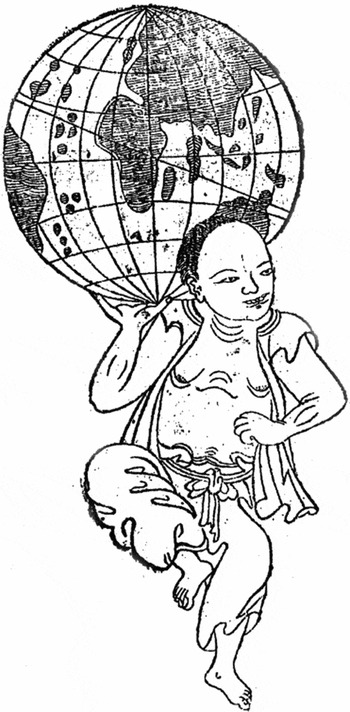
There was a constant reminder of the central importance of strength as part of the new, modern education on the cover of many of the textbooks printed for the Đông Kinh Nghĩa Thục—a depiction of a young Vietnamese student supporting a globe on his shoulder. The image suggests several things. First, it clearly indicates that a student not only could be, but should be, strong as well as educated. Second, while the image of the globe conjures up notions of Atlas carrying the world on his back, it also firmly connects the Vietnamese to this new conceptualization of a global community. Third, the globe speaks more generally to the ideas of modern geography and mapping that were being introduced in the school's curriculum. Finally, the image hints at a Vietnam strong enough to take its place within the global community. Indeed, the image and what it suggests are reinforced in the blunt assessment elsewhere in one of these volumes: ‘Dân mạnh, nước mạnh [If the people are strong, then the country will be strong].’Footnote 47
Cover image from 1907 school textbook.
Source: Văn Thơ Đông Kinh Nghĩa Thục (1997), Nhà Xuất Bản Văn Hóa, Hanoi, np.

In focusing on strength and struggle, the authors of these textbooks were not merely sounding a clarion call for strengthening the self, but appear also to have been challenging fundamental Vietnamese philosophical notions on several levels. First of all, many elements of Confucian doctrine conceptualized the universe in terms of achieving and maintaining harmony, or, when necessary, seeking to restore harmony. The idea of existence as struggle was thus a profound departure from tradition.Footnote 48 Second, the idea that education would advocate physical strength and the need to struggle was one that had traditionally been regarded with disdain by Confucian scholars in Vietnam as well as in China. Physical exertion was for the peasantry, not for those pursuing higher forms of education. Although the physical education component of the school did not ultimately attract many students, the idea was still firmly in place.Footnote 49
Furthermore, the struggle that was being described in these textbooks also brought up the ideas of evolution and progress, for the only way to triumph in the ongoing struggle between societies was to progress. As one of the textbooks noted: ‘At present the contestation is very fierce; those who make progress will survive, while those who do not will be unable to maintain their independence.’Footnote 50 Thus, simply resisting defeat by stronger societies was not sufficient; a society had to progress and advance to ensure long-term survival. Here again, it was up to individuals to take on the responsibility of advancing themselves. Thus, a section in one of the textbooks headed ‘Striving to progress’ noted ‘A country that has many people who have a will to progress will be a strong country.’Footnote 51 Although it is beyond the scope of this article, the very notion of ‘progress’ as a collective moving forward in the realms of national strength, levels of technology, levels of education, and so forth, was in some respects an important departure from older, Confucian understandings of the nature of things.
The early twentieth-century scholars writing for the Đông Kinh Nghĩa Thục publications appear to have accepted that struggle was real and inevitable and had to be confronted, whatever its challenge to long-standing philosophical belief systems. Given what they had witnessed over the past half-century, their acceptance of this concept is hardly surprising. The French had rapidly and brutally overwhelmed the Vietnamese, creating not only a political, but also a philosophical crisis. As was indicated earlier, by the beginning of the twentieth century most physical resistance had been suppressed, and what was left was resistance that took place very much in the realm of the mind. The Vietnamese needed to prepare themselves to resume the physical struggle, even as they worked through ideas that focused more on the struggle of civilizations in a considerably more abstract sense. Moreover, this Darwinian-inspired logic of the survival of the fittest society continued to hold the Vietnamese imagination well into subsequent decades. As late as 1929 one finds published discussions of Darwin's theories that focus very strongly on their extension into the social realm and the ongoing struggle between societies.Footnote 52
For all their discussion of society in terms of struggle, it should be noted that the Vietnamese did not think of society exclusively in that sense. At times, the issue was more one of attempting to understand the essence of the Vietnamese peoples in the context of changed times. Phan Bội Châu, for instance, touched on ‘society’ in his essays in ways not always attached to notions of contestation. Thus, in a 1907 essay entitled ‘Đề Tỉnh Quốc Dân Hồn [Setting Forth a Consciousness of a National Soul]’, he conceptualized society in the abstract as an idea that reverberated within countries:
I have experienced travelling back and forth to the country of Japan, and I have seen that in that country there is not a single place that has not felt the influence of society, there is not a single person who does not have the spirit of society, and there is not a single task that does not feel the influence of society.Footnote 53
In this formulation, ‘society’ (in each case ‘xã hội’) was not so much the concrete grouping of people that had to be made strong and cohesive, but almost a force with the power to shape different aspects of the country in which it operated. Phan Bội Châu had apparently encountered this phenomenon in the Japan he had visited numerous times between 1900 and 1908 and seen something that the Vietnamese did not quite yet have. Thus, while they might have a ‘society’ in the way that each national grouping of people did, they had not yet fully felt the positive effects of this collective.
Finally, while most writings on ‘society’ seemed to present it as a kind of undifferentiated collectivity of people, a few did address the notion that this was a more complex collectivity, one that was internally differentiated and hierarchical, as reflected in ‘social classes’. Even the early adopters of the term, those using it in the Đông Kinh Nghĩa Thục textbooks, acknowledged that societies were not homogeneous groupings, but rather encompassed a range of people: ‘people in society are all similar to one another [in some respects], there are people of remarkable talent, but are also people who are foolish dullards. There are people of immense wealth, and others who live in grinding poverty. Through intelligence and stupidity, wealth and poverty, societies are divided into an upper level, a middle level, and a lower level.’Footnote 54 In short, societies were complex entities made up of differentiated social classes. Elsewhere, the textbook spoke again of society as containing people of varying abilities, levels of wealth and intelligences, and described some people as belonging to ‘the lower levels of society’.Footnote 55 Thus, although there was a heavy emphasis on notions of a strong collectivity of peoples seen as necessary for the survival of the larger Vietnamese nation in its contest with other nations, there was an understanding that ‘society’ was a complex entity, composed of component parts that varied greatly across a range of attributes. Inherent in these discussions was already a hint of the conflicts that would contribute greatly to Vietnamese revolutionary discourse in the 1920s and beyond, shattering any idea of a single society struggling in unity against the challenge of the French.
Conclusion
‘Xã hội’ entered the consciousness of a small group of Vietnamese in the first decade of the twentieth century, and then spread as the ideas of the Đông Kinh Nghĩa Thục were carried by scholars to schools in other parts of Vietnam. What I hope this article has suggested is that the case of ‘xã hội’ reveals the complexities involved in transmitting not simply words, but the ideas attached to them across cultures. Lexicographers and others who study the historical transmission and transformation of words and their meanings have already made it very clear that words do not have simple and fixed meanings. Lydia Liu's writings on ‘translingual practice’ further suggest the problems inherent in assumptions about finding linguistic (much less conceptual) equivalents across languages. My examination of one of the ways in which the term ‘society’ was taken up by Vietnamese writers and thinkers and made a part of the Vietnamese realm of consciousness suggests the degree to which the particular form of that transmission is crucial to local understandings of new terms. The term ‘society’ was introduced into the vocabulary by Vietnamese scholars in conjunction with the notion of struggles for survival—the social Darwinian imperative. Their introduction of the term coincided with an active process whereby Vietnamese were wrestling to reconsider and transformed their identity as people. They were attempting to situate themselves vis-à-vis the French most immediately, but the ‘West’ (including the United States) more generally. And, even as the term ‘society’ was introduced hand in hand with the equally alien concept of social Darwinism, its meaning was necessarily localized in ways that make clear that it was not always, if ever, understood in the way that the term was used in Europe.
And yet, not surprisingly, this meaning was contested and ambiguous. The ways in which ‘society’ had been presented in the textbooks of the Đông Kinh Nghĩa Thục and the writings of such modernizers as Phan Bội Châu and Phan Châu Trinh invoked numerous concepts and contexts virtually ensuring that ‘society’ would be understood in various and sometimes conflicting ways. At times ‘society’ was seen as coterminous with the nation's population, at others it was regarded as inextricably bound up with the family structure, and at yet other times it somehow overlapped with or competed with such notions as ‘race’ (‘giống’ or ‘chủng tộc’) or the ‘nation’ (nhà nước). I would argue that students in the Tonkin Free School, and others influenced by its pedagogical materials, likely contemplated the idea of ‘society’ in conjunction with the looming threats posed to Vietnamese national survival in the face of many pressures. In short, the social Darwinian implications of ‘society’ were difficult to escape. At the same time, given the alternative conceptions of collectivities that had arisen around the same time, as well as preexisting ones, it is difficult to argue that ‘society’ was understood in an unambiguous sense. It had become a part of the vocabulary for discussions about the challenges facing the Vietnamese people, but like other terms of this era—‘revolution’, for example—it remained in flux, subject to manipulation and modification.
To close with an illustration of this phenomenon, I turn to a high-profile public lecture given by Phan Châu Trinh in Saigon in 1925, shortly after returning from a lengthy French exile. As one of the founders of the Đông Kinh Nghĩa Thục, he was closely tied to the introduction of the term ‘society’ to Vietnam, and he continued to reflect on it during his years as a political exile between 1911 and 1925. In his lectures on the topic of ‘Western’ and ‘Eastern’ ethics, Phan Châu Trinh directly addressed the question of ‘society’. He did so, however, in a changed context, and at a time in which the term had begun to take on new forms and roles. In his talk he spoke about a concept he referred to as ‘social ethics’ (luân lý xã hội) and also discussed the significance of a new formulation using the term ‘society’, namely ‘socialism’ (chủ nghĩa xã hội). Regarding the first concept, he observed that this was something about which the Vietnamese people still knew absolutely nothing. They could not yet comprehend the mechanisms for social organization that would allow them to stand up against the domination of the (colonial) state. While he felt similarly that the Vietnamese knew little of ‘socialism’, he was convinced that spreading knowledge of this concept was of the greatest importance. As he pointed out, ‘If in the future the country of Việt-Nam wishes to achieve freedom and independence, then first and foremost the Vietnamese people must have solidarity (đoàn thể). And for there to be solidarity, there is nothing more important than popularizing socialism amongst the Vietnamese people.’Footnote 56 In reaching this conclusion, Phan Châu Trinh was moving past the basic concept of ‘society’ as merely defining the Vietnamese peoples as a collectivity, and towards a new idea, one that transformed the concept into something far greater—a new configuration along lines he had read and heard about in Paris which seemed to offer possibilities for the Vietnamese future.