


1. Introduction
A series of geochemical perturbations were recorded in the late Cambrian stratum, of which the Steptoean Positive Carbon Isotope Excursion (SPICE) is one of the most intriguing and yet puzzling records because of its dramatic shifts in both carbon and sulphur isotope, worldwide distributions, implications of ocean/atmosphere redox changes, and close connections with the biological extinction/turnover (Saltzman et al. Reference Saltzman, Ripperdan, Brasier, Lohmann, Robison, Chang, Peng, Ergaliev and Runnegar2000, Reference Saltzman, Young, Kump, Gill, Lyons and Runnegar2011; Gill et al. Reference Gill, Lyons and Saltzman2007, Reference Gill, Lyons, Young, Kump, Knoll and Saltzman2011; Hurtgen et al. Reference Hurtgen, Pruss and Knoll2009; Maloof et al. Reference Maloof, Porter, Moore, Dudás, Bowring, Higgins, Fike and Eddy2010). The SPICE started at the base of the Paibian Stage, Furongian Series (∼499 Ma), and lasted for 2–4 Ma (Peng et al. Reference Peng, Babcock, Zuo, Zhu, Lin, Yang, Qi, Bagnoli and Wang2012), which shows a distinct record of 4–6 ‰ positive shift in the carbon isotope of carbonate (δ13Ccarb) in the strata from Antarctica, Argentina, Australia, England, Poland, France, Spain, Wales, Kazakhstan, Newfoundland, South China, Siberia, Sweden and the USA (Saltzman et al. Reference Saltzman, Runnegar and Lohmann1998, Reference Saltzman, Cowan, Runkel, Runnegar, Stewart and Palmer2004; Zhu et al. Reference Zhu, Zhang, Li and Yang2004; Cowan et al. Reference Cowan, Fox, Runkel and Saltzman2005; Álvaro et al. Reference Álvaro, Ferretti, González-Gómez, Serpagli, Tortello, Vecoli and Vizcaïno2007; Glumac & Mutti, Reference Glumac and Mutti2007; Ahlberg et al. Reference Ahlberg, Axheimer, Babcock, Eriksson, Schmitz and Terfelt2009; Gill et al. Reference Gill, Lyons, Young, Kump, Knoll and Saltzman2011; Glumac, Reference Glumac2011; Woods et al. Reference Woods, Wilby, Leng, Rushton and Williams2011; Peng et al. Reference Peng, Babcock, Zuo, Zhu, Lin, Yang, Qi, Bagnoli and Wang2012; Sial et al. Reference Sial, Peralta, Toselli, Ferreira, Frei, Parada, Pimentel and Pereira2013; Wotte & Strauss, Reference Wotte and Strauss2015). A covariation between the SPICE and organic carbon isotopic composition (δ13Corg), or the sulphur isotopic composition (carbonate-associated sulphate (δ34SCAS) and sedimentary pyrite (δ34Spy)) was also reported (Gill et al. Reference Gill, Lyons, Young, Kump, Knoll and Saltzman2011; Saltzman et al. Reference Saltzman, Young, Kump, Gill, Lyons and Runnegar2011). The parallel positive carbon and sulphur isotope excursions contradict their general inverse relationship, which is considered as the first-order long-term relationship of marine carbon and sulphur isotope throughout the Phanerozoic (Veizer et al. Reference Veizer, Holser and Wilgus1980; Garrels & Lerman, Reference Garrels and Lerman1981). This SPICE anomaly is thought to reflect a superimposed shorter-term variability that was caused by enhanced burial of organic carbon and pyrite (Gill et al. Reference Gill, Lyons and Saltzman2007), which has been proposed to be driven by sea-level changes, seawater warming or spread of euxinia (Saltzman et al. Reference Saltzman, Ripperdan, Brasier, Lohmann, Robison, Chang, Peng, Ergaliev and Runnegar2000, Reference Saltzman, Cowan, Runkel, Runnegar, Stewart and Palmer2004, Reference Saltzman, Young, Kump, Gill, Lyons and Runnegar2011; Cowan et al. Reference Cowan, Fox, Runkel and Saltzman2005; Elrick et al. Reference Elrick, Rieboldt, Saltzman and McKay2011; Gill et al. Reference Gill, Lyons, Young, Kump, Knoll and Saltzman2011; Dahl et al. Reference Dahl, Boyle, Canfield, Connelly, Gill, Lenton and Bizzarro2014). The SPICE was also thought to have ties to the changes in atmosphere/ocean redox conditions: widespread anoxic and even euxinic conditions in the ocean contributed in the enhanced burial of organic carbon and pyrite, and might be associated with the trilobite extinction/turnover events at the beginning of SPICE (Peng et al. Reference Peng, Babcock, Robison, Lin, Rees and Saltzman2004; Gill et al. Reference Gill, Lyons, Young, Kump, Knoll and Saltzman2011; Dahl et al. Reference Dahl, Boyle, Canfield, Connelly, Gill, Lenton and Bizzarro2014); elevated rates of organic carbon and pyrite burial led to a significant rise in atmospheric oxygen concentration (Berner, Reference Berner2006; Saltzman et al. Reference Saltzman, Young, Kump, Gill, Lyons and Runnegar2011), and triggered the onset of ‘Plankton Revolution’ after the SPICE (Saltzman et al. Reference Saltzman, Young, Kump, Gill, Lyons and Runnegar2011).
Recent studies showed differences in onset, peak values and pattern of the δ13Ccarb and δ34SCAS excursions for SPICE in different regions, and even missing of the excursions in some regions, reflecting the heterogeneity of late Cambrian seawater in carbon and sulphur isotopic compositions (Saltzman et al. Reference Saltzman, Runnegar and Lohmann1998; Hurtgen et al. Reference Hurtgen, Pruss and Knoll2009; Gill et al. Reference Gill, Lyons, Young, Kump, Knoll and Saltzman2011; Wotte & Strauss, Reference Wotte and Strauss2015; Schiffbauer et al. Reference Schiffbauer, Huntley, Fike, Jeffrey, Gregg and Shelton2017; Li et al. Reference Li, Zhang, Hu, Chen, Huang, Zhang, Li, Qin, Peng and Shen2018). Various mechanisms were proposed to explain these variations in δ13Ccarb and δ34SCAS excursions. Sedimentary studies showed that the existence of a sedimentary hiatus would cause the SPICE excursion to be missing (or partially missing) in some regions, such as northwestern Wyoming, northern Vermont and North China (Saltzman et al. Reference Saltzman, Runnegar and Lohmann1998; Glumac & Spivak-Birndorf, Reference Glumac and Spivak-Birndorf2002; Chen et al. Reference Chen, Chough, Han and Lee2011). The invasion of deep 13C-enriched water during the Sauk III transgression would produce the gradients of δ13Ccarb amplitude and SPICE stratigraphic thicknesses across the different depths (Schiffbauer et al. Reference Schiffbauer, Huntley, Fike, Jeffrey, Gregg and Shelton2017). Low-level sulphate in the late Cambrian ocean would make the sulphate reservoir more sensitive to the change in local depositional conditions (Hough et al. Reference Hough, Shields, Evins, Strauss, Henderson and Mackenzie2006; Gill et al. Reference Gill, Lyons and Saltzman2007, Reference Gill, Lyons, Young, Kump, Knoll and Saltzman2011; Hurtgen et al. Reference Hurtgen, Pruss and Knoll2009; Wotte & Strauss, Reference Wotte and Strauss2015), leading to variable sulphur isotopic records as well.
The late Cambrian succession is well developed in North China, where the sedimentary record and palaeontology have been well studied (Zhu et al. Reference Zhu, Zhang, Li and Yang2004; Peng, Reference Peng, Mikulic, Landing and Kluessendorf2007, Reference Peng2009a, b; Chough et al. Reference Chough, Lee, Woo, Chen, Choi, Lee, Kang, Park and Han2010; Lee et al. Reference Lee, Chen and Chough2010; Chen et al. Reference Chen, Chough, Han and Lee2011, Reference Chen, Chough, Lee and Han2012; Zhou et al. Reference Zhou, Willems, Li and Luo2011; Ng et al. Reference Ng, Botting, Yuan and Lin2015). The biostratigraphic correlation with that in other parts of the world is also well constrained (Peng, Reference Peng2009a, b; Chough et al. Reference Chough, Lee, Woo, Chen, Choi, Lee, Kang, Park and Han2010; Ng et al. Reference Ng, Botting, Yuan and Lin2015). A carbon isotopic positive excursion in the late Cambrian carbonate was identified as the SPICE record in North China in recent studies (Zhu et al. Reference Zhu, Zhang, Li and Yang2004; Bagnoli et al. Reference Bagnoli, Qi, Zuo, Du, Liu and Zhang2014; Ng et al. Reference Ng, Yuan and Lin2014a, b). Compared with other regions, the SPICE records in North China are always in a thinner succession (∼5–20 m), and some of the carbon isotope shifts are relatively small (<2.5 ‰ compared with 4–6 ‰) (Ng et al. Reference Ng, Yuan and Lin2014a, b). This ‘atypical SPICE’ record in North China likely provides an opportunity to explore the wide variation in sulphur and carbon isotopic behaviour during the SPICE, for which much of the geochemical information is still insufficient to constrain the depositional conditions, sizes of dissolved inorganic carbon (DIC)/oceanic sulphate and decoupling between C/S cycles, etc.
In this study, we investigate late Cambrian carbonate from the Tangwangzhai section in Shandong Province using multiple geochemical proxies (e.g. δ13Corg, δ34SCAS and trace elements). The trace element results illustrate the depositional condition changes during the late Cambrian in North China. The carbon and sulphur isotopic records provide insights for stratigraphic correlation of the global SPICE and explore the competing influence between global ocean chemistry and local influx on the carbon isotopic signatures.
2. Geological background
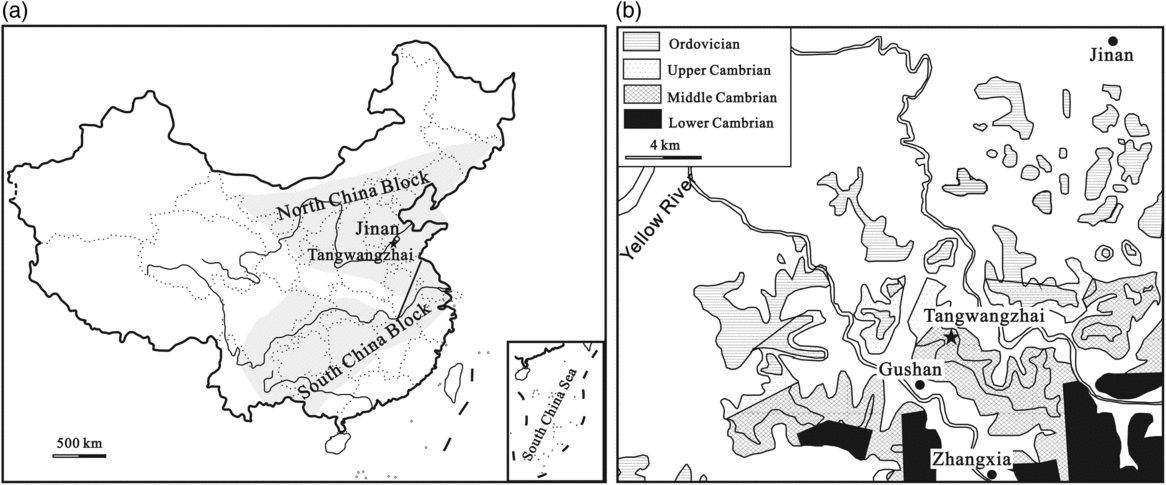
The middle and late Cambrian succession in Shandong Province is composed of the Liguan, Zhushadong, Mantou, Zhangxia, Gushan and Chaomidian formations (from bottom to top), which mainly consist of marine-origin carbonates and thinly interbedded shales (Chough et al. Reference Chough, Lee, Woo, Chen, Choi, Lee, Kang, Park and Han2010; Chen et al. Reference Chen, Chough, Han and Lee2011; Lee et al. Reference Lee, Chen and Chough2012, Reference Lee, Chen, Choh, Lee, Han and Chough2014). The Tangwangzhai section is the type section for the late Cambrian sequence in North China, consisting of the Zhangxia, Gushan and Chaomidian formations, and it is located near Tangwangzhai Village, south of Jinan, Shandong Province (Fig. 1). The upper Zhangxia Formation mainly consists of bioclastic limestone and oolitic limestone with intercalations of calcareous shale, and it contains the trilobite Yabeia–Damesella Zone; the Gushan Formation (∼52 m thickness) mainly consists of flat-pebble grainstone, thinly bedded micrites and yellowish-greencalcareous shale, and it contains the trilobite Blackwelderia and Neodrepanura zones; the Chaomidian Formation (∼160 m thickness) consists of oolitic limestone, thinly bedded micrites, flat-pebble grainstone and yellowish-greencalcareous shale, and it contains the trilobite Chuangia, Changshania–Irvingella, Kaolishania and Ptychaspis–Tsinania zones (Zhu et al. Reference Zhu, Zhang, Li and Yang2004; Bagnoli et al. Reference Bagnoli, Qi, Zuo, Du, Liu and Zhang2014) (Fig. 2).
(a) The study regions in China (modified from Zhu et al. Reference Zhu, Zhang, Li and Yang2004); (b) geological map of the Tangwangzhai section.
The stratigraphic column and carbon and sulphur isotopic composition variations from late Cambrian carbonate in the Tangwangzhai section. The relative sea-level curve is after Chen et al. (Reference Chen, Chough, Han and Lee2011). Both carbon and sulphur isotope show fluctuant, in which the δ13Ccarb shows a mild positive excursion between 40 and 60 m, while the δ34SCAS and δ34Spy do not show synchronous increase.
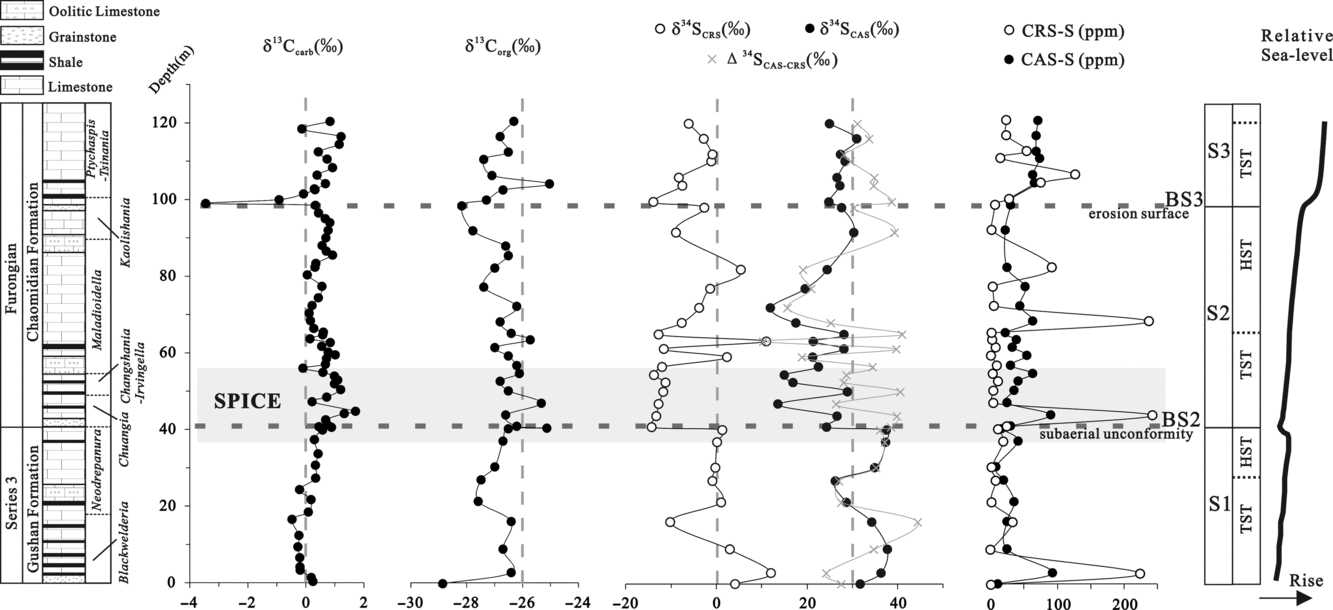
Chen et al. (Reference Chen, Chough, Han and Lee2011) identified three third-order depositional sequences (S1–S3) for the succession in the Tangwangzhai section (Fig. 2). Each sequence comprises a transgressive systems tract (TST) and a highstand systems tract (HST). The sediments in the TST contain more detrital components (e.g. shale and mudstone interlayers) (Fig. 2). It has been suggested that S1 and S2 are bounded by a subaerial unconformity (BS2) at the boundary between the Gushan Formation and the Chaomidian Formation, and S2 and S3 are bounded by a surface of submarine erosion (BS3) in the middle of the Chaomidian Formation (Chen et al. Reference Chen, Chough, Han and Lee2011, Reference Chen, Chough, Lee and Han2012) (Fig. 2). The boundary is characterized by predominant grainstone facies with fragmentary bioclasts, ooids, peloids, intraclasts and abundant glauconite grains (Fig. 2) (Chen et al. Reference Chen, Chough, Han and Lee2011, Reference Chen, Chough, Lee and Han2012; Lee et al. Reference Lee, Chen and Chough2012, Reference Lee, Chen, Choh, Lee, Han and Chough2014). These fundamental researches are conducive to the stratigraphic correlation and integrated consideration of the environmental changes during the late Cambrian.
3. Methods
We collected large carbonate hand-specimens from outcrops to ensure sufficient quantities for geochemical analysis. The samples were cut and buffed to remove weathered surfaces and secondary veins and were then ground (<200 mesh) in an agate mortar for elemental and isotopic analyses.
For the δ13Ccarb analyses, the carbonate samples were roasted and were then reacted with concentrated H3PO4 at 25 °C for 24 h, and the liberated CO2 was collected cryogenically off-line under vacuum and sealed in a Pyrex tube. We measured carbon and oxygen isotope ratios on a Thermo MAT 253 gas source isotope ratio mass spectrometer; the isotopic compositions are reported in units of per mil (‰) as deviations relative to that of Vienna Pee Dee Belemnite (VPDB) using the conventional delta (δ13C and δ18O) notations. The standard GBW4405 was used to control the analytical uncertainties, which were better than ±0.10 ‰ (1σ) for both δ13C and δ18O. The isotope analysis was conducted at the State Key Laboratory of Lithospheric Evolution, Institute of Geology and Geophysics, Chinese Academy of Sciences (Beijing, China).
For the δ13Corg analyses, powdered samples were first decarbonated by reacting with HCl (1 M), and the residual was rinsed at least six times with deionized distilled (DD) water and dried. The decarbonated samples were enclosed in tin capsules, and the organic carbon isotopes were analysed using an elemental analyser (EA) coupled with a conflo interface that automatically transfers carbon dioxide gas into a Thermo MAT 253 gas source isotope ratio mass spectrometer (Biogeochemistry Laboratory of University of Science and Technology of China (USTC), Hefei, China). The analytical uncertainties set from replicate analyses of standards (IAEA-600 and USGS-40) is better than ±0.15 ‰ (1σ; SD).
The carbonate-associated sulphate (CAS) was extracted following the method described in the previous work (Gill et al. Reference Gill, Lyons, Young, Kump, Knoll and Saltzman2011). Fifty grams of sample was first rinsed with 10 % NaCl solution (overnight under agitation) to remove the non-CAS sulphate and then treated with 5.25% NaClO solution to remove organic sulphur and sulphide minerals. Samples were rinsed with DD water six times, then dissolved with 6 M HCl quickly (within 20 min). The solution was filtered, and CAS was precipitated as BaSO4 with the addition of 20 mL BaCl2 solution (100 g L−1). The precipitates were collected by filtration and then washed with DD water. The BaSO4 was dried and weighed (precision, 0.0001 g). CAS concentrations were determined gravimetrically with an analytical uncertainty of 10 %. Approximately 15 mg BaSO4 was mixed with V2O5 (150 mg) and SiO2 (150 mg) and combusted at 1100 °C. The produced SO2 was passed through a copper column at 600 °C, and then cryogenically collected off-line to a Pyrex tube. Measurements of the SO2 sulphur isotope ratios were performed on a Delta S isotope ratio mass spectrometer in a dual inlet mode. Sulphur isotope compositions are reported in units of per mil (‰) as deviations relative to that of Vienna Canon Diablo Troilite (VCDT) using the conventional delta (δ34S) notation. A laboratory internal standard SA1 (barite, with δ34S of 15.2±0.2 ‰) was used as quality control to monitor the analysing system. The isotope analysis was performed at the State Key Laboratory of Lithospheric Evolution, Institute of Geology and Geophysics, Chinese Academy of Sciences. The analytical uncertainties were better than ±0.2 ‰ (1σ).
To evaluate the completion of the removal of non-CAS by NaCl, 5–20 g of samples were leached by 10% NaCl overnight under continuous agitation, and the leached sulphate was tested by adding saturated barium chloride solution (BaCl2) to precipitate barite (Wotte et al. Reference Wotte, Shields-Zhou and Strauss2012a). For most samples, no leachable non-CAS was detected after the first or second NaCl leaching, indicating that one-time NaCl leaching is adequate to prohibit leachable non-CAS contributions for our samples.
Then the leached samples were acidized by 25 % HCl, and the insoluble residue was used to extract the chromium-reducible sulphur (CRS) following the previous procedure (Arnold et al. Reference Arnold, Brunner, Müller and Røy2014). The Ag2S was dried and weighed (precision 0.0001 g). CRS concentrations were determined gravimetrically with an analytical uncertainty of 10 %. The δ34SCRS was measured by online combustion of Ag2S precipitates with an excess of V2O5 on a Thermo Delta V Plus isotope ratios mass spectrometer coupled with a Costech elemental analyser. Sulphur isotopes are reported in standard δ-notation relative to Vienna Canon Diablo Troilite (VCDT). Analytical precision for δ34SCRS of the sample set from replicate analyses of IAEA standards (IAEA S1, S2 and S3) is better than ±0.2 ‰ (1σ; SD).
The major elements of the bulk samples were analysed using X-ray fluorescence spectrometry (XRF) with a Shimadzu XRF-1500 system (State Key Laboratory of Lithospheric Evolution, Institute of Geology and Geophysics, Chinese Academy of Sciences); we used fusion glasses made from a mixture of sample powder and flux (Li2B4O7) at a ratio of 1:5. The analytical precision monitored by an internal standard was better than 10% (1σ).
For trace elemental analyses, 40 mg of sample powder was reacted with 1 mL of 1 M acetic acid in a Teflon pot for 4 h and was then centrifuged. Insoluble residues were removed by filtration, dried and reweighed. The supernatant was dried, re-dissolved in 0.5 mL of 0.1 M HNO3 and dried again. This process was repeated until all of the acetic acid was removed. The sample was then dissolved in 1 % HNO3. The final solutions were analysed for trace element (including rare earth element (REE)) concentrations on an inductively coupled plasma mass spectrometer (ICP-MS) monitored by an internal standard (In) using a Finnigan MAT Element system (State Key Laboratory of Lithospheric Evolution, Institute of Geology and Geophysics, Chinese Academy of Sciences). The analytical precision monitored by the internal standard was better than 10 % (1σ) for trace elements.
4. Results
The carbon and sulphur isotopic compositions are listed in Table 1 and plotted in Figure 2. The δ13Ccarb in S1 mostly ranges between −0.50 ‰ and 0.86 ‰ and slightly increases from the bottom up. The δ13Ccarb shows a positive excursion around BS2 (∼40 –50 m), and the highest value approaches 1.68 ‰. Afterwards, the δ13Ccarb decreases (down to 0 ‰) to the middle of S2 (∼50–70 m) and then increases and fluctuates around 0.5 ‰ in the upper part of S2 (∼70–98 m). An abrupt decline of the δ13Ccarb (down to −3.48 ‰) appears at BS3 (at ∼100 m). Then the δ13Ccarb increases and fluctuates around 1 ‰ in S3 (above 100 m). The δ13Corg ranges between −28.9 ‰ and −25.0 ‰. The δ13Corg increases abruptly (up to −25 ‰) at BS2 and then shows a potential positive peak (up to −25.3 ‰) in the basal part of S2 (∼40–50 m). Another rapid increase of δ13Corg (up to −25.1 ‰) is observed in the basal part of S3 (∼100–110 m). Accordingly, the carbon isotopic fractionations between carbonate and organic matter (Δ13Ccarb-org) are in the basal part range between 25.5 ‰ and 28.6 ‰.
The carbon and sulphur isotopic compositions in carbonate from the Tangwanzhai section

The δ34SCAS shows a decrease (from 37.8 ‰ to 26.3 ‰) followed by an increase (from 26.3 ‰ to 37.5 ‰) in S1. The δ34SCAS shows an abrupt decline (down to 13.7 ‰) at BS2 and then fluctuates between 11.0 ‰ and 26.3 ‰ in the lower part of S2 (∼40–70 m). The δ34SCAS increases (from 12.0 ‰ to 27.7 ‰) in the upper part of S2 (∼70–100 m) and then scatters between 24.8 ‰ and 31.0 ‰ in S3. The δ34SCRS first decreases (from 12.2 ‰ to −10.1 ‰), then increases to and remains around ∼0 ‰ in S1. The δ34SCRS shows an abrupt decline (down to ∼−12 ‰) at BS2 and remains constant in the lower part of S2 (∼40–70 m). The δ34SCRS increases (from ∼−12 ‰ to 5.4 ‰) in the upper part of S2 (∼70–100 m) and then ranges between −13.8 ‰ and −0.8 ‰ in S3. The sulphur isotopic fractionations between CAS and CRS (Δ34SCAS-CRS) range between 10.3 ‰ and 44.5 ‰.
The major and trace element contents are listed in Table 2 and plotted in Figure 3. The Sc, Zr, Th, Al, Ti and SiO2 contents show a maximum peak value in the lower part of S2 (∼40–60 m) and exhibit a decreasing trend in the upper part of S2 (∼60–100 m). Another high peak value can be observed in the lower part of S3 (∼100–120 m).
The major and trace element contents in carbonate from the Tangwanzhai section

Major and trace element content variations from late Cambrian carbonate in the Tangwangzhai section.

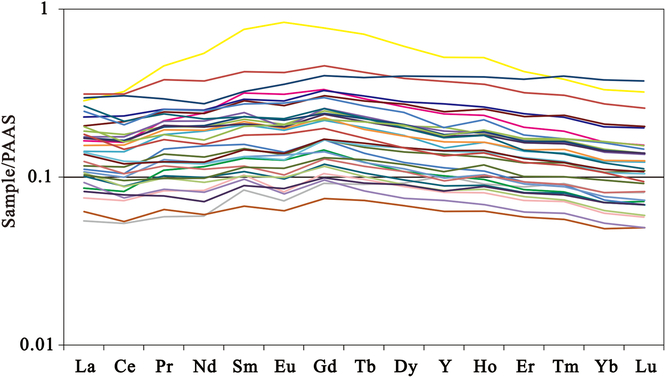
REE + Y anomalies are calculated using the following formulae: Ce/Ce* = CeN/[PrN × (PrN/NdN)], Eu/Eu* = EuN/(SmN2 × TbN)1/3, and La/La* = LaN/[PrN × (PrN/NdN)2] (Lawrence & Kamber, Reference Lawrence and Kamber2006). The concentrations of the elements with the subscript ‘N’ have been normalized to Post-Archaean Australian Shale (PAAS) (Taylor & McLennan, Reference Taylor and McLennan1985). The REE + Y contents are listed in Table 3 and plotted in Figure 4. The total REE contents range between 10.9 ppm and 74.1 ppm, with slightly negative Ce anomalies (Ce/Ce* = 0.85 ± 0.07), no Y anomalies (YN/HoN = 1.00 ± 0.05), no Eu anomalies (Eu/Eu* = 0.95 ± 0.07), no/slight light-REE (LREE) depletion (PrN/SmN = 0.89 ± 0.09), and moderate high-REE (HREE) depletion (SmN/YbN = 1.55 ± 0.31, PrN/YbN = 1.37 ± 0.28).
The REE+Y contents (ppm) in carbonate from the Tangwanzhai section

REE + Y anomalies are calculated by the following formulae: Ce/Ce* = CeN/[PrN × (PrN/NdN)]; Eu/Eu* = EuN/(SmN2 × TbN)1/3; La/La* = LaN/[PrN × (PrN/NdN)2].
The concentrations of elements with the subscript N have been normalized to Post-Archaean Australian Shale (PAAS).
REE + Y patterns from late Cambrian carbonate in the Tangwangzhai section.
5. Discussion
5.a. Fidelity of geochemical records for contemporaneous seawater
During diagenesis, Sr is often expelled from sedimentary carbonates; in contrast, Mn is preferentially incorporated; thus, carbonates with Mn/Sr < 10 are indicative of minimum diagenetic alteration (Derry et al. Reference Derry, Kaufman and Jacobsen1992; Kaufman & Knoll, Reference Kaufman and Knoll1995). All the Mn/Sr ratios of the Tangwangzhai carbonates are very low (<2) (Table 2), suggesting limited post-depositional alteration. The lack of obvious covariations between Mn/Sr and δ13Ccarb/δ13Corg/δ34SCAS further supports that the carbon and sulphur isotopic compositions were not altered significantly by diagenesis (Fig. 5a, b, c). Oxygen isotopic composition is also sensitive to diagenesis, which can reduce the δ18O values in sediments because of isotopic exchange with meteoric or hydrothermal fluids; thus, δ18O values below −10 ‰ are considered signs of strong alteration (Kaufman & Knoll, Reference Kaufman and Knoll1995). All the δ18O values from the Tangwangzhai carbonates are above −10 ‰, and there is no covariation between δ18O and δ13Ccarb, also implying no diagenetic control of δ13Ccarb (Table 1; Fig. 5d).
Isotopic and elemental cross-plots for late Cambrian carbonate in the Tangwangzhai section. (a) δ13Ccarb–Mn/Sr; (b) δ13Corg–Mn/Sr; (c) δ34SCAS–Mn/Sr; (d) δ13Ccarb–δ18Ocarb; (e) δ34SCAS–[CAS-S]; (f) [CAS-S]–[CRS-S]; (g) δ34SCAS–[CRS-S]; (h) PrN/YbN–Mn/Sr.

Previous studies indicated that meteoric diagenesis can be negligible for bulk carbonate δ34SCAS owing to the much higher sulphate contents in the sediments compared with the diagenetic fluid (Gill et al. Reference Gill, Lyons and Frank2008), and the δ34SCAS did not change with progressive burial diagenesis (Fichtner et al. Reference Fichtner, Strauss, Immenhauser, Buhl, Neuser and Niedermayr2017). Bacterial sulphate reduction during early diagensis may affect the δ34SCAS (Kampschulte & Strauss, Reference Kampschulte and Strauss2004), but CAS studies of modern carbonate sediments indicate minimal alteration of bulk δ34SCAS, which is unlikely to result in increases in δ34SCAS greater than 4 ‰ (Lyons et al. Reference Lyons, Walter, Gellatly, Martini, Blake, Amend, Edwards and Lyons2004; Rennie & Turchyn, Reference Rennie and Turchyn2014). Recent studies have indicated that secondary sulphate derived from sulphide oxidation in the pore water, outcrop and laboratory would be incorporated into the CAS, and secondary atmospheric sulphate (SAS) could also be added to exposed carbonates in desert environments, both of which might affect the δ34SCAS (Marenco et al. Reference Marenco, Corsetti, Hammond, Kaufman and Bottjer2008; Wotte et al. Reference Wotte, Shields-Zhou and Strauss2012a; Peng et al. Reference Peng, Bao, Pratt, Kaufman, Jiang, Boyd, Wang, Zhou, Yuan, Xiao and Loyd2014). In this study, the samples were effectively leached by NaClO and NaCl prior to the CAS extraction (see Section 3), excluding the non-CAS sulphate. No covariance between δ34SCAS, CAS and CRS concentrations suggests no prominent two end members mixing between oxidized pyrite and primary sulphate (Fig. 5e, f, g), further supporting that insufficient pyrite is oxidized. In addition, most samples have very low CRS contents (mostly <10 ppm), which are much lower than CAS contents (mostly >70 ppm) (Fig. 2). The low CRS contents suggest that (1) the primary pyrite was limited, and little of it could be oxidized and affected the CAS; (2) almost all primary pyrite (>90%) was oxidized and affected the CAS, but such a high pyrite reoxidation ratio seems impossible either during the early diagenesis or during the CAS extraction. Samples 09TWZ-4 (36.4 ‰), 09TWZ-78 (26.7 ‰) and 09TWZ-114 (17.6 ‰) have high CRS contents (>200 ppm) (Fig. 2), and the corresponding CAS also shows relatively high contents, suggesting potential S addition to the CAS in these samples during diagenesis. Overall, in the lower part of the Chaomidian Formation (TST of S2: ∼40–70 m), CRS concentrations of most samples are <5 ppm (Fig. 2), implying that the pyrite may have contributed minimal sulphate to the CAS. Therefore, the decline in δ34SCAS within the TST of S2 was not caused by the oxidation of pyrite, which thus reflects the isotopic composition change of ambient seawater.
Some elements (e.g. Al, Ti, Sc, Zr, Th) are conservative in normal depositional conditions, and also hardly react with aqueous phase and other minerals in normal depositional conditions, so they can be transferred and preserved almost quantitatively in the sediments, and generally used to trace detrital faction (Taylor & McLennan, Reference Taylor and McLennan1985; Webb & Kamber, Reference Webb and Kamber2000). REE + Y patterns in the carbonate can monitor their input sources (e.g. continental, riverine, hydrothermal) and depositional conditions (Nothdurft et al. Reference Nothdurft, Webb and Kamber2004; Frimmel, Reference Frimmel2009), but the diagenesis in anoxic pore water may lead to depletion of both LREE and HREE (Haley et al. Reference Haley, Klinkhammer and McManus2004). In the Tangwanzhai carbonates, no HREE nor LREE depletion is observed (Fig. 4). Furthermore, the low Mn/Sr ratios (<2) and the lack of covariation of Mn/Sr–PrN/YbN also indicate limited diagenetic alteration of REE in the Tangwangzhai carbonates (Table 2; Fig. 5h).
In summary, the carbon and sulphur isotope compositions and trace elements are pristine, representing those of the contemporary seawater at the depositional locality.
5.b. Oceanic geochemistry in North China during the late Cambrian
Trace elements were analysed by acetic acid (1 M) dissolution, and the low concentrations of Sc (mostly <2 ppm), Zr (<3 ppm) and Th (mostly <1 ppm) suggest that the impact from the detritus was eliminated effectively (Table 2). The Tangwangzhai carbonate shows relatively flat REE + Y patterns with no obvious Ce, Eu, Y or LREE anomalies (Fig. 4), similar to the REE + Y patterns observed in estuaries / coastal seas where the REE + Y characteristics are strongly impacted by riverine input (Elderfield et al. Reference Elderfield, Upstill-Goddard and Sholkovitz1990; Lawrence & Kamber, Reference Lawrence and Kamber2006; Censi et al. Reference Censi, Sprovieri, Saiano, Di Geronimo, Larocca and Placenti2007; Frimmel, Reference Frimmel2009). The moderate HREE depletion is always related to the contribution from suspended load in the river (Nothdurft et al. Reference Nothdurft, Webb and Kamber2004; Prego et al. Reference Prego, Caetano, Bernárdez, Brito, Ospina-Alvarez and Vale2012; Bayon et al. Reference Bayon, Toucanne, Skonieczny, André, Bermell, Cheron, Dennielou, Etoubleau, Freslon, Gauchery and Germain2015; de Campos & Enzweiler, Reference de Campos and Enzweiler2016). Previous sedimentological studies suggested the late Cambrian carbonate and shale in North China were deposited in subtidal environments (e.g. shallow subtidal, deep subtidal, shoreface/shoal) (Chen et al. Reference Chen, Chough, Han and Lee2011, 2012), which is consistent with the estuarine/coastal conditions indicated by REE + Y. In this case, the multiple sea-level fluctuations might play an important role in the chemostratigraphic records because they could change the proportioning between terrigenous/riverine input and primary seawater, and even cause interruptions in deposition.
Al, Ti, SiO2, Sc, Zr and Th contents can be used to track continental detritus in the sediments (Hild & Brumsack, Reference Hild and Brumsack1998; Tribovillard et al. Reference Tribovillard, Algeo, Lyons and Riboulleau2006). Maximum peaks of Al, Ti and SiO2 contents appear in the lower part of S2 (∼40–60 m) and lower part of S3 (∼100–120 m) (Fig. 3), suggesting a rapid increase in terrigenous influence; there is a decreasing trend in the upper part of S2 (∼60–100 m) (Fig. 3), suggesting a decrease in terrigenous influence. Sc, Zr and Th were leached by acetic acid, which represents only a very small part of continental detritus, but their stratigraphic variations mostly appear like those of Al, Ti and SiO2. This observation is consistent with the petrology features and sedimentary sequences: the seawater and sediments were greatly influenced by terrigenous input in the TST, where the sediments contain more shale interlayers; the terrigenous influence was weakened during the HST, where the sediments contain fewer shale interlayers (Chen et al. Reference Chen, Chough, Han and Lee2011).
The variations of δ13Ccarb and δ34SCAS show correspondences to the sea-level changes. In the Gushan Formation, the δ13Ccarb values in the lower part (TST of S1: ∼0–20 m) are lower than those in the upper part (HST of S1: ∼20–40 m) (Fig. 2); in the lower part of the Chaomidian Formation (TST of S2: ∼40–70 m), the δ13Ccarb values show a gradual decrease following a rapid increase at the bottom, and then the δ13Ccarb increases to ∼+0.5 ‰ in the middle part of the Chaomidian Formation (HST of S2: ∼70–100 m). The δ13Ccarb variations represent the changes of DIC isotope in the ocean, which were controlled by the input (predominantly terrestrial weathering input) and output (predominantly carbonate and organic carbon burial) fluxes and their respective isotopes in the popular carbon cycling models (Hayes et al. Reference Hayes, Strauss and Kaufman1999; Kump & Arthur, Reference Kump and Arthur1999). The change of terrestrial input flux or isotope could impact the DIC isotope directly, but the effect might be diluted in a large DIC pool (or amplified in a small pool). Generally, terrestrial sources influence the coastal DIC by input of weathering carbon that contained weathered inorganic carbon and remineralized organic carbon, and the average weathering carbon input is 13C-depleted (∼−5 ‰) (Hayes et al. Reference Hayes, Strauss and Kaufman1999; Kump & Arthur, Reference Kump and Arthur1999). Despite the lack of evidence of wide land biomass during the Cambrian, weathering of exposed high organic shale could provide considerable 13C-depleted remineralized organic carbon to the river and ocean. Therefore, the enhanced terrigenous input would result in the lower/decreasing δ13Ccarb in TST, while higher/increasing δ13Ccarb in the HST suggests weakening of the terrigenous influence under this environment.
The δ34SCAS shows a decreasing trend in the lower part of the Gushan Formation (TST of S1: ∼0–20 m), and also shows a decrease and fluctuations in a relatively low range of values (∼11.0–26.3 ‰) in the lower part of the Chaomidian Formation (TST of S2: ∼40–60 m), both of which are attributed to the enhanced terrigenous influence. The δ34SCAS variations represent the changes of sulphate isotope in the ocean, which are mainly controlled by the input (predominantly terrestrial weathering input) flux and output (predominantly evaporate and pyrite burial) flux and their respective isotopes (Canfield, Reference Canfield2004). The change of terrestrial input flux and/or its isotopes influences the ocean sulphate isotope directly. Like carbon, this effect is more pronounced for a small sulphate pool than a large sulphate pool of seawater. The isotopic composition of the riverine input sulphate is primarily set by the relative proportions of dissolved sulphate evaporate and oxidized pyrite, and the average weathering input sulphate was regarded as relatively isotopically light in sulphur (∼6–10 ‰) (Walker, Reference Walker1986; Arthur, Reference Arthur, Sigurdsson, Houghton, McNutt, Rymer and Stix2000). Recent models for the late Cambrian sulphur cycling generally assumed ∼6 ‰ as the riverine input sulphur isotopic compositions (Hurtgen et al. Reference Hurtgen, Pruss and Knoll2009; Gill et al. Reference Gill, Lyons, Young, Kump, Knoll and Saltzman2011). We acknowledge that the local sulphate weathering input is also largely impacted by the local sediments, which was likely to cause more 34S-enriched weathering input. For instance, Fike & Grotzinger (Reference Fike and Grotzinger2008) suggested 34S-enriched weathering input (∼30 ‰) during the Ediacaran—Cambrian transition by using the ‘rapid recycling’ hypothesis, which predicted that young sedimentary rocks were subject to rapid weathering relative to older strata because the younger rocks were more exposed to erosion at the earth surface (Berner, Reference Berner2006). For the late Cambrian weathering, however, the younger middle Cambrian strata were likely to be the weathering source, in which the δ34S values of pyrite in sediments from several regions are all lower than 20 ‰ in the middle Cambrian (Gill et al. Reference Gill, Lyons, Young, Kump, Knoll and Saltzman2011; Loyd et al. Reference Loyd, Marenco, Hagadorn, Lyons, Kaufman, Sour-Tovar and Corsetti2012; Wotte et al. Reference Wotte, Strauss, Fugmann and Garbe-Schönberg2012b; Guo et al. Reference Guo, Straus, Zhao, Yang, Peng, Yang and Deng2014). Hence, we exclude a strongly 34S-enriched weathering input (>20 ‰) in case of ‘rapid recycling’ during the late Cambrian. Therefore, the enhanced terrigenous input would reduce the δ34S of coastal seawater to <20 ‰ in TST, especially in the context of the low SO42− concentration in the late Cambrian (Hurtgen et al. Reference Hurtgen, Pruss and Knoll2009; Gill et al. Reference Gill, Lyons, Young, Kump, Knoll and Saltzman2011); the δ34SCAS shows a gradual increase back to the HST in both S1 and S2, implying the weakening of terrigenous influences.
The invasion of 13C-depleted/34S-depleted deep seawater probably provides an alternative explanation during the TST. For a coastal condition that was shallow and nearshore, however, the influence from deep water would be considerably weaker than terrigenous influence. In addition, the influence from deep water remains largely unexplored. The carbon isotopic gradients show variations in different basins: the seawater was more 13C-enriched in the deep ocean in the Missouri intrashelf basin (Schiffbauer et al. Reference Schiffbauer, Huntley, Fike, Jeffrey, Gregg and Shelton2017), while it was more 13C-depleted in the deep ocean in the Huanan basin (Li et al. Reference Li, Zhang, Hu, Chen, Huang, Zhang, Li, Qin, Peng and Shen2018). Gill et al. (Reference Gill, Lyons, Young, Kump, Knoll and Saltzman2011) suggested a widespread euxinia in the deep ocean, where the H2S might be more 34S-depleted compared with sulphate in the shallow water. However, the synchronous pyrite records in deep water suggested that the δ34S of H2S was >20 ‰ for a long time, which did not necessarily cause the δ34SCAS to reduce to <20 ‰ as we observed in the Tangwanzhai section. Besides, the widespread euxinia for the SPICE event remains controversial (Wotte & Strauss, Reference Wotte and Strauss2015).
Pasquier et al. (Reference Pasquier, Sansjofre, Rabineau, Revillon, Houghton and Fike2017) also suggested a potential relationship between sea-level and sulphur isotopic records in the sediments: sedimentation rates might increase in low sea-level, which would reduce connectivity between sedimentary pore waters and overlying seawaters, and cause enhanced δ34SSO4 and δ34Spy in closed pore water through ongoing microbial sulphate reduction. This hypothesis contradicts our observation. Therefore, in our case, the terrigenous influence linked to the sea-level change would be a reasonable explanation: the lower/decreasing δ13Ccarb and δ34SCAS in the TST was attributed to enhanced terrigenous influence; and the higher/increasing δ13Ccarb and δ34SCAS in the HST was due to weakened terrigenous influence.
5.c. The SPICE records in North China
The base of the Furongian Series is defined by the first appearance datum (FAD) of the cosmopolitan agnostoid Glyptagnostus reticulatus in Hunan, China (Peng et al. Reference Peng, Babcock, Robison, Lin, Rees and Saltzman2004). Previous work discovered the coexistence of Chuangia and G. reticulatus in South China (Peng, Reference Peng1987), providing for the first time a crucial trilobitic correlation between North China and South China. Therefore, the base of the Chuangia Zone was proposed to correlate to the FAD of G. reticulatus, which is the base of the Furongian Series in North China (e.g. Zhang & Jell, Reference Zhang and Jell1987; Zhu & Wittke, Reference Zhu and Wittke1989; Zhang, Reference Zhang2003; Ng et al. Reference Ng, Yuan and Lin2014a). A new Cambrian correlation scheme suggested a thin Prochuangia–Paracoosia trilobite zone between the Chuangia Zone and Neodrepanura Zone, and the base of the Furongian Series should be in the middle of the Prochuangia–Paracoosia zone (Peng, Reference Peng2009a, b). This implies that the base of the Furongian Series should be stratigraphically slightly lower than the base of the Chuangia Zone. However, the Prochuangia–Paracoosia zone is missing in some areas of North China. In any case, the base of the Furongian Series in North China should be near the base of the Chuangia Zone. Accordingly, the carbon isotope positive excursion in some locations in North China was proposed as the SPICE record, which ends near the bottom of the Changshania Zone (Zhu et al. Reference Zhu, Zhang, Li and Yang2004; Chen et al. Reference Chen, Chough, Han and Lee2011; Bagnoli et al. Reference Bagnoli, Qi, Zuo, Du, Liu and Zhang2014; Ng et al. Reference Ng, Yuan and Lin2014a, b). Compared with other areas, the SPICE in North China is all recorded in a relatively thin carbonate succession (∼5–20 m), and shows reduced δ13Ccarb excursions (<2.5 ‰), with peak values lower than the average range of 4–5% (Ng et al. Reference Ng, Yuan and Lin2014a, b).
In addition, conodont Furnihina quadrata and Furnishina longibasis first occur close to the FAD of G. reticulatus in the Paibi stratotype section, which would also be a proxy to distinguish the base of the Furongian Series (Qi et al. Reference Qi, Bagnoli and Wang2006). In the Tangwanzhai section, F. quadrata and F. longibasis first occur near the base of the Chuangia Zone, which can confirm the base of the Furongian Series (Bagnoli et al. Reference Bagnoli, Qi, Zuo, Du, Liu and Zhang2014). Therefore, the mild positive δ13Ccarb excursion (∼15 m thick) starting near the base of the Chuangia Zone has been identified as the SPICE records in the Tangwangzhai section (Zhu et al. Reference Zhu, Zhang, Li and Yang2004; Bagnoli et al. Reference Bagnoli, Qi, Zuo, Du, Liu and Zhang2014), which is also observed in this study (Fig. 2). A negative excursion (low to 0.19 ‰) is observed in the middle part of the SPICE curve, which was also reported in the same section (Bagnoli et al. Reference Bagnoli, Qi, Zuo, Du, Liu and Zhang2014), the Shuanqiao section in North China (Ng et al. Reference Ng, Yuan and Lin2014b) and the Wa’ergang and Paibi sections in South China (Saltzman et al. Reference Saltzman, Ripperdan, Brasier, Lohmann, Robison, Chang, Peng, Ergaliev and Runnegar2000; Peng et al. Reference Peng, Babcock, Robison, Lin, Rees and Saltzman2004). A similar positive excursion of δ13Corg that corresponds to the SPICE has also been reported in many sections throughout the world (Gill et al. Reference Gill, Lyons, Young, Kump, Knoll and Saltzman2011; Saltzman et al. Reference Saltzman, Young, Kump, Gill, Lyons and Runnegar2011). A potential positive peak of δ13Corg is present corresponding to the δ13Ccarb peak (Fig. 2), which likely provides additional chemostratigraphic correlation evidence for the SPICE in North China. However, we acknowledge that more δ13Corg data are needed in order to validate the excursion.
A positive sulphur isotope (including δ34SCAS and δ34Spy) excursion in phase with the SPICE, which is considered as a useful chemostratigraphic correlation tool, was found in several geographically diverse sections (Gill et al. Reference Gill, Lyons and Saltzman2007, Reference Gill, Lyons, Young, Kump, Knoll and Saltzman2011). Generally, the δ34SCAS/δ34Spy excursions co-vary with the SPICE δ13Ccarb excursions. The δ34SCAS continuously increases to >40 ‰ and then decreases, in which the peak is close to (or slightly pre-dates) the δ13Ccarb peak (Gill et al. Reference Gill, Lyons and Saltzman2007, Reference Gill, Lyons, Young, Kump, Knoll and Saltzman2011). However, a few SPICE records show no continuous δ34SCAS increase prior to the δ13Ccarb peak, and some even show δ34SCAS decline with the onset of the δ13Ccarb increase (Fig. 6) (Hurtgen et al. Reference Hurtgen, Pruss and Knoll2009; Gill et al. Reference Gill, Lyons, Young, Kump, Knoll and Saltzman2011; Wotte & Strauss, Reference Wotte and Strauss2015). In these records, a peak point of δ34SCAS (∼48 ‰) was reported in Kazakhstan, which is considered to be correlated to the δ34SCAS positive excursion (Wotte & Strauss, Reference Wotte and Strauss2015), but the other records show no conventional δ34SCAS peak from Newfoundland and Queensland (Fig. 6) (Hurtgen et al. Reference Hurtgen, Pruss and Knoll2009; Gill et al. Reference Gill, Lyons, Young, Kump, Knoll and Saltzman2011). In this study, we observe no δ34SCAS/δ34Spy increase prior to the δ13Ccarb peak either: the δ34SCAS/δ34Spy show relatively high values (∼40 ‰) around the onset of the δ13Ccarb increase, but then abruptly decline at BS2 and fluctuate in a relatively low value range (∼10−20 ‰) (Figs 2, 6).
Comparison of SPICE records with abnormal δ34SCAS variations. (a) A peak point of δ34SCAS (∼48 ‰) was reported prior to the δ13Ccarb peak in Kazakhstan, but the δ34SCAS positive excursion is not obvious (Wotte & Strauss, Reference Wotte and Strauss2015); (b, c) no conventional δ34SCAS peak in the records from Newfoundland and Queensland (Hurtgen et al. Reference Hurtgen, Pruss and Knoll2009; Gill et al. Reference Gill, Lyons, Young, Kump, Knoll and Saltzman2011); (d) no δ34SCAS/δ34Spy increase prior to δ13Ccarb peak in North China (this study).

The erosion surface at BS2 may cause the SPICE records to be partially missing at the bottom of the SPICE (Chen et al. Reference Chen, Chough, Han and Lee2011, Reference Chen, Chough, Lee and Han2012). More importantly, the coastal seawater was greatly influenced by the 34S-depleted terrigenous input after the submergence of subaerial unconformity (i.e. TST in S2), which would dilute or even obscure the δ34S positive excursion of the open seawater. Therefore, the δ34SCAS abruptly declines at the BS2, and could not resume the positive excursion pattern throughout the SPICE event, reflecting long-term and strong terrigenous influences. The δ13Ccarb would also be influenced by 13C-depleted terrigenous input, but the reservoir of DIC in the Furongian seawater was much larger than that of sulphate, so the mixing δ13C would modestly decrease, and the δ13Ccarb excursion only show the magnitude reduction rather than depletion in North China.
These abnormal δ34SCAS patterns may reflect different degrees of local influence, assuming positive δ34S excursions represent the primary change of the open seawater during SPICE. Up to now, there is insufficient evidence to say that the other records with declining δ34SCAS at the onset of SPICE excursion were also related to the terrigenous input like that in North China. We acknowledge that the controlling factors on these δ34S records need to be thoroughly evaluated within their geological contexts. At the very least, the variable δ34SCAS records reflect a more sensitive sulphur reservoir, supporting the low sulphate concentrations in the late Cambrian ocean.
6. Conclusions
We report new data of carbon and sulphur isotopes and trace elements in the late Cambrian stratum in North China, which represent the heterogeneity in carbon and sulphur isotopic compositions in the Furongian seawater. The REE and trace elements results support coastal conditions with multiple sedimentary sequences. The REE + Y patterns are relatively flat with no obvious Ce, Eu, Y or LREE anomalies, but they show moderate HREE depletion, suggesting shallow estuarial/coastal conditions that likely were significantly affected by riverine input. Variations of Al, Ti, SiO2, Sc, Zr and Th contents were used to track detritus from continents, which confirm that the seawater and sediments were greatly influenced in the TST, and the influence would weaken in the HST. The terrigenous input would also affect the carbon and sulphur isotopic compositions of the ocean. Both the δ13Ccarb and the δ34SCAS decrease and fluctuate within a range of relatively low values in the TST because of the large influence from 13C-depleted and 34S-depleted terrigenous input; they then recover when the terrigenous influences weaken in the HST.
A positive δ13Ccarb excursion and a potential positive δ13Corg peak are observed near the base of the Chuangia Zone; this δ13Ccarb excursion would be the SPICE record, as suggested by previous studies. This SPICE record in North China may be influenced by the subaerial unconformity and strongly terrigenous input: the former would cause the carbon and sulphur isotope records to be partially missing; the latter with depleted δ13C and δ34S would cause the amplitude of the positive δ13Ccarb excursion to be reduced, and the positive δ34SCAS excursion even to be obscured in North China. The variable δ34SCAS records further reflect a sensitive sulphur reservoir, supporting the low sulphate concentrations in the late Cambrian ocean which is vulnerable to local influences.
Author ORCIDs
Jing Huang 0000-0003-0158-4151
Acknowledgements
This research is supported by the Natural Science Foundation of China (41673002, 41890842, 41520104007, 41721002, 41330102), the Key Research Program of Frontier Sciences, CAS (QYZDY-SSW-DQC031) and the 111 Project, and the Fundamental Research Funds for the Central Universities. We thank Prof. Luo Kunli, Li Chao and Zhang Qirui for their help with the field and lab work.



