Wechsler Intelligence Scale for Children, developed in 1949 and translated into 25 languages, has been and still is the most employed intelligence assessment tool to evaluate IQ in the processes of identification and diagnosis of intellectual giftedness (Silverman, Reference Silverman and Shavinina2009). Therefore, studies on its validity are an important support to the diagnostic and clinical decisions derived from its use.
Since its inception, several studies have focused on determining how certain clinical or special population groups perform in the different subtests that compose this test and checking whether the scale’s factor structure changes when the evaluated subjects have specific characteristics, such as intellectual giftedness, for example. This fact is of fundamental importance in the population at hand as previous research has revealed significant differences in cognitive profiles obtained with this scale, between children of average intelligence and children of superior intelligence, which may affect the significance of the measured construct in both populations (Kaufman, Reference Kaufman1992, Reference Kaufman1993; National Association for Gifted Children [NAGC], 2010; Rimm, Gilman, & Silverman, Reference Rimm, Gilman, Silverman and VanTassel-Baska2008; Saccuzzo, Johnson, & Russell, Reference Saccuzzo, Johnson and Russell1992; Silverman, Reference Silverman, Genshaft, Bireley and Hollinger1995; Sparrow, Pfeiffer, & Newman, Reference Sparrow, Pfeiffer, Newman, Prifitera, Saklofske and Weiss2005; Sweetland, Reina, & Tatti, Reference Sweetland, Reina and Tatti2006; Volker & Smerbeck, Reference Volker, Smerbeck, Flanagan and Kaufman2009).
Early studies performed with the Wechsler’s Intelligence Scale for Children-Revised (WISC-R; Wechsler, Reference Wechsler1974) sought to determine whether the two-factor structure (Verbal Comprehension and Perceptual Organization) obtained for children of average intelligence also fitted intellectually gifted children. The justification for such research purpose lay in the belief that these children could process information in a qualitatively different manner than those children with average intelligence. Therefore, analyzing the patterns of response to the subtests could provide more information towards the diagnosis and intervention of these children than their IQ score. However, studies carried out with the WISC-R on gifted children reached no conclusion, yielding mixed results, ranging from single factor models to multivariate models.
Specifically, based on data from the 362 children in the American WISC-R standardization sample who scored 120 or above on the verbal, manipulative or full scale IQ indexes, Willson, Gilberg and Reynolds (Reference Willson, Gilberg and Reynolds1982) found that a univariate model called Verbal Ability, was the best fit. These results were confirmed by Macmann, Mueller-Plasket, Barnett, and Siler (Reference Macmann, Mueller-Plasket, Barnett and Siler1991), who conducted a principal component factor analysis with 829 children who had total IQ scores of 120 or above, in which the single factor model (composed of Information, Similarities, Vocabulary and Comprehension) was the most consistent solution.
On the other hand, a two-factor model, similar to the verbal-manipulative dichotomy defended on the WISC-R manual was supported by the work of Sapp, Chissom, and Graham (Reference Sapp, Chissom and Graham1985) and Greenberg, Stewart, and Hansche (Reference Greenberg, Steward and Hansche1986), while Karnes and Brown (Reference Karnes and Brown1980) had defended the existence of a third factor, called Freedom from Distractibility, in a study of 946 children with scores of 120 or above on the verbal, manipulative or full scale IQ indexes.
In addition, Brown and Yakimoski (Reference Brown and Yakimoski1987) proposed a four-factor model for the WISC-R (Perceptual Organization, Verbal Comprehension, Acquisition of Knowledge and Spatial Memory) as the best solution for the group of gifted children, compared with the two-factor model (Verbal Ability and Perceptual Organization) suggested in the same study, for the sample of children of average intelligence. Subsequently, Brown, Hwang, Baron, and Yakimoski (Reference Brown, Hwang, Baron and Yakimoski1991) developed a confirmatory factor analysis with gifted children and children with average intelligence, noting that, for gifted children, the best solution was the three-factor model, while the two-factor model was a better fit for children with average intelligence. In view of the results, these authors concluded that children with giftedness differed from children of average intelligence not only in the magnitude of the scores obtained in the WISC-R, but also in the interrelationships between them and in the cognitive processes associated to the subtests (Brown et al., Reference Brown, Hwang, Baron and Yakimoski1991).
The publication of the third edition of the Wechsler Intelligence Scale for Children (WISC-III; Wechsler, Reference Wechsler1991) allowed for the calculation of four indexes: Verbal Comprehension, Perceptual Organization, Freedom from Distractibility and Processing Speed (Georgas, Weiss, van de Vijver, & Saklofske, Reference Georgas, Weiss, van de Vijver and Saklofske2003; Kush et al., Reference Kush, Watkins, Ward, Ward, Canivez and Worrell2001; Sattler, Reference Sattler2001). However, the calculation of the Freedom from Distractibility and Processing Speed indexes is only possible if two additional subtests are applied: Digit Span and Symbol Search, respectively, hence the full scale IQ score is a combination of indexes of Verbal Comprehension and Perceptual Organization. The factorial structure for gifted children in this version of the scale was studied by Watkins, Greenawalt, and Marcell (Reference Watkins, Greenawalt and Marcell2002) on 505 children (M total IQ = 131.2, SD = 7.25), confirming a two-factor structure. The first factor consisted of Information, Similarities, Vocabulary and Comprehension, while the second showed significant loadings for Picture Completion, Block Design and Object Assembly, with both factors explaining 31.8% of variance. In this model, Picture Arrangement and Arithmetic were not loaded on any factor and Coding showed a negative loading on the verbal factor. These researchers recommended not using the Arithmetic and Coding subtests when testing for intellectual giftedness, as both of them exhibited heavy loadings on processing speed.
Finally, the fourth edition of the scale (WISC-IV; Wechsler, Reference Wechsler2003b) proposes a substantial change by introducing a four-factor structure, eliminating the Freedom from Distractibility index and introducing Working Memory and Processing Speed. Initial studies on its factorial structure carried out on normal population and on children with different suspected psychological problems have confirmed its suitability for the four-factor model (Bodin, Pardini, Burns, & Stevens, Reference Bodin, Pardini, Burns and Stevens2009; Canivez, Reference Canivez2014; Keith, Fine, Taub, Reinolds, & Kranzler, Reference Keith, Fine, Taub, Reynolds and Kranzler2006; Watkins, Reference Watkins2010; Watkins, Wilson, Kotz, Carbone, & Babula, Reference Watkins, Wilson, Kotz, Carbone and Babula2006; Wechsler, Reference Wechsler2003b, Reference Wechsler2005). However, it has not been specifically subjected to a factorial analysis on an intellectually gifted population before until the work of Rowe, Dandridge, Pawlush, Thompson, and Ferrier (Reference Rowe, Dandridge, Pawlush, Thompson and Ferrier2014). These authors conducted an exploratory factor analysis on a sample of 225 children aged between 8 and 12 years with an average IQ of 126.15, yielding a two-factor solution (a Verbal Comprehension factor and a second factor that grouped the remaining subtests except for Block Design and Picture Concepts), a three factor (Verbal Comprehension, a second factor resulting from the combination of Working Memory and Processing Speed, and a third factor consisting in a modified Perceptual Reasoning factor) and a four factor solution (corresponding to the indexes of the scale), which accounted for the 41%, 53% and 63.18% of the variance, respectively. The three solutions showed a relatively acceptable fit, and each of the subtests clearly tended to conform to a single factor, except for Picture Concepts. In order to clarify the results, the authors conducted a second study on a sample of 181 children aged between 6 and 12 years with an average IQ of 126.71. In this case, they conducted confirmatory factor analyses to test the three models obtained in the exploratory factor analysis. For the four-factor model, both a first order solution and a second order solution which included a g factor were tested. The results showed that, among the first order models, the only one that suggested a good fit was the four-factor model. The second order four-factor model obtained very similar results to the first order results, although its χ² value was slightly higher. Therefore, Rowe et al. (Reference Rowe, Dandridge, Pawlush, Thompson and Ferrier2014) concluded that the results supported the first order four-factor solution of the WISC-IV, which establishes the general structure of the scale for gifted children.
However, the four-factor structure of the WISC-IV appears to affect the performance profile of gifted children as it decreases the verbal and perceptual skills loadings from 80% to 60% and increases from 20% to 40% the weight of working memory and processing speed tasks (Rimm, Reference Rimm2010; Silverman, Reference Silverman and Shavinina2009). In fact, the results of several studies have consistently shown the existence of a differential performance profile in these children with significantly lower scores in Working Memory and especially in Processing Speed (Rimm, Reference Rimm2006; Rimm et al., Reference Rimm, Gilman, Silverman and VanTassel-Baska2008; Wasserman, Reference Wasserman2006; Wechsler, Reference Wechsler2003b). Examples include data from 63 children with intellectual giftedness within the standardization studies of this version (Wechsler, Reference Wechsler2003b) which, when compared with an average intelligence group, showed significant differences in the four indexes, remaining high for Verbal Comprehension and Perceptual Reasoning and moderate for Working Memory and Processing Speed. In fact, the Processing Speed score (M = 110.6, SD = 11.5) is the lowest score obtained by the group of children with giftedness. Similar results were obtained by Rimm (Reference Rimm2006), in whose work, the Processing Speed index score was the lowest of the group with an average of 111.9 points. This was also the case of the Gifted Development Centre’s with an even lower score (M = 104.3; Rimm et al., Reference Rimm, Gilman, Silverman and VanTassel-Baska2008). This pattern shows that, in general, these children approach cognitive tasks in a more thoughtful way, which entails negative consequences on the scale’s composite score as it reduces the full scale IQ score.
A possible explanation for this variability in gifted children’s cognitive profiles is given by Spearman’s Law of Diminishing Returns (SLORD; Spearman, Reference Spearman1927), which postulates an inverse relationship between high IQ scores and low correlations between different cognitive skills. This relationship has been proven in numerous studies (Abad, Colom, Juan-Espinosa, & García, Reference Abad, Colom, Juan-Espinosa and García2003; Facon, Reference Facon2003a, Reference Facon2004, Reference Facon2006; Jensen, Reference Jensen2003; Reynolds, Hajovsky, Niileksela, & Keith, Reference Reynolds, Hajovsky, Niileksela and Keith2011).
To avoid potential problems arising from discrepancies between indexes, on the full scale IQ score, the General Ability Index (GAI, Flanagan & Kaufman, Reference Flanagan and Kaufman2004; NAGC, 2010; Raiford, Weiss, Rolfhus, & Coalson, Reference Raiford, Weiss, Rolfhus and Coalson2005; Rimm et al., Reference Rimm, Gilman, Silverman and VanTassel-Baska2008; Weiss, Saklofske, Prifitera, & Holdnack, Reference Weiss, Saklofske, Prifitera and Holdnack2006) has been proposed. This index is obtained by evaluating children with only six of the subtests (Vocabulary, Similarities, Comprehension, Block Design, Matrix Reasoning and Picture Concepts) avoiding the subtests that are part of the indexes of Working Memory and Processing Speed. Flanagan and Kaufman (Reference Flanagan and Kaufman2004) have argued that the full scale IQ score should not be taken into consideration if there is a discrepancy equal to or greater than 23 points (1.5 SD) between different indexes, since distances of such magnitude would indicate that the full scale IQ would not be a unitary construct. The NAGC accepts the use of the General Ability Index as a criterion to gain access to educational programs for gifted children, stating that children with high scores on Verbal Comprehension and Perceptual Reasoning but low scores in Working Memory and Processing Speed can succeed in educational programs for advanced students (NAGC, 2010). The work of Rimm et al. (Reference Rimm, Gilman, Silverman and VanTassel-Baska2008) is an example of the impact of using this index. In their study, the number of children with a full scale IQ greater than 130 increased from 44 to 61 after applying this index. However, in Rowe et al.’s (Reference Rowe, Dandridge, Pawlush, Thompson and Ferrier2014) study, the exploratory factor analysis did not confirm the GAI structure and the four-factor model determined through confirmatory factor analysis yielded Working Memory as the first factor and the one that explained the a highest percentage of variance.
Taking the mentioned information as reference, the objectives of this present study are: (1) Check the fit of different factor models to Spanish intellectually gifted children; (2) Check for discrepancies between the different indexes of the scale in this group of children.
Method
Participants
A total of 87 Spanish children, previously identified as gifted by qualified professionals (full scale IQ ≥ 130) participated in the study, all of whom attended public schools in Granada and Jaén. The children were aged between 6 and 13 years (M age = 8.51, SD = 2.08). A total of 63.2% of participants were male and 36.8% were female. As can be seen on Table 1, the average IQ level was 141.18 (SD = 9.11). Prior to participation in the study, informed parental consent was obtained and it was ensured that the participating children did not suffer from any psychological or behavioral problems.
Participants according to Age, Gender and IQ

Instruments
Wechsler Intelligence Scale for Children-IV (WISC-IV) (Wechsler, Reference Wechsler2005)
It consists of 15 subtests, 10 core tests and 5 supplemental, which assess the intellectual capacity of children aged between 6 and 16 years. It provides four indexes (Perceptual Reasoning, Verbal Comprehension, Working Memory and Processing Speed) and a full scale IQ score reflects the general cognitive ability of the child. This test’s reliability in terms of its internal consistency for the Spanish adaptation reaches values of between .72 and .95. Concurrent validity has been established through the correlation between the WISC-IV and the Raven Progressive Matrices (Raven, Raven, & Court, Reference Raven, Raven and Court1998) finding correlations between .31 and .61, depending on the indexes, being .54 for the full scale IQ score.
Procedure
Firstly, permission from the Human Research Ethics Committee of the Universidad de Granada was obtained. The selection of participants was carried out through collaboration between the Universidad de Granada and the giftedness associations of Granada and Jaén. All the parents of the participants gave their informed consent. As a criterion for inclusion in the study, participants had to be aged between 6 and 13 years and had to have been diagnosed with intellectual giftedness (full scale IQ ≥ 130). Meanwhile, having any disorder diagnosed with the DSM-IV-TR was established as an exclusion criterion. Based on these criteria, 91 children were evaluated.
The evaluation was performed individually in a single, hour-and-a-half session, by members of the research group. Only the 10 core subtests were applied. Once the evaluation was completed, it was found that 4 of the children did not reach a minimum IQ score of 125, and hence these 4 children were not included into the data analysis. The IQ≥125 cut-off was set taking into account the manual’s measurement error (Wechsler, Reference Wechsler2005) and the work of Flanagan and Kaufman (Reference Flanagan and Kaufman2004). Therefore, the final number of participants in this present study was 87 children.
Design and Statistical Analysis
A factorial design was carried out. The data analysis was performed using SPSS statistical software version 18.0 and the LISREL 8.80 and PRELIS statistical programs. Confirmatory factor analysis, descriptive statistics analysis and an analysis of the frequency of discrepancies between indexes of the WISC-IV were performed.
Results
Since the psychometric validity of the WISC-IV has been extensively reviewed (Wechsler, Reference Wechsler2003b; Reference Wechsler2005), a confirmatory factor analysis was performed to determine the goodness of fit of five models: a two-factor (consisting of the verbal and manipulative subtests) model, another two-factor model according to the General Ability Index structure (including subtests of Verbal Comprehension and Perceptual Reasoning indexes), a first-order four-factor model (consisting of the scale’s four indexes: Verbal Comprehension, Perceptual Reasoning, Working Memory and Processing Speed), a second-order four-factor model with a direct g factor (which is related to the subtests), and finally another second-order four-factor model with an indirect g factor (in this case, g grouped the four indexes). Thus, the proposed models were reviewed using the LISREL 8.80 program and the Unweighted Least Squares (ULS) method was used as the estimation method.
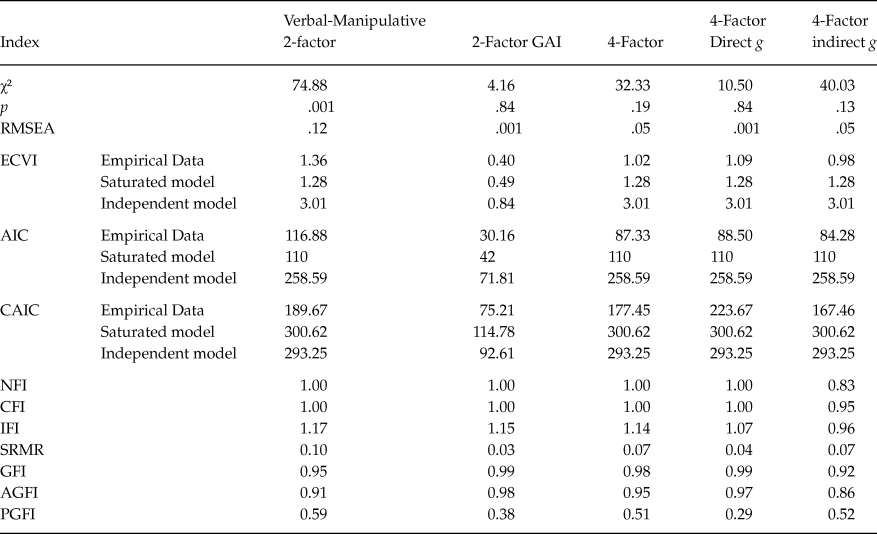
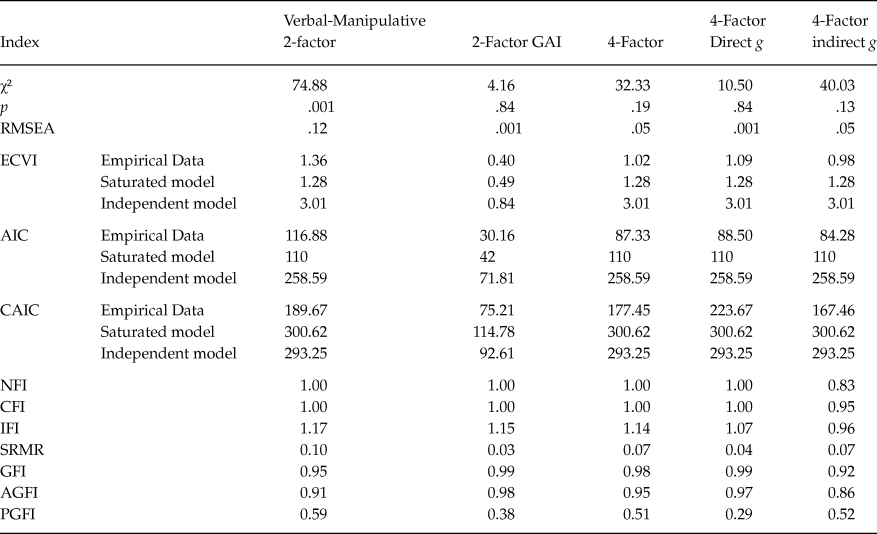
Table 2 presents the goodness of fit indexes obtained for all models. First, the χ² (χ² goodness of fit test, non-significant with p > .05) was acceptable since it yielded no significant differences between the models and the empirical data collected with all models except for the Verbal-Manipulative two-factor model (p = .001). Since χ² is sensitive to sample size, Table 2 also presents the Root Mean Square Error of Approximation (RMSEA) values for each model. Again, satisfactory values (RMSEA < .08) were obtained for all models except for the Verbal-Manipulative two-factor model (RMSEA = .12).
Goodness of Fit Indexes for Analyzed Models
Note: RMSEA = Root Mean Square Error of Approximation; ECVI = Expected Cross-Validation Index; AIC = Akaike Information Criterion; CAIC = Consistent Akaike Information Criterion; NFI = Normed Fit Index; CFI = Comparative Fit Index; IFI = Incremental Fit Index; SRMR = Standardized Root Mean Square Residual; GFI = Goodness of Fit Index; AGFI = Adjusted Goodness of Fit; PGFI = Parsimony Goodness of Fit Index.
When the rest of the goodness of fit indexes were analyzed jointly, it was possible to reconfirm that the Verbal-Manipulative two-factor model was not a valid model. Nevertheless, the other four models successfully reached the cut-off points recommended for all the individual fit indexes: NFI-Normed Fit Index, CFI-Comparative Fit Index, IFI-Incremental Fit Index, RMSEA-Root Mean Square Error of Approximation, GFI-Goodness of Fit Index, AGFI-Adjusted Goodness of Fit (Hair, Anderson, Tatham, & Black, Reference Hair, Anderson, Tatham and Black1999; Marsh, Hau, & Wen, Reference Marsh, Hau and Wen2004).
Moreover, the Expected Cross-Validation Index (ECVI), the Akaike Information criterion (AIC) and the Consistent Akaike information Criterion (CAIC) allow for the comparison between models, making it possible to emplace the four valid models into order of adjustment positions. These comparisons situated the two-factor GAI model and the four-factor with indirect g model as the best fitting models, followed by the first-order four-factor model and lastly, by the four-factor model with direct g. Finally, the Parsimony Goodness of Fit Index (PGFI) allows for the comparison of models in terms of their parsimony, placing the four-factor model with indirect g and first-order four-factor model as the best, while the two-factor GAI model and the four-factor with direct g model were placed at a second level (see Table 2).
As for the standardized residuals, only the four-factor with indirect g model maintained them always below |2.85|, as recommended. Hence, the other models must have had an excess or defect of relationships between the subtests and the factors.
As a conclusion of the above mentioned, it can be said that the two-factor Verbal-Manipulative model failed the analysis, and that the two-factor GAI solution, the four-factors with indirect g and first-order four-factor models showed the more robust fit, while the four-factor with direct g model, though valid, was not as robust as the foregoing. However, the two more robust four-factor models seemed to be more consistent with the theory behind the scale.
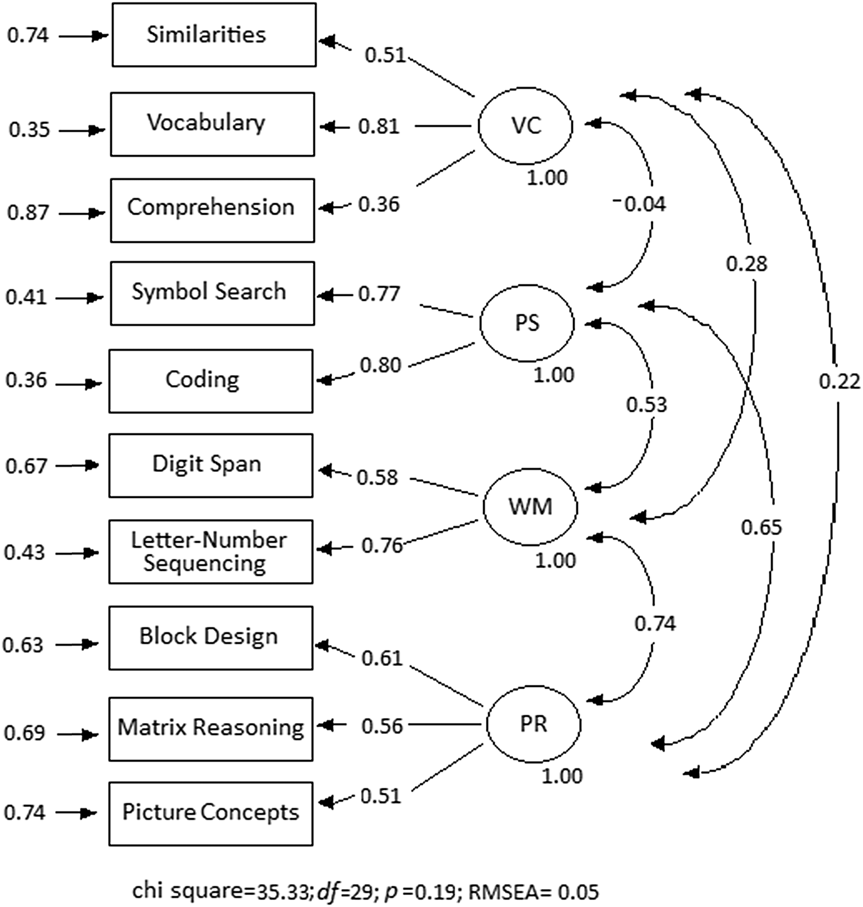
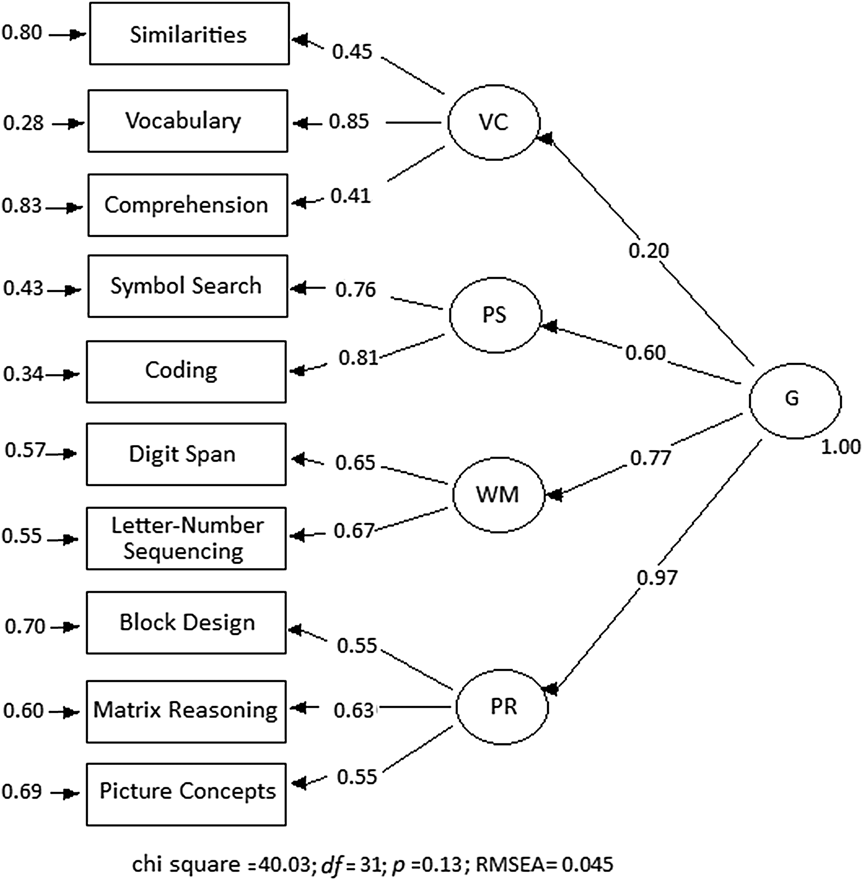
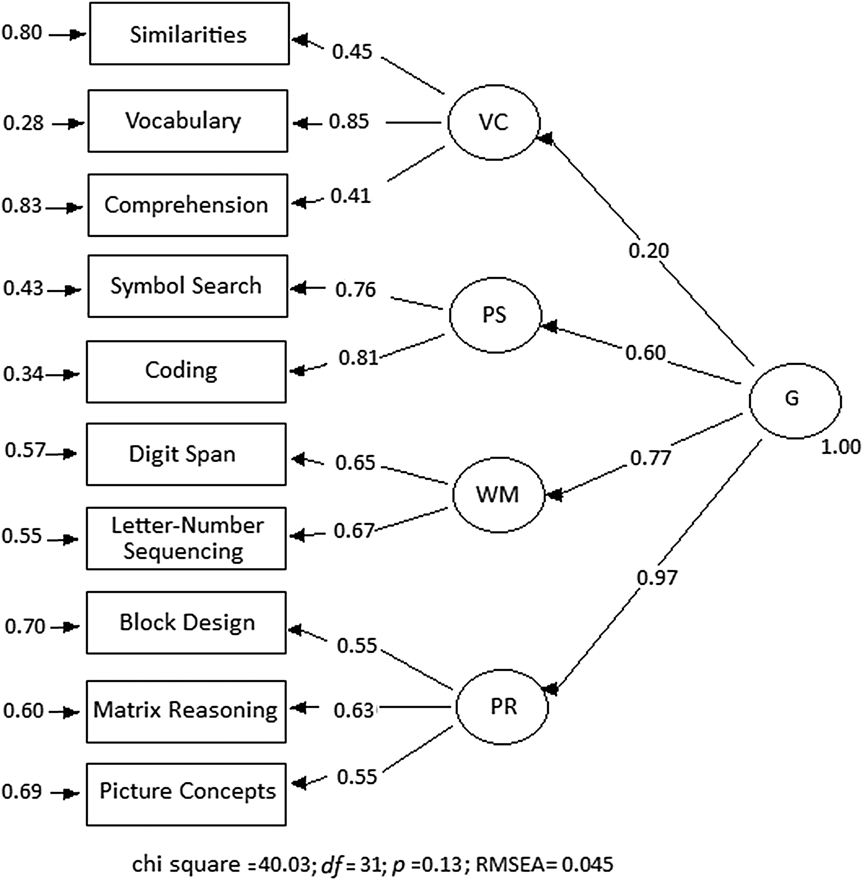
Figures 1 and 2 show the standardized factor loadings obtained in the 10 core subtests of the WISC-IV for the first-order four-factor model and for the four-factor with indirect g model. These loadings were significant in all cases, and were acceptable for both models, except for the Picture Concepts (.51 in the first-order four-factor model,.55 in the four-factor with indirect g model), Similarities (.51 in the first-order four-factor model and .45 in the four-factor with indirect g), Comprehension (.36 in the first-order four-factor model and .48 in the four-factor with indirect g model) and Block Design (.55 in the four-factor with indirect g model) subtests.
Four-factor model of the confirmatory factor analysis.
Note: VC = Verbal Comprehension; PS = Processing Speed; WM = Working Memory; PR = Perceptive Reasoning.

Four-factor model and second-order factor in the confirmatory factor analysis.
Note: VC = Verbal Comprehension; PS = Processing Speed; WM = Working Memory; PR = Perceptive Reasoning.
In relation to the standardized factor loadings, the two-factor GAI model always provided significant loadings (t >1.96). These were also acceptable (near or above 0.60) in the Vocabulary, Picture Concepts and Matrix Reasoning, but were lower in Similarities (.43), Comprehension (.39) and Block Design (.39), following the trend of previous models.
The reliability of the subtests in the three most robust models was moderate, as is observed through the Squared Multiple Correlation, which shows the proportion of each of the models’ explained variance. In the two-factor GAI model they were: Block Design (.15), Similarities (.18), Picture Concepts (.40), Vocabulary (.78), Matrix Reasoning (.48), and Comprehension (.15). For first-order four-factor model they were: Block Design (.37), Similarities (.26), Digit Span (.33), Picture Concepts (.26), Coding (.64), Vocabulary (.65) Letter-Number Sequencing (.57), Matrix Reasoning (.31), Comprehension (.13), and Symbol Search (.59). For the four-factor with indirect g model they were: Block Design (.30), Similarities (.20), Digit Span (.43), Picture Concepts (.31), Coding (.66), Vocabulary (.72), Letter-Number Sequencing (.45), Matrix Reasoning (.40), Comprehension (.17) and Symbol Search (.57).
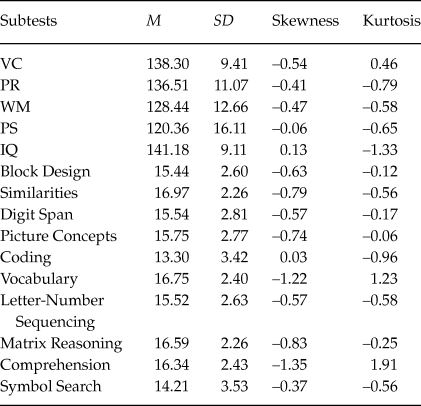
The distribution of indexes and subtests analysis showed a slight skewness and kurtosis, where the subtests with a more pronounced skewness and kurtosis were Vocabulary and Comprehension (see Table 3).
Descriptive Statistics, Skewness and Kurtosis of the WISC-IV Subtests

Note: VC = Verbal Comprehension; PS = Processing Speed; WM = Working Memory; PR = Perceptive Reasoning.
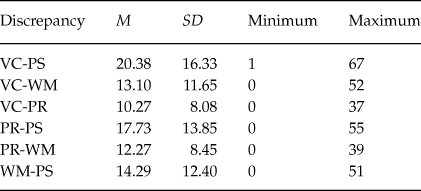
Regarding the second objective, verifying whether there were discrepancies between different indexes obtained on this scale, the data showed the existence of such discrepancies. Thus, there was an average difference of 20.38 points between Verbal Comprehension and Processing Speed. Similarly, an average difference of 17.73 points between Perceptual Reasoning and Processing Speedwas observed (see Table 4). Of the four indexes, Verbal Comprehension appeared as the most discriminative indicator of giftedness, with Perceptual Reasoning being the second. Meanwhile, Working Memory, and above all, Processing Speed, showed a lower score (see Table 3). Finally, the frequencies analysis showed that 43.7% of participants had discrepancies between Verbal Comprehension and Processing Speed greater or equal to 23 points, and 34.5% of participants showed discrepancies between Perceptual Reasoning and Processing Speed.
Discrepancy Values Analysis between the WISC-IV Indexes
Note: VC = Verbal Comprehension; PS = Processing Speed; WM = Working Memory; PR = Perceptive Reasoning.
Discussion
The usefulness of the WISC-IV for the diagnosis of intellectual giftedness depends largely on whether the validity construct of this scale is maintained for this population.
Given the divergent results obtained in the studies on the factorial structure of previous versions of the WISC, this paper has analyzed five structural proposals to clarify how the Spanish intellectually gifted children perform the WISC IV subtests: a two-factor Verbal-Manipulative model, a two-factor model according to GAI subscales, a four-factor first-order model, a four-factor model with g as a direct factor and a four-factor model with g as an indirect higher-order factor.
The confirmatory factor analysis performed yielded that the two-factor Verbal-Manipulative model could not be sustained. This result is similar to that obtained recently by Rowe et al. (Reference Rowe, Dandridge, Pawlush, Thompson and Ferrier2014) in their exploratory factor analysis performed on gifted children. This could be due to the discrepancies between the subtests’ scores, typical of these children. When this two-factor model is defined, the Verbal factor is composed of the Verbal Comprehension (which usually yields high scores) and Working Memory (which typically yields lower scores) subtests. The same applies to the second factor, which groups the remaining subtests, three of them with very high scores (belonging to Perceptual Reasoning) and two with much lower scores (corresponding to Processing Speed).
Out of the four models that showed a sufficient fit, the three most robust models can be looked into: the two-factor GAI model, the first-order four-factor model and the four-factor with indirect g model.
In reference to the subtests, Block Design, Similarities, Picture Concepts and Comprehension presented low loadings in more than one model. This could be explained through the contents of these subtests. Thus, it has been found that these tasks saturate on several factors according to different exploratory factor studies on the WISC-IV and earlier versions of the scale (Rowe et al, Reference Rowe, Dandridge, Pawlush, Thompson and Ferrier2014; Watkins et al., Reference Watkins, Greenawalt and Marcell2002). Specifically, the Block Design subtest has a great influence on Processing Speed because it limits the time the subject has to perform the task. Similarities and Comprehension, besides being Verbal Comprehension tasks, could be related to Working Memory and Perceptual Reasoning. The Picture Concepts subtest prompts ideas stored in memory and perhaps related to the vocabulary that the child understands. This aspect should be studied in subsequent research, as the possibility of using subtests as evaluation instruments of various indexes could be considered.
Moreover, previous research on the use of the WISC-IV on samples of gifted children have raised a debate about its validity as a full scale. The existence of a unitary construct of intelligence is questioned due to the disparity in scores between the four indexes that characterize these children’s profiles in the WISC-IV. However, from the analysis of the five factor models presented, the validity of this instrument to measure intelligence in Spanish children with intellectual giftedness has been verified. This result is consistent with the results of Rowe et al. (Reference Rowe, Dandridge, Pawlush, Thompson and Ferrier2014), who have also concluded that the first-order four-factor model that answers to the original structure of the WISC-IV is the most acceptable solution for gifted children. In turn, according to this present study’s data, the second-order factor that unifies the four indexes could be considered as “General Intelligence” (or g), as a superior construct that validates the use of the scale as a whole.
As has been observed consistently, there is a particular profile for this type of participants, where the Working Memory index and, especially, the Processing Speed index obtain significantly lower scores than the other two indexes (Rimm, Reference Rimm2006; Rimm et al., Reference Rimm, Gilman, Silverman and VanTassel-Baska2008; Wasserman, Reference Wasserman2006; Wechsler, Reference Wechsler2003b). In this sense, the data from the discrepancies analysis corresponding to the second objective of this study corroborate the existence of that profile. Specifically, this group of participants would be situated at the 99th percentile, both in Verbal Comprehension and Perceptual Reasoning, with a clear identification of giftedness, whereas in Processing Speed, they would be situated around the 91st percentile. These results are consistent with those obtained by Rimm (Reference Rimm2006), who reported discrepancies of 18.1 points between Verbal Comprehension and Processing Speed. Moreover, Rimm et al. (Reference Rimm, Gilman, Silverman and VanTassel-Baska2008) obtained an even higher discrepancy (27.4 points) between these same indexes. Similarly, Wasserman (Reference Wasserman2006) found that 70% of students who tried to gain access to giftedness programs in the United States had average or low scores in Processing Speed.
In relation to the frequency of discrepancy analysis, it was observed that 43.7% of children assessed with the WISC-IV obtained a discrepancy equal or greater than 23 points between the highest scoring index (Verbal Comprehension) and the lowest (Processing Speed). These results are higher than those obtained in the adaptation to a Spanish sample (Corral et al., 2005, cited in Wechsler, Reference Wechsler2005), where only 23.10% of the cases with an IQ greater or equal to 120 presented such discrepancies. Therefore, it can be said that these discrepancies become larger with increasing IQ, which is in conjunction with the Law of Diminishing Returns (SLODR; Spearman, Reference Spearman1927; Abad et al., Reference Abad, Colom, Juan-Espinosa and García2003; Facon, Reference Facon2003a; Reference Facon2004; Reference Facon2006; Jensen, Reference Jensen2003; Reynolds et al., Reference Reynolds, Hajovsky, Niileksela and Keith2011).
Furthermore, if Flanagan and Kaufman’s (Reference Flanagan and Kaufman2004) criterion is followed, the full scale IQ scores of the children that in this study have shown 23 or more points of discrepancy (38 children) between these indexes should be considered with caution, or even revised using the GAI. However, it should be mentioned that the average IQ of the children participating in this study is considerably higher than those observed in previous studies, which, in spite of the influence of the discrepancies in the IQ scores of these children; remains high and demonstrates their intellectual giftedness.
In conclusion, it can be assumed that the validity of the general second-order factor or g obtained justifies maintaining the Working Memory and Processing Speed indexes, as there is not enough evidence to eliminate them. Furthermore, according to the results, the four-factor with indirect g model, as second-order factor, is superior in terms of the parsimony (PGFI) index and it is the only one with acceptable residuals in all cases, implying that most of the theoretical relationships between variables and factors have been identified. Faced with this quality of the four-factor with indirect g model, no advantage lies in ignoring any index scores that GAI removes. In turn, it is noteworthy that Rowe et al. (Reference Rowe, Dandridge, Pawlush, Thompson and Ferrier2014) did not find the GAI model structure in their exploratory factor analysis and that it was precisely the Working Memory index which emerged first and obtained a higher percentage of explained variance.
Furthermore, since this particular score profile (higher in Verbal Comprehension and Perceptual Reasoning, and lower in Processing Speed and Working Memory) systematically appears in children with giftedness, the use of this information could prove to be a useful trait to aid diagnosis, because it is an extra characteristic that distinguishes these children from those that simply have a high IQ or a high score in any of the indexes. Confirmation of a single second-order factor verifies the validity of the scale even for different profiles such as those of gifted children.
Moreover, it is important to highlight the peculiarity of these children’s score profile as it suggests how they face their daily problems. That is, scoring significantly lower in Processing Speed than in the other indexes suggests that children face the tasks in the scale in a more reflective way. It is reasonable to believe that this behavior would be transferred to other similar situations occurring outside the evaluation environment.
Successive studies should replicate these analyzes, comparing them with other population groups, such as individuals with medium intelligence, or groups organized according to certain IQ ranges, in order to see how the factorial structure shown in this study varies as the sample approaches average IQ levels.
The main limitations of this present study relate to the sample size. Therefore, it would be appropriate to confirm the findings in subsequent research, in which not only would it be necessary to increase the number of participants, but also take into account different age groups (including children aged between 13 and 16 years, which has not been possible in this study) and IQ ranges. In turn, it would be appropriate to include the supplementary WISC-IV tests in the analysis and check how they fit the proposed models.
This work was supported by the Spanish Ministerio de Ciencia e Innovación. Projects in non-oriented fundamental research, Ref. PSI2011.24370.