Introduction
A major stream among existing works on the politicization of labor in the developing world highlights a strong link between the power of the elite and the incorporation pathways of unions, mostly based on evidence from Latin America (Valenzuela Reference Valenzuela1989; Roxborough Reference Roxborough1981; Collier and Collier Reference Collier and Collier1991; Buchanan Reference Buchanan1996; Mahoney Reference Mahoney2001). According to one dominant framework, state-led incorporation is likely to prevail in regions where a landed oligarchy holds a very powerful political position and enjoys considerable influence over electoral processes.Footnote 1 If the landed oligarchy is politically powerful but has limited capacity to shape electoral outcomes, then labor unions are expected to follow a party-led incorporation path, paving the way to the birth of labor-based parties (Collier and Collier Reference Collier and Collier1991). However, this theoretical framework says little about labor’s incorporation paths in contexts where no close-knit group of landed oligarchy exists. For example, during the formative years of Turkey—where landowners were not capable of fully centralizing political power in their hands—party-led incorporation attempts were blocked, and the state-led incorporation of labor ensued. This is interesting because the political party in control—the Republican People’s Party (RPP)—did not seek broader legitimacy by allying itself with a burgeoning labor movement at a critical time of state-building. What explains the reluctance of the RPP to ally with unions during the formative years of the new republic?
In this article, we argue that in the absence of a united and politically dominant landed oligarchy, the political incorporation of labor is strongly mediated by the preferences of new elites who emerge as powerful actors during the early stages of state formation. In the case of Turkey, labor’s future pathway has been largely influenced by the founders’ ideological choices over who constituted the nation. During the early 20th century, the triumph of the nationalist leaders subsequently led to a process marked by the exclusion of religious minority groups from the core group defined in the new constitution. As such, the multiethnic and multireligious composition of labor appeared incompatible with the ideology of the ruling party, whose members imagined a homogenous nation.Footnote 2
This exclusionary ideological orientation shaped organized labor’s incorporation path in later stages. In the absence of a strong alliance with a political party, the demographic composition of important workplaces marked by strong unionism began to change under the new republic. In particular, the purging of the non-Muslims crippled these unions’ capacity to recruit new members, since most union leaders were of Armenian, Greek, or Jewish origin. As the homogenization of the workforce accelerated, labor unions became increasingly dependent on the state to survive and lost their political significance during the formative years of the new republic. This process subsequently led to their co-optation and political incorporation under a state-led path.
Scholars agree that labor activism in the late Ottoman Empire was undoubtedly repressed by the republican government under the rule of Mustafa Kemal Ataturk. The question is why Turkey’s ruling elites chose to do so, instead of seeking to rally actively organized labor behind the new state in the making. It is difficult to explain this solely based on the authoritarian tendencies of the republican regime: a partisan alliance with organized labor is not an exclusive feature of democratic regimes. Arguments that highlight the structural weakness of the working population in terms of its size and militancy are also far from convincing. In fact, the 1910s and 1920s witnessed the rapid growth of labor movements organized across multiple sectors and mobilized under diverse ideological banners, especially in port cities.Footnote 3 Thus, we need to move beyond structural dynamics and pay closer attention to the ideational sources behind the party’s choice to distance itself from the labor movement.
Much of the influential research on the political incorporation of labor focuses on cases from Latin America and develops theoretical frameworks based the experiences of urban workers who rapidly moved away from rural areas controlled by powerful landowners. These explanations rest on an exceptionally rich historiography that scholars build on when writing about cases such as Argentina, Brazil, and Peru, to name a few.Footnote 4 Elsewhere, the limited availability of primary historical data poses a major obstacle for a more nuanced understanding of organized labor’s political incorporation in contexts such as South Asia, Southeast Asia, the Middle East, and Africa. In that sense, the broader generalizations derived from the experience of Latin American workers have a limited capacity to account for divergent experiences elsewhere, including that of Turkey.
Our findings also make an important contribution to theoretical debates by highlighting the link between diversity and the politicization of unions in the Global South. Going beyond labor’s resources, networks, and political strategies, we highlight the critical role of nation-building in relation to the emergence and political incorporation of organized worker unions. Unlike most cases in Latin America, the labor activism of the late Ottoman period had lost much of its vigor by the mid-1920s, due in part to a political agenda that pushed for the ethnoreligious homogenization of the labor force. Together with the political defeat of the populist tendencies within the national movement, the incorporation of labor was eventually seen as politically unfavorable under RPP leadership.
By placing the analytic focus on the late-Ottoman and early republican experience, we can probe deeper into the processes of labor organization during the first half of the 20th century and reveal how nation-building policies can become crucially linked to the political incorporation of labor unions in developing areas.Footnote 5 The analysis, based on primary and secondary sources, complements these debates by revealing the long-lasting implications of exclusionary policies on labor’s capacity to organize and mobilize.Footnote 6 In doing so, we also seek to go beyond studies that explain working class formation through the exclusive lens of materialistic conditions (Akin Reference Akın2009, 168–169).
The rest of the article is organized as follows. We first discuss existing works that problematize the political incorporation of labor and situate our argument in relation to these debates. The next section presents historical evidence from Turkey based on existing historiography and primary data, highlighting the antecedent conditions, critical junctures, and diverging paths. The conclusion discusses the long-term implications of our findings.
The Political Incorporation of Labor in Developing Areas
Political incorporation of labor refers to the legalization and institutionalization of labor unions and creation of institutionalized channels for resolving conflicts “to supersede the ad hoc use of repression characteristics of early periods” (Collier and Collier Reference Collier and Collier1991, 7). Formally, it encompasses a series of legal codes that govern trade union formation, collective wage bargaining, and industrial action. Informally, political incorporation includes a series of measures that enable worker representation within party organizations, as well as within legislative and executive domains. While in most established nation-states these schemes emerged out of intense rivalry between workers and business, the political incorporation of labor in the developing world followed a different route.Footnote 7 Across most areas in the Global South, labor became a salient actor in the public sphere either through a party-led or state-led incorporation.
The capacity of local unions to mobilize around shared goals and objectives is primarily influenced by the historical terms under which organized labor first gained ground as a relevant societal actor (Thompson Reference Thompson1963; Therborn Reference Therborn1977). An important dynamic that shapes this capacity hinges on whether unions are politically incorporated into or excluded from decision-making processes at the national level (Collier and Collier Reference Collier and Collier1991; Collier and Mahoney Reference Collier and Mahoney1997). While in some advanced democracies the historical incorporation of labor has taken place either under a societal corporatist arrangement (Schmitter Reference Schmitter1974) characterized by some form of voluntary coordination between business associations and unions (Wilensky Reference Wilensky1981; Katzenstein Reference Katzenstein1985; Thelen Reference Thelen1991) or evolved under a pluralist environment (Golden Reference Golden1986), these Northern experiences were not exactly replicated in the context of most developing countries. Across these settings, the political incorporation of labor evolved in the absence of a European-style state corporatism where the private interest groups were not strictly organized into “singular, compulsory, noncompetitive, hierarchically ordered and functionally differentiated categories” (Schmitter Reference Schmitter1974, 93).
In the context of Latin America, the type of initial incorporation (e.g., by the state or a political party) shaped the mobilization capacity of labor in the later stages. While Collier and Collier (Reference Collier and Collier1991) expect state-led incorporation to prevail in regions where the landed oligarchy enjoys a very powerful political position (Mahoney Reference Mahoney2001, 277)—as in Brazil and Chile—unusually powerful elites are not always equipped with a capacity to influence electoral politics, as in Argentina (Collier and Collier Reference Collier and Collier1991, 104). When the latter is the case, Collier and Collier (Reference Collier and Collier1991) expect party-led incorporation to prevail. For example, in the case of Argentina, the Perón government embarked on a populist inclusion strategy under Partido Justicialista (PJ) as the government turned away from an elitist-liberal nationalism toward a popular nationalism (vom Hau Reference Hau and Matthias2008).Footnote 8 This added a new impetus to the political incorporation of labor under a party-led coalition and turned unions into significant actors with plenty of influence in policy-making processes. In other cases where a heterogenous oligarchy was able to garner considerable political power—as in Peru—the political incorporation of labor was also initiated by a labor-based political party (Alianza Popular Revolucionaria Americana, APRA). In contrast to a more diverse ethnic composition of worker unions in Argentina, white and mestizo Peruvians were identified as those that constituted the privileged core of a new nation state in the post-independence era, which included membership in labor unions (Drinot Reference Drinot2011).
However, this theoretical framework’s predictive power reaches its limits when tested across cases beyond Latin America. For example, in Turkey where landed oligarchs were unable to monopolize political power during the late Ottoman and early republican era, the political incorporation of labor was subdued along the broader goals of state-building following the collapse of the Empire. The ruling political party curiously refrained from allying itself with the emerging labor movement in the early years of the republic. This leads us to unpack the ideational motivation behind the labor incorporation trajectories. In the absence of politically powerful landed oligarchy, the political incorporation of labor in other areas is strongly influenced by the dominant elite’s ideology. In most Latin American cases with a history of party-led incorporation, an incipient populist movement informs policies that promoted the political incorporation of labor. By contrast, in early republican Turkey, debates on populism were strongly linked to discussions over who constitutes a nation with an exclusionary angle.
Exclusionary nation-building policies may paralyze incipient labor organizations and prevent them from developing effective strategies to recruit new members, organize across multiple sectors, and build a critical capacity for negotiation. This is because identity-based divisions where one group is favored over another harm the development of class-based solidarity networks and reduce trust among the rank and file. When the activists come from a minority background, the rulers with an exclusionary orientation may appeal to ethnic or religious majority to repress critical voices and thereby legitimize their choice in the name of defending the interests of the nation. Thus, the weakening of class-based ties may propagate new forms of division, especially when workers face multiple challenges under policies that repress and isolate them. Under these circumstances, the political party at power is not compelled to build an alliance with labor unions since it can control and depoliticize labor unrest much easier by way of imposing strict legal barriers on labor mobilization, such as the banning of strikes, limits on union membership terms, or abolishing collective bargaining rights. This paves the way to the further weakening of labor when workers remain permanently silenced under an apparatus that closes off the executive domain to class-based representation.
Methodology and Case Selection
To elucidate the link between an incumbent party’s ideological orientation and the political incorporation of labor, we focus on a single, exploratory case study using process tracing. This allows us to identify the causal mechanism at work while generating new hypotheses to be tested across a larger sample (Gerring and Cojocaru Reference Gerring and Lee2016). The period of late Ottoman and early republican Turkey offers a unique opportunity to unpack this process because it serves as a critical juncture that paved the way to state-led incorporation of labor, with notable implications on the relationship between unions, employers, and the state in later stages. Based on existing historiography and circumstantial primary data, we reveal—step-by-step—how the founders’ preference for ethnoreligious homogenization stifled a growing multiethnic labor force where workers coming from a minority background systematically disappeared from the rank and file.
We choose to probe deeper into the early Turkish experience because until the end of the 19th century, the economic development trajectory appears very similar to most Latin American cases. The late Ottoman Empire was a peripheral economy where production was dominated by agriculture until the end of the 19th century. Later, growing integration with international markets and the increasing impact of European economic dominance boosted agricultural production for exports. In addition to the provincial towns and cities, commercialization of the agricultural sector went hand in hand with the rise of port cities, including Istanbul, İzmir, Salonika, and Beirut.Footnote 9 These cities emerged as important urban centers and economic hubs that served a growing network of international trade.
The second half of the 19th century saw the growth of industrial workers. A major driver of this process was the inflow of a substantial amount of foreign direct investment. Thus, ports and railways received the highest share of direct capital investments—which seemed of great importance for the integration of the Ottoman economy with the world markets (Pamuk Reference Pamuk1994, 71–92; Quataert Reference Quataert1987, 18–22).Footnote 10 European firms and holding companies made investments in urban public utilities as well. Like their counterparts in Latin America, a considerable proportion of these investments concentrated in sectors such as transportation and water supply, as well as gas and energy production. This was also accompanied by a similar expansion of the labor force with experts and workers from Europe (Martykánová and Kocaman Reference Martykánová, Kocaman, Roldán, Brauer and Rohbeck2018), in addition to the diversification of the ethnoreligious composition of the local workers, including non-Muslim (gayr-i müslim) workers of Orthodox, Catholic, and Jewish confessions. While estimates on the size of the industrial labor force in the late Ottoman period are unreliable, a population census of 1894–1895 classified 186,000 people as workers (amele) (Makal Reference Makal1999, 40).Footnote 11 According to another source, there were approximately 400,000 workers in Ottoman domains as of 1910. 23,000 of them were in Istanbul and 275,000 in Anatolia. 165,000 waged workers were employed in the weaving sector. The overall number for industrial workers was estimated at 256,855 in 1927 (Akkaya Reference Akkaya2002, 136). Most of these workers were employed by the joint-stock companies owned by European capital groups in railways, public utilities, mines, tobacco industry, and manufacturing sectors. Just like in Latin America, initial labor activism emerged across these industries.
This is where sectoral similarities end and divergences become starker. On the one hand, in Latin America, the working-class mobilization emerged amid a political struggle between the big landowners and the new political elite in the early 20th century. For example, in Argentina, prior to Juan Perón’s rise to power, a fast-growing labor movement began to take hold of urban areas, organized mostly in the private sector (Collier and Collier Reference Collier and Collier1991; Etchemendy Reference Etchemendy2011). However, unlike in North America and Western Europe, the unions lacked power to effectively negotiate with business and contribute to the birth of a European-style state corporatism. Still, these entities were politically important for burgeoning parties that challenged the establishment. In Argentina, Perón saw a major electoral opportunity as the numbers of unionized industrial workers grew rapidly, initiating the pathway to incorporate labor as a major political ally of the Partido Justicialista (PJ) as opposed to political parties that had support from the landed oligarchy. Eventually, under Perón’s populism, labor unions became part of decision making under a nonhierarchically organized, left-populist party (Collier and Collier Reference Collier and Collier1991; McGuire Reference McGuire1992; Levitsky Reference Levitsky2003).
On the other hand, the labor movement in Turkey emerged amid a different political struggle. In the absence of a powerful landed oligarchy, the nationalist leadership emerged as the dominant group with considerable say on the state-building process as the Empire crumbled. This was substantially characterized by a strong preference for Muslim economic actors under the official ideology of Turkish nationalism (Aktar Reference Aktar2001; Koraltürk Reference Koraltürk2011; Bali Reference Bali and Ozyurek2020). While the religious preference was not officially enshrined in the constitution, the religious identity was de facto designated as a marker of privilege to have access to public and private goods. Thus, as urban areas in the Ottoman Empire also witnessed the birth of multiple labor organizations during the early industrial era (Yıldırım Reference Yıldırım2013), workers were later divided along emerging fault lines after the regime change and the birth of the Turkish republic.
More importantly, unlike in Latin American cases where exclusionary policies were contested by the unions, the labor movement in Turkey took a more acquiescent stance as RPP proponents worked for the ethnoreligious exclusion of minorities. The most prominent case in point is the General Union of Workers (Umum Amele Birliği), which operated during the formative period of the Republic of Turkey. Rather than challenging the dominant ideology that called for a homogenization of the nation, the new labor organizers endorsed a commitment to the official line and enjoyed benefits largely provided by the state. The next section unpacks the historical background of this experience in further detail.
Labor’s Ethnonationalist Path to Political Incorporation in Turkey
The Emergence of Labor Unions in the Late Ottoman Era
The rise of organized labor movements in the Ottoman Empire emerged much later than they did in Europe. During much of the 19th century, the majority of the population concentrated in the countryside, and the average peasant family unit lived at the level of subsistence. Increasing integration with international markets and the growing impact of European economic dominance promoted agricultural production for export in this period. In addition to the provincial towns and cities, commercialization of agricultural sector went hand in hand with the rise of port cities, such as İzmir, Salonika, and Beirut, as important urban centers and economic hubs that served the Empire’s growing international trade. Istanbul, the Ottoman capital city, was no doubt the Empire’s most important cultural, financial, and economic center, with a population of approximately one million at the end of the 19th century.
Ottoman craftsmen, artisans, and merchants were traditionally organized into guilds, which “acted to safeguard the livelihood of their members, restricting production, controlling quality and prices.” (Quataert Reference Quataert2005, 136). In the port cities, a considerable part of the Ottoman labor force consisted of porters, boatmen, and stevedores. Wage workers employed in industrial production constituted only a minority of the Ottoman laboring classes. Initially, industrialization was first initiated by the state, which founded large-scale factories in the late 18th and early 19th centuries to manufacture goods intended for governmental and military use (Clark Reference Clark1974, 65–66). But the workshops that employed 50 to 100 workers remained exceptional even in Istanbul, where the early industrialization efforts of the Ottoman state remained limited. Most Ottoman workers were employed by small shops that were run by a master, a journeyman, and an apprentice (Kırlı Reference Kırlı2001, 128).
The second half of the 19th century saw the expansion of the Ottoman labor force. One of the major dynamics of this process was the increasing inflow of foreign direct investment (FDI; Geyikdağı Reference Geyikdağı2011, 76–134). Given their importance for the integration of the Ottoman economy with the world markets, ports and railways received the highest share of FDI (Pamuk Reference Pamuk1994, 71–92; Quataert Reference Quataert1987, 18–22). Like Latin American experiences in Argentina, the European firms and holding companies invested in urban public utilities. Until the beginning of World War I, a considerable proportion of European capital concentrated in such sectors as transportation and water supply, as well as gas and energy production. The joint-stock companies operated by the European capital groups employed a considerable number of workers across multiple sectors. This expansion of the labor force with the influx of European capital was accompanied by a further diversification of the ethnoreligious composition of the working population (Yıldırım Reference Yıldırım2013, 73–83). Non-Muslim (gayr-i müslim) workers of Orthodox, Catholic, and Jewish confessions formed a significant part of the Ottoman labor force. According to the available statistics from 1915, Orthodox Greeks were 60% of industrial workers, Armenians 15%, and Jews 10%. In 1919, 85% of the 22,000 workers employed in the manufacturing industry consisted of non-Muslims in western Anatolia (Akkaya Reference Akkaya2002, 136). Moreover, given the dearth of trained and specialized workers in new industrial technologies, the Ottoman state invited experts from European countries (Martykánová and Kocaman Reference Martykánová, Kocaman, Roldán, Brauer and Rohbeck2018, 239–245). Similarly, foreign companies operating in Ottoman domains gave preference to European specialists for the positions that required technical and executive expertise. They also employed many foreign nationals to meet their needs for a skilled labor force (Martykánová and Kocaman Reference Martykánová, Kocaman, Roldán, Brauer and Rohbeck2018, 245–249).
During the last quarter of the 19th century, the first initiatives of unionization outside the guilds emerged among the Ottoman workers. Different groups of workers joined charity organizations and then founded social and cultural clubs as well as political associations (Yıldırım Reference Yıldırım2013, 100–107). Beginning in 1870s, workers organized strike movements in different economic sectors throughout the Empire’s industrialized areas and labor activism concentrated especially in the state-run factories of Istanbul (Yıldırım Reference Yıldırım2013, 208–230). The known examples of trade unions focusing primarily on the wages and working conditions of their members were established in the first years of the 1900s. In 1901, for example, the Society for the Felicity of Tobacco Workers (Tütün Amelesi Saadet Cemiyeti) was founded in the Ottoman-Macedonian city of Kavala. In 1905, it led one of the largest strike actions of the Ottoman workers prior to the Constitutional Revolution of July 1908 and had some 4,100 members from the Muslim, Christian, and Jewish workers of the Tobacco Régie around the time of the Revolution (Yıldırım Reference Yıldırım2013, 111).Footnote 12
The Rise of the Committee of Union and Progress (CUP)
The immediate aftermath of the Constitutional Revolution witnessed the rise of the largest wave of labor mobilization in Ottoman history (Karakışla Reference Karakışla1992). Only 92 labor strikes had occurred in Ottoman domains between 1870 and 1908 (Yıldırım Reference Yıldırım2013, 114–115). During the five months that followed the revolution, 143 strike movements broke out in various sectors of the Ottoman economy and in different parts of the Empire, including but not limited to Istanbul, İzmir, Aydın, Zonguldak, Salonika, Monastir, Beirut, and Damascus. The labor strikes of this period were, to a large extent, spontaneous actions.Footnote 13 However, benefiting from the relatively liberal political atmosphere of the post-revolutionary period, the Ottoman workers were engaged in an unprecedented movement of unionization at the same time.
Meanwhile, the socialist movement began to take root. The Empire’s Christian communities, especially the Bulgarian and Armenian communities, were the first to organize socialist movements (Tunçay and Zürcher Reference Tunçay and Zürcher2010). The Social Democrat Hunchakian Party and the socialist Armenian Revolutionary Federation had already been founded before the Second Constitutional Period (1908–1918). Additionally, the Socialist Labor Federation founded in Salonika in 1909 brought together workers from different ethnic and sectarian belongings, recruiting members from the Jewish, Muslim, Bulgarian, and Greek communities of the city (Haupt and Dumont Reference Haupt and Dumont2013). The Turkish Socialist Center was formed in Istanbul around the same time under the influence of the Bulgarian Narrow Socialists (Bulgarian Social Democratic Workers Party), recruiting members especially from the Greek Orthodox community of the city (Benlisoy Reference Benlisoy2018). Founded in 1910, on the other hand, the Ottoman Socialist Party was organized particularly among the Muslims (Tunçay Reference Tunçay2009b, 44–57).
The most important result of the Constitutional Revolution was the coming to power of the Committee of Union and Progress (CUP). The CUP became the Ottoman Empire’s most influential political movement during this period (Kansu Reference Kansu1999).Footnote 14 At the same time, it had an ambiguous relationship with the labor movements: initially, after seizing indirect control of the government, the Unionists tolerated labor strikes, partly because they did not intend to alienate the workers from the constitutional regime. However, when they concluded that the strikes threatened the public order, the Unionist began to turn against labor activism (Karakışla Reference Karakışla1992, 169–174). In October 1908, the Ottoman government issued a temporary law that restricted labor strikes in public sectors, such as railways, ports, and lighting (Gülmez Reference Gülmez1983, 1–44). After this law, labor mobilization lost some momentum, and the number of strike movements immediately declined from 143 in the first five months after the Constitutional Revolution to 65 in 1909–1911, 8 in 1912, and 3 in 1913 (Yıldırım Reference Yıldırım2013, 283).
Corporatism and the Representation of the Professions Program
Given that most organized labor in the late Ottoman period included a large number of Greek, Armenian, and Jewish workers (Akkaya Reference Akkaya2002, 135–136), the CUP was less willing to allow these groups to follow their independent agendas. As labor activism completely disappeared by the outbreak of World War I, the CUP consolidated its control over the guild associations. In addition to small shopkeepers, artisans, and various occupational groups, they organized, especially in the port cities, a significant segment of the laboring classes, such as the porters, dockers, bargemen, and lightermen, workers of shipment and unloading.Footnote 15 Particularly the Istanbul branch of the CUP played a crucial role in the reorganization and modernization of guilds into labor corporations under Unionist control. In 1915, while the upper cadres unleashed a program for the mass deportation of Armenians (Akcam Reference Akcam2012; Bulutgil Reference Bulutgil2017), the leadership of the CUP’s Istanbul branch initiated the founding of the Society of Tradesmen, a Unionist organization that centralized the administration of more than 50 guild associations.Footnote 16 In the course of World War I, a political circle associated with the CUP’s Istanbul branch formulated a corporatist political program called Representation of Professions (Meslek-i Temsil) (Tekeli and İlkin Reference Tekeli and İlkin2003). It suggested the reorganization of political and economic life based on corporations to be formed by nine occupational groups: farmers and shepherds; artisans; craftsmen; merchants; workers; officials and employees; military officers; miners; and sailors.Footnote 17
The Ottoman defeat in World War I did not allow the Representation of Professions to be implemented, but this populist program based on corporatist principles maintained its importance in the next years. Soon after the signing of the Armistice of Mudros on October 30, 1918, the CUP fell from power, and the Allied forces began to occupy Ottoman territory, including the capital Istanbul. Meanwhile, the remaining Unionist cadres took important initiatives in the organization of a resistance movement (Zürcher Reference Zürcher1984, 68–105; Tanör Reference Tanör2002). The headquarters of the movement was moved to the central Anatolian town of Ankara, where the Turkish Grand National Assembly was inaugurated in April 1920. The Representation of Professions program had considerable following among the Unionist cadres involved in the Turkish national movement (Makal Reference Makal1999, 85–96).
One of them was Numan Efendi, a Unionist worker elected to the Ottoman Parliament from Istanbul in December 1919 (Ülker Reference Ülker2019). Numan clearly subscribed to the program in question. He identified himself as a national socialist, claiming that internationalism was incompatible with the Turkish working class. He saw his election as an important step toward the formation of a truly national assembly, where all socioeconomic layers of the nation should be represented. In March 1920, Numan was arrested and then sent to exile in Malta by the Allied authorities that established military control over Istanbul, dispersing the Ottoman Parliament in March 1920. He was released in October 1921, made it to Ankara, and joined the National Assembly as an Istanbul deputy. Before Numan arrived, the Representation of Professions program had been discussed in the National Assembly during the negotiations over the Constitution of 1921 (Teşkilat-ı Esasiye) (Makal Reference Makal1999, 85–96; Akın Reference Akın1992). Although quite a few of the deputies supported it, the constitution adopted in January 1921 reflected the principles of the program that Mustafa Kemal submitted to the National Assembly, which did not make any reference to the Representation of Professions (Toprak Reference Toprak2011). This was an important turning point. With the exclusion of the Representation of Professions from the constitution, the political and ideological influence of corporatism in the Turkish national movement remained limited to a small Unionist faction. However, this faction would play a significant role in the labor activism of the last phase of the armistice period.
Numan Usta returned to Istanbul in December 1922. Before Numan’s arrival, Istanbul had seen the largest labor mobilization since the Second Constitutional Period. More than 30 strikes had taken place (Yıldırım Reference Yıldırım2013, 293–294), and there had been a general trend of unionization among the workers in the diverse sectors of the economy. The Turkish Socialist Party (TSP) had operated as a confederation of many different labor unions and associations. By the time Numan arrived in Istanbul, however, the labor movement had been in decline, and the TSP had lost control over the workers.Footnote 18 There was no longer a prominent labor organization, which had once unified a large proportion of workers under the leadership of Hüseyin Hilmi. Most labor activists were divided into separate organizations, many of which had split from the TSP. In this context Numan called for the constitution of a new labor confederation that could centralize the administration of all labor syndicates and associations.Footnote 19 This suggestion was well received. The formation of the federation initiated by Numan was to a large extent complete by the end of January 1923. There were more than 15 different labor groups involved in founding of the Federation of Istanbul Worker Organizations (FIWO, İstanbul İşçi Teşkilatları Heyet-i Müttehidesi) (Dumont Reference Dumont1997, 393).Footnote 20 Among them were the Association of Ottoman Typographers, the Association of Workers of Shipment and Unloading, the Association of Tram, Funicular and Electric Workers, the union of state-owned factory workers, the workers of Tobacco Regie, maritime workers, construction workers, dockers, the workers of Silahdarağa Power Plant, and the workers of Seyr-i Sefain Factory.
After the October Revolution of 1917, multiple communist groups had emerged in the capital.Footnote 21 Aside from bringing together the majority of the labor unions, the FIWO received the support of the communist groups operating in Istanbul. Many of them participated in the FIWO. Some of them had been directly connected with the Bolsheviks of Russia, and some of them emerged during the socialist movements of the post-revolutionary days of the Second Constitutional Period. During the armistice period, such local groups consolidated their links with various labor groups here and there. Many of them supported and took part in the labor confederation initiated by Numan Usta.Footnote 22
This initiative ended with a crackdown on the communist movement in May 1923 (Tunçay Reference Tunçay2009b, 734–741). By then the control of Istanbul had to a large extent passed to the Ankara government under Mustafa Kemal’s helm, which had succeeded in defeating the Greek Army by September 1922. Although the Allied powers stayed in Istanbul until October 1923, the administration of the city had been gradually taken over by the Ankara government. The operation against the communist cadres occurred in this context, soon after the May Day of 1923. Many of the communist leaders were arrested allegedly because of a leaflet criticizing the ruling party of the Ankara regime for defending the interests of the privileged classes.
The crackdown on the communist cadres brought about two important results. First, it confirmed that the communist movement would remain illegal under the new regime. Second, the FIWO ceased activity after the arrest of the communist cadres who formed the driving force of this enterprise. The disintegration of the FIWO should be considered a crucial turning point and a critical juncture for the development of relations between the Turkish ruling circles and the labor movement. That confederation represented an attempt on the part of a faction of the Turkish national movement to establish ties with and ingratiate itself with the existing leadership of the unions. It appears that this faction was the one subscribed to the Representation of Professions. Yet, as it turned out, the influence of this circle and its corporatist program remained weak within the national movement since the adoption of the Constitution of 1921 (Teşkilat-ı Esasiye). By May 1923, the Ankara government was dominated by an anti-communist circle that promoted ethnoreligious homogeneity as defined by a Turkish and Islamic heritage. It was this circle that not only led the liquidation of the emerging communist movement but also refrained from building any form of alliance with organized labor in the years to come.
A New State: Nationalism and Turkification
The Republic of Turkey was proclaimed in October 1923. The former political cadres of CUP that initiated the establishment of this republican regime were associated with the People’s Party, which would soon receive the name Republican People’s Party (RPP). The new regime founded by the RPP was a nation-state in which the non-Muslim communities of the Ottoman Empire, particularly the Greek, Armenian, and Jewish communities, were given minority status based on the provisions of the Lausanne Treaty, signed on July 24, 1923.
Mustafa Kemal’s understanding of the nation was “essentially anti-populist, a forward looking ideology that glorified the people (and the nation) only for what they could become in the future (civilized/western and homogenous)” (Sözen Reference Sözen2010, 7), with a strong emphasis on the Turkish and Muslim components as the common denominator of this imagined community. Thus, nation-building efforts under a Kemalist program focused on getting rid of elements that did not fit this description (Sözen Reference Sözen2010, 7), including minorities on the labor front. The new regime sought to further homogenize the nation with a population exchange agreement which gave a legal status to the deportation of more than one million Greek Orthodox individuals in exchange for a large group of Muslims and Turks (Clark Reference Clark2009). The final culmination of this was enshrined in the 1924 constitution, where the definition of Turkish nation made a clear distinction between non-Muslims and Muslims with the qualifier “yurttaşlık itibariyle” (based on citizenship), which was intended to signify that non-Muslims do not qualify as Turks that constituted the core (Dinçkol and Işık Reference Dinçkol and Işık2015, 25).
One of the crucial developments that characterized the political and ideological atmosphere of early republican Turkey was the rise of Turkish economic nationalism. The nationalist policies of this period aimed to Turkify the economy with the exclusion of foreign nationals and non-Muslim Turkish subjects from the state bureaucracy, commercial and business activities, and many other professions. The expulsion of Christians from the labor force was one of the most important aspects of the Turkification process (Alexandris Reference Alexandris1974, 106; Koraltürk Reference Koraltürk2011, 229–275). The first push for the Turkification of the labor market came from the General Union of Workers (GUW) (Tunçay Reference Tunçay2009a; Ülker Reference Ülker, Ersoy and Özyürek2017).
The GUW initially participated in the efforts of forming a larger and broader labor confederation under the FIWO. Nonetheless, the dissolution of the latter allowed the GUW to rapidly grow after the May Day of 1923. By April 1924, it had become a nationwide organization that had more than 7,000 members organized in 32 different labor associations (Tunçay Reference Tunçay2009a, 109). The establishment and growth of the GUW signified a transformation in the political orientation of the labor movement. Previously, the Turkish Socialist Party (TSP) has been the driving force of the labor mobilization until the early months of 1922. The TSP organized collective labor actions with exclusive attention to economic matters, so it did not attempt to purge Christian workers from the labor force. In fact, there were many non-Muslims who figured among the TSP’s leading members and labor activists.Footnote 23 Unlike the TSP, the GUW sought to politicize the ethnoreligious differences of the workers by launching an anti-Christian and xenophobic agitation among the Muslim workers. Hence the collective movements of the Muslim workers took a nationalist character under the control of the GUW.
However, the Turkish government shut down the GUW by the middle of 1924. We have very little evidence on the primary motivation behind this decision by the RPP government. It is very likely that the RPP leaders did not want an autonomous labor confederation despite its nationalist orientation—especially during the first years of state-building in a politically unstable environment. At the same time, such an alliance was neither necessary nor desirable from a political perspective: the legitimacy of the RPP leadership did not rest on labor’s endorsement under a one-party rule in the absence of a genuine partisan competition.
Importantly, Turkification policies did not cease after the GUW’s closure. In addition to the population exchange agreement with Greece, on the one hand, the elimination of the workers of different nationalities was often regulated by contracts signed between the foreign companies and the Turkish government. On the other hand, the purge of the non-Muslim workers of Turkish nationality, who had come to be perceived as foreigners during the transition to the national rule, did not have a solid legal basis (Koraltürk Reference Koraltürk2011, 229). They often lost their jobs due to the pressure exerted directly by the government. Hence the major economic centers of Turkey, such as Istanbul and İzmir, witnessed the expulsion of foreigners and non-Muslims minorities from the labor force in the 1920s and afterward (Aktar Reference Aktar2001).
We can observe the results of Turkish economic nationalism by looking at the latest data on the ethnoreligious composition of the labor force in Istanbul.Footnote 24 Although we lack comprehensive figures that are representative of the entire country, the composition of the labor force in major economic sectors reveal a gradual decline of the non-Muslim workers. For example, Koraltürk (Reference Koraltürk2011, 240–241) finds that the share of Muslim workers employed in the East Railway company had increased—within less than a year—from 75% in July 1923 to 91.4% in February 1924. A similar increase is observed in Istanbul Port Workers: between August 1924 and February 1928, the share of Muslim workers had moved from 74% to 86%, while non-Muslims declined from 15% to 8%. The composition of the utilities firm that supplied electricity to the city also exhibits a similar pattern: between 1923 and 1924, the share of Muslim workers increased quite substantially—from 41% to 78%—while the share of non-Muslim workers drastically decreased (see table 1). The Istanbul water utilities company experienced a similar change: between October 1924 and February 1926, the share of Muslim workers went up from 72% to 93% while non-Muslims were completely eliminated, declining from 11% to 0% within the same period (Koraltürk Reference Koraltürk2011, 242).
Workers employed in the electricity company in 1923 and 1924

Source: Data from Basbakanlik Cumhuriyet Arsivi (BCA), 230.88.15.10, 26/05/1339, 1-2; BCA, 230.27.21.8, 07/09/1924, Koraltürk (Reference Koraltürk2011, 241) and Ülker (Reference Ülker, Papastefanaki and Kabadayı2020).
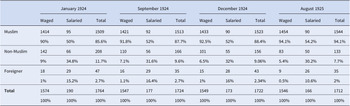
Our findings based on data from the Tram Company further reveal that this change is not limited to these sectors only. Between January 1924 and August 1925, the share of Muslim tram company workers went up from 85.6% to 94.1%, while total number of non-Muslims declined from 11.7% to 7.7% (see table 2).
The Composition of Tramway Company Employees

Source: Basbakanlik Cumhuriyet Arsivi BCA, 230.89.18.2, 24/03/1925.
The Aftermath: Etatism and Labor
By the mid-1920s, the political incorporation of organized labor through a political party was a failed project. Following the GUW’s closure, the one-party regime at power provided industrial labor with some degree of social security and relatively better working conditions compared to the earlier periods. Meanwhile, the rise of Turkish economic nationalism resulted in the further division of workers along ethnic and religious lines. A substantial part of the non-Muslim workers lost their jobs due to the Turkification policies before and after the population exchange, and a great number of Greek and Armenian workers left Istanbul (Koraltürk Reference Koraltürk2011; Ülker Reference Ülker, Ersoy and Özyürek2017). All this meant that one of the most activist segments of the working population was removed from the labor force.
Further evidence suggests that the RPP sought to control labor activism after the GUW was shut down. Initially, the party backed the establishment of a new federation of labor unions (Society for the Elevation of the Labor of Turkey [SEL; Türkiye Amele Teali Cemiyeti]) and had representatives in its central administration (Malkoç Reference Malkoç2015, 37–43). However, this attempt didn’t last long either. In February 1925, the Şeyh Sait Rebellion broke out in the Kurdish populated areas of southeastern Turkey. Thereafter the government declared martial law and silenced political opposition. Although it supported the government’s measures to suppress the rebellion, the SEL could not avoid a crackdown in this rigid political context (Çelik Reference Çelik2010, 78–79) and the federation was shut down by the government in 1928 (Malkoç Reference Malkoç2015, 43–46). The government suppressed all kinds labor activism in parallel with the gradual consolidation of the RPP’s authoritarian one-party regime. The organized labor movement which reemerged in the armistice period had almost completely disappeared.
As a result of these policies, the labor movement gradually lost its capacity to become an autonomous social actor during this period. The political incorporation of labor was interrupted during the post-1925 era, and any attempt to mobilize and organize was repressed because the political cost of an alliance with unions that wanted to retain some of their autonomy seemed rather risky. 20 years later, as Perón seized power in 1946 by rallying the support of organized workers in Argentina, labor activists in Turkey were still struggling to establish independent unions (Çelik Reference Çelik2010, 85–112). This movement in 1946 also lost its momentum, and the labor movement in Turkey remained rather docile.
In sum, the repression of Turkish labor during the early republican era under an exclusionary nation-building agenda eliminated the likelihood of a party-led incorporation in later stages and opened the path to a state-led incorporation. In 1950, the opposition party—Democrat Party, DP—won the 1950 elections, and the relatively liberal atmosphere of this transition allowed workers to establish trade unions, a process that was culminated in the formation of the labor confederation TÜRK-İŞ in 1952. While the DP allowed TÜRK-İŞ to organize and recruit many rank and file members during the 1950s, these unions were allowed to expand their operations so long as they stayed within the limits set by the government (Çelik Reference Çelik2010, 239–270). The DP chose to uphold the trade-union law adopted in 1947, which strictly forbade the involvement of labor organizations in politics. In such an environment, TÜRK-İŞ leaders subscribed to the official line and rarely challenged the status quo.
Conclusion
Unlike in Latin America, the dominance of an exclusionary nation-building agenda during the late Ottoman and early republican period explains why a populist movement seeking to mobilize workers and incorporate the organized labor did not emerge in Turkey. This is because the ruling political party was hesitant to form an alliance given the lack of congruence between labor unions’ membership composition, their demand for autonomy, and the ideological orientation of the rulers. While some union leaders indeed had a partisan link with the RPP, this did not translate into a broader alliance between union confederations and the party during the formative years of the new republic. In the absence of a major threat from a landed oligarchy, the RPP leaders faced multiple challenges to their rule—as exemplified in the Şeyh Sait Rebellion—and hardened their exclusionary stance in response. This led to an acceleration in the homogenizing tendencies in the economic domain in favor of the Muslim constituency at the expense of non-Muslims. As a result of these repressive policies, the workers in Turkey did not experience a party-led political incorporation.
The state-led incorporation of labor produced long-lasting political consequences. TÜRK-İŞ was allowed to organize and recruit many rank and file members during the 1950s, yet these unions could only expand their operations so long as they stayed within the limits of the official line. Despite the rising number of labor unions and intensification of strike movements in the 1960s and 70s, Turkish labor was, by and large, on the defensive and did not have a major clout in the legislative or the executive branch. After the coup of May 27, 1960, which put an end to the DP rule, a new period in the history of labor activism started in Turkey. In 1961, the Workers Party of Turkey (WPT [TİP, Türkiye İşçi Partisi]) was formed by a group of trade unionists soon after the new constitution was adopted. In 1967, the WPT played a crucial role in the founding of a new labor confederation, that is, the Confederation of Revolutionary Trade Unions of Turkey (DİSK, Türkiye Devrimci İşçi Sendikaları Konferasyonu) (Algül Reference Algül2015). The new confederation was much more militant than TÜRK-İŞ. Still, the links between the unions and the RPP—which had experienced a left turn by then—remained weak. In this context, the most militant labor movements focused on defending their rights to strike and unionize, as exemplified in the June 15–16 uprisings of 1970. By the end of the 1970s, the Turkish labor movement remained outside the formal channels of political influence and could not establish itself as a prominent political actor even when the militant unions, mostly involved in DİSK, were quite active. At the end of the decade, the 1980 military coup brutally repressed unions once and for all, as many activists were arrested, and others were tortured.
The political influence of Turkish labor unions has been on a downhill track since the country’s most recent transition to democracy. First, the political atmosphere remained hostile to labor when Turgut Özal arrived in office of the prime minister with his center-right political party, the Motherland Party (ANAP), in 1983. Though the military generals did not initially support Özal, the new prime minister did not face a major opposition thanks to his pro-market stance and appeasement policy toward the military. During his five years in office, former unions organized under DİSK remained banned, while the progovernment TÜRK-İŞ actively continued to recruit rank and file members. However, the TÜRK-İŞ leadership cadres had no strong ties with ANAP leaders, and the government preferred to keep unions at an arm’s length rather than incorporating them into decision-making processes. While the left-wing opposition, led by the Social Democrat People Party (SHP), appeared to be the most likely candidate to enter into a political alliance with labor, the party leadership also did not have an extensive list of union leaders as candidates on their list. This pattern remained the same in the second half of the 1990s when the SHP leadership decided to join RPP. The prospects for unions deteriorated further when the Justice and Development Party (AKP) emerged on the scene in 2002. Between 2002 and 2013, labor union density in Turkey witnessed its sharpest decline, and unions were drastically marginalized.Footnote 25 As the AKP government under R.T. Erdogan’s rule took an antidemocratic turn, there was no powerful labor confederation to stand in the party’s way to resist the executive’s increasing hold on the legislative and the judicial branches of the government.
Acknowledgements
The authors would like to thank Barry Eidlin, Matthias vom Hau, Jose Itzigsohn, Işık Özel, Yunus Sözen, and the anonymous reviewers for their comments and feedback on this article. Earlier versions have been presented at Social Science History Association 2017 Annual Meeting and Council for European Studies 2019 Conference. We are grateful to the panelists and participants for their valuable input on our work.
Disclosure
Authors have nothing to disclose.