Implications
The relationship between rabbit semen characteristics and semen fertilising ability is generally found to be weak. Nevertheless, our results obtained using a high dilution and homospermic inseminations on rabbit does not stimulated for oestrus show that a simple selection on mass motility allows increasing productivity by one rabbit born alive per insemination, when the semen shows at least a beginning of wave movement. Moreover, computer-assisted semen evaluation provides additional markers of fertilising ability (such as the percentage of rapid sperms, and the amplitude of lateral head displacement) possibly non-linearly related to fertilising ability.
Introduction
The development of artificial insemination (AI) of rabbit does in Europe was accompanied by a better understanding of the success factors of insemination related to females and males (Castellini, 2004). Fertility is highly influenced by rabbit doe characteristics, particularly their physiological status at the moment of insemination. Indeed, receptive does at insemination produce three to four times more rabbits at weaning than non-receptive ones, particularly when they are lactating (Theau-Clément, Reference Theau-Clément2007). However, regardless of the species of zootechnical interest, predicting male fertility from seminal traits still represents a challenge. In commercial rabbit farms, heterospermic pools that are prepared in rabbit insemination centres are usually used for insemination, whereas breeders practice homospermic inseminations for genetic improvement. In rabbit, it is generally assumed that the male contribution to fertility after AI with high-concentration semen doses is negligible (Piles, Reference Piles, Tusell, Lavara and Baselga2013), but it could be higher in more restrictive AI conditions. Studies of the relationships between semen characteristics and fertilising ability can be classified into two categories. Some of them are the result of a collaboration between one or several AI centres. In that case, the number of inseminations is high, the physiological status of does at the moment of insemination is generally unknown, or only receptive does are selected (by observation of vulva colour, hormonal treatment or biostimulation to induce oestrus), and insemination is done using either pools of semen from the same buck obtained on the same day (Tussel et al., Reference Tussel, Legarra, García-Tomás, Rafel, Ramon and Piles2011) or heterospermic pools (Lavara et al., Reference Lavara, Moce, Lavara, Viudes de Castro and Vicente2005). It is assumed that using heterospermic pools makes it possible to moderate the ‘buck’ effect. In these conditions, Lavara et al. (Reference Lavara, Moce, Lavara, Viudes de Castro and Vicente2005), using heterospermic pools but a relatively low number of sperms per insemination (6×10⁶ spz/dose), obtained a correlation of 0.31 between the percentage of motile sperms assessed by image analysis and fertility. Some other studies integrate the physiological status of does at the moment of insemination using homospermic inseminations (1 ejaculate/AI dose; Brun et al., Reference Brun, Sanchez, Duzert, Saleil and Theau-Clément2002). Both types of studies apply a high selection of semen, particularly on the mass motility. Indeed, the pregnancy rate drastically drops below 6, which justifies the elimination of semen under this value (Boussit, Reference Broekhuijse, Šoštarić, Feitsma and Gadella1989). In these conditions, Brun et al. (Reference Brun, Sanchez, Duzert, Saleil and Theau-Clément2002) used four genetic types (54 bucks, 216 ejaculates and 839 inseminations) to show that fertility is influenced by mass motility (microscopic observation), whereas prolificacy is more closely related to the concentration and dependent variables.
Our hypothesis was that using higher semen dilutions (1 : 19), rabbit does that were not stimulated for oestrus, and homospermic inseminations would make it easier to predict semen fertilising ability. The aim was to analyse the relationships between rabbit buck semen characteristics (microscope observations+computer-assisted sperm analysis system (CASA system)), and semen fertilising ability after insemination in these conditions. The aim was to better predict fertilising ability and, therefore, to more effectively choose semen for inseminations.
Material and methods
Animals and experimental design
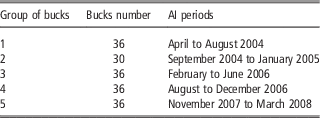
All procedures were conducted in accordance with the guidelines for the Care and Use of Animals in Agricultural Research and Teaching (French Agricultural Agency and Scientific Research Agency; approval number of the PECTOUL experimental farm: A 31 113 16). Bucks belonged to the INRA1001 strain, characterised by a heavy body weight (Larzul et al., Reference Larzul, Gondret, Combes and de Rochambeau2005) and provided by a private breeder (Hypharm, Roussay, France). Five successive groups of 30 to 36 males were used between 2004 and 2008 (Table 1). For each group, bucks were submitted to a training phase (contact with a teaser female, once a week) at the age of 21 weeks. At 23 weeks of age, the 30 to 36 males used for the study were selected on the basis of their ability to respond to semen collection. Ejaculates were collected once a week over 21 weeks with two solicitations at a 15-min interval (Bencheikh, Reference Bencheikh1995), resulting in ejaculate ranks 1 and 2. A total of 17 series of inseminations were performed to test the fertilising ability of the semen. Three successive cohorts of 220 rabbit does (INRA1077 or INRA1777 strains) were used. Females were inseminated every 42 days (single batch). Within a cohort, dead or culled rabbit does were replaced by rabbit does from INRA1077, INRA1777 or INRA2266 strains. Since the two strains, INRA1077 and INRA1777, had the same genetic origin and similar reproductive performances (fertility: 64%; live births: 8.9 and 9.0, respectively), they were considered to be the same strain (referred to as ‘77’). After kindling, free nursing was applied. The animals were housed under a continuous photoperiod of 16-h light and 8-h darkness. They were fed a commercial diet containing 175 g/kg protein and 145 g/kg fibre ad libitum. Bucks were housed in individual cages arranged in a flat deck, designed to facilitate the collection of semen. The room was heated and ventilated in winter so that the temperature did not fall below 18°C. The room had no cooling system and the maximum temperature recorded was 36°C.
Number of bucks and artificial insemination (AI) periods for the five successive groups

Male and semen evaluation
Sexual activity (libido) was estimated by the time interval between the introduction of the teaser female into the buck’s cage and ejaculation. Immediately after semen collection, pH, volume and mass motility (coded from 0 to 9) were estimated according to Brun et al. (Reference Brun, Sanchez, Duzert, Saleil and Theau-Clément2002). Sperm cell motility was analysed from a 2-ml sample after dilution (1 : 40) in Galap (IMV Technologies, L’Aigle, France) using a computer-assisted sperm analysis system (HTMA-IVOS, version 10; Hamilton-Thorne Research, Beverly, MA, USA) according to the set-up parameters of Brun et al. (Reference Brun, Theau-Clément and Bolet2006). This dilution rate is routinely used with the present CASA system to decrease the frequency of refusal of analyses due to excessively high concentrations, making it possible to limit the handling of the semen before the analysis. The minimum cell number counted was 50. For each ejaculate, two drops of 10 µl each and three fields per drop were evaluated. The operating conditions and measurements are described in the study by Theau-Clément et al. (Reference Theau-Clément, Lattaioli, Roustan and Castellini1996), following the recommendations of Boiti et al. (Reference Boiti, Castellini, Theau-Clément, Besenfelder, Liguori, Renieri and Pizzi2005). Due to the time required, the evaluation of semen concentration was delayed and performed using a Thomas-Zeiss cell counter (final dilution: 1 : 200 in sodium citrate).
Inseminations
Only ejaculates without urine, with a volume >0.4 ml, and a motility >5 were used for inseminations, consistent with the procedure usually performed in AI centres. They were diluted (1 : 19) and stored in the Galap extender until insemination. Semen from each male was packaged in 0.5-ml straws in the late morning and stored at room temperature. To limit the confusion between the effect of semen and the effect of the physiological status of does, for each series of insemination, rabbit doe receptivity was tested by presenting a vasectomised buck in the morning (receptive does will take a lordosis position). Consequently, at each insemination, females were allocated to males so as to balance the physiological status of females (lactating or not, receptive or not) between males. The consideration of receptivity is one of the unique aspects of our study. Inseminations were performed within 6 h after semen collection. One ejaculate made it possible to perform an average of seven inseminations. No hormonal treatment or biostimulation was used to induce sexual receptivity. Ovulation was induced by an intramuscular injection of 0.1 ml of Receptal (Intervet®, Angers, France) immediately after insemination.
Studied traits
The libido (s), the presence or absence of gel (0 or 1), pH, ejaculate volume (ml), mass motility and concentration (106×sperms/ml) were analysed. The HTMA variables (Boiti et al., Reference Boiti, Castellini, Theau-Clément, Besenfelder, Liguori, Renieri and Pizzi2005) were the percentage of motile sperms (Pmot, %), rapid sperms (Prap, (%) >40 µm/s), progressive sperms (Pprog, %; speed >40 µm/s; and straightness >90%), average path velocity (VAP, μm/s), linear progressive velocity (VSL, μm/s), curvilinear velocity (VCL, μm/s), amplitude of lateral head displacement (ALH, μm), beat frequency of the flagellum (Bcf, Hz), track straightness (Str=VSL/VAP, %) and track linearity (Lin, VSL/VCL, %). Some additional variables were calculated: total number of sperms per AI dose (NspzTD=volume×concentration), considered as a synthetic criterion of sperm production, and the total number of motile sperms per AI dose (NspzMD=NspzTD×Pmot), combining both qualitative and quantitative aspects of semen production. The fertilising ability of semen was evaluated after inseminations on the basis of fertility (kindling rate), prolificacy (live births, the criterion of interest to the farmer) and productivity (live births per insemination), calculated as the product of fertility and prolificacy.
Statistical analysis
To analyse the relationship between semen characteristics and fertility, prolificacy and productivity, we used an ANOVA that included the fixed effect of the physiological status of does at insemination (10 levels combining three parity levels: nulliparous, primiparous and multiparous; two levels of sexual receptivity: receptive or not; and two levels of lactation status: lactating or not), the series of insemination (17 levels) reflecting environmental factors (season, operator, buck group, cohort of rabbit does), the genotype of rabbit does (two levels: 77 and 2266), their renewal status (females in place at the beginning of the three cohorts or replacement females), and the fixed effect of semen characteristics taken one-by-one. The GLM procedure of SAS® (SAS, 2001) was used. Continuous semen variables were subdivided into three classes of similar size. Unlike linear regression on semen traits, this made it possible to take any non-linear relationship between semen characteristics and fertilising ability into account. Mass motility was divided into two classes according to the presence (score >6) or absence (score=6) of waves under microscope observation.
Results and discussion
Means and variations of reproductive performances
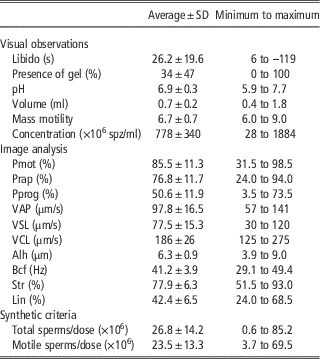
The results concerned 1970 inseminations performed on 674 rabbit does, with 275 ejaculates from 128 bucks. An average of 15 inseminations was performed per buck (7 AI/ejaculate). The number of bucks and insemination periods for the five successive groups is shown in Table 1. The elementary statistics of semen characteristics are presented in Table 2. The average fertility was 66.5±47.3%, and the average litter size was 8.8±3.8 live births. As a result, productivity was only 5.9±5.2 live births/female inseminated. These low values reflect our particular experimental conditions: the absence of induction of sexual receptivity (fertility of receptive does was 73%, whereas that of non-receptive ones was 57%), the high semen dilution and the use of homospermy. Reproductive performance varied depending on the physiological status of rabbit does (fertility ranging from 44% for primiparous, non-receptive and lactating does, to 82% for nulliparous and receptive does), the AI series, which takes environmental factors into account (fertility ranging from 54% to 75%), the genotype of rabbit does (fertility ranging from 66% to 67%) and their renewal status (fertility ranging from 60% to 73%).
Elementary statistics of libido and rabbit semen characteristics

Libido=time until ejaculation; Pmot=percentage of motile sperms; Prap=percentage of rapid sperms; Pprog=percentage of progressive sperms; VAP=average path velocity; VSL=linear progressive velocity; VCL=curvilinear velocity; Alh=amplitude of lateral head displacement; Bcf=beat frequency of flagellum; Str=track straightness; Lin=track linearity.
Influence of semen characteristics on fertility
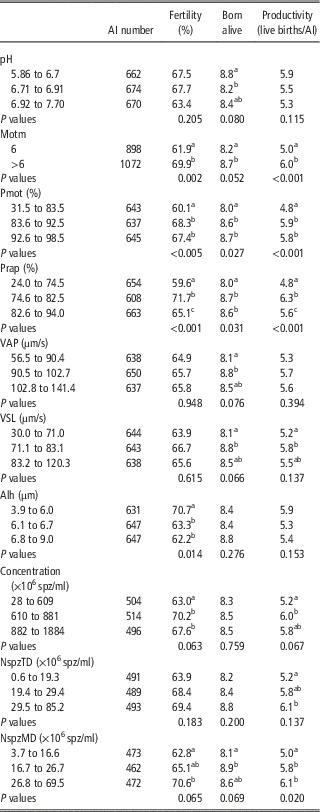
The reproductive performance for each class of semen characteristics is given in Table 3. Only the characteristics that influenced productivity or at least one of its components are reported in this table. Thus, libido, the presence or absence of gel, volume, percentage of progressive sperms, curvilinear velocity, beat frequency of the flagellum, straightness and linearity of sperm movement did not affect fertility, prolificacy or productivity. These results are in accordance with Brun et al. (Reference Brun, Sanchez, Duzert, Saleil and Theau-Clément2002). Among these semen parameters, only Lavara et al. (Reference Lavara, Moce, Lavara, Viudes de Castro and Vicente2005) obtained a negative but significant correlation between the linearity of sperm movement and fertility (r=−0.32), using heterospermic pools. In pigs, Broekhuijse et al. (Reference Boussit2011) obtained significant (P<0.05) effects of progressive motility, curvilinear velocity and beat cross frequency on the farrowing rate. Although the presence of gel plugs in the semen is a major criterion for ejaculate rejection in some AI centres (Piles et al., Reference Piles, Tusell, Lavara and Baselga2013), our results revealed that this characteristic has no effect on either fertility or prolificacy. We did not find any information in the literature on this subject and this result therefore appears to be original.
Influence of semen characteristicsFootnote 1 on fertilising ability (least square means)

Motm=mass motility; Pmot=percentage of motile sperms; Prap=percentage of rapid sperms; VAP=average path velocity; VSL=linear progressive velocity; Alh=amplitude of lateral head displacement; NspzTD=total number of sperms per dose; NspzMD=number of motile sperms per dose.
1 Only characteristics that influenced one of the criteria are presented. Means in the same column with different superscripts differ significantly (P<0.05).
In agreement with Brun et al. (Reference Brun, Sanchez, Duzert, Saleil and Theau-Clément2002), fertility was strongly influenced (P<0.001) by mass motility observed under a microscope (+8 percentage points of fertility when the semen showed at least a beginning of wave motion), by the percentage of motile cells observed by image analysis (+8 percentage points of fertility when it increased from the first to the second class, that is, from an average of 73% to 89% motile cells) and by the percentage of rapid sperms (+12 percentage points of fertility only when it increased from 64% to 79%). Lavara et al. (Reference Lavara, Moce, Lavara, Viudes de Castro and Vicente2005) obtained a significant correlation between the percentage of motile cells and the kindling rate (r=0.31; P<0.05) using heterospermic pools. For these authors, regression models including motility and the morphological parameters explained 45% of the variation in kindling rate. These results indicate that motility parameters, determined by CASA systems in combination with sperm morphology analyses, can provide relevant information about the fertilising potential of rabbit sperm. An original result in the rabbit is that the amplitude of lateral head displacement (Alh) influenced fertility negatively (−7 percentage points of fertility for an increase from 5.3 to 6.3 μm). This result is in agreement with those of Aitken et al., (Reference Aitken, Best, Richardson, Djahanbakheh and Lees1982) obtained for human sperm: the percentage of motile spermatozoa exhibiting an amplitude of lateral head displacement of <10 μm, is positively correlated with the penetrating capacity observed in vitro with a zona-free hamster egg penetration test. Indeed, a lower lateral head displacement is assumed to correspond to a higher force with which sperms enter the zona pellucida of the oocyte (Verstegen et al., Reference Verstegen, Iguer-Ouada and Onclin2002). Consequently, Alh could be negatively correlated with fertility. Another possible explanation is that Alh could be an indirect index of premature sperm hyperactivation (capacitation) and thus connected to a low fertilising ability.
Fertility was only slightly influenced by the concentration and the number of motile sperm in the insemination dose (P<0.10). However, it increased by 7.8 percentage points when the number of motile sperms in the dose increased from 11 to 38×106 sperms. This result, using homospermy, is consistent with the findings of Castellini and Lattaioli (Reference Castellini1999). Moreover, More O’Ferrall and Meacham (Reference More O’Ferrall and Meacham1968), Bencheikh (Reference Bencheikh1995), Brun et al. (Reference Brun, Sanchez, Duzert, Saleil and Theau-Clément2002) and Tussel et al. (Reference Tussel, Legarra, García-Tomás, Rafel, Ramon and Piles2011) reported a significant negative association between pH and fertility. Our experiment confirmed this association since a high pH was accompanied by a lower fertility rate, although the difference was not significant. For stallions, the sperm quality variables most highly correlated with fertility included the percentage of total sperm motility (Love, Reference Love2011).
Influence of semen characteristics on prolificacy
Prolificacy was significantly influenced by the percentage of motile cells and of rapid cells (P<0.05). Above 84% motile sperms or 75% rapid cells, an increase of +0.6 to +0.7 live births was obtained, respectively. This gain was expressed only as a trend (P<0.10) for mass motility, VAP, VSL and the number of motile sperms contained in the AI dose. Like for fertility, an increase in pH resulted in a decrease in prolificacy (P<0.10). Neither Alh, concentration nor the total number of sperms in the AI dose significantly affected litter size at birth. Our results are in agreement with those of Broekhuijse et al. (Reference Boussit2011) in pigs, revealing the significant influence of average path velocity on the number of piglets born, but in disagreement concerning the influence of amplitude of lateral head displacement, found to be significant in pigs. The number of total sperms per dose did not significantly influence prolificacy, unlike Tussel et al. (Reference Tussel, Legarra, García-Tomás, Rafel, Ramon and Piles2011) who reported a significant increase in prolificacy by increasing the number of sperms/dose from 5 or 20×106. Moreover, these authors stated that prolificacy was more sensitive to sperm number than fertility.
To model field conditions, the dilution in our experiment was fixed at 1 : 19. Consequently, the number of total sperms per dose was highly variable. It is a fact that concentration is generally not measured in rabbit farms and AI centres because it is time consuming. Moreover, spectrophotometry cannot be used because of the highly variable number of semen particles that interact with sperms for light absorption. Considering the number of motile sperms per dose, it appears that, contrary to fertility, the optimal number of motile sperms for prolificacy falls into the intermediate class (16.7 to 26.7 106 spz/ml), which seems to be in agreement with Tussel et al. (Reference Tussel, Garcia-Tomas, Baselga, Rekaya, Rafel, Ramon, Lopez-Bejar and Piles2010). This could possibly imply that a high number of sperms could have a detrimental effect on prolificacy. Nevertheless, to our knowledge, this relationship could be genotype dependent. Indeed, Bencheikh (1993) obtained opposite results depending on the strain considered. In the INRA A2066 strain, no significant correlation with prolificacy was obtained, regardless of the semen characteristic considered (volume, mass motility, pH, pmot, concentration, total or motile sperms per insemination dose). In contrast, for the INRA A1077 strain, a significant correlation was obtained between the number of live births and mass motility.
Influence of semen characteristics on productivity
Mass motility and the percentage of motile cells significantly influenced rabbit doe productivity. Thus, when the semen showed at least a beginning of wave movement under microscopic observation, or when the percentage of motile cells was >84%, an average gain of one live birth per insemination was obtained. Despite the initial selection of the semen, particularly for mass motility (Motm >5), room for improvement is still possible. Interestingly, a gain of 1.5 rabbits was observed when the percentage of rapid cells changed from 64% to 79%, whereas productivity significantly dropped beyond 83% of rapid cells, reflecting a non-linear relationship. An excessively intense metabolism could lead to an excessively rapid depletion of reserves and/or an accumulation of waste products of sperm metabolism and, consequently, to a decrease in fertilising ability. When the number of total sperms per insemination dose increased from 14 to 42×106, productivity increased by 0.9 live births/AI. In the same way, when the number of motile sperms per insemination dose increased from 11 to 38×106, productivity increased by 1.1 live births/AI. These results are in agreement with previous ones, for which productivity did not significantly increase beyond 20 million total sperms or 17 million motile sperms per dose, on a flock containing receptive and non-receptive does (Theau-Clément, personal communication). Neither pH, VAP, VSL nor Alh influenced productivity.
In an earlier study, Brun et al. (Reference Brun, Sanchez, Duzert, Saleil and Theau-Clément2002), using only microscopic observations, concluded that the qualitative criteria of the semen (motility) influenced fertility, whereas the quantitative criteria (concentration) were more closely related to litter size. Our results confirm the influence of qualitative characteristics (mass motility, Pmot, Prap and Alh) on fertility, but not the influence of concentration on litter size. Mass mot and Pmot are two measurements of motility and are highly correlated with each other (r=+0.76). As expected, their effects on productivity are similar. Consequently, in the absence of a sophisticated image analysis system to evaluate semen motility, a simple microscopic observation provides equivalent information to select ejaculates for inseminations.
Conclusion
The objective of this study was to contribute to the knowledge of the relationships between rabbit semen characteristics and fertilising ability after insemination. In order to more easily predict semen fertilising ability, the semen in our study was highly diluted (1 : 19), stored at room temperature for a maximum of 6 h and homospermic inseminations were performed on does that were not stimulated for oestrus. Moreover, the physiological status of females was taken into account in the experimental design and in the data analyses. It was confirmed that mass motility and the percentage of motile cells influence fertility, prolificacy and as a result, productivity (+1 live birth/insemination when motm >6 or when pmot >84%). This study also provides some new information. The presence of gel plugs in the semen has no effect on either fertility or prolificacy. The existence for some semen traits of a threshold beyond which productivity no longer increases (percentage of motile sperms, number of motile sperms/insemination dose) or even decreases (percentage of rapid sperms). The higher the number of motile sperms in the AI dose is, the higher the productivity will be, even if the optimal number of motile sperms for prolificacy falls into the intermediate class. In the absence of a sophisticated image analysis system to evaluate semen motility, a simple microscopic observation provides equivalent information to select ejaculates for insemination. Our study is limited to some specific semen characteristics. Further research is needed to propose new fertility markers, easy and rapid to measure, as well as inexpensive. Some new methods, including flow cytometry would be useful, although this tool is currently inaccessible and expensive for rabbit production. Knowledge about the genetic correlation between mass motility and the percentage of motile sperms and fertilising ability would make it possible to evaluate the relevancy of genetically selecting these traits.
Acknowledgements
The authors thank the technicians of the INRA experimental farm at Auzeville, J. Falières and B. Pena-Arnaud for their invaluable assistance throughout the experiments, R. Duzert and his team of data processors for their collaboration and G. Wagman for her careful revision of the English.