In November 1910 the first installment of The Camera Fiend, by E. W. Hornung, appeared in the Royal Magazine. This novel features a maniacal mad scientist—an “experimentalist”—who invents a special camera to carry out a macabre experiment. His aim is to photograph the human soul, and his method requires taking a picture at the exact moment the soul is leaving the body. The central trope invoked by the title, the idea of the “camera fiend,” unlike the mad scientist's camera-gun, is not a customized concoction. The term camera fiend was a well-worn appellation by the end of the nineteenth century that represents a specific discomfort in a contentious discourse about the appropriate use of photographic technology within the established boundaries of propriety. The label camera fiend is a cultural construction related to advancements in photographic technology that signify social interactions particularly aligned with the popularization of amateur photography in the late nineteenth and early twentieth centuries. However, Hornung's novel exceeds the conventional idea of public instantaneous photography in its representation of the villainous photographer. This character integrates his fiendish photography with a constellation of fears about scientific applications of photography—in particular the spectacular and frightening introduction of X-ray photography at the end of the nineteenth century. A focused examination of Hornung's turn-of-the-century version of the camera fiend, including its conflation with the representation of the scientist, helps illuminate the logic of threatening liminality and monstrous synthesis in the relationship between photography and existing social conventions. I argue that the novel is a radical, but not unexpected, extension of the concept of the camera fiend, depicting photographic processes that synthesize technological practices and social conventions, as with actual Victorian photographic processes, but on a more extreme scale. The exaggerated villainy of the photographer in the text renders noticeable the disruption of social boundaries and the integration of disparate cultural conversations that created anxiety about this technology. The text also proposes a solution to these cultural fears: the dénouement presents a reparative vision of conventional ideas of propriety and a reinscribing of photography within acceptable social boundaries, but it does so at a cost that is untenable.
The phenomenon of the camera fiend is a clear example of one of the many “photographies” that John Tagg theorizes—one of the “mobilizations” of the technology whose value rests in “specific practices, institutions and relations of power.”Footnote 1 These power dynamics are best understood in the context of a broader examination of social anxieties related to photography. This Victorian technology was socially destabilizing from its earliest days, though the catalyst for discreet fears have attached to different elements of photographic practice over time. Early practitioners were struck by the “uncanny,” more-than-realistic representation in photographs themselves and disturbed by the “uneasy relationship between the photograph and the photographed individual.”Footnote 2 As the technology advanced, the familiar, and highly visible, camera tripod gave way to a portable, easy-to-use hand camera that Tom Gunning notes was first called the “detective camera.”Footnote 3 The technological developments that enabled portable photography also spawned a series of patents for cameras that looked like other objects—“watches, revolvers, bags or purses, books, the knobs of walking sticks” and swept in the first wave of fears about surreptitious photography.Footnote 4 However, while critics and historians have acknowledged these anxieties about the relationship between subject and image and the right of the subject to control her photographed image, and even explored these fears as a rationale for attempts to regulate and control photographic use,Footnote 5 less attention has been paid to the role of the photographer and in particular, the intrusive, even combative, interaction signaled by the term camera fiend.
In order to understand the Victorian idea of the camera fiend, it is necessary to study the intersection of technological advancements that made amateur photography possible as well as some of the consequences of these developments. The innovations that allowed true instantaneous photography, the inheritance of Muybridge's work in the 1870s, created a range of previously unimagined subjects for the camera and for the cultural imagination.Footnote 6 These developments in photographic technology were in large part responsible for what Susan Sontag describes as “a new visual code” that expanded “our notions of what is worth looking at and what we have the right to observe.”Footnote 7 And while this expansion of the visual field was hailed with amazement and viewed as progress, these new images that froze in time motions too quick for the human eye were also discomfiting because moments that were previously invisible came into view, exploding assumptions about how things, animals, and people actually moved at high speed.Footnote 8 Through this documentation of the previously invisible, photography became another tool in the emerging attempts to understand—and control—the newly recognized, “all-pervading, invisible” world of waves and energy that natural science was beginning to discover.Footnote 9 As with other photographic phenomena, this advancement was hard to classify; it was disruptive to conventional ideas of visuality in the art world but exciting new evidence in the world of science.
When the process for instantaneous photography was further combined with the innovations of the mechanical shutter, roll film, and a development service for photographers, truly amateur photography was born. This novel and affordable photography proliferated beyond the specialized uses of science and art and became the newest fad for the public: photography enthusiasts no longer needed the leisure, space, or training to develop their own images. As one writer put it, “[T]he chief source of its [the hand camera's] popularity” is in its “power of conferring upon those quite ignorant of photographic manipulations the ability to take photographs. . . . [T]he tyro has merely to touch the button, and all the rest shall be done for him by others.”Footnote 10 Soon, other nineteenth-century fiends—the autograph-fiend, the cyclist-fiend, and the opium-fiend—had a high-tech counterpart. The term camera fiend as it was used in the last decades of the nineteenth and first of the twentieth centuries was related to these other examples of “jocular hyperbole” used to describe those “causing mischief or annoyance.”Footnote 11 But while some of these other social annoyers also perpetrated indecorous public behavior that could destabilize interpersonal interactions, improper behavior was a structural requirement only in the practice of the camera fiend. One commentator in a 1906 article defines the term camera fiend as “the popular name for the man or woman who carried a hand camera, and intruded vulgarly for the purpose of securing original snapshots.”Footnote 12 In other words, the photographer's improper behavior was necessary to the process of the camera fiend, and clearly the intrusion on the personal boundaries of the subject was unappreciated.
Yet given the vital role of socially sanctioned watching embedded in the Victorian concept of propriety,Footnote 13 it is worth differentiating this photographic practice from acceptable modes of disciplinary observation, particularly because photography is a natural extension of social regulatory and policing power in the modern “surveillance state.”Footnote 14 Unlike ubiquitous surveillance cameras in public spaces today, the social regulation mechanisms of Victorian propriety were not part of an official state apparatus. Instead, propriety was a finely calibrated social duty, and the all-seeing camera eye lacked the discrimination to perform this function properly. Victorian propriety depended, not just upon watching, but also upon turning away from moments of vulnerable intimacy and embarrassment: “The rule is imperative, that no one should see, or, if that is impossible, should seem to see, or to have seen, anything that another person would choose to have concealed.”Footnote 15 However, the eye of the camera had no such discrimination and had to be trained on the subject to take a picture; as Gunning notes, “the camera's gaze in effect broke one of the strongest behavioral taboos, that against concentrated visual attention directed at a stranger.”Footnote 16 These confrontations with conventions of propriety inherent in the process of taking pictures make the photographic practice of the camera fiend a particularly acute crucible of what Tagg calls photography's “burden of standing as a metaphor for a much more extensive pattern of social conflicts” that are “seen as threatening the destruction of existing social values.”Footnote 17 The response to this threat was public shaming expressed through the moniker camera fiend and scores of blistering editorials. This new, intrusive practice of photography in the public sphere might have withered under the harsh light of propriety's customary tools of condemnation, but the camera fiend's practice was reinforced by a commercial infrastructure. Illustrated periodicals craved surprising, surreptitious, and even scandalous photographs of the celebrity and ordinary citizen alike,Footnote 18 and that market motive proved resistant to conventional modes of social discipline.
Advertising for new amateur cameras and the market for novel images fueled the persistence of the camera fiend. Nancy West explores in detail how the Kodak's “packaging, its promotional literature, and especially its advertisements, . . . created a new kind of desire for photography,”Footnote 19 and just two years after the introduction of the first Kodak hand camera, the company was boasting in British ads that over twenty thousand Kodak hand cameras were in use.Footnote 20 Though it was by far the most popular, Kodak was not the only hand camera on the market; unsurprisingly, by the end of the nineteenth century, amateur photography was almost ubiquitous. This new photographic fad was marketed as a way to memorialize the photographer's life, and advertisements promoting photography, particularly in illustrated periodicals, were part of a recursive loop that mobilized the photographic public to buy and use hand cameras but also, potentially, to produce the content of those same periodicals, making literal the “interpretive process facilitated by magazine advertisements” that allowed readers to become “both consumers and producers of this culture.”Footnote 21 By 1890, papers like the Illustrated London News were paying for and regularly publishing photographs taken by amateurs,Footnote 22 further encouraging fiendish photographic practice and creating, as a byproduct, a competition for the most original snapshots. This emerging image market heightened the voyeuristic scintillation that made sensation fiction, penny dreadfuls, and real-crime narrativizations so popular. The camera eye, though, not only peered into previously closed spaces,Footnote 23 like private moments between lovers in the park or a family outing at the beach; it publicized them.Footnote 24 The result was twofold: the fragile boundaries of proper privacy in public spaces were dissolved, and the erosion of this boundary was combined with the documentary impulse of social observation for the purpose of entertainment rather than order.
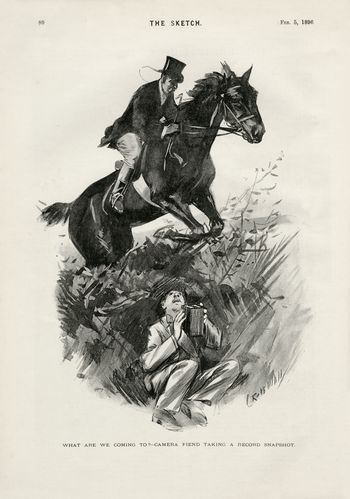
“What are we coming to?” The Sketch, 5 February 1896. Newspaper image © Illustrated London News Ltd / Mary Evans. All rights reserved. With thanks to the Mary Evans Picture Library.

A survey of articles in the British Newspaper Archive that include the term camera fiend from its first appearance in that archive in 1884 through the end of 1910 (when the first installment of Hornung's story is published) shows both an increasing normalization of some types of photography associated with the term—posed pictures of athletes before a competition, for exampleFootnote 25—and increasing discomfort and even conflict between photographers and the public as camera fiends pushed the boundaries of what was acceptable to shoot with a camera. Multiple press accounts describe the potentially severe cultural consequences of being caught unaware in the background of an image published in the press—a servant caught fibbing about her reasons for taking a day off loses her job;Footnote 26 a man pictured at the beach with a woman not his wife loses his reputation.Footnote 27 Examples like these illustrate the well-documented fear of the photographic “double”: a disassociated self that becomes an uncontrolled social agent in its own right,Footnote 28 coupled with the added anxiety that the subject may not know she was within the field of a camera eye. In her wide-ranging study of the development of the modern concept of privacy in the United States, Sarah Igo identifies instantaneous photography as one of the new tools of publicity “which flung open private life to the curious eyes and ears of others,” with notable assistance from the popular press.Footnote 29 In the United States, photographed subjects were much quicker to resort to litigation,Footnote 30 but in the UK, copyright laws drafted before the era of instantaneous photography protected the rights of photographers,Footnote 31 leaving subjects feeling frustrated and escalating confrontations between photographers and their so-called victims.Footnote 32
These examples show the intensely personal boundaries the camera fiend violated, and how that transgression was elevated to threatening levels by the evidentiary status of photographs. This feature of photography was a liability to those outed in the press by candid shots, but it was an asset to the use of photography in scientific contexts. Here, too, innovations in technology led to new applications—Muybridge's motion studies, Röntgen's X-rays, but also Galton's composite photographs. In the case of Francis Galton's work, dominant cultural assumptions were the a priori basis of the so-called science of eugenics. Galton supported his claim that he could identify innate physical traits that could be mapped onto character qualities with photographic evidence collected through his precise composite method. This proof gained social purchase because the conclusions were predetermined by the method and comfortingly conformed to familiar assumptions. In public discourse, Galton's innovative process of overlaying images to reveal dominant traits, it was thought, revealed truth, not threat.
Conversely, the photographic documentation of actual scientific discovery proved socially disruptive and a source of cultural anxiety. In late 1895 Wilhelm Röntgen published a paper announcing his discovery of a new kind of light ray—yet unnamed and termed the X-ray—that was “capable of penetrating” solid objects, showing that “all bodies possess this same transparency, but in varying degrees.”Footnote 33 Of course, the most spectacular application was to the human body: “If the hand be held before the fluorescent screen, the shadow shows the bones darkly, with only the faint outlines of the surrounding tissue.”Footnote 34 There was some apprehension surrounding the methodology behind this discovery; as Simon Avery notes in his insightful analysis of the cultural reception of X-rays, Röntgen worked on his new science secretly and in isolation, in a private lab that was part of his home, creating suspicion and unease among his colleagues.Footnote 35 These idiosyncrasies in scientific process compounded the uncanniness of the X-ray images themselves, images that were a study in the “obliteration of boundaries” separating inside and outside.Footnote 36 Röntgen's X-ray photographs were one of the “means of regaining control” over the unseen that Gillian Beer has postulated: the image becomes an artifact that can be mastered because it can be classified into new or existing systems.Footnote 37 But while there may have been some comfort in this newfound control, there was also anxiety about the process of this new technology—anxiety that was quickly combined in the cultural imagination with the work of the camera fiend.
In the popular press, X-rays were quickly colloquialized as “The New Photography,”Footnote 38 and alarms were sounded about social dangers of the X-ray process.Footnote 39 This scientific practice was refracted through the developing notion of the camera fiend as a mischievous, and increasingly malevolent, social actor. Commentators assumed fiendish photographers would misuse the new technology and bemoaned a bleak future for the concept of decency: “It is said that the ordinary feminine wearing apparel will be powerless to prevent the camera from taking any picture the operator chooses, and that the only material that will baffle the camera-fiend of the future is satin.”Footnote 40 And even those with a more realistic understanding of the science were unnerved at the thought of this capability in the hands of amateur photographers: “To have your bones photographed by the detective camera fiend . . . is a terror of civilisation arising from Professor Rontgen's [sic] new photography.”Footnote 41 Though this fearsome future was never realized, the assumption that amateur photographers would abuse the new technology were it available demonstrates the reifying cultural discourse around amateur photography as a site where conventional propriety was disregarded and boundaries ignored. This imagined future also shows a monstrous synthesis between suspect scientific practices and suspect social applications of photographic technology that excited dire fears and questioned the place of photography within established social conventions of propriety.
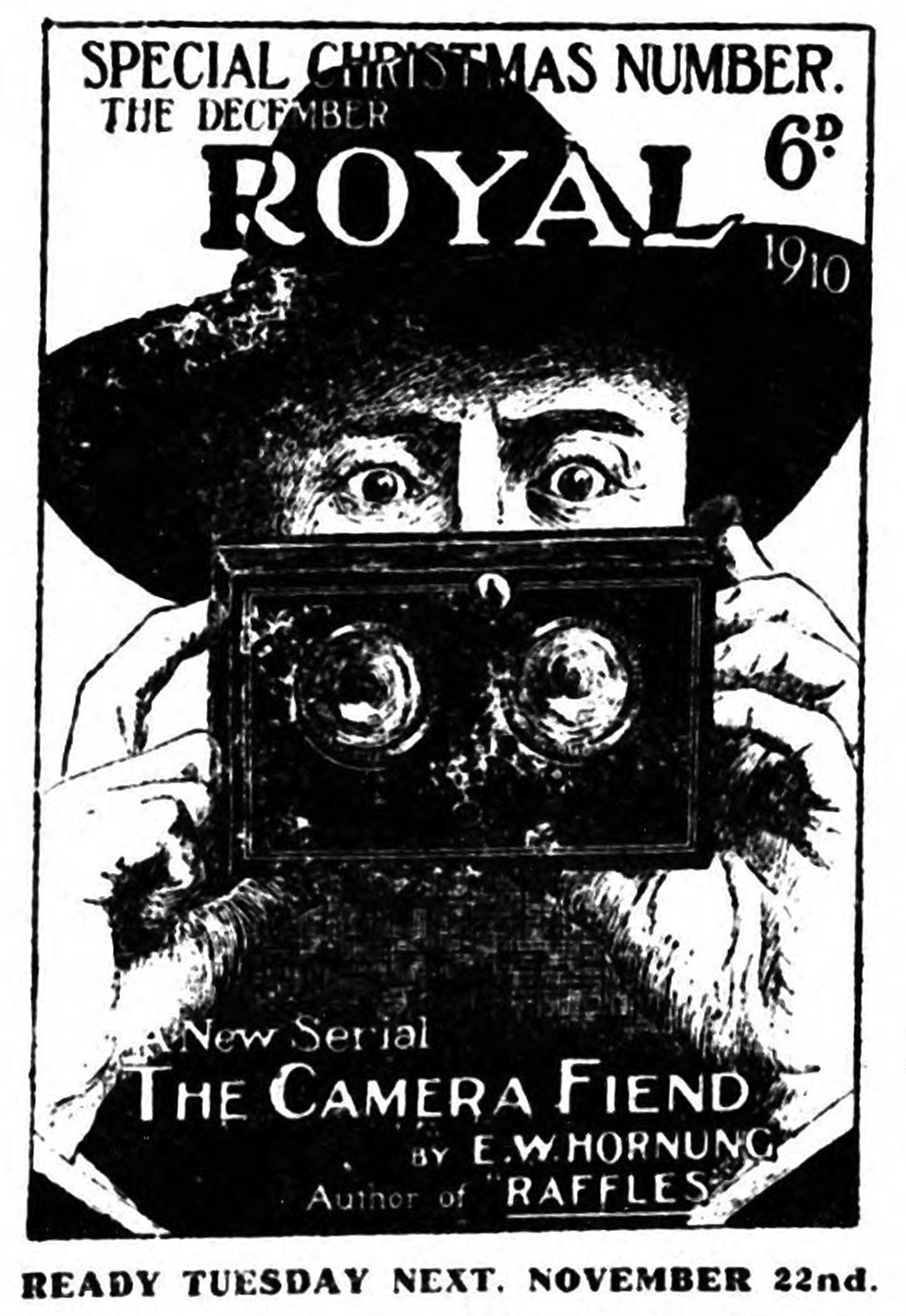
“A New Serial: The Camera Fiend,” Pearson's Weekly, 24 November 1910. Newspaper image © the British Library Board. All rights reserved. With thanks to the British Newspaper Archive (www.britishnewspaperarchive.co.uk).

This intersection of anxieties is the focus of E. W. Hornung's novel. The advertisements for the release of the first serial installment in the Royal Magazine hint at the most sinister cultural understanding of the camera fiend; they feature an image of a photographer peering over what appears to be a stereo camera and ask the question, “Have you met the Camera Fiend?”Footnote 42 Hornung's representation of the titular fiend extends a combination of cultural anxieties about popular photographic practice, technological invention, and scientific process, taking common fears to a logical but extreme conclusion through the work of the villain, Dr. Otto Baumgartner. Opposed to Baumgartner is a young amateur photographer, Tony “Pocket” Upton, a bumbling protagonist who accidentally counters the designs of the extremely proficient scientist and unexpectedly protects the villain's reputation in the dénouement. The staid, secretive scientist and the silly schoolboy are an odd duo, but their photographic practice, which initially serves as a social bond between them, also creates important distinctions between the two characters. These differences are the cornerstone of an attempt to offer a reparative view of the amateur photographer that restores the boundaries of propriety, countering the synthesis between scientific and photographic practices that endanger society.
The story begins with Upton, a petulant teenage schoolboy with health problems and a deficit of friends. Due to these characteristics and a series of semiplausible circumstances, Upton is stranded in London overnight with a pistol in his pocket and no place to sleep but a public park. He is awakened by Baumgartner, who convinces Upton that he has discharged the pistol in his sleep, killing a homeless man whose body lies nearby. In his confusion and fear, Upton accompanies the doctor home, viewing him as a rescuer and advocate. Upton's stay with Baumgartner begins as a voluntary refuge, but it becomes a compulsory prison as Upton learns more about Baumgartner's photographic experiments. Initially, Upton, an amateur photographer himself, is impressed with Baumgartner's camera and darkroom,Footnote 43 and Upton's interest in photography elicits from the scientist an explanation of his research. Baumgartner's initial explanation, that he takes portraits “in the spirit,” is dismissed by the boy, who declares that “There may be ghosts, you may see them, and so may the camera, but not without focusing and exposing like you've got to do with ordinary flesh and blood! . . . It's a question of photography, not spiritualism!” (62–63). To his surprise, Baumgartner is delighted with this exposition. The doctor's photographic pursuits have to do with scientific method, not mysticism, and the doctor invokes a notably materialist view of photography: “Think how much that glass eye throws already upon the retina of a sensitized film . . . think of all that escapes the eye but the camera catches” (64). There are unmistakable echoes of recent real-life scientific discoveries such as Röntgen's X-rays in this explanation. Baumgartner also hopes to detect and memorialize something invisible to the eye that only the camera can see—the human soul. His process for making the invisible visible certainly falls within the realm of Victorian research attempting to regain control over the unknown.Footnote 44 However, the contemporary Victorian audience would also likely judge Baumgartner's photographic process as a sacrilegious synthesis between religion and science.
Baumgartner further posits that the soul can only be photographed when it is apart from the body, which happens at two identifiable moments: the moment just before a sleeper wakes and just after a person dies. The moment of death is the most potent of these, but Baumgartner concedes that “when beloved spirits pass it would be cold-blooded desecration” to photograph them. However, Baumgartner, rather than respecting this boundary, attempts to expand the idea of what is proper: namely, he claims he has tried to “educate” the public (without success) to become inured to “psychical vivisection” (67). Specifically, he has “applied for perfectly private admission to hospital deathbeds, even to the execution-shed in prisons” but that his “applications have been peremptorily refused” (67–68). These comments reflect the public revulsion at the “disgraceful behavior”Footnote 45 of camera fiends who haunted executions and car accidents to take pictures of prone victims that would be published in the papers.Footnote 46 For the contemporary audience, these associations would have firmly dissociated Baumgartner from the role of a respectable scientist and placed him in the same category with transgressive camera fiends.
Baumgartner also escalates his confrontation with established social boundaries when he faces resistance. He transgresses the constraints of both propriety and law with his photography. But herein lies an important difference between Baumgartner and an ordinary camera fiend. One of the identifying traits of the typical camera fiend is a noted lack of technical proficiency—Kodak exploited this very trait in their ad campaign, which promised amateur users that the only skill needed was the ability to press a button. Baumgartner is not like these practitioners; rather, he is aligned with the highly proficient inventor or scientist like Galton or Röntgen who designs a custom-built apparatus to answer a specific scientific question. His specially designed instrument appears to take stereo images with its dual lenses, but the device is actually a pistol on one side and camera on the other that shoots—and then shoots—the subject. On first reading, Baumgartner's process may seem to intersect with the Victorian practice of postmortem photography. But Baumgartner's photography has little in common with the reverent death photography of the period.Footnote 47 Aesthetically driven postmortem photography is aligned with social customs surrounding death rituals and incorporated into human interaction; it is directed toward the living and memorializes the past.Footnote 48 Baumgartner practices not postmortem photography but carpe-mortem photography—seizing the moment of death—and the resulting image is, as his niece comments, “horrible”: the subject's “head,” she continues, “looks as though it were falling off!” (251). The doctor's carpe-mortem photography is aligned with scientific exploration, and while the doctor uses humans as subjects, he is unconcerned with the effects of the images in any context but as data for his experiment. His disregard of the subject's bodily integrity again aligns him with the camera fiend, but, of course, this imagined photographic practice is far more malignant than the process of actual camera fiends who were more likely to damage reputations than injure their subjects bodily.
There is, in fact, a long-standing connection between the technology of the camera and the gun and the idea of the photograph and death. In photography criticism, Sontag popularized the theoretical analogy between guns and cameras as “fantasy-machines whose use is addictive,”Footnote 49 while Barthes popularized the critical notion that photographs are “flat death.”Footnote 50 Broader theoretical readings such as these are useful tools, but they can obscure the cultural inflections of specific photographic practices. In this case, it is particularly important to attend to Victorian cultural practices because these photographic and gun technologies were not only theoretically, but very literally, linked. Daniel Novak recounts several examples of theatrical representations of photography where sitters mistake cameras for guns or the act of photography for an assassination plot: these early instances (1858 and 1862, respectively) demonstrate unfamiliarity and confusion with the function of the new photographic technology.Footnote 51 The mockery of the characters who misunderstand a new technology is a type of shaming used to separate the technologically proficient from the technologically ignorant. This discursive mechanism encouraged viewers or readers to align with proficiency in order to promote knowledge and appropriate use of new technologies.Footnote 52 By the end of the nineteenth century, there was no question that the general public understood the function of photographic technology. In this later phase of technological development, inventors deliberately modeled cameras after guns, taking advantage of the “shooting” metaphor, but also, as Jason Puskar examines in detail, emphasizing the difference between the camera and the gun—namely, the camera's capability to hunt without (physical) harm.Footnote 53 Hornung's villain exploits the cultural familiarity of the camera and takes advantage of the cultural “inattention or ‘blindness’” that accompanies the acceptance of media technologies;Footnote 54 this very property of technology diffusion allows him to approach subjects with an identifiable camera without causing fear.
The initial subjects the doctor selects for this macabre investigation are homeless “derelicts,” whom he “takes” sleeping in the park in the early hours of the morning. But after repeated disappointments, the doctor modifies his hypothesis: “I hit upon a perfectly conceivable (even though it seems willfully grotesque) explanation of my failure. What if the human derelicts I had so far chosen for my experiments had no souls to photograph?” (333). He does not question the methodology of his data collection when he cannot obtain the desired results; instead, he questions the humanity of his subjects. His rigid adherence to the idea of the infallibility of his process creates a system for classifying people based on the capacity to have a soul as a function of an innate and immutable level of morality. This idea inscribes a taxonomic principle that is at once old and new: it hearkens to the long-standing “great chain of being” philosophy, which prescribed a hierarchical order for the universe and for humanity that correlated social standing with moral and intellectual worth. It also echoes the pseudoscientific methodology of Galton's eugenics, where scores of composite portraits were taken as evidence that reinforced preconceived notions about the characteristics of cultural outsiders.Footnote 55 Like Galton, Baumgartner interprets his results along a type-based axis, but in this case, the continuum is from the soul-less, immoral derelict to a worthy moral being who possesses a photographable soul. Baumgartner concludes that in order to be successful, “I should have chosen saints instead of sinners [. . .] entities in which the soul was a major and not a minor factor” (334). In a sense, Baumgartner is a combination of the worst social fears surrounding photographic practice: he has the social aggressiveness of a camera fiend combined with the advanced technology of an inventor and the flawed methodology of a pseudoscientist.
In line with the embedded class notions of his developing theory, Baumgartner's next choice is Sir Joseph Schelmerdine, Bart. M.P., whom he lures out with the promise of taking equestrian pictures for an illustrated paper (268). His choice of a rich celebrity echoes the calculation of the ordinary camera fiend's choice of a wealthy and famous subject, and Schelmerdine's desire to be photographed for publicity carries negative connotations as well. Unlike the murders of the homeless men, this murder is reported in detail and aggressively investigated by the police, reflecting the reality of the uneven application of justice invoked in various gothic and sensation narratives in the period (e.g., Woman in White, Jekyll and Hyde, etc.). This attention of the police to Schelmerdine's death is also reminiscent of the increased social indignation at photographic incursions on the famous and powerful that delineated a scale of those most “deserving” of privacy and respect that was unquestioningly mapped onto existing notions of class status.Footnote 56 Despite the outrageous extreme of murder-by-camera depicted in the text, the photographic practice of the villain is not entirely novel in relation to the cultural context of the camera fiend.
While Baumgartner's photography exaggerates and reinforces the perceived danger of public amateur photography, the novel also offers considerable salve to the anxieties created by the camera fiend. In part, reassurance is accomplished by the providential overthrow of the fiend. Baumgartner's scheme is unraveled by a boy who is an amateur photographer who uses the technology much differently than the mad doctor. Upton is sickly and unpopular but finds refuge in his photographic hobby; it is, he says, “the only thing I have to do instead of playing games” (58), and he readily admits that he often takes portraits of his friends (61). Upton's interest in photography offsets the frailties that prevent him from being a more active participant in the world around him. The stationary observation required for taking pictures suits him perfectly, and the technology could almost be seen as a prosthetic extension that allows Upton some positive, participatory engagement in society. Upton's mode of taking consensual images of friends is a socially productive practice that bonds people and promotes interaction. And though Upton does not have an instantaneous camera, he is also not technically proficient, blundering his way through the darkroom process and accidentally destroying key evidence on multiple occasions (247, 317). Through these two opposed representations of photographers, a clear dichotomy is drawn that separates the socially productive, if technically limited, behavior of the photographic hobbyist from the destructive activities of the technically proficient camera fiend's scientific investigations. The doctor's overreaching proficiency is critiqued through his failure to achieve results and the ease with which his technology is ruined. Upton's heroic actions, conversely, foster a positive view of technology as it functions for Upton, echoing descriptions of the “healthful influence” photography could have on the amateur practitioner when practiced within the boundaries of decorum.Footnote 57
Another reassuring element of the novel is that the doctor's scientific theory and photographic practice is the foundation for the destruction of the camera fiend himself. Once the doctor decides that he needs a worthier subject to capture the image of the soul he seeks, he struggles to identify an appropriate person to photograph. Baumgartner admits in the confession he leaves behind that it would be wrong to rob society of the kind of socially productive member who would have a photographable soul (334). The only logical conclusion that he sees in his hubris is to take a picture of himself. This decision destroys the fiend, and the method he uses to take the photograph also endangers the image he sacrifices his life to create. Baumgartner intends for the camera to be found and the photograph of the moment of his death to be developed after his demise. He is confident that this final photograph will vindicate him by providing proof of his theory. In a rare failure of the doctor's technical proficiency—or perhaps his common sense—Baumgartner poises the camera on a bridge rail, and the recoil from the gun causes the camera to fall into the Thames when the picture is taken. The device is further hidden by the incoming tide. These self-inflicted damages might have been the end of the story, but this destructive note is offset by an attempt at a constructive ending. Upton and Baumgartner's niece, Phillida, who predictably becomes Upton's romantic interest, deduce that Baumgartner had the camera with him. They recover it when the tide recedes, and Upton realizes that the water-tight negative should be intact and able to be developed. But, true to form, Upton accidentally exposes the negative, which was “otherwise uninjured” (317). Baumgartner's sacrifice on the altar of science is in vain, and the amateur photographer destroys the new technical process the doctor attempted to create. Notably, this act of inadvertent destruction also preserves the possibility that Baumgartner's final attempt was successful. More importantly, though, it is an important step in a reparative vision of propriety in the age of the camera fiend.
At the end of the novel, Upton and Phillida work to restore Baumgartner's reputation: they destroy all evidence of his experiments and confession, and even Upton's father agrees that “a man's secrets should die with him” (339–40). Rather than exposing the doctor's reputation to the publicity and scandal of the story—the story of a highly trained professional using his knowledge dangerously and a highly proficient photographer exploiting subjects’ vulnerability—Baumgartner is allowed to rest peacefully as a respected medical professional. Upton, Phillida, and Upton's father collude to protect the doctor's reputation in death, restoring a sense, not necessarily of a beautiful corpse, but of a beautiful character that is worth memorializing. This rehabilitation process is completed by a symbolic sinking of the doctor's death camera “as a body is committed to the deep” (344). This type of socially productive forgetfulness is one of the most extreme tools mustered in defense of conventional boundaries of propriety because it carries with it a steep price: criminal social harm must be forgotten as a by-product of this restoration of reputation. In this case, the cost-benefit return for the acts of erasure are dubious. Upton's bungling destruction of the photographic plate that may have contained material evidence of the soul leaves intact the boundary between the material world and the spiritual plane. Baumgartner's death-camera is deliberately destroyed for the purpose of preserving his reputation, an act that seeks to reinforce conventions of propriety that camera fiends regularly trampled. But this vision of restoration and a return to a more “civilized” era of decorum are illusory. It is unreasonable to efface evidence and leave murders unsolved in order to preserve the reputation of a villain, just as it is unreasonable to expect the acceptable boundaries of the visible social field to remain unchanged by innovations in and applications of photographic technology.
The forgetting that characters choose deliberately at the end of the novel contrasts with real-life camera fiends’ disruption of the customary process of erasure that generally accompanies the acceptance of a new technology. Baumgartner plays on what Tom Gunning, via Heidegger, describes as the transformation of technology from “the spectacular and the astonishing to the convenient and unremarkable,”Footnote 58 and what Lisa Gitelman has identified as a social “amnesia” when a technology has become so well accepted that its protocols become invisible.Footnote 59 This large-scale forgetting is the consequence of technology diffusion and acceptance, and many examples from telephones to automobiles, escalators to ATMs, fit the profile of this process of acceptance leading to a type of invisibility. The villain in Hornung's text violently disrupts this invisibility with his lethal camera-gun, but this extreme representation draws attention to the more mundane resistance of the practice of actual camera fiends to adhere to this model of erasure. The age of the camera fiend followed widespread diffusion of photographic technology, and certainly the use of hand cameras was subject to a certain type of invisibility when cameras were not recognized or were deliberately disguised as other objects. But the interaction between the camera fiends and their annoyed or offended subjects kept the social eye trained on the practice of amateur photography and kept photographic technology the focus of lively astonishment and anxiety. The cultural imagination of an X-ray camera fiend peeping under ladies’ clothes or Hornung's fictional camera fiend with his deadly camera-gun are just a few signs of the ongoing social disruption.
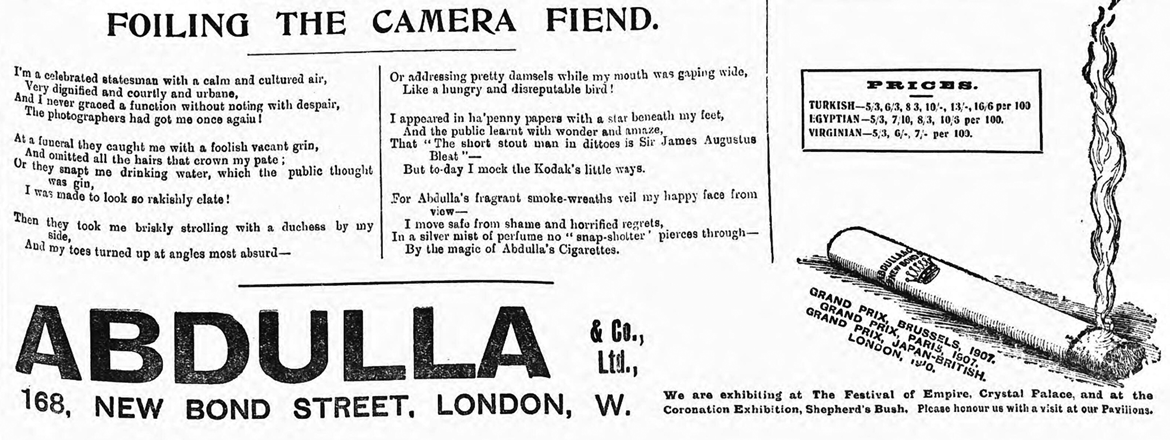
Abdulla cigarettes, Sporting Times, 29 July 1911.

What happened to the camera fiend? The work of the camera fiend at the turn of the twentieth century only intensified, despite the “extreme annoyance” of celebrities, vain wishes for legislation, and the destruction of cameras by frustrated “victims.”Footnote 60 In this era, the camera fiend was a “scourge of modern civilisation” even while it was acknowledged that “photography . . . has given civilisation another eye.”Footnote 61 This distinction between the technology and the practitioner is the same sort of distinction made at the end of the novel between the reputation of the scientist and his criminal behavior. The bifurcation of process and practitioner was a more general discursive device that was often deployed by professionals to regulate (and even exclude) the activities of amateurs.Footnote 62 The behavior of the camera fiend, though, threatened propriety and the more general practice of amateur photography, causing a further separation as “good” amateur photographers attempted to differentiate themselves from these uncouth practitioners.Footnote 63 The specialized term camera fiend signified and compartmentalized this social bad faith, creating a label that could be fought against, even as the practice itself eroded social boundaries.
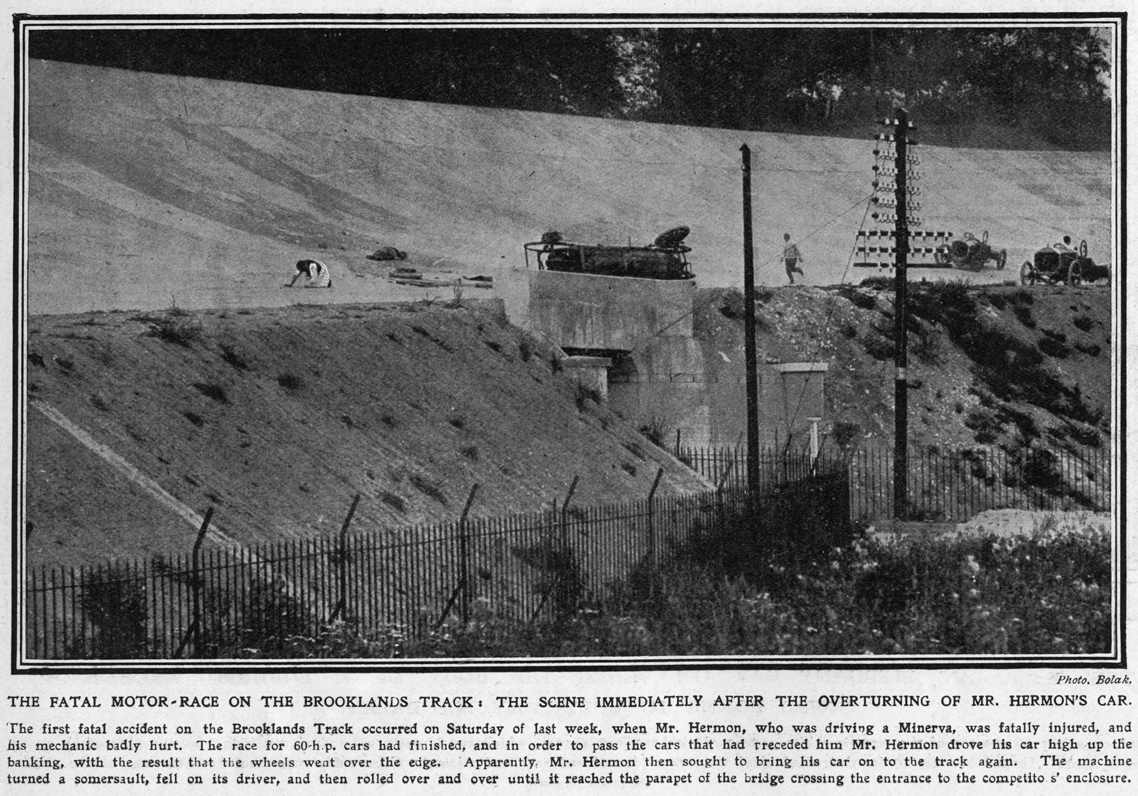
In the novel, other characters were able to restore Baumgartner's reputation by strategic acts of destruction and by using the conventional domestic space as a sanctuary of privacy. But a host of cultural factors in the Victorian period—from public divorce courts, to police detectives, to sensational media—had been eroding the privacy of that space for decades. The derisive connotations of the term camera fiend and public shaming of photographers in the columns of the popular press were the main weapons used against these invasive amateur photographers, but such tools turned out to be weapons of a bygone era. The spasm of scolding that followed the intrusive behavior of photographers after a fatal racetrack accident in 1907 rained a cascade of indignation about the “unwarrantable trespass on privacy” and “disgraceful behavior” that “transgressed all the laws of propriety and decency” and showed a “sad lack of knowing the fitness of things.”Footnote 64 But the photographs were published anyway, and the newspapers even emphasized how immediate those images were. The editorialist's hopes that “the gruesome and the sensational are . . . appealing to the reader less and less every year” were in vain already by 1907.Footnote 65
“Fatal Motor-Race on the Brooklands Track,” Illustrated London News, 21 September 1907. Newspaper image © Illustrated London News Ltd / Mary Evans. All rights reserved. With thanks to the Mary Evans Picture Library.

Today, of course, it would be odd if news outlets did not publish images of accidents or celebrities, and viewers rarely give a second thought to the most sensational images and videos being made public. So far has our tolerance developed that we use social media to out vulnerable moments of ourselves and our friends. Gitelman has identified a process of “abnegation and invisibility of supporting protocols” that signals the acceptance of new technologies,Footnote 66 and certainly today's dominant cultural assumptions about where the camera eye is welcome reflects this type of erasure. But photographic practice continues to be punctured by moments of trauma (for example, the work of aggressive paparazzi) and mistrust (the many examples of digital manipulation used to deceive). Perhaps photographic technology has more in common with Victorian travel technologies that became familiar but always remained dangerous. The anxieties around these technologies exist, as Wolfgang Schivelbusch has powerfully argued, with “a new psychic layer that obscures old fears and allows them to lapse into oblivion”—until something goes wrong.Footnote 67 Analyzing the phenomenon of the camera fiend reveals a cultural contest over the boundaries of social watching and amateur documentary photographic practice before that conflict receded into the invisibility of acceptance, and it highlights the liminality of photographic processes that made the technology a continuing spectacle and contested space that endured in public discourse long after amateur public photography was accepted. Hornung's novel uses an exaggerated representation to cast a light on fears about the monstrous syntheses—in this case between scientific and social practices—that photographic technology enabled. The irrational desire to photograph the human soul draws attention to other spectacles recorded by camera fiends that old-fashioned notions of propriety turned away from. But the commercial motivations outweighed the social invective that sought to curb the practice, and in the end, sensational images were normalized to the point that surrounding conventions of propriety and decorum expanded to accept the intrusive photographer within them. The camera fiend became merely the photographer.