Introduction
Suicide is among the ten leading causes of death worldwide, and with almost 1.5 million people dying by suicide each year, it is expected to represent 2.4% of global mortality by 2020 (Bertolote and Fleischmann, Reference Bertolote and Fleischmann2002). In most industrialized countries, suicide in older adults has increased since the 1980s (Kaplan et al., Reference Kaplan, Adamek and Rhoades1998), while older people also constitute the fastest growing population in most developed countries (Conwell et al., Reference Conwell, Duberstein and Caine2002). Therefore, the number of suicides among older people is expected to increase further in the future. Moreover, in many European countries, older men are at highest risk of suicide (Cattell and Jolley, Reference Cattell and Jolley1995) although the pattern of increasing suicide rates with increasing age was not evident in Ireland when previously examined (Kelleher et al., Reference Kelleher, Keohane, Corcoran and Keeley1997).
It has been suggested that deliberate self harm in older people can frequently be regarded as a failed suicide attempt (Dennis et al., Reference Dennis, Wakefield, Molloy, Andrews and Friedman2007). This suggestion is supported by the lower case fatality rate observed in older people. In a WHO/EURO multicenter study on suicidal behavior (De Leo et al., Reference De Leo2001), the ratio between fatal (suicide) and non-fatal (deliberate self harm) behaviors was 1:2. More recent studies from the U.K. (Hawton and Harriss, Reference Hawton and Harriss2008b) and Ireland (Corcoran et al., Reference Corcoran, Keeley, O'Sullivan and Perry2003) showed the rate ratio of deliberate self harm to suicide to decrease markedly with increasing age. The former also showed there to be a higher proportion of high suicidal intent cases of deliberate self harm in the older adults. Self harm is the strongest risk factor for suicide (Hawton and van Heeringen, Reference Hawton and van Heeringen2009) and particularly so in older people (Hawton et al., Reference Hawton, Zahl and Weatherall2003; Cooper et al., Reference Cooper2005; Hawton and Harriss, Reference Hawton and Harriss2006). This has significant implications for clinicians involved in assessment and management of patients who present to hospital due to deliberate self harm (Kapur, Reference Kapur2006; Reulbach and Bleich, Reference Reulbach and Bleich2008).
A recent review reflecting on deliberate self harm in older adults (Chan et al., Reference Chan, Draper and Banerjee2007), underlined the requirement for more population-based studies with adequate sample size. The aim of the present population-based study was to examine the incidence and nature of hospital-treated deliberate self harm and suicide mortality among people aged 55 years and older in Ireland.
Methods
Suicide data
The Irish Central Statistics Office (CSO) provided data relating to all deaths by suicide and deaths of undetermined intent (respectively, codes E950–959 and E980–989 of the Ninth Revision of the International Classification of Diseases, Injuries and Causes of Death (ICD-9)) registered as occurring from 1980 to 2006 inclusive.
Deliberate self harm data
The Irish National Registry of Deliberate Self Harm collected data on deliberate self harm presentations to all 40 hospital emergency departments (EDs) operating in Ireland in 2006–2008. The definition of deliberate self harm used was that developed by the former WHO/Euro Multicenter Study on Parasuicide (Platt et al., Reference Platt1992):
“An act with a non-fatal outcome, in which an individual deliberately initiates a non-habitual behavior that, without intervention from others, will cause self-harm, or deliberately ingests a substance in excess of the prescribed or generally recognized therapeutic dosage, and which is aimed at realizing changes which the subject desired via the actual or expected physical consequences.”
While the definition was associated with the term parasuicide, the Registry utilizes the term deliberate self harm. All data were collected and coded by trained data registration officers following the Registry's standardized methodology, described in detail in its Annual Reports (National Suicide Research Foundation, 2009). This involves the classification of the method of self harm according to the ICD-10 codes for intentional injury (X60–X84). Quality control measures include regular team meetings to reinforce the standardized application of case-definition and ascertainment criteria as well as cross-checking exercises which have shown high levels of agreement (κ statistic >0.9) and reliability across registration officers. The Registry was granted ethical approval by the National Research Ethics Committee of the Faculty of Public Health Medicine.
Setting and population data
The Republic of Ireland, with a population of 4.24 million according to the 2006 census, is made up of 26 counties and five cities. Dublin is by far the largest city and its expansion has urbanized all of Dublin county where 28% (1.19 million) of the country resides. The four other cities (Cork, Galway, Limerick and Waterford) account for 8% (0.29 million) of the country's population. There are 54 urban districts across the country accounting for almost 10% (0.40 million) of the population and the remainder of the country consists of rural districts where more than half of the country's population live (2.36 million; 56%).
Population data from the 1981, 1986, 1991, 1996, 2002 and 2006 national censuses and population estimates for intercensal years were obtained from the CSO website (http://www.cso.ie). Small-area level population data were obtained from the 2002 and 2006 censuses and aggregated to provide figures for the population of Dublin, the other four Irish cities, the urban districts and the rural districts. Population estimates were extrapolated and interpolated for the intercensal years in the period 1997–2008 by assuming that the population change between the two censuses reflected a trend that applied across the 12 years.
Calculation of rates
Annual rates per 100,000 of male and female (aged over 55 years) suicide, suicide plus undetermined deaths and deliberate self harm were calculated and age-adjusted using the European standard population (Waterhouse et al., Reference Waterhouse, Muir, Correa and Powell1976). Annual age-sex-specific rates were calculated for each five-year age group. The calculation of incidence rates for deliberate self harm only considered one presentation per person per calendar year. For 3.5% of all deliberate self harm presentations by adults over 55 years of age, no address was recorded. A further 5.5% of presentations by residents of institutions such as prisons and hospitals, by homeless people and non-residents of the country were also not included in the rate calculations by geographic area.
To help assess rate differences, 95% confidence intervals (CIs) were calculated. Assuming that the number of deaths or persons presenting with deliberate self harm (x) followed a Poisson distribution, 95% CIs for the rates were calculated using the Normal approximation, i.e. CI = (x +/− 2 * √x) * 100,000/population. The 95% CIs are presented as error bars in some charts.
Statistical analysis
Poisson regression analysis assessed the magnitude and statistical significance of rate differences and associations with sex, age group and area type. Whether associations differed due to an interaction factor was tested by fitting Poisson regression models with and then without the relevant interaction term and performing a likelihood ratio test (LRT). Rate differences assessed by Poisson regression were reported as incidence rate ratios (IRRs) with their 95% CIs and p-values. Poisson regression was carried out using Stata version 6.0 (StataCorp, 1999).
The ICD-9 external cause of death codes recorded in the mortality data for suicide and undetermined death and the ICD-10 intentional injury codes recorded in the Registry data for deliberate self harm were reclassified into comparable categories as follows: Drug overdose (ICD-9: E950.0-950.5, E980.0-980.5; ICD-10: X60-64); Poisoning, excluding alcohol (ICD-9: E950.6-950.9, E951-952, E980.6-980.9, E981-982; ICD-10: X66-69); Self-cutting or piercing (ICD-9: E956, E986; ICD-10: X78); Hanging or strangulation (ICD-9: E953, E983; ICD-10: X70); Drowning (ICD-9: E954, E984; ICD-10: X71); Firearms (ICD-9: E955, E985; ICD-10: X72-74); Other (ICD-9: E957-959, E987-989; ICD-10: X75-77, X79-84). χ2 tests were used to assess whether method of self harm differed in deliberate self harm and suicide and by gender. Whereas only one method of self harm was recorded in the mortality data, multiple methods were sometimes recorded for deliberate self harm.
All analyses were carried out for suicide deaths only and for suicide plus undetermined deaths. If it was not possible to present findings for both clearly, results from the latter were presented.
Results
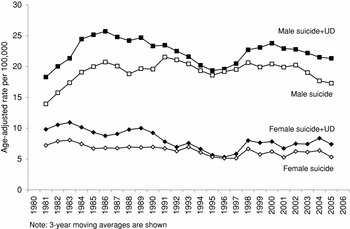
Since 1980, the female suicide rate among over 55 year-olds in Ireland has been relatively stable whereas the male rate has fluctuated (Figure 1). It increased during most of the 1980s with a decrease of smaller magnitude in the 1990s and some evidence of a further decrease in recent years. The addition of deaths of undetermined intent made a significant difference to the male and female rates in the 1980s. During the 1990s, rates of undetermined death (UD) diminished greatly but were notable again by the end of that decade.
Trends in male and female suicide and suicide plus undetermined death (UD) among over 55 year-olds in Ireland, 1980–2006

During the 10 years 1997–2006, there were 921 suicides (male: 691 (75.0%); female: 230 (25.0%)) and 175 deaths of undetermined intent (male: 110 (62.9%); female: 65 (37.1%)) among the population aged over 55 years in Ireland. The annual age-adjusted male suicide rate was 19.1 per 100,000, approximately three times the female rate (5.9 per 100,000; ratio = 3.2). The three-fold difference remained when UDs were added (male rate: 22.1 per 100,000; female rate: 7.6 per 100,000; ratio = 2.9).
In 2006–2008, 2,352 deliberate self harm presentations were made to hospital by over 55 year-olds, the majority by women (1,019 (43.3%) by men; 1,332 (56.7%) by women; sex unknown in one case). Respectively, 715, 813 and 824 deliberate self harm presentations were made in 2006, 2007 and 2008 by 592, 640 and 699 individuals. The average number of presentations per person per year was 1.22 (maximum = 13). Only one presentation per year was made by 85.4% of patients, two presentations per year were made by 11.0%, three were made by 2.2% and more than three presentations were made by 1.4% of patients. The annual age-adjusted male deliberate self harm rate was 67.4 per 100,000 (95% CI = 62.8–72.1 per 100,000). At 83.4 per 100,000 (95% CI = 78.8–88.1 per 100,000), the female rate was significantly higher (+24%).
The incidence of older male deliberate self harm was therefore 3.5 times the 19.1 per 100,000 rate of suicide and 3.0 times the 22.1 per 100,000 rate of suicide + UD. For older women, the incidence of deliberate self harm was 14.0 times the 5.9 per 100,000 rate of suicide and 11.0 times the 7.6 per 100,000 rate of suicide + UD.
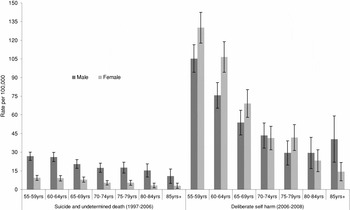
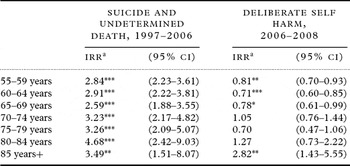
With increasing age, there was a stepped decrease in the incidence of both suicide + UD and deliberate self harm (Figure 2). The age association with suicide + UD differed significantly from that with deliberate self harm (LRT χ2 = 24.14, df = 6, p < 0.001) because older age was associated with greater decrease in the incidence of deliberate self harm. The male rate of suicide + UD was significantly higher than the female rate in each five-year age group by a ratio of 2.6–4.7:1 (Table 1). The male rate of deliberate self harm was 19–29% lower than the female rate in 55–59, 60–64 and 65–69 year-olds whereas among over 85 year-olds, the male rate was almost three times higher.
Annual age-sex-specific rate of suicide and undetermined death and hospital-treated deliberate self harm among over 55 year-olds in Ireland

Gender difference by age in the incidence of suicide and undetermined death and hospital-treated deliberate self harm among over 55 year-olds in Ireland

aIncidence rate ratio of the male rate to the female rate.
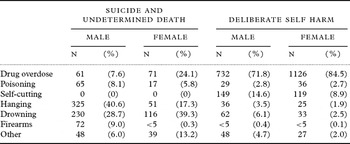
The method of self harm causing death differed significantly between men and women (χ2 = 130.2, df = 5, p < 0.001; Table 2). Hanging was the most common method used by men (40.6%), followed by drowning (28.7%), which was the most common method used by women (39.3%). Drug overdose was the external cause of almost 25% of female deaths compared to just 7.6% of male deaths. While relatively uncommon, 9.0% of the male deaths involved firearms as opposed to just 0.3% of female deaths. A similarly significant gender difference was evident when only officially classified suicides were considered (χ2 = 123.2, df = 5, p < 0.001) with the most common methods used – hanging by men (46.5%) and drowning by women (45.2%) – even more pronounced.
Methods of self harm involved in suicide and undetermined death and hospital-treated deliberate self harm among over 55 year-olds in Ireland

Note: Multiple methods of self harm were involved in some cases of deliberate self harm and therefore the percentages sum to more than 100%.
Drug overdose was by far the most common method involved in hospital-treated self harm and especially so among women (Table 2; χ2 = 56.18, df = 1, p < 0.001). The only other method that was relatively common was self-cutting and this was used by men more than women (χ2 = 18.50, df = 1, p < 0.001). More lethal methods of self harm were rare but two were more commonly used by men (Hanging: χ2 = 6.26, df = 1, p = 0.012; Drowning: χ2 = 19.37, df = 1, p < 0.001). Other methods were also more often associated with male deliberate self harm (χ2 = 13.46, df = 1, p < 0.001). In addition, alcohol was more often involved in male acts of deliberate self harm (male: 45.9%; female: 34.4%; χ2 = 32.22, df = 1, p < 0.001).
The methods of self harm involved in suicide + UD differed markedly from those involved in hospital-treated deliberate self harm. The latter involved a higher proportion of drug overdose and self-cutting whereas hanging, drowning, firearms and poisoning were significantly more common in acts of suicide + UD (all p < 0.001).
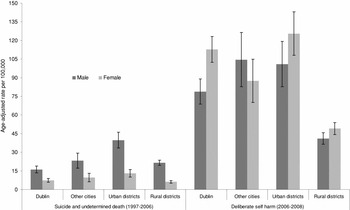
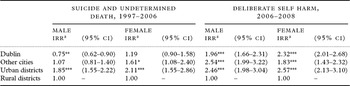
The incidence of suicide + UD varied markedly by geographic area (Figure 3). For both sexes, there were particularly high rates in the urban district populations, about twice the rate in rural districts (Table 3). The rate of suicide + UD was lower in Dublin for men only. Among women, the rate suicide + UD was significantly elevated in cities other than Dublin.
Annual age-adjusted rate of suicide and undetermined death and hospital-treated deliberate self harm among over 55 year-olds by area type in Ireland

Geographic variation in the incidence of suicide and undetermined death and hospital-treated deliberate self harm among over 55 year olds in Ireland

aIncidence rate ratio of age-adjusted rates with rural districts as the reference group.
There was also a marked urban–rural difference in the male and female incidence of hospital-treated deliberate self harm. Compared to rural districts, the male rate of self harm was twice as high in Dublin and 2.5 times higher in other cities and urban districts. Relative to rural districts, the female rate of deliberate self harm was almost twice as high in cities other than Dublin and about 2.5 times higher in Dublin and urban districts.
Discussion
The significance of suicidal behavior has become well recognized with many countries implementing national prevention strategies. Studies have found deliberate self harm in older adults generally involves greater suicidal intent (Hawton and Harriss, Reference Hawton and Harriss2008b) than in the young and that the link between deliberate self harm and suicide is also stronger in older adults (Hawton et al., Reference Hawton, Zahl and Weatherall2003; Cooper et al., Reference Cooper2005; Hawton and Harriss, Reference Hawton and Harriss2006). However, the incidence of both forms of suicidal behavior have rarely been compared. To our knowledge, only one previous study has compared the incidence of deliberate self harm and suicide at a national level in older adults (Shah, Reference Shah2009b).
Methodological issues
The national perspective of this study is one of its strengths although there was limited overlap between the years with available suicide mortality data and deliberate self harm data. Suicide and deliberate self harm in older adults have previously been compared in ten urban centers across Europe (De Leo et al., Reference De Leo2001) and in Western Australia (Lawrence et al., Reference Lawrence, Almeida, Hulse, Jablensky and Holman2000). The incidence of deliberate self harm reported in this paper was based on persons presenting to hospital emergency departments. This is an improvement on studies based on deliberate self harm that results in admission to a hospital ward (Shah, Reference Shah2009a) because admission rates following self harm presentation vary greatly between hospitals (Bennewith et al., Reference Bennewith, Gunnell, Peters, Hawton and House2004) thereby leading to significant bias. Our self harm data suffered some bias, however, as data on untreated deliberate self harm and that treated in other settings were unavailable.
The geographic comparisons made in this paper are an added strength and a rare feature of study of older adult suicidal behavior (Shah et al., Reference Shah, Sinha and Makena2009). We distinguished between Dublin, other cities, urban districts and rural districts. While this independent stratification has justification, it classifies some Irish towns and suburban areas as rural which is a limitation. Furthermore, small-area postcodes do not exist in Ireland thereby hampering the geocoding of addresses. The mortality data, in particular, were geocoded with more limited resources. As a result, unreliable geocoding must be borne in mind as a potential contributor to the geographic differences in suicide rates illustrated by this study.
Suicide research is greatly hampered by the question of data reliability due to the difficulty inherent in establishing suicide as a cause of death (Claassen et al., Reference Claassen, Yip, Corcoran, Bossarte, Lawrence and Currier2010). Misclassification of suicide deaths has most often been associated with the cause of death category “deaths of undetermined intent” (Cooper and Milroy, Reference Cooper and Milroy1995; Ohberg and Lonnqvist, Reference Ohberg and Lonnqvist1998; Jougla et al., Reference Jougla, Pequignot, Chappert, Rossollin, Le Toullec and Pavillon2002). We carried out all analyses using data related to officially classified suicides and suicides plus undetermined deaths in order to show that the findings were robust to the effects of misclassification. However, adjustment was not made for misclassification to other causes of death including natural causes. This may be more common among older persons with severe and/or terminal illness who bring about their deaths through the cessation of vital medication.
Incidence rates
The incidence of deliberate self harm among older adults in Ireland is higher than that reported for a range of states in the U.S.A. (Center for Disease Control, 2007). Other comparable studies have had predominantly urban catchment areas. The Irish rates of deliberate self harm among older adults in urban districts and cities appear similar to those of Oxford, England (Hawton and Harriss, Reference Hawton and Harriss2008a), which had previously ranked third highest of 15 European centers (De Leo et al., Reference De Leo2001). Thus, hospital-treated deliberate self harm among older adults in Ireland is likely to be high in the European context.
Ireland's suicide rate among older adults is lower than most European countries. Older Irish suicide also has a different age association because the Irish rate decreases with age whereas the opposite is seen in many other European countries (http://www.who.int/mental_health/prevention/suicide/country_reports/en/index.html). Ireland and the U.K. are similar in terms of the age pattern in suicide rates but the peak in young men is more pronounced in Ireland. The rapid social change that Ireland has experienced in recent decades seems relevant. Older Irish adults have lived most of their lives in an Ireland where the Catholic Church was dominant and suicide was condemned religiously and legally. This may have created a cohort who associate suicide with such stigma and shame that their suicide rate is relatively low (Cleary and Brannick, Reference Cleary and Brannick2007). Younger Irish adults have grown up in a secular Ireland where the Church has little or no (positive or negative) influence on their lives and suicide is far less stigmatized. In times of despair, when older generations may have turned to the Church or their religion for support, they do not seek such support and seem far more likely to resort to suicide.
The incidence of deliberate self harm among older adults also decreased with increasing age and at a greater rate than for suicide. Therefore, the ratio of non-fatal to fatal suicidal behavior was lowest among the very oldest as has been shown elsewhere (Hawton and Harriss, Reference Hawton and Harriss2008b).
There was a 3:1 male:female rate ratio in relation to suicide deaths whereas the older female rate of deliberate self harm was 24% higher than the male rate. These gender differences are similar to those found previously across a range of European centers (De Leo et al., Reference De Leo2001) although an absence of a gender difference in older adult deliberate self harm has recently been reported from Oxford, England (Hawton and Harriss, Reference Hawton and Harriss2008a).
Geographic differences
We have shown striking geographic differences in the rates of suicide and deliberate self harm among older adults in Ireland. The rates for the latter were 2–2.5 times higher in the Irish city and urban district populations than in rural districts. Given that hospital emergency departments are situated in urban centers, proximity may partly explain the higher rate of self harm presentations by urban populations. However, we have previously shown evidence that the distribution of socioeconomic deprivation is strongly associated with the geographic differences in rates of deliberate self harm (Corcoran et al., Reference Corcoran, Arensman and Perry2007). In relation to suicide, the highest rates were in urban districts and especially so for men. As mentioned above, unreliable geocoding of mortality data cannot be discounted as a potential confounder of these findings. However, the extent of the differences warrants further investigation. We observed a lower incidence of suicide among older men in Dublin. The reason behind this finding, may be an artifact of the recording system, as we previously showed the lower Dublin suicide rate to be due to deficits in the operation of the suicide recording system in Dublin (National Suicide Research Foundation, 2007).
Methods of self harm
As expected, the more lethal methods of self harm (hanging and drowning) were commonly involved in suicide deaths rather than in hospital-treated deliberate self harm. Hanging is the commonest method of suicide in most European countries but drowning is relatively rare (Varnik et al., Reference Varnik2008; Biermann et al., Reference Biermann, Sperling, Bleich, Kornhuber and Reulbach2009; Chen et al., Reference Chen, Park and Lu2009), whereas it was involved in about 30% and 40% of the older male and female suicide deaths in this study, respectively. Drug overdose was involved in the vast majority of deliberate self harm presentations, and especially so in female acts. It was also involved in a significant minority of suicide deaths. Drug overdose is consistently found to be the predominant method used by older adults who self harm (De Leo et al., Reference De Leo2001; Chan et al., Reference Chan, Draper and Banerjee2007; Shah, Reference Shah2009a). While less common, self-cutting and hanging were more often associated with male than female deliberate self harm, as has been previously shown for older adults in Europe (De Leo et al., Reference De Leo2001).
Conclusions
Older adults in Ireland have high rates of hospital-treated deliberate self harm but below average rates of suicide. Both forms of suicidal behavior decrease in incidence with increasing age, especially deliberate self harm. There are striking geographic differences with particularly high rates among urban populations that are worthy of further investigation. Drug overdose was involved in the vast majority of older adult deliberate self harm and a significant minority of suicides. Previous success in suicide prevention through means restriction (Hawton et al., Reference Hawton2004; Reference Hawton2009; Daigle, Reference Daigle2005) suggests that restriction of specific medications may be an effective approach to the prevention of suicidal behavior in older Irish adults.
Conflict of interest
None.
Description of authors' roles
All authors contributed to formulating the research questions. I.J. Perry and P. Corcoran designed the registry upon which much of the study is based. P. Corcoran carried out the statistical analysis and drafted the manuscript. U. Reulbach drafted the Introduction. All authors contributed to completing the paper.
Acknowledgments
We would like to acknowledge the staff of the Irish Central Statistics Office for their work in compiling the mortality and population data used in this paper. We would like to thank all who contribute to the Irish National Registry of Deliberate Self Harm, in particular Ms Eileen Williamson, Executive Director, the data managers and data registration officers. The Registry is funded by the Irish Health Service Executive's National Office for Suicide Prevention.