


Introduction
The global positive effect of cognitive behavioural therapy (CBT) including exposure and response prevention (ERP) for obsessive compulsive disorder (OCD) is evident with inhibitory learning being considered an important therapeutic agent (Craske et al., Reference Craske, Treanor, Conway, Zbozinek and Vervliet2014). Inhibitory learning describes a context-dependent and temporary loss of effect of a conditioned stimulus due to new operant behaviours. The association between trigger and compulsive behaviour is, hence, inhibited through the establishment of a new association. This definition implies that for ERP to be effective, it needs to be performed as often as possible and in as many contexts as possible (e.g. in the patients’ homes) to strengthen the new association (Craske et al., Reference Craske, Treanor, Conway, Zbozinek and Vervliet2014).
Beyond the dose of ERP and its implementation in varied contexts, patient characteristics, including mastery experience (Schwartz et al., Reference Schwartz, Hilbert, Schubert, Schlegl, Freyer, Löwe and Voderholzer2017) or self-efficacy, which describe people’s beliefs about their capabilities to achieve designated levels of performance, may influence the outcome of OCD treatment. During ERP, patients’ realisation that they are able to refrain from acting out compulsions might increase their self-efficacy. While one study described an increase in self-efficacy that was paralleled by a decrease in OCD symptoms during treatment with ERP (O’Connor et al., Reference O’Connor, Todorov, Robillard, Borgeat and Brault1999), no study examined self-efficacy as a potential underlying mechanism of the effectiveness of ERP for OCD.
The present study aimed to investigate (1) the association between the number of self- and therapist-guided ERP sessions and OCD symptom change during in-patient treatment and (2) whether this dose–response relationship of ERP frequency with OCD symptoms is mediated by self-efficacy.
Method
Sample and procedures
We included in-patients with a primary diagnosis of OCD from a specialised OCD ward who were treated between 2015 and 2017. Exclusion criteria were suicidality, current or past psychotic or bipolar disorder, current or past severe neurological disorders, and drug abuse. Upon admission to the clinic, all patients signed informed consent for the scientific analysis and publication of their routine data. All patients completed psychometric assessments before and after treatment, including the following instruments.
Measures
OCD symptom severity was assessed with the Yale–Brown Obsessive Compulsive Scale-Self Report (Y-BOCS-SR; Goodman et al., Reference Goodman, Price, Rasmussen, Mazure, Fleischmann, Hill, Heninger and Charney1989). The Y-BOCS-SR includes ten items (e.g. ‘How much distress do your obsessive thoughts cause you?’), that are rated on a scale ranging from 0 (lowest severity) to 4 (highest severity). A total sum score can be calculated, ranging from 0 to 40 points. Change in OCD symptoms from pre- to post-treatment was operationalised as the difference of respective Y-BOCS total scores.
The General Self-Efficacy Scale (GSE; Schwarzer and Jerusalem, Reference Schwarzer, Jerusalem, Weinman, Wright and Johnston1995) is a self-rating questionnaire assessing self-efficacy. Participants were asked to rate its ten questions (e.g. ‘I can always manage to solve difficult problems if I try hard enough’) on a 4-point scale ranging from 1 (not at all) to 4 (exactly true). The total sum-score consists of values from 10 to 40, with higher scores representing higher levels of self-efficacy. Change in self-efficacy from pre- to post-treatment was operationalised as the difference of respective GSE total scores.
In-patient therapy
Patients received a multi-modal, intensive in-patient treatment program including both individual and group psychotherapy. Individual therapy took place once or twice a week for 50 minutes. Group therapies included occupational therapy, music therapy, sports therapy and a manualised disorder-specific group. Individual therapy and the disorder-specific group were both based on the cognitive behavioural model. They included the following elements: psycho-education about OCD symptoms and the CBT rationale, individualised case formulation (including the identification of potential functions of the symptoms), in vivo ERP and the modification of interpretations of obsessive thoughts as well as of obsessive beliefs. However, the focus of the treatment lay on therapist- and self-guided ERP. ERP sessions were conducted according to guidelines (Foa et al., Reference Foa, Yadin and Lichner2012) with preparatory and debriefing sessions. Treatment was conducted by clinical psychologists and/or psychiatrists who were all trained in CBT and supervised by experienced therapists.
Statistical analysis
All analyses were conducted using the statistical software R. Assumptions of linear regression (e.g. multivariate normality) were sufficiently met. The research questions were tested using the classical three model procedure for both self- and therapist-guided ERP sessions. To test for the direct effects of self-guided and therapist-guided ERP sessions as well as change in self-efficacy on the change in OCD symptoms, independent linear regression models were estimated. The same procedure was applied to test for the direct effects of self- and therapist-guided ERP sessions on self-efficacy. In addition, linear regression models with self-efficacy and either self- or therapist-guided ERP sessions as covariables for the prediction of change in OCD symptoms were performed. Indirect effects were tested for significance using the standard error formulated by Sobel.
Results
Three-hundred seventy-seven (60.5% female) patients with OCD were included. Their mean age was 32.60 years (SD = 14.44, range 13–80). On average, patients completed 3.27 (SD = 0.99, range 1–6) therapist-guided and 4.70 (SD = 1.25, range 1–6) self-guided ERP sessions during an average treatment duration of 10.06 weeks (SD = 3.72, range 0.43–25.71). Y-BOCS total scores decreased from admission (mean = 24.04, SD = 6.61, range 7–40) to discharge (mean = 13.83, SD = 7.00, range 0–38), t = 24.58, p < .001, Cohen’s d = 1.50. GSE total scores increased from admission (mean = 22.14, SD = 5.69) to discharge (mean = 25.81, SD = 7.00), t = −8.18, p < .001, Cohen’s d = −0.56.
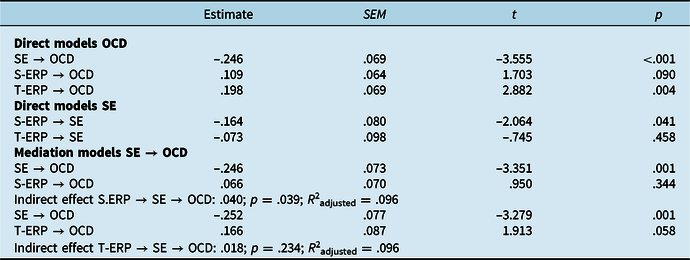
As depicted in Table 1, self-efficacy and the number of therapist-guided ERP sessions showed a significant effect on OCD symptoms in the direct models, in which they served as sole predictors. Even though the amount of self-guided ERP sessions did not directly predict OCD symptoms, a significant indirect effect, mediated by self-efficacy, was observed in the mediation model. The direct effect of the number of therapist-guided ERP sessions did not reach statistical significance any more when self-efficacy entered the regression model as a covariate, and a significant indirect effect was not observed either.
Results of the mediation analyses

SE, change in self-efficacy according to the General Self-Efficacy Scale; OCD, change in obsessive compulsive symptoms according to the Yale–Brown Obsessive-Compulsive Scale-Self Report; S-ERP, self-guided exposure and response prevention; T-ERP, therapist-guided exposure and response prevention; Estimate, standardised regression coefficient; SEM, standard error of the regression coefficient, R 2adjusted, total amount of variance explained, adjusted for the number of covariates. Dashed lines separate different models.
Discussion
The present study investigated (1) whether the total number of self- and therapist-guided ERP sessions during CBT in-patient treatment impacted OCD symptom reduction and (2) whether the link between the number of ERP sessions and OCD symptoms was mediated by an increase in self-efficacy. A higher number of therapist-guided ERP sessions was associated with better therapeutic outcome but not with an increase in self-efficacy. Thus, the related mediation hypothesis (self-efficacy as mediator of therapist-guided ERP) was refuted. While the number of self-guided ERP sessions did not predict change in OCD symptoms, self-efficacy moderated this association.
The absence of a direct effect in the presence of an indirect effect of the number of self-guided ERP sessions on OCD symptoms through an increase in self-efficacy indicates that our formal mediation model was incomplete. There might be indirect paths between the number of self-guided ERP sessions and OCD symptoms in addition to the one through self-efficacy, possibly in the opposite direction. For example, it is plausible that the total number of self-guided ERP sessions not only affected self-efficacy but also avoidance, as patients had greater freedom regarding how and to what extent they confronted themselves with feared situations. This mechanism might serve as one explanation that the total effect of self-guided ERP session on OCD symptoms did not reach significance. A further explanation for the absence of a direct effect of self-efficacy might be due to the GSE measuring general self-efficacy and not a specific construct related to ERP.
Our findings are in line with the inhibitory learning hypothesis of ERP (Craske et al., Reference Craske, Treanor, Conway, Zbozinek and Vervliet2014) and provide tentative evidence of a dose–response relationship between therapist-guided ERP and OCD symptom reduction. Studies examining the effect of massed exposure in OCD (Hansen et al., Reference Hansen, Kvale, Hagen, Havnen and Öst2019) reported similar findings, further supporting the notion that more is better when it comes to exposure and inhibitory learning. Therapists are, hence, advised to ensure that patients with OCD receive a high number of ERP sessions, preferably in varying contexts including their usual environment. Current technical developments aim to facilitate these efforts through therapist-guided videoconference ERP.
Our study has several limitations. As our sample consisted of in-patients, the findings might not apply to other patient populations, who might have less severe OCD. Also, we did not conduct follow-ups after discharge, which precludes any statements about long-term effects of ERP. Furthermore, the GSE does not measure self-efficacy with regard to ERP. A scale explicitly developed for this purpose might have been better able to detect changes in self-efficacy during treatment for OCD. Considering an average stay of 10 weeks with preparatory and debriefing sessions, ERP was conducted about every 2 weeks. The total number of ERP sessions, however, was rather low. In addition, we had no data on the exact course of the ERP sessions, precluding any statements about the influence of this variable. Strengths of our study include the relatively large sample and the routine care conditions, which lend high ecological validity to our results.
Further studies need to replicate our results in samples with higher numbers of ERP sessions and should focus on identifying other factors that might serve as mediators of the link between self-guided ERP and OCD symptoms. Also, an investigation of the presented hypothesis in an out-patient context might be useful.
Conclusion
In an in-patient setting, a higher number of therapist-guided ERP sessions lead to better outcomes at the end of treatment, and self-guided ERP may partly exert its effect through an increase in self-efficacy.
Acknowledgements
None.
Financial support
This research did not receive any specific grant from funding agencies in the public, commercial, or not-for-profit sectors.
Conflicts of interest
The authors declare no conflicts of interest.
Ethical statements
All procedures performed in studies involving human participants were in accordance with 1964 Helsinki declaration and its later amendments or comparable ethical standards. The authors have abided by the Ethical Principles of Psychologists and Code of Conduct as set out by the APA (http://www.apa.org/ethics/code/). Informed consent was obtained from the parents of all individual participants included in the study.



Comments
No Comments have been published for this article.