Introduction
Partial laryngectomy provides excellent oncological control of selected laryngeal malignancies, while minimising morbidity and maintaining the three functions of the larynx: airway protection, respiration and phonation.Reference Rinaldo and Ferlito1
While most patients are able to achieve normal oral intake with appropriate swallowing therapy, dysphagia with persistent aspiration remains a problem for some, especially those patients who undergo pre- or post-operative radiotherapy. Persistent, severe dysphagia can lead to recurrent aspiration pneumonia, poor nutrition and cachexia; definitive management often includes gastrostomy or conversion to a total laryngectomy.Reference Bergamini, Molteni, De Siati, Luppi, Marchioni and Presutti2 Swallowing difficulties following partial laryngectomy with or without irradiation are often due to unfavourable local healing, which leads to inadequate functioning of the cricoarytenoid unit, including impaired laryngeal mobility and sensation, a condition termed neoglottic insufficiency.
Previously reported attempts at surgical rehabilitation of neoglottic incompetence have employed cricopharyngeal myotomy as well as injection laryngoplasty of the cricoarytenoid unit using bovine collagen and more recently polydimethylsiloxane.Reference Bergamini, Molteni, De Siati, Luppi, Marchioni and Presutti2–Reference Remacle, Hamoir and Marbaix4 However, there have been no recent reports in the English literature regarding the efficacy of such procedures.
We therefore aimed to evaluate the efficacy of arytenoid augmentation in aiding neoglottic closure and improving swallowing function in patients who had previously undergone partial laryngectomy.
Patients and methods
Two patients with severe, persistent dysphagia due to partial laryngectomy underwent surgical rehabilitation by arytenoid injection with bovine collagen.
The first patient was an 84-year-old man who had undergone supracricoid partial laryngectomy with cricohyoidoepiglottopexy, with preservation of one arytenoid.
The second patient was a 54-year-old, tracheostomy-dependent woman who had undergone supraglottic laryngectomy and post-operative chemoradiation, with preservation of both arytenoids.
Both patients were unable to swallow due to significant aspiration and required tube feeding; both had suffered prior episodes of aspiration pneumonia.
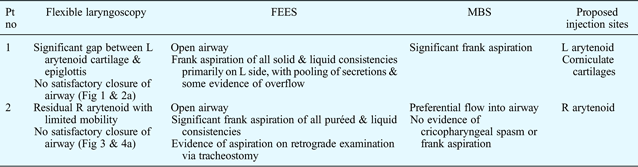
Clinical swallowing assessment was based on (1) modified barium swallow study and (2) fibre-optic endoscopic evaluation of swallowing performed one week prior to intervention (Table I) and then at subsequent visits up to two years post-intervention. In patient two, fibre-optic endoscopy was performed during both swallowing and phonation, via trans-nasal and trans-tracheostomy approaches. Both patients also underwent flexible laryngoscopy to determine the most suitable injection points (Table I).
Pre-procedure findings

Pt no = patient number; FEES = fibre-optic endoscopic evaluation of swallowing; MBS = modified barium swallow study; L = left; R = right
Intra-operative endoscopic view of first patient's larynx after partial laryngectomy. The neoglottis is formed between the mobile arytenoid cartilages, which are sutured anteriorly, and the laryngeal surface of the epiglottis. A large gap exists between the arytenoid and the epiglottis on the left. E = epiglottis; TB = tongue base; LA = left arytenoids; RA = right arytenoid; HP = hypopharynx

Magnified endoscopic view of first patient's left arytenoid (a) before and (b) after injection augmentation with collagen. The airway remains adequate but there is adduction of the arytenoid, which will now be in contact with the epiglottis on swallowing, with resultant improved neoglottic competence. E = epiglottis; JC = jet ventilation catheter; LA = left arytenoid; SG = subglottis

Pre-operative endoscopic view of second patient's larynx after partial laryngectomy. The right arytenoid shows limited mobility and unsatisfactory closure of the airway. E = epiglottis; LA = left arytenoid; RA = right arytenoid

The patients were taken to the operating theatre for direct laryngoscopy, at which time bovine collagen was injected into multiple sites in the submucosa overlying the arytenoids, in order to improve neoglottic competence (Figures 2b and 4b). In both cases, no complications of the procedure occurred. In patient one, the airway was patent and stable. Both patients were discharged on the same day as the procedure.
Magnified endoscopic view of second patient's right arytenoid (a) before and (b) during injection augmentation with collagen. E = epiglottis; VF = vocal folds; LA = left arytenoid; RA = right arytenoid

Fibre-optic endoscopic evaluation of swallowing was performed one week, three months and one year after the procedure.
Results
Within the first three months post-procedure, both patients reported a significant improvement in swallowing. Both patients were able to take most foods by mouth, although their gastrostomy tubes were left in place in order to ensure adequate caloric intake.
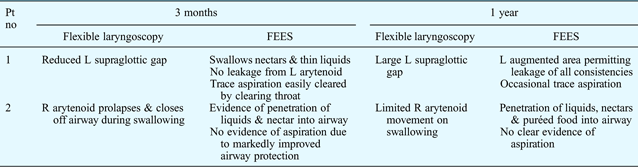
Three months after the arytenoid augmentation procedure, both patients were evaluated by fibre-optic endoscopy and flexible laryngoscopy. The findings are shown in Table II.
Post-procedure findings

Pt no = patient number; FEES = fibre-optic endoscopic evaluation of swallowing; L = left; R = right
At one year post-procedure, patient two was able to have her feeding tube removed, having demonstrated continued weight gain and no further episodes of aspiration pneumonia.
However, both patients subsequently returned with aspiration symptoms and coughing when eating. Therefore, both required repeated arytenoid injection augmentation. The decision to use collagen as the re-injection material was based on the patients' financial constraints.
Following the second arytenoid injection procedure, patient one continued to report subjective improvement in swallowing function; fibre-optic endoscopy showed improved neoglottic competence and satisfactory airway closure.
However, patient two required a third augmentation procedure within two years of the initial procedure. At the time of writing, two months after this third arytenoid injection, this patient had no dysphagia symptoms. A recent fibre-optic endoscopic evaluation of swallowing demonstrated markedly improved airway closure, with no evidence of aspiration.
Discussion
Partial laryngectomy is an oncologically sound operation; in most instances, the cure rates of total laryngectomy and partial laryngectomy are comparable.Reference Chawla and Carney5 However, functional results can be variable. When the vocal folds are preserved, phonation is spared and the airway is usually maintained without a permanent tracheostoma. In contrast, the laryngeal mechanism that protects the lower respiratory tract from aspiration is often more compromised; this is largely due to loss of the sphincteric action of the supraglottic laryngeal inlet, as well as to impaired vocal fold mobility and sensation.Reference Calcaterra6 In patients who had undergone partial laryngectomy, the primary issues are still tracheostomy decannulation and resumption of oral intake.
Dysphagia due to aspiration is the most common long-term debilitating complication of partial laryngectomy. Initially, all patients demonstrate penetration and aspiration on barium swallow or endoscopy, and are thus initially maintained on tube feeding to prevent the risk of aspiration pneumonia. Adequate airway protection can eventually be achieved with swallowing therapy and the development of safe swallow techniques.Reference Schweinfurth and Silver7 Early intervention by a speech and language pathologist experienced in the rehabilitation of partial laryngectomy patients is critical for a successful outcome. Unfortunately, up to 10 per cent of patients undergoing partial laryngectomy will have significant post-operative swallowing problems requiring subsequent total laryngectomy.Reference Laccourreye, Hans, Borzog-Grayeli, Maulard-Durdux, Brasnu and Housset8
Following partial laryngectomy, the issues of neoglottic competency and aspiration risk are further compounded in those patients requiring post-operative radiotherapy. Following post-operative radiotherapy treatment, the risk of late laryngeal complications has been shown to increase in a radiotherapy dose dependent fashion.Reference Suarez, Rodrigo, Herranz, Diaz and Fernandez9–Reference Spriano, Antognoni, Sanguineti, Sormani, Richetti and Ameli11 Fortunately, modern conformal techniques such as intensity-modulated radiotherapy can reduce the irradiation dose to the remaining cricoarytenoid joint, facilitating safer treatment when indicated. However, radiotherapy can induce acute sialorrhoea and viscous mucus production during the course of treatment, increasing the need for adequate airway protection. Therefore, neoglottic competency should be assessed, and appropriate management implemented, before commencing post-operative radiotherapy.
Understanding the role of arytenoid mobility is critical to both airway protection and phonation. After partial laryngectomy, superior and anterior translation of the larynx improves the approximation of the tongue base to the arytenoid and facilitates the safe channelling of the food bolus past the airway. Direct videofluoroscopic observation indicates that, when the larynx does not elevate, the arytenoids fail to pull away from the posterior pharyngeal wall and do not approximate with the tongue base, leading to direct aspiration in the late pharyngeal phase of swallowing.Reference Schweinfurth and Silver7 Thus, during partial laryngectomy, measures to maintain arytenoid mobility are focused on the proper superior and anterior repositioning of the larynx following tumour excision.
Despite these measures, our two patients suffered from persistent neoglottic incompetence and aspiration. There have been a number of reports of attempted surgical rehabilitation of these complications, including arytenoid injection with either reabsorbable or non-reabsorbable materials, the most common being collagen and polydimethylsiloxane. Such preliminary reports have indicated that arytenoid injection improves neoglottic competency, at least in the short term. Injection of botulinum toxin into the cricopharyngeal muscle has also been reported to aid swallowing by relaxing the upper oesophageal sphincter.Reference Marchese-Ragona, De Grandis, Restivo, Staffieri, Marioni and Pastore3 Bergamini et al. recently studied the use of the non-reabsorbable filler material polydimethylsiloxane in nine patients, and observed a significant improvement in both dysphagia and the degree of penetration and aspiration.Reference Bergamini, Molteni, De Siati, Luppi, Marchioni and Presutti2 However, the risk of airway compromise should always be considered initially, since the neoglottic sphincter is not as dynamic as the normal glottis. For this reason, in our two patients we chose bovine collagen (which lasts for approximately three to six months following injection laryngoplasty)Reference O'Leary and Grillone12 over other available injection materials (that last for longer periods) as a means to safely and economically achieve arytenoid augmentation. Several studies have reported successful arytenoid augmentation via collagen injection; the first, 1990, described a case series of nine patients who reported subjective improvement in dysphagia symptoms over a five month period.Reference Remacle, Hamoir and Marbaix4
• Dysphagia with persistent aspiration remains a problem in post-laryngectomy patients, especially those who undergo pre- or post-operative radiotherapy
• Such dysphagia is mainly due to inadequate functioning of the cricoarytenoid unit, including impaired laryngeal mobility and sensation, a condition termed neoglottic insufficiency
• Methods of surgical rehabilitation have included cricopharyngeal myotomy and injection laryngoplasty of the cricoarytenoid
• The presenting authors evaluated the efficacy of collagen injection laryngoplasty with arytenoid augmentation in aiding neoglottic closure and improving airway safety
• Arytenoid augmentation was found to be safe and effective in improving swallowing
Our two patients were followed up for a period of up to two years after their injection laryngoplasty. While they initially experienced good results, both patients' dysphagia symptoms subsequently returned, requiring re-augmentation, probably due to collagen reabsorption. The choice of collagen for subsequent injections was financially determined, given that longer-lasting injection materials were not covered by third party payers. We can therefore conclude that, while injection augmentation of the arytenoids improves neoglottic competence and therefore swallowing, the choice of injection material determines the duration of this result. Thus, once injection of a short-acting implant material is performed safely with good results, the use of longer-acting, non-reabsorbable materials such as polydimethylsiloxane may well be preferable for future procedures, as this would reduce the need for re-augmentation at shorter intervals.
Conclusion
Surgical rehabilitation methods should only be pursued in patients with persistent, severe dysphagia following partial laryngectomy. In two such patients, we found injection augmentation of the arytenoids to be effective in improving swallowing by improving airway protection and preventing aspiration. Further study is necessary to evaluate the efficacy and safety of this procedure in more patients, as well as to evaluate the use of longer-lasting injection materials.