Introduction
Animal husbandry indicates that in-breeding, also known as consanguinity, yields genetic strengths as well as weaknesses (Pyle et al., Reference Pyle, Paterson and Chacko1976; Patterson, Reference Patterson1991). In human society, marrying relatives (including first cousins) was widespread until as recently as 100 years ago (Ottenheimer, Reference Ottenheimer1996). Concern has been raised over the practice in the Middle East in general and in Qatar in particular (Jaber et al., Reference Jaber, Merlob, Bu, Rotter and Shohat1992; Al-Gazali et al., Reference Al-Gazali, Dawodu, Sabarinathan and Varghese1995; Bener et al., Reference Bener, Abdulrazzaq, Al-Gazali, Micallef, al-Khayat and Gaber1996; Abdulrazzaq et al., Reference Abdulrazzaq, Bener, Al-Gazali, Al-Khayat, Micallef and Gaber1997; Bener & Alali, Reference Bener and Alali2006). In fact, what is seen in the Middle East is not merely consanguinity but endogamy (Khlat, Reference Khlat, Teebi and Farag1997). The difference between the two is that while the former indicates marriages between blood relations, the latter is a more comprehensive term that describes a societal preference for selecting a marriage partner from within a particular group, over generations.
The principal genetic concern of consanguinity is that the rate of homozygotes for recessively inherited Mendelian characteristics could increase in relation to the gene frequency. This could bring about a decrease in the overall fitness of the population (Khoury et al., Reference Khoury, Beaty and Cohen1993). For the Middle East, the concern has been expressed that because the populations have historically been genetically isolated, their suffering from genetic diseases is greater, not only because of current consanguinity but also because of genetic drift and the founder effect (Khoury et al., Reference Khoury, Beaty and Cohen1993). The definition of consanguinity in this study is marriage to a blood relation who is closer than third cousin once removed or equivalent.
Qatar is a peninsula in the Persian/Arabian Gulf extending from the mainland of the Arabian Peninsula adjacent to the eastern coast of Saudi Arabia. It is ranked as the wealthiest country in the world with a 2007 estimated Gross Domestic Product of US$87,600 per capita, derived from the production and export of oil and natural gas. As of 2008, there were approximately one million residents in Qatar. However, the number of Qatari citizens is estimated to be 110,000, with the remainder being ex-patriates of short or long duration (Statistics Authority, Doha, Qatar). The population of Qatari nationals is made up of several distinct ethnicities: Bedouin, Persian, African and ‘other’.
The Bedouin from the Najd Plateau of the Arabian Peninsula were the earliest denizens in what came to be known as Qatar (Scott et al., Reference Scott, Mason and Marshall1946; Nyrop et al., Reference Nyrop, Benderly, Carter, Eglin and Kirchner1977; Zahlan, Reference Zahlan1979; Nyrop, Reference Nyrop1984). These Bedouins came in several waves and from several established tribes. The latest group settled in this century. The Persians migrated along the coast of the Persian/Arabian Gulf and participated in fishing and pearl diving. The African peoples settled as part of the trade routes (either legal or pirate) and were brought in as slaves. Less is documented about the fourth group of ‘other’ peoples – but it is likely that they have obtained citizenship based on service to, and residence in, Qatar. As a general rule these four groups do not inter-marry and therefore remain distinct, yet not publicly identified, ethnicities.
In Islam, marriage is a religious duty and considered moral protection against socially deviant behaviour, anarchy and chaos (fitna). The family is considered the fundamental unit of society and shari'a law protects it. Marriages, at least in the past and possibly today, are firstly considered strategic alliances which provide, secondarily, comfort and succour to the individual husband and wife and a secure place for the nurturing of children in what was considered to be, partially due to the extremely arid physical environment, an often hostile and uncertain world.
Consanguinity is a common marriage pattern within the Middle East (Roodpeyma et al., Reference Roodpeyma, Kamali, Afshar and Naraghi2002; Tamim et al., Reference Tamim, Khogali, Beydoun, Melki and Yunis2003; Gunaid et al., Reference Gunaid, Hummad and Tamim2004; Kir et al., Reference Kir, Gulec, Bakir, Hosgonul and Tumerdem2005; Wahab et al., Reference Wahab, Ahmad and Akram Shah2005) and within other populations (Schull & Neel, Reference Schull and Neel1972; Govinda Reddy, Reference Govinda Reddy1983; Khoury et al., Reference Khoury, Cohen, Diamond, Chase and McKusick1987). Advantages attributed to the practice include psycho-social benefits such as familial unity, decreased pressures on the bride in her new home, greater autonomy for women, a stronger marital bond with less risk of divorce, greater compatibility of the bride with her husband's family, property retention and effective transmission of the culture from generation to generation (Barth, Reference Barth1953; Khlat et al., Reference Khlat, Halabi, Khudr and Der Kaloustian1986; Bittles, Reference Bittles1994; Ottenheimer, Reference Ottenheimer1996). This latter attribute, in a quickly developing nation like Qatar, could create social stability, which in a period of turmoil and change could have tremendous benefits. Additionally, a father's brother's son was considered, at least traditionally, to have the first right of refusal of a nubile woman within Middle Eastern communities (Barth, Reference Barth1953). On the other hand, the practice of consanguinity has been proposed as a contributor to the presence of health problems (Al-Gazali et al., Reference Al-Gazali, Dawodu, Sabarinathan and Varghese1995; Abdulrazzaq et al., Reference Abdulrazzaq, Bener, Al-Gazali, Al-Khayat, Micallef and Gaber1997), especially autosomal recessive diseases (Teebi, Reference Teebi1994; Hegab & Al-Mutawa, Reference Hegab and Al-Mutawa1996; Al-Fuzae et al., Reference Al-Fuzae, Aboolbacker and Al-Saleh1998; El-Shanti et al., Reference El-Shanti, Saoud, Sadoon, Leal, Chen, Lee and Spiegel2006). In addition, consanguinity has been proposed as a practice that prevents efforts of ‘nation building’ by enhancing political unity among the family and the clan rather than shifting the strength of the alliance to the elected government (Barth, Reference Barth1953; Sailer, Reference Sailer2003).
The objective of this investigation was to obtain prevalence estimates; and to gain preliminary data on knowledge, attitude and practice of consanguinity in a sample population of Qataris so that in future a more representative population-based study could be undertaken. While widely employed in the West, instruments using Likert items have not been frequently implemented in Qatar. Therefore, a secondary purpose of the study was to test the acceptability among the Qatari of an instrument using seven-point Likert items.
Hard-coding versus phylogram
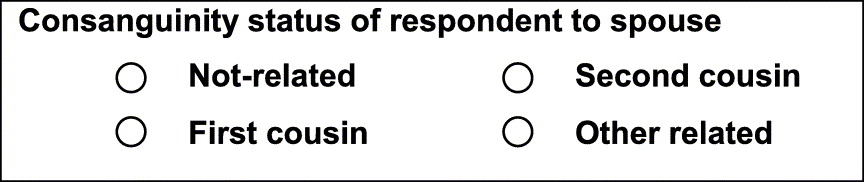
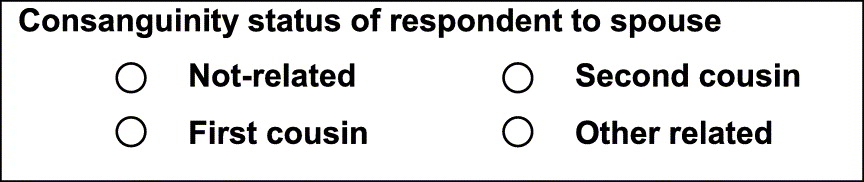
The hard-coded method (Fig. 1) is the one most frequently used to collect data identifying the closeness of a consanguineous relationship. However, collapsing the data at source allows for significant misclassification to occur: additionally, half-cousin and multiple relationships are missed (Sandridge, Reference Sandridge2006). Previous investigations have demonstrated that ‘second cousin’ relationships are often erroneously described as ‘double cousin’ relationships by informants when using a hard-coded system rather than the alternative (Sandridge, Reference Sandridge2000). The alternative to the hard-coded method is the phylogram, which takes between two and seven minutes to complete (Sandridge, Reference Sandridge2006).
Example of a hard-coded consanguinity question.
The phylogram avoids misclassification bias by using a schematic diagram to describe consanguineous relationships without ambiguity. Anthropologists have used this technique to document the theoretical endogamous and exogamous marriages allowable within a society (Parkin, Reference Parkin1997) and geneticists have used the phylogram (or pedigree) to identify disease-affected and -unaffected members of an extended family. This project has used the phylogram to help participants detail the relationship between their parents and their relationship to their spouse (if married). Genetic studies are theoretically possible to determine if two persons have common ancestors but they are expensive to implement and have not yet been attempted with this population.
Specific investigations assessing impact on health of consanguinity
Consanguinity has been investigated as a risk factor for a variety of health problems. Congenital heart defects (Gev et al., Reference Gev, Roguin and Freundlich1986; Stoll et al., Reference Stoll, Alembik, Roth, Dott and De Geeter1989; Badaruddoza et al., Reference Badaruddoza and Akhtaruzzaman1994; Hassan et al., Reference Hassan, Haleem and Bhutta1997; Bassili et al., Reference Bassili, Mokhtar, Dabous, Zaher, Mokhtar and Zaki2000; Roodpeyma et al., Reference Roodpeyma, Kamali, Afshar and Naraghi2002; Nabulsi et al., Reference Nabulsi, Tamim, Sabbagh, Obeid, Yunis and Bitar2003; Sandridge, Reference Sandridge2006), reproductive wastage, infertility, stillbirth, infant mortality (Al-Awadi et al., Reference Al-Awadi, Naguib, Moussa, Farag, Teebi and El-Khalifa1986; Chitty & Winter, Reference Chitty and Winter1989; Basaran et al., Reference Basaran, Hassa, Basaran, Artan, Stevenson and Sayli1989; Khoury & Massad, Reference Khoury and Massad1992, Reference Khoury and Massad2000; Bundey & Alam, Reference Bundey and Alam1993; Jain et al., Reference Jain, Nalini, Chandra and Srinivasan1993; Bittles et al., Reference Bittles, Grant and Shami1993; Al Husain & Al-Bunyan, Reference Al-Husain and Al-Bunyan1997; Stoltenberg et al., Reference Stoltenberg, Magnus, Lie, Daltveit and Irgens1997, Reference Stoltenberg, Magnus, Skrondal and Lie1999; Al-Abdulkareem & Ballal, Reference Al-Abdulkareem and Ballal1998; Dorsten et al., Reference Dorsten, Hotchkiss and King1999; Mokhtar & Abdel-Fattah, Reference Mokhtar and Abdel-Fattah2001), under-5 mortality (Hussain et al., Reference Hussain, Bittles and Sullivan2001), hearing loss (Zakzouk et al., Reference Zakzouk, El-Sayed and Bafaqeeh1993; Al-Gazali et al., Reference Al-Gazali, Dawodu, Sabarinathan and Varghese1995; Zakzouk, Reference Zakzouk2002; Al Khabori, Reference Al Khabori2004; Ben Arab et al., Reference Ben Arab, Masmoudi, Beltaief, Hachicha and Ayadi2004; Bener et al., Reference Bener, El Hakeem and Abdulhadi2005), serious cognitive and mild cognitive disability (Bashi, Reference Bashi1977; Stein et al., Reference Stein, Belmont and Durkin1987; Afzal, Reference Afzal1988; Al-Ansari, Reference Al-Ansari1993; Durkin et al., Reference Durkin, Khan, Davidson, Huq, Munir, Rasul and Zaman2000), Down syndrome (Alfi et al., Reference Alfi, Chang and Azen1980; Basaran et al., Reference Basaran, Hassa, Basaran, Artan, Stevenson and Sayli1989; Zlotogora, Reference Zlotogora1997; Stoll et al., Reference Stoll, Alembik, Dott and Roth1998; Rittler et al., Reference Rittler, Liascovich, Lobez-Camelo and Castilla2001), apnoea of pre-maturity (Tamim et al., Reference Tamim, Khogali, Beydoun, Melki and Yunis2003), reading disabilities (Abu-Rabia & Maroun, Reference Abu-Rabia and Maroun2005); pre-reproductive death (Govinda Reddy, Reference Govinda Reddy1983; Khoury et al., Reference Khoury, Cohen, Diamond, Chase and McKusick1987; Shami et al., Reference Shami, Schmitt and Bittles1989; Ober et al., Reference Ober, Hyslop and Hauck1999; Stoll et al., Reference Stoll, Alembik, Roth and Dott1999), schizophrenia (Chaleby & Tuma, Reference Chaleby and Tuma1987), breast cancer (Shami et al., Reference Shami, Qaisar and Bittles1991; Denic et al., Reference Denic, Bener, Sabri, Khatib and Milenkovic2005) and all major malformations (Al-Gazali et al., Reference Al-Gazali, Dawodu, Sabarinathan and Varghese1995; Abu-Rezq et al., Reference Abu-Rezq, Al-Tarkait, Husien, Qasrawi and Radovanovic1995; Abdulrazzaq et al., Reference Abdulrazzaq, Bener, Al-Gazali, Al-Khayat, Micallef and Gaber1997; Narchi & Kulaylat, Reference Narchi and Kulaylat1997; Sheiner et al., Reference Sheiner, Sheiner, Mazor, Katz and Carmi1999; Queisser-Luft et al., Reference Queisser-Luft, Stolz, Wiesel, Schlaefer and Spranger2002; Shafi et al., Reference Shafi, Khan and Atiq2003; Sawardekar, Reference Sawardekar2005) have been investigated. Few convincingly positive results have been found except in diseases that are irrefutably autosomal recessive disorders. On the other hand there is a preponderance of results with small increases of risk with confidence intervals that include 1. This may be due to lack of true association, poor gestational survivorship of genetically compromised fetuses, poor power to detect association or misclassification bias due to the use of the hard-coded method rather than the phylogram. Besides misclassification bias, other factors that make the study of the impact of consanguinity on health difficult are the rarity of the specific diseases and possible lack of independence of measurement in some studies. Studies that use more than one case from the same parental unit bias the results in favour of a positive statistical association.
Methods
From September 2007 to January 2008 data were collected from 362 Qatari employees of two Directorates of a governmental Ministry using a cross-sectional survey. The structured face-to-face interview was administered in Arabic by three medical students who were participating as research assistants in the Undergraduate Research Experience Program (UREP). The phylogram was used to collect data on the practice (prevalence) of consanguinity within two populations: the parents of the employees (n=362) and the married employees (n=247). Sixteen self-administered seven-point Likert-style questions were used to collect data on attitudes; however, two of these questions (15 and 16) were only introduced two-thirds through data collection and the number of responses for them is only 143.
In cases where the participant was illiterate the research assistant read out loud the self-administered component. Knowledge about possible risks that may be increased with consanguinity was assessed by six true/false questions relating to disease and characteristic occurrence. Additionally, there were three scenarios where participants were asked to choose between two consanguineous relationships the one which would be likely to share a higher percentage of genes and characteristics. The questionnaire was completely designed and drafted by the authors although benefit was made of previous work conducted in Beirut (Khlat et al., Reference Khlat, Halabi, Khudr and Der Kaloustian1986). A copy of the questionnaire (English and Arabic) is available from the authors.
The questionnaire was translated from English to Arabic and then the reverse translation technique was used by a qualified translator. The questionnaire was written in fus-Ha (Modern Standard Arabic); however, the interviews were conducted in the Levantine and Gulf dialects of the research assistants. Fus-Ha was used in the interviews where necessary if meaning was obscured. In a few cases it was necessary for a Ministry employee, a Qatari, to explain specific words or phrases that were unfamiliar to a participant in the Qatari dialect. The research assistants were trained in the administration of the interview, the self-administered component and in the collection of phylograms. For the phylogram, research assistants asked all participants if a sibling pair were full or half-siblings and whether they were blood or milk siblings. Milk siblings cannot marry one another, but their offspring can. Nevertheless, milk siblings are not consanguineous. They are two non-related persons who each breast-fed at least three times from the same woman. Therefore, milk cousins are not consanguineous either.
The questionnaire was piloted at Qatar University (QU) with 25 Arabic-speaking ethnically Arabic faculty members who taught primarily Qatari students to assess content acceptability. Revisions to the questionnaire were made based on the feedback of the QU professors. The project was approved by the ethics committees of Hamad Medical Corporation (Doha, Qatar), Weill Cornell Medical College (NY, USA) and the Ministry (Doha, Qatar).
Lists were provided to the study team by the Ministry of all Qatari employees who worked in the various sections of the two Directorates throughout Qatar. Once identified, the interviewer approached the potential participant and invited the individual to complete the survey. Prior to the interview verbal informed consent was obtained.
Data were entered into an SPSS (version 14.0) spreadsheet and then entered a second time into a separate SPSS spreadsheet using the double data entry technique, which ensures high accuracy of greater than 99%. These two spreadsheets were compared using Excel and all errors were corrected. The author ALS coded all phylograms. The phylogram schemata captured in this study are available upon request. SPSS was used for the creation of variables and for initial univariate presentations. Continuous variables were grouped using percentile cut points where possible or natural categories. The Likert items assessing attitude assigned 7 to equal ‘Believe strongly’ and 1 to equal ‘Do not believe at all’. In preliminary analysis these data were reduced to three categories: ‘Believe strongly’ (Likert scale 5–7), ‘Unsure’ (Likert scale 4) and ‘Do not believe’ (Likert scale 1–3).
Results
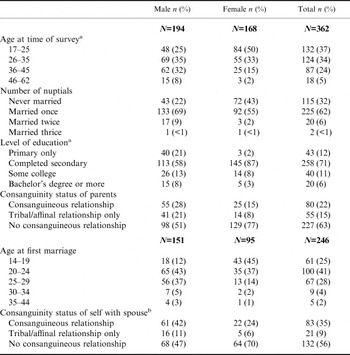
During the survey period 535 potential participants were identified as meeting eligibility requirements. Of these, not all were available for interview due to disability or study leave abroad. Of the 390 who were available, 362 consented to participate (93%). Table 1 presents demographic characteristics stratified by sex. In total, there were 247 married participants; however, one did not report age at first marriage. Results are reported on the marital consanguinity status of only 236 participants because eight spousal phylograms were not captured through research assistant error and two participants could not describe the relationship by phylogram.
Demographic characteristics of Qatari sample population, stratified by sex

a n=361;
b n=236.
Using this study's estimates of prevalence of consanguinity in the population, it was determined that the width of the confidence interval is ±5.75% using the Sample Size Tables for Clinical Studies software (Machin et al., Reference Machin, Campbell, Fayers and Pinol1987). Total identifiable parental consanguinity is therefore between 16% and 28% with a point estimate of 22%. Tribal/affinal relationships are estimated to be between 9% and 21% with a point estimate of 15%.
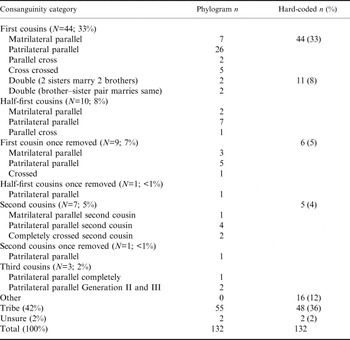
In Table 2, a detailed presentation of the data captured by phylogram as compared with data captured by the hard-coded method is presented. When asked to describe the ‘double cousin’ relationship only 4 of 11 purported double cousin marriages could be documented as two siblings marrying two siblings. The combined category of first and double cousins was reduced by 8% when participants were asked to document the relationship with the phylogram. Half-first cousins, half-first cousins once removed, second cousins once removed and third cousins can be captured with the phylogram but, as of yet, never with the hard-coded method.
Aggregate comparison of hard-coded method with phylogram method for 132 Qataris with reported parental consanguinity

Note: three parental phylograms not collected by interviewer (one double first cousin and two first cousins reported by hard-coded method only).
Only two respondents reported a milk cousin relationship with their spouse.
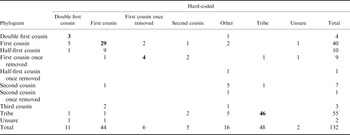
Table 3 documents the inconsistencies between the 132 participants who answered both the hard-coded question and completed a phylogram for their parents' relationship. Of these, there were two who were ‘unsure’ with the hard-coded method and two who were ‘unsure’ with the phylogram method. With respect to the two who could not describe their parents' relationship with the phylogram, one responded ‘double first cousin’ to the hard-coded question and the other responded ‘first cousin’. In the two cases where the participants were unsure of the hard-coded response, the first described a relationship that was a first cousin matrilateral parallel relationship and the other described a first cousin once removed matrilateral relationship by phylogram.
Correlation of hard-coded and phylogram methods for parental consanguinity in Qatari sample population

No one who selected ‘second cousin’ as a hard-coded choice described a phylogram of a second cousin. There were nine (7%) participants who by hard-coded method said their parents were first cousins but were less close at half-first cousin by phylogram. In total, there was 64% correlation between the two methods (82/128). Of the 46 where there was imperfect correlation between the two methods the hard-coded ‘other’ category was not considered as it is an unknown entity. Of the 30 responses where the informative hard-coded response did not agree with the phylogram, 23 (76%) reported that the relationship was less close by phylogram than by hard-coding and 7 (24%) reported that the relationship was closer by phylogram.
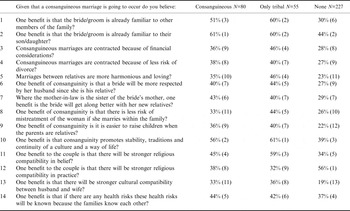
Table 4 compares the percentage with ‘strong belief’ by consanguinity category and, in parentheses, the rank order. The range of percentages of agreement for the non-related was smaller (19% to 56%) than that for those who were consanguineously related (33% to 61%), although there was overlap.
Summary of fourteen attitude questions with percentage who believed strongly by consanguinity status with rank order for Qatari sample population (N=362)

Summation scores were calculated from the 351 participants who answered all fourteen attitudinal questions. A score of 98 meant complete agreement and a score of 14 meant complete disagreement. All three relationship levels had scores ranging from 14 to 98. The non-related had the lowest average summation score of 46. The average summation score for those with a parental consanguinal relationship was lower at 55 with fewer of the attitudes believed than for the affinal at 60.
The three consanguinity groups differed on their strongest belief. Sixty-one per cent of those whose parents were consanguineously related said that they strongly believed that one benefit of consanguinity is that the bride/groom is already familiar to the son/daughter. The strongest held belief for those who married within the tribe was the benefit that consanguinity promotes stability, traditions and continuity of a culture and a way of life. For those who were not from consanguineous couples the strongest belief was that there will be stronger religious compatibility in practice in consanguineous unions.
Table 5 presents data from questions introduced midway through the project regarding beliefs related to consequences of consanguinity. There is a significant difference between the consanguineous group and the tribal group (p<0.02) and between the consanguineous group and the non-related group (p<0.04) although the numbers are small.
Summary of two attitude questions with percentage who believed strongly by consanguinity status for Qatari sample population (N=143)

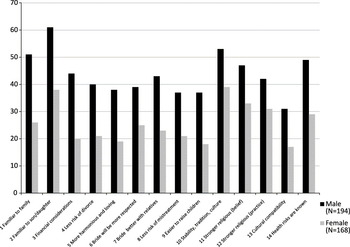
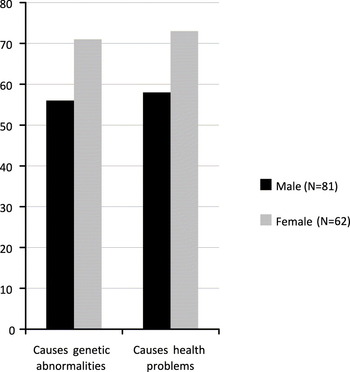
Figures 2 and 3 compare the percentage with ‘strong belief’ by sex. The range of ‘strong belief’ for the first fourteen questions for males was broader and stronger than that for females. For males it was 30 percentage points (31% to 61%) versus 22 percentage points for females (17% to 39%). For the last two questions both males and females had high proportions of persons who believed that consanguinity does cause genetic abnormalities and health problems (56% and 58% and 71% and 73% respectively). These last two questions were the only two where a high proportion of females expressed strong attitudes: more than 30% higher than any of the other attitude questions.
Comparison of male and female responses to fourteen questions regarding attitude towards consanguinity (n=362).

Comparison of male and female responses to two questions regarding attitude towards causation of consanguinity (n=143).

Phylogram data were collected from 236 of the 247 participants who had ever married. Table 6 compares the personal consanguineous status of the 236 participants for whom data were available with the consanguineous status of the participant's parents. A high proportion of persons who reported no consanguineous relationship between their parents also married a non-relative (77%). Thirty-seven per cent of persons originating from identifiable cousins married identifiable cousins. A third of those from tribally connected parents married a tribally related spouse and 10% married a cousin, although the actual number was small (n=2).
Cross-tabulation of marital and parental consanguinity status

Note: of 247 married participants, two reported being unsure by phylogram and nine phylograms were erroneously not collected.
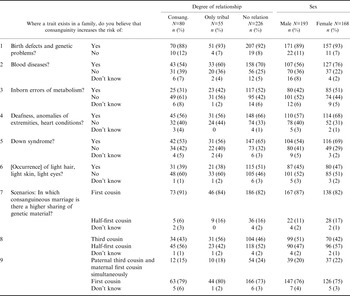
Table 7 presents data on the knowledge of the participants regarding the risks of consanguinity stratified by parental consanguinity status (left side) and stratified by sex (right side). Unlike the self-assessed attitude questions (Table 5), in this format, a higher proportion in each of the three groups (consanguineous parents, tribal parents and non-related parents) reported that they were aware that the risk of birth defects and genetic problems increased with consanguinity (88% versus 35%; 93% versus 70%; and 92% versus 63%). However, fewer in each group knew that the risk of blood diseases was increased. Nevertheless, 70% of the offspring of non-related parents knew of the risk of blood diseases such as thalassaemia and sickle cell anaemia than those of consanguinal (54%) or tribal offspring (60%). An understanding of the increased risk of inborn errors of metabolism (IEM) was shown by small percentages for all groups although 52% of offspring of non-related parents knew of the increased risk of IEM in consanguineous offspring. There was a statistically significant difference between these groups (p=0.01). Similar results were found for the question regarding the risk of deafness, anomalies of extremities and heart conditions, all of which have been associated with autosomal recessive transmission and consanguinity. Greater than 50% of the participants thought that the occurrence of Down syndrome could be increased with consanguinity although the evidence to support an association between consanguinity and Down syndrome has been conflicting (Alfi et al., Reference Alfi, Chang and Azen1980; Basaran et al., Reference Basaran, Hassa, Basaran, Artan, Stevenson and Sayli1989; Zlotogora, Reference Zlotogora1997; Stoll et al., Reference Stoll, Alembik, Dott and Roth1998; Rittler et al., Reference Rittler, Liascovich, Lobez-Camelo and Castilla2001). Rather than consanguinity, Down syndrome is more clearly associated with maternal age at conception. Participants did not know that basic traits (such as eye and skin colour) are genetic and therefore, theoretically, to be increased with consanguinity as well.
Beliefs (knowledge) of the participants regarding the risks of consanguinity stratified by parental consanguinity status (N=361) and by sex (N=361)

In stratifying the data by sex, it was found that a higher proportion of females than males knew that consanguinity increases the risk of birth defects and genetic problems, although this difference was not statistically significant (p=0.08). There was a statistically significant difference between males and females regarding their knowledge that consanguinity increases the risk of blood diseases (p=0.00) and the non-proven belief that it increases Down syndrome (p=0.03). However, there was no significance between males and females with respect to the risk of IEM (p=0.23), deafness, anomalies of the extremities and heart conditions (p=0.11), or the correct belief that consanguinity can increase basic phenotypic traits (p=0.74).
In the scenario questions, a high proportion of participants knew that first cousins were genetically closer than half-first cousins. Few of the participants, regardless of group, understood that third cousins were more distant than half-first cousins or that multiply-related persons could be genetically more similar than those who were solely first degree cousins.
Discussion
Consanguinity is of particular interest as a potential risk factor in this region and therefore accurate statistics on its prevalence are crucial for public health planning purposes. Additionally, accurate information as to the reasons for its popularity will help community health educators develop strategies to minimize potential negative consequences arising from the practice.
The 362 persons surveyed in this study ranged in age from 17 to 62 years (Table 1). There was a spread in ages with 37% of the total being less than 25 years of age, 34% being 26 to 35 and 24% being 36 to 45. There was a higher proportion of young women than young men. When stratified by sex, 50% of the women were under 25 years of age versus only a quarter of the men.
As would be expected, it was the younger persons who had never married (Table 1). No one had been married more than three times in this population. A higher percentage of participants married consanguineously compared with their parents (35% versus 22%). Nagy's (Reference Nagy2005) research proposed one explanation for this finding. She reported that recent, rapid growth and development in Doha has made Qataris feel less secure and more insular, and therefore the young have less opportunity to make the acquaintance of potential spouses outside of their own families.
When the data were stratified by sex, there were fewer women from consanguineous parents in the sample and fewer women who had married consanguineously. This could be due to the healthy worker effect in that women who work for a governmental ministry may come from less traditional families since the working environment is not segregated by sex. Women from more traditional families who might be more inclined to encourage consanguinity might find work instead in a girl's school or an office specifically for women.
The age of first marriage was 24 years of age or less for 82% for the females surveyed versus 55% of the men. Fifty-one per cent of the female employees were employed in administrative positions as compared with 36% of the male employees.
In the attitude analysis, the consanguineous group most strongly believed that the familiarity of the bride/groom to the spouse was an advantage of consanguinity, followed by the belief that consanguinity promotes stability, traditions and continuity of a culture and way of life.
For the tribal participants four reasons were tied for the most strongly believed. These reasons were (1) stability, traditions and continuity of a culture and way of life; (2) familiarity of the bride/groom to their son/daughter; (3) familiarity to other members of the family; and (4) stronger religious compatibility in belief between husband and wife.
Those who were not the product of a consanguineous relationship thought that consanguinity would encourage stronger religious compatibility in practice between husband and wife; familiarity; stability, traditions and continuity of a culture and a way of life; knowledge of health risks will be known; and stronger religious compatibility in belief.
This study demonstrates the value of the phylogram over hard-coding. Because it allows the participant to modify his/her answer with the help of a person trained in phylogram use it protects against ambiguity and increases reliability. This study found that 36% of the responses for consanguinity did not correlate between the two methods (Table 3). Using the hard-coded method there were 16 of 132 responses (12%) classified as ‘other’. The phylogram removes this uninformative category. Additionally, in the 30 examples where the closeness of the relationship could be measured 23 (76%) phylograms identified a less close relationship than had been reported by hard-coding. Given the detail involved in collecting phylograms and in the absence of DNA material it is logical to consider the phylogram a ‘gold standard’ whereas the hard-coded method would be an approximation.
One particular example is ‘half-first cousin’, where nine persons claimed to be ‘first cousins’ when responding to the hard-coded question but were actually less closely related than first cousin by phylogram. Interestingly, to the authors' knowledge, no other research has identified the category of half-first cousins, which is surprising given the presence of divorce and polygamy within many consanguineous populations. However, this omission in previous research can be explained by our finding that the research assistant must specifically ask if the consanguineous marriage stems from a sibling pair who shared the same mother and father. Within Arabic populations volunteering that relatives are half-siblings as opposed to full siblings is not routine. Reasons for this omission are likely to be cultural, although this remains a point for further investigation.
In this sample population only 22% of the Qataris could describe the consanguineous relationship between their parents while another 15% claimed an affinal or tribal relationship. It would have been difficult to elicit this tribal information if the phylogram method had not been used. Sixty-three per cent of the Qataris sampled affirmed that they were not the progeny of cousins.
It was found that offspring of affinal relationships had the highest average summation score for complete agreement towards the proposed attitudes (60 of a possible 98). This suggests that these offspring believe the attitudes encouraging consanguinity while their parents practised consanguinity in a theoretically less risky manner by marrying within the tribe rather than choosing a distinguishable cousin. This finding, if replicated and if shown that marrying within the tribe is, in fact, less risky, could have implications for public health practice. Random inbreeding through tribal endogamy to mates more genetically distant than third cousins, for example, potentially, might not need to be discouraged although further research would be necessary to validate this hypothesis.
Stratifying the questions on attitude by sex, it was shown that high proportions of both males and females believed that consanguinity causes genetic abnormalities and health problems (see Figs 2 and 3). For no other questions did females, as a group, express a comparable strength of belief, with 71% of the females responding that they believed that consanguinity causes genetic abnormalities and 73% believing that consanguinity causes health problems. Their highest strength of belief for the other attitudinal questions was 39%. For males, the strongest belief was familiarity to son or daughter (61%).
When stratified by sex, Question 15 (Fig. 3) and Question 1 (Table 7) reveal the schism between information and behaviour, which has been seen in previous health examples such as tobacco use, unplanned pregnancies and the prevention of HIV transmission. These two questions, presented differently, sought to compare the difference between what participants knew and what they believed. The data show that a high proportion of females (93%) know that consanguinity increases the risk (Table 7) and they believe it too (70%). In traditional societies such as Qatar where women spend a sizeable proportion of time with new mothers, newborns and children, it is possible that a strong link between consanguinity and outcome, based on anecdotal observations, may have embedded itself into the consciousnesses of females, leading them to admit the attitude that consanguinity causes genetic abnormalities. Whereas for men, while 89% responded positively to the knowledge question (Table 7), only 55% responded strongly to the attitude question (Fig. 3). However, this hypothesis requires more research.
Comparison of data with other studies
There are three studies that may be compared with this data: the Qatar Family Health Survey (Al-Jaber & Farid, Reference Al-Jaber and Farid2000), the work of Khlat et al. (Reference Khlat, Halabi, Khudr and Der Kaloustian1986) and the study by Bener & Alali (Reference Bener and Alali2006).
Data were collected for the Qatari Family Health Survey from March–May 1998 as part of an effort by the Gulf Family Health Survey/Central Unit. Over 29,000 individuals in 4200 households were interviewed. They reported a rate of 34% marrying a first cousin and 12% marrying another relation. This population-based random sample obtained a response rate of 91%. The study interviewed ever-married women under 50 years of age. However, this study did not use the phylogram method.
Khlat et al. (Reference Khlat, Halabi, Khudr and Der Kaloustian1986) compared 100 Lebanese women who had married a relative with 100 women who had not married a relative matched on age, religious affiliation and socioeconomic status. Both sets of women were selected from a hospital setting in Beirut. The participants were asked about their attitudes regarding consanguinity and their knowledge of the possible genetic risks involved. Findings indicated that both groups were aware of the possible genetic consequences involved in consanguinity. The women who were married to relatives reported better relationships with in-laws. However, the study was small in size and was hampered by being drawn from a hospital-based population.
The third study for comparison was conducted by Bener & Alali in (Reference Bener and Alali2006) in semi-urban areas of Doha. A sample of 1515 married Qatari women aged 15 years and over participated. This study found a higher rate of total consanguinity than the Qatari Family Health Survey conducted six years earlier. Bener & Alali reported 34% first cousin marriages and 20% other relations. Bener & Alali's population was also hospital based (personal communication).
Our results conflict with those reported by Bener & Alali, but the methods of the two studies differ. Bener & Alali relied on hard-coding (personal communication) and used female respondents only. Additionally, the population in this present study may not be representative given the influence of the healthy worker effect and that only one place of employment was used. A population-based study should be conducted to ascertain the true prevalence of consanguinity within this population.
This present study suffered from several limitations. The questionnaire did not include ethnicity or socioeconomic status (SES), which would have been useful variables for stratification. Historical readings suggest that there are four distinct groups in Qatar that have not widely intermarried and would probably have differential rates of consanguinity. It is possible that one of the groups has a higher rate of consanguinity that is masked by the relatively low rates in the other groups. Socioeconomic status could also be an underlying confounder, as has been previously shown (Assaf & Khawaja, Reference Assaf and Khawaja2009).
An unexpected result was illiteracy among some male subjects. Because education has been mandatory in Qatar since the 1950s (Nyrop, Reference Nyrop1984) and this is an employed population it was assumed, erroneously, that all would be literate. However, it was reported by the research assistants that some participants, only males, who had as much as ‘some secondary education’ were found to be functionally illiterate and therefore were unable to complete the self-administered attitude questions independently. The impact of the research assistant reading the Likert item to the participant and then circling the chosen answer on behalf of the participant is unknown. It is not known if these illiterate participants were more represented in any of the three relationship groups and the research assistants were unable to estimate the number retrospectively.
There is, of course, the possibility that the estimates of the prevalence of consanguinity are distorted by information, recall or interviewer bias. With respect to information bias the assumption of the phylogram method is that people know if their parents are related by blood and if their spouse is a relative. It is assumed, and has been shown in other research (Sandridge, Reference Sandridge2006), that Qataris, like Saudi Arabians, are proud of marrying family members. It is argued a priori that the general population knows who their first and subsequent cousins are. However, it is possible that not all people are as attentive to specific relation as others and that in fact knowing genealogical relationships is dependent on other factors such as sex, marital status, education or SES. Additionally, even though respondents said their parents were related, without genetic investigations this is theoretical and not proven. However, adoption is almost unheard of amongst Gulf Arabs and illegitimacy probably rarer.
The attitude data were collected using the 7-point Likert scale. However, in the analysis phase these seven categories were collapsed into three. These results may have been different if collapsed differently. The data were collapsed by isolating the middle (1–3, 4 and 5–7). An alternative method would have been to collapse by extremes and leave the middle category broad (1–2, 3–5, 6–7). A comparison of these methods of analysing the Likert data is planned for the future.
While the preparation of the questionnaire was very exhaustive, because of the nature of Arabic and its different dialects, in practice it was found that some of the questions may not have been completely understood by the participants. It is recognized that this population is ‘questionnaire naïve’ and there may be an art involved in responding to questions. Specifically, the scenarios and the medical knowledge questions seemed difficult for some participants. Also, some participants had never answered Likert-style questions before. Nevertheless, the participants found the Likert-style questions acceptable.
This study has numerous strengths. While the sample was not population based nor was it random, it was complete. Three hundred and sixty-two face-to-face interviews were completed from a finite population of 390 (93%) born between 1946 and 1991. There were limited missing data: only one participant failed to complete the self-administered attitudes component. It is the first study that has included data obtained from male Qataris regarding prevalence of consanguinity. Another strength of the study is the wealth of baseline data that were obtained on consanguinity.
Conclusions
The prevalence of consanguinity in two samples of Qataris was found to be lower than previously reported, especially if relationships that are unable to be described (tribal only) are distinguished from relationships that can be described (first cousin, second cousin, removed and half, etc.). The ‘half’ relationship has been identified and should be measured in future research projects. The hard-coded method of consanguinity collection should be abandoned in favour of the detailed phylogram. The attitudes that were assessed did not seem to capture entirely the reasons why consanguinity is so popular among this population and further research should be conducted into this question. Medical knowledge on the diseases that are more likely to occur if consanguinity is practised between affected individuals did not appear to be well understood among this population. The Likert scale was successfully used to collect data on attitudes from Qatar nationals.
Acknowledgments
The authors would like to thank the participants of the two Directorates of the Ministry of the Interior, especially Brigadier General Al Ali, for his cooperation with this study, the Administration of Qatar University, who kindly allowed the pilot of the questionnaire to be conducted, and Dr William Greer for statistical consulting and editing. This research was funded by a grant from the Qatar Foundation Undergraduate Research Experience Program.